A Look at SGP-Based Rankings Using Different Projection Sets (Part 1)

The bulk of the work I do pre-draft and in-season is essentially based on an SGP (standings gain points) projections and ranking system. I use SGP data from leagues that match the format and settings of the league I’m ranking for (ideally from 10+ years of data from the actual league, where possible). While I usually do my own projections for 30-40 players of specific interest, in general I’m happy to utilize the projections published by experts that actually know what they’re doing and do it for a living. Specifically (and in no particular order) I use Steamer, Pecota, and Baseball HQ.

These lists may not be useful in ‘absolute’ terms – again, the data I’m using here reflect the SGP settings I use that reflect the league I play in. However, I still believe the lists offer an interesting way to notice a) how each projection system differs on its view of individual players, and b) general overall differences in each projection system. Blindly following a projection set is probably going to be better than randomly picking players by throwing darts at the wall. But you can squeeze a lot more value out of these rankings and the projections you use by gaining a deeper understanding of how each set of projections work, and what ‘biases’ and tendencies might be part of the numbers.

What I like to do each year is generate ‘top X’ lists of players at each position for each projection set I use, then play around in the results to spot any glaring differences.  Is one projection overly conservative on expected ABs? Is one projection set basically expecting a repeat of last year’s career year? I can use that as a starting point to drill down into some of the numbers to see what might be behind the differences. Personally, I find it all too easy to get overwhelmed at all the different numbers available to be looked at – far too often I find myself deep down the rabbit’s hole, spending three hours looking at average fly ball distance on balls hit on the second Wednesday of the month on even-numbered days or something. I find this approach helps me narrow in on specific players or numbers of interest. And the benefit of doing this by SGP, broken down by category, is that it is easier to see specifically how each player is projected to impact each category. Player stats will not win your fantasy league, roto points will win you your fantasy league: I get a better understanding of the player’s ‘value components’ and how it impacts the particular league I play in.

First, a quick overview of SGP. Standings Gain Points is a way to measure the contribution of each player to your overall roto league standings. Larry Schecter’s excellent book, ‘Winning Fantasy Baseball’ is a great primer on the subject. Other places to read about SGP online are here and here. In a nutshell the system looks at the average stats needed to gain one point in the standings for a particular rotisserie category. For example, suppose in your league over the past 10 years, you needed 10 HRs to gain one point in the HR category standings. A player projected to hit 30 home runs would be credited with 3 SGPs for the HR category. Tally up all the SGPs the player is expected to add (or subtract) for all categories, and you get a total SGP score.

There’s a ton more to it, but that’s the basics – ever tried to figure out if the guy hitting a lot of HRs but no average was more valuable (and if so, by how much) than the guy hitting for a decent average and some SBs but no power? Now you have an idea.

In this first article, I look at at Catchers. I’ll add reports on all the hitter positions over the next couple of weeks. A reminder that these rankings are based on SGP values which are basically unique to my specific league, so your numbers will differ if you play in a different league format, but again, we’re looking a relative differences, not absolute numbers (For the record, the league format for the SGP rankings here: Standard 12-team 5×5 roto, 1 catcher, three OF and two util, 1250 innings cap).

Here is the list of top 12 catchers ranked by my league’s SGP, based on Baseball HQ projections:

Figure 1. Top 15 catchers by SGP & BHQ projections

Rank MLBAMID Full Name RSPG HRSPG RBISPG SBSPG AVGSPG Total
1 457763 Buster Posey 4.22 2.66 4.60 0.15 1.24 12.87
2 543228 Yan Gomes 4.22 3.08 4.28 0.15 0.12 11.84
3 519023 Devin Mesoraco 3.73 3.78 4.33 0.15 -0.31 11.67
4 594828 Evan Gattis 3.48 4.33 4.12 0.00 -0.48 11.45
5 518960 Jonathan Lucroy 3.98 2.24 3.84 0.73 0.62 11.40
6 431145 Russell Martin 3.54 2.52 3.84 1.02 -0.12 10.80
7 521692 Salvador Perez 3.54 2.38 4.01 0.00 0.46 10.39
8 435263 Brian McCann 3.42 3.50 4.01 0.15 -0.68 10.38
9 425877 Yadier Molina 3.66 1.54 3.74 0.58 0.71 10.23
10 467092 Wilson Ramos 2.86 2.52 3.84 0.00 -0.16 9.06
11 446308 Matt Wieters 3.11 2.38 3.41 0.15 -0.14 8.90
12 444379 John Jaso 3.85 1.54 3.19 0.44 -0.32 8.70
13 572287 Mike Zunino 3.66 2.80 3.68 0.00 -1.52 8.63
14 519083 Derek Norris 3.29 1.96 3.14 0.73 -0.72 8.40
15 425900 Dioner Navarro 2.61 1.96 3.25 0.29 0.05 8.16

Nobody should be surprised to see Buster Posey at the top of any catchers list; he’s there because he has such a huge advantage over everyone else at the position in Batting Average. And he has a full point advantage over the next tier of players. Gomes and Mesoraco at 2nd and 3rd? Probably more of a surprise. Gomes has legit power, and the batting average isn’t a fluke (career BABIP: .323). Mesoraco had a career year last year – his 25 HRs in 440 PA is only 6 fewer than he hit in 1,100 PAs in 2013, 2012, 2011 combined. Yes, he plays in a tiny crackerjack box of a park. But his FB% jumped 10ppt (33.8% to 43%) from 2013 and 2014, while his HR/FB rate more than doubled, from a constant 10% or so in 2011-2013 to 20.5% in 2014. Color me less than convinced. And with only .44 points separating them, the next four players (Gomes, Mesoraco, Gattis and Lucroy) are basically interchangeable.

Russell Martin’s ranking gets a big boost from expected SB contribution; if those SBs dip he falls quite a bit. Would anyone be surprised if a catcher that turns 32 in February and was only 4-of-8 in stolen base attempts last year doesn’t run that much in 2015?

Conversely, if Zunino can boost his average a bit, he could be excellent late-round value. He gets a massive -1.52 hit to his SGP total after hitting less than his weight last year. On the one hand, one could possibly expect a bit of an uptick in the batting average; his BABIP last year of .248 was the lowest mark he’s recorded at any point for a full season going back to 2012 and his days in the Arizona Fall League. On the other hand, he struck out 33% of the time last year, so…yeah.

Finally – what’s surprising about this list is who’s not on it – no d’Arnaud, no Rosario.

Figure 2. Top 15 catchers by SGP & Steamer projections

Rank MLBAMID Full Name RSPG HRSPG RBISPG SBSPG AVGSPG Total
1 457763 Buster Posey 4.29 2.66 4.06 0.15 0.87 12.02
2 594828 Evan Gattis 4.22 3.92 4.28 0.15 -0.88 11.68
3 435263 Brian McCann 3.85 3.36 3.79 0.15 -0.54 10.61
4 518960 Jonathan Lucroy 4.04 1.96 3.47 0.73 0.36 10.55
5 431145 Russell Martin 3.79 2.24 3.19 0.87 -0.81 9.28
6 518595 Travis d’Arnaud 3.29 2.38 3.25 0.29 -0.54 8.67
7 521692 Salvador Perez 3.23 1.96 3.14 0.15 0.10 8.58
8 446308 Matt Wieters 3.35 2.38 3.03 0.44 -0.68 8.52
9 543228 Yan Gomes 3.17 2.24 3.09 0.29 -0.36 8.42
10 519023 Devin Mesoraco 2.98 2.52 2.98 0.44 -0.60 8.31
11 467092 Wilson Ramos 2.86 2.24 2.98 0.15 -0.03 8.19
12 425877 Yadier Molina 2.92 1.40 2.76 0.44 0.35 7.86
13 501647 Wilin Rosario 2.30 1.96 2.44 0.29 0.16 7.14
14 518735 Yasmani Grandal 2.98 1.82 2.71 0.29 -0.69 7.11
15 455139 Robinson Chirinos 2.73 1.68 2.49 0.29 -0.80 6.39

The first thing to notice about this list – in general the total ‘SGP’s provided are considerably lower than for the BHQ group above. At 8.90 total SGPs, Wieters wasn’t even in the top 10 in the BHQ list; 8.90 SGPs almost makes him a top-5 pick on this list. The numbers suggest that Steamer is a bit more conservative (or BHQ overly optimistic) in its forecasts, particularly for HR and RBIs. My understanding is that BHQ’s projections are largely based on playing time projections, so perhaps the numbers will change as we get closer to spring training and the start of the season and jobs are won/lost etc. It will be interesting to see how (if) these numbers change.

Looking at the list itself, Posey and Gattis again in the top five, no surprise there. McCann in the top five looks somewhat surprising (despite a rather big gap between Gattis and McCann). Maybe Steamer remembers that McCann still hit 23 HRs last year and still plays in a favorable park? His LD% was stable last year, GB% down a tick, FB% up a tick. His HR/FB rate was down quite a bit from 2013, which is surprising given that the conventional wisdom suggested he was moving to a more favorable ballpark…but his 2014 HR/FB rate was almost exactly in line with his average since 2008. Steamer might also be expecting an uptick on that awful .231 BABIP from 2014, although not sure if it’s factoring in the increased defensive shifts he saw last year. Less than .50 points separate d’Arnaud at #6 and Ramos at #11. Of the group, Wieters is now the grizzled veteran of the bunch and looked like he was on his way to a career year before getting hurt last year. If he’s healthy, he ironically could be the ‘safe’ pick of the bunch.

Grandal makes an appearance. Interestingly, Steamer is forecasting almost exactly the same number of Runs, RBIs and HRs this year – in the same number of at-bats – as last year, despite Grandal moving from a horrible Padres team (last year at least) to a much better Dodgers team (last year at least). I’d normally expect a bit of an uptick in those numbers.

Spoiler alert, but this is the only projection where Chirinos comes in the top 15; Steamer appears to be a bit more optimistic in projected at-bats, giving him a bump in Runs and RBIs that he doesn’t enjoy in the other projections.

Figure 3. Top 15 catchers by SGP & Pecota projections

Rank MLBAMID Full Name RSPG HRSPG RBISPG SBSPG AVGSPG Total
1 594828 Evan Gattis 4.41 4.19 4.82 0.0 -0.6 12.82
2 457763 Buster Posey 4.47 2.66 4.33 0.15 0.90 12.51
3 435263 Brian McCann 4.10 3.36 4.12 0.15 -0.78 10.93
4 431145 Russell Martin 4.85 2.38 3.30 1.16 -1.13 10.56
5 518960 Jonathan Lucroy 3.98 1.96 3.68 0.87 0.06 10.54
6 518595 Travis d’Arnaud 3.91 2.66 3.68 0.15 -0.57 9.83
7 521692 Salvador Perez 3.54 1.96 3.68 0.0 0.33 9.51
8 446308 Matt Wieters 3.66 2.38 3.57 0.29 -0.77 9.14
9 425877 Yadier Molina 3.42 1.54 3.19 0.58 0.39 9.12
10 572287 Mike Zunino 3.79 3.08 3.74 0.29 -1.79 9.1
11 543228 Yan Gomes 3.23 2.24 3.09 0.15 -0.03 8.67
12 518735 Yasmani Grandal 3.66 2.10 3.09 0.29 -0.56 8.58
13 519023 Devin Mesoraco 3.23 2.38 3.25 0.29 -0.68 8.47
14 455104 Chris Iannetta 4.04 1.96 3.19 0.44 -1.46 8.16
15 467092 Wilson Ramos 3.11 1.96 2.92 0.0 -0.26 7.73

Pecota loooooves it some Gattis, putting him in the top spot over Posey. The Pecota rankings for catchers have fairly clear tiers: Gattis and Posey at the top, a substantial gap to McCann, Martin, and Lucroy, then another gap, followed by only a point or so between d’Arnaud at #6 and Iannetta at #14. Iannetta actually only shows up here because Pecota is significantly more bullish on Iannetta across the board vs the other projection sets; this almost certainly is due to differing views on ABs; Pecota’s AB projection for Iannetta is about 80 ABs higher than the BHQ projection, and over 150 more than the Steamer projection.

The difference between the Pecota numbers for Yan Gomes and the BHQ numbers are interesting – BHQ projects Gomes as one of the top 3-4 HR hitters at the catcher spot; here he’s projected to be 8th.

Martin again gets a big SB bump, which just manages to offset a rather large Avg hit (particularly compared to, say the BHQ projection, where the Avg hit was minor). Pecota is probably looking at his .290 average last year and figuring it’s a .336 BABIP-fueled fluke; Martin hadn’t had a BABIP over .290 since 2008.

Zunino again projects to have great all-around numbers except for the black hole at Batting Average. If he somehow is able to hit even .250, Zunino would likely be a top-five fantasy play behind the plate.

Looking at all three rankings, the projections differ – sometimes significantly – on some players. The BHQ-based SGP rankings loved Yan Gomes and Mesoraco; Steamer and Pecota, not so much. At the other end of the spectrum: Salvador Perez was ranked 7th in all three projection systems, largely because he’s one of the few catchers expected to make a reasonably-sized positive contribution to batting average. Although we saw last time that maybe targeting batting average wasn’t all that important…


John Mayberry Jr.: King of the Pinch Hitters in 2014

Pinch-hitting is difficult. You’re sitting on the bench all game, you may not have taken batting practice that day, you might be facing a relief pitcher throwing hot cheese, it’s just really difficult to come off the bench and do something productive.

There were 574 different players used as pinch-hitters in 2014, with this group of players accumulating 5483 plate appearances and hitting just .213/.291/.322. As a group, pinch-hitters accounted for negative 0.9 WAR. At the bottom of the pinch-hitting group was Greg Dobbs, who hit .107/.138/.107 in 29 plate appearances, good for negative 0.5 WAR.

There were other players who struggled nearly as much as Dobbs. Chris Denorfia was 3 for 32 as a pinch-hitter. Tony Gwynn, Jr. was 2 for 30. Little Nicky Punto was 0 for 14.

Along with the individual strugglers, there were whole teams who cost themselves at least one win because of lousy pinch-hitting. The Washington Nationals finished dead last in pinch-hitting WAR, with a mark of -1.2. Their combined triple-slash line was .118/.244/.234, for a wRC+ of 38. There were a couple teams who hit even worse than the Nationals (the Braves and Astros), but the Nationals had more pinch-hitting appearances, so finished with less WAR.

The Nationals had five players who were particularly bad at pinch-hitting in 2014: Tyler Moore (1 for 14), Greg Dobbs (2 for 15), Nate McLouth (2 for 23), Nate Schierholtz (1 for 14), and Scott Hairston (5 for 38). Combined, these five players hit .106/.199/.163 with 36 strikeouts in 121 plate appearances and accounted for -1.0 WAR. Of course, there was some bad luck involved. The Nationals’ pinch-hitting BABIP was .171. They were the only team in baseball with a pinch-hitting BABIP below .200. All teams in major league baseball had a BABIP of .282 while pinch-hitting, with a high BABIP of .440 for the Chicago White Sox. The Nationals were not only bad at pinch-hitting; they were also unlucky.

On the other side of the coin, there were three teams who received 0.7 WAR from their pinch-hitters: the Orioles, Diamondbacks, and Rockies. The Orioles were kind of amazing in this regard. The Diamondbacks had 249 pinch-hitting plate appearances and the Rockies had 266, but the Orioles earned 0.7 WAR from their pinch-hitters in just 77 at-bats, thanks to a .313/.395/.522 batting line (156 wRC+). Delmon Young (0.6 WAR as a pinch-hitter) was the driving force behind the Orioles’ league-leading pinch-hitter WAR total. Young only had 23 pinch-hitting plate appearances, but hit .500/.565/.800.

As good as Delmon Young was, he wasn’t the top pinch-hitter of 2014. That title belongs to John Mayberry Jr., King of the Pinch Hitters. Mayberry had 32 pinch-hit plate appearances and hit .400/.438/.933. As a pinch-hitter, Mayberry accounted for 0.8 WAR, tops in baseball. For the season, Mayberry had just 0.2 WAR, so he was worth negative WAR in his non pinch-hitting appearances. Let’s look at a table (smalls sample size warning, yada, yada yada):

John Mayberry’s Hitting Prowess, by position

Position PA AB R H HR RBI AVG OBP SLG
1B 40 35 3 6 2 5 .171 .250 .429
LF 42 36 0 5 0 0 .139 .262 .139
CF 37 31 2 5 0 5 .161 .297 .226
RF 17 14 3 3 1 1 .214 .353 .500
PH 32 30 7 12 4 12 .400 .438 .933
TOTAL 168 146 15 31 7 23 .212 .310 .425
Not Pinch-Hitting 136 116 8 19 3 11 .164 .280 .294
Pinch-Hitting 32 30 7 12 4 12 .400 .438 .933

As a first baseman, John Mayberry did not hit well. As a left fielder, John Mayberry was truly awful. As a center fielder, John Mayberry was really bad. As a right fielder, John Mayberry was actually good. As a pinch-hitter, John Mayberry rocked the house. He brought the noise and the funk.

This hasn’t always been the case for John Mayberry the Younger. Before his mighty 2014 season as a pinch-hitter, Mayberry had three straight years with sub-par pinch-hitting production (wOBAs of .280, .285, and .258). Then again, in his first two seasons (very small sample size), Mayberry had wOBAs of .407 and .611. Overall, John Mayberry the Second is a career .304/.355/.545 hitter as a pinch-hitter. This is considerably better than his overall career batting line of .241/.305/.429. See the table below for this information in numerical form:

John Mayberry’s Pinch-Hitting Record by Year

YEAR PA AB AVG OBP SLG BABIP wOBA wRC+
2009 12 11 .273 .333 .636 .333 .407 149
2010 6 5 .400 .500 1.000 .500 .611 289
2011 35 31 .226 .314 .323 .261 .280 72
2012 23 23 .304 .304 .348 .438 .285 76
2013 13 12 .250 .308 .250 .300 .258 59
2014 32 30 .400 .438 .933 .421 .582 283
As a PH 121 112 .304 .355 .545 .355 .388 145
Career 1400 1276 .241 .305 .429 .280 .320 100

The problem with pinch-hitting it that it’s just so unreliable. Last year, the aforementioned Greg Dobbs hurt his team more than any other player when he came off the bench to pinch-hit. Early in his career, though, Mr. Dobbs had three very good years coming off the bench from 2006 to 2008, increasing his production each year, with wOBAs of .342, .384, and .387. He was so good at pinch-hitting, he was given around 60 pinch-hit plate appearances per year in 2007 and 2008. He was reliable, consistent, someone you could count on when the chips were down. If you needed a guy to come off the bench and get a hit, dial up Dobbs! He was Mr. Dependable!

Only then he wasn’t. In 2009, Dobbs hit .167/.250/.241, for a wOBA of .230, but still got 60 plate appearances off the bench. The next year, he hit .122/.204/.286 (.213 wOBA), but old reputations die hard and Dobbs was sent up as a pinch-hitter 54 times.

Then, just when you thought it was time to give up on old Greg Dobbs as a pinch-hitter, he hit .370/.400/.519 (.396 wOBA) in 2011. D-TO-THE-O-TO-THE-DOUBLE-B-S! Greg Dobbs, pinch-hitter extraordinaire was back, baby!

Only he wasn’t. He was less-than-stellar in 2012: .268/.289/.366 (.272 wOBA). He was pretty bad in 2013: .208/.298/.250 (.222 wOBA). And he was truly unpleasant in 2014: .107/.138/.107 (.116 wOBA). This table says it all:

THE DOBSTER AS A PINCH HITTER

YEAR PA AB AVG OBP SLG BABIP wOBA wRC+
2004 5 5 .400 .400 1.200 1.000 .645 310
2005 26 24 .250 .269 .375 .375 .274 67
2006 17 17 .294 .294 .529 .333 .342 108
2007 57 48 .292 .386 .521 .316 .384 127
2008 68 63 .349 .382 .524 .408 .387 133
2009 60 54 .167 .250 .241 .190 .230 30
2010 54 49 .122 .204 .286 .118 .213 24
2011 30 27 .370 .400 .519 .360 .396 150
2012 45 41 .268 .289 .366 .286 .272 66
2013 57 48 .208 .298 .250 .250 .222 33
2014 29 28 .107 .138 .107 .143 .116 -37
As a PH 448 404 .243 .299 .379 .278 .290 73
Career 2272 2097 .261 .306 .386 .300 .299 81


Greg Dobbs had some very good years as a pinch-hitter. He also had some very bad years as a pinch-hitter. Just when you thought he had proven to be a good pinch-hitter, he disproved it. You just never know with pinch-hitters.

John Mayberry Jr. was the King of the Pinch Hitters in 2014. Given the history of pinch-hitters, it is unlikely that he will retain that crown.


American League Team Depth

A couple of weeks ago Jeff Sullivan looked at a quick depth check for all the teams in baseball.  Depth is a hard thing to measure, so I would prefer to look at it in another way and see if anything else shows up or if I can corroborate what Jeff saw.  This is the result from the AL, as I got in an hour or two and realized I wouldn’t have time for all 30 teams this week, so I will get you the rest next week.

What I did was look at the front-line players for each team and their projected WAR from Steamer.  Then I looked at the backups to see theirs.  Front line includes all eight position players, DH, five starters and six relievers.  Second includes a backup at each position (sometimes one player for a couple), 6th and 7th starter, and three relievers beyond the first six.  Here are the outcomes:

Front Line Second
Angels 31.1 3.6
Astros 24.2 1.7
A’s 32 3.7
Blue Jays 33.8 1.6
Indians 30.1 2.3
Mariners 35.7 2.6
Orioles 31.8 2.8
Rangers 28 1.3
Rays 31.1 3.2
Red Sox 33.9 6
Royals 32.3 3.8
Tigers 33 1.4
Twins 22.7 2.7
White Sox 24.7 0.1
Yankees 33.5 1.4

From a depth perspective two things can be relevant, total production expected from the second line and the difference between the first and second lines.  For the difference I want to talk about the difference as the front line being a multiple of the second to keep from the absolute gap looking bad when it is only relative to a strong first string.

You can see what teams Steamer really likes, like the Mariners, who some might not have expected.  They have three high level front line players carrying them in Robinson Cano, Kyle Seager, and Felix Hernandez along with a bunch of 1 to 3 win guys in Hisashi Iwakuma, Austin Jackson, Nelson Cruz, etc.  I don’t like Logan Morrison as much as them but they do have a pretty good mix of talent.  Their second line is not as strong, but it is still around the middle of the pack but the bulk of that coming from Chris Taylor so maybe slightly misleading.

The Red Sox are the clear winners in the second line and the White Sox, who upgraded the front line considerably in the offseason, are clearly not deep based on Steamer’s assumptions.  The Red Sox have Xander Bogaerts backing up shortstop and third, Allen Craig for left and first base, and Ryan Hanigan at catcher.  Pitching is not nearly as deep for them, but their rotation is starting from a solid foundation and they have a reasonable front line bullpen.

In Chicago, injuries to front line starters are expected to be crippling.  Chris Sale, Jeff Samardzija, and Jose Quintana make for a good front of the rotation, but beyond them you are looking at John Danks, Hector Noesi, and Erik Johnson who combine for a negative WAR projection.  That is what makes their depth look so weak.  They are also missing a good backup everywhere except for Emilio Bonifacio who will help out at several positions.

I’m not going through each team, but I do want to match this up with what Jeff found in his.  I ranked them by the multiples method I already described, so the most depth would be the lowest multiple for front line over second.  Both systems put the Red Sox number one and the White Sox last.  Doing an AL ranking they also agree on the Twins (2nd), Orioles (7th), Blue Jays (11th), and Rangers (12th).  There are only a couple of teams on which we really disagree.

Jeff had the Yankees’ depth as 5th and my system had them at 14th.  They have 15 front liners above the 1 WAR threshold he used, but they have little else to go on so in my system they look pretty shallow.  The Royals are the other team on which we disagree.  Again, the Royals front line is full of useful players, but only one of their backups is above that level in Jarrod Dyson.  That gave them a middle of the pack ranking for Sullivan.  In mine Dyson’s rather large number for a second line player along with Erik Kratz, Christian Colon, Kris Medlen and a couple other little guys added up to a pretty decent set of second tier players.

Depth does not make a team good, but for some of the contenders this could become a very big deal.  I would be especially concerned as a fan for Detroit or Toronto who I would think are expecting to contend but have very little behind their studs.  A good team has more than depth, but a potential good team can be completely derailed without it.


Big Papi vs. Father Time

I have to start with a confession: I love David Ortiz. I’ve had him on my fantasy team in my most important league in three of the last four years. I like his stats, of course, but I also like the way he claps his hands when he’s preparing to hit, the way he sets up in the box, the way he rambles around the bases after launching one into the outfield. I like the big smile on his face when things are going well. There may not be such a thing as a clutch hitter, but I like to think that when it comes to the mythical clutch hitter, Big Papi is the clutchiest of them all. In short, Big Papi es mi hombre.

Unfortunately, David Ortiz will be 39 years old in 2015. In Major League Baseball, 39-year-olds generally do not hit well. They generally don’t field well, either, but that doesn’t matter to me and Big Papi. We’re all ‘bout that bat, ‘bout that bat, no fielding…

Last year, there were two 39-year-old position players in MLB—John McDonald (.171/.256/.197, 38 wRC+) and Jose Molina (.178/.230/.187, 23 wRC+). There were three 40-year-old positions players in MLB—Bobby Abreu (.248/.342/.338, 100 wRC+), Ichiro! (.284/.324/.340, 86 wRC+), and Derek Jeter (.256/.304/.313, 73 wRC+). There were zero 41-year-old positions players, one 42-year-old—Jason Giambi (.133/.257/.267, 48 wRC+), and one 43-year-old—Raul Ibanez (.167/.264/.285, 61 wRC+). Overall, in 2014, players aged 39 and up combined to hit .220/.280/.281, for a wRC+ of 60. They were just terrible at hitting, is what I’m saying.

Of course, just because those chumps were terrible at hitting at an advanced age doesn’t mean my boy Big Papi will be terrible at hitting at an advanced age. He’s already at an advanced age and he has been pretty darn good over the last few years, unlike the Jose Molinas and John McDonalds of the world.

David Ortiz hit .263/.355/.517 last year, good for a .369 wOBA and 135 wRC+. He was worth 2.4 WAR. The previous year, he had 3.8 WAR, so last year was a somewhat significant drop-off (63% of his previous year’s total WAR). That .369 wOBA was the lowest for Ortiz since 2009 and second lowest since 2003. In other words, in 2014 David Ortiz had the second-lowest wOBA in the 12 years he’s played with the Red Sox.

So what does that mean for 2015? Can Big Papi hold off Father Time once again or will he fall off a cliff at 39 years old?

To get to the bottom of this all-important question, I decided to start with the Similarity Scores list for David Ortiz that can be found at Baseball-Reference.com, along with his #1 ZiPS comp.

Baseball-Reference.com’s most similar batters to David Ortiz through age 38:

Frank Thomas

Fred McGriff

Paul Konerko

Willie McCovery

Willie Stargell

Jason Giambi

Todd Helton

Jim Thome

Reggie Jackson

Gary Sheffield


ZiPS top comp: Rafael Palmeiro

Paul Konerko has retired, so he’s no good to us. We’ll use the other players in a not-overly-mathematical attempt to determine how David Ortiz might do in 2015.

First, here are David Ortiz’ relevant statistics from last year, when he was 38 years old:

YEAR PLAYER PA R HR RBI AVG OBP SLG ISO wOBA wRC+ WAR
2014 David Ortiz 602 59 35 104 .263 .355 .517 .254 .369 135 2.4


And here are his 10 comparable players in their age 38 seasons:

YEAR PLAYER PA R HR RBI AVG OBP SLG ISO wOBA wRC+ WAR
2006 Frank Thomas 559 77 39 114 .270 .381 .545 .275 .392 139 2.5
2002 Fred McGriff 595 67 30 103 .273 .353 .505 .232 .366 125 2.5
1976 Willie McCovey 251 20 7 36 .204 .283 .336 .132 .279 76 0.2
1978 Willie Stargell 450 60 28 97 .295 .382 .567 .272 .415 161 3.6
2009 Jason Giambi 359 43 13 51 .201 .343 .382 .181 .328 98 -0.1
2012 Todd Helton 283 31 7 37 .238 .343 .400 .162 .327 88 0.0
2009 Jim Thome 434 55 23 77 .249 .366 .481 .232 .368 119 0.8
1984 Reggie Jackson 584 67 25 81 .223 .300 .406 .183 .315 95 0.0
2007 Gary Sheffield 593 107 25 75 .265 .378 .462 .197 .368 123 2.8
2003 Rafael Palmeiro 654 92 38 112 .260 .359 .508 .248 .369 119 2.5
  AVERAGE 476 62 24 78 .252 .353 .471 .219     1.5


Four of these players were coming off much worse seasons than Ortiz just had, so perhaps they are not great comps, but we’ll keep them in the mix for now.

Here are these same 10 players in their age 39 seasons:

YEAR PLAYER PA R HR RBI AVG OBP SLG ISO wOBA wRC+ WAR
2007 Frank Thomas 624 63 26 95 .277 .377 .480 .203 .373 127 1.9
2003 Fred McGriff 329 32 13 40 .249 .322 .428 .179 .324 98 0.4
1977 Willie McCovey 548 54 28 86 .280 .367 .500 .220 .372 129 2.1
1979 Willie Stargell 480 60 32 82 .281 .352 .552 .271 .385 137 2.7
2010 Jason Giambi 222 17 6 35 .244 .378 .398 .154 .343 97 0.0
2013 Todd Helton 442 41 15 61 .249 .314 .423 .174 .322 87 -0.9
2010 Jim Thome 340 48 25 59 .283 .412 .627 .344 .439 177 3.1
1985 Reggie Jackson 541 64 27 85 .252 .360 .487 .235 .368 129 1.5
2008 Gary Sheffield 482 52 19 57 .225 .326 .400 .175 .322 92 0.0
2004 Rafael Palmeiro 651 68 23 88 .258 .359 .436 .178 .340 105 0.3
  AVERAGE 466 50 21 69 .261 .356 .473 .212     1.1


As a group, these players had better triple-slash numbers in their age 39 seasons, but with an average of 10 fewer plate appearances and less production in runs, home runs, and RBI, along with a drop in WAR from an average of 1.5 to 1.1.

That’s not too bad, though. They didn’t fall off a cliff, like one might expect from a 39-year-old player. Taking what these players did from age 38 to 39 and applying it to Ortiz’ stats from last year, you would get a line in the vicinity of this for David Ortiz in 2015: 589 PA, 48 R, 32 HR, 91 RBI, .272/.359/.519.

(Note: David Ortiz scored a ridiculously low number of runs last year—just 59 despite getting on base over 200 times. It would be unlikely that he would score at such a low rate two years in a row, especially with the Red Sox’ improved line up).

Okay, let’s go back to those comparable players and whittle down the sample size to ridiculous levels. Let’s use only those players who had between 1.5 and 3 WAR in their age 38 season. Say goodbye to 1976 Willie McCovey (0.2 WAR), 1978 Willie Stargell (3.6 WAR), 2009 Jason Giambi (-0.1 WAR), 2012 Todd Helton (0 WAR), 2009 Jim Thome (0.8 WAR), and 1984 Reggie Jackson (0 WAR). That only leaves us with four players, but sometimes you gotta do what you gotta do.

One of those remaining four players is Gary Sheffield, who stole 22 bases when he was 38 and 9 bases when he was 39. That doesn’t seem like something David Ortiz could do, so I’m going to reluctantly toss Gary Sheffield aside as a comparable player to Big Papi. Down to just three comps, I went looking for others. I found Carl Yastrzemski and Brian Downing. Yaz had 2.4 WAR at age 38, just like David Ortiz, and is left-handed, like David Ortiz, and played some first base, like David Ortiz. Yaz also played left field and even center field at age 38, so he’s not the best comp, but he’ll do for now. Brian Downing was a full-time DH at age 38 and had 1.9 WAR, close enough to Big Papi’s 2.4, so I’ll keep him also, despite his right-handedness. That gives us five comparable players look at.

Here is David Ortiz’ age 38 season again in case you forgot from a couple minutes ago:

YEAR PLAYER PA R HR RBI AVG OBP SLG ISO wOBA wRC+ WAR
2014 David Ortiz 602 59 35 104 .263 .355 .517 .254 .369 135 2.4


And the five comparable players when they were 38 years old:

YEAR PLAYER PA AB R HR RBI AVG OBP SLG ISO wOBA wRC+ WAR
1978 C. Yastrzemski 611 523 70 17 81 .277 .367 .423 .146 .355 115 2.4
1989 Brian Downing 610 544 59 14 59 .283 .354 .414 .131 .348 120 1.9
2006 Frank Thomas 559 466 77 39 114 .270 .381 .545 .275 .392 139 2.5
2002 Fred McGriff 595 523 67 30 103 .273 .353 .505 .232 .366 125 2.5
2003 Rafael Palmeiro 654 561 92 38 112 .260 .359 .508 .248 .369 119 2.5
  AVERAGE 606 523 73 28 94 .273 .362 .477 .205     2.4


So, how did this group of four perform in their age 39 season?

YEAR PLAYER PA AB R HR RBI AVG OBP SLG ISO wOBA wRC+ WAR
1979 C. Yastrzemski 590 518 69 21 87 .270 .346 .450 .180 .349 105 2.2
1990 Brian Downing 390 330 47 14 51 .273 .374 .467 .194 .376 138 2.1
2007 Frank Thomas 624 531 63 26 95 .277 .377 .480 .203 .373 127 1.9
2003 Fred McGriff 329 297 32 13 40 .249 .322 .428 .179 .324 98 0.4
2004 Rafael Palmeiro 651 550 68 23 88 .258 .359 .436 .178 .340 105 0.3
  AVERAGE 517 445 56 19 72 .266 .358 .453 .187     1.4


This group lost 1 WAR and saw drops across the board but, again, it wasn’t a cliff dive. They retained some value. If David Ortiz ages like these four players, he would have a 2015 season that looks a bit like this: .257/.351/.491, 45 R, 25 HR, 80 RBI.

So, based on this minimally-scientific study that is by no means meant to replace Steamer or ZiPS or the Fans projections, it would appear that David Ortiz will hit somewhere between the two following batting lines in 2015 (shown along with the average of the two projections from above):


COMPS PLAYER PA R HR RBI AVG OBP SLG
10 Comps David Ortiz 589 48 32 91 .271 .359 .519
4 Comps David Ortiz 514 45 25 80 .257 .351 .491
Average David Ortiz 551 47 28 86 .264 .355 .506


Or if you prefer a much more mathematical model, there’s always Cairo, Davenport, Marcel, Steamer, ZiPS, and the Fan projections, along with the average of this all these projections:

SOURCE PLAYER PA R HR RBI AVG OBP SLG
Cairo David Ortiz 569 69 23 69 .296 .376 .509
Davenport David Ortiz 492 61 20 79 .266 .355 .459
Marcel David Ortiz 561 67 28 87 .276 .362 .513
Steamer David Ortiz 601 84 26 91 .277 .366 .496
ZiPS David Ortiz 537 59 29 88 .277 .363 .526
Fans (32) David Ortiz 590 89 28 92 .280 .369 .507
Average David Ortiz 558 72 26 84 .279 .365 .502


And there you have it—David Ortiz in 2015, not over the hill just yet.


The Importance of the 30-Minute Population Radius on MLB Attendance

In 1992, the San Francisco Giants almost moved to St. Petersburg, Florida. Before the i’s could be dotted and the t’s crossed, new ownership bought the team and the Giants stayed in their Bay Area. Less than 10 years later, the Tampa Bay area received the Devil Rays.

While their results on the field have been somewhat similar since 2008 (Rays winning %: .552, Giants winning % .526), the two teams couldn’t be more different in regards to stadium experience. Since Oct 1, 2010, the Giants have sold out every game at AT&T Park, while the Rays have had 14 regular season sell-outs total since 2010. The Giants play in a beautiful new ballpark on the water, while the Rays play in a dilapidated 30-year old dome.

There is one other major difference when we look at the Giants and the Rays (besides the fact the Giants did draft Buster Posey):

Last year, of the US-based teams, the Giants had the smallest difference in weekend/weekend attendance; the Rays had the largest. By selling out every game, the Giants maintained an average Monday through Thursday attendance of 41,588 and a Friday through Sunday average of 41,589. An average of one person squeezed in to AT&T Park on the weekends.

Meanwhile, at Tropicana Field, the Rays averaged only 14,297 fans per game Monday through Thursday. This was the lowest average weekday attendance in Major League Baseball. On the weekends, however, the Rays averaged 21,692 fans per game. While still the lowest weekend average in Major League Baseball, the Rays saw a 51.7% average increase in attendance on the weekends.

There are many reasons why the Rays struggle with attendance. Many fans and residents point to the condition of the stadium, the demographics, and lack of mass transit as reason for not going. But one of the biggest and least-discussed reasons is that few people actually live near Tropicana Field. According to Maury Brown’s 2011 research on population, the Rays are dead last in population with a 30-mile radius of their ballpark.

A definite correlation exists between the population living within 30 minutes of a ballpark and the difference between weekend and weekday attendance. With only a few exceptions, teams with a 30-minute radius larger than 2 million have smaller weekend/weekday attendance differences. Teams that play in a population radius of less than 2 million, on the other hand, tend to have higher weekend/weekday differences.

Here is a breakdown of the 2014 MLB attendance:

Only the Chicago White Sox and Washington Nationals have more than 2 million people within 30 minutes of their ballpark and had an average weekend difference greater than 20%. Teams with less than 2 million people within 30 minutes of their ballpark who saw a smaller than 20% difference in average weekday to weekend attendance included the Cardinals, Twins, Rangers, and Marlins. The circumstances behind these fanbases should be studied further.

Looking at the data graphically, it is best to omit the New York teams, as the each can draw from a 30-minute population of over 8 million people, more than double any other team on the list. Removing the Mets and Yankees, we see the following:

On the left side of the chart, we see teams with smaller average weekend-to-weekday attendance difference. Notice they are all above 1.5 million and a majority are over 2 million. As we move right on the chart, the percentage gets higher and the dots trend lower, with the exception of the White Sox, who are the top-right dot. The Rays are also evident, as they are the dot in the lower-right.

Local population is important as they are the pool of fans who can most easily get to the ballpark after a day at the office. These are the fans who can also get home from a 3-hour game at a reasonable time. Having a larger local pool to draw from makes it easier for teams to pack their ballpark during fans’ valuable weekday time. It is easier to fill the average major league ballpark on weekdays when 8 million potential fans live within 30 minutes than when a majority of the area’s 3 million people have to travel over an hour each way.

Weekends, on the other hand, usually allow for more time to travel to the ballpark. Fans also don’t have to rush home to get to sleep before the next work day. Fridays and the rare Sunday night game are the odd exceptions as they have a time crunch on one side of the trip, but not the other.

While they don’t have the largest local population, the San Francisco Giants are doing a great job getting local residents to the ballpark. Fans show up, and they show up every day. (Yes, there are articles disputing exactly how many tickets are actually sold.)

The Tampa Bay Rays, on the other hand, will continue to struggle with attendance as long as they have less than 1 million fans living within 30 minutes of Tropicana Field. This is one of clearest reasons for a move to downtown Tampa, where the Tampa Bay Lightning see weekday/weekend attendance differences of approximately 5%. A move to the center of their market could vastly increase the pool of fans within 30 minutes of a Rays game. Or barring a new stadium in a new location, the Rays could build homes, apartments, and condos in an attempt to surround Tropicana Field with at least one million new neighbors.


Bartolo Colon: The Run-Scoring Machine

On his FanGraphs player page, Bartolo Colon is listed at 5’11” and 285 pounds, or roughly the size of a soda machine, I’d guess. On the one hand, that’s five pounds less than CC Sabathia, so they could sit on opposite ends of a teeter-totter and have a jolly good time, as opposed to Bartolo Colon on one end and Dustin Pedroia on the other, which would look like this: / . On the other hand, CC Sabathia is eight inches taller, so Bartolo Colon’s BMI would be 39.7 to CC Sabathia’s 32.7. It’s not exactly the case that they would make the number 10 if they were standing next to each other. It would be more like this number: 00.

Bartolo Colon is not a very good hitter. In his career, Bartolo Colon has 12 hits in 158 at-bats, for a batting average of .076. Half of those hits came in one season, the glorious 2002 season when Bartolo Colon was bright-eyed and bushy-tailed, the Montreal Expos still existed, Twitter had not yet been invented, and young Bartolo Colon hit a magnificent .133. On August 9th of 2002, Bartolo Colon had an epic day at the dish. Playing for the Montreal Expos (RIP), Colon come up to the plate in the top of the second inning with one out and nobody on. He was facing Ruben Quevedo, who pitched four big leagues seasons with a career ERA of 6.15. Ruben Quevedo, it should be noted, is listed at 6’1” and 257 pounds. Bartolo Colon probably wasn’t his full-figured 285 pounds back in 2002, but he could have been pushing 250, so there was likely 500 pounds of player squaring off in this at-bat. Colon came out on top, singling a ball into short left field. Brad Wilkerson followed with a walk, moving Colon to second (he eschewed the steal attempt). A rally was starting! Unfortunately, it ended quickly, with a pop-out by Jose Macias and a ground out to the right side by Jose Vidro, which was a preview of about 400 similar Jose Vidro at-bats with the Mariners during the last two years of his career.

In the third inning, Colon was at it again. With two outs and runners on second-and-third, Colon singled up the middle, driving in two runs (40% of his career RBI). Brad Wilkerson followed with a double and Colon made it all the way to third base (“Oxygen! We’re gonna need some oxygen here!”). Jose Macias then doubled him in and Colon had not only driven in two runs on the day, but also scored a run (25% of his career total). The excitement was almost too much for Colon. In his next two at-bats, he struck out swinging, but he had already made his mark with the bat that day.

Bartolo Colon does not have a discerning eye at the plate. He has come to bat 173 times in his career and has yet to take a walk. He’s a free swinger. He likes to take his hacks. Most of the time, he does not make contact, as his 51.4% strikeout rate can attest to. Even though he’s yet to walk in his big league career, Colon has earned first base by sacrificing his body on a hit by pitch. It was back in 2002, the peak of his hitting career, in a game against the Florida Marlins on July 28th. The pitcher was Julian Tavarez, who hit 15 batters that year, just 2 fewer than the league leader, Chan Ho Park. It was in the bottom of the 4th inning, with the Expos leading, 2-1. Colon came to the plate with two outs and runners on first-and-second and took one for the team on an 0-1 pitch, loading the bases for Brad Wilkerson. Unfortunately, Wilkerson grounded out to end the inning, so Colon’s bodily sacrifice went for naught.

Despite the 285 pounds of full-bodied force behind his swing, Bartolo Colon has not been much of a power hitter in his big league career. In fact, of his 12 career hits, just one went for extra bases. That extra base hit came in 2014, which brings me to my point. And here it is: last year, Bartolo Colon had 2 hits in 62 at-bats, struck out 33 times, never walked or was hit by a pitch, and scored 3 runs. How is this possible? How can a 285-pound player who has just 2 hits and no walks in the entire season manage to score 3 runs? I had to find out how Bartolo Colon accomplished this feat.

Colon’s first hit of the 2014 season came on June 18th. Coming into the game, Colon was 0 for his last 43, undoubtedly bitten by the BABIP bug. With the Mets losing 1-0 to the Cardinals, Bartolo Colon led off the top of the 6th inning with a double to deep left field off Lance Lynn. The next batter, Eric Young, Jr., doubled to deep right-center field and Colon chugged on home with his first run scored of the season and the second of his 17-year career. In his two other plate appearances, Colon laid down successful sacrifice bunts, making him 1 for 1 on the day with a run scored. That’s a batting average of 1.000 for those scoring at home.

In his next start, June 24th versus the A’s, Colon kept his hot hitting going. He laid down another successful sacrifice in his first at-bat, then singled to left field in his second at-bat of the game, making him officially 2 for his last 2. The man was hot! Unfortunately, his teammates let him down and he was unable to come around to score.

On July 5th, Colon utilized his speed to score his second run of the season. With no outs and Ruben Tejada on first, Colon tapped a weak grounder to third base, but Adrian Beltre’s throw to second was off the mark and Colon made it to first on the error. Curtis Granderson followed with a double to deep left field, scoring Tejada from second and allowing Colon to get to third base. Daniel Murphy followed with a single to left field, but Colon was obviously still catching his breath after going first to third on Granderson’s double, so he stayed on third and the bases were loaded (true story). David Wright then flew out to center field. In his younger days when he was full of passion and desire, Bartolo Colon may have tried to score. He’s older and wiser now, though, and chose to remain on third base, comfortable and cozy. When Bobby Abreu singled to right, Colon had no choice but to run home, as there were runners on all the bases behind him. And thus, Bartolo Colon had scored his second run of the season.

It would take another two months for Bartolo Colon to get a chance to score again. On September 5th versus the Reds, Colon came to the plate against Alfredo Simon with no outs and Wilmer Flores on second. Colon hit a ball to the shortstop, who appeared to tag Flores for the out. Upon further review (an instant replay challenge by Mets’ manager Terry Collins), it was ruled that the shortstop missed the tag and Flores was ruled safe at third, with Colon standing contentedly at first. Juan Lagares followed with a grounder to third, getting Flores thrown out at home but allowing Colon to meander down to second. After a strikeout from Matt den Dekker, David Wright hit a ground ball single into right field. Colon came motoring into third, eagerly looking at the third base coach for the windmill sending him home, but getting the hands-in-the-air stop sign instead. The bases were juiced for Lucas Duda. The count ran full and with two men already out, that meant Bartolo Colon would be running on the pitch, giving him a much better chance to score from third on a single, should there be one. Instead, Duda took ball four and Colon slowed to a trot, walking home with his third run scored of the season.

In 2014, Bartolo Colon had 2 hits, 0 walks, 0 HBP, and reached on error one time . . . and scored three runs. It was mighty impressive. Compare him to Mike Trout, who had 173 hits, 83 walks, 10 HBP, and reached on error 7 times, for a total of 273 times on base of his own accord, and only scored 115 runs.

When it comes to runs scored as a percentage of times on base, Mike Trout, good sir, you are no Bartolo Colon.


Hardball Retrospective – The “Original” 2003 Florida Marlins

In “Hardball Retrospective: Evaluating Scouting and Development Outcomes for the Modern-Era Franchises”, I placed every ballplayer in the modern era (from 1901-present) on their original team. Consequently, Reggie Jackson is listed on the Athletics roster for the duration of his career while the Mets claim Tom Seaver and the Cardinals declare Steve Carlton. I calculated revised standings for every season based entirely on the performance of each team’s “original” players. I discuss every team’s “original” players and seasons at length along with organizational performance with respect to the Amateur Draft (or First-Year Player Draft), amateur free agent signings and other methods of player acquisition.  Season standings, WAR and Win Shares totals for the “original” teams are compared against the real-time or “actual” team results to assess each franchise’s scouting, development and general management skills.

Expanding on my research for the book, the following series of articles will reveal the finest single-season rosters for every Major League organization based on overall rankings in OWAR and OWS along with the general managers and scouting directors that constructed the teams. “Hardball Retrospective” is available in Kindle format on Amazon.com and ePub format on KoboBooks.com – other eBook formats coming soon. Additional information and a discussion forum are available at TuataraSoftware.com.

Terminology

OWAR – Wins Above Replacement for players on “original” teams

OWS – Win Shares for players on “original” teams

OPW% – Pythagorean Won-Loss record for the “original” teams

Assessment

The 2003 Florida Marlins           OWAR: 43.8     OWS: 260     OPW%: .522

GM Dave Dombrowski acquired all of the talent on the finest “Original” Marlins roster in team history – the 2003 squad. Fourteen of the 27 players were signed as amateur free agents and twelve entered the organization via the Amateur Draft. Kevin Millar was the lone exception as he was purchased from the St. Paul Saints (Northern League) in 1993. Based on the revised standings the “Original” 2003 Marlins notched 85 victories and tied the Expos for second place in the National League East, two games behind the Braves.

Cuban right-hander Livan Hernandez (15-10, 3.20) fashioned a career-best WHIP of 1.209 while leading the National League in complete games (8) and innings pitched (233.1). Josh Beckett paced the staff with a 3.04 ERA in 23 starts. Claudio Vargas, Gary Knotts and Nate Robertson rounded out the rotation. Felix Heredia (5-3, 2.69) delivered the best ERA and WHIP (1.230) of his career as the featured left-hander in the bullpen.

ROTATION POS WAR WS
Livan Hernandez SP 6.33 21.08
Josh Beckett SP 3.04 10.93
Claudio Vargas SP 1.41 6.65
Gary Knotts SP -1.05 0.73
Nate Robertson SP 0.05 1.32
BULLPEN POS WAR WS
Felix Heredia RP 1.48 8.18
Will Cunnane RP 0.46 3.16
Michael Tejera SW 0.01 3.19
Vic Darensbourg RP -0.36 0.26
Jason Pearson RP -0.54 0
Hector Almonte RP -0.75 0
Brian Meadows SP -0.27 3.12
Blaine Neal RP -0.95 0
Kevin Olsen RP -1.13 0

The Marlins’ farm system yielded two first-rate shortstops, Edgar Renteria and Alex “Sea Bass” Gonzalez. Renteria (.330/13/100) topped the club in BA, hits, doubles (47), RBI and stolen bases (34) while earning his second Gold Glove Award and appearing in his third All-Star game. Gonzalez tallied 33 two-baggers and swatted 18 big-flies. Second-sacker Luis Castillo managed a .314 BA and collected the first of three consecutive Gold Glove Awards. Miguel Cabrera was recalled in mid-June to handle assignments at third base and left field. The 20 year-old sensation from Maracay, Venezuela drove in 62 runs and placed fifth in the 2003 NL Rookie of the Year balloting. Kevin Millar slugged a team-high 25 round-trippers and plated 96 baserunners. Randy Winn (.295/11/75) led the Fish with 103 runs scored, drilled 37 two-base hits and swiped 23 bags. Charles Johnson handled the primary workload behind the dish and swatted 20 long balls.

LINEUP POS WAR WS
Luis Castillo 2B 3.12 23.37
Edgar Renteria SS 4.62 25.78
Randy Winn RF/LF 2.56 19.31
Kevin Millar 1B 1.83 14.94
Mark Kotsay CF 2.15 14.21
Miguel Cabrera 3B/LF 0.08 8.66
Charles Johnson C 1.25 11.6
Billy McMillon LF 0.62 5.12
BENCH POS total_WAR total_WS
Alex Gonzalez SS 1.79 20.48
Mike Redmond C 0.14 1.88
Luis Ugueto 2B 0.01 0.21
Julio Ramirez CF -0.05 0
Dave Berg 2B -0.41 2.37

The “Original” 2003 Florida Marlins roster

Player POS WAR WS General Manager Scouting Director
Livan Hernandez SP 6.33 21.08 Dave Dombrowski Orrin Freeman
Edgar Renteria SS 4.62 25.78 Dave Dombrowski Gary Hughes
Luis Castillo 2B 3.12 23.37 Dave Dombrowski Gary Hughes
Josh Beckett SP 3.04 10.93 Dave Dombrowski Al Avila
Randy Winn LF 2.56 19.31 Dave Dombrowski Gary Hughes
Mark Kotsay CF 2.15 14.21 Dave Dombrowski Orrin Freeman
Kevin Millar 1B 1.83 14.94 Dave Dombrowski Gary Hughes
Alex Gonzalez SS 1.79 20.48 Dave Dombrowski Gary Hughes
Felix Heredia RP 1.48 8.18 Dave Dombrowski Gary Hughes
Claudio Vargas SP 1.41 6.65 Dave Dombrowski Gary Hughes
Charles Johnson C 1.25 11.6 Dave Dombrowski Gary Hughes
Billy McMillon LF 0.62 5.12 Dave Dombrowski Gary Hughes
Will Cunnane RP 0.46 3.16 Dave Dombrowski Gary Hughes
Mike Redmond C 0.14 1.88 Dave Dombrowski Gary Hughes
Miguel Cabrera LF 0.08 8.66 Dave Dombrowski Al Avila
Nate Robertson SP 0.05 1.32 Dave Dombrowski Al Avila
Michael Tejera SW 0.01 3.19 Dave Dombrowski Gary Hughes
Luis Ugueto 2B 0.01 0.21 Dave Dombrowski Orrin Freeman
Julio Ramirez CF -0.05 0 Dave Dombrowski Gary Hughes
Brian Meadows SP -0.27 3.12 Dave Dombrowski Gary Hughes
Vic Darensbourg RP -0.36 0.26 Dave Dombrowski Gary Hughes
Dave Berg 2B -0.41 2.37 Dave Dombrowski Gary Hughes
Jason Pearson RP -0.54 0 Dave Dombrowski Orrin Freeman
Hector Almonte RP -0.75 0 Dave Dombrowski Gary Hughes
Blaine Neal RP -0.95 0 Dave Dombrowski Orrin Freeman
Gary Knotts SP -1.05 0.73 Dave Dombrowski Gary Hughes
Kevin Olsen RP -1.13 0 Dave Dombrowski Orrin Freeman


Honorable Mention

The “Original” 2011 Marlins              OWAR: 39.8     OWS: 254     OPW%: .510

Adrian Gonzalez (.338/27/117) and Giancarlo Stanton (.262/34/87) along with batting champion Miguel Cabrera (.344/30/105) form a potent lineup as the Marlins seize the National League Wild Card entry.

On Deck

The “Original” 2013 Diamondbacks

References and Resources

Baseball America – Executive Database

Baseball-Reference

James, Bill, with Jim Henzler. Win Shares. Morton Grove, Ill.: STATS, 2002. Print.

Retrosheet – Transactions Database

Seamheads – Baseball Gauge

Sean Lahman Baseball Archive


A Discrete Pitchers Study – Pitchers’ Duels

(This is Part 3 of a four-part series answering common questions regarding starting pitchers by use of discrete probability models. In Part 1 we explored perfect game and no-hitter probabilities and in Part 2 we further investigated other hit probabilities in a complete game. Here we project the probability of winning a pitchers’ duel for who will allow the first hit.)

IV. Pitchers’ Duels

Bronze statues and folk songs are created to honor legendary feats of strength and stoicism… And Madison Bumgarner is deserving given his performance in the 2014 World Series. On baseball’s biggest stage, Bumgarner not only steamrolled an undefeated Royals team that was firing on all cylinders but he also posted timeless statistics (21 IP, 0.43 ERA, 0.127 BAA) that were beyond Ruthian or Koufaxian. Even as a rookie hidden among the 2010 Giants World Series rotation, Bumgarner’s potential radiated. So what do you do with an athlete who transcends time? You throw him into hypothetical matchups versus other champions. It would be thrilling, unless you like runs, to pit him against a pack of no-hitter-throwing pitchers (his 2010 rotation-mates) and even his 2010 self. We would be treated to great pitchers’ duels comparable to the matchups we would expect from a World Series.

When you oppose an excellent starting pitcher against another (and their hitters), the results will likely not reflect each players’ season averages. Hits and walks will be hard to come by and runs will be even harder. For our duels, we use each pitcher’s World Series probability of a hit, P(H), Bumgarner from 2014 and 2010 and the rest from 2010; P(H), hits divided by the same base as on-base percentage (AB+SF+HBP+BB), represents the quality of pitching we want from our duels. Even though 2014 Bumgarner faced a different lineup (the Royals) than the lineup his 2010 rotation-mates faced (the Rangers) to produce their respective averages, we are encapsulating the performances witnessed and assuming they can be recreated for our matchups. If okay with this assumption, then we can construct a probability model that predicts which pitcher will allow the first hit in our hypothetical pitchers’ duels. If interested further, we could also switch the variables to predict which pitcher will allow the first base runner by using on-base percentage (OBP).

The first formula we construct determines the probability that 2010 Pitcher A will allow m hits before 2014 Bumgarner allows his 1st hit; it is possible for the mth hit from A and the 1st hit from Bumgarner to occur after the same number of batters, but in a duel we want a clear winner. Let a be P(H) for 2010 Pitcher A and TAm be a random variable for the total batters faced when he allows his mth hit; similarly, let b be P(H) for 2014 Bumgarner and TB1 be a random variable for the total batters faced when he allows his 1st hit. If 2010 Pitcher A allows his mth hit on the jth batter, he will have a combination of m hits and (j-m) non-hits (outs, walks, sacrifice flies, hit-by-pitches) with the respective probabilities of a and (1-a); meanwhile 2014 Bumgarner will eventually allow his 1st hit on the (j+1)th batter or later and he will have 1 hit and the rest non-hits with the respective probabilities of b and (1-b). We can then sum each jth scenario together for any number of potential batters faced (all j≥m) to create the formula below:
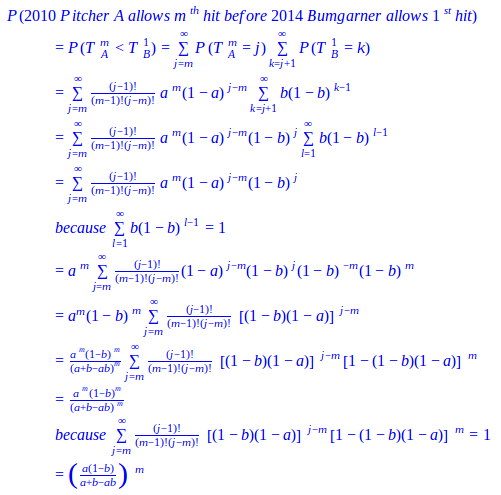

Formula 4.1

If we assume an even pitchers’ duel of who will allow the 1st hit, for m=1, then we have the following intuitive formula for 2010 Pitcher A versus 2014 Bumgarner:

Formula 4.2

This formula takes the probability that 2010 Pitcher A allows a hit minus the probability that both pitchers allow a hit and divides it by the probability that 2010 Pitcher A or 2014 Bumgarner allow a hit. Furthermore, if we let this happen for m hits, we arrive at our deduced formula. We should also note that according to the deduced formula, we should see the probability decrease as m increases. This logic makes sense because the expected span of batters until 2014 Bumgarner allows his 1st hit, TB1, stays the same, but we are trying to squeeze in more hits allowed by 2010 Pitcher A, which makes the probability become less likely.

Table 4.1:  Probability of 2010 Pitcher A Allowing mth Hit Before 2014 Bumgarner Allows 1st

Tim Lincecum

Matt Cain

Jonathan Sanchez

Madison Bumgarner

World Series P(H) 0.196 0.143 0.273 0.111
Allows 1st Hit before Bumgarner’s 1st 0.583 0.504 0.660 0.441
Allows 2nd Hit before Bumgarner’s 1st 0.340 0.254 0.435 0.195
Allows 3rd Hit before Bumgarner’s 1st 0.198 0.128 0.287 0.086

In Table 4.1, we compare 2014 Bumgarner and his 0.123 World Series P(H) versus each starter from the 2010 World Series Giants rotation and their respective P(H). We expect 2014 Bumgarner to have the advantage over 2010 Lincecum, Cain, and Sanchez, given how he dominated the 2014 World Series; clearly he does. In an even pitchers’ duel, he would win with a probability greater than 50% even after the chance of a tie is removed; we could even see 2 hits from the other pitchers before 2014 Bumgarner allows his 1st with a probability greater than 25%. However, against a comparably excellent pitcher, himself in 2010, he would likely lose the duel because 2010 Bumgarner actually has a better P(H). Notice that from Sanchez to Lincecum and from Lincecum to Cain, the P(H) descends steadily each time; consequently, the same pattern of linear decline also follows duel probabilities when transitioning from pitcher to pitcher for each of the different hits allowed. Hence, the distinction between exceptional and below-average pitchers stays relatively constant as we allow more hits by them versus 2014 Bumgarner.

We can also construct the converse formula to calculate the probability that 2010 Pitcher A allows 1 hit before 2014 Bumgarner allows his nth hit. We let TBn be a random variable for the total batters faced when 2014 Bumgarner allows his nth hit and TA1 for when 2010 Pitcher A allows his 1st hit. However, instead of directly deducing the probability that 2010 Pitcher A allows 1 hit before 2014 Bumgarner allows his nth hit, we’ll do so indirectly by taking the complement of both the probability that 2014 Bumgarner allows his nth hit before 2010 Pitcher A allows his 1st hit (a variation of our first formula) and the probability that 2014 Bumgarner allows his nth hit and 2010 Pitcher A allows his 1st hit after the same number of batters.
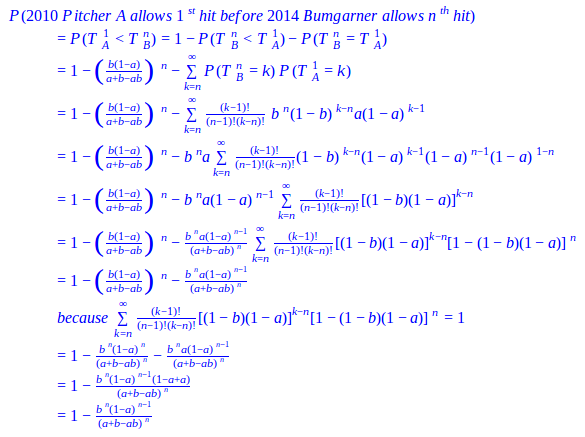

Formula 4.3

The resulting formula takes the complement of the probability that 2014 Bumgarner allows n hits and 2010 Pitcher A does not allow a hit in (n-1) chances and divides it by the probability that 2010 Pitcher A or 2014 Bumgarner allow n hits. In this formula we can contrarily see the probability increase as n increases. By extending the expected span of batters, TBn, to accommodate 2014 Bumgarner’s n hits instead of just 1, we’re granting 2010 Pitcher A more time to allow his 1st hit, resulting in an increased likelihood.

Once again, if we set n=1 for an even matchup, we get the same formula as before:

Formula 4.4

Table 4.2:  Probability of 2010 Pitcher A Allowing 1st Hit Before 2014 Bumgarner Allows nth

Tim Lincecum

Matt Cain

Jonathan Sanchez

Madison Bumgarner

World Series P(H) 0.196 0.143 0.273 0.111
Allows 1st Hit before Bumgarner’s 1st 0.583 0.504 0.660 0.441
Allows 1st Hit before Bumgarner’s 2nd 0.860 0.789 0.916 0.723
Allows 1st Hit before Bumgarner’s 3rd 0.953 0.910 0.979 0.862

In Table 4.2, we again use 2014 Bumgarner’s 0.123 P(H) versus those displayed in the table above. As expected, the probabilities from the even duels are the same as Table 4.1 because the formulas are the same. Although this time from Sanchez to Lincecum and from Lincecum to Cain, the difference between each pitcher noticeably decreases as we adjust the scenario to allow 2014 Bumgarner more hits. Thereby, there is less distinction between exceptional and below-average pitchers if we widen the range of batters, TBn, enough for them to allow their 1st hit versus 2014 Bumgarner.

Madison Bumgarner may have dominated the 2014 World Series as a starter, but he also forcefully shut the door on the Royals to carry his team to the title (by ominously throwing 5 IP, 2 H, 0 BB). Given the momentum he had, he proved himself to be Bruce Bochy’s best option. However, not every game is Game 7 of the World Series, where a manager must decisively bring in the one reliever he trusts the most. A manager needs to assess who is the appropriate reliever for the job and weigh which relievers will available later. Fortunately, an indirect benefit of the pitchers’ duel model is that it can calculate the relative probability between two relievers for who will allow a hit or baserunner first; this application could be very useful in long relief or in extra innings.

Table 4.3:  Probability of 2010 Pitcher A Allowing mth Baserunners Before 2014 Bumgarner Allows 1st

Tim Lincecum

Matt Cain

Jonathan Sanchez

Madison Bumgarner

World Series OBP 0.268 0.214 0.409 0.185
Allows 1st BR before Bumgarner’s 1st 0.602 0.547 0.698 0.511
Allows 1st BR before Bumgarner’s 2nd 0.362 0.299 0.487 0.261
Allows 1st BR before Bumgarner’s 3rd 0.218 0.164 0.339 0.133

Suppose we’re entering extra innings and the only pitchers available are 2014 Bumgarner and 2010 Bumgarner, Lincecum, Cain, and Sanchez with their respective statistics from Table 4.3 (where we substituted P(H) in Table 4.1 for OBP). We wouldn’t automatically throw in our best pitcher, 2014 Bumgarner, with his 0.151 OBP; we need to compare how he would perform relative to the other 2010 pitchers and see what the drop off is. Nor is it a priority to know how many innings to expect out of our reliever because we don’t know how long he’ll be needed. What is crucial in this situation is the prevention of baserunners as potential runs. 2010 Bumgarner, Cain, and Lincecum would each be worthy candidates to keep 2014 Bumgarner in the bullpen, because each has a reasonable chance (greater than 40%) of allowing a baserunner by the same batter or later than 2014 Bumgarner. Hence, the risk of using a pitcher with a slightly greater chance of allowing a baserunner sooner may be worth the reward of having 2014 Bumgarner available in a more dire situation. Yet, we would want to avoid bringing in 2010 Sanchez because the risk would be too great; the probability is approximately 49% that he could allow two baserunners before 2014 Bumgarner allows one. Preventing baserunners and using your bullpen appropriately are both high priorities in close game situations where mistakes are magnified.


Beware the Shark!

After spending the first four years of his career primarily in the bullpen, Jeff Samardzija became a full-time starting pitcher in 2012. In his first two years as a starting pitcher, Samardzija was worth 2.8 and 2.6 WAR, but he bumped that up to 4.1 WAR last year in the best season of his career.

Jeff Samardzija, first two years as a starter (combined)

Season Team IP ERA FIP xFIP WHIP K% BB% HR/FB BABIP GB% LOB%
12 – ’13 Cubs 388.3 4.10 3.67 3.42 1.29 24.1% 8.2% 13.1% 0.306 46.6% 72.2%


Jeff Samardzija, 2014 season

Season Team IP ERA FIP xFIP WHIP K% BB% HR/FB BABIP GB% LOB%
14 2 Teams 219.7 2.99 3.20 3.07 1.07 23.0% 4.9% 10.6% 0.283 50.2% 73.2%


Considering just the years he’s spent as a starting pitcher, in 2014 Samardzija set career bests in innings pitched, ERA, FIP, xFIP, WHIP, BB%, HR/FB%, BABIP, and GB%. When a player takes a step forward like this, there’s always the question of how sustainable this step forward is.

With Samardzija, it’s important to break down his 2014 season between the time he spent with the Chicago Cubs and the time he spent with the Oakland A’s.

Season Team IP ERA FIP xFIP WHIP K% BB% HR/FB BABIP GB% LOB%
2014 Cubs 108.0 2.83 3.10 3.19 1.20 22.9% 6.9% 8.5% 0.305 52.5% 72.9%
2014 Athletics 111.7 3.14 3.30 2.96 0.93 23.0% 2.8% 12.3% 0.262 47.9% 73.5%


The two statistics that stand out most are Samardzija’s BB% and BABIP in his time with the A’s. Samardzija made his last start with the Cubs on June 28th, 2014. At that point, he had a 6.9% BB% and .305 BABIP. His BB% was a career best and his BABIP was almost a perfect match for the BABIP allowed by the Cub’s team during the entire 2014 season (.304).

After the trade to Oakland, Samardzija’s BB% plummeted from 6.9% with the Cubs to 2.8% with the A’s and his BABIP also dropped significantly, from .305 to .262. Samardzija’s BABIP with Oakland was even better than Oakland’s team BABIP during the 2014 season (.272).

So, is this much-improved walk rate over a half-season of starts sustainable? Considering that before coming to Oakland, Samardzija had pitched 496 1/3 innings as a starter over the previous two-and-a-half years with a walk rate of 7.9%, I would say it’s not. He had a good stretch of 16 starts with a much lower walk rate than his career average, but it’s unlikely that he can sustain that low walk rate going into 2015.

Then there’s the issue of his superlative BABIP with the Oakland A’s. Again, through 496 1/3 innings pitched as a starter in the two-and-a-half-years before coming to Oakland, Samardzija had allowed a BABIP of .306. With Oakland, it dropped to .262. As mentioned above, Oakland’s team BABIP was .272 last year, so that drop for Samardzija is not surprising given that he was pitching in front of a better defense. Now that Samardzija is with the White Sox, he won’t have such a good defense behind him. The White Sox allowed a .306 BABIP last year and were in the bottom tier of all teams in baseball defensively. Since then, they’ve added Adam LaRoche, Melky Cabrera, and Emilio Bonifacio. LaRoche and Cabrera have not been good defenders over the last two years, while Bonifacio was good last year but not notably good in previous years. The bottom line is that it doesn’t look like the White Sox defense will do Samardzija any favors in 2015.

So, what should we expect from Samardzija in 2015?

Mike Podhorzer has written about the difference in ballparks as Samardzija moves from the O.co Coliseum in Oakland to US Cellular in Chicago. The takeaway is that the Cell could help Samardzija pick up a few more strikeouts at the expense of more walks and more homers allowed. Here are the strikeout, walk, and home run park factors for Wrigley, O.co, and US Cellular:


  K PF BB PF HR BF
Wrigley 101 102 101
O.co 99 101 92
US Cellular 102 107 111


In his three years as a starting pitcher in more pitcher-friendly ballparks, Samardzija has a strikeout rate of 23.7%, a walk rate of 7%, and a HR/FB% of 12.2%. To project Samardzija for 2015, we could slightly increase his strikeout rate, up his walk rate by a bit more, and his home run rate by even more, and factor in regression as Samardzija turns 30 years old. The following chart shows Samardzija’s numbers over the last three seasons, along with the average for those three seasons and what I would project for Samardzija in 2015.


Season Team IP K% BB% HR/FB BABIP
2012 Cubs 174.7 24.9% 7.8% 12.8% .296
2013 Cubs 213.7 23.4% 8.5% 13.3% .314
2014 2 Teams 219.7 23.0% 4.9% 10.6% .283
12-14 Average 202.7 23.7% 7.0% 12.2% .298
2015 My Projection 210.0 23.2% 7.3% 13.1% .305


To projection Samardzija’s stats for 2015, I used the formula for FIP and plugged in expected strikeouts walks and home runs, based on my projections above. This produced a FIP for Samardzija of 3.71. In his career as a starter, Samardzija’s FIP has been about 0.20 lower than his actual ERA. Last year, the White Sox team FIP was 0.20 lower than their team ERA. With this in mind, I bumped up my projection for Samardzija’s ERA to 3.80.

For WHIP, I used the walk rate I projected above and a .305 BABIP to come up with hits allowed and project a 1.26 WHIP for Samardzija in 2015. Here is a chart with my projection, along with projections from Steamer, ZiPS, and the FanGraphs Fans:

Source IP SO ERA WHIP K/9 BB/9 HR/9
My Projection 210 202 3.80 1.26 8.6 2.7 1.1
Steamer 192 178 3.93 1.24 8.3 2.6 1.0
ZiPS 194 197 3.90 1.23 9.1 2.4 1.1
FanGraphs Fans (15) 213 200 3.35 1.18 8.5 2.2 1.1


The Fans are more optimistic in their projection for Samardzija’s innings, ERA, and WHIP. I’m more optimistic than Steamer and the FanGraphs Fans that Samardzija will strike out a few more batters, but I also expect him to walk more and have a higher WHIP. Samardzija was the 22nd starting pitcher drafted in the recent FanGraphs Early Mock Draft, taken ahead of Masahiro Tanaka, Jake Arrieta, Hisashi Iwakuma, and Hyun-Jin Ryu, among others. I will definitely be moving Samardzija down my draft sheets a bit.


Replacing Replacement Value in Fantasy Auctions

With the baseball season rapidly approaching and recent posts by FanGraphs authors converting projected statistics into auction values, I thought I would share my approach towards valuation I have used in a long-standing A.L. league with 12 teams, 23 player rosters selected through auction (C, C, 1B, 3B, CI, 2B, SS, MI, 5 OF, 1 DH), a $260 budget, a 17-player reserve snake draft and the ability to keep up to 15 players from one year to the next, an attribute that inflates the value of the remaining pool and can further distort disparate talent across positions and categories.

We have traditionally used a 4×4 format, and while I have persuaded my co-owners to switch to a 5×5 for the coming year, what follows is my process for a 4×4 league.

There was a distant time when I was a whiz at math but my utter lack of a work ethic for advanced math collided with university-level calculus and I crumbled as surely as a weak-kneed lefty facing Randy Johnson. So my understanding of some key statistical processes is compromised. And by some I mean most.

But what I lack in math I hope I make up in approach:

(1) For categories over multiple years in this league, teams finish in a standard bell-shaped curve, with two or three teams well ahead, two or three well behind and six to eight clumped more closely together.

(2) In a 12-team league, a third-place finish in a category bets you 10 points. Across eight categories, averaging a third-place finish gets you 80 points, which is enough points to win out league between 80% and 90% of the time.

(3) Given both (1) and (2), my goal is to finish in third in every category, because doing do will far more often than not win my league, and because that target is a comfortable space above the pack in the middle, creating a margin for error within which I can still secure a win.

(4) I calculate what totals I need for each category to finish third based upon the specific history of our league, giving greater weight to more recent and relevant trends.

(5) I calculate the totals needed to finish dead middle in the pack for each category, again based upon the specific history of our league, giving greater weight to more recent and relevant trends.

(6) The difference between the third-place totals and the median totals become my spread, in a sense, the yardstick against which I then measure all projected player performance.

(7) I don’t weight pitchers and hitters evenly because my league does not – the marketplace of my league places significantly less value on pitchers, spending between $70 and $100 on them, and I adjust values to account for that. Perhaps that is also justified by either greater volatility or more injuries for pitchers. In any case, I divide the total value for hitters by 14 and for pitchers by 9 to come up with the average value for hitters or pitchers.

(8) I calculate what each of 14 hitters and 9 pitchers would need to contribute per player for each category for both the top and the bottom of the spread.

(9) For each category, I divide the median production per player by the difference in the gap to find the incremental value of each unit of production.

(10) For each player and for each category, I start with the median value of median production for all four categories, than add or subtract the incremental value depending upon if their projected production is above or below the median.

(11) I do the same for keepers to calculate inflation value, then list both the value and inflated value next to each player, broken down by position, so I can track both availability and the ebb and flow of inflation in real time.

(12) Finally, my league is mostly inelastic except for dumping trades. That means it is not easy to trade surplus categories for deficit categories. So I create a running tally of my projected production, starting with my keepers and adding players I gain in the auction with the goal or at least reaching each of the target levels needed for projected third-places finished in each category.

(13) I don’t adjust assigned value based on the position played but of course I consider position as I bid in order to reach my targets in an inelastic league. I may deliberately pay somewhat more than inflation cost for a good player if the likely alternatives is paying over inflation value for a poor player and being left with more money to spend then there is talent to spend it on. I do so knowing my keepers will produce to much surplus value that I can win simply getting players close to inflation value.

At least in my league, my projected values, adjusted for inflation, are pretty close to the mark notwithstanding the outliers that will come in any marketplace, both for individual players and for more systemic biases (my league overpays for closers, for example). I don’t win every year, but when I fall short, it is not because my valuations were off but because of too many failures in projecting specific players.

Is there a statistical basis for tossing replacement value as a baseline for creating auction values or statistical benefit to instead using league-specific gaps between middling and winning teams? Frankly, I don’t know, however intuitive my system seems to me. But I’d welcome feedback on my approach, statistical arguments for and against it, and whether it warrants further exploration.