Archive for Player Analysis

Devon Travis, Sign Stealer?

Devon Travis has been a pleasant surprise for the Jays this season, as he’s hit better than anyone could have expected out of the gate.  Despite a horrible month of May when he tried to play through a shoulder injury, he’s hit to a 129 wRC+ so far with solid defense at 2nd.  Additionally, he may be helping the Jays in other ways, as it seems as though he may be involved in stealing signs.

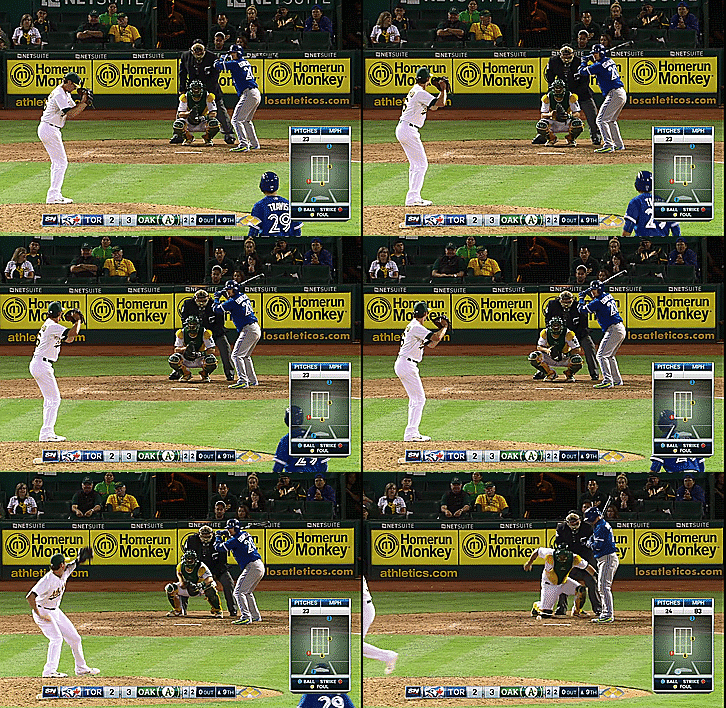
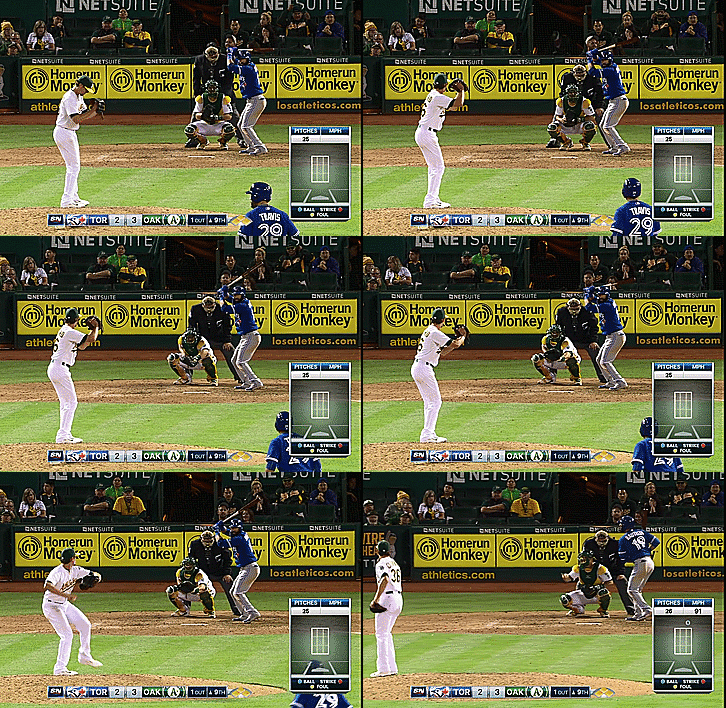
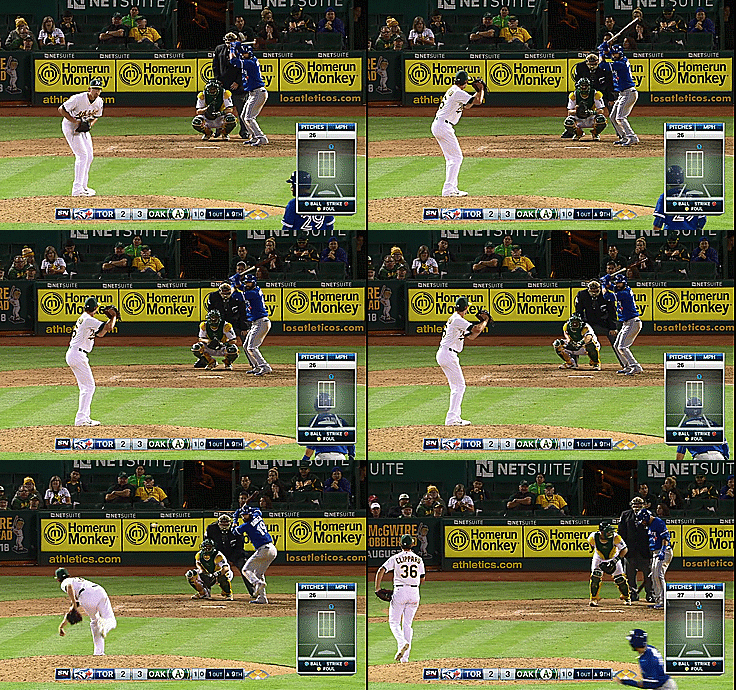
I was watching the Jays game against Oakland July 22nd, and after Devon Travis hit a double in the top of the 9th inning off of A’s closer Tyler Clippard, I began to notice Travis making some obvious movements at 2nd base.  Sometimes, I would see him clap his hands together enthusiastically; other times, I would see him hop up and down a few times. I then paid attention to the pitches that were subsequently thrown, and noticed a pattern: Whenever Travis would clap his hands, Clippard would throw a fastball, and whenever Travis would hop, Clippard would throw an offspeed pitch.  I decided to go back to the MLB.tv game archive to confirm what I thought I had seen live, and here is what I found:

Batter – Jose Reyes

Travis did not make any motions during the first five pitches to Reyes (likely, he was learning the signs). On the sixth pitch, he clapped, but Clippard stepped off and they ran through the signs again.

Batter – Josh Donaldson

Like with Reyes, Travis did not make any motions right away, as he looked at four pitches to get the signs down. The fun starts with pitch five:

Travis Motion – Clap

Clippard then steps off, followed by:

Travis Motion – Clap

Pitch – Fastball (92 mph)

Pitch six:

Travis Motion – Hop

Pitch – Offspeed (83 mph)

Pitch seven:

Travis Motion – Hop

Pitch – Offspeed (76 mph)

Batter – Jose Bautista

Pitch one:

Travis Motion – Clap

Pitch – Fastball (91 mph)

Pitch two:

Travis Motion – Clap

Pitch – Fastball (90 mph)

Sadly, after the second pitch to Bautista, the catcher visited the mound, and for the remaining three pitches in the at bat (which Bautista walked, moving Travis to third base) Travis did not make any motions (again, he probably figured they changed the signs).

So what we’re left with is five pitches (three fastballs, two offspeed) where the pattern holds up, and logical times when Travis does not clap or hop (i.e. after first reaching second base and after the mound visit when the signs could change). To me, given all the evidence, I don’t think the actions by Travis are coincidental, and I’m pretty certain he was stealing signs.

I was curious if this was a one-time thing, or something that Travis has done in the past, so I had a look at some other games in July in which Travis reached second base and was there for a few batters (i.e. long enough for him to pick up the signs).  Unfortunately, I wasn’t able to spot any patterns that would indicate he was stealing signs in those games that I checked.

As a Jays fan, Devon Travis is already one of my favourite players, as he’s having a fantastic rookie season at a position that has long been a black hole for the Jays.  Now, he’s given me further reason to appreciate him, and a definite incentive to watch his at-bats and times on base a little more closely from now on.


A Case For Wei-Yin Chen Ownership

I’m not going to tell you anything you can’t find out for yourself.  This is just a little research on Mr. Chen.  Alternative title would’ve been Chen Music, but I couldn’t find proof of an increase in high and inside fastballs.  Anyways:

Wei-Yin Chen’s surface level numbers have been great this year:

18 GS,   2.86 ERA,   1.12 WHIP,   93 K/116.1 IP

The thing is, he’s been just as good dating back to Jul 1st of 2014:

33 GS,   2.88 ERA,   1.14 WHIP,   164 K/209.2 IP

His peripherals over that time have declared him lucky and say that this success in unsustainable.  His FIP, xFIP, and SIERA for each half have been quite different from the ERAs he’s put up.


FIP xFIP SIERA ERA
JUL – SEPT 2014 3.37 3.68 3.79 2.89
APR – JUL 2015 4.09 3.85 3.78 2.86


Look, I get it, he doesn’t strike out even 20% of the batters he faces and he can struggle with the long ball.  But the Orioles’ defense is ranked 3rd in the league by UZR, and 3rd by UZR/150.  Ahead of the Orioles are the Rays and the Royals.  Each of these teams are outperforming their ERA indicators by a decent amount.

FIP xFIP SIERA ERA
Royals 3.80 4.09 4.03 3.54
Rays 3.86 3.81 3.66 3.59
Orioles 4.01 3.91 3.76 3.73


This does not mean that every pitcher on each of these teams is outperforming their peripherals but it’s obvious (and not because of that table) that defense helps pitchers’ numbers.  I also understand that Camden Yards is a little bit more of a hitters’ park than Kauffman and Tropicana, but that shows up in Chen’s numbers as he has surrendered HR at the rate of 1.29/9 IP at home and 0.89/9 IP on the road (July 3rd 2014 – present).  To be fair, I don’t know if 112 IP and 97.2 IP (home and away, respectively) are large enough sample sizes compared to his full body of work to be worth anything, but let’s say they are, and let’s see what Chen has done differently over his last 209.2 IP compared to his first 422 big league innings.


K% BB% K-BB% GB FB LD PU HF/FB SOFT MED HARD
209.2 19.2 5.2 14.1 40.3 39.5 20.2 10.5 10.1 20.6 53.0 26.5
422 18.2 6.3 11.9 37.2 40.7 22.1 11.1 11.5 14.9 54.2 30.9
DIFF 1.0 -1.1 2.2 3.1 -1.2 -1.9 -0.6 -1.4 5.7 -1.2 -4.4

(209.2 denotes the last 209.2. IP by Chen, spanning from July 3rd, 2014 to his last start against the Yankees, and the 422 is the 422 IP prior to July 3rd of last season, which encompasses the rest of his career)

Even though his ground ball rate doesn’t lead to much confidence in terms of sustainability in that soft contact management, he still is inducing pop-ups at an above-average rate.  So whether it’s a change in sequencing or it’s just as easy as working ahead in more counts, there has been some variation in his pitch usage…another table.

FB SL CB CH
203.1 66.4 17.5 6.2 9.9
422 65.8 13.6 7.4 13.1
DIFF 0.6 3.9 -1.2 -3.2


Obviously he’s traded some curveballs and change-ups for sliders.  His fastball has become increasingly more valuable in 2015 at 8.9 runs above average, compared to 3.3 runs above average from 2014 which was his previous high.

The last thing he’s done better is pound the zone early in counts which has led to a slight decrease in batters’ plate discipline against him.

F-STRK SWING OSWING ZSWING CONTACT SWSTRK
203.1 65.1 50.8 33.3 69.4 82.2 8.9
422 59.0 49.1 30.3 68.8 82.9 8.3
DIFF 6.1 1.7 3.0 0.6 -0.7 0.6


(Almost) Everywhere you want to see improvement there is improvement even if you have to look through a magnifying glass.  Granted, this could be Chen adjusting to the league and now the league will adjust to him.  It would be perfect for him to just cleanly split from the success he’s been having after the all star break and after this piece.

In conclusion, it’s hard to know what to make of Chen as a fantasy option in the long term because he is experiencing a deflated BABIP and a higher LOB% than he has in the past.  Is it all about the luck??  I’m not too bullish on him; the tweaks he has made, while they have led to some slightly positive results, do not warrant picking him up in a dynasty league, but if you’re behind in starts or innings Chen seems to be a solid option for QS/ERA/WHIP this season if he can thwart off the regression monster.  After all that, I did not recommend him in his start against the Yankees and their .325 wOBA (results on that game were meh – it was a QS, but he gave up 10 H in 6.1 IP, 3 ER, and struck out 3) but he’s at Tampa (94 wRC+) after that.  Projecting ahead, he’d face the Tigers (113 wRC+ which is best in the majors, but they could be selling some pieces and they will still be without Miguel Cabrera), and the Athletics (99 wRC+)who are also sellers.  After that it’s likely the Mariners and their 92 wRC+; I’d take that 4 start stretch.  Something to scratch your Chen about.


Chalk to Chalk

When preparing for the baseball season we will practice by playing intersquads to ensure we get as many live at-bats and innings as possible. Since it would not be affordable to hire umpires for our daily practices our assistant coaches will rotate umpiring behind the pitching mound. We have a big squad, I am talking 31 pitchers alone on the team, so in the interest of not playing until the sun rises the strike zone will expand quite a bit. It is easy for me to look great when our coaches will call strikes the hitters normally take. Offense can be limited during these practices as pitchers tend to dominate and hitters often are walking away frustrated.

Following the Nationals and Dodgers matchup on Sunday, Bryce Harper expressed his displeasure with umpire Bill Miller’s strike zone. In a recent ESPN article Harper explained “when you’re getting 6 inches off the plate, its tough to face” (Zack Greinke). Was Harper just trying to downplay the performance that Greinke put on or is there merit to the comments Harper said?

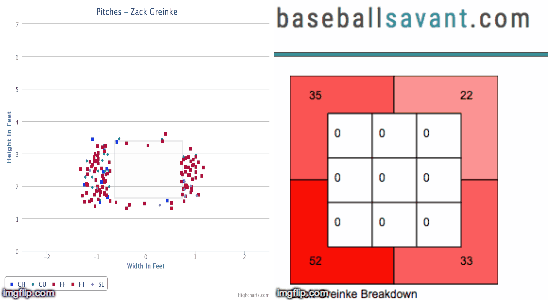
During the July 19th game between the Dodgers and Nationals, Zack Greinke had 10 pitches called for strikes outside the strike zone.

Here is Greinke’s pitching plot courtesy of Brooks Baseball:

So Harper is not incorrect by saying that Greinke was the beneficiary of some balls being called strikes. This year, Greinke has thrown 1905 pitches according to Baseballsavant.com and of those 142 pitches (7.45%) have been called strikes outside the strike zone. Currently, Greinke has the 5th most called strikes outside the strike zone only behind Dallas Keuchel, Jon Lester, Yovani Gallardo and Mike Leake.


Looking at the man behind the plate, Bill Miller, he has the highest percentage of called strikes outside the strike zone at 17.5%. Since 2010 Bill Miller has ranked in the top two for umpires in called strikes outside the strike zone four times with an average of 16.9%.

Well if that wasn’t enough to convince you that Bryce Harper was on to something, let’s look at Yasmani Grandal. Grandal, according to StatCorner.com, and taking catchers who have caught over 2000 pitches, has the 3rd highest percentage of strikes called outside.

Possibly Greinke and catcher Yasmani Grandal game-planned knowing Miller was behind the plate so they exploited his tendency. It could possibly be that on that day Greinke was a beneficiary of his normal game plan. This year of the 1905 pitches 1262 of them have been outside the strike zone. An umpire with a large zone, a fantastic pitch-framer behind the dish and a pitcher who lives outside the zone sounds like a recipe for strikes being called outside the zone.

In the end, sorry Bryce, that is just how baseball works — the zones are never the same.


Is A.J. Pollock Really This Good?

A.J. Pollock is, at the moment, one of the best fantasy outfielders in major league baseball.  He’s 4th according to the ESPN player rater but since most of you and I don’t REALLY know what that means, let’s say it a different way.  He is one of only four players with at least a .290 AVG, 10 HR, and 15 SB.  Still, whenever I talk with anyone about Pollock’s performance, the consensus opinion on him is more of a resonating question: “Is A.J. Pollock really this good?”  Let’s attempt to answer that.  Dating back to the beginning of 2014,  Pollock has played in 161 games.  We could round that up to 162 games, especially since players rarely play every single game of a season, and call it a full season, but I’m going to go the extra mile here and pull the last game from his 2013 campaign to have a constant 162 games for this exercise.  The stat line he has produced is impressive.


G   PA   H   AB   R   2B   3B   HR   RBI   SB   BB   K  HBP   SF   AVG   OBP   SLG   OPS
162   657   181   603   99   37   8   18    67   33   46  103    3    4 .300 .351 .477 .827

Let’s lower the bar a little bit so that we can find more players in THIS search: how many other players over their last 162 games have hit at the very minimum: .290, 90 R, 15 HR, 60 RBI, 25 SB?  The answer is 1, and that man is Starling Marte.

  G   PA   H   AB   R   2B   3B   HR   RBI   SB   BB   K   HBP   SF   AVG   OBP   SLG   OPS
  162   652   181   596   90   36    3    22   88   33   36   148     16    2   .304   .358   .485   .843

I’m not sure if that makes Marte a fair comparison.  We can compare them, but Marte delivers more line drives and raw power than Pollock does.  Marte, despite having a paltry 19.3% FB rate, has averaged 312 feet on his fly balls this year, 4th best in the majors, allowing him him to post an absurd 29.5% HR/FB rate – and we’re not even ready to get into park factors yet.  Pollock is just a bit more refined than Marte, posting a better BB rate and K rate than Marte has, by, obviously, swinging at better pitches to hit.

2015   BB%     K%     OSWING%     ZSWING%     SWING%     CONTACT%
  Pollock     7.4   15.6        31.2        59.1      44.3        82.7
  Marte   5.3   24.1        38.9        77.8      56.8        74.5

Pollock, too, has a fine average fly ball distance.  It’s 295 (a number he’s increased each year), which is good for 39th overall, smack dab in between Adam LaRoche to the north and Nolan Arenado to the south.  But Pollock has also been incrementally improving his BB/K ratio over the last three years, bringing it from 0.40 to 0.47 this year.  It could be as simple as that – a good player that has made strides in his approach at the plate, but I can’t just leave it at that.  Despite these improvements, albeit, very small ones, his batted ball profile looks right around league average.


2015   LD%    GB%    FB%    IFFB%    HR/FB    IFH%    BUH%    PULL    CENT    OPPO    SOFT    MED 
Pollock 19.4 51.4 29.1 12.3 13.5 10.5 100 36.7 36.3 27.0 17.4 50.2
League AVG 20.9 45.4 33.6 9.4 10.7 6.7 24.3 39.0 35.6 25.5 18.6 52.9

Pollock is fast, so hitting a lot of ground balls works in his favor.  He’s been able to have higher than average IFH and BUH percentages in each of the last three years because of his speed.  However, despite being a below average line drive hitter this year, and throughout his career, he is less susceptible to BABIP fluctuations than other high frequency GB hitters like Alcides Escobar, Elvis Andrus, Jean Segura, because Pollock produces a hard hit rate higher than the league average – he is an authoritative hitter.  Curious though, that with his below average LD rate, this is the case.  So his hard hit% is driven by either hard contact on fly balls or ground balls relative to league average.  Since he has an IFFB% above league average I’m going to predict that he’s a high authority GB hitter.  There’s logic in that, right?


  2015   GB   AVG     HARD  GB   PULL GB      CENT GB     OPPO GB     FB AVG     HARD FB     PULL FB     CENT FB     OPPO FB  
  Pollock    0.301   23.1   46.9   41.3   11.9   0.234   35.8   19.8   34.6   45.7
League AVG   0.234   17.1   52.9   34.1   13.1   0.223   36.2   22.2   38.0   39.8

He’s right at about league average for hard hit fly balls, but he does seem to have a hard hit ground ball percentage markedly higher than league average.  In fact, his 23.1% hard hit GB rate is 18th best in the league.  The 17 players in front of him have combined for an average line of:

    2015   H   AB     R     HR     RBI     SB     AVG     LD%     GB%     FB%     HARD%  
  Top 17     84   300   41    13     45     3    .280    20.4    44.5    35.1      33.7
  Pollock     100   334   58    11     42    19    .299    19.4    51.4    29.1      32.4

The list also includes names like Tulo, Miguel Cabrera, Posey, Pederson, Upton, Donaldson, Trout, Jose Abreu, and Yoenis Cespedes.  It’s guys that we generally perceive to be hard contact hitters, or I guess, more specifically, power hitters.  But he’s 18th on the list and produced a quality hard hit ground ball rate last year, too.

But, he still has a league average hard hit fly ball rate and a below average line drive rate.  These are reflected in his numbers compared to the league.

  2015     LD%     LD AVG     GB%     GB AVG     FB%     FB AVG  
  Pollock     19.4     0.667   51.4     0.301   29.1     0.234
  League     20.9     0.684   45.4     0.234   33.6     0.223

Lastly, he plays in Chase Field, which, throughout its history, has been a hitters park.  From 2008-2014 it had an adjusted park factor of +111.  For right handed hitters (and left handed hitters) like A.J. Pollock, it has had only positive affects, but this table is solely for righties:

  HR     3B     2B     1B     AVG     OBP     SLG     R  
  1.09   1.45   1.14   1.00    1.04    1.03    1.07   1.11

Put Pollock in a neutral park and his numbers for the last 162 games would theoretically look like this:

  G   PA   H   AB   R   2B   3B   HR   RBI   SB   BB   K   HBP   SF   AVG   OBP   SLG   OPS
162   657   174  603   89   33    6    17    60   31   46   103     3    4   .288   .340   .448 .788

I was kind of hoping to see more signs that Pollock is experiencing more luck.  Not because I don’t like Pollock, I love him as a baseball player and I’m sure he’s a fine person, but because of the questions regarding the sustainability of his play in the first half of the 2015 season by many of my peers.  The answer to, “is he really this good”, is that he is pretty darn close and I can see him performing to any of the projection systems’ expectations the rest of the way (ZiPS, Steamer, or Depth Charts).  He should experience some fluctuation in BABIP because of his GB rate, but so far he really hasn’t – and again that’s partially due to the authority with which he hits them.

In terms of finding a player closest in comparison to Pollock, Marte might be a pretty decent choice.  If I can just brainstorm using the cloud technique, I would probably have, with A.J. Pollock’s name in the middle: Starling Marte, Jason Heyward, Christian Yelich, Charlie Blackmon, Brett Gardner, and Lorenzo Cain as smaller clouds extending off the big, middle cloud.  Here are stats based on the last 162 games played.


PLAYER   PA   H   AB   R   HR   RBI   SB   BB   K   HBP   SF   AVG   OBP   SLG   OPS
Yelich   709   181   628   91    9    56   22   75   155      4    1   .288   .367   .390   .757
Cain   641  180   592   91   11   66  39   37  128      8    4  .304   .351   .448   .799
Heyward   636   163   576   76   12   60  22   51   96      4    4   .283  .343  .403  .746
Blackmon   698   179   628   87   18   66   36   41  123    19    5  .285  .345  .436  .781
Gardner   707   162   611 108   21   72  22   70  147     6    6  .265  .343  .458  .801
Marte  652   181   596   90   22   88  33   36 148    16    2  .304  .358  .485  .843


This group kind of works as a spectrum.  I see the players on the extreme north and south columns least like Pollock and the players in the middle most like Pollock.  There is no one player to compare A.J. Pollock with that is playing currently, although Mitch Webster would be a pretty good historical comparison using his ages 26 – 28 seasons.

Mitch Webster ages 26-28 162 G AVG:

  G   PA   H   AB   R   HR   RBI   SB   BB   K   HBP   SF   AVG   OBP   SLG   OPS
  162   656   165   580   94    15    60   36   62   87      5    5   .283   .354   .441   .795

Probably too high of a walk rate, but that looks pretty good.

The average season of the group above would look like this:

  G   PA   H   AB   R   HR   RBI   SB   BB   K   HBP   SF   AVG   OBP   SLG   OPS
  162   674   174   605   91    16    68   29   52   133     10    4   .288   .352   .437   .789

A little too high of a K rate, but that also looks pretty good.

And finally A.J. Pollock ages 25-27 162 G AVG

  G   PA   H   AB   R   HR   RBI   SB   BB   K   HBP   SF   AVG   OBP   SLG   OPS
  162   618   163   567   89    15     57   25    43   101      3    3   .287   .339   .449   .788

In conclusion, A.J. Pollock is very close to this good if he’s not actually THIS GOOD and I think these players are pretty good comparisons.  And hopefully Pollock has more long lasting success than Mitch Webster.  In a time when speed/power combo players are in decline, what Pollock is doing is clearly elite in that sense.  What I really would like to see would be the history of authoritative ground ball hitters with good speed who have played in parks that have buoyed their power numbers.  Unfortunately, I don’t have access to batted ball profiles for hitters throughout history – how many Pollocks does it take to gather that information?


The Cleveland Indians as a Fringe Playoff Contender

It’s been a disappointing year thus far for the Cleveland Indians. They are currently 42-46 heading into the All-Star Game, and are in 4th place in the competitive American League Central division. They are underperforming their BaseRuns projection by 4 wins, meaning the computers view this team as much more of a playoff threat than they actually have been thus far. Although they have the third-highest remaining projected winning percentage in the AL at .532, their rough first half has them only finishing with about 81 wins. As wide open as the wild card race is, a .500 finish would clearly not be enough. What has happened to everyone’s preseason sleeper team? Besides Sports Illustrated jinxing them of course.

Well as expected, they have had stellar starting pitching from the likes of Corey Kluber, Carlos Carrasco, Trevor Bauer, and Danny Salazar, and even have gotten good outings recently from under the radar prospect Cody Anderson. Everyone knew they had a bad defense, but many thought that the Indians’ offense could support the great starting pitching enough to propel them into the postseason. Thus far, however, that has not been the case. They are at league average or below in almost all offensive categories. They are not a power hitting team by any means, and have the 10th lowest FB% in the MLB, which makes sense seeing as to hit for power you need to get the ball in the air. However, they still run the 7th lowest BABIP in baseball, which insinuates that they have a lot of hitters who tend to roll over a lot. Lo and behold, they are 3rd in Pull %, and have a lefty heavy—heavy being an understatement—lineup.

Essentially, the Indians have amassed a lineup with a bunch of pull-happy hitters who don’t hit for much power, which doesn’t work in a league that nowadays uses the shift religiously. I think all Cleveland fans know where I’m going with this, because the phrase has been overused by Tribe fans for almost a decade now. Yes, Cleveland is lacking an impact right-handed bat. Brewer’s prized prospect Matt LaPorta was supposed to be that guy when the Indians traded C.C. Sabathia for him and others—including player to be named later Michael Brantley. However, his MLB career was as successful as Kim Kardashian’s first marriage. Ironically or not, Milwaukee has another player that I believe can push the Tribe over the hump; his name is Carlos Gomez.

The 29 year old native of the Dominican Republic, known for his fiery personality, has been extremely productive for the Brew Crew since 2011, racking up 18.4 WAR in that 4 year span. With Milwaukee sitting at the halfway point with the second worst record in all of baseball, they will most definitely be sellers at the trade deadline. I recently tweeted FanGraphs’ Jeff Sullivan asking him if Gomez would be dealt, to which he responded, “Gomez is probably moving. Lucroy not.” That doesn’t mean it is set in stone, but that shows that there is a decent chance he gets traded. Let’s just assume for arguments sake that the Indians and Brewers have mutual interest in being trade partners. Why should the Indians’ make the move?

One plus is that Gomez wouldn’t be a rental. He is under contract through 2016, and is only set to make 9 million dollars next year. If you consider 1 WAR to be worth roughly 7 million dollars, Gomez’s average of 6.6 WAR per year the last two seasons would be a huge bargain for the Tribe. With the contracts of David Murphy and Ryan Raburn likely to be coming off the books next year, an extra 9 million dollars on the payroll will be inconsequential for the notoriously conservative Dolan family. Gomez also would provide a major upgrade from primary Tribe center fielder, Michael Bourn. I have included a chart that compares their averages from the last two seasons. Why two seasons? Because that’s when Bourn signed with Cleveland, where he has not been the same player he once was.

Name Avg. WAR Avg. wRC Avg. RISP Avg. DEF Avg. ISO Avg. SLG Total PA
Bourn 1.3 53 0.298 -3.3 0.101 0.360 1,062
Gomez 6.6 93 0.298 17.2 0.208 0.492 1,234


It is easy to see who has been the more valuable player. The reason I included ISO and SLG was to demonstrate Gomez’s excellent power, not necessarily to compare it to Bourn’s (because that is not the type of hitter he is). Gomez would provide a major upgrade defensively – where the Indians struggle – and at the plate, where he is a key catalyst in manufacturing runs. Gomez has created almost 40 more runs per season than Bourn the last two years. If you take into account how every 10 runs scored or given up equates to a win or a loss, those extra 40 runs would essentially add on about 4 more wins to the Indians win total (assuming those averages hold up throughout the 2015 season). So that would take the roughly 81 win Indians and make them an 85 win team; better yes, but still not a playoff contender.

Although Bourn and Gomez have been equally as good with RISP, this season has been a different story; Bourn is hitting .216 in 68 PA and Gomez is hitting .381 in 65 PA with RISP. The Indians have the 7th worst average with RISP this season at .230, with the MLB average being .255. For a team that struggles to score runs, this would be a huge difference. Slotting Gomez in the lineup everyday behind a guy like Michael Brantley would also take a ton of pressure off of him to carry the team day in and day out.

So what does this all mean? Could Carlos Gomez really propel the Tribe into October baseball this season? Probably not. Here are their season splits against teams above and below .500.

               Wins Losses Winning Percentage
Teams ≥ .500 24 32 0.429
Teams < .500 18 14 0.563


They struggle against good teams, and beat bad ones. That is not the mark of a playoff team. In the last 74 games of the season, the average winning percentage for teams they play is .515. While I fully believe the team could make a strong second half push – I actually believe they will make the playoffs – it is not likely. Still, a trade for Carlos Gomez would not only aid them in the second half of this season, but for next season as well. Clevelanders are sick of hearing “we’re building for the future.” The Indians have an extremely strong core, one that is young and locked into team-friendly contracts. It is time to win now, because they would hate to look back years from now like a reminiscent ex-lover and say, “That was the team that got away.”


Re-examining Top NL Outfield Prospects of 2015

Earlier this year, Alex Chamberlain of FanGraphs took a look at the top NL outfield prospects for the 2015 season. On this list of five outfielders, three of them have had significant time in the big leagues: Joc Pederson, Jorge Soler, and Randal Grichuk. They were ranked 1, 2, and 5 respectively prior to the season (Andrew Lambo and Eury Perez were ranked 3 and 4 but due to both playing less than 25 games, I did not include them in my analysis). The purpose of my writing today is to analyze these three outfielders and see if the preseason rankings has translated to the regular season. To understand if the rankings hold true, I will compare how each player has hit to this point in the season as well as their ability to help their team on defense.

Offensive Analysis

Using simply batting average as a definitive metric for determining which player is succeeding is especially tough considering the snapshot is only the first half of the 2015 season. That being said I think it is important to look at simple batting average to see if there is any outliers when comparing it to BABIP. In terms of batting average, Randal Grichuk is leading the way with a .277 average, followed by Soler and Pederson at .260 and .230 respectively. While this is a good baseline, comparing it to BABIP and % of hard hit balls identify if these averages are sustainable or unsustainable over the course of a season.

Pederson has a BABIP below the league average at .282, while Soler and Grichuk have BABIP almost 80 points higher than the league average. One of the factors that could be contributing to Pederson’s significantly lower average is simply being unlucky. In terms of Hard Hit%, Pederson is tops of the three with 41.5% of the balls he makes contact with being classified as hard hit. Soler and Grichuk have a 38.6% and 39.2% Hard Hit%. Another factor to consider is K%, but this is somewhat of a moot point considering that each outfielder has a K% within one point of 30%, nearly 12% above league average. This is to be expected of young players who are adjusting to big-league pitching and have a large amount of raw power. These percentages indicate that Pederson’s average should not be nearly as low as compared to the other two and would be considered an outlier and his .230 average is not indicative of how he is hitting overall. But it stands to reason that both Soler and Grichuk could see a regression in average if their BABIP falls towards league average.

Another factor that is important to look at when ranking these three budding All-Stars is their raw power. Hitting for average is important but in today’s game it is much harder to string together multiple hits, so being able to drive the ball in gaps or over the walls is a premium quality in a young player. Isolated Power is a great metric to look at when evaluating the raw power a player is displaying because it takes out the batting average variable out of Slugging %. Grichuk and Pederson have the exact same ISO at .257 while Soler’s is much lower at .128, just below the league average of .135. What this metric means is that Soler’s actual slugging% is somewhat inflated by his average. If his average falls, which would be due to a decline BABIP, his slugging% will suffer. It seems that even if Grichuk’s BABIP slumps he will continue to make an impact at the plate in terms of slugging% since his ISO is over 120 points higher than Soler.

To wrap up the offensive portion of my analysis, I would rank the three rookie outfielders 1) Pederson. This is based on the fact he has made a huge impact on the Dodger’s lineup (20 HR, 40 RBIs) although he has been hampered by an unlucky BABIP.  2) Grichuk. Due to the higher ISO than Soler against major league pitching. Grichuk has not only produced more this year than Soler but he projects to continue to have an impact on his team through his higher ISO even if his batting average drops. 3) Soler, is ranked third because the high BABIP and lower ISO make him less appealing throughout the course of the long MLB season.

Average BABIP Hard% ISO K%
Pederson 0.230 0.282 41.5 0.257 29.2
Grichuk 0.277 0.374 39.2 0.257 30.4
Soler 0.260 0.376 28.6 0.128 31.8
League Avg. 0.256 0.296 0.135 17.9


Defensive Analysis

Defensive metrics also help determine which outfielder is helping save runs for their team which in turn improves the chance of winning a ball game. Revised Zone Rating or RZR is a good indicator of how well a player has been able to make plays in their fielding zone. In terms of RZR, Grichuk is the low man on the totem pole with .902 RZR. Pederson is tops in the group with .926 and Soler in the middle with .916. While RZR is a helpful stat it does not tell the full story of which outfielder is saving the most runs for his team.

DRS or the total defensive run saved helps give an idea of how many runs a fielder has saved above the average player. In terms of DRS, Grichuk has saved 6 runs above average even though he had the lowest RZR. Whereas Pederson has saved 1 run and Soler has saved 0 runs even though both have more outfield assist with than Grichuk (4 each vs. 1). Soler’s low DRS can be attributed to the fact on balls where Soler has between a 60-90% chance of making a play, he has only made the play 66.7% of the time compared to Grichuk and Pederson who have made those same plays 100% of the time.

In terms of defense, I would rank Grichuk number one due to his high DRS. Since saving runs is vital to a team’s success. Pederson would rank second and Soler would be third.


 DRS RZR Assist
Pederson 1 0.926 4
Grichuk 6 0.902 1
Soler 0 0.916 4


Conclusion

To wrap up my analysis, I think it is important to look at total WAR when evaluating players. Especially when breaking down these three young outfielders. I think it is clear that to this point in their 2015 seasons, Jorge Soler would be ranked third of the three due to the fact that his WAR is only .4 and he lags Grichuk and Pederson in almost every metric I have discussed. Grichuk’s WAR of 1.9 places him second. Even though he saves more runs than Pederson with his glove, the offensive impact Pederson has made even with his .230 batting average is extremely impressive. With 20 home runs at the All-Star break and a WAR of 3.3 Pederson would have to be ranked as still the top NL rookie outfielder that was ranked in the preseason.


WAR
Pederson 3.3
Grichuk 1.9
Soler 0.4


All stats for this article were taken from FanGraphs.com


Chris Sale and a Dominant June

Now that Chris Sale’s historic strikeout streak has ended, it seems an appropriate time to marvel at the dominance Sale has shown. Over an eight-game stretch from May 23 through June 30, Sale had the following line:

IP H R ER BB SO ERA AVG OPS BABIP
60.0 37 14 12 9 97 1.80 .172 .481 .287

I’ve included BABIP to show that Sale was not on some incredibly low BABIP streak. League BABIP this season currently sits at .297. Sale’s career BABIP is .286. Without showing the normal indications for extreme luck, Chris Sale turned opposing lineups into a bunch of light-hitting middle infielders. For comparison, below is the season-to-date line for Indians SS Jose Ramirez.

PA AVG OBP SLG OPS wOBA wRC+
170 .180 .247 .240 .487 .223 39

The fact that the White Sox were only 4-4 in those eight games speaks to how badly the White Sox have played during 2015. Of those eight starts, six occurred during the month of June. It is these starts I’d like to focus on through the lens of pitch values relative to the rest of the league. I’ve posted some previous work on pitch values. The framework for the calculations can be found here. I’ve made some tweaks to the calculations, mainly to allow for player specific Balls/BB and Strikes/K to be calculated and league specific adjustments rather than MLB-wide constants.

According to Brooks Baseball, Sale threw 694 pitches during the month of June with a pitch mix of 45% Four-seam Fastball, 25% Changeup, 22% Slider, and 8% Sinker. The sinker was clearly Sale’s worst pitch in June. With the 55 sinkers thrown, Sale managed to give up six hits (11%). With the other 639 pitches, he gave up 21 hits (3%). So just how good were his other pitches? Chris Sale accumulated 2.9 WAR by my calculations over the month of June. He accumulated 0.0 of that from his sinker. For reference, here is the top ten in WAR from the month of June.

Player PV-WAR fWAR Average
Chris Sale 2.9 2.5 2.7
Clay Buchholz 1.7 1.5 1.6
Jacob deGrom 1.5 1.5 1.5
Chris Archer 1.4 1.2 1.3
Madison Bumgarner 1.4 1.3 1.4
Zack Greinke 1.3 1.1 1.2
David Price 1.3 1.2 1.3
Clayton Kershaw 1.3 1.2 1.3
Max Scherzer 1.2 1.2 1.2
Lance McCullers 1.2 1.1 1.2

Sale lapped the field no matter which calculation you look at. Now, let’s take a look at a slightly adjusted version of that top-ten list.

Player PV-WAR
Chris Sale Only Fastballs 1.7
Clay Buchholz 1.7
Jacob deGrom 1.5
Chris Archer 1.4
Madison Bumgarner 1.4
Zack Greinke 1.3
David Price 1.3
Clayton Kershaw 1.3
Chris Sale No Fastballs 1.3
Max Scherzer 1.2

We can split Sale’s June into two separate pitchers, and both “Sales” were top-ten in Pitch Value WAR accumulated. The Chris Sale that threw nothing but fastballs (Four-seam Fastballs and Sinkers) was the best pitcher in baseball in June. The Chris Sale without a fastball (Sliders and Changeups) was the ninth-best pitcher in baseball. With that said, we can dig a little deeper into the value of each of his pitches. First, let’s look at Sale compared to other four-seam fastballs. The table below gives the top five most valuable four-seam fastballs as well as a pitch rating based on June data set to a 20-80 scale.

Rank Pitcher PV-WAR Rating
1 Chris Sale 1.7 62
2 Clayton Kershaw 1.0 55
3 Chris Archer 0.9 57
4 Wei-Yin Chen 0.8 58
5 Zack Greinke 0.8 54

Since WAR is a counting stat, there are two components to accumulating a high total. First, you have to throw a lot of the specified pitch type. Pitchers that threw 300 four-seam fastballs almost always accumulate more PV-WAR than those who only threw 30. Secondly, the pitch has to be of certain quality. Throwing 1000 of the world’s worst four-seam fastballs isn’t nearly as valuable as throwing 100 of the world’s best four-seam fastballs. In June, nine pitchers threw more four-seam fastballs than Chris Sale. No one that threw at least 90 total four-seam fastballs threw a better four-seam fastball than Sale. In fact, Sale’s four-seam fastball was the third highest rated qualifying pitch in June. To qualify, the pitch had to be thrown more than average for that pitch type. For example, if there were 4,000 curveballs thrown in June by 40 total pitchers, anyone who threw more than 100 curveballs would qualify. Moving on, Sale’s second most used pitch was his changeup. Here’s the table for changeups.

Rank Pitcher PV-WAR Rating
1 Chris Sale 0.5 57
2 David Price 0.4 59
3 Cole Hamels 0.4 56
4 Erasmo Ramirez 0.3 59
5 Clay Buchholz 0.3 55

Once again, Sale tops the PV-WAR rankings. He was “slacking” on his quality on his changeup though. His changeup only ranked 14th out of 126 qualifying changeups, so I guess there’s always room for improvement. The last pitch of interest for Sale is the slider. It’s the pitch I most associate with Sale, but it’s only his third most used pitch. Below is the corresponding table for sliders.

Rank Pitcher PV-WAR Rating
1 Chris Sale 0.7 61
2 Jason Hammel 0.7 57
3 Chris Archer 0.6 55
4 Tyson Ross 0.6 55
5 Joe Ross 0.4 58

I think a trend is developing. Chris Sale threw the most valuable slider in June as well. By rating, Sale finished fourth out of 129 qualifying sliders. The three pitchers above him in rating (Andrew Miller, Mark Lowe, Darren O’Day) are all relievers. To sum up, in June, Chris Sale had three pitches make up over 90% of his pitch mix. All three of those pitches were the most valuable pitch in their respective pitch types in June. He had the overall best rated four-seam fastball and the best slider thrown by a starter. His changeup was the “worst” of his three pitches and was still a top 15 rated changeup. Chris Sale was completely dominant in June. His nearest competitor for most valuable pitcher in June only accumulated a little more than half of Sale’s value. Who knows when we may see a pitcher in this much of a groove again? For curiosity’s sake, I’ve included a table with the most valuable and highest rated of each pitch type for your perusal. The overall highest rated pitch was Andrew Miller’s slider.

Pitch Type Most Valuable PV-WAR Highest Rated Rating
Four-Seam Chris Sale 1.7 Chris Sale 62
Sinker Chris Heston 0.7 Aaron Loup 62
Cutter Corey Kluber 0.5 Nick Vincent 59
Curveball Lance McCullers 0.6 Cody Allen 63
Slider Chris Sale 0.7 Andrew Miller 64
Changeup Chris Sale 0.5 Kevin Siegrist 61
Splitter Zach Putnam 0.4 Zach Putnam 61
Knuckleball R.A. Dickey 0.4 R.A. Dickey 49

Kevin Gausman and the Elevated Fastball

Orioles fans have been pining for Kevin Gausman ever since 2015 Opening Day at Camden Yards when Bud Norris got shelled by the Blue Jays. The now-24-year-old started in 20 games last season as he was yanked back and forth between the majors and minors and posted a 107 ERA+ in 2014. A good number — not excellent, but good. He stabilized the rotation after Ubaldo Jimenez struggled mightily in his first year as an Oriole. In 2015, he will be asked to do the same as Norris has scuffled in the rotation so far. Two starts in, the results are promising, even better than 2014. One key change so far for Gausman is his willingness and ability to elevate his plus fastball.

The community’s own Jeff Sullivan has written about this as well. Both, before the season and after Gausman’s first couple of relief appearances in 2015. The idea being that some teams have emphasized throwing high fastballs and that not every pitcher is equipped to do so. But, Gausman has a heavy fastball that could stand to work more up in the zone; in fact in 2014 he was at the bottom of the league only throwing that pitch in the upper half 33% of the time. Jeff Sullivan also noted astutely that Gausman and the Orioles have talked about him throwing up more and that he had been doing so coming out of the bullpen.

Well, after two starts, Gausman continues to work up in the zone with the fastball and he is getting some great results. In 2015 his strikeout rate is up from 18.5 percent to 21.7 percent while his walk rate is around the same. His hard contact rate is down from 28.7 percent to 26.9 percent and his soft contact rate is up from 17.2 percent to 25.4 percent. Meanwhile, his fly-ball and groundball rates are up as well while his line-drive rate is at only 10.4 percent. This helps to explain how he has only given up eight hits in his last 11.1 innings pitched.

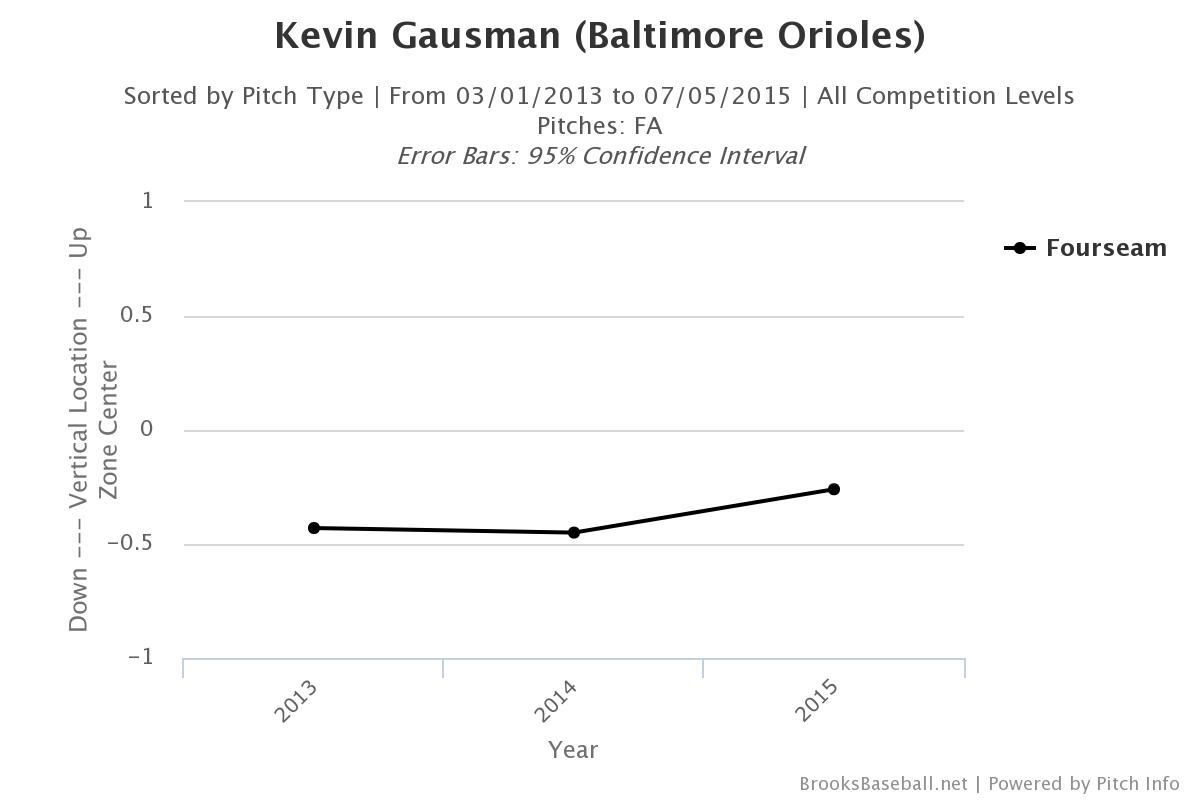
First, below is a graph of the average vertical location of Gausman’s fastballs over the past three seasons.  Brooksbaseball-Chart.0.jpeg

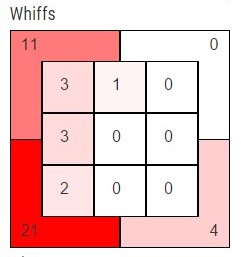
As you can see, Gausman has worked more up in the zone. Not by a lot, but enough to call it a trend so far this year. Working mostly down is always going to be more friendly for a pitcher, but the ability to throw high strikes and for the batter to know that you can, is a very effective weapon. For instance, below is a chart of the whiffs Gausman has gotten from batters so far in 2015.

Gausman_Whiffs.0.jpg

Notice the upper left portion of the zone. Gausman so far has gotten 11 swings and misses in this area in 2015; he had 29 whiffs all of last year in the same area. Every one of those 11 whiffs in 2015 has come on a four-seam fastball. Again, the bread and butter for Gausman will be dotting his fastball on the outside corner and working his splitter away, but the added weapon of a high fastball has produced some great in game results thus far in 2015.

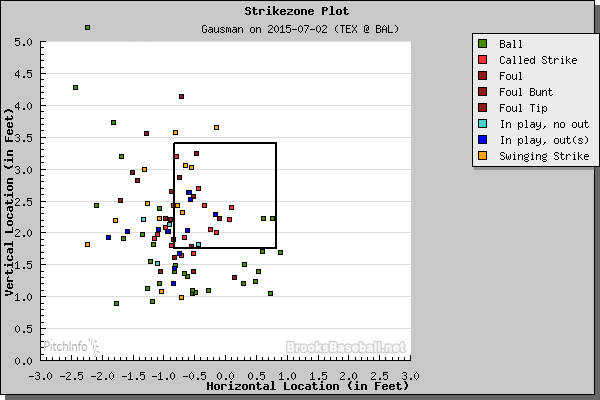
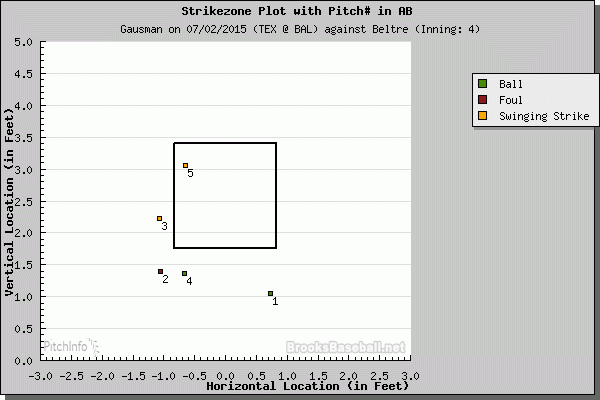
I paid close attention to the game against the Rangers on July 2nd, in which Gausman pitched 6.1 innings striking out 7 walking 2 and allowing only 4 hits. Gausman utilized his fastball in this upper area of the zone to great effect during this start. Below is the strike-zone plot for Gausman from this game. Gausman_v_Rangers_Pitch_Location.0.png

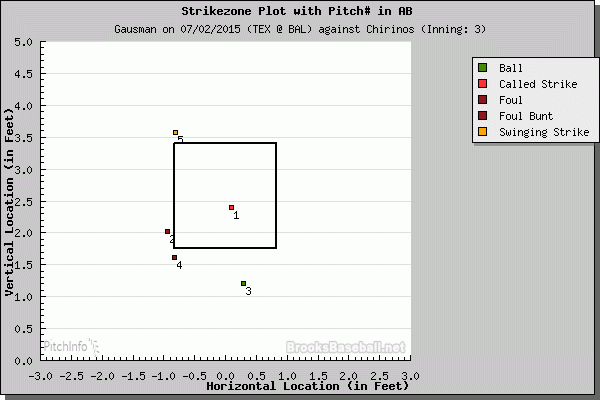
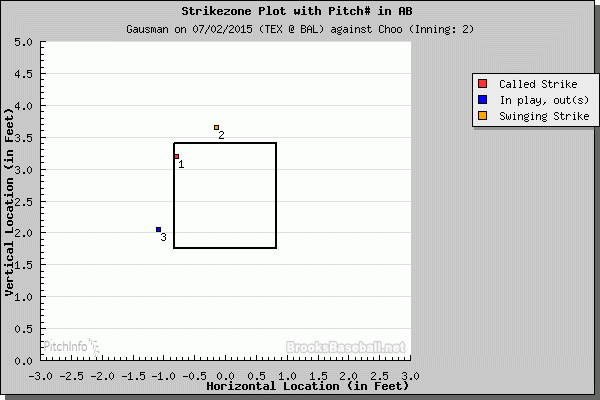
Here you can see Gausman was able to work mostly arm-side low, but he also worked up in the zone and got five swinging strikes on balls at or above three feet off the ground. I also wanted to point out some specific at bats from that game. Below is the strike-zone plot against Robinson Chirinos in the third inning. Gausman_v_Chirinos.0.gif

Gausman starts him out with a pretty bad fastball that Chirinos simply swings through, although to be fair it was 97 mph. He then throws two more low fastballs and get Chirinos to foul off the second one. Now with the count 2-1 Gausman throws his splitter which Chirinos is again able to foul off. Now, the key pitch in the at bat, Gausman climbs the ladder for the fifth and final pitch with another 97 mph fastball to get the swinging strikeout. Here is another at-bat where Gausman used the elevated fastball, this one is to Adrian Beltre in the fourth inning. Gausman_v_Beltre.0.gif

This at-bat is again five pitches. Gausman first throws a fastball low and away for a ball. Then, Beltre fouls off an inside and low fastball. Gausman then throws the splitter inside for a swinging strike and follows that up with a low and inside fastball for a ball. Now with the count 2-2 and every pitch in the lower half or below the strike zone so far in the at bat, Gausman elevates a 97 mph fastball high and tight to Beltre who swings through to get another strikeout for Gausman. All right, last one, I swear.

Gausman_v_Choo.0.gif

This at-bat is against Shin-Soo Choo in the second inning. Gausman starts him off with one called strike fastball up and away at 96 mph and follows that up with another elevated fastball at 97 mph that Choo swings and misses on. So now Choo has seen two high 90s fastballs three feet off the ground. Next, Gausman drops an 88 mph splitter a foot lower and Choo rolled over on it to second base. Not only can the elevated fastball get strikeouts, it can also setup his other pitches.

Here are the video highlights for that Rangers game where you can see the end of the two strikeouts above. Also, here are the video highlights of his start in Toronto wherein he gets two infield flies and a strikeout on elevated fastballs. Watch both for some more context.

The Orioles are now looking for Gausman to become a rotation stabilizer. Gausman has struggled somewhat in his career thus far because of a lack of true third pitch; he has gone back to his curveball this year which has shown some early promise. However, he has also struggled because for the most part he worked everything down in the zone. With the added focus of throwing elevated fastballs in 2015 it changes the hitter’s eye level and lets them know that Gausman can throw to all parts of the zone, so all parts of the zone are in play. So far, in 2015 that pitch has achieved great results. Now, we’ll have to see if Kevin Gausman can keep replicating those results.

The original version of this article was posted on www.camdenchat.com on 7/6/2015


The Steady Improvement of Xander Bogaerts

Amidst a disappointing first half for the Boston Red Sox, one of the few bright spots has been the steady offensive improvement of Xander Bogaerts. The 22-year-old shortstop is beginning to live up to hype that has seemingly plagued the former 6th overall prospect during his first full season in Boston. Bogaerts maintains a .302/.339/.414 clip through July 6, which equates to a 2.2 WAR, second to only Brandon Crawford’s 2.9 for shortstops in the MLB.

First off, its important to point out to all who thought Bogaerts was a bust after his performance a year ago, that he is still only 22 years old. To put it into perspective, consider this: Francisco Lindor was the #3 overall prospect coming into this year. The Indians called him up from AAA on June 14th to, like Bogaerts, begin his career as an every-day shortstop at age 21. And similar to Bogaerts, Lindor is enduring his share of rookie struggles, batting .215 through his first 79 at-bats. It’s not fair to write off Lindor, or Bogaerts, as busts after their 21-year old seasons. Most players, especially those that young, need time to adjust to major-league pitching.

Bogaerts is walking about the same as a year ago, but has significantly improved his strikeout percentage, which has fallen from around 23% to 14%. His BABIP has risen almost 50 percentage points from a year ago (up to .347) which would help explain the improvements in batting average.

Another explanation for improvement has been Bogaerts new-found use of the ground and opposite field in 2015. Two-thirds of his balls in play are traveling to center and right fields this year, compared to around 40% last year. And his percentage of balls hit to the opposite field has increased from 19% to 31%. While the Monster may bait right-handed hitters into becoming pull-happy, Xander has found better success driving the ball the other way.

Bogaerts has also been putting the ball on the ground more this season. His GB% has risen 12% (to 50%) and FB% has dropped the same amount (his line-drive percentage has stayed roughly the same). Xander isn’t a burner on the base paths (only four steals) but he can put his athleticism to good use when he hits on the ground.

Xander’s improvement may even result in his first All-Star appearance. Alcides Escobar and former Red Sox, Jose Iglesias, are the two American League shortstop representatives for now. Even if Bogaerts is left off the team, his first-half play has been refreshing enough in an otherwise frustrating year for many Red Sox players. The young shortstop is taking some nice steps towards proving he is the player the Boston media, and fans alike, thought he was going to be.


A Discrete Pitchers Study – Out & Base Runner Situations

(This is Part 4 of a four-part series answering common questions regarding starting pitchers by use of discrete probability models. In Part 1 we explored perfect game and no-hitter probabilities, in Part 2 we further investigated other hit probabilities in a complete game, and in Part 3 we predicted the winner of pitchers’ duels. Here we project the probability of scoring at least one run in various base runner and out scenarios.)

V.  I Don’t Know’s on Third!

Still far from a distant memory, the final out of the 2014 World Series was preceded by an unexpected single and a nerve-racking error that brought Alex Gordon to 3rd base with two outs. Closer Madison Bumgarner, who was on fire throughout the playoffs as a starter, allowed the hit but would be left in the game to finish the job. There is some debate as to whether Gordon should have been sent home rather than stopped at 3rd base , but it would have taken another error overshadowing Bill Buckner’s to get him home; also, next up to bat was Salvador Perez, the only player to ever ding a run off Bumgarner in three World Series. So even though the Royals’ 3rd Base Coach Mike Jirschele had to make a spur of the moment critical decision to stop Gordon as he approached 3rd base, it was a decision validated by both statistics and common sense. We will show our own evidence, by use of negative multinomial probabilities, of how unlikely the Royals would have scored the tying run off of Bumgarner with a runner on 3rd with two outs and we will also consider other potential game-tying or winning situations.

Runs are generally strung together from sequences of hits, walks, and outs; in the situations we will consider, we will only focus on those sequences that lead to at least one run scoring and those that do not. Events not controlled by the batter in the box, such as steals and errors, could also potentially reshape the situation and lead to runs, but we’ll take a very conservative approach and assume a cautious situation where steals are discouraged and errors are extremely unlikely.

Let A and B be random variables for hits and walks and let P(H) and P(BB) be their respective probabilities for a specific pitcher, such that OBP = P(H) + P(BB) + P(HBP) and (1-OBP) is the probability of an out; we combine the hit-by-pitch probability into the walk probability, such that P(BB) is really P(BB) + P(HBP) because we excluded hit-by-pitches from our models, P(HBP) > 0 against Bumgarner in the 2014 World Series, and the result on the base paths is the same as a walk. The first negative multinomial probability formula we’ll introduce considers the sequences of hits, walks, and an out that can occur after two outs have been accumulated, setting the hypothetical stage for the last play in Game 7 of the 2014 World Series.

Formula 5.1

In the 2014 World Series, Bumgarner’s dominantly low P(H) and P(BB) were respectively 0.123 and 0.027 and his (1-OBP) was 0.849; by applying these values to the formula above we can generate the probabilities of various hit and walk combinations shown in Table 5.1. The yellow highlighted cells in the table represent the combination of hits and walks that would let Bumgarner escape the inning without allowing the tying run (given a runner on 3rd with two outs and a one run lead). By combining these yellow cells, we see that the odds were overwhelmingly in in Bumgarner’s favor (0.873); all he had to do was get Perez out, walk Perez and get the next batter out, or walk two batters and get the third out.

Table 5.1: Probability of Hit and Walk Combinations after 2 Outs

0 Hits 1 Hit 2 Hits 3 Hits 4 Hits
0 Walks 0.849 0.105 0.013 0.002 0.000
1 Walk 0.023 0.006 0.001 0.000 0.000
2 Walks 0.001 0.000 0.000 0.000 0.000
3 Walks 0.000 0.000 0.000 0.000 0.000
4 Walks 0.000 0.000 0.000 0.000 0.000

The Royals could have contrarily tied the game with a simple hit from Perez given the runner on 3rd and two outs, yet this wasn’t the only sequence that would have kept the Royals hopes alive. Three consecutive walks, one walk and one hit, or any combination of walks and one hit could have also done the job; examples of these sequences are shown in the graphics below:
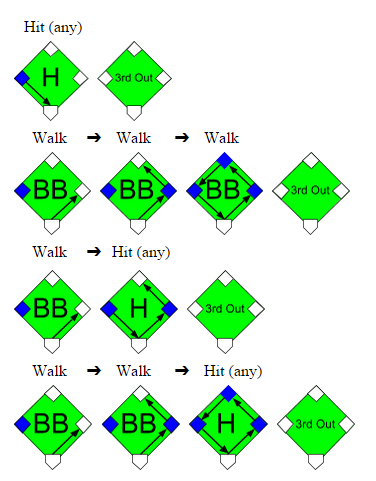
Graphic 5.1

Generally, any combination of walks and hits not highlighted yellow in Table 5.1 would have tied or won the World Series for the Royals. This glimmer of hope was a quantifiable 0.127 probability for Kansas City, so it was justified that Gordon was kept at 3rd rather than sent home after shortstop Brandon Crawford just received the ball. It would have taken an error from Crawford or Buster Posey, with respective 0.033 and 0.006 2014 error rates, to get Gordon home safely. The probability 0.127 of winning the game from the batter’s box is noticeably three times greater than the probability of winning it from the base paths (where Crawford and Posey’s joint error probability was 0.039).

We should note that the layout in Table 5.1 is a simplification of what could occur with a runner on 3rd, two outs, and a one run lead, because it only applies to innings where a walk off is not possible. In innings where a walkoff can occur, such as the bottom of the 9th, the combinations of walks and hits captured in the red highlighted cells are not possible because they would occur after the winning run has scored and the game has ended. However, Bumgarner was so dominant in the World Series that these probabilities are almost non-existent, thereby making our model is still applicable; we would otherwise exclude these red-celled probabilities for less successful pitchers.

The next probability formula considers the sequences of walks, hits, and outs that can occur after one out has been accumulated, which is situation definitely worth examining if there is a lone runner on 2nd base.

Formula 5.2

Once again we’ll use Bumgarner’s 2014 World Series statistics to evaluate this formula and insert the probabilities into Table 5.2. According to the sum of the yellow cells, Bumgarner would be able to prevent the tying run from scoring (from 2nd base with one out) with a probability of 0.762 and would otherwise allow the tying run with a probability of 0.238.

Table 5.2: Probability of Hit and Walk Combinations after 1 Out

0 Hits 1 Hit 2 Hits 3 Hits 4 Hits
0 Walks 0.721 0.178 0.033 0.005 0.001
1 Walk 0.040 0.015 0.004 0.001 0.000
2 Walks 0.002 0.001 0.000 0.000 0.000
3 Walks 0.000 0.000 0.000 0.000 0.000
4 Walks 0.000 0.000 0.000 0.000 0.000

To get out of the inning unscathed, Bumgarner would need to prevent any further hits or allow fewer than 3 walks given a runner on 2nd with 1 out; it would be possible to advance the runner to on 3rd with 2 walks and then sacrifice him home in this situation (with no hits), but this probability is insignificantly tiny especially for a dominant pitcher like Bumgarner. Once again we depict these sequences that could get the tying run home from 2nd with 1 out, with the second out inserted randomly.
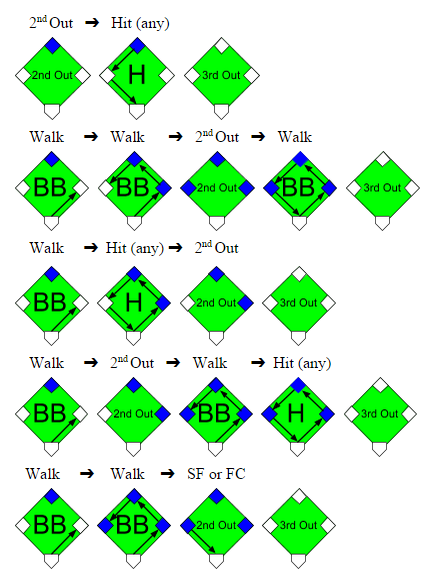
Graphic 5.2

A runner on 2nd base with one out is a scenario commonly manufactured in an attempt to tie the game from a runner on 1st with no outs situation. The logic is that if the hitting team is down by one run and the first batter leads off the inning with a single or walk, the next batter can control getting him into scoring position and hope that either of the next two batters knocks the run in with a hit. However, this method of control, a bunt, sacrifices an out to move the runner from 1st to 2nd. The defense will usually allow the hitting team to move the runner into scoring position for an out, but the out wasn’t the only sacrifice made. The inning is truncated for the hitting team with one less batter and the potential to have more hitters bat and drive in runs is reduced. Indeed, against a pitcher like Bumgarner, the out is likely not worth the meager 0.238 probability of getting that runner home.  We’ll see in the next section what exactly gets sacrificed for this chance at tying the game.

We should note that in this “runner on 2nd with 1 out” model we added few more assumptions to those we made in the prior “runner on 3rd with 2 outs” model, neither of which should be farfetched. The first assumption is that with the game close and the manager intent on tying the game rather than piling on runs, he should have a runner on 2nd base fast enough to score on a single. Another assumption is that the base runners will be precautious enough not to cause an out on the base paths, yet aggressive enough not to get doubled up or have the lead runner sacrificed in a fielder’s choice play. Lastly, we assume that the combinations of hits, walks, and outs are random, even though we know the current state of base runners and outs can have a predictive effect on the next outcome and the defensive strategy used. By using these assumptions we simplify the factors and outcomes accounted for in these models and reduce the variability between each model.

The final probability formula considers the sequences of walks, hits, and outs that can occur when we start with no outs accumulated; this allows to forge situation will allow us to forge the outcomes from a runner on 1st with no outs scenario and compare them to a runner on 2nd with 1 out scenario.

Formula 5.3

Table 5.3 below uses Bumgarner’s 2014 World Series statistics, the same as before, although in this model we deal with more uncertainty because the sequences captured in each box are not as clear cut between run scoring or not given a runner on 1st with no outs. The yellow and non-highlighted cells are still the respective probabilities of not allowing and allowing the tying run to score, however, we now introduce the green probabilities to represent the hit and walk combinations that could potentially score a run but are dependent on the hit types, sequences of events, and the use of productive outs. These factors were unnecessary in the prior two models because in those models any hit would have scored the run, the sequence of events was inconsequential, and the use of productive outs was unnecessary with the runner is already on 2nd or 3rd base (except when there is a runner on 3rd and a sacrifice fly or fielder’s choice could bring him home).

Table 5.3: Probability of Hit and Walk Combinations after 0 Outs

0 Hits 1 Hit 2 Hits 3 Hits 4 Hits
0 Walks 0.613 0.227 0.056 0.011 0.002
1 Walk 0.050 0.025 0.008 0.002 0.000
2 Walks 0.003 0.002 0.001 0.000 0.000
3 Walks 0.000 0.000 0.000 0.000 0.000
4 Walks 0.000 0.000 0.000 0.000 0.000

We must break down each green probability into subsets of yellow probabilities representing the specific sequences that would not score the tying run from 1st base with no outs; we depict these sequences below, but for simplicity, not all are depicted.
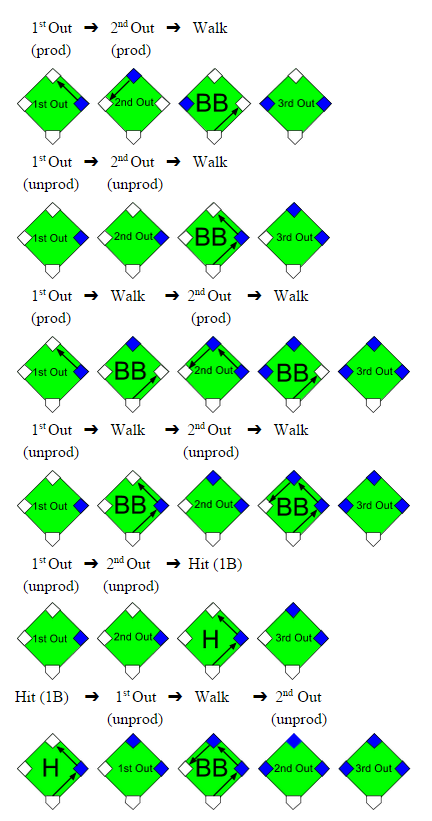
Graphic 5.3

Now that we know the conditions when a run would not score, we take the probabilities from the green cells in Table 5.3, narrow them down according to the proportion of sequences and the proportion of hit types that would not score the run, and separate them based on the usage of productive and unproductive outs; the results are displayed in Table 5.4. For example, there are 6 possible combinations for 1 hit, 1 walk, and 3 outs and 3 of these 6 combinations would not score the tying run on a single, where P(1B | H) = 0.755, with unproductive outs; yet, the run would score with productive outs, with unproductive outs on a double or better, or with unproductive outs and the other 3 combinations. When we finally sum these yellow cells, they tell us that an aggressive manager would score the tying run against Bumgarner with a 0.370 probability and Bumgarner would escape the inning with a 0.630 probability. Otherwise, a less aggressive manager would score the tying run with a mere 0.154 probability and Bumgarner would leave unscathed with a significant 0.846 probability.

Table 5.4: Probability of No Runs Scoring after 0 Outs

Productive Outs Unproductive Outs
0 Hits 1 Hit 0 Hits 1 Hit
0 Walks 0.613 x (1/1) 0.227 x (0/3) 0.613 x (1/1) 0.227 x (3/3) x 0.755
1 Walk 0.050 x (1/3) 0.025 x (0/6) 0.050 x (3/3) 0.025 x (3/6) x 0.755
2 Walks 0.003 x (2/6) N/A 0.003 x (6/6) N/A

We summarize the results from Tables 5.1-5.4 into Table 5.5 from the perspective of the hitting team.  We compare their chances of success not only against Madison Bumgarner from the 2014 World Series but also against Tim Lincecum, Matt Cain, and Jonathan Sanchez from the 2010 World Series.

Table 5.5: Probability of Allowing at least One Run to Score

2010 Tim Lincecum 2010 Matt Cain 2010 Jonathan Sanchez 2014 Madison Bumgarner
Runner on 1st & 0 Outs w/Unproductive Outs 0.305 0.224 0.531 0.154
Runner on 1st & 0 Outs w/Productive Outs 0.576 0.475 0.758 0.370
Runner on 2nd & 1 Out 0.382 0.288 0.543 0.238
Runner on 3rd & 2 Outs 0.212 0.154 0.318 0.127

Let’s return to the scenario that is the launching point for this study… The hitting team is down by one run and there is a runner on 1st base with no outs. If the game is in its early innings, where it is not mandatory that this runner at 1st gets home, the manager will likely decide against being aggressive and avoid sacrificing outs in order to increase his chances of extending the inning to score more runs; there are several studies supporting this logic. Yet, if the game is in the latter innings and base runners are hard to come by, the manager should lean towards utilizing productive outs and intentionally sacrifice the runner from 1st to 2nd base. His shortsighted goal should only be to tie the game.  By forcing productive outs rather than being conservative on the base paths, his chances of tying the game increase significantly (between 0.216 and 0.271) against our four pitchers given a runner on 1st and no outs scenario.

However, the if the manager does successfully orchestrate the runner from 1st to 2nd base with a productive out, he does still lose a little bit of probability of tying the game; between 0.132 and 0.215 of probability is lost against our pitchers. And if he decides to sacrifice the runner further from 2nd to 3rd base with another out, his team’s chances would decrease again by a comparable amount; this decision is ill-advised because a hit is likely going to be needed to tie the game and the hitting team would be sacrificing one of two guaranteed chances to hit in this situation. In general, the probability of scoring at least one run decreases as more outs are accumulated, regardless of the base runners advancing with each out. The manager could contrarily decide against sacrificing his batter if he has confidence that his batter can hit the pitcher or draw a walk, yet the imperative goal is still to tie the game. The odds of tying the game actually favor an aggressive hitting team that is able to get the runner to 2nd base with one out, by an improvement ranging from 0.012 to 0.084, over a less aggressive team with a runner at 1st with no outs. Thus, even though sacrificing the runner from 1st to 2nd base does decrease the chances of tying the game, it would be worse to approach the game lifelessly when the situation demands otherwise.