What Can Nathan Eovaldi Learn from Brandon McCarthy?

Brandon McCarthy got off to a rough start in 2014 with the Arizona Diamondbacks. Between the atrocious ERA (5.01) and the seemingly endless supply of baseballs leaving the yard (HR/FB rate of 20%), the D’Backs cut their losses and dealt McCarthy to the Yankees in early July for Vidal Nuno. What the Yankees saw was a pitcher who was terribly unlucky and just needed a little more time for variance to run its course. Well, and maybe a few things that needed adjusting.

McCarthy was among the league leaders in BABIP at the time of the trade with a .345 mark, and many seemed to think this number had to come down. BABIP after all is pretty volatile, and takes several years to stabilize, so we can expect a large amount of variance in a time period as short as a few months. The real questions are: how deserving was McCarthy of an inflated BABIP? Are there tendencies that make some pitchers more prone to higher rates than others? What can teams do to fix higher BABIPs?

First, let’s take a look at McCarthy’s zone profiles in 2014 before being traded.

No wonder hitters were teeing off against McCarthy; lefties saw plenty of offerings over the middle of the plate while righties were exclusively pitched low-and-away. Hitters could walk up to the plate with confidence knowing they’d either get a pitch in their wheelhouse or only in a few spots. This took any advantage of unpredictability out of the hands of McCarthy and subjected him to a higher than average BABIP.

Now, let’s look at how they changed after being dealt.

After coming over to New York, McCarthy looks like a completely different pitcher. The biggest changes appear to be throwing inside on right handed hitters and keeping the ball away from left handed hitters. His new found ability to mix up his locations helped keep hitters off-balance.

As for McCarthy’s pitch selection before and after the trade, that changed as well.

Left Handed Hitters

Month Fourseam Sinker Cutter Curve Change
4/14 5.60 45.60 26.40 22.40 0.00
5/14 9.26 50.74 18.52 18.89 2.59
6/14 12.00 46.80 6.00 29.20 5.60
7/14 11.92 47.69 18.46 21.92 0.00
8/14 25.38 23.24 25.38 25.69 0.00
9/14 32.02 18.72 19.21 30.05 0.00

Right Handed Hitters

Month Fourseam Sinker Cutter Curve
4/14 2.29 66.06 6.88 23.85
5/14 5.06 61.60 3.80 29.54
6/14 8.70 55.56 3.38 32.37
7/14 21.74 46.64 15.42 15.81
8/14 24.35 43.91 13.65 18.08
9/14 24.61 45.55 10.47 19.37

Left handed hitters saw a dramatic increase in four-seamers, with the sinker, cutter, and curve all being mixed in rather evenly. Righties also saw a drift away from the sinker and a more even distribution of pitches. The result was a modest .307 BABIP from July onwards. This all makes me wonder if the Yankees have found a market inefficiency — pitchers with an excellent skill set, an inflated BABIP, and zone profiles plus pitch arsenals that were all too predictable. Alter the sequencing to fix the pitcher, and you’ll see the outcomes line up more accurately with the underlying skill set.

Well, if they did it once, can they do it again? Or at least try to?

Enter Nathan Eovaldi. Eovaldi has impressed scouts for years with a blazing mid-90’s fastball. Unfortunately, the results haven’t matched his potential. Like McCarthy, Eovaldi was marred by the same tendencies- an inflated BABIP (.323) with an ERA that’s well above his FIP (4.37 vs 3.37), but he had an impressive walk rate (1.94 BB/9). His zone profiles provide some insight as well:

Eovaldi pitched almost exclusively down-and-away to right handed hitters in 2014, much like McCarthy before coming over to New York. Left handed hitters saw a buffet of pitches in the bottom half of the zone, with a high percentage coming low-and-in.  Eovaldi’s pitch usage was rather predictable as well.

Left Handed Hitters

Month Fourseam Sinker Curve Slider Change
4/14 65.86 0.60 10.88 18.73 3.93
5/14 58.63 0.00 10.42 21.82 9.12
6/14 64.11 0.27 15.34 15.62 4.66
7/14 60.43 2.13 14.89 15.74 6.81
8/14 63.64 2.69 17.85 14.81 1.01
9/14 56.70 1.55 23.71 9.28 8.76

Right Handed Hitters

Month Fourseam Sinker Curve Slider Change
4/14 62.40 2.33 1.55 32.95 0.78
5/14 66.35 0.00 0.00 33.65 0.00
6/14 57.33 0.00 1.33 40.89 0.44
7/14 59.66 1.72 3.00 35.62 0.00
8/14 64.93 0.00 1.87 33.21 0.00
9/14 55.16 3.14 7.62 33.18 0.90

Eovaldi features a fastball, slider and curve against LHH and only a fastball and slider against RHH. This would help explain his higher-than-normal BABIP — he’s just too predictable. Hitters known they can wait on 1 or 2 pitches in a general area and have good chance of guessing correctly. While Eovaldi didn’t have as wide of a pitch selection to choose from as McCarthy, I’m willing to bet the Yankees work with him to change this. I’m thinking that we see either a new pitch all together, or perhaps he works with pitching coach Larry Rothschild on his sinker and/or change. These adjustments plus more variance in the pitch location department could make a world of difference for Nathan Eovaldi in 2015.
The Contours of the Steroid Era

One of the things I enjoy most about FanGraphs Community–really, I’m not just apple polishing here–is the quality of the comments. After I came up dry trying to explain the increase in hit batters to near-historical levels in recent years, a commenter led me to what I feel is the correct path: Batters are more likely to be hit when the pitcher’s ahead on the count (and thereby more likely to work the edges of the strike zone, where a miss inside may hit the batter), and the steady increase in strikeouts has yielded an increase in pitchers’ counts on which batters get hit. Similarly, on December 30, when I wrote about how larger pitching staffs have adversely affected the performance of designated hitters, I got this smart comment from Jon L., reacting to my contention that the relative (not absolute) rise in DH offensive performance (measured by OPS+) from 1994 to 2007 probably wasn’t related to PEDs because the improvement was relative to increasing offensive levels overall:

I think it was clearly a PED thing. Players were able to build strength and muscle mass to enhance hitting prowess, and were willing to take the hit on baserunning and agility that comes with toting more weight around. And why not? The money’s in hitting. PEDs were more appealing to players with some initial level of slugging ability, and disproportionately benefited DH-type skills.

That made me think about the Steroid Era (or the PED Era, or, as Joe Posnanski put it, the Selig Era). Generally, I avoid this issue. I listen to SiriusXM in my car, and when I’m on MLB Network Radio and the discussion turns to PEDs, I change the station. I’ve had enough of it for this life, and of course it’ll keep going into overdrive every year around this time with all the Hall of Fame posturing. And, of course, there are commentators like Joe Sheehan who attribute the change in offense since drug testing was instituted to changes in contact rate rather than, as he calls them, “sports drugs.” I’m not making a call on any of that here.

But Jon L.’s comment made me look at the era in a different light. As I noted in my piece, between 1994 and 2007, the average OPS+ for designated hitters was 109. Prior to that, it was 104, and since then, it’s been 106. Those 14 years between 1994 and 2007 represent the high-water mark for DH offense. both absolutely and relatively. In the 42 years in which the American League has had a designated hitter, there have been 28 seasons in which the OPS+ for DHs was 105 or higher: Every season from 1994 to 2007, but just half of the remaining 28 years.

So I’m going to start with the years 1994-2007 as my definition of the Steroid Era. I’m not saying they’re the right answer. They do fit in with the record for DHs, and I’d note that those fourteen years account for 23 of the 43 player-seasons, and 14 of the 23 players, hitting 50+ home runs in a season. (And that doesn’t include 1994, when six players–Matt Williams, Ken Griffey Jr., Jeff Bagwell, Frank Thomas, Barry Bonds, and Albert Belle–were on pace for 50+ when the strike ended the season.) But maybe the Steroid Era started, as Rob Neyer recently suggested, in 1987, following Jose Canseco’s Rookie of the Year season. That’s the same starting point the Eno Sarris points to in this article from 2013. Maybe it ended in 2003, the last year before drug testing commenced. I’ll get to that later.

To test Jon L.’s hypothesis, I looked at Bill James’s Defensive Spectrum, which puts defensive positions along a continuum:

DH – 1B – LF – RF – 3B – CF – 2B – SS – C

For purposes of this analysis, let’s just say that the defensive spectrum rates positions as offense-first through defense-first. (It’s more nuanced, having to do with the availability of talent, but that’s not important here.) DHs, obviously, are asked only to hit, not to field. On the other end of the spectrum, players like Clint Barmes and Jose Molina get paid for the glove, not their bat.

For each position, I looked at their relative hitting (measured by OPS+, the only relative metric I could find with positional splits going back to the implementation of the DH). Obviously, overall offense increased across baseball during the Steroid Era. That’s not at issue. Rather, I’m looking for the contours of the increase: Did some types of players benefit more than others? That’s the beauty of relative statistics. Since they average to 100 overall, they’re effectively a zero-sum game. In pretty much identical playing time, Justin Upton’s OPS+ improved from 124 in 2013 to 132 in 2014. That means that the rest of his league, in aggregate, lost 8 points of OPS+ over Upton’s 642 or so plate appearances from 2013 to 2014. Taking that logic to positions, if one position goes up, as the DHs did from 1994 to 2007, another position has to go down.

I compared three ranges of seasons:

  • The Steroid Era; fourteen years from 1994 to 2007
  • The fourteen prior seasons, 1980-1993
  • The seven seasons since

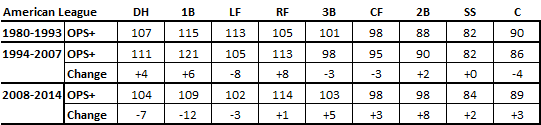
If, as Jon L. suggests, the Steroid Era disproportionately helped sluggers, we’d expect to see OPS+ rise for the left end of the spectrum and fall for the right end. If, as I contended, the increase in DH productivity was more due to the influx of very skilled hitters in the DH role (Edgar Martinez, David Ortiz, Travis Hafner, and others) than something systematic, the change in OPS+ among positions would be pretty random. Here are the American League results (source for all tables: baseball-reference.com):

It turns out that other than a somewhat idiosyncratic drop in production among left fielders (Rickey Henderson’s best years were before 1994, while left fielders Jim Rice, George Bell, and Brian Downing were all high-OPS stars of the 1980s), Jon L.’s hypothesis looks correct. Collectively, DHs, first basemen, and corner outfielders added ten points of OPS+ during the Steroid Era (two-three per position) while center fielders and infielders lost eight points (two per position – totals don’t sum to zero due to rounding). After 2007, the hitters’ positions lost 21 points of OPS+ (five per position) while the fielders’ positions picked up 21 (four per position).

Again, these are relative changes. American League center fielders batted .267/.330/.401 from 1980 to 1993, an OPS of .731. They hit .273/.339/.423 from 1994 to 2007, an OPS of .762. Their absolute numbers improved. But relative to the league, they declined. Offensive performance shifted away from glove positions to bat positions in the American League during the Steroid Era, and back toward the glove guys thereafter.

What’s an increase of two or three points of OPS+, as occurred for DHs from 1994-2007, worth? In the current environment, it’s about 14-20 points of OPS. That’s about the difference in 2014 between Indians teammates Yan Gomes (122 OPS+) and Lonnie Chisenhall (120 OPS+), or Royals teammates Eric Hosmer (98) and Billy Butler (95), or Twins teammates Trevor Plouffe (110) and Joe Mauer (107). (Man, it must be tough to be a Twins fan.)

So what does this mean? Maybe PEDs worked better for sluggers than for fielders, i.e., maybe they boosted sluggers’ batting skills more than other players’. Maybe sluggers took more drugs. I don’t know, and I really don’t care–as I said, I’m tired of the PED talk. But to swing back to Jon L.’s comments on my piece, I think I was too glib in attributing the increased relative performance by DHs from 1994 to 2007 to players and strategy alone. Looks like chemicals may have played a role.

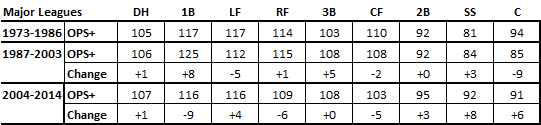
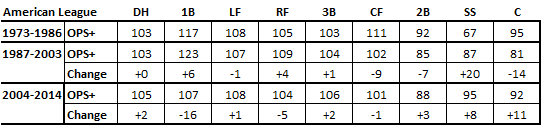
But wait, I’m not done. I mentioned the lack of definition of the Steroid Era. If I use the Neyer/Sarris starting point of 1987 and the last pre-testing season of 2003 as an endpoint, things change a bit. Stretching out the definitions of the eras to 1973-1986 as pre-steroids and 2004-present as post-steroids, here’s what I get:

That’s not as dramatic. Yes, there’s still a shift in OPS+ from the five positions on the right of the defensive spectrum to the four on the left during the Steroid Era, and back again thereafter. But it’s smaller and much less uniform. DHs and left fielders have actually done a bit better since the end of the differently-defined Steroid Era. That’s less compelling.

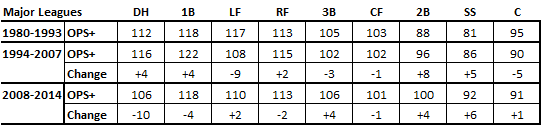
And the Steroid Era didn’t affect just the American League, of course. Of the 24 player-seasons between 1990 and 2007 in which a player hit 50+ home runs, half the players were in the National League (12 and a third, given that Mark McGwire split time in 1997 between Oakland and St. Louis en route to 58 homers), including all seven seasons of 58+ (seven and a third including McGwire’s 1997). And if you throw the NL into the mix the relationship breaks down more, regardless of how you define the Steroid Era, looking more random than systematic:

The shift of offense to bat-first positions during the Steroid Era is much less pronounced when looking at the two leagues combined, If there were an incontrovertible trend, we’d see plus signs for DHs, first basemen, and corner outfielders in the Steroid Era and minus signs thereafter, and the opposite for infielders and center fielders. That’s not the case.

So while the data aren’t altogether compelling, I’ll concede Jon L.’s point: The Steroid (or PED, or Selig) Era didn’t just boost offenses overall, it changed the contour of offensive performance, shifting some production away from the glove-first positions to the bat-first positions. There was an uptick not only in offensive performance as a whole, but particularly in offensive performance generated designated hitters, first basemen, and corner outfielders. However, the magnitude of the effect is dependent on the league and the years chosen, which indicates that it’s not strong. So I’m sticking with my view that there was an unusual concentration of talent playing DH from the mid-1990s to the mid-2000s. Designated hitters generated more offense, both absolutely and relatively, from 1994 to 2007 than in any other period. The underlying reason may be partly the Steroid Era, but we can say that those years were also the Edgar Martinez era.


Analyzing the FanGraphs’ Mock Draft from an Outsider’s Point of View – OF (part 3)

As an avid reader of FanGraphs, I’ve been following the ongoing mock draft and thought it would be interesting to compare the results to the dollar value rankings I created using Steamer’s 2015 projections.

UPDATE: I downloaded the chat spreadsheet and the following commentary is up through the middle of the 21st round, pick #249 (Rick Porcello). Here is a breakdown, position-by-position. I’ve included the overall pick and the dollar value for that player based on 2015 Steamer projections in parentheses.

Outfield—part 3

In part 1, I wrote about the first 20 outfielders taken in the FanGraphs Mock draft.

Part 2 had the next 20 outfielders. This is part 3.

In rounds 13 and 14, four outfielders went off the board. Brandon Moss (146th–$13) was taken early in the 13th round. Moss had a brutal second half of 2014, but Steamer projects him to hit 28 homers with 76 RBI in 2015. Five picks later went Gregory Polanco (151st–$5). Polanco hit quite well in AAA last year but struggled in the big leagues. His Steamer projection calls for a .250/.310/.382 line but, at 23 years old, he could easily beat that. He’s also projected for 14 homers and 23 steals. Seven picks after Polanco was Avisail Garcia (164th–$6), who is projected to be of similar value but in a different way, with more homers, RBI, and a better batting average but fewer steals. The final pick of the 14th round was Arizona’s A.J. Pollock (168th—[-$1]). Pollock hit .302 with 14 steals in 75 games in 2014, but is projected to be worth -$1 in 2015, with a .262 average and 16 steals in 127 games.

The next five outfielders were taken within nine picks of each other in the 15th round. Here are the Steamer projections for this group:

578 AB, 79 R, 5 HR 47 RBI, 23 SB, .282 AVG—Denard Span (171st–$11)

487 AB, 65 R, 24 HR, 74 RBI, 4 SB, .258 AVG—Oswaldo Arcia (172nd–$12)

526 AB, 66 R, 10 HR, 56 RBI, 27 SB, .264 AVG—Leonys Martin (173rd–$9)

564 AB, 77 R, 6 HR, 49 RBI, 19 SB, .270 AVG—Adam Eaton (177th–$7)

537 AB, 60 R, 8 HR, 55 RBI, 21 SB, .267 AVG—Lorenzo Cain (179th–$4)

Here in the 15th round, drafters had four guys who provide some steals with varying levels of power and batting average ability and one guy who should hit 20 or more homers. Later in the draft, it becomes more about team need than value. If you get to the 15th round and still need home run power, Oswaldo is your guy.

No outfielders were taken in the 16th or 17th rounds, but four came off the board in the 18th. Danny Santana (211th–$0) is more valuable at shortstop than outfield but his Steamer projection pegs him at replacement level even at the shortstop position. In seven minor league seasons, Santana hit .273/.317/.391. Then he came up last year and hit .319/.353/.472 for the Twins, with 7 homers and 20 steals in 101 games. He also had a .405 BABIP. If you take his stats with the Twins last season and adjust his BABIP from .405 to the .314 BABIP projected by Steamer for 2015, with all of the lost hits being singles, his batting line last year would have been .252/.288/.405. Steamer projects a .261/.299/.371 line. He should steal some bases (projected for 18), but don’t go overboard because of last year’s 100-game stint.

Two picks later, Michael Cuddyer (213th–$8) was added by Eno. Cuddyer hit .307/.362/.525 in his three years with the Rockies but no one expects that kind of production this year with the Mets. This late in the draft, he looks like a good value, based on Steamer projections. He was the 51st outfielder taken and is ranked 44th by Steamer among outfielders.

Michael Saunders (214th—[-$2]) was taken with the next pick. He’s only projected for 477 plate appearances, so he’s not expected to be as valuable as some other outfielders who are projected for more playing time. Saunders is a guy who could get to double-digits in homers and steals, so he’s not a bad flyer to take in the later rounds, particularly if you think he’ll play more than his projection.

The last of the four outfielders taken in the 18th round was Arismendy Alcantara (216th–$1). Alcantara has 2B eligibility and is more valuable at that spot. He will steal you some bags and has good power for a middle infielder, but the batting average will hurt you.

Seven outfielders were taken from rounds 19 through 22 and this group is all over the place. Here are the Steamer projections for this group of seven:

492 AB, 55 R, 10 HR, 58 RBI, 17 SB, .265 AVG—Alex Rios (221st–$2)

377 AB, 48 R, 6 HR, 38 RBI, 28 SB, .265 AVG—Rajai Davis (229th—[-$5])

552 AB, 75 R, 14 HR, 55 RBI, 19 SB, .241 AVG—Desmond Jennings (237th–$6)

415 AB, 55 R, 16 HR, 55 RBI, 19 SB, .246 AVG—Steven Souza (240th–$2)

510 AB, 64 R, 19 HR, 70 RBI, 4 SB, .247 AVG—Josh Hamilton (250th–$5)

526 AB, 74 R, 11 HR, 55 RBI, 13 SB, .246 AVG—Dexter Fowler (251st–$3)

567 AB, 73 R, 15 HR, 69 RBI, 4 SB, .284 AVG—Torii Hunter (253rd–$14)

We’re getting to the late rounds and here you can get an idea of what might be available. There are guys who will steal some bases and reach double-digits in home runs, but they won’t help you much in RBI and will hurt you in batting average.

Alex Rios has been all over the place in his career, from a high wRC+ of 126 in 2012 to a low of 60 in 2011. Over the last three years, his wRC+ has dropped from 126 to 104 to 92. Steamer projects him to bump it up slightly to 95 next year.

Rajai Davis is a guy who won’t play every day, but will steal some bases when he’s in the lineup and has been particularly good against left-handed pitching, with a career wOBA against lefties of .353. He can be quite productive if used correctly.

Desmond Jennings had his best stretch of hitting in a 63-game stint in 2011 at the age of 24 (128 wRC+), but hasn’t been as good since. He’s one of the better options this late in the draft, but doesn’t seem likely to ever live up to his early promise.

Steven Souza’s projection is very similar to Jennings, minus some runs scored and in less playing time. If you think Souza will get more regular playing time than the 415 at-bats he’s projected for, he’s a guy to target.

Josh Hamilton’s two years with the Angels have been very disappointing and Steamer doesn’t see any improvement coming.

Dexter Fowler is similar to Jennings and Souza but with fewer projected steals.

Finally, Torii Hunter projects to be the best of this bunch, despite his advanced age (he’ll be 39 in 2015). Hunter was the 60th outfielder taken but is ranked 31st based on Steamer projections.


Analyzing the FanGraphs’ Mock Draft from an Outsider’s Point of View – OF (part 2)

As an avid reader of FanGraphs, I’ve been following the ongoing mock draft and thought it would be interesting to compare the results to the dollar value rankings I created using Steamer’s 2015 projections.

UPDATE: I downloaded the chat spreadsheet and the following commentary is up through the middle of the 21st round, pick #249 (Rick Porcello). Here is a breakdown, position-by-position. I’ve included the overall pick and the dollar value for that player based on 2015 Steamer projections in parentheses.

Outfield—part 2

In part 1, I looked at the twenty outfielders who were taken among the first 56 picks in the FanGraphs Mock Draft. This section covers the next 20 outfielders drafted, starting with round 6.

Four outfielders were taken in the 6th round of the FanGraphs Mock, with Jason Heyward (62nd–$20) going off the board early in the round. Steamer is projecting a significant increase in home runs for Heyward, from 11 last year to 20 in 2015. In his five-year career, Heyward has hit 20 or more homers just once, back in 2012. While Steamer likes Heyward to almost double his homer total from a year ago, the same is not true for the next outfielder drafted—Nelson Cruz (66th–$15). Steamer projects a drop from 40 homers last year to 26 this year as Cruz moves from Baltimore to Seattle. This also comes with more than 100 fewer plate appearances, which contributes to a drop in his projection for runs (from 87 to 70) and RBI (from 108 to 80). He’s also projected for a drop in batting average (from .271 to .249). Christian Yelich (67th–$18) was taken with the next pick. He’s projected to increase his homer total from 9 to 14 and maintain his base-stealing ability, but with a drop in batting average. Finally, on the very next pick the choice was Yoenis Cespedes (68th–$23), who was the 24th outfielder taken in this mock draft but is ranked 12th among outfielders based on Steamer projections.

With these four outfielders, I could see very different opinions among fantasy owners. Do you believe in Nelson Cruz more than Steamer does? Do you think Heyward can hit 20 homers or Yelich can hit 14? How will Cespedes hit in Detroit? Steamer would rank them Cespedes, Heyward, Yelich, and Cruz. Your mileage may vary.

The 7th round saw two outfielders on different career trajectories. Young Mookie Betts (will be 22 this year) had a good 52-game stretch last year but plays for the Red Sox who have a packed outfield at the moment. Steamer currently has Betts (73rd—[-$1]) projected for 389 plate appearances, which gives him negative value despite a good batting line. Later in the 7th round, 35-year-old Matt Holliday (80th—$19) was taken. Steamer projects Holliday to have a similar season in 2015 as he had in 2014, but with 40 fewer at-bats, along with fewer runs scored and RBI. When it comes to drafting Betts before Holliday, you have to believe Betts will get regular playing time. Holliday has had 600 or more plate appearances in eight of the last nine years, so he’s much more of a sure thing.

Seven more outfielders were taken over a span of 16 picks in rounds 8 and 9. Here are their projections for 2015:

593 AB, 82 R, 16 HR, 64 RBI, 22 SB, .274 AVG—Charlie Blackmon (87th–$22)

573 AB, 80 R, 18 HR, 72 RBI, 9 SB, .270 AVG—Alex Gordon (89th–$18)

574 AB, 82 R, 20 HR, 68 RBI, 9 SB, .263 AVG—Kole Calhoun (90th–$17)

524 AB, 78 R, 18 HR, 73 RBI, 7 SB, .285 AVG—Jayson Werth (95th–$20)

496 AB, 64 R, 24 HR, 72 RBI, 8 SB, .239 AVG—Jay Bruce (98th–$8)

565 AB, 66 R, 22 HR, 76 RBI, 4 SB, .255 AVG—Marcell Ozuna (100th–$11)

555 AB, 76 R, 14 HR, 66 RBI, 6 SB, .288 AVG—Melky Cabrera (102nd–$15)

These projections (and this mock draft) are from before it was announced that Jayson Werth had surgery on the AC joint in his shoulder. He may not reach 524 at-bats in 2015, but the injury is not expected to keep him out for too long.

Of this group of seven outfielders, Blackmon’s projected steals and otherwise solid numbers make him more valuable than the rest. Alex Gordon, Kole Calhoun, and Jayson Werth are similarly valued. You could go for the upside play with the younger Calhoun or the steadiness of veteran Alex Gordon.

The next three outfielders don’t project to be as valuable as the top group, but there’s enough variation possible that they could get to that level. Jay Bruce had the worst year of his career in 2014, hitting just .217/.281/.373. Taking him in the 9th round is hoping for a bounce back season. Marcell Ozuna is six years younger and will likely hit for more power with a lower batting average than Melky Cabrera, so I could see an argument for taking him before the Melk-Man.

In the 10th round, three more outfielders went off the board. Before last season, Shin-Soo Choo (110th–$16) was a hot commodity coming off a 20-20 season with a .285/.423/.462 batting line and moving to a great hitter’s park in Texas. Unfortunately, he was a big disappointment. He played just 123 games and hit .242/.340/.374. He’ll be 32 in 2015 and Steamer likes him to rebound, but not to anything close to that 2013 season. Wil Myers (113th–$2) isn’t a favorite of Steamer but he has youth on his side and a good pedigree and could easily beat his projection. Jorge Soler (117th–$13) played at four levels last season. He had just 8 games in the Rookie league, then destroyed AA (.415/.494/.862 in 22 games), continued to hit well in AAA (.282/.378/.618 in 32 games) and kept it up with the Cubs in the big leagues (.292/.330/.573 in 24 games). He’s only 23 years old and has a nice projection for 2015. I’d be inclined to take him over Myers and Choo, just for the upside.

The next four outfielders taken, from pick 122 to pick 143, includes two players who do not have Steamer projections. Rusney Castillo is one of those, taken with pick #122. His playing time is in question because of the Red Sox outfield logjam, but the Sox signed him for six years and $72 million last August, so he should get a chance to play. I do have projections from Cairo and Davenport for Castillo. Averaging Castillo’s projections from Cairo and Davenport, we get 241 at-bats, with a .279/.325/.429 batting line, 6 homers, and 8 steals. If you double that line to approximate a full season, he would be worth $10 and be the #40 outfielder. He was taken 37th among outfielders in this mock draft.

Brett Gardner (136th–$11) was taken 14 picks after Castillo. Early in his career, Gardner had back-to-back seasons with 47 and 49 steals. He’s more of a 20-steals guy these days, but did just have a big homer year, hitting a career-high 17 in 2014. Steamer expects a drop to 12 homers in 2015, with the rest of his numbers being very similar to last year.

Taken shortly after Gardner was Ben Revere (142nd–$8). Revere will steal you plenty of bases (49 last year), but his RBI output is reminiscent of Rob Picciolo. Revere went the first three-plus years of his career without hitting a home run, then muscled up for two long balls last year. This is his age-27 season and Steamer is expecting a career-high of three dingers in 2015. I would take the under on that projection.

The fourth player taken in this group was Yasmany Tomas. Steamer has nothing to work with here. Tomas was signed by the Diamondbacks in December to a six-year, $68.5 million deal. He could play third base or the outfield and is expected to hit for power after hitting 30 home runs in 205 regular-season games in Cuba, going back to 2008.

In part 3: the next 20 outfielders drafted.


Analyzing the FanGraphs’ Mock Draft from an Outsider’s Point of View – OF (part 1)

As an avid reader of FanGraphs, I’ve been following the ongoing mock draft and thought it would be interesting to compare the results to the dollar value rankings I created using Steamer’s 2015 projections.

UPDATE: I downloaded the chat spreadsheet and the following commentary is up through the middle of the 21st round, pick #249 (Rick Porcello). Here is a breakdown, position-by-position. I’ve included the overall pick and the dollar value for that player based on 2015 Steamer projections in parentheses.

Outfield

The top three picks in the FanGraphs Mock Draft were outfielders Mike Trout (1st–$55), Andrew McCutchen (2nd–$39), and Giancarlo Stanton (3rd–$48).

At the top of the outfield rankings is the amazing Mike Trout, who can basically do anything on the baseball field. He’s the clear-cut top pick. The next two outfielders drafted were Andrew McCutchen and Giancarlo Stanton. Steamer projects Stanton to be more valuable than McCutchen, with a career-high in runs scored and homers. McCutchen is Trout-like, but with fewer homers, runs, and RBIs projected. After Trout, you could go either way with pick #2. You want big time power, take Stanton. You want power and steals, take McCutchen. I prefer McCutchen myself.

Late in the first round, there was a run during which six outfielders were drafted between pick #9 and pick #23. Jose Bautista (9th–$42) was the fourth outfielder taken but Steamer actually likes him more than McCutchen. Bautista had 673 plate appearances last year and is projected for 653 this year. He will be 34, though, and in the two seasons before last year he was limited to 399 and 528 plate appearances. Just based on age, he’s a little bit of a risk compared to the other top 10 outfielders. Carlos Gomez (12th–$27) was next, then Yasiel Puig (13th–$31). Puig is more valuable because he’s projected for more runs, RBI, and a higher batting average, while Gomez has the edge in projected steals. Three picks after Puig came the back-to-back selections of Jacoby Ellsbury (16th–$24) and Adam Jones (17th—$29). The edge here for Jones comes in homers and RBI, while Ellsbury should steal many more bases. The final outfielder taken in the 2nd round was Bryce Harper. After two injury-shortened seasons, Steamer is projecting Harper to play just as much as he did in his debut season (projected for 594 plate appearances) and hit 25 homers with 10 stolen bases.

Four more outfielders were taken in the third round, all within seven picks of each other. The controversial Ryan Braun (28th–$27) was the first outfielder taken in the third round, directly followed by 2014 breakout player Michael Brantley (29th–$20). The next pick was Justin Upton (30th–$14) and Carlos Gonzalez (34th–$24) came four picks later. Let’s look at this group of outfielders, starting with their averages over the last three years:

451 AB, 69 R, 23 HR, 77 RBI, 15 SB, .295 AVG—Ryan Braun

573 AB, 74 R, 12 HR, 77 RBI, 17 SB, .301 AVG—Michael Brantley

559 AB, 93 R, 24 HR, 80 RBI, 11 SB, .271 AVG—Justin Upton

390 AB, 65 R, 20 HR, 64 RBI, 15 SB, .288 AVG—Carlos Gonzalez

Based on the last three years, Upton looks like the most valuable outfielder among this group, but his Steamer projection is the worst of the bunch. Braun missed two-thirds of the 2013 season because of a PED suspension and was not the hitter he’d been when he got back on the field in 2014. Carlos Gonzalez is risky because he seemingly gets injured every year. Michael Brantley had the best 2014 season among these players, but it was out of line with what he had done before. Here are the 2015 Steamer projections for these four players:

546 AB, 79 R, 24 HR, 80 RBI, 13 SB, .278 AVG—Ryan Braun ($27)

575 AB, 75 R, 13 HR, 72 RBI, 14 SB, .290 AVG—Michael Brantley ($20)

530 AB, 71 R, 23 HR, 74 RBI, 8 SB, .253 AVG—Justin Upton ($14)

475 AB, 74 R, 24 HR, 77 RBI, 11 SB, .282 AVG—Carlos Gonzalez ($24)

Upton’s projection is the most interesting one here because it’s much worse than his three-year averages. He’s moving to a tough ballpark in San Diego and will be on a team that scored the fewest runs in baseball last year by a good margin, but his former team, the Atlanta Braves, scored the second-fewest runs last year and the Padres should be much better offensively in 2015 than they were in 2014.

Here is a comparison of Upton’s projections from Steamer, ZiPS, Cairo, and Davenport.

530 AB, 71 R, 23 HR, 74 RBI, 8 SB, .253 AVG—Justin Upton—Steamer ($14)

567 AB, 94 R, 26 HR, 85 RBI, 12 SB, .261 AVG—Justin Upton—ZiPS ($31)

564 AB, 86 R, 25 HR, 86 RBI, 10 SB, .265 AVG—Justin Upton—Cairo ($28)

515 AB, 68 R, 18 HR 76 RBI, 9 SB, .259 AVG—Justin Upton—Davenport ($12)

That’s a pretty big spread. Steamer and Davenport have Upton as a $12 to $14 player, while ZiPS and Cairo have him in the $28 to $31 range. At the high range, Upton would be a top 10 outfielder. At the low range, he’s outside the top 30. In this mock, he was the 12th outfielder drafted.

Four outfielders were taken in the fourth round and all have similar value according to Steamer: Hunter Pence (38th–$18), Corey Dickerson (42nd–$18), Billy Hamilton (43rd–$20), and Starling Marte (44th–$18). Pence and Dickerson have similar overall projections and, thus, similar value. Hamilton’s projection for 68 steals makes him the top base-stealing outfielder out there, but he’ll hurt you in homers, RBI, and batting average. Marte isn’t likely to hit as many homers as Pence or Dickerson, but will steal more bases.

The fifth round saw three more outfielders taken, which meant 20 were now off the board.In this round, two younger players and a veteran were drafted, starting with J.D. Martinez (51st–$19). Martinez didn’t hit much in his first three partial seasons in the major leagues (.251/.300/.387), but had a very good 2014 season (.315/.358/.553 with 23 homers in 123 games). Steamer doesn’t expect Martinez to reach those heights this year, but he’s still projected for 22 homers and 80 RBI. George Springer (55th–$20) had a good half-season in 2014 and Steamer likes him to hit 28 homers and steal 15 bases in 2015, putting him in the top 20 among all outfielders. The veteran, Matt Kemp, doesn’t have such a rosy outlook. Moving to San Diego should bring his numbers down. He is ranked 38th among outfielders based on Steamer projections and his Cairo and Davenport projections aren’t much better (no ZiPS yet).

FanGraphs Mock Draft Top-20 Outfielders versus Steamer Rankings
PCK RND $$ OF-Rnk NAME Steamer Rank Difference
1 1 $55 1 Mike Trout 1 0
2 1 $48 2 Andrew McCutchen 4 +2
3 1 $42 3 Giancarlo Stanton 2 (-1)
9 1 $39 4 Jose Bautista 3 (-1)
12 1 $27 5 Carlos Gomez 8 +3
13 2 $31 6 Yasiel Puig 5 (-1)
16 2 $24 7 Jacoby Ellsbury 10 +3
17 2 $29 8 Adam Jones 6 (-2)
23 2 $25 9 Bryce Harper 9 0
28 3 $27 10 Ryan Braun 7 (-3)
29 3 $20 11 Michael Brantley 15 +4
30 3 $14 12 Justin Upton 32 +20
34 3 $24 13 Carlos Gonzalez 11 (-2)
38 4 $18 14 Hunter Pence 23 +9
42 4 $18 15 Corey Dickerson 21 +6
43 4 $20 16 Billy Hamilton 14 (-2)
44 4 $18 17 Starling Marte 22 +5
51 5 $19 18 J.D. Martinez 20 +2
55 5 $20 19 George Springer 18 (-1)
56 5 $11 20 Matt Kemp 38 +18


Final Notes for Part 1: Fifteen of the first twenty outfielders taken in the FanGraphs Mock Draft are ranked in the top 20 for outfielders based on Steamer projections. The outfielders drafted who are NOT ranked in the Steamer top 20 are Justin Upton (FanGraphs—12th, Steamer—32nd), Hunter Pence (FanGraphs—14th, Steamer 23rd), Corey Dickerson (FanGraphs—15th, Steamer—21st), Starling Marte (FanGraphs—17th, Steamer—22nd), and Matt Kemp (FanGraphs—20th, Steamer—38th). These are the guys that the FanGraphs mock drafters like more than Steamer.

The outfielders missing from the FanGraphs Top 20 but included in the Steamer Top 20 are Yoenis Cespedes (ranked 12th by Steamer, $23), Charlie Blackmon (Steamer—13th, $22), Jayson Werth (Steamer—16th, $20), Jason Heyward (Steamer—17th, $20), and Matt Holliday (Steamer—19th, $19).

Up next, more outfielders.


Analyzing the FanGraphs’ Mock Draft from an Outsider’s Point of View — C

As an avid reader of FanGraphs, I’ve been following the ongoing mock draft and thought it would be interesting to compare the results to the dollar value rankings I created using Steamer’s 2015 projections.

I downloaded the draft spreadsheet partway through the 16th round, just after pick 183 (Chase Headley). Here is a breakdown, position-by-position. I’ve included the overall pick and the dollar value for that player based on 2015 Steamer projections in parentheses.

UPDATE: I downloaded the chat spreadsheet and the following commentary is up through the middle of the 21st round, pick #249 (Rick Porcello).

Catcher

The top of the catcher rankings consists of one guy: Buster Posey (35th–$29). Not only is Posey a great hitter; he also gets more playing time than most catchers because he can play first base when he’s not behind the dish. In this mock draft, Posey was taken late in the third round, ahead of such players as Jason Kipnis, Stephen Strasburg, Hunter Pence, Yu Darvish, Ian Kinsler, and David Price. The next catcher off the board came five rounds later. Based on this mock and Steamer projection-based dollar values, Posey is on a tier of his own.

The 8th round saw two more catchers get drafted. Jonathan Lucroy (88th–$5) and Yan Gomes (91st–$7) were taken within three picks of each other. Steamer has Lucroy projected for 98 games and 424 plate appearances, which has to be considered far too low. Lucroy played in 147 games in 2013 and 153 in 2014 and it sounds like he’ll get time at first base against left-handed pitching this year. He really should be only below Posey in value, but his low playing time projection has him ranked 11th among catchers by Steamer. Yan Gomes is also projected to get less playing time in 2015 than he did in 2014 and also figures to come up short of the 21 homers and 74 RBI that he produced last season.

Two more catchers were taken in the 12th round. Brian McCann (133rd–$18) is projected for similar counting stats as he had in 2014 but with a better batting average. Devin Mesoraco (137th–$4) had a breakout 2014 season when he hit .273 with 25 homers and 80 RBI in 114 games. Steamer has him down for a .246 average, 18 homers, and 54 RBI in 102 games. He’s the #12 catcher according to these projections. Two rounds and 25 picks after Mesoraco was taken, Yadier Molina (162nd–$1) went off the board. From 2009 to 2013, Molina averaged 138 games and 537 plate appearances per season (hitting .299/.356/.435). He’ll be 32 this season and was limited to 110 games last year because of an oblique injury. He’s expected to be fully healthy by spring training, but Steamer still has him projected for fewer games in 2015 than he had in his injury-shortened 2014 season.

There was a run on catchers in rounds 16 and 17. Evan Gattis (189th–$20) got it started with the 189th pick and three more catchers were taken among the next 13 choices: Travis d’Arnaud (193rd–$8), Wilin Rosario (195th—[-$1]), and Salvador Perez (202nd–$9). Based on Steamer projections, Gattis is by far the most valuable among this group, and second to Posey overall among catchers, while Rosario looks like the worst value. Let’s look at their 2015 Steamer projections:

528 AB, 63 R, 26 HR, 77 RBI, 2 SB, .243 AVG—Evan Gattis (189th–$20)

454 AB, 54 R, 17 HR, 61 RBI, 2 SB, .251 AVG—Travis d’Arnaud (193rd–$8)

271 AB, 36 R, 14 HR, 43 RBI, 2 SB, .278 AVG—Wilin Rosario (195th—[-$1])

449 AB, 52 R, 14 HR, 58 RBI, 1 SB, .274 AVG—Salvador Perez (202nd–$9)

Here again, playing time is a major driving factor in the valuations. In his two seasons in the big leagues, Gattis has averaged 351 at-bats per season but is being projected for 528 AB by Steamer right now. Travis d’Arnaud had 385 at-bats last year and is projected for 454 this year, with better triple-slash numbers. Rosario is on the other side. He’s had three straight years with 382 or more at-bats but is projected for 271 at-bats in 2015. He still has the power numbers (.488 projected slugging percentage) and a solid batting average (.278), but the playing time is short. Similarly, Salvador Perez is coming off a season in which he played 150 games and had 578 at-bats. The previous year, he had 496 at-bats. In 2015, he’s projected for 449 at-bats.

In round 20, Russell Martin (236th–$10) was taken, making him the 11th catcher taken in this mock. Steamer has Martin projected for 434 at-bats with 16 homers and 59 RBI and he’s valued as the #4 catcher.

Final notes: With these assorted playing time questions, it’s difficult to judge the FanGraphs mock draft when it comes to the catcher position. Posey is clearly #1 and I think Lucroy is an easy #2. Beyond that, the rankings can change easily based on adjustments in projected playing time. A few guys that Steamer likes better than some already drafted are Matt Wieters, Wilson Ramos, and Stephen Vogt. In a 12-team league with one starting catcher, you could go for Posey or Lucroy or maybe even McCann. After that, just wait it out and see what’s still there late in the draft.


Remembering Moses Fleetwood Walker

The interesting element about the Hall of Fame is that it always get’s me digging on the history of the game. This year I found something that shocked me to my very core.

Every year on April 15th we gather around the game of baseball to celebrate Jackie Robinson Day, as he was the first African-American to ever play in the Major Leagues. This notion, however, is false; Robinson was in fact not the first black player to play in the Majors. That honor goes to Moses Fleetwood Walker. Walker broke the colour barrier on May 1st 1884, and he played for the Toledo Blue Stockings, who were part of the American Association, which later became the American League. The contest was held in Louisville, and Walker played catcher.

Walker was born October 7th, 1856, in Mount Pleasant, located in eastern Ohio. Walker was part of a large family; he had around 7 siblings. The actual account of when Walker first started playing baseball is unclear or rather unknown. It is, however, believed that Walker probably started his relationship with the game of baseball in Steubenville. Walker then went on to Oberlin College where he became renowned as a great baseball player. In 1882 Walker transferred from Oberlin College to the University of Michigan. Walker at the same time played for an amateur team called the Neshannocks, located in New Castle.

In 1883, Walker left school and signed with a minor league team called the Toledo Blue Stockings of the Northwestern League. Walker was now pursuing baseball as a full-time profession. On the team many players were not paid; Walker was one of the few that were. The season, however, was not uneventful, for Toledo and Walker, especially when they were scheduled to play the Chicago White Stockings in an exhibition game. Cap Anson, the team’s best player, said that he would never play against or with a black player. Anson also stated that he would refuse to play the game if Walker or any other black player was playing. Anson on August 10, 1883 never did play against Toledo and sparked a debate in baseball on whether to outlaw African-Americans from the game.

The team, however, had immense success throughout the season and when the American Association was formed, a league designed to compete with the National League, the Toledo Blue Stockings were one of teams chosen to join the league. This meant that when the Blue Stockings took the field on May 1st 1884, Moses Fleetwood Walker broke the colour barrier in Major League Baseball. On that date he became the true first African-American to play baseball. The game was played against the Louisville Eclipse and Walker played catcher. Catchers during that time had a very difficult job as most of them had to catch without gloves. Walker’s first game in the bigs though wasn’t very memorable as he went 0-4 and committed four errors.

This proved to only be a blip on the radar as Walker went on to have a very successful season, accumulating a .264 batting average. Walker finished the year with 40 hits, a .325 OBP, a .361 SLG and a 107 OPS+. Walker, even with a poor slash line, was better than league average offensively due to the poor run environment of the era. Walker though only played in 42 of the 104 games that season. In fact he suffered an injury in July, which ended his season. Walker would never play in the majors again. Throughout the season Walker had to face heavy amounts of abuse from fans, apposing players and teammates. Some of his pitchers on his team would just throw whatever they wanted as they refused to take orders from an African-American ball player.

Walker then went on to play a few more years of minor league baseball until 1889 when the National League and American Association decided to ban all African-American players from playing professional baseball.

After that there would not be another African-American player in the majors for 63 years, until Jackie Robinson played his first game in the majors in 1947.

I think it’s a great tradition, celebrating what Jackie Robinson did in re-breaking the colour barrier in baseball. The problem I have is that Moses Fleetwood Walker is a player that should also be remembered and celebrated in his own right as the first African-American to ever play in the majors. He seems to have truly been forgotten from the history of the game. Almost everyone will tell you that Jackie Robinson broke the colour barrier in baseball; it’s time to change that.


The Billions of Baseball

With the winter meetings over and Opening Day months away, now is an interesting time to consider the economics of baseball.  Earlier this year, I developed a framework for estimating NBA team values for Mid Level Exceptional, which met with a positive reception.  With some tweaks, it can be adapted to MLB team valuation.

In my franchise valuation methodology, each team is priced based on a multiple of its revenue.  These multipliers reflect future earnings potential: the higher the multiple, the brighter the prospects for earnings growth.  This approach is common in finance; Aswath Damodaran, professor of finance at NYU Stern and author of Musings on Markets, used it to generate a back-of-the-envelope valuation for the recently sold Los Angeles Clippers.

Both Forbes and Bloomberg compute estimates of each MLB franchise’s value and annual revenue.  But I’m wary of their valuations.  Forbes consistently undershoots the sale price of NBA teams.  In January, Forbes pegged the Clippers’ value at $575 million; five months later, they sold for $2 billion. Prices for sports franchises have risen sharply over the past few years, as sports programming has become ever more valuable as live TV viewership dwindles.  The Forbes methodology hasn’t incorporated this shift in the value of broadcast rights, leading me to guess that its MLB valuations are also too low.  Bloomberg’s version reflects the same problem.  It values the average MLB team at 3.4 times revenue, not much higher than Forbes’ 2.9 times revenue.

In my version, I started with Bloomberg’s 2012 estimates of franchise revenue, which include revenue from teams’ stakes in regional sports networks and MLB Advanced Media.  (Forbes’ revenue figures are newer, but exclude these important revenue sources.)  To update the revenue numbers, I increased them by 20%, which is in keeping with MLB’s total revenue growth over the past two years.

Then, I created a range of revenue multipliers, which reflect the team’s market size (approximated by the size of the team’s MSA).  They are based on the multiples implied by recent MLB and NBA franchise sales.  In the model, big-market teams have higher multiples; I conclude that they generate disproportionate value from greater national media exposure, prestige, and ability to attract top free agents.  MLB’s lack of a salary cap makes the big-market advantage even more formidable than in the NBA.

I also chose multipliers that are slightly lower than the multipliers in my NBA team valuation model, since I perceive baseball to be a more mature industry than basketball (which means slower long-term revenue growth; this is analogous to Exxon trading at a lower P/E ratio than Facebook.)  Put the revenue and multipliers together, and the result is a range of estimated sale prices for each team.

Before jumping into the valuations, it’s worth explaining the shortcomings of the model.  The revenue multipliers are my best guesses, and I have no hard proof that they’re correct.  Using 2014 revenue data would be more accurate than assuming that individual teams’ revenue grew 20% since 2012, and multiple years of revenue data would be better than a one-year snapshot.  But to paraphrase Donald Rumsfeld, you go to war with the data you’ve got.  This is why I compute a range of likely values; unlike Forbes or Bloomberg, I don’t see the point of highlighting a single number of dubious accuracy.

With that said, here are the ranges of values for each MLB team.

A couple of findings that jump off the page:

  • To no one’s surprise, the New York Yankees are the most valuable team in baseball, with an estimated price tag between $3.4 billion and $5.5 billion.  The Tampa Bay Rays are the least valuable team, with a value ranging between $630 million and $840 million.
  • 21 teams have a median value of at least $1 billion; in my earlier research on NBA team valuation, only 11 teams out of 30 were valued as highly.
  • The big brother/little brother dynamic of the New York and Chicago teams is reflected in their valuations.  The Yankees are worth more than twice as much as the Mets, and the Cubs are worth 40% more than the White Sox.
  • The Boston Red Sox are the highest-valued team in a medium-sized market (with a median value of $2.4 billion), and the St. Louis Cardinals are the highest-valued team in a small market (with a median value of $1.1 billion).  This reflects their recent success on the field, as well as their fan base’s reach beyond their core MSAs.
  • The Miami Marlins and Houston Astros appear overvalued in the model, since their recent poor performance and lack of popularity are only partially reflected in their revenue.  Their MSA’s sizes probably overestimate the size of their fan bases.  Furthermore, the model doesn’t reflect team-specific issues like fan disenchantment with a team’s owners (Marlins) or difficulty in making the team’s regional sports network widely available (Astros).

Next time an MLB franchise sells, we’ll have a clearer indication of how accurate this valuation method is.


Fantasy: Don’t Fear Jose Altuve Late in First Round

I got caught up in an interesting Twitter debate Friday afternoon regarding Astros 2B Jose Altuve with FantasyAlarm.Com’s Ray Flowers that prompted a detailed response from Flowers about our Altuve dispute where he doubled down on his assertion that Altuve’s ADP of 10th overall is huge mistake.

The main crux of his argument is that Altuve is not an across-the-board contributor. He claims Altuve’s lack of power in this current environment makes him a terrible choice at the end of the 1st round.  In this article I’m going to demonstrate why this shouldn’t be a major concern for you.

Hitting Your Marks

In 5×5 rotisserie leagues, the goal is to construct a lineup that gives you a chance to accumulate as many points as possible in the various categories. In NFBC 15-team leagues, I’ve come up with these target numbers for each category.

HR R RBI SB AVG
250 930 930 150 0.270

Hitting each of these five offensive targets should put you in the Top 3 of each category, accumulating at least 65 of the maximum possible 75 points. There are 14 hitting positions to fill, so you are looking for these averages per active roster spot:

HR R RBI SB AVG
17.9 66.4 66.4 10.7 0.270

Value Is Value

The key to winning fantasy baseball leagues is to constantly find the best value in each of your picks no matter what round you are in. Getting power-happy in the early portion of the draft has been a trendy tactic over the past couple years as power has declined in baseball. Let’s look at a couple of the players Flowers suggested he’d rather pick over Jose Altuve in the 1st round and their Steamer projections:

Name PA HR R RBI SB AVG
Anthony Rendon 648 18 85 71 11 0.278
Adam Jones 653 27 79 92 7 0.274
Jose Altuve 668 8 84 62 35 0.300

NFBC has a player rating system that compares a player’s statistics to league average and creates a score to show what their true 5×5 Roto value is. Based on the above 2015 Steamer projections, here is where each of these players would have finished last season:

 Name HR R RBI SB AVG TOTAL
Anthony Rendon 1.47 1.99 1.54 0.86 0.38 6.24
Adam Jones 2.62 1.77 2.31 0.48 0.24 7.42
Jose Altuve 0.20 1.96 1.21 3.92 1.22 8.51

Altuve is the more valuable player based on 2015 Steamer projections (and most likely more valuable based on any credible projection system).

And now we get to Flowers’ main point. He says that “Power is harder to find than ever before.”  He is absolutely right but that does not mean there isn’t an island of misfit power bats available in the middle rounds. You should not be worried about missing out on power in the early rounds because THERE IS home run pop that you can add later in the draft.

In a recent NFBC draft of my own – where I took Altuve 12th overall – I had the powerful but flawed Chris Carter land right in my lap in the 10th round, 139th overall. Let’s look at his projection:

Name PA HR R RBI SB AVG
Chris Carter 592 31 73 82 4 0.222

Carter, a source of tremendous power, has been scaring the daylights out of fantasy owners for the past couple of years. Nobody wants to take on his treacherous batting average as it will surely drag their team average into oblivion. Well because we took the proper value in the first round (Altuve), we are now in a position where Chris Carter is worth significantly more to us than to the guy who took Anthony Rendon or Adam Jones. We get extra value from Carter because we can absorb his batting average better than they can!

Here is what our first round pick, combined with Carter would look like as a composite player. Remember, we need 18 HRs, 66 Runs, 66 RBIs, 11 SBs, and .270 Avg to crack the Top 3 of those categories.

Composite Player HR R RBI SB AVG
Rendon + Carter 24.5 79 76.5 7.5 0.251
Jones + Carter 29 76 87 5.5 0.249
Altuve + Carter 19.5 78.5 72 19.5 0.263

If we were to have chosen Rendon or Jones in the first round, Carter would be a terrible fit for us in the 10th round. We’d be in solid shape in three categories, but face crippling deficits in stolen bases and batting average. But because we chose Altuve (the most valuable of the 3 players), it allowed us to spend some of our excess batting average and stolen bases to acquire a middle-round power bat that nobody else wants to touch. With Altuve+Carter, we exceed our minimum requirements in FOUR categories and are not very far behind in a 5th.

A NFBC Draft Champions league that I won in 2013 stands out in my memory. The early rounds of the draft provided me a surplus of batting average and stolen bases, and I continued to take the best player available each round after that. The brutish Adam Dunn, who was coming off a terrible .159, 11 HR season, was getting drafted around 185th overall that year as people feared the damage his average would do. Because of the excess wealth I accumulated in other categories, Dunn was worth more to me than everybody else. I determined that if Dunn were to bounce back to the .220 range, I could absorb his average and bet that his home run power would return. After all, he did average 40 HRs a year for seven straight years prior to his 2012 abomination. I ended up being able to reach above his ADP and take him in the 11th round, 165th overall. He provided me with 41 HRs, 96 RBIs, and 87 runs in 2014 and was a key cog in winning the league.

Finding Speed

I suppose the counter argument to this approach would be, “Well we don’t need batting average lagging Chris Carter or Adam Dunn in the 10th round. Since we accumulated the extra power with Rendon or Jones, we can go after a speed merchant in these rounds. Perfectly reasonable case to state. You should be trying to balance your roster out. But does it work better than Altuve+Carter? Let’s look at the speedy Ben Revere, who went late in the 8th round of my draft, 118th overall. Under this scenario, since we took more power early, let’s grab this high average/stolen base machine from the Phillies and make up the ground we lost, right?

Name PA HR R RBI SB AVG
Ben Revere 622 3 64 42 37 0.285

And our new composite player:

Composite Player HR R RBI SB AVG
Rendon + Revere 10.5 74.5 56.5 24 0.282
Jones + Revere 15 71.5 67 22 0.280

Revere is a light hitting lead off man with virtually zero pop. You have now elevated your composite player into the upper echelon in stolen bases and batting average at the expense of HRs, runs, and RBIs. Despite Revere getting drafted a round or two earlier than Carter, the combinations with Rendon or Jones are worse in those three categories compared to Altuve+Carter.

There’s a myth going around that cheap steals are always available late in the draft. While it’s true you can occasionally hit the jackpot on a Dee Gordon from time to time, it is a very risky play to ignoring steals early in hopes of finding one of these guys late. These players are also dangerous to the health of your power categories as you can see from the Revere example. It just seems like an unnecessary strategic risk to plan on these guys delivering for you. Other owners plot this same strategy and often they reach above ADP to grab one of the speedsters you were also planning on supplementing your power with. Roster construction? Out the window.

Also, Chris Carter is not your only option to complement your team in these middle rounds. There are several very good targets to keep an eye for if you’re lucky enough for Altuve to land in your lap at the end of the 1st round. Lucas Duda (.234, 24 HR) and Marcell Ozuna (.255, 22 HR) were both available in the 9th round. I personally drafted Brandon Moss (.248, 28 HR) in the 12th round. Pedro Alvarez (.242, 26 HR), I got in the 14th round. Again, I could absorb these averages because I repeatedly took the best player available earlier in the draft, often players with overlooked batting averages. I constantly kept an eye on my roster construction to ensure I could absorb these lower batting averages and lack of stolen bases.

In 2014, there were 56 hitters drafted between selections 201-to-300. 16 of these hitters would hit at least 18 home runs. Meanwhile, 15 of the 56 managed 11 steals.

Back to my particular draft this year, after choosing Altuve 12th, I took Jacoby Ellsbury with my 2nd round pick, 19th overall. Between these two players, Steamer projects only 24 home runs between them. Even though I happened to not grab any huge raw power bats in the first two rounds, I still managed to construct a 14-man lineup that is projected to hit the magical 250 HR mark without falling behind in the other categories.

Altuve and .300

A repeated argument was also made that Jose Altuve “is not lock to hit .300 this year”. I believe this is a very pessimistic position to take and I haven’t heard a sensible reason for it. This is a player who hit .286 over his first 1300 PAs as a 22-23 year old youngster. Despite increasing his Swing% rate to over 50% last year, he made more contact than ever (4.4% SwStr) with an uptick of power on his way to a ridiculous .343 average.  This is an elite hit tool.

Not even the most bullish Altuve supporter would think he’s going to hit .343 again. That would be a very unfair expectation. However, not a single person who is bearish on Altuve has made a compelling argument why this 24-year-old can’t hit .300 again. Of course Altuve is “not a lock to hit .300”. By that argument there is no player who is a lock to hit any of their projections, including Mike Trout.

Yes, HR power has declined over the years. But so has batting average. Over the last six years the league average has fallen from .264 to .251. You are not going to find too many players past the 10th round who are going to give you 600+ PAs of near .300 average to complement your sluggers, and if they do hit those numbers they are tremendously weak in other categories.

To wrap this up, I’m telling you not to buy into the hysterics that there is no power available after the early rounds. Do not buy into the major regression talk. You should have no fear in drafting Jose Altuve with your first selection if he’s the best value on the board.


Analyzing the FanGraphs’ Mock Draft from an Outsider’s Point of View — SS

As an avid reader of FanGraphs, I’ve been following the ongoing mock draft and thought it would be interesting to compare the results to the dollar value rankings I created using Steamer’s 2015 projections.

I downloaded the draft spreadsheet partway through the 16th round, just after pick 183 (Chase Headley). Here is a breakdown, position-by-position. I’ve included the overall pick and the dollar value for that player based on 2015 Steamer projections in parentheses.

Shortstop

Three shortstops were taken in the first two rounds of the FanGraphs Mock Draft: Troy Tulowitzki (11th–$41), Ian Desmond (20th–$18), and Hanley Ramirez (24th–$34). Troy Tulowitzki always comes with the caveat “if healthy”. If healthy, Tulowitzki is the best shortstop in baseball. If healthy, Tulowitzki is a first round pick. If healthy, Tulowitzki can lead a fantasy team to a championship. The problem is, he hasn’t played more than 126 games since 2011. Over the last three years, he’s averaged 88 games played, but has hit .316/.399/.551 when he’s been healthy. In this mock draft, he was the first shortstop off the board, taken late in the first round. Steamer projects him for 523 at-bats and to be the most valuable shortstop by a good margin. The players taken immediately after Tulo in this mock were Carlos Gomez, Yasiel Puig, Anthony Rendon, Jose Altuve, Jacoby Ellsbury, and Adam Jones. If healthy, Tulo should deliver more value than any of them, but taking him there is a known risk.

The next two shortstops to be drafted were Ian Desmond and Hanley Ramirez, taken 20th and 24th, respectively. Here, Steamer much prefers Hanley ($34) over Desmond ($18), but that comes with 602 projected plate appearances for Hanley Ramirez, a number he hasn’t reached since 2012. He’s Troy Tulowitzki-lite, a good producer who has trouble staying healthy. He’s played in 86 and 128 games the last two years. Desmond, on the other hand, has back-to-back seasons with around 650 plate appearances in each. He’s also reached at least 20 homers and 20 steals in three consecutive seasons. It’s easy to see why someone would take Desmond ahead of Hanley despite the big dollar value difference projected by Steamer that favors Ramirez.

Two shortstops were drafted over rounds 5 and 6. Jose Reyes (50th–$25) was taken early in the 5th round, while Starlin Castro (70th–$9) was taken late in the 6th. Based on Steamer, there’s an argument that Reyes is as valuable as Desmond (2nd round pick), but again, you have to trust that he’ll get the 640 plate appearances he’s projected for. Reyes has played 143 or more games in two of the last three seasons and he’s been productive, with an average of 79 runs scored and 28 steals per season from 2012 to 2014. Castro is seven years younger and likely to play in more games, but he doesn’t steal bases like he use to (just 10 steals over the last two seasons) and has a lower batting average and on-base percentage than Reyes over the last three seasons. Reyes could be moved to a tier above Castro. Or perhaps Castro should be moved down to the next group.

In the 9th and 10th rounds, Xander Bogaerts (103rd–$7) and Alexei Ramirez (115th–$12) were drafted. This is a spot where you could bypass Castro in the 6th round and take Bogaerts or Ramirez in the 9th or 10th round. Look at their 2015 Steamer projections:

530 AB, 63 R, 12 HR, 60 RBI, 8 SB, .274 AVG—Starlin Castro (70th–$9)

493 AB, 64 R, 15 HR 63 RBI, 5 SB, .256 AVG—Xander Bogaerts (103rd–$7)

595 AB, 67 R, 11 HR, 63 RBI, 17 SB, .265 AVG—Alexei Ramirez (115th–$12)

Ramirez is the oldest of the three (will be 33 in 2015), but has been better over the last few years than Castro and better than Bogaerts was last year, although Bogaerts will be just 22 in 2015, so his upside is considerable. With Castro no longer stealing bases like he once did, I would take Ramirez ahead of him. Castro and Bogaerts are comparable even though they were taken 33 picks apart.

The final three shortstops to be drafted as of the 16th round were Alcides Escobar (150th–$4), Elvis Andrus (159th–$15), and Jimmy Rollins (170th–$7). Here are their 2015 Steamer projections:

562 AB, 60 R, 5 HR, 50 RBI, 23 SB, .260 AVG—Alcides Escobar (150th–$4)

599 AB, 76 R, 4 HR, 54 RBI, 28 SB, .269 AVG—Elvis Andrus (159th–$15)

561 AB, 72 R, 13 HR, 53 RBI, 20 SB, .237 AVG—Jimmy Rollins (170th–$7)

All three are projected to steal 20 or more bases and produce similar RBI, with Rollins hitting more homers with a worse batting average and Andrus and Rollins looking to score more runs than Escobar.

Another comparison would be their last three seasons (average production per season):

597 AB, 66 R, 4 HR, 51 RBI, 29 SB, .270 AVG—Alcides Escobar (will be 28)

623 AB, 83 R, 3 HR, 57 RBI, 30 SB, .274 AVG—Elvis Andrus (will be 26)

590 AB, 82 R, 15 HR, 54 RBI, 27 SB, .249 AVG—Jimmy Rollins (will be 36)

Andrus is the youngest and the best bet to play 150 or more games, which he’s done in each of the last four seasons. Rollins is older but can provide power and steals if you can take the hit in average. Escobar looks like the weakest link here.

Final notes: In this mock draft, there were three shortstops in the top tier: Tulowitzki, Desmond, and Hanley Ramirez. I would add Jose Reyes to this group. The next two shortstops drafted here were Starlin Castro and Xander Bogaerts, despite both being projected to be less valuable than Alexei Ramirez and Elvis Andrus. I would swap the groupings, putting Alexei and Elvis above Castro and Bogaerts, but I could see where someone could put all four in the same general area. Alcides Escobar and Jimmy Rollins are next and Jhonny Peralta (not yet drafted in the mock) would fit in with these two.