The Best of Leagues, the Worst of Leagues

As with every year, there have been storylines that are unique to the 2015 baseball season. The remarkable infusion of young talent to the game. The relevance of the Cubs and Astros after years of being doormats. The disarray in Boston and Detroit. And, of interest here, the general ineptitude of the American League.

Many commentators have bemoaned how weak the American League is this season. You can get a sense of that by just perusing the standings. All data here are as of the start of play on Sunday, September 6.

  • The Red Sox, Mariners, Tigers, White Sox, and A’s–all expected to be good teams this year, picked by many to win their divisions or qualify as wild cards–have the five worst records in the league.
  • Two divisions have only two clubs with winning records, and there are only six teams in the entire league more than a game above .500.
  • In the East, Toronto’s gotten hot, but the team had a losing record as recently as July 28. The Yankees’ two best offensive players are old, one’s hurt, and the other has the second-lowest OPS in the league in over the past 30 days. Nobody else in the division is above .500.
  • The Royals lead the Central with the American League’s best record despite having the fourth worst starting pitcher ERA and FIP along with, this being the Royals, the fewest home runs and walks on offense. The second place Twins have been outscored. Again, nobody else in the division is above .500.
  • The National League West is led by the Astros, a year after losing 92 games and two years after losing 111. Many of the players in their lineup have an on base percentage below .300 with the team. The Rangers are in second after losing their ace pitcher in spring training. The defending divisional champ Angels are treading water, just a game above .500.

Given that, one could argue that at least four of the best teams in baseball this year are in the National League, though one would get a counter-argument emanating along the Missouri/Kansas border. In any case, the Cardinals have the best record in the majors, the Pirates and Cubs third and fourth, the Dodgers tied for fifth, and the Mets eighth. The National League has the best teams, with the best records, making it the best league, right?

Except for one number: 89-73.

That’s roughly equal to the projected won-lost record for the Mets and Astros this year. That’s a good record. It’s good enough to win a soft division, good enough to make the playoffs in almost every year. An 89-73 team is a good ballclub.

But I didn’t list the 89-73 record because of the Mets and Astros. Rather, it has relevance for another reason: 89-73 is the record of American League teams against National League teams this year. Actually, it’s 151-123, but prorated over 162 games, it’s 89-73. The American League, on average, is the Rangers or Nationals playing against the Orioles or Red Sox: A .525 team playing a .475 team. The American League is, overall, clearly the superior league. And this shouldn’t come as a surprise; as Jeff Sullivan pointed out last year, the same occurred in 2014. And it happened in 2013. And 2012. And 2011. And every single year beginning in 2004.

How can that be? How can the top of the American League be unimpressive, the rest of the teams deeply flawed, yet the league is easily beating up on the National League?

There are two reasons. First, the National League may have the best teams, or at least most of them, but it absolutely runs the table on bad teams. The worst record in the majors this year is owned by the Phillies. They’re followed by the Braves. Then the Reds. Then the Marlins. Followed by the Rockies. The A’s are the next-worse, but then we return to the National League, with the Brewers. Six of the seven worst teams in the majors this year are in the National League. Those six teams, cumulatively, are 334-478, a .411 winning percentage, and 38-72 against the American League.

The second reason, closely related to the first, is parity. Yes, the American League doesn’t have the talented teams that the National League claims. But neither does it have the clunkers.When it comes to team performance, the National League is a stars-and-scrubs, penthouse-and-outhouse type of league. The American League is much more egalitarian. The teams with the six worst records in the American League are the A’s, Tigers, Red Sox, White Sox, Mariners, and Orioles. Those are six hugely disappointing teams, but they’re disappointing because they have talent, if underperforming talent. Those six teams, cumulatively, are 376-434, a .465 winning percentage, and 56-54 against the National League. Compare that to the six listed in the last paragraph.

Put this another way: You probably remember the term standard deviation from statistics classes. Without getting into the formulae, the standard deviation is a measure of variance. Given a normal distribution, about two-thirds of values (68.2%, to be precise) fall within one standard deviation of the mean. It’s a more precise term for “plus or minus.” Since 1998, the inaugural seasons of the Tampa Bay Rays and Arizona Diamondbacks, there have been 30 major-league teams. During that time, the average team won/lost percentage is .500 (duh). The standard deviation is .071. Over the course of a 162-game season, then, the average number of victories is 81 games (162 x .5), with a standard deviation of 11.6 games (162 x .071). If there’s a wide variation between teams in a league, its standard deviation will be higher. If there’s parity, it’ll be lower.

I calculated the standard deviations of team winning percentage for every season in each league from 1998 to 2015, giving me 36 league-seasons in total. I multiplied the result by 162 to express it in games. Again, in those 18 years, the average team wins 81 games, plus or minus 11.6. Here are five the seasons with the greatest standard deviations:

       Year   Lg    SD
       2002   AL   17.1
       2001   AL   15.9
       2003   AL   15.8
       1998   NL   14.3
       2004   NL   14.0

The 2001-2003 American League was the most unequal since 1998. The Mariners, with 302 wins in 2001-2003, including 116 in 2001, led the league in wins over the three seasons, which also featured outstanding teams in Oakland (301 wins) and New York (299). On the other side of the coin, Baltimore (288 losses), Tampa Bay (305 losses), and especially Detroit (321) were perennial doormats. This year’s National League, to date, is close to breaking the top five. It has a standard deviation of 13.2 games, which ranks eighth among the 36 league-seasons. It’s been a year of inequality in the Senior Circuit.

At the other extreme, here are the five seasons with the lowest standard deviations:

       Year   Lg    SD
       2015   AL    7.8
       2007   NL    7.9
       2006   NL    8.0
       2000   AL    8.7
       2005   NL    8.8

The 2005-2007 National League had only one team win 100 games (the 2005 Cardinals) and only one lose as many as 96 (the 2006 Cubs). In 2007, every team had between 71 (Giants and Marlins) and 90 (Diamondbacks and Rockies) wins. But that level of parity doesn’t match the 2015 American League so far. This year’s American League is on pace for the most egalitarian distribution of wins and losses in the 30-team era. It’s Sweden to the National League’s Honduras! Or something like that.

So what’re the takeaways? The record level parity in the American League to date has smoothed out the top and bottom of the league, resulting in hardly any notably bad or notably good teams. But that parity shouldn’t be mistaken for weakness. The American League is the better league overall, as evidenced by its clearly superior record in interleague play. The National League may have the best teams, but the American League remains the best league.


The Ray Searage Effect

Much has been made of Ray Searage, and his ability to get the most out of Pitchers. In April Jeff Sullivan wrote an article on FanGraphs about Ray Searage’s work on Arquimedes Caminero and his rise in fastball velocity. Another article was written on Rant Sports last October about how the Pirates are lucky that Searage has not been offered a manager’s job due to his proven ability to get the best out of his pitchers. There have definitely been numerous examples of pitchers who have improved once they got to Pittsburgh, including Burnett, Liriano, Volquez, Worley, Caminero (as mentioned in Sullivan’s article) and this year J.A. Happ. Happ was the pitcher who motivated me to do this article, since he has had so much success after coming over from Seattle, with another great outing last Friday night against the Cardinals. With all these examples of pitchers improving on the Pirates, it seemed like there might be something here that could be quantified.

cFIP

I wanted to use Jonathan Judge’s new statistic cFIP (FIP in Context) to quantify the pitchers’ success, since it adjusts for ballpark, league, defense and many other things, including opposition quality which many other statistics fail to do. cFIP, much like FIP-, is set to a scale on which 100 is average, and 100 – x means the player was x% above average. If a player is x above 100, they would be x% below average (For example, a cFIP of 90 would be 10% above average, and a 110 would be 10% below average). This stat will account for almost any advantage you can think of when switching teams, so whether it was a hitters or pitchers park, strong or weak division, it should not matter. Not only that, but this article by Judge for the Hardball Times shows how cFIP is better than pretty much every alternative in predicting future performance, and shows what the player’s true-talent level is. If there is a consistent improvement in cFIP for these pitchers, it would point to a change in skill which could be attributed to Searage. On the other hand, if the cFIP did not seem to change considerably, then it would be more likely that either the Pirates were good at finding players who had an unlucky season (which cFIP can show) the year before and the uptick in success could be them preforming at their true-talent level. Either that or as always possible, the Pirates could just be getting lucky. Of course this could also be the case, if the pitchers did see an increase in cFIP.

The Process

First, I found all the pitchers who played one full season with the Pirates and one full season not with the Pirates in consecutive seasons. I grouped them based on whether or not they played with the Pirates on the first of the two seasons. Their Pirates season had to occur in 2011 or later, since that was Searage’s first full season as pitching coach. I limited the group to just starting pitchers who had started at least 10 games both seasons. I found the players cFIP on Baseball Prospectus and put it in an Excel spreadsheet. Unfortunately, players like Happ who switched to the Pirates mid-season could not be included, since cFIP was not recorded for players before and after they were traded, and only for the full season of data. I found the difference in cFIP between the Pirate and non-Pirate seasons (first season minus the second season), and used that to find a weighted difference based on their total games started between the two seasons (cFIP Difference * Games Started). I then averaged all players weighted differences in the group, to get the averaged weighted difference. For example, let’s say pitcher A has 50 total games started with a cFIP difference of 4 and pitcher B has 25 games and a difference of -6. The weighted average would be pitcher A’s games * difference + Pitcher B’s games * difference all divided by total games (You could add in a third, fourth, fifth pitcher and so on). This would turn out to be (4*50) + (-6*25) / (50+25) = 50/75, which is a 2/3% improvement.

Results

Here are the two tables of results with the weighted average difference in the bottom right corner.

Pitchers Joining the Pirates

Name Year Team GS cFIP Total GS Weighted Net cFIP Average cFIP Improvement
A.J. Burnett 2011 NYA 32 102
A.J. Burnett 2012 PIT 31 97 63 315
A.J. Burnett 2014 PHI 34 113
A.J. Burnett 2015 PIT 21 95 55 990
Edinson Volquez 2013 TOT 32 112
Edinson Volquez 2014 PIT 31 111 63 63
Francisco Liriano 2012 TOT 28 92
Francisco Liriano 2013 PIT 26 84 54 432
Kevin Correia 2010 SDN 26 117
Kevin Correia 2011 PIT 26 122 52 -260
Vance Worley 2013 MIN 10 124
Vance Worley 2014 PIT 17 101 27 621
Total 196 856 4.37

Pitchers Leaving the Pirates

Name Year Team GS cFIP Total GS Weighted Net cFIP Average cFIP Improvement
A.J. Burnett 2013 PIT 30 81
A.J. Burnett 2014 PHI 34 113 64 -2048
Edinson Volquez 2014 PIT 31 111
Edinson Volquez 2015 KCA 26 105 57 342
Erik Bedard 2012 PIT 24 100
Erik Bedard 2013 HOU 26 102 50 -100
Kevin Correia 2012 PIT 28 123
Kevin Correia 2013 MIN 31 116 59 413
Paul Maholm 2011 PIT 26 106
Paul Maholm 2012 TOT 31 105 57 57
Total 287 -1336 -4.66

As the tables show, when pitchers joined the Pirates, they gained a little more 4% on the league, but when pitchers left, they lost that 4% and even a tiny bit more. If these results were accurate, it would seem that the Pirates helped their pitchers in a way that could not be attributed to anything on the field, such as defense, since that is accounted for in cFIP. It could have to do with some sort of chemistry or some other sort of edge, that didn’t stay with them when they left. One hypothesis is that it could be attributed to the fact that they are one of the few teams to have a clubhouse traveling statistician who relays information to the players from the front office. I decided to take a little bit further look at these tables, however, and I found some other interesting results.

In the first table, the only pitcher to pitch on the Pirates in 2011 was Kevin Correia. This was Ray Searage’s first year as pitching coach, and you could easily say that he was still learning on the job, and that if he was giving some sort of edge, he had not mastered his skills yet. If you take out players who pitched for the Pirates in 2011, here is the new table.

Pitchers Joining the Pirates 2012-2015

Name Year Team GS cFIP Total GS Weighted Net cFIP Average cFIP Improvement
A.J. Burnett 2011 NYA 32 102
A.J. Burnett 2012 PIT 31 97 63 315
A.J. Burnett 2014 PHI 34 113
A.J. Burnett 2015 PIT 21 95 55 990
Edinson Volquez 2013 TOT 32 112
Edinson Volquez 2014 PIT 31 111 63 63
Francisco Liriano 2012 TOT 28 92
Francisco Liriano 2013 PIT 26 84 54 432
Vance Worley 2013 MIN 10 124
Vance Worley 2014 PIT 17 101 27 621
Total 144 1116 7.75

You can see that the results are changed pretty dramatically, as now pitchers are improving by about 8% compared to the average pitcher. This is very significant, and we will get back to it later. Another change you could make to the Leaving Pitchers table is to take out Burnett, who seems to be an outlier (-2048 cFIP). This could lead to some interesting results, although there isn’t as much of a reason to take him out. After removing Burnett, as well as Maholm who pitched for the Pirates in 2011, you are left with only 3 players, but here are the results.

Pitchers Leaving the Pirates 2012-2015 (minus Burnett)

Name Year Team GS cFIP Total GS Weighted Net cFIP Average cFIP Improvement
Edinson Volquez 2014 PIT 31 111
Edinson Volquez 2015 KCA 26 105 57 342
Erik Bedard 2012 PIT 24 100
Erik Bedard 2013 HOU 26 102 50 -100
Kevin Correia 2012 PIT 28 123
Kevin Correia 2013 MIN 31 116 59 413
Total 166 655 3.95

This time the results change even more significantly then before, as now pitchers improve by 4% on the league when they leave the Pirates. I am not suggesting that you can just remove Burnett from this list, as he definitely counts, but the fact that the results do a 180 reversal by removing one player (Maholm would have made the pitchers improve even more) shows two things. 1) That the data isn’t very conclusive, but also 2) that it looks like there is not much of a trend.

Putting this new information together, you can come to another conclusion. It seems recently that pitchers improve rather significantly when they come to the Pirates, but there isn’t much evidence they regress back to their original performance when they leave. This points directly to the option that Ray Searage is improving these players in ways that stick with them once they leave. There is by no means conclusive evidence with such a small data set and there are many other possible hypotheses, but by weeding through this data, it certainly looks like a strong possibility. The Pirates definitely should be thrilled that Searage has not gotten a job as a manager, even though he may provide more of an advantage as a pitching coach, where he can focus solely on helping his pitchers. If he keeps this up however, and a bigger sample size of data backs up these results, you can bet that he will at least get some interviews for a manager’s job.

Questions or comments are much appreciated.


The Year-to-Year Consistency of Contact Quality: Pitchers

A few months ago, I read an article on FiveThirtyEight by Rob Arthur about a pitcher’s ability to suppress hard contact. One of his conclusions was that some pitchers are better at limiting hard contact than others. This makes good sense, and we can see that suppressed contact in guys like Johnny Cueto and Chris Young. He used the Statcast dataset to find, in MPH, how much faster or slower, on average, a ball would come off the bat from a given pitcher. While the Statcast dataset is still a work in progress, and the metrics may not be super reliable at the moment, the basic idea that pitchers can suppress contact quality, and therefore hits, remains.

That’s all fine, but these statistics would only be useful if they are predictive. I want to see if contact quality is consistent from year to year. I went back through the FanGraphs leaderboards and pulled pitcher seasons from 2010-2014 with at least 200 balls in play. I chose 2010 as the start year because it was the first season Baseball Info Solutions (BIS) used an algorithm to determine contact quality, instead of the video scouts’ judgments. I wanted to see how the Hard% compared from one year to the next, so I took the 20 best and 20 worst pitchers by the metric in each year and matched them with the next year’s data.

Now, since I used a 200 ball in play cutoff, some of the top 20 for a given year did not qualify for the next year, so I only used pitcher seasons that qualified in consecutive years. I did the same thing for Soft%, but not Med%, as nobody cares about who gave up the least medium contact. I had to do all this relative to the league average in that season because league average changed drastically each year (league average Soft% was .1716 in 2010 and .2417 in 2011 for pitchers in my sample). Starting with Soft%:

Year AVG Top 20 Diff Top 20 Next AVG Next Diff Next Change
2010 0.1716 0.2201 0.0485 0.2474 0.2417 0.0057 -0.0428
2011 0.2417 0.2905 0.0488 0.1677 0.1565 0.0112 -0.0376
2012 0.1565 0.1956 0.0391 0.1591 0.1499 0.0092 -0.0299
2013 0.1499 0.1877 0.0378 0.1926 0.1810 0.0116 -0.0262
Total 0.1799 0.2235 0.0436 0.1917 0.1823 0.0094 -0.0341
Year AVG Bot 20 Diff Bot 20 Next AVG Next Diff Next Change
2010 0.1716 0.1318 -0.0398 0.2344 0.2417 -0.0073 0.0325
2011 0.2417 0.2019 -0.0398 0.1549 0.1565 -0.0016 0.0382
2012 0.1565 0.1189 -0.0376 0.1364 0.1499 -0.0135 0.0241
2013 0.1499 0.1140 -0.0359 0.1818 0.1810 0.0008 0.0367
Total 0.1799 0.1417 -0.0383 0.1769 0.1823 -0.0054 0.0329

This table is not the easiest to read because, but the columns to focus on in each table are Diff, Diff Next, and Change. Diff is the difference between the Top/Bot 20 average and the league average for that year. Diff Next is the difference between how those same pitchers perform the next year and the league average for next year, and Change is the difference between Diff and Diff Next.

On average, the top 20 pitchers by Soft% had a Diff of .0436 in year one, and .0094 in year two. In other words, they generated 24.2% more soft contact than average in year 1, and only 5.1% more the next year. Similarly, the bottom 20 pitchers generated 21.3% less soft contact in the first year and 3.0% less the next year.

Here are the same results for Hard%:

Year AVG Bot 20 Diff Bot 20 Next AVG Next Diff Next Change
2010 0.3033 0.3462 0.0429 0.2523 0.2465 0.0058 -0.0371
2011 0.2465 0.2853 0.0388 0.2907 0.2858 0.0049 -0.0339
2012 0.2858 0.3282 0.0424 0.3136 0.3066 0.0070 -0.0354
2013 0.3066 0.3530 0.0464 0.3095 0.2917 0.0178 -0.0286
Total 0.2856 0.3282 0.0426 0.2915 0.2827 0.0089 -0.0338
Year AVG Top 20 Diff Top 20 Next AVG Next Diff Next Change
2010 0.3033 0.2606 -0.0427 0.2346 0.2465 -0.0119 0.0308
2011 0.2465 0.1996 -0.0469 0.2692 0.2858 -0.0166 0.0303
2012 0.2858 0.2419 -0.0439 0.3013 0.3066 -0.0053 0.0386
2013 0.3066 0.2570 -0.0496 0.2820 0.2917 -0.0097 0.0399
Total 0.2856 0.2398 -0.0458 0.2718 0.2827 -0.0109 0.0349

The 20 pitchers who allowed the most hard contact allowed 14.9% more than average in year one, but only 3.1% more in year two. The 20 best pitchers by Hard% allowed 16.0% less than average one year and 3.9% less the next.

It is obvious that some regression should be expected for these over- and under-performers. For both metrics, the top and bottom 20 pitchers in one season come much closer to average the next. These quality-of-contact metrics are similar to BABIP in that they are highly volatile from year to year.

The numbers, however, don’t come all the way back to league average in year two. The top 20 pitchers stay slightly above average the next year, while the bottom 20 guys similarly stay slightly below average. This suggests, which is often the case, that a year of these highly variable quality of contact metrics can still carry some predictive value. It is hard to say just how much predictive power they have without knowing how much to regress someone’s Hard%, for example, given some number of balls in play.

While there is some predictive value in a season’s worth of batted-ball data, there isn’t much, so it’s hard to attribute an extremely high Soft% to talent. More likely, these metrics behave similarly to BABIP, in that one fortunate season is not enough to determine the talent level of a player. Batted-ball profiles and BABIP are closely connected, as hard-hit balls tend to fall for hits more often than softly-hit balls.

Groundballs, line drives, and fly balls also have their own expected BABIPs, so we could combine this entire batted-ball profile and come up with an expected BABIP for a pitcher, both within a season and for a career. While we know how many groundballs and how much soft contact a pitcher gives up, we don’t know how many soft groundballs a pitcher gives up. Ideally, we could classify each batted ball into flight type and speed. This is what Statcast tries to do with its launch angle and launch speed data, but that system still has a ways to go. For now, don’t put too much stock into a pitcher’s ability to suppress hard contact in a single season, the same way we don’t put too much stock into a pitcher’s low BABIP for the year.


Performance After Tommy John Surgery

In the past few years a number of high profile pitchers have gone under the knife for Tommy John surgery (TJS). This surgery involves reconstructing the ulnar collateral ligament (UCL) in the throwing arm to re-stabilize a players elbow. I’ve heard a few stories about TJS — firstly, pitchers who get the surgery are able to throw harder after the procedure and another where college pitchers were voluntarily undergoing the procedure and sacrificing a year of pitching due to the belief that they would be able to throw harder or have more stamina. Whether either of these are actually true I have no idea, and I didn’t do any digging to find the answer. Instead I wanted to take a closer look at some pitchers who’ve undergone the procedure in the last couple of years and compare their performances before and after the surgery. In the table below I’ve included 4 players who missed the entire 2014 season or a significant portion of it. Matt Harvey underwent the procedure in October of 2013 while the other pitchers had the surgery sometime in 2014.

Name Season GS IP K/9 ERA FIP xFIP
Matt Harvey 2013 26 178.1 9.64 2.27 2.00 2.63
2015 24 160.0 8.38 2.48 3.34 3.38
Matt Moore 2013 27 150.1 8.56 3.29 3.95 4.32
2014 2 10.0 5.40 2.70 4.73 4.54
2015 6 26.2 5.74 8.78 5.61 5.77
Jose Fernandez 2013 28 172.2 9.75 2.19 2.73 3.08
2014 8 51.2 12.19 2.44 2.18 2.18
2015 7 43.0 11.09 2.30 1.74 2.48
Patrick Corbin 2013  32 208.1 7.69 3.41 3.43 3.48
2015  11 56.1 6.06 3.67 4.02 3.18

In 2013 all of the pitchers had pretty good years. They all made at least 26 starts and threw at least 150 innings. Fernandez and Harvey were both striking out more than one batter per inning, while Moore and Corbin still posted very respectable numbers. Now Harvey and Corbin didn’t pitch at all in 2014 and the other two suffered their injuries early in the 2014 season. Matt Moore only pitched 10 innings so it is tough to draw any conclusions due to small sample size, while Jose Fernandez threw 51.2 innings before he was shut down. His 2014 season was looking very promising posting very high K/9 numbers with a low ERA and his FIP and xFIP were even more favourable.

Now lets jump ahead to 2015. If you want to check over their 2015 stats they are in the table above. I’m not going to regurgitate them for you, but I will give a quick synopsis of each player. Harvey is having an excellent first year in his recovery, and in limited sample Corbin and Fernandez are also throwing really well. Matt Moore has had a season to forget so far, but he is just about return from a stint in AAA where he posted pretty strong numbers so the jury is still out.

Any time a player is coming off a major injury it is entirely within reason that psychological issues, fitness/conditioning or lack of practice has an effect on their performance. Without any first-hand knowledge of their unique situations fans always want a pitcher to just step right back in and perform at previous levels without any decline in performance. It’s tough to only compare stats from a before and after season and say with confidence whether a pitcher has lost any ability. So I wanted to go a step further and look at some PITCHf/x data and take a look at how their fastball, breaking ball and change-up velocities have changed, as well as any changes in the movement of their breaking balls.

Pitch Speeds By Year (MPH)
Matt Moore Patrick Corbin Jose Fernandez Matt Harvey
FF SL CH FF SL CH FF CU CH FF SL CH CU
2011 95.2 82.7 85.8
2012  94.2  82.1 85.8 90.7 78.8 80.2
2013  92.4 81.1  84.5  91.8  80.0  81.0  94.7 80.9 86.3  95.0 89.0 86.7 82.3
2014 91.3  79.7  84.2 94.9 82.3  87.7
2015  91.0  79.0 83.3  92.4  81.2  82.2 95.8 83.2 88.5 95.9 89.3 87.9  83.2
FF = 4-Seam Fastball, SL = Slider, CH = Change-up, CU = Curveball

Let’s start off with fastball velocities. As you can see from the table above Matt Moore has data going all the way back to 2011. His fastball velocities have decreased each year which should be a cause for some concern. The remaining 3 pitchers have all shown increased fastball velocities since their rookie years. Whether this is proof that TJS has an effect on increasing pitch speed I’m not sure and I’m not going to speculate, but I would welcome any comments from people who may have some theories. I’ll let you read through the rest of the table, but in general, Moore is showing decreased speed for all of his pitches this year and everybody else is throwing their stuff just a little bit harder.

OK now that’s enough looking at tables, let’s move on to some pretty graphs. Who doesn’t like a nice graph? So the first one from the set of pitch trajectories that I’m going to show you are the mean fastball trajectories from each pitcher with different colours showing a trajectory from different years. Now I’ll admit that I don’t know much about trajectories and how to analyze them, but the interesting part that I found from these was the release point. Matt Harvey has been remarkably consistent with his fastball release point; Fernandez and Corbin haven’t changed all that much either. But look at how Moore’s arm slot has dropped in the last three years. Now again I’m certainly no expert in pitching mechanics but something seems to be going on there that might be related to the drop in velocity that we saw above.

On to the curveballs! There doesn’t seem to be too much going on with arm slot changes here. Fernandez looks like he changed up his arm slot from the 2013 season and his release point has been almost identical in 2014 and 2015. Harvey on the other hand has slightly dropped his arm, but from my standpoint it doesn’t seem too significant.

Lastly we come to the sliders. Look at Harvey and Corbin! If the pitches weren’t different colours it would be very difficult to tell them apart based on the release point. Moore seems to have dropped his arm slot from the 2013 season, but his release point has remained the same the last 2 years. Corbin is definitely targeting the bottom corner of the strike zone with his slider; it looks like he may be trying to get hitters to chase. Moore and Harvey look like they are also doing a good job of keeping those pitches down in the zone.

For those of you who are not too familiar with stats, I’m going to give you a quick lesson about confidence intervals. In the plots below I’ve included the 95% confidence intervals. Basically if the ends don’t overlap from the coloured bars you can consider the differences from year to year to be significantly different statistically (boring!). On to the fun stuff — the year after Fernandez and Harvey had TJS, the spin rates on their curveballs are considerably lower. I know it’s a little tough to tell if the bars are overlapping on Harvey’s curveball, but trust me, the lines aren’t overlapping. Maybe both pitchers are a little worried about their elbows or maybe it’s just advice from the doctor, trainers, coaches, their parents, who knows. Harvey is also showing a decreased spin rate on his slider from 2 years ago. If we ignore 2013 for Moore, then Moore and Corbin have maintained consistent spin rate from their last season.

And finally we get to our last plot; hopefully I’ve kept you all interested up to this point. This is looking at the pitch movement (in inches). The decreased spin rate illustrated above for Fernandez and Harvey’s curveball has also led to less movement. Fernandez has lost just a little over a 1/2 inch from his curveball since last year, but about 1.5 inches from his 2013 curve. That seems like an awful lot, but I don’t know if there has been any change in the effectiveness of his curveball in that time. Oddly enough after TJS the sliders are showing more movement. Maybe that elbow is a little more stabilized, or maybe it has something to do with increases in velocity, but unexpected on my end to see that.

From what I can tell Harvey, Corbin and Fernandez haven’t lost a step. Moore is somewhat of a mystery though. It’s tough to tell if anything has changed, but he only threw 10 innings last year so any direct comparison to last year would be useless. I’m a little alarmed at Moore’s decreasing fastball velocity since 2011. He’s going to need to start relying on his secondary pitches if he’s going to be successful going forward. But the basic conclusion that I’m going to draw from this analysis is that players are able to come back from Tommy John and still be effective. I’m sure there are articles that argue in favour and against my conclusion, but by showing you some information about pitch speed, release point and spin rate you can go ahead and make you own conclusions.


Where to Bat Your Best Hitter: A Computational Analysis (Part 1)

Prior to the August, 2015, non-waiver trade deadline, the Toronto Blue Jays sent their leadoff hitter Jose Reyes to the Colorado Rockies for Troy Tulowitzki, a classic middle-of-the-order bat. Everyone assumed from his career power numbers that Tulowitzki would slot in the heart of the Jays order, but with Josh Donaldson, Jose Bautista, and Edward Encarnacion already comfortably set at 2-4 (over 200 RBIs between them at the time) they instead used him in the vacated leadoff spot. The move seemed to work as Tulo went 3 for 5 in his first game, and the Jays proceeded to rattle off a tidy 11-0 streak with their new top-of-the-order guy.

Troy Tulowitzki
Shortstop B/T: R/R
.297 / .370 / .510
29 HR 100 RBI 8 SB
TT José Reyes
Shortstop B/T: B/R
.290 / .339 / .432
12 HR 65 RBI 50 SB
JR

One doesn’t mess with success, but everyone knows Tulowitzki is not an ideal leadoff hitter, never having batted there before in his 10-year MLB career, and with all of 3 stolen bases in the last 3 seasons. His above-average pop suggests a traditional run-producing spot: 29 HR and 100 RBI career numbers over an averaged 162-game season (Baseball-Reference.com), but with the Jays on a 22-5 tear, Tulo, touch wood, wasn’t moving anywhere.

A leadoff hitter naturally gets more at bats per season, one reason Jays manager John Gibbons gave for putting Tulowitzki at the top of the order, given his career .297 BA and .370 OBP. But tradition and common sense dictate that top RBI men are more valuable with men on base, impossible for a leadoff man in the first inning, and presumably sub-optimal afterwards. As Tulowitzki’s new teammate 3B Josh Donaldson noted in the midst of an August run that saw the Jays go from 6 back of the Yankees to 1 1/2 up in the AL East, “I feel like every time I’m coming up I have someone in scoring position or someone on base.” Exactly.

Fine-tuning a lineup is an argument for the ages, but can we determine where a power hitter should bat, where his numbers best fit 1 to 9? Should high-average batters hit before the sluggers, or should we just bat 1-9 in order of descending batting average (or OBP)? Can we calculate how to arrange a team’s lineup to maximize the optimum theoretical run production?

Enter Monte Carlo simulations, used to model the motion of nuclei in a DNA sequence, temperatures in a climate-change projection, even determine the best shape and size of a potato chip. In Do The Math!, Monte Carlo simulations were used to calculate where a Monopoly player will most likely land (Jail and Community Chest, followed by the three orange properties: St James, Tennessee, and New York), and whether to hit or stick in Black Jack against any dealer’s up card.

In some cases, algebraic probabilities are difficult (using Markov chains, a continuously iterative system with a finite countable sample space), whereas brute force computation does the trick over a large number of trials. If a picture is worth a thousand words, a simulation is worth a thousand pictures.

BOO V1 (Batting Order Optimization Version 1) is a Monte Carlo program written in Matlab that randomly selects a hit/out event over a 9-inning, 27-out game, averaged over a large number of games, e.g., 1 million. It uses a flat lineup where all hitters have a .333 OBP (roughly the Jays average), but doesn’t include errors, hit batsmen, sacrifices, double plays, stolen bases, etc., or opposing pitchers’ numbers. (In Part II, I will include the hitting stats of a real lineup: 1B, 2B, 3B, HR, BB, K, GO/AO.)

The mathematical guts are fairly simple, essentially a random number generator and some modulo math (think of leap-frogging 3 or more chairs at a time in a circle of 9), and elegantly captures some interesting trends, in particular, the distribution of end-game batters 1-9 and thus the most likely batter to end a game. From such a simulation, we can calculate where best to slot a team’s best hitter to maximize his chances of coming to the plate with the game on the line, another stated reason for putting Tulo in the Blue Jays number 1 spot.

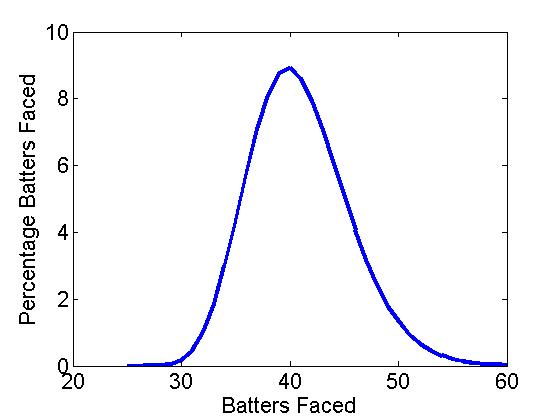
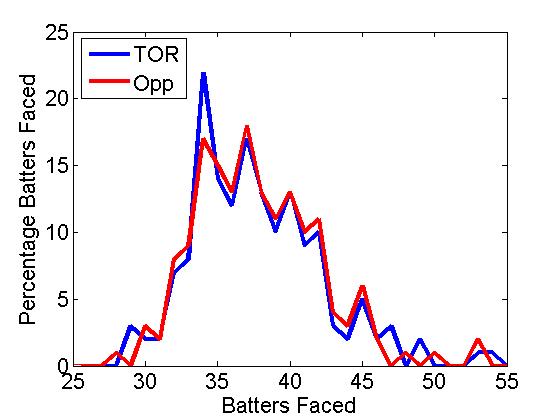
Figure 1a shows the distribution of batters faced (BF) over 1,000,000 simulated BOO games, where the most likely end was 40 batters faced followed by 39 and 41 (the 3-5 hitters), as might be expected with a hard-wired OBP = .333 (binomial p = .33). It seems the custom of having your clutch hitters in the 3-5 slots matches the computational results.

BOOFigure1a BOOFigure1b

Figure 1a: Distribution of # of batters faced   Figure 1b: Distribution of end-game batters

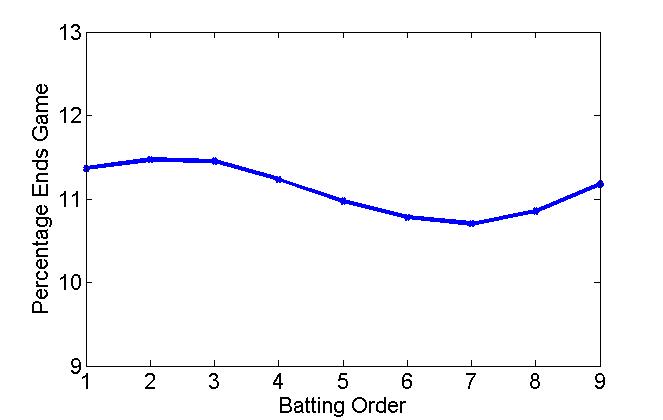
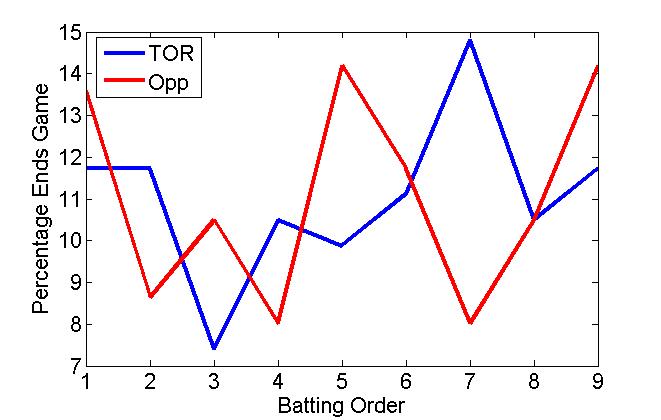
Interestingly, however, the leadoff hitter doesn’t end a game more often than a middle-order batter. Figure 1b shows the distribution of end-game batters (EGB) for a 1-9 lineup, and is perhaps counter-intuitive. In fact, the number 2 and 3 hitters are more likely to end a game than the leadoff hitter, while there is an obvious dip 3-7. Table 1 shows the frequency of end-game batters 1-9 (number and percentage).

1 2 3 4 5 6 7 8 9
# of games ended 18.4 18.6 18.6 18.2 17.8 17.5 17.3 17.6 18.1
% games ended 11.4 11.5 11.5 11.2 11.0 10.8 10.7 10.9 11.2

Table 1: Number of games ended and percentage versus lineup position (OBP = .333)

Initially, I expected a constant drop-off from 1 to 9, or perhaps following some form of a Benford’s Law distribution, for example, in the wear pattern on a ATM pad or the leading digit in a collection of financial data (1 appears about 30%, 2 about 18%, 3 about 12%, 4 about 10%, . . . , and 9 about 5%). Note, if the data were randomly distributed, each number would appear 11.1% or 1/9. But the modulo aspect of a repeated baseball lineup creates another distribution, one that has a clear maximum after the leadoff spot and a mid-lineup dip at batter number 7.

Of course, the leadoff hitter will always have more plate appearances over an entire season, but somewhat surprisingly does not end a game more often. Table 2 shows the number of at bats 1-9 averaged over a 162-game season (I have assumed 8.5% of plate appearances are walks). As can be seen, the leadoff hitter gets about 130 more ABs than the number 9 hitter, or 21% more per season, reason enough to put your best hitter at the top of the order. From one batter to the next, however, the difference is only about 17 ABs (monotonically decreasing), about an extra AB every 10 games. Not that much difference one spot to the next.

1 2 3 4 5 6 7 8 9
# of ABs 757 740 723 706 689 673 657 641 625
% ABs 12.2 11.9 11.6 11.4 11.1 10.8 10.6 10.3 10.1

Table 2: Number of ABs and percentage ABs over 162 games (OBP = .333)

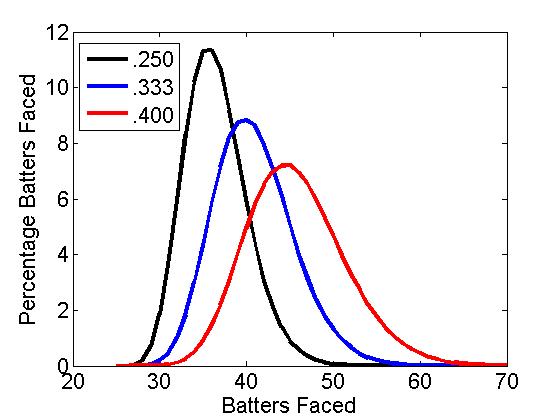
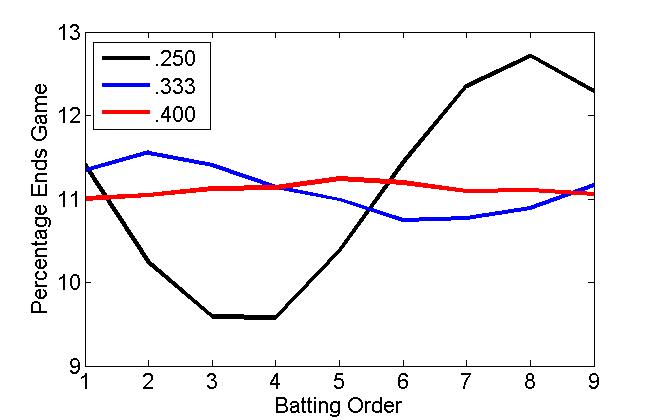
Using BOO, we can also analyse how the EGB distribution changes for a good and a bad team, modelled using an OBP of .250 and .400. The results are shown in Figure 2 including our .333 OBP team. Here, it seems that the lineup order matters more on a bad team than a good team (a practically flat EGB). Indeed, it is often said that you can run any lineup out with a good team. Conversely, losing teams are always juggling their lineups to find the right mix.

BOOFigure2a BOOFigure2b

Figure 2a: Distribution of # of batters faced   Figure 2b: Distribution of end-game batters (OBP = .250, .333. .400)

Of course, baseball is not just statistics over a large number of sample-sizes (or simulations). Baseball is played in bunches and hunches. It would take a little over 400 years to play 1,000,000 games in a 30-team, 162-game schedule. Matchups, streaks, situational hitting, and team chemistry may be more important than any theoretical trends. And, of course, a real, non-flat, batting lineup (which I’ll look at in Part II).

In an actual BF and EGB distribution for the 2014 Toronto Blue Jays and their opponents over a 162-game season, we see the small-sample versions of our super-sized theoretical distributions (Figure 3). The actual BF distribution is comparable to the theoretical binomial/Gaussian BF, though positively skewed, showing the effect of blowouts, not adequately covered in the hit/out simulation. The EGB distribution seems quite random, but late peaks may indicate the use of pinch hitters in the closing parts of a game. It is also interesting to note that BOO “throws” a perfect game about once every 10 seasons, a bit less than the official 23 over the last 135 years.

BOOFigure3a BOOFigure3b

Figure 3a: Distribution of # of batters faced   Figure 3b: Distribution of end-game batters (2014 Toronto Blue Jays and opposition)

So do the calculations mean anything? According to the numbers, your best hitter should bat 2 or 3, that is, if you want him coming up more often with the game on the line. In “The Batting Order Evolution,” Sam Miller noted that “the anecdotal evidence is strong” to put your best hitter in the number 2 spot. The worst spot for heroics is number 7.

Furthermore, a classic run producer such as Troy Tulowitzki shouldn’t bat leadoff, something the Jays found out after he struck out 4 times, almost a month to the day after acquiring him. Dropping him to the number 5 spot, the manager John Gibbons stated, “Maybe this’ll jump-start him a little bit.” Or maybe, he saw the wisdom of inserting the 2014 NL hit leader and speedster Ben Revere in the leadoff spot and using Tulowitzki’s power in a proven RBI position.

Mind you, with a scorching hot lineup that has scored 100 more runs than the next-best hitting team, it may not matter who bats where. That is, if the game is on the line.

Do The Math! is available in paperback and Kindle versions from the publisher Sage Publications, on-line at Amazon.com, and on order at local book stores. Do The Math! (in 100 seconds) videos are on You Tube.


Battery Allowed Baserunning (BAB): What It Is and Why You Need It

Before I get started, just a quick note: I have created some graphics to aid in the explanation of my work, but was unable to integrate the graphics into WordPress. To view a pdf of the post with graphics included click here. (Also note that you won’t be able to click on hyperlinks in the pdf but the URLs of each link can be found at the end.) Otherwise, please enjoy the post below without the graphics.

I set out the other day to try to develop an equation that can predict, with reasonable accuracy, the number of runs a team will allow. I intended to use Fielding Independent Pitching Minus (FIP-) and Ultimate Zone Rating (UZR) (see my blog post to come on this research for why I used those two statistics) but noticed one position that had gone unaccounted for thus far: catching. UZRs don’t exist for catchers because UZR is based on Outfield Run Arms (ARM), Double-Play Runs (DPR), Range Runs (RngR), and Error Runs (ErrR)1, none of which are among the most relevant statistics for catchers. While catchers do play a role in bunts, popups, and plays-at-the-plate, the most important aspects of the position, and where the most variability exists, is in the baserunning game. Blocking pitches and throwing out baserunners are the responsibilities of a catcher that have the greatest impact on the game.

Obviously I’m far from the first one to set out to quantify a catcher’s impact on the game. In fact, incredible progress has been made by the likes of The Fielding Bible who calculate the metric Stolen Base Runs Saved (rSB) to measure a catcher’s effect on stealing and Bojan Koprivica who calculates Passed Pitch Runs (RPP)2 to measure the catcher’s ability to block errant pitches3. While both of these are good metrics* to measure a catcher’s value, they will never be adequate predictors in a team-based context because they don’t account for the other half of the equation: the pitcher. Catcher baserunning defense will forever be connected to the pitcher. Stolen bases are dependent upon the lead and jump that the runner gets, both of which depend on the pitcher’s pickoff move, predictability on when he throws over and when he goes to the plate, and the speed of his delivery. Likewise the number of bases taken via wild pitches and passed balls depends on the accuracy of the pitcher.

* I’m skeptical on the validity of the Stolen Base Runs Saved metric because it hinges on the ability to use a pitcher’s past history of allowing stolen bases as a baseline for how easy or hard they make it for runners to steal. The way this would work would be if the stolen base attempts off a pitcher were spread out over a large number of catchers with varying abilities so that the ability of the catcher on a given stolen base attempt would be random. However, many pitchers have pitched mostly to just a few catchers, which would not achieve the necessary randomness. For the time being, I’ll take rSB’s acceptance by the baseball community as sufficient vetting but if nothing else I would point to this as another reason why a new metric is needed.

Where I differ from my predecessors is what I decided to do with this undeniable interconnectedness. They tried to control for the pitcher by measuring the variation catchers have from past averages. This is necessary when searching for a stat to measure a catcher’s independent value. I instead decided to take my catching metric and turn it into a metric that measures both the pitcher and catcher together (hence Battery Allowed Baserunning). In doing so, the metric lost its capability to assess either player’s individual impact, but gained the ability to measure their combined impact on the team. It also became more innately accurate because it is strictly a measure of observable events, rather than an experimental determination. No matter how impeccable the statistical procedure, any attempt to extract additional meaning or relevance from the numbers creates the risk of error.

Enough with the preview, lets get into it. I assembled data from the years 2003 to 2014 (every complete season with UZR data because I intended to go back with these number to my original inquiry). I selected the statistics Stolen Bases (SB), Caught Stealing (CS), Wild Pitches (WP), Passed Balls (PB), Pickoffs (PK), and Balks (BK) as those that resulted from the battery and set about combining them.

I aggregated Wild Pitches and Passed Balls because the only difference between the two is the blame assigned by the official scorer. BAB measures the impact of the battery and being that both WPs and PBs are attributable to the battery, both should be included. Furthermore, a given ball that gets by the catcher and allows runners to advance is completely random as to if it is a PB or WP—that is to say one does not happen more or less often in a given situation (eg. Mostly with 1 runner on base; scarcely with two outs) than the other. As such, they can be equally weighted. By the same logic I added balks to this sum. Oversimplified, all three are accidents by the pitcher or catcher that aren’t influenced by the situation. I call this sum of Wild Pitches, Passed Balls, and Balks non-Stolen Base Advancement (nonSBadv).

I stressed the randomness of the Wild Pitches, Passed Balls, and Balks because Stolen Base Attempts do not occur randomly. Rather, their likelihood depends upon the situation. A wild pitch is equally likely to occur with the bases loaded as when there is just a runner on first. However, a triple steal is nowhere near as likely as a runner on first stealing second with no one else on base. Likewise a balk with a runner on second is just as likely to occur with one out as it is two outs. On the contrary, the tendency of a runner to steal is influenced by the out total. For example, runners are generally less likely to steal third with two outs than with one because with one out reaching third gains the advantage of being able to score on a sacrifice fly or a ground out but that doesn’t work with two outs. The same goes for the score of the game, the inning, and so forth but you get the idea. The point is Stolen Base Attempts and non-Stolen Base Advancement need to be treated separately because the odds of the former is influenced by the situation while the odds of the latter not.

As for combining the last three stats, Stolen Bases, Caught Stealings, and Pickoffs, the easy part was the latter two. I added them because they have the exact same result—increasing the out total by one and removing a baserunner. I called this sum Baserunning Out (BRout).

The only possible issue with this is that catching a runner stealing also keeps the runner from advancing a base while pickoffs don’t always do this. Sometimes, and I would argue most of the time, pickoffs happen because of a bad jump or abnormally large lead due to a runner’s plans to steal on that pitch or soon thereafter. Furthermore, many pickoffs occur when a player doesn’t even try to get back to their former base on a pickoff throw and are thrown out in the ensuing run-down. This situation is almost precisely the same as a stolen base attempt. Other times, however, the pitcher just has a good move and catches the runner off guard, despite the runner having no plans to steal. I didn’t have a good way to account for this, being that pickoffs aren’t classified in any way. Since pickoffs are far less common than caught stealings I decided to just let this one slide.

This leaves me with just one stat unaccounted for: stolen bases. I couldn’t simply subtract baserunning outs from stolen bases because they are not the same. A caught stealing increases the out total, while a stolen base does not decrease it; a stolen base advances a baserunner a base while a caught stealing doesn’t just move a runner back a base, it eliminates them entirely. For example, given a runner on second with less than two outs, if the runner steals third the advantage is that he can now be scored on some groundouts and flyouts and all non-Stolen Base Advancements. However, if the runner is thrown out at third all opportunities for the runner to be scored via a hit and all opportunities that include advancing over multiple at-bats are lost. The latter loss is much greater than the former gain.

To measure that exact difference I turned to run potentials. The stolen base run potential measures the additional runs, on average, that are scored after a stolen base as opposed to the former state. The same goes for caught stealing except for that those numbers are always negative because fewer runs are expected to be scored after a caught stealing than otherwise would have been. Over the period 2003-2014, the SB run potential was always 0.2 while the CS run potential was anywhere between -0.377 and -0.439, depending on the year. (Since I earlier deemed Caught Stealings and Pickoffs to be statistically equivalent I allowed the CS run potential to represent both.) For each year I divided the loss in run potential from a caught stealing by the gain in run potential from a stolen base. In essence, I did this to use the run potentials as a ratio. The ratio I created was the ratio of loss from a caught stealing to the gain from a stolen base.

As I said above, a stolen base results in a one base advancement while a caught stealing results in a hindrance that is much greater, much greater than one base. By multiplying the above ratio/dividend by each Baserunning Out total, those totals become the overall loss in bases, the same unit as stolen bases. Now the new, weighted BRout total can be subtracted from (or added to if you keep the negative sign in CS run potential and your ratio is thus negative) the stolen base total. This quantity is called Net Stealing (NS).

One important question I’m sure you have is how to approach decreased stolen base attempts against well-respected batteries. This is a question I wrestled with quite a bit. The explanation that finally made sense was this: think about the advantage of a well-respected battery as that of a pitcher with an excellent pickoff move. Yes, from time to time runners will be picked-off but that’s not the purpose of the pickoff. The purpose is to keep the runners close so that they rarely attempt to steal bases—that they advance the minimum amount, only the amount allowed by hits, walks, HBPs, etc., and that when they do try to steal they are at such a disadvantage that they get thrown out. Applying this back to the battery as a whole, the best battery is the one that has a negative Net Stealing value (for whom attempting to steal against will have a negative net impact in the long run), but not necessarily a hugely negative Net Stealing value because the original intent of a strong battery is to keep runners from advancing, not to get them out. A Net Stealing value of 0 should be regarded as success because it means no bases were taken. The original purpose was achieved. A well-respected battery’s Net Stealing is bound to be low because NS is a counting stat, measuring the total bases taken against a given battery and you can’t take very many if your number of attempts is low. Therefore, the Net Stealing values of well-respected batteries does not have to be adjusted for low numbers of stolen base attempts because the advantage this entails is already reflected in their Net Stealing consequentially being a low number, be it a low positive one or a low negative one.

The final task is to merge non-Stolen Base Advancement with Net Stealing. This is not a task for a simple sum because Net Stealing’s unit is bases, as I painstakingly ensured above, but non-Stolen Base Advancement’s is not. A wild pitch with the bases loaded is a single wild pitch, as is a wild pitch with just one runner on base. The glaring issue is that the former situation resulted in three bases being taken while the latter in just one base, but both are valued as one unit, one nonSBadv. To solve this I return to a concept I referenced earlier—that nonSBadvs are totally random and no more or less likely based on the number of runners on base (ROB). Therefore, the total number of bases taken on nonSBadvs should mirror the average number of runners on base at a given moment. Although, I must clarify this to the average number of runners on base at a given moment, provided that at least one runner is on base. A wild pitch with the bases empty is not reflected in the box score so the numbers would be skewed if I included those situations as being possible scenarios for a nonSBadv. Because the only data available was from an offensive perspective—tracking the number of runners on base when each hitter was at-bat, I had to settle for creating yearly league averages to be used for every team. I did this by taking the total number of runners that were on base during plate appearances and dividing that by the number of plate appearances that had runners on base.

Once I had the average ROB with ROB I multiplied that number by each nonSBadv value to make the unit bases and therefore able to be combined without unintended weighting to my Net Stealing value.

In a perfect world I would have used team-specific average runners on base values, because teams with better pitching staffs aren’t at quite as much risk on nonSBadvs because there are typically fewer runners on base to advance than there are for teams with worse pitching staffs. At the end of the day I didn’t lose too much sleep over this because it was an approximation either way. It’s conceivable that a team that allowed very few runners on base was miraculously more prone to nonSBadvs with more runners on base or vice-versa so while the approximation would have theoretically been slightly better, it wasn’t a matter of life-or-death.

Once I had weighted non-Stolen Base Advancements by multiplying it by the average number of runners on base, I simply added that value to Net Stealing to create Battery Allowed Baserunning.

So there you have it: Battery Allowed Baserunning (BAB). The last thing I want to talk about is its applications, shortcomings, and potential improvements.

Applications: As I stated at the beginning, this statistic was originally conceived of in the search for a metric that measured the impact that a catcher (and eventually a battery) had on a team defensively. For now, I believe this stat belongs in the team defensive category for the same reason that outfield assists and double plays are measured in a team context, even though they only involve a couple of players: because it measures the skill/weakness the team as a whole has in this discipline. It could, theoretically, be used as an individual stat belonging to both the pitcher and catcher, although it would need to be understood that a tremendous confounding variable exists in the given player’s batterymate.

One way managers could use BAB is to help determine pitcher-catcher assignments. While lots of the time the catcher with the better bat will be behind the plate no matter what, this could show them which assignment would be best from a defensive perspective, and perhaps when that difference does or doesn’t outweigh the offensive difference. This would be one of the better uses of BAB because it depends on BAB’s distinguishing attribute, its measure of each battery’s combined performance. If a catcher is able to read a specific pitcher’s breaking ball especially well, their BAB value would reflect that. As a result, even if one catcher were better overall, BAB would indicate if a different catcher happens to work better with a given pitcher.

Another possible managerial use would be to use Net Stealing to decide when to steal. In a tight game with a lights-out pitcher, a large Net Stealing value, combined with predictive measures that indicate low chance of success for the batter, could mean that trying to steal a base would be a statistically/probabilistically sound decision. Finally, BAB’s best use, in the team category, would be in all-encompassing calculations such as Pythagorean expectation4. This is because it doesn’t account for the situation and such calculations measure overall offensive/defensive output regardless of situation. There is an expectation of moderate error for that exact reason.

Shortcomings: As I ended my “Applications” section with, one main issue with the stat is that it doesn’t account for the importance of a given play on the outcome of the game. A balk-off (walk-off balk) and a wild pitch by a position player in the 9th inning of a 14-0 game are treated the same. Theoretically, a team’s BAB could be skewed by throwaway innings at the end of blowout games. The stealing part of the equation takes care of itself for the most part because most stealing occurs in tight games when a team needs an edge, but the nonSBadv part of the equation would need to be addressed.

Additionally, more reliable information as to how many bases are taken on WPs, PBs, and BKs would greatly improve the accuracy of the statistic. My current strategy of using the average number of runners on base is actually ideal for a value statistic because it doesn’t discriminate against players based on how lucky/unlucky they were—based on how many runners were on base during nonSBadvs. However, BAB as it stands now is not a value statistic. Therefore, it would more effectively do its job of measuring the observed impact the battery has if the number of bases taken on nonSBadvs was more accurate.

I also wasn’t able to account for extra bases taken on overthrows by either half of the battery on pickoffs or when throwing out runners. The difficulty is that while each overthrow that allows a runner to advance is scored an error, I don’t know of a way to differentiate between non-baserunning related errors, or errors that resulted in multiple bases being taken.

Lastly, I haven’t found a good way to account for double steals. When a runner is thrown out on a double steal, the other does not get credit for a stolen base. While the battery certainly is not deserving of blame for this, the base taken is an observable influence that BAB intends to measure. Finally, introducing weighting for the different bases (2nd, 3rd, or home) would also allow BAB to more accurately measure the influence that the allowed baserunning has on the game.

Improvements: As it stands the unit for BAB is bases taken. To make it easier to read, this could be pretty easily converted to runs by dividing by four. (I must admit, I’m not positive on this one as I haven’t yet read up on how stats whose unit is runs are calculated. This just made intuitive sense to me. Judging by the run potential of a stolen base being 0.2, perhaps this I should actually divide by 5.) From there the unit could even be converted to wins and become a WAR5-like stat if plugged into the Pythagorean Expectation formula. (Again, not 100% positive this would work but it makes intuitive sense. I’ll look into it.)

One possible way this statistic could measure individuals’ performances would be (ironically) to use the same strategy Stolen Base Runs Saved used that made me skeptical. Theoretically, a pitcher’s value could be determined by comparing how he performs with each catcher relative to how that catcher performs on average with all other pitchers. This average (weighted for number of pitches thrown to the given catcher) could determine a pitcher’s true value. That true value would be the average influence they have on their battery’s BAB (per 1000 pitches or something). The catcher’s true value could be calculated by working backwards, by taking the true value of each pitcher they have caught (the influence on their BAB they have endured from other pitchers) and subtracting that value (weighted by the number of pitches they have caught from each pitcher), from their total BAB. What would make this work better than what Stolen Base Runs Saved did is if catchers saw enough different pitchers to rule out the possibility that they looked good because their pitchers, on average, made them look disproportionately good. Just as Stolen Base Runs Saved needs sufficient variability in the catchers that pitchers throw to in order to have statistic validity, for this to work for BAB catchers would need sufficient variability in the pitchers they catch.

Finally, for fun, here are the five best and worst BAB, Net Stealing, and nonSBadv seasons, by a team since 2003 (not including this current season). Do keep in mind that while I included the primary catcher for each team, each of these statistics measures both the pitcher and catcher and thus is not an accurate reflection of the contributions exclusively by the catcher. I just included the catcher because they are catching for a much higher percentage of the season than any pitcher is pitching.

Top 5 Best BAB Seasons Since 2003

Team                                                   BAB                                       Primary Catcher

2008 Oakland Athletics ……………-28.79…………………….…..Kurt Suzuki

2004 Oakland Athletics …………….7.04………………………….Damian Miller

2005 San Francisco Giants ……….10.67…………………………Mike Matheny

2012 Philadelphia Phillies …………12.12……………………..….Carlos Ruiz

2005 Detroit Tigers ………………….16.91……………………..….Ivan Rodriguez

Top 5 Worst BAB Seasons Since 2003

Team                                                   BAB                       Primary Catcher

2007 San Diego Padres …………….214.32……………..Josh Bard

2010 New York Yankees …………..185.96………….….Francisco Cervelli/Jorge Posada

2014 Colorado Rockies …………….177.41………………Wilin Rosario

2008 Baltimore Orioles ……………177.39.…………….Ramon Hernandez

2012 Pittsburgh Pirates …………….175.71……………..Rod Barajas

Top 5 Best Net Stealing Seasons Since 2003

Team                                          Net Stealing                                        Primary Catcher

2008 Oakland Athletics ……….-87.50………………………………..Kurt Suzuki

2004 Oakland Athletics ……….-73.84………………………………..Damian Miller

2005 Detroit Tigers …………….-69.35…………………………………Ivan Rodriguez

2003 Los Angeles Dodgers …..-62.08………………………………..Paul Lo Duca

2007 Seattle Mariners …………-57.95……………………….………..Kenji Johjima

Top 5 Worst Net Stealing Seasons Since 2003

Team                                          Net Stealing                                Primary Catcher

2007 San Diego Padres ……….134.60………………………….Josh Bard

2012 Pittsburgh Pirates ……….97.44……………………………Rod Barajas

2006 San Diego Padres ……….88.93……………………………Mike Piazza

2009 Boston Red Sox ………….87.40……………………………Jason Varitek

2008 San Diego Padres ……….77.70…………………………….Nick Hundley/Josh Bard

Top 5 Best Non-Stolen Base Advancement Seasons Since 2003

Team                                          nonSBadv                                   Primary Catcher

2005 Cleveland Indians …………36 ………………………………Victor Martinez

2010 Philadelphia Phillies ……..37 ………………………………Carlos Ruiz

2004 San Diego Padres …………38……………………………….Ramon Hernandez

2008 Houston Astros ……………39……………………………….Brad Ausmus

2009 Philadelphia Phillies……..40………………………….……Carlos Ruiz

Top 5 Worst Non-Stolen Base Advancement Seasons Since 2003

Team                                          nonSBadv                                     Primary Catcher

2012 Colorado Rockies ……….122………………………………Wilin Rosario

2009 Kansas City Royals …….109………………………………Miguel Olivo

2010 Colorado Rockies ……….104………………………………Miguel Olivo

2006 Kansas City Royals …….104………………………………John Buck

2010 Los Angeles Angels …….102………………………………Jeff Mathis/Mike Napoli

1http://www.fangraphs.com/library/defense/uzr/

2http://www.hardballtimes.com/another-one-bites-the-dust

3http://www.fangraphs.com/library/defense/catcher-defense/

4http://www.baseball-reference.com/bullpen/Pythagorean_Theorem_of_Baseball

5http://www.fangraphs.com/library/misc/war


Hardball Retrospective – The “Original” 1992 San Diego Padres

In “Hardball Retrospective: Evaluating Scouting and Development Outcomes for the Modern-Era Franchises”, I placed every ballplayer in the modern era (from 1901-present) on their original team. Therefore, Bobby Grich is listed on the Browns / Orioles roster for the duration of his career while the Phillies declare Dick Allen and the Pirates claim Jose A. Bautista. I calculated revised standings for every season based entirely on the performance of each team’s “original” players. I discuss every team’s “original” players and seasons at length along with organizational performance with respect to the Amateur Draft (or First-Year Player Draft), amateur free agent signings and other methods of player acquisition.  Season standings, WAR and Win Shares totals for the “original” teams are compared against the “actual” team results to assess each franchise’s scouting, development and general management skills.

Expanding on my research for the book, the following series of articles will reveal the finest single-season rosters for every Major League organization based on overall rankings in OWAR and OWS along with the general managers and scouting directors that constructed the teams. “Hardball Retrospective” is available in digital format on Amazon, Barnes and Noble, GooglePlay, iTunes and KoboBooks. The paperback edition is available on Amazon, Barnes and Noble and CreateSpace. Supplemental Statistics, Charts and Graphs along with a discussion forum are offered at TuataraSoftware.com.

Don Daglow (Intellivision World Series Major League Baseball, Earl Weaver Baseball, Tony LaRussa Baseball) contributed the foreword for Hardball Retrospective. The foreword and preview of my book are accessible here.

Terminology

OWAR – Wins Above Replacement for players on “original” teams

OWS – Win Shares for players on “original” teams

OPW% – Pythagorean Won-Loss record for the “original” teams

Assessment

The 1992 San Diego Padres          OWAR: 52.6     OWS: 324     OPW%: .595

GM Jack McKeon acquired 84.2% (32/38) of the ballplayers on the 1992 Padres roster. Based on the revised standings the “Original” 1992 Padres won 96 contests but came up two games short of the Atlanta Braves for the division title. San Diego led the National League in OWAR and OWS.

The Padres’ offense featured seven players that registered at least 20 Win Shares. Roberto Alomar (.295/8/76) scored 105 runs, stole 49 bases and topped the Friars with 31 Win Shares. Carlos Baerga (.312/20/105) accrued 205 safeties and earned his first All-Star appearance. Shane Mack posted a .315 BA with 101 tallies and 26 steals. Dave Winfield crushed 33 two-baggers and 26 big-flies while plating 108 baserunners. The corner infield was anchored by John Kruk (.323/10/70) and Dave “Head” Hollins (.270/27/93). Ozzie “The Wizard” Smith batted .295 and continued his dazzling defensive displays to earn his 13th consecutive Gold Glove Award. Tony Gwynn aka “Mr. Padre” batted .317 in the midst of an 19-year streak in which he hit .300 or better.

Gwynn ranked sixth among right fielders according to Bill James in “The New Bill James Historical Baseball Abstract.” Eight ballplayers from the 1992 Padres roster placed in the “NBJHBA” top 100 rankings including Ozzie Smith (7th-SS), Roberto Alomar (10th-2B), Dave Winfield (13th-RF), Kevin McReynolds (45th-LF), John Kruk (72nd-1B), Ozzie Guillen (74th-SS) and Carlos Baerga (93rd-2B).

LINEUP POS WAR WS
Ozzie Smith SS 3.24 22.13
Tony Gwynn RF 1.69 17.86
Roberto Alomar 2B 5.37 31.53
Shane Mack CF/LF 6.17 27.47
John Kruk 1B 4.35 25.38
Dave Hollins 3B 3.61 25.6
Kevin McReynolds LF 1.27 12.89
Benito Santiago C 0.81 8.17
BENCH POS WAR WS
Carlos Baerga 2B 4.83 28.54
Dave Winfield DH 3.53 25.75
Joey Cora 2B 0.66 3.98
Mark Parent C 0.25 1.42
Warren Newson RF 0.25 4.04
Paul Faries 2B 0.19 0.82
Ron Tingley C 0.13 3.36
Sandy Alomar C 0.09 8.2
Rodney McCray RF 0.09 0.45
Gary Green SS 0.08 0.46
Guillermo Velasquez 1B 0.08 0.7
Thomas Howard LF 0.05 6.44
Ozzie Guillen SS -0.01 0.41
Jose Valentin 2B -0.03 0
Luis Quinones DH -0.04 0.02
Jim Tatum 3B -0.1 0.08
Mike Humphreys LF -0.15 0.12
Jerald Clark LF -0.67 9.94

Andy Benes furnished a 3.35 ERA and notched 13 wins for the ’92 squad. Omar Olivares crafted an ERA of 3.84 and managed 9 victories in 30 starts. Bob Patterson saved 9 contests while Jim Austin fashioned a 1.85 ERA in 47 relief appearances.

ROTATION POS WAR WS
Andy Benes SP 4.22 15.68
Omar Olivares SP 1.89 8.33
Jimmy Jones SP 0.41 4.89
Greg W. Harris SP 0.4 3.81
Ricky Bones SP -0.35 4.22
BULLPEN POS WAR WS
Jim Austin RP 1.21 6.79
Bob Patterson RP 0.95 7.52
Mark Williamson RP 0.4 2.48
Matt Maysey RP -0.01 0.08
Steve Fireovid RP -0.18 0.3
Mitch Williams RP -0.27 4.99
Doug Brocail SP -0.23 0


The “Original” 1992 San Diego Padres roster

NAME POS WAR WS General Manager Scouting Director
Shane Mack LF 6.17 27.47 Jack McKeon Sandy Johnson
Roberto Alomar 2B 5.37 31.53 Jack McKeon
Carlos Baerga 2B 4.83 28.54 Jack McKeon
John Kruk 1B 4.35 25.38 Jack McKeon Bob Fontaine Sr.
Andy Benes SP 4.22 15.68 Jack McKeon
Dave Hollins 3B 3.61 25.6 Jack McKeon
Dave Winfield DH 3.53 25.75 Peter Bavasi Bob Fontaine Sr.
Ozzie Smith SS 3.24 22.13 Bob Fontaine Sr.
Omar Olivares SP 1.89 8.33 Jack McKeon
Tony Gwynn RF 1.69 17.86 Jack McKeon Bob Fontaine Sr.
Kevin McReynolds LF 1.27 12.89 Jack McKeon Bob Fontaine Sr.
Jim Austin RP 1.21 6.79 Jack McKeon
Bob Patterson RP 0.95 7.52 Jack McKeon Sandy Johnson
Benito Santiago C 0.81 8.17 Jack McKeon Sandy Johnson
Joey Cora 2B 0.66 3.98 Jack McKeon
Jimmy Jones SP 0.41 4.89 Jack McKeon Sandy Johnson
Mark Williamson RP 0.4 2.48 Jack McKeon Sandy Johnson
Greg Harris SP 0.4 3.81 Jack McKeon
Mark Parent C 0.25 1.42 Bob Fontaine Sr.
Warren Newson RF 0.25 4.04 Jack McKeon
Paul Faries 2B 0.19 0.82 Jack McKeon
Ron Tingley C 0.13 3.36 Bob Fontaine Sr.
Sandy Alomar C 0.09 8.2 Jack McKeon Sandy Johnson
Rodney McCray RF 0.09 0.45 Jack McKeon Sandy Johnson
Gary Green SS 0.08 0.46 Jack McKeon Sandy Johnson
Guillermo Velasquez 1B 0.08 0.7 Jack McKeon
Thomas Howard LF 0.05 6.44 Jack McKeon
Ozzie Guillen SS -0.01 0.41 Jack McKeon
Matt Maysey RP -0.01 0.08 Jack McKeon
Jose Valentin 2B -0.03 0 Jack McKeon
Luis Quinones DH -0.04 0.02 Bob Fontaine Sr.
Jim Tatum 3B -0.1 0.08 Jack McKeon
Mike Humphreys LF -0.15 0.12 Jack McKeon
Steve Fireovid RP -0.18 0.3 Bob Fontaine Sr.
Doug Brocail SP -0.23 0 Jack McKeon
Mitch Williams RP -0.27 4.99 Jack McKeon Sandy Johnson
Ricky Bones SP -0.35 4.22 Jack McKeon
Jerald Clark LF -0.67 9.94 Jack McKeon


Honorable Mention

The “Original” 1989 Padres    OWAR: 46.4     OWS: 303     OPW%: .552

Tony Gwynn collected his fourth batting crown with a .336 BA and topped the circuit with 203 base knocks. Roberto Alomar batted .295 and pilfered 42 bases during his sophomore season. Ozzie Smith contributed 30 doubles and nabbed 29 bags while Kevin McReynolds jacked 22 long balls and knocked in 85 baserunners. Greg W. Harris accrued 8 wins and 6 saves to complement an ERA of 2.60, pitching primarily out of the bullpen. The Friars tied the Giants for second place in the National League West, two games behind the division-leading Reds.

On Deck

The “Original” 1986 Mets

References and Resources

Baseball America – Executive Database

Baseball-Reference

James, Bill. The New Bill James Historical Baseball Abstract. New York, NY.: The Free Press, 2001. Print.

James, Bill, with Jim Henzler. Win Shares. Morton Grove, Ill.: STATS, 2002. Print.

Retrosheet – Transactions Database

Seamheads – Baseball Gauge

Sean Lahman Baseball Archive


Ian Desmond’s Second Half Resurgence

It’s been just over a month since Ian Desmond’s mid-season outlook. Things were not going well for Ian Desmond, playing in his contract year in 2015 he was hoping to set himself up for a massive pay day. After turning down a reported $107 million dollar extension, Desmond was hoping for a productive 2015 season. Things could not have gone much worse in the first half of the season.

Desmond’s monthly splits reveal a roller coaster season for the soon-to-be free agent. March and April started out slowly, his play picked up in May, and then June came. The month of June was simply abysmal, so of course let’s take a more in-depth look at his numbers that month. His performance that month compared to his career averages were all much worse. He walked only 3% of the time while striking out 33.3% of the time (just over 10% higher than his career average). Any time you combine a low walk rate and a high strikeout rate you can expect a really poor OBP. In the month of June his OBP (note: NOT HIS BATTING AVERAGE!) was below the Mendoza line and his wRC+ was 22. That means in the month of June Ian Desmond created 78% less runs than league average. For a player in his walk year and especially someone who turned down over $100 million, it should be concerning to say the least.

Monthly BB% K% OBP SLG ISO BABIP wRC+ wOBA
Mar/Apr 6.90% 22.80% 0.287 0.326 0.109 0.279 70 0.274
May 4.30% 28.70% 0.310 0.444 0.167 0.375 106 0.326
Jun 3.00% 33.30% 0.194 0.269 0.108 0.207 22 0.204
Jul 8.00% 33.00% 0.253 0.392 0.203 0.234 73 0.278
Aug 8.20% 24.70% 0.353 0.500 0.205 0.358 135 0.369
1st Half 4.90% 28.40% 0.255 0.334 0.124 0.279 60 0.259
2nd Half 8.60% 28.60% 0.338 0.512 0.236 0.342 133 0.366
Career 5.90% 23.10% 0.312 0.425 0.161 0.321 101 0.321

Then something strange happened: Ian Desmond started turning his season around after the All-Star break. His stats in the second half have been a complete turnaround. He’s walking more, striking out less but still more than his career average, and generally just performing better. His August BABIP is well above his career average suggesting that we can expect some regression at some point.

While only 35 games into the second half, his performance compared to the first half is night and day. He has already hit more home runs and stolen more bases in less than half the games, and his RBI total is inching closer to his first half mark. Most importantly, in the second half of the season he has been worth 1.1 WAR (Bryce Harper for comparison has been worth 1.5 WAR in the second half). Not only is this good news for Desmond’s free-agent stock, but the Nationals will need all the help they can get while they try to chase down the teams in front of them for a playoff berth. As of right now, the Nationals are 5.5 games back of the Mets for the division lead and 10.0 games back of the Cubs for that second wildcard.

Monthly G PA HR R RBI SB WAR
First Half 84 348 7 36 24 5 -0.6
Second Half 35 140 8 21 22 6 1.1

As an added bonus, I thought it might be useful here to show a plot of Ian Desmond’s career trajectory as predicted by his seasonal OPS. This model was created using the methods presented in the book “Analyzing Baseball Data with R” by Max Marchi and Jim Albert, and I’ve excluded Desmond’s age-23 season where he only played 21 games.

Based on the age trajectory graph it looks like Desmond may have already peaked in his career. What this means for his potential earnings this upcoming offseason remains to be seen. Any GM looking to add a top-tier hitting shortstop for the next few seasons will inevitable come calling his agent, but the data tells us that his best days may be behind him.


Final Month Fantasy Fun With Excel

The Major League Baseball season is just past the three-quarter mark, which means just under one-fourth of the season is left to be played. If you play fantasy baseball, you should know by now whether you have a chance to win this year. If you’re still in contention, now is the time to really take a good look at the important categories for your team. If you’re not in contention, don’t be a chump and just give up. At the very least, play an active lineup each day as a courtesy to the other owners in your league.

By this point, trades may no longer be an option. Most leagues have trade deadlines set before late August, so you are more likely looking at waiver-wire additions and setting your lineup in a way to optimize the points you can gain and minimize the points you can lose.

The vast majority of fantasy baseball leagues have both counting stat categories (runs, home runs, RBI, stolen bases, wins) and rate-stat categories (batting average, ERA, WHIP). In general, it’s easier to see how many points you can gain or lose in the counting categories. With so much of the season done, some of the counting-stat categories have taken on greater importance. Perhaps steals is a very tight category in which you have room to move up or down and could gain or lose a few points. It’s clear that you have to make add/drop moves and set your lineup to address steals, while also keeping an eye on any other hitting categories that would suffer with the addition of a low-power basestealer.

With rate-state categories, it’s a bit trickier than just looking at the standings and making an estimate of how much you can move up or down. I’ll use pitching as an example. In my standard 12-team Yahoo league, there is an innings limit of 1250 innings. In this league, the top team in innings pitched has used up 1037 innings (83% of the limit), while the bottom team has just 932 innings (75% of the limit). Moving forward, this will make a difference in the counting-stat categories of wins and strikeouts. It will also make a difference in ERA and WHIP.

I like to have an idea of how much my team can move in ERA, WHIP, and Strikeouts, so I created a spreadsheet to track this. Even though this leagues uses raw strikeouts, I want to figure out my K/9 so I can more easily compare my strikeouts to teams with different innings pitched totals (you could also use K/IP).

Below is my spreadsheet. In this spreadsheet, ER stands for “Earned Runs,” BR stands for “Base Runners,” and K stands for “Strikeouts.” I plug in my current innings total (955), with my current team ERA, WHIP and Strikeouts, then calculate ER [(ERA x IP)/9], BR [WHIP x IP], and K/9 [(K/IP)*9].

In the row labeled “Remaining IP,” I use the same formulas as above for ER and BR, then use this formula in the K column: ((K/9)*IP)/9.

For the “Projected Stats” row, I add up the INN, ER, BR, and K columns, then use formulas to figure projected ERA, WHIP, and K/9 (the yellow squares).

This gives you the framework of the spreadsheet. Now it’s time to get an expectation of how your team’s pitching numbers will play out.

In the grayed-out cells, I put in various projected ERA, WHIP, and K/9 numbers. I start with an optimistic view of my team’s future pitching abilities and work down to a pessimistic view. My team currently has a 3.44 ERA, 1.18 WHIP, and 8.94 K/9. In the top of the chart, I put in 3.00, 1.00, and 9.20 in the grayed out cells for ERA, WHIP, and K/9. This tells me that if my team puts up a 3.00 ERA, a 1.00 WHIP, and a 9.2 K/9 from this point forward, my final ERA will drop to 3.34, my final WHIP will drop to 1.14, and my final K/9 will rise to 9.0. This could be considered a best-case scenario.

On the other hand, if my pitchers post a 4.00 ERA, a 1.30 WHIP, and an 8.6 K/9 from this point forward, my final ERA will be 3.57, my final WHIP will be 1.21, and my final K/9 will be 8.86.

Here is the spreadsheet with various levels of projected performance:

The main idea is to get an estimate of how much your ERA, WHIP, and K/9 can change over the final five weeks of the season. If I use the numbers from this example, I can expect my final ERA to be between 3.34 and 3.57, while realizing a more realistic estimate would be between 3.40 and 3.50 unless I’ve made some big changes to my pitching staff. It’s a similar story for WHIP, with a likely estimate being a final WHIP of 1.16 to 1.20. The range for K/9 would be from 9.0 to 8.85. As you can see, there isn’t much movement available in these pitching categories. The particulars of your league’s standings will tell you how many points you can gain or lose based on rest-of-season expectations.

Once you’ve created the spreadsheet, you can take a closer look at ERA, WHIP, and K/9 and make the moves that will help you the most.


The Leadoff Hitter: Is Speed the Answer?

Classical baseball line-up construction involves putting your fastest player in the lead-off spot. This is due to the belief that speed generates runs (a la Rickey Henderson). In order to test this theory I went back to 1998 (since the last expansion) and looked at how may runs were scored in each season and then looked at 3 indicators, OBP, wOBA and stolen bases to test which indicator would be most useful in predicting runs. Although OBP and wOBA are very similar stats I decided to include both of them in the analysis because of differences in calculation. To put simply OBP gives a home run the same weight as a single and considers them equal (which they are not) while wOBA gives different types of hits more weight (see the OBP and wOBA pages for more information). I’ll admit that I am a huge fan of stolen bases, there is nothing like watching a player steal second or third to try and get a rally started. But the question is, can you expect to score more runs by being fast or by getting on base?

To get started I only looked at data from 2015 and pulled out the top 25 players from each stat category in order to define the “fast” players and the players who get on base the most. I also standardized runs scored to runs per game (RPG) to account for rest days and injuries which may have kept players out of the lineup for short periods of time. In the plot below it appears that the leaders in stolen bases have been scoring fewer runs per game than players who get on base more often. Based on the 95% confidence intervals of the top 25 players the difference was not significant, but the results are interesting nonetheless.

Now let’s look at some long-term data with how many runs were scored each year since 1998. In the plot below we can see that there was a large spike in runs scored in 1999 and 2000 before scoring evened out. The trend seemed to remain relatively stable from 2001 up until around 2006 or 2007 and then we see a dramatic decrease in runs scored up until last year. MLB started testing for steroids in 2003 and perhaps this is why we’ve begun to see that decrease in runs scored, but that is outside the scope of this article so let’s just focus on runs.

Runs are the most important aspect in baseball, whether that means scoring runs or preventing them. In the end, if your team can’t score any runs then you can’t win any games and unless a team have a titan of an offense you need to prevent runs as well. Here we are going to focus on run generation so we can forget about run prevention from here on out. Let’s look at the seasonal stats for our indicators and see how they look over time. I’m going to note here that OBP and wOBA shown in the plots are the league average, while the stolen bases are the league total for each season. A quick look tells us that OBP and wOBA are very closely related to the trend we saw in the second figure while stolen bases have a lot of variability over time. This seems to give a lot of evidence to getting on base, but let’s go one step further and see if we can develop a linear model to predict how each predictor affects the expected runs scored in a season.

In the final plot below I’ve put runs per game on the y axis and each stat on the x axis. In order to test how changes in league performance affects run scored I predicted the number of runs scored based on the 10%, 50% and 90% quantiles to see how many runs a player would generate over a 162-game season.

I’ve created a summary table for easy comparison of each stat and the thing that really jump out is that stolen bases doesn’t have any effect on runs scored. Based on the model, in a season where players steal almost 700 more bases collectively they generate less than 1 extra run.

OBP Expected Runs (Per Season)
0.319 56.51
0.333 60.93
0.340 63.15
wOBA Expected Runs (Per Season)
0.315 56.64
0.328 60.77
0.336 63.31
Stolen Bases (Season) Expected Runs (Per Season)
2583 59.74
2918 60.21
3281 60.72

In the end, getting on base is the most important (Thanks Moneyball!). For many the results should be unexpected, players who get on base more give their teams more opportunities to score runs. There doesn’t seem to be a significant advantage to using OBP or wOBA to predict runs, but based on advanced analytics people should probably consider wOBA more useful since singles, doubles, triple and home runs are all treated differently in the calculation.