Archive for MLB

David Fletcher’s 2021 Was Missing Something

What’s 0/573?

Baseball Savant knows, but they also know it’s useless information. This is precisely why they do not display it. And it’s a shame that they don’t display it.

If they did, it would show that David Fletcher is in the zeroth Percentile for Barrels.

For a quick refresher, Barrels are “a batted ball with the perfect combination of exit velocity and launch angle.” To qualify, a ball must be hit at least 98 mph. For that exit velocity, a launch angle of between 26-30 degrees is required. For every single mph increase, the range of acceptable launch angle degrees increases by two or three, up until 116 mph. At that level, any ball hit between 8-50 launch degrees is considered Barreled.

Fletcher didn’t do that once in 2021. Instead, he mustered eight “close calls” among his 573 batted ball events. Read the rest of this entry »


Studying Release Point Standard Deviation From Center

A few summers ago, Walker Buehler and the Los Angeles Dodgers came to Baltimore at the very end of the season. That night my buddy and I couldn’t figure out why the Dodgers, and the overwhelming mass of their fans in attendance, were so pumped about winning a single game in Baltimore. Once we saw staffers in ties and headsets running out with the “Division Champions” t-shirts, we realized what was going on.

Needless to say, Buehler was excellent, going 7 innings with 11 Ks and — because it was the 2019 Orioles — gave up no runs on four hits. During the game, while surrounded by very excited Dodgers fans, I mentioned that Buehler’s delivery seemed so efficient that his motion looked exactly the same every time he threw the ball. If you’ve ever worked on physical mechanics of any kind, be it baseball swings, golf swings, freestyle swim stroke, running stride, or maybe just proper form sitting at a desk to avoid that “work from home/pandemic backache,” you know how hard it can be to exactly replicate a motion over and over again. Buehler amazed us in his ability to do just that. We know that repetition in delivery mechanics leads to success in various forms, so with that in mind, the point of this analysis is to look at release point consistency and how that correlates with resulting pitching metrics. Read the rest of this entry »


An Extra Inning Runner Study

The 2020 season brought unprecedented rule changes, one of the most puzzling among them being the “extra inning runner.” Ostensibly in an effort to reduce the spread of COVID-19 and speed up play, commissioner Rob Manfred decreed that once a game progresses past the ninth inning, a runner would be placed at second base to begin the frame.

Manfred’s blatantly obvious motives turned baseball fans — a demographic notorious for their acceptance of changes to the national pastime — against it. If there is any defense to be made for the addition of the extraneous runner, it’s that shorter games helped save pitchers’ arms in what’s already been an utterly brutal season for pitcher injuries.

This seismic rule change also created a correspondingly large shift in how teams strategized after a game surpassed nine innings. Teams, even the more sabermetrically inclined among them, began to employ traditional tactics. In order to determine how clubs played with a free runner, I charted every extra inning of the 2020 season. Read the rest of this entry »


What Happened to Benny?

It’s safe to say the Boston Red Sox have been underwhelming this season. As a Red Sox fan who follows the local media, it’s overwhelming to hear just how underwhelming they have been. If you have followed Boston sports media during this baseball season, you would think the team is tied with the Detroit Tigers for the worst record in the league. In fairness to Boston sports pundits, the team has a wealth of talent that has played below their usual standard for most of the season. This has the local radio shows calling to trade the beloved Mookie Betts, suddenly turning on ace Chris Sale, and openly criticizing manager Alex Cora, not even a year after he was hailed the Bill Belichick of baseball.

Oh, how quickly the tides turn in the city of Boston.

The team has certainly regressed from their magical 2018 season. That’s just the way baseball works sometimes. But the true mystery to me has been Andrew Benintendi. The Red Sox left fielder was coming off a fantastic 2018 season that saw him post a WAR of 4.3 and a wRC+ of 122. These numbers have dipped to a 2.6 and 112, respectively, through 115 games. No, it isn’t the most dramatic decline in the history of baseball, but Benintendi was a key part of Boston’s success in 2018. Of all the players to take a step back this season, I wasn’t necessarily expecting it to come from him.

Traditionally, the critique of Benintendi has been that he is an elite hitter against right-handed pitching and less than stellar against left-handeders. This trend has come to a screeching halt in 2019. Read the rest of this entry »


A Minor Investigation

It feels somewhat disingenuous to focus a second straight post on a member of the Texas Rangers because I have admittedly not spent much time watching them play baseball in recent years, and by recent years I mean my entire 23-year life. With that said, what little I have watched I can mostly attribute to my enjoyment of two of their current players: Rougned Odor and Mike Minor.

Drafted seventh overall in 2009 by the Atlanta Braves, Minor was a starting pitcher for parts of five seasons with the big league club, four of which were unremarkable but one (2013) which was actually quite good. In that 2013 campaign, he logged 204.2 innings, 181 strikeouts, a 3.21 ERA, and a 3.64 xFIP en route to a solid 3.3 fWAR. Soon afterwards, career-threatening shoulder issues emerged and caused him to miss the entirety of 2015 and most of 2016 before the Kansas City Royals signed him to a minor league deal. In 2017, he pitched 77.2 quality innings out of the bullpen at the major league level, quality enough that the Rangers decided to make him a member of their starting rotation in the following season, which some who were unaware of his pre-Kansas City history probably considered a bit puzzling.

The early returns on what was a somewhat risky and potentially costly investment yielded strong results, especially for a man who had not started a major league game in close to four years. He ranked 37th in fWAR among starters with at least 150 innings pitched, which put him in pretty decent company:

Stats provided by FanGraphs

When accounting for the fact that Minor’s career-best 2013 slotted him just four spots higher despite pitching 47.2 more innings, the case can be made that even his micromanaged 2018 workload may have been even more impressive. The risk of the contract has almost evaporated entirely as well. After signing a three-year deal for $28 million, he has already delivered $24 million of value with just a season and change under his belt. A combination of his encouraging 2018 and the Rangers’ relative lack of pitching depth helped the 31-year-old Minor earn the starting nod for 2019’s Opening Day, which, no matter how extreme the dearth of talent may be, is quite meaningful. To be able to say that you had been the ace of a Major League Baseball team when all is said and done (which, barring an injury to a teammate, is usually implied by that honor) puts you in the company of very few people, and it is probably a pretty neat thing to have on a resume. Read the rest of this entry »


Rougned Odor Has Changed, but Can He Improve?

As far as breakout years are concerned, Rougned Odor did a bang-up job in 2016. His 33 home runs as a 22-year-old regular gave his baseball card a hefty amount of pop, but not as much as he gave Jose Bautista during their infamous run-in at second base.

I am not generally a fan of fisticuffs on the field, but this incident was and remains a touchstone for the 2016 season. However, in becoming so it may have, to the casual fan at least, reduced what was a solid season for one of the league’s youngest players to no more than a single moment. But Odor has, in fact, done more baseball things since that fateful afternoon, and the past couple of seasons paint a fascinating picture of a player who may not have improved overall, but one who has changed a whole lot and could very well have his best years ahead of him.
Over the past five years, he’s become a fixture at second base for the Texas Rangers, never appearing in less than 114 games during that span and accumulating a total of 7.2 fWAR. Save for his abominable 2017 campaign, which resulted in -1.2 fWAR, his career, despite no shortage of deep slumps and hot streaks, has been shockingly consistent: he’s totaled exactly 2.5 fWAR in three of the past four seasons. His career has played out much more interestingly than those identical numbers suggest, however, namely in that each campaign has played out quite differently (part of the fun of WAR!). The most pronounced changes, however, have occurred since that breakout 2016.

Though he posted identical fWAR totals in 2015 and 2016, the latter year was his first with at least 600 plate appearances, which helped him make quick work of his career-highs in the fan-favorite counting stats, namely home runs (33), RBIs (88), and stolen bases (14). A healthy-yet-not-unsustainable .297 batting average on balls in play (BABIP) anchored a solid .271 batting average, and 70 extra-base hits made for an impressive .502 slugging percentage. A paltry 3% walk rate kept his on-base percentage below .300 (.296), which limited his overall offensive production and kept his wRC+ at 103 (the league average is set at 100.) The 6.1 offensive runs above average remain a career high, but despite being 2.5 runs better than average on defense in the year prior, his -3.5 mark in 2016 remain a career low. Read the rest of this entry »


Shifting Expectation: Analysis of the Shift in 2018

The infield shift is a much-maligned defensive strategy, hounded as one of the worst analytics-based changes to baseball. Multiple times each season there will be some conversation about banning the shift, and each time pros, ex-players/managers, commentators, and analysts will chip in with their two cents. But for now, the shift is here, and it is as popular (with the fielding teams) as it has ever been. Just under 26% of all pitches were thrown with some form of infield shift in place in 2018, 22% of at-bats had a shift for the entirety of it, and 30% had at least one pitch shifted.

As you can see, left-handed hitters are far more likely to be shifted than their right-handed counterparts, with 46% of left-handed ABs seeing a shifted pitch versus 19% for righties. This makes rudimentary sense as the shifted players for a left-hander are closer to first base, so they have a greater chance of impacting the play to first and therefore stopping a potential single.

I have taken players who have 100-plus at-bats in 2018 both against a shifted and non-shifted infield, then I compared the outcomes. There were 132 such players, and their combined number of at-bats was 72,389 (39% of the seasons total). I have split these up into four categories based on the handedness of the batter and the pitcher.

Read the rest of this entry »


Umpires Disproportionately Eject Non-White Players

Anthony Rendon was ejected from a game earlier this month for … not contesting the strike zone. He flipped his bat down, faced away from the umpire, and did not visibly open his mouth. He was tossed by Marty Foster, for, what crew chief Joe West described incorrectly as ‘throwing equipment.’ (The pathologization of a non-white player’s actions after the fact to justify an ejection by a white ump is the subject of an entirely different set of analyses.)

After the game, Rendon actually went on record to say that umpires, like players, should be held to specific standards and demoted if they fail to meet those standards. This statement is remarkable for a couple of reasons. One, as most Nats fans know, getting Rendon to say anything, particularly anything of substance, to the media is pretty tough. He is, to forgive the pun, a pretty close-mouthed guy. For another, he points out that umpires, like players, are now doing their jobs in the Statcast era – we know, to a pretty refined degree, how well or not well they’re performing.

Players can be subject to replays that will tell them if their hand left the bag for the fraction of a fraction of a second, such as what happened to Jose Lobaton for the last out in the 8th in 2017 NLDS Game 5 (stay salty, my friends). But a home plate umpire’s word, particularly about the strike zone, is law. I understand ball vs. strike calls not being subject to replay. Even as someone who thinks most of the league’s pace-of-play ‘innovations’ are utter nonsense, I can’t see a good system in which every pitch could be subject to review. (Though, if the manager could make it one of their challenges, that’d be a start.) Umpires, therefore, should be held to the same standards, including performance reviews, as the players whose games they call.

The other thing that makes Rendon’s statement noticeable is that he’ll be facing the same umpiring crew in the final game against the Mets of this series and is likely to face them again this season. Saying that an umpire isn’t, in effect, doing their job commensurate with how Rendon is doing his is putting a pretty wide target on his own, and his team’s, back.

But beyond this instance, Rendon’s relatively mild approach to being struck out looking was disproportionately punished. He was ejected for not doing a whole heck of a lot, a punishment that seems incredibly disproportionate to a ‘crime’ that didn’t seem to go against MLB rules, written or unwritten.

I quickly tweeted out asking for an analysis of non-white versus white players in similar circumstances, because I had a hard time picturing a white player (like, say, Kris Bryant) being tossed for the same thing. Since no analysis existed, I did my own.

My analysis of available player ejection data from 2015-2017 led to the unmistakable conclusion: Non-white players, and Latino players in particular, are tossed at rates completely disproportionate to their representation in the league.

Methodology

Here’s a spreadsheet of data I compiled, mostly using Umpire Ejection Fantasy League data. I decided to limit it to 2015-7, in part because of use of Statcast and relatively consistent replay rules.

I also came at this analysis assuming any particular non-white and Latino player was as likely as any white, non-Latino player to be ejected, and so compared player ejections with league representation percentages for particular ethnicities. However, in doing analysis on position players only – that is, excluding pitchers – I didn’t have the league representation percentages adjusted for position players.

A major limitation in my data is having to hand-assign players as being white or non-white, and Latino or non-Latino. This was done using country of origin and knowledge of US-born players, and therefore is limited by my personal knowledge, particularly for US-born players. For instance, Marcus Stroman’s mother is from Puerto Rico and he was offered the chance to pitch for Team PR in the WBC. For the purposes of this analysis, he was classified as ‘nonwhite’ and ‘Latino.’

I also don’t know how players self-identify; I’m assuming Anthony Rendon, whose family is from Mexico and who was offered the opportunity to play for Team Mexico, self-identifies as Latino, but I don’t know if he’s stated that specifically. For non-US-born players, I also classified all players born in Latin American countries as Latino, but again, that’s not the same as asking for someone’s self-identification and that’s not the same as how any particular umpire perceives any particular player. For example, Francisco Cervelli, who is Italian and Venezuelan, was classified as non-white and Latino for this analysis.

I also classified Latino players as ‘non-white’ for the purposes of this analysis. While many Latinos self-identify as white, the Racial and Gender Report Card for Major League Baseball, where I got the league demographic data, identifies them as non-white and calculates them in the total of ‘players of color.’ So I maintained this classification for the purposes of this analysis. Any mistakes are unintentional; I welcome comments with suggestions for re-categorization.

Lastly, the umpiring corps has, as far as I know, not changed dramatically year to year. It’s a notoriously narrow pipeline and one almost entirely composed of white men. Analysis showed that some umpires toss players more than others, but this hasn’t been controlled for brawls. Additionally, the numbers of players tossed is a reflection of the number of games worked, which I haven’t controlled for.

This analysis isn’t meant to ascribe ejecting non-white and Latino players to any particular bad actor within the umpiring corps but to show a pattern of behavior.


The data:

2015 2016 2017 Grand Total
Non-white 50 52 29 131
Latino 39 42 22 103
Non-Latino 11 10 7 28
White 50 38 44 132
Non-Latino 50 38 44 132
Grand Total 100 90 73 263


Non-white players being ejected accounts for almost 50 percent of total ejections, despite players of color never being more than 42.5 percent of the league. Latino player ejections account for 38 percent of ejections, despite Latinos never being more than 31.9 percent of the league. Non-white, non-Latino players (of whom most are African-American), accounted for about 11 percent of ejections, fitting with representation in the league, except that no Asian players were ejected in this time period, and Asian players made up between 1.2 and 1.9 percent of the league. So, non-white, non-Latino, non-Asian players make up about 9-10 percent of the league and 11 percent of the ejections.

2017 is, therefore, a bit of a fluke. Of total players, nonwhite and Latino players were actually not tossed any more often (relative to their representation in the league) than their white peers.


Percentage of Total Ejections 2017        Percentage of the League
Non-white players ejections 39.7% 42.5%
Latino players ejections 30.1% 31.9%
Non-white, non-Latino players

ejections

9.6% 10.7%
White players ejections 60.3% 57.5%


I then controlled for two things:  pitcher ejections and ejections by non-home plate umpires, figuring that most pitcher ejections were as a result of beaning batters (which, yep, keep tossing them), and non-HP ejections might result from ejections during brawls, arguing slide calls, or in circumstances dissimilar to Rendon’s.


2015 2016 2017 Grand Total
Nonwhite 31 36 26 93
Latino 23 26 19 68
Non-Latino 8 10 7 25
White 26 26 32 84
Non-Latino 26 26 32 84
Grand Total 57 62 58 177

A few things became noticeable. One, overall ejections seem to be dropping, but non-pitcher, HP umpire ejections are holding pretty steady. Two, in 2015 and 2016, non-white position players comprised the majority of ejected players. Not only were non-white position players being ejected at a rate disproportionate to their representation in the league, they were being ejected more often than their white peers.

Latino position players were also being ejected by home plate umpires at rates disproportionate to league representation in 2015 and 2016 – 40 percent of ejections in 2015, despite Latino players being 29 percent of the league, and 42 percent of ejections in 2016, despite being 28.5 percent of the league.

For 2017, non-white and Latino players were ejected slightly more frequently than representation would account for.

Percentage of Total Ejections 2017 Percentage of the League
Non-white players ejections 44.8       42.5
Latino players ejections 32.8 31.9
Non-white, non-Latino players

ejections

12.1 10.7
White players ejections 55.2 57.5

So, is 2017  a step in the right direction or a flukey year or something else? No idea, and with the 2018 season being nascent, it’s hard to say. If there have been interventions on the part of the MLB or the umpire’s union, fantastic, but those interventions have not, as far as I’m aware, been made public.

I also know we won’t know for a while about 2018 ejections because ejections aren’t all timed equally. One of the weird things about this data is that white players tend to be ejected in early months, and non-white and Latino players make up the majority (or at least a disproportionate percentage) of ejections after May.

April    May   June   July   August Sept. October Grand Total
Nonwhite 14 17 27 24 22 25 2 131
White 18 37 16 15 19 24 3 132
Grand Total 32 54 43 39 41 49 5 263
April May June July August Sept. October Grand Total
Latino 10 14 18 20 18 21 2 103
Non – Latino 22 40 25 19 23 28 3 160
Grand Total 32 54 43 39 41 49 5 263

What this means is that the early ‘eye test’ for white and non-white players being ejected at similar rates won’t bear out in later months.

What if they deserve it?

None of this has addressed a fundamental question in considering ejections: Some guys have it coming. I tried to control for this in considering repeat offenders – that is, if there are certain players who, by virtue of reputation and absent any racial dynamics, just get tossed a lot.

Of the guys who’ve been tossed more than three times, the results are … very unsurprising:

Ian Kinsler    4    
Josh Donaldson    4
Mike Napoli    4
Matt Kemp    5
Yunel Escobar    5
Bryce Harper    7

Of these repeat offenders, Escobar and Kemp are non-white, and the former is Latino. The rest are the kind of love-’em-or-love-to-hate-’em white guys you might expect to make up such a list. So again, the eye test of ‘Bryce gets tossed too,’ doesn’t bear out when you look at the number of different players tossed total.

For ‘three-peaters’ – guys tossed 3 times in the past three seasons – of the 13 tossed three times, only two, Joey Votto and Justin Turner, aren’t Latino. And for players tossed once or twice – so not for having a rep as a showboat or arguer or ‘disrespectful’, 57 Latino and 115 non-Latino players have been tossed in 3 years. So, 33 percent of ejections have been for Latino players, despite the fact that Latinos averaged at 30 percent of the league’s players during this time. For non-white players, 76 non-white and 96 white players were ejected once or twice, meaning 44 percent of players ejected once or twice weren’t white, with the league averaging 41.5 percent non-white players during this time.

In totality, 36 percent of the players being tossed are Latino, and 46.5 percent of the players being tossed are non-white, both higher than their representation in the league.

If ejections are the league’s way of dealing with argumentation at the plate, we should consider that Latino players and non-white players are already disproportionately disciplined by their fellow players – and brawls are more likely to break out between players of different ethnicities.

We should also consider why players are perceived to ‘have it coming’ to them for arguing, ‘showboating,’ or other displays of either enthusiasm or disrespect, depending on your perspective, and why Latino and non-white players are dinged for it so more than their white peers for what are likely similar behaviors.

Umpiring by largely white umpires on increasingly non-white players is a cross-cultural conversation, one that’s monitored by 40,000 fans, TV viewers, and the ever-watchful eye of Statcast. The league has a vested interest in solidifying its presence in Latin American countries and in trying to encourage African-American players – who are a decreasing percentage of players overall – to continue with the game.

I don’t pretend to know what’s in an umpire’s heart (I assume pine tar and certificates for failed eye exams). I didn’t do this analysis to say that any particular umpire is actively thinking that they should eject a non-white or Latino player because they are non-white or Latino. What I discovered in doing all of this is that there is a very clear pattern of behavior among umpires when it comes to player ejections when the Statcast era is taken in its totality. An action may cause harm – in this case, an ump being more likely to throw out a non-white player – without any specific racist intent.

Additionally, the idea that umpires are enforcing ‘respect’ (and Joe West said that was Foster’s intent in tossing Rendon – “You have to do something or he loses all respect from the players.”) on non-white and Latino players is particularly galling. If non-white and Latino players are disproportionately perceived as ‘disrespectful’ of the game for similar actions as their white peers, such as tossing a bat after a strikeout, then the issue is perceptions and not players.

This, of course, is a societal issue beyond baseball. Analyses of behavioral perception by white teachers show that they tend to ascribe disrespectful, aggressive behaviors to non-white students at higher rates than they do to white students or than black teachers do with black students. Analysis of school punishments shows that black and Latino students are suspended and expelled at much higher rate than their white peers without any evidence they’re misbehaving more. So this is not a problem unique to player-umpire dynamics, but instead is one indicative of broader structural societal dynamics.

To work on addressing this as a structural issue, the league can change how it handles ejections. A few proposals:

  • All plays over which a player is ejected are automatically reviewable, including balls vs. strikes. If an umpire ejects a player on a strike call that, on review, is revealed to be a ball, the player isn’t ejected. If a player makes contact with an umpire, they should be ejected but if players see that there is a clear and objective appeals process to an ejection, my guess is that they’re more likely to calmly walk off than explode.
  • All ejections should be reviewed as part of a rigorous rating process for umpires. Umpires who repeatedly eject players for calls that, on review, they should not have made (such as a bad ball vs. strike call) should experience some form of penalty – by being demoted, retrained, or fined.
  • Umpires’ ability to call balls vs. strikes compared with what Statcast determines is in or out of the zone should be made publicly available. If an umpire is consistently below a certain percentage of accuracy, they should be demoted or retrained.
  • Player strikeout rates should be adjusted for umpire accuracy the way player defense is adjusted for particular ballparks.
  • Diversify the umpire corps. Currently, umpires are generally older white men who feel tasked with enforcing ‘respect’ from young, increasingly non-white players. I’m not saying that simply hiring more people of color (including women of color) is a cure-all for these kinds of issues, but diverse perspectives may mean a decrease in unintended slights between players and umpires, and a general change in player-umpire dynamics.
  • Radically, I would also like strike calls to be reviewable. They would cost a manager a challenge if incorrect like any other play. If a manager challenges – and is correct in challenging – strike calls repeatedly, then the umpire, and not the player or manager, should be held at fault.

If this sounds like we can replace a home plate umpire with Statcast for calling balls vs. strikes, then I’m for it. As the cliche goes, I didn’t watch the game for the umpiring, and if a computer can do what the umpires are doing in a fashion that doesn’t disproportionately penalize players of color, then I don’t see a downside.

I co-host Resting Pitch Face, a bi-weekly baseball podcast with a Nationals bias. I can be reached on Twitter at @sydrpfp.




It’s Not Collusion if it’s a Common Sense Market Adjustment

Amid the snaillike pace of the free agent and trade market this offseason, the argument that MLB owners are in collusion against the players does not hold water. It is, instead, the player’s failure to recognize the swing of the pendulum, and to fight back with some creativity in their thinking.

Owners throughout all of MLB, whether they operate in large or small markets have (finally) figured out they’ve been overpaying players at the top of the wage scale for more than a decade. Correction, the nerds with the analytical skills have figured it out for them, and they’re serving it up to owners on a silver platter.

Of all the stats out there today, the most powerful one is Wins Above Replacement, commonly known as WAR. WAR is a number arrived at utilizing a complicated algorithm which boils a player down to how many wins he represents his team if the team had to replace him.

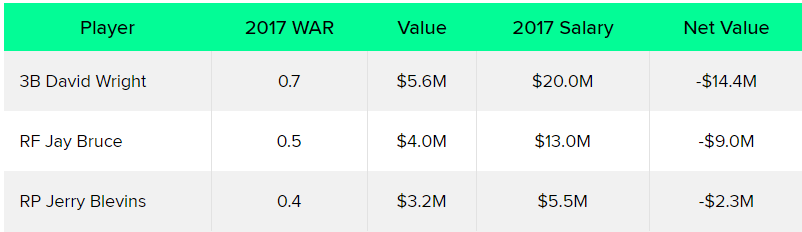
Writing for Bleacher Report, Joel Reuter put together an impressive coalition of stats to demonstrate what he calls a player’s “Net Value,” which is derived from the player’s WAR value (1.0 = $8 million in salary (see FanGraphs), minus the player’s actual salary. Here’s an example of how a few of the Yankees and Mets rated in 2017.

New York Yankees Best

New York Yankees Best WAR Value 2017
Joel Reuter, Bleacher Report

New York Mets Best

Mets Best WAR Value 2017
Joel Reuter, Bleacher Report

New York Yankees Worst

Yankees Worst WAR Value Players 2017
Joel Reuter, Bleacher Report

New York Mets Worst

Mets Worst WAR Value Players 2017
Joel Reuter, Bleacher Report

Now, let’s take Reuter’s accounting one step further. If we total up the Net Values on the plus side benefiting the owners, the Yankees “saved” $43.7 million last season and the Mets saved $48.4 million. On the negative side where the owners took a hit, the Yankees “lost” a total of $28.8 million on those three players and the Mets $25.7 million.

Which, in sum, seems to show that owners are not taking as big a bath as they would like us to believe. And further, that it’s possible players are being underpaid instead of overpaid. To draw any firm conclusions, though, a comprehensive study encompassing the entire payroll of both the Yankees and  Mets would need to be executed, which is something the Major League Player’s Association might want to tackle in making their case to MLB and the public.

My thinking is drawn more to the number of years in contracts rather than the money per year that concerns owners and general managers throughout MLB. Giancarlo Stanton, as an example, will likely be worth every penny he is paid – until he reaches a point when he isn’t. At that point, Stanton will become a reincarnation of Teixeria and Alex Rodriguez, each of whom burdened the team financially as their careers faded.

And if we reach far back into MLB’s past, players were routinely issued one-year contracts based exclusively on last year’s performance. MLB will never go there again, but the point the owners and GM’s seem to be making is the need for the pendulum to swing back the other way, in which two and three-year deals represent the top of the pay stratosphere.

[su_pullquote align=”right”]The game as we’ve known it is over. And the players need to come up with some better ways to fight what is happening – other than saying, “I’m gonna take my ball and go home.”[/su_pullquote]

The players and their union (MLBPA) are balking mainly because they (now) realize they shot themselves in the foot when the signed the collective bargaining agreement (CBA) that is with us until 2021. There was talk of boycotting Spring Training, but that will never happen.

But, is it collusion on the part of the owners? Of course, it is. If you and I and ten other people decide to go to the movies tonight, is that collusion? It could be if we plan to rob the concession stand. But otherwise, it’s just twelve people who had the same idea at the same time, and they are acting on it.

The Players Need To Get Creative

The players can do themselves a favor by stepping up the analytics game themselves. They already have one bullet in their arsenal which is MLB Merchandise. For example, how many Matt Harvey t-shirts have been sold over the years? How many pairs of Yoenis Cespedes batting gloves, Noah Syndergaard headbands, and so on? We’re talking big money here, folks. Last year, according to Forbes, MLB Shop took in $9.5 billion (that’s billion with a B) in revenue, a $500 million increase from 2015. For being #1 in the T-shirt sales department, how much money do you think Aaron Judge collected?

Similarly, the players argue that fans come to the ballpark to watch them perform athletic feats that often challenge gravity. True enough, but why not use that as a means to demonstrate the value some of these players have for, as George Steinbrenner liked to say, putting asses in the seats?

Why not, for instance, issue a card to each fan entering the ballpark with a list of all players in uniform that day with one instruction. Check the names of five players on your ballot who you came to see play today. Total ’em up at the end of a season, and the players have their version of WAR. Only this stat can be called TAP, for Tickets Sold Above Replacement.

Individually and as a unit, MLB players are not political animals. They seek only to play the game they have grown up with and love to play. No one, these days, goes to the poorhouse playing major league baseball. No one needs a second job driving a milk truck during the offseason like Hank Bauer, and Yogi Berra did for years during their playing days.

At the time time, the MLBPA and the players themselves need to understand that owners and general managers are (indeed) drawing a line in the sand. In days to come, Albert Pujols and even, Giancarlo Stanton will be seen as dinosaurs, the topic of conversation in bars across America for the contracts they won.

The game as we’ve known it is over. And the players need to come up with some better ways to fight what is happening – other than saying, “I’m gonna take my ball and go home.”

Footnote: A good follow-up read if you have the time appeared in the New York Daily News, and features MLB player, Brandon Moss, who has some controversial views on the current stalemate (“We Screwed Up”)


What’s Next for the Pirates?

It’s been about several weeks since the Pirates parted ways with both Gerrit Cole and Andrew McCutchen, the former to Houston, and the latter to San Francisco. Most fans and analysts expect Josh Harrison to be next, and by the looks of it, that’s what he’d prefer.

Some would consider the Pirates to be rebuilding, while others suggest it may be somewhat of a retooling, hoping that some names that were expected to work out, but suffered setbacks either last year or culminating throughout the last several years (like Marte and Polanco) will bounce back or reach expectations.

That, coupled with players breaking through and reaching their potential (like Bell and Taillon), along with other young players (as though the Pirates have any other type of player now) like Trevor Williams, who showed a lot of promise last year, or Steven Brault, who pitched very well at AAA Indianapolis, perhaps the Pirates can field a winning team. It doesn’t hurt that they inked one of the top relievers in the game, Felipe Rivero, who emerged with a breakout season last year, to a four-year deal.

But most Pirates fans aren’t buying it. There was even a petition started on Change.org for “MLB to force Bob Nutting to sell the Pirates”, and to this date it has reached 59,456 signatures. Of course, there is basically no chance that this petition will actually result in anything.

Before both trades, the Pirates projected win total by FanGraphs was a whopping 81. After the Cole trade, it went to- er- stayed at, 81. It did move, though, once McCutchen was dealt, dropping from 81 to 78, which would still be three wins better than last year’s club, which might cause some to say that technically the team is improving, even if it’s by the most basic metric; of course, most would say that’s nonsense.

Last year, the Pirates were plagued by a multitude of problems, from Marte’s PED suspension, a plethora of injuries to, well, everyone, and even to Taillon missing time due to testicular cancer (which he brilliantly rebounded from, appearing as a starting pitcher just five weeks after surgery). Not to mention Jung-ho Kang’s off-field issues and inability to return to the team. The Bucs suffered a six-game setback from last year’s projections where they were expected to go 81-81. They finished six games below that total, winning 75 contests.

The Pirates were basically destined to fail last year. Now many believe that the Pirates are in store for the same fate this year after departing with two of the franchise’s marquee players.

A lot of the Pirates roster will look strikingly similar to last season, except for those received in the trades, which includes: 3B Colin Moran, P Joe Musgrove, P Kyle Crick, P Michael Feliz, among several other pitchers not involved in either of those trades, Nik Turley, Jack Leathersich, and Jordan Milbrath. It is unlikely that those players will make that big of an impact.

It’s possible, without any major injuries, the contributions the Pirates expected to receive last year will be more likely to reach fruition this year. If Gregory Polanco has the kind of breakout season people felt like he might have when the Pirates first acquired him, it’s possible for him to be a 5.0 WAR player. A litany of injuries prevented him from coming anything close to that last year, registering a 0.5 WAR, but with glimpses of power in his minimal contributions.

The same is true for Starling Marte. In 135 games for the Pirates in 2013, Marte posted a 4.8 WAR and 122 wRC+. We are all aware of Marte’s 80 game suspension following him testing positive for performance-enhancing drugs prior to the 2017 season. When he returned, he failed to be the player the Pirates hoped he’d be, and of course, he’ll have a lot to prove after his suspension in his first full season, but it isn’t completely insane to think he might experience a resurgence.

Josh Bell had a breakout season for the Bucs in his rookie campaign, perhaps positioning himself to be the next face of the franchise. Bell registered a 1.4 WAR last year and 113 wRC+, a .338 wOBA, and an OPS of .800. He hit for significantly more power than was expected of him, blasting 26 cannonballs, which was 12 higher than his 2016 total in AAA Indianapolis, playing nearly every game (159) in 2017. If Bell continued to grow this offseason, it’s entirely possible he’ll repeat in some statistical categories, like home runs wOBA, and OPS, and improve in others, like BABIP (.278), making him a very legitimate threat in the middle of the order.

Joe Musgrove, whom the Pirates acquired from Houston, showed that he may have the stuff for a solid third in the rotation type pitcher. Musgrove appeared in 38 games for Houston last year, starting 10 of them, posting a FIP of 4.38, an ERA- of 113, and an xFIP of 4.03. Those numbers are about in-line for a 5 starter, most likely, but PNC is one of the most “pitcher friendly” parks in baseball. Also, I’m not one to chalk up occurrences to magic, but Ray Searage has worked some serious voodoo in the past, and that could likely be the case here, especially with Musgrove who is by no means a lost cause pitcher to begin with. Additionally, Musgrove throws pretty hard, last year registering his fastball around 93.5 mph, his cutter a tick over 90, and a slider around 92.

Colin Moran will likely see the most time at 3B this season, as David Freese’s production levels just don’t quite reach what they should to warrant starting everyday, especially with a young player like Moran waiting in the wings. Jeff Sullivan wrote an article highlighting Colin Moran’s swing change, and some of the numbers were glaring. During seasons 2013-2016, Moran sat around 50% ground balls, and with the way baseball’s evolved, that’s not really a good thing. But in 2017, that number was strikingly different. Moran hit a ground ball only 34% of the time. With his decrease in ground balls came an increase in home runs. He had a previous high of 10 in AAA with far more at bats than his 18 in 2017 during his AAA campaign.

Lastly, Michael Feliz, another piece from the Astros, comes to Pittsburgh after having posted interesting numbers in 2017. Firstly, Feliz throws hard, reaching the high 90s with his fastball, averaging nearly 97 mph in 2017. He posted a FIP of 3.78, an xFIP of 3.58, and an xFIP- of 81. Feliz will likely be a strong complement to Felipe Rivero out of the pen.

Help will have to also come from players being called up from AAA for the first time (Meadows, who suffered setbacks last year on the DL, Keller, perhaps Bryan Reynolds, among others), but if some things break the right way, the Pirates may experience more success than originally anticipated. Don’t misunderstand me, I’m not saying the Pirates will be in contention for the NL Central this year, or even a Wild Card spot. I’m saying the potential is there for them to rebound from last year and finish the season above .500 at 82-80, especially if they can capitalize on a flailing Reds team, as well as in games against the largely inept NL East.

But barring a major outbreak by a lot of guys, the Pirates will likely be an average to below average team (somewhere along the lines of 75-87 to 79-83). It wouldn’t surprise me for them to finish better than last year, if not just for the sheer manpower versus last year, and hopefully not having to deal with such setbacks.

But when is it most likely the Pirates will be able to actually contend? The front office will say 2019 at the earliest, and there’s some credence to that.

Mitch Keller is projected to make his debut sometime this season, ranked 16th overall, and is the Pirates best prospect. Austin Meadows, ranked 45th, is expected to make his debut this season, as well. The last of the Pirates top 100 prospects, Shane Baz (67th) isn’t expected to make his debut until 2021, and hopefully, the Pirates are competing before then.

From the Pirates own top 30 list, several potentially important players are expected to debut in 2018, including Nick Kingham and Bryan Reynolds (the latter of whom came over in the McCutchen trade). 2019 will see a string of more players, and if they make an impact right away could yield a winning ball club, like Ke’Bryan Hayes and Cole Tucker. If you combine their potential productivity with the progression of guys that are already there and guys that are debuting this season, the Pirates could be returning to a similar place as their winning years, 2013-2015, in as little as two seasons.

Although it should be noted, the Pirates most successful years weren’t necessarily fueled by prospects. When Gerrit Cole debuted in 2013, one of the Pirates most successful seasons, he was really the only major prospect getting to play at that time, while the majority of the roster was comprised of veteran holdovers from the season before.

What that could potentially mean is that perhaps 2019 isn’t necessarily a possibility in terms of being competitive. Perhaps a more realistic timetable is 2021. By that time, Starling Marte will be in the final year of his contract at age 32, and likely his last year as a Pirate, and assuming he’s able to rebound, will be in the latter part of his most productive years. Gregory Polanco, if he’s able to reach his potential, will be in his Age 29 season and possibly at the peak of his ability. Moreover, by 2021, most of the players we’ve discussed will have had time to fully develop, like Josh Bell and Jameson Taillon, plus any guys coming up over the next two seasons.

All of these guys won’t pan out, but there’s a pretty good chance some of them will, and that’s the best an organization and fan base can hope for (except for the Astros who have seemed to hit the jackpot in every regard). The team will also need to be supplemented by veterans, and not just the cheap ones. For the Pirates to make a run and win between 2019-2023, the front office is going to need to spend more money than they were willing with Gerrit Cole and Andrew McCutchen.

There are a lot of hypotheticals in the Pirates future, but there truly is a lot to be excited about. I know it’s a difficult thing to request of Pirates fans, but this transition will require patience. That, and the front office attempting to provide more from the outside in free agency or big trades, and probably both. There is a lot the front office has done right in the past; unfortunately, though, there is also a lot its done wrong. We’ve seen the front office make some truly good trades, having the insight to know when guys have passed their peak and flipped them at the right time (like the acquisition of Rivero). But there will have to come a time where they send prospect packages for big-time players; if not, the Pirates may not see a real contender until ownership changes.