Ballplayers and the Karmic Practice of Yoga

Injuries are something that pronounce their impact differently on every player in the game. Some guys have freakish bodies and recover faster naturally. Others push themselves to accelerate their return. But recovery from some injuries can’t be sped up. Maladies like inflammation are plainly matters of time.

JA Happ went on the 10-day DL on April 18 for having it in his elbow. He’s finally back on the mound in the Majors after being out for more than a month.

Kendall Graveman just hit the DL for soreness in his throwing shoulder and is “taking anti-inflammatory medication and resting,” per Susan Slusser of the San Francisco Chronicle. Manager Bob Melvin says he’s been through this before, that it’ll take longer this time, and that the team is going to “let this thing calm down” before trying to build up his endurance again. The passivity in his words is telling.

And if you have the heart to remember the end of Roy Halladay’s career, you’ll remember inflammation in his throwing shoulder cost him time on the DL amidst his body simply telling him, “please, no more.”

Inflammation is a general response from the body that results from cell agitation. It can occur from normal use — “normal” being a relative word. It intends to clear out damaged cells but the process causes pain, discomfort, and inherently imbalanced levels of certain proteins in our bodies. And the things a ballplayer does every day, the extreme motions they constantly put themselves through for more than half a calendar year, make them prime candidates to become victims of it.

Enter yoga.

There’s no causal relationship between yoga and reduced injuries. But as I researched its impact on ballplayers for a job, I couldn’t help but think of the benefits. And I did find that it has been connected to balancing the proteins that can get whacked out in players’ bodies through the course of a season.

Researchers have studied a particular form called Hatha yoga, which combines poses (asanas), breath control (pranayama) and meditation. They explored its ability to help aid in recovery from the regular wear-and-tear we put our bodies through. “Regular” is another relative term — think of the twist and torque your favorite hitter exhibits on each swing and how that could eventually cause a dreaded oblique strain.

The study’s trippiest finding centers on epinephrine levels in the brain, which are fueled by the adrenal gland and play a large role in maintaining both physical and emotional stress. In focusing on the differences between novices and experts, experts experienced higher levels of epinephrine on a regular basis. That surprised even the researchers.

Common sense might tell us that the more we have of something, the more we get used to it, and then the less impact it has on us. It’s why a person going skydiving for the first time can find it exhilarating while it’s just another day at the office for the instructor they’re attached to. It’s the same when a pitcher isn’t excited about his velocity inching up through the spring. He can expect it because of what he’s thrown in the past.

The study found the opposite with yoga, though. The body adapts to the poses, breathing patterns, and meditation in Hatha yoga, and the person gets better at it; but chemically, they don’t get used to it. It doesn’t become old hat. Instead, the practice becomes invigorating and those who practice it build up what becomes an expandable physiological embankment of wellness.

What’s more is that, based on the study’s parameters, a player could approach expert level at yoga over the course of a single season. A few hours a week could help keep their protein levels balanced through the summer and avoid the fickle complications of inflammation. And beyond even that, it offers a fresh, low impact way to optimize their body that could pay long-term dividends.


A Situational Lineup: Management Questions With No Clear Answers

It has come to my attention that in the 1880’s and early 1890’s an interesting management phenomenon presented itself around baseball. At this time, managers were not required to submit a lineup card before the start of the day’s game. Due to this, the first time through the batting order could be constructed the way the manager saw fit, based upon situations in the game. That being said, once the lineup went through its progression once, its construction would pervade throughout the rest of play. In lieu of this, an interesting set of strategical questions come into play. How would managers set lineups if this rule existed today? How would this effect run totals for the season for a given team? Would lineup construction change its form or remain largely the same as the way it is done now? This article is not one that analyzes or provides solutions but, instead, provides questions that are interesting and engaging to any baseball connoisseur.

The implications and strategy behind this lineup maneuverability are something that provides tons of differing opportunities for discussion. I think the lead-off hitter, if this rule was applied to the game today, would remain mostly the same. Managers would continue to look for an on-base machine to start off the game in a positive fashion. Along with this, I believe that the seven through nine batters would remain mostly static. Managers would look to place their worst hitters and their pitcher in these spots in order to diminish their number of at-bats in impact situations. With these assumptions established, a world of possibilities open up for the two through six hitters in the lineup. Each manager would approach this construction differently based upon the day’s match-up and the game’s progression. That said, here are a set of interesting scenarios that can provide interesting implications for the progression of a game and for run production in that game.

Let’s assume we’re the Angels and we have their current set of middling players that play alongside a healthy, and studly, Mike Trout. It’s the top of the first inning and the first two outs have already been made, no one’s on base, and we have to choose who will hit. Although there are no runners in scoring position, would you (as the manager) decide to hit Trout in this spot? Or, would you wait and hit Trout to lead off next inning and hope he starts off the inning strong? Or, would you wait to bat Trout sixth and hope that the first two batters in the next inning get on base and Trout can drive them in?

If you choose the latter, the implications of such would be a diminished number of at-bats in the game for Trout. Would it be worth it to wait on an impact situation to have Trout hit for the first time, even if this led to one less at-bat for the rest of the game? I think, personally, in this scenario I would hit Cameron Maybin in the three hole, following Yunel Escobar and Kole Calhoun. I think Maybin has enough pop to hit a home run every once in a while with the bases empty. I also think that if he got on base, I’d hit Trout directly following in the four hole. If it were a single by which Maybin got on, he would go first pitch and try to swipe second. If he got thrown out, it would be fine and I’d have Trout leading off my next inning, followed by Albert Pujols and Luis Valbuena. If he swiped the bag, we would now have a runner in scoring position for our best hitter, which is exactly what we want.

I can see as I’m writing that my ideas are getting harder and harder to follow, but I think this is a direct result of the vast array of possibilities this type of management choice presents. It would be interesting to see major-league managers, much more knowledgeable than myself, go about making these decisions on a daily basis. What do you think would be the best lineup set in this situation? And what other situations would be interesting to discuss as baseball fans?


The Reinvention of a Yankee You Aren’t Hearing About

gary-sanchez-aaron-judge-14.0.jpg

“Funny things happen in baseball” was what one former major-league GM had to say regarding the Yankees’ unexpected success thus far. 2017 was supposed to be a rebuilding year for this club, but after winning 30 games before the end of May, the Bronx Bombers have established themselves as one of the best teams in baseball. As Henry Druschel writes, the Yankees are not only good, but fun!

Baseball is a team game, so it’s impossible to give credit to one or even a few players. But in a season that was supposed to be focused on the development of prospects — Judge, Bird, and Sanchez — it has become impossible to ignore the surprising production from some of the established veterans on the team. Starlin Castro is having the best season of his career. Jacoby Ellsbury is having more success in a Yankee uniform than ever before. And Matt Holliday is on pace to produce the highest power numbers of his career since he played 81 games a year at hitter-friendly Coors Field.

All of these players deserve credit for the early success of this team. But one player who has not received enough praise, especially after reinventing himself, is Brett Gardner.

For years, Gardner was nothing more than a slap hitter. He would get on base at a decent clip, where he was a real threat, stealing almost 100 bases between 2010 and 2011. He was never, by any stretch of the imagination, a power hitter — in the first five years of his career, his ISO never topped .110. And that was okay. By many accounts, he was a good player. Not great, but good enough to average almost 5 WAR from 2010-2014.

Flash-forward to 2017 and Brett Gardner is a different hitter. Aaron Judge, the heir-apparent to Jeter’s throne in New York, commented on the 33 year-old leadoff hitter’s changed approach: “He’s a little ball of muscle. I’m just glad he’s finally using it now.” He sure is. There are clear trends in Gardner’s “medium” and “hard” contact numbers.

Hlp9BwD.0.png

Gardner is hitting with hard speed at a rate of 34.8%, markedly higher than his career average of 23.6%. His medium-speed percentage is 10 points lower than it has been at almost any point in the last three years. And his soft-speed percentage is also below his career average. His approach has changed.

Notably, Gardner is not clenching his teeth and swinging for the fences a la Chris Davis or Chris Carter. His walk rate and strikeout rate are both in line with his career averages. He’s not chasing balls out of the zone, either.

uupSxGq.0.png

Almost a third of the way through the season, Gardner is more disciplined now than in the past. His O-Swing% is in the top 10 with players like Joey Votto (who has stopped striking out) and Matt Carpenter, who is tied for first in non-intentional walks drawn.

With this new approach, Gardner is hitting for more power than ever before.

TYVPd1h.0.png

As you can see, his average has remained relatively constant. In other words, his slugging percentage didn’t skyrocket because he started to hit a bunch of singles. Gardner really is driving the ball, leading to more extra-base hits. As a result, his isolated power numbers have risen dramatically. Isolated power (ISO) shows how often a player hits for extra bases.

7EcLSdx.0.png

For just the second time in his career, Gardner’s ISO has risen above the league average. And in 2017, his numbers put him in the same ballpark as Kris Bryant and Giancarlo Stanton.

During a period where the Yankees have gone from rebuilding to contending, Brett Gardner has evolved from a slap hitter into someone who drives the ball remarkably well. Aaron Judge is having a tremendous season, and with Trout’s injury he may well be the AL MVP.

But Gardner’s transformation shouldn’t go unnoticed. His ISO won’t stay at .259 all year. In fact, with only 200 plate appearances, this number doesn’t have much predictive value on its own. It’s clear, however, that Gardner has changed his approach. He is no longer the speedy, slap-hitting leadoff guy expected to steal 30 bases. Although Girardi still pencils him in at the top of the lineup, Gardner has reinvented himself to hit for power.


Matt Moore and the Terrible Schedule

Not much has gone right for the San Francisco Giants in 2017. Everyone knows about the dirt bike accident and the consistent inconsistency that they call a bullpen. However, the 2017 struggles of Matt Moore have largely flown unnoticed, probably because of all the other issues facing the team. To say that Matt Moore has underperformed the Giants’ expectations since they traded Matt Duffy for him last summer feels like an understatement. To this point in the year Moore has amassed an inflated 5.28 ERA with a 1.53 WHIP. He is on one of the statistically worst offenses in the league and is currently getting out-pitched by both Matt Cain and Ty Blach.

Next comes the point of the story where FanGraphs authors write about how the underlying numbers show that Matt Moore is actually closer to Carlos Carrasco than Adam Conley. They entertain you with tales of a .400+ BABIP and a <60% strand rate. They serenade you with increased velocity and changes in spin rate.

Except I can’t do any of that. Moore has pretty much been just as bad as his stats show. He has the highest qualified walk rate and the lowest qualified strikeout rate of his career. His hard-hit rate sits at 40.6%, good for seventh-worst in the league (out of 91 qualified starters). His team currently sits 11 games out of the division lead, doesn’t provide sufficient run support, and could be in complete sell mode by the end of June.

This raises the question, why would anyone want to spend hours researching and writing about such an underwhelming pitcher? Giants fans certainly don’t enjoy the self-inflicted pain that Moore causes each time he pitches. However, there is something interesting when examining the Giants schedule from the start of the season through the end of May.

Screen Shot 2017-05-26 at 11.37.36 PM

This is about what you would expect for the Giants. Very heavy against the NL West to start the year, while beginning to adventure outside of the division as they work their way through May. Look at what happens when highlighting the series that Moore has pitched or is scheduled to pitch in (green) vs. the ones that he hasn’t (red).

Screen Shot 2017-05-26 at 11.41.14 PM

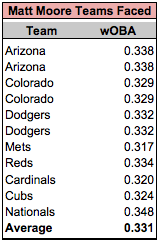
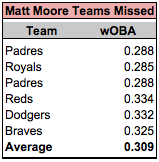
At first glance, it seems like Moore has pitched against better offenses or hitter-friendly ballparks (ARI, COL, LAD, CHC, WAS) while missing entire series against weaker offenses in pitcher-friendly stadiums (SD, KC). To see if this claim is actually supported, I used wOBA as a proxy for opponent offensive firepower to weigh each of the opponents.

Screen Shot 2017-05-26 at 11.57.41 PM

Screen Shot 2017-05-26 at 11.57.23 PM
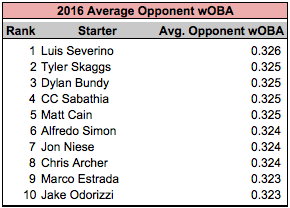
The average wOBA for teams that Moore has faced is .331 while the average wOBA for the teams he has missed is .309. A difference in wOBA of .022 is the exact difference between the wOBA of the 2017 Cubs and 2017 Pirates. The team with the wOBA closest to .331 so far in 2017 is the Dodgers, meaning that on average Moore has faced the Dodgers caliber of offense in each start throughout the season. The team with the wOBA closest to .309 is a mix between the White Sox and the Phillies, two weaker offenses. This doesn’t even take into account that Moore isn’t allowed to face the team with the lowest wOBA due to pitching for them. To obtain some historical context, I compared Moore’s .331 average opponent wOBA against all 2016 starters (min. 10 starts).

Screen Shot 2017-05-27 at 12.19.56 AM

Out of all starters with 10 starts in 2016 (185 total pitchers), Moore’s current average opponent wOBA would rank as the highest. Even the .005 difference in wOBA between 2017 Moore and 2016 Severino is a significant margin (the exact difference between the 2017 Rockies and 2017 Rays). Let’s look at how the .309 wOBA of the matchups Moore has missed would rank out of the 2016 starters.

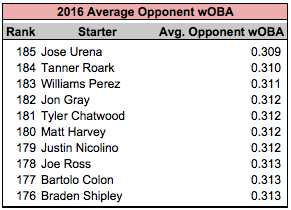
Screen Shot 2017-05-27 at 12.26.52 AM

Weighing all of the starts that Moore has missed, he would have been tied for the easiest average opponent wOBA of 2016. The difference between the offensive caliber of the teams that Moore has and hasn’t faced on the Giants schedule is not only steep; it’s the difference between the toughest and easiest pitcher schedules of 2016.

To be clear, none of this is suggesting that Matt Moore is or will be a good pitcher this season. In fact, the signs of a good pitcher is one who can toe the rubber against even the toughest teams. However, Moore’s schedule has not provided any favors. Before the Giants and their fans pass judgement on Moore, they should take a close look at who Moore has (and hasn’t) faced. Moore’s next assignment? The Washington Nationals on Monday. (Ed. note: that was Memorial Day)


The Rays and A’s Are Still Bargain Hunting

A lot of talk this offseason was about how HRs became cheap and sluggers are not getting paid. Two teams that adapted to that really quickly were the A’s and Rays. Just a couple years ago, the A’s and Rays both were no-power teams that mostly tried to compete with pitching, and, in the Rays’ case, great defense.

As of today (May 30th) the Rays and A’s are first and fourth in HR in the majors despite playing in not the most hitting-friendly parks.

They are also first (OAK) and ninth (TB) in average team launch angle, so they are probably either trying to acquire or teach launch angle.

They both strike out a ton (Rays are first in K% and A’s are fourth) but overall, offensively, it kind of works for them. The Rays are fifth in wRC+ and the A’s are eighth, which is not bad, given their financial constraints.

Where they are paying is defense. The Rays at least have a good OF compensating for their terrible IF, but they are still just 22nd in the defensive rating at the FanGraphs leaderboard. With the A’s it gets really ugly; they are dead last in defense and basically terrible in almost all of their positions.

For the Rays, it seems to work overall, as they are third in position-player WAR, and they also had some Pythagorean bad luck, but the A’s are just 22nd in position-player WAR, so they might have taken it too far.

Overall, the Rays and A’s still follow the trends and act quickly, but finding a bargain is harder and harder. Teams now have a good concept of value and if you find a bargain somewhere, you usually have to pay a price somewhere else.

Probably, it is still good that they try it. They need to gamble on upside and a balanced team is probably not the way to go. It is hard to say how much they gained, but launch angle and homers probably was a slight market inefficiency and they both went to it quickly.

What I found interesting were the Dodgers. Overall, they are a very good team, but they are not hitting homers and their launch angle is one of the worst in the majors (22nd). I thought as a sabermetrically-inclined team with a former Rays FO, they would try to close that hole, but then again they already were really good and can afford to lose some value. Also, the Dodgers team is much more expensive, so a super fast re-structuring of the team like the A’s and Rays did is not really feasible. An expensive team is not as flexible as a team full of pre-arb and early arbitration players and can’t react to a changed market as quickly.

It will be interesting how they develop in the next years. Will they slowly try to increase LA and power while trying to keep their strengths? Or will they sacrifice some defense and contact like the Rays and A’s did?

It will also be interesting if the Rays and A’s stick with it. Power will probably get slightly more expensive again, but I don’t expect the price to explode because the success of the A’s and Rays has been moderate and now teams mostly go by overall value. What teams certainly want to try is to teach elevating to their young players so they can get power without a big trade-off. Players with power and defense will always be sought after, and not be available as a bargain, so being able to teach LA to defensively good prospects could be a market inefficiency, but that is of course not easy to do.


Statistical Analysis of a Few College Hitters

As the 2017 MLB Draft quickly approaches, I thought it may be fun to analyze some of the best college hitters available.  On May 23, Eric Longenhagen released the 2017 Sortable Draft Board on FanGraphs.  This article looks at the statistics of each college hitter on the list.  In this article, I tried to not lean on literature and scouting reports of the players.  Rather, I decided to calculate some statistics to use as guides in building an outsider’s perspective of their offensive profiles.  This body of work does not include much information about attributes or skills not published on a school’s statistics page on their website.

Nobody real cares about the counting statistics of college players.  So, for my table of numbers to fit on a page, I left them out.  The statistics I focused on are a hitter’s slash line (AVG, OBP, and SLG), OPS, BABIP, ISO, RC, K% and BB%.  These are relatively easy to calculate and provide some sort of worth when evaluating prospects.  AVG, OBP, and SLG are simple and widely understood.  OPS provides a good gauge of a hitter’s overall offensive ability.  BABIP is an important indicator of a hitter’s talent at the plate, but can be inflated or deflated depending on the talent level of the different defenses faced by the hitter.  ISO is a good indicator of how well each hitter demonstrated their power and XBH ability.  Runs Created (RC) is a crude but effective measurement of total, individual offensive output.  K% and BB% give us some idea of how well the batter demonstrated their understanding of the strike zone and discipline at the plate.  For more information on each statistic, as well as how to apply it, I suggest checking out the Glossary tab.

Below is the table of numbers I made.  Even further below is where you will find a quick summation of each hitter discussed.

Name

AVG OBP SLG OPS BABIP ISO RC K%

BB%

Jeren Kendall

.306 .379 .570 .949 .333 .264 50.31 18.9%

20.8%

Adam Haseley

.400 .498 .688 1.186 .393 .288 70.21 7.7%

38.8%

Keston Hiura

.419 .556 .672 1.228 .486 .253 67.80 14.5%

40.3%

Pavin Smith

.348 .433 .581 1.013 .311 .233 53.78 3.2%

42.7%

Logan Warmoth

.336 .410 .562 .972 .374 .226 53.10 15.3%

20.8%

Jake Burger

.343 .459 .686 1.145 .319 .343 63.50 12.0%

35.1%

Evan White

.380 .454 .654 1.108 .414 .274 51.08 13.5%

17.3%

Brian Miller

.336

.412 .504 .917 .365 .168 49.78 11.7%

28.1%


Jeren Kendall (#9 on FanGraphs Sortable Draft Board)

Vanderbilt                   OF                   (B- L/ T- R)

Jeren Kendall is considered by many to be the best college hitter, outside of Louisville two-way player Brendan McKay.  Kendall showed some impressive pop out of center field this past year, knocking 15 balls over the fence in 235 at bats.  However, he also managed to record 50 strikeouts.  Kendall did manage to produce an excellent walk rate and ISO, but his total output was “middle of the pack” as far as the guys on this list go.  He should go off the board within the first 20 picks this upcoming draft.

Adam Haseley (#15 on FanGraphs Sortable Draft Board)

Virginia                       OF                   (L/L)

Hitting from the left side of the plate, Virginia outfielder Adam Haseley managed to put up the best statistical profile of any hitter on this list.  He comes into June’s draft with an impressive OPS (1.186) and an even more entertaining strikeout rate — a board-best 7.7% (only 19 punch outs in 205 ABs).  While Haseley’s power numbers may not translate at the next level, his affinity for driving the ball into deeper parts of the ballpark should make for a high doubles count at the next level.

Keston Hiura (#17 on FanGraphs Sortable Draft Board)

UC Irvine                     2B                    (R/R)

While Keston Hiura’s .486 BABIP may be a good indicator as to why his batting average is north of .400, it is also a good indicator of just how good he is with a bat in his hand.  He did not just hit singles — his 21 doubles come in second on the list.  He displayed an excellent walk rate, which contributed to the highest on base percentage on the shortlist.  While some teams may elect to take a prep shortstop over a college second baseman, Hiura still plays a premium position with solid presence at the plate and would fit in nicely in any class as a second to third-round pick.

Pavin Smith (#18 on FanGraphs Sortable Draft Board)

Virginia                       1B                    (L/L)

The second UVA Cavalier on our list slashed an impressive .348/.433/.581 this past season, and posted an impressive 3.2% strikeout rate.  While his numbers do not match those of his teammate Adam Haseley, Pavin Smith could very well be the first college first baseman off the board, assuming you do not count Brendan McKay as a first baseman.  His demonstrated knowledge of the strike zone, coupled with a list-best walk rate, are both very good indicators of a first baseman with a high ceiling.

Logan Warmoth (#20 on FanGraphs Sortable Draft Board)

North Carolina            SS                    (R/R)

Tar Heel shortstop Logan Warmoth, when compared to the rest of this list, does not really stand out.  However, he should be taken early, as he still has the best odds of being the first college shortstop off the board.  He hit well in the ACC this past season, compiling 18 doubles, 4 triples, and 9 home runs.  Though his demonstrated power will likely not follow him up the minors, any team would love to have a strong bat such as his at the most premium of all premium positions.

Jake Burger (#22 on FanGraphs Sortable Draft Board)

Missouri State            3B                    (R/R)

Our only hot corner prospect on the list is a power threat through and through, according to his numbers.  While his average will continually drop as he climbs the minors, Burger’s 20 homers showcased his raw power.  Although there may be some questions about his tendency to punch out, plus power paired with an excellent walk rate at a corner position are a recipe for success.  Everybody loves a little yak sauce on their Burger every now and then.

Evan White (#29 on FanGraphs Sortable Draft Board)

Kentucky                      1B                    (R/L)

A first baseman who hits from the right side is very common.  A First Baseman who hits from the right side but throws left is very uncommon.  A first baseman who hits from the right side but throws left with plus speed is downright unique.   Evan White legged out a list leading 23 doubles this past year, and posted all-around great offensive numbers.  He will be a very interesting draft choice, and his excellent statistics project a demonstrate a solid offensive background.

Brian Miller (#49 on FanGraphs Sortable Draft Board)

North Carolina            OF                   (L/R)

Rounding out our list is North Carolina outfielder Brian Miller.  Miller slashed a very impressive .336/.412/.504 line this past year, and should be a good mid-grade prospect in the upcoming draft.  His statistics do not lean to one type of offensive profile over another, but his high BABIP and excellent walk rate generate some reasons to believe his bat will continue to develop at the next level.

Again, this article is meant to simply provide a statistical overview of a few college prospects in the upcoming draft.  It should be looked at as a tool for anybody who cares enough to concern themselves with college statistics.


Theodore Hooper is an undergraduate student at the University of Tennessee in Knoxville.  He can be found on LinkedIn at https://www.linkedin.com/in/theodore-hooper/ or on Twitter at @_superhooper_


Fastball Confidence a Focal Point for Harvey

To express the extent of a player’s confidence is difficult, and using numbers to back up this assertion is even harder. When a player lacks confidence, it can be seen through a slew of on-field mannerisms that don’t always present themselves inside statistics. Instead, the numbers tell us the story of a pitcher, once of dominant form, who is struggling to get outs and display any sort of consistent performance. The statistics paint this picture about Matt Harvey. They tell us a tale of dominance, hindered and erased by injury and ineffectiveness. Although this story is told, it seems to be far from the truth. I believe in an alternate story. A story that displays a human being struggling with the confidence to throw his pitches and retire hitters. A lack of confidence stemming from a large set of off-field hindrances and a set of recent on-field struggles. A problem that will be moved past and put behind in the months to come, making it only a distant memory to both Matt and Met fans.

If we rewind back to September of 2015, we can see that Harvey is no stranger to hardships or headlines. After Tommy John surgery following his stellar 2013 campaign, he seemed back to form throughout 2015, culminating in an impeccable playoff start against the Cubs and a World Series game 1 nod. Throughout the season, questions about Harvey’s innings limit hovered around the Mets clubhouse, reaching its climax in early September. After a start against the Philadelphia Phillies where Harvey exited early due to dehydration, agent Scott Boras spoke about the doctor’s indication that Matt should not exceed 180 innings pitched that season. With Matt already at 166 1/3 innings, it seemed like the Mets organization was directly ignoring these suggestions.

This back and forth between the front office and Boras propelled Matt into the spotlight preceding his next start against Washington, who had become their rival in the midst of a pennant race. He pitched poorly, to the tune of 7 R (4 ER) in only 5 1/3 innings. This tough outing doesn’t hold a torch to his current struggles, but the difference in approach between this start and his recent starts form an interesting comparison.

Throughout this start in particular, and the entirety of the 2015 season, Matt Harvey was unafraid to throw his fastball to any hitter. He challenged hitters like Bryce Harper, in the midst of an MVP season, with fastball after fastball. In Harvey’s most recent start, he wouldn’t even challenge Manuel Margot with the same. Of his 74 pitches in that 2015 start, he threw 51 fastballs 95 and above, constantly pounding the zone. In his most recent start, Harvey nibbled around corners, he never challenged hitters, and he relied on his breaking ball (usually out of the zone) even when behind in the count. This tendency showed a lack of confidence to throw his fastball and challenge hitters, something that Harvey needs desperately to be successful. Overall, the dichotomy in approach between 2015 and 2017 for Matt is striking. Here are some of the numbers based on his position in the count:

2015, 2017
AHEAD
CU, CH: 22.3%, 19.7%
SL: 15.5%, 23.4%
FA, FT: 62.2%, 56.9%
BEHIND
CU, CH: 19.0%, 25.3%
SL: 16.5%, 21.7%
FA, FT: 64.6%, 53.0%
TOTALS
AHEAD% 32.6%, 20.8%
BEHIND% 20.8%, 25.9%

In 2015, when ahead in the count, Matt threw 62.2% fastballs. When behind, he threw even more, to the tune of 64.6% of the time. Because of his ability to pound the zone with his fastball, he spent 32.6% of his time ahead in the count while only 20.7% behind. This allowed him to control the pace of the at-bat and the expectations of the hitter. When he wanted to break off a curveball or a slider it became much more effective in relationship to his established fastball.

So far in 2017, he’s been unable to get ahead in the count or develop any rhythm with the pitch. His inability to challenge hitters has left him nibbling around the plate, leaving him ahead in the count only 20.7% of the time. This problem grows when behind in the count, as Harvey continues to throw off-speed pitches 47% of the time. His inability to command these pitches leads to even worse counts, and compounds the problem. Throughout his most recent start again San Diego, Harvey continued to nibble around the corners of the zone, seemingly afraid to challenge hitters with his fastball or throw off-speed pitches consistently in the zone.

This tendency, pointed out by Ron Darling during the SNY Broadcast, can be evidenced by his complete change in pitch usage as shown above. Although diminishing fastball usage is occurring league round, Harvey has to use his fastball more consistently to be more effective this season. By establishing his fastball early, he can play off of it, creating more effective offspeed pitches as well as more powerful fastballs. To be a Cy Young caliber pitcher, you have to trust your stuff and believe in your ability to dominate. As of now, Matt doesn’t believe in either.


Is the Lead-off Revolution a Bust?

2017 has been full of surprises so far. The Cubs were supposed to run away with the NL Central, but are struggling to stay above .500. The Backstreet Boys were supposed to drop an album sometime this year, but it’s May and we’ve heard squat from Nick Carter. And most intriguingly, this was the year we were supposed to see a radical change in who batted lead-off — but not much has changed.

Journalists were forecasting 2017 as the year of the slugging-lead-off hitter. Zach Kram of The Ringer boldly proclaimed “The Batting Order Revolution Will Be Televised” in explaining how more and more managers are batting sluggers, bonafide power bats like Kyle Schwarber and Carlos Santana, lead-off. This season seemed poised to be the year that we saw managers reaping the benefits of giving their best hitters more at-bats.

The folks over at The Ringer weren’t the only ones — 538, Fox Sports, and ESPN have all described the coming revolution. But there’s one small problem — the revolution isn’t having that big of an impact so far.

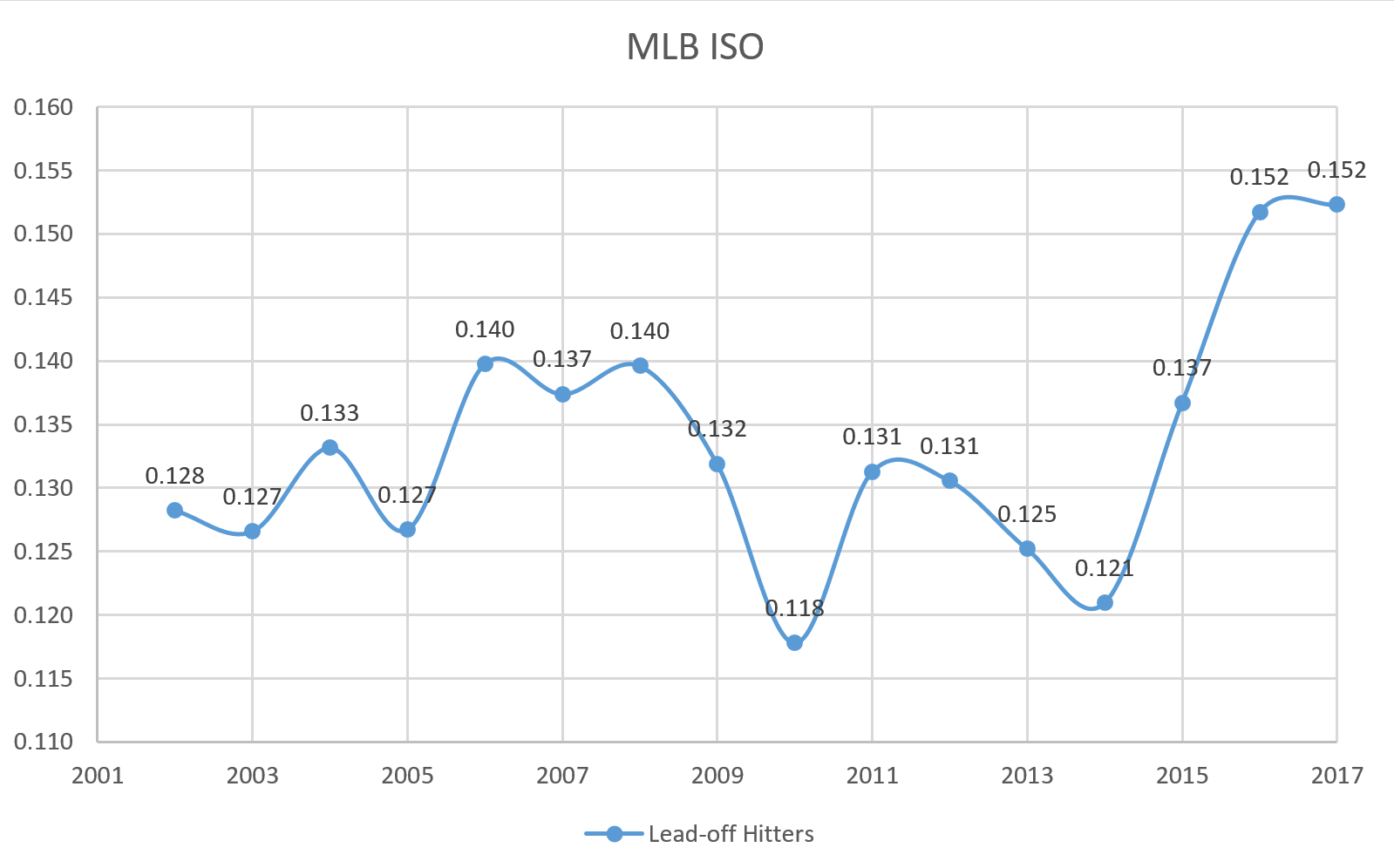
Okay, sure — lead-off hitters have, technically, hit for more power than they have in years past. League-wide, we have seen ISO for lead-off hitters in the past few years jump up faster than Bartolo Colon when he hears the words “unlimited buffet.”

MLB Leadoff Hitters ISO per year 2002-2017

What could be to blame for such a power surge from the leadoff spot? Hint: it has a lot less to do with the fact that managers are batting their sluggers in the lead-off position than you’d think.

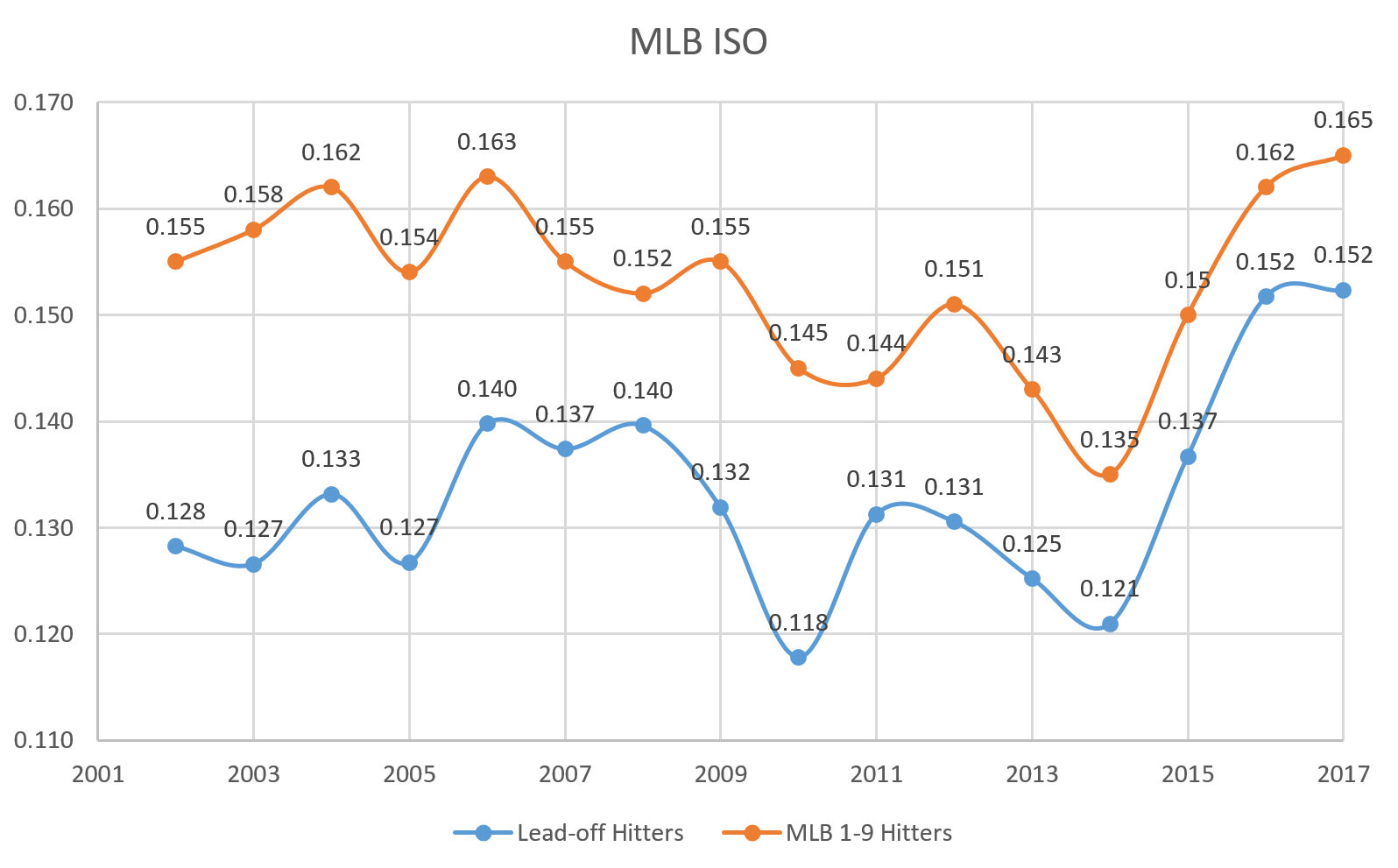
Remember the league-wide power surge that the MLB encountered last season? Power across the league skyrocketed — curiously enough, in the exact same manner in which lead-off hitters’ power skyrocketed.

MLB Lead-off Hitters' ISO v. MLB ISO

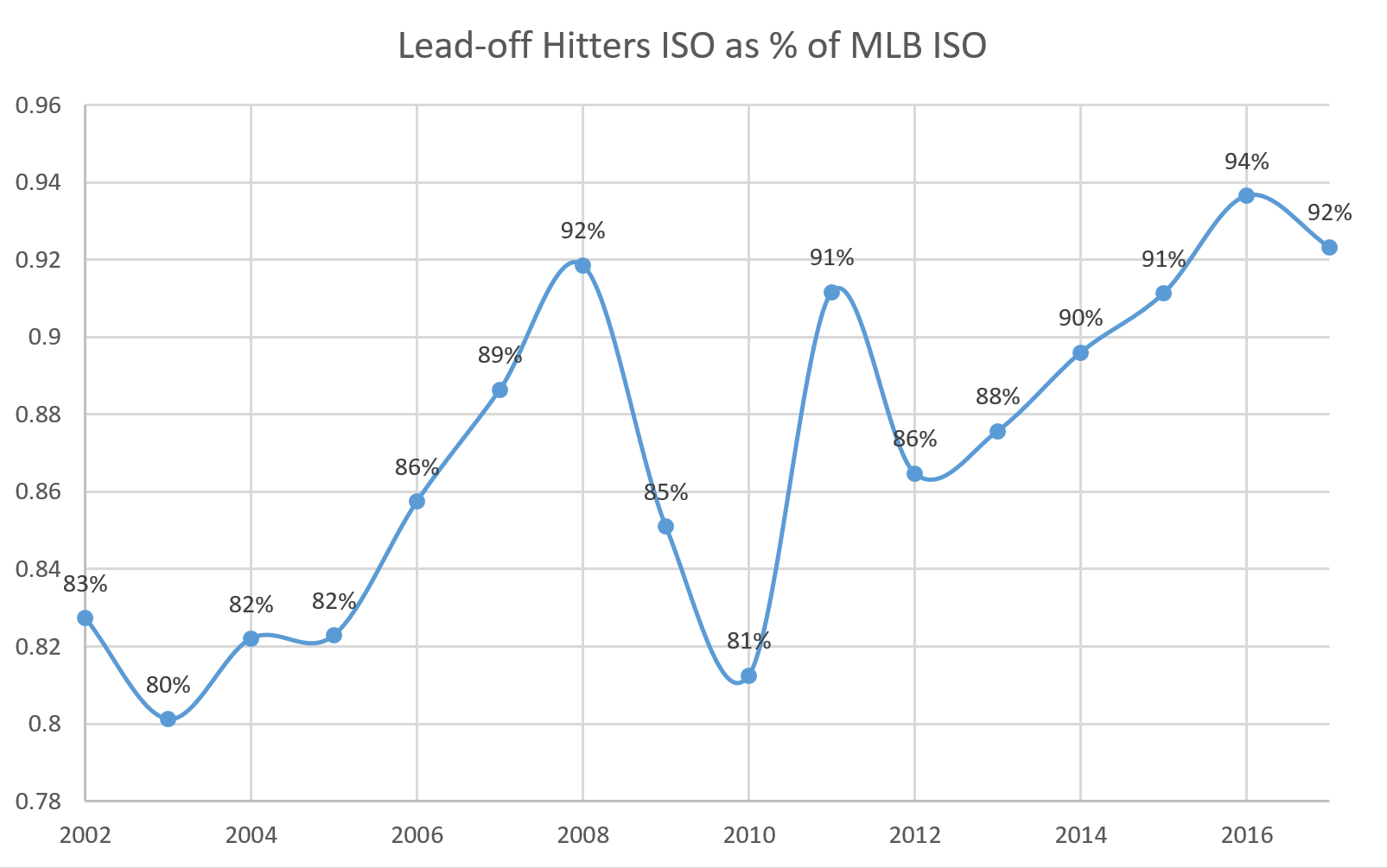
While there are some variations from 2002-2013, the recent power spike from lead-off hitters is almost entirely explained by the league-wide power spike. In fact, if we look at lead-off hitters’ ISO relative to league ISO, we find that lead-off hitters are hitting for less power than they did in 2016.

Lead-off hitters' ISO as a % of MLB ISO

This is not to say that there has been no power surge among lead-off hitters — as you can see above, adjusted ISO in the lead-off spot has risen steadily since 2012. Perhaps that is the result of batting sluggers as lead-off hitters. But the leaps and bounds in production from the lead-off spot as predicted above simply haven’t come to fruition. These lead-off hitters are power-surge imposters! It looks like they’re maintaining the same power from last year, when relative to the league, they’ve actually lost power.

The narrative of the power-hitting lead-off batter taking the MLB by storm seems legitimate on the surface, in no small part thanks to Michael Conforto‘s renaissance as a top-five hitter while starting off games, or Charlie Blackmon’s position atop the RBI leaderboards despite spending his season in the lead-off spot — and indeed, these players are providing additional value by leading off.

But these are only individual cases. The “lead-off hitter revolution” isn’t having as much of an impact league-wide as the revolutionaries might like to think — after all, Dee Gordon and Billy Hamilton still occupy lead-off slots with their .066 and .084 ISOs respectively, nevermind the fact that the poster-child of the revolution, Schwarber, is making up for the sophomore slump that he missed by being injured for all of 2016.

Lead-off hitters are technically hitting for more power, but so is everyone else. Blaming the huge spike in power in the lead-off spot on managers batting hitters lead-off is to ignore significant league-wide trends, and miss the big picture. Maybe there is a small impact caused by the new lead-off philosophy, but it certainly is not bringing unheralded power and production to the lead-off slot. The revolution might not be a bust (yet), but it still has long ways to go in order to make an impact.


The Case for Kolten Wong to Lead Off

Up until Wednesday’s game, the Cardinals offense had been struggling, or as Bernie Miklasz described it: “snoring.” As a result, the Cardinals went 1-5 over six games despite a rotation ERA of 1.28. In the same article, Bernie highlights some of the reasons this team has a “mediocre” record with the best starting pitching in baseball (3.06 ERA). Namely, a low on-base percentage from the leadoff hitter. How low you might ask? It’s at .302, which is good for 26th in the league.

Dexter Fowler

Mike Matheny has used only three different players in the top spot of the order: Dexter Fowler (35 games), Kolten Wong (7 games), and Greg Garcia (1 game). Without question, when Dexter Fowler is playing well, he should lead off. After all, that’s what he was signed to do (in one of the biggest FA deals of the offseason). Not only did he play a key role in leading a Cubs team that combined for well over 200 wins in 2015 and 2016, but he also had an OBP of .393 last year — second only to Mike Trout (who might end up being better than Mickey Mantle). This year, Fowler’s OBP has dropped to .305 and his wRC+ has fallen from 129 in 2016 to 89 (For those unfamiliar with wRC+, 100 is average).

I’m not the only one thinking it might be time for a change; Matheny has hinted at it too. But he’s not ready to make a decision just yet. Here’s why he should be.

Kolten Wong is quietly putting together a solid campaign. In one of the early surprises of the season, with a slash line of .281/.376/.422, Kolten has provided more value than Fowler thus far. If we look at a recent, albeit smaller sample size, the results are even more shocking.

UVizuk4.0.png

These results paint a clear picture: Wong has been the better player for the entire month of May. Although not an enormous difference, Wong’s 15 wRC+ advantage over Fowler is significant. As the splits become smaller, the difference only increases. This illuminates Kolten’s recent success and Dexter’s struggles.

While some may say Fowler is a natural leadoff hitter and Kolten is not, these two players have very similar plate-discipline profiles for 2017. Both players swing at about 26% of pitches out of the strike zone. To give these values some context, Matt Carpenter swings at 17% of pitches outside the strike zone, while Randal Grichuk swings at 35% of pitches outside the zone (plate-discipline profiles can be found here).

These next two tables show two things: the consistency with which Fowler has struggled, and the consistency with which Wong has excelled.

pzlogR3.0.png

Fowler has been an average hitter against the four-seam fastball. Against all other pitches, he isn’t hitting above the Mendoza line. When we examine the same data for Wong, we see a different kind of consistency.

QmNm3AI.0.png

Kolten has excelled against most pitches. This is the profile of a complete major-league hitter. Of course, this isn’t the largest sample size. But a quarter of the way through the season, I’m sure many of you are as surprised as I was to see how consistent Kolten has been. Sure, he’s struggled with the sinker and doesn’t hit for much power, but I would argue that the Cardinals only need their leadoff hitter to get on base. In fact, Fowler’s pop would be a welcome addition with runners on base lower in the lineup.

The Cardinals have a few options for the leadoff position. The three players that have been used thus far (Fowler, Wong, Garcia), as well as Matt Carpenter. Because his power is needed in the 3-spot, Carpenter isn’t an option with this roster. Garcia isn’t an everyday player, so that option is not realistic either. And when it comes down to Fowler and Wong, the outfielder’s struggles have opened the door for the young infielder. It’s up to Matheny now.


The Reds Hit the Unhittable Bullpen

Prior to the 2016 trade-deadline acquisition of Andrew Miller, the Indians had a strong bullpen. Dan Otero was in the midst of a terrific year and was arguably a top-10 reliever in baseball. Cody Allen, Bryan Shaw and Zach McAllister compiled a strong relief core that was a huge strength for the American League Champion. They finished the season 7th in the league in total WAR at 5.0, aided by Andrew Miller’s 1.1. Miller instantly added a new dynamic to the bullpen and the Indians were able to ride them through all the way to Game 7 of the World Series. Ever since then, Cleveland’s relievers have been nearly unhittable.

Up until May 21, just before the Indians and Reds series began, the Tribe bullpen was spotting an ERA of 1.97 through 146 innings, which was first in the league with a .184 batting average against and a .248 opponent wOBA. As a unit they had converted all 18 save opportunities they had been given, never relinquishing a lead from the 7th inning on.

The Indians’ opponent for the next three days happened to be the Cincinnati Reds, who, believe it or not, currently lead the majors in WAR for position players, while also sitting 5th in OBP, 5th in SLG and 6th in wOBA. They have four players with double-digit home-run totals, the only team in the league that can boast that. Zack Cozart leads all shortstops in AVG, OBP, SLG, wRC+ and WAR. They also have a former MVP who is slashing .351/.510/.608/.1.118 for the month of May. While they might not be on everyone’s radar, this offense has been one of the league’s best so far in 2017.

The Reds hitters showed they are the real deal in the battle of Ohio, particularly against the very stingy Cleveland bullpen. In 7.1 innings in three games against the Reds, the Indians’ pen allowed 5 earned runs and gave up 10 hits and 2 walks while striking out 8. It’s not the worst line for a three-game stretch by any means, but given their performance prior to this series it can certainly be classified as surprising. All of the run-scoring damage took place during two at-bats: Eugenio Suarez’s game-tying home run against Bryan Shaw and Zack Cozart’s go-ahead single against Cody Allen.

Suarez’s home-run in the bottom of the 7th inning took the Reds’ chances of winning from 18.4% to 55%, easily the most impactful play in terms of WPA for each player this season. While the Indians ended up coming out on top, it was still the first blown save for the Indians this year.

Cozart’s 9th inning, go-ahead single the following night would prove even more significant as it came in the Reds’ final out of the game and added a whopping .648 to their win probability. It quickly became the second blown save in as many nights and ultimately resulted in a Reds win. The one caveat about this play is that Billy Hamilton’s speed had quite a significant impact. He may be the only player in the league that scores from first base in that scenario, which greatly affected the WPA for both Cozart and Allen. Nonetheless, Allen still got pegged for a loss in his worst outing of the year so far.

Going forward, this series will mostly likely come to be insignificant for the Indians. Andrew Miller still turned in dominant performances and Shaw and Allen are likely to remain the strong, reliable setup men they have proven to be. For the Reds, this series is more evidence that the lineup is up and down very much improved from last year, when they posted 15.4 WAR (they are currently at 10.1 in 2017) and an 89 wRC+. With Joey Votto continuing to put himself in the discussion at the best hitter in the game and a young group of players eager to prove themselves, this Reds offense could manage to surprise some more people down the stretch.