Marco Gonzales is Quietly (Re)Learning the Art of the Breaking Ball

The development of Marco Gonzales is essential for the Seattle Mariners immediate or long-term pitching success, insight into the very way the Mariners construct their starting rotation. Gonzales is another pitcher with long-term control (through 2023) that Jerry Dipoto found in a myriad of whimsically addictive trading, acquired in July 2017 from the St. Louis Cardinals in exchange for right-field prospect Tyler O’Neill. Tommy John surgery history and analytics pushed him immediately into the safety net of the Mariners AAA affiliate, the Tacoma Rainers, with the delineation of ‘long-term’ project. However, injuries to anyone in a Mariner uniform ensured no AAA project was safe in Tacoma; Gonzales received his callup on August 5, 2017, never to look back.

Gonzales just finished the months of June and July with the Mariners second most innings pitched (59.2, just behind Mike Leake’s 62.1 innings) and a FanGraphs’ WAR of 1.3. If arguments were to be succinct by WAR, then Gonzales has been the second most stable starting Mariners pitcher with 2.5 WAR on the season after 119.2 innings pitched. The stability of Gonzales, however, is entirely despite allowing an above average BABIP and contact percentage of .305 and 80.2, respectively.

Gonzales, by design, is a breaking-ball pitcher who seeks contact, but that does not make his games any less tedious or uncomfortable. If there were an analytic for uncomfortable pitching style, where the clean-up process becomes essential, Gonzales would top that leaderboard. Context is essential to introducing his development for two-fold reason. First, Gonzales is tied to the Mariners front office vision; a pitcher that they have buried plenty of faith in his steady increase in workload around their style of development. Second, this is not a regular development process akin to the league standard; Gonzales was thrown into the MLB due to the Mariners haunting injuries through 2017, and thus has been forced to re-learn the art of the breaking ball ahead of schedule.

The Mariners noticeably began to have an immediate effect on assisting Gonzales tap into his development as a breaking-ball pitcher. His four-seam fastball was still utilized 52.5 percent of the time last season but steadily dropped throughout his August and September in Seattle. At the same time, he began to utilize his curveball, doubling the rate which he used with the Cardinals to 16.7 percent, while also slightly increasing his changeup.

There was a vision in-tact, and in 2018, that vision came to fruition. His four-seam fastball fell to 10.9 percent with a cutter and sinker appearing at the rates of 18.6 and 23.7 percent, respectively. His curve-ball further rose, effectively tying together a breaking ball type of arsenal with the sinker, changeup, and curve of equal use dependent on the situation.

This is more than a natural change to strategy, but a compelling point that Gonzales had finally overcome Tommy John surgery. He had dropped his cutter and sinker earlier in his career to alleviate torque and recover safely. Reports and commentary from catcher Mike Zunino earlier in the year signaled that this season would see a new, more aggressive Gonzales attempting to conform batters, not he conforming to batters.

Confidence from Gonzales is seen in an addiction in committing to the quickened recovery pace. Over the span of the season, the evidence already points toward Gonzales finding a natural flow to his post-Tommy John arsenal and his goal of using the zone’s shadow to pinpoint strike percentage. Further breakdown shows two important developments. First, he is using less of the zone to derive more swings, particularly outside-swing percentage. Hence, he no longer needs to use in-zone pitches to deceive batters into soft-contact on outside pitches, he can just use his natural breaking pitch. Second, at the same time, he is maintaining an uncomfortable contact percentage and BABIP rate, both are controlled with BABIP trending down on the season.

Breaking-ball pitchers are going to be more brazen in their attempt to get outs based on soft-contact, but Gonzales is showing an ability to decrease his BABIP rate on the season while also stabilizing his FIP and xFIP around 3.3 and 3.4, respectively. The stabilization of Gonzales, again, is equally impressive for how quick he has turned around, albeit, a bit surprising because of how uncomfortable his BABIP is.

Gonzales’ batting average, slugging, and ISO rates per zone are higher than average, hence the above average BABIP. His expected batting average is either similar to or the same as his functional output, but his expected slugging and ISO become worrisome, leading to the analytical insight that any moment could lead to a sudden regression.

The summary point on Gonzales’ analytics would debate the point regression is inevitable; his overwhelming confidence and ability to control the quality of contact is what makes Gonzales development as a pitcher enticing. He has maintained a steady bought of keeping launch-angle to nine degrees while holding barrel percentage to six all for the goal of making balls hit into play, easier to handle. Perfection from Gonzales may never be expected, or reasonable – his changeup floating in the upper zone to set up a low curveball does provide dangerous contact opportunity; the magic, however, in his arsenal is the crisp preciseness to obtain quick outs and double-plays if the bases are loaded. Between the sinker and curveball follow-up, spotting adequate contact on Gonzales is epitomized by the random chance of baseball.

On that note, Gonzales’ pitching style might be summarized as an ability to double-down on batting randomization.


MLB Trade Deadline Grades Part II

By Connor Pignatello

This is a continuation of a previous post, in which I graded trades that happened before the deadline. In this edition, I will grade trades that happened on deadline day itself.

OF Tommy Pham to the Rays for International Bonus Pool Money, SP Genesis Cabrera, RP Roel Ramirez and RF Justin Williams

Considering they are just one game over .500 and 20 games out of first place in a stacked AL East, no one expected the Rays to be buyers at the trade deadline. In fact, they even traded away two All-Stars, in pitcher Chris Archer and catcher Wilson Ramos. But, the Rays shocked the baseball world by trading for Tommy Pham, the Cardinals 2017 breakout star. In his breakout season last year, Pham batted .306, bashing 23 homers and stealing 25 bags — earning an eleventh place in the NL MVP voting. Pham’s wonderful combination of power and speed led him to a stellar 6.2 WAR — good for fourth among NL position players. However, this year, Pham has struggled to a 0.9 WAR, batting just .248 with 14 home runs and 10 stolen bases. However, Pham’s BABIP of .303 this year shows he has been incredibly unlucky, and a change of scenery to Tropicana Field may turn around his luck. If Pham is able to regain his 2017 form, the Rays just got a major steal, and if he isn’t able to repeat his 2017 season, the cost will not be too high as the Rays did not give up a top-ten prospect to get him. Pham is cheap and under team control for three more years, and this is a great low-risk, high-reward move by the cash-strapped Rays. Outfielder Justin Williams and SP Genesis Cabrera slot in as the Cardinals’ #9 and #14 prospects as St. Louis tries to build up a middling farm system.

Rays Grade: A

Cardinals Grade: B

OF Leonys Martin and SP Kyle Dowdy to the Indians for SS/2B Willi Castro

A deadline acquisition for the second year in a row, Leonys Martin is on his fourth team in the past two years. Solid at bat and in the field, Martin will surely help a Cleveland squad that has gotten awful production from its outfield. The Indians have used Michael Brantley, Brandon Guyer, Tyler Naquin, Rajai Davis, Bradley Zimmer, and Melky Cabrera in the outfield, but those six outfielders have combined for 1.0 WAR. Martin leads all AL outfielders in range factor per game and outfield assists — a sure upgrade over Brantley, Cabrera, and Guyer — who have all been negatives defensively. An above-average hitter, Willi Castro slides in at #10 in Detroit’s prospect rankings, a solid exchange for the tanking Tigers.

Indians Grade: A-

Tigers Grade: A-
Embed from Getty Imageswindow.gie=window.gie||function(c){(gie.q=gie.q||[]).push(c)};gie(function(){gie.widgets.load({id:’Bd8UGQlGR65eaZCPvjk6JA’,sig:’UMLB0VRn7eICZ3-6anmHQhjEY0SZAMval2OajRUc7mQ=’,w:’594px’,h:’396px’,items:’542670682′,caption: true ,tld:’com’,is360: false })});
RP Brad Ziegler to the Diamondbacks for RP Tommy Eveld

The 38-year old sidearmer Ziegler returns to the desert — where he pitched from 2011 to 2016 — in hopes of igniting a postseason return for the Diamondbacks. In his six prior years with Arizona, Ziegler pitched in 348 games and notched a 2.49 ERA before being traded to the Red Sox in July of 2016. Ziegler has struggled this year en route to a 3.98 ERA and a 4.59 FIP, but has been lights-out in June and July, recording a 0.93 ERA. With additions like Ziegler, righthander Matt Andriese, and versatile infielder Eduardo Escobar, the Diamondbacks are making a real playoff push, trying to stave off both the Rockies and the Dodgers in the tight NL West. The tanking Marlins have no use for a 38-year old relief pitcher, but were not able to recoup a top-30 prospect in the deal.

Diamondbacks Grade: A-

Marlins Grade: B

C Wilson Ramos to the Phillies for a Player to be Named Later or Cash

Amidst the best offensive year of his career, Wilson Ramos is headed to Philadelphia to provide them with a veteran, middle-of-the-order bat to supplement their playoff push. Current Phils catcher Jorge Alfaro has been solid, slashing .288/.373/.500 over the past month. Ramos has been better though, batting .297 with 14 home runs in 78 games this year. However, there is a catch: Ramos has been out since July 14 with a hamstring injury and will not return until mid-August, meaning he will provide a limited impact with his new team. Trading for an injured player is always risky, but Ramos has been brilliant this year — he would have started the All-Star game if not for his aforementioned injury. The 30-year old Ramos is just a rental, but he was acquired at little cost, and will add much needed pop to the Phillies’ below-average offense. Tampa Bay undoubtedly realized the difficulty of resigning their star backstop, and will be glad to get some value for him.

Phillies Grade: A-

Rays Grade: B

2B Brian Dozier to the Dodgers for OF/1B Luke Raley, SP Devin Smeltzer and 2B/3B/1B Logan Forsythe

Supplementing their infield yet again just two weeks after trading for Manny Machado, the Dodgers added power-hitting second baseman Brian Dozier. Despite having a down year, Dozier is a substantial upgrade over incumbent second baseman Logan Forsythe, who was sent packing to the Twins as part of the exchange. Although Dozier has always prioritized power over contact, he has career-worst .224 batting average this year — much lower than his .269 average the past two seasons. In 2016, Dozier crushed 42 home runs — a single season record for a second baseman — on his way to a top-15 MVP finish. Last year, Dozier turned in another great campaign, hitting 34 homers and earning another top-15 MVP finish, as well as his first Gold Glove. Up to this year, Dozier has averaged 4.4 WAR per season, but his WAR of 1.2 this year shows that the 31-year old may have lost a step. Despite a down year, Dozier will be an immediate upgrade at second base and the Dodgers did not have to surrender much talent to rent him. Logan Forsythe has recorded a -0.6 WAR this year thanks to a measly .207 batting average, and Luke Raley comes in at #19 in a loaded Los Angeles farm system. A 10-year vet in the Twins organization, Dozier is a fan favorite, a veteran mentor to Minnesota’s younger players, and has expressed willingness to stay with Minnesota for the rest of his career, making this a puzzling decision from the Minnesota front office.

Dodgers Grade: A

Twins Grade: C

SP Kevin Gausman and RP Darren O’Day to the Braves for C/RF Brett Cumberland, 3B/SS/1B Jean Carlos Encarnacion, SP Bruce Zimmerman, RP Evan Phillips, and International Bonus Pool Money

The Braves supplemented their starting rotation and bullpen at relatively low cost, again trading bonus pool money they can’t use to the Orioles. Although Gausman’s career ERA of 4.22 is less than stellar, he is one of the best innings-eaters in baseball and has two more years of team control left. Last year, the 6’3” righty led the league with 34 starts and pitched 186 ⅔ innings, good for tenth in the AL. 35-year old Darren O’Day, although out for the rest of the year after hamstring surgery, is a reliable asset out of the bullpen and is under contract for one more year. Jean Carlos Encarnacion and Brett Cumberland were Atlanta’s 14th and 30th best prospects, respectively, so the cost for pitching depth was not too high for the young Braves, who are just a ½ away from first place in the NL East.

Braves Grade: B

Orioles Grade: B+

SP Chris Archer to the Pirates for RP Tyler Glasnow, OF Austin Meadows and a Player to be Named Later

In the day’s only true blockbuster, Rays starter Chris Archer — the subject of trade rumors since his top-5 Cy Young finish in 2015 — moves to Pittsburg as the Pirates make a late playoff push. The Pirates have gone 16-4 in their last 20 games, propelling them back into the Wild Card race. Archer, on one of the most desirable contracts in baseball with three years of team control left, will help the Pirates contend this year and for years to come. Archer owns a career 3.69 ERA and a 3.52 career FIP, and possesses a powerful fastball, devastating slider, a firm changeup, and a blazing fast sinker. However, Archer was not acquired without a heavy price, as Pittsburg was forced to part with two great young players: Austin Meadows and Tyler Glasnow. Formerly one of the best prospects in the game, Meadows has broken in this year with the Pirates, batting .292 in 49 big league games. Although his overall production this year has been rather pedestrian, Meadows is just 23 and has All-Star potential. Also a former top-ten prospect, Tyler Glasnow has slid into a bullpen role with the Pirates this year, notching a 4.34 ERA over 56 innings. Glasnow is an adept strikeout pitcher, as evidenced by his 11.6 strikeouts per nine innings this year, but his control problems have persisted, resulting in a ghastly 5.5 walks per nine innings this year. After years of trade rumors, Archer will be glad to finally change teams, and the Rays were able to recover significant assets from the Pirates in this swap.

Pirates Grade: B+

Rays Grade: A

2B Jonathan Schoop to the Brewers for SS/2B/3B Jean Carmona, SP Luis Ortiz, SS/2B/3B Jonathan Villar

Adding to their already loaded lineup, the Brewers continued their pursuit of the NL Central title with their acquisition of power-hitting second baseman Jonathan Schoop. Schoop played like a star last year, batting .293, smacking 32 homers, driving in 105 runs, and recording a 5.2 WAR. Schoop parlayed those stats into an All-Star appearance and a 12th-place finish in the AL MVP voting. This year however, Schoop has struggled a bit, batting just .244 but still managing to hit 17 home runs. Schoop’s 1.2 WAR is actually worse than the man he’s replacing, Jonathan Villar, who has notched a 1.4 WAR this year. Milwaukee is obviously banking on the 26-year old Schoop to regain his 2017 form and supplement their already-stacked infield. Villar, already a member of rebuilding squads in Houston and Milwaukee, will join Baltimore’s rebuild for the next three years he’s under contract. The speedy Villar, who led baseball with 62 steals in 2016, is still a very serviceable and versatile infielder at 27 years old. Luis Ortiz, who came to Milwaukee in 2016 as part of the Johnathan Lucroy deal, is the fourth-best prospect in the Brewers’ farm system and is ranked as baseball’s #52 prospect. Ortiz profiles as a potential #2 starter and is a great addition to Baltimore’s newly-strengthened farm system. Although the Brewers gave up valuable assets in Villar and Ortiz, Schoop is one of the better second basemen in the league, and still has a year of team control left.

Brewers Grade: B

Orioles Grade: B


Special thanks to Baseball Reference and Fangraphs for these helpful stats, MLB.com for the prospect rankings, and The Sporting News for the transaction list.

You can find more posts like this at my blog, The Full Court Press.


MLB Trade Deadline Grades Part I

By Connor Pignatello

As teams approached MLB’s non-waiver trade deadline at 4 pm on July 31st, many hoped to bolster their squads to make pennant pushes and many sold off valuable assets for young players who can help them in the coming years. Bargain deals, veteran rentals, and blockbusters combined to form one of the most active trade deadlines in recent memory, as stars like Manny Machado, Chris Archer, and Brian Dozier changed uniforms. Here is my breakdown of the most significant moves from the days leading up to deadline day.

SS/3B Manny Machado to the Los Angeles Dodgers for 3B/2B Rylan Bannon, OF Yusniel Diaz, SP Dean Kremer, RP Zach Pop, and 2B/3B Breyvic Valera

On July 18th, the day after the All Star game, the Dodgers kicked off trade season with a blockbuster deal to land Manny Machado, an established star and one of the best players in baseball, for a handful of prospects. Machado is a stellar defender at both shortstop and third base, and has played both so far in his short Dodgers career. Although the Dodgers would love to resign Machado and place him at third for the next several years, Machado will require a lot of money in free agency and has been adamant about his desire to play shortstop, a positio that waspreviously held by 2016 Rookie of the Year Corey Seager, who underwent Tommy John surgery in May. The rebuilding Orioles had no chance to resign Machado on the open market, and received talented outfielder Yusniel Diaz, who immediately slots in as their best prospect in an extremely weak farm system. Even if this is just a rental for Los Angeles, they hope this will get them over the hump and help them defend their National League crown.

Dodgers Grade: A

Orioles Grade: A-

RP Brad Hand and RP Adam Cimber to the Indians for C Francisco Mejia

With their once-dominant bullpen suffering due to injuries and ineffectiveness — Andrew Miller hasn’t pitched since May and once dominant closer Cody Allen is struggling to a career-worst 4.57 ERA — the Indians added some much-needed bullpen help in two-time All-Star Brad Hand, who has three more years of team control left. As every other team in their division is below .500, the Indians have an easy path to the postseason, but as the 2016 AL pennant winners know, a lights-out bullpen is a necessity in the postseason. Hand and Cimber have combined for a 3.01 ERA in 99 ⅓ innings this year, and will be a big boost for the Tribe come October. However, these acquisitions did not come without a price, as the Indians were forced to part with their best prospect and the #21 prospect in all of baseball, Francisco Mejia. Mejia is the best catcher prospect in the minor leagues — a good hitter with a great throwing arm frombehind the plate. The Padres will probably give Mejia a cameo at the end of this season, and he appears to be their future at the catcher position. The Indians acquired vital bullpen help, but Hand and Cimber are unlikely to push them past better teams like the Astros, Red Sox, and Yankees. Mejia seemed to be a great replacement for veteran Yan Gomes, and this move seems a bit shortsighted, despite the three years of team control of Brad Hand.

Indians Grade: B+

Padres Grade: B+

RP Zach Britton to the Yankees for RP Cody Caroll, SP Josh Rogers, SP Dillon Tate

Although Zach Britton has fallen off in recent years, he is still an asset and will supplement a fearsome Yankee bullpen. Britton has struggled with injuries in both 2017 and 2018, but the Yankees are banking on him returning to his pre-injury form. In 2016, Britton was the most feared reliever in baseball, leading the league with 47 saves (and not blowing a single one) and recording an unfathomable 0.54 ERA. Britton got first-place Cy Young award votes in 2016, ultimately finishing fourth on the ballot.  However, the past two seasons have been tough for Britton. In just 56 games in 2017 and 2018, Britton has only notched 19 saves, and allowed more earned runs than he did in the 133 games he played in 2015 and 2016. Britton will probably be a rental for the Yankee bullpen, but this trade is beneficial for both sides. As a rebuilding team, the Orioles do not need a closer like Britton, and did well to get Dillon Tate, who projects to be a solid starter and slots in at sixth in the Orioles prospect rankings.

Yankees Grade: A

Orioles Grade: A

SP Nathan Eovaldi to the Red Sox for SP Jalen Beeks

Despite struggles with injuries, Nathan Eovaldi is now on his fifth team in seven MLB seasons thanks to his great arm and streaky play. In his first eight starts of the year, Eovaldi pitched masterfully to a 3.35 ERA and seemed to have fully recovered from a second Tommy John surgery in 2017. However, for the rest of the first half, Eovaldi struggled, and ended his tenure with the Rays with an ERA well over 4. In Eovaldi’s first and only start for the Red Sox, he impressed, throwing seven shutout innings and allowing just four hits. The backend of the Red Sox rotation has been a mess — 2016 trade deadline acquisition Drew Pomeranz has stumbled to a 6.91 ERA, fill-in Brian Johnson belongs in Triple-A, and knuckleballer Steven Wright has struggled with injuries since his breakout in 2016. With ace Chris Sale going to the 10-Day DL on July 31st, the Red Sox need starting pitching depth now more than ever, and the relatively low price of Jalen Beeks is worth it as the Red Sox progress towards the postseason. Beeks ranks as the Rays 15th-best prospect, and they will hope to develop him into a solid back-end starter.

Red Sox Grade: A-

Rays Grade: B

SP Cole Hamels to the Cubs for SP Rollie Lacy and RP Eddie Butler

In the midst of the worst season of his career, veteran pitcher Cole Hamels was acquired by the Cubs to help them retain their one game lead in the NL Central and make another trip to the postseason. Although Hamels home-road splits have been extreme — 2.93 ERA away, 6.41 at home — Hamels is in the midst of the worst stretch of the worst season of his career, and although it seems he could benefit from a change in scenery, the 34 year old does not have the stuff he used to have. In his last ten games, Hamels has pitched to a ghastly 10.23 ERA which has boosted his ERA for the year to 4.72. And no, Hamels is not the recipient of some bad luck, in fact, it is the opposite — a 5.20 FIP shows Hamels has actually been lucky this year. Although Hamels’ experience will help the Cubs come October — and the Cubs did not part with any significant assets to get him — this is a puzzling move from Theo Epstein. If Hamels can turn it around Epstein just got a great bargain, but if he continues his downward trend, he will be a disappointment for the hungry Cubs. Hamels has a $20 million team option for next season which will most definitely not be picked up, so the Rangers did well to recoup some assets for their aging pitcher.

Cubs Grade: C-

Rangers Grade: B+

3B/SS/2B Eduardo Escobar to the Diamondbacks for OF Ernie De La Trinidad, SP Jhoan Duran, CF Gabriel Maciel

Eduardo Escobar’s newfound power stroke has led to 15 homers, a league-leading 38 doubles, and 65 RBIs — and he’s on pace to easily register career highs in each of those categories. Capable at third base, shortstop, and second base, Escobar represents an upgrade at each of those positions as Arizona tries to make the postseason for the second year in a row. Escobar will be a free agent come year’s end, and after extension talks between Minnesota and Escobar failed, they wisely traded him in a forward-thinking move, which nets them two prospects that fit into their top 30, #17 Maciel and #21 Duran.

Twins Grade: A-

Diamondbacks Grade: A

Asdrubal Cabrera to the Phillies for SP Franklyn Kilome

As the Phillies try to hold onto their ½ game lead in the NL East, they bolstered their infield with a rental of Asdrubal Cabrera. Cabrera had an pretty good year from the plate with the Mets, batting .272 with 18 homers and 58 RBIs and registering a nice 2.8 WAR on the offensive end through 101 games. However, the 32-year old has been horrendous in the field, notching a -1.6 WAR on the defensive end, as his limited range has proved he can not play second base effectively anymore. His bat will help the Phillies push for the playoffs, but his glove dims his overall production. In a good trade for the Mets, they land yet another pitching prospect, Frankyln Kilome, who has struggled with control in Double-A, but slots in as their #5 prospect.

Phillies Grade: B-

Mets Grade: B+

3B Mike Moustakas to the Brewers for OF Brett Phillips and RP Jorge Lopez

After an All-Star campaign in 2017 in which he smacked 38 home runs, Mike Moustakas settled for a 1 year, $5.5 deal with the Royals, who currently hold the second-worst record in the MLB. Moustakas followed up his stellar 2017 season with another good performance this year — bashing 21 home runs before his trade to the Brewers. A solid defensive presence at the hot corner, Moustakas packs middle-of-the-order pop for a Brewers team that is just one game back from the NL Central lead. Incumbent third baseman Travis Shaw has been taking ground balls at second base, showing the willingness of the Brewers to include both of their power-hitting third basemen in the lineup. Although neither Brett Phillips nor Jorge Lopez had significant playing time this year, both are serviceable young players under team control until 2024. The 29-year old Moustakas was clearly not part of the rebuilding Royals’ plans, and they did well to recover two players for their longtime third baseman. Although Moustakas is a rental, he was one of the best bats on the trade market and was acquired for a relatively low cost by Brewers General Manager David Stearns.

Brewers Grade: A

Royals Grade: B

RP Brad Brach to the Braves for International Bonus Pool Money

From 2013-2017, Brach was excellent in the Orioles bullpen, pitching to a 2.79 ERA in 279 games. He has fallen off a bit this year, recording a 4.85 ERA in 42 games, but if he is able to regain his previous form, this will be an excellent addition for the Braves. To acquire Brach, Atlanta used international bonus pool money which they wouldn’t have been able to use anyway, thanks to a penalty handed down from MLB thanks to the John Coppolella scandal, where the Braves circumvented baseball’s international signing rules. The additional money will give the Orioles the chance to rebuild one of baseball’s weakest farm systems.

Braves Grade: A+

Orioles Grade: A

RP Roberto Osuna to the Astros for SP Hector Perez, RP Ken Giles, SP David Paulino

Osuna is currently serving a 75-game suspension for Domestic Violence, but he is one of the most successful young closers in the game, saving 104 games with a 2.87 ERA in his first four years in baseball. Osuna has only appeared in 15 games this year due to his suspension, but he is eligible for the postseason and will bolster Houston’s bullpen after their disastrous Ken Giles experiment. After pitching to a 1.56 ERA in 113 games for the Phillies, Giles was traded to the Astros and has struggled mightily in his three years in H-town. After amassing a 4.99 ERA in 34 games for the Astros this year, Giles was embarrassingly sent down to the minors three weeks ago, and he will certainly benefit from a change in scenery. On one side, Osuna is an accomplished closer at just 23 and under club control until 2021, but on the other side, his Astro teammates, especially Justin Verlander, have been extremely critical of domestic violence issues in the past, and may not welcome him as the prized deadline acquisition that his ability suggests he is. Perez slots in as the Blue Jays #11 prospect and Paulino will serve as a solid depth addition with back-end starting rotation ability.

Astros Grade: A-

Blue Jays Grade: B+

Adam Duvall to the Braves for RP Lucas Sims, LF Preston Tucker, RP Matt Wisler

After back-to-back 30 homer seasons and an All-Star appearance in 2016, the Reds sent outfielder Adam Duvall to the Braves. Duvall has struggled to a .205 batting average this year, but Statcast metrics show he’s making hard contact more consistently than last year, and his BABIP of .244 — closer to his career average of .245 — suggests he has been unlucky and there is room for him to grow. Duvall is under team control until 2021 and seems like a great replacement for 34-year old Nick Markakis, who will be a free agent this winter. Sims and Wisler have struggled for the Braves, but both pitchers are young and can act as starters or relievers. Tucker has been serviceable for the Braves in 62 games this year, and will slot easily into either a starting or bench role for the Reds. Duvall is a promising player despite his struggles this year, and the Braves have made yet another great acquisition in trading for him.

Braves Grade: A

Reds: C

Ian Kinsler to the Red Sox for RP Ty Buttrey and RP Williams Jerez

Kinsler, the longtime Rangers and Tigers second baseman, has struggled this year with a .239 batting average for the Angels, but is a valuable acquisition at a low cost for the Red Sox, who have struggled to replace Dustin Pedroia’s production at second base. Pedroia has played just three games for Boston this year and is not expected to return to the team this year. His replacements Eduardo Nunez and Brock Holt, although solid offensively, have been liabilities defensively. Still a great defensive second baseman at 36 years old, Kinsler has been a plus on the defensive end for his whole career, registering a 1.4 defensive WAR this year against Nunez and Holt, who have combined for -1.2 defensive WAR. Although Kinsler is not his former self anymore, he has rebounded in July, batting .320, hopefully signaling a change. Kinsler will slide into an almost-everyday role with the Red Sox, allowing Eduardo Nunez to slide to third base — where he is much more defensively proficient — while Rafael Devers is injured. Although Buttrey and Jerez have pitched well out of the bullpen in Triple-A, they are not high-level prospects and are easily replaceable by Boston. This trade benefits both sides, especially Boston, where Kinsler will slide in perfectly.

Red Sox Grade: A+

Angels: B+

RP Keone Kela to the Pirates for SP Taylor Hearn, Player to be Named Later

In a deal that will help both sides, Keone Kela heads to the Pirates as they make a heated pursuit of the NL Wild card, and Taylor Hearn heads to the Rangers, immediately becoming a top ten prospect for the Texas farm system. Kela has been excellent this season, converting 24 of 25 save chances with a 3.44 ERA and a 2.97 FIP, suggesting he has been even better than his numbers show. The Pirates have hopefully acquired their closer for the future in Kela, who will not be a free agent until 2022. In return, the Rangers received Taylor Hearn, a lefthander with a great fastball in the high 90s, able to pitch as a starter or a reliever. The Rangers do not need a great closer as they rebuild, but Kela has flourished in his first year of closing and is under team control for three more years. Hearn is less only sixteen months younger than Kela, so the Rangers are not getting much younger with this trade. Although Hearn is a valuable pickup, trading Kela so soon after discovering him could be a mistake.

Pirates Grade: A-

Rangers Grade: C

Thanks to MLB.com for prospect rankings and the Sporting News for a list of the transactions of the trade deadline. As always, many thanks to Baseball Reference and Fangraphs for all these helpful stats. Part II with the trades from deadline day will be released shortly.


A Record Number of Three True Outcomes Specialists?

At the start of the season, I posed the question of whether we would see another record number of three true outcomes specialists in 2018. We knew then that the rates of three true outcomes had been steadily increasing through 2017, and that the number of three true outcome specialists peaked at 17 specialists in 2017. The all-star break seems like a good time to check in and see if we are on track for another record breaking season.

Who are the Three True Outcome Specialists?

The three true outcomes rate for the average major league batter has been steadily increasing in recent years. Along with this average change, there has been a more unusual batter who takes an extreme approach at the plate resulting in a dominant three true outcome season. This is a hitter, in the mold of Rob Deer, who has at least 49% of their plate appearances result in either a home run, a strikeout, or a walk.  The number of specialists has been increasing since the 1990s, and peaked last year with 17 three true outcome specialists.

At the 2018 All-Star Break, the number of specialists sits at 10.  Table 1 lists the 10 three true outcome specialists at the All-Star break.  It includes home run, walk, and strikeout rates, and the combined three true outcomes rate.  I got here pretty easily: For each player with at least 170 plate appearances, I added their home runs, strikeouts and walks in a season and divided that by the number of plate appearances.  That provides the proportion of three outcomes plate appearances for each player. The table includes all those batters that crossed the 49% threshold.

Table 1. Three Outcomes Specialists at the All-Star Break

Player HR/PA BB/PA SO/PA TTO
Ian Happ 4% 16% 36% 56%
Joey Gallo 6% 13% 36% 55%
Matt Davidson 5% 13% 36% 53%
Aaron Judge 6% 16% 31% 53%
Robinson Chirinos 4% 10% 38% 52%
Max Muncy 8% 17% 23% 50%
Mike Zunino 5% 5% 39% 49%
Bryce Harper 6% 19% 25% 49%
Jose Bautista 4% 19% 27% 49%
Kyle Schwarber 6% 16% 27% 49%
MLB Average 3% 9% 21% 33%

There are some familiar faces on this list: Joey Gallo, Aaron Judge, Mike Zunino, and Kyle Schwarber were on the list last year. And some new ones: Max Muncy has found his power and been a surprise for the Dodgers this year.  Ian Happ’s and Matt Davidson’s newfound plate discipline has moved him onto this list of specialists as has Robinson Chirinos lack of plate discipline. Perhaps seeing Bryce Harper on this list is most surprising. His strikeout rate is about 5% higher than his typical rate, moving him onto the list.

Looking at the MLB Averages is also interesting.  Historically, the 2018 rates of home runs, strikeouts and walks are high – but they are currently the same rates as 2017.  So, maybe, we won’t see an increase in the average three true outcomes rates in 2018. There is still a lot of season left, so too soon to reach any conclusions.

What about those hitters who were on the list of three true outcomes specialists last year, but didn’t make it at the All-Star break?  Table two lists those batters.

Table 2. 13 Previous Three True Outcomes Specialists

Player PA HR/PA BB/PA SO/PA TTO
Matt Olson 397 5% 10% 25% 40%
Chris Davis 323 3% 8% 36% 47%
Eric Thames 183 7% 11% 29% 48%
Jake Marisnick 166 4% 4% 42% 50%
Miguel Sano 163 4% 9% 41% 54%
Alex Avila 141 3% 15% 42% 60%
Drew Robinson 89 1% 10% 51% 62%
Keon Broxton 52 4% 17% 29% 50%
Jabari Blash 26 0% 12% 50% 62%
Chris Carter 0
Mike Napoli 0
Cameron Rupp 0
Ryan Schimpf 0
MLB Average 3% 9% 21% 33%

The story in this table is plate appearances. First, Matt Olson and Eric Thames are getting their at bats because they are decent hitters. Olson is not quite living up to his late call up last season, Thames is looking slightly better than 2017; both are making contributions. Thames has missed time with injuries this year. A few more of these hitters are not getting at bats for health reasons: Drew Robinson, Jabari Blash and Mike Napoli are all down with injuries. The remaining players are not getting at bats because of a lack of contribution to the team.  Jake Marisnick, Miguel Sano, Keon Broxton, and Cameron Rupp all either started the season in Triple A or were optioned during the season.  Chris Carter and Ryan Schimpf were released by the Twins and Angels respectively. Being a three true outcomes specialist can result in some attention, but it is can also be a vulnerable approach, particularly when strikeout rates get out of hand. MLB teams have become more tolerant of high strikeout rates, but they have their limits.

Chris Davis and Alex Avila are the unusual cases in Table 2.  They are both getting their at bats despite very high strikeout rates. As long as the Orioles and Diamondbacks see some value in them, we might expect them, and perhaps some other newcomers, to make it to the list of three true outcomes specialists at the end of the season.


George Springer Isn’t Quite Seeing What He Wants

Look up and down the Houston Astros roster and it’s difficult to imagine them getting any better. They’re on pace to win 105 games, which is four more than even last year. But it’s possible. Though their pitching staff is the best in the league and maybe one of the best ever, their offense has been more middling. And it may start at the top with George Springer.

So far Springer has registered 1.6 fWAR and a 113 wRC+ in 97 games. While being 13% better than league average is pretty good, it’s not quite what you’d expect from him. Last year he surged to a 140 wRC+ mark. Even if you account for regression, you don’t account for him being almost 30% less than the batter he was just a season ago.

Right now the projections love him. He’s pegged to account for at least 1.5 wins for the rest of the year, in less than 60 games, and a wRC+ of at least 128. And remember that as projection systems evaluate a player’s true underlying talent level at a given point in time, they’re also conservative in nature. You could somewhat reasonably argue, then, that Springer could possibly manage an even bigger rebound here as the season resumes.

But there’s a catch with projection systems. They might capture a player’s true talent level, but by nature they can’t capture all that goes into preparing for that player. Maybe based on George Springer’s past body of work, compared to players of his ilk and age, he really is a hitter who is at least 30% better than his peers right now. But based on how pitchers have attacked him this year, he hasn’t been, and there’s one reason that sticks out as to why.

SpringerHeat2017

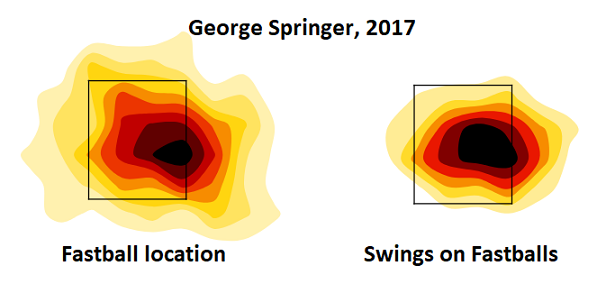
Pitchers are locating their four-seamers to Springer differently this year. On the left, you see where they spotted the pitch to him in 2017, mostly outside. Springer is 6’3 and looks every bit of it in the box. He has an upright stance. When he gets ready to swing he becomes relatively compact. His arms move down while his hands load and he has a moderately  pronounced leg kick. Given how he condenses himself, it’s possible pitchers felt there was an opportunity to attack away because of how it would take him more time to expend the energy to get there on their fastest pitch.

But if you look on the right side of the heat maps above, you’ll see the fastballs Springer swung at. He didn’t have difficulty getting to those pitches and you can see why for yourself if you get out of your seat and pretend to take a swing as you read this next part. (That’s what I did. It was fun!) Go ahead. Stare down Luis Severino or Jacob deGrom fearlessly as you ready yourself for what’s about to come. Make sure you’re in an upright stance. Slowly coil up as you get ready to take your cut. Follow through.

Notice where your arms and legs go? They explode out. They pretty much have to, right? Now imagine you’re a top tier athlete on a top team in the world, like George Springer is, and you can see how he’d shred fastballs on the outer half. He accumulated a 17.4 pitch value against four-seamers last season, which was good for 15th in all of the Majors.

SpringerHeat2018

So, the solution? Try to take advantage of the way Springer coils up. Bust him inside some more to keep his body and bat from exploding through the pitch. And so far this season, it’s working. He’s managed only a 6.9 pitch value against four-seamers so far. That’s still relatively nice, and top 40 in the Majors. His wOBA against four-seamers this year is still .381, but that’s down nearly 50 points from last year. In many ways he’s been perfectly cromulent, even if a far cry from the top six outfielder and top 20 hitter in all of baseball he was in 2017.  

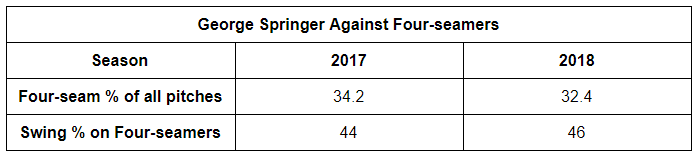
Pitch values come with caveats. They can be deceptive because on the surface they look like they report only on one specific pitch, but the value of each pitch is often heavily tied to how it’s sequenced with others. We don’t immediately know what set up the performance of the pitch we’re evaluating, and that’s a big deal. However, Springer has seen and offered at pretty much the same volume of four-seamers as just a season ago. Pitchers have merely changed where he’s seeing it.

Springerrrrrrr

If he’s still favoring swinging at the fastballs on the outer half, it’s probably because he knows he can crush them. Just last night, on June 21, poor Noe Ramirez served him a pitch right in his happy zone and the Angels paid dearly. The Astros are a smart club. Maybe they’ve tried or are brainstorming possible solutions to Springer getting crowded with heat. Maybe they’ haven’t and they’re just telling him to keep on keeping on because it’s not like he’s turned into a liability. But good gravy, imagine if he figures it out before October.

Pitch percentages and heat maps from Statcast. All other data from FanGraphs.


Ohtani’s Offensive Potential Could Potentially Hurt Him

Shohei Ohtani is an interesting dude, for so many reasons. For inquisitive baseball fans, he provides all sorts of fodder. I am a big fan of Ohtani.  He has many special characteristics, which go beyond being a two-way player.

One of those characteristics is that he chose to come over to MLB two years before he could have signed for boatloads of cash. Had Ohtani waited until after the 2019 season, he could have signed for whatever a team was willing to offer. By coming over this past offseason, he could only sign a uniform player contract. The same contract given to draftees or international free agents as young as 16. Ohtani did receive a few million in the form of a signing bonus, but it was uncontroverted that he was not making his decision based on money.

There was talk that Ohtani might start this season in the minor leagues. He struggled in spring training, and the Angels could have extracted an extra year of team control by keeping him down for about three weeks. This type of service time manipulation is common if not totally accepted by baseball pundits. But it would be particularly unseemly for the Angels, having won the lottery when Ohtani chose them, to take part in this type of chicanery.

The Angels put Ohtani on the opening day roster, and if you were alive and even a casual baseball fan, you know what happened next. Ohtani lit the world on fire as both a pitcher and a hitter from the start. Ohtani throws a triple digit fastball and it was always assumed that he was going to end up providing more value as a pitcher. But through the first half of the season, Ohtani has a 145 wRC+ in 157 plate appearances. He has identical 1.1 fWARs from both sides.

However, Ohtani’s storybook beginning to his career has taken a major blow. His pitching elbow is possibly in need of Tommy John surgery. It is possible that surgery is inevitable the Angels are simply waiting until the end of the season. From a “maximizing utility” standpoint, this makes a lot of sense. If Ohtani were to go under the knife right now, he’d most likely not pitch until 2020, and would certainly be off the mound for a large portion of next season even under the best-case scenario. He would also be unable to hit for several months, probably the rest of this season. The Angels would lose Ohtani the pitcher for 2018 and 2019 and Ohtani the hitter for 2018. However, if he has Tommy John surgery at the end of the season, he can continue to hit, and the most likely outcome is that he still just misses one additional season as a pitcher. He could continue to be Ohtani the hitter in 2018 and in 2019. *

* It’s also possible that by waiting Ohtani could avoid the surgery altogether

Now comes the fun(?) part. If Ohtani were a pitcher the same way that every other major league pitcher is a pitcher, he would be on the disabled list while he recovered from Tommy John surgery. Importantly for his financial future, his service time clock would continue to run. There would be no risk of him being sent down to the minors and having his clock stop. * This raises the question: what happens if Ohtani the hitter struggles mightily and the Angels feel it is necessary to send him to the minors? Now, this seems unlikely to happen, both because of Ohtani’s strong offensive start and the solid history of top Japanese imports performing at the major league level. While this is certainly something that could happen, I am approaching this mostly as a thought experiment.

* Ohtani would need to spend 20 or more days in the minor leagues in order to lose major league service time that would push back his free agency year

I am a lawyer, but far from an expert in this area. The best I can do is to review the collective bargaining agreement and see if there are any provisions that might shed light on this. The basic rule about demoting injured players is far from detailed: “Players who are injured and not able to play may not be assigned to a Minor League club.” A player who believes his assignment is unjust can file a grievance. I didn’t read the entire CBA, but I don’t see anything else in it that would address this situation.

By the plain reading, you could say that the Angels would be perfectly within their rights. Ohtani would not be “injured and unable to play.” While he could very much say he is injured, he is also very much able to play. Ohtani could argue that the spirit of the rule would not allow him to lose service time due to the fact he is a superior enough player that it was at least thought that he could continue to be valuable as a major league player even without pitching. You shouldn’t be able to “punish” someone because they are better than everyone else. As a matter of plain fairness, this argument is as solid as an Ohtani bomb deep into the Southern California night.

Again, Ohtani seems unlikely to make this scenario a reality. But Brendan McKay is coming up the Rays system. It is possible we will see more two-way players. Looking beyond just Ohtani, it is very much conceivable that this could become an issue at some point. It makes sense for MLB and the union to figure this out before it becomes an embarrassing (international) incident.


Evaluating Statcast Hit-Type Boundaries

Statcast defines different types of batted balls based on launch angle (LA) http://m.mlb.com/glossary/statcast/launch-angle. They call under 10 degrees a grounder, 10-25 a liner, 25 to 50 a fly ball and over 50 a pop-up. Those are not new terms, of course, those definitions have existed forever. Merriam Webster uses this definition for a line drive https://www.merriam-webster.com/dictionary/line%20drive.

To evaluate the boundaries I first looked at some characteristics of batted ball types using the boundaries that Statcast uses: https://imgur.com/a/wlWbsNE

The categories were BABIP, ISO and BA (used BA instead of BABIP to include homers) dependency on EV. You can see that “grounders” under 10 degrees have a BABIP of around .280, a very low ISO and a steady positive relationship of EV and BA. Liners have a very high BABIP, a high ISO of .435 and a relatively low impact of different EVs. On fly balls (25-50 degrees) you have a very low BABIP, a very high ISO and you have the “donut hole” where you have the bloopers on very low EVs, mostly outs at medium EVs (80-95) and then again (extra base)-hits at high EVs.

To test the existing boundaries I now did the same tests with other boundaries.
LA characteristics

Under zero degrees the BABIP is mostly under .200 except for very hard hit balls where it is around .300. From 0 to 5 and 5 to 10 that changes, at low EVs the BA on contact is low and at medium and hard contact it gets pretty high (around .500 and higher). That means those batted balls around 5 degrees behave like grounders at low EVs and like liners at medium and high EVs.

At 20-25 degrees the BA on contact is .682 on soft contact, just .251 on medium contact and around .700 on hard contact which is about the same as fly balls. That means balls hit at those angles behave like a liner on soft contact and like a fly ball on medium and hard contact.

I also compared the range of 5-20 with the 10-25 range and an alternative range of 5-20 https://imgur.com/a/qjaVrIP
What you can see is that the 5-20 range matches more closely with the “core line drive range” of 10-20 than the 10-25 range.

Overall it is not totally clear what is better. Neither range is perfect as both edge ranges (5-10 and 20-25) are more velocity dependent than the “core range”. The lower edge behaves like a grounder on soft contact and the upper range behaves more like a fly ball on medium and hard contact showing the famous donut hole.

IMO there are a lot of reasons to either narrow liners to the 10-20 range or alternatively use 5-20 if you want to keep the same angle range because soft contact is only 20% of all MLB contact. That means on 80% of all contact 5-20 behaves like a liner and on 20% like a grounder. The 20-25 range, however, behaves like a fly-ball 80% of the time and just 20% like a line drive.

So the changed ranges would be either:

<10 GB
10-20 LD
20-50 FB

or:

<5 GB
5-20 LD
20-50 FB

You could also introduce additional batted ball types to make it more precise as Andrew Perpetua did here but I think the easier solution would be to cut off the upper 5 degrees of the original range because that range behaves like a FB on most batted balls.


Exploring Batter xwOBA and its Applications, Part 2

In Part 1, I discussed what batter xwOBA does, what data feeds into it (using Statcast’s quality of contact types, including barrels), and thus what some sources of noise or “batted ball luck” are contained within xwOBA despite what it strips out in terms of defense and park impacts.

Some takeaways to set up Part 2:

  • Barrel% (AKA barrels per plate appearance) appears to be in a similar range of year-to-year reliability as K% and BB% for batters, while other Statcast quality of contact categories that produce positive results had far worse year-to-year consistency.
  • When comparing roughly the first third of a season to the rest of a season, it appears that barrels remain one of the more reliable metrics we examined, while “flares and burners,” which are worth a bit less than half the wOBA of a barrel on average, are very unreliable despite making up 25% of all batted balls. Thus, variation in the number of flares and burners a batter hits was identified as a likely source of noise that would still exist in xwOBA. (The same, to a lesser extent, could be said of “solid contact.”)

Now that we understand what feeds into xwOBA better, I want to look at the descriptive and predictive capabilities of xwOBA. To be clear, while xwOBA regresses results on batted balls based on exit velocity and launch angle, it is not a projection of future results / a predictive metric.

The “expected” element refers to what you would have expected a player’s past results to be. In this manner, it is similar to FIP, though FIP is much simpler. And, just like with FIP, you cannot simply look at a player’s FIP and then anticipate them replicating that going forward. However, as FIP is to ERA, theoretically xwOBA could be to wOBA – it considers elements potentially more indicative of skill while cutting out some noise, and thus could predict wOBA going forward better than actual past wOBA.

We should have something else to compare it to though, mostly for fun. We could compare it to past projections here at FanGraphs, but that sounds like a great deal of additional work for me that I would not know where to start with, so let’s conduct an experiment by producing a simple model that describes, but does not attempt to project, batter wOBA.

For Comparison to xwOBA: Our (Very Simple) Model

I constructed a quick linear model using all batter data from 2015-2017.

I saw, from Part 1, that three of the most reliable batter statistics we looked at were K%, BB%, and Barrel%. Therefore, I used batter K%, BB%, and Barrel% to describe wOBA in a linear model weighted by the number of plate appearances each batter had. (When we later test the predictive capabilities of Our Model, we will benefit from Statcast here by being able to look at barrels instead of home runs, as barrels appear to be more trustworthy than actual home runs.)

After rounding the coefficients, that gave me the following equation:

wOBA = 0.309 – 0.36*K% + 0.45*BB% + 1.24*Barrel%

or

wOBA = 0.309 + (-0.36*K + 0.45*BB + 1.24*Barrels)/PA

Unlike xwOBA, Our Model ignores the well over 90% of batted balls that are not barrels. Our Model also ignores the specifics of how each barrel is hit, unlike xwOBA. Not all barrels are created equal. For example, for barreled balls hit at a launch angle of 28 degrees, a 102 mph exit velocity has produced home runs on about 3 out of every 4 batted balls, while at 112 mph there have been 100% home runs.

These details undoubtedly matter for estimating past results – Our Model should be easily worse than xwOBA in that respect. But how will this impact predictive capabilities? Will Our Model’s lack of knowledge of what happens in about two-thirds of all batter plate appearances significantly worsen predictive qualities, or will it cut out the noise to the point that predictive qualities improve?

wOBA vs. xwOBA vs. Our Model

Naturally, to find out, let’s go to some tables. First, how do the models describe wOBA in a full season and at the 2-month level? (i.e. What is the R² between 2015 wOBA and 2015 xwOBA? Or between Apr-May 2015 wOBA and Apr-May 2015 for Our Model? And so on…)

R² of Models Describing wOBA – Full Year

Table 6 - Models - Descriptive capabilities - full year

R² of Models Describing wOBA – First Two Months of Season Only

Table 7 - Models - Descriptive capabilities - two month period

^using batters with min. 300 batted balls for full years and 100 batted balls for two month periods.

Of course wOBA perfectly describes itself. No other model can beat that! As was assumed, xwOBA is clearly a tier above Our Model in terms of descriptive capabilities.

xwOBA loses to wOBA because, for example, xwOBA doesn’t know when the defense made or did not make a play; when a ball that might have cleared the fence on an average day was actually blown in by the wind and caught; or whether a lumbering lefty pulled yet another hard-hit grounder straight into the shift.

Our Model, in turn, loses to xwOBA, because it leaves out the same things as xwOBA plus it knows nothing about whether a liner, a pop up, or whatever else was hit on the vast majority of batted balls. Still, Our Model is not way less successful.

Finally, on to the most interesting part: predictive capabilities.

People have been comparing batter xwOBA to wOBA when discussing breakout or slumping hitters and whether or not they may continue to succeed or fail. To test the appropriateness of this, let’s see how well our three batting value models (wOBA, xwOBA, and Our Model) predict future batting value (future wOBA) on a “year-to-year” and a “pre-June 1st to June 1st onward” basis.

R² Between One Year of Models and the Following Year’s wOBA

Table 8 - Models - Predictive capabilities - year to year

^Same sample as in Part 1: Batters with min. 300 batted balls in both years being compared.

At the year-to-year level, none of these metrics are magic at predicting future wOBA. It is not clear from this fairly simplistic analysis whether one year’s wOBA or xwOBA will tell you more about the next year’s wOBA. Our Model may be the worst (well, it at least did a poor job 2016-2017).

R² Between Models Pre-June 1st and wOBA June 1st Onward

Table 9 - Models - Predictive capabilities - Pre June 1st to ROS

^Same sample as in Part 1: Batters with min. 100 batted balls before June 1st and 200 batted balls from June 1st onward.

In our smaller in-season sample, there is a difference. It appears using wOBA from the first two months of a season to predict rest of season wOBA is the worst idea out of the three.

It also appears that using xwOBA or Our Model from the first two months of a season to predict rest of season wOBA isn’t really any different, despite Our Model ignoring so much information! (I’m not going to say Our Model is better, because this is fairly imprecise analysis and the R² values are very similar.)

Conclusions

Similar to the lessons of FIP for pitchers, we can see how leaving out large amounts of data can be appropriate when you have not figured out how to use it effectively yet. Even though wOBA itself clearly benefits from feeling the impact of certain reliable things that are ignored by the other models we examined, such as a batter outperforming their quality of contact due to playing in a hitter’s park or being fast, xwOBA and Our Model cut out other elements that muddy the data in small samples to make up for missing that info.

However, neither xwOBA nor Our Model is built to be projections of future performance. I already linked to this Tom Tango tweet in Part 1, which says that the minimum condition to make a statistic predictive is to weight it by the number of trials, which for batters here we could use plate appearances. In a simple form, this would consist of a model that incrementally adjusts the expectations for a batter to be based more on their tracked performance and less on the league average rate as more data (i.e. plate appearances) for that batter become available.

One can see how you could go about using Statcast data to build a projection system for wOBA on batted balls. For example, one could project the rate of barrels hit based more on a batter’s past barrel rate than the league average rate even in a relatively small number of PA, while one would have to heavily regress the projected rate of flares and burners a batter would hit toward the league average rate.

We have a number of projection systems available at FanGraphs that are great and constantly updated. Using Statcast data is attractive, but it is all very new, so we need to wait a bit longer before we see a similar Statcast-based projection system. Also, we probably simply need more years of Statcast data before we can be too confident in any such projection system regardless.

If you want your batter analysis to benefit from Statcast data in the meantime, maybe check out how a batter’s barrels per plate appearance have changed. Have they gone from about average to well-above average? Their ability to hit for power may have legitimately changed. (Speaking of which, this Mookie Betts power surge is crazy. 2015 to 2017 Barrel% = 4.2%. This year through July 7th: 11.9%!!!)

Enjoy xwOBA and what it does, but be careful using it to adjust your future expectations for players without diving deeper or relying on the powerful information we already have.


Exploring Batter xwOBA and its Applications, Part 1

We are around the halfway point of the fourth season for which we have had Statcast data. One of the primary metrics created with Statcast data, introduced on the excellent Baseball Savant, is xwOBA (expected weighted on-base average), which I have noticed being adopted more for public analysis, including at this site.

The primary component of xwOBA is a statistical model that estimates the wOBA that each batted ball is expected to have produced based on its exit velocity and launch angle. In addition, actual strikeouts, walks, and times hit by a pitch are added in, as it is done in the normal wOBA formula.

There have been some explorations this year into the potential for predictive value added by xwOBA for pitchers, by Craig Edwards and Jonathan Judge, and batters, by Tom Tango and recent major leaguer Nate Freiman.

The pieces related to pitchers indicate what we would expect from our traditional DIPS principles: there is little evidence that pitchers have enough control over their results on balls in play to make including balls in play particularly worthwhile. For batter xwOBA, the pieces by Tom Tango and Nate Freiman serve as good jumping off points for a deeper dive, which is what I would like to present here (now that I’m finally done dragging my feet on writing this for a couple of months).

There is nothing too crazy presented here – think of this as a PSA on what batter xwOBA does, what goes into it, and why it is more of a stepping stone to future Statcast-based predictive metrics than something you should apply in a forward-looking manner today.

What does xwOBA do and what does that mean?

At the beginning of the article, I introduced the primary component of xwOBA as a statistical model that estimates wOBA for batted balls based on their exit velocity and launch angle. This more or less regresses the results of all batted balls to the mean wOBA we would expect of them without impact from or knowledge of the defense or park in which they were hit. In this way, it strips out a form of what could be called “BABIP luck” or “batted ball luck” that is associated with those things it does not include.

This is potentially powerful for predicting future performance, though it is not a predictive metric. In the case of batters, we know that they have substantially more control over their batted ball results than pitchers, generating a much wider range of BABIP and HR/FB% on a year-to-year or career basis than pitchers. Therefore, including analysis of balls in play for batters makes much more sense than for pitchers, which batter xwOBA could help to do.

However, while I have been seeing xwOBA regularly used to comment on early season breakouts or slumps, I have not come across a close look under the hood of batter xwOBA to both test its possible predictive capabilities and identify what sources of noise or “batted ball luck” it leaves in. Let’s see what we can find out.

What goes into xwOBA?

Statcast Quality of Contact Categories

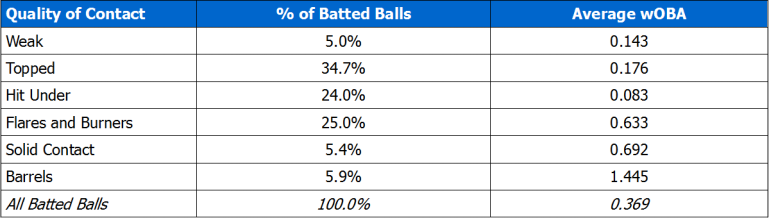
To start, I decided to use some of the new “quality of contact” categories that the Statcast crew have defined. You’ve probably heard of barrels, the category that produces the highest wOBA (1.445, according to my calculations*), consisting generally of very hard hit fly balls and high line drives. It’s also the category seemingly most indicative of skill and thus signal amidst the noise, which is why it is the only one regularly used so far. The other five categories do contribute to xwOBA though, so let’s look at a quick summary of them.

*most of the numbers I use in here will be based on what I calculated using R from 2015-2017 Baseball Savant data, which may differ very slightly for a variety of reasons from what you see elsewhere – including, most likely, my personal failures. 

Statcast Quality of Contact Type Summary (2015-2017 data)

Table 1 - Quality of Contact Summary

Some of those names are more self-explanatory than others – if you would like to know more specifics, here is a Tom Tango blog post explaining them as well as providing some visualizations to help.

Aside from the specifics of what each of the six quality of contact types refer to, the takeaway should be this: While barrels contribute the highest wOBA on average and are most representative of skill, well over 90% of batted balls are not barrels. Expected results on these non-barreled balls are still fed into the xwOBA model. For batters, how much less indicative of skill are these other batted balls? And if they are less indicative of skill, are they useful to include?

First, let’s simply look at how each quality of contact type correlates year-to-year. Unfortunately, we only have three full seasons of data to compare, but let’s do what we can. For players with at least 300 batted balls in each year, I calculated the year-to-year R² value for the rate at which players hit each quality of contact type. (e.g. 2015 Barrels/batted ball to 2016 Barrels/bb)

Year-to-Year R² of Statcast Quality of Contact Types

Table 2 - Year to year correlations for Quality of Contact types

^Red denotes categories that produce poor batting results, green denotes good batting results

From the above table, we can get a sense of why the Statcast crew has focused on barrels – they are the only quality of contact type that produces both above average results and quite a bit of year-to-year reliability. Balls categorized as “topped” or “hit under” appear to approach barrels in reliability, but are worth very little. The “flares and burners” and “solid contact” categories produce close to half the value of barrels, but are far less reliable on a year-to-year basis.

For comparison, below are the year-to-year R² values for a few other things for the same set of hitters. Each of these metrics refer to the number of occurrences of that event per plate appearance.

Year-to-Year R² of Some “per PA” Metrics

Table 3 - Year to year correlations for other plate appearance metrics

This is pretty cool to me. Barrels per plate appearance or per batted ball seem to be in at least the same vicinity of year-to-year reliability as K% and BB%, which are two of the most important simple analysis tools out there for hitters. Barrel% is also a distinctive step above HR% in both sets of years compared.

But, what I really wanted to test going into this was smaller sample reliability, given the usage of xwOBA in so many early season articles.

In the following tables are R² values for the same quality of contact and per PA metrics we have discussed so far, but instead of looking at year-to-year R², we are testing the relationship between roughly the first third of a season (before June 1st) and the final two thirds of a season (June 1st onward).

R² Comparing Pre-June 1st to June 1st Onward – Statcast Quality of Contact Types

Table 4 - Pre and post June 1st correlations for Quality of Contact types

R² Comparing Pre-June 1st to June 1st Onward – Some “per PA” Metrics

Table 5 - Pre and post June 1st correlations for other PA metrics

Note: I simply proportionally adjusted my batted ball minimums for batters in this sample (batters with min. 100 bb before June 1st and min. 200 bb from June 1st onward), weirdly producing 149 batters in each year…

In general, of course, these R² values are a bit worse than the year-to-year ones. Strikeouts and barrels look the best here, with the next tier probably being topped, hit under, and walks.

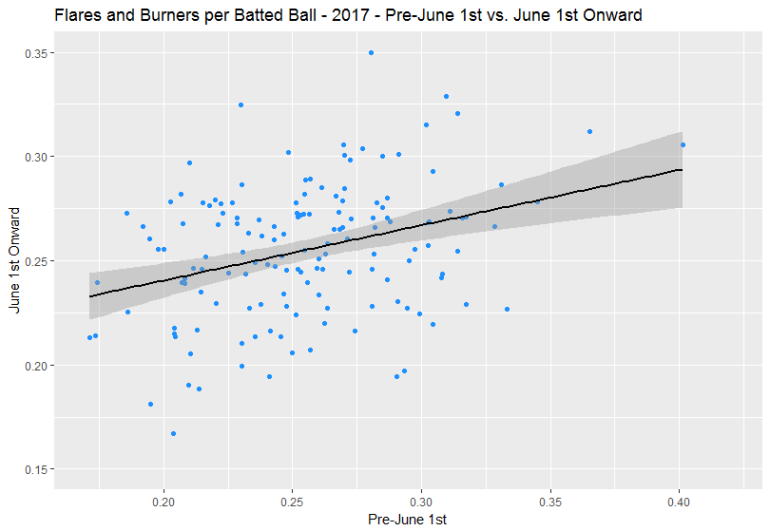
What struck me most was something I figured I would find here: flares and burners take a significant hit in this smaller sample. How many flares and burners a player hits through a couple of months tells you very little about how many they will hit for the rest of the season.

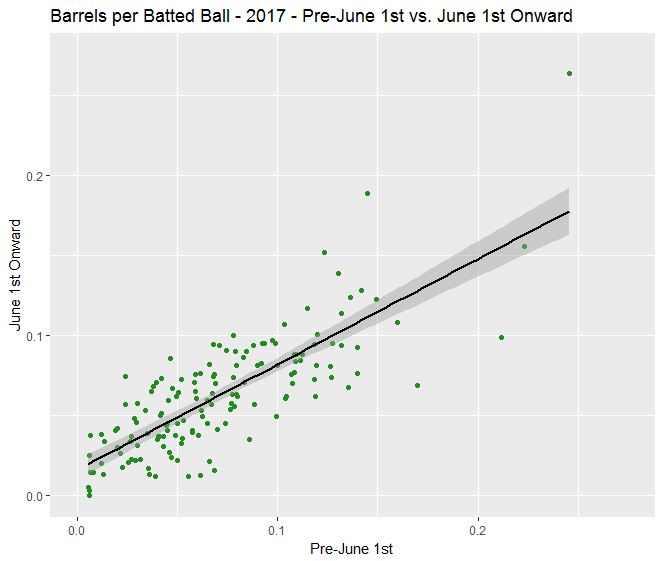
To help visualize this, below are two graphs from the 2017 “pre-June 1st to June 1st onward” comparison: flares and burners per batted ball (R² = 0.11) and barrels per batted ball (R² = 0.64).

plot_2017_FlaresandBurners

plot_2017_Barrels

There is no doubt here that barrels are more indicative of a repeatable skill in partial season samples than flares and burners. (I want to say thanks to Aaron Judge for stretching out the barrels graph, by the way.)

This is why, earlier in the article, I said that xwOBA only strips out certain types of batted ball luck. In a small sample, players could hit some extra soft line drives, hard ground balls, or bloop singles instead of cans of corn or weak grounders, causing them to have an uncharacteristically high wOBA and xwOBA. Our analysis to this point deems knowing about those flares and burners to be not very useful for assessing a batter’s future results partway through a season.

But how much of an impact could that possibly have? Well, I calculated that flares and burners produced a .633 wOBA from 2015-2017 while making up about a quarter of all batted balls. According to FanGraphs, the highest wOBA ever recorded in a qualified batting season was .598 by Babe Ruth in 1920.

So yes, I think that lucking into some extra peak Babe Ruth plate appearances could have a relevant impact on a batter’s small sample xwOBA.

Up next

We have covered a lot so far, so I will break things here. In Part 2, we will look at a similar analysis on wOBA and xwOBA themselves, see if we can create a more simplistic metric than xwOBA that is comparably predictive in small samples, and discuss how the Statcast crew is likely working to create predictive metrics based on Statcast data (since that’s not what xwOBA is, making this analysis pretty unfair to them!).


How Nolan Arenado Avoids the Ground

Nolan Arenado has been one of the elite hitters in avoiding the ground in his career with a GB rate of just 36% which is well below the league average of around 44% during that time frame. Especially impressive is his pull LA on low pitches of 9.3 degrees vs the league of 3.6 degrees. Those are the pitches the league rolls over when it tries to pull it and he drives just straight through them and pulls them in the air without hooking or rolling over.

The question is how does he do that. First, he does have a slight uppercut through the zone like most good hitters but it is not an extreme upswing.

Overall his swing is pretty flat, maybe a 10-degree positive attack angle or so, there are definitely swings with more uppercut out there. Also, his posture is rather vertical in the front to back direction. He does tilt his upper body over the plate but he doesn’t lean back toward the catcher.

This is different from many big uppercut hitters. The swing is generally pretty perpendicular to the spine thus the tilt over the plate changes the bat angle and the lean toward the catcher creates more uppercut in the plane as the natural direction faces up while a guy using just lean over the plate will have the bat going flatter and then up in the end out front compared to flatter barrel guys who will have the swing often getting flatter in the end when they roll over. In this picture, you see him vs Bellinger. Bellinger leans back much more and thus has a natural built-in lift. However, you can also see that Cody’s bat angle is flatter and his bat is already starting to roll over here. This might be why Cody- while an elite launch angle guy has a low pitch pull LA of 6.6 vs 9.3 for Nolan, who doesn’t have as much uppercut but is better in avoiding the rollover on low pitches even if he is fooled and out front.

View post on imgur.com

So how does he still create elite lift rates? One thing he does is having a very steep almost Ferris Wheel like bat angle. Even on high pitches his bat is pointing down and he swings more under the shoulders rather than around them.

Most other hitters will flatten the bat out more on high pitches like Pujols on a similarly high pitch

Here is another comparison Arenado vs Beltre on a pitch away and slightly above the belt

View post on imgur.com

Beltre also has some shoulder tilt but the bat and shoulders rotate on a much more level plane while Nolan has a lot of side bend in the spine and has the hands extremely high with the barrel pointing down (you can’t even see his face) while Adrian has the hands about lower chest high and the barrel just under the hands.

Because of this Arenado has a very straight direction through the ball and almost never rolls over. At the end of the swing the bat of every hitter will roll over to the other shoulder and if you hit balls out front there is a chance that you catch the ball during that rollover. That is the reason why pulled balls are hit on the ground more often https://www.fangraphs.com/community/the-effect-of-batted-ball-direction-on-launch-angle/ the rolling over creates a top spin.

Arenado due to his steep bat angle, however, delays that roll over extremely long. In this picture you can see that he almost is at full extension and the barrel is still below his hands and from the front, you can also see it still slightly points toward the other batters box, so it hasn’t started to roll over yet. So Arenado can be very out front and still not roll over, even in some swings where he loses his posture and lunges.

I wrote in this article how this is an important skill that holds some hitters back on low pitches
https://www.fangraphs.com/community/finding-keys-to-elevate-the-ball-more/

So Arenado does have a slight uppercut but the thing that makes him elite is that he rarely rolls over as his bat comes straight through the zone from below and not across the ball. He really gets the most out of his attack angle by rarely rolling over and across the ball but driving through it and either hit it straight or backspin instead of topspin.

There is a slight cost of this of course, on very high pitches this Ferris Wheel bat path is hard to do. Arenado does have a slight weakness very up in the zone https://www.fangraphs.com/zonegrid.aspx?playerid=9777&position=3B&ss=2018-01-01&se=2018-12-01&type=5&hand=all&count=all&blur=1&grid=10&view=bat&pitch=&season=2018&data=pi
However the first video of the article shows that he is able to pull this off until about belt high, so there is not much room for the pitcher up.

Overall this is an interesting and slightly unusual swing with some great strengths and weaknesses mitigated by great flexibility (especially in the spine) and the ability to contort himself to still get to the high pitch with a steep bat angle. This swing allows him to lift low pitches and make contact way out front without rolling over what most can’t do. There is a small space to attack him up in the zone but the margin for error is not high.

Overall, of course, we know that Arenado is an elite hitter. While I would not recommend his style for pitches belt high up it is definitely interesting how he refuses to roll over baseballs and drives them in the air consistently especially against lower pitches.