Complete Outfield Dimensions

I’ve been consistently dismayed at how metrics such as park factors could be calculated when it seems as if the fundamental data for calculating such metrics, the actual size and dimensions of MLB parks, is unknown.

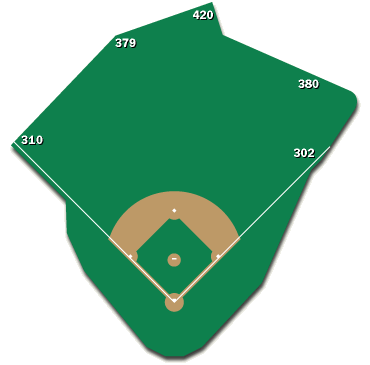
Any diagram or database of park dimensions I’ve found usually has LF, CF, and RF distances measured along with distances from home plate to the power alleys. A typical diagram is the following one of Fenway Park where five “important” distances have been marked.

The locations of these markings, particularly the power alleys, is extremely inconsistent across the different ballparks. In some parks the power alleys are measured at LCF and RCF (22.5° from each foul line), in other parks it’s where there is a corner in the outfield fence, and in other parks it’s just somewhere. In the Fenway image it’s impossible to tell where exactly any of those markings are and what any of the distances are between them. In any case, these five data points, plus any other distance markings, are not enough to define the shape and size of a ballpark.

We should be able to point in any direction in a ballpark and know the exact distance to the fence. Guessing by examining the proximity to the closest marked spot is insufficient for any real analysis. In order to understand the properties of a ballpark, to, for example, determine the ideal defensive positioning of the outfielders, we need to be able to mathematically define the boundaries, i.e. the location of the outfield fence.

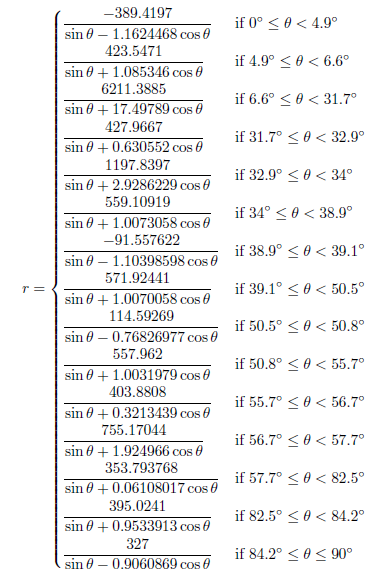
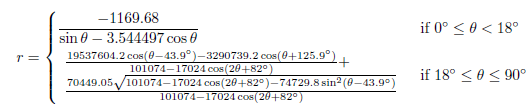
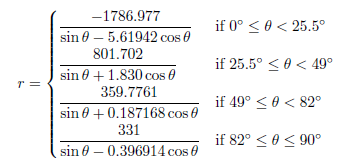
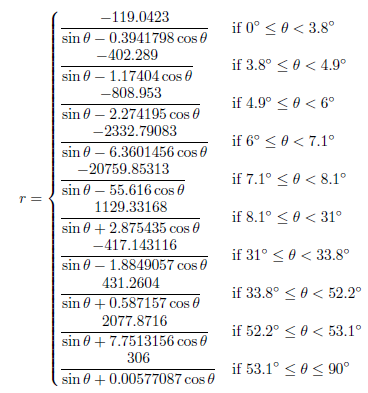
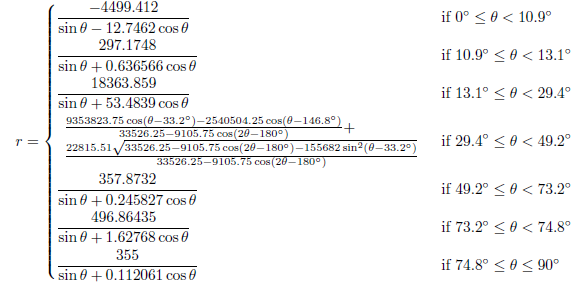
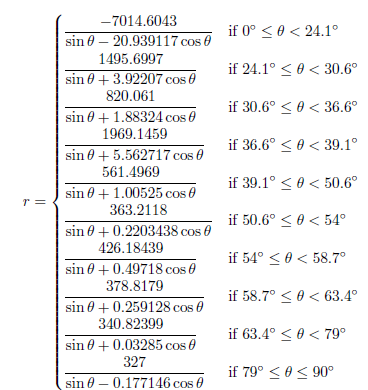
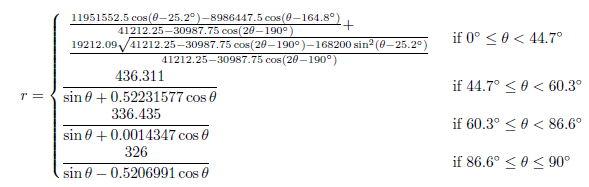
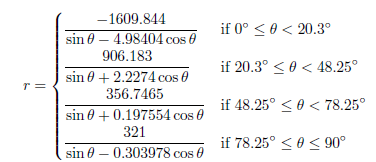
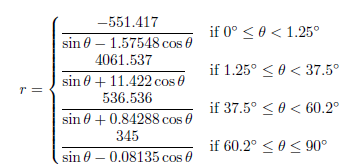
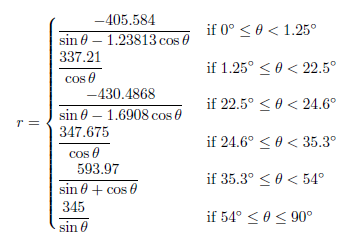
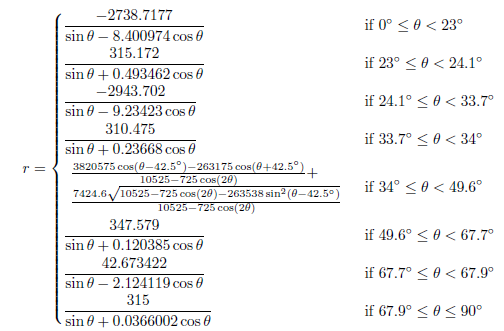
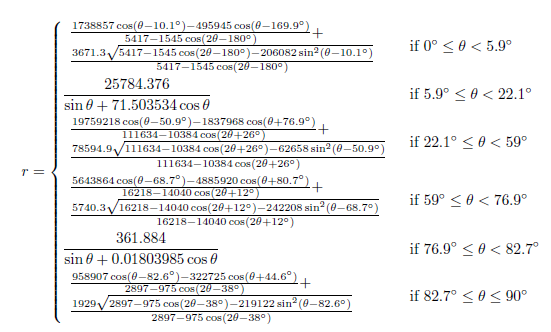
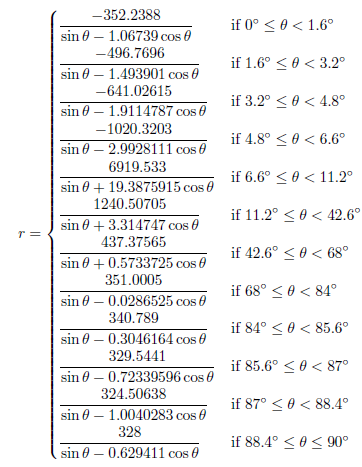
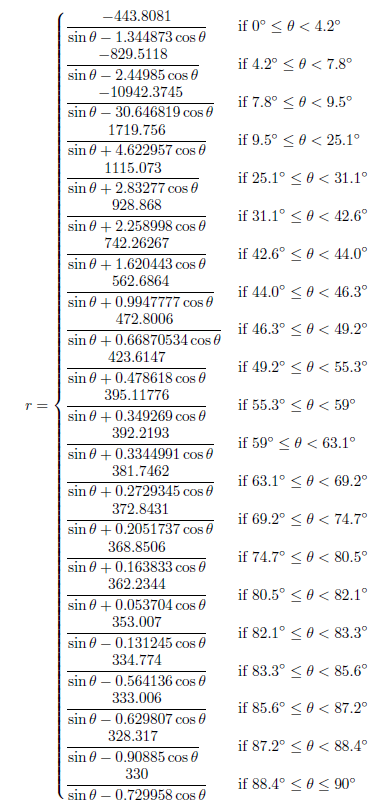
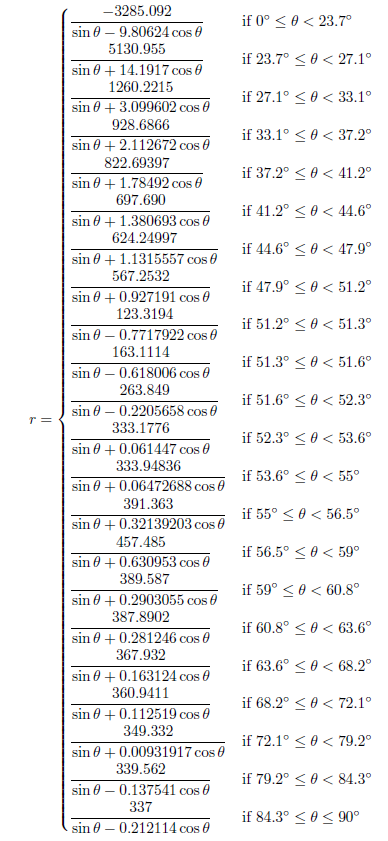
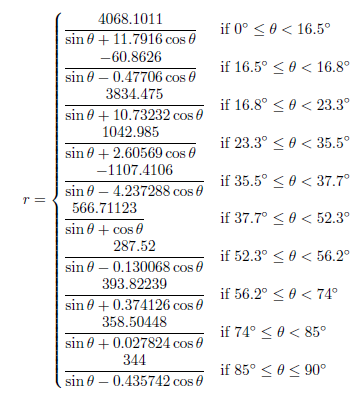
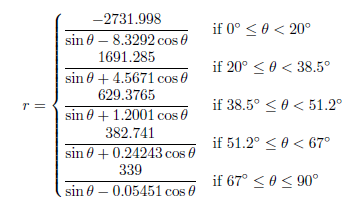
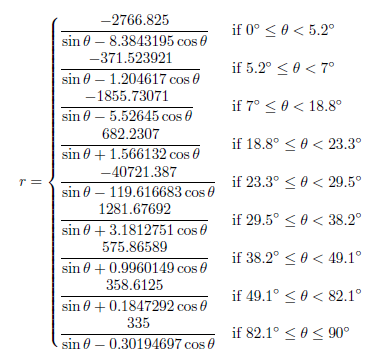
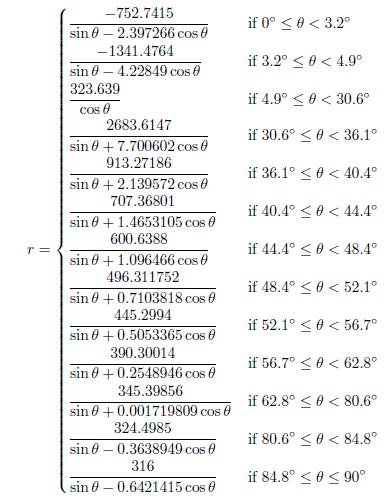
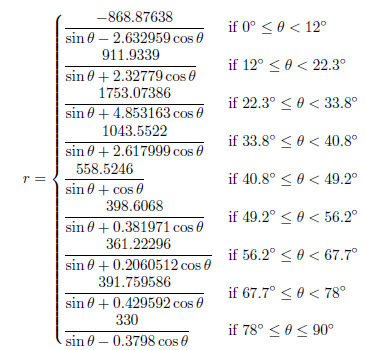
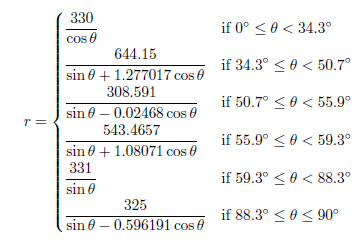
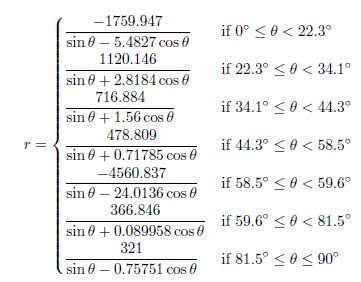
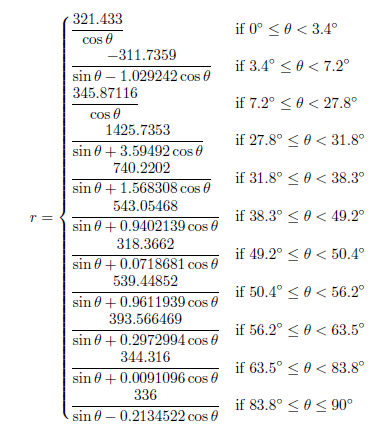
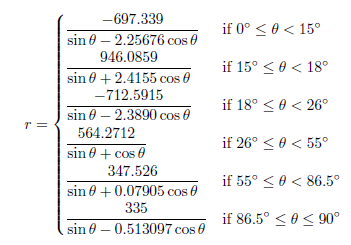
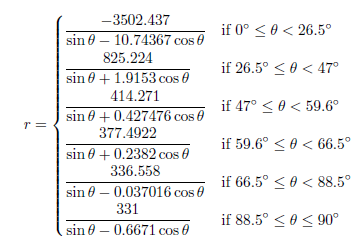
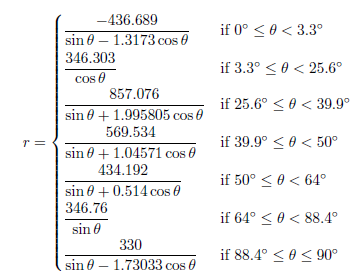
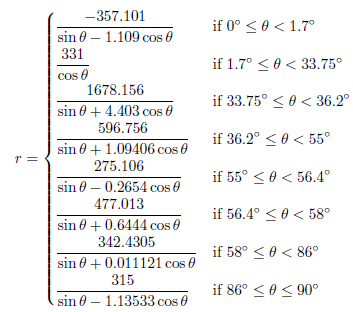
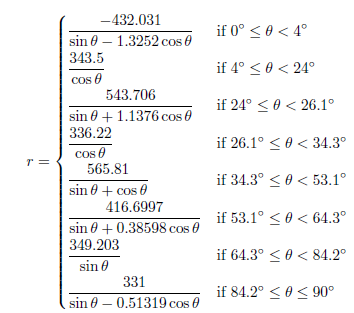
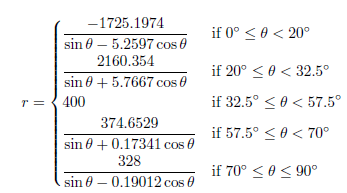
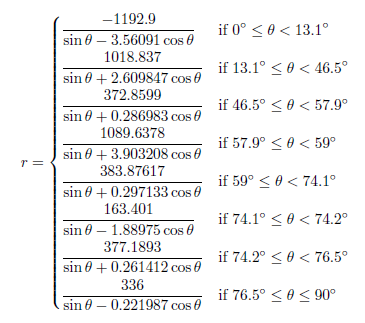
These mathematical formulas defining the outfield fences are exactly what this article presents. If you look to the bottom of this article you’ll see the 30 equations that define the major league outfield fence distances from home plate. The equations are given in polar coordinates in terms of the angle θ from the right field foul line (RF=0°, LF=90°). The resulting distance, r, is given in feet.

The equations are all piecewise functions, with breaks between the sub-functions whenever the outfield wall changes direction. The sub-functions are given by linear functions or ellipses (all mapped to polar coordinates) where appropriate. Some ballparks are more complicated than others and that’s generally reflected in the number of required sub-functions. Some of the functions may seem intimidating, however, I would intend that any analysis with these functions would be done by computer, which makes the number of sub-functions in each piecewise definition generally irrelevant once the equations have been coded.

These equations were determined by examining the diagrams at ESPN Home Run Tracker, as well as park dimension data from Wikipedia, Clem’s Baseball, MLB team pages, and any other park diagrams I could find. These sources were not always in agreement and I used my best judgment when these situations arose, however I would guess that the standard error of the fence distance for any angle for any park is only a couple feet. There are also often many more precision digits that appear in the equations than necessary. This is for two reasons. The first reason is that it helps avoid discontinuities when transitioning between the functions and the second reason is that sometimes I just wrote down a lot of digits.

As a simple exercise of what can be done with this type of data, I’ve calculated the areas of the outfields of all the different MLB parks, as well as the respective sizes of left, center, and right field. The results are shown in Table 1 (sortable by clicking any of the header items). As an arbitrary start point, I assumed the outfield started 150 feet away from home plate and that each field spans 30°. Many of these results match our intuition (Yankee Stadium RF is tiny, Comerica Park CF is huge), but we now have numbers assigned to that intuition that can be analyzed.

Table 1: Outfield Areas (x1000 ft2)
City Team Stadium OF LF CF RF
Arizona Diamondbacks Chase Field 94.1 28.7 36.2 29.2
Atlanta Braves Turner Field 94.1 29.2 35.3 29.6
Baltimore Orioles Oriole Park at Camden Yards 87.8 27.1 34.4 26.3
Boston Red Sox Fenway Park 83.5 21.1 32.8 29.6
Chicago Cubs Wrigley Field 89.7 26.8 34.1 28.8
Chicago White Sox U.S. Cellular Field 87.8 26.5 34.2 27.2
Cincinnati Reds Great American Ball Park 87.1 26.7 34.5 26.0
Cleveland Indians Progressive Field 85.6 25.8 33.2 26.6
Colorado Rockies Coors Field 97.3 30.2 38.3 28.8
Detroit Tigers Comerica Park 95.8 28.5 39.9 27.4
Houston Astros Minute Maid Park 88.6 23.2 38.8 26.6
Kansas City Royals Kauffman Stadium 97.9 30.4 36.9 30.5
Los Angeles Angels Angel Stadium 89.2 29.0 32.7 27.5
Los Angeles Dodgers Dodger Stadium 91.1 28.8 33.8 28.5
Miami Marlins Marlins Park 93.4 28.3 36.9 28.3
Milwaukee Brewers Miller Park 91.1 28.9 34.6 27.6
Minnesota Twins Target Field 90.4 28.0 35.8 26.6
New York Mets Citi Field 91.5 27.1 36.0 28.4
New York Yankees Yankee Stadium 87.6 27.7 35.6 24.2
Oakland Athletics O.co Coliseum 88.4 27.5 33.4 27.5
Philadelphia Phillies Citizens Bank Park 86.2 25.7 34.9 25.5
Pittsburgh Pirates PNC Park 90.2 29.8 33.9 26.5
San Diego Padres PETCO Park 90.8 27.9 35.0 27.8
San Francisco Giants AT&T Park 92.2 27.3 36.2 28.7
Seattle Mariners Safeco Field 87.8 27.2 34.2 26.4
St. Louis Cardinals Busch Stadium 91.1 28.6 34.1 28.4
Tampa Bay Rays Tropicana Field 89.6 27.4 36.5 25.7
Texas Rangers Globe Life Park in Arlington 92.7 28.9 36.1 27.7
Toronto Blue Jays Rogers Centre 91.8 27.9 35.9 27.9
Washington Nationals Nationals Park 88.8 28.2 32.8 27.8

The previous definition of the different fields could be modified or determined based on the intended purpose. For example, for determining the outfield positioning, the relative speed of each fielder would determine the area for which each fielder is responsible. With these equations, those values can be exactly calculated. Also, just because two fields have the same area, does not mean they are of equal difficulty to defend. The shape of the fence determines how accessible the different parts of the area are. Again though, with these equations these shapes and values can be determined.

These equations are limited though in that they only define the outfield in fair play. For further research and to more completely account for different stadiums, the distances from the plate to the fence for all 360° of rotation should be known. Foul territory is a much greater consideration in some parks than others.

And now, the equations.

Arizona Diamondbacks – Chase Field

Atlanta Braves – Turner Field

Baltimore Orioles – Oriole Park at Camden Yards

Boston Red Sox – Fenway Park

Chicago Cubs – Wrigley Field

Chicago White Sox – U.S. Cellular Field

Cincinnati Reds – Great American Ball Park

Cleveland Indians – Progressive Field

Colorado Rockies – Coors Field

Detroit Tigers – Comerica Park

Houston Astros – Minute Maid Park

Kansas City Royals – Kauffman Stadium

Los Angeles Angels – Angel Stadium

Los Angeles Dodgers – Dodger Stadium

Miami Marlins – Marlins Park

Milwaukee Brewers – Miller Park

Minnesota Twins – Target Field

New York Mets – Citi Field

New York Yankees – Yankee Stadium

Oakland Athletics – O.co Coliseum

Philadelphia Phillies – Citizens Bank Park

Pittsburgh Pirates – PNC Park

San Diego Padres – PETCO Park

San Francisco Giants – AT&T Park

Seattle Mariners – Safeco Field

St. Louis Cardinals – Busch Stadium

Tampa Bay Rays – Tropicana Field

Texas Rangers – Globe Life Park in Arlington

Toronto Blue Jays – Rogers Centre

Washington Nationals – Nationals Park


Fantasy: Three Undervalued Catchers

These three catchers are being woefully under-drafted in 2015 fantasy leagues:

Brian McCann

McCann was a trendy fantasy pick in 2014 as fantasy owners were feasting on his HR potential with the short right field porch of Yankee Stadium in play. He didn’t have a horrible season, finishing 7th among catchers in 5×5 fantasy leagues but he did underperform his draft position as many were expecting more from him.

As many players often do when switching leagues, McCann got off to a slow start, hitting just .239 with 10 HRs in 330 PAs. However, despite dealing with a foot injury that restricted him to 55 games in the second half of the season, McCann began to show off the power in his new venue. He reeled off 13 HRs in only 208 PAs the rest of the way.

Despite hitting for a lower average in the 2nd half, the underlying peripherals all look strong.

Split PAs SwStr% ISO HRs
1st Half 330 6.3% 0.138 10
2nd Half 208 5.1% 0.232 13

He’s being drafted as the 5th catcher off the board with an overall ADP of 108 in the highly competitive, high-stakes NFBC leagues. These are leagues that require two catchers so position scarcity is an important factor.

On the per-600-PA Steamer Projections, McCann is rated 2nd best catcher, and 69th best 5×5 hitter overall with a .251, 24 HR, 62 R, 70 RBI, 1 SB projection well ahead of the four catchers getting drafted in front of him Jonathan Lucroy (91st Steamer-600 5×5 hitter), Devin Mesoraco (112th), and Yan Gomes (117th).

The opportunity to use McCann as designated hitter – he got 13 starts at DH last year – helps ensure extra plate appearances over his NL counterparts. If he’s hitting, Girardi will keep his bat in the lineup anyway he can. He even managed to grab 11 starts at first base last year.

As the hype on McCann has cooled this year, it might be the right time to move in and take him.

Russell Martin

Martin has hit double digit home runs in 7 out of his 9 seasons in the big leagues and has also been a decent bet for a surprise half-dozen stolen bases. His move back to the American League also opens up some designated hitter opportunities.

His 2015 Steamer line of .242, 16 HR, 61 R, 59 RBI, 6 SB doesn’t quite stand to McCann’s projections, but based on where he’s getting drafted, Martin could end up providing more net value. The noise around him has been quiet as he’s the 11th catcher being taken, an absurd 171 ADP. Martin projects better 5×5 production than several guys being taken higher; Lucroy, Mesoraco, and Gomes just to name a few.

A key factor in his value this year will be a change in venue. Pittsburgh’s PNC Park is graded as the worst in the league for right-handed power. He will flip to the other end of the curve as Toronto’s Rogers Centre rates as the 4th best for right-handers to hit home runs in.

Fly ball distance has remained an impressive 292 feet for Martin over the last two seasons and at 31 he’s in the prime years for major league catchers. There is a lot to like here and Martin has a good chance at being a top-5 catcher this year.

Carlos Ruiz

Seeing a theme here? The old, boring catchers continue to slide down draft boards in favor of young upstarts who haven’t proven much yet.

Ruiz is being drafted as the 25th catcher, 341 ADP overall but he probably deserves consideration in the 15-20 range. In a two catcher league you could do a lot worse than adding this reliable veteran. Steamer expects him to out-produce Miguel Montero (15th C/207 Overall ADP), Derek Norris (17th/231), Dioner Navarro (19th/282), Tyler Flowers (20th/299), Jarrod Saltalamacchia (21st/302), John Jaso (22nd/309), and Kurt Suzuki (24th/328)

The key to Ruiz value is that he will churn out valuable batting average that few bottom-tier catchers can. Reliable plate appearances to accumulate the counting stats are also very important. At that point in the draft it’s often difficult to find catchers who can give you PA’s and a healthy batting average but Ruiz should do that this year. Over his 8 year career as a full-time catcher, Ruiz has average 411 PAs per season and showed no signs of slowing down last year with 445.

The key to Ruiz getting PAs is that the Phillies really have no youngsters to push him for playing time. As long as they are paying him, they are going to be playing him. The only interesting prospect you might want to handcuff him to is Tommy Joseph, who the Phillies acquired in the Hunter Pence trade a few years ago. However, Joseph is probably a late-season proposition at best.

A trade to another team is always a possibility, but Ruiz is still a good enough player that nobody is going to trade assets and pay his $8.5 million for him to sit on the bench.


Is Arrieta the Cubs’ True Ace?

So we all know the Cubs signed Jon Lester to a six-year, $155 million dollar contract this offseason. The Cubs presumably believe they will be competitive if not this season then the next, and therefore decided to get themselves an ace. This however bodes the question, is Jon Lester even the Cubs’ best pitcher going into 2015?

Last year proved to be a breakout year for right-hander Jake Arrieta. Arrieta was drafted in 2007 by the Baltimore Orioles and made his Major League debut in 2010. He spent a little over six years with the Orioles before he was traded to the Cubs in 2013. Arrieta posted good numbers in the minors, in fact in 2010, at Triple A he had a 1.85 ERA before getting the call to the Majors that same season. In the Majors, however it was a different story. From 2010-2013 Arrieta was downright awful, never pitching more than 119.1 innings in a season and never posting an ERA below 4.66, which he did in his rookie year.

2014, though, was different. Arrieta posted the best numbers of his career, finishing with a 2.53 ERA, a 2.26 FIP, and a 2.73 xFIP. He also recorded a career high in innings, netting 156.2 innings pitched. How was Arrieta able to this? A guy who had never had an ERA below 4.66 recorded a Cy Young-caliber season? He even might have had a shot at the Cy Young Award if he’d pitched more innings.

Well Arrieta essentially stopped walking hitters and started striking out a bunch of hitters. He posted the best K-BB% of his career at 20.5% and he also stopped giving up home runs at .29 HR/9. There are several ways a pitcher can become better; some of them create a new pitch, some of them make a mechanical adjustment, and some just sequence their pitches better. I think in Arrieta’s case it comes down to sequencing and maybe mechanical although I have no way of truly knowing whether the latter is true or not.

Here is an example of the type of pitches Arrieta threw from 2010-2013 according to Brooks Baseball.

2010-2013 Fourseam Sinker Slider Curve Change
LHH 27% 33% 9% 19% 13%
RHH 32% 31% 24% 11% 1%


Here is Arrieta’s sequencing in 2014.

2014 Fourseam Sinker Slider Curve Change
LHH 19% 24% 26% 21% 10%
RHH 21% 31% 32% 14% 1%


Two elements really stand out to me through these tables. The first is that Arrieta has not added a killer new pitch. The second is that Arrieta is throwing a lot less four-seam fastballs and a lot more sliders, especially to left-handed hitters. He’s also increased his curveball usage. Arrieta essentially is mixing his pitches a lot more than in previous seasons, which could be an answer to his sudden spike in production. If you’re thinking, well, maybe he’s throwing harder, he’s not. His fastball velocity last year was 93.4, which is pretty much where it’s been its entire career (career fastball velocity: 93).

Does this guarantee that Arrieta will be better than Lester next season? Probably not. Lester still has Arrieta by a wide margin in innings. Lester’s consistently pitched more 200 innings throughout his career, while Arrieta’s never pitched more than 156.2. Also even though Arrieta is mixing his pitches better, this isn’t necessarily predictive that he will keep doing it or keep doing it with the same success rate. If I personally had to put money on it I would still give a slight edge to Lester. That being said I wouldn’t be surprised if Arrieta was better than Lester next season and going forward.

Arrieta at 28 is still three years younger than Lester (31). While Arrieta’s fastball velocity had kept steady, Lester’s fastball velocity has been on a steady downward decline since 2010. Last year his fastball velocity was the lowest of his career at 91.5 and if it keeps dropping we could see a significant decline in Lester’s production. Throughout his career, Lester’s ERA and peripheral indicators have consistently been in the mid- to low-threes. It wouldn’t surprise me if Lester fell back to that norm, or even took a step back.

Essentially, it is difficult to predict which pitcher will regress and which one will keep the same level of production. For all we know, they could both regress. The point here is to demonstrate that Lester will not necessarily be that much better (if better at all) than Arrieta in 2015. For all we know, Arrieta might be the next Cubs ace.


Fantasy Baseball: Are Some Categories More Important Than Others?

While doing some work on my pre-season projections sheet, I came across a link to complete data from Razzball – complete full-season data for 48 12-team 5×5 fantasy baseball leagues[1]. I’ve been using this as a handy cross-reference in doing some SPG (Standings Points Gained) calculations, but I decided to try and use the data to do an exercise on something I’d been thinking about: are some categories more important than others?

First, I looked at the by-category scores for all 48 first place teams, then all the second place teams, etc:

R

HR RBI SB Avg W Sv K ERA WHIP Avg score
1st pl teams

10.8

10.4 10.2 9.8 8.3 10.7 10.3 11.1 9.8 9.9

10.11

2nd pl teams

9.8

9.0 9.9 8.3 8.2 9.5 9.8 9.9 9.6 9.1

9.31

3rd pl teams

9.0

8.4 9.1 8.5 7.6 8.9 8.9 9.1 8.1 7.8

8.56

4th pl teams

8.5

8.0 8.2 7.8 7.7 7.7 7.7 7.8 7.6 7.6

7.86

5th pl teams

7.9 7.5 6.9 7.4 6.8 7.3 7.2 7.5 7.1 6.8

7.24

The 48 first place teams, on average, scored 10.11 in the 5×5 categories. So basically a top-3 finish in all categories. Not that surprising.

Digging a bit deeper, I looked at the average score in each category for 1st place teams, then for 2nd place teams, and so on. I included the standard deviation (a measure of variability) and how often a team was in the top 3 for that category:

1st Place teams R HR RBI SB Avg W Sv K ERA WHIP
Average score 10.8 10.4 10.2 9.8 8.3 10.7 10.3 11.1 9.8 9.9
Std Dev 1.6 2.1 2.3 2.3 2.9 1.7 1.8 1.2 2.2 2.0
% in top 3 77.1% 72.9% 70.8% 62.5% 41.7% 79.2% 75.0% 87.5% 64.6% 66.7%
2nd place teams R HR RBI SB Avg W Sv K ERA WHIP
Average score 9.8 9.0 9.9 8.3 8.2 9.5 9.8 9.9 9.6 9.1
Std Dev 2.0 2.6 2.0 3.0 3.2 1.9 2.3 1.9 2.4 2.6
% in top 3 58.3% 52.1% 68.8% 41.7% 43.8% 60.4% 68.8% 66.7% 62.5% 56.3%
3rd place teams R HR RBI SB Avg W Sv K ERA WHIP
Average score 9.0 8.4 9.1 8.5 7.6 8.9 8.9 9.1 8.1 7.8
Std Dev 2.5 3.1 2.3 2.8 3.2 2.5 2.6 2.1 2.8 2.7
% in top 3 54.2% 47.9% 54.2% 47.9% 33.3% 52.1% 50.0% 50.0% 39.6% 37.5%

A quick glance seems to suggest that the most important categories were Runs on the batting side, and Ks on the pitching side: the average score for the team that won their league was highest – by quite a margin, and also varied less – for those two categories. Winning teams were also more likely to be at least in the top 3 in Runs and Ks compared to any of the other batting and pitching categories, respectively.

Conversely, Batting Average did not appear to be that important – less than half of the teams that won their league were in the top 3 in Batting Average, and it had the lowest average score for champion teams of all the 5×5 categories. It was also the most volatile – with a standard deviation of 2.9, around 67% of teams that won their league would have had a Batting Average score ranging from 11.2 down to as low as 5.3!

What about second-place teams? Ks and Runs were important here as well, but without the gaps seen for winning teams. The highest-scoring category on the pitching side was again Ks, but at 9.9, this was only 0.1 higher than the second category (Saves). On the hitting side, RBIs had the highest average score at 9.9, with Runs at 9.8

There’s another way to look at the data – if you were the leader in, say, Home Runs, how likely is it that you won your league? Here’s another breakdown:

1st in category
R HR RBI SB Avg W Sv K ERA WHIP
Avg Finish 2.1 3.0 3.0 3.4 5.2 2.5 3.1 2.2 3.2 3.6
% in top 3 75.0% 58.3% 56.3% 50.0% 31.3% 60.4% 58.3% 75.0% 60.4% 54.2%
2nd in category
R HR RBI SB Avg  W Sv K ERA WHIP
Avg Finish 3.4 4.3 3.3 4.3 4.9 3.5 3.0 3.3 4.5 4.2
% in top 3 39.6% 35.4% 56.3% 31.3% 31.3% 43.8% 41.7% 43.8% 27.1% 35.4%
3rd in category
R HR RBI SB Avg  W Sv K ERA WHIP
Avg Finish 4.3 4.3 4.1 4.7 5.5 4.1 3.8 3.5 4.6 4.9
% in top 3 20.8% 31.3% 25.0% 22.9% 22.9% 31.3% 43.8% 35.4% 39.6% 29.2%

This table tells us, for example, that once again, teams that finished tops in Runs or K’s, had an average overall finish of 2.1 and 2.2, respectively: basically, they finished 1st or 2nd overall in their league, and fully 75% of teams that were first in Runs or K’s had a top-3 overall finish. (15 teams were first in both Runs and Ks – of those, 14 won the league; the lone exception came in third).

Conversely, teams that had the best Batting Average only finished 5th on average, and only 30% of teams with the best batting average were in the top 3.

I’m not showing the data here, but the reverse was also true: of the teams that were in the bottom half in the league in Runs, or in K’s, exactly none of them won the league. None. Only four teams (for both Runs and K’s) even managed a 2nd place overall finish!

On the flip side, there were 26 teams that were in the bottom half in Batting Average but 1st or 2nd overall, including 14 overall winners.

So the data appear to be telling us that we need to focus on Runs and Ks, and not worry quite as much about Batting Average. There may be some logic behind this: players scoring lots of runs are, perhaps, coming to bat more often, which means more opportunities for HRs, SBs and RBIs. Pitchers generating lots of Ks are perhaps more likely to be in position to pick up Wins and Saves and have better ratios.

While I don’t think anyone would recommend ignoring a category altogether – even Batting Average – I think the key takeaway is that in looking at roster construction, you might benefit by paying closer attention to Runs and K’s – for example, by letting those two categories be the tie-breaker if two players appear to be close in value.

Obviously, none of this is particularly new or revolutionary. And of course the usual caveats apply: 48 leagues from one particular year may or may not be a sufficient sample size to draw conclusions from. Results will almost certainly differ in some way or another for leagues with different settings (1 catcher leagues vs 2 catcher leagues, 5 outfielders & 1 util vs 3 OF and 2 util, etc). My knowledge (or lack thereof) of statistics and such could make the entire exercise completely worthless, etc.

But I, at least, found it interesting – that’s all that matters, really – and I am looking to incorporate this as I do my projections this year.

[1] 12-team, standard 5×5, 5 outfielders and one utility spot; max 180 games started for pitchers, and – at least according to Razzball – the Razzball leagues are supposed to be generally more competitive that more casual leagues.


A zDefense Primer

This is installment 2 of the Player Evaluator and Calculated Expectancy (PEACE) system, which will culminate in a completely independent calculation of wins relative to replacement-level players.  Part 1 can be found here: http://www.fangraphs.com/community/an-introduction-to-calculated-runs-expectancy/

I reference Calculated Runs Expectancy a lot, so I highly recommend reading that article to gain some understanding of what I’m talking about.  Today I’m going to introduce my own defensive metric, zDefense, which operates under the same aggregate sum logic as UZR, but utilizes completely different arrangements of its components.

zDefense has 3 different methods of calculation: one for pitchers and catchers, one for infield positions, and one for outfielders.  I’ll explain how all three forms work to calculate each player’s defensive contribution in terms of runs relative to average (which for fielding is also considered “replacement-level”).  For this report, the seasons 2012-2014 have been calculated and will be compared throughout.

For pitchers and catchers, where Ball in Zone (BIZ) data isn’t available, the only calculation is zFielding, which measures how many relative runs player’s allowed according to Calculated Runs Expectancy (CRE).  For the pitchers, their defense is measured in terms of stolen bases, caught stealing, pickoffs, errors, and balks.  The catchers are judged based on stolen bases, caught stealing, wild pitches and passed balls, pickoffs, and errors.  In order to isolate each player’s individual contribution, each team’s “Base CRE” is calculated by taking their opponents’ offensive numbers and zeroing all baserunning/fielding statistics.  Then each player’s defensive numbers are included as the offensive counterpart and the difference between the new CRE calculation and the Base CRE indicates runs credited to that player defensively.  For example, in 2014 the St. Louis Cardinals had a Base CRE of 491 runs.  When analyzing Yadier Molina, his statistics (21 Stolen Bases, 23 Caught Stealing, 6 Pickoffs, 27 Bases Taken) are included in the equation and produce a new CRE value of 500, which means that he was responsible for about 9 runs allowed defensively.  This is done for all players and then compared to the positional average, which is where pitchers and catchers deviate from the other positions.

Without BIZ data, pitchers and catchers are evaluated based on the positional average number of innings played per defensive run allowed.  All other positions, however, are evaluated relative to the average number of runs allowed per ball in zone.  These numbers are almost constant year-to-year, with only miniscule variations (for example, the number of runs per BIZ for outfielders from 2012-2014 were 0.079, 0.079, and 0.078).

So in order to calculate Yadier Molina’s 2014 zDefense, his numbers would be plugged into the equation:

  • zDefense (Pitchers/Catchers) = (Innings Played / Positional Innings per Run) – Player Defensive Runs Allowed
  • zDefense (Molina, 2014) = (931.7 / 38.9) – 9.1 = +14.820


In 2014, catchers averaged one defensive run allowed every 38.9 innings; which means that an average catcher would be expected to allow about 24 runs in the number of innings that Molina caught.  Instead, he only allowed 9, saving the Cardinals nearly 15 runs in 2014.  This is all it takes to calculate the defensive contribution of pitchers and catchers.

For infielders and outfielders, zFielding is just one component; one that essentially tells how well fielders handled balls hit to them in terms of errors and preventing baserunner advancement.  It’s calculated slightly differently than for pitchers and catchers, but the first few steps are the same: find the team Base CRE, include player defensive stats, find the difference between the two CRE calculations, compare to positional rate.  Let’s use the Royals’ Alex Gordon in 2014 as an example.  The Royals as a team had a Base CRE of 519, and Gordon’s defensive contribution resulted in a new CRE of 528 (a difference of 9.1).  From here, just plug in the variables:

  •  zFielding (Infielder/Outfielders) = (Positional Runs per BIZ * Player BIZ) – Player Defensive Runs Allowed
  • zFielding (Gordon, 2014) = (0.064 * 261) – 9.1 = +7.724


Considering the number of balls in Gordon’s zone in 2014, he saved the Royals nearly 8 runs just by preventing errors and baserunner advancement.  But there are still a few other considerations for position players: zRange, zOuts, and zDoublePlays.

zRange attempts to quantify the number of runs saved by simply reaching balls in play using BIZ data and the runs per BIZ table from above.  It has 2 forms, one each for infielders and outfielders, but both begin the same way.  The first step is to find each position’s Real Zone Rating (RZR), which measures the percentage of BIZ fielded.  These numbers are more dynamic than the previous table, and the general trend has been towards higher RZR at all positions as offensive production has dwindled in the past decade.

The next step is basically the exact same as zFielding, except instead of finding relative runs allowed, we are looking for relative plays made.  For example, Alex Gordon in 2014 fielded 235 out of 261 BIZ (0.900 RZR), which was better than his positional average of 0.884.  By multiplying 261 and 0.884, it can be seen that Gordon reached about 4 more balls than the average left fielder would have.  From there, the relative number of plays is multiplied by the appropriate constant.  This is where one of the alterations to zDefense occurred.

For infielders, the idea is that by reaching a ball in play, the fielder has prevented the ball from reaching the outfield.  So in theory, this reduces the average number of runs that hit ball would be worth.  This is known as the IF (infield) Constant, and is the difference between the average runs per BIZ between outfield and infield balls in play.  In 2014 this constant was 0.068 (0.078 – 0.010), and has been nearly identical for each of the past three seasons.

For outfielders, the ball in play will almost always be classified as an outfield ball regardless of whether the fielder reaches it or not, so the OF (outfield) constant is just the average number of runs per BIZ for the outfield as a whole.  In 2014 this was 0.078, which would be multiplied by Gordon’s 4 relative plays above average.

Additionally, each player fields a number of balls outside of their zone (OOZ).  The number of OOZ plays is halved because they aren’t necessarily run-saving plays: when a shortstop catches a popup on the pitcher’s mound or when the first baseman extends to his right rather than let the second baseman handle the play, they may count as OOZ plays without being marginally beneficial.  The half of OOZ plays is also multiplied by the appropriate constant, added onto the previous product, and produces zRange.

  • zRange = {[Player Plays Made – (Player BIZ * Positional RZR)] + (Player OOZ Plays Made / 2)} * IF/OF Constant
  • zRange (Gordon, 2014) = {[235 – (261 * 884)] + (106 / 2)} * 0.078 = +4.436


On top of saving the Royals 8 runs with his arm and glove, Gordon also saved them over 4 runs with his legs and eyes.  This is where the biggest change to the formula happened; before, zRange was being calculated nearly identically to zOuts, which resulted in players essentially being credited twice with their relative RZR.  Instead, zRange just multiplies relative plays by the appropriate constant and recognizes that zOuts is a reflection of range and ability to convert balls into outs.

zOuts uses a very different approach than the previous 2 components; rather than find relative run values by conventional means, a rate statistic z-score is found and then multiplied by “playing time.”  It will be shown in the next section that this works remarkably well, but for now we are just looking at the derivation.  For zOuts, 2 different numbers are required for each player: their Real Zone Rating, and their Field-to-Out Percentage (F2O%).  These 2 numbers combine to form outs per BIZ, which is the comparative average each player is evaluated against.  Like the previous numbers, these also remain fairly consistent with a general trend negatively related to scoring.

Also required for z-scores is the standard deviation.  For these calculations, I have been using the standard deviation for just players with at least 100 innings played at that position to eliminate outliers.

Taking the z-score of outs per BIZ is simple enough, but what defines “playing time?”  Well, there are 2 factors that work well in eliminating outliers: the first is the percentage of total innings played at that position by that player.  If a team plays 1400 innings in the field over the course of the year, it means there are 1400 defensive innings available at each position, so a player who played in 1000 of them would have played about 71% of the defensive innings at that position.  The second factor considers that while players may have played an equal number of innings, they may not have had an equal number of balls to field.  This factor is one-half the square root of the number of BIZ for each player.

  • zOuts = [(Player O/BIZ – Positional O/BIZ) / Positional O/BIZ Standard Deviation] * (Player Innings / Team Innings) * (√ Player BIZ / 2)
  • zOuts (Gordon, 2014) = [(0.450 – 0.417) / 0.068] * (1372.7 / 1450.7) * (√ 261 / 2) = +3.741


zOuts is a blended statistic; it measures how well players convert balls into outs by considering their range and out-producing ability.  Alex Gordon saved the Royals another 4 runs this way, which brings his total zDefense to:

  • zDefense (Outfielders) = zFielding + zRange + zOuts
  • zDefense (Gordon, 2014) = +7.724 + 4.436 + 3.741 = +15.900


This is all it takes to calculate the defensive contribution of outfielders, but infielders still have one more factor to consider: double play ability.  zDoublePlays is nearly identical to zOuts, except double plays per BIZ is the positional average required.

From there, the calculation is almost the same as zOuts:

  • zDoublePlays = [(Player DP/BIZ – Positional DP/BIZ) / Positional DP/BIZ Standard Deviation] * (Player Innings / Team Innings) * (√ Player BIZ / 2) * Positional DP/BIZ


The last part at the end affects the weight of zDP in the overall zDefense equation.  The ability to turn double plays isn’t really a selling point for corner infielders because of the relative rarity of those plays.  Double play ability is much more relevant to middle infielders, and multiplying by the positional averages helps to bring this disparity into the equation.  JJ Hardy consistently ranks as elite in terms of double play ability, so we’ll use him as the example player here:

  • zDoublePlays (Hardy, 2014) = [(0.313 – 0.236) / 0.091] * (1257.0 / 1461.3) * (√ 316 / 2) * 0.236 = +1.540


And if we want the entire infielder formula written out:

  • zDefense (Infielders) = zFielding + zRange + zOuts +zDoublePlays


Like the previous post, there is a lot of new information to take in here, so feel free to ask any questions or leave any comments with feedback, thoughts, or concerns with work I’ve presented.  The next installment will be an exploration of z-scores in sports and how they correspond to actual points/runs, which I’ll use to provide credibility for zDefense.


Analyzing the FanGraphs Early Mock Draft from an Outsider’s Point of View – RPs 1-30

The following is a look at the first 30 relief pitchers taken in the FanGraphs Early Mock Draft, with a comparison to their rankings based on 2015 Steamer projections.

Relief Pitchers: 1-10

Relief pitchers started being drafted slowly, with Craig Kimbrel being the first taken towards the end of the 4th round, followed three picks later by Aroldis Chapman. There was a bit of a gap until Greg Holland was taken in the 6th round, then another bit of a gap until reliever started going quickly. Six relievers were taken over thirteen picks in rounds 7 and 8.

The table below shows the first 10 relief pitchers drafted in this mock, along with their Steamer rank and the difference between their Steamer rank and the spot they were drafted. Pitchers with a positive difference were taken higher than their Steamer projection would suggest. Those with a negative difference were taken later than Steamer would have expected.

FanGraphs Mock Draft RPs 1-10 vs Steamer Rankings
PCK RND $$ RP-Rnk NAME Steamer Rank Difference
46 4 $23 1 Craig Kimbrel 2 1
49 5 $28 2 Aroldis Chapman 1 -1
71 6 $19 3 Greg Holland 4 1
82 7 $20 4 Kenley Jansen 3 -1
83 7 $13 5 David Robertson 10 5
85 8 $13 6 Trevor Rosenthal 11 5
92 8 $11 7 Dellin Betances 16 9
93 8 $17 8 Sean Doolittle 5 -3
94 8 $14 9 Mark Melancon 9 0
126 11 $5 10 Zach Britton 26 16


Based on Steamer projections, Chapman and Kimbrel are ahead of the pack, then there is a large group of reliever that could easily move up or down the rankings based on a few saves here, a slightly higher or lower ERA/WHIP there, and small adjustments to their strikeout numbers.

In this grouping, Dellin Betances is ranked 16th by Steamer, mainly because he is projected for only 23 saves as we don’t yet know what the Yankees will do with both Betances and Andrew Miller at the back-end of their bullpen. With more saves, he moves up.

The big overshoot here appears to be Zach Britton, ranked 26th by Steamer among relievers thanks to a pedestrian 3.21 ERA, 1.26 WHIP, and sub-par 7.7 K/9. Britton is projected for 34 saves. Last year, he had 37 saves even though he didn’t get his first one until May 15th. As a team, the Orioles had 53 saves, tied for third in all of baseball. They were tops in MLB in saves in 2013 and second in 2012. If they continue to get saves at that pace, Britton should easily beat that projection.

Relief Pitchers: 11-20

The next 10 relief pitchers were taken over rounds 12 through 15. Here’s the chart:

FanGraphs Mock Draft RPs 11-20 vs Steamer Rankings
PCK RND $$ RP-Rnk NAME Steamer Rank Difference
140 12 $11 11 Cody Allen 13 2
152 13 $5 12 Huston Street 25 13
154 13 $17 13 Koji Uehara 6 -7
156 13 $1 14 Steve Cishek 14 0
157 14 -$3 15 Francisco Rodriguez 65 50
158 14 $6 16 Drew Storen 24 8
161 14 $8 17 Fernando Rodney 19 2
165 14 $12 18 Glen Perkins 12 -6
175 15 $6 19 Jonathan Papelbon 23 4
178 15 $15 20 Joaquin Benoit 7 -13


Based on Steamer projections, Joaquin Benoit looks like a bargain, as he was taken 20th but is ranked 7th. The risk with Benoit is a potential trade during the season. He’s in the final year of a 2-year contract (with a club option for 2016) and Padres’ GM A.J. Preller is not shy about making trades. If the Padres aren’t in contention come June or July, Benoit could be shipped out.

Koji Uehara and Glen Perkins were also taken a bit later than Steamer would suggest. Uehara will be 40 years old and has a career-high of 26 saves (last season). Perkins may not get many save opportunities with the Twins this year because of their last-place projection for the AL Central. With these two relievers, it’s perhaps not surprising to see them both drop a bit.

Francisco Rodriguez had 44 saves last year but has not found a team to play on in 2015. Despite that, he was the 15th reliever drafted, taken ahead of guys with set jobs like Storen, Rodney, Perkins, and Papelbon.

Relief Pitchers: 21-30

FanGraphs Mock Draft RPs 21-30 vs Steamer Rankings
PCK RND $$ RP-Rnk NAME Steamer Rank Difference
192 16 $9 21 Brett Cecil 17 -4
196 17 $8 22 Addison Reed 21 -1
198 17 $3 23 Santiago Casilla 30 7
201 17 $8 24 Hector Rondon 20 -4
222 19 $15 25 Jake McGee 8 -17
230 20 $1 26 Jonathan Broxton 37 11
232 20 $1 27 Neftali Feliz 35 8
234 20 $1 28 Joe Nathan 34 6
238 20 $9 29 Brad Boxberger 18 -11
239 20 $2 30 Jenrry Mejia 31 1


Jonathan Broxton looks like an overdraft here, but he is expected to be the Brewer’s closer at this point, so he could easily finish higher in the relief pitcher rankings than Steamer’s current projection of 37th.

Jake McGee (taken 25th, ranked 8th by Steamer) and Brad Boxberger (taken 29th, ranked 18th) are teammates in Tampa Bay. McGee finished last season as the Ray’s closer but had surgery in December to remove loose bodies from his shoulder. He is expected to miss at least the first month, which may allow Brad Boxberger (14.5 K/9 in 2014) to get some early-season saves, although veteran Grant Balfour is still in the mix. If one of them gets off to a good start, McGee may go back to a setup role.

Relievers in the Steamer’s Top 30 who were not drafted among the top thirty relievers drafted in this mock:

Andrew Miller (15th)

Wade Davis (22nd)

Hunter Strickland (27th)

Jason Grilli (28th)

Ken Giles (29th)

The chart below shows each owner’s reliever picks.

Owner Reliever Pick # Round RP-rnk Stmr-Rnk Difference
Blue Sox David Robertson 83 7 5 10 5
Blue Sox Drew Storen 158 14 16 24 8
Blue Sox Jonathan Broxton 230 20 26 37 11
ColinZarzycki Hector Rondon 201 17 24 20 -4
ColinZarzycki Neftali Feliz 232 20 27 35 8
cwik Huston Street 152 13 12 25 13
cwik Fernando Rodney 161 14 17 19 2
DanSchwartz Aroldis Chapman 49 5 2 1 -1
DanSchwartz Brett Cecil 192 16 21 17 -4
enosarris Sean Doolittle 93 8 8 5 -3
enosarris Glen Perkins 165 14 18 12 -6
enosarris Addison Reed 196 17 22 21 -1
jhicks Zach Britton 126 11 10 26 16
jhicks Santiago Casilla 198 17 23 30 7
jhicks Jake McGee 222 19 25 8 -17
Paul Sporer Dellin Betances 92 8 7 16 9
Paul Sporer Cody Allen 140 12 11 13 2
Pod Greg Holland 71 6 3 4 1
Pod Jenrry Mejia 239 20 30 31 1
Scott Spratt Jonathan Papelbon 175 15 19 23 4
Scott Spratt Joe Nathan 234 20 28 34 6
wiers Trevor Rosenthal 85 8 6 11 5
wiers Steve Cishek 156 13 14 14 0
wiers Francisco Rodriguez 157 14 15 65 50
wydiyd Kenley Jansen 82 7 4 3 -1
wydiyd Koji Uehara 154 13 13 6 -7
wydiyd Joaquin Benoit 178 15 20 7 -13
Zach Sanders Craig Kimbrel 46 4 1 2 1
Zach Sanders Mark Melancon 94 8 9 9 0
Zach Sanders Brad Boxberger 238 20 29 18 -11


  • Colin Zarzycki waited longest to take a closer, not drafting Hector Rondon until the 17th round, then adding Neftali Feliz in the 20th.
  • Zach Sanders, on the other hand, took a couple of top relievers in round 4 (Kimbrel) and 8 (Melancon), then added a guy with potential in the 20th (Boxberger).
  • Steamer most likes the reliever picks of wydiyd. Kenley Jansen was the 4th reliever taken (ranked 3rd by Steamer), Koji Uehara was 13th (ranked 6th by Steamer), and Joaquin Benoit was taken 20th (ranked 7th by Steamer).

What Can We Learn from the 1959 Chicago White Sox?

The terms “scouting” and “player development” are so frequently seen together that they should probably just get a room. It is axiomatic in today’s game that S&PD is the best, and perhaps only sustainable, route to baseball success.  This seems particularly true for the so-called small-market teams who are far too cash-poor to fish in Lake Boras. Which makes the recent antics of A.J. Preller (and the slightly less recent antics of Alex Anthopolous – see #12 and 13) so surprising. These are teams that play in the shadow of giants – figuratively in the Blue Jays’ case and both figuratively and literally for the Pads. If any teams should be S&PD-ing, its these, yet sweeping trades indicate that the two franchises have been less than fully successful at filling their major league roster holes with home-grown talent.

However difficult it is to be a GM in today’s AL East or NL West, few GMs have labored in a more unforgiving environment than those damned souls condemned to compete in the AL in the late 50s and early 60s, during the last of the pre-division-era Yankees dynasties. From 1947 through 1964 the Evil Empire missed the World Series just three times: in 1948 (Indians), 1954 (Indians), and 1959 (White Sox). Of these three, the 1959 “Go-Go” Sox have always stood out as the least probable Yankee-killers.

In an era when offense and power were essentially considered synonyms, the 1959 White Sox hit just 97 homers, not just last in the AL, but last in the majors. It took just four Indians to reach that total in 1948 (Gordon, Keltner, Boudreau, and Eddie Robinson). Yes, the 1959 Sox had three Hall-of-Famers (Nellie Fox, Luis Aparicio, and Early Wynn), but only one (Fox) was arguably in his prime.

All this said, the 1959 White Sox did a lot of things well. They got on base at a .327 clip, 3rd best in the AL. They stole 113 bases, leading the league, and totaling almost as many as the next two teams combined. They led the league in ERA (3.29), though the advanced metrics were less impressed with this staff. And they defended. Oh, did they defend.  They led the majors in Total Zone, and only the Spiders were even close. The White Sox had four of the top ten players in the majors, as rated by FanGraphs’ Def stat. And they were the four guys in the middle of the diamond (catcher Sherm Lollar, Fox at second, Aparicio at short, and Jim Landis in center).

So far, so small market. But of the 15 players with a WAR of least 1.0, just three were home-grown (Aparicio, Landis, and backup catcher Johnny Romano). Aparicio would end up in the Hall, and both Landis and Romano would have respectable careers (just over 20 WAR each), though Romano would spend most of his career with the Indians. The rest of the 1+ WAR players on the 1959 team were acquired by trade, with the exception of three aging but effective relievers, two of whom were signed off of waivers and one of whom was purchased.

And these were no ordinary trades. Let’s look at a couple of the more significant ones (many of these were multi-player deals – I’m focusing on the most significant players going each way):

Sox acquire Nellie Fox from the Philadelphia A’s for C  Joe Tipton in 1949.

Fox was just 21 in 1949, and his 300 or so plate appearances to that point had produced nothing of note, except one interesting harbinger of things to come: 34 career walks against just nine strikeouts. Fox would finish with 719 walks  and just 216 Ks in a career spanning over 10,000 plate appearances. No player with that many PAs has struck out less often.

As for Joe Tipton, you can admit you’ve never heard of him – you’re among friends here. Tipton spent one miserable year with the White Sox as a punchless 27 year old backup catcher before being sent to the city where it’s always sunny. He would develop into a useful backup bat, and amass a career war of 5.4. Fox had a WAR of 6.0 in 1959 alone.

Sox acquire Sherm Lollar from the St. Louis Browns for OF Jungle Jim Rivera and assorted Cracker Jack prizes in 1951.

Lollar was a bit of a late bloomer, with both the Yankees and Browns giving up on him before he found a home on the South Side at age 27, where he would be named to the all-star team six times.  This was probably a little generous, but he was a durable contributor at a position not normally associated with “durable” or “offense.” Rivera, for his part, would go on to a modest career WAR of 6.9. Even better, the Browns traded him back to the South Side the following year, where he would remain for the rest of his career.

Sox acquire Early Wynn from the Cleveland Indians for LF Minnie Minoso in 1957.

An exchange of one Hall-of-Famer for anoth- oops! Sorry about that. At age 37, Wynn looked like he might be done, with his ERA jumping from 2.72 in 1956 to 4.31 in 1957.  He was still durable, though (263 IP), so the Sox decided to get him in exchange for their star left fielder whose power had seemingly collapsed (sliding from 24 homers to 12 in the same two years). This one didn’t work out quite as well for the Sox, who got 6.5 WAR from Wynn in 1958-59, while a resurgent Minoso clobbered the ball to the tune of a 10.5 WAR for the Spiders. Wynn was nevertheless the Sox clear ace in 1959, going 22-10 with a 3.17 ERA (3.66 FIP) and leading the league with 255 IP. Minoso would return to the Sox in 1960, and he still had a couple of good years left, but he would never get that World Series ring.

Sox acquire P Bob Shaw from the Detroit Tigers for OF Tito Francona in 1958.

Shaw was the Sox’s second-best pitcher in 1959, behind only Early Wynn. He was 18-6 with a 2.69 ERA (though his FIP, at 3.36, was less kind). His career looks a little like Ervin Santana’s – basically a slightly above average pitcher with wild year-to-year ERA swings. The Sox would deal him just three years later, and he would pitch for seven different teams in his 11-year career, but he came through for the Sox when it counted most. Tito (whose real name is John Patsy Francona) had a forgettable year in a part-time role in Detroit, but showed the on-base skill that would propel him to three superb years in Cleveland before lapsing back into a bench role, albeit a long and fairly productive one, for the remainder of his career.

There were several other trades that went into building the 1959 Sox, but you get the idea. And it wasn’t just this year – the wheeling and dealing continued from 1957 through 1965, during which time the Sox would finish worse than second just three times. It was the White Sox’s misfortune that their dominance of the AL West ended four years before the division was created.

While the White Sox weren’t especially adept at developing players, they were extremely adept at finding them, and this is where scouting comes in. The Sox appear to have been very good at scouting both other teams’ rosters and their own. The only whiff in the transactions above involved Minoso, a player who was not quite done tormenting baseballs, and even in that trade the Sox received a very effective starter. This is what scouting without player development looks like. And it’s not bad if, you know, you like that sort of thing.

There are obviously only so many lessons today’s front offices can learn from those of yesteryear. While the Sox’ strategy may bear some superficial similarity to A.J. Preller’s, the Sox were able to ruthlessly exploit the reserve clause to pay quality veterans vastly less than any reasonable conception of their market value. Trading for veterans was a lot less costly back then. And while Preller was perhaps unimpressed with prospects he traded away, it is safe to say that he benefited to some extent from the Padres’ previous player development machine, in the sense that other teams were impressed enough with the young Padres (what do you call Padres prospects? los hijos?) to take them off A.J.’s hands.

But the broader point, as suggested by a commenter on my previous post, is that not every successful team has achieved that success by following whatever the then-current orthodoxy prescribes. Small market teams may be better off thinking outside the box than getting spent to death in it.


Why the Chicago Cubs Should Keep Starlin Castro

Ever since the Cubs acquired top shortstop prospect Addison Russell from the Oakland Athletics in the Jeff Samardzija and Jason Hammel deal people began to speculate that Starlin Castro’s time in Chicago may be coming to a close sooner rather than later. Castro’s name began to pop up in trade rumors all the time, Castro to the Mets, Castro to Seattle etc… but Cubs President Theo Epstein and General Manager Jed Hoyer told teams that Castro wasn’t going anywhere. With all the middle infield talent the Cubs have people see Castro as the odd man out. The front office repeated their message about Castro being their guy early in the offseason by saying “ Starlin is our shortstop in 2015.” I know a lot of people expect Castro to be traded at some point, but I’ll go over why I think they should keep the three-time All-Star, and how he’s becoming a better player.

Contract

First off Castro is still young currently 24 years old (he’ll turn 25 in spring training). Castro also has a team friendly deal at 7yr/$61M with an option for the 2020 season. This contract averages out to $8.7M each year, although the contract is back loaded, but still an average of $8.7M is a bargain for a premium position in today’s MLB market.

 Year  Age  Salary
2015 25 $6,857,143
2016 26 $7,857,143
2017 27 $9,857,143
2018 28 $10,857,143
2019 29 $11,857,143
2020 30 $16,000,000 (Team Option) $1M Buyout

Lets compare Starlin’s contract to another young shortstop, Elvis Andrus of the Texas Rangers. Andrus signed an 8yr/$120M contract with the Rangers.

Year Age Salary
2015 26 $15,000,000
2016 27 $15,000,000
2017 28 $15,00,000
2018 29 $15,000,000
2019 30 $15,000,000
2020 31 $15,000,000
2021 32 $14,000,000
2022 33 $14,000,000
2023 34 $15,000,000 (Vesting Option)


As you can see Andrus is due significantly more money than Castro. Compared to Andrus’ contract Castro’s seems like a bargain. But the real question is who is the better player, and is Andrus worth $60M more than Castro? Lets look at each player’s career numbers.

Andrus has posted of career line of (.272/.335/.345) with an OPS of .680, 20 points lower than league average. He has totaled 20 home runs in 6 seasons. Castro has a career line of (.284/.325/.410) with an OPS of .735, 35 points higher than league average. Starlin has clubbed 51 career home runs in one fewer year than Andrus. By comparing these two players numbers and contracts you can clearly see that the Cubs are getting a great deal on Castro. Castro not only makes far less than Andrus he is a superior offensive player, and is also younger with more upside. I believe that Castro’s contract could become more of a steal if Castro becomes a better player, which he is starting to show signs of. Lets go over how Castro is starting to become better in all facets of the game.

Improving Power

Castro totaled 14 home runs in 2014 tying his career high set back in the 2012 season. Starlin would have easily set a new career high if not for an ankle injury that cost him most of September. Despite missing almost 30 games Castro still put up a career high SLG% of .438 besting his 2011 season SLG% of .432. Keep in mind that is the season where Castro hit .307 and had over 200 hits so therefore his slugging percentage was based more on singles and triples and fewer long balls.

One reason for Castro’s improving power is that he is starting to hit more fly balls, and those fly balls are starting to leave the ballpark. In 2010 when Starlin got called up as a 20 year old he looked like a 16 year old due to his lean frame. Castro hit only 3 home runs that year and was mainly a singles hitter when he first started his career. In 2010 Castro’s groundball percentage (GB%) was 51.3% and his fly ball percentage (FB%) was 29.2%, this equaled a groundball to fly ball ratio (GB/FB) of 1.76. Castro’s home run to fly ball ratio (HR/FB) in 2010 was only 2.6%, which ranked 19th out of 22 qualified shortstops. As you can see when Starlin first came up he was a singles hitter who mainly hit the ball on the ground, which isn’t a bad thing, and when he did elevate the ball it rarely left the yard.

Let’s look at these same numbers in 2014. His GB% dropped to 45.3% and his FB% rose to 32.3%, which equaled a GB/FB ratio of 1.40. Now where the biggest change happened is in his HR/FB ratio — it skyrocketed to 10.1%. This means 1 out of every 10 fly balls that Starlin hit traveled over the wall for a homer. His increased HR/FB ratio brought him to 4th among qualified shortstops in HR/FB ratio, which is a huge improvement over his rookie season.

With more fly balls from Castro you’ll see more of this

and this

and this

Not only is Castro hitting more home runs; he is hitting more impressive home runs like these above. Watching Castro’s 2014 season I found myself saying, “wow that was far” on more of his home runs than ever before in previous seasons.

For these reasons above I believe that Castro is poised to show even more power in the coming seasons due to his increased FB% as well as his vastly improved HR/FB ratio.

Improving Defense

Lets take a look at Castro’s fielding numbers from the beginning of his career until now.

Year Errors Fielding Percentage (FP%) FP% Change
2010 27 .950 N/A
2011 29 .961 +11
2012 27 .964 +3
2013 22 .967 +3
2014 15 .973 +6

When Starlin came up in 2010, defense was the biggest weakness of his game by far. In 2010 he committed 27 errors in 123 games, which ranked as the 2nd most in the MLB that year. His FP% of .950, was 2nd to last among qualified shortstops in 2010. In 2011 Castro committed 29 errors, which was the most in the majors that year, although he still ranked last in FP% among shortstops, his FP% rose by 11 points. In 2012 Castro tied for the major league lead in errors at 27. 2013 was more of the same tying for the second most errors in the majors, but in 2014 we saw a great improvement by his committing only 15 errors. This improvement is Starlin’s fielding brought him towards the middle of the pack in FP% among shortstops. Castro even had a 38-game errorless streak in 2014 as well, showing that he has gotten over his problem of making the routine throw to first.

Although the metrics are down on Castro as a defender, I see Castro get to balls that he has no business getting to. For example Castro is one of the best shortstops at making plays on bloopers and shallow fly balls, like this for example.

Castro has great range on balls hit over his head. Not only can he make the plays in shallow left and center field, he covers a lot of ground moving laterally and is quickly able to get to his feet and unleash a strong throw, like this for example.

As you can see Castro is improving his defensive game year by year and there is no evidence to suggest that he can’t get any better in 2015 as well. This is just one of the many ways that Castro is steadily improving his overall game.

Comparing Castro to Other Shortstops

As offensive numbers are down in recent years, finding a premium offensive shortstop is a hard thing to do. Lets see how Castro stacks up compared to other shortstops around the league in 2014.

Among qualified shortstops Castro led all of them in batting average at .292, He was 2nd in OBP at .339, and 3rd in SLG at .438. I’ll take a guy any day of the week that ranks in the top three of those categories among his position. Castro also ranked sixth in line drive percentage at 22.3% (which beat his previous career high by 2%), trailing the leader by only 2%. Castro also ranked first in batting average on balls in play (BABIP); these two categories combined shows that he is putting the ball in play and hitting the ball hard all over the field, which will generate a good average as well as power. Another stat where Castro is ranked in the top three among shortstops is wRC+; his wRC+ was 115, 15 points over league average, good enough for third among shortstops.

One knock on Castro in his career is that he doesn’t walk enough, but looking at the shortstop position as a whole no one is posting a staggering OBP (Except for Troy Tulowitzki, who is in another league compared to every other shortstop, but he can’t stay healthy). Therefore Castro’s .339 OBP is extremely good for a shortstop in the game today. I think people need to compare players to others playing that same position, because if you look at Castro’s numbers compared to other shortstops Starlin is clearly a top three shortstop in the game offensively.

What Do You Do With All These Shortstops?

Some people see the Cubs’ surplus of shortstops as a problem, but I see it as a good problem to have. Normally your shortstop is your most athletic player and covers the most ground, so why not have three of them in the infield? I think if the Cubs fielded and infield of Castro, Javier Baez, and Addison Russell, that infield would gobble up every groundball. Whether Castro sticks at short or if Russell comes up and becomes the shortstop that everyone thinks he will be, the Cubs could have a huge defensive advantage by playing three shortstops in the IF.

Playing three shortstops in the IF would shift Kris Bryant, who will be an average defensive 3B at best, to the outfield where his defense wouldn’t be as much of a concern. Bryant in LF would fill the one spot where the Cubs don’t have a top prospect. This would mean you would have a top prospect at every position in the future. For example C: Kyle Schwarber (if he can stick at C), 1B: All-Star Anthony Rizzo, a combination of Baez, Castro, and Russell all fitting at 2B, 3B, and SS (future positions TBD), LF: Bryant, CF: Albert Almora or Arismendy Alcantara (Alcantara could become super utility as well, a Ben Zobrist role), RF: Jorge Soler. I don’t know about you but a lineup filled with all those top prospects and all that power excites the heck out of me.

Overall I think Starlin Castro is severely under-appreciated not only by the MLB, but also by Cubs fans. Castro has improved in many areas, and I believe that he is among the top three shortstops in the game. Castro is starting to show that he has more power in that bat with an increased FB% and in his FB/HR ratio. Keeping Starlin Castro as well as all of the other shortstops could be very beneficial for the Cubs.


Vegas vs. Steamer

Apparently, there’s a big game in another popular American sport coming up in a couple weeks and many fans of this other sport head to Vegas this time of year to lay down a proposition or two on this big game. Actually, big game doesn’t really do it justice. It’s more like a great game or a fantastic game or maybe even a . . . super game (so as to not be sued for violating any trademarks or licensing agreements, I will leave it at that).

If you’re a baseball fan and you happen to be in Vegas laying down some moolah on this . . . super game . . . you might want to consider throwing a few Benjamins on your favorite baseball team. The most-recent Las Vegas odds to win the World Series are out and there could be some money to be made here. Caveat: I’ve never bet on baseball, nor have I ever been to Vegas, but I would like to go someday because I’m a big fan of The Blue Man Group. I did win $175 on a $5 bet on number 11 the first time I ever played roulette, so I’m not a total novice when it comes to gambling.

Anyway, using the Vegas odds of winning the World Series and the Steamer projected Standings, there are some strong plays on the board. Let’s look at each division, in chart form, starting with the NL West:

NATIONAL LEAGUE WEST

Odds Team W L W% RDif RS/G RA/G
13 to 2 Dodgers 91 71 .561 84 4.01 3.50
20 to 1 Giants 83 79 .513 17 3.79 3.69
25 to 1 Padres 79 83 .487 -18 3.76 3.87
120 to 1 Rockies 77 85 .474 -42 4.50 4.76
120 to 1 Diamondbacks 74 88 .454 -66 3.80 4.21


It’s interesting that Vegas is really excited about the Padres, at least compared to the Rockies and Diamondbacks, who don’t project to be that much worse but who face significantly longer odds. With the Giants’ recent success, they are probably the best play here. Even if you don’t think they can beat out the Dodgers for the division, they’ve proven that they can make a run if they get into the playoffs as a wild card team. Of course, this is an odd-numbered year, so you might want to save your money and look elsewhere.

NATIONAL LEAGUE CENTRAL

Odds Team W L W% RDif RS/G RA/G
14 to 1 Cardinals 86 76 .533 46 4.02 3.74
30 to 1 Pirates 85 77 .527 38 4.06 3.82
14 to 1 Cubs 84 78 .517 24 4.10 3.95
60 to 1 Brewers 76 86 .468 -47 3.99 4.28
70 to 1 Reds 76 86 .468 -46 3.76 4.04


The play here is the Pittsburgh Pirates. They are projected to be just a game off the division lead, but with odds at 30 to 1. In a world full of parity, every team in baseball would have a .500 record and 30 to 1 odds and there would be no supermodels. That would be a sad, sad, world. In this world, the Pirates are projected to be better than .500 and should have better odds than 30 to 1. Meanwhile, Vegas is excited about the Cubs, giving them 14 to 1 odds (they opened at 45 to 1). Some of you may remember that in Back to the Future, the Cubs won the 2015 World Series (in a 5-game sweep over Miami) after starting the year with 100 to 1 odds. This could be the Cubs’ year, McFly!

NATIONAL LEAGUE EAST

Odds Team W L W% RDif RS/G RA/G
5 to 1 Nationals 91 71 .561 86 4.19 3.65
30 to 1 Marlins 81 81 .500 0 3.93 3.93
25 to 1 Mets 78 84 .482 -24 3.77 3.92
60 to 1 Braves 71 91 .439 -85 3.58 4.11
300 to 1 Phillies 68 94 .421 -112 3.53 4.22


There aren’t any real good plays here. As good as the Nationals look now, especially after acquiring Max Scherzer, it would be foolish to put any money on a major league team at 5 to 1 odds to win the World Series. There’s just too much unpredictability come playoff time. None of the teams in this division have appealing odds, unless your name is Lloyd Christmas, in which case you have to jump all over the Phillies at 300 to 1 (“So you’re telling me there’s a chance?”).

AMERICAN LEAGUE EAST

Odds Team W L W% RDif RS/G RA/G
14 to 1 Red Sox 88 74 .546 70 4.67 4.24
30 to 1 Blue Jays 84 78 .516 24 4.49 4.34
75 to 1 Rays 83 79 .511 16 4.00 3.90
25 to 1 Yankees 82 80 .508 11 4.14 4.07
20 to 1 Orioles 79 83 .485 -23 4.23 4.37


There’s no love for the Tampa Bay Rays in Vegas, with odds of 75 to 1 in what still looks like a tight division. The Rays opened at 35 to 1. Apparently, Las Vegas does not like their recent moves. Based on Steamer projections, the Rays look like your best longshot option of any team in baseball.

AMERICAN LEAGUE CENTRAL

Odds Team W L W% RDif RS/G RA/G
20 to 1 Tigers 85 77 .526 39 4.42 4.17
25 to 1 Indians 84 78 .521 30 4.15 3.97
25 to 1 Royals 81 81 .498 -2 4.06 4.08
20 to 1 White Sox 77 85 .478 -32 4.11 4.31
100 to 1 Twins 76 86 .467 -50 4.13 4.44


No team jumps out here, but if I had to pick one, I’d take the Indians at 25 to 1. They look to be right there with the Tigers to win the division, but with slightly worse odds, so you’d get a bigger payout if they went all the way.

AMERICAN LEAGUE WEST

Odds Team W L W% RDif RS/G RA/G
14 to 1 Mariners 89 73 .547 68 4.20 3.79
60 to 1 Athletics 84 78 .519 28 4.20 4.02
10 to 1 Angels 84 78 .517 25 4.28 4.13
50 to 1 Rangers 78 84 .483 -26 4.29 4.45
60 to 1 Astros 77 85 .477 -34 4.18 4.39


I guess when you lose Josh Donaldson, Brandon Moss, Jeff Samardzija, Jon Lester, and Derek Norris, your odds to win the World Series should get worse, but 60 to 1, really? Steamer still has Oakland in the mix for the AL Wild Card and just 5 games back of the Mariners for the division.

Here is a look at the teams in each league who are projected to be in contention, along with their Vegas odds:

NATIONAL LEAGUE
Odds Team W L W%
5 to 1 Nationals 91 71 .561
13 to 2 Dodgers 91 71 .561
14 to 1 Cardinals 86 76 .533
30 to 1 Pirates 85 77 .527
14 to 1 Cubs 84 78 .517
20 to 1 Giants 83 79 .513
30 to 1 Marlins 81 81 .500


The Pirates have worse odds than the Padres and Mets, neither of whom are projected to contend for the Wild Card or even finish .500. Aye, this be the National League team you should wager your doubloons on and win some booty!

AMERICAN LEAGUE
Odds Team W L W%
14 to 1 Mariners 89 73 .547
14 to 1 Red Sox 88 74 .546
20 to 1 Tigers 85 77 .526
25 to 1 Indians 84 78 .521
60 to 1 Athletics 84 78 .519
10 to 1 Angels 84 78 .517
30 to 1 Blue Jays 84 78 .516
75 to 1 Rays 83 79 .511
25 to 1 Yankees 82 80 .508
25 to 1 Royals 81 81 .498


In the American League, your best options are the Athletics and Rays, and possibly the Blue Jays. The A’s are right in the mix for the wild card, yet have the same odds as the Houston Astros and Atlanta Braves. The Rays are projected to be nearly as good as the A’s and have even worse odds, better than only four teams in all of baseball—the Phillies, Diamondbacks, Rockies, and Twins. The Blue Jays don’t look to be as good a play as the A’s and Rays but, like the Pirates, they have longer odds than other similarly competitive teams.

So, if you’re down in Vegas wagering on that super game coming up on the 1st of February, think about putting some money down on the A’s and don’t forget to see The Blue Man Group.


Hardball Retrospective: Evaluating Scouting and Development Outcomes for the Modern-Era Franchises

Would your favorite baseball team make the playoffs if player X had not been traded? Imagine your team’s roster from any particular year. Remove all of the players that your team acquired through trades and free agency. Would you be able to field a competitive team? All right, let us re-populate the roster with every player that the organization originally drafted and signed. Yes, we will include undrafted free agents and foreign players who signed with their first Major League team, as well. How does the team stack up now? Is the club better or worse than the squad that you imagined at first?

In Hardball Retrospective, I placed every ballplayer in the modern era (from 1901-present)  on their original teams. Using a variety of advanced statistics and methods, I generated revised standings for each season based entirely on the performance of each team’s “original” players. I discuss every team’s “original” players and seasons at length along with organizational performance with respect to the Amateur Draft (or First-Year Player Draft), amateur free agent signings and other methods of player acquisition.  Season standings, WAR and Win Shares totals for the “original” teams are compared against the real-time or “actual” team results to assess each franchise’s scouting, development and general management skills.

The following article is an excerpt from “Hardball Retrospective: Evaluating Scouting and Development Outcomes for the Modern-Era Franchises”. The book is available in Kindle format on Amazon.com – other eBook formats coming soon. Additional information and a discussion forum are available at TuataraSoftware.com.

Several new terms are referenced below:

OWAR – Wins Above Replacement for players on “original” teams

OWS – Win Shares for players on “original” teams

OWARavg – Wins Above Replacement divided by Player-Seasons (based on Draft Round)

OWSavg – Win Shares divided by Player-Seasons (based on Draft Round)

Note: the tables and charts accompanying this chapter in the book have been omitted from this post.

Player Development

I have examined the scouting and development of Major League baseball players from several perspectives, focusing on the Amateur Draft in order to provide a consistent method for player acquisition. Fundamentally, this places all teams on equal ground in terms of selecting from the same group of available players each year. All players eligible for the Draft are not equal with respect to monetary demands and all teams are not equal in terms of resources. Furthermore, teams may chose to pass on drafting a high school graduate who has already committed to a college. Using a half-century’s worth of results from the Amateur Draft, I divided the players into four groups based on the round in which they were selected. I added the number of player-seasons for each range in order to determine the groupings (Round 1, 2-4, 5-10 and 11-89), omitting all players who were drafted but did not sign in a particular season.

The Player Development chart compares the Amateur Draft results for each team by dividing the total OWAR and OWS into total Player-Seasons for each grouping. The Graduation Rate chart represents the number of Player-Seasons per draft, essentially relating how many ballplayers drafted by each team have “graduated” to the big leagues and how many seasons they have played.

The Angels record the second-highest graduation rate (31 player-seasons per Draft) while procuring the fifth-best OWSavg for rounds 5-10 in the Amateur Draft. Jim Edmonds (67 Career WAR, 319 Career WS) tops the list of mid-round recruits for the Halos, which also features Garret Anderson, Bruce Bochte, Wally Joyner, John Lackey, Carney Lansford, Mark McLemore, Gary Pettis, Tim Salmon, Jarrod Washburn and Devon White. Mike Trout is angling for the premier position in the Angels’ blue-chip bunch, which is presently occupied by Tom Brunansky, Darin Erstad, Chuck Finley, Troy Glaus, Andy Messersmith, Frank Tanana and Jered Weaver. Seventeenth-round draftees Dante Bichette and Mike Napoli are the lone late-rounders of note as Los Angeles tallied the third-worst OWARavg in rounds 11-89.

Arizona’s draft choices from rounds 2-4 rank last among the 30 ballclubs in OWARavg and OWSavg. On the other hand, the Diamondbacks’ brass has chosen wisely in rounds 5-10 (5th in OWARavg). The D-Backs’ first-round selections are headlined by Max Scherzer and Justin Upton while the returns from mid-round picks include Brad Penny, Dan Uggla (11th Round) and Brandon Webb.

Atlanta’s late-round selections top the leader boards in OWSavg and place third in OWARavg, including the quintet of Dusty Baker (26th Round), Brett Butler (23rd Round, 305 Career WS), Jermaine Dye, Glenn Hubbard and Kevin Millwood. Chipper Jones (69 Career WAR, 420 Career WS), Jeff Blauser, Dale Murphy and Adam Wainwright are among the notable first-round choices for the Braves. Ron Gant, Tom Glavine (82 Career WAR, 312 Career WS), David Justice, Ryan Klesko, Brian McCann, Mickey Rivers and Jason Schmidt complete Atlanta’s upper-to-mid round draft picks.

Baltimore’s draft record can be described as inconsistent. The blue-chip prospects score a ninth-place finish in OWARavg while the middle-to-late rounders settle near the bottom of the pack. Bobby Grich (327 Career WS) and Mike Mussina (82 Career WAR) headline a flock of first-round selections featuring Ben McDonald, Brian Roberts and Jayson Werth. In rounds 2-4 the Orioles system yields several treasures, Don Baylor, Doug DeCinces, Eddie Murray (58 Career WAR, 427 Career WS) and Cal Ripken, Jr. (66 Career WAR, 423 Career WS). Notable O’s middle-to-late round picks include Mike Boddicker, Al Bumbry, Mike Flanagan and Steve Finley.

Boston wins the award for overall scouting and development specific to players selected in the Amateur Draft. The organization ranks fifth among first-round selections and outshines the competition in rounds 2-10, placing second in rounds 2-4 while nailing down the top spot for rounds 5-10. Roger Clemens leads all Sox draftees with 143 Career WAR and 437 Career WS). Boston blue-chippers Ellis Burks, Rick Burleson, Carlton Fisk (60 Career WAR, 364 Career WS), Nomar Garciaparra, Bruce Hurst, Jim Rice, Aaron Sele, Bob Stanley and Mo Vaughn are prominent, and mid-round prospects, including Jeff Bagwell, Wade Boggs, Dwight Evans, Fred Lynn, Amos Otis, Curt Schilling and John Tudor flourished under the direction of the Sox’ coaching staff.

The Cubs’ first-round draftees own the third-lowest marks in OWARavg and OWSavg while the organization rates seventh-worst overall in OWSavg. Chicago’s foremost selections are a mixed bag consisting of Joe Carter, Jon Garland, Burt Hooton, Rafael Palmeiro (63 Career WAR, 401 Career WS) and Kerry Wood. The Cubbies claim the eighth-best OWARavg in rounds 2-4 on the shoulders of Greg Maddux (111 Career WAR, 404 Career WS) assisted by fellow hurlers Larry Gura, Ken Holtzman, Joe Niekro, Rick Reuschel and Lee Smith. Among the notable mid-to-late round products of the Cubs’ farm system are Oscar Gamble, Mark Grace (24th Round), Kyle Lohse (29th Round), Jamie Moyer, Bill North and Steve Trachsel.

The White Sox rank worst overall among “Turn of the Century” franchises in OWARavg and OWSavg, placing next-to-last in rounds 2-4. Chicago’s first-rounders grade slightly below average. Frank E. Thomas (70 Career WAR, 405 Career WS) stands out among the Sox selections, which encompass fellow number-one picks Harold Baines, Alex Fernandez, Jack McDowell and Robin Ventura. A short list of mid-to-late draftees for the Pale Hose includes Mark Buehrle, Mike Cameron, Doug Drabek, Ray Durham and Rich Gossage.

Cincinnati excels in the scouting and development of mid-round draft picks, scoring fifth (Rounds 2-4) and fourth (Rounds 5-10) in OWSavg. Featuring Johnny Bench (62 Career WAR, 365 Career WS), this gifted collection encompasses Eric Davis, Adam Dunn, Charlie Leibrandt, Hal McRae, Paul O’Neill, Reggie Sanders, Danny Tartabull and Joey Votto. Barry Larkin (67 Career WAR, 344 Career WS) outdistances the first-round recruits while Ken Griffey (29th Round) and Trevor Hoffman close out the endgame selections.

Despite the presence of Manny Ramirez amid the team’s premier picks, Cleveland notches the fifth-worst record in OWARavg for first-rounders. Chris Chambliss, Charles Nagy, C.C. Sabathia and Greg Swindell round out the Tribes’ blue-chippers. The club follows an unexceptional path through the middle rounds of the Amateur Draft, noting exemptions for Albert Belle, Dennis Eckersley and Von Hayes. The Indians’ redemption occurs with the late-round draft picks as the franchise secured first place in OWARavg and a runner-up finish in OWSavg for rounds 11-89. Superb endgame selections consist of Buddy Bell, Brian S. Giles, Richie Sexson, and Jim Thome (391 Career WS).

The Rockies’ blue-chip prospects place fourth in OWARavg, but struggle to develop late-round draftees, finishing second-to-last in OWARavg for players drafted in rounds 11-89. Todd Helton compiled 60 Career WAR and 315 Career WS, while fellow first-rounder Troy Tulowitzki continues to steadily climb the ranks. Matt Holliday leads the active mid-rounders with 219 Career WAR through 2013. Colorado ranks third-worst in Graduation Rate (23 player-seasons per Draft).

Detroit boasts the worst OWSavg and scores next-to-last in OWARavg among first-round draft picks while the franchise places 26th in overall OWARavg. Only five of the Tigers’ top prospects amassed 20+ Career WAR – Travis Fryman, Kirk Gibson, Howard Johnson, Lance Parrish and current Tigers’ ace Justin Verlander. Other distinguished members of Detroit’s farm system include Curtis Granderson, Chris Hoiles, Jack Morris, John Smoltz (22nd Round, 72 Career WAR), Jason D. Thompson, Alan Trammell and Lou Whitaker (66 Career WAR, 346 Career WS).

The Marlins first-round draft choices rank eighth in OWARavg, but generally the team’s scouting and development results are dreadful as the club ranks dead last overall in OWARavg, OWSavg and Graduation Rate (18 player-seasons per Draft). Prominent first-round selections for Miami include Josh Beckett, Jose D. Fernandez, Adrian Gonzalez, Charles Johnson and Mark Kotsay. Giancarlo Stanton (2nd Round) stands tall among the remaining Marlins’ draftees in conjunction with Steve Cishek, Josh Johnson, Josh Willingham (17th Round) and Randy Winn.

Houston accrues the sixth-worst OWARavg rate among first-round selections and claims the fourth-lowest Graduation Rate (23 player-seasons per Draft). Lance Berkman and Craig Biggio (426 Career WS) co-star in the Astros’ first-round rankings with Floyd Bannister, John Mayberry and Billy Wagner holding down supporting roles. Mid-round recruits consist of Ken Caminiti, Bill D. Doran, Luis E. Gonzalez, Shane Reynolds and Ben Zobrist. The ‘Stros achieve the fifth-best OWARavg in rounds 11-89 based on the development and consistent production from Ken Forsch, Darryl Kile, Kenny Lofton, Roy Oswalt (23rd Round) and Johnny Ray.

Kansas City’s first-round draft picks have collectively flopped as its second-worst OWSavg attests. Exceptions to the substandard results include Kevin Appier, Johnny Damon (302 Career WS), Alex Gordon, Zack Greinke and Willie Wilson. On the positive side, the Royals lead the Majors in OWSavg and place fourth in OWARavg for Amateur Draft rounds 2-4. George Brett (435 Career WS) highlights a star-studded cast consisting of Carlos Beltran (322 Career WS), David Cone, Cecil Fielder, Mark Gubicza, Ruppert Jones, Dennis Leonard and Jon Lieber. The organization’s prized mid-to-late rounders are Jeff Conine (58th Round), Mark Ellis, Tom Gordon, Bret Saberhagen (19th Round), Kevin Seitzer and Mike Sweeney.

The Dodgers offset pedestrian results in the early rounds with tremendous scores in rounds 5-10 (2nd in OWSavg) and 11-89 (4th in OWARavg). Drafted in the 62nd Round, Mike Piazza (324 Career WS) is a wonderful representative of late-round success. In addition the Los Angeles’ endgame claims consist of Orel Hershiser (17th Round), Ted Lilly (23rd Round), Russell Martin (17th Round) and Dave Stewart (16th Round). Famous first-rounders for the Dodgers include Steve Garvey, Clayton Kershaw, Paul Konerko, Rick Rhoden, Mike Scioscia, Rick Sutcliffe and Bob Welch. Ron Cey tops a throng of mid-rounders which encompass Doyle Alexander, Bill Buckner, Joe Ferguson, Sid Fernandez, John Franco, Charlie Hough, Eric Karros, Matt Kemp, Davey Lopes, Bill Russell, Steve Sax, Shane Victorino, Steve Yeager and Eric Young.

Milwaukee’s first round draft picks yield the top OWARavg and OWSavg among all Major League teams. Paul Molitor, Gary Sheffield and Robin Yount produced 60+ WAR and 400+ Win Shares in their careers. Other notable Brewers first-rounders include Ryan Braun, Prince Fielder, Darrell Porter, Ben Sheets, B.J. Surhoff, Gorman Thomas and Greg Vaughn. However the organization is deficient in the scouting and development of middle-to-late round talent. Second-rounder Chris Bosio and eleventh-rounder Jeff Cirillo pace the Brew Crew’s Round 2+ group with 22 Career WAR while Mark Loretta accrued 178 Career WS.

Minnesota’s draft picks in rounds 2-4 place third in OWARavg and OWSavg and the organization scores fifth overall in OWSavg. Headlined by Bert Blyleven (85 Career WAR, 341 Career WS) and Graig Nettles (317 Career WS), the round 2-4 group also counts Scott Erickson, Justin Morneau, Denny Neagle, A.J. Pierzynski and Frank Viola among its members. The Twins’ blue-chip prospects, a group which encompasses Jay Bell, Michael Cuddyer, Gary Gaetti, Torii Hunter, Chuck Knoblauch, Joe Mauer and Kirby Puckett, attained the ninth-best OWSavg. Rick Dempsey, Kent Hrbek (17th Round) and Brad Radke are among the notable mid-to-late round selections.

The Mets rank third-worst in OWARavg for players selected in rounds 5-10 of the Amateur Draft. New York’s scouting and development perform poorly overall, rating 25th in OWARavg and 23rd in OWSavg. The Metropolitans first-rounders, a collection including Hubie Brooks, Jeromy Burnitz, Dwight Gooden, Gregg Jefferies, Jon Matlack, Ken Singleton, Darryl Strawberry and David Wright, are somewhat better than the League in OWSavg. Twelth-round selection Nolan Ryan (63 Career WAR, 339 Career WS) highlights the remaining Mets draftees along with A.J. Burnett, Lenny Dykstra and Mookie Wilson.

The Yankees’ blue-chip prospects place sixth in OWSavg while players chosen in rounds 2-4 rank fifth-worst. Derek Jeter (407 Career WS) heads the first-round crew which includes Tim Belcher, Willie McGee and Thurman Munson. Ron Guidry and Al Leiter are the only Pinstripers of note that were drafted in the next three rounds. More than a few of the Bronx Bombers’ mid-to-late round selections fashioned prolific careers including Brad Ausmus (48th Round), Greg Gagne, Mike Lowell (20th Round), Don Mattingly (19th Round), Fred McGriff, Andy Pettitte (22nd Round), Jorge Posada (24th Round) and J.T. Snow.

The Athletics earn a second-place overall finish in OWARavg for the Amateur Draft and secure a third-place ribbon in OWSavg. Oakland executed particularly well in rounds 2-4 (4th in OWARavg) and 5-10 (3rd in OWSavg). Reggie Jackson (74 Career WAR, 441 Career WS) headlines the Oakland first-rounders club, which also features Eric Chavez, Phil Garner, George Hendrick, Chet Lemon, Mark McGwire, Rick Monday, Mike Morgan, Nick Swisher and Barry Zito. Fourth-round selection Rickey Henderson (115 Career WAR, 543 Career WS) tops the A’s mid-to-late round draftees. Other noteworthy products of the Oakland farm system include Sal Bando, Vida Blue, Jose Canseco, Darrell Evans, Jason Giambi, Tim Hudson, Dwayne Murphy, Terry Steinbach, Kevin Tapani, Gene Tenace (20th Round) and Mickey Tettleton.

Philadelphia rates highly in the scouting and development of players chosen in Amateur Draft rounds 2-4 with a sixth-place finish in OWARavg. On the other hand the team stumbles through the twilight rounds, ranking 25th out of 30 teams in OWARavg and OWSavg. The Phillies’ first-rounders score in the bottom-third of the League, a class consisting of Pat Burrell, Cole Hamels, Greg Luzinski, Lonnie Smith and Chase Utley. Mike Schmidt (103 Career WAR, 463 Career WS) headlines the recruits from rounds 2-4 joined by fellow members Larry Hisle, Scott Rolen, Jimmy Rollins and Randy Wolf. Mid-to-late round gems include Bob Boone, Darren Daulton (25th Round), Ryan Howard and Ryne Sandberg (20th Round).

The Pirates number-one draft picks score exceptionally well in OWARavg (2nd) and OWSavg (3rd) compared to the League average, due in large part to the contributions of Barry Bonds (156 Career WAR, 694 Career WS). Moises Alou, Richie Hebner, Jason Kendall and present-day center fielder Andrew McCutchen pay significant dividends for the Bucs. A number of Pittsburgh’s mid-to-late round selections achieved stardom including Bronson Arroyo, Jose A. Bautista, Jay Buhner, John Candelaria, Gene Garber, Dave Parker (14th Round, 324 Career WS), Willie Randolph (55 Career WAR, 305 Career WS), Tim Wakefield and Richie Zisk.

The Padres’ woeful performance in the Amateur Draft is underscored by the second-worst OWARavg and fourth-worst OWSavg overall. San Diego’s premier picks rank last in OWARavg in spite of the presence of Andy Benes, Johnny Grubb, Derrek Lee, Kevin McReynolds and Dave Winfield (412 Career WS). Featuring Hall of Famers Tony Gwynn (386 Career WS) and Ozzie Smith (325 Career WS) along with John Kruk, the Friar’s selections in rounds 2-4 provide a positive variance in the franchise record. Jake Peavy (15th Round) is the lone Padre drafted in the fifth round or later to register at least 20 Career WAR.

The Mariners excel in the drafting and development of first and mid-round selections. M’s blue-chippers include Ken Griffey Jr. (402 Career WS), Dave Henderson, Tino Martinez, Mike Moore, Alex Rodriguez (94 Career WAR, 479 Career WS) and Jason Varitek. On the other hand, Seattle’s late-round prospects place third-worst in OWSavg. An exception to the rule, Raul Ibanez (36th Round) tallied 209 Career WS. Bret Boone, Alvin Davis, Mike Hampton, Mark Langston and Derek Lowe highlight Seattle’s mid-round picks.

The Giants furnish an atrocious record in the Amateur Draft, posting below-average results in all OWARavg and OWSavg categories along with the fourth-worst overall ranking. San Francisco’s first-round selections place 27th out of 30 clubs. Buster Posey is steadily ascending the leader boards among the Giants’ premier choices which include Matt Cain, Will Clark (320 Career WS), Royce Clayton, Dave Kingman, Tim Lincecum, Gary Matthews, Chris Speier, Robby Thompson and Matt D. Williams. The franchise cultivated a group of mid-to-late round picks comprised of Jim Barr, John Burkett, Jack Clark, Chili Davis, George Foster, Garry Maddox, Bill Mueller and Joe Nathan.

St. Louis sparkles in the scouting and development of late-rounders as the club’s second-place finish in OWARavg for rounds 11-89 surely attests. Thirteenth-round selection Albert Pujols (92 Career WAR, 405 Career WS) leads the flock of Cardinals’ success stories along with John Denny (29th Round), Jeff Fassero (22nd Round), Keith Hernandez (42nd Round) and Placido Polanco (19th Round). The organization achieves moderate results in the first round including J.D. Drew, Brian Jordan, Terry Kennedy, Ted Simmons, Garry Templeton and Andy Van Slyke. Noteworthy Cardinals’ mid-rounders consist of Coco Crisp, Dan Haren, Lance Johnson, Ray Lankford, Yadier Molina, Jerry Mumphrey, Terry Pendleton, Jerry Reuss and Todd Zeile.

The Tampa Bay organization ranks second in OWSavg and third in OWARavg in terms of first-round Amateur Draft selections. The Rays count Josh Hamilton, Evan Longoria, David Price and B.J. Upton among the franchise’s finest ballplayers. The farm system also bore middle-to-late rounders such as Carl Crawford, Aubrey Huff and James Shields (16th Round). Tampa Bay’s Graduation Rate is an abysmal 20 player-seasons per Draft, the second-worst record in the League.

Texas yields the highest graduation rate (32 player-seasons per Draft) yet the club registers an unremarkable 24th place result for overall OWARavg. The Rangers’ late-round jewels, comprising Rich Aurilia (24th Round), Travis Hafner, Mike Hargrove (25th Round), Ian Kinsler and Kenny Rogers (39th Round), manage a fourth-place showing in OWSavg. The organization’s prized first-rounders include Kevin J. Brown, Jeff Burroughs, Rick Helling, Carlos Pena, Roy Smalley III, Jim Sundberg and Mark Teixeira. The club logs dismal outcomes in rounds 2-4 (third-worst in the Majors) and among the Rangers selected in rounds 2-10, only Ryan Dempster, Aaron Harang, Bill Madlock and Darren Oliver register at least 20 Career WAR.

Toronto’s upper and middle-level draft choices prospered, particularly the ballplayers chosen in rounds 5-10 (2nd in OWARavg). Roy Halladay (64 Career WAR) heads the list of first-rounders developed in the Blue Jays’ farm system together with Chris J. Carpenter, Shawn Green, Aaron Hill, Lloyd Moseby, Shannon Stewart, Todd Stottlemyre and Vernon Wells. Middle-to-late round selections Jeff Kent (20th Round), John Olerud, Dave Stieb and David Wells all post 50+ Career WAR. Other noteworthy Jays draftees include Jesse Barfield, Pat Hentgen, Orlando Hudson, Jimmy Key, Woddy Williams and Michael Young.

Washington posts the highest OWARavg in the Major Leagues for rounds 2-4 and finishes third in OWSavg for rounds 11-89. Bryce Harper and Stephen Strasburg should augment the Nationals’ first-round scores which presently mirror League average rates. The Nats top selections include Delino DeShields, Cliff Floyd, Bill Gullickson, Tony Phillips, Steve Rogers, Tim Wallach, Rondell White and Ryan Zimmerman. Among the mid-to-late round choices, Gary Carter, Andre Dawson, Randy D. Johnson (101 Career WAR) and Tim Raines amassed 300+ Career Win Shares. The thriving farm system also produced Jason Bay (Round 22), Marquis Grissom, Mark Grudzielanek, Cliff P. Lee, Brandon Phillips, Scott Sanderson, Javier Vazquez and Jose Vidro.