Archive for Player Analysis

Patrick Murphy Is in a Rhythm at New Hampshire

Prior to his start on Tuesday night when he allowed seven earned runs, Blue Jays No. 26 prospect Patrick Murphy was mowing down opponents in the Double-A Eastern League.

After allowing 12 earned runs through his first four starts of the season, the 6-foot-4, 220-pound right-hander really turned things around, dropping his ERA from 6.11 to 3.14 before Tuesday’s game. In three of his six starts since, he had gone seven innings while allowing one or zero runs.

Here is a comparison of his first four starts compared to the five that followed:

First four starts: 17.2 IP, 19 H, 12 ER, 8 BB, 18 K

Following five starts: 34 IP, 17 H, 6 ER, 4 BB, 39 K

The bottom numbers are the Patrick Murphy Dunedin fans became accustomed to watching last season when he posted some of the best stats in the organization among pitchers.

He started 26 games in Dunedin last year, throwing 146.2 innings with an ERA of 2.64, and he even got a start in Double-A New Hampshire, where he allowed two runs and struck out six over six innings. Read the rest of this entry »


Getting to Know Braves Closer Luke Jackson

In a 2019 season that has started with so many bullpens struggling (and yes, Craig Kimbrel still unemployed to this date), we still have relievers that have been brilliant thus far, some of them more surprising than others. That category of the surprising includes our guy, Luke Jackson.

Jackson, a 27-year-old righty from Fort Lauderdale, is in his third season with the Braves. He might go unnoticed if: a) one does not watch Atlanta much or b) one only looks at the current leaderboards in most metrics. By traditional stats, for example, he barely cracks the top 100 relievers in ERA (a three-run ninth on Tuesday in San Francisco took him away from the top 50) and is well below Kirby Yates’ 20 saves. As we move to advanced metrics, we see him climb higher, though still far from the leaders. His 2.24 xFIP ranks him eighth in the big leagues but well below Josh Hader’s 1.59 that currently leads the NL. While we are still early in the season and a few bad outings could hamper his (or any reliever’s) numbers, Jackson deserves to be looked at, mostly because he is changing Braves fans’ opinion from “this guy again?” to a growing sensation of security when he comes up to pitch. And that has not gone unnoticed for Brian Snitker, to whom he has now become the closer and the guy who handles most of high-leverage situations.

After a spring training that included two awful outings against the Astros and Red Sox, Jackson cracked the Opening Day roster and saw action on March 28th, on the first game of an opening series that was a catastrophe for the Braves, and especially for the bullpen. He entered to pitch the 6th inning with Atlanta trailing Philadelphia 6-3, and less than twenty pitches later, the game was as good as lost. A walk and a throwing error of his own set up the frame. The Braves intentionally walked Bryce Harper, and behind him, Rhys Hoskins hit a grand slam that put the final nail in the coffin. Twenty-two appearances later, the only extra bases he has allowed are a homer by David Peralta (who has been mashing against the Braves) and three doubles, and most importantly, he has allowed only five runs, three of them in that blown save earlier this week. Despite that, he holds a 1.80 ERA if we take out his horrid season debut.

Why so much attention on a pitcher that so far has shown nothing else than a great start to the season after more than 100 career innings of subpar pitching? Because this season is the best he has had since his debut in the big leagues with the Texas Rangers back in 2015, and this stretch (which included 14 appearances without allowing a run) already accounts for hist best one in The Show. Thus, it sure would be nice to (at least try to) analyze why. Read the rest of this entry »


Franmil Reyes Is Being the Beast Who Was Promised

Editor’s note: The FanGraphs Community Blog has received multiple submissions about Franmil Reyes lately, so we are running a pair together today. Here is the other. Happy Franmil day.

Franmil Reyes. Franimal. La Mole.

There are a few names for one of the most interesting players in the big leagues this year. He certainly has one of the most interesting triple-slash lines — Reyes was the only MLB player with a slugging percentage above .600 and an on-base percentage below .300 going into last weekend.

Reyes, who doesn’t turn 24 until July, is now firmly ensconced as the No. 2 hitter in the lineup on a San Diego Padres team that is somewhat unexpectedly above .500 more than a quarter of the way into the 2019 season.

The OBP around .300 isn’t ideal — it’s the second-lowest among the 52 players with slugging percentages above .500. Reyes ended 2018 with a .340 OBP, so he has demonstrated the ability to get on base at an above-average rate, but this season he has traded some walks for a spike in power by being aggressive, particularly early in at-bats. He was slugging .963 on first pitches after Wednesday’s game, including this blast Friday night for his 14th homer in less than 160 at-bats. There was also this shot to right-center for his 15th homer on a first pitch on Monday. If pitchers come to the inside part of the plate on a 0-0 count against Reyes, he has made them regret it.

Impressively, his aggression is not leading to an increase in strikeouts — rather, his K rate has gone down from 28% in 2018 to 25% in 2019. Reyes has made a lot of noise with his bat, including many loud outs. Bad batted ball luck has led to a .255 BABIP this year despite being in the 93rd percentile in average exit velocity, so there is still possibly some upside he has yet to reach. He isn’t in danger of platooning, with a higher OPS against RHP than LHP, and his spray chart shows he can do as much damage to the opposite field as he can the pull side. Read the rest of this entry »


The Next Giancarlo Stanton Has Arrived

Editor’s note: The FanGraphs Community Blog has received multiple submissions about Franmil Reyes lately, so we are running a pair together today. Here is the other. Happy Franmil day.

When you consider a power hitter like Giancarlo Stanton, it’s hard to think of any other player that can crush the ball the way he can outside of his teammate Aaron Judge. However, there appears to be a young slugger who resembles Stanton in many ways that everyone should be paying more attention to. This is a player who debuted in 2018, and is playing in his first full season in 2019. Meet Franmil Reyes, the 23-year-old Padres outfielder who has 15 home runs through his first 50 games this season. Obviously it’s pretty significant to compare any baseball player to Giancarlo Stanton, right? What’s awesome about this comparison specifically is that Reyes stacks up with Stanton in almost every statistical category from the 2018 season. Take a look at how their offensive numbers compare:

Giancarlo Stanton & Franmil Reyes, 2018
Name BB% K% ISO BABIP OBP SLG wOBA wRC+
Stanton 9.9 % 29.9 % 0.243 0.333 0.343 0.509 0.360 127
Reyes 8.4 % 28.1 % 0.218 0.345 0.340 0.498 0.360 129

As you can see above, Reyes and Stanton produced almost identically at the plate last season. Of course Stanton produced over the course of a full season, while Reyes played slightly more than half of a season’s worth of games (87). Nonetheless, the similarities between their statistical outputs are remarkable. When we get into the Statcast numbers from the 2018 campaign, the two sluggers once again compare pretty well:

Giancarlo Stanton & Franmil Reyes, 2018
Player Avg Exit Velo FB/LD Exit Velo GB Exit Velo
Stanton 93.7 mph 99.7 mph 91.4 mph
Reyes 92.3 mph 96.4 mph 90.1 mph

With this data, it’s clear that Reyes didn’t quite hit the ball as hard as Stanton. Despite their similarities statistically, Stanton definitely showed a better ability to crush the ball than Reyes did. We’re looking at the 2018 data because Stanton is currently hurt, but Reyes’ 2019 Statcast data has actually improved this season. Here’s how he’s performed in the same categories thus far: Read the rest of this entry »


Looking Into Brandon Nimmo’s Slow Start

Brandon Nimmo broke out for the New York Mets in 2018, emerging as one of their core hitters. He featured an excellent combination of power and plate discipline that led him to a .263/.404/.483 slash line and a 149 wRC+, a mark that ranked among the best in all of baseball. In getting to that point, Nimmo developed a more pull-heavy approach at the plate, which led to more hard contact and ultimately more power. Nimmo also featured a high .351 BABIP in 2018, which most would expect to come back down to a more reasonable number because of his tendency to pull ground balls into a shifted infield.

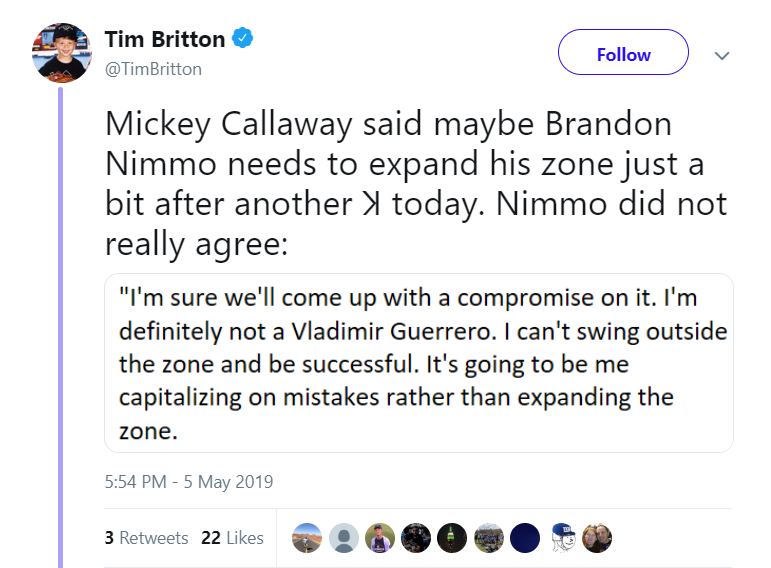
Very few, however, would have expected Nimmo to struggle like he has to start the 2019 season. To this point, Nimmo has put up a .200/.344/.323 slash line, good for a 93 wRC+ in 161 plate appearances, and injury concerns continue to linger. Nimmo’s struggles are playing a big part in the overall difficulties of the Mets lineup, and coaches have offered suggestions to Nimmo that might snap him out of it:

nimmo_1

Nimmo disagrees with Callaway, and so do I. Nimmo is one of the more patient hitters in the game, and he likes to wait for a pitch he can do damage with. The problem has been that he isn’t doing damage on those pitches like last year, so I wanted to find out what it is about Nimmo’s profile that could potentially be causing such a slow start. Read the rest of this entry »


Lucas Giolito and the Long-Awaited Comeback

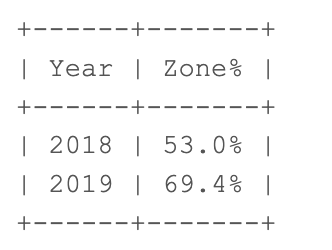
Are we finally seeing the Lucas Giolito performance that we waited so long for? Once pegged as a “top-of-the-rotation demigod,” Giolito has struggled to find any consistency in the majors. Through the month of May, he’s got the highest K% of his career at 29.2% and the largest K% increase in MLB from 2018 to 2019 with a 13.1% jump. He’s got an average fastball velocity of 93.4 mph, up exactly one tick from last season, and has also added 148 rpm to his heater. Giolito has been more aggressive in terms of overall zone percentage, with the third-largest MLB increase from 2018 to 2019 at 6.8%. Even while down in a hitter’s count, he’s found ways to battle back in the zone, something he was below league average in last season:

Batters are having a tougher time squaring him up and he’s even added some vertical break on his fastball and curveball: Read the rest of this entry »


Judge and Altuve: A Tale of Two Strike Zone Oddities

Aaron Judge and Jose Altuve seem like they shouldn’t coexist in Major League Baseball, but their mutual success reveals an amazing fact about different paths to pitcher dominance.

Here’s a line of reasoning using the transitive property about short hitters and small strike zones:

  • If a player is shorter, then his shoulders are closer to his knees.
  • If his shoulders are closer to his knees, his strike zone should be smaller.
  • If his strike zone is smaller, then it should be harder for the pitcher to throw strikes.
  • If it is harder to throw strikes, he should get on base more.
  • Shorter players should have higher on-base percentages.

But this isn’t how it actually works. Why not?

Aaron Judge is tall and Jose Altuve is short. That’s analysis. They both are very productive at the plate. That’s deeper analysis. However, Judge gives pitchers a 25% larger strike zone to target due to his 6-foot-7 height, so he must be doing something different and better than Altuve to offset the larger area he gifts to pitchers with every pitch.

Read the rest of this entry »

A Minor Investigation

It feels somewhat disingenuous to focus a second straight post on a member of the Texas Rangers because I have admittedly not spent much time watching them play baseball in recent years, and by recent years I mean my entire 23-year life. With that said, what little I have watched I can mostly attribute to my enjoyment of two of their current players: Rougned Odor and Mike Minor.

Drafted seventh overall in 2009 by the Atlanta Braves, Minor was a starting pitcher for parts of five seasons with the big league club, four of which were unremarkable but one (2013) which was actually quite good. In that 2013 campaign, he logged 204.2 innings, 181 strikeouts, a 3.21 ERA, and a 3.64 xFIP en route to a solid 3.3 fWAR. Soon afterwards, career-threatening shoulder issues emerged and caused him to miss the entirety of 2015 and most of 2016 before the Kansas City Royals signed him to a minor league deal. In 2017, he pitched 77.2 quality innings out of the bullpen at the major league level, quality enough that the Rangers decided to make him a member of their starting rotation in the following season, which some who were unaware of his pre-Kansas City history probably considered a bit puzzling.

The early returns on what was a somewhat risky and potentially costly investment yielded strong results, especially for a man who had not started a major league game in close to four years. He ranked 37th in fWAR among starters with at least 150 innings pitched, which put him in pretty decent company:

Stats provided by FanGraphs

When accounting for the fact that Minor’s career-best 2013 slotted him just four spots higher despite pitching 47.2 more innings, the case can be made that even his micromanaged 2018 workload may have been even more impressive. The risk of the contract has almost evaporated entirely as well. After signing a three-year deal for $28 million, he has already delivered $24 million of value with just a season and change under his belt. A combination of his encouraging 2018 and the Rangers’ relative lack of pitching depth helped the 31-year-old Minor earn the starting nod for 2019’s Opening Day, which, no matter how extreme the dearth of talent may be, is quite meaningful. To be able to say that you had been the ace of a Major League Baseball team when all is said and done (which, barring an injury to a teammate, is usually implied by that honor) puts you in the company of very few people, and it is probably a pretty neat thing to have on a resume. Read the rest of this entry »


Marcus Semien Looks Remarkably Different

Marcus_Semien_on_August_15__2015.0.jpg

Marcus Semien on August 15, 2015 / Keith Allison, Wikimedia Commons

Over the course of his career, Marcus Semien has been nothing if not consistent. It’s quite remarkable, really — the 28-year-old shortstop has posted between a 95 and 98 wRC+ in each of his three full seasons (and one half season) since being traded to the Oakland Athletics by the Chicago White Sox in 2014. He has long provided a modest blend of power and speed, and his well-documented defensive improvements last year boosted him to a career-high 3.7 WAR and placed him squarely in the tier of not-great-but-pretty-darn-good shortstops in a league flush with some pretty darn good ones.

It may seem a bit strange, then, to suggest that such a player could be on the verge of a breakout, having already “broken out” last year and being on the wrong side of baseball’s aging curve. And yet, in the early weeks of the 2019 season, Semien appears to be suggesting that he is ready to do just that.

A bit of context: Semien has really flashed all the various facets of his potential at one time or another as he’s settled into a regular at shortstop for the A’s, but he hasn’t quite managed to put together a season that has wrapped it all up. He knocked 27 home runs in 2016 (although there was little in his batted ball profile to suggest any sort of adjustment), has consistently stolen around a dozen bags a year, and takes walks at a rate a tick or two above league average (8.2% across his career) — plus the aforementioned improvements on defense.

But, I ask you, what if he made a little more contact? Contact is good for hitters! It’s generally something you strive for. Allow me to present you with an incredibly simple graph:

That is what we in the industry (which one? Not sure) like to call “trending in the right direction.” A career-best 11.2 K% plus a stellar 10.3 BB% have helped Semien hit the ground running in 2019, posting a line of .311/.379/.505 over 116 plate appearances. Am I suggesting that Semien is going to hit .310 for the rest of the year? I am not (yet). Am I suggesting that an early display of improved plate discipline from him could foreshadow a step forward for him this year? We’re getting warmer! Read the rest of this entry »


Creating an App to Guide Pitch Design

Before we begin, here is the link to app being discussed: https://cargocultsabermetrics.shinyapps.io/Pitch_Design_Tool/

Two months ago, I wrote a blog post arguing José Berrios should learn a cutter. My argument hinged on the striking similarities between Berrios and Corey Kluber and the fact that Kluber has a good cutter and Berrios does not. Since then, I’ve developed a more objective way to evaluate a pitcher’s current pitches and make recommendations to guide the pitch design process. Pitch design is the process of a pitcher making changes to existing pitches or adding new ones, often using high-speed video and devices such as Rapsodo or TrackMan to get the spin axis of the pitch just right to create desired movement. The app I’ve built creates targets for pitchers and details ideal pitch characteristics to give objective, quantitative direction to the pitch design process.

My plan is to turn the tool into a service for college teams to use for their pitchers in pitch design, but I’ve also created a version which uses Statcast data to create pitch design plans for big leaguers that I’ve released for free. I figured this would be a good place to share the Statcast data version and give a brief explanation of how it works (if you’re interested in a more detailed explanation of the tool, check out this post on my blog). Read the rest of this entry »