Archive for Player Analysis

Why Did Xander Bogaerts Stop Walking?

For most of his baseball career Xander Bogaerts has been an extremely successful player, whether it’s been in the low or high minors. He’s also always been a highly touted prospect, primarily praised for his ability to hit the baseball all the while playing reasonably good defense as a shortstop. It’s not simply Bogaerts’ ability to impact the baseball that made him such a touted prospect, but also his approach. In his brief stint in the majors, in 2013, Bogaerts was lauded for his impeccable plate discipline, especially in the playoffs. As he should have been; in 2013, Bogaerts had a 10% walk rate, and in the postseason it skyrocketed to 17.6%.

This, however, was in a small sample size; Bogaerts only had 50 plate appearances in the majors in 2013, and only 34 in the playoffs. In 2014, Bogaerts, got off to a very strong start. He didn’t hit for much power at the beginning of the year but he walked an awful lot and the power was slowly starting to creep up. Around the end of May, Bogaerts had close to a 400 OBP.

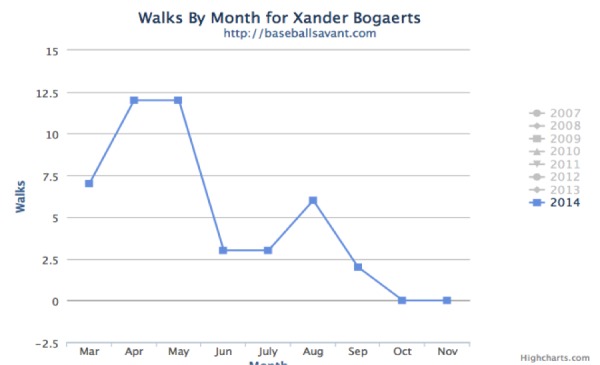
The wheels though fell off after that. Bogaerts simply stopped walking and hitting well. He basically struggled the rest of the year apart from September where he did show signs of improvement. Bogaerts’ failures though went almost side by side with his walk rate apart from the last month of the season where he did have a spike in BABIP. Below is a chart of Bogaerts’ walks per month displayed by Baseball Savant.

Untitled.popopo

As you can see Bogaerts’ walks just took a huge dip after May. So what happened — why did Bogaerts just stop walking? Well there are a number of factors to consider here. First I think it’s important to look at how Bogaerts was pitched — did pitchers make a sudden adjustment? Below is a chart of hard, breaking, and off-speed pitches used against Bogaerts in 2014. Provided by Brooks Baseball.

loolololo

What is primarily noticeable is that pitchers, as the year went on started throwing fewer hard pitches and more breaking pitches. This, however, only shows us that pitchers made an adjustment to Bogaerts it doesn’t show us the full story; it doesn’t show us how Bogaerts reacted to the adjustments the pitchers were making.

There are many factors that can indicate how a player reacts to pitching adjustments. We can look at his swing rate or his whiff rate but the question, which we are really trying to answer, is: did something change in the player’s approach? Below I think is the most accurate example of how Bogaerts changed his approach at the plate and why he started walking a lot less. It’s a chart provided by Brooks Baseball that examines a player’s aggressiveness and passiveness, essentially his plate approach on hard, breaking, and off-speed pitches.

Untitled

As you can see Bogaerts early on in the year was a very patient hitter but as the season went on he became increasingly aggressive at the plate. In fact he didn’t just start getting more aggressive on one type of pitch, but rather in general. He went away from what made him successful on the outset and began his prolonged slump throughout the year. What can be rather alarming is that it wasn’t just a one or two-month spike in aggressiveness, but rather trend in increased aggressiveness throughout the year.

Xander Bogaerts is still a very young player — he’s going into his age 22 seasons and this breakdown by no means should be taken as a prediction for future failures. This is really just part of maturing as a young athlete, getting better and making adjustments. Bogaerts went through the highs and lows of a baseball season in 2014. While I don’t expect him to be a superstar next year, I do expect that we will see significant improvement in not just his stats but his approach at the plate. My advice to Bogaerts on this behalf would be to look back at what made him successful in the first two months of the 2014 season and try and replicate that. Don’t be so aggressive at the plate, just wait for your pitch and when you get it, put a good swing on it. This is of course an annoying cliché but I do think it applies in Bogaerts’ case.


Was Clay Buchholz Ever That Good?

This might be a scary thought to consider if you’re a Red Sox fan or if you’re a member of the Red Sox front office. Most of us including myself perceive Buchholz to be a really good pitcher who just happened to have a terrible year in 2014, which he did. Buchholz last year finished with a 5.34 ERA, which was the worst ERA of his career. His peripherals were better — that being said they were not great — his FIP was 4.01 and his xFIP was 4.04. The problem is that I think the Red Sox are banking or hoping that Buchholz has a bounce back year in 2015 and finds the “Cy Young” caliber form he displayed in 2013.

Buchholz in 2013 posted a great ERA at 1.74, and his FIP was really good too at 2.78. The problem was that he just couldn’t stay healthy throughout the year only pitching 108 innings. This has been a chronic problem for Buchholz throughout his career. Buchholz has never pitched 200 innings in a season; the most he’s ever pitched was in 2012, where he threw 189.1 innings. The other problem is that Buchholz performance has always been very volatile, one year he has a good ERA and then the next he has a bad ERA.

So let’s take a look at Buchholz’s underlying numbers to try and get a better understanding of his erratic performance records. First let’s look at 2013, where he conceptually had the best year of his career. He as I’ve already mentioned posted a great ERA though in a limited sample size. His BABIP that year was also very low at .254. What, however, was most alarming was his left on base percentage (LOB%). His LOB% in 2013 was at 83.7%, which is extremely high. A normal or league average LOB% is normally around 72%, Buchholz that year was well above that and quite frankly unsustainably high. Then if we look at his HR/FB ratio, at 4.5%, it’s also at an unsustainable rate. If you combine these factors, the low innings pitched, the BABIP, the HR/FB, and the LOB% for Buchhotlz great 2013 ERA, it’s easy to see why he had such a low ERA and why that probably was just a fluke.

Now let’s look at his 2010 season, which was considered by most to be his breakout year. In 2010 as you might have guessed Buchholz had a great ERA at 2.33, which probably gave the impression that he had a great year. His FIP however was at 3.61, which is above average, but his xFIP was at 4.07. His BABIP and HR/FB were also at unsustainable rates that year. His BABIP was .261 and his HR/FB ratio was at 5.6% creating his low ERA.

Finally let’s take a look at his 2012 season, the year where he pitched the most innings of his career, 189.1. I think this is the year that best describes Buchholz’s true value and not the skewed value of his 2010, 2013, and 2014 seasons (If you’re wondering what about 2011? Well he only pitched 82.2 innings so I pretty much discounted that year from the analysis). In 2012, Buchholz finished with a 4.56 ERA, his FIP was 4.65, and his xFIP was 4.43. These are not good numbers, in fact they’re well below-average numbers. This is a scary scene especially if you’re the Red Sox and hoping that Buchholz will bounce back. The essential problem is that the only year where Buchholz’s ERA lined up perfectly with his peripherals, the numbers weren’t pretty. His LOB% granted was a little bit low at 69.7% but his BABIP was also low at .283.

This is not a welcoming sight. I’m not actually certain that Buchholz was ever that good of a pitcher or rather a top of the rotation starter. It for the most part seems that his good years or good ERAs were merely a product of low BABIPs and good luck. It’s also not like he’s ever been a pitcher with a high strikeout to walk rate. His career K/9 is at 6.88 and his BB/9 is at 3.33. His K/9 and BB/9 have also always remained around his career average, with not much fluctuation, so it’s not like he’s been trending upward in that regard. Who I really think got Buchholz’s value just about right is Steamer. In 2015 Steamer projects him to finish with a 4.19 ERA and a 4.06 FIP, which is right around where I think Buchholz true talent and value lies. For those who think Buchholz has the great potential of a top of the line starter, well I’m sorry but at this point I just don’t see it; I think he’s probably more of a mid to back of the rotation starter. A useful piece in the rotation but definitely not someone who you should count on.


How to Use LABR Mixed Draft to Your Benefit

The 15-team LABR Mixed Draft is the most exciting of the expert fantasy drafts each year. Amateur fantasy owners from all over the globe tune into the live spreadsheet broadcast and debate each one furiously on social media.

Most of these amateurs are looking for expert guidance to help them in their own draft. They see a player getting drafted well above their ADP and they often move the player up on their own personal big board.

I do not think this is the best way to approach and absorb the most information out of LABR. When one expert reaches on a pick, we have no idea if there is a consensus. It could have been just one expert making a stand on a player he himself feels strongly about, or there could have been several owners who felt the same way about that player. We just don’t know.

What we do know is that when certain players drop well below their public rankings, there is an agreement of pessimism. That is the information that could be significant for the rest us. Every owner in the league letting a player fall well below their ADP is the expert consensus we should be looking for.

Here’s a quick look at nine players who the experts are cool on.

Read the rest of this entry »


Contact Quality (CQ)

Set forth below is a description of a short-hand stat designed to measure how well a batter hits when he hits a fair ball.  I call it “Contact Quality” or “CQ.”

Obviously, BABIP is the most common measure of hitting balls-in-play.  But BABIP excludes home runs, and doesn’t otherwise distinguish between singles and extra-base hits.  One possible approach would be to compute slugging average on fair balls (“fair balls” refers balls-in-play plus home runs).  However, the weights used in slugging average do not accurately reflect the value of different types of base hits.

CQ uses the weights from wOBA, in a simplified fashion, before the adjustment to normalize the scale to OBP.  Rounding the weights, I assign 0.8 for a single, 1.1 for a double, 1.4 for a triple, and 1.7 for a home run.  Or, in other words, 0.5 for a hit and 0.3 per total base.

So, the formula is:  (0.5*H+0.3*TB)/(AB-K)

Interestingly, the average CQ in 2014 was .312, as compared to an average OBP of .314.

CQ is intended to be a simple stat that, together with K% and BB%, gives a pretty good profile of any batter.

If a batter’s CQ is above .400, he is considered a member of Mensa (contact quality division).  In 2014, among qualified batters, the following were Mensa members:

1. Giancarlo Stanton (.453)
2. Mike Trout (.450)
3. Jose Abreu (.435)
4. Chris Carter (.407)
5. Justin Upton (.405)
6. Andrew McCutchen (.404)
7. Matt Kemp (.403)

Rounding out the top 10:

8. Miguel Cabrera (.388)
9. Anthony Rizzo (.387)
10. Marlon Byrd (.386)


Phil Hughes a Cy Young Candidate in 2015?

If you told me, at the end of 2013 (5.19 ERA) that Phil Hughes would have a chance to win a Cy Young, I would’ve told you, no way. If you told me in 2012 (4.23 ERA) that Phil Hughes had a chance to win a Cy Young, I would’ve said it was highly improbable. If you told me in 2011 (5.79 ERA) that Phil Hughes had a chance to win a Cy Young, I would’ve told you to get out of my face; the guy would be lucky to be in the starting rotation (the Yankees’ starting rotation). That’s because for a large part of his career Phil Hughes was a terrible starting pitcher. Not a bad starter, a terrible starter. He was actually, over the last three years, before 2014, one of the worst starting pitchers in baseball.

2014, though, was a different story. In the 2013-14 offseason Hughes signed a 3-year, 24-million-dollar contract with the Minnesota Twins. That year Hughes had one of the best seasons in all of baseball, and needless to say the best season of his career. Just how good was Hughes in 2014? Well Hughes pitched a career high 209.2 innings. His ERA was moderately good at 3.52 but he had the sixth-best FIP in all of baseball at 2.65. The only pitchers to have a better FIP in 2014 were Garrett Richards, Chris Sale, Felix Hernandez, Corey Kluber, and Clayton Kershaw. Of those five only Hernandez and Kluber pitched more innings than Hughes.

Hughes finished with an above-average K/9 that year at 7.98 but he led all of baseball with .69 BB/9. Phil Hughes’ BB/9 in 2014 was one of the greatest BB/9 of all time (37th all time), in fact the last pitcher to have a BB/9 better than Hughes was Carlos Silva, also of the Twins in 2005 at .43. Hughes’ great peripherals allowed him to finish with a 6.1 fWAR, which was tied as the fourth-best fWAR in all of baseball (not including position players). Only Kluber, Kershaw, and Hernandez had a better fWAR than Hughes in 2014.

The 2014 season, however, was a complete anomaly for Hughes. For most of his career he’s been awful. So how can one determine if he’ll be a Cy Young candidate in 2015? First I think it’s important to consider one’s BABIP. This after all could have just been a fluky BABIP year. It, however, was not. Hughes was actually unlucky by BABIP standards at .324. BABIPs though can be inflated when a pitcher gets a lot of groundballs, but Hughes does not, his GB% is at 36.5, which is below average. Hughes has predominantly been a fly-ball pitcher so I do expect his BABIP to normalize somewhat next year.

Then I think it’s important to see if Hughes made some adjustments to his repertoire and his pitching style. In the table below, provided by Brooks Baseball you can see Hughes’ pitch usage since he’s entered the big leagues.

Year Fourseam Sinker Cutter Curve Slider Change Split
2007 67.60 0.00 0.00 22.39 3.88 6.03 0.00
2008 62.65 0.00 6.79 22.58 2.72 5.26 0.00
2009 59.72 3.01 16.11 20.59 0.00 0.58 0.00
2010 63.94 0.00 15.82 16.81 0.00 3.44 0.00
2011 59.41 0.00 12.13 20.96 1.82 5.69 0.00
2012 65.31 0.44 1.71 17.37 5.16 10.00 0.00
2013 61.48 0.00 0.00 8.64 23.72 5.12 1.04
2014 60.78 4.36 20.27 14.36 0.00 0.20 0.00

It seems the important element to observe here is Hughes has always thrown a ton of fourseam fastballs and that clearly has not changed. What has changed, however, is his use of sliders, cutters, sinkers, and changeups. Hughes essentially completely rebuilt his repertoire in 2014, apart from his curveball and fourseam fastball. Hughes abandoned the slider and changeup and basically added a sinker. He also re-started using a cutter, a pitch he basically or barely used over the past two years. Now, it’s the second-most-used pitch in his repertoire.

I don’t know who in the Twins organization told Hughes to re-start throwing a cutter, but he probably deserves a raise (unless Hughes decided to throw it all on his own of course). Hughes throws his cutter at an average speed of 89.2 mph. He threw the pitch a total of 509 times and the wRC+ against it was only 71. It also netted an IFFB% of 23.4 and a GB% of 46.4.

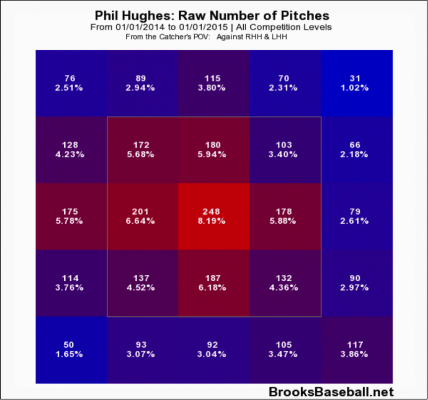
This of course was not the only adjustment made by Hughes in 2014. Hughes was never someone who walked a lot of hitters but a .69 BB/9 is extremely low. Below is Phil Hughes’ heat map for 2014.

Untitledppppppp

As you can see, Hughes basically decided to throw the ball down the middle. Is this a good strategy? To be honest I’m not 100% percent sure but it sure did work for Hughes in 2014 and it’s definitely efficient. This strategy obviously isn’t conducive to a lot of walks and it won’t tire a pitcher out. Plus when one considers the low scoring environment, throwing a pitch right down Broadway may not be such a bad idea. It’s also not like Hughes is throwing a ton of off speed pitches down the middle, most of the pitches he throws are fastball and cutters, in fact more than 80% of them are. Which makes his success all that more impressive.

This strategy may be devised to fit Hughes’ new environment and more specifically his new ballpark. Hughes as I’ve already mentioned is a fly ball pitcher, his FB% last year was 40.2%, which was the 15th highest FB% in the majors. When Hughes was pitching for the Yankees he was pitching in a stadium that gave up a lot of home runs. In 2014 Yankee Stadium yielded the third-most home runs in the majors, after Great American Ball Park (Cincinnati) and Coors Field (Colorado). Giving up a lot of fly balls in a home-run-heavy ballpark is typically not a good mix. In 2012 Hughes’ HR/FB ratio was 12.4%, well above average and in 2013 it was 11.1%. The Twins stadium (Target Field), however, is not conducive to home runs, in 2014 it ranked 23rd in home runs allowed. Phil Hughes’ HR/FB ratio dropped to 6.2%.

So is this going to translate into another great 2015 season? Well one thing is certain, Hughes is staying put and so he will play most of his games in Target Field, which should keep his numbers down (when I say down that’s a good thing). However, there’s no way of being 100% sure or accurate on this and Steamer does project a 3.89 ERA with a 3.90 FIP. Hughes, though, I think has a very good chance of repeating his success due to his pitching adjustments and new pitching approach. Plus Hughes’ high BABIP of 2014 should normalize somewhat. Maybe next year he’ll have a low BABIP and his numbers will look even better, netting him a Cy Young. Who knows?

I think a lot of people have a hard time believing in one year of success and with good reason, for all we know it could just be a blip on the radar. That being said, pitchers, sometimes, just figure something out; sometimes things just click. Maybe they invent a new pitch or maybe they re-discover an old one, like Hughes. Sometimes they even change their entire approach to pitching and find success in the latter years of their career, like Cliff Lee. Phil Hughes could very well be that guy and he definitely wouldn’t be someone I would write off in 2015.


Alex Cobb’s Pitching Adjustments

As most of you already know Alex Cobb is a pitcher for the Tampa Bay Rays. He is projected to be their “ace” in the upcoming season. In fact many people would argue that he’s the best pitcher in the AL East. Considering Masahiro Tanaka’s health issues it doesn’t seem unreasonable to assume that this might be true. Cobb, however, wasn’t always considered a top of the rotation starter. Since arriving to the majors, Cobb has made significant adjustments to his pitching style, which has earned him his current reputation.

The Rays drafted Cobb in the 3rd round in the 2006 Major League draft. After spending a few years in the minors, in 2011, Cobb made his Major League debut. He pitched 52.2 innings that year and finished with a relatively good ERA, 3.42. 2012, was essentially his first real full season in the big leagues and he didn’t do so well. Cobb, that year finished with a 4.03 ERA. His peripheral numbers, however, were relatively good, his FIP being 3.67 and his xFIP being 3.54.

The next two years Cobb became an extremely dominant pitcher. In 2013, he finished with the best ERA of his career at 2.76 and in 2014 his ERA was only slightly worse at 2.87, but still stellar. His FIP and xFIP, however, have remained consistently in the mid to low 3s. Over the past two years mostly in the low 3s. Many of us have a good understanding of FIP and understand that Cobb’s recent ERA production may just be a normalization of FIP. This may very well be true and an important element to consider, however Cobb in the past two years Cobb has made significant pitching adjustments, which may indicate that this recent ERA success is no fluke.

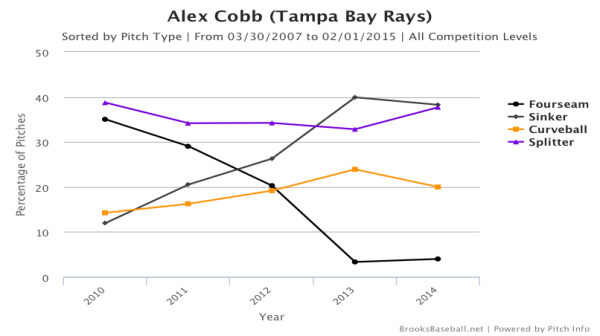
So what type of adjustments has Cobb made? Well thanks to Brooks Baseball PITCHf/x tool we have a sample size of Cobb’s pitch usage leading back to 2010. If you look at the graph below one thing truly stands out in Cobb’s pitch mix.


Untitled.olll

Cobb as you can see in the graph above has four essential pitches. What is most notable is how Cobb has made use of his fastball and sinker or inverted their use. In 2010 his fastball was one of the pitches he used the most. In 2013, however, he made a significant decision to use the fastball a lot less. It’s actually the pitch he’s started using the least. Cobb now mostly throws his off-speed pitches and his sinker. The sinker now is basically the pitch he’s using most frequently. Both pitches are predominantly thrown at the same speed, around 92 mph according to Brooks Baseball. The biggest difference is that the sinker has more movement or vertical movement while the fourseam fastball does not.

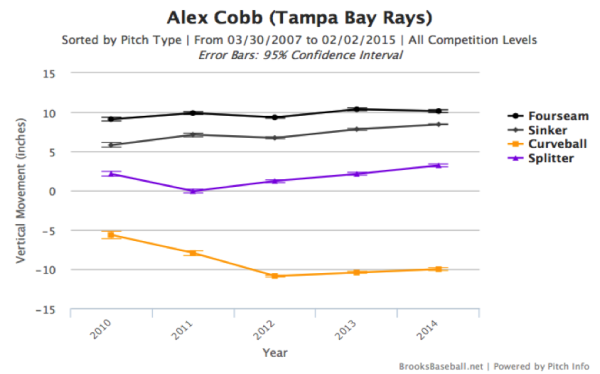
In the chart below is an example of the vertical movement on Cobb’s pitches. Why vertical movement? Because Cobb throws a splitter, a curveball, and a sinker, which are all conducive to vertical movement.


Untitled.lll

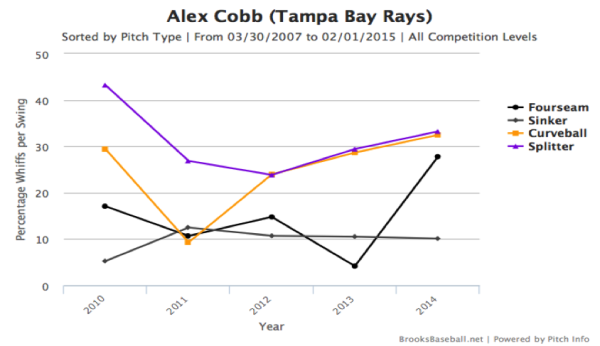
The sinker or movement on a sinker can be more favorable in creating a higher groundball percentage. It, however, has not been the case with Cobb; his groundball percentage has always remained around his career average of 56.5%. One of the more drastic differences in Cobb’s results in correlation with his new pitching technique is his whiffs per swing.

Untitled

As you can see here, at the same time that Cobb started to decrease his use of fastballs, he started getting more and more swings and misses with the pitch. The splitter and the curveball have also been pitches which have induced more swing and misses due to his new pitch mix. What one can primarily take away from this chart is that hitters now seem to either be sitting on his sinker or sitting on a pitch with movement (the sinker would fall into that category). Cobb’s fourseam fastball is really the only pitch that doesn’t have significant movement and yet it’s getting a ton of swing and misses even though it’s being thrown a lot less. Meaning that hitters are probably expecting a pitch with movement and when the fastball is thrown they are either surprised or not prepared to hit the pitch.

Cobb here has transformed one of his weakest pitches into one of his strongest. Many young pitchers, and veterans for that matter rely a ton on their fastballs, yet it might be a drastic mistake. If you don’t have an overpowering fastball, like Cobb’s, a good pitching strategy could be to stop throwing it very often. There is no one way to pitch, just like there is no one way to get wins or be successful. Most pitchers are taught at an early age that everything derives off their fastball; “you need to establish your fastball early in the count to set up your off-speed pitches”. This is not true; if you want you can throw off-speed pitches early and then throw fastballs or not throw fastballs at all. There are no rules to dictate the way one pitches and Cobb is exploiting that.

Cobb’s success can serve as a template for younger pitchers, in the minors or majors who do not throw 95+ mph and are trying to compete in this hard-throwing era. It actually can also serve as a formula for pitchers who are getting older and are losing their fastball velocity. Cobb is a very good and unique pitcher, and should be someone who pitchers try and emulate.


A Look at SGP-Based Rankings Using Different Projection Sets (Part 1)

The bulk of the work I do pre-draft and in-season is essentially based on an SGP (standings gain points) projections and ranking system. I use SGP data from leagues that match the format and settings of the league I’m ranking for (ideally from 10+ years of data from the actual league, where possible). While I usually do my own projections for 30-40 players of specific interest, in general I’m happy to utilize the projections published by experts that actually know what they’re doing and do it for a living. Specifically (and in no particular order) I use Steamer, Pecota, and Baseball HQ.

These lists may not be useful in ‘absolute’ terms – again, the data I’m using here reflect the SGP settings I use that reflect the league I play in. However, I still believe the lists offer an interesting way to notice a) how each projection system differs on its view of individual players, and b) general overall differences in each projection system. Blindly following a projection set is probably going to be better than randomly picking players by throwing darts at the wall. But you can squeeze a lot more value out of these rankings and the projections you use by gaining a deeper understanding of how each set of projections work, and what ‘biases’ and tendencies might be part of the numbers.

What I like to do each year is generate ‘top X’ lists of players at each position for each projection set I use, then play around in the results to spot any glaring differences.  Is one projection overly conservative on expected ABs? Is one projection set basically expecting a repeat of last year’s career year? I can use that as a starting point to drill down into some of the numbers to see what might be behind the differences. Personally, I find it all too easy to get overwhelmed at all the different numbers available to be looked at – far too often I find myself deep down the rabbit’s hole, spending three hours looking at average fly ball distance on balls hit on the second Wednesday of the month on even-numbered days or something. I find this approach helps me narrow in on specific players or numbers of interest. And the benefit of doing this by SGP, broken down by category, is that it is easier to see specifically how each player is projected to impact each category. Player stats will not win your fantasy league, roto points will win you your fantasy league: I get a better understanding of the player’s ‘value components’ and how it impacts the particular league I play in.

First, a quick overview of SGP. Standings Gain Points is a way to measure the contribution of each player to your overall roto league standings. Larry Schecter’s excellent book, ‘Winning Fantasy Baseball’ is a great primer on the subject. Other places to read about SGP online are here and here. In a nutshell the system looks at the average stats needed to gain one point in the standings for a particular rotisserie category. For example, suppose in your league over the past 10 years, you needed 10 HRs to gain one point in the HR category standings. A player projected to hit 30 home runs would be credited with 3 SGPs for the HR category. Tally up all the SGPs the player is expected to add (or subtract) for all categories, and you get a total SGP score.

There’s a ton more to it, but that’s the basics – ever tried to figure out if the guy hitting a lot of HRs but no average was more valuable (and if so, by how much) than the guy hitting for a decent average and some SBs but no power? Now you have an idea.

In this first article, I look at at Catchers. I’ll add reports on all the hitter positions over the next couple of weeks. A reminder that these rankings are based on SGP values which are basically unique to my specific league, so your numbers will differ if you play in a different league format, but again, we’re looking a relative differences, not absolute numbers (For the record, the league format for the SGP rankings here: Standard 12-team 5×5 roto, 1 catcher, three OF and two util, 1250 innings cap).

Here is the list of top 12 catchers ranked by my league’s SGP, based on Baseball HQ projections:

Figure 1. Top 15 catchers by SGP & BHQ projections

Rank MLBAMID Full Name RSPG HRSPG RBISPG SBSPG AVGSPG Total
1 457763 Buster Posey 4.22 2.66 4.60 0.15 1.24 12.87
2 543228 Yan Gomes 4.22 3.08 4.28 0.15 0.12 11.84
3 519023 Devin Mesoraco 3.73 3.78 4.33 0.15 -0.31 11.67
4 594828 Evan Gattis 3.48 4.33 4.12 0.00 -0.48 11.45
5 518960 Jonathan Lucroy 3.98 2.24 3.84 0.73 0.62 11.40
6 431145 Russell Martin 3.54 2.52 3.84 1.02 -0.12 10.80
7 521692 Salvador Perez 3.54 2.38 4.01 0.00 0.46 10.39
8 435263 Brian McCann 3.42 3.50 4.01 0.15 -0.68 10.38
9 425877 Yadier Molina 3.66 1.54 3.74 0.58 0.71 10.23
10 467092 Wilson Ramos 2.86 2.52 3.84 0.00 -0.16 9.06
11 446308 Matt Wieters 3.11 2.38 3.41 0.15 -0.14 8.90
12 444379 John Jaso 3.85 1.54 3.19 0.44 -0.32 8.70
13 572287 Mike Zunino 3.66 2.80 3.68 0.00 -1.52 8.63
14 519083 Derek Norris 3.29 1.96 3.14 0.73 -0.72 8.40
15 425900 Dioner Navarro 2.61 1.96 3.25 0.29 0.05 8.16

Nobody should be surprised to see Buster Posey at the top of any catchers list; he’s there because he has such a huge advantage over everyone else at the position in Batting Average. And he has a full point advantage over the next tier of players. Gomes and Mesoraco at 2nd and 3rd? Probably more of a surprise. Gomes has legit power, and the batting average isn’t a fluke (career BABIP: .323). Mesoraco had a career year last year – his 25 HRs in 440 PA is only 6 fewer than he hit in 1,100 PAs in 2013, 2012, 2011 combined. Yes, he plays in a tiny crackerjack box of a park. But his FB% jumped 10ppt (33.8% to 43%) from 2013 and 2014, while his HR/FB rate more than doubled, from a constant 10% or so in 2011-2013 to 20.5% in 2014. Color me less than convinced. And with only .44 points separating them, the next four players (Gomes, Mesoraco, Gattis and Lucroy) are basically interchangeable.

Russell Martin’s ranking gets a big boost from expected SB contribution; if those SBs dip he falls quite a bit. Would anyone be surprised if a catcher that turns 32 in February and was only 4-of-8 in stolen base attempts last year doesn’t run that much in 2015?

Conversely, if Zunino can boost his average a bit, he could be excellent late-round value. He gets a massive -1.52 hit to his SGP total after hitting less than his weight last year. On the one hand, one could possibly expect a bit of an uptick in the batting average; his BABIP last year of .248 was the lowest mark he’s recorded at any point for a full season going back to 2012 and his days in the Arizona Fall League. On the other hand, he struck out 33% of the time last year, so…yeah.

Finally – what’s surprising about this list is who’s not on it – no d’Arnaud, no Rosario.

Figure 2. Top 15 catchers by SGP & Steamer projections

Rank MLBAMID Full Name RSPG HRSPG RBISPG SBSPG AVGSPG Total
1 457763 Buster Posey 4.29 2.66 4.06 0.15 0.87 12.02
2 594828 Evan Gattis 4.22 3.92 4.28 0.15 -0.88 11.68
3 435263 Brian McCann 3.85 3.36 3.79 0.15 -0.54 10.61
4 518960 Jonathan Lucroy 4.04 1.96 3.47 0.73 0.36 10.55
5 431145 Russell Martin 3.79 2.24 3.19 0.87 -0.81 9.28
6 518595 Travis d’Arnaud 3.29 2.38 3.25 0.29 -0.54 8.67
7 521692 Salvador Perez 3.23 1.96 3.14 0.15 0.10 8.58
8 446308 Matt Wieters 3.35 2.38 3.03 0.44 -0.68 8.52
9 543228 Yan Gomes 3.17 2.24 3.09 0.29 -0.36 8.42
10 519023 Devin Mesoraco 2.98 2.52 2.98 0.44 -0.60 8.31
11 467092 Wilson Ramos 2.86 2.24 2.98 0.15 -0.03 8.19
12 425877 Yadier Molina 2.92 1.40 2.76 0.44 0.35 7.86
13 501647 Wilin Rosario 2.30 1.96 2.44 0.29 0.16 7.14
14 518735 Yasmani Grandal 2.98 1.82 2.71 0.29 -0.69 7.11
15 455139 Robinson Chirinos 2.73 1.68 2.49 0.29 -0.80 6.39

The first thing to notice about this list – in general the total ‘SGP’s provided are considerably lower than for the BHQ group above. At 8.90 total SGPs, Wieters wasn’t even in the top 10 in the BHQ list; 8.90 SGPs almost makes him a top-5 pick on this list. The numbers suggest that Steamer is a bit more conservative (or BHQ overly optimistic) in its forecasts, particularly for HR and RBIs. My understanding is that BHQ’s projections are largely based on playing time projections, so perhaps the numbers will change as we get closer to spring training and the start of the season and jobs are won/lost etc. It will be interesting to see how (if) these numbers change.

Looking at the list itself, Posey and Gattis again in the top five, no surprise there. McCann in the top five looks somewhat surprising (despite a rather big gap between Gattis and McCann). Maybe Steamer remembers that McCann still hit 23 HRs last year and still plays in a favorable park? His LD% was stable last year, GB% down a tick, FB% up a tick. His HR/FB rate was down quite a bit from 2013, which is surprising given that the conventional wisdom suggested he was moving to a more favorable ballpark…but his 2014 HR/FB rate was almost exactly in line with his average since 2008. Steamer might also be expecting an uptick on that awful .231 BABIP from 2014, although not sure if it’s factoring in the increased defensive shifts he saw last year. Less than .50 points separate d’Arnaud at #6 and Ramos at #11. Of the group, Wieters is now the grizzled veteran of the bunch and looked like he was on his way to a career year before getting hurt last year. If he’s healthy, he ironically could be the ‘safe’ pick of the bunch.

Grandal makes an appearance. Interestingly, Steamer is forecasting almost exactly the same number of Runs, RBIs and HRs this year – in the same number of at-bats – as last year, despite Grandal moving from a horrible Padres team (last year at least) to a much better Dodgers team (last year at least). I’d normally expect a bit of an uptick in those numbers.

Spoiler alert, but this is the only projection where Chirinos comes in the top 15; Steamer appears to be a bit more optimistic in projected at-bats, giving him a bump in Runs and RBIs that he doesn’t enjoy in the other projections.

Figure 3. Top 15 catchers by SGP & Pecota projections

Rank MLBAMID Full Name RSPG HRSPG RBISPG SBSPG AVGSPG Total
1 594828 Evan Gattis 4.41 4.19 4.82 0.0 -0.6 12.82
2 457763 Buster Posey 4.47 2.66 4.33 0.15 0.90 12.51
3 435263 Brian McCann 4.10 3.36 4.12 0.15 -0.78 10.93
4 431145 Russell Martin 4.85 2.38 3.30 1.16 -1.13 10.56
5 518960 Jonathan Lucroy 3.98 1.96 3.68 0.87 0.06 10.54
6 518595 Travis d’Arnaud 3.91 2.66 3.68 0.15 -0.57 9.83
7 521692 Salvador Perez 3.54 1.96 3.68 0.0 0.33 9.51
8 446308 Matt Wieters 3.66 2.38 3.57 0.29 -0.77 9.14
9 425877 Yadier Molina 3.42 1.54 3.19 0.58 0.39 9.12
10 572287 Mike Zunino 3.79 3.08 3.74 0.29 -1.79 9.1
11 543228 Yan Gomes 3.23 2.24 3.09 0.15 -0.03 8.67
12 518735 Yasmani Grandal 3.66 2.10 3.09 0.29 -0.56 8.58
13 519023 Devin Mesoraco 3.23 2.38 3.25 0.29 -0.68 8.47
14 455104 Chris Iannetta 4.04 1.96 3.19 0.44 -1.46 8.16
15 467092 Wilson Ramos 3.11 1.96 2.92 0.0 -0.26 7.73

Pecota loooooves it some Gattis, putting him in the top spot over Posey. The Pecota rankings for catchers have fairly clear tiers: Gattis and Posey at the top, a substantial gap to McCann, Martin, and Lucroy, then another gap, followed by only a point or so between d’Arnaud at #6 and Iannetta at #14. Iannetta actually only shows up here because Pecota is significantly more bullish on Iannetta across the board vs the other projection sets; this almost certainly is due to differing views on ABs; Pecota’s AB projection for Iannetta is about 80 ABs higher than the BHQ projection, and over 150 more than the Steamer projection.

The difference between the Pecota numbers for Yan Gomes and the BHQ numbers are interesting – BHQ projects Gomes as one of the top 3-4 HR hitters at the catcher spot; here he’s projected to be 8th.

Martin again gets a big SB bump, which just manages to offset a rather large Avg hit (particularly compared to, say the BHQ projection, where the Avg hit was minor). Pecota is probably looking at his .290 average last year and figuring it’s a .336 BABIP-fueled fluke; Martin hadn’t had a BABIP over .290 since 2008.

Zunino again projects to have great all-around numbers except for the black hole at Batting Average. If he somehow is able to hit even .250, Zunino would likely be a top-five fantasy play behind the plate.

Looking at all three rankings, the projections differ – sometimes significantly – on some players. The BHQ-based SGP rankings loved Yan Gomes and Mesoraco; Steamer and Pecota, not so much. At the other end of the spectrum: Salvador Perez was ranked 7th in all three projection systems, largely because he’s one of the few catchers expected to make a reasonably-sized positive contribution to batting average. Although we saw last time that maybe targeting batting average wasn’t all that important…

John Mayberry Jr.: King of the Pinch Hitters in 2014

Pinch-hitting is difficult. You’re sitting on the bench all game, you may not have taken batting practice that day, you might be facing a relief pitcher throwing hot cheese, it’s just really difficult to come off the bench and do something productive.

There were 574 different players used as pinch-hitters in 2014, with this group of players accumulating 5483 plate appearances and hitting just .213/.291/.322. As a group, pinch-hitters accounted for negative 0.9 WAR. At the bottom of the pinch-hitting group was Greg Dobbs, who hit .107/.138/.107 in 29 plate appearances, good for negative 0.5 WAR.

There were other players who struggled nearly as much as Dobbs. Chris Denorfia was 3 for 32 as a pinch-hitter. Tony Gwynn, Jr. was 2 for 30. Little Nicky Punto was 0 for 14.

Along with the individual strugglers, there were whole teams who cost themselves at least one win because of lousy pinch-hitting. The Washington Nationals finished dead last in pinch-hitting WAR, with a mark of -1.2. Their combined triple-slash line was .118/.244/.234, for a wRC+ of 38. There were a couple teams who hit even worse than the Nationals (the Braves and Astros), but the Nationals had more pinch-hitting appearances, so finished with less WAR.

The Nationals had five players who were particularly bad at pinch-hitting in 2014: Tyler Moore (1 for 14), Greg Dobbs (2 for 15), Nate McLouth (2 for 23), Nate Schierholtz (1 for 14), and Scott Hairston (5 for 38). Combined, these five players hit .106/.199/.163 with 36 strikeouts in 121 plate appearances and accounted for -1.0 WAR. Of course, there was some bad luck involved. The Nationals’ pinch-hitting BABIP was .171. They were the only team in baseball with a pinch-hitting BABIP below .200. All teams in major league baseball had a BABIP of .282 while pinch-hitting, with a high BABIP of .440 for the Chicago White Sox. The Nationals were not only bad at pinch-hitting; they were also unlucky.

On the other side of the coin, there were three teams who received 0.7 WAR from their pinch-hitters: the Orioles, Diamondbacks, and Rockies. The Orioles were kind of amazing in this regard. The Diamondbacks had 249 pinch-hitting plate appearances and the Rockies had 266, but the Orioles earned 0.7 WAR from their pinch-hitters in just 77 at-bats, thanks to a .313/.395/.522 batting line (156 wRC+). Delmon Young (0.6 WAR as a pinch-hitter) was the driving force behind the Orioles’ league-leading pinch-hitter WAR total. Young only had 23 pinch-hitting plate appearances, but hit .500/.565/.800.

As good as Delmon Young was, he wasn’t the top pinch-hitter of 2014. That title belongs to John Mayberry Jr., King of the Pinch Hitters. Mayberry had 32 pinch-hit plate appearances and hit .400/.438/.933. As a pinch-hitter, Mayberry accounted for 0.8 WAR, tops in baseball. For the season, Mayberry had just 0.2 WAR, so he was worth negative WAR in his non pinch-hitting appearances. Let’s look at a table (smalls sample size warning, yada, yada yada):

John Mayberry’s Hitting Prowess, by position

Position PA AB R H HR RBI AVG OBP SLG
1B 40 35 3 6 2 5 .171 .250 .429
LF 42 36 0 5 0 0 .139 .262 .139
CF 37 31 2 5 0 5 .161 .297 .226
RF 17 14 3 3 1 1 .214 .353 .500
PH 32 30 7 12 4 12 .400 .438 .933
TOTAL 168 146 15 31 7 23 .212 .310 .425
Not Pinch-Hitting 136 116 8 19 3 11 .164 .280 .294
Pinch-Hitting 32 30 7 12 4 12 .400 .438 .933

As a first baseman, John Mayberry did not hit well. As a left fielder, John Mayberry was truly awful. As a center fielder, John Mayberry was really bad. As a right fielder, John Mayberry was actually good. As a pinch-hitter, John Mayberry rocked the house. He brought the noise and the funk.

This hasn’t always been the case for John Mayberry the Younger. Before his mighty 2014 season as a pinch-hitter, Mayberry had three straight years with sub-par pinch-hitting production (wOBAs of .280, .285, and .258). Then again, in his first two seasons (very small sample size), Mayberry had wOBAs of .407 and .611. Overall, John Mayberry the Second is a career .304/.355/.545 hitter as a pinch-hitter. This is considerably better than his overall career batting line of .241/.305/.429. See the table below for this information in numerical form:

John Mayberry’s Pinch-Hitting Record by Year

YEAR PA AB AVG OBP SLG BABIP wOBA wRC+
2009 12 11 .273 .333 .636 .333 .407 149
2010 6 5 .400 .500 1.000 .500 .611 289
2011 35 31 .226 .314 .323 .261 .280 72
2012 23 23 .304 .304 .348 .438 .285 76
2013 13 12 .250 .308 .250 .300 .258 59
2014 32 30 .400 .438 .933 .421 .582 283
As a PH 121 112 .304 .355 .545 .355 .388 145
Career 1400 1276 .241 .305 .429 .280 .320 100

The problem with pinch-hitting it that it’s just so unreliable. Last year, the aforementioned Greg Dobbs hurt his team more than any other player when he came off the bench to pinch-hit. Early in his career, though, Mr. Dobbs had three very good years coming off the bench from 2006 to 2008, increasing his production each year, with wOBAs of .342, .384, and .387. He was so good at pinch-hitting, he was given around 60 pinch-hit plate appearances per year in 2007 and 2008. He was reliable, consistent, someone you could count on when the chips were down. If you needed a guy to come off the bench and get a hit, dial up Dobbs! He was Mr. Dependable!

Only then he wasn’t. In 2009, Dobbs hit .167/.250/.241, for a wOBA of .230, but still got 60 plate appearances off the bench. The next year, he hit .122/.204/.286 (.213 wOBA), but old reputations die hard and Dobbs was sent up as a pinch-hitter 54 times.

Then, just when you thought it was time to give up on old Greg Dobbs as a pinch-hitter, he hit .370/.400/.519 (.396 wOBA) in 2011. D-TO-THE-O-TO-THE-DOUBLE-B-S! Greg Dobbs, pinch-hitter extraordinaire was back, baby!

Only he wasn’t. He was less-than-stellar in 2012: .268/.289/.366 (.272 wOBA). He was pretty bad in 2013: .208/.298/.250 (.222 wOBA). And he was truly unpleasant in 2014: .107/.138/.107 (.116 wOBA). This table says it all:

THE DOBSTER AS A PINCH HITTER

YEAR PA AB AVG OBP SLG BABIP wOBA wRC+
2004 5 5 .400 .400 1.200 1.000 .645 310
2005 26 24 .250 .269 .375 .375 .274 67
2006 17 17 .294 .294 .529 .333 .342 108
2007 57 48 .292 .386 .521 .316 .384 127
2008 68 63 .349 .382 .524 .408 .387 133
2009 60 54 .167 .250 .241 .190 .230 30
2010 54 49 .122 .204 .286 .118 .213 24
2011 30 27 .370 .400 .519 .360 .396 150
2012 45 41 .268 .289 .366 .286 .272 66
2013 57 48 .208 .298 .250 .250 .222 33
2014 29 28 .107 .138 .107 .143 .116 -37
As a PH 448 404 .243 .299 .379 .278 .290 73
Career 2272 2097 .261 .306 .386 .300 .299 81


Greg Dobbs had some very good years as a pinch-hitter. He also had some very bad years as a pinch-hitter. Just when you thought he had proven to be a good pinch-hitter, he disproved it. You just never know with pinch-hitters.

John Mayberry Jr. was the King of the Pinch Hitters in 2014. Given the history of pinch-hitters, it is unlikely that he will retain that crown.


A Discrete Pitchers Study – Pitchers’ Duels

(This is Part 3 of a four-part series answering common questions regarding starting pitchers by use of discrete probability models. In Part 1 we explored perfect game and no-hitter probabilities and in Part 2 we further investigated other hit probabilities in a complete game. Here we project the probability of winning a pitchers’ duel for who will allow the first hit.)

IV. Pitchers’ Duels

Bronze statues and folk songs are created to honor legendary feats of strength and stoicism… And Madison Bumgarner is deserving given his performance in the 2014 World Series. On baseball’s biggest stage, Bumgarner not only steamrolled an undefeated Royals team that was firing on all cylinders but he also posted timeless statistics (21 IP, 0.43 ERA, 0.127 BAA) that were beyond Ruthian or Koufaxian. Even as a rookie hidden among the 2010 Giants World Series rotation, Bumgarner’s potential radiated. So what do you do with an athlete who transcends time? You throw him into hypothetical matchups versus other champions. It would be thrilling, unless you like runs, to pit him against a pack of no-hitter-throwing pitchers (his 2010 rotation-mates) and even his 2010 self. We would be treated to great pitchers’ duels comparable to the matchups we would expect from a World Series.

When you oppose an excellent starting pitcher against another (and their hitters), the results will likely not reflect each players’ season averages. Hits and walks will be hard to come by and runs will be even harder. For our duels, we use each pitcher’s World Series probability of a hit, P(H), Bumgarner from 2014 and 2010 and the rest from 2010; P(H), hits divided by the same base as on-base percentage (AB+SF+HBP+BB), represents the quality of pitching we want from our duels. Even though 2014 Bumgarner faced a different lineup (the Royals) than the lineup his 2010 rotation-mates faced (the Rangers) to produce their respective averages, we are encapsulating the performances witnessed and assuming they can be recreated for our matchups. If okay with this assumption, then we can construct a probability model that predicts which pitcher will allow the first hit in our hypothetical pitchers’ duels. If interested further, we could also switch the variables to predict which pitcher will allow the first base runner by using on-base percentage (OBP).

The first formula we construct determines the probability that 2010 Pitcher A will allow m hits before 2014 Bumgarner allows his 1st hit; it is possible for the mth hit from A and the 1st hit from Bumgarner to occur after the same number of batters, but in a duel we want a clear winner. Let a be P(H) for 2010 Pitcher A and TAm be a random variable for the total batters faced when he allows his mth hit; similarly, let b be P(H) for 2014 Bumgarner and TB1 be a random variable for the total batters faced when he allows his 1st hit. If 2010 Pitcher A allows his mth hit on the jth batter, he will have a combination of m hits and (j-m) non-hits (outs, walks, sacrifice flies, hit-by-pitches) with the respective probabilities of a and (1-a); meanwhile 2014 Bumgarner will eventually allow his 1st hit on the (j+1)th batter or later and he will have 1 hit and the rest non-hits with the respective probabilities of b and (1-b). We can then sum each jth scenario together for any number of potential batters faced (all j≥m) to create the formula below:
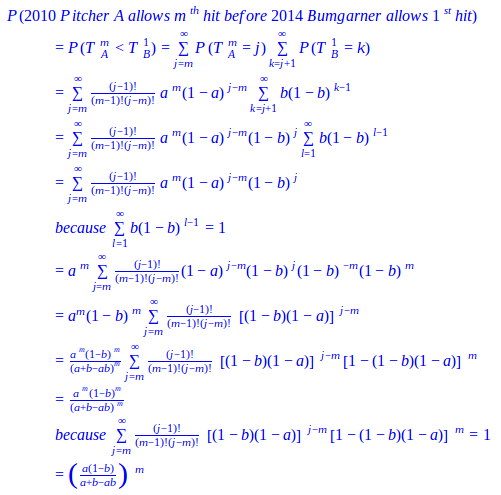

Formula 4.1

If we assume an even pitchers’ duel of who will allow the 1st hit, for m=1, then we have the following intuitive formula for 2010 Pitcher A versus 2014 Bumgarner:

Formula 4.2

This formula takes the probability that 2010 Pitcher A allows a hit minus the probability that both pitchers allow a hit and divides it by the probability that 2010 Pitcher A or 2014 Bumgarner allow a hit. Furthermore, if we let this happen for m hits, we arrive at our deduced formula. We should also note that according to the deduced formula, we should see the probability decrease as m increases. This logic makes sense because the expected span of batters until 2014 Bumgarner allows his 1st hit, TB1, stays the same, but we are trying to squeeze in more hits allowed by 2010 Pitcher A, which makes the probability become less likely.

Table 4.1:  Probability of 2010 Pitcher A Allowing mth Hit Before 2014 Bumgarner Allows 1st

Tim Lincecum

Matt Cain

Jonathan Sanchez

Madison Bumgarner

World Series P(H) 0.196 0.143 0.273 0.111
Allows 1st Hit before Bumgarner’s 1st 0.583 0.504 0.660 0.441
Allows 2nd Hit before Bumgarner’s 1st 0.340 0.254 0.435 0.195
Allows 3rd Hit before Bumgarner’s 1st 0.198 0.128 0.287 0.086

In Table 4.1, we compare 2014 Bumgarner and his 0.123 World Series P(H) versus each starter from the 2010 World Series Giants rotation and their respective P(H). We expect 2014 Bumgarner to have the advantage over 2010 Lincecum, Cain, and Sanchez, given how he dominated the 2014 World Series; clearly he does. In an even pitchers’ duel, he would win with a probability greater than 50% even after the chance of a tie is removed; we could even see 2 hits from the other pitchers before 2014 Bumgarner allows his 1st with a probability greater than 25%. However, against a comparably excellent pitcher, himself in 2010, he would likely lose the duel because 2010 Bumgarner actually has a better P(H). Notice that from Sanchez to Lincecum and from Lincecum to Cain, the P(H) descends steadily each time; consequently, the same pattern of linear decline also follows duel probabilities when transitioning from pitcher to pitcher for each of the different hits allowed. Hence, the distinction between exceptional and below-average pitchers stays relatively constant as we allow more hits by them versus 2014 Bumgarner.

We can also construct the converse formula to calculate the probability that 2010 Pitcher A allows 1 hit before 2014 Bumgarner allows his nth hit. We let TBn be a random variable for the total batters faced when 2014 Bumgarner allows his nth hit and TA1 for when 2010 Pitcher A allows his 1st hit. However, instead of directly deducing the probability that 2010 Pitcher A allows 1 hit before 2014 Bumgarner allows his nth hit, we’ll do so indirectly by taking the complement of both the probability that 2014 Bumgarner allows his nth hit before 2010 Pitcher A allows his 1st hit (a variation of our first formula) and the probability that 2014 Bumgarner allows his nth hit and 2010 Pitcher A allows his 1st hit after the same number of batters.
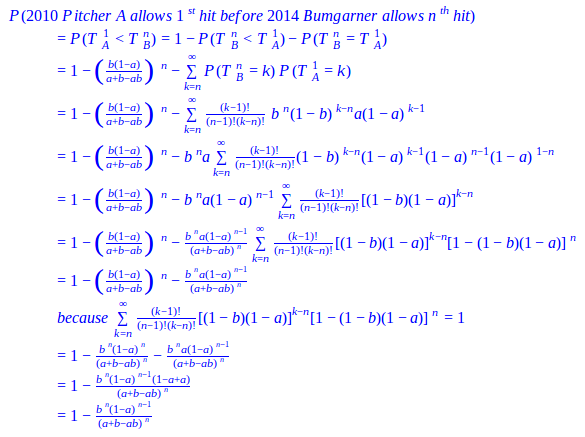

Formula 4.3

The resulting formula takes the complement of the probability that 2014 Bumgarner allows n hits and 2010 Pitcher A does not allow a hit in (n-1) chances and divides it by the probability that 2010 Pitcher A or 2014 Bumgarner allow n hits. In this formula we can contrarily see the probability increase as n increases. By extending the expected span of batters, TBn, to accommodate 2014 Bumgarner’s n hits instead of just 1, we’re granting 2010 Pitcher A more time to allow his 1st hit, resulting in an increased likelihood.

Once again, if we set n=1 for an even matchup, we get the same formula as before:

Formula 4.4

Table 4.2:  Probability of 2010 Pitcher A Allowing 1st Hit Before 2014 Bumgarner Allows nth

Tim Lincecum

Matt Cain

Jonathan Sanchez

Madison Bumgarner

World Series P(H) 0.196 0.143 0.273 0.111
Allows 1st Hit before Bumgarner’s 1st 0.583 0.504 0.660 0.441
Allows 1st Hit before Bumgarner’s 2nd 0.860 0.789 0.916 0.723
Allows 1st Hit before Bumgarner’s 3rd 0.953 0.910 0.979 0.862

In Table 4.2, we again use 2014 Bumgarner’s 0.123 P(H) versus those displayed in the table above. As expected, the probabilities from the even duels are the same as Table 4.1 because the formulas are the same. Although this time from Sanchez to Lincecum and from Lincecum to Cain, the difference between each pitcher noticeably decreases as we adjust the scenario to allow 2014 Bumgarner more hits. Thereby, there is less distinction between exceptional and below-average pitchers if we widen the range of batters, TBn, enough for them to allow their 1st hit versus 2014 Bumgarner.

Madison Bumgarner may have dominated the 2014 World Series as a starter, but he also forcefully shut the door on the Royals to carry his team to the title (by ominously throwing 5 IP, 2 H, 0 BB). Given the momentum he had, he proved himself to be Bruce Bochy’s best option. However, not every game is Game 7 of the World Series, where a manager must decisively bring in the one reliever he trusts the most. A manager needs to assess who is the appropriate reliever for the job and weigh which relievers will available later. Fortunately, an indirect benefit of the pitchers’ duel model is that it can calculate the relative probability between two relievers for who will allow a hit or baserunner first; this application could be very useful in long relief or in extra innings.

Table 4.3:  Probability of 2010 Pitcher A Allowing mth Baserunners Before 2014 Bumgarner Allows 1st

Tim Lincecum

Matt Cain

Jonathan Sanchez

Madison Bumgarner

World Series OBP 0.268 0.214 0.409 0.185
Allows 1st BR before Bumgarner’s 1st 0.602 0.547 0.698 0.511
Allows 1st BR before Bumgarner’s 2nd 0.362 0.299 0.487 0.261
Allows 1st BR before Bumgarner’s 3rd 0.218 0.164 0.339 0.133

Suppose we’re entering extra innings and the only pitchers available are 2014 Bumgarner and 2010 Bumgarner, Lincecum, Cain, and Sanchez with their respective statistics from Table 4.3 (where we substituted P(H) in Table 4.1 for OBP). We wouldn’t automatically throw in our best pitcher, 2014 Bumgarner, with his 0.151 OBP; we need to compare how he would perform relative to the other 2010 pitchers and see what the drop off is. Nor is it a priority to know how many innings to expect out of our reliever because we don’t know how long he’ll be needed. What is crucial in this situation is the prevention of baserunners as potential runs. 2010 Bumgarner, Cain, and Lincecum would each be worthy candidates to keep 2014 Bumgarner in the bullpen, because each has a reasonable chance (greater than 40%) of allowing a baserunner by the same batter or later than 2014 Bumgarner. Hence, the risk of using a pitcher with a slightly greater chance of allowing a baserunner sooner may be worth the reward of having 2014 Bumgarner available in a more dire situation. Yet, we would want to avoid bringing in 2010 Sanchez because the risk would be too great; the probability is approximately 49% that he could allow two baserunners before 2014 Bumgarner allows one. Preventing baserunners and using your bullpen appropriately are both high priorities in close game situations where mistakes are magnified.


Beware the Shark!

After spending the first four years of his career primarily in the bullpen, Jeff Samardzija became a full-time starting pitcher in 2012. In his first two years as a starting pitcher, Samardzija was worth 2.8 and 2.6 WAR, but he bumped that up to 4.1 WAR last year in the best season of his career.

Jeff Samardzija, first two years as a starter (combined)

Season Team IP ERA FIP xFIP WHIP K% BB% HR/FB BABIP GB% LOB%
12 – ’13 Cubs 388.3 4.10 3.67 3.42 1.29 24.1% 8.2% 13.1% 0.306 46.6% 72.2%


Jeff Samardzija, 2014 season

Season Team IP ERA FIP xFIP WHIP K% BB% HR/FB BABIP GB% LOB%
14 2 Teams 219.7 2.99 3.20 3.07 1.07 23.0% 4.9% 10.6% 0.283 50.2% 73.2%


Considering just the years he’s spent as a starting pitcher, in 2014 Samardzija set career bests in innings pitched, ERA, FIP, xFIP, WHIP, BB%, HR/FB%, BABIP, and GB%. When a player takes a step forward like this, there’s always the question of how sustainable this step forward is.

With Samardzija, it’s important to break down his 2014 season between the time he spent with the Chicago Cubs and the time he spent with the Oakland A’s.

Season Team IP ERA FIP xFIP WHIP K% BB% HR/FB BABIP GB% LOB%
2014 Cubs 108.0 2.83 3.10 3.19 1.20 22.9% 6.9% 8.5% 0.305 52.5% 72.9%
2014 Athletics 111.7 3.14 3.30 2.96 0.93 23.0% 2.8% 12.3% 0.262 47.9% 73.5%


The two statistics that stand out most are Samardzija’s BB% and BABIP in his time with the A’s. Samardzija made his last start with the Cubs on June 28th, 2014. At that point, he had a 6.9% BB% and .305 BABIP. His BB% was a career best and his BABIP was almost a perfect match for the BABIP allowed by the Cub’s team during the entire 2014 season (.304).

After the trade to Oakland, Samardzija’s BB% plummeted from 6.9% with the Cubs to 2.8% with the A’s and his BABIP also dropped significantly, from .305 to .262. Samardzija’s BABIP with Oakland was even better than Oakland’s team BABIP during the 2014 season (.272).

So, is this much-improved walk rate over a half-season of starts sustainable? Considering that before coming to Oakland, Samardzija had pitched 496 1/3 innings as a starter over the previous two-and-a-half years with a walk rate of 7.9%, I would say it’s not. He had a good stretch of 16 starts with a much lower walk rate than his career average, but it’s unlikely that he can sustain that low walk rate going into 2015.

Then there’s the issue of his superlative BABIP with the Oakland A’s. Again, through 496 1/3 innings pitched as a starter in the two-and-a-half-years before coming to Oakland, Samardzija had allowed a BABIP of .306. With Oakland, it dropped to .262. As mentioned above, Oakland’s team BABIP was .272 last year, so that drop for Samardzija is not surprising given that he was pitching in front of a better defense. Now that Samardzija is with the White Sox, he won’t have such a good defense behind him. The White Sox allowed a .306 BABIP last year and were in the bottom tier of all teams in baseball defensively. Since then, they’ve added Adam LaRoche, Melky Cabrera, and Emilio Bonifacio. LaRoche and Cabrera have not been good defenders over the last two years, while Bonifacio was good last year but not notably good in previous years. The bottom line is that it doesn’t look like the White Sox defense will do Samardzija any favors in 2015.

So, what should we expect from Samardzija in 2015?

Mike Podhorzer has written about the difference in ballparks as Samardzija moves from the O.co Coliseum in Oakland to US Cellular in Chicago. The takeaway is that the Cell could help Samardzija pick up a few more strikeouts at the expense of more walks and more homers allowed. Here are the strikeout, walk, and home run park factors for Wrigley, O.co, and US Cellular:


  K PF BB PF HR BF
Wrigley 101 102 101
O.co 99 101 92
US Cellular 102 107 111


In his three years as a starting pitcher in more pitcher-friendly ballparks, Samardzija has a strikeout rate of 23.7%, a walk rate of 7%, and a HR/FB% of 12.2%. To project Samardzija for 2015, we could slightly increase his strikeout rate, up his walk rate by a bit more, and his home run rate by even more, and factor in regression as Samardzija turns 30 years old. The following chart shows Samardzija’s numbers over the last three seasons, along with the average for those three seasons and what I would project for Samardzija in 2015.


Season Team IP K% BB% HR/FB BABIP
2012 Cubs 174.7 24.9% 7.8% 12.8% .296
2013 Cubs 213.7 23.4% 8.5% 13.3% .314
2014 2 Teams 219.7 23.0% 4.9% 10.6% .283
12-14 Average 202.7 23.7% 7.0% 12.2% .298
2015 My Projection 210.0 23.2% 7.3% 13.1% .305


To projection Samardzija’s stats for 2015, I used the formula for FIP and plugged in expected strikeouts walks and home runs, based on my projections above. This produced a FIP for Samardzija of 3.71. In his career as a starter, Samardzija’s FIP has been about 0.20 lower than his actual ERA. Last year, the White Sox team FIP was 0.20 lower than their team ERA. With this in mind, I bumped up my projection for Samardzija’s ERA to 3.80.

For WHIP, I used the walk rate I projected above and a .305 BABIP to come up with hits allowed and project a 1.26 WHIP for Samardzija in 2015. Here is a chart with my projection, along with projections from Steamer, ZiPS, and the FanGraphs Fans:

Source IP SO ERA WHIP K/9 BB/9 HR/9
My Projection 210 202 3.80 1.26 8.6 2.7 1.1
Steamer 192 178 3.93 1.24 8.3 2.6 1.0
ZiPS 194 197 3.90 1.23 9.1 2.4 1.1
FanGraphs Fans (15) 213 200 3.35 1.18 8.5 2.2 1.1


The Fans are more optimistic in their projection for Samardzija’s innings, ERA, and WHIP. I’m more optimistic than Steamer and the FanGraphs Fans that Samardzija will strike out a few more batters, but I also expect him to walk more and have a higher WHIP. Samardzija was the 22nd starting pitcher drafted in the recent FanGraphs Early Mock Draft, taken ahead of Masahiro Tanaka, Jake Arrieta, Hisashi Iwakuma, and Hyun-Jin Ryu, among others. I will definitely be moving Samardzija down my draft sheets a bit.