Archive for Player Analysis

Dominican Major Leaguers and the Provinces They Hail From

It shouldn’t come as any great surprise to a typical baseball fan that Dominican players play an outsized role in Major League Baseball today. In fact, the Dominican Republic, which has a population roughly just 3.3% that of the United States, supplies MLB with upwards of 10% of its players. Major League Baseball and baseball fans are better off because of this. After all, who wants to live in a baseball world without Nelson Cruz or Fernando Tatis Jr., for instance?

With this point in mind, the following takes a look at players from the Dominican Republic. More specifically, where in the D.R. players were born and when they made their way to MLB. What follows will be split into three brief sections: a description of the data utilized, some insights into the growth of the D.R.’s influence in MLB, and finally some map-based depictions of the players’ provinces of birth within the Dominican Republic. Read the rest of this entry »


Solving Adam Ottavino

There are many contributing factors to the lackluster performance of Boston Red Sox reliever Adam Ottavino, who made headlines in 2018 after saying he “would strike Babe Ruth out every time.” Currently, Ottavino has a 3.68 ERA, a FIP of 3.27, and 58.2 innings pitched at time of writing, placing him 119th out of 283 qualifying pitchers. Some big reasons for his mediocre stat line includes his inability to get left-handed batters out, command struggle, and pitch selection.

Red Sox Manager Alex Cora has done well to put Ottavino in situations to succeed, and without Cora at the helm, Ottavino’s stat line would look much worse. The bottom line is that the right-hander has been an abomination against lefties in 2021. In 19.2 innings pitched, he has allowed 10 earned runs, 22 hits, and 10 walks. Ottavino’s comments to the Boston Herald earlier in the season did not age well:

“I have no idea what they’re looking for these days in terms of roles and stuff like that, but I do think it would benefit me to get a full season in facing as many lefties as possible so I can put that kind of narrative to bed.”

Read the rest of this entry »


James McCann Has Lost His Progress

For Mets catcher James McCann, 2019 represented a career-altering triumph over the struggles that had plagued him through his first five big-league seasons in Detroit. With the Tigers, McCann’s abject lack of success at the plate led him to yo-yo between batting stances and approaches. In June 2016, he replaced his leg kick with a quieter front-foot step, struck out in a career high 29.2% of his at-bats, and tweaked his stance again in the offseason. McCann closed the book on his rookie contract with a 2018 season from hell — an abysmal triple-slash of .220/.267/.314, and a wRC+ of 56, good for second-worst among all hitters with at least 450 plate appearances.

2018 Worst wRC+ (450+ PA)
Player PA wRC+
Chris Davis 522 46
James McCann 457 56
Alcides Escobar 531 59
Scott Kingery 484 61
Billy Hamilton 556 68
JaCoby Jones 467 68
Adam Engel 463 68
Wilmer Difo 456 71
Jonathan Lucroy 454 72
Victor Martinez 508 73

Things opened up (literally) for McCann in Chicago. After signing a one-year, $2.5 million “prove it” deal with the White Sox, McCann’s most radical tweak struck gold. Opening his stance and bringing his hands closer to load unlocked an entirely different hitter in the once-struggling backstop. McCann became a legit power threat, popping 18 homers in just 118 games, and his wRC+ jumped to 108, placing him eighth among all catchers with at least 300 PAs. He continued this trend in 2020’s short-season madness: a slash of .289/.360/.460, a wRC+ within the top-40 of all hitters with as many at-bats, and even a positive grade as a framer. Read the rest of this entry »


The MVP Batter Through the First Month

In one of the later chapters of The MVP Machine, the authors describe a working relationship between an unnamed position player and a writer at an “analytically inclined” baseball website. The player felt that his club’s advanced scouting data wasn’t granular enough and asked the writer to supplement the information he was given by the club with additional detail. The writer was eventually performing scouting reports on the player himself, opposing pitchers, as well as the home plate umpires’ strike zones. In terms of evaluating his own performance, the writer summarized that the player was basically looking at three things: “Am I squaring up the ball? Am I swinging and missing? Am I swinging at strikes?”

With the first month of the season in the books, who would be some of the best performing hitters in the league according to this particular player’s criteria? Thanks to Statcast, we have the tools at our disposal to try and figure out just that. Note that the dataset I used for this exercise was all qualified batters as of the morning of April 30th, 2021.

First, we need to decide which parameters to use to represent each of the three questions posed by the player. Two of the three are pretty easy. “Am I swinging and missing?” We can look up a player’s whiff percentage on Statcast. “Am I swinging at strikes?” That information is represented in a player’s chase percentage. “Am I squaring up the ball?” The natural candidates here would be, if we’re using just one number, the average exit velocity, hard hit percentage, and barrel percentage. I decided to go with the average exit velocity because it takes into account every batted ball put in play by the batter. Let me explain. Read the rest of this entry »


The Cardinals Should Send the Angels A Very Large Check

Baseball’s compensation system ensures that teams have a long time before they need to pay their superstars in market value. The whole structure is broken, and I’m not just talking about “the Kris Bryant problem,” when a player’s debut is deliberately delayed in order for the team to gain an extra year of control. The issues go way beyond that.

This isn’t an article presenting a solution for this issue per se, mainly due to the fact that any restructuring requires flexibility and willingness to sacrifice some current profits for the long-term welfare of the game in what ultimately is a dispute about money. This change will come if and when it does primarily due to leverage that one side has over the other.

I want to talk about Albert Pujols specifically, the future first-ballot Hall of Famer who was recently released by the Los Angeles Angels. Looking back at his career, a glorious one at that, the difference between what he earned and produced with the Cardinals and with the Angels is quite staggering.

Instead of focusing on the negative and all that went wrong during his time in California, let’s look at it from a different perspective: how everything ultimately evened out for this all-time legend. Read the rest of this entry »


Clayton Kershaw Is Breaking Barriers in Breaking Ball Usage

Knuckleballer R.A. Dickey set record marks for a starting pitcher in the 21st century in terms of breaking ball percentage, usually hovering around 50%. The most prominent other examples are:

Which Starters Have Thrown the Most Breaking Stuff?
Pitcher Season Breaking% xERA
Patrick Corbin 2018 50.3 3.39
Jon Gray 2018 48.7 4.03
Madison Bumgarner 2015 48.7 2.92

But Clayton Kershaw could do something unprecedented this season. It may still be early, this goes beyond simply what happened during this first few weeks of baseball.

It’s well-documented that the future Hall of Famer doesn’t have the same zip on that fastball that he used to, which was most concerning during the 2019 season where the heater topped out at 90.3 mph. Giving up a lead to the Nats in Game 5 on back-to-back homers before being knocked out of the NLDS might have been the catalyst for a change in approach during the following offseason, but that’s just pure speculation on my part.

Kershaw went to Driveline, and through a meticulous study of his mechanics was able to make some minor adjustments and give himself a bit of velocity back. For a pitcher into his thirties, that’s especially huge.

One could look to that moment and mark it as a turning point, but to discuss Kershaw’s pitch selection, we must recognize that since the development of his slider way back when in a bullpen section in Wrigley Field (and even more so since his first Cy Young campaign in 2011), the left-hander has been steadily increasing the slider’s usage to the same rate he was decreasing the fastball selection. Just take a look at the graphic.
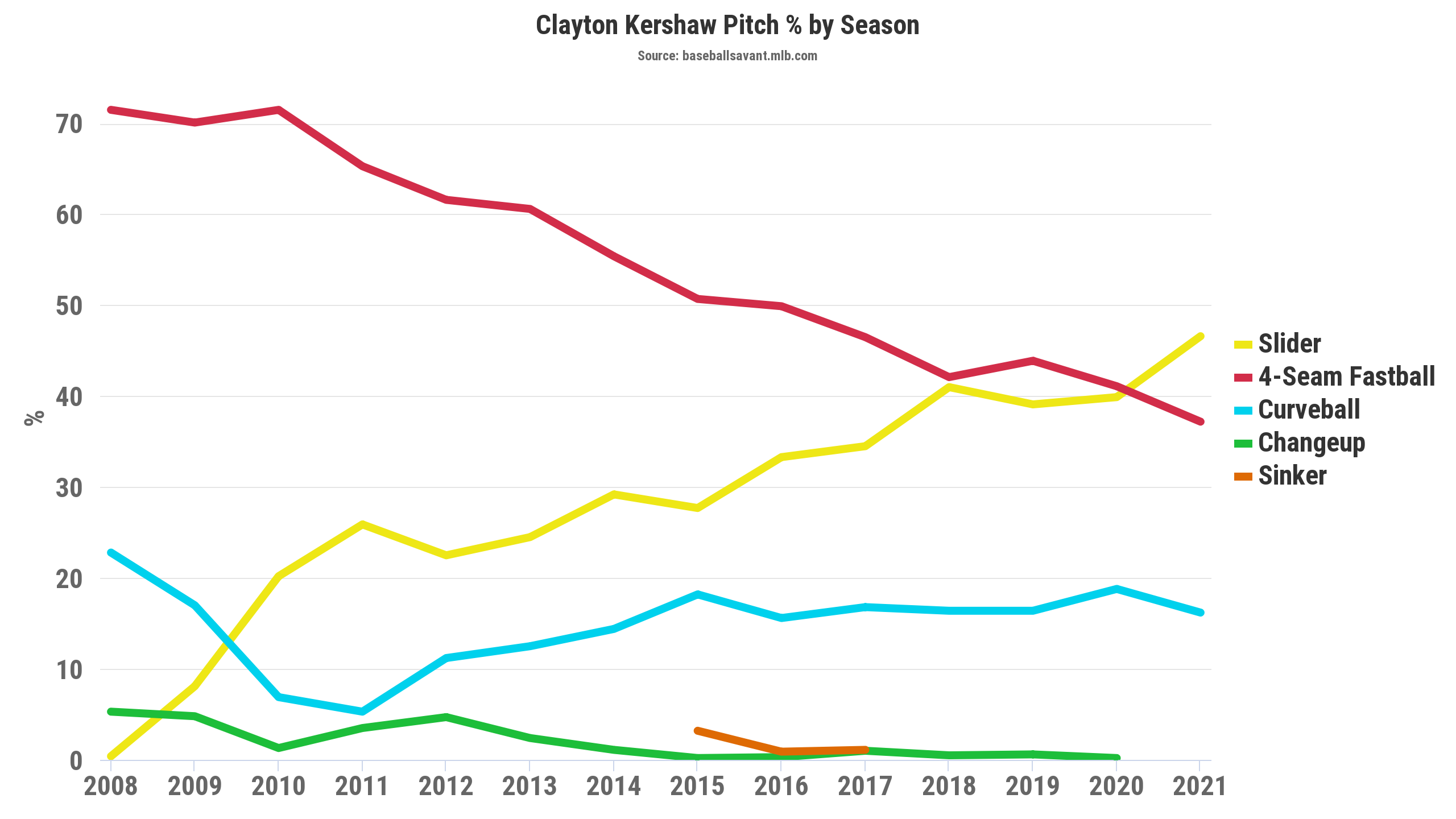
We are four starts into Kershaw’s 2021 season, and so far he’s maintained a steady pace towards the first season of a breaking ball rate of 60% or above.

The bulk of this change comes from Kershaw’s significant increase of sliders, specifically against right-handed hitters.
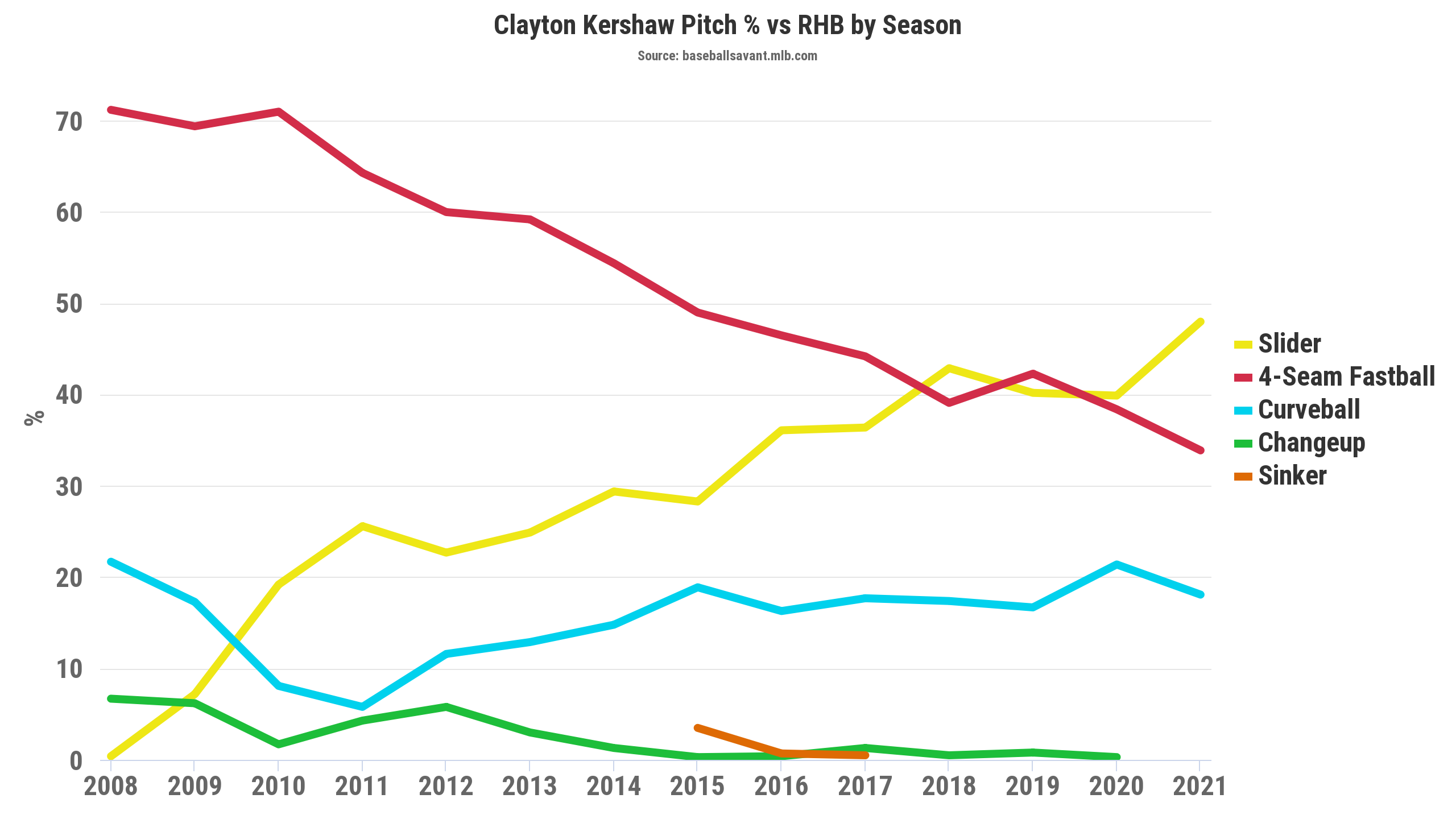
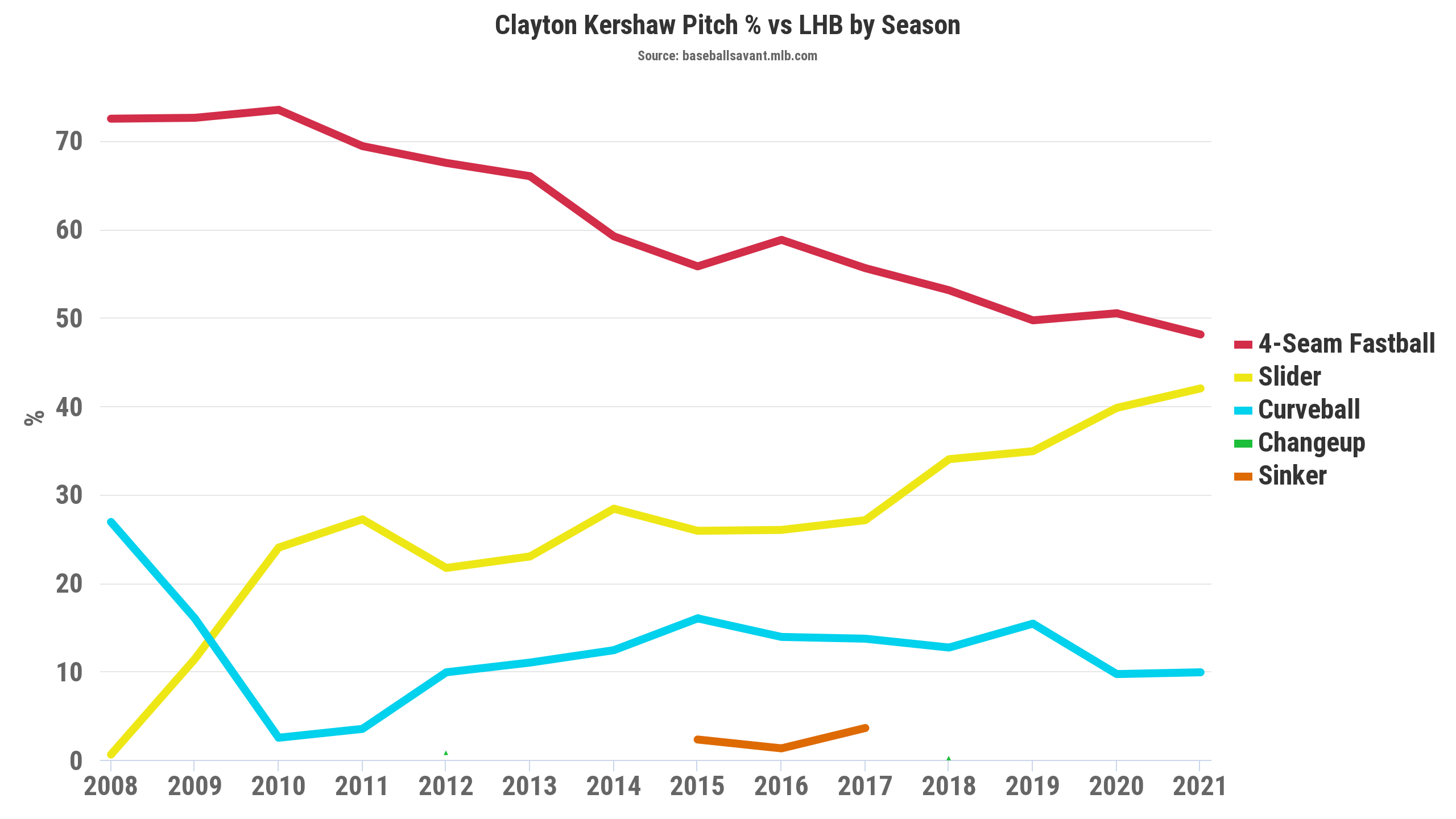
As you can see, he went from the low 40s in slider percentage (40.2 and 39.8 in 2019 and 2020, respectively) to 48 over his first four starts. I know it’s early, but if you are a right-handed batter against Kershaw in 2021, you’re basically getting three fastballs out of 10 pitches. The sample size against left-handed batters is small, just a total of 81 pitches, but it follows his career trend with a not-so-accentuated increase in breaking ball usage.
Here is a table of his pitch usage during each game this season:

Clayton Kershaw’s First Four 2021 Starts
Pitch Usage @ Rockies @ Athletics vs. Nationals @ Padres
Fastballs: 28 (36%) 34 (37%) 30 (35%) 39 (40%)
Sliders: 35 (45%) 44 (48%) 41 (48%) 44 (45%)
Curveballs: 14 (18%) 13 (14%) 15 (17%) 15 (15%)
Breaking%: 63% 62% 65% 60%

It’s about as close to the same approach as you can get in terms of pitch selection. As the first graphic showed, somewhere around the 2018 season Kershaw began throwing the slider just as much as he threw the fastball, and this could be the year he takes it one step forward. After all, he looked pretty good striking out Fernando Tatis Jr. three times with the same pitch just one night after Tatis hit a bomb against Walker Buehler in his return from the IL.

What also helps the left-hander throw that slider so often is the variations of it. Just ask Mitch Moreland.

The first slider Kershaw threw him here went for a ball with a horizontal break of three inches, but Moreland would strike out swinging (on a slider) as the next two broke eight and seven inches, respectively.
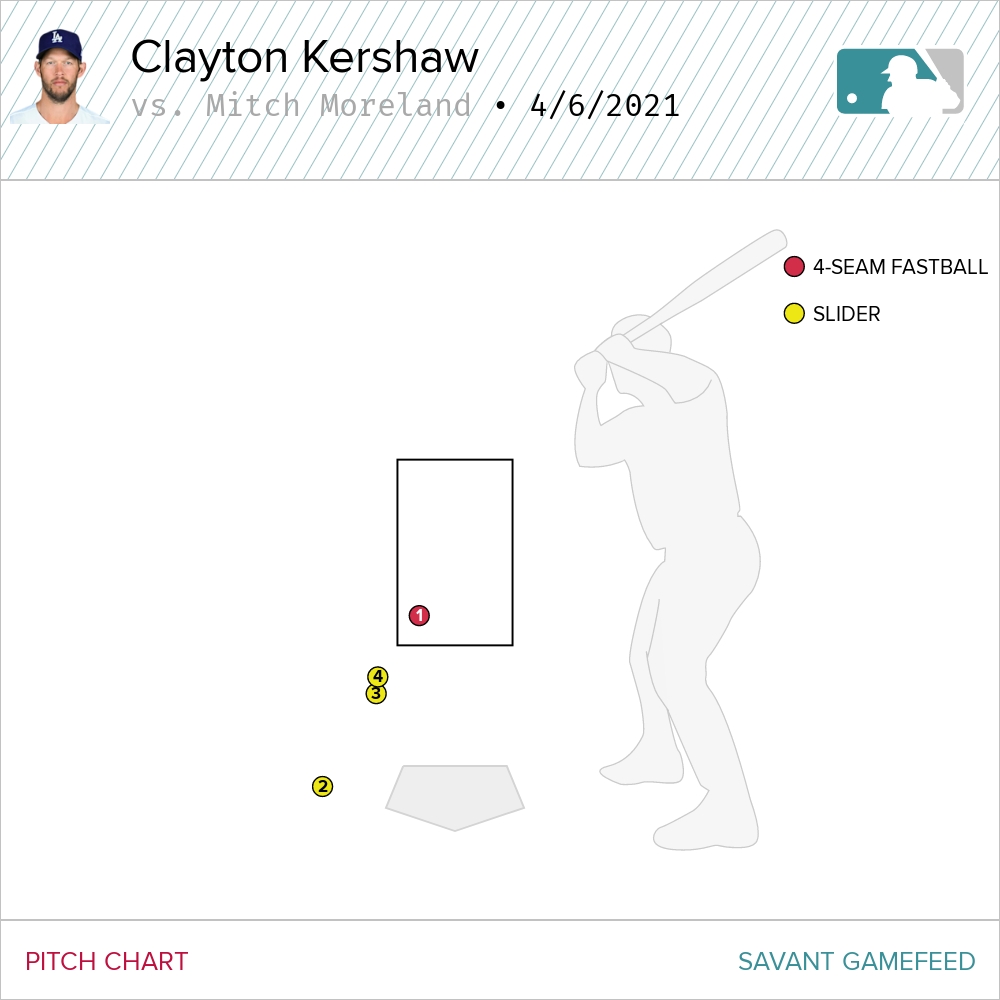
The second time up, Moreland saw six pitches and five were sliders, including the last one to punch him out, which had 30 inches of vertical break and five horizontal.
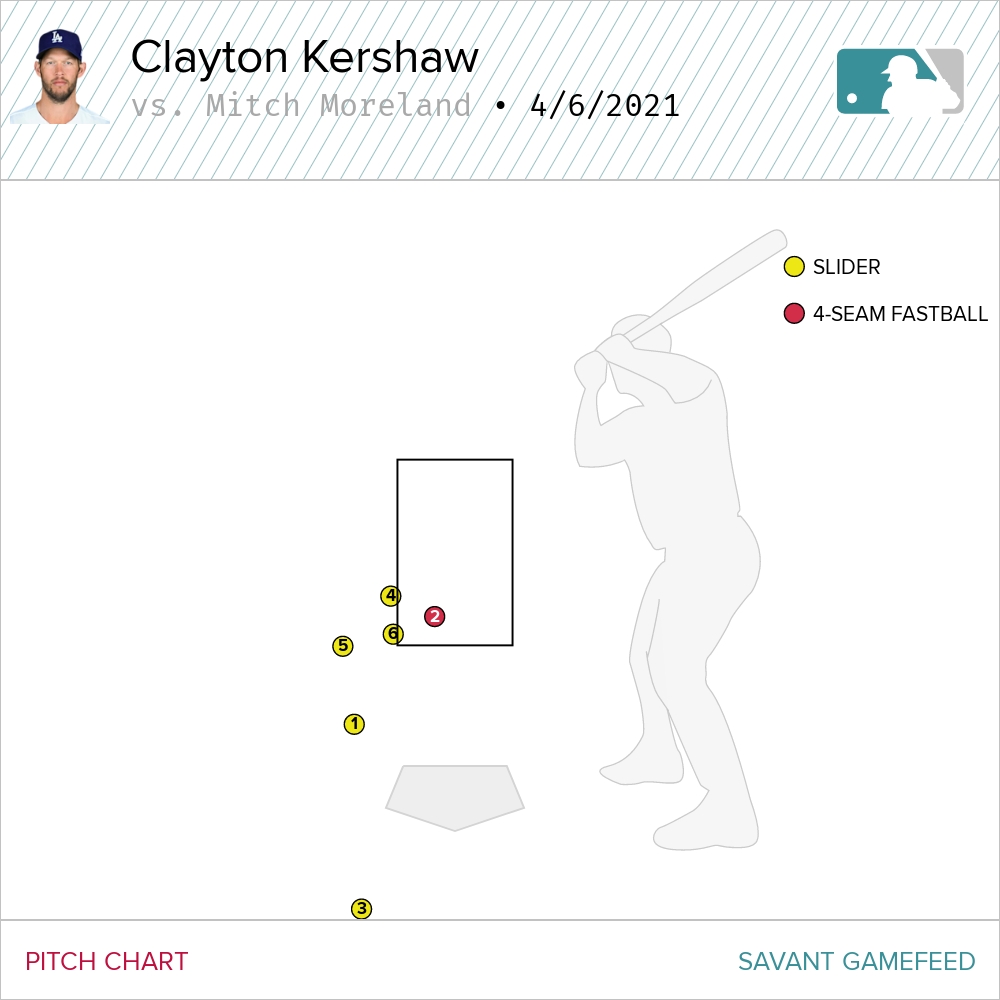
Third time’s the charm? Not so much. Kershaw threw another couple of sliders to finish Moreland off, the first for a ball with a vertical break of 24 inches, but the second one had 30, resulting in a weak grounder to the first baseman.
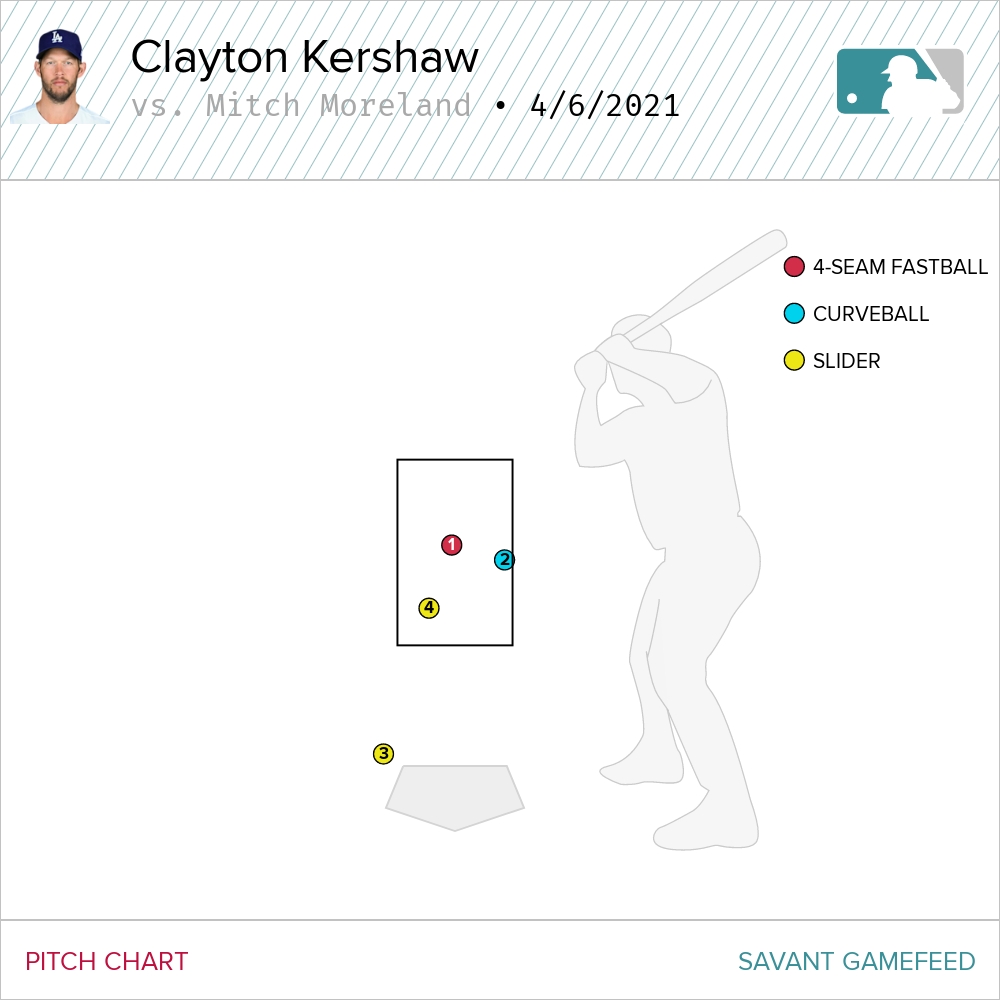
We’ll see what the season delivers, but so far Kershaw has looked really good following the career trend of pitching selection that’s been a constant since 2011. How far will he go in terms of breaking ball usage? My guess is we’ve seen the limit, or roughly that, for the foreseeable future. It remains to be seen if he can sustain it at that level moving forward, but whether that 60% mark is reached or not, it’s almost a given that he’ll set a career high and also perhaps the new record for non-knuckleballers, his only obstacle being this new “cutterless” Shane Bieber, although I’m betting he’ll bring it back at some point.

Note: No homers over the first four starts is an encouraging sign for Kershaw, and if he experiences a decrease in a trend that was working against him, let’s just say the rumors of his demise might’ve been a little exaggerated. He could may no longer be the overwhelming best pitcher in the game, but he can certainly still be a bona fide ace.

Estevão Maximo is an aspiring sportswriter from Brazil. You can find more of his writing here and here.


Jake McGee: The One-Pitch Pitcher

One of the newest members of the San Francisco Giants, lefty reliever Jake McGee, is coming off one of his best years in the major leagues throwing one pitch: a fastball. Seemingly by magic, McGee twirled a fastball 97% of the time he threw in 2020 on the way to a 2.66 ERA, 0.836 WHIP, and 11 strikeouts for every walk. I will be taking an in-depth look into McGee’s success and failure over his career, which might give better insight as to how he can continue to perform and how a major league reliever can succeed with only one pitch.

McGee was drafted in 2004 by the Tampa Bay Rays and made his major league debut with them in 2010. After his first full season in 2011, McGee posted extremely strong numbers in 2012, 2014, and 2015 with an ERA+ (it will become clear why I use ERA+) of 148 and a K/BB of 5.02 within those four seasons. After the 2015 campaign, McGee was traded along with Germán Márquez to the Colorado Rockies in exchange for Corey Dickerson and Kevin Padlo.

McGee immediately regressed in Colorado, as his ERA+ went from 163 to 103 (ERA+ adjusts for ballparks, which is particularly useful at Coors Field) and his K/BB sunk from 6 to 2.38 in the transition from the Rays to the Rockies (2015-2016). Of course, some of this decline is attributed to the difficult conditions of Colorado, but there is also additional evidence to show that McGee’s style of pitching contributed to his declined performance. Following 2016, McGee remained a strong-yet-aging reliever and was ultimately released by the Rockies in July of 2020.

Four days later, McGee signed with the Los Angeles Dodgers and proceeded to outperform even his 27-year-old self with an incredible season. McGee finished in the 99th percentile in K%, 96th in BB%, 95th in xERA, and 95th in xwOBA. So what exactly was the cause of this change and what did McGee do to get there? Read the rest of this entry »


Pound the Knees, Steven

After the Toronto Blue Jays traded for left-handed pitcher Steven Matz, he is projected to slide into the bottom of the starting rotation and pitch about 115 innings this year. Matz’s 2020 was a year to forget — join the club, Steven — but let’s take a look at who Matz is as a pitcher and why a change in fastball location is something the Jays coaching staff might consider.

Matz pitched only about 30 innings last year, so in the interest of sample size, I will also be using statistics from 2019 and 2018. Here is what those last three seasons looked like, courtesy of Baseball Savant: Read the rest of this entry »


Maybe It’s Better To Never Swing at Shane Bieber’s Pitches

You don’t need me to tell you how effective Shane Bieber was in 2020. He led the majors in ERA, FIP, K/9, overall strikeouts, and of course was the unanimous winner of the AL Cy Young Award. The underlying pitch-tracking data all back up the quality of his skillset. He’s very good. So you’re probably wondering how this all jibes with a title suggesting it may be better for hitters to not swing at Bieber’s pitches, right?

I’ll start with this: Bieber’s 34% zone rate ranks 316th out of 323 pitchers who threw a minimum of 20 innings in 2020. That’s dead last among qualified starters. How is this possible? The simple answer is that, once again, he’s very good. The slightly less simple answer is that batters swing at unhittable pitches and don’t swing at hittable pitches. Bieber throws almost twice as many pitches out of the zone as he throws in the zone, so what if hitters just stopped swinging at his offerings? Surely he would just change his approach if a batter didn’t swing at his pitches, right? Read the rest of this entry »


The Max Fried Change That Gave Way to a Stellar Season

After reading Alex Chamberlain’s piece on Kyle Hendricks‘ ability to suppress exit velocity, I was interested in attempting a similar investigation. Beginning with a linear mixed-effects model and Statcast batted ball data from the 2019 and 2020 seasons, I looked at which pitcher-pitch combinations were most effective at creating weaker contact and found similar results to Alex’s: Hendricks was still amazing. With a new toy in hand, I asked myself the next logical question — which pitcher-pitch combination improved the most from 2019 to 2020 (minimum 50 balls in play each season)?

The answer turned out to be Max Fried’s four-seam fastball.

When I consider Fried, the first thought that comes to mind is his breakout 2020 season. After establishing himself as a rotation mainstay the prior year with peripherals (3.72 FIP and 3.32 xFIP) that outpaced his results (4.02 ERA), Fried decided to stop giving up the long ball in 2020 (.32 HR/9). The reward for a season well-pitched was a fifth-place finish in Cy Young Award voting. The second thing that comes to mind about Fried is his devastating curveball. Since his first cup of coffee in 2017, Fried’s curveball spin rates have ranked between the 81st and 92nd percentiles, with hitters consistently struggling to square-up the pitch. For his career, Fried’s curveball xwOBA is just a hair above .200. It’s no surprise that FanGraphs’ 2018 prospects ratings gave Fried a 65/70 grade for the curve.

On the flip-side, Fried’s four-seam fastball may only be notable for being unconventional. In a period when four-seamers are supposed to be high-speed and high-spin, Fried’s does neither. Read the rest of this entry »