Archive for New York Mets

How Brad Brach Re-Found Success With the Mets

Back in February, Justin Toscano wrote that when the Mets acquired reliever Brad Brach last August, the team asked Brach to do the one thing he couldn’t do with the Cubs in the first half of the season: throw his cutter.

The 6-foot-6, 33-year-old right-hander was designated for assignment by Chicago after signing a $1.65 million deal with the team during the 2018–19 offseason. Brach posted a 6.13 ERA in just 39.2 innings across 42 games for the Cubs in 2019.

After having spent most of the second half of 2019 with the Mets, Brach re-signed with the team on a $850,000 deal, with a player option for 2021, that can increase to $1.25 million with incentives.

From March 27 through August 10 of 2019, among 197 relief pitchers with at least 30 innings pitched during that time frame, Brach ranked 123rd in the league in GB% (41.1%), 70th in K/9 (10.21), 193rd in BB/9 (6.35), and 97th in FIP (4.12). Suffice it to say, Brach was not the most productive pitcher for the Cubs, thus justifying his being DFA’d from the team in the middle of the year.

When analyzing Brach’s career numbers, however, it is clear that his time with the Cubs is not indicative of his overall arc. From 2011–18 with the San Diego Padres and Baltimore Orioles (and half a season with the Braves), Brach pitched to a 3.08 ERA (132 ERA+), a 3.68 FIP, and a 9.6 K/9 in 456 IP.

Prior to 2019, Brach only recorded an ERA over 4.00 once (5.14 in seven innings in 2011 — his first year in the league) and has never allowed more than 28 earned runs in a season. Moreover, since 2013, Brach has posted an ERA+ over 100 in every year but 2019, including a 210 ERA+ in his All-Star 2016 campaign for Baltimore. Read the rest of this entry »


Michael Conforto Had a Unique 2017

A few days ago, I decided to start my 2018 Fantasy Baseball List. My process this year is about categorizing all players into groups that defines each player’s positive and negative traits, all based on league average stats. In this process, while linking players with similar traits, I found something interesting about Michael Conforto’s 2017 season.

So, without further ado, here is the process and the math disclaimer:

First, I took all the players who had at least 900 PA between 2015-2017 (Averaging 300 PA per season), and while I evaluated a lot of the stats, the one who I’m talking about right now is Hard Contact %. Then, I found out the league average Hard Contact % of those three seasons altogether. After that, I took all the players who were league average and ran another average to know who were the ones on top. (I wanted to make this benchmarking process as easy as possible). I used the trait ”Ball Murderer” on those players.

After that, I evaluated a lot of other stats, but the focus right now is on FB%, LD%, GB% and wOBA. I took all players with at least 200 PA on both 2016 and 2017, and found out the players who made the biggest changes in each batted ball-type, using a similar process of average as before. For those players, I decided to use the trait ”Substantial Line Drive Increase”, ”Substantial Fly Ball Increase”, ”Substantial Ground Ball Increase” and ”Substantial wOBA Increase”. The same is true for decreasing values.

Then, I decided to see which players had a sustainable ”Substantial wOBA Increase”. What I wanted was to link every positive baseball process that I know that could derive into an increase of wOBA.

So, between all those links, it came the moment to answer a pretty easy question, which was: ‘‘Which players who hit the ball relatively hard on the last three seasons have made a batted ball type adjustment in order to increase their wOBA production”?

With this question, I thought I would get a narrow list of 5 – 10 players whose wOBA Increase would be backed up by this adjustment. To my surprise, I only found one name on it: Michael Conforto.

Conforto had a great season last year. He upgraded his BB%, upgraded his batting line to .279/.384/.555 and had a great .392 wOBA. Also, he became less pull happy and slightly upgraded his Hard Contact %. What most people could point out as a step back was that he lifted the ball less than last year.

While this might be true, Conforto showed an impressive upgrade on his LD%, which is a major factor behind his production upgrade. Going back to the name of this post, he was the only player who has hit the ball hard for the last three seasons (which I call ”Proven Hard Contact%), to upgrade substantially his LD% and wOBA. Another interesting aspect of this analysis is that no player who was tagged with the ”Ball Murderer” trait showed a substantial increase on his FB% and wOBA.

Conforto had a breakout season last year. He was characterized for lifting the ball in his career, and he lifted it less last year. But his great increase on LD% indicates that his results of 2017 were valid, and that he is a great and unique choice for your 2018 fantasy baseball team.


Alex Cobb Will Be One of the Gems of This Free Agent Class

Of the pitchers hitting the free-agent market this winter, Alex Cobb is not likely to receive the most fanfare.

Aces Yu Darvish and Jake Arrieta will command contracts north of $100 million. Closers Wade Davis and Greg Holland will do their best to secure four-year deals with big price tags. The whole world is watching every development in the Shohei Ohtani saga. Hell, among midmarket starting pitchers, MLB Trade Rumors predicts Lance Lynn to receive a more lucrative contract than Alex Cobb.

Cobb, who broke in as a full-time starter with Tampa Bay in 2012, has historically shown great promise and good-but-not-great results. He averaged 2.5 fWAR from 2012-2014, lost the next two seasons to Tommy John surgery, then came back with a 2.4 fWAR season in 2017. Cobb has never started 30 games in a season, nor has he ever thrown 200 innings. These facts are concerning to some, but I would argue that he is one of the wisest investments one can make this offseason.

Alex Cobb has evolved as a pitcher through pitch selection. Cobb has a great curveball. You either already know that, or you’re about to find out. He also mixes in a four-seam fastball, a splitter, and a sinker. Right now, curveballs are all the rage in baseball, resulting in tremendous success for pitchers like Rich Hill, Trevor Bauer, and Lance McCullers. They throw their curveballs so often that we can consider the breaking ball, not the fastball, to be their primary pitch. Like Hill, Bauer, and McCullers, Cobb has a quality breaking ball, so it stands to reason he should throw it more often and perhaps eschew his mediocre offerings. With Brooks Baseball, we can track the usage rate on each of his pitches throughout the season.

Look at the first couple data points for the usage rates on his pitches, and then compare them to his points at the end of the season. It’s clear that Cobb began to realize he works best by using the fastball and the curveball exclusively, so he increased his usage rate on those pitches and gradually phased out the splitter and sinker.

The question for Cobb is whether this was a good idea. In Cobb’s career, he’s only posted a strikeout-to-walk percentage (K-BB%) above 15% twice, and only ever so slightly so. He’s not bad in that regard, but it’s not where he makes his bread and butter. Fortunately for Cobb, he is one of the better pitchers in the league at inducing ground balls, which we know is favorable contact. The more grounders Cobb induces, the better he gets, and his curveball is a ground-ball machine. Consider the correlation between the rate at which Cobb increased his curveball usage and his ground-ball rate (GB%) throughout the season:

That’s a pretty strong correlation. It seems that Cobb is ready to join the Hills, Bauers, and McCullerses of the world and ride a high breaking-ball-usage rate to breakout success. Of course, it’s never going to be that easy for Cobb or anybody, but let’s go through one of his starts and parse what we can from the good and bad.

On September 4, Cobb pitched against a red-hot Minnesota Twins lineup and had one of his better starts of the season. His first batter of the game was second-half monster and fly-ball connoisseur Brian Dozier, and he managed to get him out on the first pitch.

It’s been proven that batters from the “fly-ball revolution” can be neutralized if you throw them high fastballs. These hitters are swinging up to lift the ball, but it’s difficult to put much lift on a high pitch coming in fast.

We’re going to focus on the curveball throughout this piece, but here is a fun fact about his fastball. Cobb’s heater sits at 92 MPH and had a spin rate of 2101 RPM this season, which seems pretty pedestrian. However, among starting pitchers with at least 100 batted-ball events involving fastballs, Alex Cobb’s has the 31st lowest exit velocity (87.1 MPH). To put this in perspective, that’s a better mark than James Paxton, Chris Sale, Max Scherzer, Jon Gray, Justin Verlander, and Luis Severino.

Cobb was smart to bait Dozier here, and he reaped the benefits with a first-pitch out to begin the ballgame.

In the second inning, we see Cobb pitching out of the stretch and unleashing a curveball that Ehire Adrianza buries into the ground. This will be the common theme today.

I mentioned earlier that Cobb doesn’t have the K-BB% of Chris Sale or Corey Kluber, so every once in awhile he walks batters. The common thought is that Cobb, who throws so many breaking balls, might end up behind in the count thanks to misplaced curves. Then, to get back in the count, he throws his 93 MPH fastball in the zone, which gets crushed by every hitter expecting it.

This would be a bad habit for Cobb to fall into, but he certainly didn’t in 2017. Consider the list of pitchers who threw the most curveballs while behind in the count this season (via Baseball Savant):There’s Cobb, in fifth place, not far behind Rich Hill himself. All five of these guys have great curveballs, so it makes sense for them to Trust the Process™ and continue dropping the hammer rather than submitting to doom and throwing a predictable fastball in the zone.

After walking the leadoff batter to start the third inning, Cobb knew Joe Mauer could make him pay. So rather than giving Mauer the fastball he wanted, Cobb began the at-bat by dropping a curveball for a strike that even froze the great Mauer.

This changed the whole at-bat, because now Mauer didn’t know whether Cobb would be coming at him with the curve or the fastball. Cobb took advantage of his opportunity, used the fastball to get him in an ideal 1-2 count, and then he went back the curveball and got Mauer to ground into a double play.

Cobb is comfortable throwing the curveball both behind in the count and with runners on base, so he can reap the rewards and induce quite a few double plays. That is an asset. Additionally, Cobb is comfortable throwing his curve from both the stretch (as we saw against Adrianza and Mauer) and from his big windup, as you can see here.

Eddie Rosario is a good hitter who made great strides late in the season, but even he found himself to be another ground-ball victim of Cobb’s curveball.

By the fifth inning, Cobb was almost through his second time against the Twins’ batting order. At this point, they weren’t sure whether to expect the curveball or the fastball, so Cobb was often ahead in the count. Here, he has Eduardo Escobar in a 1-2 count and throws a high fastball that Escobar swings right through.

Everyone in the park was expecting Cobb to throw the curveball to finish Escobar off. From a look at Escobar’s swing, it’s safe to say he was expecting a curveball himself. Cobb’s fastball isn’t necessarily anything special, but the way he uses it to pitch off the curveball can be.

With two outs in the inning, Cobb faced his 18th batter (which would complete his second time through against the opposing batting order). He quickly got Ehire Adrianza into an 0-2 count and then unleashed his best curveball of the night, which Adrianza pounded into the ground for another easy out.

At this point, Cobb had gone through the opposing order twice, pitched five innings, and only given up one run. Teams around the league are beginning to realize that most of their starters simply shouldn’t go out for the third time through the order, even if they are rolling. The Houston Astros just rode using Lance McCullers, Brad Peacock, and Charlie Morton in tandems all the way to the World Series. Those three guys are valuable pieces, and if Cobb is utilized liked this, so is he.

Unfortunately for Cobb, his pitch count was at 85, so his manager decided to bring him out for another inning. The Twins got their third look at Cobb, and I don’t need to cite the statistics to you about what happens at this point. Hitters are smart, so they can pick up on the tendencies of a pitcher if they see him so many times. Alex Cobb, as great at he was through five innings and two times through the order, is no exception to this rule.

Here is Joe Mauer taking an 0-2 curveball from Cobb and driving it into the gap in center for a double.

The important question here is, “was that Cobb’s fault or just a good piece of hitting from Joe Mauer?” Of course, the answer in baseball is always going to be both, but you can see in the embedded GIF that Cobb doesn’t necessarily leave the pitch up. In fact, if you compare it to the curveball that Cobb threw earlier in the game to get Mauer to ground into a double play, it doesn’t look much different — maybe an inch or two higher, at worst. The bigger change is Mauer, who swings like a guy fighting to stay alive in the first GIF, then like he knew exactly what was coming and how to handle it in the second.

This is the “third time through the order” effect in a microcosm. Pitches that fool batters earlier in the game become cookies, so the key is to relieve your pitcher while his pitches still fool the batters. Cobb should not be penalized by us for giving up a double to Mauer there; in 2018, analytical teams will be bringing in a new pitcher in these situations.

In this sense, Cobb is the first free-agent test case for the newest pitching trend in the industry — the tandem starter — one who pitches twice through the order, hopefully gets 15-18 outs, and then gives way to someone else. The Mets, who hired progressive Indians pitching coach Mickey Callaway to be their new manager, have made it clear that all starters not named deGrom or Syndergaard will be shielded from facing lineups more than twice in a game. Baseball has never experienced a shortage of five-inning pitchers in its history, but these changes in pitcher usage are leading to new premiums for these specialists.

It’s as simple as this: every team wants to stock their pitching staff with Alex Cobbs. To be clear, every team wants a Justin Verlander, but there is only one Justin Verlander; even horses Chris Sale and Corey Kluber showed significant wear and tear in October. To combat this dilemma, the Houston Astros deployed Lance McCullers, Brad Peacock, and Charlie Morton in five-inning tandems and rode them all the way to the last out of Game 7.

I expect Alex Cobb will fit into this role quite nicely for whichever team he signs with.


The Mets Should Trade Noah Syndergaard

Thor’s lat tear was the team’s biggest disappointment in 2017, a season that’s been chock-full of frustration and futility.

It was more demoralizing than the poor winning percentage. More displeasing than a certain player’s disappearance. And even more disheartening than the injuries en masse.

The fall of the Mets’ burgeoning ace is so distressing because it raised alarms about the future of their starting rotation. It’s now uncertain whether Noah Syndergaard, the pitcher once dubbed the second coming of Nolan Ryan, can play a significant role – let alone become the successor to Tom Seaver and Dwight Gooden.

How should the Mets deal with this situation? Though unpopular, there’s only one pragmatic solution: hope for a full recovery, let him recoup value, and trade him before future injuries occur.

Wait – trade him? Wouldn’t it make more sense if they gave such a tremendous talent the opportunity to fix his problems before they press panic button?

Sadly, it’s not quite that simple.

Syndergaard’s issues are so deeply rooted that he’s probably going to get hurt again.

And again.

And again.

Two core components of his skill set are the likely culprits of these injuries, and both are difficult to cure – at least without harming his effectiveness.

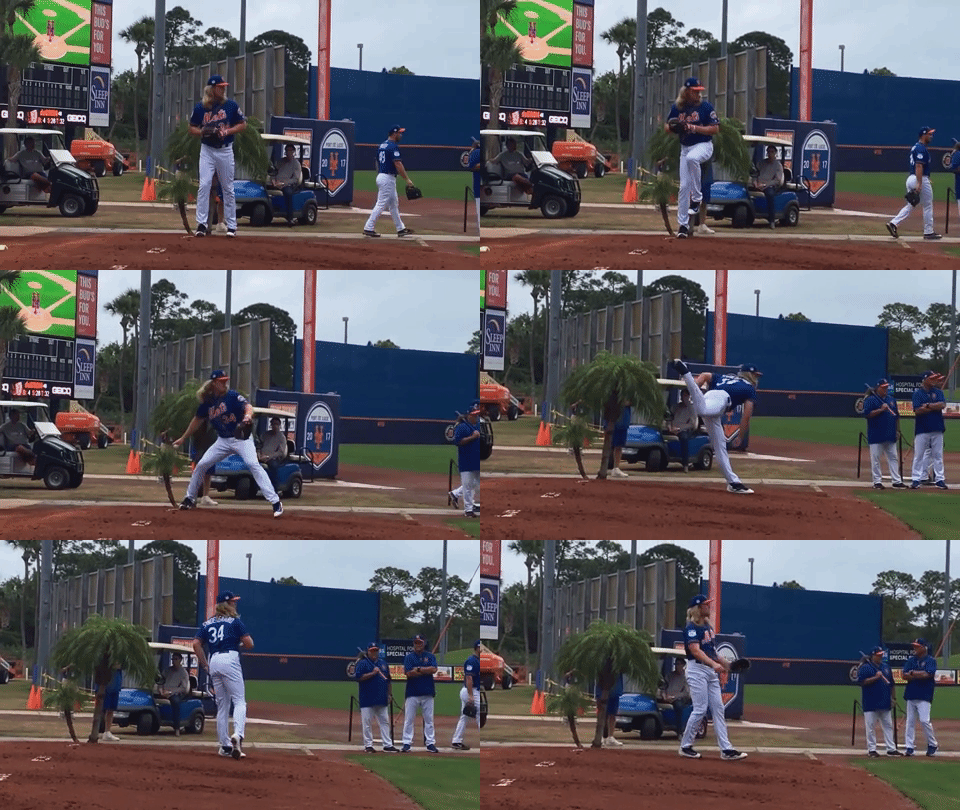
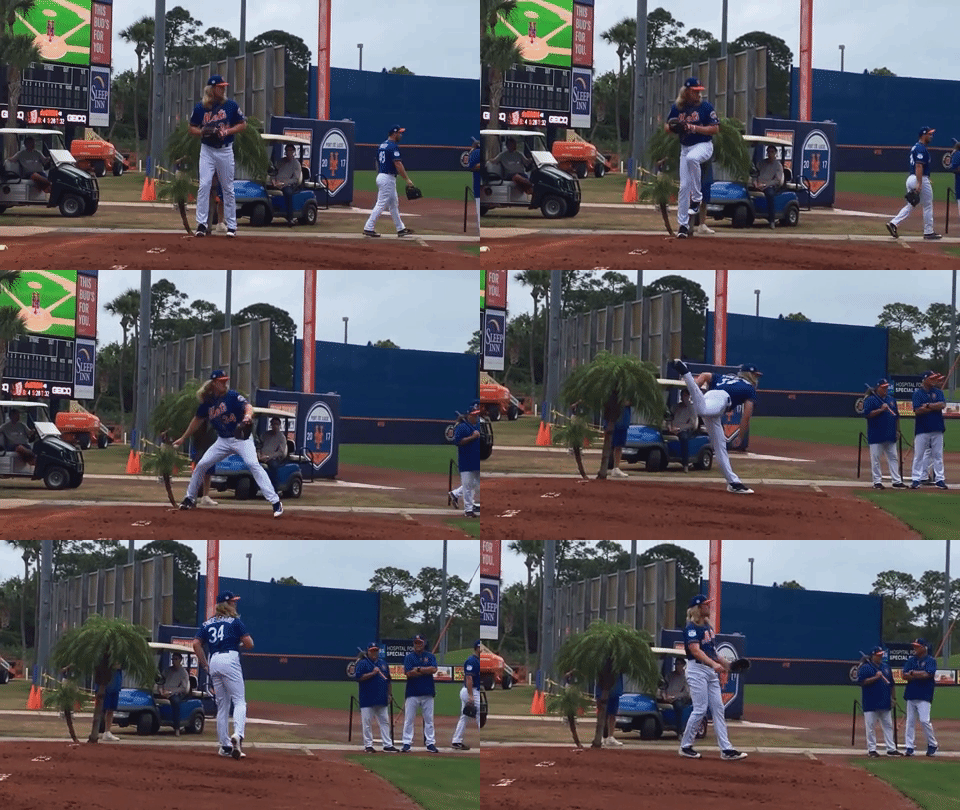
The first is Thor’s throwing motion. In the GIF below, you can see how he relies heavily on his golden arm when delivering a pitch:

At first glance, these mechanics appear quick, straightforward, and minimalistic. But also arm-dependent. If you look more closely, you won’t spot a single movement that attempts to alleviate the immense stress placed on his right wing. Not one.

You don’t see Syndergaard use a high leg kick or take a long stride. Nor do you notice him place substantial weight on his right leg when pushing off the rubber. You can’t observe him rotate his hips fully. And you won’t find too much torque in his upper body.

In short, he utilizes none of the mechanics that generate substantial velocity from his legs, hips, and core. Instead, you witness Thor gain most of his power from a sudden, violent contortion of his back and a quick snap of his almighty arm.

Needless to say, this delivery taxes his right wing…exorbitantly. On every single pitch.

But that’s not all. You also glimpse a slight timing problem that’s already become a ticking time bomb:

Syndergaard’s throwing arm is practically parallel to the ground when he plants his left foot. Then – before raising it to the cocked position – he rotates his hips and accelerates all components of his upper body, actions that place additional stress on his elbow and shoulder.

Mechanics of this sort, both arm-dependent and off-time, significantly increase his chances of getting hurt in the future…and that his afflictions will be far more severe than a torn lat.

The second cause of Thor’s injuries tilts those odds even further. That’s his max-effort pitching style. He looks to dominate batters with a repertoire of five overpowering pitches and, as you can see, holds nothing back:

Noah Syndergaard Average Velocity (MPH), 2015-2017
Pitch Type 2015 2016 2017 Avg MLB Avg
Four-Seam FB 97.72 98.64 98.70 98.23 93.17
Sinker 97.69 98.52 97.99 98.11 91.67
Slider 87.86 91.42 92.27 91.27 84.77
Changeup 88.83 90.31 90.06 89.61 84.13
Curveball 81.21 82.95 84.25 81.91 78.14
OVERALL 92.63 94.83 93.93 93.85 88.52
SOURCE: Baseball Savant/Statcast/PITCHf/x

Both fastballs routinely register around 98 MPH, and his slider and changeup hover about or above 90 MPH. Each one is at least 5 MPH faster than league average and is among the hardest thrown by any starting pitcher. Even his curveball, the “slowest” of the group, is well above the 78.14 MPH mean.

But something sinister lurks beneath these awe-inspiring averages. And that’s the not-so-subtle implication that Thor competes on stuff alone.

There’s neither an inkling that he paces himself nor an indication that he uses complex pitching strategies – at least not to any meaningful degree. Au contraire. From the looks of it, he throws as hard as physically possible all game long. Nothing more, nothing less.

Such an explosive approach requires Thor to exert himself fully on every single pitch he throws. This places additional strain on his elbow and shoulder, accelerates the damage inflicted by his delivery, and dramatically increases his chances of developing major arm problems.

Making matters worse, the two reasons for his injury are incredibly difficult to fix without breaking something else, namely his dominating performance.

Which is exactly why the Mets should move their star pitcher.

Noah Syndergaard is still a blue-chip asset with great trade value. You’d be hard-pressed to find another starter whose repertoire resembles that of an elite closer…let alone one who just turned 25 and won’t be a free agent until 2022.

That combination of unique ability, extraordinary upside, and relatively low financial risk makes him an attractive target despite his injury and its causes. As such, the team would probably acquire several top prospects in return for their ace.

If he’s able to put together a healthy season (or half-season), they should shop him around and pull the trigger on the best deal they find. Otherwise, it’s likely that a catastrophic arm injury will compromise his value; they’d never be able to swap him for anything meaningful again.

Should that day of reckoning arrive, the Mets will be forced to admit that they have another Matt Harvey on their hands: a supremely talented, though fundamentally flawed pitcher whom they should have traded before it was too late.


Are the Mets in Rebuilding Mode Once Again?

The Mets are the talk of the town…for all the wrong reasons. They currently sit at a 31-41 record and are 12 games behind the Washington Nationals in the NL East, which as of now seems to be theirs for the taking. The Mets boast one of the worst bullpens in the majors and have been plagued by injuries as well as underperformance from the bulk of their lineup. With the results of this season, many are beginning to wonder if it’s time to turn the page on this current pack of Mets players, many of whom were on the 2015 team that lost to the feisty Kansas City Royals in the World Series. I will attempt to go group by group in an effort to determine whether or not the Mets should begin a new rebuilding process, the most dreaded phrase in sports.

Starting with the outfield, Yoenis Cespedes is locked in for three more years in his current contract. It’s understandable why the Mets were looking to sign him in the offseason based on his performance in 2015 and 2016. However, injuries and poor performance have contributed to the current record that the Mets have. Cespedes still won’t lose his spot in left. Curtis Granderson, due to his age, will most likely not be re-signed, as well as Jay Bruce who, if he is not traded before the deadline, will most certainly test free agency. Juan Lagares has been injury-prone the last couple years but the one piece of good news is that Michael Conforto has seen a resurgence since coming back from Triple-A Las Vegas. Also, one of their top prospects, Brandon Nimmo, should receive regular playing time in the outfield, if not this season, then definitely in 2018.

Next, we have the infield, which has been decimated by injuries. Neil Walker and Asdrubal Cabrera have struggled through injuries (and who knows if/when David Wright will ever step on a baseball field again). Jose Reyes and Lucas Duda have mightily underperformed. The good news for the Mets is that Cabrera, Walker, and Reyes will be gone after the season, which means that the infield can get much younger. Top prospects Dominic Smith and Amed Rosario will be September call-ups and, if all goes well, can be regulars in the lineup next year. T.J. Rivera and Wilmer Flores have proven to be reliable pieces in the lineup. Despite some injuries from Flores, he has made up for it with his versatility in both the field and in the lineup, giving manager Terry Collins options to choose from. While Flores and Rivera may not be long-term solutions, they are the best options that the Mets have at the moment. As far as catching is concerned, Travis d’Arnaud is probably the Mets’ best option right now, although he has severely underperformed since being traded to them. The Mets should try to get another catcher in free agency.

Finally, the best pitching staff is a huge question mark, but also a big concern among scouts. Matt Harvey clearly no longer has any interest in remaining with the team and Noah Syndergaard, Zack Wheeler, and Steven Matz are just injuries waiting to happen. Even Jacob deGrom, who has been I believe the best starter this season, has a history of arm injuries that makes Mets front-office personnel nervous. Even Robert Gsellman and Seth Lugo are recovering from injuries sustained during this season. The bullpen has been just as bad. The bullpen so far has logged 257 innings to the tune of a 4.97 ERA. Not to mention they have not had a reliable closer since Jeurys Familia has been both suspended and injured this season, and the rest of the bullpen outside of Addison Reed and Jerry Blevins has been downright horrendous.

Overall, the Mets need to begin the next phase of the rebuilding process. With aging veterans and current players underperforming, it’s clear that the time for a championship has come and gone for this group. The Mets need to get younger and it starts with the old addition-by-subtraction technique. By dumping aging veterans with big contracts, the Mets will be able to allocate their resources and maybe pick up some pieces in free agency while simultaneously giving their top prospects playing time and allowing them to develop. As the great Cosmo Kramer once said on Seinfeld, “I think it’s time that we shut down and re-tool.”


The Mets Offense Lives and Dies With the Long Ball

Recently the New York Mets took the lead in the top of the first inning for the fifth straight game, setting the tone early in their 11-1 victory over the Philadelphia Phillies.  The Mets hitters looked extremely comfortable in the batter’s box, taking aggressive swings at good pitches all game.  The result was 11 runs all scoring through six home runs.  After hitting only two home runs in the first eight games of this season, the Mets have hit 17 home runs over their last five.

Every good team hits home runs, especially timely home runs.  However, great teams don’t need a lot of home runs.  Great teams live by the old adage, get on, get over and get in, meaning, get on base, advance on the base paths and score.

Since the wild card playoff system began in 1995, only two of 21 World Series championship teams finished in the top four in home runs during the regular season (2008 Phillies, 2009 New York Yankees).  However, during the same span of time, eight of 21 World Series championship teams finished in the top four in on-base percentage during the regular season, including 13 champions finishing in the top 10.

Home runs are an exciting, quick confidence boost for a batting lineup.  The only problem for a home-run-reliant team is home runs come in bunches.  Between facing MLB pitching every night and the natural difficulty in hitting a home run, sustaining home runs every game and the corresponding confidence is extremely difficult.

Conversely, a lineup with high on-base percentage forces the pitcher to uncomfortably pitch from the stretch more often and drives up pitch count which helps get the opposing starting pitcher out of the game earlier and into the opposing team’s weaker bullpen pitchers.

Currently, the Mets rank sixth in Major League Baseball with 19 home runs, two behind the third-ranked teams.  However, the Mets rank 21st in MLB in on-base percentage, 20th in batting average and have scored 56.6% of their total runs through home runs (30 of 53 runs).

Comparatively, the St. Louis Cardinals rank third in MLB with 21 home runs.  However, the Cardinals are second in MLB in on-base percentage, fifth in batting average and have scored 44.2% of their total runs through home runs (38 of 86 runs).

Additionally, the Mets are 24th in contact rate (percent of swings on which contact was made) and 29th on O-Contact rate (percent on which contact was made on swings outside the strike zone) according to FanGraphs.  What does that even mean?

A low contact percentage creates fewer balls in play resulting in a lower opportunity for the Mets to get hits and a greater challenge advancing runners along the bases.  The O-Contact rate shows the Mets aren’t hitting bad pitches, particularly two-strike pitches, well, a staple of many great teams (see 2015 Royals, recent Cardinals and Giants teams).  Making high contact percentages with pitches outside the strike zone lowers strikeout rates, forcing opposing pitchers to throw more pitches and puts additional pressure on the fielders to complete more defensive outs.

Additionally, in the nine games the Mets hit one home run or none, they averaged 2.9 runs per game.  In the other four games hitting two or more home runs, the Mets averaged 6.8 runs per game.  Obviously, runs per game will be higher when two or more home runs are hit but the disparity shouldn’t be as high as almost four runs or 2.3 times as high.

I’m not suggesting Mets hitters can’t manufacture runs through singles, extra-base hits and taking extra bases (not only by steals but going first to third on singles).  I’m not suggesting it’s time to panic.  I’m suggesting it’s something to pay attention to as the season progresses.


Logan Verrett Scouting Report

Stat Line:  6 IP, 0 R, 3 H, 6 SO, 2 BB

In the New York Mets’ 2-1 victory over the Miami Marlins, Logan Verrett showed why he would be in the starting rotation for 29 of 30 Major League teams.  Verrett attacks opposing lineups differently than the Mets’ big three power pitchers, looking to induce poor contact early in at-bats rather than inducing a high whiff/miss and strikeout rates.

Logan Verrett continues showing more than scouts prepared us for, exhibiting an above-average breaking ball while keeping four pitches low in the strike zone.

Repertoire

Verrett’s breaking ball (slider and curveball) is a viable MLB strikeout pitch, inducing a strong 16.6% whiff/miss rate (swing and miss rate).  His breaking ball, particularly his slider, shows sharp, late, downward movement and has enough velocity to deceive the hitter into thinking the pitch is a four-seam fastball.  The reason behind defining it as a breaking ball is because it’s tough to decipher the difference between his slider and curveball.

Verrett’s four-seam fastball sits 90 to 93 mph while his two-seam fastball, also referred to as a sinker, dials in at 88 to 92 mph.  At times, Verrett’s two-seam fastball/sinker seemed to move 6 to 10 inches with sharp 10-to-5 downward movement (think of 10 to 5 on a clock).  Although he didn’t show consistent fastball command on the corners of home plate, Verrett kept his pitches between ankle and thigh high.

Staying low in the strike zone with two pitches having sharp downward movement makes it nearly impossible for opposing hitters to lift the baseball for hard hits and extra base hits.

Verrett’s Four Keys to Success

Verrett has to focus on four aspects of pitching to be successful with a fastball/sinker primarily sitting 88 to 92 mph:

  1. Command fastball low in the strike zone because any misses in the strike zone will be hit hard.
  2. Rely more on a two-seam fastball/sinker with downward movement rather than straighter four-seam fastballs further reducing hard contact and naturally helping keep the ball down.
  3. Throw many off-speed pitches (45%-50% of total pitches) making his fastballs appear harder than reality.
  4. Throw at least 70% to 75% first-pitch strikes otherwise Verrett will be forced to throw predictable fastballs to climb back even in counts.

Verrett commanded his fastball thigh-high or below on 46% of fastballs but excluding the five intentionally thrown high four-seam fastballs the percentage moves to a respectable 52%.  However, Verrett only threw 34% two-seam fastballs/sinkers, another reason his “fastball low in the strike zone” percentage wasn’t higher.  Verrett threw 52% off-speed pitches at an outstanding 70% strike rate.  Lastly, Verrett threw 77% first-pitch strikes.  Three out of four isn’t bad for his first spot start of the 2016 season.

Cause for Concern

Verrett showed a stronger out pitch than scouts reported but didn’t exhibit fastball command on each corner of home plate needed for a pitcher throwing in the low 90s.  In fact, he threw 27 of his 85 pitches (31%) on the inner half of home plate or inside to hitters but only eight of those were commanded well on the inside corner.  Understandably, Verrett lives on the outside corner but must learn to throw inside with a purpose and control.  Lacking control and a presence on the inside corner allows MLB hitters to feel comfortable in the batter’s box and gives them the ability to look for predictable outside pitches.  When an MLB hitter is able to predict or feel comfortable guessing a certain pitch type or pitch location, the more aggressive and confident their swings become.  This makes Verrett vulnerable to higher home run, hard contact and walk rates.


One Reason Steven Matz Struggled Against the Miami Marlins

Steven Matz’s season debut quickly went south, with him giving up seven earned runs in the second inning en route to a 10-3 New York Mets loss against the Miami Marlins.  Matz exhibited one mechanic flaw leading to his lack of command, particularly in two-strike counts, resulting in the Marlins’ second-inning carousel around the bases.

Steven Matz (L, 0-1) 1.2 IP, 7 R, 6 H, 1 SO, 2 BB

Arrows were pointing up after watching a 1-2-3 first inning with fastball velocity at 95 mph, culminating in striking out one of Major League Baseball’s best power hitters, Giancarlo Stanton.

Unfortunately, Matz started the second inning breaking one of the cardinal rules of pitching: walking leadoff man Martin Prado.  When a leadoff hitter makes it to first base, he scores approximately 35% of the time.  Making matters worse, Matz walked the following batter, Chris Johnson.  Five of the next seven batters ground out hits, including a Giancarlo Stanton man-bomb home run to left field, knocking Matz out of the game.

The frustrating aspect for Matz and Mets fans alike was during all three Marlins RBI single at-bats, Matz was ahead in the count 1-2 or 2-2.  Matz proceeded throwing hanging curveball after hanging curveball.  Even in Marcell Ozuna’s pop-out, both two-strike pitches were hanging curveballs which thankfully Ozuna missed (Side note: Ozuna can’t hit an outside pitch….at all).  Obviously, Matz’s objective was not to hang curveballs or throw hittable two-strike pitches.  The reason lies in Matz’s release point.

Simply, Matz’s throwing arm lagged behind his body forcing his release point to be late, rushed and higher than normal as opposed to his normal release point out in front of his body.  This results in an inability for Matz’s throwing fingers to stay on top of the baseball.

Matz, and every other Major League pitcher, needs his fingers on top of the baseball at release, allowing his fingers to stay on top of the seams on the baseball.  This allows his fingers to manipulate the spin of the baseball at release, whether ripping down on the seams for a four-seam fastball or getting over the top of the baseball throwing a curveball.

Consequently, Matz’s fingers come around the seams of the baseball instead of over the seams of the baseball when throwing his curveball, resulting in a weak spin rate and a floating or hanging curveball.  Additionally, fastballs tend to sail high and towards the throwing arm side (up and to the left for Matz) out of the strike zone as seen in four straight fastballs during Prado’s leadoff walk.

Why Matz’s arm lagged is a separate question I couldn’t unveil through the TV broadcast.  Originally, Matz appeared throwing across his body, meaning his stride/planting leg lands too far left towards first base, blocking off his arm from releasing the baseball out in front of his body.  But this was not the case as Matz was landing with good alignment towards home plate.  Other reasons could include rushing his motion or opening his front shoulder and glove hand too soon but I didn’t see those either.

Whatever the reason, pitching on ten days’ rest is very difficult, especially for a starting pitcher in a rhythm and routine created during spring training.  Do not put too much stress in the results of this start.


Meet the 2016 Mets, A Good Enough Team

The Mets off-season has been very “Mets”. One could gripe, one could be happy, one could simply think it was reasonable. But it was undeniably the Alderson-Mets; a conservative off-season.

Mets fans will associate it with loss, more than gain. Many came to adore Yoenis Cespedes and he (or a bat like him) is thought of, more than anything else, as the type of piece needed for a return trip to the World Series. The failure to re-sign Cespedes (which is more of a refusal to sign Cespedes on part of the Mets) has drawn the ire of those same fans. I mean, my brother is a pretty calm and reasonable person, and I get e-mails like this:

“The Mets fucked themselves. Royals go out and steal Gordon for 4/$75M. What a joke. If Cespedes goes for this number, it will be an absolute shame.”

The truth is that Cespedes was a great fit for the Mets at the trade deadline but he was always an awkward fit in the long-term.

First, the Mets need a center fielder and while Cespedes can play center field, he is not a center fielder. He compiled a -4 DRS and -3.2 UZR in 312 innings in center field for the Mets last year. If you look back to his time in Oakland the results were similar. He’s played 912.1 innings in center field over his career and has compiled a -17 DRS and -12.6 UZR. So, if he’s not going to supplant Michael Conforto and you can’t make room for him in right field with Curtis Granderson having two more years on his contract, there is no home for Cespedes in the field.

Second, his acquisition coincided with the additions of Kelly Johnson and Juan Uribe, the debut of Michael Conforto, and the returns of Travis d’Arnaud and David Wright from injury. Cespedes probably ignited something qualitative in the team, while blasting 17 home runs after the trade, but the Mets have ample opportunity to replace his 1/3 of a season impact with a full season of the other things that propelled them to a NL East title.

These are arguments against bringing back Cespedes, but don’t even touch on the most obvious inevitability  —  Cespedes is unlikely to replicate his performance in August and September, nor his performance over the entirety of 2015. Cespedes is a very good baseball player, but he’s not the baseball player the Mets are looking for.


The real key to the 2016 Mets offense is Travis d’Arnaud. d’Arnaud is oft-injured, but when he is not he is a great player. He could be the best catcher in baseball, but he may also cobble together a half-season of play, losing multiple battles to the disabled list. d’Arnaud provided 2.3 fWAR and 1.7 bWAR in 2015 while only playing 67 games. When he plays he is an elite catcher, and a very good hitter, ranking 3rd in wRC+ (.131) and wOBA (.355) for catchers, trailing only Buster Posey and Kyle Schwarber. A full season of d’Arnaud could exceed the value of Cespedes in 1/3 of a season…by a lot.

In the outfield, the Mets are banking on what they have. A full season of Michael Conforto would be as impactful as a full season of d’Arnaud. Conforto provided nearly identical value to Cespedes down the stretch of the season, contributing 2.1 WAR, by both FanGraphs and Baseball Reference’s measure. Cespedes value was measured at 2.7 or 2.3 WAR, respectively. It’s unlikely that Conforto can extrapolate that performance over an entire season, but he doesn’t need to.

 The signing of Alejandro De Aza indicates the Mets are pushing it all in on Juan Lagares. Lagares will never be a great hitter, but if his elbow is healthy and he can revert back to something resembling the center fielder he was in 2013 and 2014, then Lagares will add a couple more wins in 2016 then he did 2015.

The team needs to hope that Conforto is an impact bat in the middle of the order, and Lagares reverts to his old form, because they should expect some sort of meaningful regression from Curtis Granderson, who will play his 35-year-old season this year and is coming off one of the quietest great seasons of 2015, where he contributed 5.1 WAR, the 19th highest total in the league.


The front office seems to have a strong belief that the depth provided by Kelly Johnson and Juan Uribe provided a large amount of value. This is the simplest rationale of the signing of Asdrubal Cabrera and a combined $14 million given to Cabrera and De Aza for 2016

Terry Collins will be able to shuffle the middle infield around injuries and match-ups with Wilmer Flores, Ruben Tejada, and Cabrera all capable of playing SS and 2B. Tejada and Flores will likely be able to slide over to 3B to relive Wright, who seems on track to start in an abbreviated amount of games in order to manage his spinal stenosis.

Finally, the Mets traded Jon Niese for Neil Walker. Walker provides equivalent value as Daniel Murphy and allows Dilson Herrera to spend one more year in the minors, or alternatively, gives the Mets a valuable trade asset to improve the team in July. Both make sense, although Herrera appeared to be ready to grab the second-base job — but between Herrera’s age (he won’t be 22 until August) and potential trade value, picking up Walker was the right move.


In sum, the Mets’ off-season wasn’t really one of gain or loss. Walker was the most obvious move: He provides nearly identical value to Murphy, while giving the Mets a little more glove in exchange for a little lighter bat. It wasn’t really an addition, but a replacement. Other than that, there were no other “moves”; just gambles. d’Arnaud is fragile, Conforto is young, and Lagares may not be good enough to start, at least in the context of this lineup. If all these gambles pay off, then the Mets’ off-season acquisitions will make perfect sense. Depth in the infield and outfield may be all they need. It just seems so rare, particularly for the Mets, that all these gambles pay off.

These do not feel like long-shot bets though. They seem reasonable and calculated. If you couple these bets with the belief that, in the aggregate, 3/4 of the season with Wright, a full-season of Matz and Syndergaard, and a full season of bench depth is worth 5–6 extra wins, then the Mets are a better team than the 2015 version, at least on a full-season basis.

And if it’s not good enough? Well, that’s what the prospects are for. Trade some. Unless it’s really not good enough, in which case, it was never going to be good enough. And that too is what the prospects are for  — the future.

If it wasn’t for last season’s World Series run, we’re probably more focused on the future of the Mets: Herrera replacing Walker; Dominic Smith replacing Duda; Brandon Nimmo platooning with Lagares and Granderson in 2017, all in tandem with a developing Conforto and the “young pitching.” However, the pitching staff is so good, the Mets can never abandon the present, but they also can’t screw up the future.

In light of all of this, the Mets’ off-season wasn’t bad, it wasn’t great, and it wasn’t exciting. It was good enough. They are taking a plunge into what they have, in light of what is coming and in fear of investing in a potentially flawed team. We’ll never know exactly what the Mets are thinking, but we know what they have done. The 2016 Mets were built with one eye on the future, one eye on the past, with neither taking too much time to glance at the present.

The following projections for 2016 were made using Steamer Projections. 

2016 Mets wOBA Expected Runs — 670 (.311 wOBA)

2016 Mets FIP and Def Expected Runs — 584 (3.57 FIP, -16.1 Def)

2016 Mets Pythagorean W-L — 92–70


A Quick and Dirty Attempt to Find Justin Upton’s Trade Value

Players like Justin Upton aren’t usually available at the trade deadline. Upton ranks 35th in wOBA (.353) and 47th in WAR (8.9) between 2013 to the present.  Also of note, Upton is in his walk year.

So, how many players like Justin Upton have been traded in the past 10 years? I did a quick scan of deals made in June and July since 2005 and I found four similar players who were traded in their walk years.

1. Hunter Pence PHI->SF, 2012 (68th wOBA (.347) and 68th WAR (8.7), 2010-2012)

2. Carlos Beltran NYM->SF, 2011 (19th wOBA (.379) and 74th WAR (8.1), 2009-2011)

3. Matt Holiday OAK->STL, 2009 (4th wOBA (.410) and 6th WAR (18.2), 2007-2009)

4. Mark Teixiera ATL -> LAA (15th wOBA (.396), 17th WAR (14.8), 2006-2008)

The Mets received Zack Wheeler in return for Beltran and the Athletics received Brett Wallace in return for Holliday. Baseball America ranked Wheeler the 55th best prospect pre-2011 and Wallace was ranked 40th pre-2009. In the following years, pre-2012 and pre-2010, respectively, Wheeler was ranked 35th and Wallace was ranked 27th.

The Mets and Athletics did well in each trade. They received top prospects and non-deteriorating prospects (they were not losing value as prospects during the year they were traded for). This is evidenced by the ranking of Wheeler and Wallace in the season following the trade.

The Pence and Teixiera trades did not net the Phillies or Braves prospects. Each team received a major league asset, using “asset” in the loosest of ways.

The Phillies received Nate Schierholtz, who had totaled .9 WAR up to that point in 2012. They also received Seth Rosin, an A Ball pitcher, and Tommy Joseph, a AA catcher. Essentially, they received a replacement level player and organizational depth. 

The Braves received Casey Kotchman. Kotchman had totaled 2.1 WAR in 2008 with the Angels before the trade. He managed 3.7 WAR the year before. The Braves could not expect Kotchman to live up to his past billing (he was Baseball America’s 6th ranked prospect pre-2005), however, from the most optimistic perspective, they may have expected him to be worth 2 WAR per year over the remaining four years of team control. At least this is my best attempt to get in the head of the Braves’ front office seven years after the fact.

Now, I’ll attempt to determine Justin Upton’s trade value based upon these past trades.

Kevin Creagh and Steve DiMiceli published a study on Point of Pittsburgh that analyzed the value and future performance of prospects based on their ranking in the Baseball America’s Top 100 (the ranking was determined by the final appearance of the prospect in the rankings).  The article has a lot of information you should read regarding the dollar value of prospects and their potential to bust, but for purposes of this article, I am concerned with a prospect’s projected WAR over the six years of team control.

Hitters that rank between #26-50, which is Brett Wallace, project to have an average of 6.8 WAR. Pitchers ranked between #51-75 project to have 3.8 WAR. However, based on Wheeler’s fast rise up Baseball America’s list, I’ll factor in that pitchers ranked between #26-50 project to have 6.3 WAR. The average of the two is 5 WAR, which is the value I’ll place on Wheeler at the time the Mets traded for him.

Justin Upton is not Matt Holliday, circa 2009, and he is not quite Carlos Beltran, circa 2011, although he is much less of an injury risk than 2011 Beltran (who would go on to spend time on the DL for the Giants in 2011). Therefore, I project that the Padres should receive between 3.8-5.0 WAR in return for Upton. The return should scale up towards the higher side of that projection based upon an active and interested market for Upton.

Below is a list of potential Upton suitors and their prospects that appeared in Baseball America’s Top-100 rankings before the season began. The rank of the prospect is in parenthesis, followed by their Creagh and DiMiceli projected WAR. The prospects in bold represent the most likely return for Upton, however I included some prospects that are possibilities, but project to have more WAR value than should be expected in return for Upton.

Mets – Brandon Nimmo (45, 6.3), Dilson Herrera (46, 6.3), Amed Rosario (98, 4.1). I excluded Kevin Plawecki (63) and Michael Conforto (80) due to their major league role and rise to prominence, respectively. 

Pirates – Jameson Taillon (29, 6.3); Austin Meadows (41, 6.8); Josh Bell (64, 5); Reese McGuire (97, 4.1)

Cubs – C. J. Edwards (38, 6.3); Billy McKinney (83, 4.1)

Giants – Andrew Susac (88, 4.1)

Orioles – Dylan Bundy (48, 6.3); Hunter Harvey (68, 3.4)

Rays – Daniel Robertson (66, 5); Willy Adames (84, 4.1)

Royals – Raul Mondesi (28, 6.8), Brandon Finnegan (55, 3.4), Kyle Zimmer (75, 3.4), Sean Manaea (81, 3.5)

Twins – Jose Berrios (36, 6.3); Nick Gordon (61, 5); Alex Meyer (62, 3.4)

Astros – Mark Appel (31, 6.3)

A.J. Preller should feel (somewhat) vindicated regarding the Justin Upton portion of his winter experiment if he can get a player he likes that resembles the players on this list. However, it remains to be seen if he will chase after something safer, like the Braves in 2008, or squander an asset like the Phillies in 2012. In that case, he’s probably better off going all-in on the Padres he built for 2015.