Jeter, Jeter, Numbers Beater

About a month ago, I wrote an unintentionally controversial article about some puzzling patterns in Derek Jeter’s early season numbers.

There were two main contradictions within his statistics: that he was on pace for the best power numbers of his career while posting his highest ground ball rate ever, and that he was posting a career-low strikeout rate while swinging at a dramatically larger proportion of pitches thrown outside of the strike zone.

My critics claimed that I was reading too much into the stats too early in the season. Under normal circumstances I would have agreed, but it was more than the numbers themselves that were puzzling. When a person hits more home runs on fewer fly balls and makes better contact with worse pitch selectiveness, the results contradict the logic, no matter how small the sample size.

Four weeks later, I think it’s appropriate to revisit the situation and see how things are shaping up.

Overall, the discrepancies have become less dramatic, but the contradictory trends are still in place.

As I predicted, his power numbers have come back down to earth. He’s now on pace for 16 homers (down from 26 at last writing) and 98 RBI (down from 130). Neither would be a career high, but both would be above his norm.

But Jeter’s unprecedented groundball tendencies haven’t abated. Over two-thirds of balls off his bat (67 percent) have been on the ground—by far the highest such figure in the American League. While that’s a slight decline from the 71 percent mark he posted last month, it’s by far the highest of his career and a full 10 points above what he posted from 2002-09.

Meanwhile, his 16 percent HR/FB rate is the highest it’s been since 2005. Coincidentally, the 2005 season was the only other time in his career that his groundball rate hit 60 percent. So basically, the more he puts the ball on the ground, the more likely it is that each fly ball he hits will clear the fences. I’m not sure if that’s really a contradiction, but it’s certainly an odd correlation.

One thing is clear: this isn’t a common trend. This year, Jeter is the only player in the AL who has both a groundball rate over 50 percent and a HR/FB rate over nine percent.

But the more dramatic (and interesting) statistical oddity stems from the collapse of Jeter’s plate discipline.

Over his career, Jeter has been one of the most selective hitters in baseball, hacking at less than 20 percent of balls out of the strike zone. This year, that number has ballooned to 31.3 percent. Simply put, he’s chasing bad pitches. That’s not an insult or a criticism—that’s an indisputable, objective fact.

The sample size isn’t too small to start drawing conclusions. Jeter has seen 288 pitches outside the zone and swung at 90 of them.

As one might expect, this trigger-happy approach has had a negative effect on his walk rate, which, at five percent, is a career low. It’s less than half of the walk rate he posted last year.

Similarly, you’d expect his strikeout rate to shoot up into the stratosphere, right?

Wrong.

While Jeter’s 14 percent whiff rate is a sizable increase from last month’s nine percent figure, it’s still inexplicably lower than it ought to be, given Jeter’s history and his newfound aggressiveness.  How is that possible?

My first thought upon revisiting these numbers was that, in addition to swinging at more pitches off the plate, Jeter was starting to be less discriminatory with pitches thrown in the zone. That made sense, and I was embarrassed that I hadn’t thought of it a month ago.

But it turns out that’s not right either—in fact, it’s actually the opposite. This year, Jeter has chased a career-low 69 percent of balls in the zone, compared to 74 percent for his career. Simply put, Jeter is swinging at more bad pitches and fewer good ones.

I plugged in the numbers and found that, while 80 percent of the pitches he’s swung at since 2002 were good, just 69 percent of balls he’s chased in 2010 would have been called strikes.

And yet, Jeter’s 86 percent contact rate is the best of his career.

This just doesn’t make sense.


Ichiro, Grounded

Ichiro Suzuki is a singular talent. He is fast, seeming to fly all over the outfield. He steals bases with great success — 45 while being caught only twice in 2006. He has a legendary cannon for a right arm. And he hits like a machine. He racked up over 2,000 hits in his first nine major league seasons, and was the second fastest to that milestone (to Al Simmons, who reached it in 12 fewer games). He does not hit many home runs or a particularly impressive number of doubles or triples. He piles up his hits by putting the ball on the ground and running to first base. Joe Posnanski recently explored Ichiro’s hitting prowess, coming to the conclusion that he is one of the few truly unique players in history.

What if Ichiro were slow? What type of player would he be if he were not able to knock out so many ground ball hits? For one possible answer to this question, I compared the rate at which Ichiro reached base on ground balls to the American League average. Baseball Reference lists batting average splits by hit trajectory, and I compiled the league numbers from 2003 through 2009. The league statistics for the first two years of Ichiro’s career, 2001 and 2002, differ significantly from the next seven, possibly due to different methods of categorizing ground balls. I omitted those two years, as well as this season’s small sample. During the seven seasons from 2003-2009, American League players consistently reached base at a .240-.245 average on grounders. Ichiro beat the average in every year, with a high of .368 on ground balls in 2007.

To get an idea of what type of player Ichiro would look like without all those extra hits, I normalized his ground ball hit rate to the league average for each season and recalculated his batting totals. This adjustment cost him 42 hits in 2007 and 44 in 2004, and no less than 14 in any of the seven seasons. For simplicity, I removed only singles from his batting line. I then searched for a player with career statistics similar to Ichiro’s adjusted totals and came up with an interesting candidate. The following table displays Ichiro’s statistics over the past seven years (again, discarding 2001 and 2002) without his extra ground ball hits, side by side with Curt Flood’s career averages.

Table: Curt Flood versus Adjusted Ichiro
Statistics Per 600 Plate Appearances
Adj. Ichiro Curt Flood
Doubles 19 23
Triples 6 4
Home Runs 8 7
Walks 37 38
Strikeouts 56 53
Average .291 .293
OBP .338 .342
Slugging .391 .389
OPS .729 .732
BABIP .313 .314

This adjusted version of Ichiro is a near statistical clone of Flood, who played center field in the 1960s for the Cardinals. Flood was also a great fielder, winning gold gloves in each of his last seven full seasons. He is most famous, however, for starting a chain reaction that led to the free agency system when he refused a trade to the Phillies after the 1969 season. It marked the effective end of his career at just 31, as he played only 13 games in a comeback attempt in 1971. Despite now being inextricably linked with baseball labor history and not often mentioned for his playing ability, Flood was actually a surprisingly valuable hitter. He played in the offensively-challenged 1960s and was significantly above average with the bat for most of his career. Ichiro’s adjusted stats, in today’s era of power and on-base percentage, would be far less impressive.

Of course, this is all merely a thought experiment. Ichiro probably does have some control over where he hits the ball, as his New York Times profile explains. FanGraphs’s Jack Moore also explored Ichiro’s propensity to hit grounders to the opposite side of the infield at an abnormal rate. Thus, simply removing some of Ichiro’s hits does not show us the player he would actually be if he were not so fast. If he could not get on base so often on this type of batted ball, it is likely he would adjust his approach and that his numbers would reach a different equilibrium. What removing all of the extra singles does show us is just how much value those ground ball hits supply. Without them, Ichiro’s numbers look fairly pedestrian, especially in the era in which he has played. With them, Ichiro is Ichiro, and he will go down as one of the greatest and most dynamic hitters in baseball history.

This article originally ran at Ball Your Base.


Is Scott Rolen a Hall of Famer?

Note: Article was originally submitted to Bleacher Report on March 22nd, 2010, before the beginning of the 2010 season. For a link to the piece, visit Joe Regan’s bleacher report article.

As anyone who has read examples of my past writing can attest, I tend to focus a lot of my historical analysis pieces on the Hall of Fame. Today, I will divert myself from that path a little bit to argue my Hall of Fame case for a great in our generation whose contributions have been highly underrated: Scott Rolen.

A lot of words come to mind when discussing Rolen: grinder, a “veteran presence,” scrappy, gritty. I hear these a lot. One thing I do not hear a lot, for whatever reason, is “great.”

A quick look at his hitting numbers, for example, do not scream “great.” In 14 seasons, and 7,382 PAs, Rolen currently sports a line of .284/.370/.498, with 283 HR, good for a 124 OPS+/128 wRC+ . His HR total is good for 146th all time, behind players like Garret Anderson and Miguel Tejada, and he has never led his league in any statistical category, from the “old school” categories of BA, RBI, and hits, to the more analytical categories of OPS, OPS+, and others. Sounds like a classic “good, not great” player, correct?

I disagree completely. His 128 wRC+ puts him in the same category rate-wise (albeit sans-full decline stage) as Paul Molitor and Tony Perez. Molitor, if you recall correctly, spent a good chunk of his career as a DH, while Perez spent over two-thirds of his career at first base. Rolen, on the other hand, has played every inning of his career at third base.

Positional differences, obviously, is not enough. While fangraphs approximates an average third baseman to be worth 1.5 WAR per 600 PA more valuable than an average defensive first baseman with the same batting numbers, this does not address the fact that Perez had a longer career. Heck, Perez is not even the issue here. The issue is Rolen.

Everyone’s favorite new “quick reference” defensive statistic is UZR. Also, most everyone (myself included ) recognizes Adrian Beltre to be a fantastic defensive 3B. UZR reflects this, rating Beltre at +104.5 UZR at 3B since 2002, and a +13.9 UZR/150.

Scott Rolen? 102.1 UZR, 15.5 UZR/150.

I think most people would acknowledge that Rolen can flash leather. I doubt too many would think he is as good as Adrian Beltre.

Total Zone (which can be found on the player pages of Sean Smith’s website ) is not quite as gung-ho over Rolen as UZR, but at +93 since 2002 (and +141 overall), it’s close. The aforementioned Beltre is rated at +79 since 2002, and +96 overall. While I am not prepared to state that Rolen is a better defensive 3B than Beltre, any system that recognizes Beltre’s elite abilities, and then also states Rolen shares said abilities, is a perfectly credible system to me.

So what we are left with is a good hitting, great fielding player at a position that is in the middle of the defensive spectrum, and we are tasked to determine his place in history. Once again, Sean Smith provides a great point of reference for us, which his top 500 positional listing. At 94, we find our subject, Scott Rolen. Behind him are, well, a lot of all-time greats.

One could argue that Rolen still needs to post good seasons to make it to The Hall. Fine. According to Rolen’s fangraphs page , his CHONE projection rates him to be a +3.0 WAR player in 2010 (which is solidly above average). Even if Rolen breaks down rapidly (to the tune of +3.0, +2.0, and +1.0 seasons), that would push him up on Sean Smith’s rankings to Brooks Robinson status.

Maybe he did not peak well enough? Peaks are important, but I would argue that Rolen had many outstanding seasons. According to his baseballprojection.com page, Rolen did not post a season of sub-4.0 WAR baseball from 1997-2004. 4.0 is usually considered the level of an all-star player. At age 34 in 2009, he posted a +4.8 (according to Sean Smith’s system), yet another terrific season.

To further emphasize “excellence,” one can use a “junk statistic” called WAE, or “Wins Above Excellence,” calculated by subtracting four from every individual season’s WAR total, and defaulting to zero if the number is less than four.

Using Sean Smith’s WAR totals, Rolen’s WAE clocks in at 19.9. The aforementioned Brooks Robinson? A WAE of 15.3. Looks to me that Rolen passes the “excellence” test.

I have already written that the Hall of Fame should measure players more about the way they help their team win, rather than the hype they generate. Fact of the matter is, Rolen is a great baseball player, and I hope when his name hits the ballot (perhaps in 2019? 2020?) that the BBWAA evaluates his career correctly.


Believe the Hype: Looking Back at the 2005 Draft

With the 2010 MLB Draft just around the corner, and excitement in the air, many writers have been cautioning optimistic fans.  Throughout the 1990’s, very few first rounders contributed anything meaningful in the big leagues. However, I believe times have changed, and improved scouting and statistical analysis have lead to better draft choices across the board.  To see this theory in action, we have to look no further than the stacked first round of the 2005 MLB Draft.  Only five years after the fact, 18 of the 30 draft choices have posted a positive WAR in the big leagues.  All statistics courtesy of FanGraphs and MiLB.com.

1. Justin Upton:  5.7 WAR

Drafted out of high school, Upton has already made a big impact at the Major League Level, posting a .388 wOBA for the Diamondbacks in 2009.  The team has locked him up, and he appears to be a superstar in the making.

2. Alex Gordon: 4.3 WAR

After strong showings in 2007 and 2008, Gordon has struggled in recent years, and the Royals have sent him down to AAA to learn how to play left field, where he is currently mashing minor league pitching (1.207 OPS).

Read the rest of this entry »


A New Old Idea For the Kansas City Royals

Sabermetric pioneer and hero Bill James has suggested that certain teams need to abandon the traditional methods of putting together a baseball team and adopt unorthodox methods. Perhaps no team is better suited for this idea than James’ old favorite Kansas City Royals.

Founding Royals owner Ewing Kauffman was an original thinker which helped him develop his fortune with the Marion Labs pharmaceutical company. Kauffman was not any less creative in setting up the Royals and believed that it was possible to teach great young athletes to play baseball. He tasked his front office with doing just that. The result was the Kansas City Royals Baseball Academy.

Read the rest of this entry »


Brian Matusz: A Curious Case of Control Issues

Brian Matusz entered the 2010 season considered one of the top rookie pitchers in the game. Marc Hulet of Fangraphs recently wrote that he thinks Matusz will win the AL Rookie of the Year. Things haven’t been so rosy for the Baltimore lefty in the last month, however.

Matusz hasn’t pitched excellently in 2010 according to his peripherals. He’s better than his 5.8 ERA, but he’s worse than 3.8 FIP on account of an unsustainable 6.2% HR/FB. His xFIP of 4.6 looks a lot more like the pitcher that he is. He’s striking out a lot of hitters (7.4 per 9), but his fly-ball tendencies are extreme (46.5% over 446 batters faced) and his control looks spotty: 3.3 BB/9 this season.

It’s the last part I want to take a look at, because a (career) 3.1BB/9 is going to wreck a fly-ball pitcher like Matusz unless he can develop swing-and-miss stuff that will get him a strike out per inning. But here’s the thing: Matusz control has been impeccable through his major league career.

54.3% of his pitches have hit the zone since he first took the mound in 2009. For comparison’s sake, just four pitchers managed to throw that percentage of pitches (or more) in the zone last season: Ted Lilly, Cliff Lee, Johan Santana and Roy Oswalt (who tied Matusz’s 54.3%). Just below that are Justin Verlander and Scott Baker. Matusz has allowed 7.6% of hitters a free pass since his arrival. Of those six comparisons, the highest walk percentage was 6.5% (Santana), the lowest 4.4% (Lee) and the average was 5.6%. Somehow Brian Matusz manages to walk 35% more batters than the average of this group of similar pitchers.

It gets even stranger. Matusz throws pitches in the zone, but he’s not exactly a pitch-to-contact guy. His contact rate on pitches in the zone (=83.3%) is about 4% below major league average (~=88%). He does tend to allow contact on pitches out of the zone, but the net result is an average contact rate, and his swinging strike rate of 9.3% is 1% better than the major league average. He’s not throwing pitches in the zone because he gets behind in the count: his 62.0% F-strike rate place him around the top 15% of starters with 60 or more IP last season.

If we adjust his walk rate to reflect what pitchers with a similar rate of pitches in the zone do, Matusz would have just 15 walks this season and a 3.0K/BB ratio. That’s good enough to produce a 4.2 xFIP and 3.6 FIP. ( I calculated the expected walk rate at 6% of batters faced. I calculate expected HR for xFIP as 6.5% of line drives plus flyballs, i.e., balls in the air, rather than as proportion of fly balls to account for inconsistencies in LD and FB scoring.)

While it’s difficult to tell a lot about a pitcher from his plate discipline stats, two things do stand out: swinging strikes get Ks and pitches in the zone prevent walks. The correlation coefficent between BB/BFP and zone% was -.43 for 78 qualified starting pitchers in 2009, which is a pretty strong correlation for baseball.

It would be really cool if I had an explanation of Brian Matusz high walk rate, but it confounds me, and I’m completely open to suggestions. His walks look like an anomaly.


Carlos Marmol Dares You to Hit Him

At age 23, Carlos Marmol made his major league début with the Cubs as a starter.  He was mostly dreadful in 2006, finishing with an ERA over 6.00.  Since then, he’s settled in as the setup man and now the closer for the Cubs and for the most part has been very good.  Since 2007, he’s averaged over 11 strikeouts per nine innings in each season, finishing in the top ten each season; this year, his strikeout numbers have been absolutely stupid.  Here’s a summary of Marmol’s rate statistics for his career, followed by his totals:

Season K/9 BB/9 HR/9 BABIP LOB% GB% HR/FB FIP xFIP
2006 6.90 6.90 1.64 0.265 70.2% 28.9% 11.8% 6.47 6.22
2007 12.46 4.54 0.39 0.276 91.0% 31.3% 3.9% 2.72 3.67
2008 11.75 4.23 1.03 0.185 78.1% 34.6% 9.9% 3.62 3.71
2009 11.31 7.91 0.24 0.262 77.7% 35.8% 2.6% 4.06 5.13
2010 17.47 5.56 0.40 0.376 90.9% 34.3% 7.7% 2.06 2.27

Season ERA SV / BS IP TBF H HR BB IBB HBP SO H/9
2006 6.08 0 / 0 77.0 356 71 14 59 2 5 59 8.3
2007 1.43 1 / 1 69.1 285 41 3 35 3 4 96 5.3
2008 2.68 7 / 2 87.1 348 40 10 41 3 6 114 4.1
2009 3.41 15 / 4 74.0 335 43 2 65 3 12 93 5.2
2010 1.59 9 / 2 22.2 96 13 1 14 0 3 44 5.3

Marmol has always had issues throwing strikes, particularly in 2009.  He got away with it (mostly) by not allowing home runs and being a little lucky.  What really strikes me though is that with such high strikeout and walk rates, there is a lot of walking at the end of plate appearances against Marmol (either to first base or back to the dugout).

A couple of weeks ago, Dave A. noted that Brandon Morrow, Clayton Kershaw, and Rich Harden lead starting pitchers in keeping the ball out of play via walks, strikeouts, and hit batters.  They had “Ball-Not-In-Play” percentages in the lows 40s.  Check out Marmol’s career, and in particular, his start to 2010:

Season Team TBF Ball-Not-In-Play
2006 Cubs 356 125 35.1%
2007 Cubs 285 138 48.4%
2008 Cubs 348 164 47.1%
2009 Cubs 335 173 51.6%
2010 Cubs 96 61 63.5%

This year he’s moving away from his fastball and moved toward his slider more and more.  He’s also throwing harder (almost a full mile per hour faster than any previous season) and batters are not making contact with anything.  Hitters are hitting only 60% of the pitches they swing at, 20% below the major league average; he also leads the league by almost 5%.

Season Team O-Contact% Z-Contact% Contact%
2006 Cubs 51.3% 84.6% 77.7%
2007 Cubs 44.9% 80.1% 67.0%
2008 Cubs 51.3% 82.5% 73.6%
2009 Cubs 52.8% 81.6% 73.0%
2010 Cubs 35.2% 71.7% 59.4%
2010 ML Average 65.6% 88.2% 80.9%

It’s easy to see from his Pitchf/x data that Marmol might not have any idea where the ball is going when he throws it.  It’s almost impossible to keep up what he’s doing, but after watching him walk a Ranger and strike three out in the 9th inning during Sunday’s game, it sure seemed to me that some good major league hitters simply don’t have much of a chance against him right now.

This article was originally published on Knuckleballs.


Interview: Jed Hoyer

I’m Mike Lee and I am the Deputy Editor of American Thinker. I stepped outside the world of news and politics recently to conduct an e-mail interview with San Diego Padres GM Jed Hoyer. That follows below.

Psychologically, we are hard-wired as humans to want to clean house when we take over a position that oversees many others, but are we better off working in conjunction with the existing personnel? By coming in to a new environment, does it make it difficult to properly evaluate incumbent talent- perhaps because employees, unlike players, do not have concrete levels of production from which to draw?

JDH – After getting the job with the Padres, I had a lot of great calls from the existing GM’s around the game.  Almost all of them offered some advice for a new GM.  One theme that was consistent was ‘don’t be hasty in your desire to make changes.’  I have made changes and will continue to add talent to the front office, but I was also fortunate to inherit a lot of very good employees from Kevin Towers.  If I had tried to put my stamp on the office too quickly, I would never have been able to properly evaluate those employees.

How important is discipline by a GM? Can you make an ill-advised decision if you’re tempted by boredom or feel the need to do something?

JDH – The marathon nature of a baseball season can certainly tempt a GM into activity.  For one, you are competing against 29 other teams and you always have a sense that if you’re not doing something to get better, you’re falling behind.  Also, small sample sizes can often mask the real value of a player or a team.  It is really important to constantly look at underlying numbers/metrics to make sure that you aren’t reacting to a meaningless slump.

Read the rest of this entry »


Dusty Baker and Pitch Counts

Over the first week of my new blog, I’ve made a number of posts about Dusty Baker’s handling of Reds pitchers.  I suggested that I thought Baker has done a better job of managing the workload of his starting pitchers this year. In that same post, I noted how Reds pitchers exceeded 110 pitches only five times at that point this season, and that after each such occurrence the starter was given an extra day of rest before his next start.  The next day, he left Johnny Cueto in to throw 113 pitches in the fourth game of a twenty-day stretch with no off days.  I then speculated that having Cueto throw so many pitches might cost the Reds before the stretch was over. Cueto had to leave his next start early with a blister.  Then, of course, there is Homer Bailey.  Yesterday, Bailey left his start early, and I pointed out that Baker has not been as careful in his handling of Bailey -particularly last year – as he has been with the other two youngsters in the rotation: Johnny Cueto and Mike Leake. Today, Bailey went on the DL with shoulder soreness.  So, is Dusty managing the starters’ pitch counts better or not?

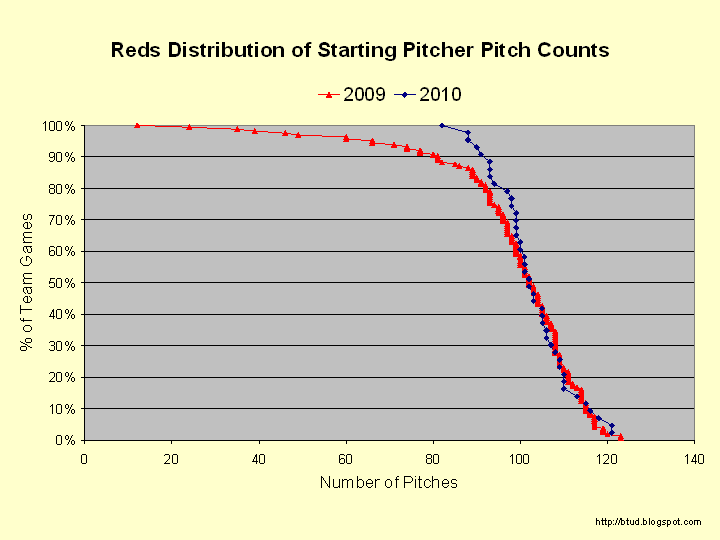
To help understand, I put together this chart (with data pulled from fangraphs).

The chart shows the percentage of team games in which the starter pitcher threw at least the number of pitches on the x-axis.  So, in 2009, Reds starters threw 80 or more pitches nearly 91% of the time. In 2010, the fewest pitcher a Reds starter had thrown in a game was 81 pitches.  (I pulled this data the day before Homer Bailey’s injury forced him out early.)  This chart makes clear that the 2010 Reds are not having as many low pitch count outings as the 2009 team.  Low pitch count outings are driven by the injury bug and by ineffectiveness.  The 2010 Reds have been generally healthy, Bailey’s injury notwithstanding.  Plus, the 2010 Reds are in contention and have been pitching relatively well of late, so it stands to reason that they’ve had relatively few ineffective outings.  It also doesn’t hurt that it is still early in the season before arms wear down.

While the factors mentioned above explain the low pitch count disparity between the 2009 and 2010 Reds, the manager makes a move in those cases out of necessity.  What is more interesting are the high pitch count games, where the manager determines the pitcher has done his day’s work.  Reds starters are being called on to throw between 103 and 113 pitches slightly less frequently than in 2009, but they are also throwing 118 pitches or more with greater regularity (albeit with a very small sample size).  So, is Dusty abusing his rotation?  It depends on where you draw the threshold for what constitutes overuse.

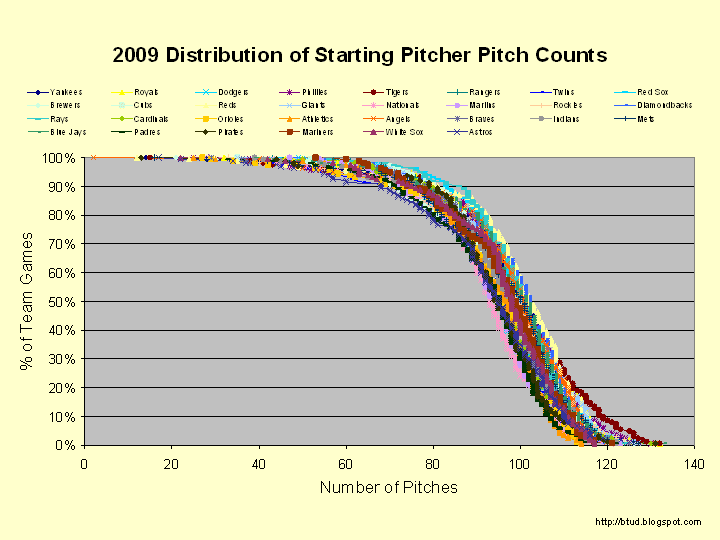
For comparison, let’s see how other teams are handling their starting rotation.  First, here are curves for each MLB team in 2009.

A few features jump out here.  First, Astros starters (blue x) managed to get to 80 pitches only 23% of the time.  That was considerably less than any other team.  Second, Nationals pitchers (pink triangles to the left) reached the magical 100 pitch mark only 24% of the time, while the Diamondbacks (royal blue to the right) reached it a league-high 59% of the time.  Finally, and most interesting of all, is that Tigers starters (maroon diamonds at the bottom right) were called on to throw more than 110 pitches with significantly greater frequency than any other team.  Maybe Rick Porcello isn’t striking anyone out because his arm is about to fall off.  🙂

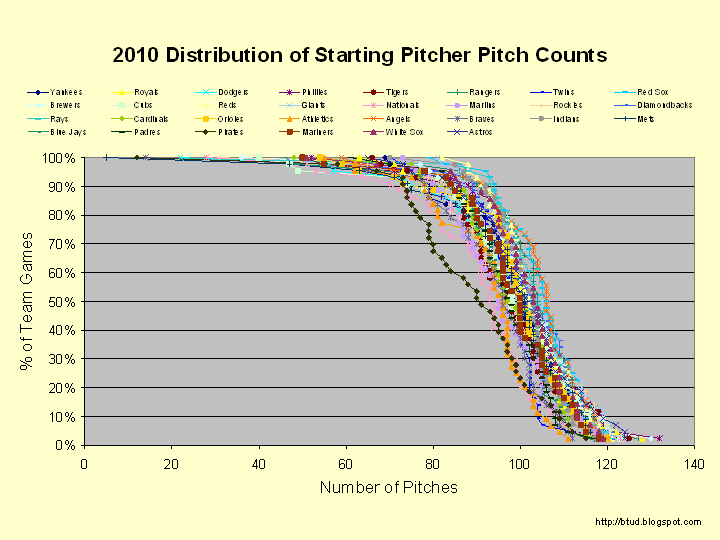
So, is 2010 any different?

Boy, is it!  Pirates starters (green diamonds) have made it to 90 pitches just 53% of the time.  I had to look it up to make sure there wasn’t an error in my script.  It is, in fact, correct.  Other than Zack Duke and Paul Maholm, no one has been able to get to remotely deep into games with any consistency at all.  Also of note is that pitchers are generally having fewer low pitch count games in 2010 than in 2009.  This can be seen because the top half of the curve is generally to the right of the top half of the 2010 curve.  I assume this difference is because of the fatigue that shows up as a season wears on.  This trend even hold true in the high pitch count games, although it isn’t as clear from this chart.  In 2009, just four teams had starters throw more than 115 pitches in 10% of their games.  They were the Tigers (17%), Giants (12%), Royals (12%), and Reds (12%).  In 2010, there are 13 teams whose starters have thrown 115 or more pitches 10% of the time.  That group is led by the Rockies (19%), and includes the Giants (17%), Angels (16%), Astros (14%), Tigers (14%), Phillies (14%), Rangers (14%), Red Sox (14%), Brewers (12%), Dodgers (12%), Reds (12%), Cubs (11%), and Diamondbacks (11%).

By this measure, Dusty Baker is still working his starting rotation pretty hard but not any more than he did last year.  Maintaining the status quo is still better than much of the rest of the league at this point in the season though, so maybe we should cut him some slack and see how the season plays out.


Adam Jones’ Regression At The Plate

I don’t think it’d be a stretch to say that Adam Jones has been a big disappointment at the plate so far in 2010. He came into Saturday’s game batting just .254/.283/.384, and instead of taking a step forward from his .277/.335/.457 line in 2009 he’s taken a step (or two) back. What might be going on?

It’s not exactly news to say that Adam’s not the most disciplined hitter, but that’s actually gotten worse this year:

Year Swing % O-Swing % Z-Swing % In Zone Swing %
2008 53.5% 36.2% 69.1% 68.0%
2009 53.7% 35.3% 73.2% 66.0%
2010 52.5% 40.1% 65.2% 61.3%

Jones is swinging about as often he has in recent years, though that’s still a much higher mark than your average batter. He is chasing pitches out of the strike-zone more than he used to, and even the mid 30s rates were high. He started out last season getting that rate down a little, but his slump coincided in part with starting to chase balls close to that 40% rate he’s continued into this season. Adam’s swing at strikes less though, which means the percent of pitches that he swings at that are better to hit – in the zone (the last column) – has gone down. For the average batter, somewhere around 70% of the pitches they swing at are in the strike-zone. For Jones this year, that’s down to just 61%. So even if he’s going to be making contact – which he isn’t exactly great at anyway – it’s not going to be on as good of a pitch to hit.

Now, one might think that Jones is chasing more balls because pitches are throwing him a bunch of sliders and curveballs out of the zone. I think we all have that mental image of Adam waving at a slider down and away. That’s not exactly the case though:

Year Fastball% Change-up% Slider% Curveball%
2008 58.5% 7.6% 18.8% 12.7%
2009 62.3% 9.9% 17.6% 10.1%
2010 63.1% 10.1% 13.5% 8.0%

In his first full season pitchers tried to get him to chase, but now they seem to be challenging him more. I don’t think that’s a good sign. How often does he swing at each pitch?

Year Fastball S% Change-up S% Slider S% Curveball S%
2008 51.0% 62.0% 57.9% 48.5%
2009 52.0% 57.4% 59.9% 50.5%
2010 51.5% 52.2% 60.7% 45.6%

Very consistent on the heaters each season. He’s taking more change-ups and – in 2010 at least – curveballs as well. That slider continues to be his nemesis, as even though he’s seeing fewer of them he is swinging more often at the ones he does see. The percent of total pitches that Adam has thrown to him that fall into the “swinging at a slider” group has fallen though, from over 10% in ‘08 and ‘09 to about 7.4% in ‘10. Even when you add in the fact that his contact rate against the pitch has gotten worse, the percent of all pitches that end up as sliders that have been swung on and missed has gone down.

Breaking out the pitch types by in the zone versus out of the zone was inexact, but it looks like a much higher percentage of the fastballs thrown to Jones are in the strike-zone while a much lower percent of sliders and (especially) change-ups.

So summarizing the best I can by pitch type:

Fastball: Seeing more of them, principally in the strike-zone; swinging at them as much as he used to, and also making contact more often when he swings.

Change-up: Seeing more of them, and more of them out of the zone; swinging at them less, but making less contact when he does swing.

Slider: Seeing a lot less of them, but more frequently out of the zone; still chasing a lot, with slightly higher whiff rate.

Curveball: Seeing less of them, with about the same frequency in the zone; chasing it less, and still whiffing a whole lot on it.

It looks to me like Adam is taking pitches early in the count a little more often – getting fastballs in the zone to fall behind (he went to an 0-1 count over 55% of the time, and was getting a first-pitch fastball much more often – almost 70% of the time – which explains more than the entire increase in fastball usage overall) – and then chasing pitches out of the zone later in the count. He’s maybe trying to work the count, but doesn’t have the pitch recognition or the ability to tell a ball from a strike that’s needed to carry through on it.

Jones is striking out more and walking much less this year, and given his swing rates, those marks (~3% and ~21% respectively) aren’t out of line. If that doesn’t change – especially the first number – then it’s going to be very hard for him to be even an average hitter. ZiPS still thinks it’ll get better though, projecting a line from here to the rest of the season of .273/.327/.461. I don’t want to overreact to 40 games, but it certainly is concerning (and swing rates are the first things to stabilize). Also – it should be noted – it wouldn’t matter so much if Jones was playing plus defense in center.

Article originally posted at Camden Crazies.