Using Batted-Ball Data to Measure Hitter Performance

Imagine a batter hits a long fly ball that’s destined for the right-field seats only for the outfielder on the other team to clear the wall and rob him of his home run. In traditional stat sheets, this is treated the same way as any other out and there’s no real way of distinguishing that from a dribbler down the third-base line. But intuitively we know that these are two very different things, and a batter who does more of the first is going to end up being more valuable than one who does more of the second. Thus, if we wanted to truly measure how well a player has performed, we need to separate the performance from the results. The best way of doing that is to break down a batted ball in the most granular way possible and look at the average performance for similar batted balls, and today I’ll reveal a personal tool to do this. This work was inspired by Tony Blengino’s terrific posts on batted-ball data, and I suggest reading his introductory post as background on the theory and methodology that I employ.

This tool uses information on the type, velocity, direction, and distance of a hitter’s batted balls to calculate an expected AVG, OBP, and SLG for him. It divides batted balls into buckets based on the type (GB, FB, LD, PU) and either the direction and velocity or the direction and the distance and calculates the resulting AVG and SLG for all batted balls that meet that criteria. It then goes through all of a batter’s plate appearances and uses these data to calculate both the observed and expected AVG/OBP/SLG for each PA. The table below shows the top 30 hitters by Expected wOBA (xwOBA) as of 5/26/2015.

Name AB PA Velocity AVG OBP SLG wOBA wRAA xAVG xOBP xSLG xwOBA xwRAA
Bryce Harper 151 191 89 0.331 0.471 0.722 0.505 29.1 0.298 0.445 0.650 0.467 23.3
Miguel Cabrera 164 195 93 0.341 0.446 0.610 0.453 21.7 0.304 0.415 0.665 0.457 22.3
Prince Fielder 182 199 93 0.363 0.417 0.571 0.425 17.7 0.349 0.404 0.640 0.443 20.5
Mike Trout 168 194 92 0.298 0.392 0.548 0.404 14.0 0.321 0.412 0.615 0.438 19.3
Anthony Rizzo 161 197 88 0.311 0.437 0.565 0.433 18.7 0.304 0.431 0.589 0.438 19.6
Ryan Braun 154 173 94 0.266 0.347 0.532 0.376 8.7 0.298 0.375 0.661 0.436 16.9
Paul Goldschmidt 160 190 93 0.338 0.442 0.631 0.459 22.0 0.290 0.402 0.615 0.433 18.1
Adrian Gonzalez 158 179 89 0.342 0.419 0.620 0.443 18.5 0.322 0.401 0.614 0.432 16.9
Todd Frazier 164 187 92 0.256 0.348 0.549 0.382 10.4 0.304 0.390 0.620 0.429 17.2
Yasmani Grandal 104 124 95 0.288 0.403 0.462 0.379 6.6 0.310 0.421 0.574 0.428 11.3
Brandon Crawford 151 170 93 0.298 0.376 0.510 0.383 9.5 0.316 0.393 0.608 0.426 15.2
Brandon Belt 139 156 93 0.302 0.378 0.496 0.379 8.2 0.316 0.391 0.606 0.424 13.8
Nelson Cruz 170 186 92 0.341 0.398 0.688 0.456 21.2 0.295 0.356 0.654 0.423 16.3
Alex Rodriguez 146 170 94 0.260 0.365 0.541 0.388 10.2 0.283 0.384 0.612 0.423 14.9
Joc Pederson 146 179 95 0.247 0.385 0.548 0.401 12.6 0.257 0.394 0.592 0.421 15.4
Mark Teixeira 147 177 87 0.231 0.362 0.551 0.390 10.9 0.281 0.402 0.560 0.414 14.2
Hanley Ramirez 158 170 94 0.259 0.312 0.468 0.336 3.2 0.318 0.366 0.590 0.406 12.6
Stephen Vogt 131 155 87 0.298 0.406 0.580 0.423 13.5 0.283 0.394 0.544 0.404 11.2
Cameron Maybin 109 126 92 0.248 0.349 0.404 0.332 2.0 0.304 0.398 0.537 0.403 9.0
Jose Bautista 133 165 92 0.211 0.364 0.444 0.353 5.4 0.252 0.397 0.530 0.401 11.5
Josh Reddick 153 170 90 0.314 0.382 0.536 0.395 11.1 0.302 0.372 0.561 0.399 11.6
Brian Dozier 174 196 90 0.247 0.332 0.494 0.355 6.6 0.284 0.365 0.572 0.399 13.4
Adam Jones 167 178 91 0.311 0.354 0.479 0.360 6.8 0.319 0.361 0.571 0.397 11.9
Freddie Freeman 169 188 92 0.302 0.372 0.485 0.372 8.9 0.304 0.375 0.553 0.397 12.6
Giancarlo Stanton 174 198 97 0.230 0.323 0.500 0.353 6.4 0.249 0.340 0.598 0.396 13.1
Matt Carpenter 165 184 91 0.321 0.391 0.582 0.416 15.0 0.293 0.366 0.557 0.394 11.9
Eric Hosmer 171 192 91 0.310 0.385 0.520 0.391 11.9 0.306 0.382 0.534 0.394 12.4
Lucas Duda 161 186 92 0.292 0.387 0.491 0.381 10.2 0.285 0.381 0.536 0.394 12.1
Mark Trumbo 144 152 93 0.264 0.303 0.507 0.345 3.9 0.298 0.335 0.600 0.394 9.8
Corey Dickerson 111 117 90 0.306 0.342 0.523 0.370 5.3 0.317 0.352 0.573 0.393 7.4

The tool uses the velocity and direction, rather than the distance and direction, of a batted ball to calculate the expected values with a few exceptions. If the velocity is not available for a fly ball or a line drive, it uses the distance and the direction of the batted ball to calculate the expected values. If the velocity of the batted ball is not available for a ground ball, the tool assumes it was of average velocity and only considers the direction it was hit when calculating the expected values. It does not consider distance for ground balls, as the distances are calculated using where the ball was fielded, so using distance would be describing what actually happened rather than what we expected to happen. For all line drives and fly balls hit over 375 feet it uses distance and direction rather than velocity and direction. The reason for this is that I do not have information on the hang time of batted balls, and in going through the data I found that fly balls and line drives that traveled over 375 feet but weren’t hit very hard were being severely underrated by the tool. As an example of the underlying data, the table below shows the reference data for fly balls hit to center field.

TYPE Velocity Range (MPH) Direction Range (90=CF) AVG OBP SLG
FB 105 150 85 95 0.732 0.732 2.511
FB 100 105 85 95 0.314 0.314 0.931
FB 97.5 100 85 95 0.082 0.082 0.247
FB 95 97.5 85 95 0.023 0.023 0.047
FB 92.5 95 85 95 0.000 0.000 0.000
FB 90 92.5 85 95 0.010 0.010 0.038
FB 87.5 90 85 95 0.025 0.025 0.063
FB 85 87.5 85 95 0.000 0.000 0.000
FB 80 85 85 95 0.020 0.020 0.050
FB 75 80 85 95 0.056 0.056 0.070
FB 70 75 85 95 0.220 0.220 0.231
FB 65 70 85 95 0.583 0.583 0.590
FB 60 65 85 95 0.145 0.145 0.145
FB 55 60 85 95 0.073 0.073 0.073
FB 0 55 85 95 0.073 0.073 0.073

I’m providing a link to a Google Sheets document with a leaderboard for all qualified batters, along with leaderboards broken down by each batted ball type. The document also contains a reference page that contains all the information for how batted balls performed in each bucket based on 2015 StatCast data for velocity references and 2014-2015 MLBAM data for distance references. The numbers in the reference page will continue to be updated as more data becomes available from StatCast. Feel free to look through this section and point out any inconsistencies you may see, and note that all data comes from BaseballSavant.

I’ve also provided a Methodology Example in the document so you can dig through what the behind the scenes data looks like as it’s being processed. Note that you may see some discrepancies in a player’s actual AVG seen here and his AVG seen elsewhere, as I treat sac flies as regular outs. The “Notes” tab gives a general outline of the procedure, and also contains a link to an Excel sheet that you can download to perform these calculations on your own.

https://docs.google.com/spreadsheets/d/1-XohbJlWIceDS2Rc8_7-rOxv9avU3IwMCecPkUNxlYU/edit?usp=sharing

Before I wrap up, I should also mention the limitations. It’s been noted elsewhere on FanGraphs that the StatCast data isn’t always completely accurate. Also, the tool currently doesn’t incorporate a player’s speed in any way, so guys like Dee Gordon are going to be fairly underrated in terms of their ground ball performance. I’ve been brainstorming ways to incorporate this and am open to any input you may have. Furthermore, I’ve noticed the tool can be pretty stingy with labeling balls as pop-ups and occasionally pretty generous with labeling them as line drives. I’ve noticed some fly balls with velocities over 95 MPH that only traveled 300 feet, indicating they were hit almost straight up in the air. Unfortunately, without data on the vertical angle of the ball off the bat or on the hang time of the ball in play, it will be difficult to fix this issue.

Even with these limitations, the tool works extremely well at determining how well guys have been hitting the ball and identifying who has been helped or hurt by factors beyond their control. Take the time to dig through the data and the code and point out areas for improvement, and I’ll incorporate them in future versions.


Joc Pederson’s Plate Discipline

Joc Pederson: your leading runner for rookie of the year. Pederson started off at the beginning of the year in the bottom half of the order and was mashing the ball with authority. Don Mattingly had us all scratching our heads when he refused to bat Joc Pederson first in favor of the aging Jimmy Rollins. But after tremendous production from Pederson and lack thereof from Rollins, Mattingly finally made the switch.

Batting mostly from the bottom of the order in March and April, Pederson walked at an ungodly 22.1% and batted his way to an inflated .406 BABIP en route to a .440 wOBA. His strikeout sat at an ugly 28.6% but with his walk rate also in the 20’s, it balanced out nicely.

Upon his move to the leadoff spot, Pederson has gotten very aggressive. His walk rate has plunged, and his strikeout rate has increased; sitting at a 12% and 30%, respectively. Despite these negative trends,  Joc has adjusted nicely and is still hitting the ball with authority… against righties. All of 12 of his home runs have come off of righties and he has compiled a total of 19 extra-base hits against them. Against lefties, Pederson has only collected one extra-base hit, a double off of Madison Bumgarner on 5/21, and has walked only once. Given these struggles, Joc has hit a bit of snag lately dropping his average tremendously and has neutralized his BABIP a bit. He has hit for the occasional home run but that’s about it.

Is it time to panic? Absolutely not, Joc is a rookie and has only 35 plate appearances against lefties, making it a small sample size. He’s raised his average against lefties above .200 at the end of May suggesting he is starting to adjust. However, for those who own Pederson, be aware he is young and is still going through the growing pains of being in the majors. Continue to send him out in your lineups, but be aware that the production he had in the bottom order may not continue through the year in the leadoff unless he adjusts. Given his talent, that’s certainly possible.


Effects of Stats So Far on Depth Charts RoS Projections — Pitchers

Previously, I looked at hitters and how their current in-season performance has changed their rest-of-season projections. Here, I do the same for pitchers.

I limited my analysis to starting pitchers. For starting pitchers, I compared their preseason Depth Charts projections to their rest-of-season Depth Charts projections, then found the five starters with the biggest positive and negative differences in their projected ERA. All statistics are from May 27th.

The Biggest Losers


Adam Warren (+0.29 in ERA)


50.7 IP, 3.91 ERA, 4.54 FIP, 4.42 xFIP, 1.24 WHIP—current

166 IP, 3.81 ERA, 1.28 WHIP—preseason

115 IP, 4.10 ERA, 1.33 WHIP—rest-of-season


Used exclusively as a reliever in 2014, Adam Warren had a career-high 8.7 K/9 and career-low 0.5 HR/9. As a starting pitcher this year, Warren has seen his K/9 drop to 5.7 and his HR/9 go up to 1.1. Even though he has a 3.91 ERA, his 4.54 FIP and 4.42 xFIP explain why his rest-of-season ERA projection has increased by 0.29 from his preseason projection. He’s lost a little more than two miles per hour on his fastball, from 94.2 to 91.9 but has increased the use of the fastball at the expense of his slider and has seen his contact percentage go up from 76% in 2014 to 81% this year. Warren is a good illustration of the difficult transition from reliever to starter. As a reliever, he threw harder and used his slider more and struck out more batters in short stints. As a starter, he’s throwing his slider less, using more two-seam fastballs and generating fewer strikeouts.

Phil Hughes (+0.29)


64.7 IP, 4.59 ERA, 4.60 FIP, 4.16 xFIP, 1.29 WHIP—current

205 IP, 3.66 ERA, 1.15 WHIP—preseason

144 IP, 3.95 ERA, 1.19 WHIP—rest-of-season


Phil Hughes had an unreal 1.9% walk rate last year that was coupled with the best strikeout rate he’s had as a starting pitcher (21.8%). This year, he’s still been quite stingy with the walks (2.2% BB%) but his strikeout rate has dropped to 15.1%, his lowest mark since 2011. The biggest change in his pitch types (per PITCHf/x) has been a dramatic rise in the percentage of two-seam fastballs, from 5.2% last year to 23.9% this year, with a drop in four-seam fastballs (61.8% to 50.2%) and cutters (16.7% to 12.8%). He’s also lost about one mile per hour on his fastball. Batters are making more contact on his pitches and they are doing damage with the long ball, which had long been a problem for Hughes before last season. From 2010 to 2013, Hughes allowed 1.4 HR/9 and had a HR/FB rate of 10.8%. Last season, those numbers dropped to 0.7 HR/9 and 6.2%. This year, he’s back to his old ways, giving up 1.6 HR/9 and a 12.3% HR/FB. Looking at Hughes’ last six years as a starting pitcher, it’s clear that his 2014 season was the aberration.

Matt Garza (+0.29)


57 IP, 6.00 ERA, 5.31 FIP, 4.37 xFIP, 1.58 WHIP—current

185 IP, 3.96 ERA, 1.26 WHIP—preseason

124 IP, 4.25 ERA, 1.32 WHIP—rest-of-season


Garza came into this season with a walk rate consistently in the range of 7.5% over the previous five seasons but has seen that rate jump to 10.5% so far this year. He also may be experiencing age related decline as his strikeout rate is on pace to decline for the fourth straight year right along with his fastball velocity, which has also gradually declined over that time from 93.8 miles per hour in 2011 to 92.5 this year. Like other pitchers in the “biggest losers” category, Garza has had trouble with home runs, giving up 10 so far in 57 innings with a career-high 18.2% HR/FB rate. Last year, pitching for the same team in the same ballpark, Garza allowed just 12 home runs in 163 1/3 innings (7.0% HR/FB). He’s also had trouble stranding runners for the second year in a row (67.5% LOB% this year, 66.6% last year).

R.A. Dickey (+0.28)


64 IP, 5.77 ERA, 5.70 FIP, 4.80 xFIP, 1.33 WHIP—current

209 IP, 4.08 ERA, 1.28 WHIP—preseason

140 IP, 4.36 ERA, 1.33 WHIP—rest-of-season


Dickey’s preseason Depth Charts projection called for a 7.1 K/9, which was reasonable considering he’d been over seven strikeouts per nine in each of the last three seasons. Unfortunately, the knuckleballer has seen his strikeout rate plummet this year. Through 10 starts, he’s at 4.9 K/9. Dickey has also seen his walk rate go up in each of the last three seasons and he’s giving up more homers than he has since establishing himself as an above-average starting pitcher with the Mets in 2010. So, strikeouts down, walks and homers up, that’s a recipe for disaster.

Taijuan Walker (+0.28)


43 IP, 7.33 ERA, 5.48 FIP, 4.84 xFIP, 1.84 WHIP—current

158 IP, 3.98 ERA, 1.30 WHIP—preseason

116 IP, 4.26 ERA, 1.34 WHIP—rest-of-season


Taijuan Walker pitched well in 11 games and 53 innings over his first two partial seasons in the major leagues at 21 and 22 years old (2.89 ERA, 3.28 FIP, 1.21 WHIP). He then ramped up the hype machine with a sterling spring training this year that saw him give up just two runs in 27 innings with 26 strikeouts and five walks. He had a nice projection for a 23-year-old pitcher coming into this season. Unfortunately, he’s been lit up so far in 2015, posting a 7.33 ERA and 1.84 WHIP. His .356 BABIP and 63% LOB% are a big part of the problem, as are the eight home runs allowed in 43 innings (1.7 HR/9, 14.5% HR/FB). His FIP (5.48) and xFIP (4.84) are much better than his actual ERA, but still nothing to be excited about, which is why his rest-of-season projection for ERA is 0.28 higher than it was before the season started.

That 14.5% HR/FB should come down but Walker has also allowed many more fly balls than he did last season, up from 26.2% to 39.0% so he is likely to give up more home runs than he has in the past even with regression in his HR/FB rate. He’s also giving up a higher percentage of hard-hit balls, increasing from 23.8% last year to 34.3% this year. On the bright side, his fastball velocity has stayed at the same level since his rookie year. Walker still has the raw skills to be a good major-league pitcher but a combination of giving up more fly balls and seeing more fly over the fence, along with a below-average left-on-base percentage has really hurt him this season.


The Biggest Winners


Michael Pineda (-0.40)


64.3 IP, 3.36 ERA, 2.54 FIP, 2.52 xFIP, 1.14 WHIP—current

142 IP, 3.74 ERA, 1.20 WHIP—preseason

117 IP, 3.34 ERA, 1.12 WHIP—rest-of-season


Last year, Phil Hughes had the second-lowest walk rate of any pitcher who qualified for the ERA title since 2001. He walked just 1.9% of the batters he faced. Only Carlos Silva in 2005 (1.2%) has had a better rate over the last 15 years. This year, Michael Pineda is walking even fewer batters than Hughes did last year, allowing just 1.7% of the batters he’s faced to reach via the base on balls. Pineda has the added bonus of a 25% strikeout rate to go with that miniscule walk rate. Along with elite strikeout and walk rates, Pineda has added the ability to induce groundballs to his arsenal. He came into this year with a career groundball rate of 37.2%. This year, his groundball rate is up to 52.4%. He’s turned into Felix Hernandez Lite. Imagine if the two of them were on the same staff. Jesus (Montero) that would be nice for Mariner fans. Pineda’s 3.34 ERA is actually higher than you’d expect based on his peripherals, mainly due to a .339 BABIP and 68.3% left on base percentage.

Jake Odorizzi (-0.24)


66.3 IP, 2.31 ERA, 2.52 FIP, 3.61 xFIP, 0.96 WHIP—current

178 IP, 4.05 ERA, 1.31 WHIP—preseason

136 IP, 3.81 ERA, 1.27 WHIP—rest-of-season


Jake Odorizzi has seen his strikeout rate drop from last year’s 24.2% to 20.2% this year but he’s offset that with a walk rate that has dropped at an even greater rate, from 8.2% last year to 4.6% so far this year. According to PITCHf/x Pitch Types, he’s changed his pitch arsenal in a number of ways. Consider the chart below:

Odorizzi has dropped his usage of the four-seam fastball and almost completely eliminated his slider and increased the use of his two-seamer, cutter, and splitter. The result has been a lower strikeout rate but better control and an increase in ground ball percentage, from 29.9% last year to 41.2% this year. Last year, Odorizzi gave up the second-highest percentage of fly balls of any pitcher who qualified for the ERA title, at 48.7%, behind only Chris Young (58.7%). This year, he’s 34th out of 109 pitchers who qualify. Fewer fly balls generally mean fewer home runs allowed and Odorizzi has seen a big drop there also. Last year, he gave up 20 homers in 168 innings. This year, he’s allowed just two long balls in 66 1/3 innings, although a very low 2.8% HR/FB rate is part of that decrease and he’s not likely to sustain a home run per fly ball rate that low for the whole season. Still, despite the lower strikeout rate, Odorizzi has been even more effective this year than previously because he’s made up for it with better control and more ground balls.

Jake Arrieta (-0.23)


58 IP, 2.95 ERA, 2.39 FIP, 2.68 xFIP, 1.09 WHIP—current

173 IP, 3.62 ERA, 1.25 WHIP—preseason

127 IP, 3.39 ERA, 1.21 WHIP—rest-of-season


Over the first four years of his career, Jake Arrieta had a 5.23 ERA (4.75 FIP) and 1.43 WHIP. He struck out 17.5% of the batters he faced, walked 10.2%, and induced ground balls on 43.3% of his balls in play. Since the beginning of 2014, Arrieta has a 2.64 ERA (2.29 FIP), and 1.02 WHIP. He’s struck out 27.1% of the batters he’s faced, walked 6.5%, and has a 49.8% ground ball rate. All of the most important things you want a pitcher to do better, he’s done better. He’s done this by changing his pitch arsenal. If you go by Baseball Info Solutions pitch types, Arrieta started throwing cutters nearly 30% of the time in 2014 and has continued to do so this season after not throwing any cutters from 2010 to 2012 and throwing it 6% of the time in 2013. According to PITCHf/x pitch types, he went from throwing sliders roughly 14% of the time prior to the 2014 season to nearly 30% of the time this year and last. I don’t know enough about the difference in classification between the two sources but Arrieta made a change of some sort and it is working. It may be more cutters, it may be more sliders. Maybe it’s a slutter. Whatever it is, this change in pitch type that has resulted in much improved numbers since the beginning of last season would suggest to me that even that improved rest-of-season projection is likely going to come in on the high side for Arrieta.

Aaron Harang (-0.22)


65 1/3 IP, 1.93 ERA, 2.86 FIP, 4.30 xFIP, 1.03 WHIP—current

155 IP, 4.51 ERA, 1.40 WHIP—preseason

125 IP, 4.29 ERA, 1.37 WHIP—rest-of-season


Based on some metrics, Aaron Harang is off to a terrific start. He’s currently seventh in WAR among all pitchers with a sub 2.00 ERA. His 2.86 FIP is also quite good but that comes with a caveat—Harang’s 2.3% HR/FB rate, which would be much better than anything he’s ever done before. In his career of over 2215 innings, Harang has allowed 9.9% of his fly balls to leave the yard, so it’s hard to believe he has somehow magically developed the ability to limit home runs on fly balls. He has improved his walk rate but is also striking out fewer batters and has a .258 BABIP, which is much lower than his career .304 BABIP. All signs point to regression from his current numbers, but his rest-of-season projection doesn’t think he’ll be as bad as his preseason projection thought he’d be. That’s still not good, of course.

Chris Archer (-0.21)


59.3 IP, 2.12 ERA, 2.46 FIP, 2.59 xFIP, 0.99 WHIP—current

183 IP, 3.69 ERA, 1.29 WHIP—preseason

138 IP, 3.48 ERA, 1.26 WHIP—rest-of-season


Chris Archer was good in 2013 and 2014 but has turned it up a notch this year. Over the first two years of his career, Archer had a 21.2% strikeout rate, 7.9% walk rate, and 46.3% ground ball rate. This year, he’s increased his strikeout rate to 30.7%, dropped his walk rate to 7.5%%, and increased his ground ball rate to 52.5%. Archer has increased his slider usage by about 10% over last year (based on BIS and PITCHf/x) and is generating more swinging strikes than he ever has, up to 12.1% this year compared to 9.3% last year.


Concerns About Polanco

Gregory Polanco has been one of the most talked-about Pirates prospects in recent years. Baseball America rated him #51 and #10 respectively in 2013 and 2014 rankings. Moreover, prior to the 2015 season, Jayson Stark wrote an article for ESPN entertaining the idea that the Pirates may have the best outfield in baseball with Gregory Polanco, Andrew McCutchen and Starling Marte.

When Polanco came up in June of 2014, the budding 22-year-old looked like the future McCutchen. With a home run in his first at-bat and a strong slash line in his first month (.288/.374/.375), Polanco looked like the real deal. After a few weeks of success, his game leveled out. Most writers attributed his downfall in the latter half of the 2014 season to the fact that he had played 127 games in 2013, then went to Winter Ball, and followed that up with 158 games in 2014. And there may be some truth to that.

Fully rested, Polanco came into the 2015 season with high expectations. To this point, his fielding has been stellar: he is tied for 1st amongst all right fielders with Giancarlo Stanton in UZR at 3.6 and is in sole possession of 1st in DEF at 2.0.

He is definitely holding up on his defensive abilities, but to this point, his offense has been underwhelming. His OPS has dropped from .650 in 2014 to an abysmal .626 in 2015. Thus far, he has only hit one home run on the season and driven in just 12 runs. The gleam of light in his offensive game has been his work on the base paths. Stealing 40 bags in A-ball in 2012 and then a combined 38 from A+, AA, and AAA in 2013, Polanco was projected to be a speedster, but his decline from there seemed alarming. He stole only 14 bases in 19 attempts in 2014 for the Pirates, but is already close to eclipsing that mark. Polanco is 12 for 14 in steal attempts this year, and in most cases is doing so based on good reads and strong jumps rather than on speed alone.

Most casual fans appreciate the defense and see the potential as a real threat on the base paths, and simply hope that he shows more pop as he matures at the plate. But there are also other warning signs with Polanco. He was to work on his plate discipline this year, but his walk rate has actually lowered from 9.6% to 8.9% and his strikeout rate has risen from 18.9% to an unsightly 22.6%. Especially if he will not produce power numbers, these numbers are trending in the wrong direction.

I started thinking back to other Pirates who were young and showed promise only to become mediocre players, and then I found this.

Each through 131 Career Games:

Player A: .286/ .341/ .386 – 26 doubles; 7 home runs; 41 RBIs; 44 walks; 28 stolen bases

Player B: .235/ .306/ .336 – 19 doubles; 8 home runs; 45 RBIs; 45 walks; 26 stolen bases

Player B is obviously Gregory Polanco, and player A is Jose Tabata.

In no way am I saying that Polanco will fall in the footsteps of the powerless Tabata, but the numbers are eerily similar. With Tabata, writers and fans alike hoped for the same changes: better discipline at the plate, the stolen bases to continue to rise, and the power to follow.

The big difference between Polanco and Tabata is that Polanco is an elite fielder today. Through advanced metrics, it is easier to quantify the impact of guys like Jason Heyward and Alex Gordon, and perhaps that will be the same fate of Polanco. Since 2010, Heyward is ranked 19th and Gordon is ranked 13th in cumulative WAR according to FanGraphs. Defensive impact should not be overlooked.

Polanco is still young, and he has tremendous upside. Even if the power stroke never emerges, he can still be a great player. As the 2015 Pirates season continues, Polanco needs his strikeout rate to drop, his on-base percentage to rise, and to run on a more frequent basis.


Hardball Retrospective – The “Original” 2005 Los Angeles Angels

In “Hardball Retrospective: Evaluating Scouting and Development Outcomes for the Modern-Era Franchises”, I placed every ballplayer in the modern era (from 1901-present) on their original team. Therefore, Roy Halladay is listed on the Blue Jays roster for the duration of his career while the Braves declare Joe Torre and the Brewers claim Prince Fielder. I calculated revised standings for every season based entirely on the performance of each team’s “original” players. I discuss every team’s “original” players and seasons at length along with organizational performance with respect to the Amateur Draft (or First-Year Player Draft), amateur free agent signings and other methods of player acquisition.  Season standings, WAR and Win Shares totals for the “original” teams are compared against the “actual” team results to assess each franchise’s scouting, development and general management skills.

Expanding on my research for the book, the following series of articles will reveal the finest single-season rosters for every Major League organization based on overall rankings in OWAR and OWS along with the general managers and scouting directors that constructed the teams. “Hardball Retrospective” is available in digital format on Amazon, Barnes and Noble, GooglePlay, iTunes and KoboBooks. The paperback edition is available on Amazon, Barnes and Noble and CreateSpace. Additional information and a discussion forum are offered at TuataraSoftware.com.

Don Daglow (Intellivision World Series Major League Baseball, Earl Weaver Baseball, Tony LaRussa Baseball) contributed the foreword for Hardball Retrospective. The foreword and preview of my book are accessible here.

Terminology

OWAR – Wins Above Replacement for players on “original” teams

OWS – Win Shares for players on “original” teams

OPW% – Pythagorean Won-Loss record for the “original” teams

Assessment

The 2005 Los Angeles Angels      OWAR: 48.2     OWS: 309     OPW%: .560

GM Bill Bavasi acquired 43% (17/39) of the ballplayers on the 2005 Angels roster. 32 team members were drafted by the club. Based on the revised standings the “Original” 2005 Angels battled the Athletics down to the wire as Oakland seized the pennant by a lone game. The Halos earned the Wild Card entry as a consolation prize.

Jim Edmonds (.263/29/89) anchored the third slot in the lineup and played flawless defense in center field to earn his eighth Gold Glove Award. Troy Glaus manned the hot corner and batted cleanup for the Halos, thumping 37 round-trippers and knocking in 97 baserunners. Bengie Molina supplied a career-high .295 batting average along with 15 jacks and 69 ribbies. Darin Erstad triggered the offense with 33 two-base hits from the leadoff slot.  Garret Anderson (.283/17/96) cracked 34 doubles and merited his third All-Star selection. Eduardo Perez (.255/11/28) and Mark Sweeney (.294/8/40) provided additional power potential while platooning as the designated hitters.

LINEUP POS WAR WS
Darin Erstad 1B 0.53 14.21
Damion Easley 2B 0.98 8.91
Jim Edmonds CF 6.29 25.6
Troy Glaus 3B 3.11 22.95
Garret Anderson LF 0.33 13.54
Bengie Molina C 2.4 16.09
Mark Sweeney DH/1B 1.61 10.05
Orlando Palmeiro RF/LF 0.65 5.6
Alfredo Amezaga SS/3B -0.02 0.08
BENCH POS WAR WS
Aaron Guiel CF 0.6 3.37
Eduardo Perez 1B 0.57 5.98
Casey Kotchman DH 0.48 4.35
Dallas McPherson 3B 0.42 5.15
Jamie Burke 1B -0.01 0
Jeff Mathis C -0.01 0.09
Trent Durrington 3B -0.06 0
Todd Greene C -0.11 1.88
Robb Quinlan 3B -0.14 2.26

John Lackey compiled a record of 14-5 with a 3.44 ERA and a personal-best 199 strikeouts. Jarrod Washburn fashioned a 3.20 ERA but failed to earn a decision in 13 of his 29 starts. Ervin Santana accrued 12 victories in his rookie campaign despite an ERA of 4.65.

Francisco J. Rodriguez (2.67, 45 SV) captained the Halos’ sensational bullpen. “K-Rod” whiffed 91 batsmen in 67.1 innings. Roberto M. Hernandez (8-6, 2.58) and Scot Shields (10-11, 2.75) locked down the late-inning threats. Matt Wise contributed a 3.36 ERA and a WHIP of 0.964 to round out the relief corps along with Bobby Jenks (50 K’s in 39.1 IP) and Scott Schoenewis (3-4, 3.32).

ROTATION POS WAR WS
Jarrod Washburn SP 4.34 13.76
John Lackey SP 4.3 16.12
Ervin Santana SP 0.8 6.51
Chris Bootcheck SP 0.4 1.46
Ramon Ortiz SP 0.01 4.02
BULLPEN POS WAR WS
Francisco Rodriguez RP 2.06 13.83
Roberto Hernandez RP 2.31 9.39
Scot Shields RP 1.58 13.3
Matt Wise RP 1.04 6.19
Scott Schoeneweis RP 0.77 5.47
Bobby Jenks RP 0.6 5.71
Matt Perisho RP 0.46 1.72
Brian Cooper SW 0.4 1.46
Shigetoshi Hasegawa RP 0.09 3.5
Greg Jones RP -0.14 0
Seth Etherton SP -0.21 0
Joe Saunders SP -0.21 0
Brian Anderson SP -0.33 0
Troy Percival RP -0.4 1.68
Jake Woods RP -0.47 0.77
Pedro Liriano RP -0.6 0


The “Original” 2005 Los Angeles Angels roster


NAME POS WAR WS General Manager Scouting Director
Jim Edmonds CF 6.29 25.6 Mike Port Bob Fontaine Jr.
Jarrod Washburn SP 4.34 13.76 Bill Bavasi Bob Fontaine Jr.
John Lackey SP 4.3 16.12 Bill Bavasi Bob Fontaine Jr.
Troy Glaus 3B 3.11 22.95 Bill Bavasi Bob Fontaine Jr.
Bengie Molina C 2.4 16.09 Dan O’Brien Bob Fontaine Jr.
Roberto Hernandez RP 2.31 9.39 Mike Port Larry Himes
Francisco Rodriguez RP 2.06 13.83 Bill Bavasi Bob Fontaine Jr.
Mark Sweeney 1B 1.61 10.05 Dan O’Brien Bob Fontaine Jr.
Scot Shields RP 1.58 13.3 Bill Bavasi Bob Fontaine Jr.
Matt Wise RP 1.04 6.19 Bill Bavasi Bob Fontaine Jr.
Damion Easley 2B 0.98 8.91 Mike Port Bob Fontaine Jr.
Ervin Santana SP 0.8 6.51 Bill Stoneman Donny Rowland
Scott Schoeneweis RP 0.77 5.47 Bill Bavasi Bob Fontaine Jr.
Orlando Palmeiro LF 0.65 5.6 Dan O’Brien Bob Fontaine Jr.
Aaron Guiel CF 0.6 3.37 Dan O’Brien Bob Fontaine Jr.
Bobby Jenks RP 0.6 5.71 Bill Stoneman Donny Rowland
Eduardo Perez 1B 0.57 5.98 Dan O’Brien Bob Fontaine Jr.
Darin Erstad 1B 0.53 14.21 Bill Bavasi Bob Fontaine Jr.
Casey Kotchman DH 0.48 4.35 Bill Stoneman Donny Rowland
Matt Perisho RP 0.46 1.72 Dan O’Brien Bob Fontaine Jr.
Dallas McPherson 3B 0.42 5.15 Bill Stoneman Donny Rowland
Brian Cooper SW 0.4 1.46 Bill Bavasi Bob Fontaine Jr.
Chris Bootcheck SP 0.4 1.46 Bill Stoneman Donny Rowland
Garret Anderson LF 0.33 13.54 Mike Port Bob Fontaine Jr.
Shigetoshi Hasegawa RP 0.09 3.5 Bill Bavasi Bob Fontaine Jr.
Ramon Ortiz SP 0.01 4.02 Bill Bavasi Bob Fontaine Jr.
Jamie Burke 1B -0.01 0 Dan O’Brien Bob Fontaine Jr.
Jeff Mathis C -0.01 0.09 Bill Stoneman Donny Rowland
Alfredo Amezaga 3B -0.02 0.08 Bill Bavasi Bob Fontaine Jr.
Trent Durrington 3B -0.06 0 Bill Bavasi Bob Fontaine Jr.
Todd Greene C -0.11 1.88 Dan O’Brien Bob Fontaine Jr.
Greg Jones RP -0.14 0 Bill Bavasi Bob Fontaine Jr.
Robb Quinlan 3B -0.14 2.26 Bill Bavasi Bob Fontaine Jr.
Seth Etherton SP -0.21 0 Bill Bavasi Bob Fontaine Jr.
Joe Saunders SP -0.21 0 Bill Stoneman Donny Rowland
Brian Anderson SP -0.33 0 Dan O’Brien Bob Fontaine Jr.
Troy Percival RP -0.4 1.68 Mike Port Bob Fontaine Jr.
Jake Woods RP -0.47 0.77 Bill Stoneman Donny Rowland
Pedro Liriano RP -0.6 0 Bill Bavasi Bob Fontaine Jr.

Honorable Mention

The “Original” 1997 Angels               OWAR: 40.3     OWS: 313     OPW%: .547

Los Angeles outdistanced Seattle by a seven-game margin, taking the Western Division title with a record of 89-73. Tim “Kingfish” Salmon (.296/33/129) recorded a personal-best in RBI. Damion Easley joined the 20-20 club as he swiped 28 bases and belted 22 long balls while scoring 97 runs. Roberto M. Hernandez registered 10 victories and saved 31 contests with a 2.45 ERA. Darin Erstad posted a .299 BA, tagged 34 doubles and pilfered 23 bags. Jason Dickson (13-9, 4.23) made his lone All-Star appearance and finished third in the 1997 A.L. Rookie of the Year balloting.

On Deck

The “Original” 2002 Blue Jays

References and Resources

Baseball America – Executive Database

Baseball-Reference

James, Bill. The New Bill James Historical Baseball Abstract. New York, NY.: The Free Press, 2001. Print.

James, Bill, with Jim Henzler. Win Shares. Morton Grove, Ill.: STATS, 2002. Print.

Retrosheet – Transactions Database

Seamheads – Baseball Gauge

Sean Lahman Baseball Archive


Effect of Stats So Far on Depth Charts RoS Projections

Major League Baseball teams have played more than one-fourth of their schedule so for and there is new data to incorporate into projections. Some players are off to amazing starts (Bryce Harper and Nelson Cruz), while others have really struggled (Troy Tulowitzki and Steve Pearce). With that in mind, I thought I’d look at which players have seen their rest-of-season projections change the most from their preseason projections. I used the preseason Depth Charts projections and compared each player’s preseason projection for AVG/OBP/SLG and wOBA to their rest-of-season Depth Charts projection. All statistics are from May 25th.

The Biggest Losers


SS Troy Tulowitzki (-.019)


.272/.288/.415, .301 wOBA—current

.307/.386/.539, .400 wOBA—preseason

.300/.370/.515, .381 wOBA—rest-of-season


The statistic that stands out most when looking at Tulowitzki is an extremely low walk rate of just 2.6%. Tulo’s career walk rate is 9.8% and the lowest single-season walk rate he’s had was an 8.4% mark in 2007, his second year in the major leagues. He also has a strikeout rate (21.7%) that is 5.7% higher than his career mark. According to Pitch f/x Plate Discipline, Tulowitzki is swinging at more pitches outside the strike zone (on pace for a career high of 32.9% O-Swing%) and more pitches inside the strike zone (65.6%, career mark is 57.8%) and making less contact than he ever has in a season (78.2% Contact%). When it comes to balls in play, Tulowitzki has seen just 4.3% of his fly balls leave the yard, far below his career rate of 15.1% HR/FB. Despite his struggles, his rest-of-season projection of a .381 wOBA is still elite for a shortstop even if it’s dropped .019 from his pre-season projection of .400.

2B/OF/1B Steve Pearce (-.018)


.188/.262/.323, .259 wOBA—current

.266/.346/.471, .358 wOBA—preseason

.254/.333/.446, .340 wOBA—rest-of-season


Pearce is striking out slightly more than he did last year (20.6% to 19.8%) and walking a bit less (7.5% to 10.4%), but nothing as glaringly different from the norm as Troy Tulowitzki has shown so far (see above). One of the biggest problems for Pearce has been a .197 BABIP, down from .322 last year and well below his .287 career mark. His BABIP is down despite a career-best 25.3% line drive rate. His HR/FB is also close enough to last year’s rate to not be anything to worry about (14.3% this year, 17.5% last year). According to Pitch f/x Pitch Types, Pearce has seen a much lower percentage of two-seam fastballs (4.5%) than he did last year (14.1%) even though his overall percentage of fastballs is up (45.1% to 43.7%), so pitchers are attacking him a bit differently. The heat maps below show the swing percentage for Steve Pearce in 2014 on the left and his swing percentage for 2015 on the right. It looks like pitchers are getting Pearce to swing at more pitches in the upper half and inside part of the strike zone with four seam fastballs. Can he adjust?

OF Carlos Gonzalez (-.017)


.206/.285/.326, .275 wOBA—current

.281/.346/.509, .370 wOBA—preseason

.270/.338/.481, .353 wOBA—rest-of-season


Unlike his equally disappointing teammate, Troy Tulowitzki, Carlos Gonzalez is walking more and striking out less than he has in the last couple seasons. His walk rate of 10.1% is higher than his career mark of 8.0% and his strikeout rate of 20.8% is below his career mark of 22.3%. Like Steve Pearce, CarGo has a BABIP problem. From 2008 to 2013, Gonzalez never had a BABIP below .318 and his career mark over 2826 plate appearances was .350. Last year, he had a .283 BABIP. This year, it’s down to .238. His batted ball profile shows a 22.9% line drive rate, which is higher than his career rate of 20.2%. He’s hitting more ground balls and fewer fly balls than he has historically, which should help his BABIP. When looking at Gonzalez’ hard hit percentage, we find his 27.3% mark this year is his lowest since his rookie year. In his two best season’s (2010 and 2013), CarGo had his two best Hard Hit percentages, at 43.8% and 38.8%. With Gonzalez and his history of injuries, you never know if he’s truly healthy. His plate discipline numbers suggest he’s fine in that regard but that low hard hit percentage is troublesome.

OF Melky Cabrera (-.014)


.241/.287/.271, .253 wOBA—current

.292/.342/.436, .342 wOBA—preseason

.286/.335/.414, .328 wOBA—rest-of-season


Melky is suffering from a low BABIP of .252 (career mark is .308) but his batted ball profile isn’t much different from last year as far as line drives, ground balls, and fly balls are concerned. His HR/FB is way down at 2.4% (last year it was 10.7%) and his Hard% of 19.6% is well below his 2014 rate of 30.5%. He’s walking about as much as he usually walks and is striking out less often than he ever has so he’s making contact, it just hasn’t been good contact.

2B Robinson Cano (-.013)


.253/.295/.337, .279 wOBA—current

.296/.361/.455, .353 wOBA—preseason

.289/.351/.438, .340 wOBA—rest-of-season


Through more than one-fourth of the season, Robinson Cano has just one home run. Other than a terrible 2.9% HR/FB, his batted ball profile looks much like last year and his Hard% of 32.6% is better than last season’s 28.5% mark. As for plate discipline, his walk rate is down to 5.4% after averaging over 9% in the three previous seasons. He also currently has the highest strikeout rate of any season of his career, at 16.7%, with a contact percentage down by approximately 5% on pitches both inside and outside of the strike zone.


The Biggest Winners


OF Bryce Harper (+.019)


.333/.471/.727, .494 wOBA—current

.279/.363/.491, .372 wOBA—preseason

.287/.383/.528 .391 wOBA—rest-of-season


Bryce Harper’s monster start to the season has raised his wOBA projection by .019, the largest increase for any player. This looks like the year Harper has made the jump to elite level. His walk rate of 20.9% is well above his career rate of 11.6%. He’s been hitting so well, and with such power, that pitchers just don’t want to throw him anything to hit. His percentage of strikes out of all pitches thrown was 61.7% in his first three years in the major leagues. This year, pitchers are throwing strikes to Harper just 55.8% of the time. He’s also swinging less often on pitches both inside and outside the strike zone and has a career-best 40.0 Hard% when he does make contact. His HR/FB of 35.6% is almost double his career rate and he’s increased the percentage of fly balls he’s hit and the percentage of balls he’s pulled. It looks like he’s matured into the player everyone thought he’d be.

C Stephen Vogt (+.019)


.307/.410/.598, .424 wOBA—current

.255/.303/.398, .308 wOBA—preseason

.263/.322/.429, .327 wOBA—rest-of-season


Stephen Vogt has some of the same indicators as Bryce Harper. Vogt is also seeing fewer strikes (58.2% after seeing 64.1% strikes in his first three seasons) and has a career-best walk rate of 15.1% (career rate is 8.1%). His HR/FB rate of 22.2% is more than double his career rate (10.6%) and he’s pulling more balls than he ever has.

OF Nelson Cruz (+.016)


.341/.398/.688, .458 wOBA—current

.250/.309/.457, .334 wOBA—preseason

.262/.322/.492, .350 wOBA—rest-of-season


Unlike Harper and Vogt, Cruz has a walk rate that is very close to his career mark. He’s also striking out just a little more than he has during his career, so he’s not walking or striking out at a much different rate than he normally does. He does have a very high .374 BABIP (career BABIP is .302) and the best HR/FB rate of his career, at 31.5% (career mark is 17.9%). With Cruz being on the positive side of the biggest changes in projected wOBA from the preseason to now and his teammate Robinson Cano being on the negative side, the only explanation is that Cruz stole Cano’s mojo.

The interesting thing is that the Cruz and Cano combined are not far off from preseason projections when pro-rated to their current 376 combined plate appearances:

376 PA, 44 R, 14 HR, 49 RBI, .274/.336/.456—Combined preseason projection for Cano & Cruz pro-rated to their current 376 plate appearances.

376 PA, 48 R, 18 HR, 48 RBI, .296/.346/.508—Current combined hitting statistics for Cano & Cruz.

DH Alex Rodriguez (+.015)


.262/.363/.545, .388 wOBA—current

.231/.311/.386, .310 wOBA—preseason

.236/.323/.417, .325 wOBA—rest-of-season


Heading into his age 39 season and having missed all of 2014, expectations were low for Alex Rodriguez this year. And yet, here he is with a very good .263/.363/.545 batting line and 10 home runs in 41 games. His current .388 wOBA would be his highest since 2009. Of course, the projections don’t see that happening but they have bumped up his wOBA from .310 before the season started to .325 for the rest of the season. A-Rod is walking and striking out at similar rates to his 2013 season and has a similar BABIP to that year as well, but he’s increased his HR/FB percentage from 15.6% in 2013 to 23.3% so far this year. That rate would be his best since 2007.

1B Mark Teixeira (+.015)


.236/.362/.563, .387 wOBA—current

.229/.319/.422, .327 wOBA—preseason

.234/.332/.454, .342 wOBA—rest-of-season


Mark Teixeira has seen a projected increase of .015 in his wOBA from the preseason to the rest-of-season thanks to a .387 wOBA through his first 43 games. Teixeira is doing this despite a .191 BABIP, which is well below his career mark of .285. Of course, Teixeira routinely had BABIPs above .300 in the first seven years of his career but has been below .250 in each of the last five years. He is walking more than he ever has (15.6% BB%) and striking out at a career-low rate (12.1%). He also has a 25.5% HR/FB, which would be a career high.


Being Drafted and Making the Show the Same Year

At this point we’re less than a month away from the June 8th, 2015 Major League Draft. Which essentially means we’re in draft season. A lot of mock drafts are coming out, and most fans are excited to see which young talent their team will add to their minor-league system. While the draft can be an exciting event to some, it’s very different than the NBA or NFL draft. Unlike in the NBA and NFL draft where a player will have an immediate impact on the team upon being drafted, the players drafted in the Major League draft will have to spend some time in the minors before making an impact. Most fans therefore won’t be able to see the fruition of the draft for several years. This can be frustrating.

But every now and then a rare event in baseball occurs. A player sometimes reaches the Majors the same year he’s drafted. This event actually happened last year. Brandon Finnegan, you see, was drafted 17th overall, in the first round of last year’s draft by the Kansas City Royals. He eventually went on to make his Major League debut that same season on September 6th and helped the Royals reach the playoffs for the first time since 1985. Finnegan, however, is not the first player to accomplish this feat. Since the draft was first implemented in 1965, a total of 55 players who have been drafted made the majors the same season. This of course does not include international free agents.

But is this feat becoming more or less prevalent? Are certain organizations more likely to promote a player quickly? Is there a certain position that get’s promoted more frequently? And is this even a smart strategy? Will this affect a player’s long-term success? Are the players capable of actually helping the Major League squad? These are all questions I will attempt to answer.

First will look at the prevalence of this feat.

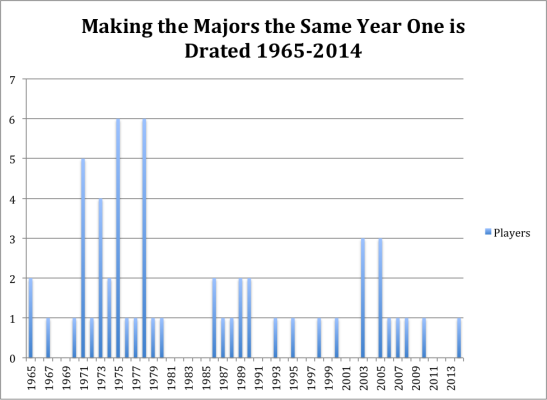
Maikng majors trend

As you can see this was actually not an uncommon occurrence in the 70s. It was actually pretty popular, in 1975 and 1978 as a total of 6 players made the majors upon being drafted. In fact this event actually happened at least once a year for ten straight seasons (1970-1980). Now, however, the trend is far less frequent. Brandon Finnegan was the first player to accomplish the feat since 2010, when Chris Sale was promoted by the White Sox to the Major Leagues.

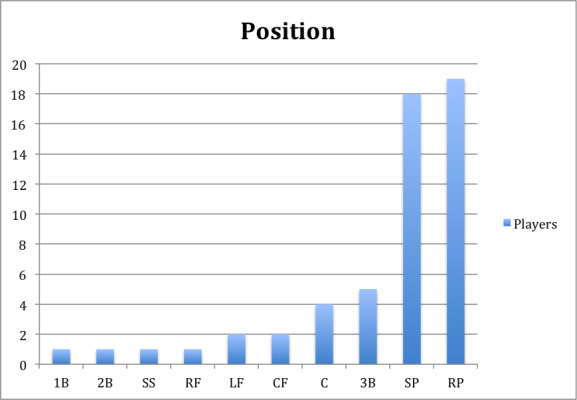
What you may have noticed at this point, is that both players are pitchers. In fact both players were promoted to the majors as relief pitchers. I think at this point most of us would assume that the vast majority of players promoted to the majors upon being drafted would be pitchers. It simply makes sense. Some pitchers coming out of college who have devastating stuff can theoretically come up and get batters out. A position player, however, probably needs more time in the minors to develop an acceptable hitting approach before he can help a team. Developing a hitting approach takes time. So below is the list of all 55 players separated by their different positions.

making majors by position


If you happened to read my latest Tommy John article you probably noticed that a relief pitcher was defined as GS/G < 0.5. I again used this barometer to define a relief pitcher. The position of the player was also defined as, the position that was most often played, the year of the promotion. So for example normally Chris Sale would be defined as a starter, but since he was primarily used as a reliever when promoted, I put him in the reliever group.

At this point you’ve probably noticed that the majority of players promoted are in fact pitchers. As for the reasons stated above this shouldn’t be very surprising.

So now let’s look at whether this is an effective strategy. Most teams are probably hoping that these players make an impact, or else why would they be promoting them, which would speed up their free agent clock, and theoretically affect their development.

Basically what I did was rather simple. I looked at the average stats of all the players when they were promoted. I also, obviously, split the pitchers and position players into two different groups. There were a total of 38 different pitchers and 17 position players.

Pitchers
Age Innings ERA+ PWARP
20.8 27.52 107.5 0.05


Position Players
Age PA wRC+ WAR
20.76 77 101.11 0.14

The results seem to look good, while ERA+ isn’t a perfect statistic by any measure it gives us a sense of the situation and here it looks like the pitchers who are promoted to the majors upon being drafted give above-average production. The hitters fare less well but again give an above-average production. For rookies who have just been called up, I’d say that’s pretty good. This is of course an average look at the players and one needs to consider that not all of them were productive. Also, this strategy for teams is only productive if they’re filling in a need. If a player for example, is performing below league average then this would be an effective strategy, if he were performing above league average then you’re probably better off keeping your everyday player in the lineup.

If we also take a look at the PA and innings, it seems that these players are being used as role players. So basically part-time fielders, or mostly relief pitchers. The position chart above, however, doesn’t support this claim, as the second-most frequent position was starting pitcher.

Another explanation therefore could be that these players are called up later in the season; for example, I would guess that most of them are called up in September. Fortunately though I don’t have to guess I have the results, so here they are.

Months Players
April 1
May 0
June 11
July 7
August 10
September 24

As one might have expected most players are called up by September. This is not surprising. What might be surprising was that a player was called up in April. This might be surprising to some especially considering that the draft begins in June. Some of you might think this is an error. It, however, is not. You see, initially baseball’s draft was divided into three separate drafts. The first and largest was in June. The second was in January, to adhere to the players who graduated in the winter semesters. The third and final round then took place in August. The August draft only lasted two years, while the January draft lasted until 1986. For those interested the one player who was called up in April was drafted in the January draft, his name was Dick Ruthven, and the Philadelphia Phillies called him up April 17th 1973.

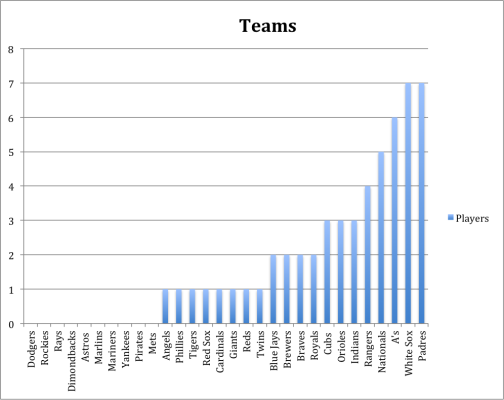
What might be even more interesting is that not only was Dick Ruthven the only player who was called up in April; he was the only players who was ever called up by the Phillies (The same year he was drafted). The Phillies though are not the only team who are squeamish about this strategy. In fact, there are 10 teams who have never called up a player the same year he was drafted. Below are the results.


making majors teams


As you can see the Padres and White Sox seem to be the ones who feel most comfortable promoting a player so early in his development process. That being said, while I have described this as a “strategy” earlier on, this is probably just statistical noise. It’s not like there’s a team or a few teams that are doing this a lot more than other teams. If I had to venture a hypothesis, I would guess that teams probably make the decision to promote someone so quickly, based on need and how advanced the player already is in his development. Personally, however, I would be hesitant to do so in fear that it might affect the player in the long run. For example, he might come up to the majors earlier than he should and therefore will not be able to develop into the player he could have been in the minors.

So now I’ll look to answer my final question and that’s how being promoted the first year a player is drafted affect his career production?

For this I looked at the average of all the player’s career stats. Again splitting the position players and pitchers. I wanted to see if these players ended up having successful careers.

Pitchers (Career)
MLB Games Innings ERA+ WARP
223.52 872.53 94.73 5.93


Position Players (Career)
MLB Games PA wRC+ WAR
961.58 3575.17 89.58 15.43


This time it looks like the position players were more successful than the starters, which was surprising to me. Maybe, it has something do to with the sample size, but I would have either way expected the pitchers to be better.

These career statistics also don’t leap off the screen. These are not superstars, for the most part, but seem to be serviceable Major League players. To me that’s a definite success. It’s a successful draft pick and it shows that the promotion doesn’t overly affect the players. (Of course I’m speaking generally here, I have no way of knowing if it affected a particular player.) This might be a controversial or surprising statement to some but the fact remains that most players who get drafted simply don’t make it to the Major Leagues, let alone have any semblance of a career. The fact that the position players, on average participate in 961.58 games shows that on average they’ve had a respectable career. The same thing goes for the pitchers. While being in 223.52 games might not seem like a lot, that’s more than an entire season’s worth of baseball, which most minor leaguers would kill to have.


Statistics were found at Baseball Prospectus, FanGraphs, and Baseball Reference.


The database for players making it to the majors the same year they were drafted was found at The Baseball Cube, which is a great website where a lot of good research can be done.


Baseball, Regression to the Mean, and Avoiding Potential Clinical Trial Biases

It’s baseball season. Which means it’s fantasy baseball season. Which means I have to keep reminding myself that, even though it’s already been a month and a half, that’s still a pretty short time in the long rhythm of the season and every performance has to be viewed with skepticism. Ryan Zimmerman sporting a 0.293 On Base Percentage (OBP)? He’s not likely to end up there. On the other hand, Jake Odorizzi with an Earned Run Average (ERA) less than 2.10? He’s good, but not that good. I try to avoid making trades in the first few months (although with several players on my team on the Disabled List, I may have to break my own rule) because I know that in small samples, big fluctuations in statistical performance in the end  are not really telling us much about actual player talent.

One of the big lessons I’ve learned from following baseball and the revolution in sports analytics is that one of the most powerful forces in player performance is regression to the mean. This is the tendency for most outliers, over the course of repeated measurements, to move toward the mean of both individual and population-wide performance levels. There’s nothing magical, just simple statistical truth.

And as I lift my head up from ESPN sports and look around, I’ve started to wonder if regression to the mean might be affecting another interest of mine, and not for the better. I wonder if a lack of understanding of regression to the mean might be a problem in our search for ways to reach better health.
Read the rest of this entry »


What in the World is Going on with James Shields?

Here at FanGraphs, it is gospel to say that a pitcher’s ERA is related to both skill and luck. The skill comes from being able to get batters to swing and miss or to induce weak contact, while limiting walks and home runs. The luck comes from how well the other players defend, and also the sequencing of events. That last element of luck, sequencing, merits a brief conversation.

There is little difference, from a pitcher’s skill point of view, between consecutive hits and hits in separate innings. That is to say, a pitcher’s skill is related to how many hard hit balls he gives up; a pitcher’s luck is related to when those hard hit balls occur. So, ERA is affected by the timing of hits, which we can measure easily using LOB%, which is the percentage of base runners that do not score at the end of an inning. It’s not this simple, but basically, a low LOB% rate means the pitcher has been unlucky, and a high LOB% rate means he has been lucky.

The average LOB% in 2015 so far is 72.4%. James Shields‘ LOB% is 87.8%. This is significant! Seven out of eight runners that reach base on him get stranded! His ERA should be anemic, right? Wrong. His ERA is a respectable 3.74, but this is unexpectedly high given what I have told you so far. Clearly, I haven’t told you everything.

There was concern during the offseason that James Shields’s fly ball tendencies would be problematic in the spacious Petco Park with a highly questionable outfield defensively. I guess his home ballpark isn’t spacious enough, because Shields is allowing a career high 2.28 home runs per nine innings, and 25.5% of the fly balls he surrenders leave the ballpark.

Meanwhile, Shields is also striking batters out at a significantly higher rate than his historical numbers indicate he should be. In fact, Shields is striking out batters at a greater rate than any other qualified starting pitcher (and most unqualified ones too!). Opposing hitters are also swinging and missing against Shields more frequently than any other pitcher, even more than highly sophisticated robot and Rust Cohle impersonator Corey Kluber!

When contact is made against Shields, though, it’s been hard contact. According to our new quality of contact statistics, only three starting pitchers have given up a higher percentage of hard contact than Shields. Batters rarely make contact, but paradoxically, when they do make contact, they’re hitting ropes.

This is confusing, and I don’t know why it’s happening, though I can speculate. Shields picked up a knuckle curve a few years ago, and he’s throwing it this year almost a quarter of the time. He’s a good pitcher, and it’s probably a good pitch, which explains the swinging and missing. However, it’s also a new pitch, and he’s probably also making a fair amount of mistakes, which hitters are taking advantage of.

That all made sense to me until a quick PitchF/X search told me that only one of the dingers off Shields were on curveballs. Back to Square 1; I have no idea why this is happening, and it will probably take someone smarter than me to figure it out, or it’s just a sample size issue.

In conclusion, let’s look back at the definition of LOB%. It measures the amount of batters that are left on base when an inning is over. Shields’s high K% probably helps inflate that LOB%. But, it’s also small sample size, and I’m not talking about early season small sample size (although that is probably also a factor). When a high percentage of hits given up are home runs, there are no runners to leave on base in the first place! James Shields is striking out and walking batters, and giving up home runs, all at a career high rate. And it’s kind of working.


Checking in on Starting Pitchers

The MLB season is nearing the one-quarter mark. Most teams are getting close to 40 games played and many starting pitchers have between 40 and 60 innings under their belts. With that in mind, I decided to take a look at fantasy-relevant starting pitchers. Fantasy-relevant can mean different things to different people, depending on the size of the league. For these purposes, I gathered information on all starting pitchers with four or more starts, then eliminated those who are projected by the FanGraphs Depth Charts to finish with an ERA over 4.25. This is arbitrary, I know, but I wanted to get the number of pitchers down to a smaller number. I was left with 90 pitchers.


Here is the key for the tables below:

IP—Current innings pitched (as of May 18)

ERA—Current ERA

FIP—Current FIP

xFIP—Current xFIP

DC-ERA—Rest-of-Season Projected Depth Charts ERA

ERA-xFIP—Current ERA minus current xFIP

ERA-DCERA—Current ERA minus Rest-of-Season Projected Depth Charts ERA


I used xFIP because I’ve read that it is a better predictor going forward than actual ERA or FIP.

I’ve separated the table into groups because a 90-pitcher spreadsheet just seems like too much to take in at one time. The groups will be sorted based on the difference between the pitcher’s current ERA and their current xFIP. With most of these pitchers having pitched around 50 innings, a difference of one earned run allowed is a difference of 0.18 in ERA, so I’ve used 0.54 and 1.08 as cutoff points in either direction for the charts.

The first group of pitchers includes those with an ERA at least 1.08 below their xFIP. These are the guys whose results are much better than you’d expect based on their peripherals.

The column on the far right shows the difference between their current xFIP and their Depth Charts RoS projections (DC-ERA). For pitchers who have a number close to zero, you could say they are pitching about as well as they’re projected to pitch going forward.

I will revisit these charts at the end of the year to see how things play out.

All of the pitchers in the top 17 have shown much better results than would be expected based on their peripherals and their projections. The column on the far right is interesting, though, and may be where we learn something at the end of the season. For example, Zack Greinke has a terrific 1.52 ERA, much lower than his 3.64 xFIP or his 3.20 FIP. His RoS Projection calls for a 3.14 ERA. At the end of the year, I will compare Greinke’s actual ERA from May 19th to the end of the season with these numbers. Greinke can be expected to have a higher ERA moving forward. The question is whether it will be closer to the 3.64 xFIP he has or the 3.14 DC-ERA.

A similar situation is true for Garrett Richards. Among this group of pitchers, Richards has the biggest difference between his xFIP and Depth Charts RoS projection (DC-ERA), at 0.69. Richards has a 2.29 ERA, 3.10 FIP, 4.04 xFIP, and 3.35 DC-ERA. He’s due for regression no matter which metric you favor, but is he closer to a 4.00 guy or a 3.30 guy?

A.J. Burnett has the biggest difference going the other direction, with a 3.58 xFIP and 3.98 DC-ERA. His current 1.38 ERA is ridiculous. He can be a useful pitcher with a 3.50-ish ERA but much less useful if his ERA is closer to 4.00 from this point on. Similar to Burnett is Dallas Keuchel, with a 1.87 ERA, 2.85 FIP, 3.28 xFIP, and 3.67 DC-ERA, and Jake Odorizzi (2.36 ERA, 2.49 FIP, 3.54 xFIP, 3.83 DC-ERA).

In theory (it’s my theory and I admit I am no Isaac Newton), the pitchers with the biggest negative difference in the column on the far right are pitchers who are more likely to beat their projections going forward. A big difference in the other direction could mean they are less likely to hit that projection. Again, I’ll revisit this at the end of the season.

This next group of pitchers also has results that are better than expected. The guy to target in this group based on my theory from above would be JA Happ:

JA Happ—2.98 ERA, 3.35 FIP, 3.58 xFIP, 4.07 DC-ERA. Happ is expected to regress but his FIP and xFIP say he won’t regress nearly as much as his projection would have you believe. In his first seven starts, Happ has a 1.8 BB/9, which is a much better walk rate than he’s had in any previous season of his career. His lifetime BB/9 is 3.7.

On the other hand, the following guys may not be all you want them to be:

John Lackey—2.96 ERA, 3.19 FIP, 4.00 xFIP, 3.63 DC-ERA. Lackey is striking out fewer batters and walking more than he did last year but has a much better ERA. The big difference has been a .269 BABIP and 0.4 HR/9. Last year he gave up 1.1 HR/9 and had a .305 BABIP. His xFIP suggests an ERA around 4.00 while his projection is for a 3.63 ERA going forward.

Jordan Zimmermann—3.66 ERA, 3.19 FIP, 4.21 xFIP, 3.32 DC-ERA. Zimmermann’s strikeout rate has dropped from 8.2 K/9 last year to 5.8 K/9 this year. That being said, last year looks like the outlier, as it was the first time in his first four years as a starter that his K/9 was over 7.1. Still, this year’s strikeout rate would be the lowest of Zimmermann’s career. His xFIP is at 4.21, while his rest-of-season projection is a much more optimistic 3.32.

These pitchers have ERAs within -0.54 and +0.54 of their xFIPs, which is the equivalent of two or three runs, so they could be considered the big group in the middle with numbers closest to what you’d expect. Still, the column to the right reveals some pitchers to target and avoid.

Guys who could outpitch their rest-of-season projections:

Gerrit Cole—2.40 ERA, 2.43 FIP, 2.75 xFIP, 3.32 DC-ERA. Cole could be taking a great leap forward to Ace status. He’s upped his strikeout rate and lowered his walk rate and his ERA, FIP, and xFIP are all below 3.00.

Jason Hammel—3.11 ERA, 3.36 FIP, 3.37 xFIP, 3.83 DC-ERA. Hammel is enjoying life back in the National League. In his career, Hammel has a 2.9 BB/9. Last year he sported a 1.9 BB/9 in his time with the Cubs but that went up to 2.8 BB/9 with the Athletics. He’s back with the Cubs and has walked just 1.2 per nine so far this year.

Chris Archer—2.47 ERA, 2.58 FIP, 2.73 xFIP, 3.47 DC-ERA. Through nine starts, Archer has jacked up his strikeout rate from last year’s 8.0 K/9 to 10.2 K/9. He’s also dropped his walk rate (3.3 BB/9 to 2.6 BB/9). He could be taking the leap along with Gerrit Cole to becoming a top tier-starting pitcher.

Jake Arrieta—2.77 ERA, 2.23 FIP, 2.69 xFIP, 3.39 DC-ERA. In his first four years in the major leagues (2010-2013), Jake Arrieta had a 5.23 ERA (4.75 FIP). Last year he broke out with the Cubs and posted a 2.53 ERA (2.26 FIP, 2.73 xFIP). Projections naturally expected some regression but he has been just as good this year as last year (2.23 FIP, 2.69 xFIP) so his Depth Charts Rest-of-Season Projection of 3.39 looks like it could be much too high.

Bartolo Colon—3.86 ERA, 3.60 FIP, 3.39 xFIP, 3.96 DC-ERA. Bartolo Colon saw what Phil Hughes did last year (186 strikeouts and 16 walks in 209 2/3 innings) and decided he would show the youngster how it’s done. Colon has 42 strikeouts and just one walk in 52 1/3 innings so far this year (he walked Ryan Zimmerman in his first outing this year, back on April 6th).


Guys to be cautious about:

Doug Fister—4.31 ERA, 4.71 FIP, 4.69 xFIP, 3.75 DC-ERA. Fister just went on the DL with forearm tightness so there’s a chance we won’t learn much from him over the rest of the season.

Madison Bumgarner—3.20 ERA, 3.52 FIP, 3.58 xFIP, 2.94 DC-ERA. Bumgarner pitched almost 270 innings last year when you include his stellar postseason and has seen his K/9 drop from 9.1 to 8.2 through his first eight starts. He can still be a positive contributor with an ERA in the 3.50 range but owners likely drafted him expecting an ERA near 3.00.

Alex Wood—3.83 ERA, 3.36 FIP, 4.02 xFIP, 3.49 DC-ERA. After striking out 8.9 batters per nine over his first 249 innings in the big leagues (2013 and 2014 combined), Wood’s K/9 has dropped to 6.1 this year. He’s upped his ground ball rate to over 50% but his fantasy owners would prefer he find those lost strikeouts.

Julio Teheran—4.33 ERA, 5.55 FIP, 4.18 xFIP, 3.66 DC-ERA. If you’re expecting Teheran to have a 3.66 ERA going forward, as his Depth Charts projection would suggest, you may be quite disappointed. Tehran is walking more batters than he ever has and giving up home runs at a ridiculous rate. Even adjusting to a league average home run rate doesn’t make him look very good, as his xFIP is over 4.00.

These pitchers all have ERAs that are worse than would be expected based on their xFIPs.

Guy from this group my theory would expect to be better than his rest-of-season projection:

Michael Pineda—3.31 ERA, 2.01 FIP, 2.41 xFIP, 3.27 DC-ERA. Pineda’s rookie year was back in 2011, when he struck out 9.1 batters per nine and walked 2.9. After missing two years because of injury, he came back last year to strike out 7.0 batters per nine and dropped his walk rate to 0.8 BB/9. This year, he has combined the best of both years, upping his strikeout rate to 9.6 K/9 and dropping his walk rate to 0.5 BB/9. He’s first in all of baseball with a 2.01 FIP and third in xFIP, at 2.41. Pineda’s rest-of-season projection calls for a 3.27 ERA but it looks like he could be on track to outdo that.

Guy my theory would not expect to be better than his rest-of-season projection:

Danny Duffy—5.87 ERA, 4.58 FIP, 4.82 xFIP, 3.86 DC-ERA. Duffy was a useful starting pitcher in fantasy league’s last year when he had a 2.53 ERA and 1.11 WHIP. His walk rate of 3.2 BB/9 was the best of his career. This year, he can’t get the walks under control (4.5 BB/9) and his ERA and WHIP have skyrocketed. Duffy’s FIP and xFIP don’t portend the improvement you might expect if you’re looking hopefully at his rest-of-season projection.

This final group of pitchers includes guys who have ERAs much worse than their xFIPs. These are the guys who have destroyed you ratios in the early going. You probably aren’t real happy with any of these chumps. Based on regression to the mean, they should all be better, but you knew that. Which guys should REALLY be better and which guys should you be a bit more skeptical about?

Should be MUCH better:

Danny Salazar—4.06 ERA, 3.52 FIP, 2.36 xFIP, 3.55 DC-ERA. Since returning from his minor league exile to start the season, Salazar has struck out 12.4 batters per nine and walked just 1.4. He’s given up too many home runs (7 in 37 2/3 innings, 1.7 HR/9), which has inflated his ERA. Salazar’s rest-of-season projection calls for an ERA around 3.50, which is the same as his current FIP. His xFIP, though, has him with an ERA under 2.50.

Clay Buchholz—4.93 ERA, 2.91 FIP, 2.99 xFIP, 3.95 DC-ERA. Based on the things a pitcher has the most control over—strikeouts, walks, and home runs allowed—Clay Buchholz is having his best season (10.6 K/9, 2.6 BB/9, 0.8 HR/9). Based on actual results (2-4 record, 4.93 ERA, 1.38 WHIP), he’s been pretty bad. He should be better. The caveat with Buchholz is that his ERA last year was 5.34, which was much higher than his FIP (4.01) and xFIP (4.04), so you just don’t know if maybe this is who he is now. For the record, in his career, Buchholz has a 3.97 ERA, 4.00 FIP, and 4.03 xFIP.

Finally, the guys who should be better but maybe not as good as you hope:

Chris Tillman—6.34 ERA, 5.42 FIP, 5.09 xFIP, 4.24 DC-ERA. From 2012-2014, Chris Tillman had a 3.42 ERA and 1.19 WHIP in 499 2/3 innings, although his FIP was a much less impressive 4.22. This year, Tillman currently has a 6.34 ERA through seven starts and his FIP and xFIP are both over 5.00. He’s projected to have a 4.24 ERA from this point forward but a sky-high walk rate (4.5 BB/9) will have to come down for him to approach that number.

Stephen Strasburg—5.98 ERA, 3.47 FIP, 3.66 xFIP, 3.14 DC-ERA. It’s shocking to see Stephen Strasburg with a 5.98 ERA. He’s striking out fewer batters than last year (9.3 K/9 to 10.1 K/9) and walking more (2.7 BB/9 TO 1.8 BB/9), but his strikeout and walk numbers are still quite good. The biggest problem appears to be a .389 BABIP and 60.6 LOB%. The Depth Chart projections expect a 3.14 ERA going forward but Strasburg’s FIP (3.47) and xFIP (3.66) aren’t as optimistic.