Archive for Player Analysis

Pitch Win Values for Starting Pitchers – June 2014

Introduction

A couple months back, I introduced a new method of calculating pitch values using a FIP-based WAR methodology.  That post details the basic framework of these calculations and  can be found here.  The May update can be found here.  This post is simply the June 2014 update of the same data.  What follows is predominantly data-heavy but should still provide useful talking points for discussion.  Let’s dive in and see what we can find.  Please note that the same caveats apply as previous months.  We’re at the mercy of pitch classification.  I’m sure your favorite pitcher doesn’t throw that pitch that has been rated as incredibly below average, but we have to go off of the data that is available.  Also, Baseball Prospectus’s PitchF/x leaderboards list only nine pitches (Four-Seam Fastball, Sinker, Cutter, Splitter, Curveball, Slider, Changeup, Screwball, and Knuckleball).  Anything that may be classified outside of these categories is not included.  Also, anything classified as a “slow curve” is not included in Baseball Prospectus’s curveball data.

Constants

Before we begin, we must first update the constants used in calculation for June.  As a refresher, we need three different constants for calculation: strikes per strikeout, balls per walk, and a FIP constant to bring the values onto the right scale.  We will tackle them each individually.

First, let’s discuss the strikeout constant.  In June, there were 50,861 strikes thrown by starting pitchers.  Of these 50,861 strikes, 4,837 were turned into hits and 14,888 outs were recorded.  Of these 14,888 outs, 3,981 were converted via the strikeout, leaving us with 10,907 ball-in-play outs.  10,907 ball-in-play strikes and 4,837 hits sum to 15,744 balls-in-play.  Subtracting 15,744 balls-in-play from our original 50,861 strikes leaves us with 35,117 strikes to distribute over our 3,981 strikeouts.  That’s a ratio of 8.82 strikes per strikeout.  This is down from 8.88 strikes per strikeout in May.  Hitters were slightly easier to strikeout in June than they were in May.

The next two constants are much easier to ascertain.  In June, there were 28,442 balls thrown by starters and 1,469 walked batters.  That’s a ratio of 19.36 balls per walk, up from 18.77 balls per walk in May.  This data would suggest that hitters were slightly less likely to walk in June than previously.  The FIP subtotal for all pitches in June was 0.57.  The MLB Run Average for June was 4.16, meaning our FIP constant for May is 3.59.

Constant Value
Strikes/K 8.82
Balls/BB 19.36
cFIP 3.59

The following table details how the constants have changed month-to-month.

Month K BB cFIP
March/April 8.47 18.50 3.68
May 8.88 18.77 3.58
June 8.82 19.36 3.59

Pitch Values – June 2014

For reference, the following table details the FIP for each pitch type in the month of June.

Pitch FIP
Four-Seam 4.16
Sinker 4.14
Cutter 4.00
Splitter 4.43
Curveball 3.98
Slider 4.03
Changeup 4.64
Screwball 3.24
Knuckleball 6.30
MLB RA 4.16

As we can see, only three pitches would be classified as below average for the month of June: splitters, changeups, and knuckleballs.  Four-Seam Fastballs and Sinkers also came in right around league average.  Pitchers that were able to stand out in these categories tended to have better overall months than pitchers who excelled at the other pitches.  Now, let’s proceed to the data for the month of June.

Four-Seam Fastball

Rank Pitcher Pitch Value Rank Pitcher Pitch Value
1 Jordan Zimmermann 0.8 171 Marco Estrada -0.3
2 Brandon Cumpton 0.6 172 Masahiro Tanaka -0.3
3 Clayton Kershaw 0.6 173 Juan Nicasio -0.3
4 Matt Garza 0.5 174 Edwin Jackson -0.3
5 Nathan Eovaldi 0.5 175 Nick Martinez -0.3

Sinker

Rank Pitcher Pitch Value Rank Pitcher Pitch Value
1 Tanner Roark 0.5 160 Wei-Yin Chen -0.2
2 Chris Archer 0.5 161 Andrew Heaney -0.2
3 Charlie Morton 0.5 162 Jake Peavy -0.2
4 Alfredo Simon 0.4 163 Jered Weaver -0.2
5 Brandon McCarthy 0.4 164 Dan Haren -0.4

Cutter

Rank Pitcher Pitch Value Rank Pitcher Pitch Value
1 Jarred Cosart 0.6 73 Chris Tillman -0.1
2 Madison Bumgarner 0.4 74 Brandon McCarthy -0.1
3 Corey Kluber 0.3 75 Mike Minor -0.1
4 Adam Wainwright 0.3 76 Brad Mills -0.1
5 Josh Collmenter 0.3 77 Scott Feldman -0.2

Splitter

Rank Pitcher Pitch Value Rank Pitcher Pitch Value
1 Alex Cobb 0.3 26 Tim Hudson -0.1
2 Masahiro Tanaka 0.3 27 Charlie Morton -0.1
3 Tim Lincecum 0.2 28 Jake Peavy -0.1
4 Kyle Kendrick 0.2 29 Ubaldo Jimenez -0.2
5 Alfredo Simon 0.2 30 Miguel Gonzalez -0.3

Curveball

Rank Pitcher Pitch Value Rank Pitcher Pitch Value
1 Jered Weaver 0.2 150 Vance Worley -0.1
2 Edinson Volquez 0.2 151 Christian Bergman -0.1
3 Roenis Elias 0.2 152 Alfredo Simon -0.2
4 Collin McHugh 0.2 153 Marcus Stroman -0.2
5 A.J. Burnett 0.2 154 David Price -0.3

Slider

Rank Pitcher Pitch Value Rank Pitcher Pitch Value
1 Garrett Richards 0.4 113 Aaron Harang -0.2
2 Ervin Santana 0.4 114 Wily Peralta -0.2
3 Chris Archer 0.3 115 Wei-Yin Chen -0.2
4 Homer Bailey 0.3 116 Juan Nicasio -0.2
5 Tyson Ross 0.3 117 Vidal Nuno -0.3

Changeup

Rank Pitcher Pitch Value Rank Pitcher Pitch Value
1 Felix Hernandez 0.3 154 Ervin Santana -0.2
2 Jeff Locke 0.3 155 Mark Buehrle -0.2
3 Henderson Alvarez 0.3 156 David Buchanan -0.3
4 Jeremy Guthrie 0.2 157 Hyun-Jin Ryu -0.3
5 Jason Vargas 0.2 158 Scott Kazmir -0.3

Screwball

Rank Pitcher Pitch Value
1 Trevor Bauer 0.0

Knuckleball

Rank Pitcher Pitch Value
1 C.J. Wilson 0.0
2 R.A. Dickey -0.4

Overall

Rank Pitcher Pitch Value Rank Pitcher Pitch Value
1 Jordan Zimmermann 1.0 177 Dan Haren -0.4
2 Felix Hernandez 1.0 178 Miguel Gonzalez -0.4
3 Chris Archer 0.9 179 Joe Saunders -0.4
4 Clayton Kershaw 0.9 180 Juan Nicasio -0.5
5 Matt Garza 0.9 181 R.A. Dickey -0.6

Pitch Ratings – June 2014

Four-Seam Fastball

Rank Pitcher Pitch Rating Rank Pitcher Pitch Rating
1 Drew Smyly 60 80 Samuel Deduno 36
2 Drew Hutchison 59 81 Wade Miley 34
3 Matt Garza 59 82 Nick Martinez 34
4 Hector Santiago 59 83 Tony Cingrani 33
5 J.A. Happ 59 84 Ricky Nolasco 33

Sinker

Rank Pitcher Pitch Rating Rank Pitcher Pitch Rating
1 J.A. Happ 61 62 Andrew Heaney 38
2 Jeff Samardzija 59 63 Jered Weaver 38
3 Jake Arrieta 59 64 Tommy Milone 35
4 Jesse Hahn 58 65 Jake Peavy 32
5 Felix Hernandez 58 66 Dan Haren 24

Cutter

Rank Pitcher Pitch Rating Rank Pitcher Pitch Rating
1 David Price 59 28 Brandon Workman 46
2 Corey Kluber 59 29 Mike Bolsinger 44
3 Jarred Cosart 57 30 Scott Feldman 40
4 Mike Leake 57 31 Dan Haren 39
5 Phil Hughes 57 32 Mike Minor 34

Splitter

Rank Pitcher Pitch Rating Rank Pitcher Pitch Rating
1 Masahiro Tanaka 59 12 Dan Haren 42
2 Doug Fister 58 13 Wei-Yin Chen 40
3 Kevin Gausman 58 14 Jake Odorizzi 40
4 Alfredo Simon 58 15 Tim Hudson 36
5 Alex Cobb 57 16 Ubaldo Jimenez 25

Curveball

Rank Pitcher Pitch Rating Rank Pitcher Pitch Rating
1 Stephen Strasburg 60 63 David Phelps 42
2 Erik Bedard 59 64 Aaron Harang 38
3 Drew Pomeranz 59 65 Alfredo Simon 34
4 Collin McHugh 59 66 Marcus Stroman 28
5 Josh Tomlin 58 67 David Price 20

Slider

Rank Pitcher Pitch Rating Rank Pitcher Pitch Rating
1 Jeff Samardzija 62 50 Zack Greinke 37
2 Max Scherzer 60 51 Matt Cain 32
3 Tanner Roark 59 52 Wei-Yin Chen 30
4 Vance Worley 59 53 Aaron Harang 29
5 Jhoulys Chacin 59 54 Vidal Nuno 27

Changeup

Rank Pitcher Pitch Rating Rank Pitcher Pitch Rating
1 Gio Gonzalez 61 58 Scott Kazmir 24
2 Jeff Locke 59 59 Drew Hutchison 22
3 Jeremy Guthrie 58 60 Ervin Santana 22
4 Josh Collmenter 58 61 T.J. House 22
5 Sonny Gray 58 62 Hyun-Jin Ryu 20

Screwball

Rank Pitcher Pitch Rating
1 Trevor Bauer 54

Knuckleball

Rank Pitcher Pitch Rating
1 R.A. Dickey 41

Monthly Discussion

As we can see, Jordan Zimmermann takes the top for this month most due to the  quality of his Four-Seam Fastball.  Zimmermann was classified as throwing five different pitches in June (Four-Seam, Sinker, Curveball, Slider, and Changeup) and managed to earn at least 0.1 WAR from the Four-Seam, Curveball, and Slider.  The most valuable pitch overall in June was Zimmermann’s Four-Seam Fastball.  The least valuable was R.A. Dickey’s Knuckleball.  As far as offspeed pitches, Garrett Richards’s 0.4 WAR from his slider lead the way.  The least valuable fastball was Dan Haren’s sinker.

On our 20-80 scale pitch ratings, the highest rated qualifying pitch was Jeff Samardzija’s slider.  Somewhat surprisingly, the lowest rated was David Price’s curveball.  The highest rated fastball was J.A. Happ’s sinker, and the lowest rated fastball was Dan Haren’s sinker.

Pitch Values – 2014 Season

Four-Seam Fastball

Rank Pitcher Pitch Value Rank Pitcher Pitch Value
1 Jordan Zimmermann 1.5 228 Nick Martinez -0.3
2 Phil Hughes 1.3 229 Dan Straily -0.4
3 Ian Kennedy 1.3 230 Doug Fister -0.4
4 Michael Wacha 1.2 231 Juan Nicasio -0.4
5 Jose Quintana 1.2 232 Marco Estrada -0.6

Sinker

Rank Pitcher Pitch Value Rank Pitcher Pitch Value
1 Charlie Morton 1.4 216 Vidal Nuno -0.3
2 Felix Hernandez 1.2 217 Dan Straily -0.3
3 Chris Archer 1.1 218 Jake Peavy -0.3
4 Cliff Lee 1.0 219 Erasmo Ramirez -0.3
5 Justin Masterson 1.0 220 Wandy Rodriguez -0.3

Cutter

Rank Pitcher Pitch Value Rank Pitcher Pitch Value
1 Madison Bumgarner 1.2 102 Cliff Lee -0.2
2 Corey Kluber 1.0 103 Felipe Paulino -0.3
3 Adam Wainwright 1.0 104 Johnny Cueto -0.3
4 Jarred Cosart 0.9 105 C.J. Wilson -0.3
5 Josh Collmenter 0.7 106 Brandon McCarthy -0.3

Splitter

Rank Pitcher Pitch Value Rank Pitcher Pitch Value
1 Masahiro Tanaka 0.7 32 Charlie Morton -0.2
2 Alex Cobb 0.4 33 Franklin Morales -0.2
3 Tim Lincecum 0.4 34 Clay Buchholz -0.2
4 Hisashi Iwakuma 0.3 35 Danny Salazar -0.3
5 Hiroki Kuroda 0.3 36 Miguel Gonzalez -0.3

Curveball

Rank Pitcher Pitch Value Rank Pitcher Pitch Value
1 Sonny Gray 0.8 197 J.A. Happ -0.2
2 A.J. Burnett 0.7 198 Erasmo Ramirez -0.2
3 Jose Fernandez 0.6 199 David Price -0.2
4 Brandon McCarthy 0.6 200 Franklin Morales -0.2
5 Stephen Strasburg 0.5 201 Felipe Paulino -0.3

Slider

Rank Pitcher Pitch Value Rank Pitcher Pitch Value
1 Garrett Richards 0.8 159 Jered Weaver -0.2
2 Tyson Ross 0.6 160 Liam Hendriks -0.2
3 Jason Hammel 0.6 161 Travis Wood -0.3
4 Ervin Santana 0.6 162 Erasmo Ramirez -0.3
5 Corey Kluber 0.6 163 Danny Salazar -0.4

Changeup

Rank Pitcher Pitch Value Rank Pitcher Pitch Value
1 Felix Hernandez 0.7 211 Jordan Zimmermann -0.3
2 Henderson Alvarez 0.6 212 Tony Cingrani -0.3
3 Stephen Strasburg 0.6 213 Matt Cain -0.3
4 Francisco Liriano 0.5 214 Wandy Rodriguez -0.4
5 John Danks 0.5 215 Marco Estrada -0.6

Screwball

Rank Pitcher Pitch Value
1 Trevor Bauer 0.0
2 Alfredo Simon 0.0
3 Hector Santiago 0.0

Knuckleball

Rank Pitcher Pitch Value
1 R.A. Dickey 0.7
2 C.J. Wilson 0.0

Overall

Rank Pitcher Pitch Value Rank Pitcher Pitch Value
1 Felix Hernandez 2.8 235 Dan Straily -0.4
2 Adam Wainwright 2.5 236 Felipe Paulino -0.5
3 Chris Archer 2.1 237 Juan Nicasio -0.5
4 Corey Kluber 2.1 238 Wandy Rodriguez -0.8
5 Garrett Richards 2.1 239 Marco Estrada -1.0

Year-to-Date Discussion

If we look at the year-to-date numbers, MLB FIP and WAR leader Felix Hernandez still sits in the top spot.  Current NL FIP leader Adam Wainwright ranks second.  The least valuable starter has been Marco Estrada.  On a per-pitch basis, the most valuable pitch has been Jordan Zimmermann’s four-seam fastball.  The most valuable offspeed pitch has been Garrett Richards’s slider.  The least valuable pitch has been Marco Estrada’s four-seam fastball.  The least value offspeed pitch has been Marco Estrada’s changeup.  Needless to say, it’s been a rough year for Marco.  Qualitatively, I feel fairly encouraged by the year-to-date results so far.  The leaderboard is topped by two no-doubt aces, both of whom currently their respective leagues in FIP, and Marco Estrada comes in at the bottom after posting the highest FIP among qualified starters so far.  For reference, the top five in the year-to-date overall rankings are currently 1st, 6th, 23rd, 3rd, and 7th on the FanGraphs WAR leaderboards respectively.


Baseball’s Most Under-Popular Hitters

Lists of baseball’s most underrated players are often interesting and thought-provoking exercises, because by definition they focus on players that tend to get less attention than they should. However, there isn’t an easy way to definitively say how players are “rated” by baseball followers. Writers often just list off players who have the attributes that they are looking for (grit, plate discipline, small market players, etc.), which isn’t a bad way of doing it.

However, there is a more scientific way of approaching a list like this. We could look at how many people are doing Google searches for specific players. It wouldn’t exactly tell us what players are most underrated, but it can tell us which players should be getting more attention; these two things are very tightly correlated. The key difference is that plenty of players get attention for things that don’t necessarily mean they are considered good players. Ryan Braun got a lot of attention during his steroid drama, Robinson Cano was heavily talked about during free agency, and people search for Carlos Santana because of this and this. But when good players draw very little interest from fans, they’re probably underrated. But the term I’ll use is under-popular.

Using Google’s Adwords Keyword Tool, I gathered the data on every player who has achieved a WAR of at least 3.0 since the beginning of the 2013 season. A regression model with those 132 players showed that an additional 1 WAR was worth 6,000 Google searches per month – not too shabby.

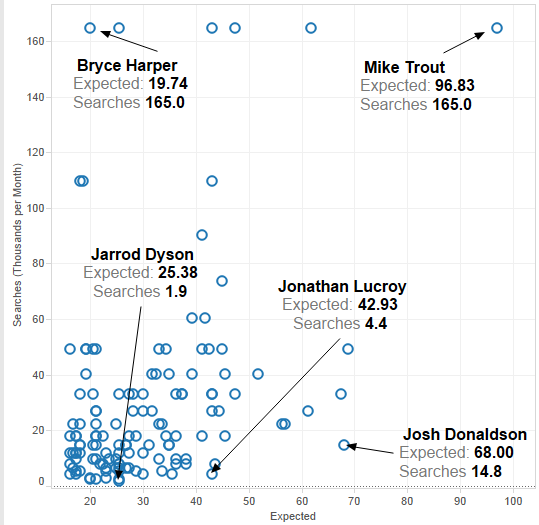
Here is a plot of these players, with the expected amount of Google searches on the horizontal axis, and the actual amount of searches on the vertical. While the keyword tool was incredibly useful, it rounds numbers when they get too high, and you can see a handful of players were rounded off to exactly 165,000 searches per month (FYI, these players were Mike Trout, Miguel Cabrera, David Ortiz, Robinson Cano, Bryce Harper, and Yasiel Puig). Derek Jeter has roughly double that amount, but his WAR did not qualify him for this list.

Searches vs. Expected

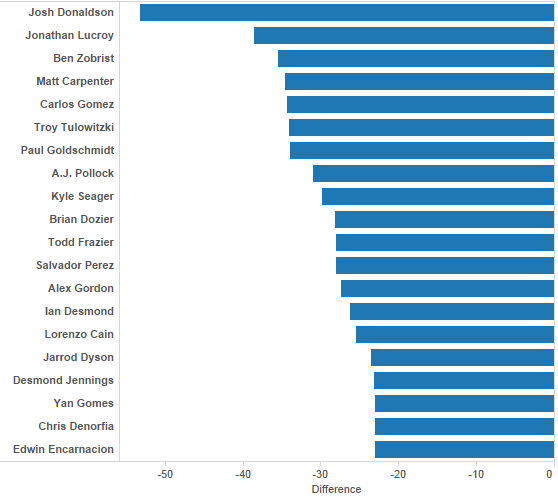
There are a lot of players who have played very well the last two years who are by no means household names. Welington Castillo has put up 3.8 WAR since the start of 2013, A.J. Pollock has been worth 6.1 wins, and Brian Dozier 5.8. In order to really measure who the most under-popular players are, I’ll use two methods. The first is just to simply subtract how many Google searches were expected and how many there really were.

difference

According to this measurement, Josh Donaldson is the most under-popular player in baseball, because he should have been looked up 53,000 times per month more often than he was (68k vs. 15k). That’s a big difference. There are some excellent players on this list, with many players who have an argument as the best or one of the few best players at their position. But for the most part, these are well known players who should just be more well known.

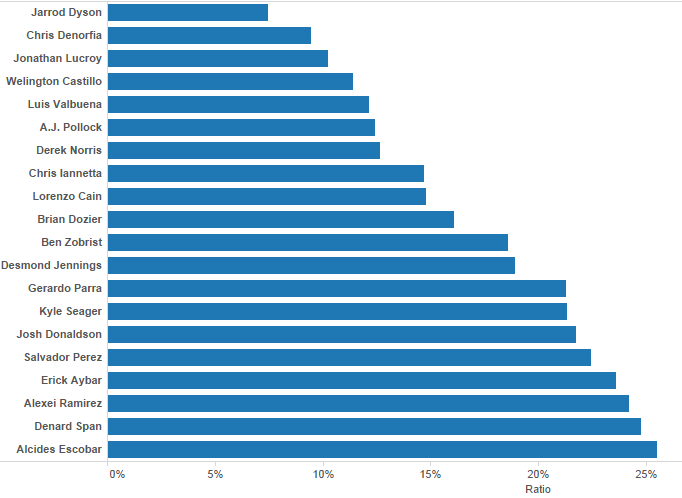
A different way to measure under-popularity, and the way I think is more telling, is to find the ratio between expected and actual searches, as opposed to just subtracting. For instance, is Edwin Encarnacion more under-popular than, say, Luis Valbuena? Encarnacion should have gotten 41,000 searches per month, but actually only got 18,000. Valbuena, however, played like someone who should have been searched 20,000 times, but was only Googled 2,400 per month. Since I believe Valbuena’s numbers are more out of whack, I prefer the second method.

Here are the top 20 players using that measurement, where we see how many times a player was searched as a percentage of how many times you would expect them to be:

Jarrod Dyson has quietly become a well above average baseball player. In about 800 career PA, Dyson has a WAR of 6.8. That is All-Star level production. His elite fielding and baserunning skills (which have combined to be worth more than 3 wins these last two years) make his wRC+ of 91 more than acceptable.

A.J. Pollock appears high on both lists, and for great reason. This year he is quietly hitting .316/.366/.554, after putting up 3.6 WAR last year.

This method of establishing players who deserve more credit for their play certainly has some flaws. WAR is not the only way to measure how good a player is, and Google searches are not a perfect representation of how popular or famous players are. However, it takes away the guess work and opinions from the standard underrated player lists, and in that there is some value.


A Discrete Pitchers Study – Perfect Games & No-Hitters

I. Introduction

In the statistics driven sport of baseball, the fans who once enjoyed recording each game in their scorecard have become less accepting of what they observe and now seek to validate each observation with statistics.  If the current statistics cannot support these observations, then they will seek new and authenticated statistics.

The following sections contain formulas for statistics I have not encountered, yet piqued my curiosity, regarding the 2010 Giants’ World Series starting rotation.  Built around Tim Lincecum, Matt Cain, Jonathan Sanchez, and Madison Bumgarner, the 2010 Giants’ strength was indeed starting pitching.  Each player was picked from the Giants farm system, three of them would throw a no-hitter (or perfecto) as a Giant, and of course they were the 2010 World Series champions.  Throw in a pair of Cy Young awards (Lincecum), another championship two years later (Cain, Bumgarner, Lincecum), eight all-star appearances between them (Cain, Bumgarner, Lincecum), and this rotation is highly decorated.  But were they an elite rotation?

II. Perfectos & No-No’s

It certainly seems rare to have a trio of no-hit pitchers on the same team, let alone home-grown and on the same championship team.  No-hitters and perfect games factor in the tangible (a pitcher’s ability to get a batter out and the range of the defense behind him) and the intangible (the fortitude to not buckle with each accumulated out).  Tim Lincecum, Matt Cain, and Jonathan Sanchez each accomplished this feat before reaching 217th career starts, but how many starts would we have expected from each pitcher to throw a no-hitter or perfect game?  What is the probability of a no-hitter or perfect game for each pitcher?  We definitely need to savor these rare feats.  Based on the history of starting pitchers with career multiple no-hitters, it is unlikely that any of them will throw a no-hitter or perfect game again.  Nevermind, it happened again for Lincecum a few days ago.

First we deduce the probability of a perfect game from the probability of 27 consecutive outs:

Formula 2.1

Table 2.1: Perfect Game Probabilities by Pitcher

Tim Lincecum

Matt Cain

Jonathan Sanchez

Madison Bumgarner

On-Base Percentage

.307

.294

.346

.291

P(Perfect Game)

1 / 19622

1 / 12152

1 / 94488

1 / 10874

Starts until Perfect Game

N/A

216

N/A

N/A

The probability of a perfect game is calculated for each pitcher (above) using their exact career on-base percentage (OBP rounded to three digits) through the 2013 season.  Based on these calculations, we would expect 1 in 12,152 of Matt Cains starts to be perfect.  Although it didn’t take 12,152 starts to reach this plateau, he achieved his perfecto by his 216th start.  For Tim Lincecum, we would expect 1 in 19,622 starts to be perfect; but starting even 800 starts in a career is very farfetched.   Durable pitchers like Roger Clemens and Greg Maddux only started as many as 707 and 740 games respectively in their careers and neither threw a perfect game nor a no-hitter.  No matter how elite or if Hall of Fame bound, throwing a perfect game for any starting pitcher is very unlikely and never guaranteed.  However, that infinitesimal chance does exist.  The probability that Jonathan Sanchez would throw a perfect game is a barely existent chance of 1 in 94,488, but he was one error away from a throwing a perfect game during his no-hitter.

The structure of a no-hitter is very similar to a perfect game with the requirement of 27 outs, but we include the possibility of bb walks and hbp hit-by-pitches (where bb+hbp≥1) randomly interspersed between these outs (with the 27th out the last occurrence of the game).  We exclude the chance of an error because it is not directly attributed to any ability of the pitcher.  In total, a starting pitcher will face 27+bb+hbp batters in a no-hitter.  Using these guidelines, the probability of a no-hitter can be constructed into a calculable formula based on a starting pitcher’s on-base percentage, the probability of a walk, and the probability of a hit-by-pitch.  Later we will see that this probability can be reduced into a simpler and more intuitive formula.

Let h, bb, hbp be random variables for hits, walks, and hit-by-pitches and let P(H), P(BB), P(HBP) be their respective probabilities for a specific starting pitcher, such that OBP = P(H) + P(BB) + P(HBP).  The probability of a no-hitter or perfect game for a specific pitcher can be constructed from the following negative multinomial distribution (with proof included):

Formula 2.2

This formula easily reduces to the probability of a no-hitter by subtracting the probability of a perfect game:

Formula 2.3

The no-hitter probability may not be immediately intuitive, but we just need to make sense of the derived formula. Let’s first deconstruct what we do know… The no-hitter or perfect game probability is built from 27 consecutive “events” similar to how the perfect game probability is built from 27 consecutive outs.  These “event” and out probabilities can both broken down into a more rudimentary formulas. The out probability has the following basic derivation:

Formula 2.4

The “event” probability shares a comparable derivation that utilizes the derived out probability and the assumption that sacrifice flies are usually negligible per starting pitcher per season:

Formula 2.5

From this breakdown it becomes clear that the no-hitter (or perfect game) probability is logically constructed from 27 consecutive at bats that do not result in a hit, whose frequency we can calculate by using the batting average (BA). Recall that a walk, hit-by-pitch, or sacrifice fly does not count as an at bat, so we only need to account for hits in the no-hitter or perfect game probability. Hence, the batting average in conjunction with the on-base percentage, which does include walks and hit-by-pitches, will provide an accurate approximation of our original no-hitter probability:

Formula 2.6

Comparing the approximate no-hitter probabilities to their respective exact no-hitter probabilities in Table 2.2, we see that these approximations are indeed in the same ball park as their exact counterparts.

Table 2.2: No-Hitter Probabilities by Pitcher

Tim Lincecum

Matt Cain

Jonathan Sanchez

Madison Bumgarner

P(No-Hitter)

1 / 1231

1 / 1055

1 / 1681

1 / 1772

P(≈No-Hitter)

1 / 1295

1 / 1127

1 / 1805

1 / 1883

P(No-Hitter) / P(Perfect Game)

15.9

11.5

56.2

6.1

Starts until No-Hitter

207, 236

N/A

54

N/A

The probability of a no-hitter is calculated for each pitcher (above) using their exact career on-base percentage, walk probability, and hit-by-pitch probability through the 2013 season.  Notice that the likelihood of throwing a no-no is significantly greater than that of a perfecto for each pitcher.  For example, Lincecum and Cain’s chances of making no-no history are far easier than being perfect by the respective factors of 15.9 and 11.5.  Although Lincecum and Cain are still both unlikely to accumulate the 1,231 and 1,055 starts necessary to ascertain these no-hitter probabilities.  If it’s any consolation, Lincecum already achieved his no-hitter by his 207th start (and another by his 236th start) and Cain already has a perfecto instead.

Furthermore, it’s possible for two pitchers with disparate perfect game probabilities to have very similar no-hitter probabilities, as we see with Sanchez and Bumgarner.  Sanchez has a no-hitter probability of 1 in 1,681 that is 56.2 times greater than his perfect game probability, while Bumgarner’s 1 in 1,772 probability is a mere 6.1 times greater.  This discrepancy can be attributed to Sanchez’ improved ability to not induce hits versus his tendency to walk batters, while Bumgarner’s improvement is of a lesser degree.  Regardless, Sanchez’ early no-hitter, achieved by his 54th start, can instill hope in Bumgarner to also beat the odds and join his 2010 rotation mates in the perfect game or no-hitter’s club.  Adding Bumgarner to the brotherhood would greatly support the claim that the Giants 2010 starting rotation was extraordinary.  However, the odds still fall in my favor that I will not need to rewrite this section of this study due to another unexpected no-no or perfecto by Lincecum, Cain, Sanchez, or Bumgarner.


What’s Changed for J.D. Martinez?

Before the 2012 season, some folks drafted J.D. Martinez as a deep sleeper, coming off a decent debut with the Astros in 2011 and a solid minor league profile. He went on to slug only 11 HR in 439 PA and hit a disappointing .241/.311/.375.  What went wrong? Well, he pounded the ball into the ground at a 51.8 % clip. His line drive % dropped to 16.6 % and he hit only 31.6 % flyballs. It’s hard to hit HR’s and hit for average with that kind of batted ball profile.

He got demoted to AA after failing to impress in 2013 and got injured. This year, for the Tigers, he mashed in AAA, was called up in late April, and has already hit 7 HR’s in only 117 PA with a .312/.342/.596 batting line. So what has changed? Read the rest of this entry »


The Resurgence of Starlin Castro and Anthony Rizzo

The struggles of Starlin Castro and Anthony Rizzo during the 2013 season were well documented. Chicago Cubs fans’ hopes and dreams rested on these two young players to be the cornerstones of the long and painful “rebuild” on the North Side and it appeared that maybe they were not cut out for such lofty expectations. The lineup around them offered little in the way of quality. Pitchers shifted most of their focus on these two and they struggled terribly. Starlin Castro owned a triple slash of .245/.284./.347. which led to the questioning of his focus and ability. Anthony Rizzo did not exactly turn any heads either, batting .233/.323/.419. At least Rizzo’s peripherals offered some hope that some positive regression was in store for the 2014 season. To say the least, 2013 was a down year for both young players.

When the 2014 season arrived, the script was quite different. Castro and Rizzo set out to silence the critics. With the disappointing 2013 season in the rearview mirror, both are producing at all-star levels so far this season. Castro’s mainstream statistics look spectacular, with a triple slash of .287/.331/.484 including 11 home runs and 43 RBIs (already matching his 2012 counting stats). That production at the premium position of shortstop makes it all the better. Here’s a look at Castro’s underlying statistics from 2013 and 2014:

O-Swing% BB% K% ISO wOBA wRC+ WAR
2013 32.6 4.3 18.3 .102 .280 70 -0.1
2014 29.8 5.5 17.2 .197 .356 122  1.7

Castro has improved greatly across the board. He is swinging at less pitches out of the zone which is paying dividends towards his BB% and K%. He ranks 3rd in both wOBA and wRC+ among all shortstops, behind Troy Tulowitzki and Hanley Ramirez. It is amazing to think that he is still pre-peak in the power category since he has been in the MLB for almost five full seasons. He is on pace for a career high in home runs this year collecting 11 so far. I think that it is safe to say that last year’s Castro was an illusion. He appears to be on his way to stardom just as the Cubs rebuild comes to a close.

Over at first base, Anthony Rizzo looks like the player Theo Epstein and Jed Hoyer thought he was going to be when they traded for him. This year, his production is nothing short of spectacular with a .278/.400/.506 triple slash including 15 home runs and 48 RBIs. That production is drawing comparisons to Joey Votto. The growth in his game can also be seen in his sabermetric stat line from 2013 and so far in 2014:

O-Swing% BB% K% ISO wOBA wRC+ WAR
2013 31.1 11.0 18.4 .186 .325 102 1.6
2014 26.9 15.5 19.4 .227 .393 148  2.6

Just like Castro, Anthony Rizzo drastically improved across the board (minus K%). Rizzo ranks 4th in wOBA and 5th in wRC+ among all first basemen. He has improved his defense and looks very comfortable at the plate. He too is on pace for a career high in home runs, racking up 15 already. Rizzo is showing that he can be a huge threat at the plate for years to come.

This was a crucial season for both Castro and Rizzo. The Cubs organization, having given out long term contracts to both, depended on them becoming mainstays in the lineup when they finally become threats in the NL Central. With Rizzo on pace for 4+ WAR this season and Starlin on pace for 3+ WAR, it looks like they really are the budding stars that Epstein and Hoyer believed they would be. With these two all-stars, Javier Baez, Kris Bryant, and the other top prospect talent the Cubs possess, the future looks very bright on the North Side of Chicago.


How Jose Abreu’s Career in Cuba Reflects His Future MLB Success

Before coming to the MLB and smashing 20 home runs in just his first 58 games, Jose Abreu had a prolific career in the Cuban Baseball National Series (Cuba’s top championship), starting at the very early age of 16, when he would play at first, second, third or in the outfield. While doing so, he averaged .271 with five homers and 21 RBIs in 71 games. He seemed like a very hot prospect, taking into account how old he was (or how young, for that matter), and for that very short stretch (say for the 2003-04 and the 2004-05 seasons) he seemed overpowered by pitchers, some of whom were old enough to be his father. From then on, he owned them.

For his career in Cuba, Abreu fell shy 16 homers of 200 in ten seasons. Yet, it was his youth that kept him from getting them early season-wise. Up to his 21-year-old season, his career-high in dingers was 13 (that very year) and had collected more than ten only once (11 in 2005-06), when he had what could be called his breakthrough year, hitting .337, with 105 hits and 64 RBIs in 84 games. Read the rest of this entry »


Is David Price Actually Improving?

Casual fans who look at David Price’s stat-line this year definitely come away unimpressed. On the surface, his 4-6 record with a 3.97 ERA are sub-par for a pitcher of his caliber, especially one who has been pegged as an ace for his entire major league career. Along with the underwhelming initial stat-line, his average fastball velocity is still down from its apex at about 95-97 MPH to around 92-94 MPH. All of this looks like it spells disaster for both the Rays, who want to ship him out at the deadline for future cornerstone players, and for Price, who is a free agent after the 2015 season.

This table can show you the slight but meaningful decline in Price’s velocity since his Cy Young Award winning season in 2012:

Velocity (MPH)
Fastball    Sinker    Change    Curve    Cutter
2012    96.49       96.17        84.93      79.55     89.88
2013    94.51        94.47       84.72      80.32     89.15
2014    94.38       93.96       85.63      79.88     87.26

But if you delve deep into the world of statistics, it appears that David Price is arguably improving as a pitcher.

His K/9 is sitting at a career best 10.02 along with a career best BB/9 at 0.90. If you look a little deeper at the sabermetric stat-line Price is also performing at a career best FIP and xFIP, which are 2.97 and 2.66, respectively. These two stats portray how Price’s ERA is not indicative of his actual performance. Continuing this trend, his LOB% sits at below average 67.5%. High strikeout pitchers like Price usually have more control over their LOB%, so its very likely that Price will positively regress toward his career average of about 75%. It could even be better due to his increase of strikeouts and decrease in walks. He also is sporting a career high 12.3% HR/FB that is contributing to his inflated ERA.

And if you look even deeper into the statistical world, Price is changing how he pitches—-and its actually improving his performance from its already lofty level. The only problem is the surface stats are not catching up with his actual performance…… just yet. Here is a table that shows Price’s pitch usage over the past three years:

      Pitch Usage
Fastball    Sinker     Change    Curve    Cutter
2012    12.56%    48.39%    12.15%    10.85%    16.06%
2013    15.07%    39.43%    16.61%    11.02%    17.87%
2014    15.97%    40.45%    17.02%    10.93%    15.64%

 With the velocity decrease in mind, the data is portraying that Price has had to adapt as a pitcher in order to continue having success. His fastball and changeup usage has increased because he can no longer blow it by hitters with ease. Along with this:

 Whiff Percentage
Fastball   Sinker  Change  Curve   Cutter
2012     9.24        6.15       12.37      20.25    9.74
2013     9.83        4.49      17.38      6.73       6.29
2014     9.28        9.20      19.09     12.88    12.02

In 2014, Price is rocking better whiff rates than in his amazing Cy Young Award winning 2012 season. His whiff rates have increased across the board other than his curveball. This means that David Price has adjusted his game around his diminishing velocity and has adapted from a power pitcher to a smarter, more crafty pitcher that changes speeds and does not solely rely on velocity to put away hitters. These increased whiff rates are the reason that Price is sporting a career best K/9 ratio. He is throwing a career best 72.1% of pitches for strikes on the first pitch of an at-bat, which contributes to his career best BB/9.

Overall, a simple glance at Price’s stat-line would give the impression that he is declining. But after looking deeper at his actual performance this season, the underlying facts show that he is changing the way he pitches and could quite possibly be getting better. There are rumblings that scouts no longer view Price as an ace that can lead a team deep into the playoffs. From a scouting perspective that may appear to be true, but with the knowledge of these underlying statistics, I believe that Price is still the pitcher he always has been, if not better.


Josh Donaldson vs. the Elite

Tip: Don’t understand an acronym? Just click on it and it will take you to the corresponding FanGraphs glossary of terms.

Watching the final game of the Yankees – A’s series last week, which featured one of the game’s finest pitchers in Masahiro Tanaka, I had a thought during Josh Donaldson’s final at-bat against the Japanese hurler. After he struck out to finish 0-3 against Tanaka, my mind traveled back to the ALDS game 5s of the past two years. It’s no secret the A’s crashed out against a dominant Verlander in both 2012 & 2013, just like it’s no secret that Josh Donaldson was almost entirely absent in both of those very important games: 1-7, 0 BB, 3 K (with all 3 of those Ks coming in 2013′s game 5). 7 at-bats is obviously an incredibly small sample size, especially for an up-and-coming player getting his first taste of the postseason. However, for what Donaldson means to the A’s, there were certainly quiet rumblings of disappointment among the fan base.

Verlander is very good; it seems he’s especially good in high leverage situations when his team needs him. Josh Donaldson is also very good, posting 7.7 WAR last year in 158 games. This year, Donaldson has been even better, posting 3.4 WAR through just 62 games and asserting himself in the conversation of the best overall players in baseball. A sizable portion of that WAR comes from the plus defense he plays, but his bat is what he’s known for: since getting called up from the minors on August 14th, 2012 (the point at which his consensus “breakout” started), he’s batted .291/.377/.509 with a wRC+ of 148 (which means that Donaldson has created 48% more runs than a league average player). Only one player has higher WAR in 2013 and 2014 combined (Mike Trout), and only nine other players have higher wRC+. Josh Donaldson is an elite defensive and offensive player by many metrics.

After watching Donaldson’s at-bats against Tanaka, I started wondering how he fares against other elite pitchers in the game, having an unproven hunch he might struggle against them. We know that most everyone struggles against elite pitching, as that is generally the very definition of elite pitching; however, there’s the larger question of just how much impact elite pitching has on hitting statistics, and how elite hitters fare against elite pitching. One might assume that elite hitters are better able to succeed against elite pitching. Looking at Donaldson’s statistics, you wouldn’t think that is the case.

Pulling data from the start of the 2013 season, I’ve identified some of the “elite” pitching that Donaldson has gone up against. I’ve tried to identify pitchers he has faced most often in terms of plate appearances – fortunately (for our sake at least), those pitchers he’s seen most often are also elite arms in his division, like Felix Hernandez, Yu Darvish, and Hisashi Iwakuma. All pitchers on this list are ranked in the top 15 for xFIP for 2013-2014 (minimum 160 innings pitched) with the exception of Verlander (77th) & Lester (41st). I’ve included them as their FIP rankings are in the top 40, and because I’ve already used Verlander as a benchmark above. Here are Donaldson’s statistics for 2013 & 2014 against some of the best arms in the game, with his total statistics overall in the final line for reference:

Donnie_VS._Elite

These figures don’t include the 2012 and 2013 postseason series against the Tigers, which actually helps Donaldson’s case. However, let’s get the small sample size disclaimer out of the way before we continue. 113 plate appearances is about a month’s worth of full-time hitting statistics, which is not a tremendous sample to draw from, but not insubstantial either. What’s clear from these numbers is that Donaldson really struggles against elite arms, posting awful strikeout and walk rates and severely depressed average, on base, and power numbers (just 7 extra base hits in 104 at-bats).

One larger question we have to answer is whether Donaldson’s drop in production vs. elite pitching is congruent with the standard drop of production any hitter would expect when going up against this level of competition. To find that out, I combined all of the batting-against statistics for these 12 pitchers for all of 2013 & 2014, a total of 12,534 plate appearances, which gives us a “league average” line vs. these pitchers. The findings? These elite arms are really good. Big surprise, right? In fact, the league strikeout and walk rates against these pitchers is very close to Donaldson’s rates, with the walk rate exactly the same. Here are Donaldson’s numbers vs. the elite pitchers, his overall numbers vs. all competition, and then the league average line vs. the elite arms:

Donnie_BB_K_Rate

Even though we’re looking at the best pitchers in baseball, these statistics were still a bit surprising to me, as these league-wide walk and strikeout rates are abysmal from a hitter’s perspective. How does Donaldson’s slash line compare to the league average? Again, let’s take a look:

Donnie_3_Stats

We know that Donaldson’s poor BB and K rates fit tidily within the standards of the league line, as seen in the first graph, but his slash lines tell us that he’s been far worse than the rest of the league against these elite pitchers in the limited plate appearances we’re looking at. Shouldn’t we expect a player of his offensive caliber to fare better than league average against this level of competition?

The answer is not necessarily. Donaldson’s approach at the plate has a large bearing on the fact that he struggles against elite pitching. He is not a contact hitter, posting below average marks in swinging strike percentage, contact percentage, and Z-Contact percentage. In fact, he has changed his approach over the past calendar year specifically to try to hit more home runs, resulting in an almost 5% spike in his strikeout rate from 2013 to 2014 (16.5% to 21.1%), but also increasing his home run per fly ball rate by almost 7 points to 17.3%, an elite mark for someone who plays half of their games in one of the most pitching friendly ballparks in baseball. Coupled with an increase in his walk rate, Donaldson’s run creation output has benefited from Chili Davis’ hitting instruction, sitting on pitches he is more likely to drive and swinging hard at the expense of a lower average and higher strikeout rate. Donaldson batted .301 in 2013 with an inflated BABIP (.333), but with his change of approach, he projects somewhere in the .270 range moving forward.

Donaldson is the profile of a hitter that may be more apt to struggle against the elite pitching in the league due to the simple fact that elite pitchers tend to have makeups consisting of low walks and high strikeouts. For example, against “Power” pitchers (pitchers that are in the top third of the league in strikeouts plus walks), Donaldson has a career line of .210/.316/.356, showing that he struggles with pitchers who have strikeout potential, whether elite or not. He’s not alone in being a top offensive player that struggles against power pitching in relation to his overall performance: the benevolent baseball god Mike Trout slashes a fairly pedestrian (for him) .269/.379/.473 against the high strikeout arms.

The most important point to remember when looking at these statistics is that Josh Donaldson is currently one of the best players in baseball, regardless of his past performance versus elite pitching. He is a player that has enjoyed only a year and a half of sustained high-level performance and is continuing to make adjustments in hopes of greater success, which could completely alter his future at bats versus these elite arms I’ve highlighted. However, my gut tells me he may always struggle with these pitchers due to his approach at the plate, which trades contact for power – an Oakland A’s team-wide trait. It bears further scrutiny in the future for his potential playoff success, as he will obviously face more elite pitching in October when the average arms have gone home for the offseason. Will Donaldson and the Oakland A’s home run-centric approach carry them to a deep playoff run against the best arms in the game? Fortunately for us, it looks like we’re going to find out.

Wondering about the two home runs he hit off of Bumgarner and Sale? EXTRA CREDIT BONUS FREE BASEBALL GIFS!

Off Madison Bumgarner: May 27, 2013, 2-0, no out, 1 on, 4-seam fastball:

Donnie_Bums

Off Chris Sale: June 8th, 2013, 1-1, 1 out, 3 on (oppo taco all the way), 2-seam fastball:

Donnie_Sale


Comparing the Three Cuban Stars: Abreu, Cespedes, and Puig

On February 13, 2012, the Oakland A’s shocked the baseball world by signing Cuban outfielder, Yoenis Cespedes. They never make big money signings but this time they did, signing him to a four year, $36 million deal. That season, he seemingly led the Oakland A’s to their surprising division title and was thought to be a major candidate for the MVP award for leading the A’s offensive charge. Had it not been for some player on the Los Angeles Angels, I think his name is Mike Trout, winning the Rookie of the Year, Cespedes would have been an easy pick for that award.

During that same season, another Cuban outfielder was signed by a Major League team. This time it was the Los Angeles Dodgers on June 28, 2012 signing 21 year old Yasiel Puig to a seven year, $42 million contract. Puig played in rookie ball and A ball in 2012 before making his Major League debut with the Dodgers in 2013. From that moment on, Cespedes was seemingly forgotten and the birth of “Puigmania” began. Puig, like Cespedes did for the Athletics, led the Los Angeles Dodgers offense in his 104 games with them to a division title. Puig too, lost out on Rookie of the Year but he certainly did provide a strong case for that award.

And this year, Puigmania rolls on but another Cuban slugger has come in as well. Jose Abreu of the Chicago White Sox (on a six year, $68 million contract) has burst onto the scene, making the White Sox one of the story teams this year. And while it is likely that the White Sox won’t make a run like the A’s or Dodgers did, Abreu certainly will make his strong case for Rookie of the Year.

Each of these players are great, all of them with phenomenal talent. One question that has been brought up with the recent emergence of Abreu is which Cuban player is better. Judging everyone based on the stats that they have put up and seeing how each one stacks up by the common scouting method called, “the five tools,” (the five tools being hitting for power, hitting for contact, speed, arm strength, and fielding ability). I will try to present a case for which one of them is truly the best. Now granted, both Cespedes and Puig have had more playing time than Abreu, but that will be taken into account when judging them.

Hitting for Power:

This, to me, is one of the most interesting of the five tools to compare the players because each of them has quite a lot of power. Cespedes has yet to post up a Major League season where he has not hit at least 20 homers (he looks to be on pace for that number this year again with his 12 homers in 55 games so far), Puig hit 19 home runs in only 104 games last year, and Jose Abreu has done nothing but knock the cover off the ball so far this year hitting 17 homers in a mere 47 games. But as many people who go on this website I’m sure know, there is more to power than just hitting home runs. Extra bases count. Doubles, triples, home runs, all contribute to one’s ability to hit for power.

Looking at ISO, Abreu is far and away the leader in this category. His .353 ISO leads Cespedes (.218) and Puig (.232) by a very wide margin. But since his .353 ISO is in a limited playing time of only 47 games, I have decided to measure the ISO through the first 47 games of both the careers of Cespedes and Puig. Cespedes’ ISO through his first 47 games was .341 and Puig’s was .310. While I can see Abreu’s power diminishing somewhat from this extraordinary power number, I can’t see Puig and Cespedes quite matching his power hitting ability (even though Cespedes really punished the baseball in the 2013 Home Run Derby).

Edge: Jose Abreu

Hitting for Contact:

This too is an interesting statistic to judge because there are so many numbers to indicate contact hitting ability. One could look at batting average to see who the best is but of course that could easily be countered by BABIP. For example, Puig has the highest batting average of the three, hitting .327 but his BABIP (.385) is over .100 points higher than both of the other two. The other two players have BABIP numbers that are remarkably close to their actual batting average. Cespedes’ batting average is at .262 with a .261 BABIP while Abreu’s batting average is at .266 but his BABIP is at .276. But those numbers are just how good someone is at letting the ball hit the ground and reach base with a hit, not necessarily making contact with the ball.

Each player is good at making contact with the baseball. One would think that because Puig has the highest batting average, he is the best at making contact but that is actually not true. In fact, of the three players, he makes contact the least of all of the players. He just happens to hit the ball in such a way that he gets a hit more often than the other two do. In terms of overall contact%, Cespedes makes the most contact with his 74.8% contact rate, Abreu comes after him with 70.9% contact, and Puig is third with 69.9%. When the ball is inside the strike zone, Abreu is slightly better than Cespedes with his 83.3% vs. Cespedes 82.5% (Puig is also fairly close at making contact with the ball 81.6% of the time when it is in the strike zone). When the ball is outside the strike zone, Cespedes is once again the contact king with a contact rate of 64%, Abreu is trailing far behind with only 55.5%, and Puig is again in third with 53.3%. Now granted, Puig’s numbers are improving, but so are Cespedes’ numbers and Abreu is still only in his first season with plenty of time to improve.

Edge: Yoenis Cespedes

Speed (Base running ability):

If anyone is expecting Abreu to be the best in terms of speed and overall base running ability, I’m going to tell you right now to not get your hopes up. Abreu isn’t awful in terms of base running but he is far from great. This is basically between Cespedes and Puig. With more time under his belt, Cespedes does have more stolen bases but they are both equal in caught stealing. Cespedes has stolen a total of 23 bases and been thrown out 12 times (a 66% success rate) while Puig has stolen 16 bases and been thrown out 12 times (57% success rate). Abreu has not attempted a steal yet. Then when looking at actual speed in terms of miles per hour, Cespedes has been clocked at a high of 19.4 mph while Puig has been clocked around 20 mph so Puig has a slight edge in terms of raw speed but not necessarily an overwhelming advantage. To settle the divide, a look at the sabermetrics should settle who is better.

To say the least, Yasiel Puig is reckless running on the bases. He runs very fast but he often runs into outs. So needless to say his BsR is hurting. He has a career -5.2 BsR with his low being in 2013 when he had a -4.2 number and his high being this year at -0.9. Yoenis Cespedes is much smarter on the bases. He doesn’t run himself into outs as frequently as Puig does and so his BsR career number sits at 2.9 with a low of 0.6 in 2013 and a high of 1.4 in 2012. And if that isn’t enough to show that Cespedes is better, his career Spd sits at 5.3 while Puig’s is at 4.8. For the record, Abreu’s Spd is at 2.8 and his BsR is at -0.7 so like I said, he isn’t bad but he just isn’t a very fast guy.

Edge: Yoenis Cespedes

Fielding Ability:

Defensive ability is always thought to be one of the toughest things to measure because there is no real perfect way to calculate it. Another thing making it difficult is that while outfielders Puig and Cespedes basically play the same position, Abreu does not. Since he is the only first baseman in this mix of players, we will look at his numbers first.

When stacking him up with the other first basemen, Abreu really doesn’t seem half bad. In terms of UZR, Abreu is 7th among all first basemen with at least 300 innings played with his 2.2 UZR which is slightly above average. In terms of Defensive Runs Saved, Abreu is 24th among all first basemen with at least 300 innings played with his -4 which is deemed below average. So by no means is he bad, he just isn’t great. Now in the outfield, Puig and Cespedes are different stories.

Puig and Cespedes are both very good defensive outfielders. In his career, Puig has been better defensively posting up a career UZR of 3.5 while Cespedes has put up a 2.7 number. When it comes to Defensive Runs Saved, Puig again holds an advantage with his +7 mark to Cespedes -1. All in all, while Abreu is a decent first baseman, Puig is a very good defensive outfielder (not deserving of a gold glove but none the less is the best defensive player of these three).

Edge: Yasiel Puig

Arm Strength:

Defensive ability isn’t just catching and fielding the ball, it is also having the arm to make big plays. But it is tough to tell who is best because there aren’t many numbers to point to actual arm strength. Puig has some of the more highlight reel arm throws, in terms of both good throws and bad throws, and so his arm has garnered the most attention of the three. Abreu, being a first baseman generally just has to do underhand flips to the pitcher covering the bag at first and occasionally start a double play feed so his arm is really not tested as much. So again, Abreu is eliminated from the conversation almost before it started. It is again between Puig and Cespedes.

Like I said, Puig has made some of the more highlight reel throws but him being in Los Angeles and in the center of a massive media hub might have some effect on that. Cespedes has made some very strong throws but being in Oakland where not much media attention is seen, he doesn’t get as much time on the highlight reels. Still, the arm of Cespedes is not to be denied. Again, he has played in more innings than Puig has so it would be expected that he would have more outfield assists than Puig, and he does. He has 25 assists, 13 more assists than Puig’s 12. He also has two more throwing errors with three compared to Puig’s 1. But the numbers show that in spite of those throwing errors, Cespedes rARM (Outfield Arms Runs Saved) is much higher, being a 12 as opposed to Puig’s 4. The other statistic to rate an outfielder’s arm is the ARM (Outfield Arm Runs), another stat designed to show runs saved based on throwing ability, that still has Cespedes higher with 13.8 to Puig’s 4.1. So sure Puig has made some good throws, but his arm is not better than that of Yoenis Cespedes.

Edge: Yoenis Cespedes

By judging each player by the scouting five tools, Cespedes does have an edge both in actual scouting reports and by the numbers. Cespedes has the best arm, base running ability, and contact ability while Puig is the best fielding and Abreu is the best power hitter. If only judging by the five tools, Cespedes appears to be the better player but when looking in terms of actual production, Puig has done the best over his career to this point. Posting a 7.2 WAR, Puig matches Cespedes’ exact same WAR in 160 fewer games. Puig also has the highest wOBA of them all (Puig has .415, Cespedes has .344, and Abreu has .396) and the highest wRC+ of the three (Puig with 172, Cespedes with 120, and Abreu with 151). Puig is also the youngest of the three at only age 23 while Cespedes is 28 and Abreu is 27 so there is more time and room for improvement.

And in conclusion, this article would not be complete if I also did not compare the bat flips of the three. So here they are:

Puig:

Cespedes:

And Abreu’s bat drop (I’m sure that he is working on his bat flip though):


Dellin Betances’s Jedi Mind Tricks

Before his June 6th appearance, Dellin Betances had thrown his knuckle curve 255 times, and it had amassed a value of 8 runs above average(according to FanGraphs), but that is not the point of this post. Betances throws the knuckle curve a lot (48% of the time), batters can’t hit it (74% zone contact, 20% out of zone contact!, for a total contact rate of 42%), and when they do it’s very weakly (15% line drives, 55% ground balls, 10% popups, 0 home runs). It’s impressive  but not what I’m interested in.

Here’s a hint, in gif form

DBKC

Batters take the pitch for a called strike all the time. They swing at the curve in the strike zone a measly 29.3% of the time. This is where it gets really crazy, they swing at it out of the strike zone 36% of the time! I’ll let that sink in. This may sound hyperbolic (it’s actually hypergeometric) but a literal blind person would be expected to do better than these pros have.  There is an 83.96% chance swinging at random would beat current major league performance.

For a little math aside, you can think of this like one of those marble problems. You have a jar filled with 116 red marbles (pitches in the strike zone) and 139 green marbles (pitches outside the zone), and you pick 84 (swing at) at random. What are the chances that out of the 84 marble you chose more than 34 are red (in the strike zone)?  You can determine the probability of picking more than 34 red marbles using a hypergeometric distribution.

How is it even possible to make major league players look so confounded (see gif above)?

The worst approach at the plate (other than sabotaging yourself) is just swinging at random.  There is an 84% chance that the approach of  these players is worse than random. A possible explanation is hitters are actually trying to swing at more of the pitches outside the strike zone. This sounds like a really stupid strategy, because it is. The only reason hitters should do this is if they were able to crush the knuckle curve when it’s outside the strike zone. Hitters haven’t crushed any of the knuckle curves (an anemic .029 ISO), and they are barely ever hitting it when it’s outside the zone. It makes you wonder if Betances is using Jedi mind tricks.

draft4

Assuming that Betances is not a Jedi (if he was wouldn’t he use his powers on his fastball as well?), then something else has to be going on. From the batter’s reaction you can tell that the batter thought the pitch was going to hit him. So, maybe the batters are just so worried about the 95MPH heater that they are getting surprised by the knuckle curve? Still Betances threw the pitch 48% of the time; it’s not a surprise pitch.  Whatever it Betances is doing is definitely making hitters look dumbfounded. I don’t know of any other pitch that gets a higher swing rate out of the zone than in it (if you can think of a pitch that gets more swings out of the zone than in leave it in the comments).

Thanks to Pitcher Gifs for this great gif.

Also and unrelated useless fact, hitter have exactly a .000 wOBA on plate appearances ending with DB’s knuckle curve.

This is definitely something to keep an eye on and look into further.  What makes a pitch look like a ball to the batter when its in the strike zone and look like its going to be a strike when it is out of the zone. This is the only pitch I know of that can do both.

I challenge any reader to find a pitch thrown more than 200 times that has a higher O-Swing% than Z-swing%, and leave the name of the pitcher and the pitch in the comments.

All stats are from FanGraphs PITCHf/x

This article was originally posted at GWRamblings.