Archive for Player Analysis

The Escape from Boston: Analysis of Allen Craig in Fenway

Some people do not believe in “clutch”. The timing of hits is based on luck. If that is the case, then Allen Craig who hit .454 with runners in scoring position in 2013 is the luckiest man in baseball. But the baseball gods are a fickle bunch, and just as they bestow greatest on Allen Craig they quickly took it away. At the end of 2013, the baseball gods sent the injury plague to Mr. Craig. It was diagnosis as a Lisfranc fracture, and it has morphed Craig from a perfect fit for Fenway Park to a surefire disaster.

Without a doubt Craig is a professional hitter, he has been at all levels of professional baseball. But since that injury, the ability to turn on a baseball as evaded him. He has never been a dead pull hitter but most of his power has historically been to left field. In 2012-2013, nearly 63% of Craig’s long balls were to the left of center field (he hit 35 total home runs in 253 games)[1]. In case you have not heard of Fenway Park, there is a big green wall in left field that is only 310 feet away from home plate, not a bad place for a right handed power hitter. But as car companies know, the new model is not always better. In 2014, Craig devolved into a light hitting outfielder with little power to left field and the inability to crush inside fastballs. In 2013 before the injury, Craig hit .382 (50 of 131)[2] against inside fastballs. Post injury, he hit .189 (28 of 148).

Without the ability to pull the ball, power numbers to left field plummeted. Three of Craig’s eight home runs were to the left field side of center field in 2014[3].

Bostonians beware; shipping up to Boston may be the worst thing for Craig if he continues his trend.  Fenway is a haven for right handed power hitters who can play pepper off the Green Monster. But just a few feet left of Pesky’s Pole; right field at Fenway deepens to 380 feet and walks back to 420 feet before reaching straightaway center field. These are not exactly ideal conditions for a guy who just hit five of his eight home runs to the right of center field in 2014.In fact, only five of Craig’s home runs would have been home runs in Fenway[4].

Acquiring Allen Craig before 2014 would have been a masterful move for the Red Sox who were trying to acquire some depth in the outfield and at first base. But now they might be better off resurrecting the career of Mark Reynolds by letting him play pepper with the Green Monster (ironically the Cardinals signed him earlier this offseason) and shipping Craig out of Boston. If Craig’s 2014 season is any indication of 2015, only having limited power to the right side will not bode well for the Red Sox and Craig. If Craig cannot adjust to the inside fastball, he may be shipping out of Boston even faster than Bobby V.


Clay Buchholz: Not What He Appears to Be

After the 2013 season, Clay Buchholz was kind of interesting. He put up some crazy good numbers with an ERA/FIP/xFIP line of 1.74/2.78/3.41. It was clear that Buchholz was good in 2013, putting up a 3.2 WAR while being limited to just 108 innings of work. This may have caused some to be weary of Buchholz following the 2013 season. Sure he was good during the Red Sox championship run, but he also had trouble staying on the field. Combine that with several outliers, a lot of luck (.254 BABIP, 83.3% LOB%), and it was easy to see that there were a lot of red flags in Buchholz’s performance.  While we shouldn’t discredit 108 innings of awesome work, we also shouldn’t put all of our weight on it either. Buchholz’s 2014 season taught us that as well.

Buchholz’s 2014 season looked pretty bad.

In 2014, Buchholz put up an ERA/FIP/xFIP line of 5.34/4.01/4.04. The first thing that pops out is that awful ERA. However, ERA isn’t everything, and there’s a compelling argument that it’s not the most trustworthy statistic. However, we do know that run prevention is some kind of a skill. Buchholz’s RA9-WAR between 2013 and 2014 fell from 5.0 t0 -0.5. There was some bad luck as well. In order for Buchholz’s skillset to work he needs to have a low BABIP, and the seasons in which he has been successful his BABIPs were somewhere in the .250-.260 range. In 2014 his BABIP was .315, which was the highest it’s ever been aside from a 75- inning stint early in his career.  This is not entirely Buchholz’s fault, however it’s clear that he took a step back as a pitcher in 2014.

However, peripherally Buchholz actually seems in line with his career norms.

Season ERA FIP xFIP WAR
2007 1.59 2.75 3.70 0.8
2008 6.75 4.82 4.24 0.8
2009 4.21 4.69 4.04 1.1
2010 2.33 3.61 4.07 3.5
2011 3.48 4.34 4.28 1.1
2012 4.56 4.65 4.43 1.5
2013 1.74 2.78 3.41 3.2
2014 5.34 4.01 4.04 2.2
Career 3.92 4.06 4.08 14.1

Buchholz has proven that he’s the type of pitcher who succeeds by outperforming his FIP, and for the most part he has done a decent job of doing just that. In his career year of 2011, he had nearly a 1.30 ERA-FIP differential, and in 2013 the trend was the same, with his ERA being a whole run lower than his FIP. It’s clear that this is how Buchholz has made himself an above-average starting pitcher. That’s not to say that this is not a skill set that can’t work. Matt Cain has always outperformed his FIPs, and done so at an elite level. Shelby Miller looks like the type of pitcher who may do the same thing. There are exceptions to everything, and it’s clear that there are some pitchers who can do a good job of beating out their FIPs. Buchholz may or may not be one of those pitchers.

It is clear that Buchholz, for a good chunk of his career, has masked his average to below-average peripherals by doing a good job of preventing runs from scoring. That eventually caught up with him in 2014 when his luck ran out. Regression from the 2013 season was inevitable. Buchholz increased his K% in from 16% in 2012 to 23%. This is what made his peripherals look really good in 2013. However, an increase in strikeouts isn’t always sustainable as the increase in strikeout rate usually doesn’t carry over into the next season.

Buchholz never struck out batters at such a high clip in his career and given that this was a small sample — 108 innings — regression in 2014 was predictable. However, it’s not like Buchholz regressed to something that was godawful in 2014. In fact, he actually regressed to something that was pretty similar to what he has always been. There were a couple of concerns throughout the season in terms of his ability to repeat his delivery, which is quite concerning, but at the end of the day the stuff hadn’t changed that much from 2013 to 2014.

Whiffs Per Swing: 

Year Hard Breaking Offspeed
2013 18.21 22.67 48.09
2014 15.25 26.43 40.39

There was a decrease in his ability to get whiffs on two of his pitch categories. However, the decreases weren’t that extreme. One could label an 8% change on Whiffs per Swing on his off speed stuff as drastic, but at the same time this only regressed Buchholz back to getting strikeouts at a typical 16-17% rate rather than the 23%. At the end of the day, Buchholz’s skill set isn’t about striking guys out. His approach is about not walking too many guys, making weak contact and keeping the ball in the park. He has never excelled at being a command artist, in fact in some parts of his career he has been quite lousy at keeping his walk rate down as well as keeping the ball in the park. If a pitcher is not going to strike guys out at a high rate, in order to be elite he has to be able to excel at either keeping the ball in the park or not walking guys. Buchholz has been very okay at both keeping the ball in the park and not giving up walks.

Buchholz has built up a conventional reputation of being something special by posting low ERAs, a no hitter, and maybe some post-season dramatics. However, Buchholz may just be a mediocre pitcher masked by some stellar defense. He doesn’t have that stellar walk rate and he doesn’t seem immune to home runs like Matt Cain in his prime. However, Buchholz in 2014 wasn’t as bad as many thought he was. Sure a 4.06 FIP in 2014 — where pitching rules — isn’t the prettiest figure, but at the same time there are still plenty of teams that would consider the figure very serviceable. Positive regression is likely for Buchholz, however asking him to come back to those pretty looking ERAs is asking a lot. By FIP Buchholz has never been anything elite, and he has proven that he is nothing elite. Buchholz is what he is, a very serviceable pitcher with some highlights in his career such as postseason heroics and a no-hitter. Buchholz is not terrible nor is anything spectacular; he is somewhere in between.


Jon Niese Is Changing It Up

Mets southpaw Jon Niese has something interesting going on and if the trend continues, he might not be so average in 2015.

One thing I enjoy doing is comparing 1st and 2nd half splits to spot anomalies and possible mid-season skill growth of players.  Niese’s 2014 splits stood out remarkably on two of my favorite metrics:  First pitch strike % (F-Strike) and Swinging Strike % (SwStr).

Niese has a career 61.4% F-Strike and 7.8 SwStr.  Last year’s first half he was struggling along with a 59.2% F-Strike and 5.8% SwStr.  Then something changed.  In the 2nd half his F-Strike soared to an elite level 67.8%.  SwStr rebounded to 8.6%.  What happened?

A solid changeup happened.

Read the rest of this entry »


2015 Fantasy: More Starting Pitching Busts

Starting pitching is half of the fantasy baseball equation and when you take them in the early rounds you cannot afford to strike out.  Here are three starting pitchers you should be letting others draft along with seven other names you should consider as alternatives.

Read the rest of this entry »


2015 Fantasy Bust: Johnny Cueto

I was planning on covering several overvalued starting pitchers in this next article but after analyzing Reds ace Johnny Cueto, I realized I might have enough material to fill an encyclopedia. Read the rest of this entry »


Trouble With the Aging Curve

Ever since I became enamored by the baseball statistical community, I’ve tried to gather as much information as I could. I registered on several websites dedicated to the analysis of baseball statistics such as baseballprospectus.com or FanGraphs.com or HardballTimes.com. I read every book, article I could get my hands on and even tried my hand at producing my own research and analysis in order to achieve two goals in my life: 1. Publish my research and become a savvy baseball analytical mind; and 2. Work within a baseball organization.

My first basic analysis came in the form of three year projections in order to try my hand at fantasy baseball. Personally, I’m proud to say that my first dip within the analytical waters where fruitful as my projections helped me win my league 3 times out of 5 attempts[1]. But, after many years keeping my projections and questions to myself; I’ve finally felt compelled to start more serious research and publish my questions and results online to share with people interested in these topics. So, without further ado, I give you my first serious publication.

***

Many readers will often find that writers, commentators and analysts highly value a player before they reach their age 30 season. But, once they pass this mark, players will begin to gradually decline; their production will falter, they’re prone to getting injured more than once within the same season, their speed will begin to abandon them. In other words, the shine begins to disappear and is replaced by a shelled version of a player we, the fans, and managers value. Furthermore, I’ve often read in many articles that players even peak at the age of 27 – this being the season where a player will give his (all-time) best performance before beginning that slow decline into retirement.

Now, I have two problems with this:

  1. What stats determine that a player’s best season is his age 27 season?
  2. Does this peak age season vary for every position or are all players subjected to the same aging curve?

To answer the first question, I used player statistics starting from 1960 up to 2013 and looked specifically at power numbers – slugging percentage, isolated power and on-base plus slugging[2]. I then calculated each player’s age in accordance with their birthday and how old they would be by June 30th and took this to be their age-season. Once I had this, I began running histograms in order to determine the lowest performance, highest performance, mean and first and third percentiles.

For this analysis, I only used the data for players who were between 20 and 35 years of aged during any given season. What I found, starting with SLG, was that players – power-wise – don’t reach their peak at 27 but after their 30s. A player’s SLG increases gradually as he gets older until he reaches his age 31-32 season. A player will have a mean SLG of 0.437 by age 27, while, during his age-32 season, the mean SLG will be 0.447 – ten percentile points higher or an increase of 2.3%.

So, as we can see, SLG-wise, a player will show a better performance past his 30th birthday. But maybe I am biased. Maybe if I checked ISO, we will find different results.

What I found were very similar results. A player’s isolated power, again, on the mean, didn’t peak at age 27. The ISO was 0.159. And, the ISO didn’t peak during the age-32 season but a year earlier during the age 31 season. During this season, ISO was 0.167 while the next season it began to decline at 0.165. ISO increases by 5.0% during those five years.

Finally, I decided to take a look at OPS to see if I could find a similar pattern. Again, players mean OPS peaks during their age 32 season, going from 0.784 at their age 27 season to 0.801 by the time they’re 32. It’s not much of an increase (2.2%) but it’s something.

What I can determine, then, is that a player’s power begins to develop once he hits 27 years of age and will gradually increase right up to when he turns 32. But, after this, his power performance will begin to decline, though not by much.

Another thing that I concluded from looking at these three histograms is that, even though there are gradual increases every season.  Player performance – power-wise – will be fairly consistent from one season to the next. Save for the early seasons (21-25 when a player is still developing), there are no surprising jumps in power[3] from one age to the next. Therefore, though we might prefer younger players for cost control reasons, when we need power production, we can’t fully disregard an older player’s power performance. Chances are they will still produce the same.

***

Having checked how power changes as a player ages, I come to my second question: Does the aging curve differ across positions? Well in football – or soccer for Americans – we have four major positions: striker, midfielder, defense and goalkeeper. Through statistical analysis by Arsenal F.C.’s data department, Arsene Wenger, Arsenal’s manager, found that a players decline varies on the position he plays on the field. That is to say, a striker will age differently than a goalkeeper, and a defender will age different to these two positions.

And, as we all know, work at different positions takes a different toll on a player’s body. Catchers will suffer become more fatigued as a season rolls by than players at any other position; shortstops, as well, have a more demanding position that will require more physical effort. We expect different results from each of the three outfield positions. So, it would be natural that players at different positions age differently on the power curve[4].

What I found out was that my thoughts were correct: positioning on the diamond does affect a player’s power performance but not by much. These are the results based on the mean:

Position Peak Age SLG
Catcher 33 0.413
First Base 31 0.451
Second Base 35 0.390
Third Base 34 0.417
Shortstop 35 0.389
Left Field 32 0.441
Center Field 32 0.433
Right Field 32 0.447


As we can see from the data, first basemen will usually be the first position players to peak. After them, the three outfield positions will peak at age 32. Catchers will then follow suit. Finally, the hot corner will peak at 34 and the middle infield will produce more power by the time they turn 35 than any of their previous years.

What we can conclude from this table is the following; because the demand on power from first base more than defense, players will tend to flex their muscles more often than not; whilst primarily defensive positions such as catcher, second base and shortstop will develop more power later in their careers than when they start off. Outfielders, on the other hand, tend to produce power throughout their careers.

The position that does surprise me is the hot corner. I would have expected third basemen to peak earlier in their careers because most players at the position are power hitters. Then again, there are many good defensive third basemen who aren’t big power players (I’m looking at you Juan Uribe).

***

After reviewing all the numbers, I can safely conclude that as players age, power doesn’t decline. On the contrary, power also increases though not by very much. Furthermore, the gradual increase in power at the plate will vary by position, much like a football – soccer – player’s performance will vary according to his position. Therefore, though we may like young players because of their hustle, cost-control and their energy, it doesn’t hurt to carry a few veterans in the lineup, if not to mentor the young ones, to provide some pop within the lineup.


[1] A small sample size, I admit, but nevertheless, a positive achievement as it encouraged me to delve deeper into baseball analytics.

[2] I didn’t look at OBP as I believe that this stat has more to do with a player’s ability at identifying pitch types, though in retrospect, this can also become better as a player ages and gains more experience.

[3] Though there are many outliers as you can see.

[4] I have charts and charts of histograms for each position measuring SLG, ISO and OPS but since I don’t want to oversaturate with information.


2015 Fantasy Sleepers: Starting Pitching

The key to winning at fantasy baseball is finding players who will outperform their draft position.  This will be the first of a series of articles addressing undervalued and overvalued players that you should be targeting in your draft.

Read the rest of this entry »


Boston Should Turn Joe Kelly Into the Next Zach Britton

It seems that every MLB season, we witness a failed starter turn into a great reliever. The 2014 season was no different, and one of the biggest transformations came from the arm of Orioles RHP Zach Britton. Britton, a former 3rd round pick by the O’s in 2006, was twice named to Baseball America’s top 100 prospects list during his time as an Orioles’ minor leaguer. Britton would go on to join the Orioles’ rotation in 2011, posting a 4.86 ERA and a 4.23 xFIP over 46 starts from ’11-’13, while splitting time at AAA Nofolk. Due to Britton’s inconsistencies, the Orioles decided to try his hand in the bullpen for the 2014 season, and the results speak for themselves:

76.1 IP, 1.65 ERA, 2.82 xFIP, 75.3% GB rate

The ridiculous 75.3% GB rate comes after Britton posted a 55.5% rate over the previous three years. The key difference was Britton relying heavily on his sinking fastball, going from using it 69.6% of the time as a starter, to 91.5% as a reliever. As with most converted starters, Britton also saw a jump in his fastball velocity, going from an average of 92 MPH from ’11-’13, to 95.1 as a reliever. Is there another pitcher out there that could go from being a very average starter to a top notch closer? There is, and he also resides in the AL East.

Joe Kelly and Allen Craig were shipped to Boston in a 2014 trade-deadline deal that sent veteran John Lackey to the St. Louis Cardinals. In his seven starts with the Cards in 2014, St. Louis witnessed a regression from Kelly that was expected by anyone that had kept up with his peripheral statistics in the previous two seasons. Over the 2012 and 2013 seasons, Kelly posted a 3.08 ERA, which tied Madison Bumgarner and Stephen Strasburg, as well as topped teammate Adam Wainwright’s 3.39 ERA during that time frame. But when you look deeper, you see more numbers that don’t belong next to names like Bumgarner, Strasburg and Wainwright: 6.0 K/9, 4.12 xFIP, and 4.22 SIERA. Despite a fastball velocity that tied Jeff Samardzija’s 94.7, and only finished behind Strasburg and Matt Harvey’s 95.5, Kelly’s results were very mixed. In fact, they showed a great resemblance to someone else’s numbers:

               Kelly         Britton (starter)

FIP        4.11            4.25

xFIP      4.14           4.23

K/9        6.05           5.94

BB/9     3.35           4.00

GB%      52.4%        54.9%

While the numbers are not exactly identical, the results are very similar: two pitchers that had very good stuff, but were very inconsistent. As noted earlier, Britton’s move to the ‘pen was also a move to a primarily two-seam/sinking fastball that induced tons of ground balls. While it is unlikely that Kelly’s move to the ‘pen would turn him into a ground ball machine like Britton, it should be noted that Kelly already possesses an average fastball of 94.7 MPH as a starter, while Britton saw his jump from 91.6 as a 2013 starter to an average of 95.1 as reliever in 2014. A few other notable velocity spikes we’ve seen from pitchers with a history of working as a starter, as compared to  fastball velocity as a reliever:

Tommy Hunter 91.6 to 96.0

Andrew Miller 92.5 to 94.9

Wade Davis 91.8 to 93.7

Joba Chamberlain 92.5 to 94.6

Maybe Kelly puts it together as a starter this season. After all, Boston thought very highly of him if they were willing to give up John Lackey last season. Maybe we see Kelly cut down on his walk rates, and finally put together some peripheral stats that match his strong ERA numbers in 2012 and 2013. But what if he doesn’t? What if he continues to be a bottom-of-the-rotation type pitcher? Boston could move him to the ‘pen, see that 95 MPH fastball bump up to the 97-98 range, and reap similar rewards that the O’s received from Britton in 2014.


Progressive Pitch Projections: Four-Seam Fastballs (+ PITCHf/x Simulation)

Last time, we analyzed Yu Darvish’s sliders in terms of when they projected as strikes and how pitch movement affected perception, leading batters to swing at pitches outside of the strike zone in the direction of the pitch movement. This time, we will turn our focus to four-seam fastballs. As before, we are using the 2013 data set since the algorithms for this were run before the completion of the 2014 season. To start, we can examine a four-seam fastball from Yu Darvish, his second-most thrown type of pitch in 2013, via simulation using the nine-parameter PITCHf/x data for its trajectory. The chosen fastball from Darvish was thrown roughly down the middle of the strike zone and we also track the projection of the pitch as it approaches the plate.
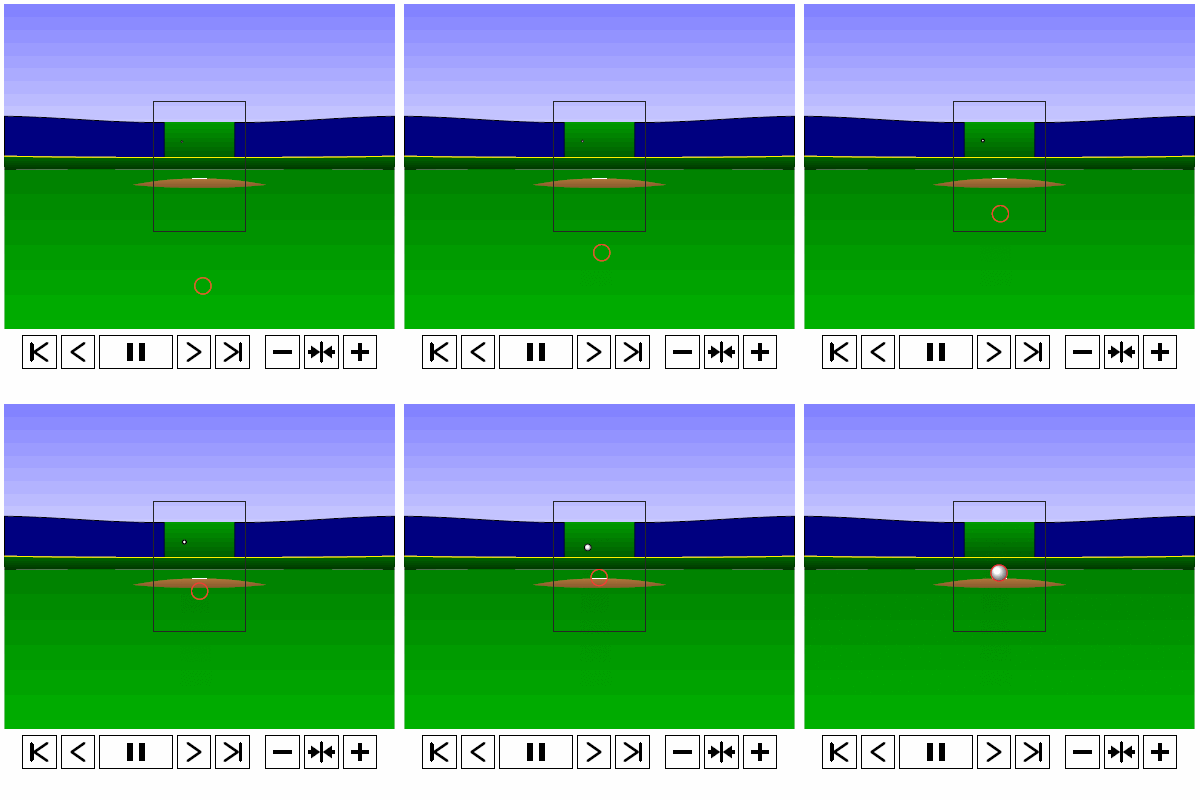
 photo Darvish_FF_Middle.gif

Note that the pitch, in this case, is simulated at one-quarter actual speed. The strike zone shown is the standard width of the plate and 1.5 to 3.5 feet vertically. The red circle represents the projection of the pitch after removing the remaining PITCHf/x definition of movement from its current location (Note that while the simulation shown above is a GIF, the actual simulation is an interactive PDF where the controls at the bottom of the image can play, rewind,  slow down, etc. the simulation. This is discussed at the end of the article for the interested reader, including a link to several interactive PDFs as well as a tutorial for the controls and the source code written in TeX). Here, the movement causes the pitch to rise, giving the pitch in the simulation a “floating” quality as it never seems to drop.

As in the previous work on sliders, we will start by splitting the four-seamers into four groups based on the pitch location and the batter’s response: strikes (pitches with a 50% chance or better of being called a strike) and balls (lower than 50% chance of being called a strike), and swings and pitches taken. Working with the projections to the front of the plate after removing the remaining movement on the pitch, we can examine how attractive (in terms of probability that the projection will be called a strike) pitches in each of these four categories, on average, are to batters incrementally as they approach the plate.

To begin, for left-handed batters versus Darvish in 2013:
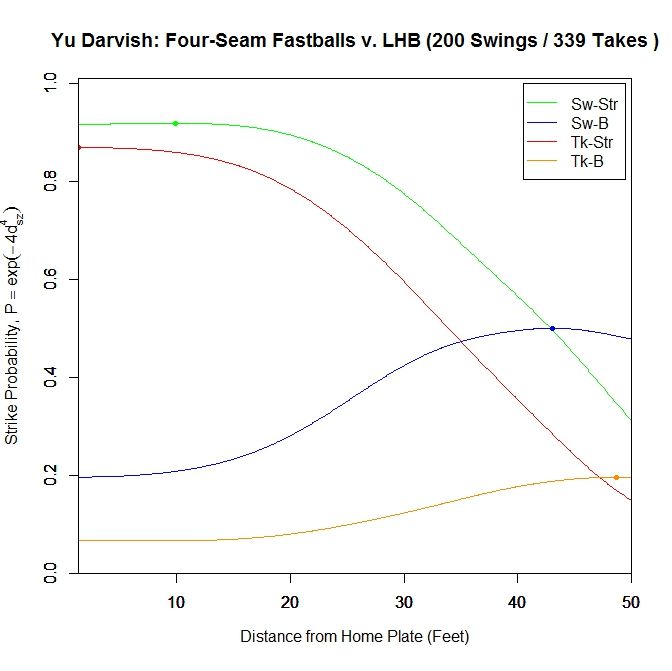
 photo Darvish_ST_BS_FF_LHB.jpeg

For both types of pitches in the strike zone (red=taken, green=swung at), the average probability of the pitch being called a strike levels off around 20 feet, with strikes swung at peaking at probability 0.919 at 9.917 feet from home plate, then dropping to 0.917 at the plate. Strikes taken reach their maximum at the front of the plate with probability 0.869. The four-seamers swung at outside of the strike zone (blue) average around 0.5 probability of being called a strike up until around 30 feet, before dropping off. The fastballs taken outside the zone (orange) tend to project as low-probability strikes initially and remain so to the front of the plate.

We can simplify this graph to include only swings and pitches taken.
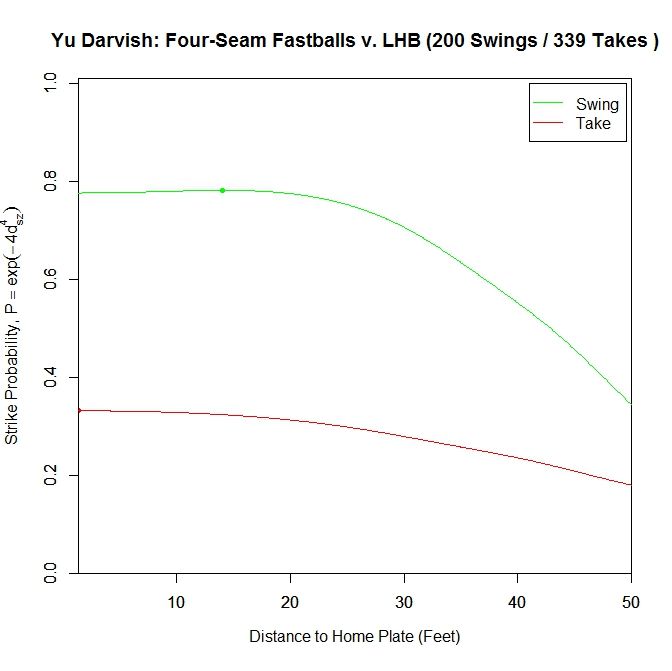
 photo Darvish_ST_FF_LHB.jpeg

Once again, pitches swung at project as better pitches throughout than those taken. The peak for swings is at 14.083 feet with probability 0.782, and finishes at 0.777. The pitches taken keep increasing in attractiveness all the way to the front of the plate, reaching a called-strike probability of 0.332.

To further examine what is happening in these graphs, we can view the location of these projections from 50 feet to the front of home plate. The color scheme is the same as the four-curve plot above.
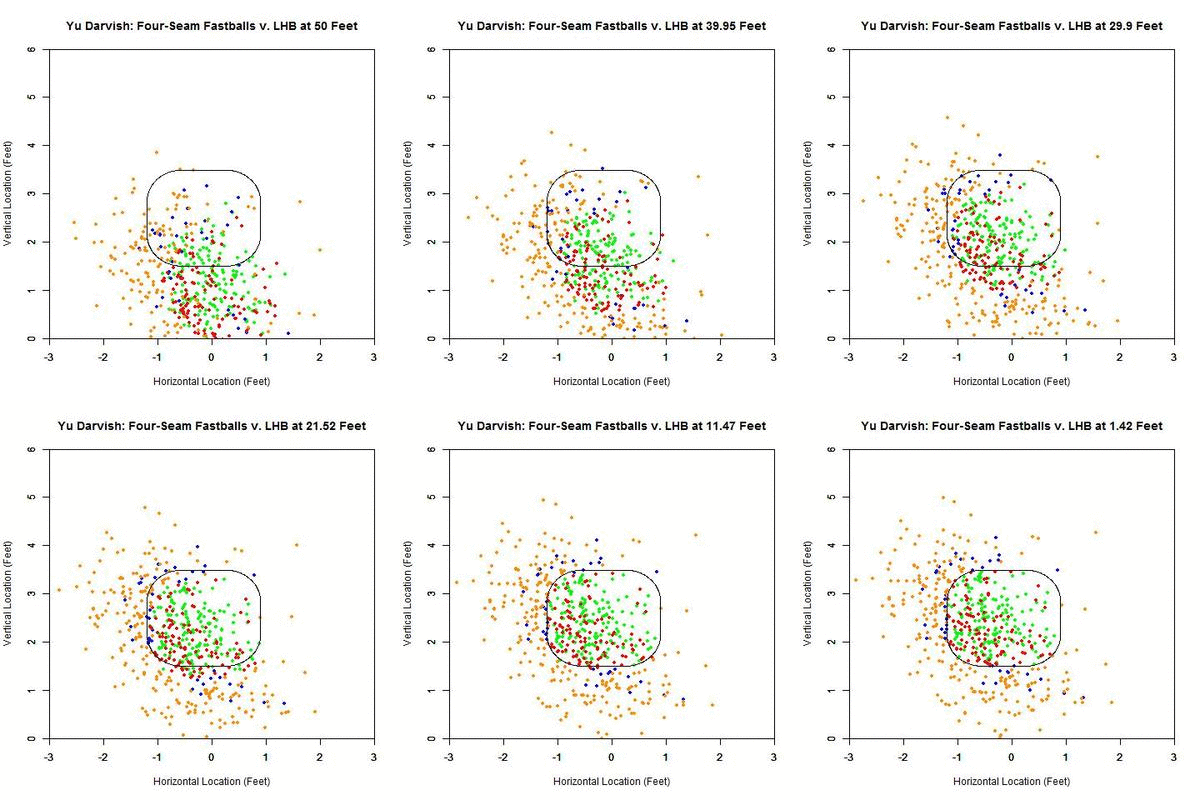
 photo Darvish_Pitch_Proj_FF_LHB_250ms.gif

Focusing on the blue projections for the moment (swings outside the strike zone), the projections down and to the right of the zone are carried by movement toward the strike zone and most end up as borderline strikes. Those up and to the left project further and further outside the strike zone as they approach the plate, since their direction of movement is roughly perpendicular to the strike zone contour. To get a better idea of the number of each of the four cases in nine regions in and around the strike zone, we can fade the data into the background and replace it in each region by an arrow indicating the direction that the average projection for that area is moving and the number of pitches of that case located there.
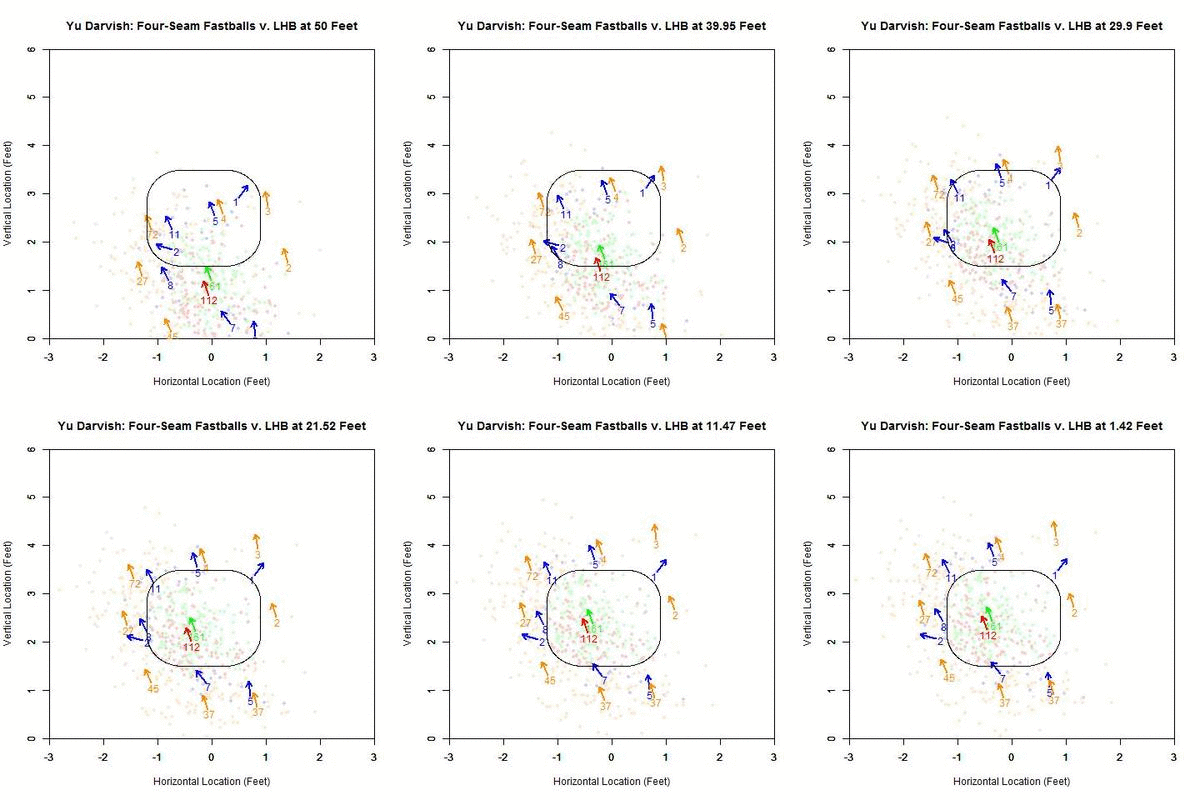
 photo Darvish_Pitch_Proj_Gp_FF_LHB_250ms.gif

Focusing first on the pitches in the strike zone, there is a dearth of projections in the upper-right area, which would be on the inside half of the plate to LHB. The pitches taken in the strike zone tend to skew slightly down and to the left, relative to those swung at. Note that in many of the regions around the strike zone, the samples are quite small so it may be difficult to draw any strong conclusions. With this in mind, these results can be summarized in the following table where the center cell represents the swing percentage in the strike zone and all other cells contain the percentage of swings in that region.

Darvish – Four Seamers vs. LHB
13.3 55.6 25
22.9 59 0
4.3 15.9 11.9

The region with the highest swing percentage is the strike zone, at 59%. The region with the next highest percentage is above the strike zone, which is in the general direction of movement, but here there are only nine data points to rely on for this percentage. It would seem that the regions that induce swings are those where the pitches project in the strike zone and are carried out by movement (above and above-and-left of the zone) and where the pitches project as balls but movement is carrying them toward the zone (below and below-and-right of the zone). Notice that the area below and left of the strike zone has 47 pitches thrown there and only 2 swings, which is where the movement parallels the strike zone.

It would appear, based on these observations, that the location of the pitch, relative to the direction of the movement, has an influence on generating swings outside the strike zone. As with the sliders in the previous article, we will use, as a measure of if the pitch is thrown outside in the direction of movement, the angle between the movement of the four-seam fastballs at 40 feet (the pfx_x and pfx_z variables in the PITCHf/x data set) outside the zone and a vector perpendicular to the strike zone extending to the final location of the pitch at the front of home plate. An angle of zero indicates that the movement of the pitch carried it perpendicularly away from the strike zone. Ninety degrees means that the pitch projection parallels the strike zone due to movement. A one-eighty degree angle means that the pitch is being carried by movement perpendicularly toward the strike zone. Further explanation, including a visual depiction, can be found in the link to the previous article at the top of this page.

To begin, we will look at the distribution of angle versus distance from the strike zone for all of Darvish’s four-seamers outside the zone to lefties.
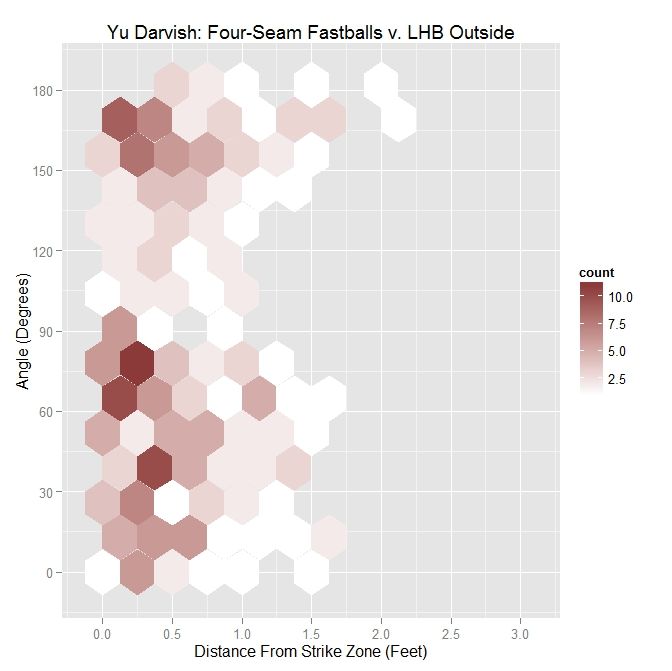
 photo Darvish_Out_FF_LHB.jpeg

Darvish – Four Seamers Outside the Zone v. LHB
Angle Percentage Average Distance
Less Than 45 Degrees 28.9 0.546
Less Than 90 Degrees 58.6 0.517
All X 0.553

The distribution, in this case, seems slightly skewed toward having pitches thrown in the general direction of movement. This visual assessment is supported by the percentages in the table (sorted by angle and average distance from the strike zone contour in feet. e.g., 0.5 = 6 inches, 0.33 = 4 inches), with nearly 29% of pitches having an angle of less than 45 degrees and over 58% with an angle less than 90 degrees. The distribution does not seem to have definitive shape.
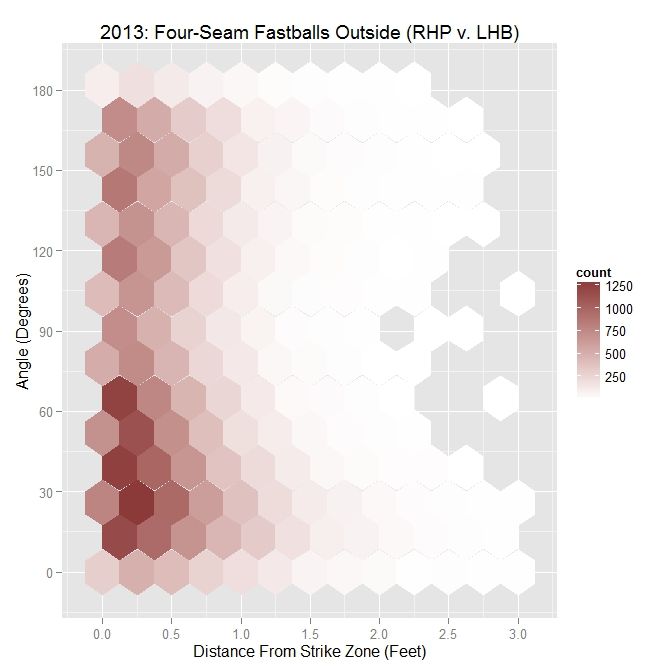
 photo MLB_Out_FF_RHP_LHB.jpeg

MLB RHP 2013 – Four Seamers Outside the Zone v. LHB
Angle Percentage Average Distance
Less Than 45 Degrees 37.5 0.557
Less Than 90 Degrees 61.9 0.501
All X 0.477

For all MLB right-handed pitchers in 2013, including Darvish, the distribution is much more clear. There is a swell of pitches thrown with angle between 0 and 90 degrees and within six inches of the strike zone, with 37.5% thrown with an angle of less than 45 degrees, and 61.9% with an acute angle. In conjunction, as the angle increases, the average distance from the strike zone decreases. To get a better handle on the ramifications of this choice of pitch locations, we can further sort the data into swings and pitches taken.
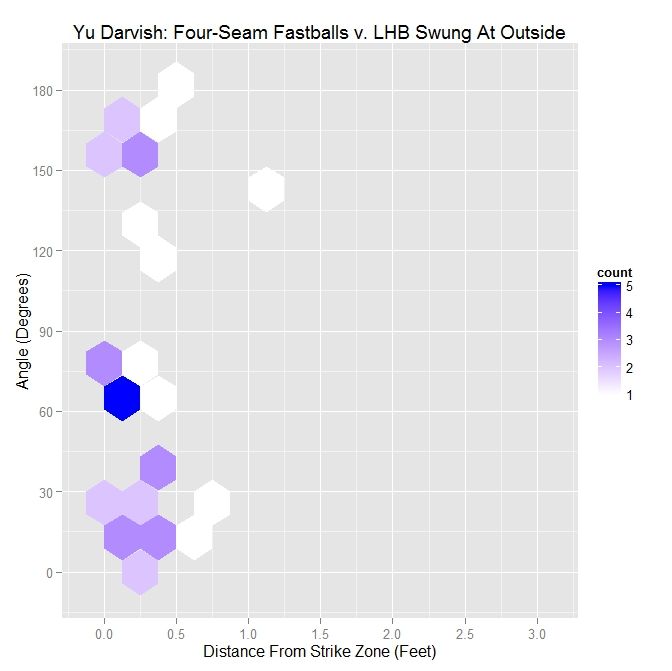
 photo Darvish_Out_Swing_FF_LHB.jpeg

Darvish – Four Seamers Swung At Outside the Zone v. LHB
Angle Percentage Average Distance
Less Than 45 Degrees 43.6 0.315
Less Than 90 Degrees 69.2 0.232
All X 0.248

For Darvish, nearly 44% of the pitches swung at had an angle between the vector perpendicular to the strike zone and the movement vector of less than 45 degrees. For those less than 90 degrees, this percentage jumps to nearly 70%. In addition, the average distance outside with angle less than 45% is an average of 4 inches outside whereas, overall, the average is about 3 inches in all directions. We can compare this to Darvish’s right-handed colleagues in 2013:
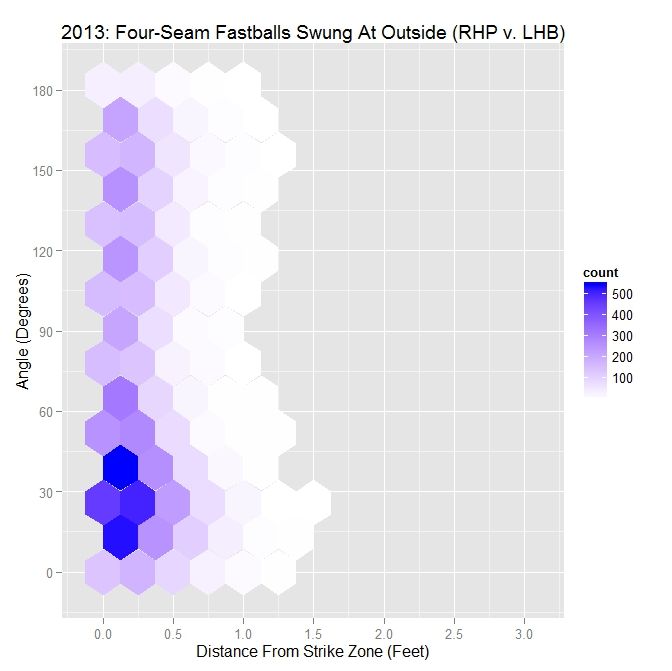
 photo MLB_Swing_Out_FF_RHP_LHB.jpeg

MLB RHP 2013 – Four Seamers Swung At Outside the Zone v. LHB
Angle Percentage Average Distance
Less Than 45 Degrees 46.9 0.267
Less Than 90 Degrees 66.8 0.248
All X 0.238

For MLB righties, the largest area of swings is right around a 30-degree angle. Close to half of the swings, 46.9% to be exact, occur when the angle is less than 45 degree and over two-thirds are for pitches in the general direction of movement. The average distance on four-seamers swung at outside is close to Darvish’s overall, but is almost an inch further out for Darvish for 45-degree or less angles. So for RHP to LHB, pitches thrown in the neighborhood of 30 degrees and within a half-foot of the strike zone tend to induce swings, which is also seen for Darvish. We can now look at the complement of this, pitches taken outside, to see how this distribution compares to swings.
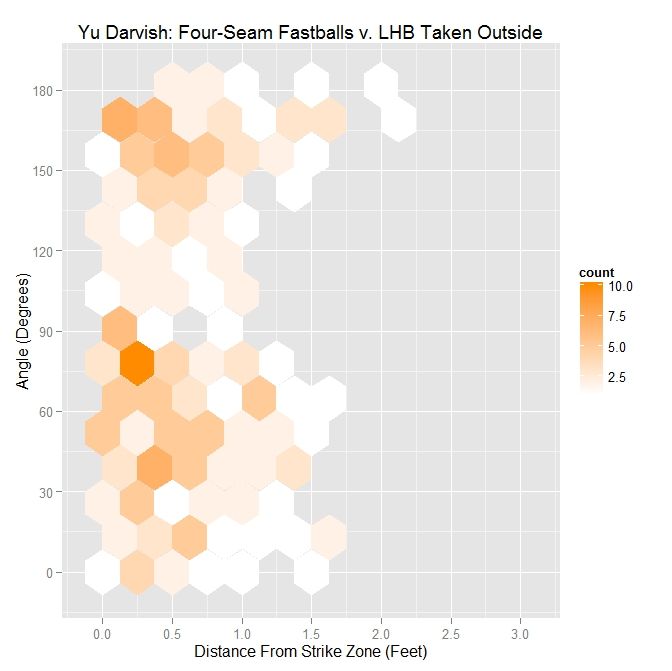
 photo Darvish_Out_Take_FF_LHB.jpeg

Darvish – Four Seamers Taken Outside the Zone v. LHB
Angle Percentage Average Distance
Less Than 45 Degrees 26.4 0.611
Less Than 90 Degrees 56.8 0.577
All X 0.605

The distribution for Darvish on pitches taken has some semblance to that for all pitches, but the percentages have dropped in all cases. In addition, the average distances across the board are over six inches outside.
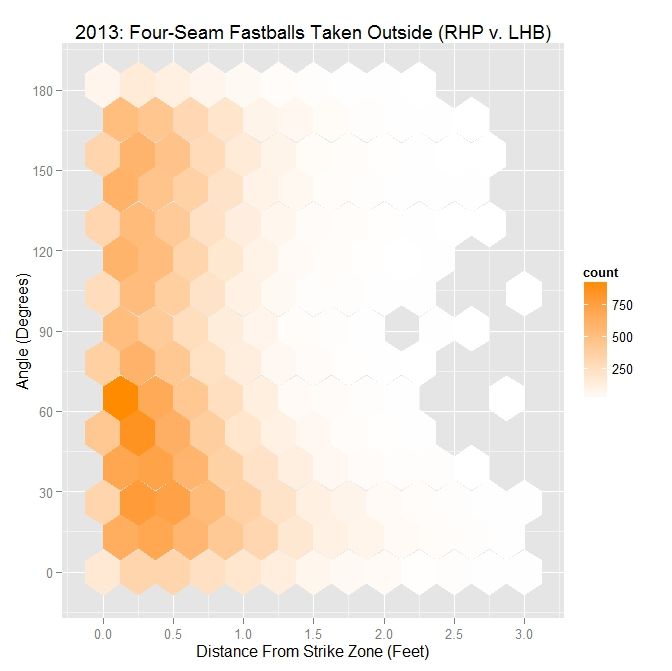
 photo MLB_Take_Out_FF_RHP_LHB.jpeg

MLB RHP 2013 – Four Seamers Taken Outside the Zone v. LHB
Angle Percentage Average Distance
Less Than 45 Degrees 35.1 0.654
Less Than 90 Degrees 60.7 0.571
All X 0.537

For all MLB RHP in 2013, the pitches taken by LHB outside the strike zone are largely located below 90 degrees, with a large number near 60 degrees. Compared to the case of all pitches outside the strike zone, the percentages are not all that dissimilar, but the distances are slightly larger. Putting the two hexplots together to see how they form the plot for all outside pitches, we see that what appears to be one large grouping of data below 90 degrees for all pitches separates into two smaller groupings: one around 30 degrees for swings and one around 60 degrees for pitches taken.

To examine why it might be the case that pitches thrown in the direction of movement, meaning a small angle between the movement vector and the vector perpendicular to the strike zone, are swung at more frequently and are more effective at inducing swings further from the strike zone than those that are not, we can take a four-seamer thrown by Darvish above the strike zone and examine both the trajectory of the pitch and its projection. We can again simulate such a pitch (at quarter speed) via the PITCHf/x data for Darvish. Note that since the below simulation does not possess the same computational capabilities as the rest of the code, which is done in R, we use the standard strike zone as a reference rather than the 50% contour.
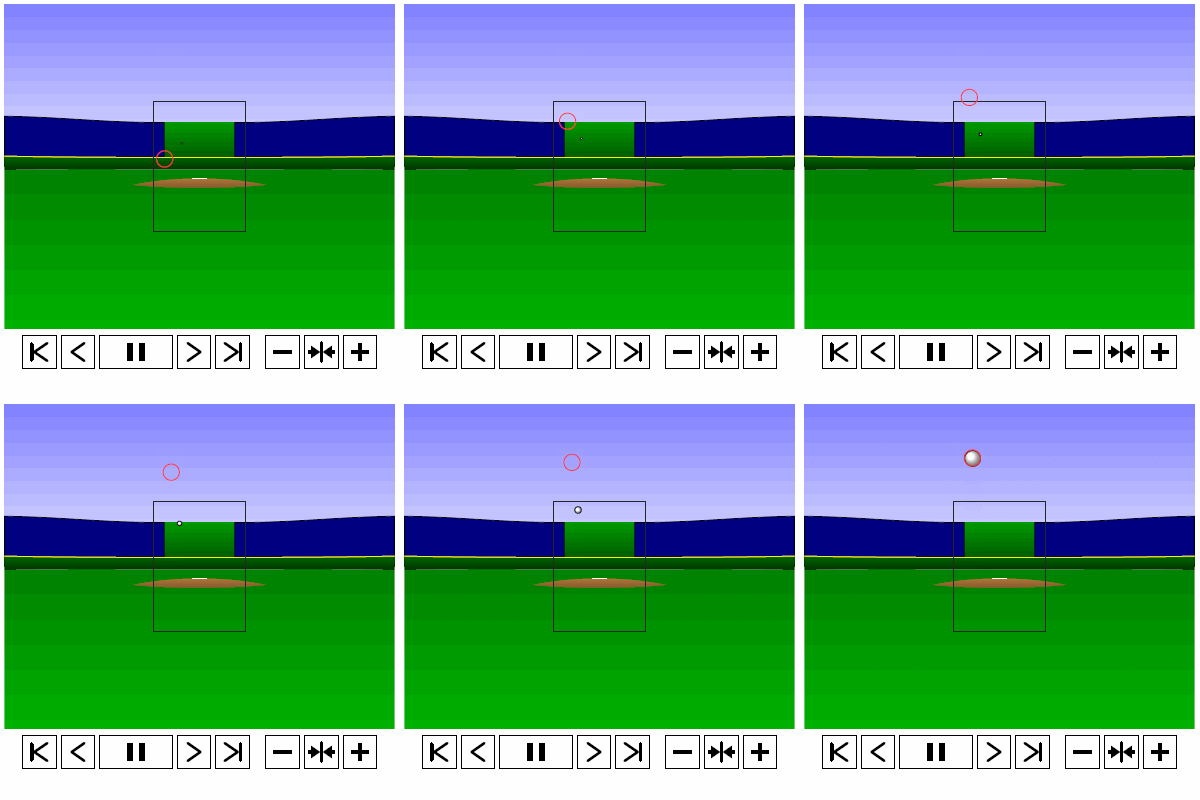
 photo Darvish_FF_Top.gif

Based on the simulation and associated projection, we can see that the pitch projects as a strike early on and, late in its trajectory, appears to be a ball. The important observation for this is that, for some part of its flight, the pitch does appear that it may be a strike. Similarly, for a pitch below the strike zone, we see the opposite result.
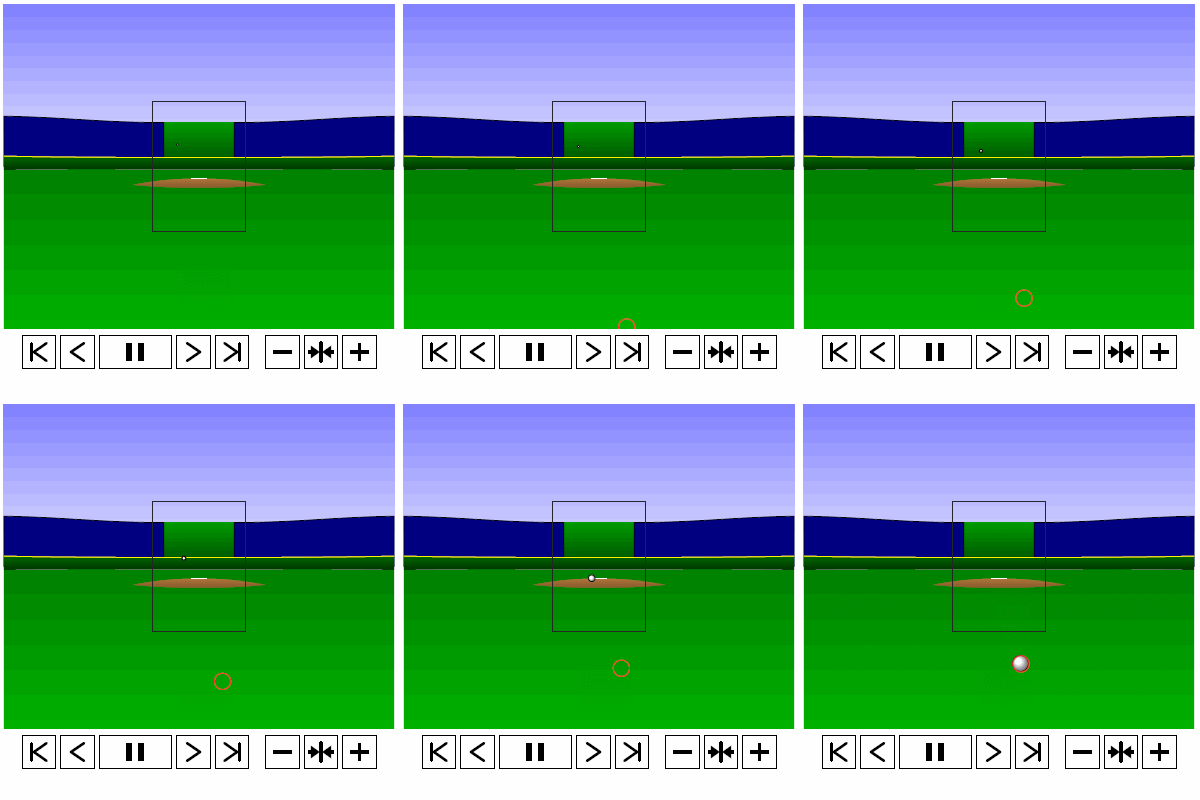
 photo Darvish_FF_Bottom.gif

One can see the problem with getting a batter to swing at a pitch such as this. It starts out as looking like a pitch in the dirt and, through its path to the plate, only slightly improves its chances of being called a strike, and at no point really gives the batter much incentive to swing at it. Thus it makes sense that a batter might swing at a four-seam fastball high above the strike zone but not one a similar distance beneath.

Performing the same analysis for right-handed batters, we again start with Darvish’s results for the four-seam fastball in terms of ball/strike and swing/take.
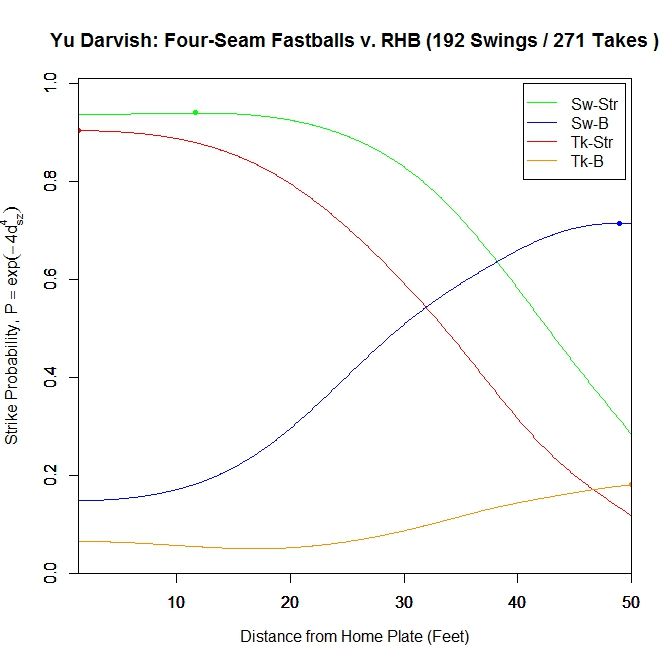
 photo Darvish_ST_BS_FF_RHB.jpeg

Here, the swing/strike curve peaks at probability 0.94 at 11.667 feet and finishes at 0.937. These probabilities are slightly higher than those for lefties at the maximum and at the front of the plate. The pitches taken in the strike zone peak at the plate with probability 0.904, compared to 0.869 for LHB. For both cases of pitches outside the strike zone, they reach their maximum very early in the trajectory and drop off afterward.
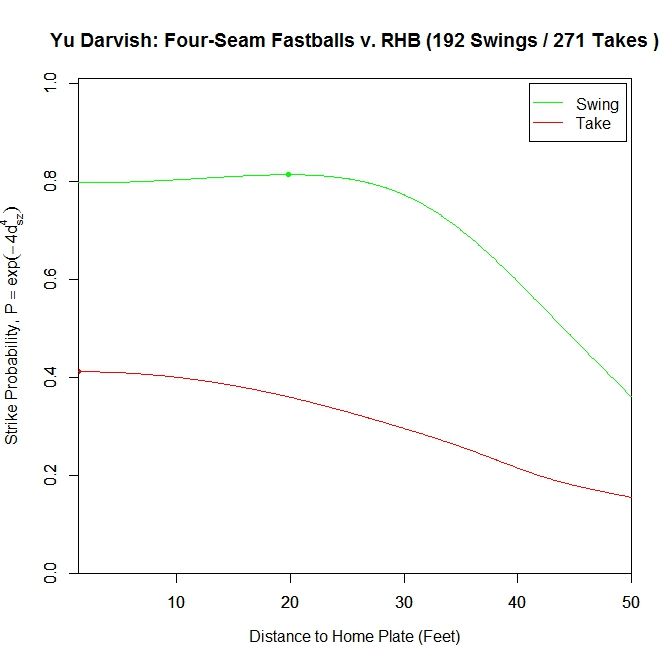
 photo Darvish_ST_FF_RHB.jpeg

Changing to the two-curve representation for four-seam fastballs to right-handers, the swing curve reaches its apex of probability 0.814 at 19.833 feet and ends with probability 0.797 at the plate. For pitches taken, the average strike probability increases throughout the trajectory, ending at 0.411. Once again, these probabilities are higher than for left-handed batters.
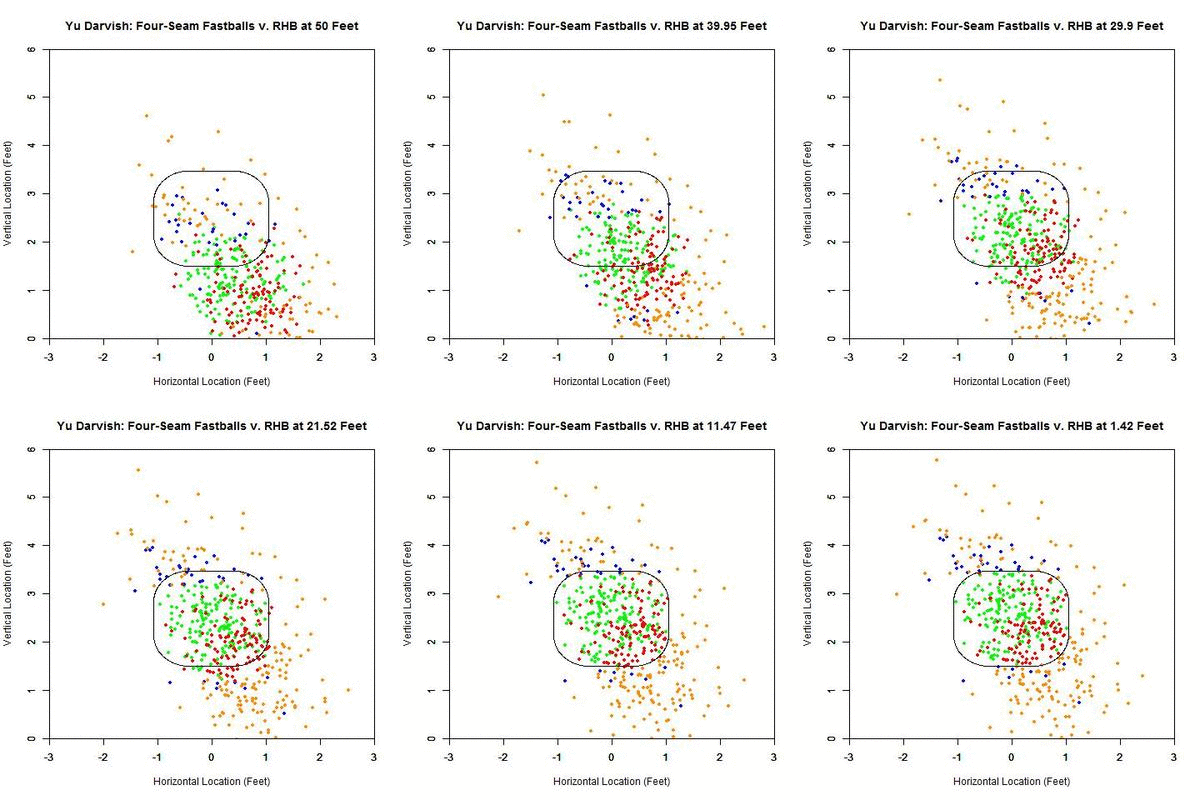
 photo Darvish_Pitch_Proj_FF_RHB_250ms.gif

As before, we can switch to the discrete data and their projections as the pitches near the front of home plate. Of note is that the pitches taken (red data points) are, by and large, down and to the right of the strike zone from the catcher’s perspective, which is in the opposite direction that the movement influences the pitches as they approach the plate. In addition, the majority of swings outside the strike zone, the blue data points, leave the strike zone in the direction of movement. Also of interest is that the pitches fill up the strike zone more against RHB, while four-seamers to LHB were lacking for the inner half of the strike zone. For the pitches swung at outside the strike zone in the opposite the direction of movement, down and to the right, they end up very close the strike zone contour, making them boarderline strikes, and thus nominally classified outside the zone. To observe these phenomena more succinctly, we can switch to a vector representation indicating the number of pitches and the direction that the projections are headed for each of the nine regions in and around the strike zone.
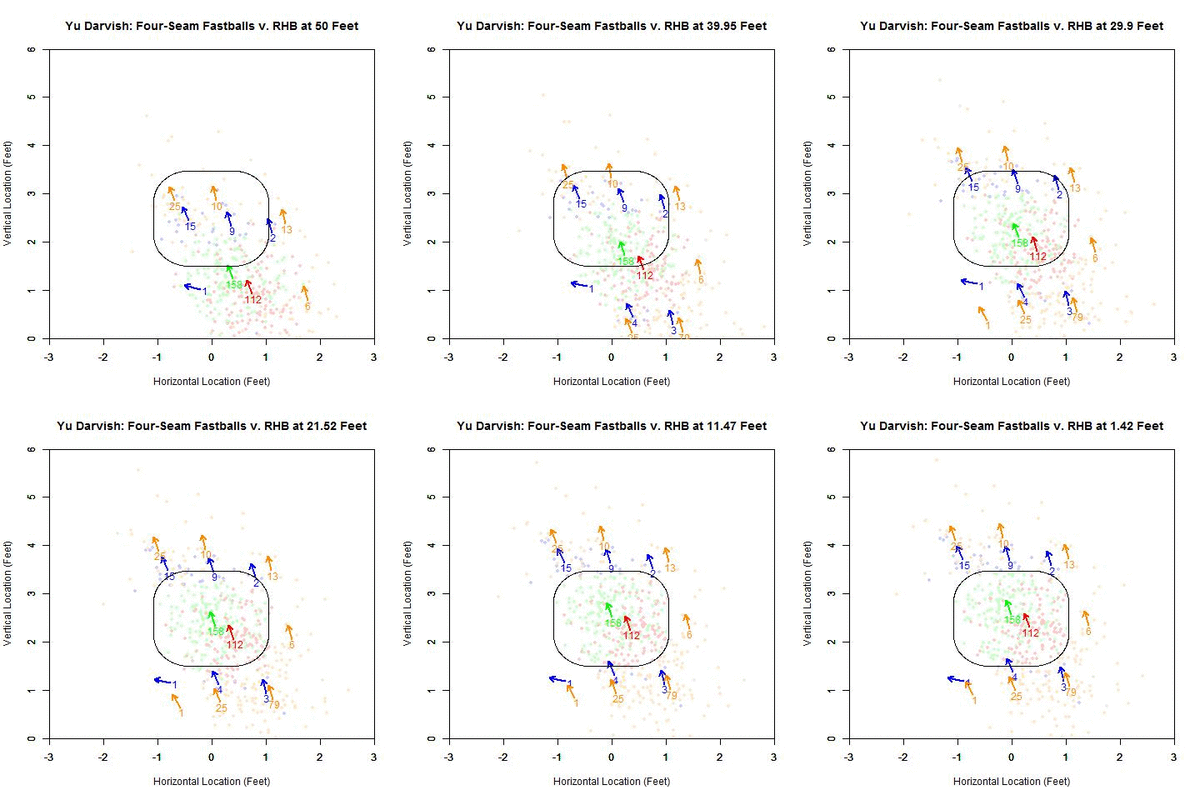
 photo Darvish_Pitch_Proj_Gp_FF_RHB_250ms.gif

Of the 270 pitches in the defined strike zone, the average location of the 112 taken were down and to the right of those swung at, as represented by the red and green arrows. To quantify the percentage of swings in each of the nine regions, we can refer to the below table, aligned spatially with the data from the GIF (center square being in the strike zone).

Darvish – Four Seamers vs. RHB
37.5 47.4 13.3
X 58.5 0
50 13.8 3.7

Based on these results and for regions with more than a handful of pitches, the highest percentages of swings outside the strike zone are in the upper and upper-left regions, in the direction of movement. The lower-left corner is large as well but can be disregarded as it only contains two pitches, one of which was swung at. Also, it is hard to draw any conclusions to the left of the plate since there is no data.

We can now turn our attention to pitches outside the zone for both Darvish and other MLB righties in 2013:
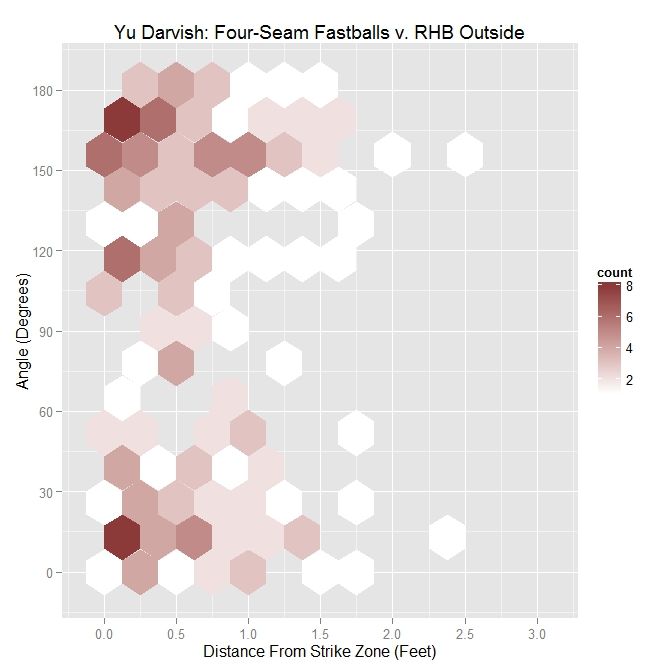
 photo Darvish_Out_FF_RHB.jpeg

First, for Darvish, the distribution of pitches, when viewed by plotting distance from the strike zone versus angle between the perpendicular vector to the strike zone and the movement vector, appears bimodal with a large grouping both above and below the 90-degree mark.

Darvish – Four Seamers Outside the Zone v. RHB
Angle Percentage Average Distance
Less Than 45 Degrees 31.2 0.633
Less Than 90 Degrees 41.1 0.619
All X 0.619

The four-seamers outside to righties are, on average, over 6 inches outside, with most thrown, 59.9% to be precise, in the opposite direction of movement. However, most of the pitches thrown in the direction of movement, 31.2%, are thrown with an angle of less than 45 degrees. Compared to LHB, the distances are greater and the percentage of pitches with an angle of less than 90 degrees is noticeably lower.
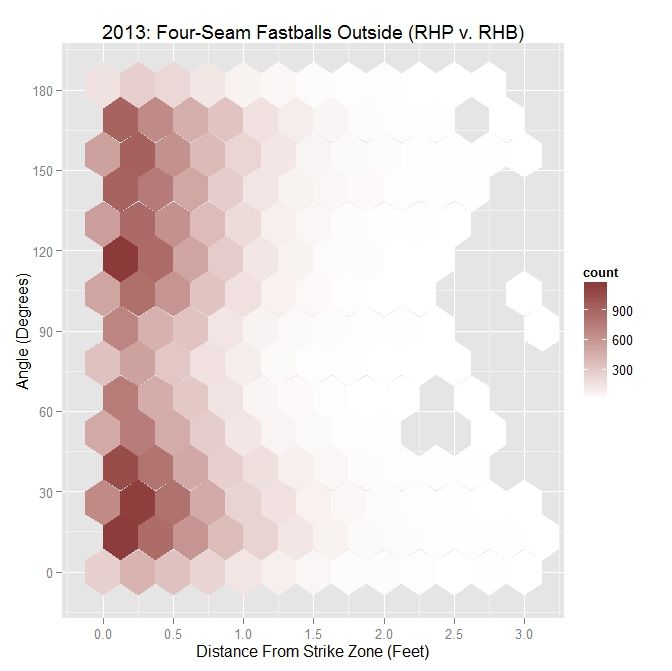
 photo MLB_Out_FF_RHP_RHB.jpeg

For MLB RHP, the distribution also appears bimodal, with two groupings of data near 30 degrees and 120 degrees. This roughly mirrors Darvish’s distribution, relative to angle versus distance.

MLB RHP 2013 – Four Seamers Outside the Zone v. RHB
Angle Percentage Average Distance
Less Than 45 Degrees 31.6 0.514
Less Than 90 Degrees 48.6 0.478
All X 0.476

As compared to Darvish, RHP threw about the same percentage of pitches with an angle of less than 45%, but more with an angle of less than 90 degrees. In all cases, the MLB RHP four-seamers outside were, on average, closer to the strike zone. Compared to pitches outside to lefties, the percentages for less than 45 and less than 90 degrees are down.
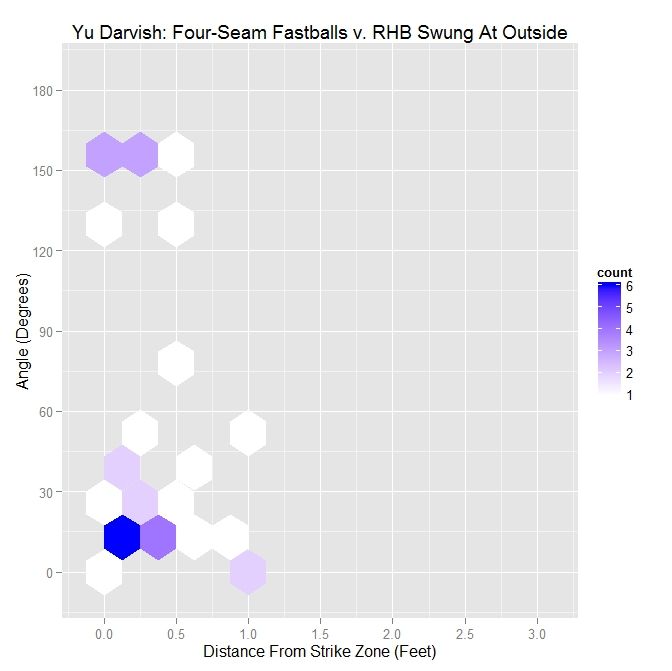
 photo Darvish_Out_Swing_FF_RHB.jpeg

Taking the subset of pitches swung at outside for Darvish, the distribution has become closer to having a single mode near 30 degrees. Despite reaching into small sample sizes for this subset, the below table reinforces these conclusions.

Darvish – Four Seamers Swung At Outside the Zone v. RHB
Angle Percentage Average Distance
Less Than 45 Degrees 67.6 0.351
Less Than 90 Degrees 73.5 0.347
All X 0.313

While only around 30% of Darvish’s pitches were thrown with an angle of 45 degrees or less, over two-thirds of his swings outside the strike zone were in this range of angles. This increases to nearly 75% when considering four-seam fastballs thrown in the general direction of movement, meaning 90 degrees or less. Of note here is that the distance that entices a swing decreases as the movement aligns less and less with the vector perpendicular to the strike zone. Here, the distances are greater compared to left-handed batters faced by Darvish in 2013, but the percentages are up.
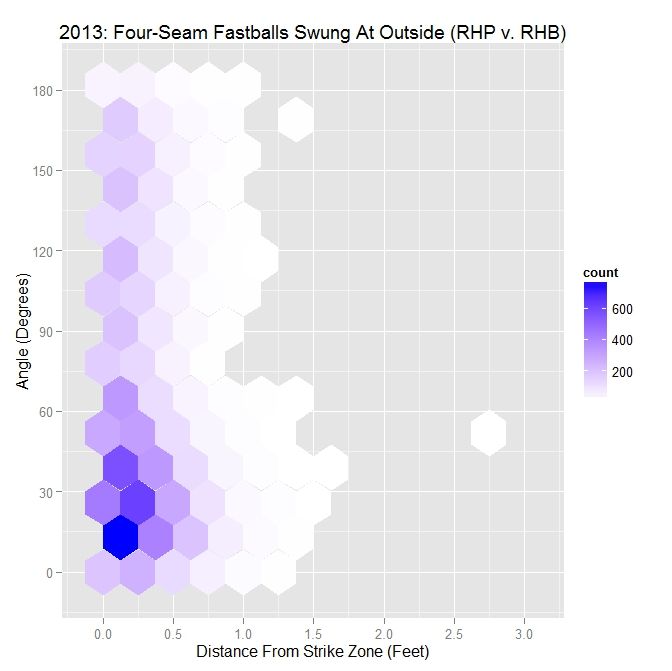
 photo MLB_Swing_Out_FF_RHP_RHB.jpeg

Switching the larger sample of all 2013 MLB RHP, we retain only one of the modes observed for all pitches. The pitches that are swung at outside are clustered down near 15 degrees and within half a foot of the strike zone.

MLB RHP 2013 – Four Seamers Swung At Outside the Zone v. RHB
Angle Percentage Average Distance
Less Than 45 Degrees 53.9 0.286
Less Than 90 Degrees 74.2 0.268
All X 0.255

The percentage of swings with an angle of 45 degrees or less is over 50% and, like Darvish, those less than 90 degrees are up near 75%. The distance again decreases as the angle increases and, compared to Darvish, is much closer to the zone. Versus right-handed batters, the percentages for angles 45 and 90 degrees or less are greater but the distances do not differ greatly as compared to LHB.
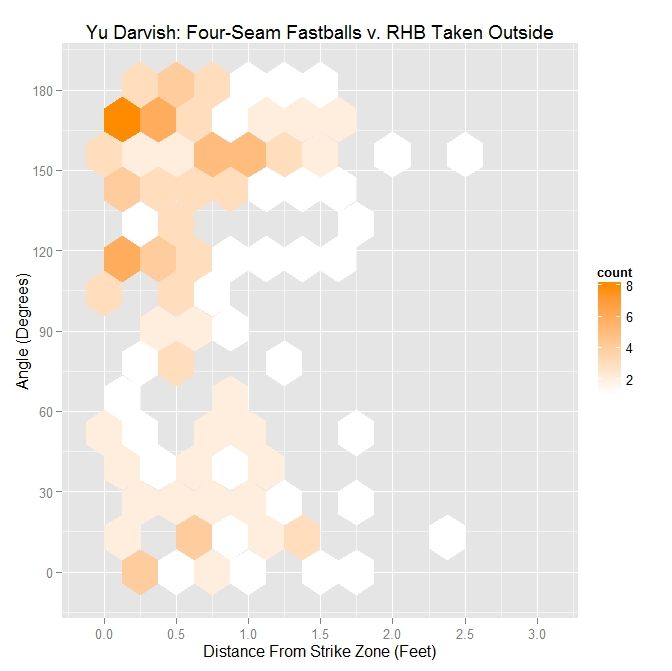
 photo Darvish_Out_Take_FF_RHB.jpeg

The other half of the data, pitches taken outside, gives us the second mode seen originally in Darvish’s data. This mode is a cluster of data above the 90 degree level.

Darvish – Four Seamers Taken Outside the Zone v. RHB
Angle Percentage Average Distance
Less Than 45 Degrees 23.8 0.794
Less Than 90 Degrees 34.5 0.736
All X 0.681

While a quarter of the pitches taken are thrown with an angle of 45 degrees, only a little over one-third were thrown in the general direction of movement. Note that the pitches that are thrown in the direction of movement and are taken tend to average three-quarters of a foot outside, so it makes sense that they would not be swung at. The percentage of pitches taken with an angle of less than 90 degrees is down from 56.8% for LHB and, overall, the pitches are almost an inch further outside.
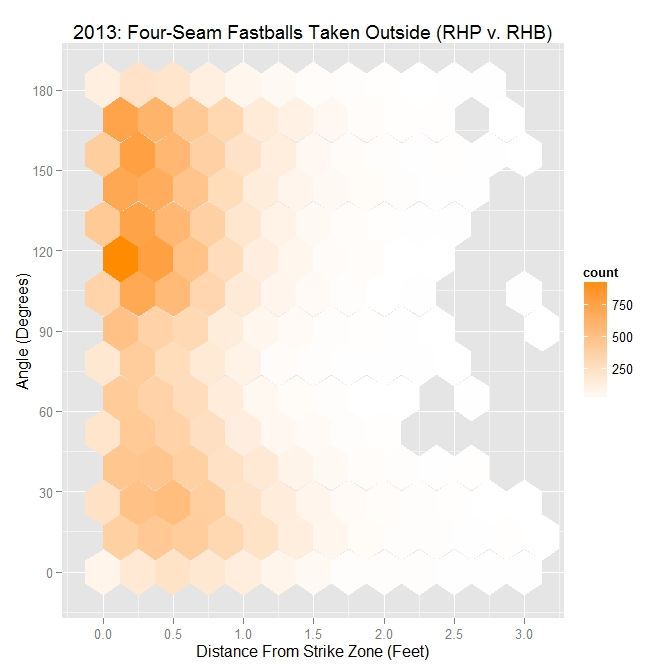
 photo MLB_Take_Out_FF_RHP_RHB.jpeg

For the MLB data set, the second mode is located around 120 degrees.

MLB RHP 2013 – Four Seamers Taken Outside the Zone v. RHB
Angle Percentage Average Distance
Less Than 45 Degrees 24.9 0.662
Less Than 90 Degrees 41 0.592
All X 0.542

As with Darvish, about one quarter of the pitches taken outside are at an angle of 45 degrees or less and 59% are thrown in the opposite direction of movement. When put up against the pitches taken by LHB, the percentages are down for both 45 and 90 degree or less pitches from 35.1% and 60.7%, respectively.

As with RHP versus LHB, the full distribution, in terms of the hexplots, separates into two clusters: one related to swings and one related to pitches taken. The cluster related to swings sits in the range of 15 degrees while pitches taken are closer to 120 degrees. This is similar to the case for lefties, except the cluster of pitches taken moves from the 60-degree area to the 120-degree area and the cluster related to swings moves down from 30 degrees to 15 degrees. However, in both cases, the swings appear to be separate clusters from the pitches taken.

Discussion

For four-seam fastballs thrown by Yu Darvish in 2013, the maximum attractiveness on swings is in the range of 10-20 feet in front of home plate for left- and right-handed batters, possibly tying into how long a batter can reasonably project a pitch when deciding to swing. The four-seamers also tend to be swung at outside the strike zone in the general direction of movement, which we have seen previously with sliders. This is especially pronounced for RHB vs RHP, with pitches exiting the strike zone in the direction of movement causing swings, and pitches entering the zone opposite the direct of movement being taken. By simulating the PITCHf/x data, we can get an idea of why this might be true: pitches outside thrown in the general direction of movement project in the strike zone for some period of time before projecting outside of it and pitches thrown opposite this direction project outside and, while their probability increases, these pitches never appear as strikes and thus do not usually induce swings from the batter.

Next time, we will finish up with cut fastballs from Yu Darvish and see how movement affects perception in this case. After that, we can switch to the 2014 data set and also turn the algorithm around and apply it to a batter.

PITCHf/x Simulation

For those familiar with the previous installment, we covered a slider thrown by Yu Darvish to Brett Wallace and simulated the projected pitch location in R. To better represent how the pitch projection may tie into perception, we have switched to a more visually appealing representation of simulating the PITCHf/x data in the context of the catcher’s viewpoint (we could presumably display this from the batter’s point of view as well). For the aforementioned slider to Wallace, the simulated PITCHf/x data, based on the 9-parameter model, is:
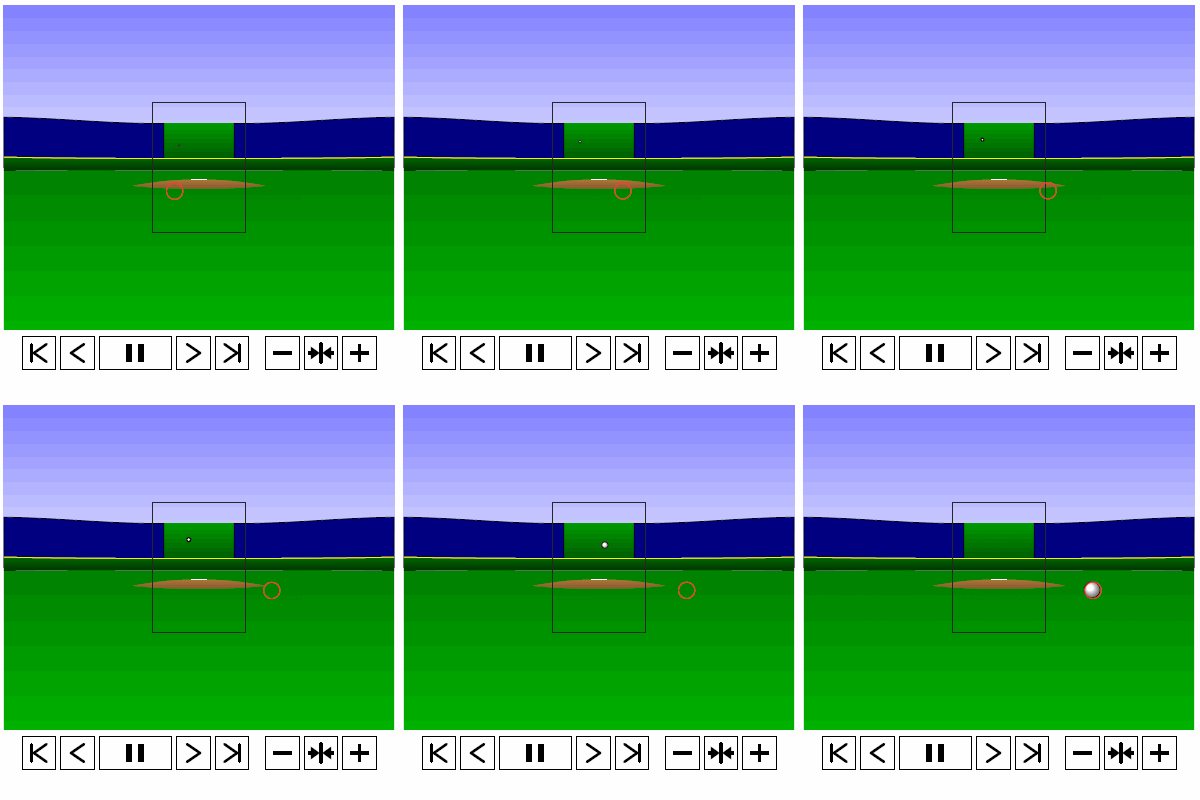
 photo Darvish_Slider.gif

This would seem to be a better way to represent the data, including a backdrop and accurate scaling of the pitch size and location. As another example, we can simulate a random Darvish curve:
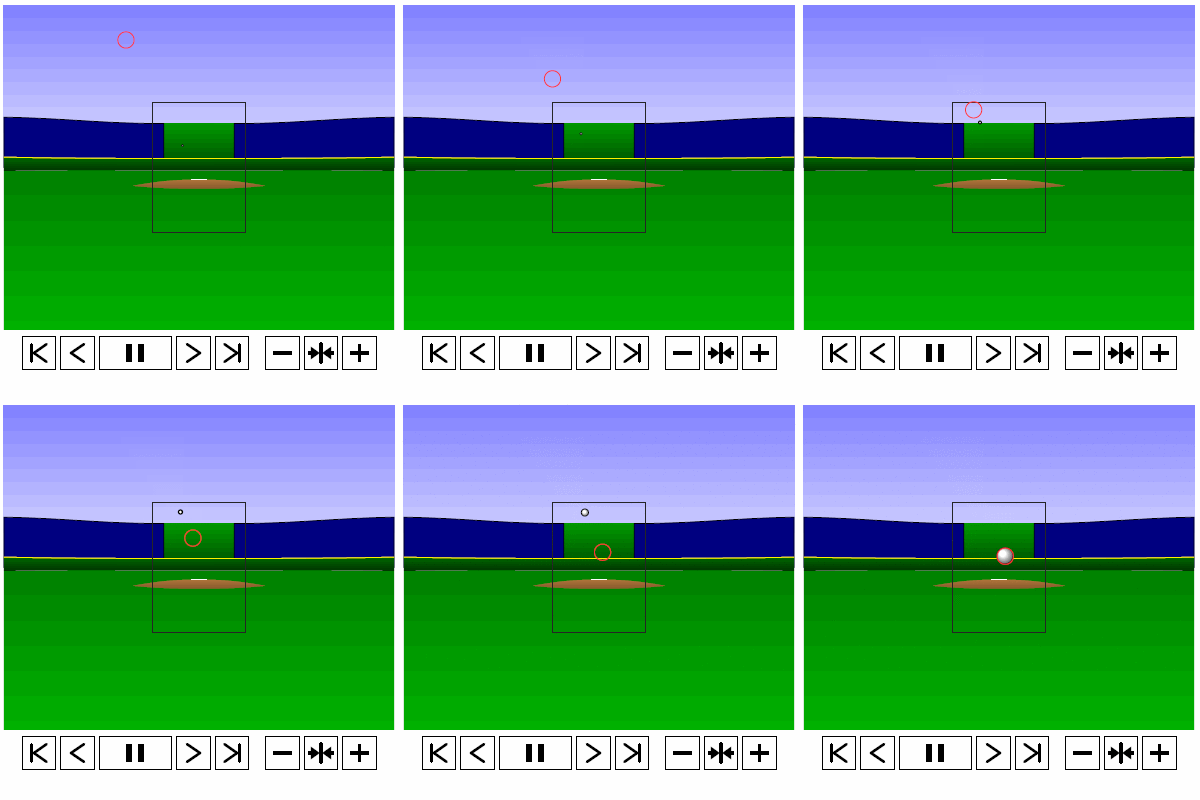
 photo Darvish_Curve.gif

In order to make the GIFs for simulating the PITCHf/x data, we are first using TeX to write the code and then compiling it using MiKTeX with the “animate” package handling the controls. To begin, we place a reference point 6 feet, 1 inch behind the tip of home plate, roughly approximating the location of the catcher (the one inch past six feet is not important but makes the distance to the front of home plate an even 7.5 feet).  The height of the reference point is taken to be 2.5 feet in the z-direction. This is the point by which we will determine perspective. Everything will be projected into the plane at the front of home plate, spanning three feet to the left and right of center and from the ground to five feet high. For a given position of the pitch, we find the associated spherical coordinates, relative to the reference point. To figure out where to display the pitch in the frame, we track the pitch along the line formed between the pitch location and the reference point until it reaches the frame. Since the two angle measures of the spherical coordinates will not change when tracking along this line, we need only find the distance along it that places it in the frame we are displaying.

Once we have the location of the pitch in the frame, we still need to find the size of the pitch as seen from that distance. To do this, we again use the reference point and find the distance to the center and to the top of the baseball. With a third side that goes from the top to the center of the baseball, this creates a triangle. Forming a similar triangle by adding an additional third side where the frame cuts the triangle at the front of the plate, we obtain a smaller triangle contained in the larger one. Using this geometry, we can find the size that the pitch will appear at this distance using trigonometric properties of similar triangles (namely that their sides have the same ratio).

To begin the simulaton, we find the times associated with 55 feet and the front of the plate. We then find the location of the pitch in three dimensions, incrementing in time from release to strike zone and adjusting the location and the size of the pitch to appear positioned and scaled correctly in frame. The simulation in the actual PDF is at 60 frames per second, with most animations lasting around a half a second. For the purposes of creating GIFs, we slow the pitches down to one quarter this speed and capture using a program called LICEcap. The code is written so as to work for any pitch by merely swapping in the chosen 9-parameter PITCHf/x data and recompiling. The projection is shown as a red circle, and is calculated as previously discussed. All background features are scaled appropriately, in a similar manner as the pitch.

Note that while this is, in many ways, an approximation of perception from the catcher’s point of view, it functions well for our purposes of providing a decent replacement for live video since we can overlay the projection and view it from the reverse of the traditional television angle from center field. Included is a link to a Google Drive containing a collection of interactive PDFs for pitchers and pitches from 2013 and 2014. There is also an interactive guide to the controls with the given example being a Clayton Kershaw slider. Finally, the source code is included so the interested reader/programmer can input any chosen PITCHf/x parameters and compile to get a representation of the pitch, that includes distance to home plate, the velocity of the pitch, and the time since release.


The Resurgence of Jon Lester: How a Small Mechanical Change Brought Back a Pitch that Earned Millions

Jon Lester just got paid. Early Wednesday morning, it was announced that Jon Lester accepted a 6-year $155M contract with a vesting option for a 7th year to become a member of the Chicago Cubs. This is over $20M more than the FanGraphs readers predicted in the offseason free agent crowdsourcing. This is the same pitcher that the Red Sox offered a 4-year $70M extension to prior to the season and proceed to nearly double their offer to $135M in the off-season. Before 2014, it was reasonable to think Jon Lester might be looking at a deal similar to the 5 years $90-95M that has been predicted for James Shields. What did Lester do to convince teams he is closer to a $200M pitcher than a $100M pitcher? He looked like the elite Lester we saw in 2009-2010, and not the merely very good pitcher he was in the past few years. How did he improve in his contract year? Let’s take a look.

Jon Lester fWAR/Season fWAR rank FIP FIP rank K% K% rank Contact % Contact% Rank
2009-2010 5.8 9th 3.14 10th 26.4% 2nd 76.1% 7th
2011-2013 3.6 16th 3.84 60th 20.4% 48th 80.9% 68th
2014 6.1 6th 2.80 9th 24.9% 12th 78.6% 29th


Lester was one of the top pitchers in the game during the 2009 and 2010 seasons, and even placed 4th in AL Cy Young voting in 2010. His peers were Felix Hernandez and Adam Wainwright, along with Lincecum and Sabathia (before they became husks of their former selves on the mound). While WAR still treated Lester well in 2011-2013, partially due to the sheer number of IP and park and league statistical adjustments, his FIP placed him in the leagues of Kyle Lohse, Homer Bailey, Yovani Gallardo and Ian Kennedy. During that period, Lester’s opponent contact rate and swinging-strike rate were the same as those of Clay Buchholz. So comparing a theoretical Lester deal to the Bailey extension, which was looked at as an overpay by some, didn’t seem unfair. From 2011-2013, Lester trailed Shields by over 2 WAR, so a similar contract didn’t seem unfair prior to 2014.

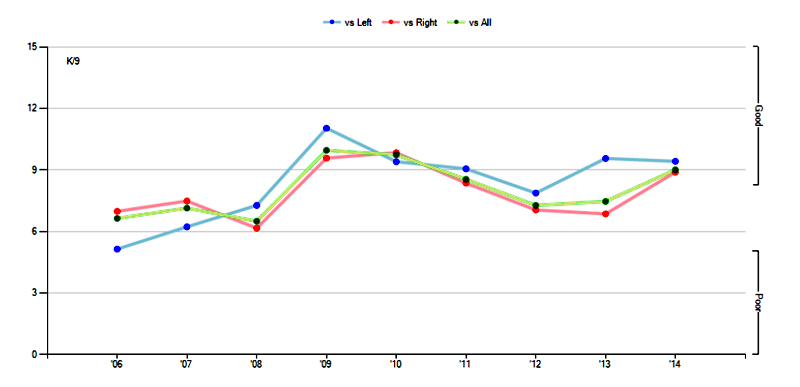
What caused Lester to fall from the ranks of the elite and become more of a number-two starter? The strikeouts disappeared.

800x387xlester-l-r.png.pagespeed.ic.p9Ej

800x394xlester-k9.png.pagespeed.ic.-Zrox
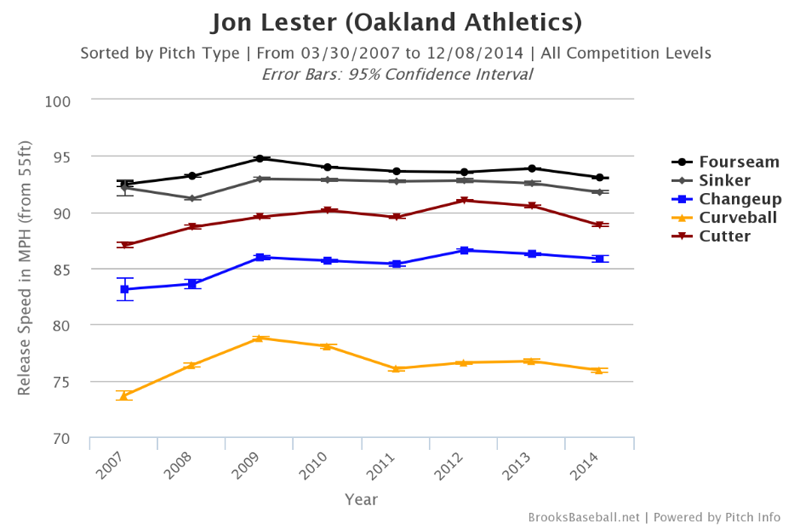
The problem was especially apparent against righties, whom he struck out at only a 17.9% clip in 2013 (compared to 26.3% in 2010). What caused this decline? Let’s take a quick look at the Pitch F/X data. A lot of people are under impression that the decline was due to velocity loss that occurs with aging. This isn’t really the case for Lester. Lester’s fastball velocity has declined by less than one mile per hour, from 94 MPH in 2010 to 93.2 MPH in 2014. While the cutter and curveball have lost velocity, they aren’t as dependent on velocity as the fastball:

800x529xlester-pitch-type.png.pagespeed.
If we take a look at his pitch usage, we notice two things: He has for the most part ditched the sinker and changeup in favor of the fastball, cutter, curveball combination that our Matt Trueblood detailed in his recent piece.

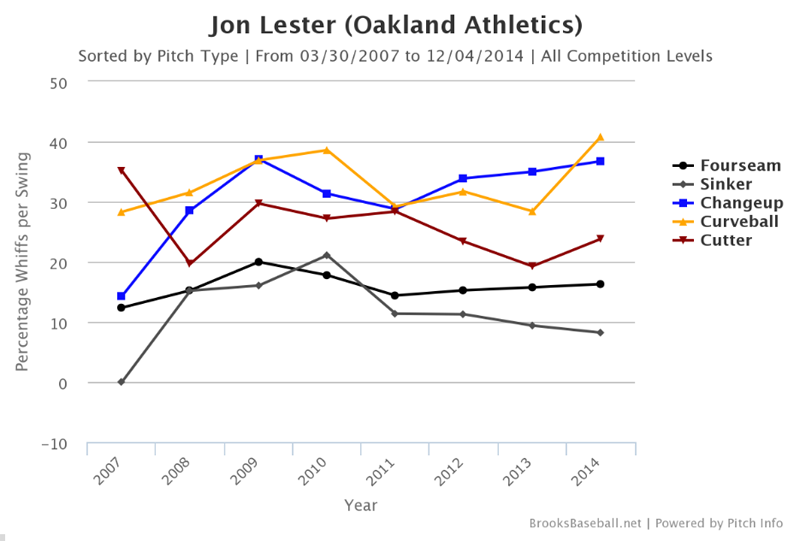
Let’s take a look for the most telling data for any pitcher: the ability to get hitters to swing and miss.

800x541xlester-whiff.png.pagespeed.ic.Br

Lester’s fastball generated whiffs on 16.3 percent of all swings in 2014, his best mark since 17.8 percent in 2010. That is around the league average of 16.4 percent, according to Eno Sarris’s benchmarks. The cutter, which he is throwing at a career-high frequency of 31.0% of all his pitches, is generating a whiff-per-swing rate of 23.8 percent (5th in MLB, minimum 500 pitches thrown), above the league average of 21.4%. The pitch isn’t as good as it used to be, when it generated whiffs on over 28 percent of swings, for reasons Sarris detailed last year. However, it’s still a very good pitch that was even better in 2014 due to improvements in the horizontal movement.

The curveball, though, is what’s special. In 2014, Lester’s curveball generated whiffs-per-swing on 40.8 percent of opponents’ swings, the highest mark of his career—and 12 percentage points more than in 2013, when his curveball was league-average in that regard. In 2014, It was the best curveball in the league in terms of whiffs per swing, with pitchers like A.J. Burnett, Adam Wainwright and Sonny Gray behind him.

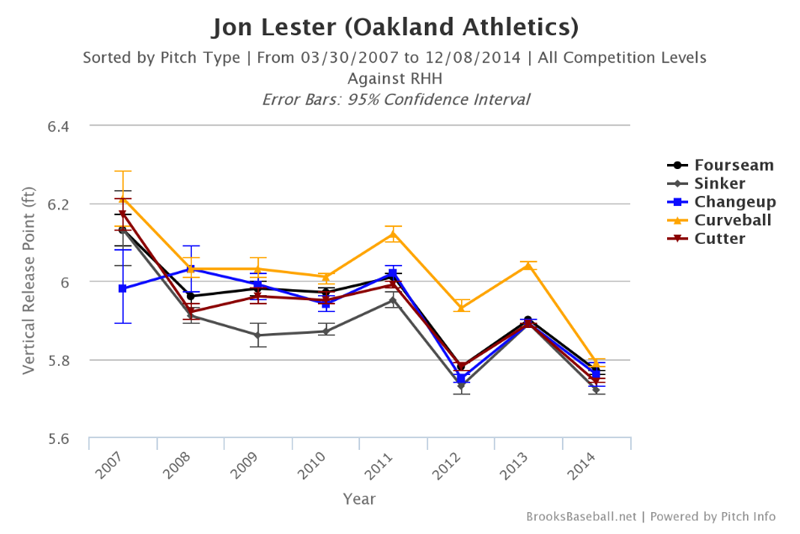
Now what happened to the curveball? It didn’t gain velocity. It didn’t gain movement. It gained a more consistent vertical release point. Look at 2014. Lester changed his release point on all pitches, but as you can see, the release points of the fastball, cutter, and curveball are tightly grouped together. Now look at 2009 and 2010, and compare it to 2011-2013. It appears that in his “peak years,” Lester maintained a better-disguised release point on the curve than he did in 2011-2013.

If the curveball was being tipped or was less deceptive, righties would have the best look at it.  Let’s check that out:

800x534xlester-release.png.pagespeed.ic.

nAa3HGr.png


NqtDfGc.png

There is something incredibly satisfying in finding the results we might expect. The curveball generated 41.4% Whiffs/Swing vs. righties compared to the 25.8% in 2013. Lester’s Curveball caused 25 Ks against righties, 6th in baseball compared to 2014 when it only caused 6. This is exceptional because he only generated 55 whiffs on the CB vs. RHH. When righties do make contact, they aren’t hitting it hard, only slugging .151 against the hook last year, compared to .338 in 2013. Righties aren’t picking up the curveball like they were before, and in 2014, that solved the platoon issues he had against them in previous years. Trueblood said, “Lester might have tapped into something that will allow him to dominate right-handed batters in the future.” That something is the curveball. It allowed him to ditch his changeup with little consequence.

The gist is that 2014 Jon Lester was more like 2009-2010 Jon Lester than 2011-2013 Jon Lester. A mechanical adjustment allowed the curveball to reemerge as an elite weapon in Lester’s arsenal, complementing a very good cutter and an above average fastball. It also allowed him to enjoy success versus righties again. The question is: How sustainable is this change? If Lester can lose his mechanics for years, is there serious risk of him losing them again? Can he continue to improve? If he can bring the curveball back to its former glory, can he regain a bit more movement on the cutter again? Can he bring back an effective sinker, giving him a deeper arsenal? These are the questions on which the Cubs will be betting $155 million on. If these changes can be sustained, it wouldn’t be surprising if Lester is worth the contract barring injury. Just one 5 WAR season can be worth $40M on this market. Lester made a slight change to his mechanics and it just might have earned him tens of millions of dollars.