Archive for Player Analysis

Free Agent Profile: Yoenis Cespedes

Yoenis Cespedes will be one of the most watched upcoming free agents this winter. He has become a coveted player on the market that has earned a huge payday. Cespedes defected from Cuba and signed a 4yr/36m deal (’12-’15) with the Oakland A’s in 2011. He immediately burst onto the scene as an offensive force hitting 20+ home runs, driving in at least 80 runs and slugging .450+ in each of his three seasons. After his success in Oakland, he became a journeyman over the last two seasons being traded to Boston, Detroit and then to the New York Mets this past July.

As a Met, he’s hitting .302 with 17 home runs and 42 RBI in 42 games after a week of hot hitting. Cespedes has totaled 2.9 Wins Above Replacement (WAR) with the Mets and his 6.9 WAR for the 2015 season ranks in the top 10 in the major leagues between both pitchers and hitters. Cespedes is a free agent this off-season but is a special case, as he can’t receive a qualifying offer for a draft pick. When Oakland signed Cespedes as a free agent out of Cuba, they took a significant gamble that he would be major-league ready, inserting him into their lineup right away. Cespedes’ contract requires that he be released after the season without the qualifying offer. The Mets would’ve retained exclusive negotiating rights for the first five days following the conclusion of the 2015 World Series. After that, they couldn’t negotiate with Cespedes until May 15, 2016. But due to the recent success and big gamble of a new payday from New York, Cespedes waived that part of his contract and will now be able to sign with New York at any time in the FA period.

Career Numbers

Cespedes’ value with the Mets is astronomical. After acquiring him on July 31st the Mets have scored the most runs (311) in the majors since that time. Before the acquisition the Mets were 28th in the league! They had what was considered a minor-league offense. Although they did acquire Kelly Johnson and Juan Uribe, none have made more of an impact than Cespedes. What Cespedes brings to a team is power and pure run support. He became a catalyst for a struggling team and propelled them into first place. Almost all the hitters in their lineup have boosted numbers since that time as well. Pitchers can’t afford to pitch around batters in front of Cespedes. More guys are getting more pitches to hit resulting in more men on base for Cespedes to drive home. He also plays average defense and has a cannon for an arm.

metsweb2s-3-web


INTERESTED BUYERS:
I can see Cespedes re-signing with the Mets if they have a successful postseason. The fans along with the media would grill the front office/ownership if they did not get him back. That was the case this past trade deadline when GM Sandy Alderson was scrutinized for not making any moves until the final days leading up to July 31st. Roc Nation has the rights to negotiate his contract and as we saw from Cano’s FA market in 2013, they may try to get the most lucrative deal by waiting it out and reaching out to all interested teams. If the Mets want him back they are going to have to give him a big payday.

Some other clubs I can see having interest in Cespedes could be Baltimore, Houston, Miami, and San Diego (if they lose Justin Upton). I think the ones that just makes the most sense are Houston and Baltimore — they need to have more consistency, especially in their OF positions. Houston has Rasmus, Gomez and Springer. But Rasmus is a FA this offseason and Gomez has struggled. I think Cespedes provides that jolt to an offense that’s hard to find. He produces runs, which any offense needs. They could have Altuve, Correa and Springer/Gomez hit in front of Cespedes. That would be an incredible lineup. Throw in their great young staff and a decent back end of a lineup. That’s a scary team. Plus, they have the payroll to go out and get him. Right now its only about $72,000,000, but we’re not sure if ownership wants to go out and spend on one guy. They may try to find value elsewhere for cheaper which is something that General Manager Jeff Luhnow likes to do.

As for the Baltimore Orioles, they have Adam Jones in CF and could sign Cespedes to play LF. He has better defensive numbers in left and if the Orioles cannot sign 1B Chris Davis back I think they will strongly consider Cespedes. Baltimore has a ton of money coming off the books having only $41 million committed to next year so it seems as if they will have a lot of changes coming their way.

San Diego could be a good fit only if Justin Upton signs elsewhere, otherwise he’d be useless on a team that has three solid outfielders and no DH. We know AJ Preller could wave his magic wand at any moment and make something happen. Lastly, Miami could be a dark horse. They cut back on their spending in the last couple years but could look to make another “Marlin splash” with Yoenis Cespedes. Miami plays in a big Hispanic market and considering they are located not too far from Cuba, that could be influential in their decision-making.  The excitement from the fans and a power-filled lineup would be tremendous. Just imagine facing a lineup with Dee Gordon, Yoenis Cespedes and Giancarlo Stanton…someone call Jack McKeon to manage this squad.

In the end, I think Cespedes does sign back with the Mets, especially if they have a deep postseason run. The Orioles are the second favorite. I think the fans/media will get on the front office/ownership to sign him back. The Wilpons might be cheap but after seeing this postseason run they are going to ask themselves, how could they not? Cespedes seems to like being the top dog on a team; with the Mets he’s exactly that. As Reggie Jackson would say, “the straw that stirs the drink.” Without him, they are very vulnerable, as shown before his acquisition.

In terms of his deal, I think he will get around $26 million average annual value (AAV). The big part is how many years he will be able to get. After seeing Roc Nation get Cano to sign for 10 years, I don’t think we will see another double-digit figure like that. It seems that most teams are trying to shy away from that long-term deal and rather give a 6/7/8yr contract with more AAV. So I believe Cespedes will most likely go for about 7 years but higher AAV. Although I don’t think we will be surprised if a front office came up to 8-9-10 years…it’s not every day a .290, 30+HR, 100+RBIs, 7 WAR guy comes on the market.

Similar players we can compare to: Shin Soo Choo – 7yr/130m (18m/AAV) and Jacoby Ellsbury – 7yr/153m (21m/AAV). Cespedes has better numbers than both these players, especially in the power department. Choo was a guy known more for getting on base and Ellsbury had his average/legs/defense behind him. There’s no doubt in our minds Cespedes will get more than these two. If we also take into consideration that for every 1 WAR, a player usually gets $7-8 million/yr. Cespedes this season already has 6.9 WAR. That’s incredible but he’s more likely not to keep that up and fall back to his career average of about 4-5 WAR per season. With that being said, 4-5 WAR equates to a very high salary. The Mets/other teams will probably go a bit overboard and give on the higher end as usual. I think he will get to 7 years/182m for 26m AAV. I don’t think any of these teams will go to 8 years or longer because of the history of longer contracts not working out. If anything this deal will contain more AAV.

As Jerry Seinfeld tweeted: “A Cespedes for the rest of us.”
A Cespedes for the rest of us
PROJECTION: 7 years, $182 million with Mets or Orioles.


Why IP Is a Poor Indicator

Innings pitched (IP) seems to be the standard for judging a player’s workload. Sure it will tell you how deep into a game a pitcher went and it’s often used as a measure of pitcher durability, but it tells you nothing about a pitcher’s effectiveness. A far more useful stat is the pitch count during each particular outing, or even better pitches per innings pitched (P/IP). I think we can all agree that all innings are made differently. A pitcher can throw three pitches or it can take 61 pitches as evidenced by Steve Trachsel (1997 – Chicago Cubs) and still get credit for 1 IP. Actually I think it’s possible to throw zero pitches and get 3 outs, but I don’t have the motivation to look up the rule at this particular moment.

Here are some stats for three players in the 2015 season.

Player GS W L IP
Player 1 27 11 10 159.2
Player 2 26 12 7 171.2
Player 3 30 12 10 169.1

All the players in the table above have very similar peripheral statistics, aside from an IP difference of 12 between players 1 and 2. From looking at these stats it’s a toss-up as to who has had the most successful season — do you choose player 2 since he has the most IP or player 3 since he’s made the most starts? In the table above Chris Heston is player 1, Matt Harvey is player 2 and Yovani Gallardo is player 3. What really separates the players is the pitch counts and P/IP.

Chris Heston – 2461 Pitches and 15.4 P/IP

Matt Harvey – 2533 Pitches and 14.8 P/IP

Yovani Gallardo – 2959 Pitches and 17.5 P/IP

Chris Heston has 12 IP less than Harvey but has thrown 72 fewer pitches this season. Harvey and Gallardo have thrown about the same amount of innings, but Gallardo has thrown 426 more pitches this season. The reason I chose Harvey as one of the pitchers for this comparison is due to the very public feud between the Mets, Boras and Harvey. In case you missed it, there was a disagreement with the innings limit imposed on Harvey in his first season after Tommy John surgery. Boras wants the Mets to stick to 180 IP while the Mets thought it was more of a soft cap. I wanted to look at the relationship between the IP in a season and the total number of pitches thrown. Luckily this data was readily available for download via FanGraphs, but only pitch counts back to 2002 were available. Below is a plot showing all pitchers who threw more than 100 innings in a season compared to their pitch counts. The data has a linear relationship, with the red line showing the mean and the outside black lines are the prediction intervals where we would expect 95% of the observations to fall within.

Now based on the 180 IP limit imposed on Matt Harvey, a linear model predicts that a pitcher would throw 2867 pitches in a season with an upper limit of 3158 and a lower limit of 2576. Now this means that at 180 IP we can reasonably expect a pitcher to throw between 2576 and 3158 pitches. Now for a guy coming off a major surgery, doesn’t a range of 582 pitches seem a bit extreme? It basically amounts to a difference of 5 complete games’ worth of pitches. In the plot below I also highlighted an innings range based on the range of innings where a pitcher throws 2867 pitches in a season. Now most importantly this range extends from 160 to 200 innings.

The medical team could just have easily set a limit anywhere between 160 and 200 IP. This is why an innings limit doesn’t work well in this situation; there is just too much variability in the data. In the future it will probably be a better idea for team officials and the medical staff to discuss a pitch limit over a season instead of an innings cap. Since the main goal of limiting a pitcher’s workload is to reduce stress on his arm I think the plot above does a good job showing that innings limits will have very little effect on actually managing a pitch count. Harvey is obviously thinking about the long term here because I know he doesn’t want to go through another surgery. After a second Tommy John the chances of a pitcher returning to the majors drops to somewhere around 30%, not to mention the drop in potential future earnings.

So I’ve shown you why I don’t think IP is a good indicator and now I’m going to show you why I think pitch counts and P/IP should be more important statistics.  Based on the linear model shown in plot 1 the formula to predict pitches in a season is as follows: Pitches = IP*14.5 + 256.9. Now the intercept for this model is 256.9 which suggests that if you don’t throw a single inning in a season you would still be expected to have thrown 257 pitches. Obviously there is something going on at the lower inning totals, but we are going to ignore that for the purpose of this article. As an added note, the lower prediction interval from plot 1 has an intercept of -33.975, so we are very within range of showing 0 pitches for 0 IP from this model.

Player IP P/IP P/IP Rank Actual Pitches Expected Pitches Difference Predicted IP
Chris Heston 159.2 15.4 24 2461 2565 -104 152
Matt Harvey 171.2 14.8 11 2533 2739 -206 157
Yovani Gallardo 169.1 17.5 84 2959 2708 251 186.1

Heston and Harvey both rank very high in P/IP among qualified starters while Gallardo is dead last among qualified starters. Efficiency is key here. Should Harvey be directly compared to Gallardo based on IP? No, absolutely not, Harvey is among the most efficient pitchers in the game this year. He has been able to get through innings while keeping his pitch count down and most importantly reducing stress on his arm. An inverse prediction based off pitch counts was used to predict the IP in the table above. Based on their pitch totals from this season Harvey and Heston have “thrown” less than their IP totals suggest and Gallardo has actually thrown quite a bit more. This has a big effect on that innings cap imposed on Harvey for this season. His stats show that he’s thrown 171.2 IP, but based on the number of actual pitches he’s thrown in game situations his number may be closer to 157 IP. Does that mean he should have the equivalent of 23 IP left in the tank for this season? Well that’s not up to me, but IP should less important than total pitches.

One thing I didn’t look at this article was the proportion of pitches thrown throughout the 2015 season. It’s been in the back of my mind, but I don’t have a reference for what the most stressful pitches are on a pitchers arm. I think it’s safe to assume that all pitches are not equal. Let’s think a Dickey knuckleball vs. Chapman fastball. The amount of effort needed for each pitch type is likely highly dependent on the pitch speed and type, but to simplify things here I’ve just assumed that all pitches are equal. We also need to realize that all pitchers are not equal, whether it be mechanics or individual variation in abilities. I was curious to see where Mark Buehrle’s pitch count (leaderboard here) lined up with all other pitcher since 2002 and lo and behold he’s thrown the most pitches since records became available. Obviously he doesn’t throw as hard as many of the other guys in the league, but that hasn’t stopped him from being a workhorse and one of the most effective pitchers over the last decade.


How Rare Is a Chris Davis Comeback?

The Orioles are having a rough go of it. After being tied with the Yankees for first place in the AL East on July 2nd with a 42-37 record, the Orioles have gone 26-36 since and, as of September 13, are just a half-game above the last place Red Sox.

However, the standings don’t appear to be having an effect on Chris Davis, the slugging Orioles first baseman who is in the midst of a hot streak that includes 6 HR and a .493 OBP in his last 15 games. Davis’ recent performance continues his resurgence, bringing his average up to .261 and his home run total to 41 on September 13. Davis struggled mightily last year before a suspension for unapproved Adderall use cut short his season, finishing with 26 HR and a miserable .196 BA. A power surge couldn’t come at a better time for Davis, who is looking to make more money in the free-agent market this offseason.

Just how rare is Davis’ comeback, however? Davis was an established major-league player before this season, having played 723 games while averaging 2.0 WAR per 162 Games. His Oriole-record 53 homers in 2013 (which included 7.1 WAR) made him a star while his forgettable 0.8 WAR in 2014 made him just another one-hit wonder.

Examining position players with at least a full season’s worth of games played before their comeback season, we’ll set the following criteria for a comeback:

  • At least 2.0 WAR per 162 Games prior to the comeback year
  • The WAR for the comeback year is at least 4.0
  • The WAR for the previous year is less than 1.0

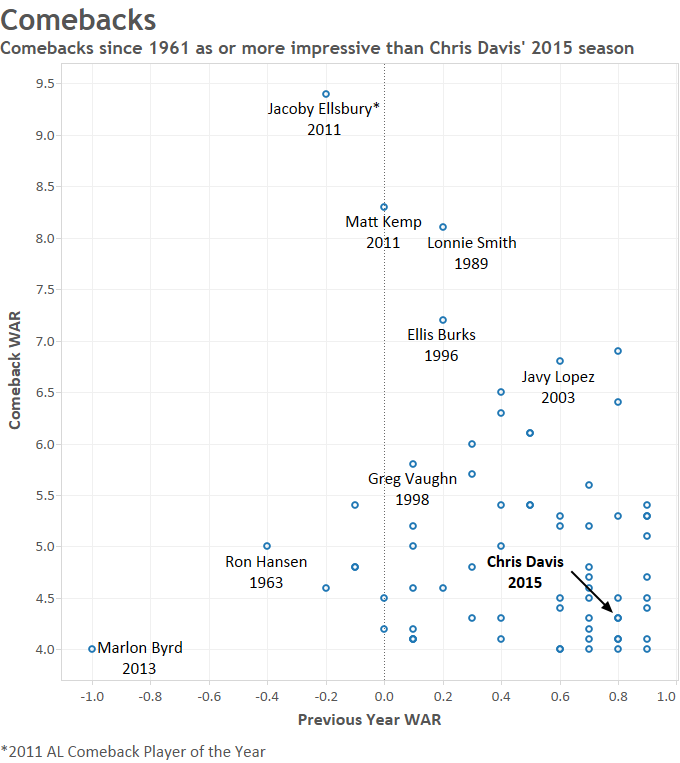
These baseline cutoffs are very similar to Chris Davis’ 2015/2014 experiences. Noting these, we find 70 comeback seasons since the beginning of the expansion era (1961) that fit the criteria.

Davis’ 2015 is bunched around Coco Crisp’s 2007 with the Red Sox and Victor Martinez’ 2014 with the Tigers. These players all saw their WAR increase by about 4.3 from their previous years.

The most impressive comeback in terms of WAR improvement was Jacoby Ellsbury’s 2011 with the Red Sox, when he put together a 9.4 WAR season after an injury-shortened -0.2 WAR season.

Overall, a comeback like Davis’ isn’t all that rare. In fact, comebacks as or more impressive happen about five times every four years. That shouldn’t deter Davis, however, whose performance is one of the bright spots on a struggling Orioles team.


Performance After Tommy John Surgery

In the past few years a number of high profile pitchers have gone under the knife for Tommy John surgery (TJS). This surgery involves reconstructing the ulnar collateral ligament (UCL) in the throwing arm to re-stabilize a players elbow. I’ve heard a few stories about TJS — firstly, pitchers who get the surgery are able to throw harder after the procedure and another where college pitchers were voluntarily undergoing the procedure and sacrificing a year of pitching due to the belief that they would be able to throw harder or have more stamina. Whether either of these are actually true I have no idea, and I didn’t do any digging to find the answer. Instead I wanted to take a closer look at some pitchers who’ve undergone the procedure in the last couple of years and compare their performances before and after the surgery. In the table below I’ve included 4 players who missed the entire 2014 season or a significant portion of it. Matt Harvey underwent the procedure in October of 2013 while the other pitchers had the surgery sometime in 2014.

Name Season GS IP K/9 ERA FIP xFIP
Matt Harvey 2013 26 178.1 9.64 2.27 2.00 2.63
2015 24 160.0 8.38 2.48 3.34 3.38
Matt Moore 2013 27 150.1 8.56 3.29 3.95 4.32
2014 2 10.0 5.40 2.70 4.73 4.54
2015 6 26.2 5.74 8.78 5.61 5.77
Jose Fernandez 2013 28 172.2 9.75 2.19 2.73 3.08
2014 8 51.2 12.19 2.44 2.18 2.18
2015 7 43.0 11.09 2.30 1.74 2.48
Patrick Corbin 2013  32 208.1 7.69 3.41 3.43 3.48
2015  11 56.1 6.06 3.67 4.02 3.18

In 2013 all of the pitchers had pretty good years. They all made at least 26 starts and threw at least 150 innings. Fernandez and Harvey were both striking out more than one batter per inning, while Moore and Corbin still posted very respectable numbers. Now Harvey and Corbin didn’t pitch at all in 2014 and the other two suffered their injuries early in the 2014 season. Matt Moore only pitched 10 innings so it is tough to draw any conclusions due to small sample size, while Jose Fernandez threw 51.2 innings before he was shut down. His 2014 season was looking very promising posting very high K/9 numbers with a low ERA and his FIP and xFIP were even more favourable.

Now lets jump ahead to 2015. If you want to check over their 2015 stats they are in the table above. I’m not going to regurgitate them for you, but I will give a quick synopsis of each player. Harvey is having an excellent first year in his recovery, and in limited sample Corbin and Fernandez are also throwing really well. Matt Moore has had a season to forget so far, but he is just about return from a stint in AAA where he posted pretty strong numbers so the jury is still out.

Any time a player is coming off a major injury it is entirely within reason that psychological issues, fitness/conditioning or lack of practice has an effect on their performance. Without any first-hand knowledge of their unique situations fans always want a pitcher to just step right back in and perform at previous levels without any decline in performance. It’s tough to only compare stats from a before and after season and say with confidence whether a pitcher has lost any ability. So I wanted to go a step further and look at some PITCHf/x data and take a look at how their fastball, breaking ball and change-up velocities have changed, as well as any changes in the movement of their breaking balls.

Pitch Speeds By Year (MPH)
Matt Moore Patrick Corbin Jose Fernandez Matt Harvey
FF SL CH FF SL CH FF CU CH FF SL CH CU
2011 95.2 82.7 85.8
2012  94.2  82.1 85.8 90.7 78.8 80.2
2013  92.4 81.1  84.5  91.8  80.0  81.0  94.7 80.9 86.3  95.0 89.0 86.7 82.3
2014 91.3  79.7  84.2 94.9 82.3  87.7
2015  91.0  79.0 83.3  92.4  81.2  82.2 95.8 83.2 88.5 95.9 89.3 87.9  83.2
FF = 4-Seam Fastball, SL = Slider, CH = Change-up, CU = Curveball

Let’s start off with fastball velocities. As you can see from the table above Matt Moore has data going all the way back to 2011. His fastball velocities have decreased each year which should be a cause for some concern. The remaining 3 pitchers have all shown increased fastball velocities since their rookie years. Whether this is proof that TJS has an effect on increasing pitch speed I’m not sure and I’m not going to speculate, but I would welcome any comments from people who may have some theories. I’ll let you read through the rest of the table, but in general, Moore is showing decreased speed for all of his pitches this year and everybody else is throwing their stuff just a little bit harder.

OK now that’s enough looking at tables, let’s move on to some pretty graphs. Who doesn’t like a nice graph? So the first one from the set of pitch trajectories that I’m going to show you are the mean fastball trajectories from each pitcher with different colours showing a trajectory from different years. Now I’ll admit that I don’t know much about trajectories and how to analyze them, but the interesting part that I found from these was the release point. Matt Harvey has been remarkably consistent with his fastball release point; Fernandez and Corbin haven’t changed all that much either. But look at how Moore’s arm slot has dropped in the last three years. Now again I’m certainly no expert in pitching mechanics but something seems to be going on there that might be related to the drop in velocity that we saw above.

On to the curveballs! There doesn’t seem to be too much going on with arm slot changes here. Fernandez looks like he changed up his arm slot from the 2013 season and his release point has been almost identical in 2014 and 2015. Harvey on the other hand has slightly dropped his arm, but from my standpoint it doesn’t seem too significant.

Lastly we come to the sliders. Look at Harvey and Corbin! If the pitches weren’t different colours it would be very difficult to tell them apart based on the release point. Moore seems to have dropped his arm slot from the 2013 season, but his release point has remained the same the last 2 years. Corbin is definitely targeting the bottom corner of the strike zone with his slider; it looks like he may be trying to get hitters to chase. Moore and Harvey look like they are also doing a good job of keeping those pitches down in the zone.

For those of you who are not too familiar with stats, I’m going to give you a quick lesson about confidence intervals. In the plots below I’ve included the 95% confidence intervals. Basically if the ends don’t overlap from the coloured bars you can consider the differences from year to year to be significantly different statistically (boring!). On to the fun stuff — the year after Fernandez and Harvey had TJS, the spin rates on their curveballs are considerably lower. I know it’s a little tough to tell if the bars are overlapping on Harvey’s curveball, but trust me, the lines aren’t overlapping. Maybe both pitchers are a little worried about their elbows or maybe it’s just advice from the doctor, trainers, coaches, their parents, who knows. Harvey is also showing a decreased spin rate on his slider from 2 years ago. If we ignore 2013 for Moore, then Moore and Corbin have maintained consistent spin rate from their last season.

And finally we get to our last plot; hopefully I’ve kept you all interested up to this point. This is looking at the pitch movement (in inches). The decreased spin rate illustrated above for Fernandez and Harvey’s curveball has also led to less movement. Fernandez has lost just a little over a 1/2 inch from his curveball since last year, but about 1.5 inches from his 2013 curve. That seems like an awful lot, but I don’t know if there has been any change in the effectiveness of his curveball in that time. Oddly enough after TJS the sliders are showing more movement. Maybe that elbow is a little more stabilized, or maybe it has something to do with increases in velocity, but unexpected on my end to see that.

From what I can tell Harvey, Corbin and Fernandez haven’t lost a step. Moore is somewhat of a mystery though. It’s tough to tell if anything has changed, but he only threw 10 innings last year so any direct comparison to last year would be useless. I’m a little alarmed at Moore’s decreasing fastball velocity since 2011. He’s going to need to start relying on his secondary pitches if he’s going to be successful going forward. But the basic conclusion that I’m going to draw from this analysis is that players are able to come back from Tommy John and still be effective. I’m sure there are articles that argue in favour and against my conclusion, but by showing you some information about pitch speed, release point and spin rate you can go ahead and make you own conclusions.


Ian Desmond’s Second Half Resurgence

It’s been just over a month since Ian Desmond’s mid-season outlook. Things were not going well for Ian Desmond, playing in his contract year in 2015 he was hoping to set himself up for a massive pay day. After turning down a reported $107 million dollar extension, Desmond was hoping for a productive 2015 season. Things could not have gone much worse in the first half of the season.

Desmond’s monthly splits reveal a roller coaster season for the soon-to-be free agent. March and April started out slowly, his play picked up in May, and then June came. The month of June was simply abysmal, so of course let’s take a more in-depth look at his numbers that month. His performance that month compared to his career averages were all much worse. He walked only 3% of the time while striking out 33.3% of the time (just over 10% higher than his career average). Any time you combine a low walk rate and a high strikeout rate you can expect a really poor OBP. In the month of June his OBP (note: NOT HIS BATTING AVERAGE!) was below the Mendoza line and his wRC+ was 22. That means in the month of June Ian Desmond created 78% less runs than league average. For a player in his walk year and especially someone who turned down over $100 million, it should be concerning to say the least.

Monthly BB% K% OBP SLG ISO BABIP wRC+ wOBA
Mar/Apr 6.90% 22.80% 0.287 0.326 0.109 0.279 70 0.274
May 4.30% 28.70% 0.310 0.444 0.167 0.375 106 0.326
Jun 3.00% 33.30% 0.194 0.269 0.108 0.207 22 0.204
Jul 8.00% 33.00% 0.253 0.392 0.203 0.234 73 0.278
Aug 8.20% 24.70% 0.353 0.500 0.205 0.358 135 0.369
1st Half 4.90% 28.40% 0.255 0.334 0.124 0.279 60 0.259
2nd Half 8.60% 28.60% 0.338 0.512 0.236 0.342 133 0.366
Career 5.90% 23.10% 0.312 0.425 0.161 0.321 101 0.321

Then something strange happened: Ian Desmond started turning his season around after the All-Star break. His stats in the second half have been a complete turnaround. He’s walking more, striking out less but still more than his career average, and generally just performing better. His August BABIP is well above his career average suggesting that we can expect some regression at some point.

While only 35 games into the second half, his performance compared to the first half is night and day. He has already hit more home runs and stolen more bases in less than half the games, and his RBI total is inching closer to his first half mark. Most importantly, in the second half of the season he has been worth 1.1 WAR (Bryce Harper for comparison has been worth 1.5 WAR in the second half). Not only is this good news for Desmond’s free-agent stock, but the Nationals will need all the help they can get while they try to chase down the teams in front of them for a playoff berth. As of right now, the Nationals are 5.5 games back of the Mets for the division lead and 10.0 games back of the Cubs for that second wildcard.

Monthly G PA HR R RBI SB WAR
First Half 84 348 7 36 24 5 -0.6
Second Half 35 140 8 21 22 6 1.1

As an added bonus, I thought it might be useful here to show a plot of Ian Desmond’s career trajectory as predicted by his seasonal OPS. This model was created using the methods presented in the book “Analyzing Baseball Data with R” by Max Marchi and Jim Albert, and I’ve excluded Desmond’s age-23 season where he only played 21 games.

Based on the age trajectory graph it looks like Desmond may have already peaked in his career. What this means for his potential earnings this upcoming offseason remains to be seen. Any GM looking to add a top-tier hitting shortstop for the next few seasons will inevitable come calling his agent, but the data tells us that his best days may be behind him.


Introducing Two New Pitching Metrics: exOUT% and exRP27

exOUT%

In the early 21st century, Oakland Athletics’ General Manager Billy Beane revolutionized baseball forever. He was the first general manager in baseball to heavily utilize sabermetrics in his baseball operations. This isn’t a history lesson though, I bring him up because of his idea that outs are precious, and as a hitter your goal is to not make out, thus him prioritizing OBP so heavily. In the following years, baseball statistics have seen phenomenal progress on both offense and for pitchers. While I believe FIP and xFIP are both very useful statistics in really measuring a pitcher’s skill, my problem is that they essentially ignore all the batted ball data that we have (GB%, FB%, LD%). SIERA and tERA have solved some of these problems, but are far from perfect, and I believe the more statistics we have, the better.

As I mentioned with Beane, while we largely focus on a hitter’s ability to not make out, we still don’t have a catch-all statistic to realize how effective pitchers are at getting batters out, because if the batter’s goal is to not make out, the pitcher’s goal is to get the batter out. So I present to you expected out percentage, or exOUT% (the name is certainly a work in progress). exOUT% sets out to answer a simple question: For any plate appearance, what is the likelihood that the pitcher will get the batter out? This can easily be found by just looking at a pitcher’s opponent OBP, but that is rather primitive, and we can get a better estimate by focusing more on pitchers’ skills to strike people out, not walk batters, and the type of contact they are giving up, and also trying to negate the effect of the defense by him, by just using league averages. So to calculate a pitcher’s exOUT%, I used K%, BB%, GB%, LD%, FB%, lFFB%, and 2014 league averages on ground balls, line drives, and fly outs. (HBPs are essentially ignored but can certainly be incorporated in a future version, this is pretty much exOUT% v1.0)

I want to give full disclosure, I am not a statistician or close to it. Math and statistics are an area of interest and I am currently pursuing a degree in math-economics, but I am far from a professional, so I recognize there are going to be errors in my data. This is an extremely rough version; there’s even a combination of data from this year and last year so there will be inconsistencies, as I don’t have the resources to gather all the data I need. If after reading this, you are interested in this and would like to take this further, please feel free to contact me if you have the skills necessary to advance this further (or even if you don’t).

I will first post a simple step-by-step breakdown of how to calculate exOUT%, and then get into more detail and take you through it with Clayton Kershaw, because well, he is awesome.

1- Add K% and BB%, subtract this percentage from 100%, this leaves you with a balls in play%, let’s just say BIP%

2- Multiply the pitcher’s GB% (make the percentage a number less than 1, for example 40% is .4) and BIP% (leave it between 1 and 100, ex 40%), this gives you a GB% for all PAs, not just balls in play, we’ll call this overall GB%, or oGB%… now multiply this percentage (in between 1 and 100) times the league average percentage of ground balls that don’t go for hits (league average is .239 on ground balls in 2014, so out percentage on ground balls is 76.1%, but make it .761…. this will give you a percentage you can leave between 1 and 100, if the number is 20%, that means that there’s a 20% chance that pitcher will induce a ground ball out that PA, assuming league average defense, we can assume this because we’re using the league average for batting average on groundballs… we’ll call this exgbOUT%

3- Now follow the same steps but with LD%, exldOUT%, the percentage chance for any given PA that the pitcher will produce a line drive out. (The league average on line drives last season was .685 (!) so that means there is a 31.5% chance a line drive will result in an out)

4- Same thing with FB%, sort of, because we also want to incorporate IFFB%. So multiply a pitcher’s FB% by their IFFB%, this gives you the percentage of balls in play that the pitcher produces an infield fly ball (bipIFFB%). Multiply this percentage by their BIP% to get his overall percentage of PAs that result in an infield fly, and this will also be their exiffbOUT%, because any infield fly ball should be converted to an out, and if not, it’s to no fault of the pitcher, so we won’t punish him. Next subtract a pitcher’s IFFB% from 1 or 100, whatever, and this is their balls in play percentage of fly balls that are normal fly balls, to the outfield. Multiply this number by their BIP%, this gives you the overall normal FB% for a pitcher, not just balls in play. Multiply this number by .793 (the league average on fly balls in is .207, so there’s a 79.3% that a fly ball will result in an out). This number is the percentage chance that for any given PA, the pitcher will produce a fly ball out to the outfield. Add this exnfbOUT% (n for normal) and his exiffbOUT% and you have his exfbOUT%, the percentage that for any given PA, the pitcher will produce a flyball out, to the infield or outfield.

5- Add K% + exgbOUT + exldOUT + exfbOUT

6- You have your exOUT%


The terms are not that technical or scientific so I don’t confuse anyone — I tried to simplify a very complicated procedure as much as possible. To clarify and give you an example, let’s go through Clayton Kershaw.

Kershaw profiles like this (I compiled this data on 8/21): 32.3 K%, 4.9 BB%, 52.8 GB%, 26 FB%, 11.8 IFFB%, 21.2 LD%.

So let’s look at the balls that don’t go in play, strikeouts and walks. Add the two and balls not in play percentage is 37.2, 4.9% are walks and thus won’t be an out, and 32.3% are strikeouts so will be an out. Thus far, Kershaw’s exOUT% is 32.3 (of a possible 37.2 so far)

Now let’s look at the balls in play. People will usually say that a pitcher can’t control what happens when a ball is in play, but I vehemently disagree, the type of contact the pitcher gives up can’t be ignored and largely effects what will happen to the ball in play. I will quote a FanGraphs article here to explain it, “Generally speaking, line drives go for hits most often, ground balls go for hits more often than fly balls, and fly balls are more productive than ground balls when they do go for hits (i.e. extra base hits). Additionally, infield fly balls are essentially strikeouts and almost never result in hits or runner advancement.” And FanGraphs also gives us this data from 2014.

GB: AVG- .239, ISO- .020, wOBA- .220

LD: AVG- .685, ISO- 190, wOBA- .684

FB: AVG- .207, ISO- .378, wOBA- .335


So this means that fly ball pitchers are most likely to get outs, although they may be less effective because when they don’t get outs, it’s more trouble than for ground ball pitchers. But remember, this statistic is just finding the chance that the pitcher will get a hitter out.


All right, so, let’s calculate Kershaw’s exgbOUT%, exldOUT%, and exfbOUT%; you can follow the numbers along with the steps I listed above.


GB%- 52.8

62.8 x .528 = 33.1584

(33.1584 x .761)=  25.23354424 exgbOUT


LD%- 21.2

62.8 x .212 = 13.3136

(13.3136 x .315) = 4.193784 exldOUT


FB%- 26

26 x .118= 3.068 bipIFFB%

26 x .882= 22.932 (bipFB%)

62.8 x .22932= 14.401296 (onFB%)

14.401296 x .791= 11.3914251 exnfbOUT%

62.8 x .03068= 1.926704 oIFFB% and exiffbOUT%

exnfbOUT% + exiffbOUT% = 13.3469317 exfbOUT%, if you followed my math exactly a decimal may be off, like 13.31 something, but this is the number the excel doc chugged out, so I’m trusting that, my iPhone calculator can’t carry all the decimals sometimes.

Now add them all up

32.3 + 25.23354424 + 4.193784 + 1.926704  + 11.3914251 = 75.07%

K% + exgbOUT% +  exldOUT% + exiffbOUT% + exnfbOUT% = exOUT%

The league average exOUT%, using league average statistics from 2014 for the ones involved, is 69.8%. Scherzer leads the majors (well the 89 pitchers I was able to export data from FanGraphs) with a 76.43 exOUT%. If you want to look at it as a more concise and better version of opponent OBP, his is .236, so, you know, good. Here is a picture of the data for the top 37 — the J column is what you are looking at. Betances is in their because I wanted to calculate one reliever. 

View post on imgur.com

All right, I’ve explained it a bit in the prologue, but now that you’ve seen it, let me explain more why I like this stat. Well first, I created it and calculated, so, well, yeah… but I also like this stat because it answers a very simple question “How good is a pitcher at getting people out?” Pitching in its simplest form, is exactly that, getting people out. The stat recognizes that there’s basically only these outcomes for an at bat: strikeout, walk, ground ball, line drive, and fly out, and looks at the pitcher’s stats in these categories to determine how many people he should be getting out. The stat is more predictive than evaluative in nature, because you can calculate a pitcher’s actual out percentage, but that doesn’t nearly tell the whole story, because a lot of luck is involved with balls in play, and other fluky outcomes.

This operates under the basis that a ground ball will perform the way the average ground ball does, a line drive performs the way an average line drive does, and a fly ball behaves the way a typical fly ball does. There could be guys getting very fortunate with ground balls: having a great infield behind them, balls not squeaking through the holes; with line drives: being hit right at people; and fly balls: staying in the park, having outfielders who cover a lot of ground. And there could be guys who are getting unlucky: the ground balls are getting through the holes, the infielders don’t have range; line drives seem like they are always going for hits, and fly balls are falling in. This says that a pitcher can’t control that, but they can control how much they strike out people, how much they walk people, and how often they give up ground balls, line drives, and fly balls, and if these balls in play behaved the way they should, the pitcher should be getting this percentage of people out.

I will address the flaws I have found with it. As much as getting people out is important, sometimes what happens in the plate appearances that don’t end in outs are almost as important. This only deals in batting average regarding balls in play, but wOBA is very important too. Fly balls are more likely to be outs than ground balls, but the wOBA on fly balls is over 100 points higher. Additionally, I’d prefer instead of ground balls, line drives, fly balls, to use soft contact, medium contact, hard contact, because that is a truer test of pitcher skill, however, I did not have this data at my disposal as far as league averages on what the batting average is for soft contact, medium contact, hard contact (if someone does, please contact me like I said). So what I have for now will do and this batted ball data is still a good measure. I set out to calculate what percentage of batters a pitcher should be getting out, and that is exactly what I found out. So while it’s not perfect, it has its use, and it’s something to build on.


exRP27

And build on I did. While the out percentage is nice, it doesn’t give us a measure like ERA or FIP or xFIP, that tells us how many runs a pitcher should be giving up. So using the data I used to calculate exOUT%, I present to you exRP27 (expected runs per 27 outs, a stupid name for a hopefully not stupid stat).

The basis for this stat is this data from FanGraphs, “Line drives are death to pitchers, while ground balls are the best for a pitcher. In numerical terms, line drives produce 1.26 runs/out, fly balls produce 0.13 R/O, and ground balls produce only 0.05 R/O.” (I don’t know how this was calculated, or when it is accurate for, but this is what I got). We don’t know this for soft contact, medium contact, hard contact, so again I’m sticking with ground balls, line drives, and fly balls. 

All right, so what I am going to do using this stat and the pitcher’s K%, BB%, GB%, LD%, and FB% is see how many runs the pitcher should be allowing over 27 outs, and then adjust it to get it on a scale similar to ERA, FIP, and xFIP.

Keeping Clayton Kershaw as our example, let’s take a look.

Kershaw’s K% is 32.3 — we’re multiplying this by 27 (for outs in a game), and we get 8.721 K’s, so 0 runs so far because a K will never produce a run

Now GB%. His exgbOUT% is 25.23354424, multiply this by 27 and we get 6.8 (ish, final number will be exact via the Excel doc). Multiply this by .05 (the runs per GB out he gets) and we get .34 runs.

LD%- his exldOUT% is 4.193784, multiply by 27 and get 1.13232168, and multiply this by 1.26 for LD runs/out and we get 1.43 runs

His exfbOUT% is 13.3181291, now multiply by 27 get 3.6 and then that by .13 and you get .47 runs

Add up all these exRUNS and Kershaw’s total is 2.24. However, we can’t stop here because the number of outs he’s recorded is only 20.3 (8.7+6.8+1.1+3.6) approximately. 20.3 is the rounded up total. So get this 20.3 (or whatever the pitcher’s exOUTS is) up to 27  by multiplying by whatever it takes, and then multiply his exRUNS by this same number. For Kershaw you end up with 2.97 exRP27. The league average would be 3.78. Last year’s average ERA/FIP/xFIP was 3.74, but when I adjust everything to that, everyone’s exRP27 just goes down slightly (Kershaw’s from 2.97 to 2.94), but I want it to be on a more realistic scale where everyone’s totals are lower and a really good exRP27 is comparable to a really good FIP, like in the low 2s. 

So I don’t know what the statistic’s correct way is, but here is what I did to make it work. I calculated what his “ERA” would be using by multiplying his exRUNS by 9 and then dividing that by his exOUTS. His was .99, the league average was 1.26. I then did .99/1.26 to get .78 or so, I then multiplied that by his exRP27 and got 2.34. I felt like this was more realistic and in line with his ERA/FIP/xFIP. Obviously, can’t be the same because they measure different things, but just got in in the area. And the same is done for all pitchers. Obviously, not everyone gets multiplied by .78 of course. The league average remains 3.78, between last season and this season’s average for ERA/FIP/xFIP.

Here is the leaderboard for that (S column):

View post on imgur.com

 I really like this stat a lot, and feel like it does what I wanted to accomplish: figure out how many runs a pitcher should allow per 27 outs given his K%, BB%, GB%, LD%, FB%, and the notion that balls in play will behave the way they normally do, as anything else is likely luck and not indicative of the pitcher’s performance.

I look at Sonny Gray as someone this stat is perfect for. His ERA is outstanding at 2.04, but his FIP is 3.00, his xFIP is 3.47 and his SIERA is 3.50. The problem is, at least with FIP and xFIP for sure, is that they ignore what happens when the ball is in play. He doesn’t strike out too many people, he has a good BB% but not spectacular, and he’s given up 10 home runs, a fair amount, so this hurts his FIP and whatnot. However, instead of saying “well he will regress, look at his FIP/xFIP/SIERA” this looks at why he’s having this success, and it has to do with the balls in play, which is getting ignored. Gray’s LD% is just 14.6! That is really good! Second best of the 90 pitchers I did this for. And his GB% is 54%, 9th best, also really good. The pitcher does have control over the type of contact he allows, and the fact that Gray is producing a ton of ground balls, and very few line drives, is why he’s been so successful. His 2.34 exRP27 suggests that he has not been as good as his 2.04 ERA suggests, but he’s not as far off as the other stats suggest. 

Obviously exRP27 is far from perfect, and is in no way supposed to replace FIP/xFIP/SIERA, but it is something to look at with them. I am a big believes in aggregation, so I think that averaging some combination of these 4 stats together or them all, is an even better way to evaluate a pitcher. We’ve got more data than ever, so it makes sense to use it, exRP27 and exOUT% are just more examples of utilizing this data to help better evaluate pitchers.  

I hope you guys enjoyed. Any feedback please comment or contact me. Next I will be looking at exWOBA against for pitchers using similar data, and exWOBA for batters using the data but for hitters.


The Improvement of the Indians Starting Rotation

Remember at the end of last season and before this season when we all foresaw an Indians rotation that could possibly feature somewhere between 2 and 5 really good, and possibly great, starting pitchers?  Don’t get bogged down on the slight exaggeration of that 1st sentence – To recap what we were looking at coming into this season for the Indians’ rotation:  Corey Kluber won the 2014 AL Cy-Young; Carlos Carrasco had a string of starts to end 2014 in which he seemingly (finally) figured out how to harness all of his powers in a bid to ascend his name to an echelon where only Clayton Kershaw’s name resides; Danny Salazar has always had elite swing and miss stuff and was also excellent in the second half of 2014;  Trevor Bauer and his Costco-sized arsenal of pitches have made some of us incredulously, if not warily optimistic since he was taken 3rd overall in 2011; and even T.J. House made us pause and take notice with his strong second half of 2014.

Then, like hype men with a special blend of Cleveland Kool-Aid being intravenously administered, Eno Sarris and Daniel Schwartz posted one of my favorite FanGraphs articles ever, Pitch Arsenal Score Part Deux, and the anticipation over the Indians’ rotation pulsated like a vein in the neck of John Rambo in the midst of fleeing from man-hunters.
The supporting cast, the lineup, looked poised to support the staff with plenty of runs.  Returning would be: break out star Michael Brantley; bounce-back candidate Jason Kipnis; now-full-time-first-basemen, Carlos Santana; a supposedly healthy Michael Bourn; an offense-first but totally-respectable-defensively, Yan Gomes; and an actually-not-that-horrible-in-2014, Lonnie Chisenhall.  Slugger Brandon Moss, and contact-happy-supposedly-glove-first Jose Ramirez had secured full-time spots as well in RF and SS respectively.  So even though it wasn’t without flaws, it seemed like they would allow the pitchers to rack up plenty of fantasy-relevant wins.

Note: This post isn’t about the disappointment of the Indians, though they have been disappointing; it’s more about what factors beyond luck have contributed to the numbers of the Indians’ starting rotation at various points throughout the year, and the disparity (big or small) between the pitchers’ rates and predictors at those points.

The Indians’ starting pitchers, or at least the top 4 (Kluber, Carrasco, Salazar, and Bauer) have, for the most part, been putting up good, albeit, inconsistent numbers all year despite posting some elite peripheral rates and ERA indicators.  A number of reasons have caused these numbers to grow apart (bad), come together, and then grow apart again (good).  Luck can work like a bit of a pendulum, swinging from one extreme, through the middle, and to the other extreme before evening out and that is at the core of what the Indians’ starting pitchers have experienced this year — although they have yet to experience the final stabilization phase.

We will examine plenty of numbers (Beginning of season to August 18th) based on this time frame: (Spoiler alert – this article is long and dense, and this timeline serves as a sort of cliff notes as to how the staff’s numbers have improved throughout the year – so if you’re the type of person who feels like looking at a bunch of data is superfluous when the bullet points are in front of your eyes, just read the timeline and be done with it.)

timeline

April 6th – May 23rd/May 24th – June 15th

One week into the season, before it was evident that the team’s defense was very sub-par, Yan Gomes hurt his knee and hit the disabled list for over a month.  Roberto Perez filled in quite nicely, and looking at just a couple numbers, could be considered the more valuable catcher (1.4 WAR compared to 0.5 WAR for Gomes).  Brett Hayes (0.0 WAR) was called up and was the secondary catcher during this period.  Behold, a table from StatCorner:

statcorner


Perez has had the least amount of pitches in the zone called balls and the most amounts of pitches out of the zone called strikes.  Overall, despite receiving fewer pitches than Gomes, he has saved more runs (4 DRS to Gomes’ 1) and their caught stealing rates are basically identical with a slight edge going to Perez – 38% to Gomes’ 35%.  Gomes was much better in terms of framing in 2014, and it’s possible the knee injury has limited his skills all around this season.  Anyways, from April 6th – May 23rd, the combined stats of Kluber, Salazar, Carrasco, and Bauer look like this:

ERA FIP xFIP SIERA K-BB% GB%
Kluber 3.49 2.16 2.46 2.51 25.3 48.6
Salazar 3.50 3.27 2.46 2.30 28.7 43.8
Carrasco 4.74 2.60 2.67 2.82 22.3 48.9
Bauer 3.13 3.23 4.09 3.94 14.2 35.7
3.75 22.7 44.7

Gomes returned as the primary catcher on 05/24, and from that point through June 15th, the cumulative numbers aren’t too different, although there is a dip in both K-BB% and GB% that we’ll have to look into.

ERA FIP xFIP SIERA K-BB% GB%
Kluber 3.67 3.26 3.20 3.19 19.8 43.8
Salazar 3.60 3.72 3.36 3.43 17.3 47.7
Carrasco 3.65 2.83 3.29 3.17 20.2 44.1
Bauer 3.96 4.72 4.47 4.30 11.5 36.8
3.74 17.2 43.1

So despite lower K-BB and ground ball percentages (leading to higher ERA predictors), the group’s ERA in the segment of the season when Gomes was reinstated is essentially exactly the same as from the first block of time with Perez.  Now, I am not a big believer in CERA because there is a high level of variation and too many unknown variables pertaining to how much of the responsibility/credit goes to the catcher, the coaching staff, or the pitcher; but I do think that it’s possible Gomes’ extra service time has enabled him to be more in tune with his staff as well as understand hitter tendencies better than Perez and Hayes.  I realize we’re getting into a gray area of intangibles, so I’ll reel it in with some results based on pitch usage%.

% Difference in Pitch Usage with Yan Gomes compared to Roberto Perez

Pitcher FB% CT% SL% CB% CH% SF%
Corey Kluber -9.0 8.8 -17.3 5.0
Danny Salazar 9.8 -12.6 -4.4 17.1
Carlos Carrasco -6.5 9.4 49.2 13.3
Trevor Bauer -2.9 -15.0 -8.9 78.5 25.8

Using BrooksBaseball Pitch f/x data, let’s painstakingly find out how different each pitcher’s pitch usage was in regards to different counts, or better known as Pitch Sequencing.  We’ll look at first pitches, batter ahead counts, even counts, pitcher ahead counts, and 2 strike count situations.  As good as pitch f/x is, the data still isn’t perfect.  There may be discrepancies if you look at usage at Brooks compared to the usage at FanGraphs, so for each pitcher we’ll split the pitches up into three categories: Fastballs (four-seam, sinkers, cutters), Breaking Balls (sliders, curve balls), and Change Ups (straight change/split finger) – I’m aware that splitters are “split fingered fastballs”, but I liken them to change ups more because of the decreased spin rate and generally lower velocity.

*Having a table for each pitcher in regards to pitch sequencing made this article quite messy, so I’ve included a downloadable Excel file, and briefly touched on each pitcher below.

Pitch Sequencing Excel Doc.

Corey Kluber

Looking at the data, Gomes stays hard with Kluber more than Perez until they get ahead in the count.  Perez swaps some early count fastballs for curve balls, but they both see his curve ball as a put-away pitch.  Gomes tends to trust Kluber’s change-up more than Perez later in counts and Perez likes it more earlier in counts.

Danny Salazar

Much like with KIuber, when Gomes catches Salazar, they have a tendency to stay hard early.  Gomes pulls out Salazar’s wipe out change up after they’re ahead whereas Perez will utilize it in hitter’s counts as well.

Carlos Carrasco

Carrasco has 5 good pitches and he’s pretty adept at throwing them for strikes in various counts which is why there is some pretty even usage across the board, at least in comparison to Kluber and Salazar.  There is quite a bit more usage of Carrasco’s secondary pitches in all counts and there are pretty similar patterns when Gomes and Perez are behind the plate.  With Hayes, it doesn’t look like there is much that changes in sequencing until there are two strikes on a hitter.

Trevor Bauer

Bauer is probably a difficult pitcher to catch because of the number of pitches he has and the constant tinkering in his game.  Side note: Gomes is the only catcher to have caught a game in which Bauer threw cutters, and in their last game together, Bauer threw absolutely no change-ups or splits.  Bauer’s highest level of success has come with Hayes behind the plate and perhaps that’s from their willingness to expand his repertoire in more counts than Gomes and Perez do, but there is no way I can be certain of that.

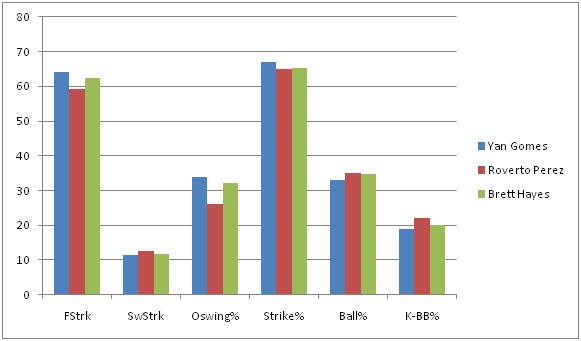
Pitch sequencing can effect the perceived quality of each pitch and therefore, can produce more favorable counts as well as induce higher O-Swing and SwStrk percentages (or less favorable and lower).  So despite the framing metrics favoring Perez, the group throws more strikes with Gomes and also induces more swings at pitches outside the zone – although, as previously noted, there is some regression with Gomes behind the dish in terms of SwStrk% and K-BB%.

swing tendencies


aaa0ide


**These graphs represent numbers through the entire season to garner a bigger sample size.

With lower line drive rates and more medium + soft contact, and (in the case of the Indian’s defense), more fly balls, a conclusion could be jumped to that the staff’s BABIP has trended downward since Gomes regained his role.  A look at BABIP throughout the course of the season:

babip


Woah!  It was well above league average in April and then plateaued at just above league average through mid June, but has been plummeting ever since.  Obviously a catcher is not responsible for this dramatic of a swing in BABIP, so the Indians’ defense must have improved.

June 16th – August 18th

The rotations’ traditional stats look even better if you use June 16th as the starting point:

Pitcher IP H K BB W ERA WHIP
Corey Kluber 84 61 82 16 5 3.11 0.92
Danny Salazar 71 46 69 23 5 2.79 0.97
Carlos Carrasco 77.1 56 77 13 3 2.91 0.89
Trevor Bauer 68.1 69 63 24 4 5.80 1.37
300.2 232 291 76 17 3.59 1.03


So let’s take a look at the Indians’ defensive alignment by month (Player listed is the player who received the most innings played at the position).


POS April May June 1 – 8 June 9 – 15 June 16 – 30 July August
C Perez Perez Gomes Gomes Gomes Gomes Gomes
1B Santana Santana Santana Santana Santana Santana Santana
2B Kipnis Kipnis Kipnis Kipnis Kipnis Kipnis Ramirez
3B Chisenhall Chisenhall Chisenhall Urshela Urshela Urshela Urshela
SS Ramirez Ramirez Aviles Aviles Lindor Lindor Lindor
LF Brantley Brantley Brantley Brantley Brantley Brantley Brantley
CF Bourn Bourn Bourn Bourn Bourn Bourn Almonte
RF Moss Moss Moss Moss Moss Moss Chisenhall

If you’ve paid attention to the Indians at all, you know they’ve made some trades and called up a couple prospects.  But just how different is the new defense?  Well, we only have a small sample with the current configuration, but it appears to be A LOT better. If BABIP wasn’t enough of an indicator, and it’s not, because there has to be some regression to the mean – it can’t stay that low – here are some numbers from the players who were playing the most in May compared to the players who are playing the most in August (again, numbers represent full-season stats):


MAY PLAYER FLD% rSB CS% DRS RngR Arm UZR UZR/150
C Perez .994 2.0 38.5 4
1B Santana .997 -6 0.0 0.7 1.2
2B Kipnis .988 4 4.5 3.6 7.0
3B Chisenhall .963 7 3.1 3.3 10.5
SS Ramirez .948 -2 -2.4 -5.2 -21.9
LF Brantley .992 1 0.3 -2.1 -1.4 -3.3
CF Bourn 1.000 4 -7.2 1.1 -5.8 -11.4
RF Moss .975 -4 1.7 -2.5 -1.1 -1.8
AUG PLAYER FLD% rSB CS% DRS RngR Arm UZR UZR/150
C Gomes .996 0.0 35.0 1
1B Santana .997 -6 0.0 0.7 1.2
2B Ramirez 1.000 1 1.1 2.8 23.2
3B Ursehla .973 2 4.5 6.0 15.7
SS Lindor .967 6 6.0 4.9 14.9
LF Brantley .992 1 0.3 -2.1 -1.4 -3.3
CF Almonte 1.000 2 0.4 -0.2 0.9 10.0
RF Chisenhall 1.000 4 1.6 0.5 2.3 27.3

What’s interesting is that the biggest difference in the infield is Francisco Lindor (Giovanny Urshela has been very solid, but Chisenhall was pretty similar this season at 3B).  I’m sure someone at FanGraphs could churn out a really cool article (if someone hasn’t already) that shows us a quantifiable difference an above average to well above average shortstop makes for a team even if you just keep the rest of the infield the same, as the control.  The 2015 Tigers come to mind – a healthy Jose Iglesias has made a difference for a team that still features Nick Castellanos at 3B and Miguel Cabrera at 1B.  Teams are willing to sacrifice offensive contributions if a SS has elite defensive skills (Pete Kozma, Andrelton Simmons, Zack Cozart to name a couple off the top of my head).  Lindor, to this point, has been an above average offensive player, too, so this could be special.

At this point the Indians are in last place and are out of contention.  Abraham Almonte is their starting center fielder and with Kipnis back from the DL, Jose Ramirez is not playing 2B, but is instead getting reps in left field while Michael Brantley DHs due to his ailing shoulder.  Perhaps all this means is that they don’t have better replacements; OR PERHAPS they’re planning to establish a more defense-oriented squad next year…

Now there’s no doubt that this research has led to some frustrating conclusions.  With Gomes behind the plate, the K rate and GB rate of the staff has trended in the wrong direction in regards to ERA indicators; so is the difference in the batted ball profile plus an improved defense enough to make up for these facts?  This small sample size thinks so, but it could 100% just be noise.  However, there are clubs that are succeeding by using similar tactics right now:

Team ERA FIP ERA-FIP GB% (rank) SOFT% (rank) OSWING% K-BB% (rank)
Royals 3.57 3.93 -0.36 42.1 (29th) 18.1 (16th) 30.9 (19th) 10.5 (26th)
Rays 3.63 3.79 -0.16 42.4 (28th) 18.7 (13th) 31.2 (17th) 14.8 (7th)
Indians (as a reference) 3.85 3.65 0.20 44.7 (17th) 18.2 (15th) 33.3 (2nd) 16.9 (1st)

Granted, the Royals and Rays have the 1st and 2nd best defenses in baseball, and their home parks play differently than the Indians, but they also don’t boast the arms the Indians do.

The Indians have their noses deep in advanced metrics and having rid themselves of Swisher, Bourn, and Moss during 2015’s trading period has allowed them to deploy a better defensive unit which has amplified their biggest strength – their starting pitching.  Furthermore, their unwillingness to move any of their top 4 starting pitchers also leads me to believe they see next year as a time for them to compete.  I’m not going to speculate what moves the Indians will make in the offseason, but I hope they stick with this defense-oriented situation they have gone with recently because it’s been working (and because I own a lot of shares of Kluber, Carrasco, and Salazar in fantasy).


Three Undervalued Hitters to Help Down the Stretch

We’re officially in the dog days of summer, which means a few things of note: NFL is almost upon us; the fantasy baseball playoffs have begun for many; and finally, whether you’re in a roto league without playoffs or otherwise, you’re still looking to find value on your waiver wire.

I define value as something like: Players who produce counting stats (and/or average), who, for whatever reason, have low ownership rates and thus can be found on waivers for free, or in my case, for a few FAAB dollars (of which, I have zero remaining). The players I’m referring to are generally valuable in deeper mixed leagues or NL- or AL-only formats, but some, like Dexter Fowler, whom I’ve written about in the past, can offer solid numbers for leagues of any size/format.

I’ve recently written about guys like David Peralta, Fowler, and Jung-Ho Kang, and my advice on these players remains the same as it’s always been: pick them up ASAP. Their low ownership rates on ESPN continue to leave me flummoxed; E.g., David Peralta and his .294 average, 48 R, 13 HR, 66 RBI, and 5 SB is owned in just 70% of ESPN leagues. Go figure. Better yet: Go pick him up.

Here are a few more hitters I like who can help you down the stretch:

Yangervis Solarte: Solarte hit his tenth home run on August 21 and third in as many games. A switch-hitter, Solarte has multi-position eligibility (1B; 2B; 3B) and is owned in just 34% of ESPN leagues. With a triple-slash line of .269/.325/.425, Solarte has 47 R, 10 HR, and 49 RBI. Those stats play in most leagues, and while he is a bit streaky and on a power surge in August, his ambidexterity keeps him in the Friars’ lineup on a near-daily basis. Solarte has solid on-base skills (29:46 BB/K), hits for decent power, above league-average batting average, and the vast majority of his AB’s come in the leadoff or 2-holes in the lineup (110 and 142 AB, respectively).

That said, hitting in front of a hot Matt Kemp and a hopefully-getting-hot Justin Upton should help keep his run totals healthy, and he’s showing some nice HR power in August. His .283 BABIP is in line with career norms, so I don’t expect much regression in terms of batting average; if anything, that number seems somewhat low for a player who runs well, but ZiPS projects a BABIP of .280 the rest of the way. At any rate, you could certainly do a lot worse than Solarte, a player who might be finding his stride in the second half.

Colby Rasmus: In short, Rasmus is who he is: He hits for power and not much else. His power, particularly against righties, is the real deal: Rasmus owns a .451 slugging percentage and a solid .222 ISO in 2015 (with a career-norm .297 BABIP); his 17 HR and .750 OPS suggest he can help in AL-only or deeper mixed-leagues.

Owned in just 6.5% of ESPN leagues, Rasmus has 44 R, 17 HR, 44 RBI, and 2 SB to his credit (along with an unsightly .228 batting average), with the two most recent of his 17 Colby Jacks courtesy of Detroit lefty Matt Boyd. While he does sit against most LHP, Rasmus’ OPS against lefties in 2015 is a respectable .815 across 80 AB’s (compared to a .726 OPS vs. RHP over 244 AB). That said, you will see him in the lineup against a few soft-throwing lefties, but that will likely stop when Springer returns.

For perspective, consider Brandon Moss relative to Rasmus:

Moss is batting .211 with 38 R, 15 HR, and 51 RBI. He was recently ranked OF number 52 and 49 by two CBS analysts, whereas Rasmus is ranked 63 and 88. Although Rasmus’ power is less proven than that of Moss, Moss has been miserable since June and Rasmus has been steady, if unspectacular, effectively all season. But despite hitting more HR—and being projected to hit just 3 fewer HR than Moss (8 HR projected for Moss ROS seems totally absurd, incidentally)—Moss is owned in roughly 8 times more leagues than is Rasmus. In short: Colby is either massively under-owned, or Moss is hugely overvalued; or, I guess, both.

ZiPS has another 5 HR and 13 RBI projected for Rasmus rest of season, but those number seem a bit soft in the absence of Springer for a player hitting at Minute Maid Park. Rasmus won’t win a batting title anytime soon, but his solid OPS vs. lefties this year (an outlier, to be sure) and strong defense at all three OF positions keeps him in the lineup on a near-daily basis, especially given the recent, albeit short-term, demotion of Preston Tucker. Colby is a funk since his 2-HR game on 8/16, but like most power hitters, Rasmus is prone to streaks; my advice to you is exactly the same advice I took myself: pick him up and enjoy the HR power, but don’t expect him to suddenly become Bryce Harper.

Asdrubal Cabrera: Arguably the hottest hitter in baseball since he returned from the DL on July 28, Cabrera is hitting .404 with an OPS of 1.078 since the All-Star break. Those are not typos, though his numbers are propped up by a massively inflated BABIP. Also since the break, Cabby has 20 runs, 4 HR, 13 RBI, and 2 SB across 89 AB’s. He’s on fire, no two-ways about it.

What we’re seeing here, I think, are two things: 1) a player out-of-his-mind hot and 2) a veteran with proven, decent power and a solid hitter regressing to the mean. Currently batting .264 with 49 R, 9 HR, 35 RBI, and 5 SB (.730 OPS), Cabrera has hit at least 14 home runs every season since 2011 (career high of 25), and he’s on pace for roughly 12 this year. A career .267 hitter, Cabrera was miserable in April, May, and some of June, and while he’s hitting an unsustainable BABIP of .320, he was certainly due for a few bloopers to drop.

With dual 2B/SS eligibility, his ownership rate on ESPN has spiked from sub-20% in mid-August to 39% at the time of this writing. If you’re looking for help at a very weak SS position, or a possible Howie Kendrick replacement, Cabrera can certainly help you out; and as a switch-hitter, you’ll find him in the 5- or 6-hole in the Ray’s lineup on a daily basis.


The Evan Gattis Triples Game

There are 13 qualified hitters in baseball with at least six triples.  12 of the 13 players have at least five SB and the average among those 12 players is 18 steals.  Among the league leading ranks in triples stands one man who defies the common narrative that triples hitters are speedy.  He’s known as ‘El Oso Blanco’, which translates to “The White Bear” for non Spanish-speaking readers, and listed at a whopping 6’4”, 260 lbs, it’s easy to see why they call him that.  His story is one of modern day folklore, and it’s fitting that his wandering days eventually would lead him to an Astros squad that have taken the American League West by surprise.  Evan Gattis, has as many stolen bases as he has batting gloves, or as many as he appears to have, which is zero, because if you’ve witnessed him hit at all, one of the first things you notice about him is that he does not wear batting gloves.  Yet there his name is, one triple ahead of the likes of Adam Eaton and David Peralta; Evan Gattis, with nine triples, the man in sole position of second place for the most triples in major league baseball.

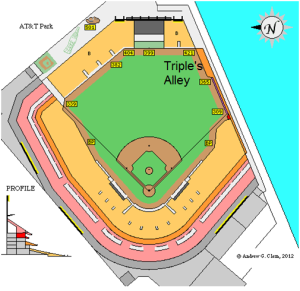
Consider this: he had 1 triple in his first 783 PA (or even 1 in his first 928, if we want to include all of his career PA up to May 28th, 2015 – the date of his first triple this year), and that one triple was hit into Triples Alley at AT&T Park in San Francisco on May 13th, 2014 (No, this was not a Friday the 13th).  Triples Alley is aptly named for the high volume of balls that are hit there that result in triples (relatively speaking).  So that was Gattis’ one and only, and yet he’s hit 9 in his following 446 plate appearances (or even scarier, 9 in 301 PA).  Before delving too much into this, I thought, “Conditions for an Evan Gattis triple would have to be perfect.  I bet at least 6 of these triples are due to Tal’s Hill“, which is the 90 foot wide, 30 degree incline, that extends the area of balls in play about 34 feet beyond where the fence would normally end at Minute Maid Park.  It is a whopping 436 feet to the wall at the top of Tall’s Hill.  However, a quick peek at Gattis’ home/away splits would reveal that he has just 5 triples at home and 4 on the road.

Well then he must have hit his triples in “triple-friendly” parks; below is a table showing where he has hit his 9 triples this year:

STADIUM 3B FACTOR
AT & T Park 1.211
Minute Maid Park (5) 1.549
Kauffman Stadium 1.240
Comerica Park (2) 1.465

Okay, that was predictable and makes a lot of sense to me.  Now here is a spray chart that shows his hit types (if you don’t read keys, the red dots are the triples):

chart (3)

*There is a sneaky red dot signifying a triple hiding behind a home run dot in left center just to the right of the most far left red dot*

Looking at the plotting of the red dots and considering what stadiums he hit his triples at is where I got the idea for this article – and I will now switch to writing in present tense to portray the feeling of spontaneity I felt when I first started this writing. Considering the factors, I get the feeling that I can guess which stadium each of his triples have been hit at – an exhibition of frivolity to be sure, but this is just the kind of thing that we’re looking for while we’re at work, trying to look busy, isn’t it?  If you wanna play, keep reading and guess along.  I am going to take a liberty and use the pronoun “we” instead of “I” so this feels more like a group effort.  And I also have a disclaimer: If you continue reading, you are assuming the risk that this could be a jarringly disjointed, moderately sarcastic, and gif cluttered article – it is.

The Evan Gattis Triples Game

Let’s consider my first hypothesis – that Tal’s Hill is responsible for a majority of these triples.  Looking at the red dots it looks like 3 of them may have very well landed there.  In order to kind of stick with my original idea, we’ll take the five most centrally located red dots and say that those are the triples he hit at home.

chart home

For reference into this reasoning, here’s the stadium layout of Minute Maid Park (all ballpark layouts are courtesy of Clem’s Baseball).  Note the massive depth of center field.

MinuteMaidPark

Using FanGraphs’ Game Logs I’ll pinpoint the dates of his 5 home triples and then plug those dates into Gattis’ spray chart over at BrooksBaseball.

1st Triple at home; 3rd Triple of Season: 06/28 vs NYY

triple1

That ball is not hit to Tal’s Hill, but it is one of his 5 most centrally hit triples of 2015, so that’s 1/1 if you’re scoring at home.

Now here’s the GIF – and here’s where I have to pause and give credit to another article.  When I started to write this post I hadn’t planned on including so much media, but as the post evolved it really did call for GIFs of these triples.  When I searched ‘Evan Gattis triples’ on google, the first link that popped up is this SB Nation post by Murphy Powell, and it’s the source for 6 of the 8 GIFs here and is, by all accounts, VERY similar and a much better article than mine, so check it out.  Any other GIFs were created using Baseball Savant media and makeagif.com.

gattis_3.0

“ARGH!”  That’s the sound of Michael Pineda groaning as he grimaces and falls on to bended-knee while telepathically willing the ball to stay in the park, which it does, barely.  Pineda is groaning because that was not a quality slider.  This information could probably be an entirely new post altogether, but I did warn you about this post being disjointed, so let’s to a quick detour.

This triple took place at the end of June – a table tracking velo and movement of Michael Pineda’s sliders shows that Pineda was throwing sliders of a lesser quality during this period.

Date(s) Velo x-movement v-movement BAA
Pitch to Gattis (06/28) 87.9 2.15 1.25 1.000 (obviously)
April 2015 84.08 4.54 -0.30 .208
May 2015 85.76 4.00 -0.41 .191
June 2015 87.12 2.47 0.02 .250
July 2015 87.10 1.34 0.46 .231

Whether it has been a conscious decision to throw his slider harder or it is a product of his ailing elbow, the results have not been so good.

Anyways, at this point, three triples into the season – and 3 in his last 36 games – Gattis’ reputation as a triples machine is really starting to build momentum (I warned you about the sarcasm, too) and as soon as the ball bounces away from Brett Gardner and is left to be retrieved by a scurrying Garrett Jones, Gattis is off to the races.

2nd Triple at home; 4th Triple of the season: 06/30 vs KCR

triple2

Bingo! This is a Tal’s Hill special and would be a home run at 29 other ball parks.

gattis_4.0

Lorenzo Cain, who has to at least be in the conversation for the smoothest looking active baseball player, is rendered looking like a reckless drunkard, smashing head-first into the wall and then toppling over on to his side after heaving the ball in towards a cut-off man from his knee.  Nonetheless, Gattis has his 4th triple of the year and we are 2 for 2.

3rd Triple at Home; 5th Triple of the season: 07/17 vs TEX

triple3

That one is not quite as impressive as the last one in terms of distance, but he laid into this one pretty good, too.

gattis_real_5.0

This hit scoots up on to Tal’s Hill after it nicks off Leonys Martin’s glove and then bounces off the wall – are you already missing the antics that Tal’s Hill won’t be causing in 2016?  The main thing here is that we are now 3 for 3 in this game.  I knew this would be easy.

4th Triple at Home; 7th Triple of the year: 07-28 vs LAA

triple4

So we’re wrong on this one and that brings our tally to 3 for 4 – and I’ll take most of the responsibility for the ones we get wrong – my bad.  “My bad” suffices when a player makes an errant pass out of bounds in a professional basketball game, so it should be enough here, too.

gattis_5.0 (1)

This one hit just under the yellow line against the Papa John’s sign, and it had to careen off the wall in such a way that it caused the ball to bounce into another empty center field where Shane Victorino finally picks it up and hurls it in just in time for Gattis to pull in to third base with a stand up triple.

5th Triple at Home; 7th Triple of the year: 08-14 vs DET

plot_hc_spray

This is technically another one of the 5 most centrally located triples so we are 4 out of 5.

Gattis Triple 5 Gif


The ball comes off the bat hard enough (99.3 mph) and then takes a generously frictional hop and loses speed as it trickles up against the wall in the deepest part of right center field at Minute Maid.  I don’t care if even the great Roberto Clemente was in right field, that is a long relay throw and there is plenty of time for Evan Gattis to lock down his 9th triple of the season.  Gattis is immediately pulled from the game as he is probably completely out of juice at this point in the season, but fans rejoice over his exploits and even Evan Gattis can’t believe his recent output of triples:

7fx3An


So we are hitting .800 after the home stand, but now let’s take on the triples hit away from home.  Here are the triples that we have left to identify:

chart (3)

The media, for whatever reason, has started to get smaller, so I will point out the locations of the triples: there is one to deep, left center; one to deep center, one to right-center, and one down the right field line.

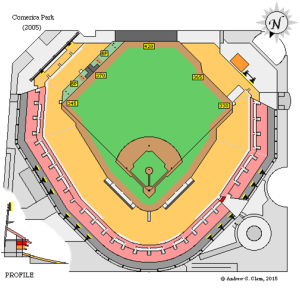
For reference, here are the stadium layouts for Comerica (where he’s hit 2 triples), AT&T Park, and Kauffman Stadium.

Comerica

ballpark

AT&T

triple7

Kauffman Stadium: has the largest outfield in major league baseball as measured by total square feet.

KauffmanStadium

Let’s start with the one triple hit to deep center that did not take place at Minute Maid and say that one took place at Comerica Park, since, like Minute Maid, Comerica has a cavernous center field.

1st Triple of the Year: 05/21 vs DET @ Comerica

triple6

Huzzah! That was kind of obvious and maybe shouldn’t have elicited a Tobias Funke jubilation, but the fact that we’re five for six does.

gattis_half_1.0

Let’s jump ahead to what should be considered the other obvious pick, his triple hit at AT&T park.  There’s a triple that was hit to right center and we’ll say this triple it was a throwback piece; inspired by his first triple in the bigs, in that it was hit to Triples Alley.

8th Triple of the Year: 08/11 vs SFG @ AT&T Park

triple8

This one is wrong and that stings because I felt like this one would’ve been obvious.

qzp-eX

I’m not sure how much of the ball Gregor Blanco gets when he leaps – he may have ultimately sandwiched the ball between his back and the wall – but it looks like he prevented an Evan Gattis HR; but still can’t prevent yet another Evan Gattis Triple.  We’re 5 out of 7.

So of the two triples left, there is one that goes to deep right-center, and one that scurries down a right-field line.  The ballparks left are Kauffman and Comerica.

We’ll play the odds and guess that the one down the right-field line is hit at Kauffman Stadium because it would make sense for the one to right-center to have ended up in that little enclave at Comerica.

6th Triple of the Season: 07/26 vs KCR @ Kauffman Stadium

Oddly enough there is no data for this on Brooks Baseball and there is also no GIF for this triple; Who’s padding the stats?? At least that builds some suspense…

2nd Triple of the Season: 05/24 vs DET @ Comerica

triple9

Wrong – which also makes us wrong on the triple hit at Kauffman so we miss the final 2 – “my bad”.

gattis_2.0

It looks like Rajai Davis was positioned towards the gap and therefore had to hunt this ball down while El Oso Blanco set the base paths aflame.

So our (my) final score is 5/9, which is good but not great considering my 100% accuracy prediction.  While I’m completely aware of the vast, expansive magnitude of my ignorance, I really did believe I could pick out where each of these 9 triples happened…it’s probably this same hubris that causes me to lose $3 daily over at Draft Kings.

Trying to elicit some meaning out of this article would be contrived, so I’ll just say (tongue-in-cheek-ly), Gattis is likely to experience some regression to the mean (whatever that mean is in regards to triples).  I can’t imagine a reality where Evan Gattis highlights aren’t home runs and continue to be centered around him tearing around the basepaths – his massive, rippling thighs simultaneously inspiring awe, terror, and a few chuckles among his teammates – but what do I know?  The last time I tried to predict something about Evan Gattis, I was only 55.6% right.


BABIP Aging Curves

At age 35, Albert Pujols is having somewhat of a resurgent season. Many wrote him off last year after he posted his second straight, for him, subpar season. This year, though, he has hit 30 home runs through 108 games with ZiPS projecting him to get to 40 on the season. But there remain two big differences between 2015 and prime Pujols. One, he is walking less, at 7.5% vs. his career average of 11.8%. And two, his BABIP is a minuscule .228, continuing a declining trend:

Pujols BABIP

It certainly makes sense that with a loss of footspeed, BABIP would decline as well. After doing a quick mental recall, I decided to look up Mo Vaughn as another power hitter who seemingly lost it overnight. And sure enough, he experienced a big BABIP decline late in his career as well:

Vaughn BABIP

He still put up a .314 BABIP in his last full season, but it was a step change from the average .365 (!!!) BABIP he put up from 25-30.

So, is this a larger trend that we should be paying attention to? Or are Pujols and Vaughn just confirmation bias. Thanks to FanGraphs’ excellently downloadable data, I expanded the datatset to include every season and every player. Grouping by age reveals:

BABIP by Age

Well seemingly a lot of nothing. The BABIP for all 20 year olds in that time was .301, while the BABIP for all 39 year olds was .295. Definitely a decline, but with a p-value of 0.7 is not statistically significant. So that’s disappointing for my thesis, but encouraging for all the old folks out there! Back to the drawing board.

Pujols and Vaughn were big, hulking guys. Maybe when they lost a step, it was a step that they could less afford to lose and the impact on their BABIP of a marginal slowing down was magnified. So what if we restrict the group to only power hitters? For this, I defined power hitters as players with career ISOs over .200. The results appear to support my hypothesis better:

BABIP by Age, Power Hitters

This is plotted on the same scale as the previous chart so we can appreciate the relative differences. For this sample, the BABIP for power hitters declined from .313 at age 22 to .296 at age 36. Interestingly enough, power hitters had higher BABIPs earlier in their careers than the general population (including the power hitters), which then dip lower than the general population later in their careers. Apparently hitting the ball hard does have some benefits.

This time, the science backs up the hypothesis! My engineering professors would be so proud. With a p-value of 0.0165, the difference in BABIP between a 36 year old power hitter and a 22 year old power hitter is statistically significant. Pujols and Vaughn were indeed the victims of a real trend.

There could be a number of factors behind this. The first one I highlighted is the loss of footspeed. Second, it could just be that as you get older you don’t hit the ball as hard. Looking at exit velocity or ISO by age would help us judge that. Finally, age and a loss of bat speed or reflexes could lead to a change in batted ball in a way that leads to less balls falling for hits. It would make sense that as his bat speed slowed, Pujols tried to hit more fly balls to recover some of the home run power. That is the next thing I will look at.