Archive for Player Analysis

Reliever Buy-Low: Craig Stammen

Any team need a reliever who can pitch multiple-inning stints if you need? I think lots of teams would jump at the chance to acquire such a reliever considering Madison Bumgarner’s legendary five-inning relief appearance in Game 7 of the 2014 World Series. Andrew Miller became a dangerous bullpen weapon in the 2016 postseason with the Indians, which brought them within a game of winning the World Series in three consecutive games. And there’s some guy on the Astros called Chris Devenski, who could also spot start if you need a starter desperately. The Blue Jays acquired Tom Koehler from the Marlins, who I admittedly have some interest in as a starter or multi-inning reliever. Maybe you want someone like Raisel Iglesias or Michael Lorenzen.

Currently, most relievers are used in one-inning stints; some are even used against lefties or righties only. Christian Bethancourt, Chris Gimenez, and Jordan Schafer have been two-way players: a hitter and a reliever to give more bench depth and help keep Rule 5 draft picks. Some top prospects have been billed as two-way players such as Brandon McKay, Hunter Greene and most notably Shohei Otani, who has been fantastic in Japan.

The reliever who should be receiving more attention as a multiple-inning reliever is Craig Stammen, who used to be a part of the Nationals as a starter and was then converted into a reliever when he was called up from AAA in 2011. Stammen was doing pretty well from 2012-2014 as a setup reliever, but then he missed most of 2015 and didn’t make it back to the big leagues until this season. As a result of him previously having been a starter for much longer, he has more stamina than an average reliever, and can be used in multiple-inning relief stints, providing more bench depth for a team like the effect of having a two-way player (even if they aren’t very good).

This year, he has been getting back to what he was doing before in terms of his ERA, strikeout and walk rates, and innings per appearance. His home-runs, however, have gone up quite a bit despite his 52.2% ground-ball rate. This is due to an unsustainable 19.4% HR/FB ratio(!), which has overly inflated his FIP to 4.34, with a much more appealing 3.75 xFIP and a 3.60 SIERA, which suggest a solid middle relief/ setup type of reliever that he has been performing like. This and his ability to pitch multiple-inning stints create a higher value than his $900,000 contract. He has four pitches with positive values according to Pitch Info this year. Despite minute velocity drops for his pitches from his peak years of 2012-2014, he is still very effective with his pitches, with only one registering a slight negative according to Pitch Info.

Admittedly, his BABIP is a bit lower than it should be at .254, but it shouldn’t regress too badly (somewhere around .280 since he does generate quite a few ground balls). He is only getting about 6.7% pop-ups, which is not very good, compared to his peak seasons. Batters are getting more hard contact this year compared to the rest of his career (30.1% this year compared to 28.5% for his career). And his strand rate is at 85.7% this year, compared to just a 71.9% career mark. Additionally, he has allowed a .329 wOBA against lefties this year vs a .256 wOBA vs righties.

Overall, Stammen has been lucky and unlucky this year. Ultimately, he is a solid reliever who should be able to do quite well in almost any park except Coors Field or any extreme hitters park. He should receive a two-year deal worth around $4-5 million per year for how well he can pitch as a solid multiple-inning reliever, and how he can help increase bench depth for a team that wants to keep a Rule 5 talent, an extra bench player, a normal reliever, or maybe a specialized reliever such as a LOOGY (looking at you, Randy Choate, Brian Shouse, and so many more who have made careers out of being LOOGYs). The former two are much more likely than the latter two — particularly a LOOGY, as most aren’t as useful to teams anymore.

All stats and links are owned by FanGraphs, except for the link to Shohei Otani’s player page, which is owned by the NPB.


Luis Castillo’s Dominance Fades to Black

Some say the sample size of Luis Castillo’s season is 15 starts; I say it’s only eight.

July 25th was the first game in which BrooksBaseball.net registered a sinker from the 24-year-old. While some other sites show blips of the pitch peering out from behind the curtain – misread changeups? – you’ll read elsewhere that he learned the pitch right as the August sun crept up on the city of Cincinnati. After adopting the sinker, his following eight starts showed a clearer picture of the pitcher he’ll be in 2018.

The issue that resonated most with analysts during his debut at the end of June was his fastball’s tendency to stay straight. An old adage you’ll hear in baseball circles revolves around a straight fastball’s velocity mattering less, because if it’s a straight 98-99 mph pitch, theoretically, a major-league hitter will have a better chance of squaring it up.

Castillo never got that memo.

Unless the Yankees’ ace Luis Severino concentrates some adrenaline to kick up his average fastball velocity by season’s end, Castillo will claim the “velo crown” for starting pitchers – 97.8mph is his number (min. 200 pitches). While velocity doesn’t tell the whole story – I’m looking at you, 2016 Nathan Eovaldi, and your 97.8mph average four-seamer – for Castillo it’s a catchy interlude; a hook that gets your undivided attention. Even with the pitch and its “straight” tendencies, aggregating all 15 of his starts, the pitch maintained a whiff-per-swing rate inside the 85th percentile among all starters – 22.6% (min. 200 pitches).

It may seem dubious that the hardest fastball among starters in all of baseball could get better during any stretch of time, but Castillo wove into his repertoire a sinker that allowed his four-seamer to change its attack.

Above we’re looking at Castillo’s four-seam fastball location pre-sinker adoption (before July 24th) and post-sinker adoption (July 25th forward). The former being a tight concentration towards the outside part of the plate, while the latter is the much larger area of dark red, up in the zone.

This philosophy makes sense; take a straight fastball, stop throwing it for strikes down in the zone, and put it at the letters, making it nearly impossible for hitters to muster success. It worked. Castillo wasn’t able to execute this move sooner because he didn’t have another fastball to establish the zone with early in starts.

Before Castillo’s sinker, hitters were teeing off on Castillo’s fastball to the tune of a .658 slugging percentage. All the while, his slider and changeup – which we’ll touch upon shortly – were nearly unhittable with slugging percentages that couldn’t edge past the fabled “Mendoza Line.” After Castillo learned his sinker, that cringe-worthy slugging percentage on his four-seamer fell to a manageable .368. His sinker, meanwhile, was his early-count pitch, and he located it unbelievably well. Castillo’s worm-killer was second among starters with a 77% grounder-per-ball-in-play rate, trailing only Jordan Zimmermann, who can’t sniff the whiff rates of our Dominican-born phenom (almost as good as Carrasco’s sinker). As Eno Sarris mentions in a FanGraphs column, Castillo is creating a duo of skills that most pitchers envy: choppers and whiffs.

Those whiffs come from his slider and changeup, two pitches that stood out before the sinker, becoming much easier to “arrive at” in terms of sequencing with a two-percent cut in walks and improved ability to get ahead of hitters. His changeup – like with most righties – is a put-away pitch to left-handers; 33% usage rate overall that kicked up to 43% when Castillo had two strikes on a lefty. The sinker we’ve discussed at length also seems to correlate with an uptick in slider usage to left-handed hitters. It ticks up 8% when Castillo has two strikes on a hitter. My speculation is this has a bit to do with gaining confidence in the pitch through understanding eye-level adjustments that hitters have to make after realizing Castillo is now living up in the zone with his four-seamer (see the GIF above). Of course, this is merely speculation; it could easily be Castillo becoming more comfortable with the break of the pitch, eliminating fears that he doesn’t follow-through and leave it up in the zone – essentially a meatball.

Sitting just below Castillo’s changeup in terms of velocity is his preferred put-away pitch to right-handers, a compact slider that doesn’t jump out in terms of swinging strike rate, velocity, or even movement, but possesses an uncanny ability to avoid becoming line drives. A peculiar metric to stand out in, yes, but after understanding line drives go for hits three times more often than ground balls, limiting line drives becomes the best thing you can do if you’re offering a pitch devoid of Kershaw-territory whiff rates.

A 27% strikeout rate in just under 90 innings, with a ground-ball rate near 59%, is a combination very few pitchers possess; Castillo is one of them. With his sinker in play, those numbers became 25% and 61% respectively; just as dominant, yet more stable with the improved control I’d speculate the sinker brought about. I’ve heard a lot of Luis Severino and Michael Fulmer comparisons to Castillo because of the fastball-slider-changeup offerings, but one of the best young pitchers in baseball is becoming a unique beast with his sinker.

Castillo’s potential is the good kind of unbelievable, in contrast to another kind of unbelievable from this Cincinnati.com article titled, “Bryan Price: Luis Castillo is in the 2018 Rotation” which implies we needed to know one of the best young pitchers in all of baseball will be allowed to dominate as a starter come March 29th of 2018. March? Yes, March. Baseball and snow is quite possibly my second favorite pairing. Behind, of course, the whiffs and grounders Castillo generates.

A version of this post can be found on my site, BigThreeSports.com.

I’m on Twitter @LanceBrozdow


Zach Davies Commands Contact

The Milwaukee Brewers have been a very entertaining team in 2017. Their early dominance of the NL Central over the struggling Cubs predictably came to an end after the Cubs decided to stop being bad and to start winning baseball games again. Now, thanks to some struggles, along with the surge of the Rockies and Diamondbacks, the Brewers are on the outside looking in during the playoff race. However, that doesn’t mean that the Brewers don’t have an interesting group of solid young pitching and an intriguing offensive core. Among all of these players, Zach Davies may be one of the most interesting. Davies was never a highly-touted prospect; he always lingered near the bottom of organizational top-10 lists during his time with the Baltimore Orioles and Milwaukee Brewers. In 2016, Baseball Prospectus had him ranked 8th in the Brewers system with a 45 FV, projecting him as a back-end starter with above-average command.

This year, Davies has sported a 4.38 xFIP and a 15.9 K%, which certainly profiles like a 4th starter’s stat line. However, Davies ranks in a tie for 27th (min. 100 IP) for WAR with 3.0 on the season up until September 16th, which definitely isn’t something to expect from a back-end starter. When you look at Davies’ numbers, you have to wonder how he has manged to succeed with such a low K rate and an inflated xFIP.  Even going back to last year, Davies had a higher K rate at 19.8%, along with a 3.94 xFIP in 163.1 innings, and posted a 2.7 WAR. These stat lines look fairly similar, except for the the fact that he reduced his K rate in 2017. What else changed that has allowed him to succeed with this decreased strikeout rate? One thing Davies has changed in 2017 is his HR rate, which decreased from 1.10 in 2016 to 0.87 in 2017. So, in essence, Davies traded strikeouts for home runs. How did he manage to do that?

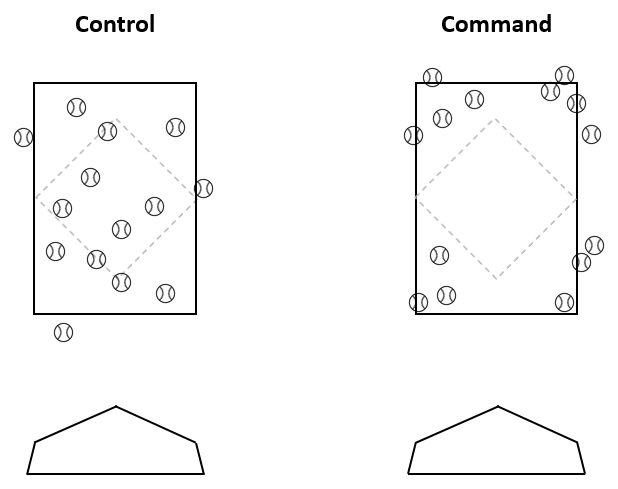
Let’s revisit that scouting report from 2016, with an emphasis on the 55 FV for Davies’ command. In that same report, it’s said that he had battled control problems during his time in the Brewers system. Now, there has always been a little bit of confusion as to what exactly the difference is between command and control, but Baseball Prospectus did a great job of dissecting this issue. Basically, control is the ability to throw the ball in the strike zone, while command is the ability to throw the ball in precise locations in or out of the strike zone. Below is a very handy diagram from the aforementioned article.

In this same article, two new stats are introduced that help attempt to quantify command and control: CSAA (called strikes above average) and CSProb (called strike probability). While these stats were originally created to show how well a catcher frames pitches, they can also tell you a lot about a pitcher. CSAA attempts to quantify how many strikes a pitcher creates for his team solely on taken pitches, and quantifies command. For example, having a CSAA of 3.0% means that there is 3 percent better chance that pitcher’s pitches will be called a strike than your average pitcher. CSProb quantifies how likely a certain pitch is to be called a strike, and highlights control. If you have a 50% CSProb, then there is a 50% chance a pitch you throw will be called a strike. As it turns out, the 2016 scouting report on Davies was correct; he ranks at the top of the leaderboard in CSAA and is near the bottom in CSProb. In 2017, Davies ranks 6th among qualified pitchers in CSAA at 2.83%, and he has a CSProb of 43.8%.

Davies has always been good at working the corners with a low 90’s to high 80’s fastball that has a lot of heavy run/sink to it. Usually, pitchers like this have to ensure that they can nibble at the corners of the plate so that their “slow” fastballs don’t get completely crushed by the power hitters of the league (which are apparently Elvis Andrus and Didi Gregorius now). Davies does just that, as shown in his zone heat map from Brooks Baseball below. He stays low in the zone to the majority of batters and does a good job of working both sides of the plate.

A pitcher who lives on the corners like this usually tends to draw poor contact, and that’s exactly what Davies does, in whatever way you want to to quantify it. He is one of the better pitchers in a multitude of categories, as he ranks near the top in Baseball Savant’s barrels per plate appearance stat at 2.9, has one of the lowest average exit velocities at 85.0 mph, and only 28.3% of contact against him is classified as hard hit by FanGraphs. It seems like Davies has the ability to use his pitches to work the corners and manipulate contact in his favor, which explains how he started allowing fewer home runs in 2017.

You can see this in his numbers, like stated before, where he has worked to his strengths and traded strikeouts for weak contact. This is also supported by his ability to command the ball, and his 2.83% CSAA. Put both of these qualities together, and you get a pitcher who not only limits good contact but also excels in getting called strikes more often than the average pitcher. These qualities can also help show why Davies has an inflated xFIP. Davies’ contact rate has gone up 2.5% from 2016 to 2017, and since xFIP relies a lot on batted-ball events, it can help explain why his is fairly high despite his 3.0 WAR. Davies has shown that he has the ability to adapt to major-league hitting by identifying that he can be successful in limiting good contact while at the same time allowing more of it and striking fewer batters out. If he can keep it up, there’s no reason to believe he couldn’t be a mainstay in the Brewers rotation for a long time.


One of the Best Ground-Ball Pitches in Baseball Isn’t a Sinker

If it weren’t for Adam Engel, Carlos Carrasco would have shut out the Chicago White Sox on Wednesday night. It’s hard to believe something stood out to me more than the preceding sentence’s qualifier, but baseball possesses the quality of unpredictability, and I will never complain.

Carrasco is an artist, mixing five pitches with such care that I often find myself gravitating towards his starts despite my lack of association with the Indians’ fan base. On Wednesday, what I noticed more than Engel ruining a shutout was Carrasco veering away from a pitch vital to his repertoire — his changeup. Due to the graces of BrooksBaseball.net, I can confirm the lack of changeup usage was unusual for Carrasco; five instances of the pitch were his second-fewest in any start this season. Wednesday was the longest outing of Carrasco’s season and matched his season-high “game score” of 89 (50 is average) from a battle back on April 22nd against — you guessed it — the White Sox.

Carrasco’s beauty stems from his ability to execute flawlessly with a game plan contrary to what you would expect. His season averages reflect the bigger picture, yet on a given night he can meander in unprecedented directions. My wonder surrounding the lack of his usual third pitch brought me to another contrarian aspect of Carrasco’s game: this changeup possessed the best ground-ball per ball-in-play ratio of any pitch in baseball (min. 200 pitches). 82% of the time when contact is made between the lines, the batted-ball result of this changeup is a ground ball. With 6% of batted balls falling into the “fly-ball” category, Carrasco’s pitch is one of the hardest in baseball to hit in the air.

Does this make it the best changeup in baseball? That depends on what qualities you believe make a changeup great. Per FanGraphs, Clayton Kershaw — shocker — holds the highest pitch value for a changeup at 6.9 runs per 100 pitches (0.0 is an average offering), with Carrasco just behind him. If you subscribe to limiting line drives as the better indicator of changeup success, the honor would go to Stephen Strasburg, who coincidentally gets the most whiffs per swing on his changeup at 51%. I’m not arguing that Carrasco has the best changeup in baseball; I’m highlighting how absurdly hard it is to do anything but hit Carrasco’s changeup on the ground. That in itself deserves as much attention as one that generates excessive swings, or is throw by the left hand of a legend — I tip my hat to you, Mr. Kershaw.

If you read my most recent recent column on the Orioles’ Dylan Bundy — whom I already consider to be “great” (yeah, pretty bold) — you can tell I’ve become intrigued by the Baseball Prospectus rabbit hole that is pitch-tunneling. In as simple terms as you can get, the “tunnel point” is where the hitter has to decide whether or not to swing, with movement more than 2.6 inches between the tunnel point and home plate considered above-average. The concept is fresh, with only bits of hard evidence for suggesting how to correctly apply the statistic, but one of its beliefs makes intuitive sense. In a vacuum, if your pitch moves more than average beyond the tunnel point, it becomes harder to hit. My thinking with Carrasco’s changeup is simple: it must have a lot of downward, “late” break to force hitters into topping the ball at such a high rate.

Ah, if only baseball was that easy.

Carrasco’s pitch sequence of fastball-changeup is his fourth-most commonly used pitch pair; it doesn’t stand out in terms of post-tunnel break among his other pitch pairings, nor when you compare that break back to the league average for a typical fastball-changeup sequence. What it does stand out on is something called “flight-time differential.” Carrasco’s .0223 is the third-lowest in baseball among pitchers who have thrown a fastball-changeup sequence more than 50 times. This stat is another way to show velocity differences between pitches. The short flight-time differential holds up when we observe Carrasco’s 5.7 mph difference between his average fastball and changeup velocities (fourth-smallest, qualified pitchers).

Good news: this all jives with Harry Pavlidis’ research. Harder changeups with smaller velocity differentials between that pitcher’s fastball means more ground balls, while a larger velocity gap between the two pitches means more whiffs. While ground-ball inducers tend to throw their change earlier in counts, whiff inducers favor the pitch as a put-away offering. While that sentence isn’t all-encompassing, Carrasco’s deviation from conformity continues.

As with most right-handed pitchers, Carrasco tends to throw his changeup to left-handed bats substantially more than right-handed bats, favoring the benefits of arm-side movement a changeup generally possesses due to the pronation of a pitcher’s hand. But unlike conventional thought that suggests the pitch’s ground-ball rate is such that early-count looks are likely, Carrasco throws the pitch more as he gets deeper into counts.

Just as Carrasco plays second fiddle to Corey Kluber in the Indians rotation, his changeup plays second fiddle to his slider, both allowing for rampant underappreciation. The pitch is so good this year that Carrasco has muddied the stigma that high-velocity, or low-velocity differential, changeups should remain early-count offerings. Once again, Carrasco is veering from the path of predictability.

Even after four seasons where progressive improvement hasn’t ceased, due to injuries we still haven’t seen a 200-inning campaign from the righty. 2018 will be his age-31 season, and as father time comes knocking, it’s unfortunate that we may be observing the tail end of Carrasco’s peak performance. With the Indians firmly intertwined with the phrase “playoff bound,” Carrasco will get his first reps on an October mound. If history provides any indication of the future, we know Carrasco will both stand out from him predecessors and succeed.

In regards to an obscure September outing and the lack of changeup usage, digging deeper might unearth logical reasoning, but with Carrasco, I think mystery adds to the legend of an under-the-radar arm.


I can be found on Twitter – @LanceBrozdow – tweeting about the greatest of all games.

A version of this post can be found on my website, BigThreeSports.


It’s Not Too Late to Give Bryce Brentz a Shot

*Apologies for the bad writing, as this is my first-ever community post on FanGraphs.*

At the time of this writing, it’s been seven days since rosters expanded in the major leagues. Still, the International League (AAA) home-run leader has yet to appear in a major-league game season. Since the 2000 season, there have been three International League home-run champions that had not appeared in a major-league game that same season. Bryce Brentz, leading that league with 31 home runs and winner of the Triple-A Home Run Derby, is about to be fourth.

The Red Sox of the old days had the reputation of being offensive powerhouses by working long at-bats and possessing big power in the middle of the lineup. This year, it’s been quite the opposite. Red Sox pitching has been absolutely amazing this season; the pitching WAR is tied for second place (with the Dodgers) while also having the fourth-best ERA in the majors at 3.76 ERA. Compared to how great the Red Sox pitching is, the hitting is bad. REALLY BAD. Their pitching and hitting are night and day. It’s well documented that the Red Sox aren’t hitting for power this year, sitting dead last in the AL with only 146 home runs. Perhaps teams don’t need to hit home runs to be productive? The advanced metrics say otherwise. Out of all qualified players, the Red Sox batter with the highest wRC+ is Dustin Pedroia who has a 106 wRC+, and 2016 MVP runner-up Mookie Betts is running a 101 wRC+. All in all, the Red Sox offense has been below average this season. The emergence of Rafael Devers and the spark that Eduardo Nunez has provided to the Red Sox have both softened the blow, but there still appears to be a glaring weakness.

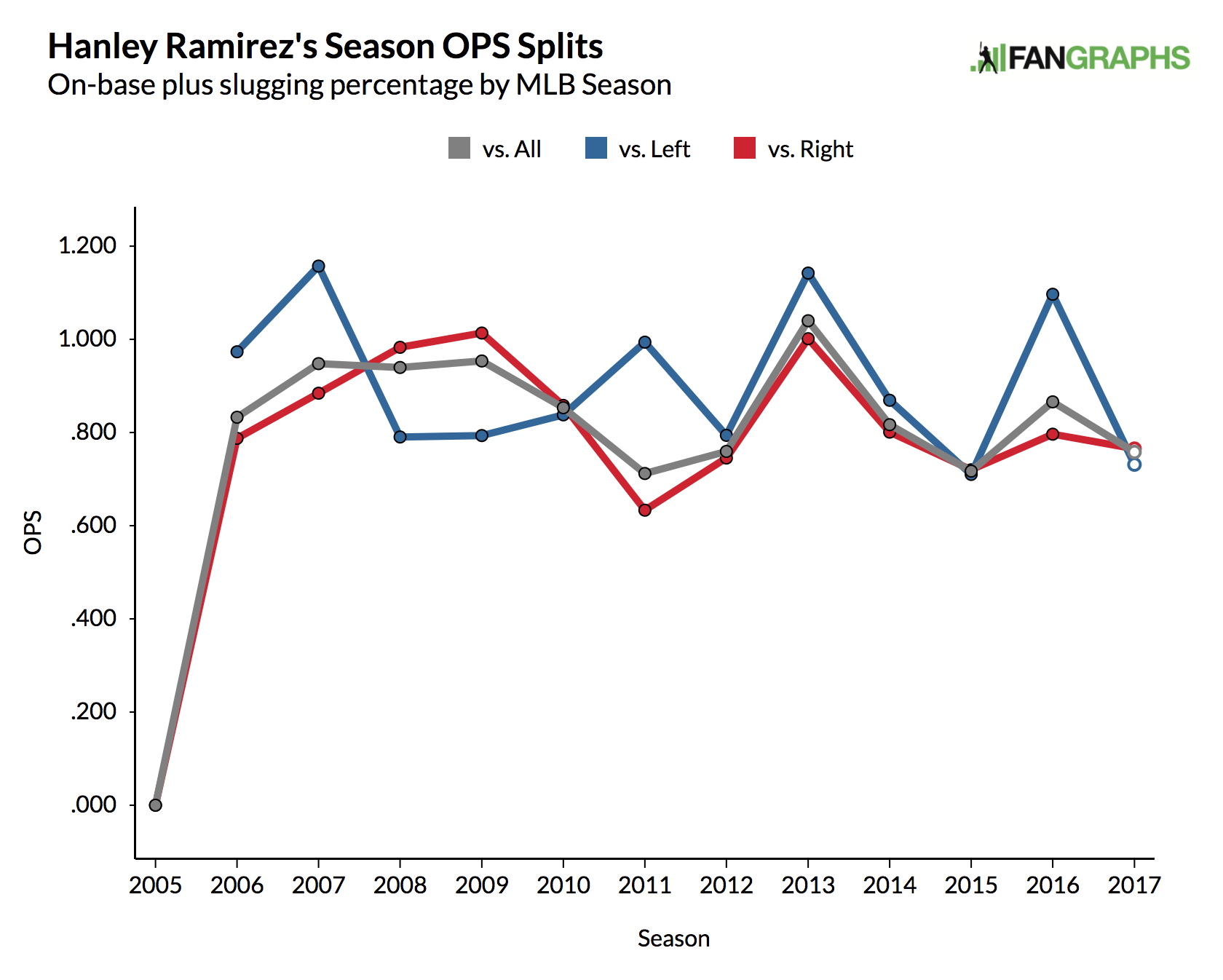
In the absence of David Ortiz, Hanley Ramirez was supposed to step up and become a middle-of-the-order power threat. What’s inexcusable is his performance versus lefties this year. As someone who’s destroyed lefties his entire career, he’s suddenly slashing .194/.312/.419 against lefties in 2017. His career OPS/wRC+ vs. lefties is .902 OPS and 138 wRC+ respectively.

Hanley Ramirez OPS by Season

HanRam has been having one of his worst seasons hitting-wise versus lefties. Despite insisting that he will improve against lefties, Red Sox fans have yet to see the results come out.

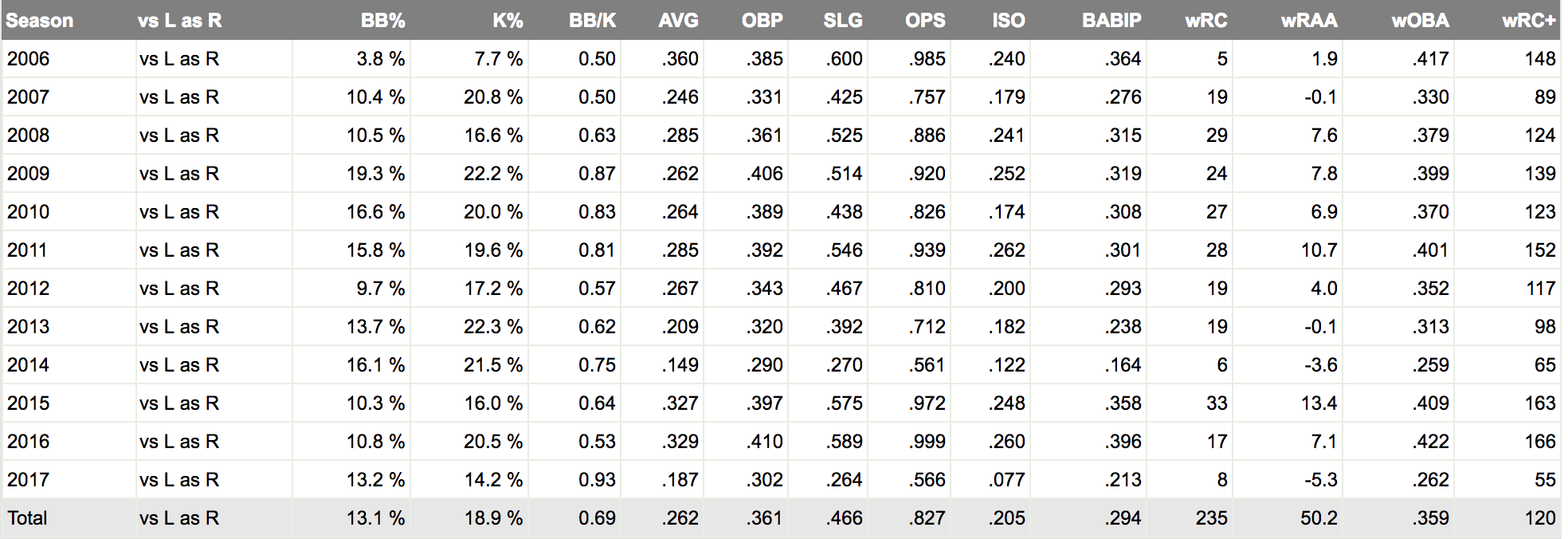
Another factor is Chris Young’s performance. Chris Young was brought to Boston to club lefties. He’s always been able to hit them, and his splits against lefties prove just that.

Chris Young Splits v. Lefties

Discarding 2014 and this current season, that chart is a thing of beauty. Chris Young’s performance this year has been concerning; he hasn’t had an RBI since August 6! Chris Young was a player who was specifically brought onto this roster for the specific purpose of facing tough lefties. He is having his worst season hitting lefties yet. As of right now, he is batting only .184 against lefties this season with one home run, four extra-base hits, and four RBI.

The Red Sox need Bryce Brentz. Brentz certainly has the prospect pedigree, being drafted by Red Sox in the first round of the 2010 Major League Baseball Draft out of South-Doyle High School. Once rated as the No. 5 prospect in the Red Sox system, he stood out with his plus raw power. FanGraphs’ Kiley McDaniel had this to say about him a few years back:

“Brentz has easy plus raw power from the right side and is a solid athlete, but it doesn’t translate to defense, where his fringy arm limits him to left field. There’s some holes, lots of swing and miss and trouble with spin from right-handed pitchers, but also 20-25 homer power with a floor of a solid platoon bat.”

The key word here is “solid platoon bat,” something he’s finally evolved into this year. This year, down in Triple-A, when facing left-handed hitters, Brentz was hitting .279 with nine home runs, 25 RBI, and 17 walks. His OPS against lefties is 391 points higher than Chris Young’s OPS in the majors this season (.957 OPS). Rhys Hoskins, who took the majors by storm, was the only player ahead of him in the IL in terms of wRC+.

Brentz had worked with PawSox hitting coach Rich Gedman this past offseason, which has suddenly changed him into someone who destroys left-handed pitchers and is at least passable against righties. By introducing a toe-tapping procedure to Bryce Brentz, Gedman has turned him into a major home-run threat. I think it’s time to believe that after 6+ seasons in the minor leagues, Bryce Brentz finally has things figured out.

The basis behind why Dave Dombrowski won’t call up Bryce Brentz is, to say the least, questionable.

No 40-man roster spot available? C’mon. Off the top of my head, I could name off a few minor leaguers who don’t deserve this spot over Brentz. Most notably, the walk machine himself, Henry Owens. Owens was sent down to Double-A to work on mechanics, but instead, he’s walking 8.68 batters per 9. Ben Taylor, who made the Opening Day roster for the Red Sox, has had considerable minor-league success, but the results haven’t translated to the majors. He’ll most likely end up as a career middle reliever or minor-league journeyman. Sure, these players have their uses, but they don’t deserve their spots as much as Brentz does. After his hard work in the offseason, his performance needs to warrant him a 40-man spot. Additionally, after Chris Young becomes a free agent next year, Brentz can serve as the fourth outfield for the Red Sox in 2018. If the Red Sox don’t add Brentz to the 40-man by the offseason, he’ll become a free agent. It’s almost guaranteed that a team such as the Athletics or the Reds would be willing to give him a chance.

There’s another problem. At the moment, the Red Sox really lack good pinch-hitters. When your best hitters off the bench are Brock Holt, Sandy Leon, Rajai Davis, etc, the outcome looks really bleak. Brentz is a minor-league veteran who is a power threat off the bench, something the Sox currently lack. His career hasn’t progressed much (until now at least) since he shot himself in the leg during the spring training of 2013. If fact, if you go to some online forums, his spring-training incident has created tons of puns that have to with guns; the former top prospect had become a joke. Similar to the rest of the “comeback” stories (such as Rich Hill, Eric Thames, etc) that fans have loved to watch in recent seasons, the story of Bryce Brentz should warm the hearts of fans.

Something else stands out. During the Red Sox’s recent 19-inning game, this tweet was sent out. While it may have been mostly a joke, it really exemplifies the lack of power the Red Sox have.

This really speaks about the Red Sox offense. Bryce Brentz is the spark plug that they need.

As seen by the Nationals calling up Victor Robles just the other day (considered late), the Red Sox certainly still have time to call up Bryce Brentz. If any Red Sox personnel is reading this, the rest of Red Sox Nation and I have this to say to you: “Hey, It’s worth giving Brentz a shot.” He’s deserved it.


Ken Giles Is Flying Under the Radar

When the Houston Astros sent two of their top pitching prospects, Vince Velasquez and Mark Appel, to the Philadelphia Phillies for Ken Giles in December 2015, they were expecting an excellent flame-throwing reliever, and possibly their closer of the future. In his first two years in the league, Giles amassed a 1.56 ERA in 115.2 innings. His work as a setup man/closer went largely unappreciated due to the losing nature of the Phillies, but Giles pitched like one of the best relievers in the game.

But his first year in Houston did not go as planned. Giles couldn’t maintain a hold of the closer job, as he blew five of his 20 save opportunities and finished with a 4.11 ERA. His 2.86 FIP proved he might have suffered from bad luck, and he still displayed incredible stuff (nearly 14 K/9), but he did not execute as expected or needed for the Astros.

2017 has been a different story for Giles. His 29 saves rank ninth in the league, and he has blown only three opportunities this season. His 2.30 ERA is legitimate, supported by a 2.14 FIP. Giles has been one of the best closers in baseball, but his name is hardly mentioned among the top guys in the league. And he’s been especially locked in of late.

Last night (September 5th at the time of writing this), Giles struck out the side in a 10-pitch inning to earn the save against the Seattle Mariners. The only ball he threw came when the batter barely checked his swing. Here he is hitting triple digits on the outside corner to get Ben Gamel looking and close out the game:

It was the second night in a row that he struck out the side for 1-2-3 ninth.

Since June 7th, Giles has a minuscule 0.86 ERA and .147 average against. FIP will rarely support a mark that low, but his 1.57 mark in that category is still exceptional. He’s striking out more batters and walking fewer, accumulating a K-BB% of 31.3%.

Giles has given up one run since July 16th, in 20.1 innings of work. His FIP is under 1, at an absurd 0.82, and he’s sporting a ridiculous 45.1% K-BB% in that time. He has also show the ability to be stretched out of late, as he has gone 1.2 or more innings in three of his last ten appearances. What has made him so effective this season?

It all starts with the slider for Giles, which ranks third in run value among relievers at 12.9 runs. Run values aren’t the best metric, but they definitely give you an idea of the effectiveness of a pitch. Just look at it:

The pitch starts at the “TEXAS” on Rougned Odor’s jersey and finishes below his knees. There is about nothing a hitter can do with that.

Look at a heat map, by pitcher viewpoint, of Giles slider’s location. He is burying the majority of his sliders along the bottom of the zone. Now look at a heat map of the average against the pitch, by zone. Where the majority of the pitches are going, hitters aren’t doing much with. At all. Per Brooks Baseball, hitters have only put the ball in fair territory on 25% of their swings at the pitch. They rarely put the ball in play, and they don’t do much with it when they do.

But this is actually not new for Giles. He was third last year in slider run value among relievers, at 12.6 runs. Where Giles has greatly improved his effectiveness is with his fastball. It was worth a run value of -13.3 in 2016, but it’s currently sitting at 3.4 this year. It has not been incredible, but paired with the slider, it doesn’t need to be.

Here is a comparison of his fastball in 2016 vs. 2017:

Season AVG OPS xwOBA Zone% Contact% SwStr% wRC+
2016 0.376 1.079 .415 53.6% 85.5% 7.1% 200
2017 0.286 .829 .330 59.1% 77.3% 11.8% 137

The batted-ball numbers are down across the board. He’s throwing it in the strike zone more often as well, which would cause you to expect he is pitching more to contact with the pitch. However, the Contact% has steeply declined, and the swinging-strike rate is way up. Obviously, with a 137 wRC+ allowed this year, the pitch is still not great. But when you have a slider running a -14 wRC+, it does not need to be.

Here is a heat map comparison of the two pitches: 2016 vs. 2017

The spray is much tighter in 2017, and he is throwing across the middle of the zone a whole lot less. Improved command of a pitch will obviously lead to more success. But another element might be involved in the improvement of his fastball. Giles has added nearly four inches of horizontal movement this year, from -1.7 to -5.6.

A 2016 fastball:

And the fastball from last night again:

The run to the right on the pitch is clear. Movement of any kind will always help to keep a hitter off balance, and while we can’t be sure, it looks like this may be what has given life to Giles’ fastball. His confidence with the pitch has grown, as his usage of it exploded from roughly 50% to 68.4% in August. And it appears this improved fastball may be keying his emergence as one the best closers in the game.

Giles lost some respect and notoriety with his poor 2016. But with the year he has put together so far, especially the way he’s pitching of late, he has earned all of that, and then some, back. He’s locking down the back of Houston’s bullpen. The Cleveland Indians displayed the importance of relievers in the playoffs last season, so don’t be too surprised if Giles is at the forefront of a charge to the World Series for the best team in the American League.


Guillermo Heredia, Starting Center Fielder

With Jarrod Dyson set to be a free agent, and Leonys Martin both ineffective and DFA’d twice, there has been some uncertainty among Seattle Mariners fans regarding who will patrol center field for the team in 2018. Luckily for Mariners fans, they have an internal option who is potentially an above-average player already playing for their favorite team: Guillermo Heredia.

At 26, Heredia is a bit old to just be emerging. Though unlike other players his age, his late arrival to the major leagues has nothing to do with his ability. Heredia defected from Cuba in January of 2015, just a few weeks before his 24th birthday. Before defecting, Baseball America ranked Heredia as the 11th best prospect in Cuba. He was signed by the Mariners in February 2016, after sitting out the entire 2015 season.

Heredia, considered by most to be a glove-first prospect, started the year hot with the bat in AA Jackson, hitting .293/.405/.376 in 260 plate appearances while living up to his defensive reputation. Heredia walked more times (36) than he struck out (32) and earned a promotion to AAA Tacoma after just 58 games. Heredia’s 35 AAA games—where he hit .312/.378/.414—were split by a cup of coffee when the major league club. In AAA, Heredia improved his strikeout rate to 9.6%, while his walk rate fell to 7.5%, but his combination of solid on-base skills and great defense earned him a call up to the majors for good on August 22nd.

Heredia made the most of his cup of coffee, hitting a solid .250/.349/.315, drawing 12 walks against just 15 strikeouts in a small sample of 107 plate appearances. Thanks to his strong on-base skills, and stellar defense, Heredia managed 0.4 WAR in just 45 games — with most of his playing time coming as a late-inning defensive replacement.

Despite his stellar defensive reputation, Heredia was relegated to corner outfield for all but one game of 2016 due to Leonys Martin’s stellar defense in center. Still, Heredia managed to make an impression. Heredia passed the eye test, and scored positively in both UZR/150 (+7.2) and DRS (+3). But what stood out most was his throwing arm. This throw made me a believer that among his many pretty good skills, he had at least one that was elite:

Petit out after challenge

He made an equally impressive throw this season to get George Springer trying to go from first to third, an out that proved pivotal in the Mariners securing a series win against the Astros:

Heredia nabs Springer at third

In just 705 innings in the outfield this season, Heredia has four outfield assists and +2.3 rating in the ARM component of UZR. His arm is an asset, and potentially one of the better throwing arms in the league.

Heredia’s scores in the range component of UZR were positive in 2016, and have been negative in 2017, for a total of -2.9 in 705 innings across three outfield positions. DRS is more favorable, giving him a +7 score across all three outfield positions, and exactly even at -1 in 251 innings in center. There’s no doubt he has the speed to play there, though his route efficiency is in question. Still, Heredia has nabbed 19 out-of-zone plays in center this season, and can outrun plenty of his poor jumps. Across all three outfield positions, he has scored +0.0 UZR, and +0.3 UZR/150. Even the most pessimistic evaluation of his defense would likely call him slightly below average in center.

If you’re someone that does hold the pessimistic outlook on his defense, then his bat would have to justify his playing time. The good news is Heredia now has a little more than two-thirds of a full season’s worth of plate appearances, and has steadily improved.

Heredia is hitting .271/.344/.368 (97 wRC+) in 450 career plate appearances, with a solid 14.5% strikeout rate, and decent 6.1% walk rate. He’s not riding an unsustainably high BABIP, either — his BABIP sits at .310, perfectly reasonable for someone with well above-average speed like Heredia.

In 34 games in the second half of 2017, Heredia has found a little more power: his first half ISO was just .091; it currently sits at .137 in the second half. Nine of his extra-base hits came in 208 plate appearances before the break, while 12 (11 doubles, 1 home run) have come after.

Even more encouraging is the fact that Heredia isn’t just a pull, or slap, hitter. Heredia’s career numbers split by where the ball is hit show that he can be effective hitting to any part of the field.

(Since walks aren’t put into play, this split is just AVG/SLG)

Pull: .333/.571
Center: .308/.342
Opposite: .323/.376

Essentially, Heredia only has power on his pull side, but can get on base hitting the ball in any direction.

There is one elephant in the room, though: despite his outstanding speed, Heredia just can’t steal bases. Perhaps he can learn how to get better jumps as he gains experience. It’s important to note that he missed his entire age-24 season trying to become eligible to sign with a team. But so far, Heredia has shown that he’s probably best utilizing his speed once the ball is put in play, rather than trying to advance via the steal. Between the minors and majors, Heredia has seven steals and has been caught 11 times.

Heredia can be an effective baserunner outside of when the ball is being pitched, though. He’s turned numerous singles into doubles by hustling out of the box, and shown that he can take two bases on a wild pitch If the catcher is lollygagging, as he did against Boston earlier this year:

Gamel scores on a wild pitch, ties the game

What the Mariners have in Heredia is a raw, speedy athlete with an absolute cannon for an arm, above-average on-base skills, and below-average, but developing, power. Heredia might never hit more than 10 home runs in a season. He might never steal more than 10 bases, either. But he’s amassed 1.2 WAR and posted a .344 OBP while playing at the very minimum passable defense in center field, with the upside for better.

He’s not Jarrod Dyson with the glove. He’s not Andrew McCutchen at the plate. What he is, though, is a competent offensive and defensive player with untapped potential. Even if he never improves, he looks capable of giving Seattle a 2-win center fielder going forward. Even a slight improvement could turn him into an above-average player, and one who is under team control for five more years.


dScore: End of August SP Evaluations

I went over the starters version of dScore here, so I’m not going to re-visit that here. I’ll just jump right in with the list!

Top Performing SP by Arsenal, 2017
Rank Name Team dScore +/-
1 Corey Kluber Indians 69.41 +2
2 Max Scherzer Nationals 62.97 -1
3 Chris Sale Red Sox 56.82 -1
4 Clayton Kershaw Dodgers 55.26 +1
5 Noah Syndergaard Mets 47.39 +2
6 Stephen Strasburg Nationals 47.24 +5
7 Danny Salazar Indians 43.46 +16
8 Randall Delgado Diamondbacks 42.00 +1
9 Luis Castillo Reds 37.99 +5
10 Alex Wood Dodgers 40.72 -8
11 Zack Godley Diamondbacks 39.55 -1
12 Luis Severino Yankees 39.24 +1
13 Jacob deGrom Mets 36.69 -1
14 Dallas Keuchel Astros 37.37 -8
15 James Paxton Mariners 35.81 +1
16 Carlos Carrasco Indians 34.23 +4
17 Sonny Gray Yankees 30.59 UR
18 Brad Peacock Astros 29.98 +6
19 Lance McCullers Astros 32.18 -11
20 Buck Farmer Tigers 31.31 UR
21 Nate Karns Royals 30.21 -2
22 Zack Greinke Diamondbacks 29.45 -4
23 Charlie Morton Astros 28.55 UR
24 Kenta Maeda Dodgers 27.40 -7
25 Masahiro Tanaka Yankees 26.83 -3


Risers/Fallers

Danny Salazar (+16) – dScore never gave up on him, despite him being absolute trash early on this year. He came back and dominated, launching him up the ranks even farther in the process. Current status: injured. Again.

Sonny Gray (newly ranked) – If there were any doubts about the Gray the Yankees dealt for, he’s actually surpassed his dScore from his fantastic 2015 season. He’s legit (again).

Alex Wood (-8) – Looks like the shoulder issues took a bit of a toll on his stuff, but dScore certainly isn’t out on him.

Dallas Keuchel (-8) – Keuchel’s stuff isn’t the issue. He’s still a buy for me.

Lance McCullers (-11) – Poor Astros. Maybe not too poor though; their aces have gotten hammered but haven’t fallen far at all. McCullers is going to bounce back.


The Studs

Some light flip-flopping at the top, with Kluber taking over at #1 from Scherzer. The Klubot’s been SO unconscious. Everyone else is pretty much the usual suspects.


The Young Breakouts (re-visited)

Zack Godley (11) – He’s keeping on keeping on. He barely moved since last month’s update, and I’m all-in on him being a stud going forward.

Luis Castillo (9) – He’s certainly done nothing to minimize the hype. In fact, he’s added a purely disgusting sinker to his arsenal and it’s raising the value of everything he throws. Also, from a quick glance at the Pitchf/x leaderboards, two things stand out to me. He seems to have two pitches that line up pretty closely to two top-end pitches: his four-seamer has a near clone in Luis Severino’s, and his changeup is incredibly similar to Danny Salazar’s. That’s a nasty combo.

James Paxton (15) 


The Test Case

Buck Farmer (20) – Okay, so to be honest when he showed up on this list, I absolutely thought it was a total whiff. By ERA he’s been a waste, but he’s really living on truly elite in-zone contact management, swinging strikes, K/BB, and hard-hit minimization. His pitch profile is middling (not bad, but not great either), so I really don’t think he’s going to stay this high much longer. He’s certainly doing enough to earn this spot right now, and I’d expect him to not run a 6+ ERA for much longer.


The Loaded Teams

Yankees – Luis Severino (12), Sonny Gray (17), Masahiro Tanaka (25) / Some teams have guys higher up, but the Yankees are loaded up and down.

Astros – Dallas Keuchel (14), Lance McCullers (19), Brad Peacock (18), Charlie Morton (23) / Similar to the Yankees. Morton and Peacock are having simply phenomenal years.


The Dropouts

Rich Hill (39)

Trevor Cahill (35)

Marcus Stroman (28)

Poor Rich Hill. Lost his perfect game, then lost the game, then lost his spot in the top 25. Cahill’s regressed to #DumpsterFireTrevor since his trade to the Royals. Stroman really didn’t fall that far…and his slider is still a work of art.


The Just Missed

Jordan Montgomery (26) – Too bad the Yankees couldn’t send down Sabathia instead. This kid is good.

Aaron Nola (27) – #Ace

Carlos Martinez (29) – Martinez simply teases ace upside, but frankly I think you can pretty much lump him and Chris Archer (30) in the same group — high strikeouts, too many baserunners and sub-ace starts to move into the top tier.

Dinelson Lamet (32) – He’s absolutely got the stuff. He could stand to work on his batted-ball control though.

Jimmy Nelson (34) – dScore buys his changes. He finished at #148 last year. I’ll call him a #2/3 going forward.


Notes from Farther Down

Jose Berrios is all the way down to 47. His last month cost him 19 spots, but frankly it could be much worse: Sean Manaea lost 39 spots, down to 87. Manaea really looks lost out there. I don’t want to point at the shoulder injury he had earlier this year since his performance really didn’t drop off after that…but I’m wondering if he’s suffering from some fatigue that’s not helped by that. He’s pretty much stopped throwing his toxic backfoot slider to righties, and that’s cost him his strikeouts. Michael Wacha is another Gray-like Phoenix: he’s up to 52 on the list, once again outperforming his 2015 year. I’m cautiously buying him as a #3 with upside. And finally, buzz round: Mike Clevinger (33), Alex Meyer (36), Robbie Ray (38), Rafael Montero (41), and Jacob Faria (43) are already ranked quite highly, and outside of Montero and maybe Meyer I could see all of them bumping up even higher. Clevinger’s really only consistency away from being a legitimate stud.


My next update will be the end-of-season update, so I think I’m going to do a larger ranking than just the top 25; maybe all the way down to 100. Enjoy the last month-plus!


Eddie Rosario and “Going the Other Way”

The Twins are one of two teams in baseball competing for a wild-card spot without a qualified hitter inside the top 50 on FanGraphs’ WAR leaderboard. Venturing out beyond this window unveils two players the average baseball guru would guess are Thad Levine and Co.’s most valuable assets: Miguel Sano (injured; 2.5 fWAR) and Brian Dozier (2.7 fWAR). If “Thad Levine and Co.” was the name of an ’80s band — which I can’t confirm or deny — Eddie Rosario would be the rhythm guitarist capable of beautiful harmonies; forgotten, but essential to the end product.

Anytime a player of Rosario’s level comes into relevancy, the radar in my mind starts to tick, hoping to decipher what changed to bring about better results. Naturally, venturing to other outlets helps to answer that question quickly, leaving me satisfied and with one less idea for a future column. Other times, unsatisfied by the results of searching, a new narrative will linger in my mind long enough to expand such thoughts into a column. That’s exactly what took place with my thoughts on Rosario’s recent breakout.

If you’re looking for a deep dive into some of the finer aspects of Rosario’s changes, SB Nation’s Twinkie Town — unrelated to the apocalypse-proof snack — has what you’re looking for. I, however, was stuck on one general concept from a Star Tribune post at the end of April. In an attempt to not rob the outlet of its quote, I’ll paraphrase by citing that Rosario was looking to go up the middle and the other way more, in an effort to help him find comfort at the plate.

The midpoint of that sentence — “… go up the middle and the other way…” — is something I’ve heard so much in baseball circles that I’ve become numb to the concept. Most of the time when I see those words in citation of a change in approach, it’s backed up by said player’s batted-ball distribution. For Rosario, that was initially the case, but then something odd happened.

La Velle E. Neal III’s column for the Tribune — 80-grade name — was written at the end of April and jives with the barebones comparison of Rosario’s batted-ball distribution between 2016 and the first month of action in 2017.

2016 – Pull 36.1% / Middle 39.8% / Oppo 24.1%

2017 – Pull 26.9% / Middle 44.8% / Oppo 28.4%

Whether this created an intersection of adjustment and improvement, in a purely statistical sense, I would be skeptical. Rosario had a wRC+ of 86 in his full season of work from 2016 and April brought with it a discouraging 72 wRC+. He was pushing balls to the middle of the field more, but this dampened production wasn’t intended.

Even more spiteful of any theory linking Rosario’s batted-ball distribution the other way and casual success is breaking down the outfielder’s changes over time in relation to performance. Keep in mind the love for Rosario was spurred off the starting block recently, as the average fantasy owner got tired of struggling vets, and searched for the hot hand (Rob Arthur say what?!).

April 2017 – Pull 26.9% / Middle 44.8% / Oppo 28.4% / wRC+ 72 / 18.6% K

May 2017 – Pull 33.9% / Middle 38.5% / Oppo 27.7% / wRC+ 108 / 18.6% K

June 2017 – Pull 36.7% / Middle 38.3% / Oppo 25.0% / wRC+ 126 / 22.4% K

July 2017 – Pull 36.8% / Middle 35.3% / Oppo 27.9% / wRC+ 126 / 18.5% K

August 2017 – Pull 54.1% / Middle 29.7% / Oppo 16.2% / wRC+ 155 / 15.6% K

Total 2017 – Pull 38.0% / Middle 37.1% / Oppo 24.9% / wRC+ 118 / 18.7% K

Weird indeed. That statement about Rosario going the other way, and that concept leading to results, is a theory that just took a wrench to the gut in the form of this progression in 2017. A progressive tendency to pull the ball, met with better wRC+ numbers, and a fluctuating strikeout rate that — in the aggregate — is substantially lower than 2016.

Intuition took over as I began to formulate ideas on what exactly happened in this particular case of the missing culprit of success. One stuck, and to my dismay, it’s not as groundbreaking as I had hoped.

Seeing Rosario’s strikeout rate plummet this much, I theorized that staying up the middle, or to the other way, doesn’t always mean actually doing so in a way that results in tangible batted-ball changes. It’s all about the approach itself. By Rosario telling himself to approach the ball with anticipation of hitting it to the left-center gap, he was effectively saying see the ball deeper into the zone. This may have helped his ability to recognize pitches and judge the break on an offspeed pitch better, along with a plethora of other nuances that sum to cuts in his swing and miss tendencies of years prior.

But my theory wasn’t enough to inspire confidence in claim, so I went to an individual that I admired the presentation of at Boston’s Saberseminar, and subsequently connected with on the network that is Twitter: Dan Blewett, host of the Dear Baseball Gods podcast and pitching guru.

I asked him whether it made sense that when Rosario says he is going the other way, it may actually be a larger complex of changes taking place. His response was what I wanted to hear…

“Hitters who are dead-pull commit earlier to pitches, because they have to get their barrel farther out in front of the plate in the same amount of reaction time. This limits pull-hitters to only a small grouping of pitches that they can both hit hard and keep fair.

By taking an opposite-field approach to the plate, Rosario is watching pitches in deeper, and thus keeping his barrel in the hitting zone longer. For someone who was an extreme pull-hitter, ‘opposite field’ is somewhat relative, and lining balls up the middle with authority is a sign that his new approach is working, even if it’s not producing true opposite-field hits.

He’s making himself a vastly tougher out, and it’s a sign that he’s growing as a player.”

– Dan Blewett

The interesting thing about Rosario is that he wasn’t much of a dead-pull hitter last year, but still realized that his production lacked punch with the approach he carried. This concept of him staying toward the middle of the field and the other way is a roundabout way of saying what Dan Blewett points out above — Rosario is making himself a vastly tougher out, and growing as a player. He’s not going the other way more, but that middle/oppo approach allows him to see the ball deeper — fewer strikeouts — and recognize which pitches he can pull productively without creating the dead-pull approach that Blewett implies is futile for most.

It’ll be interesting to see what happens going forward with Rosario’s approach, as he has gotten pull-happy in the month of August, but has been unbelievably productive in the process. With hitting’s mental side as important as its mechanical side, I continue to think his April tweaks to take a left-center approach primed him for development as an asset, even as his batted-ball distribution changes like the weather.

Hearing that a player is trying to go up the middle, or the other way, is too general of a statement to capture all that a player is doing. Next time I hear those four words — going the other way — I’ll be a lot more inquisitive as to what else may actually be happening in the player’s approach. Cycles of adjustments are guaranteed in baseball; player analysis is catching those adjustments and hammering out the what and why.


A version of this post can be found on my site, BigThreeSports.com (to be published 8/27/2017).

I also tweet baseball… pretty much all the time — @LanceBrozdow


Rhys Hoskins Is Particularly Exciting in the Context of the Current Phillies

Rhys Hoskins is getting a lot of digi-ink recently. You may have read about him being only the third player ever to have eight dingers in his first 15 games. Or maybe the first player to have 19 RBI in those same games. Or how he’s walking nearly as much as he’s striking out. Or how he’s doing it with a BABIP flirting with the Mendoza line. Or how he’s done it all despite having only 64 plate appearances and after starting out 0-for-12. All these things are worth talking about.

None of those reasons acknowledge Hoskins in the context of the current Phillies lineup, though. Maybe it’s because the team is the clear-cut worst in the majors this year. Or how they’ve been so terrible the last few years that it mirrors their futility in the 90s. Or how they stand in such stark contrast to the organization’s great run from just a few short years ago. All of these things are worth not talking about.

But the way the this year’s team persists makes it important to look at Hoskins in their construct.

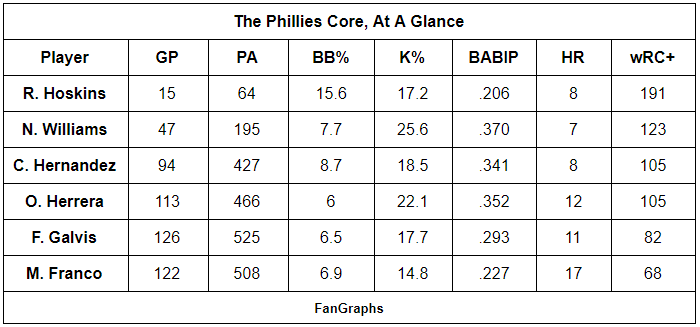
coreglance

These numbers back up everything about Hoskins at the start of this piece. They also tell us a couple of other things about the rest of the current Phillies core, whose average age is 25. (Jorge Alfaro is excluded because he’s only played in nine games this year.)

Nick Williams has probably been the second-most exciting bat in the Phillies lineup this season, but his BABIP and K% also make him the biggest wild card moving forward. Cesar Hernandez is a worthwhile hitter who provides value in a few ways. Odubel Herrera goes through stretches that are equal parts brilliance and frustration. Freddy Galvis is a defense-first shortstop who isn’t a total black hole at the plate. And Maikel Franco may be genuinely concerning at this point, which could be why JP Crawford is seeing time at third base in AAA.

As members of the second-worst offense in baseball, do they provide a single reason to get excited when watching them? They can be compelling on a given night, but no one in that group has a game-altering skill that urges you to tune in or stick with them through a whole contest.

It’s more than not having a standout skill, though, and goes beyond being bad. It’s that this Phillies team’s greatest flaw often seems to be that they can handily beat themselves. How each individual performs at the plate can provide one example.

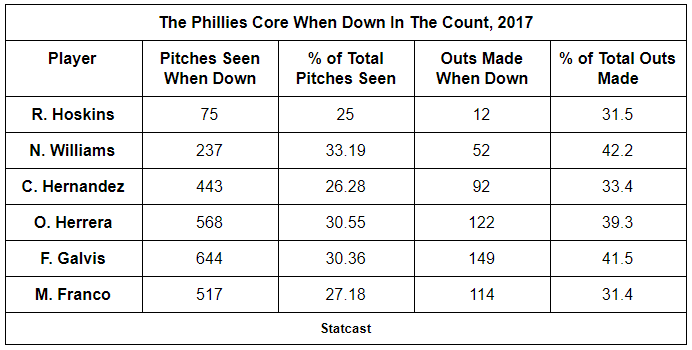
downinthecount

Galvis is the eighth-easiest out in baseball when he’s down in the count. Nick Williams would be up there if had enough at-bats to qualify. Odubel Herrera is in the top 50. Maikel Franco is 74th, but his overall game hasn’t struck fear into anyone in a couple years. Cesar Hernandez is quietly one of the better second basemen in the league, but he doesn’t offer nearly the offensive upside as Hoskins.

That likely makes Hoskins the best of the Phillies core at avoiding outs when behind in the count, and what contributes to him already being the team’s best hitter. Consider his crazy low BABIP and ability to walk and it gets easier to buy into. Yes, the sample size is small. But it’s also yielded results very similar to what his minor-league profile says to expect.

Hoskins isn’t just making outs at a lower rate than his teammates when down in the count. He’s shown himself to be adept at causing damage in such situations. That’s when he’s hit half of his eight home runs, meaning he doesn’t make it about just shortening up or taking a pitch. He simply doesn’t give a flip if he’s behind. He appears calm at all times. Combined with true talent, that is what makes for perhaps the most dangerous type of player.

Now, add that distinction to a lineup of other serviceable players where one or two of them grow. Add a pitcher or two to Aaron Nola, who’s becoming an ace. Think of other help coming from the minors. Things are looking much better for the Phillies, even if they come with conditions.

Rhys Hoskins has been excellent, but that’s not all. He’s clarifying Philadelphia’s path out of the basement, and possibly back to relevance, rather quickly.