Archive for Nick Markakis

The Atlanta Braves Have no Fear of Swinging

The austere face of Freddie Freeman; the resounding crack of Dansby Swanson’s bat; Ozzie Albies brimming smile – these are the surprising Atlanta Braves whose description is no longer surprising, but partial to a definitive fun run through the National League East. The Braves are baseball joy with a mix of relaxed confidence, even brimming optimism. A brimming optimism that has little been partial to any of the Braves players in the past.

A sort of confidence is sweeping the organization as every player is contributing, allowing each player to be distinctly themselves. No longer does Swanson have to turn himself into an all-star, slugger defined hitter, but a second-year player still learning. Nick Markakis can take time to become more confident in a refinement of his mechanics.

The simple undertone is two-fold; the Braves batting lineup is simultaneously playing at a career high, which has allowed the Braves batting lineup to refine their optimal batting throughout the first half of the season. The dominoes fell right, and the Braves learned how to optimize, cutting their progression time in half through analytical chemistry. Second, the one point that defined their functional progression: they have no fear of swinging, second highest in the MLB at 48.6 percent combined with the third highest contact percentage at 79.6 percent.

The odd perception is that swinging this high would lead to inappropriate risk. And for most developing teams, it has. The Detroit Tigers, Kansas City Royals, Chicago White Sox, and Baltimore Orioles round out the top five in swinging percentage, each with a resulting high swinging-strike rate. The Braves, however, have a 9.9 percent swinging-strike rate, eighth best in the MLB. The magic is not accidental due to a combination of veterans who are more patient and, young, power hitters whose slugging means swinging more is appropriate. Nick Markakis has a 4.8 percent swinging-strike rate and Kurt Suzuki is at a mere 7.5. This does not excuse Swanson or Freeman posting 11.7 and 11 percent swinging-strike percentage, respectively, but it allows them to take those extra risks to optimize slugging opportunity.

Suzuki has been an enigma for the Braves, but one of the most important supporting pieces to their run creation. After going his entire career with only one season at a wRC+ over 100 (Minnesota Twins, 2014, 106), Suzuki is now on pace to break his 129 wRC+ and tie his 2.7 WAR from last season. There might not be a coincidence that these two seasons have also seen him break the 50-percent swing margin (52.8 and 53.6 percent) while maintaining a high contact rate, specifically in the zone (93.5 percent this season).

Suzuki’s resolution has come on the backward notion to stop attempts to hit the ball opposite (below 20 percent of hits) instead opting to pull the simply pull hits for apt run creation. His placement map dictates he is better at hitting sharp, pulling balls, and his hits to opposite field were traditionally drab and futile with long hang-time. Hence, an allowance to be better at playing Suzuki baseball and not a league meta-style.

While Suzuki has added value by changing his batting style, there is Nick Markakis who is playing the exact same baseball, just with better contact and providing better leverage. He is hitting well above his career average in ISO at .160 while striking out remarkably lower at only 10.2 percent of pitches. His batted ball profile remains the same, making Markakis a player benefitting from the simple adage of relaxed baseball and improving at tearing pitchers apart in high-leverage situations.

Ozzie Albies, in his second season for the Braves, has already blown away a good first season, posting a 2.4 WAR with a 118 wRC+ (1.9, 112 in 2017). Much like Markakis, Albies has been a run creating machine with high-leverage situation hitting. He doubles down on chaos creation by forcing pitchers to throw uncomfortably away from the zone, less he turns a pitch for a deep slug shot. Albies has refined his slap-shot hitting by achieving his best slugging percentage in the bottom of the zone; thus as pitchers throw breaking-balls and off-speed pitches to derive poor contact, and those pitches drift, Albies is not only able to make contact, but make derisive contact.

The macro change has come with a micro improvement on finding the changeup. He has starkly increased his contact percentage, now above 85 percent in all but two zones. Last season he was above 80 percent in only four of nine zones. Albies is sending more of that contact higher into the air, a bit of a downside to the slugging revolution, but at the same time, is expanding his placement map. He has placed more balls sharply under three seconds of hang time, specifically under 1.5 seconds, implicating an ability to send even soft contact for hits. The career-trajectory implication is Albies is developing an ability to be a rounded hitter, known for more than homeruns.

That then is how the Braves have become a team still fighting into the July trade deadline; a buyer and not a depressed seller. The sudden power from the veterans meant the younger players had time to relax and optimize their best ability, creating a waterfall effect. The Braves have the best high-leverage analytics in the MLB because they find ways to creatively get on base, and those veterans now have players to send home.


Nick Markakis’ Forgotten 2008 Season

While browsing Baseball Reference’s database, I encountered a strange thing. I was looking at the WAR leaders for each season. WAR stands for Wins Above Replacement, which is a statistic that measures how many wins a team gained by having a certain player instead of a replacement player, who would have a WAR of 0. The leaders were all recognizable names — MVPs, World Series Champions, Cy Young award winners, etc.

Surely the leader in WAR in 2008 finished near the top in the MVP voting. And of course he was an All-Star. And sure, maybe he even won a Silver Slugger or a Gold Glove.

Nope.

Nick Markakis led the American League in WAR with 7.4 and did not receive an MVP vote, make the All-Star team, win a Silver Slugger or take home a Gold Glove.

Markakis is now a veteran outfielder for the Atlanta Braves. But back in 2008, he was a stud for the Baltimore Orioles, and he led his team in hits, walks, batting average, and on-base percentage. Markakis had a reputable slash line of .306/.406/.491, scored 106 runs, drove in 87, clobbered 20 homers and stole 10 bases. These stats are excellent, and Markakis finished near the top of many leaderboards once the season ended.

He finished in the top ten in the AL in batting average, OPS (on-base + slugging), hits, extra-base hits, and Offensive WAR. The right fielder also closed the year in the top five in the AL in on-base percentage, runs, doubles, and walks. Markakis was also a great asset in the field, leading AL right fielders in games played and putouts while leading all AL outfielders in outfield assists.

According to Baseball Reference, there have only been 32 seasons when a player either matched or exceeded Markakis’ WAR, Offensive WAR, Defensive WAR, batting average and on-base percentage.

Markakis’ excellent stats were matched by only 32 players ever, but he was snubbed from every award.

Markakis was not selected as one of the six outfielders to compete in the All-Star Game despite his achievements.

Instead, Ichiro Suzuki, Josh Hamilton, Manny Ramirez, J.D. Drew, Carlos Quentin, and Grady Sizemore were selected. None of them recorded more than 6.0 WAR, while Drew did not even record 3.0 WAR. Markakis was thoroughly robbed of an All-Star appearance.

Looking back on it, it’s an injustice that Nick Markakis had such a standout year and did not even receive a single vote for MVP. His 7.4 WAR outnumbered every other candidate, including winner Dustin Pedroia, who recorded 6.9 WAR.

Markakis had arguably a better year than anyone in the American League in 2008, and yet was not recognized at all.

Markakis was also a standout defensively, and recorded 1.7 Defensive WAR. Yet he was not appreciated for this achievement either, as Torii Hunter (-0.1 dWAR), Ichiro Suzuki (0.8 dWAR), and Grady Sizemore (0.1 dWAR) took home the outfield Gold Gloves in 2008.

Another intriguing aspect of Markakis’ season, besides being slighted from every award, was that this explosion came out of the blue. Markakis’ 7.4 WAR in 2008 soars above his career average of 2.6 and towers above his next-best season, when he recorded 4.2 WAR in 2007.

Markakis’ defensive exploits in 2008 were also very surprising. He has never been a great defender, and he has only two years in his 12-year career in which he has a positive dWAR, 2008 (1.7) and 2016 (0.3). Markakis has a career dWAR of -6.5, which shows that his excellent 2008 season was an anomaly.

Markakis also logged a career high in Offensive WAR in 2008, as he achieved career highs in runs, doubles, walks, batting average, on-base percentage, slugging, and OPS.

I’ll never know why Markakis could not even come close to matching his exploits from 2008. Markakis was just 24 in his breakout season, but his stats decreased as he headed toward his prime. I can’t find an explanation for his decline, as injuries weren’t a factor — Markakis has played at least 155 games in every season from 2007-2016, with the lone exception of 2012. Markakis was a bit lucky in 2008, as his BABIP (batting average on balls in play) was .350, higher than his actual batting average of .306. However, his career year cannot be explained away by luck.

The lack of recognition of Markakis’ magnificent season is puzzling. He did play in one of baseball’s smallest media markets (Baltimore) for a team that stayed in the basement of the AL East, but at a certain point, efforts like his need to be noted.

Markakis never again reached the heights of his 2008 season, and I’ll always wonder two things: why he wasn’t recognized for his achievements, and why he was never able to match his production again.

Special thanks to Baseball Reference for all of these helpful statistics


Nick Markakis, What Happened?

Nick Markakis has carved himself out a nice major league career. He now has the 8h most hits in Orioles history and by seasons end he’ll likely be in sole possession of 6th place. Markakis, now with nearly 1,500 hits, at 30 years old has a shot at gathering 2,500 hits in his career. While hits are a compilation statistic,  that would still place him in the top 100 of all time. However, Markakis still strikes me as a player of unfulfilled potential. In his last four seasons, Markakis has not compiled a WAR higher than his rookie season (2.1 in 2006). His two highest WAR seasons—far and away—were at ages 23 and 24. In 2008, a season in which he compiled 6.1 WAR, he had the 11th highest total in all of baseball. To peak so young is a very odd career trajectory. While Markakis was on the path to being one of the best all around players in baseball, he cratered early. This loss in value is due to two reasons, which are readily apparent to date this season, a reduction in power and a reduction in defense.

Markakis early on posted decent advanced defensive numbers. But, since 2009 he has been bad according to the metrics. To follow up that up with some regular scouting, he has simply lost a step. He lost his range at a young age and has never been able to get it back. His arm keeps him respectable but he has even lost some of that strength as well. He remains a below average right fielder and it is not getting any better.

While his defense has hindered his overall value, the most critical aspect of his game to leave him at young age was his power. Markakis never hit many home runs, with a career high of 23, but the doubles were critical to his value. He had four straight seasons of 43, 48, 45, and 45. All fantastic numbers. In fact, after the 2010 season, he had a decent shot of reaching the top 10-20 for the all time doubles record if he kept up that pace. However, his homers and doubles fell following 2010. If he had maintained a 40 double, 15-20 homer pace over the course of his career, alongside his .300 batting average and decent walk rate, Markakis could have been one of the most valuable outfielders in the game. The graph below tells the story best of when he lost his power. Those are his season by season ISO and SLG numbers.

NickMarkakis_PowerGraph

Looking at the graph above, once can see that Markakis was average to above average in power production for his first handful of seasons. Starting in 2010 is when his power began to fall to below average. His numbers spiked in 2012, however that is his shortest season to date so the sample size is smaller than the other years around it. Also, 2012 was still lower in both ISO and SLG than 2007 and 2008. Since 2009, Nick Markakis has been a below average power hitter. And his most recent season, 2013, was his worst ever producing a paltry .085 ISO (.145 is considered average and .080 is considered awful) and posting a -.1 WAR number. But, the question still remains to why did he lose his power?

After watching Markakis for years and staring at hours of tape it is hard to tell if this power reduction is due to mechanical issues. Markakis has been known to change his stance and approach at the plate nearly every week. He will lower or raise his hands, stay open or close up, he is a constant tinkerer at the plate with his mechanics. I do not believe mechanics has anything to do with the steady power decline. Nor is it necessarily how pitchers are pitching to Markakis. Looking at the numbers, he is seeing a similar amount of pitches in the zone, a little less than the early years but nothing unexpected and in fact his rate has rebounded recently. Furthermore, the mix of pitches he is seeing is similar to his early years. It has not been an adjustment from pitchers. Rather, much like his defense, he simply lost a step earlier than most other position players do.

Looking at the two heat maps below. One shows his power peak years (2007 to 2010) and the one below that shows the last two seasons (2013 to 2014). They are ISO heat maps showing which pitches in which locations Markakis has been able to drive for extra bases.

Markakis2007to2010ISOMarkakis2013to2014ISO

Clearly, Nick Markakis has shown over the past two seasons to not be able to drive the pitches for extra bases that he once could. In particular the pitches in the outside middle of the plate—which if you remember those great Markakis years he could artfully fade right in between the center fielder and the left fielder for a double like clockwork—he has shown a clear ability to not drive for extra bases anymore. The only power left in Markakis’ game comes from pitches down and in and even then its limited power at best. Basically, he can still run into a meatball, but his double-hitting days are over. And with someone who cannot and has never been able to hit the ball out of the park readily, Markakis is basically a slap-hitting right fielder who can post some decent value at the plate, but nothing special.

The career arc is strange and unfortunate but clearly obvious. Markakis simply could not and cannot maintain the production of his early seasons. His skills broke down sooner than most. He is a nice piece and if he kept up his early pace, he would have been a steal on his current contract. However, unless he is brought back at a reduced price—or if Peter Angelos decides that loyalty is worth $17.5 million—Orioles fans better get used to having a new right fielder in 2015.

Article originally posted at www.Orioles-Nation.com


Nick Markakis’ Lack Of Power

Nick Markakis has just two home runs thus far this season, and is on pace to hit just 9 on the year. I think it’s relatively clear now that Nick isn’t really a power hitter – he’ll get his share of homers but is more of a doubles hitter who is content taking outside pitches to left-field. “His share” though, has been quite low in 2010. I’m not saying I’m worried yet – the season is long and the ZiPS updated projections still has him finishing with 17 homers (only one less than last year) – but it is a bit curious.

One of the more obvious aspects of home run hitting is that it’s much easier when you pull the ball. Here’s a nice graph from an article by Mike Fast at The Hardball Times:

So where is Nick hitting the ball? Here’s all balls in play by year and field:

LF CF RF
2006 31.4% 34.0% 34.7%
2007 33.6% 38.0% 28.4%
2008 29.4% 36.4% 34.2%
2009 32.3% 32.1% 35.6%
2010 31.6% 46.2% 22.2%

He’s always been a guy who uses the whole field, but so far this year he’s not turning on as many pitches. And just the flyballs:

LF CF RF
2006 46.0% 34.7% 19.4%
2007 46.7% 35.7% 17.6%
2008 47.2% 37.7% 15.1%
2009 41.8% 33.3% 24.9%
2010 37.5% 50.0% 12.5%

Last year Nick hit a much higher proportion of flyballs to right-field, which helps explain why almost all of his home runs (14 of 18) were to right. This year, not only is Markakis not pulling flyballs but he’s also not hitting as many to the opposite field. Center-field is the deepest part of any park, and a full half of Nick’s flyballs are going out there. No wonder they’re not finding seats.

I’m not really sure why that’s happening – likely mostly normal variation – but Nick is getting a lot more fastballs and he’s done a pretty terrible job of getting around on that the pitch so far.

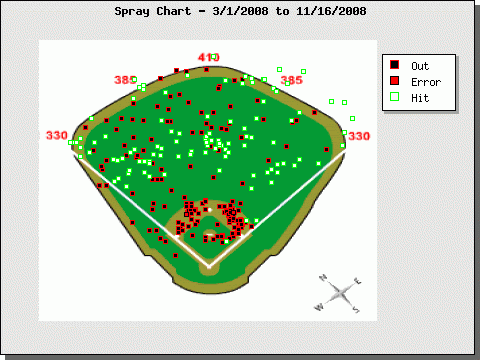
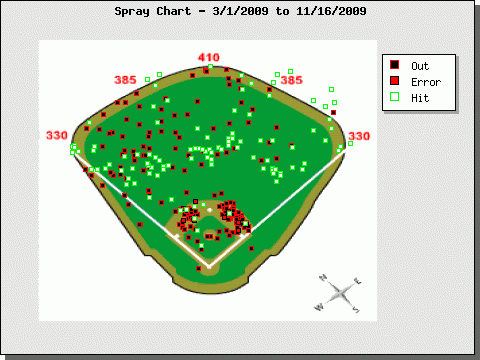
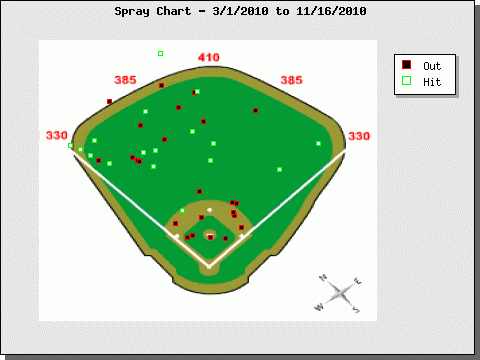
Compare these three spray charts on fastballs going back the last three years (courtesy of Texas Leaguers):

2008:

2009:

2010:

Right-field on that last one is pretty barren. I thought that maybe Nick hasn’t been able to catch up to a good fastball, but his contact rate against heaters at 94 mph or above has actually gone up the last three years; from 71% to 85% to 93%. Perhaps he’s more content to just make contact than to try to drive the ball. The spray charts for all pitches tell a similar tail; not all that many balls being driven to the “warning track”, or to right-field.

Nick’s 5% HR/FB rate is well below his career mark of 10.6%, as well as last year’s career low of 8.6%. I’m not might sure exactly how much we can expect that rate to go up this season, but I do think it’s clear that if Markakis doesn’t start pulling the ball in the air at least a little more often his power numbers won’t be particularly impressive at the end of the year.