Archive for Boston Red Sox

The Myth of the Indestructible Catcher Tandem

In the world of sports, the catcher position is kind of weird. Catchers start each play out of bounds, facing a different direction than their teammates. On a more micro level, baseball’s most important in-bounds/out-of-bounds determination, the strike zone, isn’t static as it is other sports; it’s determined on every pitch, and the catcher has a role in making that determination. In a non-contact sport, they’re covered in protective armor. Those of us with lousy knees are in awe just of their ability to do all that squatting.

Catcher is also the only position on modern rosters where there is planned redundancy. Thirteen-man pitching staffs have more or less eliminated platoon tandems, but catching tandems persist. The Pirates don’t carry an extra center fielder to give Andrew McCutchen a rest in the second game of doubleheaders. The Nationals don’t have a second right fielder to play instead of Bryce Harper on day games after night games. The Yankees don’t roster a spare third baseman in case Chase Headley gets hurt or tossed from a game. But every team has to have two catchers, and each of them sees a decent amount of playing time. (The catchers for those three teams in particular, as we’ll see.)

Further, the impact of a catcher injury can be significant. A disabled catcher’s replacement could well be unfamiliar with his pitching staff and opposing hitters’ tendencies, impairing his ability to call a game. He may not know the league’s umpires and their interpretation of the strike zone. He might not be up to speed on his infielders’ shifting tendencies and how that may affect pitch selection and location. And his presence probably means extra work, and extra fatigue, for the team’s other catcher. Just ask a Boston Red Sox fan about the importance of healthy catchers. (That’s a rhetorical suggestion. I don’t recommend actually doing that, unless you want to hear a long exposition about the importance of good free agent signings, a reliable starting rotation, offensive production from your first basemen, keeping your closer and second baseman off the DL…really, it can go on for a while.)

This summer, while attending a Phillies-Pirates game during which the Pirates used both of their catchers, my friend wondered whether the Pirates had the skinniest catchers in the league. (Francisco Cervelli is listed at 6’1″, 205, Chris Stewart 6’4″, 210). While actually putting in the time to figure this out (the answer appears to be “yes,” if you can trust listed heights and weights), I noticed that Cervelli and Stewart had caught all but 17.1 innings for the Pirates in 2015. This was in August, but it remained the case for the entire year. Cervelli caught 1099.2 innings and Stewart 372.2. Combined, that represented 98.8% of all the Pirates’ defensive innings last year. This struck me as notable, as the Pirates had lost the durable Russell Martin to free agency over the winter, replacing him with Cervelli, who’d never played more than 93 major league games in a season previously. The Pirates are famous for their use of analytics, including monitoring player health, with an eye toward injury prevention. Maybe that’s working. Or maybe they’ve figured out something with skinny catchers. Either way, I wondered whether the Pirates’ tandem represented something unusual.

To check, I looked at every team’s catchers since the 1969 start of divisional play. Using this year’s Pirates as my model, I looked for teams for which the top two catchers caught 98.5% or more of all innings. Last year, the average team’s catchers caught 1,446 innings, so I was looking for teams for whom top two catchers were on the field for all but 21.2 innings, on average.

It turns out the Pirates weren’t unique. Brian McCann and JR Murphy caught every inning for the Yankees this year. Wilson Ramos and Jose Lobaton caught all but nine innings for the Nationals. Carlos Ruiz and Cameron Rupp were behind the plate for all but 18 innings for the Phillies. That’s about typical. Since 1969, there have been 240 teams whose top two catchers caught at least 98.5% of all innings during the season, or a little over five per year (closer to four and a half if you exclude strike-shortened seasons).

But totals don’t tell the whole story, since baseball’s expanded from 24 teams in 1969 to 26 beginning in 1977, 28 beginning in 1993, and 30 beginning in 1998. The graph below shows the percentage of teams, per season, with two catchers handling 98.5% or more of the workload. The overall average is 18.6%. There’s a very slight downward trend to the line–the slope is -0.03% (yes, I got the decimals right)–meaning that catchers have been becoming a little less durable over the years, but almost imperceptibly so. (I was tempted to say “a little less durable or managers are giving them more rest,” but other than the occasional Kyle Schwarber, who primarily plays another position but can catch in a pinch, teams just don’t carry three catchers any more, so rest for one catcher in a tandem means playing time for the other.)

(The outlier on the high side is 1994, when there were only 117 games played.)

Teams for which two catchers caught 98.5% or more of innings won, on average, 85 games during the non-strike-shortened seasons. That’s not super impressive, considering the selection bias inherent in this sort of analysis. Specifically, teams with two catchers handling virtually all of the time behind the plate are teams that not only avoid catcher injuries, but also have two catchers good enough that they’d want to have them there all year, contributing to overall team success. In 2014, for example, the Red Sox had three catchers with over 400 defensive innings, in part because none of them could hit: A.J. Pierzynski (540 innings, 71 wRC+), Christian Vazquez (458.1 innings, 70 wRC+), and David Ross (418.1 innings, 71 wRC+). (See, I told you not to ask a Red Sox fan about catchers.)

Still, 85 wins is decent, four games better than .500–that’s the Angels this year. Of the 213 teams for which two catchers caught 98.5% or more of innings in non-strike-shortened years, 77, or 36%, won 90 or more, which is generally good enough to get you into the postseason these days. So there’s certainly an advantage to getting all the work out of two catchers.

So has anybody cracked the code on keeping their two catchers healthy? I looked for teams that had three or more seasons in a row with two catchers handling 98.5% more of innings. If teams have a secret sauce, they should show up on this list with regularity:
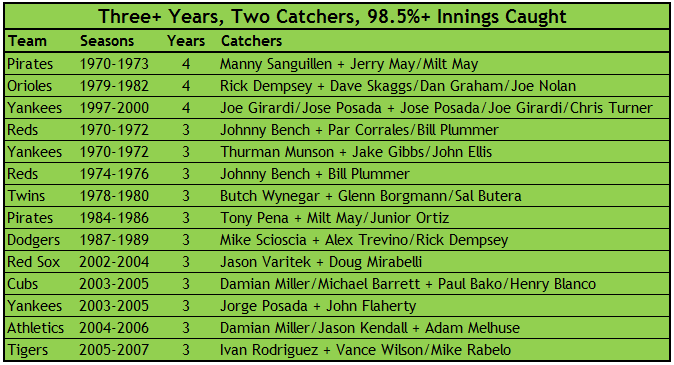
Nope. The closest thing there is the Yankees, who had streaks with Thurman Munson in the 1970s and Jose Posada around the turn of the century. The only other teams to appear more than once are the Johnny Bench Reds and two iterations of the Pirates, over a decade apart and 30 years ago. There’s nothing in this table suggestive that it’s a matter of skill, rather than luck, to keep two catchers on the field all season. Specifically, these teams generally had an All-Star caliber No. 1 catcher who avoided injury with various guys in the backup role. That’s about it. No team has cornered the market on that formula.

So maybe that’s making the criteria too tough. Maybe I should be looking just at back-to-back 98.5%-plus inning performances. Given that, on average, 18.6% of teams had two catchers with 98.5% or more innings caught since 1969, random chance suggests that a team with two dominant catchers has about a one-in-five chance of repeating the following year, like flipping a coin that comes up heads 18.6% of the time. A rate of repeat significantly above that could indicate skill rather than luck. Of the 236 teams, 1969-2014, that had two catchers with 98.5% or more innings caught, 60 repeated the following year, or 25%. That’s not a statistically significant difference (using an N-1 chi-square test, if you were wondering). In other words, there’s no reason to believe that a durable catcher tandem is a matter of anything but good fortune.

So feel good about keeping your two catchers healthy this year, Yankees, Nationals, Pirates and Phillies. Especially the Pirates (111 wRC+) and Yankees (104 wRC+), who got above-average offensive performance from their catchers as well. (The 69 wRC+ Phillies and 62 wRC+ Nationals catchers were among the worst in baseball.) Just don’t assume you’ll be able to keep those two guys on the field all of 2016 as well.


The Cubs, the Red Sox and a Blank Check

The Cubs and Red Sox are doing interesting things for their ambitions. Boston overhauled their young and unpredictable club with two of the top free agents on the board while the Cubs’ rotation makeover coincides with a slew of young offensive talent already in place. Neither team is yet finished as the outcomes of Scherzer, Shields and whatever we’re calling San Diego still loom toward the New Year. Regardless, their intent for 2015 and beyond is the same: win.

But these two teams are interesting for another reason. It’s not often that clubs expected to contend in one year also happen to have top 10-selections of that year’s amateur draft, but that’s exactly what will happen this coming June. The former club of Epstein and Hoyer will select 7th overall. Their current club will select 9th and if all goes according to plan, each club’s 2016 selections figure to fall well out of protection.

But rising from this is a fascinating opportunity. It’s a very rare opportunity requiring the unique but exact convergence of factors surrounding these two teams, swinging the cost/benefit ratio to an extreme. The Red Sox intend to be at the top of the standings this season and based on what they’ve done, chances are good that they will. The Cubs are not far behind and as opined by Dave Cameron may be just a leap or two from the same goal. Whatever happens, each of the next two seasons project to be followed by two of the strongest free agent classes in history. 2015 should include Justin Upton, Jordan Zimmermann, Jason Heyward and more. The 2016 elite is likely to be headlined by Stephen Strasburg. There is going to be a hefty number of qualifying offers and little reason to care.

Focusing upon the next two years is important. The current collective bargaining agreement is in effect until December 1st, 2016, specifying the rules that govern draft bonus allotments and the penalties for their violation. Summarized below:

–        0-5% overage: 75% tax on the overage

–        5-10%: 75% tax on the overage and loss of 1st round pick in subsequent draft

–        10-15%: 100% tax on the overage and loss of 1st and 2nd round picks in subsequent draft

–        15% or higher: 100% tax on the overage and loss of 1st round picks in subsequent two drafts

o   Note: If a team lacks the selection subject to penalty due to a prior penalty levied from draft overages, the team will be penalized in the next draft in which said selection is conveyed.

To date, no team has spent beyond the 5% threshold and thus no team has been penalized a selection.

But then no team has been in this particular position before, a situation perhaps too unlikely to have been considered during CBA negotiations. Under the rules above, teams are pressured either to adhere to slot value or to strategize by shifting their allotments in favor of two or three top talents. The Cubs and Red Sox will have no such limitations this June. They can spend with complete and utter impunity.

Part of how this is possible is due to the language of the CBA and the impending sequence of events. A theoretical chronology:

1)     The 2015 draft begins

2)     Boston or Chicago picks who it wants and spends as much as it wants

3)     Boston or Chicago receives the maximum penalty, including tax and forfeiture of 2016 and 2017 1st-round selections

4)     2015 free agent class – Either team signing a QO free agent forfeits its next highest 2016 selection (2nd round)

5)     2016 free agent class – Either team signing a QO free agent forfeits its next highest 2017 selection (2nd round)

6)     Draft Penalty completed

Why would they do this? Because of who they are and because there is every incentive for doing so. Consider the maximum penalty – forfeiture of 2016 and 2017 first round picks – only for these two clubs, it’s entirely probable that none of these picks project to exist. Notice I said project, which is a critical distinction, because at the time of the 2015 draft their 2016-17 selections are officially still in place.

Implying, what if they can be sacrificed? The Cubs and Red Sox each operate at the highest levels of revenue and at their current win-curve trajectory are virtually guaranteed to be major players on the free agent market in each of the next two years. As a demonstration, both have already signed major targets this off-season. It’s easy then to imagine either team having to relinquish their top selections anyway, except either club can decide that in June as opposed to November. Given enough information by then, they’d have to ask themselves: What do they have to lose?

Lets assume each team performs toward the fringe of the playoffs and we assign them the 23rd selection in 2016 and 2017. In Boston’s case we could argue this will be even lower, or a few spots higher for the Cubs if you think they aren’t quite playoff ready, but as a middle ground the 23rd selection is a good place to start. Keep in mind by June, enough games will have been played to know this with some certainty. Let’s also assume that the first-round selections in each year will be lost to FA compensation. This isn’t an exact process since picks will be added or removed to a varying degree, but using 2014’s values will give us a rough estimate going from one year to the next:

2014 7th 9th 23rd
Round ($M) ($M) ($M)
1 3.30 3.08 1.95
2 1.19* 1.13 0.90
3 0.68 0.66 0.53
4 0.47 0.46 0.39
5 0.35 0.34 0.29
6 0.26 0.26 0.22
7 0.20 0.19 0.17
8 0.16 0.16 0.15
9 0.15 0.15 0.14
10 0.14 0.14 0.14
Total 5.71 6.57 2.93
% Decrease -48.7 -55.5

*Boston forfeits 2nd round selection (Hanley Ramirez)

In addition to forgoing the top 30 prospects, dwindling bonus pools severely damage teams’ ability to pay for any talent at all. By employing this strategy, Boston and Chicago can essentially punt drafts in which they might have expected to extract little value in the first place. In exchange, they take full reign to obtain as much talent as they wish in the coming draft – and the talent will be there. Even as restrictions pressure draftees to sign close to slot nevertheless talent falls due to signability, particularly when coming from high school. In the scenario above, a team is looking at one 7-figure talent, maybe two if slots can be shifted. Compare that to what they might obtain with 40 limit free selections.

Just as important, where these teams select has a significant influence on realistic return. Where top ten selections can result in impact talents, selecting early in each round is an opportunity to grab a falling talent well before other teams consider themselves able. Within current strategies, teams have to be cautious of the round in which they decide to risk on higher prospects as the ability to pay is tied directly to their selections in other rounds. But if money is no object, the Cubs and Red Sox can simply pick whomever they want whenever they want, in which case having the higher position becomes a huge advantage.

This isn’t foolproof. It would have to be a “calculated risk” decided upon almost the day-of. For one thing, it’s impossible to predict exactly what a free agent class will have to offer. If several projected free agents instead sign extensions, it becomes more difficult to justify devaluing your top selection. By June, teams should have a better sense of the picture ahead but it won’t be crystal clear. These teams will have to be reasonably confident not only that targets will exist, but that they’ll have a reasonable desire to sign them.

For another thing, at a certain point the cost in payable tax becomes a bit unwieldy. Perhaps the key then isn’t to sign as many top prospects as possible but rather enough to make up for impending losses in the two subsequent drafts. Because their pools are relatively large both teams will be partly insulated, but past that you’re paying double what you normally would per prospect. That requires confidence that the talent available is worth the additional costs, something not often expressed by teams prior to the current CBA.

That’s an argument to be made however, simply because the successful development of a few can exponentially result in surplus value. Should you prefer a direct measure of dollars, studies such as this one routinely demonstrate the windfalls in appropriately identifying and obtaining draft talent regardless of where they’re picked. In today’s league with today’s prices, that’s as tempting an idea as ever and if you wonder whether teams still place premiums on potential, look no further than the international market. Furthermore, the value of a prospect is predicated not on “Will he produce major-league value?” but rather “Can he?” The extractable value of potential in trades should be evident as I write this.

But the third and perhaps the most critical obstacle is the league itself and whether it takes the power to reject bonus agreements. This is suggested in the CBA document linked above, where the “uniform player contract” specifies required-approval by the Office of the Commissioner. Whether this suggests the Office would actually exercise its right of refusal isn’t clear. The only precedent as far as I know is MLB’s refusal to allow a $6M bonus to Matt Purke, a unique situation in which MLB had control of the Rangers’ finances. Particularly controversial deals have drawn little more than ire. Strict stipulation of penalties in the current CBA implies a team’s right to accept said penalties should it choose to do so. For the Commissioner to explicitly prevent a team from exercising this right is bordering on breach and may be actionable or subject to a grievance by the club or by the MLBPA. This is where the issue gets a little messy and comes down to debates beyond the scope of this article.

I won’t hesitate to call this what it is: a gambit. Strategies like this enliven the game and introduce an element of danger that can either pay off or egg face. Regardless, it highlights yet another flaw to the system in place. In one sense, this strategy is a novel way of playing within the rules, which is at the very heart of high competition. In another sense, it goes against sportsmanship in that this strategy is available only to teams who can realistically devalue their top selections, i.e. teams operating with enough capital to consistently invest at the top of the open market.

But rules are rules. The Cubs and Red Sox have the chance to align their playoff ambitions with a prospect bonanza not yet seen. They’ll have their pick among the elite and after that, should the dominoes fall along the way, they can – and should – take full advantage.

Jonathan Aicardi is a researcher with UCSF in the study of glioblastoma and the proprietor of Another Mariners Blog! Because apparently the world needed another one.


Xander Bogaerts’ Rookie Struggles

Coming into the year, the Boston Red Sox were riding high after the 2013 title in which they’d gone from worst to first. Just about everyone with a worthwhile opinion thought that’d they at least be in contention for the playoffs again this year, and it wasn’t uncommon to see people picking them to repeat in 2014.

One of the few questions people did have about the team was how would they integrate their two young players, Jackie Bradley, Jr. and Xander Bogaerts, in their first full seasons as starters. Of these two players, Bradley was the one that people seemed most concerned about. This made sense, since he was less regarded as a prospect than Bogaerts (number 2 overall on most prospect top 100 lists). But while Bradley has been a complete zero with the stick (57 wRC+), his defense has carried him to 1.5 fWAR so far this season. Bogaerts, on the other hand, has a wRC+ of 82, which combined with mediocre defense has left him hovering around replacement level.

Now, there’s no doubt that people are disappointed by Bogaerts’ season, and they have every right to be. Bogaerts was hyped as the rare prospect with superior skills and a significant amount of polish, and he showed why when he played like a veteran down the stretch in last year’s playoffs. Nobody was expecting him to be replicate Mike Trout’s rookie season, but a league average regular was probably a reasonable expectation. Obviously Bogaerts has underperformed relative to that standard.

Guys like Trout, Yasiel Puig and Manny Machado have essentially ruined the kind of expectations we now put on guys going through their first full seasons. Do you know how many batting-title-qualified rookies have had an OPS lower than Bogaerts’ current .650? 311! And of that 311, 283 of them were older than Bogaerts’ current 21 years of age. Bogaerts is struggling, but that’s what rookies do. There’s no greater jump in professional baseball than the one to the majors.

Bogaerts is actually hitting pretty well against fastballs and changeups. The crux of his issues this year have been against breaking balls. And there’s really no way to sugarcoat it. He’s been terrible against any and all spin, hitting just .143 and slugging .167. Unfortunately, opposing pitchers have noticed, and Bogaerts has only seen more breaking balls as the season has progressed.

plot_hco_bytime (1)

As the rate of breaking balls has gone up against Bogaerts, his numbers have gone down. The Red Sox shortstop was actually a well above average hitter heading into June (119 wRC+ in March/April, 149 wRC+ in May), but then everything fell apart. Bogaerts posted an almost unthinkable .426 OPS in June, a number less than half (.897) of what he posted the month before. He followed that up with a much improved, but still terrible July (.595 OPS) and continued to struggle in August.

Bogaerts’ struggles with breaking balls coincide with the part of his game that has perhaps regressed the most as his season has progressed: his plate discipline. After working 25 walks through the end of May, Bogaerts has been told to take his base just seven times since. A large part of that has been the decline of his ability to discriminate between a breaking ball thrown for a strike, and one thrown for a ball.

plot_hco_bytime

As you can see in the graph above, Bogaerts has stayed fairly steady against fastballs and changeups, but his ability to recognize breaking balls has completely melted away. As for why this has happened, that’s difficult to say. Maybe Bogaerts has always struggled against breaking pitches. But the most likely answer is that he’s a rookie struggling to adjust against pitchers capable of taking advantage of his weaknesses. Nevertheless, it’s at least been a prolonged slump, and one that Red Sox fans have to hope isn’t a glimpse into continual struggles for their youngest player.

Then, putting aside things that we can actually measure, there’s the possibility that Bogaerts is simply in his own head right now. As a ballplayer, he’d probably tell you he’s trying to do too much. There’s certainly something to that side of the argument. It can’t be easy to fail so spectacularly after being hyped as the next face of one of the most prestigious franchises in the game.

There’s also an argument to be made that some responsibility for Bogaerts’ struggles can be set at the feet of his manager, John Ferrell. There have been rumors that Ferrell was the person in the organization pushing the hardest for the Red Sox to resign Drew, which they ultimately did in late May. Drew, who had never played any position but shortstop in his big league career at that time, would be forcing Bogaerts over to third base, the position he played down the stretch of the 2013 title run. Bogaerts expressed some disappointment at time as a result, and an argument can be made that the team’s decision to resign Drew shook his confidence. Before Drew joined the lineup on June 2nd, Bogaerts was batting .296/.389/.427. Since then he’s hit .169/.201/.279. You might say that those dates are arbitrary and coincidental, and you can make of them as you wish. I will say that confidence is a huge part of succeeding in this game, and it should not be overlooked.

Overall, Bogaerts probably won’t look like he belongs back in AA forever, though we may have to wait until 2015 to see the player we were all hoping for. We got that player in the first couple months of this season, but pitchers’ adjustments, along with Bogaerts lack of adjustment to those adjustments, have torpedoed what was initially a very promising rookie year. That said, young players with Bogaerts pedigree and polish often turn into solid players at the very least, and I’m still as excited as ever about his career going forward. He’ll figure it out.


What the Red Sox are Getting in Grady Sizemore

The Red Sox have made news, signing Grady Sizemore to a Major League contract worth $750k ($6 million if all incentives are factored in).  This got me thinking about what happened to Sizemore.  He made the game of baseball seem simple with his defensive prowess, his above average power, and his lightning speed.  Then one day, his aging body realized that the kind of aggressive player that he had been would no longer work and it started giving in to the high strain that he put it under.  He had a hernia surgery as well as several knee and back surgeries between 2010 and 2013 which seemed to end his baseball career.  Then out of the blue he was picked up by the Red Sox in a deal that has high potential for both sides; the Red Sox could get a great player for cheap and Sizemore could resurrect his career.  This deal could end poorly for Sizemore, who could finally realize that his career is over either from injury or performance reasons while the Red Sox will view it as a failed experiment that doesn’t hurt them financially now or in the long term.

The signing of Grady Sizemore is an indication that they are ready to give Jacoby Ellsbury’s former job over to Jackie Bradley Jr., but it also shows that they are prepared with a backup plan in case that doesn’t pan out.  Some would say that Sizemore is hardly a backup plan as he could very well end up injured, which is absolutely true, and that an outfield of Gomes LF, Victorino CF, and Nava RF would happen in the event of Bradley turning out to be a dud.  But with Sizemore comes a tremendous amount of upside.  Five years ago he was a 30-30 player and a gold glover in the outfield.  He was healthy, he was starting to walk more and strike out less, and then everything stopped for him.  He was forced to undergo elbow surgery in 2009, an injury that had plagued him all season long, and from that point on if it wasn’t one problem then it was another.  Left knee surgery, right knee contusion, hernia surgery, back surgery, and then a right knee surgery came all in a span of three years which can leave a player asking whether or not their career is over.

The question that should also be brought to the attention about Sizemore is what his plate discipline will be like.  Sizemore’s BB/K reached its peak in 2008 with a .75 BB/K, dropped to .65 in 2009, and then plummeted to .245 in the combined 104 games in 2010 and 2011.  For most of his career, it seemed that Sizemore was above average at walking and avoiding strikeouts as his career BB/K was .53, .05 above the Major League average during that time period of .48.  Now did the drop come about as a result of the injuries that he suffered from 2009 to 2011 or did they just come as a result of him losing his ability?  The interesting thing about his BB/K having such a drastic change is that his swing percent rarely changed.  His career Swing% is 43.4% which is fairly decent considering that between 2004 and 2011, the average swing rate among players was 47.6%.  Sizemore also made contact with the baseball at an 81.1% rate over the course of his career with the contact rate dropping barely below that number in the three shortest years of his career (2004, 2010-2011).  Those were also the only years that his swinging strike percent exceeded 10%.  Perhaps what this shows is that pitchers weren’t afraid to attack him and he wound up taking a lot of called strikes.

The other facets of his game that must be viewed at with a lot of importance are his power and speed.  I truly believe that if Sizemore can stay healthy, then we will see a resurgence of his power.  His power numbers have always been impressive, with a career ISO of .204 and career SLG of .473.  Even in 2011 when he was limited to 71 games and was coming off of microfracture surgery in his left knee, he produced an ISO of .198.  I don’t think power will be an issue for him.  The other major part of his game that will likely never return is the speed.  In those 71 games of 2011, he stole 0 bases after averaging 19 swiped bases per season and stealing at least 22 bases in 4 of his 7 seasons prior to 2011.  With the second knee surgery having occurred in 2012, my guess is that little to no speed will be found from him in 2014.

As with everything in baseball, there are the intangibles that must come into consideration when discussing the future of Grady Sizemore.  For starters, he has not set foot onto a baseball field in 2 years.  It is a possibility that he will be incredibly rusty and might struggle to perform again at the big league level.  For some players, that would be less of a concern but for a player who last played baseball in his twenties and who is now playing in his thirties (granted, it was his late twenties and it will be his early thirties), it could pose a greater challenge.  It’s possible that he could shake all rust in Spring Training and come out in April and prove all the doubters wrong although it is impossible to know for sure.

The most optimistic yet realistic scenario for Sizemore is that he comes back to the majors, is solid defensively, and puts up great power numbers for the Red Sox.  My guess is that from the knee and back surgeries, his base stealing days are over and he will not be able to cover as much ground in the outfield that someone else might.  If I was Red Sox management, I would not give him the role of backup center fielder until I knew for sure the kind of speed that he has left.  I would task Shane Victorino with that as he has remained healthy and still has the speed to cover that ground.  Victorino would play center and when he does then Sizemore would be in left field and Gomes/Nava would be in right field.  If Bradley fits in with the Red Sox plan, then Sizemore just becomes a spot starter/platoon player in left, center, and right field only to give people a break when they need it.  So to answer the question that the title of this article poses: the Red Sox are getting a wild card, a player with the potential to be a power bat off the bench or even in the everyday lineup or a player that has played his last days in the bigs.