Dansby Swanson’s Adjustment, Into the Rabbit Hole

(Editor’s note: this post was submitted prior to the start of the season but it seems rather timely now)

I can’t shake myself from latching onto spring training hype trains. Even after all we’re taught about small sample sizes, I find myself watching games and wondering whether this could be the year for any number of players.

Watching the Braves and the Nationals last weekend, something about Dansby Swanson seemed different. I started digging and emerged on the other end of a rabbit hole that brought me from hitting guru Jason Ochart (@Jason_cOchart) to Coach Bobby Stevens Jr. (@StevieBobbinsBattersBoxChicago.comGoWindyCityBaseball.com) to gif-ing up everything and more.

I’ll admit, I forgot Dansby Swanson was sent to the minor leagues in late July. The former number one pick relinquished his major league role after mustering only a .287 OBP in just under 400 plate appearances. Two weeks later he was recalled with little more than generalities to sift through in hopes of unearthing what the Braves wanted to change mechanically if anything at all.

After Swanson’s return to the major leagues tinkering began.

Video via MLB.com – 12

It’s a relatively simple adjustment, but the ramifications and reasoning behind the alteration bubbles numerous points to the surface.

“Getting [your front foot] down too early can mess up timing and alter the kinematic sequencing of the swing.” Jason Ochart quickly summed up via Twitter what I speculated might be true.

For almost all of Swanson’s 2017, before his change in late August, his front foot was down earlier than your standard hitter (in the video on the left above).

“For most hitters, the pressure shifting onto the front foot is what initiates their swing. Force plate data shows that the forceful heel drop works as the trigger of the swing and works as a brake to send energy upward through the body… to accelerate the bat late in the swing arc, as all the best hitters do.”

Breaking down Orchart’s points make a complex explanation simple. A hitter’s front foot is used to initiate their swing. When this foot plants, it helps transfer energy from one’s lower body to upper body. Eventually, that energy affects a hitter’s bat.

“Force plate data” sounds complex, but it’s nothing more than a plate on the ground that measures exerted force. In this case, the force from a hitter’s front foot. (YouTube is always here to help as well).

Ochart went on to state research shows that shorter time between the peak of one’s front-foot force and contact with the baseball can lead to greater exit velocity. If your front foot peaks early, as a hitter’s might if they’re planting as early as Swanson was, the effects could be detrimental on the one variable most hitters are focused on.

Stats, however, have a tough time backing up a substantial performance boost solely through the hovering of Swanson’s front foot.

Upon Swanson’s return to the majors in August, there was a strong uptick productivity that lasted until the beginning of September. This correlates nicely with his front-foot alteration but doesn’t sustain through the end of the season, as one would hope a material adjustment would. A variety of other factors could counter the change: production uptick being artificial, fatigue, comfort with the new approach, etc.

But what about other components of Swanson’s swing that might have been affected by this change?

“Hitting is controlled all through the back hip in relation to controlling your weight and ‘staying back’ on pitches. The issue is in the explanation of ‘stay back’. Stay back in what position? With your foot off of the ground? With your front foot on the ground? In your stance? That is where understanding is lost in my opinion.” Stevens took a different route to a similar conclusion that buoys the case Swanson had beneficial intentions, even if stats cloud improvement.

“A hitter must ‘stay back’ in their hip with their foot off the ground or hovering. This does not mean that you lift the front foot off the ground and balance on your back leg, though. It means that we load or coil into our back hip, then as our lead leg begins to stride out towards the pitcher, we want to ‘stretch’, or use our back muscles, to hold our weight back until we decide it is time to launch the swing.”

Stevens’ broadening of terminology related to “staying back” unearths numerous other factors related to what Swanson did. Each of his points made me consider other aspects of Swanson’s kinetic chain, particularly how the most visible change – foot down early to hover – could be covering up other, more important changes to help the former college star, acting as the low-hanging fruit.

So why bring this front-foot change up now, six months late? Because Swanson’s lower body alteration was actually the second thing I noticed, behind another change that caught my eye on his long home run off Max Scherzer in spring’s first weekend of action.

Video via MLB.com – 12

First his lower body, now his upper body. While the above camera perspective when comparing is slightly askew thanks to spring training parks and their uniqueness, Swanson is starting his hands lower and bringing them up into his load. In 2017, he started his hands higher and kept them there for the duration of his pre-swing rhythm. Now, his momentum is built up into the hitting position, yet the path and aesthetic of his swing after his load are nearly identical to the naked eye. This feels like a conscious attempt at relaxation in the box, with the foresight to alter the path to his load as opposed to how exactly he is loading. What could be invisible, however, to my untrained scouting eyes are the concepts Stevens talked about above relating to a hitter’s back hip and launch into his swing.

Swanson’s adjustment is similar in direction to Zack Cozart’s alteration from 2016 to 2017, one that brought Cozart a substantial uptick in power. Some might say Billy Eppler’s new third baseman’s breakout came demonstrably because of health, but Cozart admitted last Spring he wanted to start his bat on his shoulder to relax himself at the plate and come up into the hitting position. What Swanson is doing above mimics that concept – coming up into his load – even if the point at which the process begins is different. Swanson’s relaxation also reminds me of Anthony Rendon’s gradual adjustment, as the All-Star began to push his hands further south when comparing his swing at Rice University to that of later in his career.

Most relevant to my gracious sources, Ochart and Stevens, Swanson retains his front-foot hover from late in 2017 in the gif above.

While the stats seem doubtful a tangible change in the Braves shortstop, numbers can often be blind to progression mechanically that hasn’t manifested on the spectrum of production. My confidence in an improved Swanson is driven by the theory around adjustments he seems to have made, starting with the hover of his front foot to the repositioning of his hands preload. Add him to the list of players I’ll be watching closely in one month’s time.

A version of this column can be found on BigThreeSports.com.

You should do that thing where you follow me on Twitter – @LanceBrozdow.


Reason For Optimism For… Matt Davidson?

Matt Davidson was not good last year. He got 443 plate appearances in his first full MLB year on a rebuilding White Sox club, and it didn’t go well as he posted a WAR of -0.9. That mark was seventh-worse in MLB for position players with at least 400 PA. There’s little mystery how he got there, as he combined DH-only caliber defense with a paltry 83 wRC+.

Davidson achieved that uninspiring number by hitting like a three-true-outcomes guy without the walks, more or less a poor man’s Chris Carter. Good news first: last year, he ran a pretty decent ISO of .232, putting him close to good-to-great hitters like Francisco Lindor, Anthony Rendon, and Anthony Rizzo, cracking 26 homers along the way. His raw strength is very real: he blasted a tape-measure 476-foot moonshot out of Wrigley with a 111MPH exit velocity in July. Big power is a good trait to have, but it’s been devalued in today’s game, where guys like Carter and Logan Morrison can hit 35+ homers in a year and then can’t find contracts of even $5M the following offseason.

Still, significant pop is necessary for a high offensive ceiling, so what’s holding Davidson back? In a word, strikeouts. He struck out a horrifying 37.2% of the time in 2017, second-most in the majors.  Unsurprisingly, his whiff rate was a scary 16.3%, sixth-highest among his peers; for reference, that’s identical to how often hitters swung and missed against Andrew Miller last year. The walk rate that keeps most K-prone sluggers’ OBP somewhat afloat wasn’t in evidence, as Davidson walked only 4.3% of the time. You won’t be shocked to find that he finished second-worst in K/BB with an ugly 0.12. Although he did hit the ball hard (we’ll come back to that), his flyball-heavy batted ball profile and below-average speed kept his BABIP suppressed to .285. That mark was in close agreement with his xBABIP of .283.

The astronomical K% and below-average BABIP held him to an ugly .220 AVG, which combined with the poor BB% led to a truly abysmal OBP of .260, second-worst among hitters with 400+ PAs. The only guy worse in that column was Rougned Odor, who has a similar offensive profile, but at least he can partially blame a particularly unlucky .224 BABIP.

Looking at last year’s stats, there appears to be approximately zero reason for optimism for Matt Davidson. He hit for power well, but was near the top of all the peripheral leaderboards that you really don’t want to be at the top of.  So why is this post being written at all? In short, Davidson seems to have turned over a new leaf this spring.

Now, I know the sabermetric kneejerk reaction to that last sentence: spring training means nothing and spring training stats mean less than that. But that’s not entirely true, as this excellent piece in the Economist way back in 2015 details. If you don’t want to read the whole piece, that’s fine, because it can be summed up very briefly: a hitter’s strikeout rate in spring training actually has a pretty high correlation with their strikeout rate in the regular season. Of course, one of the chief objections to drawing conclusions from spring training stats is the tiny sample sizes with which we’re working. Fortunately, strikeout rate is one of the fastest-stabilizing peripheral rates there is; Fangraphs itself puts the threshold for stabilization of strikeout rate at about 60 PA.

That piece was linked somewhere recently and I read it for the first time. A couple days later, being entirely starved for any form of baseball through this long winter, I reached the rock bottom of scouring the spring training stats of the team I supported, the White Sox. To my own surprise, there was actually something interesting buried there; as you might guess, it was in Matt Davidson’s stat line.

Luckily for us, and this piece, Davidson’s played the most of any White Sox this spring, totaling 60 PA as of March 20. He’s struck out twelve times, a K rate of 20%. He has walked seven times, for a walk rate of 11.7%. In this small sample, he’s almost halved his strikeout rate and nearly tripled his walk rate from 2017. On the one hand, that sounds like an insane improvement that cannot possibly be maintained; on the other, those rates from spring training are by themselves quite unremarkable for a major league hitter. Using BBRef’s summed 2017 stats to calculate league-wide rates, 20% K and 11% BB would have both been slightly better than average league-wide in 2017.

A significant walk rate improvement wouldn’t actually be terribly surprising. If you peruse Davidson’s player page, you’ll find that before last year he never posted a BB% worse than 9.1%, ranging up to 12.0%, from Double-A onwards, a total of five seasons spent mostly at Triple-A plus a month in the majors with Arizona. His walk rate at least doubling this coming year wouldn’t be coming out of left field; rather, it would be him returning to the player he has been in that sense for pretty much his entire professional career minus last year. It will probably come down from 11.7%, given that MLB pitchers likely have better control than those he’s faced this spring, but still, a big jump in walk rate seems likely for him this year.

That strikeout rate is a different animal, though. He’s always struck out a lot, never posting a K rate below 20% at any stop in the minors, and the whiff rate mentioned previously supports that. On the other hand, the sample size is now at the point where this being a complete fluke is pretty unlikely. Is this a real improvement or a mirage? I don’t know, and we don’t have plate discipline numbers in ST to see underlying patterns, but according to Davidson himself, making more contact is exactly what he’s trying to do. It sure seems like he’s succeeding in that thus far. As another small data point, he doesn’t seem to have a pattern of ST flukes in K rate, as in 58 PAs during last year’s spring training he struck out in 37.8% of his plate appearances, a number that echoes his full-season 37.2%.

This wouldn’t be as interesting a case if Davidson did nothing well offensively. He’s a large and very strong man, which is why he hasn’t just been released by the White Sox years ago. Take a look at his contact profile. Basically, last year, he pulled balls, hit more fly balls than ground balls, and vaporized balls in to play, with a quality-of-contact triple-slash line of 15.7% Soft/46.1% Med/38.2% Hard. His HR/FB% was a robust 22.0%, rubbing statistical shoulders with established sluggers like Nelson Cruz and Edwin Encarnacion. In short, when he actually did hit the ball, he looked for all in the world like a poster child for the fly ball revolution. Those underlying numbers hint at a lot more offensive potential than anyone outside of the White Sox organization sees in him, if he could just reduce that giant 32.9 K-BB%.

Now he’s showing signs of significant improvement in that fatal flaw of plate discipline. It doesn’t seem like the improvement in K% and BB% thus far in spring training has cost him much in power, considering that he’s demolished ST pitching to the tune of .358/.433/.679 (1.113 OPS & .321 ISO). Obviously, he’s not going to keep hitting quite that well, but the still-rebuilding White Sox aren’t about to outright bench or demote him either. Maybe it’s all a lot of noise, and he’ll be bad again this year. Or maybe Matt Davidson, at the age of 26, is about to be the Next Big Breakout™. Just as a reminder, it took J.D. Martinez until 26 to figure it out and become the “King Kong of Slug”; Justin Turner was 29-year-old replacement-level utility infielder who suddenly blossomed offensively in 2014; Jose Bautista was almost 30 before he turned into a nightmare for AL pitchers in 2010. So, here’s an prediction I would have laughed off for 2018: Matt Davidson is about to bust out in a big way.


UPDATE 3/29: Davidson hit three homers on a cold day in Kauffman Stadium, every single one of them with a 114+ MPH exit velocity. He also walked and did not strike out. Jump on the bandwagon now while there’s still room.


The Best Team Money Can’t Buy

Another off-season has come and gone, and your favorite team practically sat out free agency citing some combination of small-market budget concerns or vague allusions to the luxury tax, hoping you won’t mind another season of mediocrity. Why couldn’t they just get some of those cost-controlled star players? You know, the kind [team you hate] has! What were they thinking in the draft when they passed on all those late round gems?!?

It may be tempting to think you could assemble a truly unbeatable team with the benefit of hindsight, but even with some form of crystal ball or time machine, many players will never be available to you. Maybe a bargain free agent doesn’t like the weather in your city, international free agents might not see your system as their best option, and depending on your draft position, dozens of the most highly regarded young players will already be taken.

What follows is a hypothetical team constructed from a pool of players any team would have access to: domestic players drafted outside the first 30 picks. Steamer projections based on a full season of playing time were used to control for the differences in playing time these players might be expected to get on their real teams. Signability may still be of some concern so draft bonuses (as listed on thebaseballcube.com) are included for reference and players are split into arbitration eligible and pre-arb categories if a slightly more expensive upgrade is available. In some cases, your team may have needed to pass up on a free agent signing to avoid losing a first round pick.

All pre-arb team:

C: Austin Barnes (2.2 WAR, LAD) Drafted 9th round, 283rd overall in 2011. $95,000 Bonus.

1B: Rhys Hoskins (3.4 WAR, PHI) Drafted 5th round, 142nd overall in 2014. $349,700 Bonus.

2B: Whit Merrifield (1.9 WAR, KC) Drafted 9th round, 269th overall in 2010. $100,000 Bonus.

3B: Travis Shaw (1.6 WAR, MIL) Drafted 9th round, 292nd overall in 2011. $110,000 Bonus.

SS: Paul DeJong (2.4 WAR, STL) Drafted 4th round, 131st overall in 2015. $200,000 Bonus.

LF: Cody Bellinger (2.7 WAR, LAD) Drafted 4th round, 124th overall in 2013. $700,000 Bonus.

CF: Chris Taylor (2.1 WAR, LAD) Drafted 5th round, 161st overall in 2012. $500,000 Bonus.

RF: Aaron Judge (3.9 WAR, NYY) Drafted 32nd overall in 2013. $1,800,000 Bonus.

SP: Zack Godley (3.4 WAR, ARI) Drafted 10th round, 288th overall in 2013. $35,000 Bonus.

SP: Joe Musgrove (3.4 WAR, PIT) Drafted 46th overall in 2011. $500,000 Bonus.

SP: Tyler Glasnow (3.2 WAR, PIT) Drafted 5th round, 152nd overall in 2011. $600,000 Bonus.

SP: Steven Matz (3.1 WAR, NYM) Drafted 2nd round, 72nd overall in 2009. $895,500 Bonus.

SP: Bryan Mitchell (2.6 WAR, SD) Drafted 16th round, 495th overall in 2009. $800,000 Bonus.

RP: Chad Green (1 WAR, NYY) Drafted 11th round, 336th overall in 2013. $100,000 Bonus.

RP: Edwin Diaz (0.9 WAR, SEA) Drafted 3rd round, 89th overall in 2012. $300,000 Bonus.

RP: A.J. Minter (0.9 WAR, ATL) Drafted 2nd round, 75th overall in 2015. $814,300 Bonus.

RP: James Hoyt (0.8 WAR, HOU) Undrafted, signed in 2013.

RP: Scott Alexander (0.7 WAR, LAD) Drafted 6th round, 179th overall in 2010. $125,000 Bonus.

RP: Drew Steckenrider (0.7 WAR, MIA) Drafted 8th round, 257th overall in 2012. $137,900 Bonus.

RP: Carl Edwards Jr. (0.7 WAR, CHC) Drafted 48th round, 1464th overall in 2011. $50,000 Bonus.

Even assuming a replacement level bench, this team is a wild card contender with a combined 41.6 WAR from the listed players. With a full replacement level team expected to win 48 games, our best guess for this team would be 90 wins. All for a payroll around $15,000,000 and a total of $8,211,900 in bonuses, although you might expect to pay higher bonuses if you had selected some players in higher rounds.

Add in some arbitration-eligible players and you’ve got a real contender;

All under 6 years service time team:

C: J.T. Realmuto (2.4 WAR, MIA) Drafted 3rd round, 104th overall in 2010. $600,000 Bonus. 2018 Salary: $2,900,000.

1B: Anthony Rizzo (4.4 WAR, CHC) Drafted 6th round, 204th overall in 2007. $325,000 Bonus. 2018 Salary: $7,000,000.

2B: Brian Dozier (3.5 WAR, MIN) Drafted 8th round, 252nd overall in 2009. $30,000 Bonus. 2018 Salary: $9,000,000.

3B: Josh Donaldson (5.8 WAR, TOR) Drafted 48th overall in 2007. $652,500 Bonus. 2018 Salary: $23,000,000.

SS: Paul DeJong (2.4 WAR, STL) Drafted 4th round, 131st overall in 2015. $200,000 Bonus.

LF: Aaron Judge (3.9 WAR, NYY) Drafted 32nd overall in 2013. $1,800,000 Bonus.

CF: Kevin Kiermaier (3.7 WAR, TB) Drafted 31st round, 941st overall in 2010. 2018 Salary: $5,500,000.

RF: Mookie Betts (5.3 WAR, BOS) Drafted 5th round, 172nd overall in 2011. $750,000 Bonus. 2018 Salary: $10,500,000.

SP: Noah Syndergaard (5.8 WAR, NYM) Drafted 38th overall in 2010. $600,000 Bonus. 2018 Salary: $2,975,000.

SP: Corey Kluber (5.2 WAR, CLE) Drafted 7th round, 134th overall in 2007. $200,000 Bonus. 2018 Salary: $10,500,000.

SP: Jacob deGrom (4.6 WAR, NYM) Drafted 9th round, 272nd overall in 2010. $95,000 Bonus. 2018 Salary: $7,400,000.

SP: Robbie Ray (4.5 WAR, ARI) Drafted 12th round, 356th overall in 2010. $799,000 Bonus. 2018 Salary: $3,950,000.

SP: Chris Archer (4.2 WAR, TB) Drafted 5th round, 161st overall in 2006. $161,000 Bonus. 2018 Salary: $6,250,000.

RP: Dellin Betances (1.3 WAR, NYY) Drafted 8th round, 254th overall in 2006. $1,000,000 Bonus. 2018 Salary: $5,100,000.

RP: Ken Giles (1.1 WAR, HOU) Drafted 7th round, 241st overall in 2009. $250,000 Bonus. 2018 Salary: $4,600,000.

RP: Zach Britton (1 WAR, BAL) Drafted 3rd round, 85th overall in 2006. $435,000 Bonus. 2018 Salary: $12,000,000.

RP: Chad Green (1 WAR, NYY) Drafted 11th round, 336th overall in 2013. $100,000 Bonus.

RP: Justin Wilson (0.9 WAR, CHC) Drafted 5th round, 144th overall in 2008. $195,000 Bonus. 2018 Salary: $4,250,000.

RP: Edwin Diaz (0.9 WAR, SEA) Drafted 3rd round, 89th overall in 2012. $300,000 Bonus.

RP: A.J. Minter (0.9 WAR, ATL) Drafted 2nd round, 75th overall in 2015. $814,300 Bonus.

This youthful juggernaut combines for 62.8 WAR – 111 wins for the season – with a payroll just under $120,000,000 and a total of $9,300,000 in draft bonuses.

Surely most readers don’t need any additional convincing that drafting and player development is incredibly hard, but the presence of so many late-round picks on this list should be some cause for optimism for fans of teams that leak either the means or desire to sign from the top tier of free agent talent. If you do happen to come across a time machine, congrats on all your future World Series rings.


The Elite Imperfections of Mike Trout

It’s hard to tell exactly what’s going on with a player when their numbers get skewed. Sometimes its injury, others could be due to team/manager/front office resentment, more often than not it can be attributed to bad luck. However, when numbers begin to become conventional or eclipse career norms on a regular basis, under certain conditions, it behooves me as a curious self-proclaimed ‘baseball scientist’ to look into that.

Today’s subject is one Mike Trout of the Los Angeles Angels. Observe his monthly OPS through his seven seasons in Major League Baseball.

troutMonthOPS

Before I proceed, this is not an indictment or deposition on Trout. This is a scrutinization that will attempt to answer why his OPS drops so sharply once we hit the dog days of summer.

Trout is a great player, no one can deny that. You ask just about any baseball player if they’d like to have numbers like Trout and they’d answer before you even finish the question.

A simple assumption through basic observation would be that it’s the fault of the three true outcomes; striking out more and walking less while his power remains the same or takes a dive as well. Since I don’t have a better explanation yet, we’ll stick with that.

But first, I wanted to see if Trout was any sort of outlier; does the average player peak mid-season, then drop off as Trout does? Sort of.

mlbMonthlyOPS

I see the same dip, somewhat as steep for Trout, in July but followed by a resurgence into August. OK, so nothing extreme; basically the same start with a disjunct finish.

Going back to his monthly performances, what also stood out is that as his at-bats increased, his OPS seemed to decrease. However, that only occurred once he surpassed 500 ABs. In the scatter plot below, the coefficient of determination reveals that just about 60% of Trout’s OPS change is attributed to his increase in ABs. That’s a pretty good interrelationship.

troutScatterOPSAB

So far we know that Trout seems to fade in late summer and that his OPS plummets as his at-bats go up. Is it as simple as that? I can somewhat understand that as the season progresses, players get worn out and, sometimes but not always, their production drops. But the ABs situation makes it more intriguing; you’d think a great hitter is usually always great regardless of the number of times he comes to bat. It doesn’t always follow that the more chances you have the more likely you are to fail.

Remember my original supposition of K/BB/HR variation causing his OPS drop? That’s an invalid inference because we have the same thing happening; as ABs increased, his strikeouts and walks did also. Home runs bounced a little with no correlation to AB figures.

troutPercentIncrease

Trout’s strikeouts did jump quite a bit from June to July while his walks increased at the same rate as his ABs. However, his biggest OPS drop-off was from July to August, so we can’t parallel that to a conclusion. The following month (July to August), his ABs increased at the same 11% with both walks and strikeouts growing at the identical rates.

Not satisfied, I needed a couple of player comps to see if they showed any of the similar tendencies I see with Trout. Using his career wRC+ (the best all-inclusive offensive stat) of 169, I see Joey Votto, Miguel Cabrera, and David Ortiz in his range.

  • Votto- 162
  • Cabrera- 158
  • Ortiz- 151

Now, lets move back to their OPS. I took the quad’s career monthly average and created a comparison chart. Keep in mind we aren’t concerned about the numbers, only the trends.

And, because I’m a cheapskate, I have to use Google Sheets to create this chart which will not let me customize the labels.

 So you have: Trout, Cabrera, Votto, Ortiz

compareCareerMonthlyOPS

Cabrera dips about the same time as Trout but his trend line is much more stable. Votto seems to get better as the season goes on, while Ortiz seems to match pretty well except for his minor improvement in Sept/Oct.

So, is Trout and anomaly? Not really; Oritz has very similar tendencies, but also played twice as long as Trout has. To say for certain they match will take more playing time for Trout. In any case, for a player as good (and highly regarded) as Trout, that drop-off is still vexing.

So, I moved on to check and see if his hitting tendencies change. We can view Trout’s career monthly contact figures to determine if there are any obvious signs that could give any sort of explanation for the drop. Things like putting more balls on the ground instead of the air, contact type such as line drives which end up as hits more often, any infield pop-ups indicating a change in swing path, and directional hitting in regards to beating any sort of “shift” to his hitting proclivities (e.g. more balls are finding well-positioned fielders).

contactTypeTrout
A couple of things stand out. The first being his line drive rate; dropping from 23.6 to 19.2 from June to Oct. Secondly his hard contact; while not a huge difference, we can see less potential for barreled contact. Lastly, as you would expect, his BABIP and OPS drop sharply from June on; .395 to .333 and 1.036 to .919 respectively.

Perhaps looking into what causes line drive as well as his hard contact regression will provide the answer; are there changes in exit velocity and/or launch angle? As a reminder, we only have the data that is available through the Statcast era (2015-2017), so take this with a grain of salt; I’m not sure we can glean much from it but its worth looking because it covers roughly half of his career.

  • June- 13.8 degrees/91.6 mph
  • July- 13.9 degrees/91.4 mph
  • August- 14.3 degrees/91.3 mph
  • Sept/Oct- 14.7 degrees/91.1 mph

There are drops but the change is slow; launch angle changes by nearly one degree and exit velocity declines by .5 MPH. Can we claim that as the cause? It’s hard to say because as I noted, it only covers his last three years.

To reinforce the lack of apparent swing path/tendencies, observe the gif that goes in chronological order from June through Sept. Do you see any pronounced change, because I don’t?

troutLA

Perhaps I’m thinking about this too hard. Perhaps I’m asking the wrong question(s). Perhaps its just the way it is; sometimes you eat the ball and sometimes the ball eats you. As I said before, this isn’t a judgment or doubt on Trout’s ability; when he’s at his worst, he’s still better than most of the other hitters in the league.

This post and others like it can be found over at The Junkball Daily.


Nate Pearson’s Pitching Coach on Grunting, Routines, and Hard Changeups

Fluctuation of prospect value during the offseason is a mental exercise. Given the lack of activity to substantiate one’s changing opinion, hype can often be attributed to reputable names in the industry praising players, or the release of top prospect lists into the wild. Nate Pearson’s name has generated helium in the recent months, but instead of dismissing a storyline and citing our historically slow offseason for the surfacing of this hype, I wanted to understand the origin of praise surrounding our budding prospect.

Jim Czajkowski, the Vancouver Canadians pitching coach helped put into perspective how bullish the Blue Jays organization is on their first-round pick from 2017’s draft. Pearson carries a 6-foot-6, 240-pound frame onto the mound, his arm balancing out the offensive firepower Bo Bichette and Vladimir Guerrero Jr. bring to a system loaded with top-end talent.

Having groomed the likes of Aaron SanchezMarcus Stroman, and Noah Syndergaard, Czajkowski’s reps with advanced skill sets and assessment of their potential needs no introduction.

“[Nate] is better at his age than any of those guys were…. If I were to rank those guys, Sanchez probably had the best pure arm action and a good curveball, a good sinking fastball too, but Nate has all four [pitches].”

Pearson transferred from Florida International University (FIU) to Central Florida Junior College for the 2017 season for personal development reasons, and the gamble paid off as he posted 118 strikeouts in 81 innings with only 23 walks. Even with his stellar stats, one could assume Pearson may have been passed on last June due to his size.

“It’s a chunky 240 [pounds]. And in high school he was up to 300… he’s thinned down some… It was definitely his workout regiment; it was phenomenal.”

As his time at FIU was largely in a relief role, it was inevitable that discussion arose between Czajkowski and myself regarding how to condition the 6-foot-6 righty to shoulder a progressively larger workload. The focus was more on optimization – the sequencing of Pearson’s innings and coinciding off days – than sheer control of inning quantity.

“He probably pitched once a week [in college], and then he’d have six days to recover… we got him down to one less [recovery] day in Vancouver, and then wherever he goes next year, he’s going to be on a five-man rotation, so he’ll really need to adjust his regiment and take care of his arm care.”

Preparation for the next level is front of mind for Czajkowski and the Blue Jays. Focusing on routine and laying the groundwork to ease Pearson’s adaptation to higher levels lead to necessary and subtle tweaking.

“When we talked to him about his routine, we actually thought he might be overdoing it right after the game with his arm care. We wanted him to tone it down a little bit.”

This restructuring of Pearson’s off-day regiment and arm care was not suggested to his detriment. It became a vital step to eventually ease him into Lansing or Dunedin’s standard, five-man rotation, dealing with less off days in the process.

While any arm possesses the inherent risk of injury, Czajkowski admitted that himself and management are more optimistic with Pearson’s arm health knowing the primary generator of velocity comes from his lower half.

Adding audible intimidation to Pearson’s presence on the mound is a less statistical reason hitters struggled mightily against his offerings.

“There is not a lot of herky-jerky in [Pearson’s] motion, there are times where he pitches and he’ll grunt. And when he does that, he throws 100 [mph]. There are times early in counts where he grunts because he’s trying to make a statement, and he’ll overthrow a couple pitches… he was almost trying to strike guys out early in counts; trying to not let them touch the ball, that’s when he would lose a little bit of command and come out of his delivery a little bit.”

Pearson’s delivery is unique. His 6-foot-6 frame barrels downhill towards a hitter, as the harmony of his kinetic chain capitalizes on the energy stored in his lower half. A strong front leg allows him to stabilize after the energy released from his torso’s aggressive tilt forward finishes his motion. Exceptional is an understatement when describing the extension he achieves; the eye is tricked for seconds as one forgets the amount of mass supporting the big righty.

(Gif from YouTube, video credit to Niall O’Donohoe)

“If you watch him play long toss you know where he gets his power; his power is from his legs.” Czajkowski was quick to confirm what is visually consistent.

Pearson’s work ethic and natural ability, continually touted by Czajkowski in our talk, remain one reason why concerns over inconsistency fell to a simmer from the boil that eclipsed his potential pre-draft. An unusual detriment associated with this level of velocity is how advanced it can be for the pitcher’s level.

“At the lower levels they can’t catch up to his 100[-mph fastball]… The higher Nate goes, to Double-A and Triple-A, his changeup will be able to play because those guys will be able to catch up to his 100.”

Velocity differential between a pitcher’s fastball and changeup remains one of the key factors to predicting the value of the feel-dominant pitch and whether it behaves like a sinker, generating ground balls, or a true changeup, generating whiffs. While Czajkowski rated each of Pearson’s four pitches – fastball, slider, changeup, and curveball – above average, he was quick to disclose his high expectations for a pitch that was hit around for Pearson in his 19 innings with Vancouver.

Pearson’s arm speed is another reason why I’m bullish on his changeup. His body’s aggressive motion towards the plate can deceive hitters from an aesthetic standpoint. Add that to the fade he’ll be able to generate as he evelates his feel for a pitch and his mastery will quickly exceed the talents of his seniors.

But Pearson’s calling card is a two-plane slider; an unfair pitch when backed up with his command. He seamlessly changes the eye level against hitters, leaving most Class A Short Season hitters to guess if they stand a chance of hitting either pitch. The offering below is at this hitter’s belt, which gives a better idea of the pitch’s depth, rather than the late, “fall off the table” break noticeable when he buries the pitch at a hitter’s knees.

(GIF via YouTube, video credit to Blue Jays Prospects)

Is there a point where overuse of such an advanced pitch could hurt a young arm?

“If we think he is overusing his slider, just for strikeouts, we’ll talk about the percentage he throws his pitches. [Nate] gets a breakdown… and I think he did a very nice job this year in utilizing everything.”

Czajkowski reiterated the themes of our talk, bringing up a final thought that adds to his appreciation for the righty.

“He has four major league quality pitches, he has size, but the one thing he doesn’t have yet is stamina. He hasn’t built up the innings to be a starter at the major league level. Roberto Osuna pitched a couple years in the minor leagues as a starter and then became a reliever. So Nate Pearson as a closer at the major league level, I can see that too. Because of his regiment; the way that he throws, and the way that he bounces back tells me that he can handle a relief role, too.”

If the Blue Jays window of contention opens quicker than some anticipate, Pearson’s services may be needed at the major league level sooner than later. With Czajkowski’s suggestion that Pearson could reach Double-A New Hampshire by season’s end if the stars align, opportunity for Pearson to make an impact in 2019 isn’t off the table. His adaptation to higher levels and a five-man rotation are what I consider the largest factors dictating his future role.

Czajkowski’s final words to me on the record epitomize what we’re all thinking about Pearson.

“The sky is the limit for him.”

Special thanks to Jim Czajkowski for allowing me to steal some of his vacation time to chat Canadians baseball and Pearson. I wish the Blue Jays organization, and each pitcher he grooms, the best in the coming season.

I can be found on Twitter – @LanceBrozdow

A version of this post can be found on BigThreeSports.com


Temporarily Replacement-Level Pitchers and Future Performance

As I’d like to think I’m an aspiring sabermetrician, or saberist (as Mr. Tango uses), I decided to test my skills and explore this research question. How did starters, who had 25 or more starts in one season and an ERA of 6.00 or higher in their final 10 starts, perform in the following season? This explores whether past performance, regardless of intermediary performance, adequately predicts future performance. Mr. Tango proposed this question as a way to explore the concept of replacement level. From his blog: “These are players who are good enough to ride the bench, but lose some talent, or run into enough bad luck that you drop below ‘the [replacement level] line’.” Do these players bounce back to their previous levels of performance, or are they “replacement level” in perpetuity?

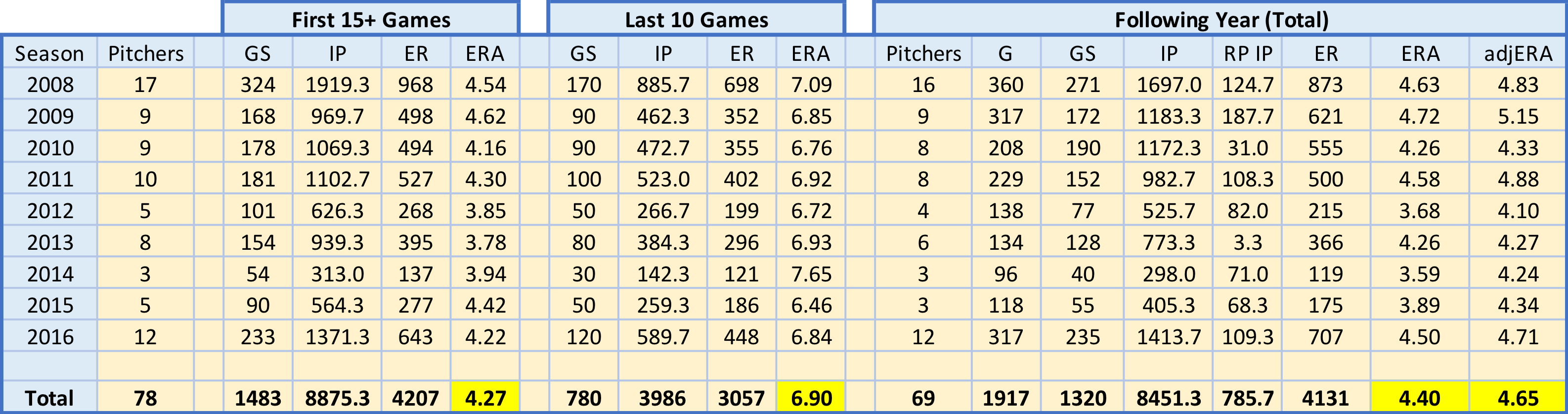
To explore this, I gathered game-level performance data for all starters from 2008 through 2017 from FanGraphs, grouped by season. I then filtered out pitchers who had fewer than 25 starts and had an ERA less than 6.00 in their final 10 starts. This left me with a sample of 78 starters from 2008 through 2016 (excluding 2017 as there is no next year data yet). I assumed that a starter with an ERA above 6.00 was at or below replacement level. Lastly, as some starters were converted to relievers in the following year, I adjusted the following year ERA according (assuming relievers average .7 runs over nine innings less than starters: see this thread).

final10.png

Seems like the 10-game stretch to end each season is a bit of an aberration. The following year’s adjusted ERA is much closer to the first 15+ games than the final 10 games for pitchers in our sample. In fact, the largest difference between any first 15+ game ERA and its following year adjusted ERA is .58 runs, in 2011. The smallest difference between any last 10 games ERA and its following year adjusted ERA counterpart, for comparison, is 1.7 runs, in 2009.

Using adjusted ERA corrects for the potential slight downward bias in our following year totals. Following year games started fell by ~9%, while reliever innings increased from zero to each season’s value. Relievers, on average, have a lower ERA than starters. As mentioned above, I adjusted each season’s following year ERA by .3 runs per reliever inning pitched (my assumed difference in runs allowed between starters and relievers per inning pitched). Another source for potential downward bias is sample size – of the 78 pitchers who fit our sample qualifications, only 69 pitched in the majors the following season. A survivor bias could exist in that the better pitchers in the sample stayed pitching, while the worse pitchers weren’t signed by a team, took a season off or retired.

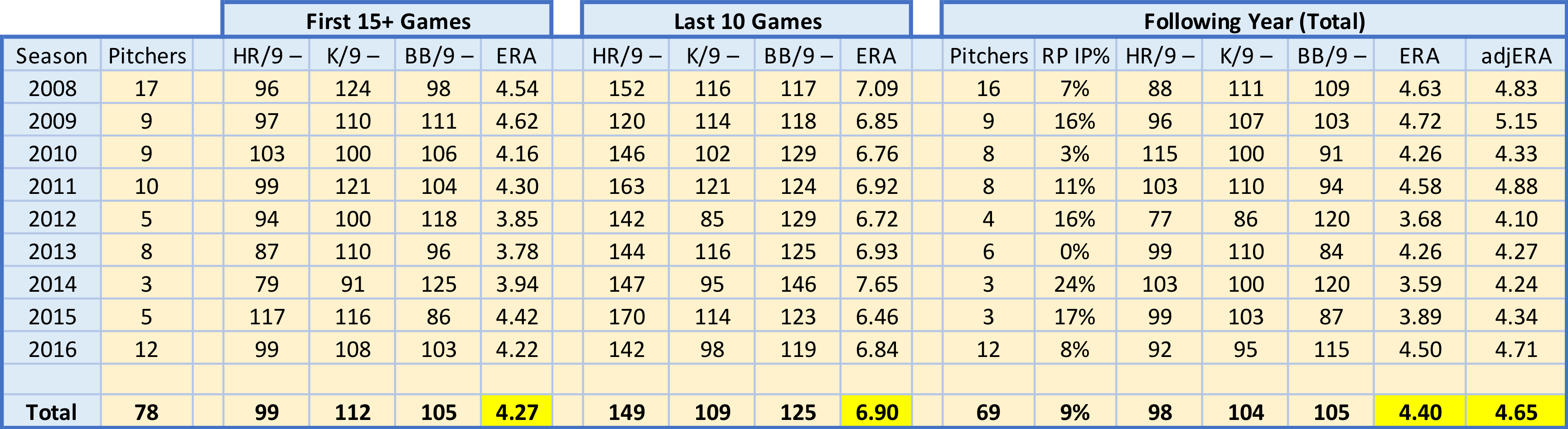
What is driving these final 10 game ERA spikes? It has been shown that pitchers don’t have much control over batted ball outcomes. Generally, it is assumed pitchers control home runs, strikeouts and walks – the basis of many defense-independent pitching stats. Changes in these three stats could explain what happens during our samples’ final 10 games. Looking at each stats’ rate per nine innings, however, would be misleading, as each season exhibits uniform change (such as the recent home run revolution, or the ever-growing increasing in strikeouts). I calculated three metrics for each subset (first 15+, last 10 and following year) to use in evaluation: HR/9–, K/9– and BB/9–. All three are similar to ERA– in interpretation – a value of 100 is league average, and lower values are better.

Further, not necessary math details: for example, a value of 90 would be read as the following. For HR/9– or BB/9–, a value of 90 means that subset’s HR/9 or BB/9 is 10% lower, or better, than league average.  For K/9–, a value of 90 means that the league average is 10% lower, or worse, than the subset’s K/9. To create these measures, I calculated HR/9, K/9 and BB/9 for each subset and normalized them to the league value for each season – including the next year’s value for the following year’s rates. Then, I normalized these ratios to 100. To do that, I divided HR/9 and BB/9 by the league averages and multiplied by 100. Because a higher K/9 is better (unlike HR/9 and BB/9), I had to divide the league average by K/9 and then multiply by 100, slightly changing its interpretation (as noted above).

final10-2.png

As mentioned above, the issue of starters-turned-relievers within our sample likely influences our following year statistics. I was able to adjust the ERA, but I did not adjust the rate stats – HR/9, K/9 or BB/9 – as I have not seen research suggesting specific conversion rates between starters and relievers for these.

Interestingly, our sample of pitchers improved their K/9– across the three subsets, despite having fluctuating ERAs. They were below average, regardless, but improved relative to league average over time. Part of this could be calculation issues, as league K/9 fluctuates monthly, and I used season-level averages in calculations.

Both HR/9– and BB/9– drastically get worse during the 10 start end-of-season stretch. These clearly drive the ERA increase. In fact, despite seven of the nine seasons’ samples having better-than-average HR/9 in their first 15+ starts, every season’s sample has a much-worse-than-average HR/9 in their last 10 starts, where eight of the nine seasons’ samples HR/9 are 40%+ worse than league average. Likewise, though less drastically, our samples’ BB/9 are much worse than league average in the last 10 starts subset. Unlike HR/9–, though, our samples’ BB/9– is worse than league average in the first 15+ starts subset. The first 15+ games’ HR/9– and BB/9– are identical to the following year’s values, unlike K/9–.

It appears that starters with an ERA greater than or equal to 6.00 in their final 10 starts, assuming 25 or more starts in the season, generally return to close to their pre-collapse levels in the following year. This end of season collapse seems to be driven primarily by a drastic increase in home run rates allowed, coupled with an increase in walk rate. These pitchers performed at a replacement level (or worse) for a short period and bounced back soon after. Mr. Tango & Bobby Mueller, in their email chain (posted on Mr. Tango’s blog), acknowledge this conclusion: “they are paid 0.5 to 1.0 million$ above the baseline… At 4 to 8 MM$ per win, that’s probably an expectation of 0.1 wins to 0.2 wins.” We can debate the dollars per WAR, and therefore the expected wins, but one thing’s for sure – past performance is a better predictor of the future than most recent performance.


– tb


Special thanks to Mr. Tango for his motivation and adjusted ERA suggestion.

Osuna or Later, Roberto Should Bounce Back

Roberto Osuna, the Blue Jays young star reliever, has put together a very impressive resume in his 3-year career. Last season Osuna ranked 3rd in RP WAR (3.0) only behind Craig Kimbrel and Kenley Jansen in his age 23 season, and has also posted the highest cumulative WAR among relievers aged 20-23 years old in the last 40 years, while also producing the 2nd best FIP (2.69) and the moves saves (95).

Last July, Jeff Sullivan wrote a very compelling and in-depth article into the pure dominance Osuna was displaying on the mound; he was having a near perfect start to his season. He showed that across the board, Osuna ranked in the top 90 or 95 percentile in all of the major pitching statistics, proving that he had put it all together – matching his control to his skills. A few weeks before Jeff published his article (around June 25th), Osuna had missed some time for personal reasons, which was later disclosed as time away from the team to deal with anxiety issues. Roberto showed great courage speaking out to the public about his own internal struggles, but it was soon after that announcement that Osuna began to struggle on the mound.

It is both a difficult and a delicate analysis to undertake when analyzing the changes to Roberto’s performance last season. It is important to not read too much into certain trends and extrapolate that these derive from mental rather than physical, mechanical or strategic changes; however, this article will explore these changes to see why he suddenly began to struggle and how Roberto can strive to regain his top form for his 2018 season and beyond.

Roberto was at the top of his game in May and June and was putting up ridiculous numbers every time he took the mound. From July onward, Osuna began throwing his cutter and sinker much more frequently and threw fewer four-seam fastballs and sliders, as shown below:


The increase in his FC and SI usage and decrease in his SL and FA usage resulted in a change in his batted ball profile and strikeout potential. Osuna has a devastating slider with one of the best chase rates and swinging strike percentages in the league. He moved away from this pitch in favor of his sinker, which resulted in a lot more groundballs, as shown below. This change affected his BABIP, as it rose from .269 to .298.


Further, the large increase in his cutter usage resulted in a lot more hard-hit balls and he began to use it more often in high leverage situations with runners on base. His cutter usage increased from 15.7% to 37.4% with runners on base and this led to a plummeting left on base percentage. Last season Osuna posted the 2nd worst LOB% in the league among relievers at 59.5%. This is a statistics that jump off the page when juxtaposed with his fellow elite relievers who post metrics above 80 or even 90 percent. Below we can see just how drastic the drop was for him.


Considering that his LOB% was such an outlier compared to his peers, it is important to delve further into how this occurred. Recent history shows how rare it is for a pitcher with such great skills and control to have such trouble with runners on base. Since 2000, there has only been one other reliever who had a FIP under 2.00 who had a lower LOB%. A contributing factor to his struggles with runners on base was his aforementioned change in pitch composition. Increased usage of his sinker increased his balls in play and BABIP, his increased usage of his cutter resulted in harder hit balls and his decreased slider usage decreased his strikeout rate at times where he needed it most. Before June 25th, Osuna had a 2.41 FIP, 29.4% strikeout rate, 0% walk rate and a .304 BABIP with runners on base. After his temporary absence, his FIP actually dropped to 2.02, despite striking out fewer batters (24.1%) and walking more batters (1.8%) but his BABIP increased to .378. His xwOBA of .274 versus his wOBA of .311 with runners on suggests that he got a bit unlucky in the second half of the season, so his high BABIP is likely a combination of poor pitch command or selection, poor defense behind him and bad luck on balls in play.

Osuna enjoyed such great success when getting ahead of hitters (.189 wOBA after 0-1) and especially with 2 strikes (.130 wOBA), that hitters began to be more aggressive earlier the count looking for something to hit hard. A combination of a loss in fastball velocity and poor pitch location, Osuna began to get hit harder in high leverage situations. The top two heatmaps are Osuna’s fastball location and the bottom two are for his cutter. The heatmaps on the left are before June 25th while the ones on the right are after June 25th.


Osuna began to leave his fastball up over the plate in a hittable spot, as opposed to up and in, where he could tie-up right-handed hitters and produce weak contact. His cutter went from a setup pitch or even a waste/chase pitch to a pitch that he threw for strikes. Since Osuna started to throw so many more cutters, of course, he had to throw more of them for strikes, but the problem was he was unable to command the pitch to the better areas of the zone. A likely reason why Osuna began throwing more cutters was because the drop in his fastball velocity, as it was losing its effectiveness.


Pete Walker the pitching coach for the Toronto Blue Jays recently discussed with reporters Roberto Osuna’s offseason and reflected on his 2017 season. He acknowledged that Osuna had a drop in velocity during the season, had some mechanical issues, which impacted his fastball command, and that perhaps he threw his cutter too often during stretches of the season. All of this can be backed up with stats. Both the Jays coaching staff and Osuna are aware of where he can improve to regain with elite form. Walker also alluded that perhaps Osuna’s off of the field issues had an impact on his performance last season. By interpreting some statistics through this lens we can see how it can appear that Osuna lost of a lot of his confidence on the mound, especially in high-stress situations.


In particular, Osuna struggled away from the Rogers Centre as his road ERA was 5.10 versus only 1.85 at home in 2017. Further, Osuna had the 2nd best home wOBA while on the road it was only ranked 48th best.

Osuna was still good in the 2nd half (1.80 FIP and 4.24 ERA) and overall had a great 2017 season, but when the pressure started to grow and the wheels started to spin, they usually fell off (i.e. on the road with runners on base). It is hard to say whether this is the result of a lack of confidence, his decreased velocity on his fastball and his subsequent increased usage of his cutter or if it was a bit of bad luck with runners on base. It is likely a combination of these factors that led to Osuna’s declining second half, but we shouldn’t forget how dominant he can be when he’s at his best. According to Walker, Osuna has put on some muscle this offseason to help him with his durability in maintaining fastball velocity. Just like for most if not all other pitchers, being able to command his fastball is pivotal to Osuna being successful. At the end of last season, Osuna saw a small up-tick in fastball velocity and retired all 15 batters he faced in his last 5 appearances of the season, which is an encouraging sign, but how will he handle adversity, when batters reach base in 2018? With some minor tweaking to his game, Osuna should be on track to bounce back and have another dominant season as the Blue Jays closer.


How Long Before Things Go Bad?

Spring is a time for optimism, in baseball and in life. Teams are starting to think about their opening day starters and more broadly, their starting rotations. Some rotations look “set” while some have a “battle for the 5th spot”. Some are toying with the idea of a 6-man rotation.

But here’s the thing: we know that (almost) every team will end up using a 6-man rotation, whether they like it or not. Eventually, your favorite team will need to call in reinforcements. This can happen because of poor performance or injury. But hey, we’ll cross that bridge when we come to it, right?

… when do you think we might come to it?

We know, as do those in charge that teams use something like 11 starters per year (in 2017: 11.3). In a six-month season, how long does it take before the first reinforcements arrive?

Cumulative Starters Used, 2017

In a few words, not very long. Some pitchers have injuries, some get moved to the bullpen, some sent to the minors. Either way, at least one of them will be gone pretty soon, so don’t name the puppy.

Of course, fate comes at different paces. In 2017, the Cardinals didn’t use a sixth starter until June 13th. And even then, Marco Gonzales only pitched because they had a double-header. In contrast, Junior Guerra, the Brewers’ opening day starter, was injured that same opening day. He wouldn’t pitch in the majors for another seven weeks (and it turns out, not very well either).

Half of teams used a sixth starter before April 25th. 90% of teams used a sixth starter before their 50th game.

Some of those sixth starters, along with their full-season WAR: Alex Wood (3.4), Mat Latos (-0.3), Mike Clevinger (2.2), Mike Pelfrey (-1.0).

We know that teams need depth. Not only that, but life comes at you fast.

Data: Baseball Savant


Diagnosing Shohei Ohtani’s Pitching Woes

There has been a lot of concern over Shohei Ohtani, and his rough spring training performance recently. Considering the hype he has come with, it is only natural for people to react as strongly as they have. Given his track record in the Nippon Professional Baseball League, and the presence of his impressive physical abilities, it is frustrating to see him struggle.

What must be considered more seriously, is the significance of the transition Ohtani is making. There has to be better recognition of his being human. He does not speak the language in a new country where customs, culture, and even life philosophies are often very different than back home in Japan. Based on the information available surrounding his appearances hitting, and pitching, it seems that this is simply a guy adjusting to his new life in the United States.

Also significant are the differences between the Baseballs,  such as the NPB ball that has higher seams, as well as the mounds in Japan that are softer than the contrastingly more solid mounds in Major League Baseball. These are factors affecting Ohtani, and his transition, that must be considered.

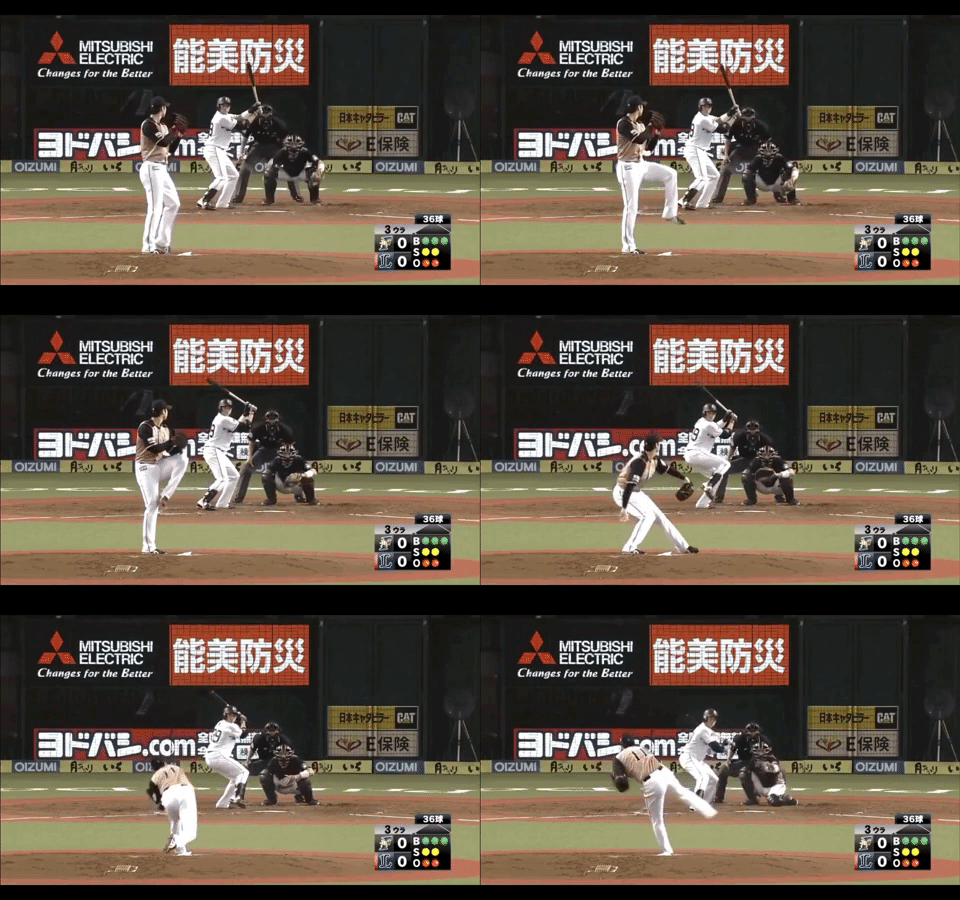
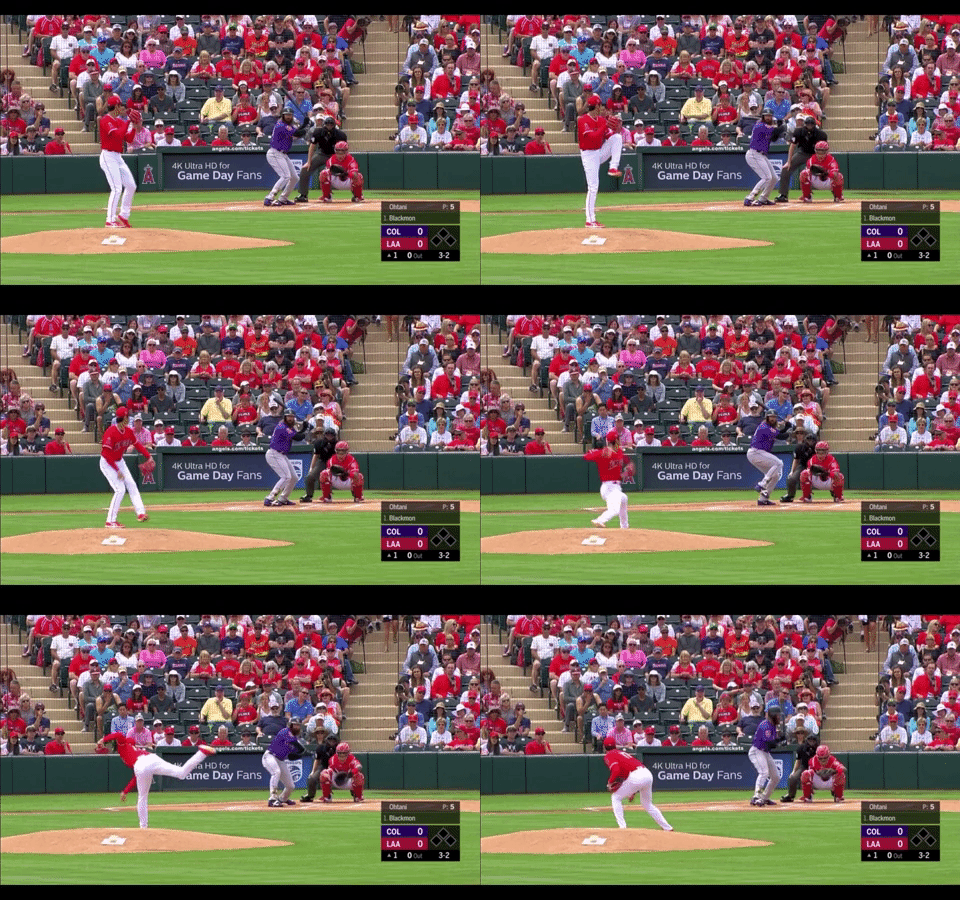
To begin, Ohtani’s pitching mechanics and delivery as a whole, seem to be somewhat different than they were in Japan. His approach and intentions have looked to be the same, but the execution has been slightly off. These gifs are slowed down to show the differences in Ohtani’s mechanics in Japan during the 2017 season, and 2018 in Spring training. Take a look at the location and execution of his fastball in said seasons:

2017 in Japan:

Animated GIF

2018 Spring Training:

Animated GIF

The key aspect to watch here is the contrast in the times it takes him to bring the ball to the plate. In real time, from the start of his throwing motion to when he releases the Baseball, Ohtani throws the ball in 1.8 seconds in 2017. In contrast, during his most recent Cactus League start in the second gif, he releases the ball in 2.2 seconds following the beginning of his throwing motion. Is he trying to reach back for more velocity this spring? His mechanics seem to indicate such a suggestion.

Looking at the freeze frame just after he releases the ball, Ohtani’s arm slot is higher on the left than on the right. Ohtani’s back foot is higher than it was previously. His whole body is slightly more upright, his arm is further behind his lower half, and he is not as balanced on the left in comparison with the frame on the right.

He does not drag his back foot on the mound anymore, the way he used to in Japan. This has caused him to have less balance in his delivery to the plate, which will be explained further later on. It is likely that Ohtani has no interest in sliding his foot across the harder mounds in the United States, which is clearly hindering the execution of his mechanics.

Furthermore, he is opening his body more in his pitching motion this spring, than he used to in Japan. Being more upright means that it’s harder for him to get on top of the Baseball, which makes it more difficult to keep the ball down in the zone when he wants to throw it there. Having his arm behind his lower half as seen on the left, is putting more unnecessary stress on it as well.

His balance point is off on the left, too – This makes it more difficult for him to sync his arm and lower half, as well as locate his pitches. Ohtani has better control of his body in the frame on the right, thus allowing him to have more fundamentally sound mechanics.

Often, when a pitcher is not fully finishing his delivery, he (Hopefully someday She!) is overthrowing. Ohtani has indicated that he feels hardly any anxiety surrounding his performance, however it seems that he may be pressing a little, based on the contrast between the mechanical execution of his delivery in Japan, and here in the United States.

The finish of the delivery with his back leg swinging up as it always does, is more pronounced and noticeably higher on the left than on the right. Given that the pitches were thrown to similar locations in both frames, this is likely an indicator of him putting more effort into his delivery:

His non-throwing arm and glove are much higher on the left, and his pitching arm is visible on the left while it is not on the right. His left arm is actually turned up-and-out in his pitching with the Angels, whereas in Japan his arm is folded inwards, and is much closer to his body. This is simply further evidence of his seemingly increased level of effort while pitching this spring.

There is also the possibility that he is hurt, as his change in mechanics would support, too. Maybe his elbow is not as healthy as it has been made out to be. Regardless of the cause, Ohtani is not himself at the moment.

What is interesting, is that the pace of his delivery has slowed, while also becoming more stiff and less explosive. The abilities are there for him to perform at a much higher level, and it would really help him to stay within himself more and execute the fundamental aspects of his delivery.

It is likely difficult for him to adjust to the mounds in the United States, which could be affecting his delivery and mechanics significantly. Above all else, it seems that this is a case of a 23 year-old acclimating to a completely new country and culture. He is learning countless new things about life here, and his poor performances this spring seem to be a reflection of the recent change in his life, more than anything else.

The most glaring issue in his pitching thus far, has been in his mechanics. The pitches he is throwing are objectively impressive, they just aren’t being placed where Ohtani wants them to be as a result of his delivery being out of sync. He is absolutely fine, and simply needs to make a few adjustments to get back to being the potentially dominant pitcher many envision.

Video in this piece was taken from MLB.com.


Let’s Strategize Under the Potential Extra Inning Rule

As I’m sure you know, Major League Baseball is toying with the idea of putting a runner on second base sometime around the 12th inning. While I’m not doing this to argue its validity or lack thereof, I’m going to discuss and evaluate some scenarios that could happen under those conditions. It won’t be anything groundbreaking; I’ll be demonstrating the metrics involved with a team under the various circumstances I induce.

The following scenarios are played out to score at least one run in a given inning. Top or bottom of the inning, I envisage the same sort of conditions will play out for both teams. And because there is never any telling what part of the order will start with this setup, I speak in generalizations.

I’ve thought about what would be the likeliest of moves under this arrangement and I’m going to guess it would come down to the most boring events in baseball; the offense bunts the runner to third or the pitcher intentionally walks the first batter attempting to set up the double play. Of course, there will be times when the managers decide to simply attack the situation as-is. That’s more of a volatile situation and therefore much harder to work with.

First, the basics. From 2010-2015, having a runner on second base with no one out produces the following:

  • The predicted number of runs scored is 1.100
  • The percent chance of scoring a run under those conditions is 61.4%

So from the get-go, the offense is expected to score a run in three out of every five chances.

Play the bunt or a standard defense?

Let’s start off with the first of two scenarios; the bunt to move the runner over to third. I feel like this is the most likely action but also the most difficult to work with because of varying defensive strategy. Will the defense make an anticipatory shift for a bunt or will they be in ‘straight up’ formation? In 2011, Bill James found out that bunting in sacrifice situations produced a .102 batting average. Not like we needed that because we could have guessed that you’re going to be out roughly 90% of the time.

To bunt or to swing away?

So assume the hitter lays down a bunt that moves the runner while making an out at first. Run expectancy is now 0.95 with a 66% chance of scoring a run. Your run expectancy went down 0.15 runs BUT you increase your chances of scoring by a little less than 5%. Would bunting make sense to you as a manager? Taking out any sacrifice-type contact, if your hitter produces an out and the runner has to stay at second, your run expectancy drops to 0.664 and the chance of scoring a run plummets to roughly 40%. Still feel the same way (regardless of the hitters bunting ability)?

Walk or pitch to the next hitter?

Keeping with the initial decision, we have a runner on third and one out. Pitch to the next hitter or put him on to set up the double play? Our strategy could be further altered because at this point the defense might be inclined to bring out a ground-ball pitcher or create a split situation (lefty vs lefty and vice versa). But again, let’s go with the assumption that the team will do the safest thing by having the next hitter walked. That puts runners on first and third with one out. That decision causes run expectancy to jump back up 0.18 to 1.13 and but the probability you’ll score at least one run drops to 63.4%. Would you make that same call (remember, we are in a vacuum)?

Runners on first and third with one out produce the following expectancy:

  • Average number of runs scored is 1.130
  • The chance of scoring a run under those conditions is 63%

One of a couple of outcomes will follow should you elect not to intentionally walk the hitter. He will drive in the run by putting the ball in play various ways (sacrifice fly, fielder’s choice, hit, etc) and accomplish what the offense set out to do; score at least once to put the pressure on the home team. Or, the hitter could strike out, ground out (which could turn into a double play, an out at home, etc) or fly out.  If contact is made, this could alter our base-out states: two outs and runners at various bases (first and third, second and third, second or first should the runner somehow get thrown out at home). Due to the randomness of contact in this event, we’ll stay with the intentional walk.

To bunt or to swing away, pt II?

So what about the offensive strategy for first and third, one out? The options are much more vast. You could sacrifice bunt to move a runner over to second (assuming the runner on third is held up), thereby dropping run expectancy to 0.580 and dropping your scoring chances to 26%. The risk here is having the batter somehow bunt into a double play; runner at third is tagged/thrown out and the batter is thrown out at first. Do you, as a manager, take the initial risk that set up this problem? It is challenging to turn a double play on a bunt but if the defense is ready, it makes it easier to do so.

This time, let’s assume the hitter botches the bunt to the first base side and the overeager runner is thrown out at home (or caught in a rundown), runner safe at first. Now, with two outs, there’s a runner on first and second, we sit at a very poor run expectancy of 0.429 and have just over a one in five chance of driving in that run.

Walk or pitch to the next hitter, pt. II?

At this point, again with neutral context, you can walk the batter to load the bases, (if the hitter is too good and the next isn’t great, etc.) or you can just pitch to the batter (maybe bringing in a bullpen specialist). Walking the batter gives the offense a 10%better chance of scoring and a .33 increase for run expectancy.

If you elect to pitch to the batter either the final out is made or runs score. Walking the batter loads the bases and forces the defense to hope for the best. The latter situation would actually produce the most excitement; a crucial decision would need to be made. Either way, my tangent baseball universe will end; three outs, inning over or the needed run(s) score.

While I don’t necessarily agree with or enjoy the thought of the game being altered in this way, it could produce some interesting strategical decisions and test the maneuvering skills of team managers.

This post and others like it can be found over at The Junkball Daily.