Kendrys Morales and Gerardo Parra aren’t two players you tend to think about together. Parra is an elite defensive player with solid offensive skills and Morales is a slugging DH. Parra walks a little bit more and strikes out a little bit less, but Morales makes up for that differential by slugging about 80 points higher. Parra stands right around average at the plate in 2013 with a 99 wRC+ and Morales is above average at 138 wRC+. They’re both valuable in different ways, but they are also the only two players to date in 2013 to be credited with an extra-base hit to the pitcher.
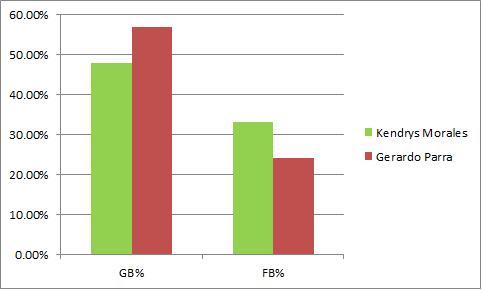
Their batted ball profiles are quite different as Parra tends to put the ball on the ground and Morales makes his money in the air.
Parra swings more often and makes more contact along the way, but Morales seems to hit the ball with more force considering his higher home run total in a less hitter-friendly park. These are two players who aren’t all that similar but happen to be the only players to accomplish one of the stranger feats in baseball during the 2013 season.
Up front, it’s important to know this comes from Pitch F/X classifications, meaning that the play had to be scored a double, triple, or home run and it had to be fielded by the pitcher or hit into his zone. I don’t know exactly how the latter determination is made but I will assume that there aren’t massive mistakes in classification. I’ve watched Parra and Morales’ hits to confirm, but I obviously haven’t watched every double this season to make sure there aren’t any missing points.
What’s wonderful about these two extra base hits to the pitcher (both doubles) is that they match the respective players so perfectly.
May 5, 2013 – Mariners at Blue Jays
With Brandon Morrow on the mound Morales came to the plate in the Top of the 8th inning and worked a 1-1 count. Amazingly, before Morrow could throw his 3rd pitch of the at bat, a fan ran onto the field and stopped play. I have no idea if that was responsible for what happened next, but the coincidence is too hilarious not to mention.
When play resumed Morrow came at Morales with an 85.7 MPH slider which the Mariners’ DH hit way up into air. With the roof open and sun beating down, the infielders converged toward the back of the pitcher’s mound to field the routine pop fly.
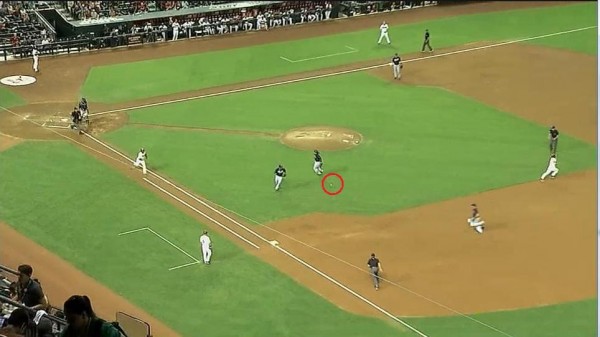
There are three professional athletes within 10 feet of where the baseball is going to land and they are all close enough to make the play quite easily. However, things take a comical/terrible turn depending on your personal feelings toward the Blue Jays.
As you can see, hopefully, Encarnacion called the ball vigorously and then fell over causing the third baseman to jump out of the way and lose sight of the ball, thus removing any hope of catching it himself. The baseball bounced about 10 feet into the air and Morales, who had been hustling, cruised into second base.
Morales hit his double to the pitcher in a very Morales fashion. He hit a fly ball and the defense didn’t catch it. The fan who ran on the field may have been in the minds of the players, but it’s more likely Encarnacion was trying so hard to fight the sun that he forgot about the hill located in the center of the diamond.
May 14, 2013 – Braves at Diamondbacks
In the Bottom of the 3rd, Cliff Pennington stood on first base and Julio Teheran climbed onto the mound. Parra dug in and took the first two pitches for balls, putting him into a nice hitter’s count. On the next pitch, Teheran delivered an 89.3 MPH fastball with some nice tailing action that Parra slapped to the right side.
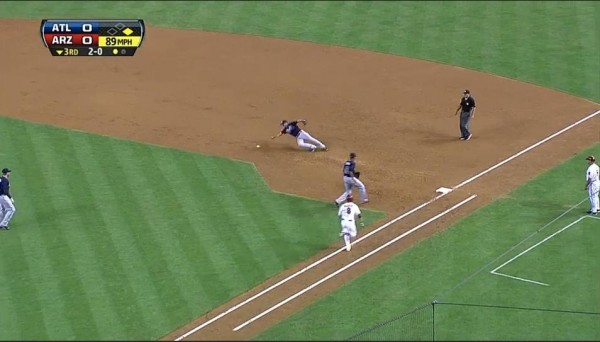
You can see the baseball came right between the pitcher and first baseman as neither could make the play on the weakly hit bouncer. Generally this situation should result in a respectable infield single. After all, if I hadn’t prepared you, it would seem likely that the second baseman would pick up the ground ball and hold the runners at 1st and 2nd. You can see the third baseman is manning his position and just off the screen I assure you the shortstop is doing the same.
However, it didn’t exactly happen like this. Dan Uggla over-ran the ball, perhaps because he was expecting to run to the bag and couldn’t decide quickly enough to change course.
As a result, the pitcher had to back up the second baseman on a ground ball as Parra hustled into 2nd base.
This strikes me as a very Gerardo Parra type of hit. He put it on the ground and used his legs to turn it from an infield single into an infield double. It required a defensive mistake, but it was a defensive mistake that was, in part, forced by his ability.
Didi Gregorius singled in the next at bat to plate the Dbacks only two runs of the game, which also happened to be decisive in their win over the Braves. The final score was 2-0, so Pennington would have scored the winning run even if Uggla made the play on Parra, but it’s possible the defensive implosion took focus from Teheran or simply exhausted him given how far he had to run to make get the ball and resulted in poorer pitches
Nothing came of the Morales double as the Mariners didn’t score and went on to lose 10-2 despite that double coming as a result of much more egregious defensive play. Parra was going to have a single unless the Braves made an excellent play, but Morales shouldn’t have been on base at all. Apparently, the Baseball Gods agreed and didn’t punish Morrow as much as Teheran.
Baseball is often remarkable for the strange things you see. If you had to guess which two players doubled to the pitcher in 2013 you probably wouldn’t have picked Morales and you probably wouldn’t have expected that neither case involved someone failing to cover second base. This is one of those wonderfully weird moments in baseball that ties together to very different players with an odd set of circumstances.
Twice this season a player has doubled to the pitcher and both times that player did so in a way that was partly in line with their style of play, but both were very different. In one case the play was critical to the outcome and in one case it was meaningless.
Doubles to the pitcher are rare as a database search going back to 2008 reveals these as the only two. They happened nine days apart and are the only extra-base hits to the pitcher recorded by Pitch F/X in the last six seasons. Next time something like this happens, maybe the batter will try to stretch it into a triple in order to have an honor all his own.
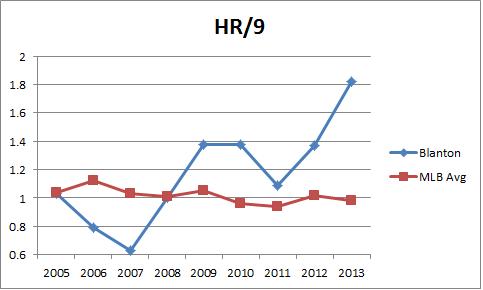
Let’s start with a picture. What it communicates won’t surprise you and it tells you essentially two things. First, over the last nine seasons, we’ve seen a modest decline in home runs. Second, that doesn’t apply to Joe Blanton.
Now, Blanton has had a respectable career. He’s accumulated 19.3 WAR which is good for about 2 WAR per season and in all but one of his seasons, he has provided or is on pace for at least 175 IP. He has essentially been the definition of an innings-eater with a flash of greatness in 2007.
But over the last few seasons, Blanton has turned himself into one of the most homer-prone pitchers in baseball. Since the start of 2010, only three qualifying pitchers have allowed more HR/9 than Blanton’s 1.45 mark. It’s not terribly interesting that Blanton started giving up more home runs when he moved from Oakland to Philadelphia, but it is interesting that he’s giving up even more this season since moving to Angels Stadium.
In fact, Blanton’s 2013 mark is the 9th highest HR/9 total in the xFIP Era (2002-present). You’ll notice something interesting about the list of the qualifying pitchers who have given up the most home runs:
Rank
Season
Name
IP
HR/9
xFIP-
1
2011
Bronson Arroyo
199
2.08
118
2
2012
Ervin Santana
178
1.97
108
3
2004
Jamie Moyer
202
1.96
109
4
2008
Brandon Backe
166.2
1.94
112
5
2004
Eric Milton
201
1.93
110
6
2005
Eric Milton
186.1
1.93
116
7
2006
Carlos Silva
180.1
1.90
107
8
2004
Darrell May
186
1.84
110
9
2013
Joe Blanton
119
1.82
95
10
2009
Braden Looper
194.2
1.80
113
11
2005
Ramon Ortiz
171.1
1.79
110
12
2004
Brian Anderson
166
1.79
119
13
2006
Jeff Weaver
172
1.78
105
14
2004
Ismael Valdez
170
1.75
123
15
2004
Jose Lima
170.1
1.74
97
Most of them aren’t great even if you factor out their fluky high HR/FB rate and home park, and Joe Blanton is the only pitcher in the top 14 on this list with an xFIP- below 100. He’s getting a decent number of ground balls (43.7%) and his K% (18.1%) and BB% (5.2%) are both pretty good. Usually guys who give up a ton of long balls are also doing a lot of other things poorly. Blanton doesn’t seem to be on the surface.
But with an ERA of 5.52, FIP of 4.82, and xFIP of 3.81 it makes you wonder exactly what’s going on. This is a pitcher who has a solid strikeout profile, good walk numbers, and a solid ground ball rate. Not only should that lead to pretty good run prevention, but it shouldn’t go hand in hand with a high HR/9.
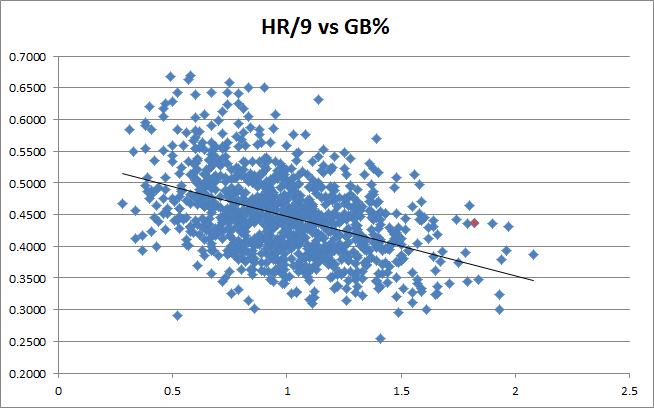
These are all the qualifying seasons since 2002, with Blanton labeled in red. Of pitchers in that cluster of HR/9 above 1.7, only Braden Looper in 2009 had a higher GB%. On average, pitchers who throw 43% ground balls allow around 1.00 HR/9. Everything about Blanton’s huge homer total screams that the HR/FB rate is unsustainable. It’s 17.3%. It will come down.
It’s the highest of his career, but he’s now calling Los Angeles home. He gave up more home runs when he moved from Oakland to Philly, but now he’s giving up more in his move from Philly to LA.
Look at that trend. It makes sense that it would go up between 2008 and 2009, but it went up every year he was in Philadelphia and is going up again now that he’s in a pitcher friendly park. Keith Law remarked recently that HR/FB and BABIP regression paradigms don’t apply to guys with stuff as poor as Blanton’s, and while I’m not sure I would go that far, this information has me wondering.
This doesn’t look like luck to me. You buy the first jump because of the ballpark and I know it’s only been 120 innings this season, but this is the 10th highest HR/FB% since 2002. And only one pitcher who has posted a higher HR/FB% had a GB% below 50%. In other words, the guys who have the really bad HR/FB% are usually guys who don’t allow many fly balls to begin with.
Season
Name
Team
GB
HR/FB
xFIP-
2003
Odalis Perez
Dodgers
53.00%
19.70%
79
2013
Roberto Hernandez
Rays
51.60%
19.60%
89
2012
Ervin Santana
Angels
43.20%
18.90%
108
2005
Derek Lowe
Dodgers
63.10%
18.90%
81
2005
Brandon Webb
Diamondbacks
65.00%
18.80%
70
2004
Greg Maddux
Cubs
50.90%
18.20%
79
2013
Jason Marquis
Padres
52.30%
18.20%
128
2012
Henderson Alvarez
Blue Jays
57.00%
18.10%
107
2007
A.J. Burnett
Blue Jays
54.80%
17.70%
79
2013
Joe Blanton
Angels
43.70%
17.40%
95
It’s reasonable to expect some regression because that’s always the reasonable thing to do, but Blanton’s HR/9 and HR/FB% have gone up since moving to a better park. It’s worth considering if there is something about Joe Blanton that’s causing this to happen because pretty much everything else he’s doing seems to be working. In fact, if you normalize his home run rate he’s actually above average even now that he’s back in the AL.
What stands out to me is what hitters are doing against his four-seam fastball according to Pitch F/X data. 12 of his 24 HR allowed have come on the fastball, and he’s allowed a .442 wOBA against that pitch, which is the pitch he throws most often in 2013. Against the fastball, he’s allowing a 27.3 HR/FB% and has allowed the ball to be hit in the air more often against it than any other pitch at 32.8%. Let’s take a look at the average movement on his four-seam fastball:
The vertical movement fluctuates some over time but it’s getting worse since 2011 and the horizontal movement is trending in a bad direction especially considering he’s throwing this pitch more often than anything else he’s got. Some of this could be classification issues, but the basic numbers say this is his main pitch and it’s not moving nearly enough. It was never a great pitch, but now it’s one of the straightest fastballs in the game and he’s getting crushed on it.
Of the 12 HRs he’s allowed on fastballs, the average velocity was 89 mph with less than three inches of horizontal break, and only one missed the strike zone. Those aren’t flukes, they are asking to be crushed. Here’s a look at his home runs allowed this year with Angel Stadium superimposed. He’s not giving up too many cheap ones considering the size of that stadium.
I’m not sure I have a perfectly clear conclusion to offer. If you only looked at Blanton’s 2013 stat line, you’d feel pretty confident that his HR/FB% would come down and he would pitch closer to his xFIP going forward given the decent strikeout, walk, and ground ball numbers he’s putting up. But if you look at his 2013 in the context of his other seasons and in the context of recent history you come to a different conclusion. If you’re looking with a wider lens, it seems as if Blanton isn’t going to rein in the home-run rate.
The trends don’t look good for Blanton who is allowing more home runs than ever before after moving to a bigger park thanks to a fastball that has less bite than at any time in his career. He’s throwing 89 mph heaters with little life down the middle and opposing hitters aren’t missing. This doesn’t seem like something that’s due for regression, it seems like it’s a function of the pitcher Blanton is right now.
I haven’t watched his starts closely, so perhaps an Angels fan can speak to this better, but I think I might bet against a whole lot of regression in this case. I think Law’s point my be valid, at least in this case. Blanton’s fastball might not be good enough for us to apply our standard beliefs. Blanton might be the exception that proves the rule.
Normally we expect a pitcher’s HR/FB% to come back to the pack, but only if that pitcher’s skills are close enough to average. Maybe that’s what we’re seeing with Joe Blanton in 2013. He’s routinely throwing a pitch that isn’t good enough to get hitters out and it’s costing him. It’s also possible that this is all a mirage and things will even out with more time.
I don’t have a perfect answer, but I think it’s worth raising the question and following Blanton’s season the rest of the way in order to find out.
Remember lichens? Those organisms you learned about in biology that form as a partnership between fungi and algae in which both benefit? I would argue that a new such mutualistic symbiotic relationship has formed: the one between the Atlanta Braves and Waffle House. Long a revered Southern institution, Waffle House was installed at Turner Field last Friday (though it’s rumored after last week’s ankle injury that Tim Hudson prefers IHOP). Since then, the Braves have been on a tear, winning six straight, including a sweep of the (at the time) red-hot St. Louis Cardinals. Coincidence? I think not! As always, let’s take a look at the numbers.
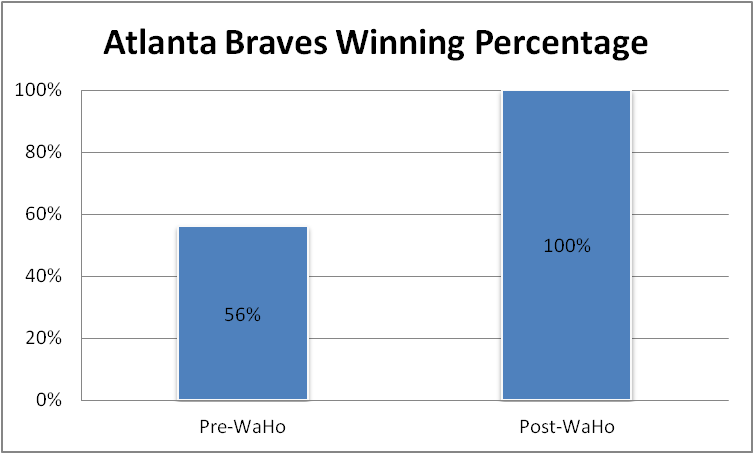
The following charts will be broken up into two distinct periods: the first 102 games (“pre-WaHo”) and the past six games (“post-WaHo”). We’ll start with the bottom line.
If the numbers are to be believed (and Numbers Never Lie, right ESPN?) then the Braves, a strong team already pre-Waho, are now unbeatable post-WaHo. It remains to be seen if this is merely a home game effect, however. It’s also possible that the Braves are playing similar baseball post-WaHo compared to pre-WaHo and are fortunately getting better results. To investigate, let’s dig deeper into the components that drive wins: run scoring and run prevention.
Clearly the Braves have played better baseball since Waffle House arrived at the Ted. Run scoring (RS/G) is up over two runs per game, while runs allowed (RA/G) are down over a run per game. Based on pythagorean expectation (read here), a team scoring and preventing runs at the rate the Braves have these past six games would be expected to go 144-18 over a full season. So extrapolating recent results to expectations of an undefeated rest-of-season might be a little extreme, but a 90% win rate seems entirely reasonable.
In general, someone with some background in statistics might warn against inferring causation from correlation, as well as reading into a six-game sample. That said, I believe the Braves/Waffle House relationship warrants an exception. It’s simple math, really. WaHo at Turner = happy, enthusiastic fans. In turn, enthusiastic fans lead to motivated players and motivated players drive on-field success. Now there’s just one question left to be asked: why didn’t Waffle House come sooner?
Ed. Note: This post was not sponsored by Waffle House. If anybody knows how to make that happen, please contact me. Thanks.
The Miami Marlins are always in the news at the Trade Deadline, and the story is no different in 2013.
Bullpen
Steve Cishek Fist Pump
The Marlins possess sought after relievers Steve Cishek, Mike Dunn, Ryan Webb, and Chad Qualls. Cishek, Dunn, and Webb still have multiple years under team control, while Qualls’ is signed on a one-year deal. Of the four, I would be most inclined to keep Cishek, who is currently closing games for the Marlins, and doing so extremely well. Qualls is the most likely to be dealt, as the Marlins don’t want to part with valuable bullpen arms who could contribute to next year’s team. Also, they don’t want to leave the young starting rotation with an inexperienced bullpen to back them up for the remainder of this season. Qualls would be a rental reliever for any team, as a 34 year-old journeyman doesn’t scream “Long-term plans”. Nevertheless, Qualls has caught fire in 2013, putting up the best season of his career. Through 42 IP in 42 Appearances, Qualls has put up a 2.57 ERA, 1.024 WHIP with a 7.29 K/9 and a 1.93 BB/9 leading to a 3.44 FIP.
The Marlins dealt relief to a contender at last year’s deadline as well, sending Edward Mujica to the Cardinals for 3B prospect Zack Cox. Mujica had a 4.38 ERA at the time he was sent to St. Louis, so Qualls’ numbers are significantly superior. However, Mujica was just 28 at the time, and still had a year of Arbitration remaining, which increased his value. All things considered, Qualls should be able to produce the same return as Mujica did, possibly more. What Mujica brought in was fairly significant. Zack Cox was the Cardinals #4 prospect heading into 2012 by Baseball America. He was drafted in the first round out of the University of Arkansas in hopes that he would develop into a premier hitter. He showed that ability during his first full minor league season in 2011, but fell off dramatically in 2012, hitting .254/ .294/ .421 in the hitter-friendly Pacific Coast League. Cardinals management decided it was time to move on from Cox, and shipped him to the Marlins, who sent him back down to AA. Cox has been solid in AA this season, hitting .292/ .393 / .391. his power numbers decreased, but he’s hitting more consistently as the Marlins are allowing him to take a slow track through the system. He has the Marlins’ future 3B job in his sights, but will be competing in the system with recent 1st round pick, Colin Moran out of UNC.
In my opinion, the Marlins sold Mujica enormously high The Cardinals’ frustration with Cox allowed him to be moved at a fairly cheap price, and it’s difficult to say that this trade is comparable to what the Marlins can get for Qualls. Nevertheless, this shows that the Marlins can target mid-level prospects (or seemingly declining former top level prospects) in exchange for Qualls.
Decision: Avoid trading Qualls for the sake of trading him. Aggressively shop him around, but if the return isn’t right (comparable to Mujica’s return), try to negotiate a 2014 contract in the off-season. Cishek, Dunn, and Webb are main contributors to the Marlins bullpen, and with the team appearing to be a contender in 2014, I would want to keep that consistency.
OF Justin Ruggiano
Veteran Position Players
The Marlins could potentially move Placido Polanco, Juan Pierre, Greg Dobbs, and Justin Ruggiano. Polanco and Pierre are signed to one-year deals, and will be Free Agents after the season. Dobbs is in the last year of a two-year contract. All four are most likely fits on the bench for a contender, and none of them would be able to bring in a significant return. Ruggiano had a breakout year in 2012, his first full season, hitting .313/ .374/ .535 in 91 games. However, he’s slumped this year, removed from his everyday role, floating around a .200 batting average. He holds the most value, as he still has another season before he’s arbitration eligible, and teams may hope that he returns to his 2012 form. However, his remaining pre-Arb year is valuable to the Marlins as well, who didn’t want to move him a few weeks ago. The Marlins called up their top two outfield prospects last week, which makes Ruggiano slightly more available.
Decision: Without much to gain in return, I’d hold on to the veterans, and try to retain Polanco, Pierre, and Dobbs for another year to serve as valuable bench players for the 2014 season.
Giancarlo Stanton
The feature of this article, and many national news stories is Right Fielder Giancarlo Stanton. I’ve admittedly flip-flopped back and forth about what the Marlins should do with the face of the franchise. He’s 23 years old, and will be arbitration-eligible for the first time after this season, which will increase his salary by a couple million dollars. He led the league in slugging in 2012, and had already amassed over 100 career Home Runs. He is a budding superstar, and teams are willing to pay a very high price for him.
Keep Him
Giancarlo Stanton
The Marlins are historically known to being a penny-pinching team, but are in a position to spend big money, which they have available to give to Stanton. If the Marlins stick with Stanton, I see them avoiding arbitration this year with a one year deal in the neighborhood of $7-8MM. I then project him to earn $10-12MM after 2014, and $13-15MM after 2015. To avoid paying Stanton $13-15MM for 2016, and then have a future long-term deal based on that salary structure, I would begin working on a back-loaded multi-year deal immediately after the season. My first offer of a proposed contract would follow a similar structure to my predicted arbitration salary hike, but then level off around $17-18MM for 2016 and beyond. Miguel Cabrera, former Marlins emerging offensive superstar, signed a long-term deal with the Tigers in 2008, which levels off at about $20MM per year. In my opinion, Stanton has shown the potential to deserve a similar contract, but there is no way that I would begin the negotiations at Miguel Cabrera’s deal.
Trade Him
Dontrelle’s Delivery
Stanton’s value is as high as it’s ever been. As mentioned before, he’s an emerging superstar who is just reaching arbitration for the first time. Comparing him again to Cabrera, the Marlins traded him after the 2007 season to the Detroit Tigers along with pitcher Dontrelle Willis for the Tigers #1, 2, 6, 8 rated prospects according to Baseball America, along with other mid-low level players. The Marlins would be able to reel in at least three of a team’s top ten prospects, ideally two of the top five. In my opinion they should throw in one of the relievers teams have been calling for (preferably Qualls) to bump up the level of the prospects they would receive.
The most important thing to consider in this situation, is that the Marlins already have multiple potential replacements for Stanton. According to Baseball America, three of the Marlins’ top five prospects are outfielders, all of whom have been in the majors this season (Christian Yelich #2, Jake Marisnick #4, Marcell Ozuna #5). Beyond those three, they also feature Jesus Solorzano, Austin Dean, Brent Keys, and Isaac Galloway in a rich system of minor-league outfielders. Stanton is simply not at a premium position of need for the Marlins, which in my opinion makes him expendable. Also, the millions of dollars that would be used to lock up Stanton could be better used to lock up the Marlins phenomenal young pitching staff.
Don’t Trade Him
The rebutting argument against trading Stanton is how unpredictable trading for prospects can be. Once again, the Marlins traded Miguel Cabrera and Dontrelle Willis to the Tigers for four of their top ten prospects, including #1 and #2. A total of zero of them are still with the Marlins, and Cameron Maybin (#1) and Andrew Miller (#2) never lived up to their potential. All those two names do is make Marlins fans cringe. Bad trades happen, Major Leaguers are known commodities, while prospects are prospects, something that might be good in the future. The unpredictability and risk of trading Giancarlo is something that cannot be over-analyzed.
Decision: Make Stanton Available, and listen to offers, but don’t undersell him
Yelich at the 2013 Futures Game
If a team wants to give you their entire future, then by all means go for the trade. But if I’m Michael Hill, and I’m not receiving everything that I want from a team, then there’s no deal. If I’m trading Giancarlo Stanton to your team, I want to be able to go through your organization, and hand-pick the players I want like I’m at a buffet. If any compromise has to be made, then it’s no deal. Stanton won’t break the bank in the off-season, and it’s worth keeping him around to see if the Marlins can be truly competitive in 2014, which I believe is very possible, barring unforeseen injuries.
Needs
Jose Fernandez
The most difficult part about making trades for prospect is to decide where you need help. The Marlins are set in the outfield, no question about that. 3B seems locked down with Cox and Moran, and I’m a big fan of future Gold Glove winner Adeiny Hechavarria at SS. Derek Dietrich hasn’t been amazing at 2B, though I really like Ed Lucas. If only he wasn’t 31. Donovan Solano could still be a fit, but this is a position that could use improvement. At 1B, there isn’t much behind Logan Morrison, who is finally fully healthy. Rob Brantly has been a disappointment behind the plate after impressing at the end of 2012 after he came over from the Tigers for Omar Infante and Anibal Sanchez. Brantly is still just 24, but is hitting .232/ .283/ .294 while splitting time with Jeff Mathis. Former first round pick Kyle Skipworth hasn’t been able to hit at any level, and relying on J.T. Realmuto to be the future isn’t a safe bet. The Marlins pitching is phenomenal, led by Jose Fernandez, and followed by Nate Eovaldi, Jacob Turner and Henderson Alvarez. The Marlins also have Andrew Heaney and Justin Nicolino in the minors among others with a young pitching staff whose future is just as bright, if not brighter than the Marlins’ outfield crop.
Trade Possibilities
Chad Qualls
2B Kolten Wong
If we assume that Chad Qualls can bring in a similar return to Edward Mujica, then we’re talking a downward-trending lower high-level prospect (if such a thing exists) or a mid-level prospect. I love what the marlins did in the Mujica trade, by taking a risk on a possible high-level guy, who is having a bad season. If the Marlins deal with the Cardinals again, Kolten Wong’s name has been thrown around, as he’s blocked at the Major League level by Matt Carpenter. However, the Marlins aren’t likely to be able to put together the package for him without having to part with an integral piece. His name has been linked to a potential Alexei Ramirez trade, who holds more value than Qualls. The Marlins would have to throw in another reliever or two (Dunn, Cishek, or Webb), or maybe even Derek Dietrich who replace Wong’s spot in the Cardinals system, obviously to a lesser extent. As an outsider, it’s unclear what the asking price is for Wong, but maybe the Cardinals could sell low again. Wong is more highly regarded than Cox was at this time last year, but then again Qualls has been better than Mujica was, and the Marlins have arms to give.
Giancarlo Stanton
SS/IF Xander Bogaerts
I’m trying very hard not to be one of those internet users who has no sense of trade balance, but it would take a completely unreasonable package for me to trade Stanton right now. The Red Sox reportedly are willing to give up everything to get Giancarlo. Any deal with them would need to include Xander Bogaerts, and Henry Owens, plus much more. Bogaerts plays the same position as Hechavarria, but could move over to 2B to create a stellar middle infield that already has me excited. Bogaerts, the Red Sox #1 prospect by BA, is a 20 year old from Aruba, who has absolutely torn it up in the minors. Owens, their #5 prospect, recently turned 21, and has pitched very well at High-A Salem. The Red Sox also have C Blake Swihart at #6 who is showing an upward batting trend. Their #2 prospect, former South Carolina Gamecock standout, Jackie Bradley Jr. has already spent time in the majors, but being an Outfielder isn’t necessarily attractive to the Marlins. Again, I’d just pick out the Red Sox star prospects, and if I can’t have everyone I want, then sorry Beantown, Giancarlo will still be a Marlin.
The Pirates and Rangers have also expressed interest in Stanton. For me, the Pirates would have to part with Gerrit Cole and Jameson Taillon at least. It would create a very crowded pitching rotation for the Marlins, but is that ever a bad thing? Unfortunately for the Pirates, many of their top prospects are Outfielders which doesn’t help. The Rangers have Jurickson Profar, who has been playing 2B. However, they just traded for Matt Garza which took a hit out of their system, and don’t have many other guys close enough to being Major league ready for me to feel comfortable about.
If Stanton does get traded, I’m thinking that it’s going to be the Red Sox.
If I were to argue that Adam Wainwright and Matt Moore were having similar seasons, you’d probably question my analytical skills. They have similar win totals and are both major-league starting pitchers on good teams, but you generally wouldn’t consider them to have a lot else in common when thinking about them in the context of their contemporaries. Heck, they don’t even throw with the same arm! I’m not going to argue that they’re having similar seasons, but there is one thing they are doing at a surprisingly similar rate. Allow me to explain.
Let’s start by talking about how they are different. Wainwright goes much deeper into games, walks way fewer batters, gets a lot more ground balls, and limits runs a better rate. FIP and xFIP like him a lot better, no doubt because he doesn’t issue free passes. Moore strikes out more batters, but other than that he doesn’t measure up to what Wainwright brings. Wainwright is right in the thick of the NL Cy Young race, Moore is just having a solid season.
Name
GS
IP
K/9
BB/9
HR/9
BABIP
LOB%
GB%
HR/FB
ERA
FIP
xFIP
WAR
Adam Wainwright
21
154.2
7.97
0.99
0.35
0.308
76.30%
49.10%
5.30%
2.44
2.20
2.72
4.9
Matt Moore
20
116.1
8.66
4.33
0.62
0.252
77.00%
39.00%
6.20%
3.17
3.56
4.22
1.9
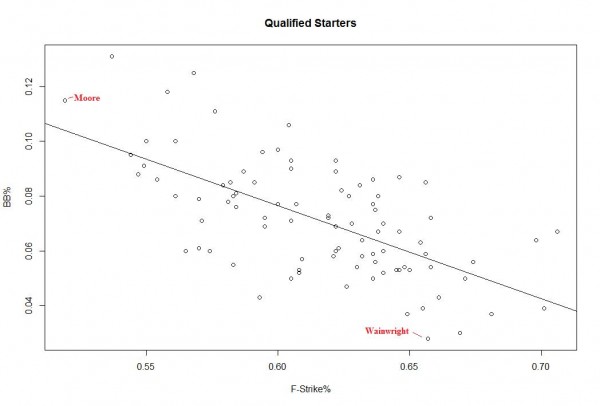
The comparison comes as a byproduct of some aimless leaderboard scanning and a stray thought. I started wondering about the correlation between Zone% and BB%, much in a similar way to how Jeff Sullivan considered the connection between Contact% and K% earlier this year. My study led me to the production of this graph, with BIS data through July 24:
Generally, a higher Zone% correlates with a lower BB%. The slope coefficient is -0.33 and is statistically significant, but the Adjusted R squared is only .2116. Pitchers who pound the zone usually walk fewer batters than pitchers who don’t, but there is a lot of unexplained variation. Matt Moore and Adam Wainwright carry quite a bit of the blame for that as they have nearly identical Zone% and extremely different BB%. In fact, Wainwright is 1st in BB% and Moore is 87th among qualified starters.
Wainwright has a K/BB ratio above 8. Moore’s is 2. Wainwright and Moore both strike out between 22 and 24% of the batters they face, but Wainwright walks less than 3% and Moore walks more than 11%.
Amazingly, Wainwright and Moore throw 44.5% and 44.2% of their pitches in the zone, respectively, despite what their walk rates seems to be telling you.
If you give them both 100 pitches and 25 batters, they’ll both average 55-56 strikes but Wainwright will walk fewer than 1 and Moore will walk close to 3. That’s impressive. No other two starters in baseball this year have such similar Zone% and such different walk rates. (Ubaldo is the data point above Moore, but he is a full percent behind Wainwright in Zone%)
Name
O-Swing%
F-Strike%
Adam Wainwright
38.40%
65.70%
Matt Moore
28.50%
51.90%
Well that’s something. Wainwright and Moore throw the same number of pitches in and out of the zone, but Wainwright gets batters to chase when he leaves the zone much more often and starts at bats with strikes much more often as well. It’s pretty interesting that two pitchers can throw the ball in the zone with the same frequency and get such dramatically different results.
You can see that despite hitting the zone with similar frequencies, Wainwright hits the zone early to set up chases later on in the at bat. Here are their zone plots on first pitches.
Wainwright
Moore
Wainwright and Moore are a great example of how averages can sometimes be deceiving. Despite throwing the same percentage of pitches in and out of the zone, they are throwing them in and out of the zone at much different times. Wainwright pounds the zone early and gets hitters to chase late. Moore misses more consistently.
Think of it this way. When Wainwright throws a pitch out of the zone, he’s doing it when he’s ahead in the count so hitters are forced to chase and get themselves out. Moore leaves the zone with less purpose and more because he doesn’t have great control. It balances out to the same percentage, but the effects are much different. You can see it in BB%, you can see it in ERA, and you can see it in FIP and other advanced stats.
Matt Moore is still a very promising young pitcher and is still quite valuable in his current form. Nothing about this is meant to degrade Moore, but rather to highlight some extreme variation and consider how important it is to get ahead of hitters. By the third and fourth pitches in at bats, Wainwright has hitters chasing and Moore has hitters taking.
Getting ahead early with a first-pitch strike is really important as it is much more predictive of BB% than Zone%. The slope coefficient is nearly identical to Zone%, but the Adjusted R Squared comes in at .4020.
Finding the zone is important, but as Wainwright and Moore demonstrate, finding the zone early is more important. Matt Moore has tremendous stuff, but if he hopes to get results to match Wainwright, he’s going to have to command it more effectively, even if he is hitting the zone with the same frequency.
Moore doesn’t really profile as a Wainwright kind of pitcher, but Wainwright’s own impressive drop in BB% rate can be instructive for pitchers looking to improve. Wainwright is throwing pitches in the zone less frequently as he’s aged, but is adding to his first-pitch strikes. I’ll let the data speak for itself. Adam Wainwright is fantastic.
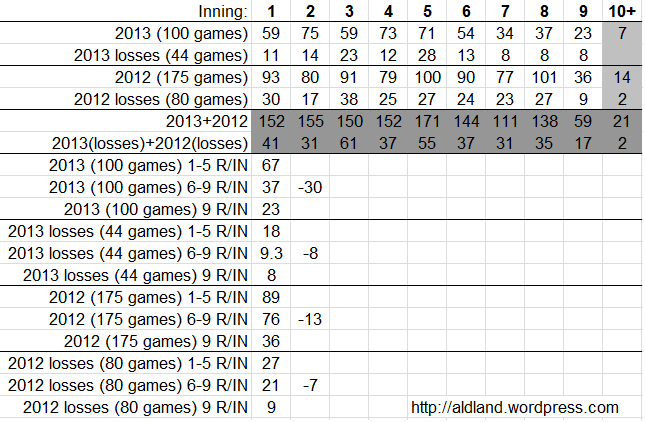
I celebrated tax day this year by taking a dive into the numbers behind the Detroit Tigers’ offensive production. Since last season, I had developed the feeling that this should-be offensive power was having trouble scoring late in games, hamstringing their ability to mount comebacks and generally secure a win in the later innings, and I wanted to investigate to see whether that really was the case.
The evidence I gathered in April appeared to support my hypothesis. The 2013 season was just twelve games old, though, and it was difficult to ascribe too much meaning to data gathered from such a small sample set. As of today, however, Detroit has played one hundred games in the 2013 campaign, so I decided to update the numbers:
Dave Cameron recently posted an interesting article about Jhoulys Chacin. It’s all about how Jhoulys Chacin is defying the rules of HR/FB rates. His HR/FB rate this year is a mere 2.8%. Jhoulys Chacin has pitched 120 innings, had 106 fly balls, and allowed just three home runs. Very impressive. But it makes you wonder if there are other pitchers who are maintaining low rates while allowing more fly balls overall. Because while Jhoulys Chacin is obviously benefiting from his HR/FB ratio, it’s possible for a pitcher to have more fly balls while maintaining a slightly higher HR/FB and benefit more. So I invented CAIN, a counting stat to help measure that.
CAIN does not stand for anything. I’m just paying homage to a famous outlier.
CAIN = FB – (9.34 x HR)
To explain, the Fangraphs Glossary says that the league-average fly ball rate is “~9-10% depending on the year”. In fact, of the 91 qualified pitchers in Fangraphs database for 2013, the average HR/FB ratio is 10.7 percent. So there are 9.34 fly balls for every homer. So we can say that for most pitchers, if they had ten homers at this point in the season, they would have about 93.4 fly balls. Ten homers and 93.4 fly balls would give you a CAIN of exactly 0. Make sense?
Now for what you came here for. Here are the top ten in CAIN this year:
Note that I’m not saying any players might actually be able to sustain their CAIN, I just think it’s an interesting little tidbit, and perhaps a nice follow on to Dave Cameron’s article.
Name
Team
IP
HR
FB
CAIN
HR/FB
Eric Stults
Padres
133
8
163
88.3
4.90%
Jhoulys Chacin
Rockies
120
3
106
78
2.80%
Bartolo Colon
Athletics
135.2
9
161
76.9
5.60%
Travis Wood
Cubs
128.1
10
159
65.6
6.30%
Adam Wainwright
Cardinals
154.2
6
113
57
5.30%
Bud Norris
Astros
119.2
10
150
56.6
6.70%
Lance Lynn
Cardinals
122
7
121
55.6
5.80%
Matt Moore
Rays
116.1
8
130
55.3
6.20%
Derek Holland
Rangers
133.2
9
137
52.9
6.60%
Clayton Kershaw
Dodgers
152.1
9
136
51.9
6.60%
And Jhoulys Chacin is not #1. It turns out that Eric Stults is in fact benefiting more from his HR/FB rate outlier this year. Of course, that’s partially happening in Petco. Petco is not Coors.
Name
Team
IP
HR
FB
CAIN
HR/FB
Joe Blanton
Angels
116
24
133
-91.2
18.0%
Roberto Hernandez
Rays
113.1
18
91
-77.1
19.8%
Jason Marquis
Padres
117.2
18
99
-69.1
18.2%
CC Sabathia
Yankees
142
23
150
-64.8
15.3%
Chris Tillman
Orioles
119.2
21
135
-61.1
15.6%
Ryan Dempster
Red Sox
115.2
20
130
-56.8
15.4%
R.A. Dickey
Blue Jays
134.2
23
163
-51.8
14.1%
Jeremy Guthrie
Royals
126.2
22
155
-50.5
14.2%
Hisashi Iwakuma
Mariners
138.1
21
146
-50.1
14.4%
Lucas Harrell
Astros
112
15
96
-44.1
15.6%
Poor Joe Blanton. His peripherals aren’t that bad this year. But he’s been posting some pretty high HR/FB rates for the last five years or so. I’ll leave it to someone else to puzzle that out.
After doing this analysis I wanted to know about exceptional seasons in the “UZR era” for pitchers’ CAINs. I am continuing to use 9.34 as the FB/HR value, not adjusted for year. If I was being very scientific I would probably break that constant out for league AND year, but I’m lazy and unpaid. Anyway, here, unsurprisingly, is Matt Cain:
Season
Name
Team
IP
HR
FB
HR/FB
CAIN
2011
Matt Cain
Giants
221.2
9
246
3.70%
161.94
2007
Chris Young
Padres
173
10
243
4.10%
149.6
2002
Jarrod Washburn
Angels
206
19
317
6.00%
139.54
2009
Zack Greinke
Royals
229.1
11
242
4.50%
139.26
2002
Mark Redman
Tigers
203
15
273
5.50%
132.9
2011
Jered Weaver
Angels
235.2
20
319
6.30%
132.2
2010
Anibal Sanchez
Marlins
195
10
222
4.50%
128.6
2010
Livan Hernandez
Nationals
211.2
16
278
5.80%
128.56
2010
Jason Vargas
Mariners
192.2
18
295
6.10%
126.88
2007
Matt Cain
Giants
200
14
255
5.50%
124.24
So in summary, CAIN is a nice little tool if you are interested in seeing just how much a HR/FB rate is affecting a pitcher’s performance. If anyone can think of a better acronym, like one that actually is an acronym, please leave a comment.
Earlier this season, while writing a piece on Rick Porcello’s breakout, I noticed he was mixing a certain combination of skills that seemed both interesting and valuable. He was striking out more than 7 hitter per 9, walking fewer than 2, and also inducing a ground ball rate above 50%. The story with Porcello was the increase in strikeouts, but it also put him in some excellent company. Going back to 2002 (when GB% becomes available) the list of qualifying pitchers to meet those criteria is short and impressive. Roy Halladay (4), Chris Carpenter (3), and Cole Hamels (1). Porcello is doing it this year and so is John Lackey. And Lackey’s story might be the most interesting.
(Note: K% and BB% tell a similar story, the cut-offs are just harder to express and are not the real focus of the article.)
Porcello’s key was an improved changeup and new curveball that induced more strikeouts, but Lackey has actually improved his numbers in all three categories pretty dramatically. Even if we accept that Lackey’s 2011 numbers were depressed due to the coming injury, if you take his career numbers and place them next to his 2013 season, the change is quite interesting.
Season
IP
K/9
BB/9
HR/9
BABIP
GB%
HR/FB
ERA
FIP
xFIP
WAR
2002-2012
1876
7.03
2.73
0.91
0.309
43.20%
9.10%
4.10
3.91
4.08
34.7
2013
106
8.44
1.94
1.18
0.290
50.80%
14.70%
2.95
3.64
3.18
2.1
At 32, Lackey is getting better. Certainly he had some excellent seasons from 2005-2007 when he exceeded 5.0 WAR for three straight years, but this performance is quite something. He’s getting more strikeouts than in all but one year of his career and he’s posting the best walk rate and highest ground ball rate in his career by substantial margins. The results are better if you look at ERA, FIP, and xFIP as he’s never had a lower ERA or xFIP and only bested this year’s FIP during that run from 2005-2007.
Lackey is having a career renaissance. But the interesting thing on the surface is that Lackey’s velocity isn’t much different and his pitch selection isn’t either. He’s got the same repertoire and it seems to be of the same quality. But looks can be deceiving.
A word is needed up front regarding pitch classification. Pitch F/X seems to think he’s throwing a different mix of pitches, but it’s actually just classifying them differently. You can see in the two charts below, from 2011 and 2013, that the velocity and horizontal movements are quite similar, but the pitches are being called something different.
His velocity isn’t much different from his rough 2011 campaign and the location of the pitches aren’t terribly different either. He’s routinely working low and away to both RHH and LHH this year just like he did in 2011.
This doesn’t seem to be about stuff or location, and this isn’t an increase in performance driven by BABIP because the indicators I’m looking at are entirely within the pitcher’s control This is an analysis about an increase in strikeouts, a decrease in walks, and an improvement in GB%. Lackey is getting better results because he’s doing well in those categories. Yet he’s not throwing harder and he’s not throwing much differently than he did in one of his worst years.
Well, not so fast. There is one key difference that I’ve been able to find and I think it can explain why Lackey is doing so much better. Let me start by pointing out some even more interesting tidbits. First, Lackey is throwing fewer pitches in the zone overall while inducing much less contract overall with virtually the same swing percentage as in 2011. His first-pitch strikes are up but are not much different than his career norms. Lackey is getting more swings and misses, which could point to the strikeout increase. But Lackey is also hitting the zone less often, which means a good portion of the walk decline is coming from batters swinging at pitches outside the zone. That all makes sense to some degree.
Lackey is getting more swings and misses via pitches out of the zone, so his strikeouts are up and his walks are down. But the increase in GB% is the aspect about which I was most curious and it fits in with what I believe is cause the strikeout and walk transformation.
Lackey isn’t throwing harder, the ball isn’t moving more horizontally, and the general location of his pitches haven’t changed. What has changed is the vertical movement on a subset of his pitches. It’s hard to notice when you’re looking at season averages, but graphically it is quite striking. In certain situations, Lackey throws a variation of his fastball and cut fastball that moves with the same velocity and horizontal movement as normal, but with more vertical break. It’s almost like having another pitch that Pitch F/X doesn’t understand. Take a look and remember he’s thrown fewer pitches overall in 2013, so the cluster stands out even more:
I’m not a leading expert on Pitch F/X or pitching in general, but this is the kind of thing that catches my attention. Lackey’s pitches don’t seem different overall, but there is a group of them that are acting differently. The increased downward break is likely to blame for more ground balls and I can certainly imagine it’s part of what’s driving the strikeouts via hitters swinging and missing on pitches they didn’t except to drop so much.
In analyzing this particular cluster of fastballs, the results were striking. Of 86 such pitches, 27 were called balls, 17 were called strikes, 19 were fouled off, 10 were swung at and missed, 3 were hit for singles, and 10 resulted in ground outs. When Lackey throws this pitch, the worst thing that happens is a single and even those are pretty rare. If we consider this pitch in context, during at bats in which he threw one of these pitches, he walked 14 hitters, struck out 28, induced 3 line outs, got 33 groundouts, and allowed just eight hits. All singles.
I haven’t watched many Lackey starts, so Red Sox fans might be able to speak more confidently on the subject, but it appears as if Lackey has turned himself into one of these special pitchers who can maintain high K%, low BB%, and a high GB%. We only have a couple of months of data, so this could still vanish from in front of our eyes.
My interest in Lackey, Porcello, and these pitchers at large comes from my belief in DIPS theory, but also a more general belief that limiting walks and extra base hits will help prevent runs and a pitcher can play a role in limiting extra base hits even if some of it is out of their control. If you’re inducing ground balls when you allow contact, you’re not going to get hurt nearly as often. Whether you like metrics like SIERA for this, or simply like to read FIP alongside GB%, it makes good sense.
John Lackey is becoming one of those guys. Along with Porcello (and Fister and Felix who have been hovering around these somewhat arbitrary cutoffs), he is headed for the club occupied only by Doc, Carpenter, and Hamels. I can’t tell you how often this happened prior to 2002, but the fact that only one of the eight recorded seasons is anything short of great makes me think this is worth tracking. The specific numbers aren’t hugely important, but they allowed me to discover the new and improved John Lackey.
He gets more strikeouts, allows fewer walks, and induces more ground balls. He’s had a bit of a rough stretch since his peak five years ago, but with this new approach, and occasionally different fastball, John Lackey is pitching himself back into the upper reaches of the American League.
In fall 2008 FanGraphs was kind enough to release new plate-discipline metrics, including first-pitch strike percentage (F-Strike %), outside-the-zone swing rate (O-Swing %), and inside-the-zone swing rate (Z-Swing %). At the time, Eric Seidman was even kinder when he investigated the correlation of these plate-discipline statistics with standard pitcher metrics like WHIP, FIP, BB/9, and K/9. Very thoughtful indeed.
Now we have another 4.5 years of plate discipline data, compiled by Pitch f/x rather than Baseball Info Solutions. It may be worthwhile to see how these numbers compare with Seidman’s, as well as add a measure of uncertainty to the correlations. It is possible for two factors to have a strong relationship, but because of small sample sizes or other forms of variability, the correlation value may not be as precise a measure as a high R-value may suggest.
Bootstrapping
Correlation coefficients, which fall between -1 and 1, allow us to measure the strength of linear dependence between two variables, such as O-Swing % and K %. We can use bootstrapping techniques to obtain 95% confidence intervals for these correlation coefficients. Calculating confidence intervals for correlations adds a measure of uncertainty to the process—narrow intervals indicate we can have greater confidence that the R-value we obtain represents the true correlation between the two metrics.
Bootstrapping is a statistical technique in which we resample our current sample, in this case 500 times. This repeated process allows us to assign measures of accuracy to sample estimates, such as medians, means, or correlation coefficients. For our purposes here, it is only important to note that we can be 95% confident that the true R-value lies between the intervals. If the interval includes 0, meaning absolutely no correlation, we can conclude that there is not enough evidence to indicate any relationship between the two variables.
First Strike %
These correspond well enough to the values obtained by Seidman, with one exception worth noting. While he used K/9 and BB/9 to correlate with F-Strike %, here we examine the correlation with strike and base on balls percentages. Our correlation coefficient is similar in magnitude at .24 versus .19, but its wide confidence interval approaches the null value and suggests the estimate is not very precise. This is worth noting, especially considering that BB % appears to have such a strong correlation with F-Strike % of -.79 with relatively narrow confidence intervals. Seidman observed a similar pattern—pitchers who get into an 0-1 count are more prone to not walking batters than striking them out.
First Strike %
R-Value (95% CI)
K%
0.24
(.024, .455)
BB%
-0.72
(-.848, -.604)
WHIP
-0.52
(-.649, -.376)
FIP
-0.41
(-.576, -.237)
O-Swing %
O-Swing % is the percentage of pitches a pitcher pitched outside the zone but still generated a swinging strike. Think anyone facing Pablo Sandoval. Here we again see relatively moderate correlations with relatively tight confidence intervals ranging from 0.30 to 0.19. Pitchers who induce swings at pitches outside the zone may be especially tricky for hitters to do damage against. So far this season Adam Wainwright and Matt Harvey are both in the top three in O-Swing %, and top two in both WHIP and FIP.
O-Swing %
R-Value (95% CI)
K%
0.39
(.274, .548)
BB%
-0.44
(-.637, -.254)
WHIP
-0.50
(-.677, -.317)
FIP
-0.45
(-.650, -.283)
Z-Swing %
We can see from the results below that Z-Swing %, the rate of inducing swings at pitches in the zone, bears little relationship with any of these metrics. Seidman’s analysis showed that the correlations were negligible at best. The confidence intervals for all of these measure metrics include 0, meaning that we cannot be 95% confident that there is any relationship present. A quick glance at the leaderboards shows that Ian Kennedy and Miguel Gonzalez are near the top of the list this season, and these guys aren’t exactly shoving.
Z-Swing %
R-Value (95% CI)
K%
-0.17
(-.370, .035)
BB%
-0.17
(-.381, .048)
WHIP
-0.09
(-.276, .111)
FIP
0.10
(-0.09, .286)
All data courtesy of FanGraphs.
Because I’m a believer in open data, you can find my R code here.