Extreme Teams Past and Present

The way a team is built is always at the heart of discussions of free agent acquisition, trade analysis, optimal lineup construction, etc.  It is what general managers are paid to do, and there are some very divergent philosophies that are espoused by folks like Brian Sabean or Jeff Lunhow.  A few teams each year by happenstance or design end up having one unit, offense or pitching and defense (p/d), far outstrip the other in performance, and these are what I want to look it today.

In this instance I am stripping teams down to a function of two activities, how many runs do they score and how many do they give up.  Some teams have innate advantages to one or the other of these activities based on fun things like park effects or deep pocket books, but that’s okay.  What I did was pull the last ten full seasons (2004 through 2013) first and find out what the average runs scored/given up by a team was for that year.  Then for each team I gave them a plus minus for runs scored and given up so a team that scored 20 more runs than the average gets a +20 and if they also allowed 20 fewer runs than average they get another +20 and their extremeness rating is 20 – 20 = 0, so their units of offense and p/d are balanced and not extreme.  The most extreme differences for the two units over those ten years are as follows:

 photo ExtremeTeams_zps6989f530.jpg


What stands out is that the most extreme teams tend to not be very good because one unit tends to be very, very bad creating an insurmountable obstacle to success.  The Rangers of 2008 are by leaps and bounds the most extreme team because the had the best offense in major league baseball at 148 runs more than the average team, but they also allowed the most runs that year giving up 214 more than average and thus one 79 games and an extremeness rating almost 50% above second place.  The 2005 Red Sox are the only team that made the playoffs with one dominant unit, and their pitching staff was bad, but not extremely bad as we will see in a bit.  Their 2011 team was similar, but the 90 wins was not enough to get them into October.

Another interesting thing in this group is that almost all of them skew toward hitting.  Only the 2010 Mariners, and the Giants teams 2009 and 2011 were pitching oriented with no offense to speak of.  Also, 2005 was evidently the year for being extreme as there are three teams from that season in the top 10.  Now let’s look at teams that are most extreme in one or the other category rather than the combined.

If we look at just extreme offenses there is a lot of success.  The top offense of the last 10 seasons was the 2007 Yankees who scored 190 more runs than the average team that season.  I was looking at the top 15 offenses by this measure and the Yankees show up 6 times and Boston does 4 times.  Money can buy you a great offense, and it can get you to the playoffs.  A full 80% of the top 15 offenses above average made the playoffs with only the aforementioned 2008 Rangers and 2011 Red Sox along with the 2005 Rangers missing the postseason.  Those three teams all had negative p/d production relative to average that kept them out, though the Red Sox team was close.

Before moving to p/d extreme teams, I also looked at the records of these teams versus their Pythagorean expectation and they seem to perform as you would expect.  Seven of the 15 were below expectation, so conversely eight above and on average the actual and expected were very close to being the same.

The teams that were best by runs allowed look very different.  At +165, the 2011 Phillies’ “Best Rotation Ever”, was at least the best rotation of the past ten years by runs allowed versus the average.  The volatility of pitchers prevents particular organizations from dominating this list like the offensive list.  Only the Giants and Padres show up more than once with the three and two seasons respectively, thanks PECTCO!  That means the top 15 offenses of the past decade belong to only four organizations versus 12 different teams being represented on the pitching side.

This probably shows that teams are being smart (or unsuccessful) in trying to build a team with extreme pitching dominance too.  Only eight of the 15 best p/d teams made the playoffs, so better than naive probability of getting there, but a lot worse than the dominant hitting teams percentage at a little over 50% versus the 80 we saw before.  Three of the playoff teams did manage to cover up below-average offenses, but generally you need a decent offense to go along with dominant p/d.  A big reason for the difference is that the offenses tend to diverge from average to a greater extent as we can see in the top 2, top offense +190 and top p/d only +165.  This difference is consistent though decreasing in magnitude moving down the top 15s.

If you compare the pitching extreme teams’ actual wins versus their Pythagorean expectation it does not behave like the extreme offensive group did.  Out of the top 15 pitching extreme teams, 11 had fewer wins than expectation.  The two tail p-value on a paired t-test for actual versus expected is 10.4% which doesn’t make for a strong conclusion, but probably means this needs some more attention.  So what does all of this mean for this year’s playoff race?

The extreme run scoring teams for 2014 are Oakland, LA Angels, and the Blue Jays.  Detroit was close, but they also just traded away some offense, so I will save them for another day as I think they are interesting right now too.  Oakland is a lock for the playoffs and are the only team on pace to crack the top 15 of the past ten years with the offense trending toward being about 125 runs above average though the departure of Yoenis Cespedes may bring that back a little.  The Angels are also looking pretty good for the playoffs, but probably as a wild card due to Oakland.  Toronto is 2 games out of the wild card and needing to jump two teams, so they are in some trouble as their p/d is not doing so well.  Their only trade deadline move of note was to add Danny Valencia so they have not shored up the pitching much though Marcus Stoman and Aaron Sanchez have come up and maybe Daniel Norris will as well.

The extreme p/d teams so far this year are Seattle, Washington, Oakland again, and a couple of almost teams like Cincinnati and San Francisco.  Seattle is there with Toronto only flipped as they have a below average offense.  They added Kendrys Morales and Austin Jackson and Chris Denorfia to try and help, but all have struggled so far for the Mariners.  Oakland of course added lots of pitching in Jeff Samardzija and Jason Hammel and then Jon Lester, so don’t be surprised if they end up with the best offense and defense by the end of the year.  Washington added Asdrubal Cabrera to a very average offense and Matt Thornton to their bullpen, but since they are almost a lock for the playoffs they weren’t needing large upgrades.


Can the Cubs Draw an Ace?

A major league baseball franchise exists to serve one of only two purposes: (1) win a World Series; or (2) line the owner’s pockets without regard to the quality of the team on the field. Since this post isn’t about the Miami Marlins, I’ll focus on the first purpose. It is almost axiomatic that a championship team needs at least one ace-caliber starting pitcher. Cubs president Theo Epstein has been acting as though he would single-handedly battle a battalion of Imperial storm troopers if that’s what it would take to get an ace. And indeed, many of you felt a minor disturbance in the Force when the Cubs claimed Cole Hamels off waivers from the Phillies tire fire. No trade was consummated, but is Theo right to obsess over finding an ace?

Here are the best starters from each of the last 10 World Series winning clubs, along with their ERA+ for that year, their career ERA+, and age that year. I’m using ERA+ to wash out park effects as well as the effects of the last decade’s gradually desiccating run environment.

Year   Pitcher                     ERA+ (WS season/career)           Age

2004  Curt Schilling (BOS)                   148/127                   37

2005  Mark Buehrle (CHW)                 144/118                   26

2006  Chris Carpenter (STL)               144/118                   31

2007  Josh Beckett (BOS)                     145/111                    27

2008  Cole Hamels (PHI)                     141/125                    24

2009  CC Sabathia (NYY)                     137/120                    28

2010  Madison Bumgarner (SFG)   131/114                   20(!)

2011: Kyle Lohse (STL)                         109/99                     32

2012: Matt Cain (SFG)                          126/117                     27

2013: Clay Buchholz (BOS)                234/110                    28

So while a team can be championship caliber without a dominant starter, it hasn’t happened often in the last 10 years. The 2011 Cardinals were the only team in this (admittedly miniscule) sample to scrape by with a pedestrian #1 starter (and remember, this was the year that Cards managed to win the pennant only by imprisoning the Atlanta Braves in a shipping container). Buchholz is a bit of an oddity in that he pitched only 108 innings, but man, they were 108 damn good innings. Lester and Lackey had weaker rate stats but pitched many more frames.  Every other team had a clear ace who beat the league ERA by at least 25% — most did even better.

What this list also shows is that aces don’t ace it every year. Most of these guys beat their own career ERA by roughly 10-30% in their World Series seasons. These are, for the most part, very good pitchers who had an occasional great season, but not guys who can crank out stifling dominance year after year. Almost nobody can do that. The other thing to note is that 7 of the 10 were under 30, and only Schilling was putting his teeth in a glass at night. Dominance is generally a younger man’s game.

All this suggests that the best way to get an ace season is to get two or three young quality starters with upside, and hope that at least one of them has an explosive season when the rest of the team is also doing well. But for a team like the Cubs, who have a plethora of low-ceiling starters in their system, this big bang approach probably won’t work.

So if they’re going to get an ace season, they need to import. Unfortunately, imported front line starters generally don’t come young, and never come cheap. The big obtainable names include the following (numbers are career ERA+/ current age):

Free agents at the end of this year

Max Scherzer (118/30)

Jon Lester (120/30)

Free agents at the end of next year

David Price (123/28)

Zack Greinke (116/30) (Greinke has an opt-out after the 2015 season, but he’s signed through 2018.)

I’m a celebrity! Get me out of here!

Cole Hamels (125/30)

And here they are ranked by 4-seam velocity this year:

Price             93.4

Scherzer       92.7

Hamels         91.8

Lester            91.6

Greinke         91.6

If I were Theo I’d probably start at the top of this list and work down, but Price may never become available if the Tigers lock him up. Scherzer and Lester will cost lots of money but no current talent, and will both probably be available in 2 months. The Cubs don’t have a front-line starter anywhere in the organization, but they do have around eleventy quillion dollars in payroll space, which will get even larger after the ad revenues from the new jumbotron start rolling in. Buying two of these guys and teaming them up with C.J. Edwards, Corey Black, and what looks likely to be a young, cost-effective, video game offense could finally make Cubs fans forget about 1908. Or the free-agent contracts could be giant albatrosses that make Cubs fans forget about Alfonso Soriano. That’s why they call it gambling.


Biogenesis Players: Then vs. Now

After watching Nelson Cruz this year and all the noise he has been making, on top of a recent report by Buster Olney stating, “The average distance of the fly balls pulled by Ryan Braun this season is down 42 feet, from 302 to 260…”, it inspired me to look up the numbers for players suspended in the Biogenesis case. The big four suspended were Alex Rodriguez, Ryan Braun, Nelson Cruz, and Jhonny Peralta. Other position players involved and suspended were Everth Cabrera, Jesus Montero, Francisco Cervelli, and Jordany Valdespin.

This article will focus on the big four with the exception of A-Rod because he has been suspended all season. Obviously enough this is a small sample size so take heed. I will be making a couple of assumptions, the main one being that these players had been using steroids for at least 3 years (2010-2012) prior to their being caught and suspended. The other assumption being that enough time has passed for the effects of the steroids to have worn off and that their bodies/abilities are back to their more natural state.

Ryan Braun 2010 2011 2012 2014 2014 (ZiPSU)
HR/FB 14.00% 18.80% 22.80% 15.10%
Slug% 0.501 0.597 0.595 0.496 0.505
ISO 0.197 0.265 0.276 0.211 0.231
WRC+ 134 171 160 129 133
OFF 32.5 58.8 52 12.5 21
True Distance (ft) 408.2 406.7 406.9 387.9
Average Speed Off Bat (mph) 105.1 104.7 104.2 102.1


Nelson Cruz 2010 2011 2012 2014 2014 (ZiPSU)
HR/FB 15.20% 18.70% 13.10% 20.00%
Slug% 576 509 460 513 505
ISO 258 246 200 253 246
WRC+ 147 116 105 130 127
OFF 26.6 7.7 0.8 14.9 18.5
True Distance (ft) 405.2 411.6 418.6 398.9
Average Speed Off Bat (mph) 105.2 106.4 106.8 104.2


Jhonny Peralta 2010 2011 2012 2014 2014 (ZiPSU)
HR/FB 7.50% 10.80% 8.30% 12.50%
Slug% 392 478 384 447 441
ISO 143 179 145 187 180
WRC+ 91 122 85 122 120
OFF -12.7 11.2 -13.8 8.4 10.3
True Distance (ft) 392.5 388.4 391.9 397
Average Speed Off Bat 101.2 102.3 101.7 102.8


The main thing that jumps out at you is that Cruz and Peralta are statistically putting up some of the best numbers of their careers (without a doubt, top 3)! Braun, however, is having his worst season of the 4 above, while Peralta and Cruz both are having their most powerful seasons yet. Their HR/FB rates are each at their highest as well as their ISO numbers, while again Braun’s are at his worst of the 4 seasons. Looking at WRC+ and OFF, Peralta is having his 4th best season ever, Cruz is having his 2nd best ever, and Braun is having the worst season of his career to date (with the possible exception of 2008).

Using ESPN’s hittrackeronline.com I looked up each player’s True Distance on home runs this year as well as the average exit speed velocity of their home runs. Ryan Braun has lost 3 mph which has correlated to a shortage of almost 20 feet on his balls. Nelson Cruz has lost about 2 mph and 20 feet off his home run balls from his peak of the four years. Jhonny Peralta, on the other hand, is showing his best numbers this year.

So what does all this mean? In summary, I believe the main thing we can take away from this is that each player who used steroids should be assessed on a case by case basis. Every player is affected differently. We cannot group all steroid users together. Using the above statistics as proof, after being charged in the Biogenesis case, 2 players are having among the best seasons of their careers while another is having his worst. In addition the best all-around athlete and youngest of the 3 (so therefore closest to his prime) is the one who is struggling most, Ryan Braun! Whether it is the HOF vote, or evaluating future value of perceived steroid users, we can’t lump them all into the same group and assume that they will automatically decline. Yes, using steroids is absolutely cheating, however it doesn’t necessarily mean that those players wouldn’t have been just as productive had they chosen legal supplements or nothing at all.


Another Way to Show that Mike Trout’s Athleticism is What Separates Him

We all know Miguel Cabrera and Mike Trout are elite hitters.  Yes, I am going to compare the two.  And yes, I know that’s been done many times before.  However, I’ve come up with a stat that really separates the two. I’ll be looking at their complete offensive package, so this is not at all related to WAR, as it does not include defense.

Cabrera has won the MVP for the past two years, and Trout is putting up seasons never seen before from 20-22 year olds.  When you compare what they’ve done since 2012, they are very similar hitters. (Stats through Aug. 9, 2014)

Trout: .317/.408/.563 with a 172 wRC+, .247 ISO, .415 wOBA (1860 PA)

Cabrera: .330/.403/.592 with a 167 wRC+, .263 ISO, .420 wOBA (1828 PA)

As you can see, they’re almost identical.  Cabrera has a slight advantage in the power department with a 16 point advantage in ISO and a 29 point advantage in SLG. What I want to do is take this a bit further and analyze how much speed and athleticism gives Mike Trout an advantage.

WAR takes everything a baseball player can do into account.  Trout has had the edge over Cabrera since 2012 with a 26.5 mark compared to Cabrera’s 17.7, a pretty significant gap.  Many people don’t buy into WAR, so I wanted to show how speed changes Trout’s offensive game.  Again, I am not looking at defense for this piece.

As we know, SLG is total bases divided by plate appearances.  However, it does not include every single base a hitter collects.  For example, walks and HBP are not included.  There are many more things that it does not include, and that’s what I looked at in order to create a new stat, adjusted SLG, if you will. I used FanGraphs and Baseball Reference to find every single base an offensive player can collect, whether it’s after they hit the ball or after they reach base. In addition to hits, walks, and HBP, I looked at extra bases taken, reaching on errors, net stolen bases, pickoffs, and double plays grounded into.  I included double plays because they make a huge impact.  It’s two outs on one play, so I took an extra base away for each double play, as it eliminates another base runner.  For extra bases taken, I included five things:

  • Times a runner is on first, then reaches third or home on a 1B
  • Times a runner is on first, then scores on a 2B
  • Times a runner is on second, and scores on a 1B
  • Bases taken on fly balls, passed balls, wild pitches, defensive indifference, balks
  • Minus outs made at bases (doubled off, trying for double/triple/HR, advancing on fly balls, wild pitch, passed balls)

Other things to keep in mind; I added up every single base, then subtracted a base for when a guy gets picked off or bounces into a double play.  For the final percentage, I took all the bases each player collected and divided it by plate appearances.  It’s a very simple stat, once you gather all the information needed.

Here is a table for what I calculated (ROE—reached on error. NSB—net stolen bases. XBT—extra bases taken.  PO—pickoffs.)

PA (TROUT) BB HBP ROE NSB 1B 2B 3B HR XBT PO DP TOTAL ADJ SLG
1860 239 20 24 82 297 99 22 82 161 6 19 1390 0.747
PA (CABRERA) BB HBP ROE NSB 1B 2B 3B HR XBT PO DP TOTAL ADJ SLG
1828 200 9 9 6 319 102 2 105 120 0 63 1230 0.673

As you can see, the speed of Trout has pushed him way over the top when it comes to being a complete offensive player.  He has reached on an error 15 more times than Cabrera (24-9).  Speed has a lot to do with this by putting pressure on defenders, especially infielders, who often rush throws when a speed guy is running down to first.  Trout also has 76 more net stolen bases than Miggy (82-6) as he has racked up 94 steals since 2012 while being caught just 12 times.  He also grounds into a double play far less than Cabrera, with 19 since 2012 compared to Cabrera’s whopping 63.  Trout also takes more bases while on the base paths.

When you consider that Trout and Cabrera both get hits, extra-base hits, and walks at a fairly similar rate, it’s alarming to see how much Trout goes ahead of Cabrera when you take speed and baserunning into account. Trout’s “adjusted slugging percentage” (or fill in another creative name here) is .747 since 2012, compared to Cabrera’s .673, a very noticeable difference of 74 points.  This percentage, and all of the counting stats that are included with the table, is reliable because they both have almost the same number of PA since 2012, with Trout at 1,860 and Cabrera at 1,828.

Everybody loves to compare Trout and Cabrera.  This is just another way of showing that Trout is ahead of Cabrera, because it shows how well Trout does the things that are smaller and often unnoticed things well.


The Curious Case of Chris Coghlan

Jed Hoyer and Theo Epstein have been praised over and over for how well they draft and how they sign pitchers like Scott Feldman and Jason Hammel to one-year contracts and flip them for Jake Arrieta, Addison Russell, and Billy McKinney.  The hype they have created about the Cubs farm system is unimaginable and deserving.  But I’m not here to talk about how great the farm system is, it’s been repeated to us a million times.

Chicago’s 2013-2014 offseason signings were headlined by players like Nate Schierholtz and Emilio Bonifacio (especially after his hot start), but the best free agent pick up came from a minor league contract and has been undervalued by the Cubs fan all season.

I’m here to talk about the Curious Case of Chris Coghlan.

Chris Coghlan was the Rookie of the Year in 2009 when he played for the Marlins.  He put up a .321/.390/.460 line and had a wRC+ on 127.

In 2010 Coghlan became an average hitter putting up a pedestrian line of .268/.335/.383.

His decline continued until he hit rock bottom in 2012 only playing 39 games with the big club and putting up numbers that shouldn’t be uttered.  But just so you don’t have to go look them up yourself: .140/.212/.183.  *He did miss a lot of time due to injury

In 2013 Coghlan put up numbers comparable to his 2010 season and the Cubs front office must have liked the upward trend because they signed the 29-year-old to a minor-league contract that gives them team control until 2017.  This was not an investment but a very low-risk speculation, and right now the Cubs have their second-most productive hitter only making ~$500,000 this year.

Yeah, I said it: Chris Coghlan is the Chicago Cubs’ second-most productive hitter. (Behind Rizzo)  Not Castro, not Baez (yet, needs more PA), not Ruggiano, the only player relatively close was Bonifacio.

Coghlan has put up numbers that are comparable to his Rookie of the Year season:

2009:                                                                                   2014:

BABIP: .365                                                                      BABIP: .333 (2nd on Cubs)

wRC+: 127                                                                         wRC+: 135 (2nd on Cubs)

wOBA: .374                                                                       wOBA: .369 (2nd on Cubs)

Walk Rate: 10.9 %                                                           Walk Rate: 10.6% (2nd on Cubs)

K Rate: 13.6%                                                                    K Rate: 16.9 % (1st on Cubs)


Right now Chris Coghlan realizes 35% more value in Runs Created than the average position player.  And although he doesn’t have enough PA to be qualified for the FanGraphs leaderboards, plugging his numbers in would put him in the class of players like Carlos Gomez, Matt Kemp, Melky Cabrera, Ryan Braun,  and Ben Zobrist.

What those players will be making this year followed by their wRC+ and wOBA:

Carlos Gomez: 7 Million, 135, .370

Matt Kemp: 21 Million 133, .358

Melky Cabrera: 8 Million 137, .374

Ryan Braun: 10 Million 129, .362

Ben Zobrist: 7 Million 132, .356

Chris Coghlan: 500k, 135, .369

The Chicago Cubs are paying 500k dollars for the offensive production of Carlos Gomez.  It’s almost scary how similar their numbers are:

Name                    Slash                                      wRC+                    wOBA

Gomez                 .289/.352/.490                   135                         .370

Coghlan                .288/.367/.477                   135                         .369


With the assumed call up of Soler in September, there is one outfield spot left for Coghlan.  And with the development of Almora stunted a little bit in his call-up to AA it seems Coghlan has some more time to prove himself, and also prove he brings value to the Cubs in other ways.

With the army of prospect the Cubs will be calling up these next couple years it would be downright crazy to believe that some players aren’t going to struggle.  I really don’t feel like I have to draw the conclusion for you but I will anyways.  Even if Coghlan’s playing time and numbers decrease next year, the Cubs will have a 30-year-old who has been Rookie of the Year while also having a 30-year-old player who has gone through major slumps and bounced back. Chris is (hopefully) somebody who can be a mentor for the up and coming while still giving value of somewhere between 115-120 wRC+.

For all of the things that Theo and Jed have done for the Cubs, I think I’m right here to argue that the signing of Chris Coghlan has realized the most value of any position player signing they have made.  The Chicago Cubs are paying $500k for Carlos Gomez offensive output, let that sink in.

Maybe the Curios Case of Chris Coghlan is just like The Curious Case of Benjamin Button (but with better alliteration) in the fact that Coghlan is playing younger as he’s getting older.


Xander Bogaerts’ Rookie Struggles

Coming into the year, the Boston Red Sox were riding high after the 2013 title in which they’d gone from worst to first. Just about everyone with a worthwhile opinion thought that’d they at least be in contention for the playoffs again this year, and it wasn’t uncommon to see people picking them to repeat in 2014.

One of the few questions people did have about the team was how would they integrate their two young players, Jackie Bradley, Jr. and Xander Bogaerts, in their first full seasons as starters. Of these two players, Bradley was the one that people seemed most concerned about. This made sense, since he was less regarded as a prospect than Bogaerts (number 2 overall on most prospect top 100 lists). But while Bradley has been a complete zero with the stick (57 wRC+), his defense has carried him to 1.5 fWAR so far this season. Bogaerts, on the other hand, has a wRC+ of 82, which combined with mediocre defense has left him hovering around replacement level.

Now, there’s no doubt that people are disappointed by Bogaerts’ season, and they have every right to be. Bogaerts was hyped as the rare prospect with superior skills and a significant amount of polish, and he showed why when he played like a veteran down the stretch in last year’s playoffs. Nobody was expecting him to be replicate Mike Trout’s rookie season, but a league average regular was probably a reasonable expectation. Obviously Bogaerts has underperformed relative to that standard.

Guys like Trout, Yasiel Puig and Manny Machado have essentially ruined the kind of expectations we now put on guys going through their first full seasons. Do you know how many batting-title-qualified rookies have had an OPS lower than Bogaerts’ current .650? 311! And of that 311, 283 of them were older than Bogaerts’ current 21 years of age. Bogaerts is struggling, but that’s what rookies do. There’s no greater jump in professional baseball than the one to the majors.

Bogaerts is actually hitting pretty well against fastballs and changeups. The crux of his issues this year have been against breaking balls. And there’s really no way to sugarcoat it. He’s been terrible against any and all spin, hitting just .143 and slugging .167. Unfortunately, opposing pitchers have noticed, and Bogaerts has only seen more breaking balls as the season has progressed.

plot_hco_bytime (1)

As the rate of breaking balls has gone up against Bogaerts, his numbers have gone down. The Red Sox shortstop was actually a well above average hitter heading into June (119 wRC+ in March/April, 149 wRC+ in May), but then everything fell apart. Bogaerts posted an almost unthinkable .426 OPS in June, a number less than half (.897) of what he posted the month before. He followed that up with a much improved, but still terrible July (.595 OPS) and continued to struggle in August.

Bogaerts’ struggles with breaking balls coincide with the part of his game that has perhaps regressed the most as his season has progressed: his plate discipline. After working 25 walks through the end of May, Bogaerts has been told to take his base just seven times since. A large part of that has been the decline of his ability to discriminate between a breaking ball thrown for a strike, and one thrown for a ball.

plot_hco_bytime

As you can see in the graph above, Bogaerts has stayed fairly steady against fastballs and changeups, but his ability to recognize breaking balls has completely melted away. As for why this has happened, that’s difficult to say. Maybe Bogaerts has always struggled against breaking pitches. But the most likely answer is that he’s a rookie struggling to adjust against pitchers capable of taking advantage of his weaknesses. Nevertheless, it’s at least been a prolonged slump, and one that Red Sox fans have to hope isn’t a glimpse into continual struggles for their youngest player.

Then, putting aside things that we can actually measure, there’s the possibility that Bogaerts is simply in his own head right now. As a ballplayer, he’d probably tell you he’s trying to do too much. There’s certainly something to that side of the argument. It can’t be easy to fail so spectacularly after being hyped as the next face of one of the most prestigious franchises in the game.

There’s also an argument to be made that some responsibility for Bogaerts’ struggles can be set at the feet of his manager, John Ferrell. There have been rumors that Ferrell was the person in the organization pushing the hardest for the Red Sox to resign Drew, which they ultimately did in late May. Drew, who had never played any position but shortstop in his big league career at that time, would be forcing Bogaerts over to third base, the position he played down the stretch of the 2013 title run. Bogaerts expressed some disappointment at time as a result, and an argument can be made that the team’s decision to resign Drew shook his confidence. Before Drew joined the lineup on June 2nd, Bogaerts was batting .296/.389/.427. Since then he’s hit .169/.201/.279. You might say that those dates are arbitrary and coincidental, and you can make of them as you wish. I will say that confidence is a huge part of succeeding in this game, and it should not be overlooked.

Overall, Bogaerts probably won’t look like he belongs back in AA forever, though we may have to wait until 2015 to see the player we were all hoping for. We got that player in the first couple months of this season, but pitchers’ adjustments, along with Bogaerts lack of adjustment to those adjustments, have torpedoed what was initially a very promising rookie year. That said, young players with Bogaerts pedigree and polish often turn into solid players at the very least, and I’m still as excited as ever about his career going forward. He’ll figure it out.


Does Troy Tulowitzki Suffer Without Carlos Gonzalez?

Does Troy Tulowitzki suffer without Carlos Gonzalez in the lineup?

Several weeks ago, in the same way my last article on rookie first and second half splits was inspired, my attention was alerted when a podcast personality contrived that Troy Tulowitzki, before his most recent bout with the injury bug, had performed poorly because Carlos Gonzalez had been out of the lineup.

The pundit grabbed the lowest handing fruit he could find in an effort to create a narrative, and a dogmatic one at that, as to why the Colorado Rockies slugger had not lived up to his pre All-Star break numbers.

******* *******’s (I’d prefer the article to be more about the subject of Tulowitzki and Gonzalez than the podcast member) argument was that without Carlos Gonzalez in the lineup, pitchers could approach Tulowitzki without fear, give him less strikes, and that is why his hitting has declined.

While this pundit surmised that Troy Tulowitzki’s performance declines when Carlos Gonzalez is out of the lineup, the numbers tell a much different story.

While we will look at the more direct numbers in a moment, the idea that Tulowitzki plays worse without Gonzalez is essentially the idea of lineup protection at a micro level. There have been countless instances that have debunked the idea of lineup protection, and, to my knowledge, none that have proved its existence.

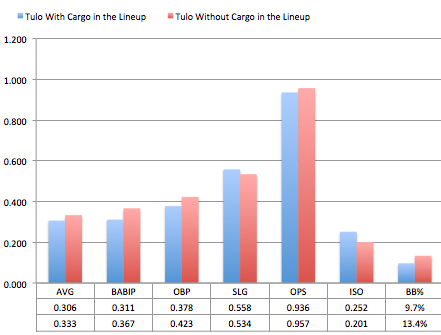
Screen Shot 2014-08-10 at 6.02.45 PM

The research looked at all games from 2010—Carlos Gonzalez’ first complete season—to today.

The results paint a much lighter picture than the Guernica that ******* ******* painted.

In games where Tulo has played without Cargo, he has had a higher AVG, OBP, OPS, and BB%. One might think that Tulowitzki would continue his normal performance without Carlos Gonzalez in the lineup, but, as this information suggests, it is hard to imagine that Tulo plays better because Carlos Gonzalez is not in the lineup, which leads me to believe what one would normally think about out of the ordinary performances in a small amount of at bats.

The utility of these results should be used for descriptive, and not predictive, purposes. Troy Tulowitzki has only had 479 plate appearances without Carlos Gonzalez, and that is far from a large enough sample size to be deemed reliable.

But because of the recent remarks made by Tulowitzki, it seems like it will be more likely than not that sooner rather than later we will see a large enough of a sample size of Tulo in another uniform to see if this trend continues.

While Tulo has played worse and is hurt as of late, we might expect that it is because he was unlikely to live up to the performance he had in the first half, and not because of Cargo’s presence or lack thereof in the lineup. Over the course of the first half of the season, Tulowitzki’s posted the 15th best OPS in a half of a season since 2010.

Tulo’s latest play suggests a regression to the mean, and while we are powerless to know exactly why regression happens, some pundits proclaim to know the reason (i.e. Tulo plays worse without Carlos Gonzalez), when really their specious statement is noise with a coat of eloquent words painted upon it.

When the next “expert” tells you that Tulo has preformed poorly, because “ he wants out of Colorado” or  “he wants to be traded”, you’ll know to be more skeptical and not passively agree.

If he gets healthy at some point this season, we should expect Tulowitzki to perform close to his projections in all areas for the rest of the year, and it will be with or without Carlos Gonzalez, not because of him.


Yankees Rotation: Playoff Bound?

When Spring Training rolled around the Yankees had one the better rotations in baseball on paper. CC Sabathia lost weight, Huroki Kuroda was back for another season, Ivan Nova was poised for a breakout and they had two new big additions to the staff. Masahiro Tanaka was fresh off setting records in Japan and signing a massive contract and Michael Pineda was healthy and finally ready to contribute. However, at this point in the season Kuroda is the only one who remains from that highly touted staff. Nova and Sabathia have suffered season ending injuries with Tanaka out since the All-Star break and his rest of season and possibly even 2015 season in question. Pineda is currently on a rehab stint and could rejoin the rotation as soon as Wednesday after missing most of the season to this point with a multitude of injuries.

However, despite all of these injuries Brian Cashman has made a few minor moves and some strategic callups to help build what has become a very successful rotation. Kuroda has still remained part of the rotation with Cashman adding Brandon McCarthy and Chris Capuano and calling up pitchers like Shane Greene and Chase Whitley. David Phelps had also joined the rotation replacing the injured starters yet he himself has also gotten injured and found himself on the disabled list. They also added Esmil Rodgers who in a spot start on Friday pitched well earning himself a win and potentially another start until Pineda returns.

The question remains though although this rotation has been extremely successful to this point can they maintain the success enough to carry the Bronx Bombers to the playoffs? The Yankees currently sit six games out of first in the division while also trailing in the race for the second wild card spot by 1.5 games need to the rotation to pitch well in order to make a run at October.

As of right now the four guys poised to remain in the rotation for the foreseeable future are Kuroda, McCarthy, Capuano, and Greene with the fifth spot likely being Pineda’s when he returns, likely in the next two weeks.

Kuroda has pitched much like the Yankees had expected of him throwing to a 3.97 ERA, which is slightly above his 3.46 career ERA, but it is an anticipated regression for a pitcher in his age 39 season. For his career Kuroda although he has thrown less innings had been a better second half pitcher (3.52 ERA vs 3.39) and this season the trend has continued with Kuroda throwing to a 4.10 ERA in the first half and he has a 3.42 ERA so far in the second half. The Yankees have tried to limit the aging Kuroda’s pitch count and innings so far this season wanted to ensure the right hander was stronger down the stretch run as Kuroda faded in 2013 late in the season. If Kuroda figures to maintain his career splits and pitch better in the second half he should be able to maintain his success to this point in the season and be the pitcher he was expected to be early on in the season.

The two minor trades that Cashman made before the trade deadline are also going to factor into the Yankees postseason chances. Thus far McCarthy and Capuano have been huge for the Yankees pitching to a 2.21 and 2.84 ERA respectably over 9 starts combined and have a combined 5-1 record in those 9 starts. So far over his 36 innings as a Yankee McCarthy is pitching much better than his career averages in K/9, BB/9, and HR/9. He has faced 155 batters as a Yankee meaning only his K rate has stabilized (70 BF). Thus the other two statistics especially his HR rate which is currently at .74 is much improved compared to his career 1.03. The improved HR rate is likely what has caused his vast success to this point, and pitching down the stretch in the power-hitting AL East and in Yankee Stadium, chances are this will regress back to his career averages and McCarthy will once again be a back-of-the-rotation starter, as opposed to the ace he has been for the Yankees so far since the trade.

Although Capuano’s sample size has been smaller than McCarthy’s his success has been similar. According to career averages Capuano is striking out around a half batter more per nine and walking about a half batter less. Those don’t account for the increase in success he’s had. So far in 19 innings in New York Capuano has yet to allow a home run. However, looking back at his time earlier this season with the Red Sox his season HR/9 is at .53 significantly lower than his career 1.20. Unless at the age of 35 and in his 10th season Capuano has magically figured out the secret to keeping the ball in the ballpark he will likely regress back and beginning pitching more like he has in the past with his ERA moving back into the range of his xFIP which currently sits at 3.35 as a Yankee and 4.07 for his career.

Lastly, that leaves the rookie revelation that has been Shane Greene. As Eno Sarris points out, looking at Greene’s pitch mix gives him a few good comps of successful major-league starting pitchers. However, Greene’s minor league track record did not signal anything similar to this type of success he’s had since being called up. However, there is room for excitement as Greene has posted the lowest K/9 rate since his call up than he did at any point in his minor league career meaning that rate could see an increase. Also, his walk rate seems to be on par with his minor-league record, especially when looking at his numbers over 2013 and the first half of 2014.

Where Greene has succeeded in the big leagues has been with his ability to limit BABIP (.268) and his low HR/9 numbers. Throughout his minor-league career the highest HR/9 Greene posted at any stop was in rookie ball when he posted a .79 rate over 23 innings. Thus far in 37 big league innings Green’s HR/9 has been .72. He has a track record of being very successful at keeping the ball in the ballpark. However, what remains to be seen is if his BABIP comes back down to Earth and his K rate remains low. If he doesn’t retain the ability to strike batters out like he did in the minors and regresses to his minor-league BABIP numbers — only one stop lower than .330 — Greene figures to regress to the below-average pitcher he was in the minors

Over the last month the Yankees’ makeshift rotation has been keeping them alive in the playoff race. However, looking at each member of their rotation, there is reason believe that significant regression is coming with Kuroda being the only one performing near his career averages. Unless each of these arms continues this unprecedented success or Pineda and potentially although unlikely Tanaka return and pick up right where they left off it doesn’t seem like this current Yankee rotation has what it takes to reach the playoffs.


What Types of Hitters Have Large Platoon Splits?

Big-league teams today employ a myriad of data-driven strategies to eek every last drop of value from the players on their rosters. Many of these strategies consist of matching up hitters and pitchers based on their handedness. Between lineup platoons and highly-specialized bullpens, managers today go to great lengths to ensure they’re putting their players in the best possible situation to succeed.

It’s easy to see why. With very few exceptions, Major League hitters hit much better against opposite-handed pitching. In terms of wOBA (vs. opposite-handed – vs. same-handed), lefties perform about .031 better against righties, while righties hit .043 better against lefties. Yet not all platoon splits are created equal. Players like Shin-Soo Choo, David Wright, and Jonny Gomes are notorious for their drastic splits, while others put up comparable numbers no matter who’s on the mound. Ichiro Suzuki and Alex Rodriguez are a couple of the no-platoon-split poster boys.

Ok, so some batters have bigger platoon splits than others, but is there any particular reason for this? Take Choo for example. Is there something inherent to his skill set or approach that causes him to struggle against lefties?

Hoping to find an answer, I ran some regressions in search of attributes that might make a player more likely to have an exaggerated platoon split. I tested all sorts of things out there — from walk rate and swing% to a player’s height and throwing arm — but didn’t come away with much. Aside from a hitter’s handedness, attributes that proved statistically significant included: a hitter’s overall wOBA, his line drive rate, his strikeout rate, and his contact rate on pitches out of the zone, but even those relationships are extremely weak. It takes .100 points on a batter’s wOBA, or a 10% increase in K% or LD%, to move a batter’s platoon split by just .010 points. This tells us something, but not a ton, and at the end of the day, these variables account for a nearly negligible 4% of the variation in hitters’ platoon splits. Here’s the resulting R output. My sample included all batter seasons from 2007-2013 with at least 100 plate appearances against both lefties and righties, excluding switch hitters:

Platoons

Good hitters or guys who strike out frequently might be a little more prone to having large platoon splits. But for all practical purposes, a player’s ability to hit one type of pitching better than the other seems to be a skill that’s independent of all others. Aside from going by a player’s platoon stats, which can take years to become reliable, there’s little we can do to anticipate which hitters might fare particularly bad against same-handed pitching. And with the exception of players with long track records of unusual platoon splits — like Choo and Ichiro — it’s generally safe to assume that any given hitter’s true-talent platoon split is within shouting distance of the average: .043 for lefties and .031 for righties.


Manny Machado and Selective Agression

In the off season I wrote about how Manny Machado’s 2013 second-half struggles lied in his inability to select pitches he could hit. Essentially, his innate ability to get bat to ball combined with a poor understanding of knowing which pitches he could drive led to him swinging and making contact on pitches he could not barrel up. This led to an increase in fly balls – especially infield fly balls – which indicate poor contact is being made. Machado was swinging at junk and this caused his batting average and extra base hit production to plummet in the second half of 2013.

Fast forward to now, and Machado has been hitting .301/.340/.494 for the last two months after a cold start coming off of knee surgery. He has a .193 ISO during that time period as well as a 24.3% line drive rate. He certainly has been barreling up the ball for the last two months and has been one of the only Orioles hitters  doing so since the All Star break. Therefore, I wanted to see if Machado has changed his approach in any meaningful way and has learned to be selectively aggressive. Meaning, while he still is never going to be an on base machine, he can still be patient enough to wait on pitches he knows he can hit and hit well rather than making contact on pitches he cannot hit well.

Looking into his basic 2014 plate discipline numbers, interestingly, reveals little to no positive change from 2013. He is swinging more at pitches in the zone and out of the zone. He has an O-Swing% of 32.8%, a Z-Swing% of 68.6% and an overall swing% of 49.9% all of which are two to three percentage points higher than last year. Furthermore, he is making less contact on pitches in and out of the zone. His O-Contact% is 63.5% and his Z-Contact% is 85.4% alongside an overall contact% of 77.9% all of which are three to four points lower than last season. If Manny was swinging and barreling up better pitches to hit his swing rate may be the same, but he should not be swinging at pitches out of the zone more often. Furthermore, his contact rate would be higher especially on pitches in the zone, which it is not. Also, his swinging strike rate is up and his pitches seen in the zone are down. So, if those numbers are not showing why Manny is being more successful to date this year, then either there is another reason or it has simply been luck so far.

A quick look at some other figures tells a slightly different story.  His walk rate is nearly two points higher to date this season and his pitches per plate appearance is up from 3.53 P/PA to 3.68 P/PA. While that may not seem like an astronomical increase, it is significant. Manny had 710 plate appearances last season, if he had this season’s rate of P/PA he would have seen 106.5 more pitches last year. Therefore, his increasing strikeout rate is not surprising simply because he is seeing more pitches. He also is not striking out at an absurdly high rate to begin with, only slightly above 2014 league average. Basically, Machado is seeing more pitches this year than last, and this has led to a higher walk rate and a higher strike out rate.  This, however, does not quite prove the theory of selective aggression that I am purporting.

Using heat maps, this theory can truly be put to the test. Manny may be swinging slightly more and making a little less contact, but what matters here is whether or not he is swinging at good pitches for him to hit, which his recent numbers and line drive rate would suggest he is doing. Below are two heat maps. One is of Manny’s 2013 season swing rates by pitch location, the whole season, and the second one is his 2014 season swing rates by pitch location to date.

Manny 2013 Swing Manny 2014 Swing

Of note, Manny Machado thus far in 2014 has swung significantly less at pitches out of the zone that are down and away, down and in, and up and in.  Also, he has focused on swinging at pitches that are middle in, middle, down, middle up, and even up and away. This allows him to extend his arms and drive the ball, especially the other way. In 2013, Manny focused much more on pitches in the middle of the plate and up and in. The swings at pitches that are up and in especially, and the other problem areas as well, zapped his ability to make solid contact and nosedived his 2013 offensive production.

Next up in this what is turning more and more into a slideshow are contact rate heat maps for 2013 (first picture) and to date in 2014 (second picture).

Manny 2013 Contact

Manny 2014 Contact

Manny seemed to make much more contact on pitches inside and outside the strike zone in 2013.  In particular, he made contact at a much higher rate on pitches up and in, down and in, and up and away. These are pitches that Manny simply cannot drive well, which means that if he is making contact with these pitches they are most likely to be outs, which in turn led to his struggles in the second half of 2013.  In 2014 his contact rates are much more concentrated within the strike zone and specifically middle in, down, and up. He is still making lots of contact on pitches too far up and away and down and away, but much lower than he was in 2014. This minimizes the bad contact and allows him to see more pitches that he can make hard contact on.

To bring it all home, below are two more heat maps. These heat maps are Manny’s batting average by pitch location again for the entirety of the 2013 season and the 2014 season to date. Again, the first one will be 2013 and the second one will be 2014.

Manny 2013 AVG

Manny 2014 AVG

These heat maps reveal more about how Manny’s approach at the plate has transformed. In 2013, the averages were decently high all around the plate and even out of the zone. However, this is not necessarily a great thing. Manny was swinging at pitches wherever they may be and his average was not great in many of those pitch locations. Fast forward to 2014, and the hitting zones are much more concentrated and with higher batting averages. The section that is middle in Manny is hitting .242 on pitches thrown to that location and is swinging 82% of the time at pitches in that location, tied for highest of any spot on his 2014 swing map.  He is swinging and driving pitches that are middle in, up, and down. He can drive the ball by extending his arms on up and away pitches and he can pull his arms tight to either pull the middle pitches or inside out them to center field or right field. These are the pitch locations that Manny can hit and hit hard and he is swinging more at those pitches than he was in 2013.

The adjustments made to Machado’s plate discipline provide a selective aggression that make him a better batter. As stated before, he is unlikely to become an on base machine. But, Manny has shown that he can hit doubles and home runs. If he maintains a higher average and his selectively aggressive eye at the plate he can continue to be an all star level player for the Orioles. Time will tell how pitchers adjust and how he adjusts, but the developments this year over last provide a great picture into Machado’s ability to adapt and thrive.

This post was originally posted to www.Orioles-Nation.com on 8/8/2014