Time for Giants to Part Ways with Hector Sanchez

San Francisco Giants backup catcher Hector Sanchez is a ball magnet.

Every single time he plays — and this is no exaggeration — he takes a savage beating behind home plate. Foul tips rock his hockey-style catcher’s mask at least three or four times a game. He also takes baseballs to the shoulders, fingers, feet and groin like you would not believe.

So to no one’s surprise, Sanchez finds himself on the disabled list with a concussion. And the Giants are taking their time bringing him back, as the team is all too familiar with concussions caused by multiple blows to the head (Mike Matheny’s playing career came to a screeching halt because of multiple concussions sustained when he strapped on the tools of ignorance for San Francisco back in 2006).

While it may seem cruel to add insult to injury, now is the perfect time for the Giants to part ways with Sanchez.

The trouble is that Sanchez’s bat is a ball magnet, too — and not in the good, solid contact kind of way. He simply can’t stop swinging at pitches in or out of the strike zone.

Simply put, Sanchez is not a good baseball player, while his replacement, Andrew Susac, is.

Sanchez has been one of the worst players in MLB this season. Take a look at how he’s fared in some key statistical categories, along with how those stats rank among fellow National Leaguers with a minimum of 170 plate appearances:

OBP K% wOBA wRC+ O-Swing % Swing %
.237 (2nd-worst) 31.1% (6th-worst) .237 (2nd-worst) 52 (4th-worst) 47.1% (2nd-highest) 63.0% (highest)

This chart essentially shows that Giants fans have selected an appropriate nickname for Sanchez. They call him “Hack-tor”.

Susac, on the other hand, is known for his plate discipline. He’s never had a BB% lower than 12.9% in four minor league seasons (Sanchez’s career BB% is 4.0%). Susac’s slash line for AAA-Fresno this season was .268/.379/.451. Hopefully he never goes back.

In 26 plate appearances for the Giants this season, Susac has a .250 average and a .308 OBP. He’s swung at just 22% of pitches outside of the strike zone (compared to 47.1% for Sanchez) and he’s struck out only 19% of the time (31% for Sanchez). Perhaps most importantly, Susac has already been worth 0.1 WAR, meaning he’s added value to the team even though he’s played in only parts of 10 baseball games. Comparatively, Sanchez has been worth -0.2 WAR in 66 games, meaning that even an average minor league replacement player would have been more valuable.

And Susac is an average replacement-level catcher at worst. In fact, it’s hard to argue that he is that bad. So there’s essentially no question that Susac is superior to Sanchez.

In a baseball era where it is increasingly accepted and known that getting on base — not making outs — is the most important baseball skill, Sanchez has proven himself to be a free-swinging out machine.

That’s why the era of Susac ought to be upon us. What’s more, backup catcher is an especially interesting position on this Giants team.

There is increasing sentiment within the organization that Buster Posey needs to be moved out from behind the dish. He’s arguably their most valuable offensive player, but as a catcher, he requires frequent days off, and the physical demands of catching already seem to be wearing Posey down.

Offensive skills deteriorate faster for catchers than for non-catchers, so as Posey ages and navigates the seven remaining years of his 9-year, $163 million contract, the Giants are absolutely right to seriously consider moving Posey to a less demanding and offensively-crippling position.

Third baseman Pablo Sandoval will be a free agent after this season, and if he walks away, it will create a glaring hole at third base — a hole that could be filled by Posey. Posey played all over the diamond in college, including shortstop and pitcher, so it’s at least possible that he could man the hot corner next year and beyond. If Posey moves to third base, Brandon Belt could stay at first and Susac could settle in as the everyday catcher.

But if the Giants re-sign Sandoval, there could be a logjam if the Giants indeed have intentions of getting Posey out of the squat.

Belt has good speed (he has 23 steals in 409 MLB games and he’s only 26 years old), so it’s possible he could play a decent left field, allowing Posey to play first base and Sandoval to stay at third. This is not ideal, and I understand that it’s possible Belt will not be a good defensive outfielder (but hey, he can’t be worse than Michael Morse, can he?).

Even if Posey remains behind the plate, he gets a lot of rest (as most catchers do), so it’s important to have a good backup catcher if at all possible. That’s why it’s time for the offensively skilled Susac to leapfrog the offensively challenged Sanchez on the organizational depth chart.

Sorry Sanchez, but Susac is the catcher of the future. It’s time to let him play.

On Chris Davis and How He Isn’t Hitting Very Well

A fair amount has been written about both Chris Davis of the Baltimore Orioles and his season. Put simply, Davis has been a train wreck combined with a tire fire. He was the third-best hitter in all of baseball last year, which is shocking for me to even write considering how bad he is right now. This is just a snapshot of his numbers between 2013 and 2014.

__ Batting Avg. On-base % ISO BABIP wOBA wRC+
2013 0.286 0.370 0.348 0.336 0.421 168
2014 0.191 0.296 0.202 0.241 0.302 89

So everything is worse, which — not surprisingly — leads to a worse season. While he’s still hitting for great power, it’s nothing close to what he was hitting in 2013. It would be pretty easy to look at his BABIP, which often is an indicator of how lucky a hitter is, and say Davis has just been tremendously unlucky this year, and was super lucky last year.

And you wouldn’t be wrong, necessarily. He has been unlucky this year. But his career BABIP is .323, which isn’t too far off from the .336 he posted last year. So I guess a positive here is that if the season were, I don’t know, 250 games instead of 162, Davis would probably stop being so unlucky and get closer to normal. Unfortunately it’s not 250 games, so he might not turn it around so quickly.

When hitters have a major breakout year like Davis did in 2013, it maybe shouldn’t be too surprising if they drop back a little in the following season. It often is a surprise, but pitchers scout those hitters a little harder, coaching staffs focus on them more, and so on and so on. So naturally, if a pitcher realizes a hitter totally crushes sliders and fastballs, that pitcher — if he’s not a dummy — will likely throw fewer sliders and fastballs, or at least fewer of those that are hittable.

Using pitch values from FanGraphs, we can see that, last season, Davis was that guy who crushed fastballs and sliders (and changeups, too).

Pitch Values Fastballs Sliders Cutters Curveballs Changeups
2013 1.7 3.4 1.98 0.94 5.71
2014 0.98 0.9 2.3 -3.07 -2.27

So Davis was better than most at hitting fastballs in 2013, and he was even better at hitting sliders and changeups. This year, though, he can’t seem to hit any of those three kinds of pitches as well, and he pretty much can’t hit a curveball or changeup at all.

Would you like to guess what non-fastball pitches he’s been getting more? Did you guess curveballs and changeups?  If you did, congratulations! You’re correct! Pitchers have adjusted to Davis hitting fastballs and sliders, and they’ve started to give him more curveballs and changeups, which, again, he can’t seem to hit this year. So part of Davis’ problem could simply be that he’s being pitched to differently.

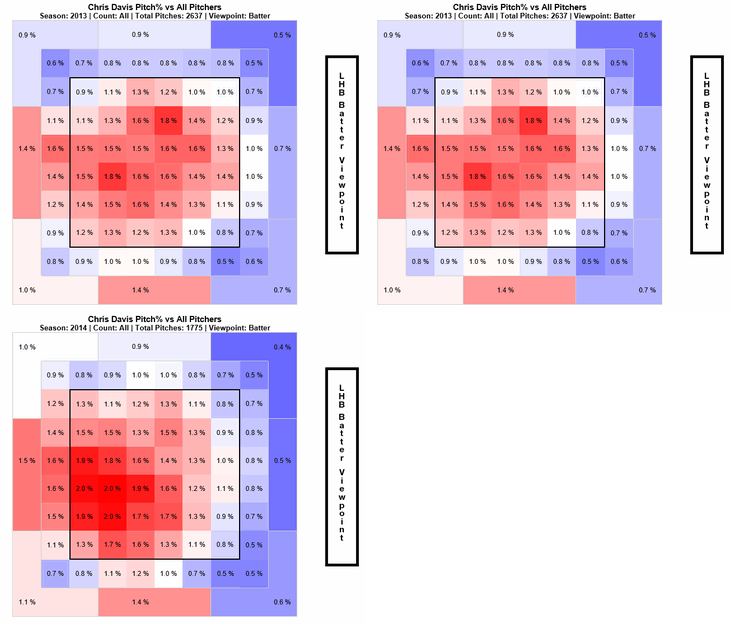
And it’s not only that different kinds of pitches are coming to Davis. Pitchers are throwing low and away more often, and it’s hurting his numbers. Below is what I’m going to call an animation showing where pitches are coming to Davis. It’s from the catcher’s point of view, and it reads like a heatmap; white is neutral, red means more pitches are coming in that location and blue means fewer pitches are coming in that location.

pitch percent

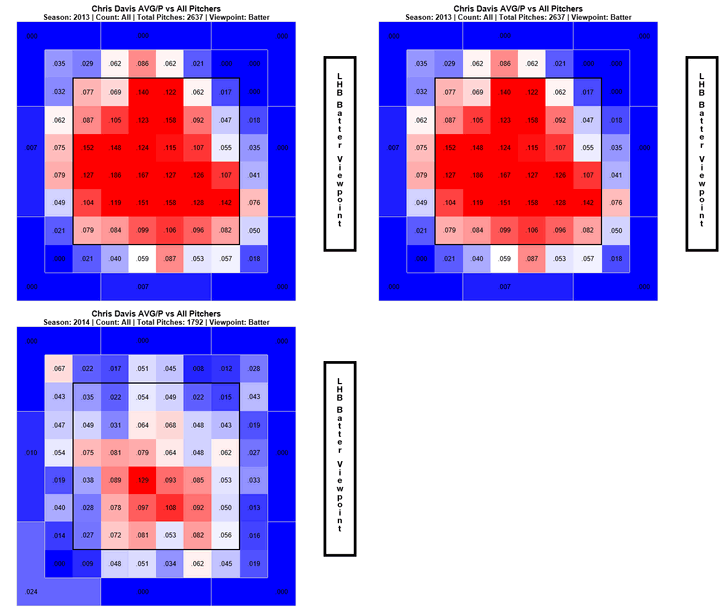
So it’s pretty clear that 2014 pitchers are focusing on Davis low and away, which is a good idea since Davis is having trouble hitting those pitches, as shown in this second animation, or whatever it is.

avg

So pitchers are coming at him differently, and he’s hitting differently. In 2013, Davis could basically hit anything in the strike zone and even a little bit below the zone. This year, he seemingly can’t hit the ball unless it’s low in the zone, and even then it’s a little shaky.

He’s also changed his approach a little bit. While Davis is chasing fewer pitches out of the zone, he’s also swinging less in general, even at strikes, and that’s a trend that’s been going on since 2012. And not swinging at strikes isn’t always a bad thing; Joey Votto swings less than almost anyone, and he’s a pretty good hitter. What’s a little troubling is that Davis is making less contact when he does swing, and that’s also a trend two years in the making. Of course, when a guy is hitting .286 and blasting 53 home runs, who cares if he’s making less contact? But when those 53 dingers turn into 21 and that .286 average drops below .200, we can start to be concerned.

So it’s all kind of going against Davis right now. He’s trying to be more patient, but pitchers are recognizing that and throwing him more strikes. And when he gets behind in the count, it makes things a little more difficult. Plus those mean old pitchers are throwing him pitches he doesn’t hit so well. It’s been an off year for Davis, and he’s still hitting for really good power. Not as much as 2013, but still a lot. If he can do that, and maybe turn things on for the last 35 or so games and into the playoffs, his team could make some kind of run. Maybe not a great run, but some kind of run.


Better Outfield of the Future: Pirates or Marlins?

I know that I’m not alone in saying that one of my favorite parts about baseball is the projection of young players. In fact, I’d probably even say that I enjoy dreaming on what young players could be even more than I enjoy players for what they actually are. It’s one of the reasons I follow the Cubs and Twins (get well soon, Byron) farm systems as closely as I do the A’s and Dodgers big-league clubs. Obviously, it’s especially exciting when a group of young prospects on the same team all come up and meet expectations, as rare as that may be. To take it one step further, it’s just the best when all of that talent is concentrated in one positional group (pitchers, infielders, outfielders). So in an effort to combine my love of projection with what is currently happening on the field, I’m going to take a look at a couple of the most exciting young units in baseball.

Here are the top ten outfields as currently ranked by fWAR:

Screenshot 2014-08-14 at 9.08.00 PM

Of the top ten, only two teams are currently starting an outfield where all three players are 28 years old or younger. Now, it would be pretty funny if I said they were the Orioles and Blue Jays just to make you angry, but since you’re a person who ostensibly reads titles before you read articles, you know that these two teams are the Pittsburgh Pirates and Miami Marlins. Spoiler revealed.

Anyways, both young outfields are clearly extraordinarily talented. Each unit has an excellent case as the most promising outfield for the next five or ten years. That said, it’ll almost surely be a young outfield that exceeds them, because if baseball does nothing else, it destroys our expectations each and every season.

But focusing on the task at hand, the two outfields are very similar if you look at them in a certain arbitrary way. They each feature one superstar (Andrew McCutchen and Giancarlo Stanton), a strikeout-prone “tools” guy (Starling Marte and Marcell Ozuna) and a skinny corner guy with all-star potential (Gregory Polanco and Christian Yelich). Now, those descriptions don’t really matter, but they’re interesting nonetheless. What does matter, however, is performance on the field.

The Pirates outfield has probably been the more hyped unit so far, and I think the majority of people would choose them to be better going forward as well. Their core three is currently the more productive, and they blow away the Marlins in production over the next four years, using the Oliver projection system.

image (5)image (6)If the projections turn out to be correct, the Pirates outfield is going to be, on average, 4.8 wins per season more valuable than the Marlins. But I have a couple of issues with these projections.

First, wow do they hate Marcell Ozuna. This is somewhat understandable considering Ozuna never was that highly regarded as a prospect, and some people thought that the Marlins were making a mistake by promoting him to the big leagues so quickly last year. But as he’s shown since his call-up, Ozuna is actually pretty valuable. In only 70 games in 2013, he was worth 1.6 fWAR. In 2014, he’s been hitting for power and been worth nearly 2 wins with a month and a half left to go in the season. He’s not a perfect player (28.7 K%), but I think it’s fair to say that he’s not the borderline replacement-level guy that he is projected to be right now.

My second issue is that I just can’t get comfortable projecting Gregory Polanco as a 5 fWAR player just yet. He’s obviously a top prospect holding his own in the majors, but five-win players are really good. Only 19 position players were more valuable in 2013 than the 5.2 fWAR that Polanco is currently projected to reach by 2018. I certainly won’t be shocked if he reaches that level, but man, as fun as prospects are, sometimes they bust for no apparent reason. I’ll need to see a full productive season before I feel good about calling him a future MVP vote-getter.

Unfortunately for the Pirates’ case in this argument, the outfield fWAR top ten that I posted at the beginning of the article largely reflects the contributions of a player whom I have not mentioned thus far: Josh Harrison. At just 27 years old himself, Harrison has continued to be productive after what most assumed was just a hot couple of months. However, with Polanco now in the majors, it looks as though Harrison will be playing in the Pirates infield over the coming years, assuming all of the outfielders are able to retain their health. So it will likely be up to Polanco to replicate Harrison’s 2014 numbers (144 wRC+) going forward, a tall task even for someone as talented as he. Combine that with the possibility that Andrew McCutchen begins to decline upon hitting 30 in a couple years, and the Pirates outfield may not look quite as pretty as it does on paper at the moment (though it’ll still probably be really good).

Now, rather than continue to list reasons why you shouldn’t choose the Pirates, let’s talk about one final reason why you should choose the Marlins in our completely meaningless debate. Talent aside, the Marlins’ greatest advantage over the Pirates is their youth. Stanton is actually the oldest of Miami’s outfielders at the decrepit age of 24, while Ozuna and Yelich are 23 and 22, respectively. As a group, they certainly have the longest way to go to reach their ceiling, but they also have the most time to get there. And if you’re like me, you may be inclined to be on upside.

When choosing between these two outfields, there’s really no wrong option, as cliche as that may sound. They each have a combination of current production and future projection that we simply don’t see very often. Personally, despite all of the reasons I listed against them, I’m still inclined to go with Pittsburgh, but the choice is harder now than it was when I began this post. Either way, it doesn’t really matter. We’ll be able to sit back and enjoy both units, hopefully for the next decade or so.

This article was originally posted on gappower.wordpress.com, a site you’ve definitely never been to. I’ve checked. You can also find me on Twitter, at least occasionally. 


Ranking Relief Pitchers

I recently set out on a quest to determine the best way to evaluate relief pitchers in order to find the most valuable relievers this season. That led down a number of different paths of research that all centered around two main ideas. The key to success in relief pitchers is their ability to pitch out of jams and to pitch in big situation, which in a sense go hand in hand. Since the introduction of the save as a stat teams have began using their best reliever only in the ninth inning when they have a lead of 3 runs or less.   However, this is not always the most important part of the game and often times the most important innings are the 7th and 8th.

So in order to truly determine the best reliever a good place to start is looking at the importance of the innings that each pitcher has thrown. This is where leverage index comes in. The higher the LI the more important the inning. This is a combination of score, situation, and place in the order.

The other key to relievers’ success is their ability to work out of jams. Often times a relief pitcher is brought in to the game with runners in scoring position. This is why ERA is not a good indicator of the success a reliever because it does not factor in the inherited runners that scored on that reliever. This is where RE24 can be of extreme help. RE24 is a counting statistic that uses a run expectancy table to show how many runs better than average a pitcher is based solely on game situation. This means than a pitcher will be penalized for allowing an inherited runner to score. However, since this is a counting statistic by dividing it by innings pitched it can be turned into a rate statistic, which allows more equal comparison between pitchers.

Since RE24 does not factor in the importance of the situation in the context of the game combining it with LI is a good determination of the value of the individual relievers. So in an attempt to determine this year’s best reliever I used this simple formula:

Reliever Rating (RR)=(RE24/IP)*LI

According to this stat the better the pitcher the higher the number and the worse the lower the number. A rating close to 0 indicates an average pitcher as a RE24 of 0 means the pitcher performed exactly as expected in the given situations. The worst ratings are the negative numbers meaning that pitcher was below average.

Here are the top 10 relievers according to RR thus far in 2014.

Name

Reliever Rating

Huston Street 0.73
Koji Uehara 0.69
Wade Davis 0.64
Darren O’Day 0.62
Jonathan Papelbon 0.59
Jake McGee 0.58
J.P. Howell 0.56
Santiago Casilla 0.52
Jonathan Broxton 0.51
Greg Holland 0.51

This list includes several big-name closers and several setup men. Looking at the value of these pitchers using this formula shows how not all inning pitched are equal. This is not a valuation of the true talent of the pitchers but what it does is create an even way of looking at the importance of each pitcher to their team. Not surprisingly, there are several closers among the leaders as due to the late game innings they pitch and the fact that they typically pitch in close games their leverage indexes are high. Yet for pitchers like Darren O’Day his high ranking is due to his very high RE24 total. This is due to O’Day’s ability to strand runners so far this season (96% LOB%). For a comparison, since 2000, the best single season total belongs to Jonathon Papelbon in 2006 with a RR of .95.

This can also be used to look at the worst relievers thus far this season.

Name Reliever Rating
Chris Perez -0.16
Addison Reed -0.16
Jerome Williams -0.18
Antonio Bastardo -0.25
Joe Nathan -0.30
Ernesto Frieri -0.31
Rex Brothers -0.31
Brian Wilson -0.36
Ronald Belisario -0.47
Jim Johnson -0.50

Many of these names are not surprising as players like Nathan, Frieri, and Johnson failed miserably in their different stints as closers thus far this season. Many of these pitchers have very low RE24’s which supports their low ranking but pitchers like Steve Cishek (15th worst) who have been slightly below average (-3.18 RE24) are punished for struggling in high-leverage situations (2.11 LI).


Daniel Norris: Next Blue Jay in Line

Just two starts into his Triple-A career, it’s clear why the Blue Jays gave Daniel Norris a $2M signing bonus when they drafted him in the second round of the 2011 draft out of Science Hill High School in Tennessee.

Further, Blue Jays GM Alex Anthopoulos has hinted that Norris might be in the process of being prepared for a September call-up to join the bullpen, a strategy they recently employed with Aaron Sanchez, the club’s other top pitching prospect.

After struggling with command issues and forearm stiffness in 2013, Norris has worked with coaches in order to make tweaks in his motion to find more consistency with his mechanics and release point. Whereas the 6’2”, 180 pound lefty used to throw across his body, he now employs a high ¾’s release point, and the change has worked wonders.

At High-A Dunedin this season, Norris posted a 10.31 K/9 while limiting the number of free passes to just 2.44 per nine innings. In 66.1 innings, Norris didn’t allow a single home run while posting a FIP of 1.72.

In his eight starts with Double-A New Hampshire, Norris struggled a bit with his command, posting a 4.29 BB/9. But he did strike out more batters (12.36 K/9), and the Blue Jays decided he was ready for Triple-A.

Through two starts with the Buffalo Bisons, Norris has looked like a frontline starter. In 11.2 IP, he has struck out 23 batters while walking only one. He’s yielded just five hits and one run. His first Triple-A start was against a Durham lineup that featured Wil Myers, Nick Franklin, Wilson Betemit and Mike Fontenot. Norris had no problem, striking out 10 batters (including Myers) in 6 innings, walking just one while allowing two hits and zero runs.

Norris works with a full arsenal of pitches. His fastball sits at 93 mph and can touch 96 with good, late movement. His high release point allows him to pound the lower half of the strike zone, as his 43.3 career GB% indicates. He has enough velocity to pitch up in the zone when he wants to, and hitters at all levels of the minor leagues have consistently swung through the pitch.

He also works with a slider, which ranges from 83-87 mph while exhibiting sharp, late downward bite and sometimes some slurvy action. He uses the pitch as much against right-handed batters as he does against lefties, and hitters from both sides of the plate swing through it with frequency.

Norris’ biggest improvement this season has been the movement on his curve. While in the past the pitch showed a higher velocity and sweeping movement, he now throws it 72-81 mph with 11-7 break. He will often freeze hitters, especially lefties, when dropping the pitch into the strike zone with an effortless motion.

The changeup has also made improvements, although it still needs a little work if Norris is going to reach his potential as a No. 2 starter. He doesn’t throw it very often, and many times he misses too far down in the zone. When he throws it right, it exhibits late sinking movement, and hitters get out front and swing over the top.

Norris’ downfall could be his command, which sometimes disappears on him in the middle of starts. But he’s still just 21 and three years out of high school, and he’s made significant strides over the past year. As he climbs the ladder and eventually reaches the major leagues, where he will receive premium coaching, the likelihood of him finding consistent mechanics and maintaining them for seven innings at a time certainly increases.

I like Norris as a No. 2, mostly due to his impressive arsenal of average-to-above-average pitches and ability to retire both left- and right-handed batters consistently. Over 241.1 career innings in the minor leagues, Norris has posted a near identical FIP (3.04, 3.03) against lefties and righties, respectively. As long as he continues to control his mechanics and becomes more confident with the changeup, there’s no reason Norris can’t be a successful member of a fearsome Blue Jays rotation in 2015.


Living in Dangerous Times

Let’s start with the surprising conclusion: Batters are getting hit by pitches at near-historic rates. For all that you hear about pitchers who won’t pitch inside, and umpires issuing warnings that make it impossible to throw at hitters, and batters being unwilling to take one for the team, we’re seeing batters get hit by pitches at the highest rate since the turn of the last century.

I looked at each decade since 1901, the first year there were two leagues. Using FanGraphs’ Leaders page, I calculated the number of hit batsmen per 100 games played:

   1901-1910  6.5

   1911-1920  4.9

   1921-1930  3.6

   1931-1940  2.6

   1941-1950  2.4

   1951-1960  3.1

   1961-1970  3.4

   1971-1980  3.1

   1981-1990  3.0

   1991-2000  4.7

   2001-2010  5.8

   2011-2014  5.3

Baseball was kind of a wild game in the early days, with all sorts of shenanigans on the ball field, including throwing at batters. Hit batsmen were already in decline when, on August 16, 1920, Carl Mays hit Ray Chapman in the head with a pitch, killing him. Hit batters declined through the next three decades, bottoming out at 2.14 per 100 games in 1946. They stayed around 3 or so per 100 games through the 1980s, and then they took off. Here are the 30 years with the most batters hit by a pitch per 100 games:

    1. 1901  8.0       11. 1907  6.1       21. 2008  5.5

    2. 1903  6.9       12. 2004  6.1       22. 2011  5.3

    3. 1905  6.9       13. 1909  6.0       23. 2009  5.3

    4. 1902  6.8       14. 2003  6.0       24. 2013  5.2

    5. 1904  6.6       15. 2006  6.0       25. 1913  5.2

    6. 1911  6.5       16. 2005  6.0       26. 2010  5.2

    7. 2001  6.2       17. 2007  5.8       27. 1999  5.1

    8. 1908  6.1       18. 2014  5.7       28. 1998  5.1

    9. 1910  6.1       19. 2001  5.7       29. 2000  5.1

   10. 1906  6.1       20. 1912  5.5       30. 2012  5.1

Isn’t that strange? Every year from 1901 to 1913 and every year since 1998. Nothing from the intervening 84 seasons. It raises two questions:

  1. What’s going on? Why have hit batsmen increased despite efforts to cut down on beanball wars? It really has turned on a dime. There were 3.8 hit batsmen per 100 games in 1992, the 68th straight year below 4.0. It hasn’t been below that level since.
  2. When will it change? Andrew McCutchen’s plunking was a big story but didn’t lead to any calls for change. Amid laudable efforts to improve player safety, from batting helmets to neighborhood plays to home plate collision rules, hit batters are returning to levels not seen since the year before Babe Ruth’s rookie season. There have been some pretty terrible beanings, like Jason Heyward’s last year. Let’s hope it doesn’t take something worse than that to reverse the trend.


2014’s Most Average Hitter

The premise of this article is a very simple one: which hitter has been the most average in 2014? Considering this question led me through a very simple process, and to a very sad answer (I urge you not to look at the links until the end because suspense). To the leaderboards we go!

Seeing as we’re looking for the most average hitter (not considering defense), and wRC+ is a hitting statistic designed to compare hitters against the average, it seems like a natural starting place. Considering only players with wRC+ between 95 and 105 gives us a list of 24 players.

Next, let’s look at wRC+’s partner in crime: wOBA. League average for wOBA is .316, so this round we’ll be restricting our list of 24 even further, only looking at hitters with wOBA between .310 and .320. Doing so cut our list (almost) in half! We are now left with only 13 players, progress!

Now that we’ve condensed the list based on production, it’s now time to look at the composition of said production. Our average player should have a BB% of about 7.9, and a K% of 19.8. Adjusting our leaderboard leaves us with the three most average hitters in the league. One of these three is not a surprise. The other two are very sad surprises.

But we want 1 average player, not 3, so to narrow it down to the end, I have included another filter for ISO, because our most average hitter should hit for an average amount of power. This final filter leaves us with the single most average player in the major leagues, and fair warning, it will sadden you:

Evan Longoria: BB%: 8.8 / K%: 18.8 / ISO: .139 / BABIP: .287 / OBP: .324 / SLG: .390 / wOBA: .312 / wRC+: 102

League Average: BB%: 7.9 / K% 19.8 /ISO .140 / BABIP: .301 / OBP: .319 / SLG: .396 / wOBA: .316 / wRC+ 100

There was a time when Longoria was to baseball what Mike Trout is today (well maybe not quite on the same level). He came up in 2008 and was the the star of the Rays in their surprising march to the World Series. He showed off 100% not-fake, seemingly-superhuman powers. From 2008 to 2013, Longoria’s wRC+ was 15th in baseball, in a virtual tie with David Wright (who happens to be one of the other most average players). He was also the single most valuable position player by WAR (36.1) in that time. For the first 6 years of his career, Longoria was a model of offensive consistency.

2014 has been a different story though. I’m not the first to write about Longoria’s down year, so I’ll refer you to the works of Jeff Sullivan and James Krueger. The bottom line: Longoria’s bat speed is down, which is killing his power and his ability to hit inside fastballs. This can be seen in his power numbers: a .139 ISO is a far cry from his career ISO of .225 (for reference, David DeJesus has a career ISO of .140). Longoria’s only hitting 9.7% of his fly balls for home runs, compared to 15.5% for his career.

His power hasn’t fully disappeared, but it’s nowhere close to what it was. It’s this sort of sharp power decline that usually suggests some sort of injury à la Matt Kemp (.236 ISO in 2012, .125 in 2013 following a shoulder surgery). Longoria is not expected to miss much time with his latest foot injury, and as Krueger points out, Longoria himself has attributed these struggles with mechanical issues. However, if I were a betting man (or at least old enough to legally gamble in casinos), I would put money on the Rays’ third baseman undergoing some sort of procedure over the offseason.

Now the good news for the Rays is this: even as the league-average hitter, Longoria is still very valuable. Dave Cameron ranked him 9th in his trade value series, no doubt in large part due to his superb defense and very team-friendly contract. Projections have Longoria finishing 2014 with 4.0 WAR. If the cost of a win is approximately $6 million, then he’s worth about $24 million in 2014, but only being paid $7.5 million. Even if Longoria continues to be a league-average bat with excellent defense, he will be very underpaid and very valuable. Really goes to show how great that contract was, huh?

Even more fortunate for Rays’ fans is that given Longoria’s career history, this sort of drop off in offensive production likely is not representative of his true-talent level. While his days as a ~135 wRC+ hitter may be behind him, 119 games is not a huge sample size and Longoria is still just 28. It’s likely that Longoria’s production increases closer to his career averages (Oliver has him 126 wRC+ for next year, which definitely passes the sniff test). The fact remains: Evan Longoria, despite being the most average hitter in baseball, is still one of the most valuable. Now we’ll just have to see what happens to that other average-hitting third baseman.


Scouting Buck Farmer’s MLB Debut

Thanks to sudden injuries to Justin Verlander and Anibal Sanchez, the Tigers were forced to scour their minor league affiliates’ rotations in order to find a replacement on short notice. Whether due to his rather fun name or the fact that he happened to line up to pitch on Wednesday, the Tigers selected Buck Farmer from Double-A to make the start against the Pirates.

Although Farmer was a four-year college pitcher out of Georgia Tech, he hadn’t thrown a pitch above Single-A until August 1st of this year. This fact, coupled with his lack of pedigree as a prospect, would lead one to believe that Farmer’s MLB odds for the 2014 season weren’t looking particularly bright, let alone existent, a few short weeks ago.

As a 23-year-old in Single-A, Farmer did exactly what he would be expected to, posting 10.07 K/9 while walking only 2.08 batters per nine. He’s mostly a groundball pitcher, and the long ball (0.52 HR/9) hasn’t been a problem for the big right-hander.

The Tigers believed that Farmer is advanced enough to compete (for one start, at least) against major league hitters, and he proved himself worthy of the challenge. While his final line wasn’t necessarily pretty (5 IP, 6 H, 4 ER, 4 K, 1 BB, 1 HR), he pitched much better than the numbers might indicate.

Farmer relied mostly on his fastball, a two-seamer that he threw 53% of the time. The pitch sat at 93 mph and topped out at 95 mph while exhibiting mild sink. He only got one whiff with the fastball, and four of the six hits he allowed came on the pitch. The two biggest hits of the game, an RBI double by Russell Martin and a two-run HR by Travis Snider, came on fastballs up in the zone. Farmer struggled to keep the pitch down in the zone, where it is most effective since it doesn’t garner whiffs.

His best pitch throughout the night was his changeup, which flashed plus at times. Farmer throws the changeup at various speeds, from 80-86 mph, and he used it as his main strikeout pitch, especially against left-handed batters. The pitch showed nice fading action, sinking more than his fastball did. He threw it from an identical motion, and most hitters were off balance when offering at the changeup. Both of his swinging strikeouts were a result of the changeup.

Farmer’s slider wasn’t particularly impressive, and he struggled to get right-handed batters to chase the pitch out of the zone. Varying in break and velocity (79-83 mph), the slider sometimes looked more like a curveball, often exhibiting far more vertical than horizontal movement. Yet he was able to throw it over the plate to steal strikes, and he mixed pitches well for the most part.

What really hurt Farmer was his (or, more likely, Alex Avila’s) stubbornness with the fastball. In the fourth inning, Farmer had retired the first batter before backing Pedro Alvarez — who he had struck out on three consecutive changeups in the third inning — into an 0-2 hole. Avila called for a fastball, which Farmer placed perfectly on the lower edge of the zone. Alvarez lined it into center field for a base hit, setting things up for Jordy Mercer and Travis Snider, who tripled and homered, respectively — both on fastballs. Farmer retired the next two batters using his slider.

Overall, Farmer was more than decent for a kid making only his third start above Single-A, not to mention his first big league start in the thick of a pennant race. He was confident enough to throw any pitch in any count, and he was in or around the zone for the most part. When he did miss, however, it was often up in the zone. That’s not going to work against MLB hitters, especially since he probably won’t get many whiffs with the fastball.

The slider needs more polish, but it looks to be an average pitch. His high strikeout rate won’t translate to the major leagues, unless he adds more bite to the slider in order to get right-handed batters to chase. But the changeup is a nice pitch and he throws hard enough, doesn’t hurt himself with walks, and gets enough ground balls to be a No. 4 starter in the big leagues, maybe even in 2015.


The Chicago Cubs and the Terrible, Horrible, No Good, Very Bad Junior Lake Season

The future is bright on the North side of Chicago. As Rany Jazayerli pointed out this week on Grantland, that future is especially bright in the batter’s box. With an absolute stud to build around, arguably the best bat in the minor leagues right now, a 24-year old short stop who has been worth over ten wins in his career so far, and seemingly every single middle infield prospect in the world, even the biggest curmudgeon on TV seems to be enthusiastic about the Cubs future. However, if this article were written a year ago today, there would be another name that Cubs fans would be screaming at me for leaving off, Mr. Junior Lake. While Lake was not the biggest prospect in the Cubs’ system, when he burst on to the scene last July, excitement was high. It took him only five games to tie a major league record, as no player has ever had more than the 12 hits he garnered through his first five games.

After six games, Lake had an article of his own on FanGraphs, (deservedly) espousing his hot start, while (prophetically) looking at a few red flags in Lake’s game (more on that later). In those six games he slashed .519/.536/.852 with a pair of home runs and three doubles. He even continued to hit well for the remainder of the season, finishing with a wRC+ of 110 and despite below average defense in the field, was still worth over a win to the Cubs for the 64 games in which he appeared. Coming into this season, Lake was a 23-year old with a decent upside who had Cubs’ fans excited for the future.

Cut to: August 13, 2014.

Lake has lost his regular spot in the lineup, and no one has deserved to lose their spot in the lineup more this season. Now Lake may bounce back to be a decent contributor for future iterations of the Cubs (again, more on that in a little bit), but his numbers this season are incredibly poor. Check out his ranks (these will all be from the bottom ranks, as in first really means the worst in the league) in these essential statistics in 2014:

Stat Lake in 2014 League Rank (min. 300 PAs)
OBP .246 2nd
wOBA .269 11th
LD% 15.6 8th
wRC+ 66 10th
fWAR -0.7 6th

Being near the bottom of one of these statistics is hardly a death knell (check out the killer lineup that could be created with the lowest line-drive rates in the league), but if you’re at the bottom of the barrel across the board, it’s fair to say you’ve Schruted up your season in a big way.

So what has been the cause of Lake’s collapse at the plate? The answer is pretty simple. All that’s needed is a trip over to the plate discipline graphs on this very website. Once again using from the bottom ranks, check out some of Lake’s plate discipline statistics:

Stat Lake in 2014 League Rank (min. 300 PAs)
K% 33.4% 3rd
BB% 3.3% 7th
BB 10 T-1st
BB/K 0.10 1st
O-Swing% 43.0% 7th
Z-Swing% 77.2% 7th
Swing% 58.1% 4th
O-Contact% 43.3% 5th
Z-Contact% 74.5% 4th
Contact% 61.6% 3rd
F-Strike% 69.5% 1st
SwSt% 21.7% 1st

As someone who is neither here nor there on the Cubs (aside from a long-term bet in which I have them making the playoffs before the Astros), I think it’s fair to look at this man who has somehow combined a Pablo Sandoval-esque lack of patience at the plate with a Chris Carter-esque lack of contact on those reckless swings, and simply say, “I’m not even mad, that’s amazing.”

That duo isn’t easy to pull off. Of the top thirty highest swing rates among hitters with at least 300 plate appearances, only one other hitter (Mike Zunino) has a contact rate in the sixties, and Zunino’s swing rate is lower and his contact rate is higher than Lake’s. Not to mention that Zunino’s defense has actually made him worth two wins for the Mariners this season, while only George Springer has committed more errors in the outfield than Lake in 2014.

Lake’s Brooks Baseball profile is maybe the most depressing thing in Chicago since this guy.

His performance against fastballs is described as, “an exceptionally aggressive approach at the plate (-0.19 c) with a disastrously high likelihood to swing and miss (30% whiff/swing),” against breaking pitches, “an exceptionally aggressive approach at the plate (-0.32 c) with a disastrously high likelihood to swing and miss (50% whiff/swing),” and against offspeed pitches, yeah, “an exceptionally aggressive approach at the plate (-0.65 c) with a disastrously high likelihood to swing and miss (55% whiff/swing).”

The man clearly needs a private lesson with Wade Boggs, although that might not even be enough. Interestingly enough, in his aforementioned piece on Lake last year, FanGraphs’ Bradley Woodrum spotted a couple of potential flaws that Lake would have to fix. Woodrum mentions Lake’s lack of plate discipline in the minor leagues, but he also touches on two other drawbacks to Lake’s game: his extremely “loud” swing, and his struggles with low sliders.

As far as the “loud” swing, scouting player’s swings is not my specialty, but his swing actually does seem a little toned down in 2014. Check out the gif used in last year’s FanGraphs piece showing Lake’s bat going crazy as the pitch comes in. Now here’s his toned down approach taken from the middle of this season. Well, toned down until he swings and misses, at least:

While his hands are still moving, they don’t seem to be doing so with the same reckless abandon as last year. That would seem to be a good sign, one that Lake is willing to tinker with his swing to get better results. As I said though, I am far from a scout, and would be curious to hear feedback on what others think about his swing.

In terms of his struggles with sliders, those have only been exasperated in 2014, as he has derived the fourth-lowest value against sliders this season, at -7.4 runs. And considering that that pitch value is a cumulative statistic and the three men in front of him all have more than 100 more plate appearances than Lake in 2014, it’s fair to say Lake has struggled as much as any hitter in baseball against the slider in 2014.

With Arismendy Alcantara having made a far smoother transition to the outfield (believe it or not, Lake was yet another middle infield prospect originally), and Jorge Soler/Kris Bryant due to be called up in the not-too-distant future, one has to wonder whether Lake’s shot at as a member of the Cubs is through with. The best option likely would have been to send him down to Triple-A about a month ago, as sitting on the bench in the major leagues will neither help his confidence, nor give him the chance to get in regular swings every day, and begin to tinker with his swing etc.

There is some evidence that Lake far prefers to play left field instead of center field, slashing .312/.333/.561 in his 44 games in left field, but this seems a little bit more noise than signal. However, given that the Cubs really have no motivation to win at this point, their best option may well be to put Chris Coghlan, their current left fielder and a useful piece for say the Oakland A’s, on waivers, and see what they have with Lake in left field for the remainder of the season. With a month and a half of season left, the Cubs could see if those splits really are statistically significant, and if they were, the Cubs could have yet another piece of their future lineup in place. And if not, there are plenty of reinforcements on the way.


How Eric Sogard Made History

Last Saturday’s Athletics vs. Twins game turned out just about as everyone expected, with Oakland winning the game 9-4 in what was a noncompetitive contest after the 5th inning. Minnesota chose to debut their #8 prospect, starting pitcher Trevor May, in a road game during a lost season against a team with the best run differential in the majors. They did this, one can only suspect, because they are the Minnesota Twins. From experience we may infer the answer to the question “what happens when we give a young man his debut against a pitching meat grinder?”, and so it was that Trevor May struggled, and struggled mightily. May lasted only two innings, gave up four earned runs, walked seven batters, and did not record a single strikeout. This is strange for many reasons, the main ones being that Minnesota is a pitch-to-contact team in its approach, and because no one has walked at least seven batters and not struck anyone out in their debut since Ricky Romero for the Blue Jays in August of 2012.

However, we’re not here to talk exclusively about Trevor May, even though his wild performance on Saturday night partially allowed this article’s existence. We’re here to talk about Eric Sogard, who quietly had a strangely historic night during an otherwise fairly pedestrian Oakland win. Eric Sogard is known, if he is truly known outside of the Oakland fan base, for two things: coming in second during this past off-season’s “Face of MLB” contest, and for his prowess with the glove.

Sogard doesn’t really hit: he’s currently slashing .216/.305/.271, and he hit his first home run of the year last week, a 349-foot missile down the right field line. Eric Sogard is one of those major leaguers who is in the league because he does one thing very well, and because he plays for a team that has the luxury of being able to carry a player whose value is determined almost entirely by defense. Make no mistake, Eric Sogard is a very good defensive second baseman: he has a UZR/150 of 8.5 that puts him 8th among active 2B this year with a minimum of 500 innings played. He is not, however, great with the bat.

That being said, let’s look at Eric Sogard’s batting line from Saturday night against the Twins, when he batted in the 9th position:

0-1, 1 R, 4 BBs, 1 SB

Eric Sogard walked four times while batting in the 9th position in the lineup on Saturday night. Take a moment to let that fact sink in, because it’s crazy. How rare is it for a batter in the 9th position in the lineup to walk four times? Since 1914, it has only happened 14 times including Sogard this past weekend. He’s the first member of the Oakland Athletics to ever do it. Only two other players since 1914 have accomplished this and also stolen a base in the same game: Desi Relaford (2002) & Brady Anderson (1990). On top of all of that, Sogard also made an error – because in a game when weird things are happening to a defensive second baseman, of course he did. He’s now the only player in baseball history to have walked four times in the 9th spot, stolen a base, and made an error in the same game. That’s reaching a little bit, but hey, baseball history!

Just pointing out the rarity of this phenomenon isn’t really interesting enough, though. Let’s go a little deeper. Specifically, let’s ask ourselves this question: “how many pitches did Eric Sogard ‘get to hit’ on Saturday night?” By “get to hit” I mean pitches in the strike zone that have a high likelihood of good contact – i.e., not “pitcher’s pitches” on the corner low and away or nasty breaking pitches located perfectly. Yes, this is subjective, as every hitter is different in their preference of locations to swing at and hit thrown pitches, but we’re more generally going to look at pitches that were over the plate and hittable. We know the answer to this question isn’t going to be a lot of pitches, given the four walks. However, for a light-hitting second baseman batting in the 9th spot, who should expect to be challenged over the plate in almost every at-bat, it’s a fun question to ask. It also allows us to look at some GIFs.

I’ve gone ahead and split up every at-bat that Eric Sogard had on Saturday into different GIFs and overlaid them with circles: green for balls and red for strikes. Sogard saw 22 pitches on Saturday, which tied him for the team lead with Derek Norris. Let’s dig in.

1st AB, 2nd inning – 2 out, none on, P Trevor May:

AB1_Cropped

Sogard saw four pitches, all four of which were balls. Only the first pitch of the at-bat was close to in the strike zone, and Sogard was either taking all the way or correctly identified the pitch as a changeup and laid off.

Pitches to hit tally: 0

2nd AB, 3rd inning, 1 out, 1 on: P Samuel Deduno:

AB2_Cropped

This was the biggest battle of the game for our nerd power-harnessing second baseman, as he saw seven pitches and went to a full count. The 2-0 strike might have been the most hittable pitch Sogard saw all night, even though it was low in the zone and breaking slightly toward the outer half of the plate. The 3-1 pitch, called a strike, probably could’ve been called either way, and Sogard pulled a 3-2 liner foul off of an inside fastball off the plate before taking his second walk.

Pitches to hit tally: 1

3rd AB, 5th inning, 1 out, none on: P Samuel Deduno:

AB3_Cropped

Deduno had just given up a two run homer to Stephen Vogt in the previous at-bat, so he might’ve been a little rattled when facing our young hero. Sogard walked on five pitches, with the 1-0 high fastball strike the best pitch to hit. However, when you’ve already walked twice, why start swinging now?

Pitches to hit tally: 2

4th AB, 6th inning, 2 out, 1 on: P Ryan Pressly:

AB4_Cropped

Nothing to swing at. The two low and away pitches were the closest to strikes, but they were also easy takes after two pitches high and outside that weren’t close. Four walks achieved.

Pitches to hit tally: 2

5th AB, 8th inning, 2 out, 1 on: P Anthony Swarzak:

AB5_Cropped

At last Eric Sogard is bested. After a high and outside pitch was taken for a ball, allowing us to dream of the first-ever five walk night out of a hitter in the 9th spot, Sogard swung at a nasty low and away pitch on the corner and meekly chopped out to the pitcher. Not even Sogard’s blazing speed could rescue him this time. Unfortunately, that was not a pitch to hit/swing at.

Alas, poor Sogard, we knew him well.

Final pitches to hit tally: 2

To wrap it all up, here we have a GIF of all of the pitches Sogard saw on Saturday (from the catcher’s perspective). I’m viewing the strike zone that was generated by the system with a healthy bit of skepticism, as it’s not adjusted for the batter or the umpire. Still, it gives us a concrete idea of how many pitches Sogard saw that were worth swinging at:

sogard

The answer is two or three at most, which is insane, because the Minnesota Twins have the fifth-lowest BB/9 in the majors, and Eric Sogard is hitting around .215 with one home run.

Baseball is great because Giancarlo Stanton hits majestic 500 foot moon shots, but it’s also great because guys who are 5′ 10″ (on a good day) defensive specialists who platoon at second base draw four walks against a team that is known for pitching to contact. Players like Eric Sogard aren’t barred from the history books, even though they’re often overlooked in favor of the mashers chasing home run titles; they simply make their history in a very different and sometimes more interesting way. Maybe we have to dig for it a little. Or maybe Eric Sogard just needs to not swing for a whole game and let the stars align.

This post is dedicated to my good friend Adam Sax, who is nice enough to help me out with the deep stats (and the last GIF) and is the biggest Sogard fan I know.