Offering a Solution to the fWAR League Adjustments

This article is a response to Noah’s thought inspiring articles about a modification to the FIP-based pitching  fWAR and  his issues with the fWAR league adjustments in which I want to lay out a possible solution to the somewhat “flawed” league adjustments currently used. My method could be applied to a divisional context as well therefore I won’t address it specifically.  I am not a native speaker therefore please do not take any offense in grammar or spelling mistakes.

Let’s start with the basics of the current concept. 1,000 WAR has to be given out each year to all players implying a replacement level of .294. Even if for some reason every player on all the current 25-man rosters happened to be abducted by aliens this would not change. Even if both leagues consisted entirely of “replacement” players, 1,000 WAR would be handed out. This is our model and it is a great one because it includes context so beautifully and effortlessly.

Here is a little thought experiment: Say these aliens are huge fans of the NL for some reason and decide to abduct the entire league’s player population. We would be left with the untouched AL (we assume the AL and NL are of exactly equal strength for this thought experiment). Again, 1,000 WAR has to be distributed among all big league players. If our current model is handling league adjustments correctly we would expect to see 0 WAR in the NL and 1,000 WAR in the AL. Unfortunately, the current fWAR model wouldn’t spit out a result coming close to this.

Here is why: Even in a reality where about 88% of all games are played internally in a given league a great portion of the fWAR calculation is based on treating MLB as being ONE league instead of two rather independent leagues. The consequences can be strongly seen in my thought experiment. Because every player in the NL would be a replacement player we could hardly find a hint of the changed talent level in the NL’s stats. This is because replacement level hitters are facing replacement level pitching and my guess would be that the NL’s overall batting line and R/G would barely change – even if the talent changed dramatically. Now wOBA is calculated using both leagues and the offensive output by these replacement hitters would be weighted as if they put up these numbers against actual major league competition. Thus, the NL would be undeservedly credited with batting runs and run prevention for the pitchers (again versus replacement hitters).

This is certainly an exaggeration but it is still true with one league being weaker. The only way we would notice the changed talent level would be the interleague record against the AL. In a perfectly balanced world with two equally strong and talented leagues we were to see a .500 record and our 1,000 WAR could be handed out 50/50 between the AL and NL and 57/43 between position players and pitchers. What would the interleague record be? What would it have to be? The answer is pretty easy: .294 aka replacement level. Now this is interesting and it seems like we are going somewhere. Here seems to lie the key for the proper league adjustments because how much WAR should be handed out to a league that wins at a replacement level against a “true” major league? Sounds pretty darn like a league full of replacement players which are by definition worth 0 WAR. And this 0 WAR should be the correct answer based on our assumptions in this thought experiment.

How do we get there?

1) Calculate every aspect that goes into WAR (R/PA, wOBA, FIP, etc) separately for both leagues. In fact we have to treat both leagues as independent. This would mean 500 WAR for each league per default, distributed 57/43 between position players and pitchers.

2) Figure out the interleague record. I would suggest using something like a 3 year regressed rolling average (Just like the 5 year rolling regressed park factors on FG that can actually change a player’s WAR retroactively if his home park happens to play very hitter – or pitcher friendly in the immediate future) I will use a .525 record in favor of the AL for an example later on.

3) Based on the “true” replacement levels of .294 for teams, .380 for starters and .470 for relievers we calculate an “artificial replacement level” for the weaker and the stronger league via the odds ratio.  Using the .525 interleague record for the AL as an example this will come out to an artificial replacement level of

.315 for NL teams / .274 for AL teams

.404 for NL starting pitchers / .357 for AL staring pitchers

.495 for NL relievers / .445 for AL relievers.

To help interpret these numbers think about it this way: The .475 NL is the weaker league. A “replacement team” would have a .294 record in the NL (forget about interleague for a moment). If this team plays against a .294 AL team, we would expect a .500 W% IF both leagues are equally strong. But we already established that the AL wins at a .525 clip when two teams with “equal” records IN their respective leagues match up. The .315 “artificial” replacement level for the NL means that we expect a .315 NL team to win 50% of all games a against a .294 AL team. Thus, we can conclude that the replacement level bar to clear should be put a little higher in the NL because it seems easier to accumulate value in the weaker league. On the other hand the opposite is true for the AL, where the replacement level bar should be put a little lower for the same opposite reasons and to be consistent with handing out 1,000 WAR each year.

4) Derive  the correct distribution of WAR for both leagues based on the artificial replacement levels. In my thought experiment at the beginning we would have a 0/1,000 WAR distribution, because replacement level would actually be .500 for the NL using my methodology in 3). A balanced league would have a 500/500 WAR distribution with a replacement level of .294 for both leagues. With the AL winning at a .525 clip against the NL this means a WAR distribution close to 450/550 in favor of the AL.

The WAR distribution for 2014 on FG was 472/528 in favor of the AL.

Conclusion

There are really some beautiful and elegant side effects. The independence of both league’s calculations would mean interleague adjustments are not necessary at all. This is because even if there are about 12% interleague games, pitchers and hitters are only compared to the stats that other players in the same league have put up – interleague included. The adjustment takes place when we evaluate the interleague record because this is the only direct way to measure difference in strength/talent. The current league adjustments are a little bit flawed in my opinion because wOBA and the run environment is calculated for the entire MLB and interleague records are not taken into consideration at all. Therefore a stiff replacement level is used for all years. My methodology addresses these problems and scales an artificial replacement level for each year and league based on a multi-year regressed interleague record while still keeping the overall replacement level for all of MLB to .294 and 1,000 WAR each year.

To be honest with you I am not a huge fan of divisional adjustments because of small samples and differing opponents. In an entire season’s interleague schedule there should be a lot more signal. I think when applying divisional adjustments we would have to regress heavily. I am not entirely sold yet to include a possibly very complicated divisional adjustment when its heavily regression doesn’t give us much to learn from anyway. But I am open to be sold the other way.

Look forward to a follow-up in which I walk through some real life examples and present some of the changes my methodology brings. Feel free to comment and discuss! Prost!


Clay Buchholz: Not What He Appears to Be

After the 2013 season, Clay Buchholz was kind of interesting. He put up some crazy good numbers with an ERA/FIP/xFIP line of 1.74/2.78/3.41. It was clear that Buchholz was good in 2013, putting up a 3.2 WAR while being limited to just 108 innings of work. This may have caused some to be weary of Buchholz following the 2013 season. Sure he was good during the Red Sox championship run, but he also had trouble staying on the field. Combine that with several outliers, a lot of luck (.254 BABIP, 83.3% LOB%), and it was easy to see that there were a lot of red flags in Buchholz’s performance.  While we shouldn’t discredit 108 innings of awesome work, we also shouldn’t put all of our weight on it either. Buchholz’s 2014 season taught us that as well.

Buchholz’s 2014 season looked pretty bad.

In 2014, Buchholz put up an ERA/FIP/xFIP line of 5.34/4.01/4.04. The first thing that pops out is that awful ERA. However, ERA isn’t everything, and there’s a compelling argument that it’s not the most trustworthy statistic. However, we do know that run prevention is some kind of a skill. Buchholz’s RA9-WAR between 2013 and 2014 fell from 5.0 t0 -0.5. There was some bad luck as well. In order for Buchholz’s skillset to work he needs to have a low BABIP, and the seasons in which he has been successful his BABIPs were somewhere in the .250-.260 range. In 2014 his BABIP was .315, which was the highest it’s ever been aside from a 75- inning stint early in his career.  This is not entirely Buchholz’s fault, however it’s clear that he took a step back as a pitcher in 2014.

However, peripherally Buchholz actually seems in line with his career norms.

Season ERA FIP xFIP WAR
2007 1.59 2.75 3.70 0.8
2008 6.75 4.82 4.24 0.8
2009 4.21 4.69 4.04 1.1
2010 2.33 3.61 4.07 3.5
2011 3.48 4.34 4.28 1.1
2012 4.56 4.65 4.43 1.5
2013 1.74 2.78 3.41 3.2
2014 5.34 4.01 4.04 2.2
Career 3.92 4.06 4.08 14.1

Buchholz has proven that he’s the type of pitcher who succeeds by outperforming his FIP, and for the most part he has done a decent job of doing just that. In his career year of 2011, he had nearly a 1.30 ERA-FIP differential, and in 2013 the trend was the same, with his ERA being a whole run lower than his FIP. It’s clear that this is how Buchholz has made himself an above-average starting pitcher. That’s not to say that this is not a skill set that can’t work. Matt Cain has always outperformed his FIPs, and done so at an elite level. Shelby Miller looks like the type of pitcher who may do the same thing. There are exceptions to everything, and it’s clear that there are some pitchers who can do a good job of beating out their FIPs. Buchholz may or may not be one of those pitchers.

It is clear that Buchholz, for a good chunk of his career, has masked his average to below-average peripherals by doing a good job of preventing runs from scoring. That eventually caught up with him in 2014 when his luck ran out. Regression from the 2013 season was inevitable. Buchholz increased his K% in from 16% in 2012 to 23%. This is what made his peripherals look really good in 2013. However, an increase in strikeouts isn’t always sustainable as the increase in strikeout rate usually doesn’t carry over into the next season.

Buchholz never struck out batters at such a high clip in his career and given that this was a small sample — 108 innings — regression in 2014 was predictable. However, it’s not like Buchholz regressed to something that was godawful in 2014. In fact, he actually regressed to something that was pretty similar to what he has always been. There were a couple of concerns throughout the season in terms of his ability to repeat his delivery, which is quite concerning, but at the end of the day the stuff hadn’t changed that much from 2013 to 2014.

Whiffs Per Swing: 

Year Hard Breaking Offspeed
2013 18.21 22.67 48.09
2014 15.25 26.43 40.39

There was a decrease in his ability to get whiffs on two of his pitch categories. However, the decreases weren’t that extreme. One could label an 8% change on Whiffs per Swing on his off speed stuff as drastic, but at the same time this only regressed Buchholz back to getting strikeouts at a typical 16-17% rate rather than the 23%. At the end of the day, Buchholz’s skill set isn’t about striking guys out. His approach is about not walking too many guys, making weak contact and keeping the ball in the park. He has never excelled at being a command artist, in fact in some parts of his career he has been quite lousy at keeping his walk rate down as well as keeping the ball in the park. If a pitcher is not going to strike guys out at a high rate, in order to be elite he has to be able to excel at either keeping the ball in the park or not walking guys. Buchholz has been very okay at both keeping the ball in the park and not giving up walks.

Buchholz has built up a conventional reputation of being something special by posting low ERAs, a no hitter, and maybe some post-season dramatics. However, Buchholz may just be a mediocre pitcher masked by some stellar defense. He doesn’t have that stellar walk rate and he doesn’t seem immune to home runs like Matt Cain in his prime. However, Buchholz in 2014 wasn’t as bad as many thought he was. Sure a 4.06 FIP in 2014 — where pitching rules — isn’t the prettiest figure, but at the same time there are still plenty of teams that would consider the figure very serviceable. Positive regression is likely for Buchholz, however asking him to come back to those pretty looking ERAs is asking a lot. By FIP Buchholz has never been anything elite, and he has proven that he is nothing elite. Buchholz is what he is, a very serviceable pitcher with some highlights in his career such as postseason heroics and a no-hitter. Buchholz is not terrible nor is anything spectacular; he is somewhere in between.


Trying to Improve fWAR Part 2: League and Divisional Factors

In Part 1 of the “Trying to Improve fWAR” series, we focused on how using runs park factors for a FIP-based WAR leads to problems when calculating fWAR, and suggested the use of FIP park factors instead.  Today we’ll analyze a different yet equally important problem with the current construction of FanGraphs Wins Above Replacement for both position players and pitchers: league adjustments. When calculating WAR, the reason we adjust for league is simple; the two leagues aren’t equal.  The American League has been the superior league for some time now, and considering that all teams play about 88% of their games within their league, the relative strength of the leagues is relevant when trying to put a value on individual players.  If a player moved from the American League, a stronger league, to the National League, a weaker league, we’d expect the player’s basic numbers to improve; yet, if we properly adjust for quality of league when calculating WAR, his WAR shouldn’t change significantly by moving into a weaker league.

The adjustments that FanGraphs makes for strength of league are unclear.  The glossary entry “What is WAR?” and the links within it don’t seem to reference adjusting for the strength of a player’s league/division at all.  The only league adjustment is within position player fWAR, and is described as “a small correction to make it so that each league’s runs above average balances out to zero”.  Not exactly a major adjustment. Rather than evaluating FanGraphs’ methods of adjusting for league, let’s instead look at the how the two leagues compared in fWAR for both pitchers and position players in 2014:

League

Position Player fWAR Pitcher fWAR Total fWAR
AL 285.7 242.3 528
NL 284.3 187.7 472
AL fWAR / League Average 1.002 1.127 1.056
NL fWAR / League Average .998 .873

.944


Interestingly, AL pitchers seem to get a much greater advantage than AL position players from playing in a superior league.  Yes, the AL does have a DH, but the effect of having a DH should be in the form of the AL replacement level RA/9 being higher than the NL replacement level RA/9.  Having a DH (and hence a higher run environment) does not mean that the league should have more pitching fWAR.  Essentially, somewhere in the calculation and implementation of fWAR, the WAR of AL pitchers is being inflated by around 13% and the WAR of NL pitchers is being deflated by the same amount. Meanwhile, AL position players don’t benefit at all from playing in a superior league.  In order to accommodate for league strength, the entire American League should benefit from playing in the stronger league, not just the pitchers.  In order to find out what the league adjustment should be (at least for the 2015 season), let’s look at each league’s interleague performance since 2013:

League Wins Losses Interleague WP% Regressed WP%
AL 317 283 0.528 0.5255
NL 283 317 0.472 0.4745

The “Regressed Winning Percentage” is simply the league’s interleague Winning Percentage regressed to the mean by a factor of .1, meaning that 90% of the league’s interleague WP% is assumed to be skill.  Each league’s interleague winning percentage is regressed slightly to ensure that we aren’t overestimating the differences between the two leagues.  Part of the reason we regress each league’s interleague winning percentage is because the interleague system is admittedly not perfect; while NL teams believe that the AL has an inherent advantage because of their everyday DH, AL teams complain about having pitchers who can’t bunt and a managerial style that is strategically difficult for their managers.  While both sides have valid points, interleague games probably don’t hurt one side significantly more than the other, meaning that the vast amount of data that comes from interleague games is reliable as long as it is properly regressed.

Just knowing each league’s regressed interleague winning percentage, however, is not enough.  We also need to know the percent of games each league plays within its own league.  Why?  The more games the league plays against the other league, the less playing in a superior league matters; the only reason we have to adjust for strength of league in the first place is because of the disparity in competition between the leagues. In a 162-game season, a team plays exactly 20 games against interleague opponents, meaning that 142 of 162 games, or 87.7% of a team’s schedule, is intra-league.  Therefore, in order to find each league’s multiplier, the following equation is used:

League Multiplier = 2 * ((.877 * Regressed WP%) + ((1-.877) * Opponent Regressed WP%))

In this calculation, the “Opponent Regressed WP%” is simply the opposing league’s Regressed WP%.  This is incorporated into the formula because each league plays 12.3% of its games (20 games) against the other league.  Without further ado, here are the league multipliers:

League Regressed WP% Percent of Games Intra-league Interleague Opponent Regressed WP%

League Multiplier

AL 0.5255 0.877 0.4745 1.0384
NL 0.4745 0.877 0.5283 0.9616

As expected, the American League comes out as the stronger league, albeit by a smaller margin than its advantage in fWAR (remember, the AL’s league multiplier in fWAR was 1.056).  Still, there are other adjustments that can be made besides adjusting for league. In the same way that the superiority of the American League is no secret, the fact that all divisions are not created equal is relatively obvious to most baseball fans.  The AL East has long been considered the best division in baseball, and their inter-division record backs up that reputation; they have a .530 inter-division winning percentage over the last two seasons (only including games in their own league), best in the American League.  Using the same process we used to calculate the league multipliers, division multipliers were calculated as shown below, with the data from the 2013-2014 seasons:

Division W L Inter-division WP% Regressed WP% Percent of Non- Interleague Games Intra-division Inter-division Opponent Regressed WP% Division Multiplier
AL East 350 311 0.530 0.527 0.535 0.487 1.041
AL Central 322 338 0.488 0.489 0.535 0.505 0.983
AL West 319 342 0.483 0.484 0.535 0.508 0.976
NL East 318 342 0.482 0.484 0.535 0.508 0.975
NL Central 350 310 0.530 0.527 0.535 0.486 1.042
NL West 322 338 0.488 0.489 0.535 0.505 0.983

One difference between this calculation and the league multiplier calculation was that, in this calculation, not all games were used when determining what percent of a division’s games were intra-division; because we already adjusted for league earlier, the 20 interleague games on each team’s schedule were ignored from the calculation.  The .535 figure in column 6 is simply the number of games each team plays against its own division, 76, divided by the number of non-interleague games each team plays, 142.  In addition, the “Interdivision Opponent Regressed WP%” is the average opponent each division faces while playing out of division in non-interleague games.  The AL East, for example, plays the AL Central and AL West in its remaining intra-league games, so the .487 inter-division opponent regressed WP% is calculated by taking a simple average of the AL Central’s Regressed WP%, .489, and the AL West’s Regressed WP%, .484.

Now that we have both divisional and league multipliers, we can derive each division’s total (observed) multiplier by simply multiplying the two:

Division Division Multiplier League Multiplier Total Multiplier
AL East 1.0408 1.0384 1.081
AL Central 0.9833 1.0384 1.021
AL West 0.9760 1.0384 1.013
NL East 0.9749 0.9616 0.937
NL Central 1.0419 0.9616 1.002
NL West 0.9833 0.9616 0.945

How do these multipliers, which were fairly easy to calculate, compare with the multipliers implied in FanGraphs’ WAR calculations?  Below, the multipliers are compared in bar graph form:

L and D 1


As you can see, the current construction of fWAR artificially helps certain divisions while hurting others.  Let’s get a closer look at the problem by graphing how much fWAR inflates each division’s pitchers and position players relative to the multipliers we just calculated:

L and D 4


Upon viewing the chart, a theme emerges: Pitching WAR at FanGraphs is in need of serious repair.  Pitching fWAR dramatically overvalues the American League.  All three American League divisions have Pitching fWAR Multipliers at least 4.5% higher than they should be, while each Pitching fWAR Multipliers for the National League are all at least 6% lower than they should be.

Is this just a random aberration for 2014?  Probably not; in 2013, the American League’s Pitching fWAR Multiplier was 1.095, not much lower than 2014’s 1.127 (and nowhere near the 1.038 value we got).  For whatever reason, Pitching fWAR overvalues American League pitchers and undervalues their National League counterparts.  The strongest National League division, the NL Central, suffers the most from this calculation error, while the weaker American League divisions (the AL Central and AL West) experience the greatest benefit.  Fans of the Reds and Brewers in particular should take solace in the fact that their teams were hurt the most by not only the errors discussed here but also the park factor miscalculation discussed in Part 1 (hint: fWAR seriously undervalues Cueto).

As the chart shows, position player fWAR overvalues the National League, albeit to a lesser extent.  Position player fWAR suffers an almost entirely different problem then Pitcher fWAR: Unlike pitcher fWAR, which seems to over-adjust for league, position player fWAR doesn’t adjust for strength of league and division at all.  This inflates the fWAR of players/teams in weaker divisions – the NL East and NL West, for example – while deflating the fWAR of players in stronger divisions, like the AL East.

While the issue with position player fWAR is more obvious – a lack of league and divisional factors – the problem with pitching fWAR is less clear.  Perhaps part of the problem is how replacement level is calculated.  I am not familiar enough with the FanGraphs’ process of calculating WAR to know if there is a clear, fixable mistake.  Either way, hopefully this article will inspire change in the way that fWAR is calculated for both pitchers and position players, with the changes to position player fWAR being much simpler to incorporate.


A Quick and Easy Way to Rank Starting Pitchers for Fantasy Baseball

There are different ways to rank players for fantasy baseball. These rankings will depend on the league settings and your personal beliefs as to what is the best method. Currently, there are two main methods that immediately come to mind. Here at FanGraphs, Zach Sanders has posted his method to determine rankings and dollar values using z-scores, which takes into account the standard deviation for that player’s statistics compared to the set of players in the sample. Others prefer a method called Standings Gain Points. With Standings Gain Points, you will need to have an expectation of the end-of-year standings in the different categories based on previous year’s data.

I wanted to find a quick-and-easy way to rank starting pitchers and I remembered reading a post at Tom Tango’s site about the usefulness of “strikeouts minus walks” for pitchers (K-BB). Similarly, some writers here at FanGraphs have begun to use K%-BB% in their posts. I decided to look at a few options to see which is the best “quick-and-easy” way to rank starting pitchers.

For each of the last three seasons, I used the z-scores method to determine the top 100 starting pitchers for comparison purposes. More specifically: I found the sum of the standard deviations for four traditional categories for starting pitchers: wins, strikeouts, ERA, and WHIP (saves were not included because I was just looking at starting pitchers). I’ll use Clayton Kershaw as an example. I divided Kershaw’s wins (21) by the standard deviation of all pitchers’ wins in this sample (3.5) to get the z-score for Kershaw in the wins category (6.0). I did the same for strikeouts (239/41.9=5.7).

For ERA and WHIP, I had to do a little more work. Again, using Kershaw as an example. I took the ERA of the group of pitchers (3.27), subtracted Kershaw’s ERA (1.77), multiplied by Kershaw’s innings pitched (198.3), then divided by nine. The result was 33. This gave me Kershaw’s number of runs saved (runs allowed below what a pitcher with a league average ERA would allow in that many innings). This may be confusing to some. That number, 33, is how many more earned runs Kershaw would have to allow to have a league average ERA. In 2014, Kershaw pitched 198.3 innings and allowed 39 earned runs for an ERA of 1.77. Had he allowed 33 more earned runs, he would have allowed 72 earned runs. Allowing 72 earned runs in 198.3 innings would give him an ERA of 3.27, which is the average of this group of pitchers I’m working with.

I did a similar thing for WHIP. I took the WHIP of the group of pitchers (1.18), subtracted Kershaw’s WHIP (0.86), then multiplied by Kershaw’s innings pitched (198.3). This gave me the number of base runners saved for Kershaw (64). This means had Kershaw allowed 64 more base runners (walks or hits) in the same number of innings pitched, his WHIP would have been league average.

Once I found runs saved and base runners saved for each pitcher, I found the standard deviation of the group of pitcher for each metric. I then divided that pitcher’s runs saved and base runners saved by the standard deviation of the group of pitchers to get the z-scores for ERA and WHIP. Because I was only dealing with starting pitchers, I did not use saves, but if relievers had been included, saves would be done the same way as wins and strikeouts. Once I found the z-scores for wins, strikeouts, ERA, and WHIP, I added them together to get a total number for each pitcher. The pitchers were ranked by this total number for fantasy purposes.

Once I had this total for each pitcher, I ran correlations with each pitcher’s total number based on z-scores and some potential “quick-and-easy” methods to rank these pitchers. I started off with four potential methods: raw strikeouts, K-BB, K%, and K%-BB%. The following shows the correlation for these four methods with the total number figured above (the sum of the z-scores for the four fantasy pitching categories for starting pitchers).

For 2014:

0.80    K-BB

0.72    Strikeouts

0.65    K%-BB%

0.58    K%


For 2013:

0.78    K-BB

0.72    Strikeouts

0.67    K%-BB%

0.56    K%


For 2012:

0.77    K-BB

0.71    Strikeouts

0.55    K%-BB%

0.44    K%


Of these four methods, K-BB has the highest correlation, followed by raw strikeouts. This makes sense because starting pitchers in fantasy baseball get some of their value from the innings they pitch. They need to pitch to get those wins and strikeouts. The other two options (K% and K%-BB%) don’t factor in playing time, so it’s not surprising that they don’t correlate as well as K-BB and raw strikeouts.

With this in mind, I took K% and multiplied by innings pitched for an additional metric, along with (K%-BB%)*IP for another. Below, I’ve included these two options.

For 2014:

0.83    (K%-BB%)*IP

0.80    K-BB

0.78    K%*IP

0.72    Strikeouts

0.65    K%-BB%

0.58    K%


For 2013:

0.81    (K%-BB%)*IP

0.78    K-BB

0.77    K%*IP

0.72    Strikeouts

0.67    K%-BB%

0.56    K%


For 2012:

0.80    (K%-BB%)*IP

0.77    K-BB

0.76    K%*IP

0.71    Strikeouts

0.55    K%-BB%

0.44    K%


As you can see, (K%-BB%)*IP comes out on top, but the more simple K-BB is close and the point is to find a “quick-and-easy” method. The next idea I had was to incorporate home runs allowed. Keeping it simple, I created K-BB-HR and compared it to the others.

For 2014:

0.83    (K%-BB%)*IP

0.82    K-BB-HR

0.80    K-BB

0.78    K%*IP

0.72    Strikeouts

0.65    K%-BB%

0.58    K%


For 2013:

0.81    (K%-BB%)*IP

0.81    K-BB-HR

0.78    K-BB

0.77    K%*IP

0.72    Strikeouts

0.67    K%-BB%

0.56    K%


For 2012:

0.80    K-BB-HR

0.80    (K%-BB%)*IP

0.77    K-BB

0.76    K%*IP

0.71    Strikeouts

0.55    K%-BB%

0.44    K%


This method (K-BB-HR) is right there with (K%-BB%)*IP. It’s not quite as simple as K-BB, but it is quite simple. Using K-BB is very simple and will get you close to the more complex methods to rank starting pitchers. If you want to take it one step farther, use K-BB-HR.

So, without further ado, here are the top 20 pitchers ranked by K-BB-HR using Steamer projections for 2015:


  1. Clayton Kershaw (164)
  2. Chris Sale (152)
  3. Max Scherzer (151)
  4. Felix Hernandez (141)
  5. Stephen Strasburg (137)
  6. Yu Darvish (136)
  7. Madison Bumgarner (135)
  8. Corey Kluber (132)
  9. David Price (123)
  10. Matt Harvey (121)
  11. Zack Greinke (118)
  12. Jon Lester (116)
  13. Masahiro Tanaka (111)
  14. Cole Hamels (110)
  15. Adam Wainwright (106)
  16. Johnny Cueto (106)
  17. James Shields (105)
  18. Jeff Samardzija (102)
  19. Jordan Zimmermann (101)
  20. Ian Kennedy (100)


That’s a pretty good-looking list and easy to figure using three basic statistics and subtraction.


Prepping You for an Ottoneu Initial Auction

If you are a Fantasy Baseball fan and read FanGraphs, you are probably contemplating joining an Ottoneu league, if you have not already. Three years ago, I was in the same boat. I had experience with snake drafts and was looking for something different. Ottoneu provides that. Dynasty, minor league players and owners must win a player through an auction. I took the plunge three years ago and was not prepared for the initial auction and wanted to share my experiences with some advice sprinkled in.

For the initial auction, make sure you can devote the ENTIRE DAY and probably some of the night. With 12 people and 40 players to roster, that is 480 auctions. Not to mention the inevitable mistakes (wrong Raul Mondesi) and an owner’s internet problems (it will happen to at least one person) and someone showing up late. Oh and those sweet, sweet bathroom breaks. This was my first auction, and if you have never done a real one before, you are in for a treat.

In a snake draft, if you pick ninth, there is only a slight chance you will get the stud you want. In an auction, you WILL get him. Just be prepared. If you pick Trout for example, be prepared to be in a bidding war with several other owners. Popularity comes in to play here. There are some players that are first-rounders that just aren’t as popular because they play for a team that everyone in your league hates, or they play on the west coast and your league is filled with east coast snobs. Once you have a player identified, keep bidding until you win him. You are thinking, “But what about the budget? It’s only $400 and there are 40 positions on my roster!” Do not worry about that now. Now is your chance to get the player YOU WANT. Not the player who is the best available based on your random draft position.

So now, you got the player you wanted. The power is coursing through your veins. You feel like you have already won. Snap out of it! That is only one spot filled. You have to start 22 players in total and bench another 18! That stud represents less than 5% of your total starting lineup. A thought will cross your mind that you just spent a big portion of your payroll on less than 5% of your team! What have you done?! If he gets hurt, you are screwed right? Wrong. Do not freak out and sit out bidding for the next several picks to let everyone else’s remaining budgets catch up. Why? Because you will be surprised on the caliber of players won for a buck or two during the final rounds, after everyone has spent most of their money.

It is within the next few rounds where you can still get top-notch talent, but for a lot less than what the first round players went for. Popularity comes into play again here. Ottoneu owners favor young players because they can be kept year-to-year. Use this to your advantage here. It is in these rounds where you can get older studs at a discount. In addition, other owners’ pocketbooks are still stinging from their first round purchase. You can get some very good, post peak, players for around half of what players went for in the first round. Three years ago, I got Beltre and Konerko for less than $20 each. Within these next few rounds, still go after players you want, knowing that the final price will not hit nearly the same astronomical levels as the first round.

After 3 or 4 rounds, you have a nice nucleus of top-notch talent on your squad. This is when you can start looking at the tiers of players within your positional rankings. Also, start paying attention to how many owners are actively bidding up a player you want. You will see many owners bidding small amounts, looking for a bargain. Ignore them. Pay attention to how many owners are bidding as if they really want the player. If several owners are actively bidding, bow out, and go after the next player within the same tier. That next player should have one less owner bidding on him and he should come cheaper.

During the later rounds, start focusing on those high-upside starters, sleeper types. Do not bid on players who might fall to the waiver wire. If your sleepers do not pan out, the waiver wire will have plenty of serviceable players. Furthermore, it is better to see what a players is doing in April before bidding on him. Again, you will be amazed at the player that is won for a few bucks during the last rounds. This is where you will start prospecting. Remember, they are prospects! Do not spend a ton on prospects. The flameout rate is just too high. Another losing endeavor is taking the heir apparent to an older star you got. I took Mike Olt thinking once Beltre hangs them up; Olt will take over and not miss a beat. Minor league prospects change hands more than a $20 bill at a white elephant gift exchange. This combined with their high flameout rate is a doomed strategy. Focus on guys with an ETA of current year + 1 and don’t spend more than a few dollars on each one.

Finally, keep some powder dry for free agents. Every year, players come out of nowhere and surprise everybody. There are less owners actively bidding during the regular season than during the initial auction so the player should cost less. Throughout the season, you can monitor players off to fast starts and check FanGraphs to know when those small sample sizes can start to be taken seriously.


Jon Niese Is Changing It Up

Mets southpaw Jon Niese has something interesting going on and if the trend continues, he might not be so average in 2015.

One thing I enjoy doing is comparing 1st and 2nd half splits to spot anomalies and possible mid-season skill growth of players.  Niese’s 2014 splits stood out remarkably on two of my favorite metrics:  First pitch strike % (F-Strike) and Swinging Strike % (SwStr).

Niese has a career 61.4% F-Strike and 7.8 SwStr.  Last year’s first half he was struggling along with a 59.2% F-Strike and 5.8% SwStr.  Then something changed.  In the 2nd half his F-Strike soared to an elite level 67.8%.  SwStr rebounded to 8.6%.  What happened?

A solid changeup happened.

Read the rest of this entry »


Alex Wood Poised to Be NL Version of Chris Sale

As the Braves enter the 2015 season, the roster is expected to be extremely pitching-heavy. In John Hart’s first offseason as the Braves’ President of Baseball Operations, he has made two huge moves by sending outfielders Justin Upton and Jason Heyward to the Padres and the Cardinals, respectively. While the return in the Upton trade was primarily made up of lower level prospects at least a few years away from helping the big club, the Braves did land RHP Shelby Miller in the Heyward/Cardinals trade. Although the Braves lost two key pieces to the offense, the pitching staff could be very strong, especially if Miller can bounce back to 2013 form (3.06 ERA, 3.67 FIP). Miller will join a rotation that returns three starters in Julio Teheran, Mike Minor, and Alex Wood. 

Minor enters the 2015 season in a very similar situation to Miller’s. After a breakout year in 2013 (3.21 ERA, 3.5 WAR), Minor was worth just 0.2 wins in 25 starts in 2014. While Teheran is considered to be the budding star ($32M contract extension and a 3.2 WAR for his age 23 season), Wood could be the pitcher that steals the show.

Following a three-year stint at the University of Georgia (one of which shortened by Tommy John surgery), the Braves drafted Wood in the 2nd round of the 2012 draft. Wood would go on to make his MLB debut less than one year later, after starting just 23 minor league games. Wood would appear in 16 games as a reliever, before transitioning into a starting role in the second half of the 2013 season. Wood’s final numbers for his age-22 season looked very similar to those numbers of another funky-delivering 22-year-old southpaw, Chris Sale:

Pitcher    Inn          K/9          BB/9        GB%        FIP

Sale            71            10.01        3.42           49.7%         3.12

Wood        77.2         8.92          3.13           49.1%         2.65


Unlike Wood, Sale spent the entire 2011 season working out of the bullpen, and had even pitched in 23 innings in the 2010 season, joining Chicago’s bullpen less than two months after signing with the White Sox. Following Sale’s strong 2011 season, the White Sox decided it was time to move Sale to the rotation. The Braves had similar plans for Wood in 2014, although the club planned to limit his innings in his first full year with Atlanta, and Wood would only make 24 starts for the season, along with 11 more relief appearances. For the age-23 seasons, the numbers look very similar, yet again:

 Pitcher    Inn          K/9         BB/9       GB%        FIP

 Sale            192           9.0            2.39          44.9%       3.27

Wood         171.2         8.91          2.36          45.9%       3.25

Another key factor for both pitchers is the durability later in the season. While many young pitchers wear down later in the year, both pitchers got stronger as the year went on. Sale’s strikeout numbers increased (9.41 to 10.64), and his walks and FIP saw a significant decrease as well. The same would hold true for Wood, as his K/9 rate went from a first half 8.61 to a second half 9.21, with a decrease in walks and a 3.05 second half FIP. The midseason move to the pen (to help limit innings) could have given Wood a fresher arm for his full-time return to the rotation in the second half, but whatever the reason may be, he was one of the top NL starters down the stretch.

As for Sale, his improving performance went well beyond the second half of the 2012 season, as the lefty would go on to post back-to-back 5+ WARs over the next two seasons, as well as finishing in the top 5 for the AL Cy Young Award in both 2013 and 2014. The key for Sale was his ability to continue to improve his strikeout numbers, while also cutting down on his walks. Sale’s 1.97 BB/9 over the last two years has been good for 7th among all American League starters. During that same time frame, Sale’s 10.06 K/9 rate trailed only Yu Darvish and Max Scherzer. Only 14 pitchers were able to top Wood’s 3.25 FIP as well as his his 3.78 K/BB in 2014. If he can push the FIP closer to 3.00, as well as the K/BB over 4.00, we could be looking at another Chris Sale.


The Ghosts of Designated Hitters Past and Designated Hitters Yet to Come

Among the flurry of deals announced over the past month and a half, a couple raised eyebrows:

(That’s how the transactions were listed on mlb.com. I have no idea why Billy Butler, who started 108 games at DH in 2014 and 35 at first base, is listed as a DH, but Kendrys Morales, who started 71 games at DH and 26 at first, is listed as a first baseman.)

The logic behind these signings made sense superficially: The A’s signed Butler, who was the Royals’ DH in 2014, because Oakland DHs hit a middle-infielder-esque .215/.294/.343 last year. The Royals signed Morales to take Butler’s place. What was a little more surprising was the money: three years for $30 million for Butler, two years for $15.5 million plus an $11 million mutual option/$1.5 million buyout in 2017 for Morales.

The reason that’s surprising is that both were below-average hitters in 2014. Butler had a wRC+ of 79 as a DH, while Morales’s was 62. Among the eleven players with at least 200 plate appearances at DH last season, Morales’s wRC+ ranked eleventh and Butler’s ninth.

That’s the thing about designated hitters: They play the ultimate You had one job… position. All they’re supposed to do is hit. There will never be a Derek-versus-Ozzie, bat-versus-glove debate about DHs. They’re all bat. And while wRC+ doesn’t encompass baserunning contributions, DHs are generally plodders like Butler, who went from first to third on a single only once in 31 opportunities last year, so that doesn’t differentiate them. (There have been only 12 seasons in which a player’s gotten more than 15 stolen bases as a DH, and five of those were by one guy, Paul Molitor.)

(Another DH fun fact: The American League adopted the designated hitter after the 1972 season, when the league batted .239/.306/.343, equating to a .297 wOBA. The worst season since then? 2014: .253/.316/.390, .312 wOBA.)

Designated hitters are paid to hit, not to field and run. So why do DHs who are below-average hitters stay on rosters, much less sign multi-year free agent contracts? Before I try to answer that, here’s another tidbit about designated hitters. This is a list of the number of American League players, by position, who qualified for the batting championship last year (i.e., 502 plate appearances):

  • Catchers: 1
  • First basemen: 4
  • Second basemen: 8
  • Shortstops: 9
  • Third basemen: 7
  • Left fielders: 5
  • Center fielders: 7
  • Right fielders: 5
  • Designated hitters: 1

Salvador Perez was the only player to amass 502 plate appearances as a catcher. That’s understandable, given the demands of the position. But why was David Ortiz the only player to get 502 plate appearances as a DH? It’s clearly not the physical strain of being a designated hitter. So let’s lower the bar a bit and count the number of players, by position, to get 400 plate appearances–regulars, if not batting title qualifiers:

  • Catchers: 9
  • First basemen: 10
  • Second baseman: 11
  • Shortstops: 11
  • Third basemen: 11
  • Left fielders: 7
  • Center fielders: 10
  • Right fielders: 7
  • Designate hitters: 4

Yikes. That makes it look even worse. There were fewer regular designated hitters than there were regulars at any other position. Has this always been the case: unremarkable hitters who aren’t even regulars?

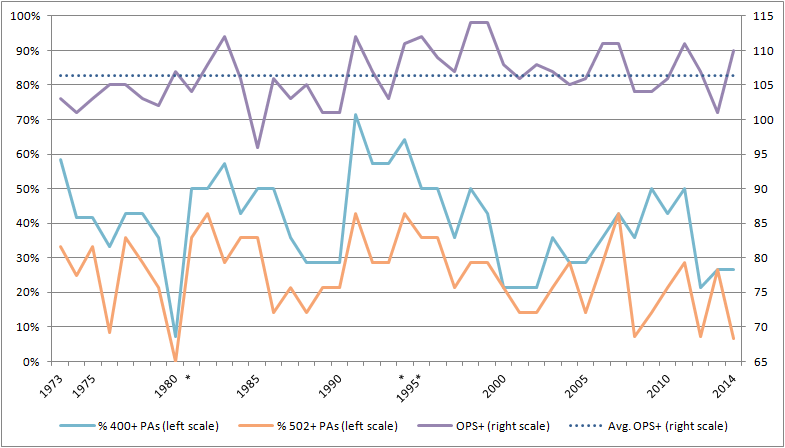
To answer this question, the chart below shows, for every season since the advent of the DH in 1973, the percentage of teams with a DH with 502 plate appearances, the percentage with a DH with 400 plate appearances, and the aggregate OPS+ for all DHs. (I chose the percentage of teams, rather than the the number of DHs, to account for the increase in American League teams from 12 in 1973 to 14 in 1976 and 15 in 2013. And I used OPS+ because that’s the only relative  metric I could find with splits data going all the back to 1973.)

*Strike-shortened year; playing time data prorated.
Source: baseball-reference.com, using the Play Index Split Finder.

As you can see, there were roughly three eras for DHs:

  • 1973-1993: Teams trying to figure out how to optimize the position, with playing time and performance fluctuating, including a nadir of a 96 OPS+ in 1985
  • 1994-2007: Slightly fewer regular DHs but the position generating the most offense in its 42-year history
  • 2008-2014: Reduced offense and sharply fewer full-time DHs

Let’s examine those three eras in detail. When the DH was first implemented, American League teams relied heavily on aging sluggers. From 1973 to 1976, the DHs with the most plate appearances were Tommy Davis (in his age 34-37 seasons), Tony Oliva (34-37), Frank Robinson (37-40), Deron Johnson (34-37), Willie Horton (30-33), and Rico Carty (33-36).

This began to shift with Hal McRae, whom the Royals acquired via a trade with the Reds at the end of the 1972 season, when he was 27. He started 134 games at DH in 1973-75, and was a full-time DH for the remainder of his career. He received MVP votes in four seasons. In 1978, 29-year-old Angel Don Baylor finished seventh in the MVP vote, primarily as a DH (102 starts at DH, 56 in the field) and he won the MVP the next year starting 97 games in the outfield and 65 at DH. There were still plenty of old DHs by the late 1970s — Horton was 36 in 1979 when he became one of only two DHs in history to play 162 games at the position — but it wasn’t the exclusive province of old guys.

Still, there were variations in play. The year 1980 is the only non-strike-shortened season in which no DH qualified for the batting title, and that was largely because of a changing of the guard: Carty retired, Lee May and Mitchell Page neared the end of their careers, Horton played his last season, and Rusty Staub inexplicably got 40% of his plate appearances as a 1B/OF.

As you can see by the chart, the performance of DHs took off after 1993, a year during which four former MVPs and/or future Hall of Famers provided 400+ plate appearances of subpar performance as a DH: George Brett (.265/.311/.431, 95 OPS+), Andre Dawson (.266/.308/.432, 94 OPS+), Dave Winfield (.258/.313/.406, 90 OPS+), and George Bell (.217/.243/.363, 59 OPS+). Brett, 40, and Bell, 33, were in their last seasons, while Winfield, 41, and Dawson, 38, were in their last years as regulars.

That led to another changing of the guard in 1994, and fourteen straight years in which DH OPS+ was 105 or higher, accounting for half of the 28 such seasons in the DH’s 42-year history. Of the nine seasons during which DHs had a combined OPS+ greater than 110, six occurred during 1994-2007. This was the heyday of Edgar Martinez, the greatest DH, of course, but Ortiz (4), Chili Davis (3), Travis Hafner (3), Frank Thomas (3), Ellis Burks (2),  Jose Canseco (2), Juan Gonzalez (2), and Jim Thome (2) all had multiple seasons with an OPS+ of 125 or more as a regular DH during those years.

(I know what you’re thinking: Hmm, 1994 to 2007: PEDs. Yes, but the statistics I’ve used throughout this analysis — wRC+ and OPS+ — are relative figures. The league average, every year, is 100. When DHs compiled a 114 OPS+ in 1998-99, it meant they were 14% better than the inflated averages of the time, a level never attained before or since. So unless there’s some reason DHs were more chemically enhanced, or benefited more from such enhancement, than other players, it’s not a PED thing. And no, it’s not because of the alleged career-prolonging properties of PEDs, as only five of the 21 seasons of OPS+ over 124 cited above were amassed by players older than 35. Nine of the player-seasons were compiled by hitters in their 20s, and five occurred in 2006 and 2007, after the implementation of MLB’s drug policy.)

That brings us 2008-2014. The average OPS+, which was 104 in the 1973-93 period and 109 during 1994-2007 has receded to 106 over the past seven seasons. More strikingly, while the percentage of teams employing a full-time DH (400+ plate appearances) has declined steadily, from 43% in the first 21 years to 38% in the next 14 to 36% in the past seven, the percentage qualifying for the batting title has nosedived, from 27% over the first 35 years of the DH to 16% in the seven years since. In 2008, Thome was the only player who qualified for the batting title as a DH, as was Butler in 2012 and Ortiz in 2014. Prior to those seasons, the only times that happened were in the nascent DH seasons of 1980 (noted above) and 1976 (Carty).

So what’s happening now, and how might it inform the Butler and Morales contracts? I think that the decline in DH performance relative to the league and the decline of full-time DHs are related, because they both stem from the construction of pitching staffs in general, and the modern bullpen in particular. In 1973, the first year of the DH, teams commonly carried 10-11 pitchers on their 25-man rosters. Now they usually have 12, sometimes as many as 13. That leaves less room for a full-time player who can’t play in the field and more need for positional flexibility. As Dave Cameron wrote nearly five years ago:

Teams are choosing to increase their flexibility, even if it comes at the expense of some production. Increasingly, teams want the option to use the DH spot as a pseudo off day for their regulars, or as a fall back plan if their banged-up position player is unable to acceptably field his position. With the move towards 12 man pitching staffs, limited bench sizes put a premium on roster flexibility, and teams are reacting by devaluing players who can’t play the field.

In 2014, eight players played at least 15 games at DH (the extreme right side of the defensive spectrum) and 15 games at catcher, second base, or shortstop (the extreme left side). Breaking that combination down by the eras I defined above, it works out to:

  • 1973-1993: 91 occurrences, or 4.3 players per season
  • 1994-2007: 50 occurrences, or 3.6 players per season
  • 2008-2014: 42 occurrences, or 6.0 players per season

Positional flexibility allows teams to get maximum utility from scarce roster spots, but it doesn’t boost batting by DHs. The eight players in 2014 who played at least 15 games at second, short, or catcher as well as DH were J.P. Arencibia (64 wRC+), Alberto Callaspo (68 wRC+), Logan Forsythe (80 wRC+), John Jaso (121 wRC+), Derek Jeter (73 wRC+), Josmil Pinto (101 wRC+), Dioner Navarro (98 wRC+), and Sean Rodriguez (99 wRC+): One good hitter, three average hitters, and four lousy ones. That doesn’t help the aggregate numbers for designated hitters. Add to that the “DH Penalty,” i.e. the observation that hitters tend to perform worse at DH than when playing in the field — which Mitchel Lichtman calculates in this article to be about 14 points in wOBA — and we can expect increased positional flexibility to erode the offensive contributions of designated hitters.* Jaso, an extreme example, hit .298/.362/.488 in 50 games as a catcher but only .208/.293/.296 in 35 games as a DH.

The DH will remain an offensive position, obviously. And there are obvious risks in drawing conclusions based on just the past seven seasons of data, which admittedly include three above-average years for DHs in aggregate. But given modern roster construction, it’s hard to see DHs consistently generating an outsized contribution to offense as they did in years past. That doesn’t make the below-average performance of Butler and Morales tolerable, but it does make it less of an outlier than it would’ve been previously.


*Lichtman’s data indicate that position players who sometimes were DHs didn’t suffer a greater DH penalty than players like Ortiz or Butler, who rarely play in the field. But as he stated in the above-cited article,

I expected that the penalty would be greater for position players who occasionally DH’d rather than DH’s who occasionally played in the field. That turned out not to be the case, but given the relatively small sample sizes, the true values could very well be different.


2015 Fantasy: More Starting Pitching Busts

Starting pitching is half of the fantasy baseball equation and when you take them in the early rounds you cannot afford to strike out.  Here are three starting pitchers you should be letting others draft along with seven other names you should consider as alternatives.

Read the rest of this entry »


The Cubs, the Red Sox and a Blank Check

The Cubs and Red Sox are doing interesting things for their ambitions. Boston overhauled their young and unpredictable club with two of the top free agents on the board while the Cubs’ rotation makeover coincides with a slew of young offensive talent already in place. Neither team is yet finished as the outcomes of Scherzer, Shields and whatever we’re calling San Diego still loom toward the New Year. Regardless, their intent for 2015 and beyond is the same: win.

But these two teams are interesting for another reason. It’s not often that clubs expected to contend in one year also happen to have top 10-selections of that year’s amateur draft, but that’s exactly what will happen this coming June. The former club of Epstein and Hoyer will select 7th overall. Their current club will select 9th and if all goes according to plan, each club’s 2016 selections figure to fall well out of protection.

But rising from this is a fascinating opportunity. It’s a very rare opportunity requiring the unique but exact convergence of factors surrounding these two teams, swinging the cost/benefit ratio to an extreme. The Red Sox intend to be at the top of the standings this season and based on what they’ve done, chances are good that they will. The Cubs are not far behind and as opined by Dave Cameron may be just a leap or two from the same goal. Whatever happens, each of the next two seasons project to be followed by two of the strongest free agent classes in history. 2015 should include Justin Upton, Jordan Zimmermann, Jason Heyward and more. The 2016 elite is likely to be headlined by Stephen Strasburg. There is going to be a hefty number of qualifying offers and little reason to care.

Focusing upon the next two years is important. The current collective bargaining agreement is in effect until December 1st, 2016, specifying the rules that govern draft bonus allotments and the penalties for their violation. Summarized below:

–        0-5% overage: 75% tax on the overage

–        5-10%: 75% tax on the overage and loss of 1st round pick in subsequent draft

–        10-15%: 100% tax on the overage and loss of 1st and 2nd round picks in subsequent draft

–        15% or higher: 100% tax on the overage and loss of 1st round picks in subsequent two drafts

o   Note: If a team lacks the selection subject to penalty due to a prior penalty levied from draft overages, the team will be penalized in the next draft in which said selection is conveyed.

To date, no team has spent beyond the 5% threshold and thus no team has been penalized a selection.

But then no team has been in this particular position before, a situation perhaps too unlikely to have been considered during CBA negotiations. Under the rules above, teams are pressured either to adhere to slot value or to strategize by shifting their allotments in favor of two or three top talents. The Cubs and Red Sox will have no such limitations this June. They can spend with complete and utter impunity.

Part of how this is possible is due to the language of the CBA and the impending sequence of events. A theoretical chronology:

1)     The 2015 draft begins

2)     Boston or Chicago picks who it wants and spends as much as it wants

3)     Boston or Chicago receives the maximum penalty, including tax and forfeiture of 2016 and 2017 1st-round selections

4)     2015 free agent class – Either team signing a QO free agent forfeits its next highest 2016 selection (2nd round)

5)     2016 free agent class – Either team signing a QO free agent forfeits its next highest 2017 selection (2nd round)

6)     Draft Penalty completed

Why would they do this? Because of who they are and because there is every incentive for doing so. Consider the maximum penalty – forfeiture of 2016 and 2017 first round picks – only for these two clubs, it’s entirely probable that none of these picks project to exist. Notice I said project, which is a critical distinction, because at the time of the 2015 draft their 2016-17 selections are officially still in place.

Implying, what if they can be sacrificed? The Cubs and Red Sox each operate at the highest levels of revenue and at their current win-curve trajectory are virtually guaranteed to be major players on the free agent market in each of the next two years. As a demonstration, both have already signed major targets this off-season. It’s easy then to imagine either team having to relinquish their top selections anyway, except either club can decide that in June as opposed to November. Given enough information by then, they’d have to ask themselves: What do they have to lose?

Lets assume each team performs toward the fringe of the playoffs and we assign them the 23rd selection in 2016 and 2017. In Boston’s case we could argue this will be even lower, or a few spots higher for the Cubs if you think they aren’t quite playoff ready, but as a middle ground the 23rd selection is a good place to start. Keep in mind by June, enough games will have been played to know this with some certainty. Let’s also assume that the first-round selections in each year will be lost to FA compensation. This isn’t an exact process since picks will be added or removed to a varying degree, but using 2014’s values will give us a rough estimate going from one year to the next:

2014 7th 9th 23rd
Round ($M) ($M) ($M)
1 3.30 3.08 1.95
2 1.19* 1.13 0.90
3 0.68 0.66 0.53
4 0.47 0.46 0.39
5 0.35 0.34 0.29
6 0.26 0.26 0.22
7 0.20 0.19 0.17
8 0.16 0.16 0.15
9 0.15 0.15 0.14
10 0.14 0.14 0.14
Total 5.71 6.57 2.93
% Decrease -48.7 -55.5

*Boston forfeits 2nd round selection (Hanley Ramirez)

In addition to forgoing the top 30 prospects, dwindling bonus pools severely damage teams’ ability to pay for any talent at all. By employing this strategy, Boston and Chicago can essentially punt drafts in which they might have expected to extract little value in the first place. In exchange, they take full reign to obtain as much talent as they wish in the coming draft – and the talent will be there. Even as restrictions pressure draftees to sign close to slot nevertheless talent falls due to signability, particularly when coming from high school. In the scenario above, a team is looking at one 7-figure talent, maybe two if slots can be shifted. Compare that to what they might obtain with 40 limit free selections.

Just as important, where these teams select has a significant influence on realistic return. Where top ten selections can result in impact talents, selecting early in each round is an opportunity to grab a falling talent well before other teams consider themselves able. Within current strategies, teams have to be cautious of the round in which they decide to risk on higher prospects as the ability to pay is tied directly to their selections in other rounds. But if money is no object, the Cubs and Red Sox can simply pick whomever they want whenever they want, in which case having the higher position becomes a huge advantage.

This isn’t foolproof. It would have to be a “calculated risk” decided upon almost the day-of. For one thing, it’s impossible to predict exactly what a free agent class will have to offer. If several projected free agents instead sign extensions, it becomes more difficult to justify devaluing your top selection. By June, teams should have a better sense of the picture ahead but it won’t be crystal clear. These teams will have to be reasonably confident not only that targets will exist, but that they’ll have a reasonable desire to sign them.

For another thing, at a certain point the cost in payable tax becomes a bit unwieldy. Perhaps the key then isn’t to sign as many top prospects as possible but rather enough to make up for impending losses in the two subsequent drafts. Because their pools are relatively large both teams will be partly insulated, but past that you’re paying double what you normally would per prospect. That requires confidence that the talent available is worth the additional costs, something not often expressed by teams prior to the current CBA.

That’s an argument to be made however, simply because the successful development of a few can exponentially result in surplus value. Should you prefer a direct measure of dollars, studies such as this one routinely demonstrate the windfalls in appropriately identifying and obtaining draft talent regardless of where they’re picked. In today’s league with today’s prices, that’s as tempting an idea as ever and if you wonder whether teams still place premiums on potential, look no further than the international market. Furthermore, the value of a prospect is predicated not on “Will he produce major-league value?” but rather “Can he?” The extractable value of potential in trades should be evident as I write this.

But the third and perhaps the most critical obstacle is the league itself and whether it takes the power to reject bonus agreements. This is suggested in the CBA document linked above, where the “uniform player contract” specifies required-approval by the Office of the Commissioner. Whether this suggests the Office would actually exercise its right of refusal isn’t clear. The only precedent as far as I know is MLB’s refusal to allow a $6M bonus to Matt Purke, a unique situation in which MLB had control of the Rangers’ finances. Particularly controversial deals have drawn little more than ire. Strict stipulation of penalties in the current CBA implies a team’s right to accept said penalties should it choose to do so. For the Commissioner to explicitly prevent a team from exercising this right is bordering on breach and may be actionable or subject to a grievance by the club or by the MLBPA. This is where the issue gets a little messy and comes down to debates beyond the scope of this article.

I won’t hesitate to call this what it is: a gambit. Strategies like this enliven the game and introduce an element of danger that can either pay off or egg face. Regardless, it highlights yet another flaw to the system in place. In one sense, this strategy is a novel way of playing within the rules, which is at the very heart of high competition. In another sense, it goes against sportsmanship in that this strategy is available only to teams who can realistically devalue their top selections, i.e. teams operating with enough capital to consistently invest at the top of the open market.

But rules are rules. The Cubs and Red Sox have the chance to align their playoff ambitions with a prospect bonanza not yet seen. They’ll have their pick among the elite and after that, should the dominoes fall along the way, they can – and should – take full advantage.

Jonathan Aicardi is a researcher with UCSF in the study of glioblastoma and the proprietor of Another Mariners Blog! Because apparently the world needed another one.