7 Reasons Why the A’s Will Win the AL West in 2015

The A’s winning the West after a huge offseason makeover in 2015 might seem like an unlikely achievement, but here are seven reasons why this is not at all unachievable:


1. The New-Look Infield

In 2015 the Athletics will be throwing out a fresh face at each of the four starting infield positions. Here’s a quick look:

2014 2015
1B: Brandon Moss 1B: Ike Davis (Mets)
2B: Eric Sogard 2B: Ben Zobrist (Rays)
SS: Jed Lowrie SS: Marcus Semien (White Sox)
3B: Josh Donaldson 3B: Brett Lawrie (Blue Jays)

Especially from an Athletics fan’s perspective, the left side of this chart looks very nice. The names Moss and Donaldson are very important and dear to you; however, the right side of this chart is actually more productive overall. While Moss and Donaldson have the highest wOBA of the eight players at .351 and .339 respectively, Jed Lowrie and Eric Sogard have the two lowest at .300 and .262 respectively. This averages out to be a wOBA of .313. The Average wOBA for 2015’s infield is .320.

You might be thinking that Lawrie does not compare to Donaldson, and you could be right. The fact of the matter is that Lawrie is a downgrade from Donaldson, but not by all that much, meanwhile, Zobrist is a huge upgrade from Sogard at 2B. And even Sogard is an upgrade from Punto as the UTIL infielder.

Other important categories that favor the 2015 infield are BB%, K%, FB%, Contact%, OPS, OBP, etc. Also, the new infield got quite a bit younger and faster.

The 2015 infield also has a higher average wRC+ at 104 in comparison to 2014’s 102.5. These aren’t huge differences, but the A’s are expecting better years from Lawrie, who was injured a lot in 2014, Davis, who hit 32 HR in 2012, and Semien, who hasn’t really had much of a chance in the majors yet. These moves were necessary, not only to save money, but because the 2014 team didn’t actually win the AL West. I’m now going to compare this new INF to a team that did win the West, the 2012 A’s.

The 2012 INF consisted of Josh Donaldson, Stephen Drew, Cliff Pennington and Brandon Moss. There were other guys in the mix earlier on in the season, i.e. Jemile Weeks, Brandon Inge, however, these were the guys that got it done down the home stretch.

2012 A’s INF WAR wOBA wRC+ 2015 A’s INF WAR wOBA wRC+
Brandon Moss 2.3 .402 160 Ike Davis 0.3 .324 108
Cliff Pennington 1.0 .263 65 Ben Zobrist 5.7 .333 119
Stephen Drew 0.0 .310 97 Marcus Semien 0.6 .301 88
Josh Donaldson 1.5 .300 90 Brett Lawrie 1.7 .320 101
2012 AVG 1.2 .319 103   2014 AVG 2.1 .320 104

These numbers are almost identical, however the 2015 team has a slight edge in every category. That is despite the fact that the A’s expect growth from the incoming players this season. Even after the significant losses of Josh Donaldson and Brandon Moss the A’s infield is more than capable of pushing them toward another Western division title.


2. The Designated Hitter

The Athletics’ DH numbers from 2014 are not where you want them to be. Yes, Melvin will still use this spot as a “half-rest” day for players like Crisp, Reddick and Lawrie, but the newcomer Billy Butler will most likely fill the spot the majority of the time. Butler is a huge upgrade from the A’s team DH numbers last season in which Callaspo, Moss, Norris, Jaso, Vogt, Dunn, among countless others had at bats. Let’s take a look at the 2014 A’s DH numbers vs. Billy Butler’s 2014 numbers. (he also had a down season):

Player WAR wOBA wRC+
2014 Team DH -1.3 .284 82
Billy Butler -0.3 .311 97

This chart shows that Butler is a significant upgrade at the DH spot, as he will bring a lot more production to the middle of this lineup. I should also bring up his career numbers, which are a wOBA of .351 and wRC+ of 117. If Butler can get back to his career form, the A’s offense is looking at a huge boost, but even if he doesn’t and repeats his 2014 performance, the DH spot is still getting a nice upgrade.


3. The Rotation

The starting rotation for the A’s no longer consists of Jon Lester, Jeff Samardzija or Jason Hammel, but it is still a very strong group with huge potential. I’m going to compare the projected 2015 group to the 2012 and 2013 rotations that led the A’s to division titles.

2012

Player IP K/9 BB/9 HR/9 ERA WHIP WAR
Tommy Milone 190 6.49 1.71 1.14 3.74 1.28 2.8
Jarrod Parker 181.1 6.95 3.13 0.55 3.47 1.26 3.5
Bartolo Colon 111 5.38 1.36 1.00 3.43 1.21 2.4
Brandon McCarthy 82.1 5.92 1.95 0.81 3.24 1.25 1.8
A.J. Griffin 79.1 7.00 2.08 1.09 3.06 1.13 1.4
Team Average  / 6.35

2.05

0.92 3.39 1.23

2.4


2013

Player IP K/9 BB/9 HR/9 ERA WHIP WAR
A.J Griffin 200 7.70 2.43 1.62 3.83 1.13 1.5
Jarrod Parker 197 6.12 2.88 1.14 3.97 1.22 1.3
Bartolo Colon 190.1 5.53 1.37 0.66 2.65 1.17 3.9
Tommy Milone 153.1 7.10 2.29 1.41 4.17 1.29 1.3
Dan Straily 152.1 7.33 3.37 0.95 3.96 1.24 1.4
Team Average  / 6.76 2.47 1.16 3.72 1.21 1.9


Projected 2015 (2014 STATS)

Player IP K/9 BB/9 HR/9 ERA WHIP WAR
Sonny Gray 219 7.52 3.04 0.62 3.08 1.19 3.3
Scott Kazmir 190.1 7.75 2.36 0.76 3.55 1.16 3.3
Jesse Chavez 125.2 8.52 2.94 0.93 3.44 1.30 1.7
Jesse Hahn 70 8.36 3.73 0.51 2.96 1.13 0.8
Drew Pomeranz 52.1 8.6 3.44 0.86 2.58 1.13 0.7
Team Average  /

8.15

3.10

0.74

3.12

1.18

2.0

As you can see, the 2015 rotation wins four out of the six categories. They won the majority of the categories already, but this 2015 staff has the potential to be better than these numbers show. In past years, the A’s success had a lot to do with their strong pitching staff — this is a big reason why I believe they will win the west in 2015 — however, we need to take a look at the projected rotations of the four other teams in the division to see how the A’s compare to each of them.

Here are the five teams’ projected rotations for 2015:


Angels

Player IP K/9 BB/9 HR/9 ERA WHIP WAR
Jered Weaver 213.1 7.13 2.74 1.14 3.59 1.21 1.5
C.J. Wilson 175.2 7.74 4.35 0.87 4.51 1.45 0.6
Garrett Richards 168.2 8.75 2.72 0.27 2.61 1.04 4.3
Matt Shoemaker 121.1 8.16 1.56 0.67 2.89 1.07 2.6
Andrew Heaney 24.2 5.84 2.55 2.19 6.93 1.50 -0.4
Team Average  / 7.52 2.78 1.03 4.11 1.25 1.7


Mariners

Player IP K/9 BB/9 HR/9 ERA WHIP WAR
Felix Hernandez 236 9.46 1.75 0.61 2.14 0.92 6.2
Hisashi Iwakuma 179 7.74 1.06 1.01 3.52 1.05 3.2
Roenis Elias 163.2 7.86 3.52 0.88 3.85 1.31 1.4
J.A. Happ 153 7.53 2.71 1.24 4.12 1.31 1.5
James Paxton 74 7.18 3.53 0.36 3.04 1.2 1.3
Team Average  / 7.95 2.51 0.82 3.33

1.16

2.7


Rangers

Player IP K/9 BB/9 HR/9 ERA WHIP WAR
Colby Lewis 170.1 7.03 2.54 1.32 5.18 1.52 1.6
Yu Darvish 144.1 11.35 3.06 0.81 3.06 1.26 4.1
Nick Tepesch 125.2 4.01 3.15 1.07 4.30 1.34 0.4
Derek Holland 34.1 6.29 1.05 0 1.31 1.02 1.3
Ross Detwiler   /   /   /   /   /   /   /
Team Average   / 7.17

2.45

.8 3.46 1.29 1.85


Astros

Player IP K/9 BB/9 HR/9 ERA WHIP WAR
Colin McHugh 154.2 9.14 2.39 0.76 2.73 1.02 3.3
Dallas Keuchel 200 6.57 2.16 0.50 2.93 1.18 3.9
Scott Feldman 180.1 5.34 2.50 0.80 3.74 1.30 1.6
Brett Oberholtzer 143.2 5.89 1.75 0.75 4.39 1.38 2.4
Brad Peacock 122 7.97 4.57 1.48 4.50 1.52 -0.1
Team Average   / 6.98 2.67 0.86 3.59 1.28 2.2


Athletics

Player IP K/9 BB/9 HR/9 ERA WHIP WAR
Sonny Gray 219 7.52 3.04 0.62 3.08 1.19 3.3
Scott Kazmir 190.1 7.75 2.36 0.76 3.55 1.16 3.3
Jesse Chavez 125.2 8.52 2.94 0.93 3.44 1.30 1.7
Jesse Hahn 70 8.36 3.73 0.51 2.96 1.13 0.8
Drew Pomeranz 52.1 8.6 3.44 0.86 2.58 1.13 0.7
Team Average   /

8.15

3.10

0.74

3.12

1.18 2.0

The Mariners and the Athletics both have really solid pitching staffs. The Mariners have arguably the best pitcher in the American League in Felix Hernandez. The Angels also have a good young ace in Garrett Richards, but he is coming off an injury; it will be interesting to see how he bounces back. Sonny Gray proved that he is a true ace last season, going over 200 innings and pitching extremely well in big games. The numbers do give the A’s a slight edge; they won three of the six categories and the Mariners won two of them. King Felix, Iwakuma and the solid supporting cast are hard to bet against, but 1-5, the A’s have a better staff according to last year’s numbers.


4. Speedee Oil Change

Anytime manager Bob Melvin calls on the bullpen, the A’s should be confident. There are so many capable arms out there that it’s really not fair. Honestly, a starter could go four innings with a lead and that would be enough for this bullpen with Otero, Abad, Cook, O’Flaherty, Clippard and Doolittle in the mix. There are plenty of other options as well that might not get a shot because it’s already crowded with talent out there. The starters, however, are very capable of giving you six or seven innings consistently, which makes this bullpen even that much more deadly, allowing Melvin to create left-on-left matchups or vice versa. The fact of the matter is, if you can’t score, you can’t win. While the starting staff is very solid, getting to the bullpen might not be the opponent’s best option when facing the A’s. Another positive for the A’s has been their ability to fight their way back into ballgames the last few years. With a bullpen like this who can keep the deficit where it is, the probability of achieving a comeback is that much greater.

As shown by the Royals on the successful end and the Dodgers on the opposite end, the strength of your bullpen can make or break your season.

Let’s compare the A’s bullpen to the other teams in the division by highlighting the projected top six bullpen arms for each team:


Angels

Player IP K/9 BB/9 HR/9 ERA WHIP HLD SV
Joe Smith 74.2 8.20 1.81 0.48 1.81 0.80 18 15
Huston Street 59.1 8.65 2.12 0.61 1.37 0.94 0 41
Mike Morin 59 8.24 2.90 0.46 2.90 1.19 9 0
Fernando Salas 58.2 9.36 2.15 0.77 3.38 1.09 8 0
Cory Rasmus 37.0 9.24 2.92 0.73 2.68 1.16 0 0
Vinnie Pestano 18.2 12.54 2.41 1.45 2.89 1.23 1 0
Team Average  / 9.37 2.39 0.75 2.51 1.07  /  /


Mariners

Player IP K/9 BB/9 HR/9 ERA WHIP HLD SV
Tom Wilhelmsen 75.1 8.12 2.7 0.72 2.03 1.00 8 1
Danny Farquhar 71 10.27 2.79 0.63 2.66 1.13 13 1
Dominic Leone 66.1 9.50 3.39 0.54 2.17 1.16 7 0
Fernando Rodney 66.1 10.31 3.80 0.41 2.85 1.34 0 48
Yoervis Medina 57 9.47 4.42 0.47 2.68 1.33 21 0
Charlie Furbush 42.1 10.84 1.91 0.85 3.61 1.16 20 1
Team Average  /

9.75

3.17

0.60

2.67 1.19  /  /


Rangers

Player IP K/9 BB/9 HR/9 ERA WHIP HLD SV
Robbie Ross 78.1 5.86 3.45 1.03 6.20 1.70 2 0
Shawn Tolleson 71.2 8.67 3.52 1.26 2.67 1.17 7 0
Roman Mendez 33 6.00 4.64 0.55 2.18 1.12 10 0
Neftali Feliz 31.2 5.97 3.13 1.42 1.99 0.98 0 13
Tanner Scheppers 23.0 6.65 3.91 2.35 9.00 1.78 1 0
Phil Klein 19 10.89 4.74 1.42 2.84 1.11 0 0
Team Average  / 7.34 3.90 1.34 4.15 1.31  /  /


Astros

Player IP K/9 BB/9 HR/9 ERA WHIP HLD SV
Luke Gregerson 72.1 7.34 1.87 0.75 2.12 1.01 22 3
Pat Neshek 67.1 9.09 1.2 0.53 1.87 0.79 25 6
Josh Fields 54.2 11.52 2.80 0.33 4.45 1.23 8 4
Chad Qualls 51.1 7.54 0.88 0.88 3.33 1.15 2 19
Tony Sipp 50.2 11.19 3.02 0.89 3.38 0.89 11 4
Jake Buchanan 35.1 5.09 3.06 1.02 4.58 1.50 0 0
Team Average   / 8.63

2.14

0.73 3.29 1.10  /  /


Athletics

Player IP K/9 BB/9 HR/9 ERA WHIP HLD SV
Dan Otero 86.2 4.67 1.56 0.42 2.28 1.10 12 1
Tyler Clippard 70.1 10.49 2.94 0.64 2.18 1.00 40 1
Sean Doolittle 62.2 12.78 1.15 0.72 2.73 0.73 5 22
Fernando Abad 57.1 8.01 2.35 0.63 1.57 0.85 9 0
Ryan Cook 50 9.00 3.96 0.54 3.42 1.08 7 1
Eric O’Flaherty 20 6.75 1.80 1.35 2.25 0.95 3 1
Team Average   / 8.62 2.29 0.72

2.41

0.95

 /  /

The Mariners and Athletics each won two out of the five categories. The Athletics also came in second in two other categories. Although this chart shows the Mariners and the A’s as pretty evenly matched, the Mariners have a lot of aging players in their pen, so we cannot be sure if they will keep up the good numbers. The Astros got a lot better by adding Luke Gregerson and Pat Neshek, but that still wasn’t enough to make them the best in the division, especially after the A’s went out and traded for the two time All-Star, Tyler Clippard. All of these teams except Texas have a very strong bullpen, so trying to come back from a deficit is going to be a tough feat in this division.

The A’s also have a lot of other options past these six players, probably more so than the other four teams, making injuries less of a factor for them.


5. Coco Crisp

When Coco Crisp is at the top of the lineup, the A’s are a better team. Over the past three seasons there’s no player who has had as much of an overall impact on this team than Coco. Whether it’s at the plate, in the field or in the clubhouse, Crisp’s impact is significant. Despite losing a lot of star players, the A’s will not take a step backward because they still have their most important piece in Crisp. If Crisp would have been traded away this offseason, I don’t believe the A’s would be ready to compete for the AL West title in 2015. There would be too long of an adjustment period, someone else would need to step up big time and fill his shoes. Luckily, the A’s don’t have to worry about that yet. Bottom line: the A’s need Coco Crisp.


6. Depth and Versatility

Having a deep roster is always important in a 162 game season. You will have players go on the DL, it is unavoidable. Being able to replace the injured players with capable major leaguers is key to a team’s success in the long run. Billy Beane has constructed a 40-man roster with tremendous depth, especially with pitching. The A’s have eight or nine guys capable of making the starting rotation, not to mention two others (Jarrod Parker and A.J. Griffin) due back this summer. There are upwards of ten players competing for a spot in the bullpen as well. It will be interesting to see who makes it on to the 25-man roster, but I wouldn’t be surprised if Triple-A Nashville has a stacked opening day roster. Having great options in the minor leagues is key for any team, and the A’s will definitely have that this season with Kendall Graveman, Chris Bassitt, Sean Nolin and Brad Mills, four starters likely to be starting in Triple-A. Also, RJ Alvarez, Eury De La Rosa and Evan Scriber, three above-average bullpen arms will likely be starting down there as well.

The A’s lineup is a very versatile group this season. Eric Sogard, A’s second baseman the last few seasons, has moved into a utility INF role; he plays excellent defense, and for a defensive replacement, he can handle the stick pretty well. Ben Zobrist is known for his ability to play all over the diamond with above-average defense, and also for getting the job done from both sides of the plate; his career wOBA is .344. Craig Gentry and Sam Fuld can play all three outfield positions with ease while providing speed off the bench in pinch running situations. Marcus Semien will likely be the everyday SS, but he can play all over the infield as well. Stephen Vogt will mostly catch, but he can play first base and corner outfield if the A’s need him to. The amount of options the A’s have, if injuries do occur, are limitless. It will be entertaining to see how Bob Melvin constructs his lineup card every day.


7. The Manager

Bob Melvin is the perfect manager for a team of misfits and players who have never played together previously. He will bring this group to play for each other, as a unit, one day at a time. Melvin is great at creating matchups that benefit the team and give them the best chance to succeed. The roster that has been assembled this season is perfect for just that. It is loaded with skilled, versatile players. Bob Melvin has done it before and he will do it again.
Making Sense of a Strasburg-for-Betts Trade

Now that the Washington Nationals signed Max Scherzer to a seven-year deal, they have an open opportunity to make a blockbuster trade involving one of their aces. The Nationals for all intents and purposes have two aces, Stephen Strasburg and Jordan Zimmermann. The idea is that since they’ve acquired a third ace one of these two pitchers will become available in a trade. Zimmermann is on the final year of his contract so he was always available. Strasburg however has only recently became available, as several reports have suggested, due to the signing of Scherzer.

There are very few teams who could potentially create a package attractive enough to the Nationals, for them to trade Strasburg. One of them is the Boston Red Sox and there seems to be an ideal fit. The Red Sox have a glut of outfielders but one of them can also play second base. He’s also young, cheap, and was a highly-touted prospect. By this time you’ve probably guessed that the player is Mookie Betts. The Nationals need a second baseman and while they have Yunel Escobar and Danny Espinosa, Betts is probably a better player already than both of them and he’s younger and cost efficient.

The Red Sox are in need of a front-of-the-line starting pitcher. They’ve added several pitchers this off-season (Rick Porcello, Wade Miley, and Justin Masterson) but none of them would be described as an ace. Clay Buchholz certainly has the potential of being an ace but he’s never pitched 200 innings and has always dealt with a bunch of injuries. Combine that with the fact that he had the worst season of his career last season, posting a 5.34 ERA, the Red Sox simply cannot bank on him being a reliable front-of-the-rotation starter. Then there’s Joe Kelly who is questionably a viable starting pitcher. Many people have argued that he belongs in the bullpen. He’s also never thrown more than 200 innings; as a matter of fact the most innings he’s pitched in a season is 124 in 2013.

Strasburg last year threw 210 innings all the while keeping his K/9 above ten (10.13). He also had the lowest walk rate of his career, at 1.8 BB/9. It was essentially the best year of his career and at the age of 26 he is entering his prime. The Red Sox are currently in a win-now mode. They’ve also acquired Pablo Sandoval and Hanley Ramirez, this offseason, to beef up the offense, essentially making it one of the best in baseball. The Red Sox have a glut of quality position players with Shane Victorino, Allen Craig, Daniel Nava, and Brock Holt who can all potentially claim that they deserve significant playing time and at this point there simply is not enough room for them on the Red Sox roster. The Nationals have a glut of quality starting pitchers with Stephen Strasburg, Jordan Zimmerman, Max Scherzer, Gio Gonzalez, Doug Fister, and Tanner Roark.

If the Red Sox trade Mookie Betts they could have a bunch of creative options for RF. They could try Victorino again in RF and hope he is healthy. In 2013, when Victorino was healthy, he was one of the best players on the Red Sox, with a 119 wRC+ and a 5.6 fWAR. If that doesn’t work out and Victorino can’t stay healthy, then the Red Sox could always have a platoon of Allen Craig and Daniel Nava. Nava had a career year in 2013, with a 128 wRC+, but he came back down to Earth in 2014 with a 100 wRC+. Nava though was still excellent against righties, even in a down year, posting a .372 OBP and 118 wRC+. If the Red Sox don’t let him hit against lefties Nava should provide considerable value offensively. As for Craig, he had the worst year of his career last season but he had a low BABIP and traditionally has been great against lefties in his career, notching a 130 wRC+. Combining this platoon the Red Sox would probably have above-average offensive production out of RF. Even if they don’t the rest of the lineup is plenty good enough to carry the load.

If the Nationals lose Strasburg, well, they have Scherzer, who has been one of the best pitchers in the game over the past 3 years plus he will be going to the National League, which is an easier environment to pitch in than the American League, as there is no DH. They also have Zimmermann, Gonzalez, Fister and Roark who all, apart from Gonzalez, had an ERA under 3, and it’s not like Gonzalez had a bad ERA as his was 3.57.

There probably would be a lot more moving parts in a deal of this magnitude and I’m still not 100% sure this deal would be beneficial for the Red Sox. Betts is only 22 and while almost every rookie last year struggled, Betts had a 130 wRC+ in 213 AB. He also rated somewhat favorably when playing the outfield, with 3 DRS. The sample size is small for the outfield but Betts seemed to be able to handle his own out there and if he hits the way he did, he could prove to be a franchise player for many years to come. Betts also does not have a history of injury, while Strasburg had Tommy John in his rookie year; another one could prove to be fatal to his career. Betts is also under team control for a much longer time, while Strasburg has already hit his arbitration years; he is therefore more expensive than Betts, and is set to hit free agency in 2017.

The deal may and probably will never happen but it is fun to fantasize about a deal of this magnitude and all the moving parts in it. If both teams were to execute it, the Nationals would inevitably retain their status as favorites to win the NL and the Red Sox would become the favorites to win the AL. It would be a perfect blockbuster to end an offseason full of blockbuster trades.


Analyzing the FanGraphs Early Mock Draft from an Outsider’s Point of View – SPs 41-60

The following is a look at the 41st through 60th starting pitcher taken in the FanGraphs Early Mock Draft, with a comparison to their rankings based on 2015 Steamer projections.

Starting Pitchers: 41-50

The table below shows starting pitchers taken 41st through 50th in this mock, along with their Steamer rank and the difference between their Steamer rank and the spot they were drafted. Pitchers with a positive difference were taken higher than their Steamer projection would suggest. Those with a negative difference were taken later than Steamer would have expected.

FanGraphs Mock Draft SPs 41-50 vs Steamer Rankings
PCK RND $$ SP-Rnk NAME Steamer Rank Difference
149 13 $1 41 Justin Verlander 63 22
153 13 $7 42 Gio Gonzalez 45 3
160 14 $0 43 Chris Archer 66 23
167 14 $10 44 Danny Salazar 30 -14
169 15 $20 45 Jose Fernandez 17 -28
174 15 $7 46 Lance Lynn 44 -2
180 15 $1 47 Andrew Cashner 65 18
181 16 $8 48 Ian Kennedy 37 -11
182 16 -$5 49 Mat Latos 97 48
185 16 $10 50 Scott Kazmir 31 -19


Justin Verlander was drafted as the 41st starting pitcher in this mock, but Steamer doesn’t see Verlander being worth that pick, pegging him for 63rd among starting pitchers. Verlander is coming off his worst season since 2008, when he had a 4.84 ERA and 1.40 WHIP. Verlander bounced back from that ugly 2008 season with a much-improved 2009 season (3.45 ERA, 1.18 WHIP), but he was 26 at the time. Now he’s 32 and less likely to bounce back like he did in his youth.

Chris Archer was another guy who went earlier than Steamer projections would expect. Archer was the 43rd pitcher drafted but is ranked 66th by Steamer. In his three years in the major leagues, Archer has a career 3.39 ERA. His FIP (3.64), xFIP (3.75), and SIERA (3.78) are not as favorable. Steamer is projecting an ERA of 3.96 and 1.31 WHIP, which knocks him out of the top 60 starting pitchers.

Another pitcher not well regarded by Steamer is Andrew Cashner, taken 47th among starting pitchers but ranked 65th. Cashner has a career ERA of 3.25 but Steamer is projecting a 3.96 ERA in 2015. Cashner’s ZiPS projection is a much more favorable 3.27 ERA.

Finally, Mat Latos has the biggest discrepancy of any pitcher in the top 50 between where he was drafted (49th starting pitcher off the board) and where Steamer would rank him (97th). Latos has not had an ERA over 3.50 since a 10-games stint as a rookie in 2009, but Steamer is projecting a 4.12 ERA for 2015. To be fair, that’s not far off Latos’ 2014 FIP (3.99) or SIERA (4.08).

The Steamer “bargains” in this group of ten pitchers were Danny Salazar, Jose Fernandez, Ian Kennedy, and Scott Kazmir.

Danny Salazar was a popular pick heading into last season after a very good 10-game major league debut in 2013 (3.12 ERA, 1.13 WHIP, 11.3 K/9). On the face of it, Salazar struggled last year, finishing with a 4.25 ERA and 1.38 WHIP. The biggest culprit was a .343 BABIP, though, and his FIP (3.52), xFIP (3.45), and SIERA (3.33) were much better than his ERA. Also, he struck out 9.8 batters per nine innings. I don’t have a projection from ZiPS for Salazar, but his Steamer projection (3.62 ERA, 1.23 WHIP) is better than Cairo (3.69, 1.51) or Davenport (3.95, 1.30). Taken as the 44th starting pitcher, Steamer sees great value here.

Jose Fernandez was taken two picks after Salazar (45th starting pitcher), but is even more well-liked by Steamer (ranked 17th). In 36 major league starts over two seasons, Fernandez has a career ERA of 2.25 and WHIP of 0.97. Fernandez is coming off Tommy John surgery and is likely to miss the first couple months of the season. Steamer is projecting 20 starts with a 2.93 ERA. The current Fans projections have Fernandez with 18 starts and a 3.00 ERA. ZiPS projects 19 starts and a 2.87 ERA. You know he’ll be good, it’s just a matter of how many innings he’ll provide and where you want to draft him to get those quality innings.

Scott Kazmir was the 50th starting pitcher drafted and is ranked 31st by Steamer. Kazmir has had a long strange journey in his major league career that led him to miss the entire 2012 season. He came back with the Indians in 2013 and had a 4.04 ERA and 1.32 WHIP. Last year he pitched for Oakland and had his best season since 2007, finishing with a 3.55 ERA and 1.16 WHIP. Steamer is projecting a 3.71 ERA and 1.23 WHIP, good for 31st among starting pitchers.

Starting Pitchers: 51-60

FanGraphs Mock Draft SPs 51-60 vs Steamer Rankings
PCK RND $$ SP-Rnk NAME Steamer Rank Difference
186 16 $10 51 Homer Bailey 28 -23
187 16 -$3 52 Henderson Alvarez 84 32
188 16 $8 53 Anibal Sanchez 38 -15
190 16 $9 54 Phil Hughes 34 -20
191 16 $4 55 Drew Hutchison 52 -3
194 17 -$8 56 James Paxton 118 62
199 17 $2 57 Jake Odorizzi 60 3
203 17 -$1 58 Jered Weaver 74 16
207 18 $1 59 Collin McHugh 62 3
208 18 $9 60 Francisco Liriano 33 -27


The final group of pitchers who rounded out the top sixty starting pitchers taken in this mock draft are a mixed bunch. There were four guys taken at least 15 picks later than Steamer would suggest (Homer Bailey, Anibal Sanchez, Phil Hughes, and Francisco Liriano). These are the “bargains” of the 16th, 17th, and 18th rounds.

Homer Bailey had his 2014 season cut short in August with a flexor mass tendon injury. He’s been a solid major league pitcher for the last three years (3.61 ERA, 1.19 WHIP) and Steamer is projecting more of the same (3.67 ERA, 1.20 WHIP).

Anibal Sanchez is also coming off a year with some injuries. He missed time in early May and again in August and September, finishing the year with 21 starts and 126 innings pitched (3.43 ERA, 1.10 WHIP). Steamer projects Sanchez to be relatively healthy, with 28 starts (3.80 ERA, 1.21 WHIP). He is ranked 38th among starting pitchers according to Steamer projections but wasn’t taken until the 53rd pick in this mock.

Phil Hughes is an interesting character. From 2011 to 2013, Hughes had an ERA of 4.83 with a 1.37 WHIP. He struck out 7.3 batters per nine innings and walked 2.5 per nine. Last year, he suddenly decided to never walk anyone, dropping his BB/9 to a microscopic 0.7. He also upped his strikeout rate to 8.0 K/9 and finished with a 3.52 ERA and 1.13 WHIP. Steamer has some belief in the 2014 version of Philip Hughes, projecting a 3.91 ERA, 1.20 WHIP, and 1.6 BB/9, good enough to be the 34th-best starting pitcher based on Steamer projections. Hughes was the 54th starting pitcher taken, so if you agree with Steamer that Phil Hughes can keep that walk rate down, then hop on board the Phil Hughes Express.

The fourth “bargain” taken among this group of pitchers was Francisco Liriano, on the board until the 208th pick, the 60th starting pitcher drafted. In his two seasons with the Pittsburgh Pirates, Liriano has a 3.20 ERA and 1.26 WHIP. For the rest of his career, he has a 4.40 ERA and 1.35 WHIP. He re-signed with the Pirates and Steamer likes him for 2015—3.59 ERA, 1.27 WHIP, 9.1 K/9 (ranked 33rd among starting pitchers).

In this last group of pitchers, there were two guys who stood out as overdrafts, based on Steamer—Henderson Alvarez and James Paxton. Alvarez had a shiny 2.65 ERA in 2014, but his FIP (3.58), xFIP (3.57), and SIERA (3.70) say “buyer beware.” The biggest issue with Alvarez is a low strikeout rate, just 4.8 K/9 for his career. He was the 52nd pitcher drafted but is ranked 84th by Steamer.

Finally, James Paxton was the 56th starting pitcher drafted but Steamer has him way down at 118th. In 17 starts over two seasons with the Mariners, Paxton has a career 2.66 ERA and 1.13 WHIP, but Steamer is projecting a 4.14 ERA and 1.37 WHIP. That seems way off to me, but I’m not a computer program designed to project baseball statistics. The Fans Projections (10 so far) expect Paxton to be much better than that—3.25 ERA, 1.23 WHIP.

After 60 starting pitchers were drafted, there were 11 starting pitchers who had not yet been drafted, including three in the top 30:

SteamerRank Pitcher
22 Brandon McCarthy
25 John Lackey
26 Mike Fiers
39 Jake Peavy
43 Michael Pineda
48 Matt Cain
50 Tony Cingrani
53 Jason Hammel
54 CC Sabathia
55 Wei-Yin Chen
56 Dan Haren


Analyzing the FanGraphs Early Mock Draft from an Outsider’s Point of View – SPs 21-40

The following is a look at the 21st through 40th starting pitcher taken in the FanGraphs Early Mock Draft, with a comparison to their rankings based on 2015 Steamer projections.

Starting Pitchers: 21-30

The table below shows starting pitchers taken 21st through 30th in this mock, along with their Steamer rank and the difference between their Steamer rank and the spot they were drafted. Pitchers with a positive difference were taken higher than their Steamer projection would suggest. Those with a negative difference were taken later than Steamer would have expected.

FanGraphs Mock Draft SPs 21-30 vs Steamer Rankings
PCK RND $$ SP-Rnk NAME Steamer Rank Difference
101 9 $14 21 Alex Cobb 24 3
104 9 $7 22 Jeff Samardzija 42 20
111 10 $24 23 Masahiro Tanaka 12 -11
116 10 $9 24 Jake Arrieta 35 11
118 10 $3 25 Jacob DeGrom 57 32
119 10 $17 26 Hisashi Iwakuma 20 -6
121 11 $5 27 Tyson Ross 51 24
124 11 $9 28 Alex Wood 36 8
127 11 $15 29 James Shields 23 -6
128 11 $3 30 Jose Quintana 58 28


In this mock draft, pitchers started flying off the shelves in the 10th and 11th rounds. It took 104 picks for the first 22 starting pitchers to be drafted. Nineteen more were taken over the next 45 picks. It looks like the second half of the 10th round is when things really started heating up.

In this group of 10 pitchers, there were a few who were picked well before or much later than their Steamer projection would expect. Jeff Samardzija was the 22nd pitcher taken; Steamer has him ranked 42nd. Samardzija had a 2.99 ERA and 1.07 WHIP in 2014 and his FIP (3.20), xFIP (3.07), and SIERA (3.06) weren’t far off from his ERA. Steamer isn’t buying on Samardzija, projecting a 3.94 ERA and 1.24 WHIP.

The next pitcher taken was Masahiro Tanaka. Steamer has Tanaka just outside the top 10 and he was taken here as the 23rd starting pitcher drafted. Tanaka’s health is the big issue. He missed more than two months of the 2014 season, so it’s hard to know what to expect from him in 2015. Steamer is still projecting 31 starts and 192 innings. The Fans projections have him at 28 starts and 178 innings.

The 2014 NL Rookie of the Year, Jacob deGrom, was the 25th starting pitcher drafted, but is ranked 57th by Steamer. deGrom put up a 2.69 ERA, 1.14 WHIP, and 9.2 K/9 last year in 22 starts. The strikeout rate was surprising. In 323 1/3 minor league innings, deGrom’s K/9 was 7.4. Steamer projects deGrom for a 3.93 ERA, 1.26 WHIP, and 8.0 K/9.

Like Jacob deGrom, Tyson Ross was drafted much earlier than Steamer would suggest. Ross very much enjoyed pitching at home in Petco Park last year, where he posted a 1.88 ERA and 1.01 WHIP, with a K%-BB% of 18.9% and a .267 BABIP. He was much more human on the road, with a 3.79 ERA, 1.42 WHIP, 11.6% K%-BB%, and .315 BABIP. Ross was the 27th starting pitcher drafted. Steamer has him ranked 51st among starting pitchers.

The 30th starting pitcher taken was Jose Quintana. Quintana has started 87 games over the last three years with a 3.50 ERA, 1.26 WHIP, and 7.1 K/9. Steamer is projecting a 3.95 ERA, 1.27 WHIP, and 7.7 K/9, which puts him 58th among starting pitchers based on Steamer projections. In this case, ZiPS is just as pessimistic, forecasting a 3.88 ERA, 1.30 WHIP, and 7.2 K/9.

The Steamer “bargains” among starting pitchers taken in this grouping were the aforementioned Masahiro Tanaka and a pair of older pitchers—Hisashi Iwakuma and James Shields. Iwakuma was the 26th starting pitcher drafted and is ranked 20th by Steamer. Shields was the 29th starting pitcher taken and is ranked 23rd by Steamer.

Starting Pitchers: 31-40

The next 10 starting pitchers were taken over rounds 11 through 13. Here’s the chart:

FanGraphs Mock Draft SPs 31-40 vs Steamer Rankings
PCK RND $$ SP-Rnk NAME Steamer Rank Difference
130 11 $20 31 Hyun-Jin Ryu 16 -15
131 11 $16 32 Cliff Lee 21 -11
132 11 $1 33 Yordano Ventura 64 31
134 12 $0 34 Zack Wheeler 69 35
138 12 $6 35 Doug Fister 49 14
141 12 $6 36 Drew Smyly 47 11
144 12 $8 37 Garrett Richards 41 4
145 13 $10 38 Marcus Stroman 29 -9
147 13 $2 39 Matt Shoemaker 59 20
148 13 $10 40 Michael Wacha 32 -8


Based on Steamer projections, there were four “bargain” picks in this grouping of starting pitchers, starting with Hyun-Jin Ryu with the 130th pick of the draft. Ryu was the 31st starting pitcher drafted but is ranked 16th by Steamer. Of the first 40 starting pitchers drafted, Ryu had the biggest discrepancy between his Steamer ranking and the spot he was drafted and it’s not like Steamer has a particularly favorable projection compared to what Ryu has done in the past. Last year, Ryu had a 3.38 ERA and 1.19 WHIP. Steamer projects a 3.33 ERA and 1.16 WHIP.

The next Steamer bargain was Cliff Lee who was taken 32nd among starting pitchers and ranked 21st by Steamer. It’s understandable that Lee would drop a bit in this mock draft because of his age (36) and his injury-shortened 2014 season (just 13 starts). Steamer has him starting 28 games with a 3.53 ERA and 1.14 WHIP in 2015.

On the tail end of this group of pitchers were two more Steamer projected bargains: Marcus Stroman (38th pitcher drafted, ranked 29th) and Michael Wacha (40th pitcher drafted, ranked 32nd). Stroman was a 1st round pick in 2012 and has a history of good minor league performances. He started 20 games with the Blue Jays last year and is getting some buzz heading into this year. Wacha has pitched well over two major league seasons but in limited time with just 28 starts over those two seasons. Steamer is projecting 27 starts in 2015 but the Fans are less optimistic, projecting just 23 starts (based on the projections of nine fans so far).

There were three pitchers in this group who were drafted much sooner than their projection would suggest—Yordano Ventura, Zack Wheeler, and Matt Shoemaker.

Steamer is projecting Ventura to have an ERA closer to his 2014 SIERA (3.87) than his actual 2014 ERA (3.20). Ventura was the 33rd starting pitcher drafted and is ranked 64th by Steamer.

Zack Wheeler was taken 34th among starting pitchers and is ranked 69th by Steamer. Wheeler has been in the bigs for two seasons and has a career ERA of 3.50 and WHIP of 1.34. Steamer is projecting a 3.90 ERA and 1.31 WHIP. Wheeler was a 1st round pick (6th overall) in 2009 and has been a top prospect ever since, so it wouldn’t be surprising to see him outpitch his projection.

Matt Shoemaker (39th starting pitcher drafted, ranked 59th by Steamer) has some similarities to Jacob deGrom. Both made their major league debuts at the age of 26, which is later than most successful big leaguers. deGrom had a 7.4 K/9 in 323 1/3 minor league innings, then struck out 9.2 per nine innings at the major league level. Matt Shoemaker had a 7.4 K/9 in 786 2/3 minor league innings and has struck out 8.2 per nine at the major league level. Both were liked much more by the people in this mock draft than their Steamer projections would suggest. Shoemaker has a career 2.94 ERA and 1.06 WHIP (3.26 FIP, 3.28 xFIP, 3.19 SIERA), but Steamer is projecting a 4.06 ERA and 1.25 WHIP.

After 40 starting pitchers were taken, there were 12 pitchers remaining who rank in the Steamer top 40. The pitchers undrafted at this point were Jose Fernandez (Steamer ranked 17th), Brandon McCarthy (22nd), John Lackey (25th), Mike Fiers (26th), Homer Bailey (28th), Danny Salazar (30th), Scott Kazmir (31st), Francisco Liriano (33rd), Phil Hughes (34th), Ian Kennedy (37th), Anibal Sanchez (38th), and Jake Peavy (39th).

Up next: Starting Pitchers 41-60


Analyzing the FanGraphs Early Mock Draft from an Outsider’s Point of View – SPs 1-20

The following is a look at the first 20 starting pitchers taken in the FanGraphs Early Mock Draft, with a comparison to their rankings based on 2015 Steamer projections.

Starting Pitchers: 1-10

Every owner has his own theory on when to draft starting pitchers. Some like to get a couple of big guns early. Some won’t take a starting pitcher in the first few rounds because of the inherent uncertainty around pitchers. Some prefer to wait on pitching and go for high-risk, high-upside arms late in the draft or feel confident trolling the waiver wire during the season.

In this twelve-team mock draft, there were 12 starting pitchers taken in the first five rounds. These twelve pitchers were divided up among nine teams, with Zach Sanders being the first owner to draft two starting pitchers when he chose Felix Hernandez and Corey Kluber back-to-back at the end of the 2nd and beginning of the 3rd round. After Sanders, five other teams grabbed their second starter in the 5th and 6th rounds. The three owners who held off on pitchers were Pod, the Blue Sox, and Dan Schwartz, who all waited until the 7th round or later to take their first starting pitcher.

The table below shows the first 10 pitchers drafted in this mock, along with their Steamer rank and the difference between their Steamer rank and the spot they were drafted. Pitchers with a positive difference were taken higher than their Steamer projection would suggest. Those with a negative difference were taken later than Steamer would have expected.

FanGraphs Mock Draft Top-10 Starting Pitchers vs Steamer Rankings
PCK RND $$ SP-Rnk NAME Steamer Rank Difference
5 1 $53 1 Clayton Kershaw 1 0
19 2 $37 2 Chris Sale 2 0
22 2 $37 3 Felix Hernandez 4 1
27 3 $28 4 Corey Kluber 9 5
31 3 $37 5 Max Scherzer 3 -2
33 3 $34 6 Madison Bumgarner 5 -1
37 4 $33 7 Stephen Strasburg 6 -1
39 4 $28 8 Yu Darvish 10 2
41 4 $29 9 David Price 8 -1
52 5 $21 10 Johnny Cueto 14 4


There was mostly agreement between the drafters and Steamer among the first 10 pitchers drafted. Corey Kluber went 5 picks earlier than his projection would suggest and Johnny Cueto went 4 picks early, but most pitchers were within a spot or two of their Steamer projected ranking.

Kluber has seen his K% jump from 19.2 to 22.4 to 28.3% over the last three years. Steamer expects some regression there, down to a 25.0% strikeout rate, but that’s still terrific. Kluber was solid in 2013 but last year was his first elite season. Is that enough to take him ahead of Max Scherzer, Madison Bumgarner, Stephen Strasburg, Yu Darvish, and David Price?

Johnny Cueto was taken 9th and is the #14 pitcher by Steamer projection. Cueto had a big jump in innings from 60 innings in 2013 to 243 2/3 innings in 2014. That’s an unusual jump in the number of innings pitched from one year to the next and we just don’t know how it might affect him in 2015.

Starting Pitchers: 11-20

The next 10 starting pitchers were taken over rounds 5 through 9. Here’s the chart:

FanGraphs Mock Draft Next-10 Starting Pitchers vs Steamer Rankings
PCK RND $$ SP-Rnk NAME Steamer Rank Difference
54 5 $23 11 Jon Lester 13 2
60 5 $20 12 Jordan Zimmermann 18 6
63 6 $30 13 Zack Greinke 7 -6
64 6 $19 14 Cole Hamels 19 5
65 6 $20 15 Adam Wainwright 15 0
74 7 $6 16 Julio Teheran 46 30
84 7 $2 17 Sonny Gray 61 44
86 8 $8 18 Gerrit Cole 40 22
96 8 $25 19 Matt Harvey 11 -8
97 9 $12 20 Carlos Carrasco 27 7


Here we start to see some big differences between the Steamer projection rankings and where some of these guys were taken in this mock. Jordan Zimmermann was taken about six picks early, according to Steamer, while Zack Greinke was taken six picks late. The big differences came with the 16th, 17th, and 18th starting pitchers drafted—Julio Teheran, Sonny Gray, and Gerrit Cole.

Over the last two years, Julio Teheran has won 28 games with a 3.03 ERA and 1.12 WHIP, but with a 3.58 FIP. Steamer projects 10 wins, a 3.81 ERA and 1.23 WHIP, making him the 46th-most-valuable starting pitcher. It should be noted that ZiPS has Teheran with a 3.22 ERA and 1.13 WHIP, which would move him into the top 20.

Sonny Gray was the 17th starting pitcher drafted in this mock and is ranked 61st by Steamer. In his two-year big league career, Gray has a 2.99 ERA and 1.17 WHIP (with a 3.29 FIP, 3.34 xFIP, and 3.44 SIERA). Steamer is projecting a 3.81 ERA and 1.31 WHIP (3.62 FIP). A couple of reasons for this increase in ERA would be a higher projected BABIP (.297 compared to a career .277 mark) and lower LOB% (70.2% compared to a 74.6% career mark). ZiPS has Gray projected for a 3.36 ERA and 1.26 WHIP.

Like Gray, Gerrit Cole has just two years in the bigs. In 41 career starts, he has a career 3.45 ERA and 1.19 WHIP (3.09 FIP, 3.20 xFIP, 3.28 SIERA). His Steamer projection calls for a 3.63 ERA and 1.24 WHIP (3.43 FIP), which ranks him 40th.

Julio Teheran, Sonny Gray, and Gerrit Cole were all taken well before their Steamer projections would suggest, but their actual career ERAs and WHIPs are much more favorable. It’s never a good idea to be a slave to projections, so if you like their upside, feel free to take them this early. Some pitchers taken shortly after Teheran, Gray, and Cole who are projected by Steamer to be more valuable were Matt Harvey, Carlos Carrasco, Alex Cobb, Masahiro Tanaka, and Hisashi Iwakuma.

Rounding out the top 20 pitchers taken in this mock were back-to-back selections by Dan Schwartz of Matt Harvey and Carlos Carrasco. These were the first two starting pitchers taken by Schwartz. He was able to hold off on starting pitching until the last pick of the 8th round and still got two guys with great upside. Neither Harvey nor Carrasco are likely to be workhorses, but they could both be top starting pitchers in 2015.

There were four pitchers who rank in the Steamer top 20 who were not drafted in the top 20 in this mock draft—Hyun-Jin Ryu, Jose Fernandez, Cole Hamels, and Hisashi Iwakuma.

Up next: Starting Pitchers 21-40


Would the Dodgers Have Been Better Off Keeping Andrew Heaney?

Earlier this offseason, the Dodgers and Marlins completed a large trade, with Dee Gordon, Dan Haren, and Miguel Rojas getting shipped to Florida (along with $10 million) while Andrew Heaney, Enrique Hernandez, Austin Barnes, and Chris Hatcher headed out west in return. The Dodgers, whose new front office was in a midst of one of the most ridiculous trading benders in recent memory, then turned around and less than an hour later sent Heaney to the Angels in exchange for second baseman Howie Kendrick. While Heaney was a valuable piece, touted as one of the game’s top left handed pitching prospects who was also considered close to the majors if not already capable of handling it, the Dodgers were clearly happy to get Kendrick in return, an under the radar stud at second base who was worth over four and a half wins last year.

Ignoring the other teams in the trades for a moment, the Dodgers come out of these moves looking much better than they had before. Austin Barnes and Chris Hatcher are both valuable pieces that provide the Dodgers with bullpen and bench depth that they sorely needed. Even if Dee Gordon’s first half was not an aberration, and even if you take issue with both players’ defensive stats, the worst anyone could argue is that both second basemen are close to equal, but most would agree that Kendrick is an improvement over Gordon.

Now obviously, there was more to the trade than their straight up value. Gordon is young and affordable with five more years of team control. Kendrick, while also relatively cheap, is 31 and in the last year of his contract. However, I’m not interested in comparing Kendrick and Gordon. I’m interested in the last piece that the Marlins sent to the Dodgers in their trade, a 23-year-old utility player by the name of Enrique Hernandez. Hernandez broke into the majors for the first time in 2014, playing a total of 42 games with both the Astros and Marlins (he was a part of the Jarred Cosart deal). Among many other skills (which we will soon examine), Hernandez has the ability to play second base, and he was actually pretty decent in his short stint in the majors last year. So what I’m curious to look at is whether the Dodgers are better off with Kendrick manning second and Hernandez on the bench, or whether giving Hernandez the starting job and keeping Heaney might have been the better move for the organization.

Let’s start by examining Hernandez. His primary weapon is versatility, having spent time at SS, 2B, and 3B, as well as all three outfield positions, providing plus defense everywhere he played. On top of that, he also managed to provide value with the bat, posting a .248/.321/.421 line, which was good for a 110 wRC+ last year (I know, offense was crazy down last year). Now granted, that was only in 134 PAs, which leads to the question whether that success was sustainable. Hernandez was not a good hitter in the minors. A 6th round pick in 2009, he averaged an 85 wRC+ across three levels from 2011-2013, and for a while it didn’t look like he was going to amount to anything much. However, something seemed to click in 2014, as he posted above average numbers across three levels, including the big leagues.

So what changed? Well, his strikeout rate dropped (at least in the minors, it spiked once he started facing big league pitching), and his walk rated jumped. He also started hitting for a lot more power, which did manage to carry over to the majors. In an interview with Jimmy Price, Hernandez credited his recent success to a mechanical adjustment in winter ball.

I went into winter ball and decided to figure out what was wrong with my swing. I tried a few things, not really worried about how my season was going, I was just trying to get better and there it was. I tweaked a little something in my batting stance and it clicked. All of the sudden [sic] I was seeing the ball better, recognizing pitches a lot earlier and I started driving the ball again.

These signs (increased walk rate, more power, a mechanical adjustment) all point to a real offensive outbreak as opposed to a fluky few games. On top of that, he even posted a below average BABIP in the majors while still being productive. ZiPS also thinks his breakout is at least somewhat sustainable, projecting him for a .306 wOBA for next year. Combine that with his plus defense, and the system believes he will be worth 2 WAR. While nothing remarkable, that seems like a completely capable starting second baseman.

So now let’s turn our attention to Howie Kendrick, who will be manning second base for the Dodgers on Opening Day, save any Simpsons-esque misfortunes. I suppose injury would be another possibility, but I digress. Kendrick was a top prospect coming up through the Angels system, with sky-high expectations set upon him. While Kendrick didn’t turn into a superstar, he carved out a nice niche for himself, playing plus defense while always being at least average with the bat, sometimes much more. And while he started out his career as an average regular, he turned himself into a well above-average player as he entered his prime, averaging more than four wins per season over the past four years. Last year Kendrick hit a very solid .293/347/397, good for a 115 wRC+. He also provided plus defense, posting a 6.7 UZR. In short, he was really good.

However, next year isn’t necessarily a guarantee of the same thing. ZiPS still likes Kendrick to produce 3.7 WAR, which would be right in line with his past few years. However, Steamer is quite pessimistic, projecting a drop in both offense and defense, and sees Kendrick only being worth 2.4 wins. Let’s split the difference and say that Kendrick will be about a 3-win player next year. Now even here, Kendrick is a clear upgrade over Hernandez, but he does come with some caveats of his own. For starters, Kendrick is 31 years old, and he is also in the last year of his contract that will see him make $9.5 million in 2015. While the salary is a major bargain, the Dodgers will likely have to purchase some of Kendrick’s decline years at the price of his prime years if they sign him to an extension, and he could turn from a bargain into another bad veteran contract.

Now if the Dodgers don’t extend him, they can just take his 2015 and its surplus value, offer Kendrick a qualifying offer at the end of the year, accept the draft pick and move on. Since estimates peg a sandwich round pick to be worth about two wins, we can also factor that into Kendrick’s value. But now we turn our attention to the piece that brought Kendrick to Los Angeles from Not Los Angeles: Andrew Heaney.

The 23-year-old Heaney was highly touted coming up through the minors. He was rated as the Marlins’ number-one prospect by Baseball Prospectus and the number-30 prospect in baseball headed into the 2014 season. Scouting reports were all positive, pegging him with three plus pitches and a repeatable delivery. Bringing all of this from the left side made him all the more attractive. Heaney did nothing to disprove that, starting the year by tearing up AA and holding his own in AAA as well. That culminated with him getting called up to the majors in June when the Marlins were in need of some rotation help.

Unfortunately for them (and Heaney), he was flat-out bad upon reaching the show. Across four starts in June, the young southpaw gave up 15 runs in just 20.2 innings. Heaney only struck out 13 while walking six, but his true enemy was the longball, as he gave up five home runs. Those are all bad totals, which led to his FIP of 6.18. His BABIP of .297 also suggests that he wasn’t really unlucky in any discernible way. These bad outings led to Heaney being sent down on July 6, a day after giving up five runs in just 3.2 innings.

After he spent the rest of the minor league season in Triple-A, the Fish called Heaney back up for another cup of coffee in September, this time using him out of the bullpen. While he wasn’t anywhere near as terrible as his starts in the summer, Heaney wasn’t extremely impressive either, posting a 3.71 FIP in 8.2 innings of long relief. While Heaney is still a highly regarded prospect, and his two stints in the majors are an incredibly small sample size, there are some worrying signs. The home runs are obviously not good, but Heaney also had a Z-Contact% of 93.9. This means that pitches in the strike zone that hitters swung at were hit 94% of the time. That number would have been the highest among qualified starters last year by a lot, and it might suggest that he doesn’t quite have enough to get it by major league hitters, at least not on his fastball.

However, a SwStr% of 9.6 was actually quite good, suggesting he might have to live off his breaking stuff in the show. FanGraphs’ pitch values also support this, rating his fastball as a poor pitch while his slider is average and his change is plus. However, these reasons might have given the Marlins the motivation to move him for Dee Gordon when the opportunity arose. Yet, most scouts (or at least the ones who write on the internet) still look highly upon Heaney. Kiley McDaniel gives him an overall future value of 60, which translates to an above-average starter in the majors. ZiPS also sees potential, projecting the youngster to produce more than a win if given a starting role, albeit with a 4.42 FIP (the system anticipates he’ll still have home run troubles).

But the value of Heaney isn’t what he is now, it’s what he will become. Heaney offers his team six years of team control, his age 23 through 29 seasons. Those are exactly the years you want to control, getting a player right through his prime, then being able to say goodbye as the guy turns 30 and starts to decline. Even if Heaney follows a late aging curve, and doesn’t start realizing his potential until 26, and even if he just becomes a league average starter, it’s still a reasonable expectation that he will produce at least 9 wins over the next six years, save for any injury (which is obviously a realistic but unpredictable possibility).

So, would the Dodgers have been better off keeping Andrew Heaney? Going by ZiPS projections, Heaney and Hernandez combined might be able to provide Kendrick’s 2014 in the aggregate this year, and that doesn’t even include the value the Dodgers would have gained from Heaney in the future. But, there is a lot more to it than that. So even factoring in the potential draft pick or extension Los Angeles might get, the two seem to be more valuable over the long term. However, the Dodgers obviously want to win now. Kendrick not only provides an upgrade over Hernandez for 2014, but they can also fill their fifth slot in the rotation with someone better than Andrew Heaney, which they might have done with the combination of Brett Anderson and Joe Wieland. It also allows the Dodgers to move Hernandez to the bench, where his versatility can be fully utilized. Considering the Dodger’s relatively old infield, it wouldn’t be unreasonable to expect Hernandez to start at least twice a week, possibly more, while providing the team with value on both sides of the ball.

So while keeping Heaney might have provided more value in the long run, it is important to remember that a win now might be more valuable than a win later to a team that is expected to contend for the World Series. Also, the front office folks might not have been as high on Heaney after his brief foray into the major leagues, but they took advantage of an Angels team that still wanted him. Or after already signing Brandon McCarthy, trading for Joe Wieland, and possibly planning on acquiring Anderson as well, the Dodgers might not have wanted to stunt Heaney’s development with another year in the minors. Regardless of the motivation, the LA brass decided that the team was better off with Howie Kendrick than it was with Andrew Heaney. If Heaney turns into a star and Kendrick implodes this year, it might be a move they end up regretting, but this Dodger front office has been executing a very specific game plan all offseason long, and this trade was just another part of it. So odds are they won’t end up regretting this move, because if there is one thing we know for certain, it’s that those guys are much smarter than I am.


What to Make of Clay Buchholz for 2015

Clay Buchholz is probably the hardest pitcher to project (I also waited until the end to write this write-up) because his performances in the past have been so widely inconsistent. To borrow a line from Jason Mastrodonato, “Baseball-reference.com creates comparable player lists based on the numbers, and the players Buchholz is compared to – Rich Harden, Shaun Marcum, Ricky Nolasco, Ian Kennedy and Wade Miller, among others – are perhaps equally talented as they are sporadic.”

So before going down the rabbit hole let’s take a look at his baseline numbers first. From 2008-13 he has a 3.66 ERA. 1.30 WHIP, 17.9% strikeout rate and 9.1% walk rate. Last year he was really bad; last year’s ERA was the highest it’s been since his rookie year in 2008. When asked about his poor numbers not even Buchholz himself was able to identify why.

He was incredibly unlucky last year as his BABIP and strand rate were much than his career norms. It’s easy to say both numbers will positively regress, but there’s a reason why last year’s BABIP was 30 points higher than his career average and the strand rate was nearly ten percentage points lower than his career average.

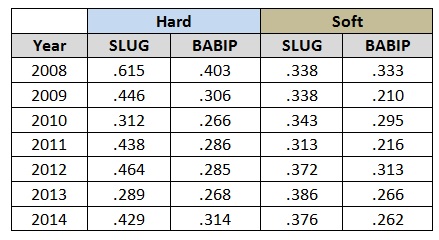
Let’s take a look at the performance of his pitches (table below). I categorized his pitch types into two categories: Hard and Soft. Hard consists of the fastball, sinker and cutter and Soft consists of the curveball, splitter and changeup.

buchholz-1

The biggest reason why his BABIP was so high was due to the Hard pitches. Even though the Hard pitches had a high BABIP he didn’t allow a lot of hard contact as evidenced by normal slugging percentage. Let’s take a deeper dive and look at his performance against left-handed and right-handed hitters.

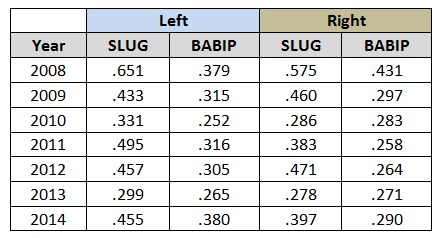
The table below shows his performance throwing Hard pitches against left-handed and right-handed batters.

buchholz-2

He had huge spike in BABIP against lefties last year, but like the previous table lefties didn’t make a lot of hard contact against him. He also saw an uptick in BABIP against righties too so maybe it was bad pitch location that caused the high BABIP?

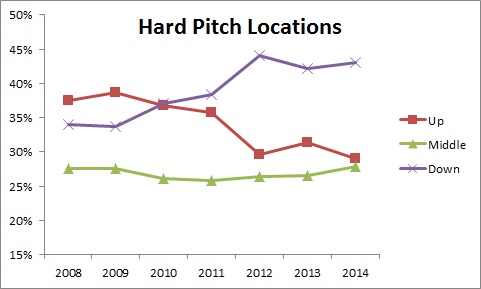
The image below shows the percentage of pitches by pitch location for Hard pitches. The three locations are Up, Down or Middle.

buchholz-hard-pitch-location

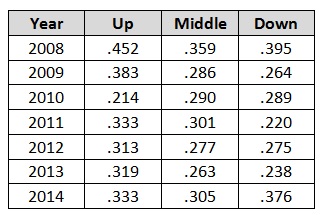
Last year he continued to throw Hard pitches down in the zone so it’s counter-intuitive because keeping the ball down in the zone is one of the most effective ways to be successful. If he kept the ball down then why was his BABIP so high? The table below shows the BABIP of Hard pitches thrown in various locations. Those locations are classified as Up, Middle and Down.

buchholz-3

He’s thrown Hard pitches down in the zone at the same clip for the past three seasons, but his BABIP shot up immensely which indicates he was extremely unlucky last year.

Some fantasy owners may say the reason for his poor performance was a decrease in fastball velocity, but his velocity was barely less than 2013 and only one mph less than the 2011 season.

In late September he had surgery to repair a torn meniscus in his right knee, which could have been a factor to his poor performance because it was the same knee that put him on the DL in May. However, when asked Buchholz insisted he was fully healthy.

After looking at all this data I conclude he got unlucky with the BABIP and if he continues to throw Hard pitches down in the zone he should be very successful next season. The big question is how successful?

Last year he posted the lowest walk rate of his career while continuing to throw Hard pitches down in the strike zone. If he’s able to continue both trends and the BABIP positively regresses he could have an ERA in the 3.40-3.50 range with a sub 1.29 WHIP. Injuries are always going to be a concern for Buchholz (he’s never pitched more than 190 innings in a regular season), but he has tremendous upside. The infield defense should be very good and he’ll likely be pitching with a lot of runs on the board. His ADP will likely be suppressed so fantasy owners will likely be able to draft him at a substantial discount. I’m going to take a chance on him and so should you.


The Johnny Cueto Experience

Johnny Cueto was very good in 2014. By traditional metrics, he was excellent: 20 wins, 242 strikeouts in 243 2/3 innings, a 2.25 ERA and 0.96 WHIP. By more advanced metrics, he was good but not quite that good: 3.30 FIP, 3.21 xFIP, 3.15 SIERA. Per FanGraphs, Cueto had 4.1 WAR, ranking him 14th among pitchers. Baseball-Reference had Cueto with 6.4 WAR, which placed him 6th among pitchers. No matter how you look at it, Johnny Cueto was good in 2014.

Johnny Cueto threw 3659 pitches during the regular season last year, making him one of only six pitchers to throw 3500 or more pitches. [NOTE: for this article, I’m only using major league regular season pitches thrown.] Cueto is not a big guy for a pitcher. He’s listed at 5’11, 215. The other five pitchers to throw 3500 or more pitches last year were David Price (6’6”, 220), Corey Kluber (6’4”, 215), James Shields (6’3”, 215), Max Scherzer (6’3”, 220), and R.A. Dickey (6’3”, 215). Of these six pitchers, Cueto had the greatest increase in pitches thrown from the previous year.

So, based on his high pitch total last year and low pitch total the year before, should we be worried about Johnny Cueto in 2015?

Let’s start with the high pitch total. Using the Baseball-Reference Play Index and the FanGraphs Leaderboards, I gathered some information. The following chart shows the number of pitchers who threw 3500 or more pitches each year going back to 2000, along with the average number of pitches thrown per pitcher in their high-pitch year, the average number of pitches thrown by those same pitchers in the following year, and the difference between the two.

YEAR N

# of Pitchers
>3500 pitches

Avg Pitches
Year N

Avg Pitches
Year N+1

Difference
(N+1)-N

2000

15

3664

3202

-462

2001

17

3617

3213

-404

2002

13

3614

3028

-586

2003

9

3609

3132

-477

2004

8

3651

3332

-319

2005

8

3679

3390

-289

2006

7

3648

3437

-211

2007

8

3606

3175

-431

2008

8

3624

3254

-370

2009

6

3646

3499

-147

2010

13

3621

3514

-107

2011

11

3661

2965

-696

2012

2

3693

3675

-18

2013

6

3600

3402

-198

TOTAL

131

3635

3256

-379


As you might expect, pitchers who throw 3500 or more pitches one year are likely to throw fewer pitches the following year. That’s the nature of regression to the mean. To throw 3500 pitches, a pitcher is likely to be having a good, healthy season. Things happen in baseball and it’s difficult for any group of pitchers to have back-to-back good, healthy seasons. Some are going to get injured and some are going to pitch worse and pitch less. In this case, the average difference was 379 pitches. Over the last fourteen years, pitchers who throw 3500 or more pitches one season have averaged 379 fewer pitches the following season. These days, 379 pitches is about 3 or 4 starts.

What about performance following a 3500-plus pitch season? The following chart shows how pitchers who threw 3500 or more pitches in one season performed in the following season.

Years Pitchers
>3500 pitches
Better
ERA+
Worse
ERA+
Better
K%
Worse
K%
Better
BB%
Worse
BB%
2000-2013 131 42% 58% 37% 63% 52% 47%


Once again, keeping in mind regression to the mean, it’s not surprising to see that these pitchers were worse the following season. Looking at ERA+, 58% of these pitchers were worse in the year following their high pitch total year. The majority (63%) also had lower strikeout rates, but improved walk rates (52% improved their walk rate in the year after their high pitch year).

More specifically, the following chart shows the difference in innings pitched (IP) and runs allowed per 9 innings (RA/9):

Years Year N
AVG IP
Year N+1
AVG IP
DIFF Year N
RA/9
Year N+1
RA/9
DIFF
2000-2013 228 205 -23 3.87 4.08 +0.21


Over the last fourteen years, pitchers who threw 3500 or more pitches in one year averaged 228 innings pitched that year. In the following year, they dropped to 205 innings pitched, a difference of 23 innings (this matches up well with the 379 fewer pitches thrown). In their high pitch count year, these pitchers had an RA/9 of 3.87. The following year, their RA/9 went up to 4.08, an increase of 0.21 RA/9.

Is this bad news for Johnny Cueto and the other five pitchers who threw more than 3500 pitches in 2014? Not really. I’ve mentioned regression to the mean a couple times. Based on regression, we would expect these pitchers to pitch fewer innings and have a higher RA/9.

With this in mind, here is a look at these 131 pitchers and their innings pitched and RA/9 in the year after they threw 3500 or more pitches compared to their Marcel projections for that year. Thanks to The Baseball Projection Project, I was able to find Marcel projections going back to 2001. The following chart shows each pitcher’s next-year Marcel projection for innings pitched and RA/9, along with each pitcher’s next-year actual innings pitched and RA/9.

Years Year N+1
Marcel
proj. IP
Year N+1
AVG IP
DIFF Year N+1
Marcel proj. RA/9
Year N+1
RA/9
DIFF
2000-2013 194 205 +11 4.05 4.07 +0.02


Over the last fourteen years, pitchers who threw 3500 or more pitches in a season were projected by Marcel to pitch 194 innings the following season. They actually pitched 205 innings in that following season, for an increase of 11 innings over their Marcel projection.

When it comes to performance, we find that these pitchers averaged a 3.87 RA/9 in their high pitch total season and were projected by Marcel for a 4.05 RA/9 for the following season. They actually had a 4.07 RA/9 in the following season. It’s a very slight increase of 0.02 RA/9, which shouldn’t be anything to worry about, really.

So it would appear that throwing 3500 pitches in one season should not be a big cause for alarm. The pitchers who have done this recently did not perform any worse than their projections would have expected.

With Cueto, though, there was that other thing that worried me—his large increase in pitches thrown from 2013 (953 pitches thrown) to 2014 (3659 pitches thrown).

With this in mind, I looked at the 131 pitchers in this study to find the pitchers who had the largest increase in pitches thrown from one year to the next. I set the limit at no more than 2000 pitches thrown in the year prior to that pitcher’s 3500-plus pitch season. There were only 10 pitchers, including Cueto, who threw fewer than 2000 pitches in one season and more than 3500 pitches the next season. That screams “small sample size!”

Unfortunately, there is a problem with even this group of comparable pitchers—they aren’t very good matches for the Johnny Cueto Experience. For example, one of them was Barry Zito. Zito only had 92 2/3 innings in the major leagues in 2000, the year before he threw more than 3500 pitches, but he also pitched 101 2/3 minor league innings that year, so there really wasn’t a big increase in the number of pitches thrown from one year to the next. He gets eliminated. The same is true for Steve Sparks, Roy Halladay, Randy Johnson, Noah Lowry, and Adam Wainwright, all of whom had additional minor league innings that would push them over the 2000 pitch limit. Unfortunately, that leaves very little to work with—just three pitchers (Woody Williams, Roy Oswalt, and Chris Capuano).

Pitchers Year N
AVG IP
Year N+1
Marcels
AVG IP
Year N+1
AVG IP
Year N
RA/9
Year N+1
Marcels RA/9
Year N+1
RA/9
Williams/Oswalt/Capuano 226 182 217 4.07 4.18 3.95


These three pitchers did throw fewer innings in the year after their 3500-plus pitch year, but to a lesser degree than the group as a whole and they pitched more innings than projected by Marcel. Also, this group actually improved their RA/9 in the year after their 3500-plus pitch year and were much better than their Marcel projection.

Based on throwing 3500 or more pitches, it doesn’t appear there’s anything to worry about with Cueto. Based on such a large increase in pitches thrown from one year to the next, we don’t really know because there just haven’t been many pitchers allowed to do that over the last 14 years. My gut still tells me to be wary but the numbers don’t see a problem.


Which Center Fielders Made the Plays that Mattered Most?

Jeff Zimmerman posted an interesting article on Friday. It prompted me to try to analyze the relationship between (i) an outfielder’s ability to make plays, and (ii) an outfielder’s ability to save runs. From my analysis below, the relationship is not as hand-in-glove as I initially would have thought.

From what I understood about Jeff’s article, he advanced a new defensive metric called “PMR,” which stands for Plays Made Ratio. Jeff calculated this ratio using data from Inside Edge, which categorizes every ball in play into one of six buckets. Jeff explains:

Most of the fielding data falls into two categories. The zero percentage plays are just that, impossible plays, and make up 23.2% of all the balls in play. Balls in this bucket are never caught and always have a 0% value. The other major range is the Routine Plays or the 90% to 100% bin. Defenders make outs on 97.9% of these plays, which make up 64.0% of all the plays in the field; the 2.1% which aren’t made are mostly errors. In total, 87.2% of all plays are graded out as either automatic hits or outs; it is the final ~13% which really determine if a defender is above or below average.

Between almost always and never, four categories remain. Even though each category has a defined range, like 40% to 60%, the average amount of plays made is not exactly in the middle of each range. Here are the actual percentage of plays made in each of the four ranges.

Range

Actual Percentage

1% to 10%

6%

10% to 40%

29%

40% to 60%

58%

60% to 90%

81%

With these league average values and each individual player’s values, a ratio of number of plays made compared to the league average value can be calculated. To have the same output of stats like FIP- and wRC+, I put Plays Made Ratio on a 100 scale where a value like 125 is 25% better than the league average. Here is the long form formula and Jason Heyward’s value determined for an example.

Plays Made Ratio = ((Plays made from 1% to 90%)/((1% to 10% chances * .063%)+( 10% to 40% chances * .289)+ (40% to 60% chances * .576) + (60% to 90% chances * .805))) * 100

Heyward’s Plays Made Ratio = ((1+10+9+26)/((14*.063)+(16*.289)+(9*.576)+(27*.805)))*100

Heyward’s Plays Made Ratio = (46/32.4)*100

Heyward’s Plays Made Ratio = 142

Heyward had a heck of a season. Of the 66 playable balls hit to him, normally only 32 of them would have been caught for an out. Heyward was able to get to 46 of them, or 42% better than the league average. He has consistently had above league average values with a 133 value in 2012 and 125 in 2013.

Jeff posits that the new PFM metric gives us new insight that FanGraphs current go-to defensive metric (Ultimate Zone Rating) does not:

Now remember this stat [PMR] only looks at how often a fielder would have made the play considering their position on the field. The team could be playing its outfielders back to prevent a double or their infielders in for a bunt which could put the defender out of position. Additionally, it doesn’t look at the final results of the play (at least for now). If Sir Dive Alot is playing in the outfield and he loves to try to catch every ball hit his way, then he will get to a few extra flyballs by diving all the time, but those he doesn’t get to will pass him by for more doubles and triples. Also, an outfielder could be good at making plays while coming in versus going deep; balls which fall in over his head would be more damaging than those which fall for shallow singles. While his Plays Made Ratio may be high, the number of runs he saves, as seen by UZR or Defensive Runs Saved, may be lower by comparison.

This got me thinking about the relationship between a player’s PMR and his UZR, and, more specifically, his RngR. As I understand RngR, it is the component of UZR that estimates the number of runs a player saves, or surrenders, due to his range. RngR isolates the contribution a player’s range makes to his Ultimate Zone Rating by ignoring the contributions from his arm and his ability to limit errors.

Intuitively, it would make sense that a player’s PMR and his RngR would be strongly correlated. In other words, a player whose range allows him to make more plays than average would also be the same type of player whose range would allow him to save more runs than average. A simple two-by-two matrix, with RngR along the left side and PMR along the top would show the following quadrants:

Below Average PMR Above Average PMR
Above Average RngR (1) Poor range/saves runs(?) (2) Good range/saves runs
Below Average RngR (3) Poor range/surrenders runs (4) Good range/surrenders runs(?)

My intuition is that players would fall in either quadrant (2) or quadrant (3). The interesting questions arise with players that would fall in quadrant (1) (those who exhibit poor range, but whose range saves runs), and in quadrant (4) (those who exhibit good range, but whose range does not save runs). There are several explanations for why a player may fall into quadrant (1) or (4).

Jeff noted three possible explanations.  First, a player may be overly aggressive, which would may lead to more outs (a higher PMR) but also more misplays resulting in doubles and triples (a lower RngR). Second, “an outfielder could be good at making plays while coming in versus going deep; balls which fall in over his head would be more damaging than those which fall for shallow singles. While his Plays Made Ratio may be high, the number of runs he saves, as seen by UZR or Defensive Runs Saved, may be lower by comparison.” Third, a player (or his team) may be particularly well adept at positioning himself, which would amplify his RngR rating, but not necessarily his PMR (as Jeff noted when discussing Nick Markakis).

How does the relationship between PMR and RngR look if it is applied to actual players? To find out, I looked at all center fielders who between 2012 and 2014 had at least 70 “total chances” (defined by Inside Edge as balls hit to that fielder where there is between a 1% and 90% likelihood that the ball is caught). That provided me a list of 18 center fielders. Next, I calculated each player’s rate-based RngR/150 (calculated by his total RngR divided by the innings he played in center field, multiplied by nine, multiplied by 150). That revealed the following table:

Name PMR RngR/150
Jacoby Ellsbury 128 11.5
Lorenzo Cain 127 19.5
Mike Trout 126 3.9
Michael Bourn 122 4.4
Ben Revere 122 -3.0
Andrew McCutchen 120 -1.5
Denard Span 116 4.0
Carlos Gomez 114 11.2
Dexter Fowler 114 -12.0
Juan Lagares 108 18.7
Coco Crisp 106 -2.3
Jon Jay 105 3.2
Adam Jones 90 -5.7
Leonys Martin 89 0.6
Austin Jackson 88 -1.2
Colby Rasmus 87 2.7
Angel Pagan 87 -2.4
B.J. Upton 80 -0.6

A scatter chart of this information looks like this. I also added a best-fit line to the scatter plot. My intuition that a player’s RngR/150 would be strongly correlated with his PMR is contradicted by this data. In fact, according to this data, (and based on my very limited skillset at statistical analysis, which may be completely incorrect), only 15% of the runs saved due to these 18 center fielders’ range can be explained by their Plays Made Ratio.

Even more interesting than the two-by-two matrix characterization introduced above, are the points on the scatter plot that are either way above (Juan Lagares and Lorenzo Cain) and way below (Dexter Fowler) the linear trendline.

The data suggest that Lagares/Cain and Fowler have similar range in center field, but that the former use their range to save more runs than the latter. One possible implication of this information is that Fowler is not optimizing his ability and that through better decision-making (such as being more aggressive or less aggressive on fly balls) or better positioning he could save more runs. As discussed earlier, it could also mean that Fowler is not (relatively) adept at playing balls hit over his head or in the gap, which leads to more doubles and triples.

On a larger scale, a possible implication of this data is that teams could significantly improve the amount of runs their center fielders save by (i) coaching their center fielders to make optimal decisions regarding their aggressiveness and (ii) properly positioning their center fielders. I would be curious to analyze what is the optimal amount of aggression a center fielder would have in going after balls hit to the outfield, the optimal way to position himself. For example, is it better to play shallow and be aggressive in cutting off singles (which Lagares has a reputation of doing) or to play deep? Those questions are best answered in a follow-up post/article.


The Future is Bright, But Will the A’s Compete in 2015?

The Oakland Athletics may have finally completed their roster turnover on Wednesday with their most recent deal sending Yunel Escobar to Washington for RP Tyler Clippard. However, you can never know if Billy Beane is finished making moves. With that being said, I’d like to break down the roster from last year to this year and assess whether or not the team will actually regress in 2015. The fact is that the Athletics got quite a bit younger this offseason and acquired many players with a lot of team control remaining. The distant future appears brighter now than it did prior to this offseason, but the main question is, will the Athletics be able to compete in 2015 as well as they would have prior to the roster turnover? Lets take a look at the numbers:

STARTING LINEUP

I will start by comparing the most common nine players in the A’s lineup last year to their projected starting nine this year, using WAR and wRC+:

[All stats give on the chart will represent the 2014 season in the MLB only. In further commentary I may bring up career numbers or minor league numbers for some players.]

2014 WAR wRC+ 2015 WAR wRC+
C – Derek Norris 2.5 122 C – Stephen Vogt 1.3 114
1B – Brandon Moss 2.3 121 1B – Ike Davis 0.3 108
2B – Eric Sogard 0.3 67 2B – Ben Zobrist 5.7 119
3B – Josh Donaldson 6.4 129 3B – Brett Lawrie 1.7 101
SS – Jed Lowrie 1.8 93 SS – Marcus Semien 0.6 88
LF – Yoenis Cespedes 3.4 109 LF – Sam Fuld 2.8 90
CF – Coco Crisp 0.9 103 CF – Coco Crisp 0.9 103
RF – Josh Reddick 2.3 117 RF – Josh Reddick 2.3 117
DH – Alberto Callaspo -1.1 68 DH – Billy Butler -0.3 97

2014 AVG WAR = 2.1 / Total wRC+ = 929

2015 AVG WAR = 1.7 / Total wRC+ = 937

As shocking as it may seem, this displays that the A’s should in fact score more runs with their lineup in 2015 than they did with Donaldson, Moss and Cespedes in the heart of their lineup last season. Although, this chart only accounts for 2014 stats, in which Billy Butler (among others) had an off year. If the A’s can get him back to, or even near his 2012 form, in which his WAR was 2.9 and his wRC+ was 139, they could be in for a significant upgrade on offense as a whole. One of the reasons why this lineup has the potential to be more successful even after losing a guy like Donaldson is because of the acquisition of Ben Zobrist. While Brett Lawrie is -4.7 to Donaldson in WAR and -28 to Donaldson in wRC+, Zobrist is +5.4 to Sogard in WAR and +52 to Sogard in wRC+, more than making up for the loss of Donaldson. While the A’s did use a lot of other DH besides Callaspo in 2014, he totaled the greatest amount of plate appearances from that spot, which might lower the 2014 numbers a little.

The average WAR is down slightly from last season, but with Stephen Vogt behind the plate and Marcus Semien most likely getting the every day job at SS, the A’s feel they are upgrading defensively. Semien’s numbers represent his slim 255 plate appearances in the majors last season, but in TripleA his wRC+ was 142. You cannot expect that out of Semien at the major league level, but it shows that he has potential to improve in 2015. The A’s did use a lot of players at each position last season and they will again in 2015; that is why it is important to also take a look at the bench players from last year and the projected bench for this year.

BENCH

While the 25-man roster is not set in stone for 2015 just yet, here is last year’s most commonly used bench players versus next year’s projected bench.

2014 WAR wRC+ 2015 WAR wRC+
Nick Punto 0.2 73 Craig Gentry 1.4 77
Craig Gentry 1.4 77 Josh Phegley 0.2 92 – 132(AAA)
John Jaso 1.5 121 Eric Sogard 0.3 67
Sam Fuld 1.3 73 Mark Canha N/A 131(AAA)

2014 AVG WAR = 1.1 / TOTAL wRC+ = 344

2015 AVG WAR = .48 / TOTAL wRC+ = 367(407)

While these numbers are a bit skewed due to the fact that Canha has not yet reached the majors and also because Jaso was actually a starter while he was healthy, they do give a good idea of what to expect in 2015. Sogard takes over for Punto as the reserve infielder. Fuld and Gentry will most likely platoon in LF, same goes for Vogt and Phegley at C. Since Fuld and Vogt are LH, they will see more time in the starting lineup, leaving Gentry and Phegley on the list of bench players for 2015. Gentry and Phegley will see most their time against lefties, which will likely help their overall numbers. The A’s always do a great job shifting their lineup to create the match ups they want, expect more of the same with platoons and late pinch hitting in 2015.

STARTING ROTATION

The starting rotation is an area where a lot of people say they A’s have question marks. This may be due to the fact that they lost Jon Lester and Jason Hammel to free agency and traded away Jeff Samardzija to the White Sox earlier this off season. However, the A’s held the best record in baseball for months in 2014 with a rotation featuring Sonny Gray, Scott Kazmir, Jesse Chavez, Drew Pomeranz and Tommy Milone. Four of those guys will be returning in 2015, with a slew of other young arms fighting for a spot in the rotation. Anyone from Chris Bassitt, Jesse Hahn, Sean Nolin or Kendall Graveman would be an upgrade or at worst an equal replacement of Milone. Let’s take a look at the numbers for the five players who started the most games for the Athletics last season VS the A’s projected rotation for next season using ERA, WHIP and WAR from the 2014 season:

2014 ERA WHIP WAR 2015 ERA WHIP WAR
Sonny Gray 3.08 1.19 3.3 Sonny Gray 3.08 1.19 3.3
Scott Kazmir 3.55 1.16 3.3 Scott Kazmir 3.55 1.16 3.3
Jesse Chavez 3.44 1.30 1.7 Jesse Hahn 2.96 1.13 0.8
Jeff Samardzija 2.99 1.07 4.1 Jesse Chavez 3.44 1.30 1.7
Tommy Milone 4.23 1.40 0.4 Drew Pomeranz 2.58 1.13 0.7

2014 AVG: ERA = 3.46 / WHIP = 1.22 / Avg WAR = 2.56

2015 AVG: ERA = 3.12 / WHIP = 1.18 / WAR = 1.96

Keep in mind that ERA and WHIP are better when they are lower and WAR is better if it is higher. While this list does not consist of Jon Lester, the A’s were at their best when they still had Chavez and Milone in their rotation. Also, it was a small sample size for Pomeranz, so we cannot expect numbers quite that solid again in 2015. However, with all that being said, the A’s, despite losing All-Stars, should not take more than a tiny step back in 2015. This rotation is still very solid and is in fact younger this year than last. Not only that, the A’s now have a lot more depth with three other pitchers not on this list that could fill a rotation spot, Chris Bassit, Sean Nolin and Kendall Graveman. Also, we cannot forget about the Tommy John rehabbers Jarrod Parker and AJ Griffin, who could make their way back into this rotation before the All-Star break. Both Parker and Griffin were huge contributors to the A’s success in both 2012 and 2013.

BULLPEN

There are a lot of similar faces coming back to the Athletics’ bullpen in 2015. So, instead of continuing with the format I’ve used for position players and the starting rotation I’m quickly going to compare Luke Gregerson and Tyler Clippard, the one main difference in the bullpen for 2015.

Player ERA / WHIP / WAR

Luke Gregerson 2.12 / 1.01 / 0.9

Tyler Clippard 2.18 / 1.00 / 1.5

These numbers are very similar, making Clippard a perfect replacement for Gregerson, taking over the 8th inning duties in front of incumbent closer Sean Doolittle. I don’t think many people expected the A’s to make a move to acquire another back end of the bullpen piece. Even after losing Gregerson, they seemed to have a very solid bullpen, but now it is even more solidified with a proven set-up man in Tyler Clippard. Another important thing to note about Clippard is his ability to create fly balls. His FB% in 2014 was 49.4% also, his IFFB% was 19.3% and that will likely increase mightily with him now pitching in Oakland. He is the perfect pitcher for the o.Co Coliseum. The A’s will pay Clippard more than they would have paid Escobar in 2015, but they are saving money in the long run due to the fact the Escobar is owed 14 million over the next two seasons and Clippard becomes a free agent after this season (in which he will make around 9 million).

Now let’s take a look at 12 potential options for the Athletics bullpen in 2015. Some of them are locks, but the others will either gain a spot due to the fact that they did not make it into the rotation or if they have a solid showing in spring training.

Name Team (2014) IP ERA WHIP WAR
Sean Doolittle Athletics 62.2 2.73 0.73 2.4
Tyler Clippard Nationals 70.1 2.18 1 1.5
Dan Otero Athletics 86.2 2.28 1.1 0.7
Chris Bassitt White Sox 29.2 3.94 1.58 0.7
Fernando Abad Athletics 57.1 1.57 0.85 0.6
Ryan Cook Athletics 50 3.42 1.08 0.3
Eury De la Rosa Diamondbacks 36.2 2.95 1.39 0.2
R.J. Alvarez Padres 8 1.13 1 0
Kendall Graveman Blue Jays (AAA) 38.1 1.88 1.02 N/A
Sean Nolin Blue Jays (AAA) 87.1 3.5 1.25 N/A
Eric O’Flaherty Athletics 20 2.25 0.95 -0.1
Evan Scribner Athletics 11.2 4.63 0.94 -0.2

There are a lot of very solid options for the A’s bullpen in 2015. I’d expect to see, Doolittle, Clippard, O’Flaherty, Cook, Otero and Abad for sure, but I expect all of these guys to make an impact at some point, if not this season then in 2016.

TAKEAWAY

The Athletics have a very deep pitching staff. With Sonny Gray and Scott Kazmir headlining the rotation, they have a plethora of options to fill the remaining three spots. Pomeranz, Hahn and Chavez look to be the leading candidates, although Billy Beane himself has mentioned Kendall Graveman as someone he sees making the rotation out of spring training. The A’s also have a very strong bullpen, especially after the recent acquisition of All-Star set-up man Tyler Clippard. After losing Josh Donaldson, Brandon Moss, Yoenis Cespedes and Derek Norris (four All-Stars), the A’s lineup for 2015, according to wRC+ actually got better. It’s not always the big name All-Stars that make a team successful. Oakland has proven this many times in the past, most recently in 2012, right after an offseason makeover similar to this year’s. The one piece that has remained since before the 2012 makeover and after this 2015 makeover, is Coco Crisp. There cannot be enough said about the value of Crisp to the A’s organization. With Crisp healthy in CF and the newly acquired pieces filling in around him, I expect the A’s to be back competing for another American League West division title in 2015.