Archive for Research

Victimized by Infield Hits

We see it every night. A weak groundball to a defensively incapable player, a broken-bat roller behind the mound into no-man’s-land, a slap hit into the vacated area caused by the shift, a tomahawk chop resulting in a dirt-bounce that goes 20 feet upward. Not good enough to be a true hit, not bad enough to be an error. Infield hits are awkward.

“It’ll look like a line drive in the box score,” the broadcasters chirp happily. And while that’s very true, I would argue that infield hits are ESPECIALLY demoralizing for pitchers. Usually, the pitcher made a quality pitch, got the groundball he was looking for, and had little control over the infield defensive positioning or assignments. But because the official scorer ruled the play too difficult for a fielder to make, any runs driven in by the infield hit or resulting later in the inning will be earned.

Infield hits are the result of bad defensive skill, poor defensive positioning, poor use of the shift, sloppy weather conditions, speedy runners, jittery infielders, and/or good old fashioned bad luck. So which pitchers have been victimized the most by infield hits? Let’s look at the numbers for each league.

American League pitchers have allowed 9,650 hits, including 1,166 infield hits (as of June 29). The infield hits/hits rate in the American League, therefore, is 12.1%.

The Athletics’ defense ranks worst in the American League with a -23.9 UZR, and the team’s two best starters suffer a plethora of infield hits allowed. Take out Gray’s 17 infield hits allowed, and his already pristine 0.99 WHIP falls to 0.84 WHIP. Without the infield hits, Chris Sale of Chicago would also see his WHIP drop to a crazy 0.82 WHIP. (The ChiSox need to figure out how to shift.) Keuchel is the king of groundballs (64.5% GB), so infield hits are only natural to him. Same goes for Madson and his 56.4% GB rate. The Yankees’ middle infield has been miserable this year, and the team doesn’t know how to shift properly. Warren, Rogers, and Betances have been the poor-luck “beneficiaries.”

Nate Karns (45.4% GB) and Brad Boxberger (36.6% GB) are the real enigmas here, as the Rays have the second-best defense in the AL. Bad luck? Infielders hate them? Poor use of the shift by Tampa Bay coaches? According to Inside Edge, Rays defenders make only 4% of very difficult plays, labelled “remote.” Since these plays are too difficult to be ruled an error if the defender miffs, these balls in-play are often ruled infield hits (if, of course, they occur on the infield). For the curious, the Yankees are dead last (1.2%), and the Blue Jays are first (19%).

Zach Britton’s rate really jumps out, but it is most likely a result of very few hits allowed overall and, as with all the relievers, a small sample size. Britton has only allowed 28 hits on the season, and only 17 have left the infield. Dominant.

National League pitchers have allowed 9,892 hits, including 1,174 infield hits (as of June 29). The infield hits/hits rate in the National League, therefore, is 11.8%.

Noah Syndergaard (16.6% infield hits/hits) just missed this list, so that’s three Mets starters who have allowed way more infield hits than the average NL starter. The Mets have already taken Wilmer Flores off shortstop, but Eric Campbell (-1.1 UZR) and Daniel Murphy (-2 UZR) aren’t helping either. Brett Anderson (68.7% GB rate) is the most predictable pitcher on this chart, but Alex Wood and Shelby Miller are not, especially since 2B Jace Peterson and SS Andrelton Simmons flash the leather on a nightly basis. (Do the Braves  suffer from the Dee Gordon effect or just from poor use of the shift?)

The Cardinals infield has been below average defensively (Matt Carpenter -1.6 UZR; Mark Reynolds -1.6 UZR; Jhonny Peralta -1.1 UZR), which partially explains Lynn and Rosenthal. Starlin Castro (-3.4 UZR) and Arismendy Alcantara (-2.0 UZR) have not helped out Hendricks or Strop defensively either. Benoit is on the wrong team defensively to have a career-high ground ball rate (43.6%).

Finally, who has been stingy with infield hits? For the American League:

And for the National League:

Just something else Max Scherzer has been amazing at in 2015.


What Has Happened to the Second Basemen?

 2nd Base hasn’t been a particularly stacked position in the major leagues in the past five years. Entering the 2015 season, the 2nd base position was headlined by Jose Altuve and Robinson Cano. The second tier arguably consisted of Ben Zobrist, Neil Walker, Dustin Pedroia, and Ian Kinsler, and maybe Brian Dozier. Then the next level housed names like Jason Kipnis, Daniel Murphy, and maybe DJ LeMahieu. I’m here to analyze what has possibly happened to this group of baseball players in the past few months.

According to the Depth Charts pre-season projections, the top eight second basemen ranked by wOBA were Robinson Cano, Neil Walker, Ben Zobrist, Jose Altuve, Dustin Pedroia, Ian Kinsler, Howie Kendrick, and Chase Utley. The projections are usually somewhat accurate, but if you’ve been following baseball at all this season, just by looking at those names, you know that we’ve found an exception to that.

These are the top 10 second baseman thus far in the 2015 season ranked by wOBA:

Name Team G PA HR BB% K% ISO BABIP wOBA wRC+
Jason Kipnis Indians 69 322 5 10% 13% 0.17 0.396 0.409 169
Brian Dozier Twins 70 310 14 9% 19% 0.257 0.276 0.363 133
Logan Forsythe Rays 72 284 8 9% 15% 0.161 0.325 0.363 139
Joe Panik Giants 69 296 6 9% 12% 0.156 0.326 0.362 137
Dustin Pedroia Red Sox 68 311 9 9% 12% 0.147 0.325 0.358 127
Dee Gordon Marlins 68 311 0 3% 15% 0.071 0.418 0.347 120
Danny Espinosa Nationals 62 229 8 9% 22% 0.187 0.317 0.345 118
DJ LeMahieu Rockies 68 274 4 7% 16% 0.103 0.373 0.344 102
Kolten Wong Cardinals 69 284 8 7% 14% 0.163 0.3 0.336 114
Jace Peterson Braves 66 270 2 11% 17% 0.103 0.337 0.327 107


If I told you in April that Logan Forsythe would be the 3rd best second baseman in the league, you would think I’m ridiculous. He came absolutely out of nowhere to raise his BABIP nearly 60 points and raise his ISO 55 points! Joe Panik’s beautiful swing has moved him up to be the 4th best-hitting 2nd baseman. Jason Kipnis has shut up all the critics. He took his .310 2014 OBP as confidence going into this year, and now has a wOBA over .400. Danny Espinosa, who has been previously known as a ‘defensive’ second baseman, has skyrocketed his offensive production into a player who Matt Williams is comfortable having run onto the field every day. Cardinals 2B Kolten Wong is pulling the ball more and more every season. He’s also upped his LD% from 19% to 25%. Braves utility-infielder Jace Peterson is doing a bit of hitting in his rookie year, after being traded from San Diego (who, it turns out, could really use him) to the Braves in December. Think back to when I mentioned the tiers up top. Where is Robby Cano on the list above? Where’s Altuve? I don’t see Zobrist, Walker, or Kinsler on this list either. It is not an error.

So we talked about the breakouts at 2nd; now lets talk about the guys who haven’t or haven’t yet lived up to expectations.

Lets start with the guy who all of his fantasy owners hate this year. Robinson Cano. Yeah, the six-time All-Star Robinson Cano. The 32-year-old — the guy who has a wRC+ of 76. This is easily, by far, his worst season of his 11-year career. Why? Lets talk about it.

Cano has raised his Hard% and his Pull% over 4% each! What does jump out at you is that he’s making a ton less contact than he did last year. Actually, the least of his whole career. His Contact% has plummeted down almost 5%. Along with a raised K%, his BABIP has jumped down nearly 50 points.

The next guy is Altuve. Altuve hasn’t been that bad this year, but compared to his 2014 campaign, he’s not playing like Jose Altuve. He’s even fighting with a mild hamstring injury, but in his 287 PA’s, every single one of his numbers are down. His wOBA has decreased .363 to .304. BB% is down, strikeouts are up, OBP and SLG are both way down. He’s swinging more, and making less contact which isn’t a combination that pulls you in a positive direction.

Same can be said for Neil Walker. Almost all his numbers are down. One of the positives that I found, though, is that he’s hitting the ball harder. My prediction is that the .303 wOBA will start to show positive regression. Ian Kinsler isn’t having a horrible season. He’s raised his OBP a bit, but he’s becoming more of a singles hitter, dropping his SLG from .420 to .338.

Almost every starting second baseman in the big leagues has totally changed their style of hitting this year. Guys like Forsythe and Panik, who were projected to be replacement level or below, have made their names rise to the top of many leaderboards. Cano and Altuve’s value have fallen. Here’s your homework: Think of all the 2nd baseman in the major leagues. How many of them have close to similar stats from their projections? Comment down below.


Going the Other Way

Ryan Howard doesn’t like infield shifts. I’m not making this up, or just surmising it. He said so after recording four outs on balls that probably would have gotten through an unshifted infield:

 “No, I don’t like it at all,” said Howard, who has grown accustomed to seeing four infielders on the right side of the infield when he steps to the plate. “That’s four hits. I mean, again, it’s nothing that I’m doing wrong, I’m hitting the ball hard. It’s just right at guys playing shifts. So, all you can do is continue to swing.”

Back in May, Craig Edwards noted that Jason Kipnis had a rotten 2014 (86 wRC+), likely in part due to an oblique injury in April that affected his performance all year. Kipnis’s 2014 was characterized by an increase in grounders, weak contact, and pulled balls. This season, of course, he’s been a monster (164 wRC+ through June 21, fourth in the American League), in part because, with a healthy oblique, he’s pulling less.

Why, fans and sportswriters ask, can’t more hitters do what Jason Kipnis has done by going the other way? Proliferating infield shifts are taking hits away from the likes of Howard, David Ortiz, and Mark Teixeira. So why don’t those players just hit the ball where they ain’t? I’m not talking about bunting. This is just about pull-happy hitters go the other way, guiding batted balls to the opposite field.

I think pretty much everyone reading this knows the answers why. First, infield shifts are effective against grounders and soft liners, and a batter with fly ball tendencies hits the ball over the shifted infielders more often than not. The Indians’ Brandon Moss is a pronounced pull hitter (48% of batted balls hit to right field) who also hits the ball in the air a lot (0.67 ground ball/fly ball ratio, fifth lowest in the majors). So he goes to the plate trying to hit over the shift. Second, and more significantly, I think, hitting, one hears, is hard. Granted, I never played professional baseball like the people on sportstalk radio who insist that Chris Davis would be a much more productive player if he’d just shorten his swing and go with where the ball’s pitched, dumping singles through the vacated space on the left side of the infield. Changing one’s approach to the plate would seem to have a concomitant risk of decreased production.

But players can and do make adjustments. And, as the case of Kipnis illustrates, those adjustments can lead to better outcomes. How often do batters rely less on pulling the ball, and what does it do to their performance?

To answer this, I looked at every batter who was a semi-regular (which I arbitrarily defined as compiling two-thirds the plate appearances necessary to qualify for the batting title) in 2014 and 2015. (My criteria worked out to 334 plate appearances in 2014 and, depending on the team, 140 or so plate appearances in 2015.) There were, through games of June 21, 186 such players. I calculated their “pull tendency” by subtracting the percentage of balls they hit to the opposite field from the percentage they hit to the pull field. Ryan Howard, for example, has a pull tendency of 31.9% this year, having hit 48.8% of batted balls to right field and 16.9% to left. I then subtracted each player’s 2015 pull tendency from his 2014 pull tendency to arrive at the change, i.e. how much more he’s going the other way in 2015. To determine the effect of the change, I calculated the change in the player’s wRC+ from 2014 to 2015 as well. Here are the 15 players who have most dramatically changed from pulling to going the other way in 2015:

Well now. That’s quite a mix. There’s probably the 2015 poster child for going the other way, Mike Moustakas, leading the way with a vast improvement in wRC+. But the median wRC+ change on the list is negative five points–players who are pulling markedly less are having less, not more, success at the plate. Seven of the fifteen players are having a better year in 2015, while the remaining eight aren’t. Of course, as with any list like this, there are caveats. The change for Moustakas is evidence of a well-executed plan. But you can make a pretty good argument that Carlos Ruiz is pulling less because,at 36, he can’t get around on pitches as he used to, and a fairly airtight argument that Victor Martinez is pulling less because he’s been playing hurt. Danny Santana, he of the .405 BABIP in 2014, was at the top of the 2015 regression list regardless of where he’d hit the ball–a lot more of them were bound to find their way into fielders’ gloves. Josh Harrison is coming off a career year. Alcides Escobar, who cares, the guy’s an All-Star Game starter! But if there’s a pattern there of pull less, hit more, I’m not seeing it.

How about players who have done the opposite–in the face of shifts, they’re pulling the ball more now than they did last year? Here’s the list:

Another mixed bag, with a negligible median change in wRC+ (-2 in this case; seven players doing better, eight doing worse). Pulling the ball more certainly hasn’t hurt Todd Frazier (leading all third basemen in wRC+) or the first two second basemen on the list. By the same token, it’s one of many symptoms of the woes of Robinson Cano (discussed in length by Jeff Sullivan here). As with players pulling less, if there’s a pattern here, that pulling more has a systemic impact, I’m not seeing it.

Admittedly, there are limits to this type of analysis. Hitting isn’t just a product of where the ball is hit. It’s affected by whether it’s hit on the ground or in the air, whether it’s hit hard or soft, whether it’s hit by a healthy batter or an injured one, whether it’s hit off a fastball or an off-speed pitch, and whether it’s hit at all or missed. I looked only at the first comparison: pulling the ball vs. going the other way, because that one characteristic has been harped on by fans and some in the media. And the data indicate that changing one’s approach–going from pulling to hitting to the opposite field, or, for that matter, vice-versa–does not appear to have a systemic change in batting outcomes. It works for some players. It doesn’t work for others. For every Mike Moustakas, it seems, there’s a Todd Frazier, or a David Peralta. When Ryan Howard hits four grounders to Kolten Wong in short right field, turning singles to right into 4-3 putouts, it may frustrate him, but that’s not to say that trying to hit the ball to left wouldn’t frustrate him even more.


Hardball Retrospective – The “Original” 1953 Milwaukee Braves

In “Hardball Retrospective: Evaluating Scouting and Development Outcomes for the Modern-Era Franchises”, I placed every ballplayer in the modern era (from 1901-present) on their original team. Therefore, Roy Halladay is listed on the Blue Jays roster for the duration of his career while the Brewers declare Gary Sheffield and the Cardinals claim Mordecai Brown. I calculated revised standings for every season based entirely on the performance of each team’s “original” players. I discuss every team’s “original” players and seasons at length along with organizational performance with respect to the Amateur Draft (or First-Year Player Draft), amateur free agent signings and other methods of player acquisition.  Season standings, WAR and Win Shares totals for the “original” teams are compared against the “actual” team results to assess each franchise’s scouting, development and general management skills.

Expanding on my research for the book, the following series of articles will reveal the finest single-season rosters for every Major League organization based on overall rankings in OWAR and OWS along with the general managers and scouting directors that constructed the teams. “Hardball Retrospective” is available in digital format on Amazon, Barnes and Noble, GooglePlay, iTunes and KoboBooks. The paperback edition is available on Amazon, Barnes and Noble and CreateSpace. Additional information and a discussion forum are offered at TuataraSoftware.com.

Don Daglow (Intellivision World Series Major League Baseball, Earl Weaver Baseball, Tony LaRussa Baseball) contributed the foreword for Hardball Retrospective. The foreword and preview of my book are accessible here.

Terminology

OWAR – Wins Above Replacement for players on “original” teams

OWS – Win Shares for players on “original” teams

OPW% – Pythagorean Won-Loss record for the “original” teams

Assessment

The 1953 Milwaukee Braves         OWAR: 52.2     OWS: 300     OPW%: .664

GM John Quinn acquired 88% (22/25) of the ballplayers on the 1953 Braves roster after assuming the reigns from his father Robert Quinn in 1945. Based on the revised standings the “Original” 1953 Braves secured the National League pennant by a 16-game margin over the Brooklyn Dodgers. Thus began a streak of seven consecutive National League titles while pacing the Senior Circuit in OWAR and OWS.

Eddie Mathews (.302/47/135) established career-bests in home runs, RBI and SLG (.627) during his sophomore year. The slugging third-sacker placed runner-up in the 1953 NL MVP race and led the circuit in round-trippers. Al Dark (.300/23/88) rapped 194 base hits, clubbed 41 doubles and scored 126 runs from the leadoff slot. Johnny Logan slashed 27 two-base hits and registered 100 tallies. Del Crandall walloped 15 dingers and earned the first of eight All-Star invitations. Earl Torgeson aka “The Earl of Snohomish” drove in 64 baserunners while batting .274. Bill Bruton placed fourth in the 1953 NL Rookie of the Year balloting after collecting 14 triples and leading the League with 26 stolen bases.

Mathews is listed as the third-best ballplayer at the hot corner according to Bill James in “The New Bill James Historical Baseball Abstract.” Five teammates join him in the top 100 rankings including Warren Spahn (5th-P), Dark (27th-SS), Logan (39th-SS), Crandall (30th-C) and Bruton (73rd-CF).

LINEUP POS WAR WS
Al Dark LF/SS 3.41 20.61
Johnny Logan SS 3.86 23.8
Eddie Mathews 3B 8.87 38.91
Earl Torgeson 1B 1.77 13.85
Del Crandall C 2.73 16.03
Bill Bruton CF 0.45 13.61
Jack Dittmer 2B -0.95 10.85
Bob Thorpe RF/LF -0.54 0.13
BENCH POS WAR WS
George Crowe 1B 0.2 1.28
Harry Hanebrink 2B 0.15 1.6
Mel Roach 2B -0.03 0
Sibby Sisti 2B -0.04 0.5
Jack Lohrke 2B -0.12 0.08
Gene Verble SS -0.16 0.29
Mike Sandlock C -0.4 1.85

Warren Spahn (23-7, 2.10) flummoxed opposing batsmen as he completed 24 of 32 starts and paced the National League in ERA, victories and WHIP (1.058). Hoyt Wilhelm aka “Old Sarge” provided 7 wins and 15 saves in 68 relief appearances. Returning from two years of military service, Johnny Antonelli delivered a record of 12-12 with a 3.18 ERA.

ROTATION POS WAR WS
Warren Spahn SP 8.46 29.45
Johnny Antonelli SP 1.4 11.32
Don Liddle SP 1.43 9.36
Joey Jay SP 0.62 1.73
BULLPEN POS WAR WS
Hoyt Wilhelm RP 2.23 13.57
Ernie Johnson RP 0.63 6.03
Jerry Lane RP -0.37 0.64
Virgil Jester RP -0.38 0
Vern Bickford SP -0.39 0.72
Dave Cole RP -0.54 0.44


The “Original” 1953 Milwaukee Braves roster

NAME POS WAR WS General Manager Scouting Director
Eddie Mathews 3B 8.87 38.91 John Quinn
Warren Spahn SP 8.46 29.45 Bob Quinn
Johnny Logan SS 3.86 23.8 John Quinn
Al Dark SS 3.41 20.61 John Quinn
Del Crandall C 2.73 16.03 John Quinn
Hoyt Wilhelm RP 2.23 13.57 John Quinn
Earl Torgeson 1B 1.77 13.85 John Quinn
Don Liddle SP 1.43 9.36 John Quinn
Johnny Antonelli SP 1.4 11.32 John Quinn
Ernie Johnson RP 0.63 6.03 Bob Quinn
Joey Jay SP 0.62 1.73 John Quinn
Bill Bruton CF 0.45 13.61 John Quinn
George Crowe 1B 0.2 1.28 John Quinn
Harry Hanebrink 2B 0.15 1.6 John Quinn
Mel Roach 2B -0.03 0 John Quinn
Sibby Sisti 2B -0.04 0.5 Bob Quinn
Jack Lohrke 2B -0.12 0.08 John Quinn
Gene Verble SS -0.16 0.29 John Quinn
Jerry Lane RP -0.37 0.64 John Quinn
Virgil Jester RP -0.38 0 John Quinn
Vern Bickford SP -0.39 0.72 John Quinn
Mike Sandlock C -0.4 1.85 John Quinn
Dave Cole RP -0.54 0.44 John Quinn
Bob Thorpe LF -0.54 0.13 John Quinn
Jack Dittmer 2B -0.95 10.85 John Quinn


Honorable Mention

The “Original” 1902 Beaneaters         OWAR: 44.1     OWS: 314     OPW%: .580

Vic Willis (27-20, 2.20) shouldered a massive workload, completing 45 of 46 starts and leading the National League with 410 innings pitched and 225 strikeouts. Alas, Boston (81-59) finished three games behind Cincinnati. Togie Pittinger (27-16, 2.52) matched Willis’ win total and registered 36 complete games. Charlie “Piano Legs” Hickman (.361/11/110) led the circuit with 193 hits and 288 total bases. Chick Stahl, Jimmy Collins, Fred Tenney, Patsy Donovan, Kitty Bransfield, Joe Kelley and Dan McGann exceeded the .300 mark in batting average.

The “Original” 1983 Braves    OWAR: 51.0     OWS: 293    OPW%: .568

Dale Murphy (.302/36/121) received his second straight NL MVP award. “Murph” topped the charts in RBI and SLG (.540) while earning the second of five successive Gold Glove Awards. Brett Butler led the League with 13 triples and Glenn Hubbard (.263/12/70) received his lone All-Star nod. Craig McMurtry (15-9, 3.08) merited a runner-up finish in the 1983 NL Rookie of the Year balloting. Larry McWilliams (15-8, 3.25) whiffed 199 batters and set career-bests in virtually every pitching category as he placed fifth in the Cy Young voting.

On Deck

The “Original” 1948 Indians

References and Resources

Baseball America – Executive Database

Baseball-Reference

James, Bill. The New Bill James Historical Baseball Abstract. New York, NY.: The Free Press, 2001. Print.

James, Bill, with Jim Henzler. Win Shares. Morton Grove, Ill.: STATS, 2002. Print.

Retrosheet – Transactions Database

Seamheads – Baseball Gauge

Sean Lahman Baseball Archive


The Allure of Potential and the Black Hole In the Indians Rotation

The Cleveland Indians can be a frustrating team to follow.  As a small to mid-market ball club, the Indians do not have the luxury to spend big in free agency, and when they do, they usually have to spend extra to bring in overrated players (see Kerry Wood, Nick Swisher, and Michael Bourn).  As a result, the Indians hedge their success on taking risks.  This process started in the early ’90s when they signed their young players with big potential to long-term contracts.  As a result, the Indians turned into an offensive juggernaut with stars such as Jim Thome, Sandy Alomar Jr., Kenny Lofton, Omar Vizquel, Carlos Baerga, and many others.  However, many people do not realize that the Indians also lost on some of the risks that they took in that era with cases such as Eric Plunk, Herb Perry, and so on.

This strategy has continued to this day, and has resulted in a very promising, yet frustrating team.  Carlos Santana has been productive with his high OBP, but never the player the team envisioned.  Jason Kipnis has had up and down years.  Lonnie Chisenhall has shown moments of brilliance, but has been unable to sustain those moments, resulting in his demotion to Triple-A Columbus last week.

While the offense has been widely inconsistent, the rotation has, for the most part, been brilliant.  Corey Kluber is second in the league in strikeouts with 111.  Danny Salazar, Carlos Carrasco, and Trevor Bauer have been inducing a lot of long walks back to the dugout as well, ranking tied for sixth, seventh, and ninth, respectively.  These four have a combined 3.65 ERA, which is quite remarkable considering that the most respected starting rotation in the Majors (the Nationals) has logged a 3.60 ERA.

However, this is not where the story ends.  As everyone (hopefully) knows, major-league rotations consist of five starting pitchers (unless you’re the Mets for a few weeks).  With the fifth starter added in, the Cleveland Indians rotation has an ERA of 4.37, almost three-quarters of a run higher.  This is absolutely startling.  By themselves, the fifth starters in the rotation have gone 3-8 with an 8.33 ERA.  I’ll repeat that, an 8.33 ERA.  The only fifth starter to win at all has been Shaun Marcum, the man who had not pitched in the major leagues since halfway through 2013.  In the games that a fifth starter has pitched in, the Indians have been outscored 88-48.  Opponents have nearly doubled the Indians run output when a fifth starter has taken the hill.

Are there games that the Indians should have won when a fifth starter has pitched? Absolutely.  But in order to have any shot of making the playoffs, someone has to step up in the back of the rotation and close up the black hole.  A .375 winning percentage does not a contender make.


The Importance of Hard-Hit Percentage

In some ways, baseball is a simple game. For a hitter, it boils down to: see ball, swing at ball, hit ball hard, jog around bases (the Frankenstein approach). Of course, it’s not really that simple and there are many other variables involved. Still, a simple goal for a hitter would be to hit the ball hard as often as possible. With that in mind, I thought I’d investigate what happens when a batter hits the ball hard on a regular basis.

I took all players with 150 or more plate appearances so far in 2015. All data in this article is through June 14. Using players with more than 150 plate appearances gave me 236 players.

To start off, I looked at the correlation between the old-school statistic of batting average with hard, medium, and soft hit percentage. You may think that players who hit the ball hard more often would have higher batting averages. This is true. The correlation between batting average and hard hit percentage for these 236 players was .18. For both medium and soft hit percentage, the correlation was negative. The more often you hit the ball hard, the higher your batting average. The more often you hit the ball medium or soft, the lower your batting average.

Here is a table that shows the correlation for other metrics:

The statistic that correlates most with hard-hit percentage (Hard%) is Isolated Slugging (ISO), with a correlation of .73. Hitting the ball hard more often leads to getting extra-base hits more often. The top three metrics in the table—ISO, HR/FB, and SLG—are all measures of power and correlate quite nicely with Hard%. The two measures of overall hitting production—wRC+ and wOBA—also score high on this chart.

Both strikeout rate and walk rate correlate positively with Hard%. When you swing hard, you are more likely hit the ball hard and also more likely to miss, so hitters who have a higher Hard% also have higher strikeout rates, in general. Hitting the ball hard also correlates with walking more often. Perhaps pitchers a more careful to hitters who can beat them with one swing of the bat.

Hard% has a positive correlation (0.36) with fly-ball percentage, no correlation with line-drive percentage, and a negative correlation with groundball percentage.

With all of that in mind, I decided to separate hitters into groups based on hard-hit percentage and compare their composite batting lines. Consider the charts below. There’s a great deal of information here, but if you go down the column as Hard% goes down, you can see the effect on other statistics.
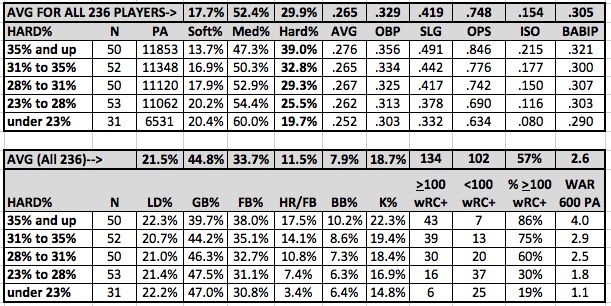
The group of hitters who have a hard-hit percentage of 35% or higher have combined to hit .276/.356/.491. Their .276 batting average is 9 points higher than the next-highest group, their OBP is 22 points higher, and their slugging percentage is 49 points higher. They have a .215 ISO, a solid 10.2% walk rate, and the best HR/FB rate, at 17.5%.

As the hard-hit percentage goes down, the other numbers go down also. By the time you get to the bottom group, those with Hard% below 23%, the composite batting line is .252/.303/.332, with an ISO of .080 and a HR/FB rate of 3.4%. This group strikes out less often than any other group, has the highest rate of soft-hit balls, and the lowest rate of fly balls. These are your typical light-hitting shortstops (Alcides Escobar, Elvis Andrus) and speedy outfielders (Billy Burns, Sam Fuld).

The three wRC+ columns show the number of hitters with a wRC+ at 100 or higher, the number below 100, and the percentage of above-average hitters in each group. For example, 86% of the hitters with Hard% above 35% have been above-average hitters this year, while just 19% of the hitters with Hard% below 23% have been above-average. If you’re not hitting the ball hard with some frequency, you are unlikely to be productive. The break-even point where half the players are above average hitters and half are below is in the range of 27% to 28% hard hit balls.

Let’s take a closer look at these groups.

Diamond Group (35% and higher Hard%)


.276/.356/.491, .321 BABIP

.215 ISO, 17.5% HR/FB

10.2% BB%, 22.3% K%

WAR/600 PA: 4.0

wRC+ >100: 43 players (86%)

wRC+ <100:   7 players (14%)


Best Hitter: Bryce Harper, 216 wRC+

Median Hitter: George Springer, 131 wRC+

Worst Hitter: Matt Kemp, 78 wRC+


  • Top five hitters in this group, by wRC+: Bryce Harper, Paul Goldschmidt, Miguel Cabrera, Mike Trout, Anthony Rizzo.
  • Middle five hitters in this group, by wRC+: Andrew McCutchen, Jose Abreu, George Springer, Adam Lind, Seth Smith.
  • Bottom five hitters in this group, by wRC+: Mark Trumbo, Will Middlebrooks, Matt Adams, Steve Pearce, Matt Kemp.
  • Bryce Harper is the top performing player in this group, hitting .333/.469/.721 with a Hard% of 40.4% and a 216 wRC+. He’s the Hope Diamond of Major League Baseball right now.
  • Giancarlo Stanton has the highest Hard%, at 51%. Stanton’s .341 ISO is second in baseball to Harper’s .388. Stanton’s Hard% is 5% higher than the next-highest player in baseball, Brandon Belt.
  • Nine of the top ten hitters in baseball by wRC+ are in this group (Nelson Cruz missed the cut with a Hard% of 32.9%.
  • The seven below-average performers with a 35% or higher Hard% are Jorge Soler (96 wRC+), Jay Bruce (96 wRC+), Mark Trumbo (93 wRC+), Will Middlebrooks (80 wRC+), Matt Adams (79 wRC+), Steve Pearce (79 wRC+), and the enigmatic Matt Kemp (78 wRC+) bringing up the rear. These players are hitting the ball hard at a high rate but have still been below average hitters.
  • Speaking of Kemp, what is up with this guy? After a bounce-back year in 2014, when he hit 25 home runs in 599 plate appearances, Kemp has just two homers so far in 274 plate appearances. He’s the Robinson Cano of the National League. His 35.4% Hard% isn’t bad, but it’s not as high as last year’s 40.3%. He also pulled the ball more often last year (43.8%) and his ground ball rate is at a career high (48.7%, career rate is 41.9%). He is struggling big time on fastballs after crushing fastballs in 2014. It’s been an ugly start to the year for Kemp, just ask Bud Black.
  • Two players in this group who are very close to a 100 wRC+ are Ryan Howard (100 wRC+ and Pedro Alvarez (104 wRC+). They both have been terrible against left-handed pitchers, having struck out at least 30% of the time against lefties. Also, when they do make contact against southpaws, they aren’t making good contact, with identical 25% Hard% versus lefties.


Quartz Group (31% to 35% Hard%)


.265/.334/.442, .300 BABIP

.177 ISO, 14.1% HR/FB

8.6% BB%, 19.4% K%

WAR/600 PA: 2.9

wRC+ >100: 39 players (75%)

wRC+ <100: 13 players (25%)


Best Hitter: Nelson Cruz, 175 wRC+

Median Hitter: Evan Longoria, 115 wRC+

Worst Hitter: Christian Yelich, 68 wRC+


  • Top five hitters in this group, by wRC+: Nelson Cruz, Mark Teixeira, Andre Ethier, Albert Pujols, Stephen Vogt.
  • Middle five hitters in this group, by wRC+: Danny Espinosa, Carlos Santana, Evan Longoria, Khris Davis, Mark Canha.
  • Bottom five hitters in this group, by wRC+: Justin Maxwell, Luis Valbuena, Robinson Cano, Michael Taylor, Christian Yelich.
  • The magic pixie dust that Nelson Cruz was sprinkled with in April (206 wRC+) and May (188 wRC+) seems to have worn off in June (78 wRC+). His ISO has dropped from .402 to .262 to .000 by month (although he has continued to be fortunate on balls in play with a .393 BABIP in June). He’s also seen a big drop in the percentage of hard hit balls, from 40.6% in April to 30.1% in May to 21.4% this month. This has coincided with a drop in fly ball rate, from 55.1% to 27.4% to 21.4%. Cruz was never going to keep up his torrid early-season pace but he’s also not as bad as he’s looked recently.
  • The player at the bottom of this group, Christian Yelich, has an above average Hard% of 34.2%. Unfortunately, his sky-high ground ball rate (69.1%) and miniscule fly ball rate (15.4%) mean those hard hit balls are not providing much production (68 wRC+).
  • Another player in this group, Luis Valbuena, is having a very peculiar season. He’s hitting the ball hard (31.5% Hard%) and hitting a ton of fly balls (50.3%), which has resulted in 14 home runs in just 234 plate appearances. His career high was set last year when he hit 16 dingers in 547 plate appearances. Valbuena has seen his fly ball rate increase in each of the last three seasons from 35.4% in 2012 to his current rate of just over 50%. That all sounds very good until you look at his ugly .185/.256/.412 batting line, good for an 86 wRC+. With all of those balls flying over the wall for home runs, Valbuena has a .169 BABIP. It’s surprising that a player could hit 14 home runs in 234 plate appearances and be a below-average hitter but Valbuena is doing it.


Apatite Group (28% to 31% Hard%)


.267/.325/.417, .307 BABIP

.150 ISO, 10.8% HR/FB

7.3% BB%, 18.4% K%

WAR/600 PA: 2.5

wRC+ >100: 30 players (60%)

wRC+ <100: 20 players (40%)


Best Hitter: Jason Kipnis, 160 wRC+

Median Hitter: Torii Hunter, 110 wRC+

Worst Hitter: Alexei Ramirez, 51 wRC+


  • Top five hitters in this group, by wRC+: Jason Kipnis, Josh Reddick, Justin Turner, Russell Martin, Brian Dozier.
  • Middle five hitters in this group, by wRC+: Edwin Encarnacion, Trevor Plouffe, Torii Hunter, Daniel Murphy, Brad Miller
  • Bottom five hitters in this group, by wRC+: Aaron Hill, Nick Castellanos, Ryan Zimmerman, Mike Zunino, Alexei Ramirez.
  • Jason Kipnis tops this group of players with a 160 wRC+, 50 points higher than the median player in this group. He’s having his best season. Looking at his numbers, he’s striking out less often than he ever has and has a .375 BABIP that is 68 points higher than his career mark. He’s also hitting fewer fly balls than ever (26.9% FB% compared to a career mark of 30.8%). He’s replaced those fly balls with line drives. His current Hard% almost exactly matches his career rate, but he’s done it in an interesting way. In three of his first four seasons, his Hard% was around 27% (2011, 2012, 2014). In 2013, his Hard% was 35.3%, which would put him up in the elite group (the Diamonds). That 2013 season was his best before this year’s revival. Kipnis is not going to OBP over .400 and likely won’t slug over .500, but he’s looking more like the 2013 version of himself than last year’s colossal disappointment. Maybe this is what a healthy Kipnis looks like.
  • The two players at the very bottom of this group in wRC+ are Mike Zunino and Alexei Ramirez. Zunino just strikes out way too much (36.7% K%). He has power (.159 ISO, 13.0% HR/FB) because he does hit the ball hard, but he doesn’t hit the ball hard often enough to be productive.
  • Alexei Ramirez is actually hitting the ball hard more often than he has in any season in his career. His current 28.4% Hard% is quite a bit higher than his career mark of 23.7%. His batted ball profile hasn’t changed, with a similar rate of line drives, ground balls, and fly balls. He does have the lowest BABIP of his career, at .256 (career mark is .293) and he’s walking at the lowest rate of his career, although he’s never been one to walk much.


Calcite Group (25% to 28% Hard%)


.262/.313/.378, .303 BABIP

.116 ISO, 7.4% HR/FB

6.3% BB%, 16.9% K%

WAR/600 PA: 1.8

wRC+ >100: 16 players (30%)

wRC+ <100: 37 players (70%)


Best Hitter: Mike Moustakas, 133 wRC+

Median Hitter: Jean Segura, 91 wRC+

Worst Hitter: Danny Santana, 42 wRC+


  • Top five hitters in this group, by wRC+: Mike Moustakas, Dustin Pedroia, Brandon Guyer, Cameron Maybin, Rajai Davis.
  • Middle five hitters in this group, by wRC+: Cory Spangenberg, Juan Uribe, Jean Segura, Martin Prado.
  • Bottom five hitters in this group, by wRC+: Dustin Ackley, Lonnie Chisenhall, Chris Owings, Jordy Mercer, Danny Santana.
  • The Bizarro World version of Mike Moustakas tops this group. This is the first time Moustakas has ever been an above average hitter in his major league career, but it doesn’t look like Hard% has much to do with it. His Hard% of 25.6% is right in line with most of his career and close to his career average (last year’s 31.7% is an outlier). The rest of his batted ball profile is quite different, from the lowest fly ball rate and highest ground ball rate of his career, to the direction he’s hitting the baseball. After never hitting the ball to the opposite field more than 22.7% of the time in a season, Moustakas’ 33.3% Oppo% this season is a career high. That may explain some of his elevated .346 BABIP (.270 career mark). He’s also striking out less frequently than he usually does (11.1% K% to 16.1% career mark). On the other hand, looking at his monthly splits throws up a big red flag. Moustakas went opposite field 39% of the time in April, 30.7% of the time in May, and is at 26.3% in June and has seen his wRC+ drop from 170 in April to 112 in May and June (aided by a .368 BABIP in June). Whatever changes he made in April don’t seem to be sticking, as his batted ball locations in June look much more like his career marks than they did in April. This Tiger may be reverting back to his original stripes. It seems strange that he would consciously make that change despite being so effective in April, so it could be that pitchers have adjusted and are pitching him differently.
  • Among this group of 53 players with Hard% between 23% and 28%, Salvador Perez has the most home runs, with ten. This is interesting because Perez has had much higher Hard% rates over the last three years, when his lowest mark was 29.8%. This year, he’s hit fewer hard hit balls but has the highest HR/FB of his career. That doesn’t seem like something that can continue going forward.


Talc Group (23% and below Hard%)


.252/.303/.332, .290 BABIP

.080 ISO, 3.4% HR/FB

6.4% BB%, 14.8% K%

WAR/600 PA: 1.1

wRC+ >100:   6 players (19%)

wRC+ <100: 25 players (81%)


Best Hitter: Nori Aoki, 131 wRC+

Median Hitter: Eric Sogard, 69 wRC+

Worst Hitter: Rene Rivera, 24 wRC+


  • Top five hitters in this group, by wRC+: Nori Aoki, Jacoby Ellsbury, Jose Iglesias, Billy Burns, Dee Gordon.
  • Middle five hitters in this group, by wRC+: Alcides Escobar, Elvis Andrus, Eric Sogard, Freddy Galvis, Jimmy Rollins.
  • Bottom five hitters in this group, by wRC+: Melky Cabrera, Chase Utley, Jose Ramirez, Omar Infante, Rene Rivera.
  • If you aren’t hitting the ball hard on a regular basis, you better find some holes. The top 12 hitters by wRC+ in this group have BABIPs at .311 or higher and the top five are significantly higher than that: Aoki–.344 BABIP, Ellsbury–.379, Iglesias–.367, Burns–.366, Gordon–.418.
  • On the other hand, the players at the bottom of this group in wRC+ are not only struggling to hit the ball hard but also struggling to get those balls to drop in for hits: Utley–.189 BABIP, Jose Ramirez–.205, Infante–.241, Rene Rivera–.198. Of course, this may not stop Infante from starting the All-Star game, but that’s a whole different topic.
  • These players don’t hit home runs, for the most part. Of this group of 31 players, just two have more than four home runs and 25 of the 31 have 0 to 2 home runs.
  • Stephen Drew leads this group with 9 home runs, despite a Hard% of 20.4%. His career rate is 30.6% and he had a 38.8% Hard% in 2013, the last year he was an above average hitter (109 wRC+). In that 2013 season, Drew had a fly ball rate of 41.6%. Drew then went unsigned prior to the 2014 season and missed spring training and the first two months of the year before joining the Red Sox in early June. He appears to be a very different hitter than he’d been before. His Hard% has been 23.2% and 20.1% in 2014 and 2015 after regularly being around 30% in previous seasons. He’s also greatly increased his rate of fly balls, from a consistent 40-42% from 2009 to 2013 to around 50% the last two seasons. Along with the increase in fly balls is an increase in the number of balls he pulls. His career rate is 41.2%. Over the last two seasons he’s pulled the ball over 50% of the time. Along with these changes in batted ball profile, Drew has a .182 BABIP since joining the Red Sox in early June of 2014. It’s hard to believe that missing a half season could result in such a dramatic change in a player’s batted ball profile, but it may have happened to Drew and it’s not a good thing for him.
  • Jimmy Rollins is the other hitter in this group with more than four homers. He currently has seven. His HR/FB rate is 10.6%, which would be the highest he’s had since 2007. Unfortunately, that’s about all he’s done well on offense, as he is hitting .199/.260/.336 (.265 wOBA, 68 wRC+).




Delino DeShields and the Baseline BABIP for Speedy Players

Delino DeShields currently has a .395 BABIP en route to a .291 average. A .395 BABIP is probably unsustainable, but I was shocked when I saw the Steamer projection of .287 BABIP for DeShields, going forward. A .287 BABIP for a guy like DeShields is just unreasonable. He’s one of the fastest guys in the league, and his baseline BABIP should be well above .300 as he can turn groundouts into infield singles.

So I decided to crunch some numbers, which ultimately confirmed my suspicions. A BABIP of .286 is too low.  Looking at batted ball data, .315 is what I calculated his expected BABIP to be going forward. I’ll explain below:

DeShields has 13.6% infield hit%.

League average is 6.7%.

DeShields is more than twice as likely to get an infield hit, which is 6.9% more likely than average to get a hit in general. As a side note, he’s also 50% on bunting for hits, which is astounding (also more than twice league average).

Baseline BABIP for groundballs is .232

Add a DeShields speed .069 infield groundball advantage, and therefore you’re looking at a DeShields baseline groundball BABIP of .301.

Line drives are the best — .690 baseline BABIP according the source above. Fly balls have .218 baseline BABIP. Speed shouldn’t have much of an effect on these so I’m not adjusting them, other than accounting for infield fly balls which are guaranteed outs.

I’m going to calculate the expected BABIP for DeShields based on the above data. The expected BABIP will equal the summation of the following:

Flyballs — .218 x .261 (26.1% FB, minus the difference between DeShields IFFB and league average, which is .111 minus .095 = .016; .261-.016=.245) = .05341

Groundballs — .301 x .638 (63.8% GB) = .192038

Line Drives — .690 x .101 (10.1% FB) = .06969

= .315 BASELINE BABIP

We can take that average and take away his strikeouts/walks to determine his expected batting average/OBP going forward.

22.1% Ks. So we’ll take the baseline BABIP multiplied by .779. = .245 expected batting average.

13.1% BBs. So we’ll take the baseline BABIP multiplied by .648 (Ks and BBs out) = .204. Add back the BBs. = .335 expected OBP.

I haven’t even gotten into directional placement of grounders, so it could be true that DeShields is even better than these projections I just calculated.

Regardless, league averages are .252 average and .314 OBP. DeShields is proving to be roughly a league-average hitter by expected batting average, and clearly above-average hitter if you’re looking at expected OBP.

In other words, DeShields is here to stay.


Hardball Retrospective – The “Original” 2002 Toronto Blue Jays

In “Hardball Retrospective: Evaluating Scouting and Development Outcomes for the Modern-Era Franchises”, I placed every ballplayer in the modern era (from 1901-present) on their original team. Therefore, Jim Edmonds is listed on the Angels roster for the duration of his career while the Astros declare Rusty Staub and the Athletics claim Lefty Grove. I calculated revised standings for every season based entirely on the performance of each team’s “original” players. I discuss every team’s “original” players and seasons at length along with organizational performance with respect to the Amateur Draft (or First-Year Player Draft), amateur free agent signings and other methods of player acquisition.  Season standings, WAR and Win Shares totals for the “original” teams are compared against the “actual” team results to assess each franchise’s scouting, development and general management skills.

Expanding on my research for the book, the following series of articles will reveal the finest single-season rosters for every Major League organization based on overall rankings in OWAR and OWS along with the general managers and scouting directors that constructed the teams. “Hardball Retrospective” is available in digital format on Amazon, Barnes and Noble, GooglePlay, iTunes and KoboBooks. The paperback edition is available on Amazon, Barnes and Noble and CreateSpace. Additional information and a discussion forum are offered at TuataraSoftware.com.

Don Daglow (Intellivision World Series Major League Baseball, Earl Weaver Baseball, Tony LaRussa Baseball) contributed the foreword for Hardball Retrospective. The foreword and preview of my book are accessible here.

Terminology

OWAR – Wins Above Replacement for players on “original” teams

OWS – Win Shares for players on “original” teams

OPW% – Pythagorean Won-Loss record for the “original” teams

Assessment

The 2002 Toronto Blue Jays         OWAR: 51.4     OWS: 312     OPW%: .572

GM Pat Gillick acquired 65% (35/54) of the ballplayers on the 2002 Blue Jays roster. 43 team members were drafted by the club. Based on the revised standings the “Original” 2002 Blue Jays captured the American League Eastern Division title by nine games over the New York Yankees and topped the Junior Circuit in OWAR and OWS.

The middle of the Blue Jays’ batting order was stacked. Shawn Green (.285/42/114) scored 110 runs and placed fifth in the MVP balloting. Jeff Kent (.313/37/108) laced 42 doubles and recorded a career-best in home runs. Carlos Delgado tallied 103 runs scored and blasted 33 round-trippers in the midst of a ten-year streak with at least 30 home runs per season (1997-2006). John Olerud (.300/22/102) rapped 39 two-base knocks and garnered his second Gold Glove Award. Shannon Stewart contributed a .303 BA and registered 103 tallies from the leadoff spot. Alex S. Gonzalez slashed 27 doubles and clubbed 18 circuit clouts while fellow shortstop Chris Woodward batted .276 with 13 dingers. Vernon Wells produced a .275 BA with 23 four-baggers and 100 ribbies.

Kent placed 48th at the keystone position in “The New Bill James Historical Baseball Abstract” and Olerud ranked 53rd among first sackers.

LINEUP POS WAR WS
Shannon Stewart LF 2.37 18.47
Alex Gonzalez SS 2.78 14.36
Shawn Green RF 6.18 32.07
Jeff Kent 2B 6.04 29.93
Carlos Delgado DH/1B 4.76 25.97
John Olerud 1B 4.64 25.92
Vernon Wells CF 0.83 16.7
Greg Myers C 0.57 5.57
Chris Stynes 3B -0.02 3.46
BENCH POS WAR WS
Chris Woodward SS 2.17 11.74
Josh Phelps DH 1.46 9.8
Orlando Hudson 2B 1.17 5.89
Craig Wilson RF 0.95 10.78
Jay Gibbons RF 0.59 11.97
Ryan Thompson LF 0.14 2.84
Felipe Lopez SS 0.08 5.8
Pat Borders DH 0.06 0.36
Abraham Nunez 2B 0.04 4.88
Casey Blake 3B -0.11 0.11
Kevin Cash C -0.14 0.08
Mike Coolbaugh 3B -0.17 0.16
Brent Abernathy 2B -0.44 4.99
Michael Young 2B -0.63 10.72
Cesar Izturis SS -0.68 3.77
Joe Lawrence 2B -0.83 1.48

Roy “Doc” Halladay (19-7, 2.93) led the American League with 239.1 innings pitched and merited the first of eight All-Star invitations. David “Boomer” Wells equaled Halladay’s win-loss record. Billy Koch amassed 11 victories and saved 44 contests while Jose Mesa closed out 45 games with a 2.97 ERA. Steve Karsay (3.26, 12 SV) and Ben Weber (2.54, 7 SV) provided solid relief in the late innings.

ROTATION POS WAR WS
Roy Halladay SP 6.74 21.67
David Wells SP 3.99 14.79
Woody Williams SP 3.2 9.65
Mark Hendrickson SP 1.23 4.01
Chris Carpenter SP 0.41 2.73
BULLPEN POS WAR WS
Steve Karsay RP 2.01 11
Billy Koch RP 1.44 18.37
Ben Weber RP 1.33 10.48
Jose Mesa RP 1.28 12.4
David Weathers RP 1.02 6.68
Mike Timlin RP 1 8.04
Giovanni Carrara RP 0.62 6.77
Kelvim Escobar RP 0.53 9.14
Carlos Almanzar SW 0.24 0.94
Jim Mann RP 0.18 1.02
Jose Silva RP 0.11 1.38
Brian Bowles RP 0.04 1.37
Gary Glover SP 0.03 4.54
Mark Lukasiewicz RP 0 1.17
Aaron Small RP -0.08 0
Pasqual Coco RP -0.13 0
Tom Davey RP -0.36 0.17
Todd Stottlemyre SP -0.38 0
Scott Cassidy RP -0.43 1.67
Mike Smith SP -0.45 0
Bob File RP -0.47 0
Graeme Lloyd RP -0.53 1.89
Pat Hentgen SP -0.54 0
Brandon Lyon SP -0.56 0

 The “Original” 2002 Toronto Blue Jays roster

NAME POS WAR WS General Manager Scouting Director
Roy Halladay SP 6.74 21.67 Gord Ash Bob Engle
Shawn Green RF 6.18 32.07 Pat Gillick Bob Engle
Jeff Kent 2B 6.04 29.93 Pat Gillick
Carlos Delgado 1B 4.76 25.97 Pat Gillick
John Olerud 1B 4.64 25.92 Pat Gillick
David Wells SP 3.99 14.79 Pat Gillick
Woody Williams SP 3.2 9.65 Pat Gillick
Alex Gonzalez SS 2.78 14.36 Pat Gillick Bob Engle
Shannon Stewart LF 2.37 18.47 Pat Gillick Bob Engle
Chris Woodward SS 2.17 11.74 Pat Gillick Bob Engle
Steve Karsay RP 2.01 11 Pat Gillick
Josh Phelps DH 1.46 9.8 Gord Ash Tim Wilken
Billy Koch RP 1.44 18.37 Gord Ash Tim Wilken
Ben Weber RP 1.33 10.48 Pat Gillick Bob Engle
Jose Mesa RP 1.28 12.4 Pat Gillick
Mark Hendrickson SP 1.23 4.01 Gord Ash Tim Wilken
Orlando Hudson 2B 1.17 5.89 Gord Ash Tim Wilken
David Weathers RP 1.02 6.68 Pat Gillick
Mike Timlin RP 1 8.04 Pat Gillick
Craig Wilson RF 0.95 10.78 Gord Ash Bob Engle
Vernon Wells CF 0.83 16.7 Gord Ash Tim Wilken
Giovanni Carrara RP 0.62 6.77 Pat Gillick
Jay Gibbons RF 0.59 11.97 Gord Ash Tim Wilken
Greg Myers C 0.57 5.57 Pat Gillick
Kelvim Escobar RP 0.53 9.14 Pat Gillick Bob Engle
Chris Carpenter SP 0.41 2.73 Pat Gillick Bob Engle
Carlos Almanzar SW 0.24 0.94 Pat Gillick
Jim Mann RP 0.18 1.02 Pat Gillick Bob Engle
Ryan Thompson LF 0.14 2.84 Pat Gillick
Jose Silva RP 0.11 1.38 Pat Gillick Bob Engle
Felipe Lopez SS 0.08 5.8 Gord Ash Tim Wilken
Pat Borders DH 0.06 0.36 Pat Gillick
Brian Bowles RP 0.04 1.37 Pat Gillick Bob Engle
Abraham Nunez 2B 0.04 4.88 Pat Gillick Bob Engle
Gary Glover SP 0.03 4.54 Pat Gillick Bob Engle
Mark Lukasiewicz RP 0 1.17 Pat Gillick Bob Engle
Chris Stynes 3B -0.02 3.46 Pat Gillick Bob Engle
Aaron Small RP -0.08 0 Pat Gillick
Casey Blake 3B -0.11 0.11 Gord Ash Tim Wilken
Pasqual Coco RP -0.13 0 Pat Gillick Bob Engle
Kevin Cash C -0.14 0.08 Gord Ash Tim Wilken
Mike Coolbaugh 3B -0.17 0.16 Pat Gillick
Tom Davey RP -0.36 0.17 Pat Gillick Bob Engle
Todd Stottlemyre SP -0.38 0 Pat Gillick
Scott Cassidy RP -0.43 1.67 Gord Ash Tim Wilken
Brent Abernathy 2B -0.44 4.99 Gord Ash Tim Wilken
Mike Smith SP -0.45 0 Gord Ash Tim Wilken
Bob File RP -0.47 0 Gord Ash Tim Wilken
Graeme Lloyd RP -0.53 1.89 Pat Gillick
Pat Hentgen SP -0.54 0 Pat Gillick
Brandon Lyon SP -0.56 0 Gord Ash Tim Wilken
Michael Young 2B -0.63 10.72 Gord Ash Tim Wilken
Cesar Izturis SS -0.68 3.77 Gord Ash Tim Wilken
Joe Lawrence 2B -0.83 1.48 Gord Ash Tim Wilken

Honorable Mention

The “Original” 2001 Blue Jays           OWAR: 51.5     OWS: 297     OPW%: .547

Toronto outpaced Boston to claim the A.L. East by a four-game margin. Shawn Green dialed long distance 49 times and plated 125 baserunners. John Olerud (.302/21/95) earned his second All-Star nod. Carlos Delgado launched 39 moon-shots and Jeff Kent drilled a career-high 49 two-baggers.

On Deck

The “Original” 1953 Braves

References and Resources

Baseball America – Executive Database

Baseball-Reference

James, Bill. The New Bill James Historical Baseball Abstract. New York, NY.: The Free Press, 2001. Print.

James, Bill, with Jim Henzler. Win Shares. Morton Grove, Ill.: STATS, 2002. Print.

Retrosheet – Transactions Database

Seamheads – Baseball Gauge

Sean Lahman Baseball Archive


Selling David Price

I’ve been thinking about this one a lot, and I think people in general still view Price as a top-10 pitcher. I’ve seen him appearing in expert lists as such, and that’s the general vibe I’ve gotten from the fantasy community. I just think top-10 at this point is too high, especially when we’ve got such talented young stars ranked below him, both according to the expert lists and public perception (I’m talking about guys like Archer, deGrom, and Cole).

I’d actually have him closer to top 20-25 at this point (there are so many great pitchers). His K/9 has plummeted to 7.6 and K-BB% has fallen nearly nine percentage points to 14.3%.

At 14.3%, David Price is the No. 39 pitcher in the league in K-BB%.

Am I putting too much stock into a small sample, or has the decline begun, but people haven’t realized it yet (he still sports a solid 3.15 ERA)?

His peripherals also support his regression, as his xFIP is 3.94 and SIERA is 3.87.

Encouraging signs: FIP still has him at 3.27. Swinging strikes are similar to last year at 10.4% (only 0.2% difference). No velocity loss — in fact, his fastball is faster this year than last year.

Over his career, however, Price has been only slightly better than average at giving up/suppressing home runs, so I think xFIP and SIERA are the better ERA estimators than FIP. League average HR/FB is 10.8%, and Price was at 9.7% last year, 8.6% in 2013, 10.5% in 2012. So he may be slightly better than average, but unlikely to maintain 6.6% going forward.

It’s also worth noting that last year’s 9.8 K/9 was a career high. In 2013, he had a 7.3 K/9. From 2010-2012 his K/9 hovered in the 8s (and in 2008 and 2009 his K/9 was also sub-8, although I don’t give any weight to that at all as he was still developing as a pitcher). It could be that his high K/9 last year was an aberration.

I’m choosing to give weight to his current K-rate and peripherals (the sample size is now significant), while accounting for some improvement (this is David Price after all). Doing that, by my rough calculations, I’m looking at about a 3.5+ ERA ~8 K/9 pitcher going forwards.

Those are quality numbers, but not top-10 numbers, which is where people still value him. I’d flip Price for any top-20 pitcher with upside in an instant.

I don’t have an answer as to why the K-rate has plummeted so far. I did take a look at his usages, and he seems to have reduced the usage of his two-seam fastball. His entire career, that has been his most-used pitch. Last year he used it 40%. This year, he’s only throwing it 23% of the time, instead favoring a four-seam fastball as his dominant pitch. I believe this *may* be related to his K-rate drop, but it’s just an observation at this point. Regardless, we’ve reached the point in the season where it might be wise to be proactive.


Using Batted-Ball Data to Measure Hitter Performance

Imagine a batter hits a long fly ball that’s destined for the right-field seats only for the outfielder on the other team to clear the wall and rob him of his home run. In traditional stat sheets, this is treated the same way as any other out and there’s no real way of distinguishing that from a dribbler down the third-base line. But intuitively we know that these are two very different things, and a batter who does more of the first is going to end up being more valuable than one who does more of the second. Thus, if we wanted to truly measure how well a player has performed, we need to separate the performance from the results. The best way of doing that is to break down a batted ball in the most granular way possible and look at the average performance for similar batted balls, and today I’ll reveal a personal tool to do this. This work was inspired by Tony Blengino’s terrific posts on batted-ball data, and I suggest reading his introductory post as background on the theory and methodology that I employ.

This tool uses information on the type, velocity, direction, and distance of a hitter’s batted balls to calculate an expected AVG, OBP, and SLG for him. It divides batted balls into buckets based on the type (GB, FB, LD, PU) and either the direction and velocity or the direction and the distance and calculates the resulting AVG and SLG for all batted balls that meet that criteria. It then goes through all of a batter’s plate appearances and uses these data to calculate both the observed and expected AVG/OBP/SLG for each PA. The table below shows the top 30 hitters by Expected wOBA (xwOBA) as of 5/26/2015.

Name AB PA Velocity AVG OBP SLG wOBA wRAA xAVG xOBP xSLG xwOBA xwRAA
Bryce Harper 151 191 89 0.331 0.471 0.722 0.505 29.1 0.298 0.445 0.650 0.467 23.3
Miguel Cabrera 164 195 93 0.341 0.446 0.610 0.453 21.7 0.304 0.415 0.665 0.457 22.3
Prince Fielder 182 199 93 0.363 0.417 0.571 0.425 17.7 0.349 0.404 0.640 0.443 20.5
Mike Trout 168 194 92 0.298 0.392 0.548 0.404 14.0 0.321 0.412 0.615 0.438 19.3
Anthony Rizzo 161 197 88 0.311 0.437 0.565 0.433 18.7 0.304 0.431 0.589 0.438 19.6
Ryan Braun 154 173 94 0.266 0.347 0.532 0.376 8.7 0.298 0.375 0.661 0.436 16.9
Paul Goldschmidt 160 190 93 0.338 0.442 0.631 0.459 22.0 0.290 0.402 0.615 0.433 18.1
Adrian Gonzalez 158 179 89 0.342 0.419 0.620 0.443 18.5 0.322 0.401 0.614 0.432 16.9
Todd Frazier 164 187 92 0.256 0.348 0.549 0.382 10.4 0.304 0.390 0.620 0.429 17.2
Yasmani Grandal 104 124 95 0.288 0.403 0.462 0.379 6.6 0.310 0.421 0.574 0.428 11.3
Brandon Crawford 151 170 93 0.298 0.376 0.510 0.383 9.5 0.316 0.393 0.608 0.426 15.2
Brandon Belt 139 156 93 0.302 0.378 0.496 0.379 8.2 0.316 0.391 0.606 0.424 13.8
Nelson Cruz 170 186 92 0.341 0.398 0.688 0.456 21.2 0.295 0.356 0.654 0.423 16.3
Alex Rodriguez 146 170 94 0.260 0.365 0.541 0.388 10.2 0.283 0.384 0.612 0.423 14.9
Joc Pederson 146 179 95 0.247 0.385 0.548 0.401 12.6 0.257 0.394 0.592 0.421 15.4
Mark Teixeira 147 177 87 0.231 0.362 0.551 0.390 10.9 0.281 0.402 0.560 0.414 14.2
Hanley Ramirez 158 170 94 0.259 0.312 0.468 0.336 3.2 0.318 0.366 0.590 0.406 12.6
Stephen Vogt 131 155 87 0.298 0.406 0.580 0.423 13.5 0.283 0.394 0.544 0.404 11.2
Cameron Maybin 109 126 92 0.248 0.349 0.404 0.332 2.0 0.304 0.398 0.537 0.403 9.0
Jose Bautista 133 165 92 0.211 0.364 0.444 0.353 5.4 0.252 0.397 0.530 0.401 11.5
Josh Reddick 153 170 90 0.314 0.382 0.536 0.395 11.1 0.302 0.372 0.561 0.399 11.6
Brian Dozier 174 196 90 0.247 0.332 0.494 0.355 6.6 0.284 0.365 0.572 0.399 13.4
Adam Jones 167 178 91 0.311 0.354 0.479 0.360 6.8 0.319 0.361 0.571 0.397 11.9
Freddie Freeman 169 188 92 0.302 0.372 0.485 0.372 8.9 0.304 0.375 0.553 0.397 12.6
Giancarlo Stanton 174 198 97 0.230 0.323 0.500 0.353 6.4 0.249 0.340 0.598 0.396 13.1
Matt Carpenter 165 184 91 0.321 0.391 0.582 0.416 15.0 0.293 0.366 0.557 0.394 11.9
Eric Hosmer 171 192 91 0.310 0.385 0.520 0.391 11.9 0.306 0.382 0.534 0.394 12.4
Lucas Duda 161 186 92 0.292 0.387 0.491 0.381 10.2 0.285 0.381 0.536 0.394 12.1
Mark Trumbo 144 152 93 0.264 0.303 0.507 0.345 3.9 0.298 0.335 0.600 0.394 9.8
Corey Dickerson 111 117 90 0.306 0.342 0.523 0.370 5.3 0.317 0.352 0.573 0.393 7.4

The tool uses the velocity and direction, rather than the distance and direction, of a batted ball to calculate the expected values with a few exceptions. If the velocity is not available for a fly ball or a line drive, it uses the distance and the direction of the batted ball to calculate the expected values. If the velocity of the batted ball is not available for a ground ball, the tool assumes it was of average velocity and only considers the direction it was hit when calculating the expected values. It does not consider distance for ground balls, as the distances are calculated using where the ball was fielded, so using distance would be describing what actually happened rather than what we expected to happen. For all line drives and fly balls hit over 375 feet it uses distance and direction rather than velocity and direction. The reason for this is that I do not have information on the hang time of batted balls, and in going through the data I found that fly balls and line drives that traveled over 375 feet but weren’t hit very hard were being severely underrated by the tool. As an example of the underlying data, the table below shows the reference data for fly balls hit to center field.

TYPE Velocity Range (MPH) Direction Range (90=CF) AVG OBP SLG
FB 105 150 85 95 0.732 0.732 2.511
FB 100 105 85 95 0.314 0.314 0.931
FB 97.5 100 85 95 0.082 0.082 0.247
FB 95 97.5 85 95 0.023 0.023 0.047
FB 92.5 95 85 95 0.000 0.000 0.000
FB 90 92.5 85 95 0.010 0.010 0.038
FB 87.5 90 85 95 0.025 0.025 0.063
FB 85 87.5 85 95 0.000 0.000 0.000
FB 80 85 85 95 0.020 0.020 0.050
FB 75 80 85 95 0.056 0.056 0.070
FB 70 75 85 95 0.220 0.220 0.231
FB 65 70 85 95 0.583 0.583 0.590
FB 60 65 85 95 0.145 0.145 0.145
FB 55 60 85 95 0.073 0.073 0.073
FB 0 55 85 95 0.073 0.073 0.073

I’m providing a link to a Google Sheets document with a leaderboard for all qualified batters, along with leaderboards broken down by each batted ball type. The document also contains a reference page that contains all the information for how batted balls performed in each bucket based on 2015 StatCast data for velocity references and 2014-2015 MLBAM data for distance references. The numbers in the reference page will continue to be updated as more data becomes available from StatCast. Feel free to look through this section and point out any inconsistencies you may see, and note that all data comes from BaseballSavant.

I’ve also provided a Methodology Example in the document so you can dig through what the behind the scenes data looks like as it’s being processed. Note that you may see some discrepancies in a player’s actual AVG seen here and his AVG seen elsewhere, as I treat sac flies as regular outs. The “Notes” tab gives a general outline of the procedure, and also contains a link to an Excel sheet that you can download to perform these calculations on your own.

https://docs.google.com/spreadsheets/d/1-XohbJlWIceDS2Rc8_7-rOxv9avU3IwMCecPkUNxlYU/edit?usp=sharing

Before I wrap up, I should also mention the limitations. It’s been noted elsewhere on FanGraphs that the StatCast data isn’t always completely accurate. Also, the tool currently doesn’t incorporate a player’s speed in any way, so guys like Dee Gordon are going to be fairly underrated in terms of their ground ball performance. I’ve been brainstorming ways to incorporate this and am open to any input you may have. Furthermore, I’ve noticed the tool can be pretty stingy with labeling balls as pop-ups and occasionally pretty generous with labeling them as line drives. I’ve noticed some fly balls with velocities over 95 MPH that only traveled 300 feet, indicating they were hit almost straight up in the air. Unfortunately, without data on the vertical angle of the ball off the bat or on the hang time of the ball in play, it will be difficult to fix this issue.

Even with these limitations, the tool works extremely well at determining how well guys have been hitting the ball and identifying who has been helped or hurt by factors beyond their control. Take the time to dig through the data and the code and point out areas for improvement, and I’ll incorporate them in future versions.