Archive for Player Analysis

Concerning Chris Archer’s Future; A Disappointing Comparison

Young players are exciting. They’re fun to watch, fun to talk about, and especially fun to project, and young players that succeed early in their careers are even more exciting. If, over the next few weeks, you find yourself sitting in Progressive Field holding a $4 beer (yes, they’re that cheap) while watching the Indians play a meaningful late-season game for the first time since 2007, mention Danny Salazar to the fans in your section. About the worst thing you’ll hear someone say about him is, “Salazar? Potential front-line arm, but I dunno, maybe he throws too hard?”

I’m just as fascinated with young talent as those title-starved Indians fans drinking their reasonably priced beverages, and one player who’s caught my eye this year is Chris Archer, the 24-year-old, flame-throwing pitching prospect currently shutting down MLB lineups to the tune of a 2.95 ERA over 15 starts this season. When a pitcher with Archer’s level of raw talent shows flashes of that potential brilliance right out of the gate, it’s easy to get carried away and envision him turning into the next Max Scherzer (who Harold Reynolds thinks is the AL Cy Young, hands down), but is that a fair comparison? Are we putting too much emphasis on Archer’s string of early successes?

Unfortunately, we can’t really know the answer to that question until Archer himself is 29 years old and either anchoring the front end of an MLB rotation, filling in at the back end, contributing out of the bullpen, or worse. Fortunately, we can speculate. Even more fortunately, there’s a wealth of data and numbers from which we can speculate.

Using pitch data compiled by FanGraphs and readily available on player pages and custom leaderboards, I looked at every player-season from 2002-2012 for Archer’s closest pitching comparison. I considered factors such as pitcher age and experience, pitch usage rates, velocities, and effectiveness, batted ball distribution, strikeout and walk rates, and even non-pitching factors like height and handedness, which matter for release point and pitch trajectory.

After crunching the numbers, I am officially proclaiming Edwin Jackson the winner.

On the surface, this comparison makes some sense. Back in 2007, Jackson was a 23-year-old pitcher of the same height and weight as Archer is currently listed, and both were getting their first extended major league looks. Jackson was drafted out of high school in the sixth round of the 2001 amateur draft. Archer was drafted out of high school in the fifth round of the 2006 amateur draft.

Both paid their dues in the minors as Jackson compiled a 4.39 ERA over 556 innings in parts of six minor league seasons, whereas Archer was slightly better with a 3.77 ERA in 769.2 innings over parts of eight seasons. Both showed big-time velocity but struggled with control. Jackson’s strikeout rate in the minors was lower than Archer’s, but so was his walk rate. All told, Jackson posted a strikeout-to-walk ratio of 1.91. Archer’s was nearly identical at 1.80.

Pretty similar, huh? Well, it gets a little eerier.

The table above shows Archer’s pitch usage, velocity, and effectiveness over his first 15 starts of 2013 versus what Jackson did during his first full season back in 2007. Right off the bat, we see three-pitch pitchers who featured a fastball and slider prominently while occasionally mixing in a change-up. Both could dial up the heat, and both used the slider as their out pitch.

By now I think we’ve done a pretty good job of establishing just how similar these two pitchers are (though if you’d like, you can check out the deliveries of Jackson here and Archer here), but what does that mean for Archer’s future? Let’s pretend for a moment that he does in fact follow in Jackson’s footsteps. How good has Jackson been?

Well, Jackson’s been about as average as they come. His career ERA is 4.45, and he’s never finished with a single-season ERA better than 3.62. In six-plus seasons since Jackson became a full-time starter in 2007, there have been 50 pitchers that have logged over 1,000 innings (Jackson has tossed 1,295). Of those 50, Jackson’s 4.36 ERA ranks 44th, ahead of only Kevin Correia, Jason Marquis, Barry Zito, Roberto Hernandez/Fausto Carmona, Joe Blanton, and Livan Hernandez. Jackson’s 17.6 WAR over that span is good for 26th, but his WAR/IP drops him down to 35th. His most notable accomplishments are ranking 17th among that group in innings pitched and 11th in games started.

Jackson has been very durable, and there’s something to be said for durability, but if all Archer turns into is a league-average starter best known for taking the mound every fifth day, then Rays fans will long for the days when Archer unexpectedly bolstered Tampa’s rotation and when he showed filthy stuff, a fiery demeanor and, most importantly, promise.


The Basic Fortune Index (Or bFI, If You Are So Inclined)¹

Note: I have no idea if I’m the first to do this, but quite frankly I don’t care.

Last Friday against the Rockies, Matt Wieters had a plate appearance that perfectly epitomized his 2013 season. Coming to the plate in the bottom of the 3rd, with the Orioles up 2-0, two outs in the inning, and the bases loaded, Wieters worked Juan Nicasio for an eight-pitch full count; on the ninth pitch of the at-bat, Wieters hit a perfect, textbook line drive…right to DJ LeMahieu at second, for the third out of the inning.

While watching this game with my father, I was forced to restrain him from destroying the flatscreen upon which this atrocity had been viewed. My level of outrage was not nearly at that of my progenitor’s, however, for I–being more statistically inclined than him–knew that Wieters had been rather unlucky on batted balls this season; after another lineout in Saturday’s game, and two more on Tuesday against the Diamondbacks², Wieters now has a .596 BABIP on line drives, “good” for 170th out of 183 qualified players. At this late in the season, a player’s numbers start to level off to what they’ll be at season’s end, and despite the reassurances of experts, Wieters has not ceased to be unlucky.

Which got me thinking…

Would there be a way to measure how lucky or unlucky a player has been as a whole? Not just for one individual stat, but for an entire stat line, over the course of a whole season? After exhaustive Google searches returned nothing, I decided to take matters into my own hands. Using my rudimentary statistical knowledge, and the findings of Mike Podhorzer–who created equations for xK% and xBB%–and Jeff Zimmerman–who devised an xBABIP equation–I created a basic equation to determine how lucky a player has been 0verall³. Because I have absolutely no idea how linear weights and all that shit works, I kept it simple:

bFI = 100*((xK%–K%) + (BB%–xBB%) + (BABIP–xBABIP))

I call it the Basic Fortune Index; I would’ve called it the Luck Index, but I didn’t want to confuse it with Leverage Index. Basically, I took the difference between each player’s xK% and K%, BB% and xBB%, and BABIP and xBABIP, added them together, and then multiplied it by 100 for shits and giggles. Since a lucky hitter would have a lower K% than expected (as opposed to a higher BB% and BABIP than expected), I took the difference from xK% to K%, instead of the other way around. A positive bFI would indicate a lucky player, and a  negative value would indicate an unlucky player. Also, due to time constraints, I was only able to compile stats for the AL.

On to the leaderboards⁴!

Player K% xK% kdiff BB% xBB% bbdiff BABIP xBABIP bdiff bFI
Joe Mauer 0.175 0.218 0.043 0.12 0.119 0.001 0.383 0.343 0.04 8.4
Miguel Cabrera 0.144 0.147 0.003 0.138 0.097 0.041 0.363 0.335 0.027 7.1
Billy Butler 0.145 0.18 0.035 0.129 0.116 0.013 0.323 0.304 0.019 6.7
David Ortiz 0.138 0.156 0.018 0.123 0.109 0.014 0.333 0.301 0.032 6.4
Josh Donaldson 0.168 0.2 0.032 0.109 0.109 0 0.33 0.319 0.012 4.4
Mike Trout 0.17 0.194 0.024 0.138 0.13 0.008 0.376 0.366 0.01 4.2
Jhonny Peralta 0.225 0.221 0.004 0.08 0.087 -0.007 0.379 0.339 0.04 3.7
Mike Napoli 0.337 0.336 0.001 0.109 0.119 -0.01 0.36 0.314 0.046 3.7
Evan Longoria 0.238 0.235 -0.003 0.108 0.111 -0.003 0.318 0.279 0.04 3.4
Torii Hunter 0.164 0.166 0.002 0.042 0.042 0 0.343 0.316 0.027 2.9
Dustin Pedroia 0.113 0.165 0.052 0.108 0.102 0.006 0.317 0.347 -0.03 2.8
Adrian Beltre 0.097 0.113 0.016 0.07 0.069 0.001 0.324 0.317 0.007 2.4
Carlos Santana 0.178 0.218 0.04 0.135 0.133 0.002 0.299 0.317 -0.018 2.4
Jose Bautista 0.16 0.2 0.04 0.129 0.131 -0.002 0.259 0.274 -0.015 2.3
Jacoby Ellsbury 0.145 0.149 0.004 0.077 0.088 -0.011 0.34 0.311 0.029 2.2
Jason Kipnis 0.215 0.23 0.015 0.115 0.13 -0.015 0.35 0.329 0.021 2.1
Victor Martinez 0.107 0.148 0.041 0.08 0.092 -0.012 0.298 0.306 -0.008 2.1
Daniel Nava 0.178 0.195 0.017 0.1 0.111 -0.011 0.342 0.327 0.015 2.1
Kendrys Morales 0.17 0.176 0.006 0.067 0.077 -0.01 0.325 0.3 0.025 2.1
Adam Lind 0.202 0.216 0.014 0.1 0.099 0.001 0.319 0.314 0.004 1.9
Desmond Jennings 0.202 0.218 0.016 0.091 0.099 -0.008 0.306 0.299 0.007 1.5
Chris Davis 0.292 0.277 -0.015 0.103 0.103 0 0.354 0.327 0.027 1.2
Lorenzo Cain 0.197 0.216 0.019 0.08 0.079 0.001 0.317 0.326 -0.008 1.2
Colby Rasmus 0.301 0.271 -0.03 0.08 0.099 -0.019 0.363 0.306 0.057 0.8
Prince Fielder 0.175 0.19 0.015 0.11 0.103 0.007 0.288 0.303 -0.015 0.7
Ben Zobrist 0.143 0.136 -0.007 0.103 0.094 0.009 0.302 0.298 0.003 0.5
Kyle Seager 0.165 0.19 0.025 0.088 0.104 -0.016 0.309 0.313 -0.004 0.5
Mitch Moreland 0.206 0.234 0.028 0.08 0.091 -0.011 0.265 0.279 -0.014 0.3
Robinson Cano 0.13 0.133 0.003 0.115 0.095 0.02 0.311 0.333 -0.022 0.1
Nick Markakis 0.099 0.124 0.025 0.079 0.075 -0.004 0.295 0.318 -0.022 -0.1
Alejandro De Aza 0.217 0.224 0.007 0.073 0.094 -0.021 0.33 0.317 0.013 -0.1
Jason Castro 0.261 0.258 0.003 0.098 0.103 -0.005 0.345 0.343 0.001 -0.1
Eric Hosmer 0.138 0.153 0.015 0.068 0.071 -0.003 0.32 0.333 -0.013 -0.1
Nelson Cruz 0.239 0.234 -0.005 0.077 0.089 -0.012 0.299 0.284 0.014 -0.3
Alex Gordon 0.207 0.217 0.01 0.08 0.098 -0.018 0.311 0.306 0.005 -0.3
Justin Morneau 0.179 0.193 0.014 0.066 0.07 -0.004 0.294 0.308 -0.013 -0.3
Brandon Moss 0.275 0.267 -0.008 0.09 0.087 0.003 0.29 0.289 0.001 -0.4
Adam Jones 0.185 0.177 -0.008 0.03 0.029 0.001 0.33 0.328 0.002 -0.5
Albert Pujols 0.124 0.159 0.035 0.09 0.089 0.001 0.258 0.288 -0.031 -0.5
Shane Victorino 0.114 0.141 0.027 0.052 0.068 -0.016 0.309 0.327 -0.018 -0.7
Chris Carter 0.368 0.355 -0.013 0.118 0.112 0.006 0.296 0.296 0 -0.7
Manny Machado 0.156 0.136 -0.02 0.039 0.056 -0.017 0.338 0.31 0.028 -0.9
James Loney 0.128 0.13 0.002 0.074 0.066 0.008 0.337 0.357 -0.019 -0.9
Ian Kinsler 0.093 0.132 0.039 0.088 0.109 -0.021 0.271 0.301 -0.03 -1.2
Mark Reynolds 0.317 0.32 0.003 0.11 0.107 0.003 0.288 0.306 -0.018 -1.2
Vernon Wells 0.163 0.148 -0.015 0.062 0.047 0.015 0.266 0.28 -0.013 -1.3
Howie Kendrick 0.171 0.171 0 0.051 0.051 0 0.344 0.357 -0.013 -1.3
Edwin Encarnacion 0.098 0.142 0.044 0.122 0.117 0.005 0.255 0.317 -0.063 -1.4
Erick Aybar 0.088 0.103 0.015 0.043 0.44 -0.001 0.299 0.328 -0.029 -1.5
Brett Gardner 0.201 0.202 0.001 0.083 0.097 -0.014 0.333 0.336 -0.002 -1.5
Nick Swisher 0.218 0.23 0.012 0.121 0.118 0.003 0.292 0.322 -0.03 -1.5
Michael Bourn 0.228 0.216 -0.012 0.063 0.073 -0.01 0.344 0.338 0.006 -1.6
Mark Trumbo 0.26 0.254 -0.006 0.083 0.07 0.013 0.274 0.298 -0.024 -1.7
Austin Jackson 0.21 0.208 -0.002 0.095 0.083 0.012 0.32 0.35 -0.03 -2
Salvador Perez 0.12 0.093 -0.027 0.042 0.038 -0.004 0.299 0.29 0.01 -2.1
Alexei Ramirez 0.1 0.071 -0.029 0.03 0.008 0.022 0.314 0.328 -0.014 -2.1
Jed Lowrie 0.136 0.106 -0.03 0.083 0.081 0.002 0.315 0.308 0.007 -2.1
Nate McLouth 0.14 0.147 0.007 0.088 0.084 0.004 0.305 0.338 -0.033 -2.2
Coco Crisp 0.114 0.148 0.034 0.109 0.11 -0.001 0.256 0.312 -0.056 -2.3
Alex Rios 0.167 0.151 -0.016 0.066 0.07 -0.004 0.315 0.318 -0.003 -2.3
Ryan Doumit 0.168 0.19 0.022 0.084 0.094 -0.01 0.272 0.308 -0.036 -2.4
Yunel Escobar 0.124 0.125 0.001 0.086 0.092 -0.006 0.286 0.308 -0.022 -2.7
Drew Stubbs 0.29 0.257 -0.033 0.072 0.068 0.004 0.333 0.333 0 -2.9
Yoenis Cespedes 0.233 0.23 -0.003 0.076 0.079 -0.003 0.256 0.283 -0.027 -3.3
Mike Moustakas 0.137 0.14 0.003 0.066 0.086 -0.02 0.251 0.268 -0.018 -3.5
Jose Altuve 0.133 0.107 -0.026 0.055 0.041 0.014 0.311 0.335 -0.024 -3.6
Brian Dozier 0.188 0.212 0.024 0.081 0.094 -0.013 0.278 0.327 -0.049 -3.8
Lyle Overbay 0.222 0.207 -0.015 0.068 0.076 -0.008 0.303 0.318 -0.015 -3.8
Adam Dunn 0.285 0.286 0.001 0.132 0.145 -0.013 0.283 0.31 -0.027 -3.9
Matt Wieters 0.172 0.175 0.003 0.081 0.088 -0.007 0.244 0.28 -0.036 -4
Michael Brantley 0.108 0.094 -0.014 0.073 0.076 -0.003 0.3 0.323 -0.023 -4
Elvis Andrus 0.143 0.155 0.012 0.081 0.098 -0.017 0.301 0.343 -0.041 -4.6
Paul Konerko 0.146 0.158 0.012 0.078 0.071 0.007 0.26 0.326 -0.066 -4.7
J.J. Hardy 0.118 0.124 0.006 0.057 0.07 -0.013 0.253 0.296 -0.043 -5
Matt Dominguez 0.164 0.162 -0.002 0.038 0.056 -0.018 0.248 0.283 -0.035 -5.5
Josh Hamilton 0.246 0.24 -0.004 0.067 0.067 0 0.264 0.317 -0.052 -5.6
Alcides Escobar 0.126 0.118 -0.008 0.032 0.025 0.007 0.271 0.325 -0.055 -5.6
Alberto Callaspo 0.106 0.159 0.053 0.072 0.119 -0.047 0.256 0.319 -0.064 -5.8
Asdrubal Cabrera 0.22 0.211 -0.009 0.06 0.075 -0.015 0.288 0.323 -0.035 -5.9
Ichiro Suzuki 0.097 0.108 0.011 0.045 0.047 -0.002 0.292 0.364 -0.072 -6.3
Maicer Izturis 0.094 0.097 0.003 0.069 0.066 0.003 0.248 0.326 -0.078 -7.2
Raul Ibanez 0.256 0.249 -0.007 0.069 0.084 -0.015 0.278 0.33 -0.052 -7.4
David Murphy 0.117 0.128 -0.011 0.076 0.083 -0.007 0.228 0.288 -0.061 -7.9
Jeff Keppinger 0.088 0.07 -0.018 0.039 0.049 -0.01 0.263 0.33 -0.067 -9.5
J.P. Arencibia 0.295 0.255 -0.04 0.04 0.06 -0.02 0.253 0.324 -0.071 -13.1

Wieters ended up 70th out of the 85 players, as his xBABIP wasn’t as high as I thought it would’ve been.

After compiling this table, I noticed a trend (one that has been noticed by others before me): the “lucky” players were mainly good players, whereas the “unlucky” players were mainly bad offensive players. I then matched each player’s wRC+ up with their bFI, and made a table of the result⁵:

Player bFI wRC+ Player bFI wRC+ Player bFI wRC+
Joe Mauer 8.4 143 Nick Markakis -0.1 91 Coco Crisp -2.3 96
Miguel Cabrera 7.1 207 Alejandro De Aza -0.1 104 Alex Rios -2.3 99
Billy Butler 6.7 124 Jason Castro -0.1 120 Ryan Doumit -2.4 91
David Ortiz 6.4 160 Eric Hosmer -0.1 114 Yunel Escobar -2.7 101
Josh Donaldson 4.4 139 Nelson Cruz -0.3 123 Drew Stubbs -2.9 87
Mike Trout 4.2 179 Alex Gordon -0.3 99 Yoenis Cespedes -3.3 98
Jhonny Peralta 3.7 125 Justin Morneau -0.3 101 Mike Moustakas -3.5 80
Mike Napoli 3.7 109 Brandon Moss -0.4 115 Jose Altuve -3.6 83
Evan Longoria 3.4 138 Adam Jones -0.5 125 Brian Dozier -3.8 100
Torii Hunter 2.9 118 Albert Pujols -0.5 111 Lyle Overbay -3.8 98
Dustin Pedroia 2.8 110 Shane Victorino -0.7 102 Adam Dunn -3.9 121
Adrian Beltre 2.4 142 Chris Carter -0.7 108 Matt Wieters -4 91
Carlos Santana 2.4 127 Manny Machado -0.9 110 Michael Brantley -4 106
Jose Bautista 2.3 133 James Loney -0.9 124 Elvis Andrus -4.6 69
Jacoby Ellsbury 2.2 110 Ian Kinsler -1.2 101 Paul Konerko -4.7 77
Jason Kipnis 2.1 137 Mark Reynolds -1.2 96 J.J. Hardy -5 99
Victor Martinez 2.1 101 Vernon Wells -1.3 79 Matt Dominguez -5.5 80
Daniel Nava 2.1 123 Howie Kendrick -1.3 116 Josh Hamilton -5.6 93
Kendrys Morales 2.1 124 Edwin Encarnacion -1.4 145 Alcides Escobar -5.6 54
Adam Lind 1.9 124 Erick Aybar -1.5 94 Alberto Callaspo -5.8 94
Desmond Jennings 1.5 110 Brett Gardner -1.5 104 Asdrubal Cabrera -5.9 91
Chris Davis 1.2 183 Nick Swisher -1.5 111 Ichiro Suzuki -6.3 78
Lorenzo Cain 1.2 88 Michael Bourn -1.6 90 Maicer Izturis -7.2 63
Colby Rasmus 0.8 122 Mark Trumbo -1.7 114 Raul Ibanez -7.4 122
Prince Fielder 0.7 115 Austin Jackson -2 103 David Murphy -7.9 75
Ben Zobrist 0.5 113 Salvador Perez -2.1 85 Jeff Keppinger -9.5 51
Kyle Seager 0.5 128 Alexei Ramirez -2.1 84 J.P. Arencibia -13.1 70
Mitch Moreland 0.3 99 Jed Lowrie -2.1 112
Robinson Cano 0.1 136 Nate McLouth -2.2 105

Apparently, the correlation was not as strong as  I had initially hoped (thanks, Dunn and Ibanez!), as the .53746 R Squared implies.

In the end, it’s probably not a very good statistic–more of a Pseudometric–which, to be fair, is why I named it the Basic Fortune Index. Like most everything I post here, there really wasn’t a point to this whole thing. In addition, it’s fairly likely that, if this is actually published, someone will be so kind as to inform me that there is already a better stat out there for determining the luck of a hitter, and that–despite the disclaimer–I should care about this. If, however, this is an original idea, I invite those more statistically knowledgeable than myself to expound upon it (assuming, of course, I receive all the credit).

———————————————————————————————————————————-

¹How should that be capitalized?

²I refuse to use their nickname, and usage of it by anyone else should be considered cause for legal euthanasia.

³I wanted to use HR/FB%, but since Parts 6 and 7 of this series were never released, I was forced to go without.

⁴All stats are as of Tuesday, August 20th.

⁵I tried to put in the graph, but couldn’t figure out how.


The Folly of Pitching to Contact

‘Pitching to contact’ and ‘throwing ground balls’ are classic baseball buzzwords. Twins pitching coach Rick Anderson has essentially built a career around this philosophy. It seems like every time a young pitching phenom arrives and starts striking hitters out, people start talking about how he needs to pitch to contact. The strategy has been around since this guy played, and while Kirk Rueter pitched in his last game in 2005, Kevin Correia is still hanging around and Jeremy Guthrie signed a three-year deal last offseason. And, lest we forget, Aaron Sele got a Hall of Fame vote. To take a more in-depth look at the merits of pitching to contact I grouped all 394 starting pitchers from 2002 onward (the batted ball era) who had thrown 200 or more innings, and organized them by Contact% into eight groups. The following spreadsheet details the results of my study. Groups 1-4 are classified as contact pitchers, while groups 5-8 are strikeout pitchers.

Group Contact range xFIP- ERA- WAR/200 IP RA9-WAR/200 IP GB% K% BB% HR% BABIP FB velo FB% Pitches/IP
MLB 80.0—82.2 101 103 2.4 2.3 43.0 16.8 7.9 2.8 0.295 90.3 59.3 16.2
Group 1 85.2—89.9 109 112 1.7 1.5 44.7 11.8 6.8 2.9 0.299 89.2 64.3 15.8
Group 2 84.0—85.2 106 110 2.1 2.0 43.7 13.8 7.2 2.8 0.300 89.6 61.7 16.0
Group 3 83.1—84.0 106 112 2.0 1.7 44.0 14.6 7.3 2.8 0.295 89.3 59.0 15.9
Group 4 82.1—83.1 105 110 2.4 2.0 42.4 15.6 7.6 2.8 0.299 89.4 60.1 16.2
Group 5 81.0—82.0 105 106 2.3 2.3 42.4 16.8 8.3 2.7 0.290 90.0 60.3 16.4
Group 6 79.7—80.9 100 101 3.0 3.0 43.2 18.4 7.5 2.7 0.292 90.5 59.0 16.0
Group 7 78.0—79.6 98 98 3.0 3.1 43.1 19.5 8.2 2.6 0.290 91.1 58.8 16.2
Group 8 71.3—77.8 89 90 3.8 3.7 42.1 22.7 8.2 2.5 0.290 91.9 58.5 16.2

Of the Group 1 pitchers, only 5 had an xFIP- better than the league average, and only 6 had an ERA- better than league average.  Two of these were posted by aging control artists Rick Reed and David Wells, who had success on the strength of their walk rates of 4.0% and 3.7%, respectively. Chien-Ming Wang rode his 59.5 GB% to a 98 xFIP- and 99 ERA-. Overall, Nate Cornejo was more typical of the group than these three. xFIP- went down with decreasing contact, and except for a small blip between groups 2 and 3 (both contact groups), so did ERA-.

There is a strong connection here between fastball velocity and contact rates, but there is also a strong connection between fastball usage and contact rates. Group 1 had both the slowest average fastballs and the highest use of fastballs. As anyone watching Gerrit Cole and the Pirates can tell, contact rate has almost as much to do with fastball usage as fastball velocity.

Though the contact pitchers had lower walk rates than the strikeout groups, their strikeout rates were far below average. The separation between strikeout and walk rates was better for the strikeout pitchers, with an average separation of 11.3, compared to 6.7 for the contact pitchers. In terms of K/BB, the strikeout pitchers posted a 2.4 K/BB, and the contact pitchers were at 1.9 K/BB. The old adage that groundball pitchers prevent home runs did not bear out. While the contact pitchers had a groundball rate of 43.7% compared to 42.7% for the strikeout pitchers, the contact pitchers had a HR% of 2.8, and the strikeout pitchers had a HR% of 2.6. Home runs are connected to contact.

The contact pitchers also slightly underachieved their peripherals. The ERA- for the contact groups was an average of 4.5 points higher than their xFIP-, while the ERA- for the strikeout groups was on average less than 1 point higher. The contact pitchers had an average BABIP of .298 compared to the .291 for the strikeout pitchers. High strikeout pitchers can often sustain slightly lower BABIP than their counterparts.

The connection between contact and efficiency is slight. The difference in Pitches/IP was the biggest between group 1 and group 5. The difference of 0.6 Pitches/IP translates to only 120 pitches per 200 IP. While the pitch count and innings limit debate has overtaken the nature of starting pitching, pitching to contact does not seem to be the answer. Teams and pitching coaches that are advocating pitching to contact as a means to pitch longer in games are essentially sacrificing a lot of quality for a tiny amount of quantity. And with 12 or 13 man pitching staffs being the rule of the day, this strategy seems absurd.

Despite mounting evidence that pitching to contact is a futile strategy, teams keep encouraging their young pitchers to stash away their strikeout stuff in the name of efficiency. Young pitchers Nathan Eovaldi and Gerrit Cole currently own the 3rd and 4th fastest fastballs among starting pitchers. Both of them, and Cole in particular, posted very high strikeout rates in the minor leagues. Yet both of them own strikeout rates well below the NL average, and Cole and Eovaldi’s respective xFIP- rates of 99 and 101 are decidedly average.  I know, almost anybody with a good fastball can rack up a lot of strikeouts in the minors, and Eovaldi in particular has a limited repertoire that may keep him from reaching his potential. But shouldn’t young pitchers focus on developing strikeout pitches rather than trying to get ground balls? After all, fastball velocity peaks early and Cole and Eovaldi will probably have a tougher time getting outs on contact when they aren’t throwing 96. While Mike Pelfrey has carved out a decent career for himself, I’m sure most teams hope for more out of their top pitching prospects.


In Defense of Striking Out: Ideal Strikeout Rates for Hitters

Strikeout rates have climbed since 2006, while league wOBA has dropped.  Responses to ballooning strikeout rates have been mixed. One response is to trade one of your best hitters, while another is to lead the MLB in home runs. Some clubs are more averse to strikeouts than others.

It’s no secret that Diamondbacks GM Kevin Towers hates strikeouts. Since taking over in 2010, Towers has discarded every Diamondbacks player who struck out 100 times or more from the 2010 club that set the major-league record for strikeouts in a season by striking out 24.7% of the time. His 2013 squad’s 18.5% strikeout rate is 10th-lowest in the majors. However, the decreased strikeout rate has not resulted in increased offense. The 2010 D-Backs scored 4.40 runs per game, posting a .325 wOBA and 93 wRC+, a shade better than that of the more contact-driven 2013 Diamondbacks who currently average 4.17 runs per game with a .313 wOBA and 92 wRC+. While the 2010 team had the 4th-best walk rate at 9.5%, the 2013 Diamondbacks are just 13th at 8.1%. Though the 2010 Diamondbacks struck out more, they also walked more, and made more quality contact, as shown by a .312 BABIP% and .166 ISO which were 2nd and 4th in the majors, respectively. The 2013 team has a .301 BABIP% and .135 ISO, good for 10th and 23rd in the majors. A look at the plate discipline numbers shows that the 2013 Diamondbacks swing at more pitches out of the strike zone and make more contact on those swings than the 2010 team.

2010 O-Swing% Z-Swing% Swing% O-Contact% Z-Contact% Contact% Zone% F-Strike% SwStr%
Diamondbacks 27.6% 64.7% 44.6% 57.9% 84.2% 75.4% 45.8% 58.5% 10.6%
2013 O-Swing% Z-Swing% Swing% O-Contact% Z-Contact% Contact% Zone% F-Strike% SwStr%
Diamondbacks 31.4% 64.8% 46.4% 68.6% 87.8% 80.6% 44.9% 59.9% 8.7%

If a hitter can cut his strikeout rate while maintaining his walk rate and power production, that is special. However, there is usually a tradeoff between power/walks and contact. After all, not everyone can be vintage Albert Pujols. To dig deeper into the balance between power and contact, I separated MLB hitters by strikeout percentage into five groups, with 30 hitters per group. I limited the study to qualified hitters, to eliminate the presence of pitchers and small sample size hitters. Not surprisingly, the first group was the clear leader in home run rate.

MLB K% BB% HR% wOBA BABIP% WAR Total PA
  19.7 7.9 2.6 0.313 0.296  
Group 1 K% BB% HR% wOBA BABIP% WAR Total PA
  27.2 8.7 4.4 0.336 0.305 61.7 13008
Group 2 K% BB% HR% wOBA BABIP% WAR Total PA
  20.7 8.6 2.5 0.337 0.323 65.9 12962
Group 3 K% BB% HR% wOBA BABIP% WAR Total PA
  17.1 8.1 3.0 0.342 0.313 68.9 13510
Group 4 K% BB% HR% wOBA BABIP% WAR Total PA
  14.3 8.5 2.4 0.342 0.313 71.5 13895
Group 5 K% BB% HR% wOBA BABIP% WAR Total PA
  10.4 7.0 2.1 0.317 0.284 51.9 13187

I included WAR even though it includes defensive and baserunning values because I thought that the contact-heavy hitters in group 5 might make up for their offensive deficiencies by being better defenders or baserunners. However, the total WAR for each group tracked offensive production for the most part. The first four groups are very close together with regards to wOBA. As I expected, the most strikeout-heavy group owned the highest walk and home run rates. Group 2 made up for its lower home run rate with a higher BABIP%. The rates of doubles were very close in all groups, ranging from 4.5% in group 5 to 5.2% in group 3. Group 5 had the lowest homerun and walk rates. Despite group 5’s ability to put the ball in play, the contact generated was of a lesser quality due to higher contact rates on pitches out of the zone. With the exception of Edwin Encarnacion, Adrian Beltre, and Buster Posey, none of the hitters in group 5 had more than 20 weighted runs above average (wRAA). The group average was 0.9 wRAA. Though group 5 had the lowest WAR of any group by a wide margin, they had the 3rd most plate appearances.

As the above table shows, there is not a significant negative connection between higher strikeout rates and offensive production. In fact, the most contact-heavy hitters are far less productive offensively than their more strikeout-prone counterparts. Of course, the plate approach of Chris Davis would not work for Marco Scutaro and vice versa. The idea of an ideal groundball rate for individual hitters has been posited. I would suggest that there is also an ideal strikeout rate for individual hitters. The following is a list of five hitters who I believe would benefit from a more or less contact-friendly approach.

Matt Holliday has trimmed his strikeout rate from 19.2% in 2012 to 14.4% this year. However, he has also trimmed his wRC+ from 141 to 137. His BABIP% is down from .337 to .312, but this is likely due to a less formidable batted ball profile, as his xBABIP% has dropped from .328 to .304. His Line Drive/Infield Fly ratio is down from 89/11 to 58/16. Furthermore, his home runs on contact has dropped from 5.7% to 4.8% and his overall homerun rate has dropped from 4.9% to 3.5%. His flyball distance has decreased from 305.15 to 294.66. A look at the PITCHf/x data shows that Holliday is swinging more and making more contact on those swings. His Swing% has jumped from 47.2 to 49.9 and his Contact% has gone from 78.5 to 81.8. His O-contact% has gone from 65.0 to 66.1 and his Z-contact from 86.1 to 89.0. While Holliday is striking out less while walking at the same rate, his swings have been noticeably less aggressive, and his overall offensive production is down.

Mike Moustakas has reduced his strikeouts even more than Matt Holliday, going from 20.2% in 2012 to 13.6% in 2012 while essentially maintaining his walk rate. However, his offensive production is down significantly, from 90 wRC+ to 79 wRC+. His home run rate has dropped from 3.3% to 2.6%, and his home runs on contact is a paltry 3.3% compared to 4.5% in 2012. His fly ball distance has dropped to 279.2 to 274.6. Moustakas’ increased contact rate has come largely from swings on balls outside of the zone, as he has seen as increase in O-Contact% from 63.7 to 74.3. During GM Dayton Moore’s tenure, the Royals have had an emphasis on putting the ball into play. Their 16.4 K% since 2007 is the lowest in the league over that time frame. However, they have only a 92 wRC+ over that span, good for 21st in the league and their BB% of 7.0 is dead last. While the Royals’ emphasis on contact appears to have helped Eric Hosmer, its application to Moustakas has had a negative impact on his production.

Adrian Gonzalez has undergone a significant change since being traded from the Padres. While playing in the spacious Petco Park Gonzalez posted home run rates between 3.8-5.9% and walk rates of 8.2-17.5%. His wRC+ numbers ranged from 123 to 156. His home run rate dipped to 3.8% in his first year at Fenway, his lowest since his first full season, but a still solid walk rate of 10.3% and a .380 BABIP% led him to an excellent 154 wRC+. Since then, his ability to draw walks and hit for power have plummeted. From 2012 to the present, Gonzalez has a 2.9 HR% and a 6.7 BB%. While Gonzalez has posted his three best contact rates since 2011, his O-Contact% has been between 70.1 and 75.9, well above his career rate of 67.1. Though Gonzalez has slightly improved his power production from 2012, his 126 wRC+ remains a far cry from his peak years. In Gonzalez’ best years, he had strikeout rates in the 17-20% range. He can still be a productive player, but the make-contact approach has taken away much of his power and walks.

Asdrubal Cabrera is posting career high strikeout and fly-ball rates in 2013. Unfortunately for him, this approach has not led to an increased power output, as his home runs on contact, average fly ball distance, and ISO are virtually unchanged from 2012. The 22.0% strikeout rate has conspired to cut his wRC+ from 113 to 91. In an effort to hit for more power, Cabrera’s contact rate has gone from 84.0% to 78.6%, a career-low figure, and his walk rate has dropped from 8.4% to 5.8%, also a career low. Though Cabrera’s BABIP%  has dropped from .303 to .286, his xBABIP% is up from .319 to .334, suggesting that he can be productive when he puts the ball in play. Not yet 28, it is time for the Indians shortstop to go back to the plate approach that made him a productive hitter in 2009-12, controlling the strike zone with a more level swing. In picture form, here is a swing from 2011 when Cabrera had a K% of 17.8 and a 119 wRC+.

 Yoenis Cespedes has improved his home runs on contact from 5.9% in 2012 to 6.4% in 2013. However, because of the jump in his strikeout rate from 18.9% to 23.9% his overall home-run rate remains at 4.3% and his ISO is basically the same. His wRC+ is only 96, compared to 136 in his debut season. Cespedes is hitting more fly balls at 47.7% compared to 39.9%, and their average distance is the same, but those fly balls have come at the expense of line drives and ground balls, which has caused his xBABIP% to sink from .305 to .279 and his actual BABIP% to go from .326 to .255. Because Cespedes is relatively new to the league, I wanted to see if pitchers are attacking him differently. However, Cespedes has been pitched to in largely the same fashion as 2012, but with slightly more fastballs and less changeups. Cespedes has been less able to hit those fastballs, as he is only 0.37 runs above average per 100 fastballs, compared to 1.71 last year. Cespedes has been seeing slightly more pitches out of the zone, as his Zone% has decreased from 46.2% to 45.1%, but his O-Zone Swing% is mostly the same. For the most part, Cespedes has been getting beat in the strike zone, as his Z-Contact% down from 84.2% to 81.0%. Because Cespedes’ raw power and athleticism are so impressive, there is a temptation to be overaggressive at the plate. He will likely always be an aggressive hitter, but if he can cut his strikeout rate to his 2012 level, it will be worth the decrease in home runs on contact.

Unlike many people, I do not think that strikeouts are inherently bad. For some hitters, the increased strikeouts are the cost of home runs and walks. Other hitters would be well served to put more balls in play while suffering a loss of power. However, start implementing a one-size fits all approach of strikeout avoidance and you’ll end up like the Royals.


Yasiel Puig’s Batting Title

I think one of the most fun parts of baseball is this part of the year; as we wind down, you can start to root for unlikely things to happen. For example, I’m kind of hoping the Pirates manage to lose at an .800+ clip and keep their sub-.500 streak alive. I’d love to see the Royals make the playoffs. Finally, I’d love to see Yasiel Puig win the NL batting title.

The rules of the game are that you have to have 502 plate appearances to win a batting title. If you’re short, you’re given an 0-fer for the rest. So if Puig finished with 492 PAs, he’d take an 0-for-10 for the purposes of the batting title. Right now, Puig is projected by STEAMER to finish the year with 435 PAs. We’ll accept that number for now, but given that number, let’s think about how likely it is that he has a high enough batting average to win the title.

The first step is to figure out the mark he needs. Let’s go with STEAMER again, and we see Michael Cuddyer, Joey Votto, Yadier Molina, and Chris Johnson all projected to finish at about .320. Let’s assume that one of those four players finishes right at his 87.5% projection (the middle of the highest quartile)…I’ll say Joey Votto, who is projected to go .302 for the rest of the year (the highest of the bunch). Using the binomial distribution, there’s a 16.2% chance Votto finishes 51/149 or better given his “true” .302 batting average. We’ll say that that is the target Puig has to reach: Votto (or one of the others) adds something like 51/149 to his current stats, for a .329 batting average.

What are the chances Puig reaches that clip? To keep it simple, let’s assume STEAMER is right on the number of PAs, ABs, and Puig’s true chance of getting a hit, and then figure out Puig’s chance of getting enough hits to finish at .329 or better. He’s going to end the year with 435 PAs and 390 ABs, if he keeps up his current pace. To that, add an 0-for-67 to get him up to 502 PAs. So he needs enough hits to have a .329 batting average in 457 ABs. That number is 150. He currently has 85 hits in 224 ABs, so for the rest of the year he needs 65 hits in 166 ABs.

Given that STEAMER projects a .293 batting average for the rest of the year, it’s pretty unlikely that he’ll hit at a .392 clip. In fact, his chances of doing so are only about 0.4%, using the binomial model.

What could help his chances? First, there’s no guarantee Votto/Johnson/Molina will get hot enough to make the mark .329. If we drop the required average to .320, using the same method as above, he’d only need 146 hits, which raises his chance to about 2.3%.

Another possibility is that he’s a better hitter than STEAMER projects. If he only regresses to .310, which would make him one of the better hitters in the league admittedly, he has about a 1.6% chance of winning the batting title. And if he is truly a .310 hitter, AND none of the other players near the top of the leaderboard stay hot enough to beat .320, Puig has a whopping 6.6% chance of winning the batting title.

Yeah, I know batting average is stupid. And I know this is a minuscule chance. But isn’t it amazing that Puig has a chance to do something like this at all, after making his debut in June? Baseball!


Where have Jarrod Saltalamacchia’s Fly Balls Gone?

Besides having a great last name, Jarrod Saltalamacchia has been a productive hitter for the Red Sox. Since 2011, he has increased his wRC+ each year, posting a 94,96, and 110 wRC+ the last three years, respectively. Despite Saltalamacchia’s career-high .340 wOBA, his ISO stands at .186, a drop from the .215 and .232 numbers he posted in 2011 and 2012. After leading the Red Sox in homeruns with 25 a year ago, Salty has only 10 homeruns this year. His PA/HR  has fallen from 17.9 in 2012 to 34.0 in 2013.

Last year, 20% of Saltalamacchia’s fly balls left the park, a career-high average. This year, only 12.3% of Saltalamacchia’s fly balls have reached the seats, his lowest number since joining the Sox, and below his career 13.5%. However, a look at baseballheatmaps shows that Salty is 15th in average fly ball distance at 303.8 feet, only a little behind teammate David Ortiz who at 305.5 enjoys an 18.1% HR/FB ratio. Salty’s fly ball distance is ahead of notable AL home run leaders such as Edwin Encarnacion, Jose Bautista, Mark Trumbo, Adrian Beltre, Adam Jones, and Raul Ibanez. While Fenway is tied with Chase Field for the 3rd-most hitter-friendly park with a park factor of 105, Fenway slightly suppresses home runs. Fenway’s 97 home run factor is tied for 17th. Digging further, we find that Fenway’s home run factor for left-handed hitters is 92, the 6th lowest in baseball. The switch-hitting Saltalamacchia has generated more power from the left side of the plate, as only 7 of his 51 homeruns in a Red Sox uniform have come from the right side of the plate despite experiencing 23% of his plate appearances from that side. However Fenway’s quirky dimensions do not appear to be swallowing up Salty’s flyballs, as his HR/FB ratio is 17.4% at home, compared to a paltry 5.7% on the road. Chalk this up to randomness, and expect Salty’s HR/FB ratio to move closer to 15%.

A further explanation for Saltalamacchia’s decreased power lies in a changed plate approach. While Saltalamacchia’s home run to fly ball ratio is low, his BABIP is very high, at .376, a huge increase from last year’s .265. Much of the increase can be attributed to a line drive rate of 28.6%, a jump from the 22.8% he posted in 2012. The line drives have come partly at the expense of fly balls, as Salty’s fly-ball rate has fallen from 46.6% in 2012 to 40.7% in 2013. All this has combined to produce an xBABIP of .344.  The graphs below illustrate Saltalamacchia’s uptick in line drives and decrease in fly balls and the corresponding change in BABIP%.

Jarrod Saltalamacchia GB/FB/LD : Season Stats Graph


Jarrod Saltalamacchia BABIP : Season Stats Graph


Looking at these charts, it appears that Saltalamacchia has gone to a more BABIP-friendly approach by trading fly balls for line drives. While this has resulted in a decrease in his ISO from .232 to .186, his overall offensive production has increased. His wRC+ climbed from 96 in 2012 to 110 in 2013.  For catchers with at least 250 PA, Salty’s wRC+ rose from 21st in 2012 to 8th in 2013. Though Saltalamacchia’s line-drive approach has reaped dividends, expecting a .376 BABIP the rest of the way is being unrealistic. Most likely, the BABIP will regress some, but the HR/FB ratio should improve. Saltalamacchia will likely maintain a similar level of production the rest of the way, but it will likely come in the form of a decreased batting average and increased ISO.


Pawtucket Red Sox Prospect Review

This Saturday and Sunday I caught the Pawtucket Red Sox on the road against the Buffalo Bisons. The matchup of the Red Sox and Blue Jays AAA affiliates featured several of the top prospects in the Red Sox organization with the following members of Marc Hulet’s preseason Top 15 Red Sox prospects on the Pawtucket roster: #1 Xander Bogaerts, #3 Jackie Bradley Jr., #4 Allen Webster, #10 Brandon Workman, #12 Bryce Brentz and #14 Anthony Ranaudo. Additionally, 2012 #2 Will Middlebrooks manned the hot corner for Pawtucket. Bogaerts at #2, JBJ at #38, and Ranaudo at #49 also appeared on Hulet’s 2013 midseason top 50 list.

I offer the following (perhaps voluminous) review for your reading pleasure. Furthermore, I included the following images and GIFs for your viewing pleasure.
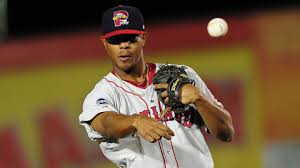
  (Image from Milb.com)

Xander Bogaerts: The Red Sox wisely held onto Bogaerts this trade deadline, the crown jewel of their farm system, and the consensus top shortstop prospect in baseball. The 20 year-old has thrived following a promotion to AAA, with a .282/.378.477 line in 47 games along with a .387 wOBA and 139 wRC+, despite a BABIP% of .311, 31 points lower than his minor league career average. Impressively, the youngster has posted a 12.4 BB%, and has actually cut his strikeout rate from 21.6% to 16.9% after being promoted from AA to AAA. Bogaerts has excellent bat speed and real power, and hit a couple balls hard the other way, including a fly ball to the wall in right-center. While Bogaerts appeared to recognize off-speed pitches well, he swung through several breaking balls, including three straight in one poor at-bat. Improved patience will be key for Bogaerts to realize his full potential at the next level.

Tall and lean at 6’3 and 185 pounds, Bogaerts looked smooth at the shortstop position. He flashed some nice range making a sliding backhand play and putting plenty on the throw to first. While he may eventually outgrow the position his defense is sufficient for the major-league level. In the best-case scenario, Bogaerts provides elite-level offense combined with solid defense from the shortstop position a la Troy Tulowitzki or a young Nomar Garciaparra. Bogaerts may have the opportunity to make a Manny Machado-like impact as a late-season call-up. With Stephen Drew being a free agent this offseason, Bogaerts will likely have the opportunity to win the Red Sox starting shortstop job in 2014, which would be his age-21 season. Nomar Garciaparra, the last great Sox shortstop, took over the position full-time in his age-23 season.
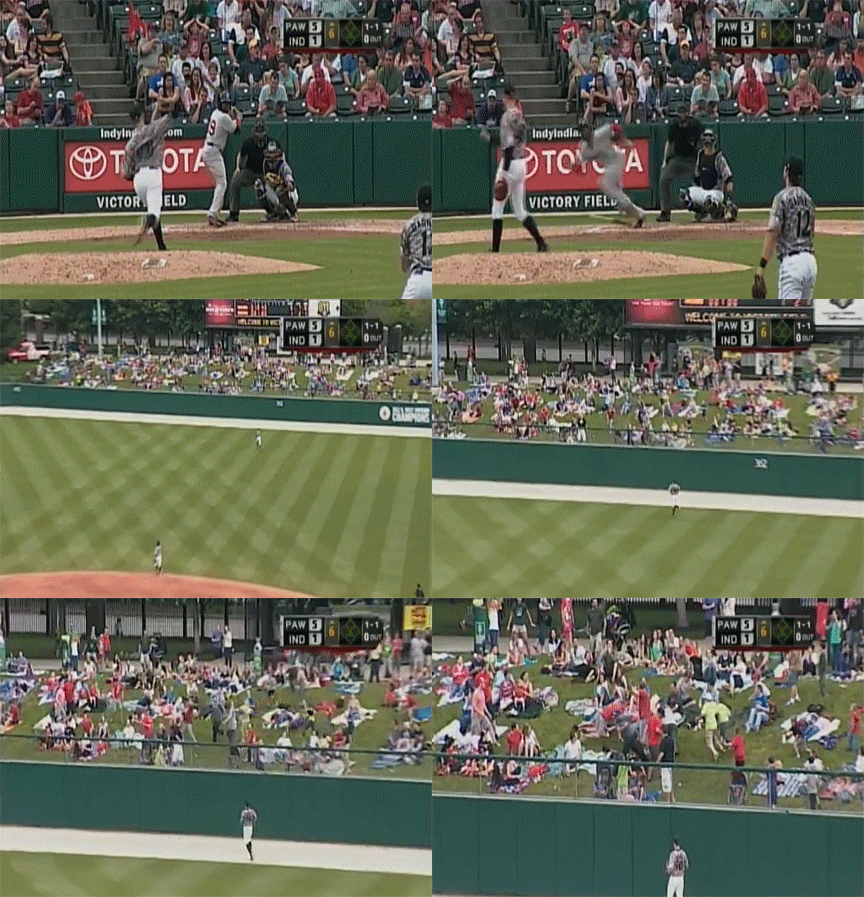
Jbj-hr (overthemonster)

Jackie Bradley Jr.: An outstanding spring earned Bradley Jr. a starting spot in left field for the Red Sox.  He then promptly reminded fans how little spring stats mean, as he has posted a .155/.258/.310 slash line, with a .259 wOBA and 54 wRC+, compiling a -0.4 fWAR in 23 games. A 30.3 K% hampered him in 66 PA with the Sox. Fortunately, his minor league stats have shown much more promise, as he is currently at .278/.378/.489 with a .388 wOBA and 140 wRC+ with Pawtucket. Bradley Jr. has also exhibited good patience with a 12.3 BB%. Plate discipline has been a strength of Bradley Jr’s. game, as he has posted a 14.0 BB% and a 16.7 K% over his minor league career. While his career minor league BABIP% of .350 will likely fall some at the big league level, it will certainly be higher than the .194 this year, with his true talent likely being in the .310 range. Though Bradley is only 31/46 in stolen bases for his professional career, scouts have noted his base running chops. Additionally, his speed, range, throwing arm and instincts give him the potential to be a plus defender. With the likely departure of Jacoby Ellsbury this offseason, JBJ will have every chance to win a starting spot in 2014.
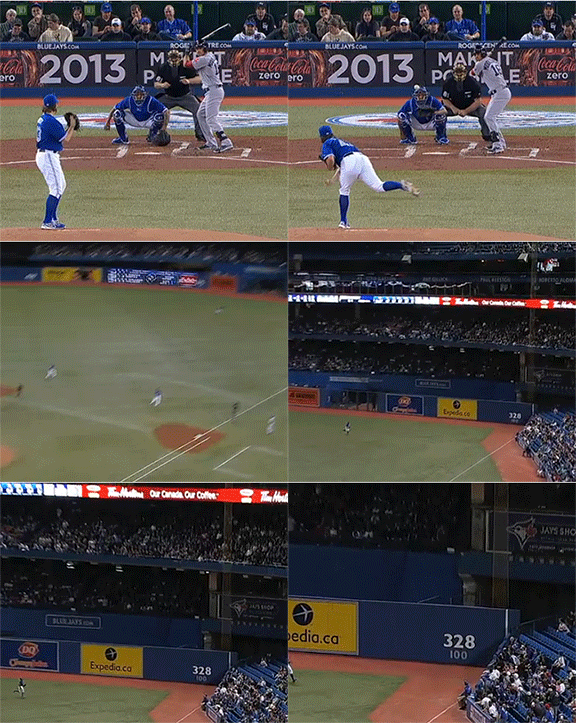
Middlebrooks-dickey-homer-1_medium (GIF from SBNation)

Will Middlebrooks: Middlebrooks burst onto the scene last year, offering a bright spot for the Red Sox during a mostly dismal 2012 campaign. He slashed his way to .288/.325/.509 with a .357 wOBA and 122 wRC+ compiling 1.9 fWAR before a broken bone in his hand ended his season after 75 games. These numbers may have obscured his plate-discipline issues, as his strikeout and walk percentages were 24.5% and 4.5%, respectively. However, 2013 has not been so kind to Middlebrooks, who was sent down on June 25. At the time of his demotion, he was .192/.228/.389 with a woeful .266 wOBA and 60 wRC+, posting a -0.6 fWAR. His K% increased to 27.8%, with his BB% at 4.2%. A major culprit of his struggles are BABIP-related.  In 2012 his xBABIP% was .336, and his actual BABIP% was .335.  This neat symmetry has been dashed in 2013 as his xBABIP% is .327, a far cry from the .221 he has experienced. Furthermore, his struggles have been compounded by a HR/FB % that has dropped from 21.4 to 15.0 despite his average fly ball distance experiencing a small increase from 278.9 to 280.4. Middlebrooks’ batted ball profile suggests that his poor offensive numbers are due for a positive correction. In 40 AAA games Middlebrooks has shown improved contact skills, posting a K% of 18.8% with a BB% of 8.0%, improvements on his career minor league rates of 25.6% and 7.5%. He showed more patience at the plate when I saw him, laying off several breaking balls, and pouncing on a hanger. His BABIP% of .281, compared to his minor league career average of .346, has limited him to a solid but unspectacular .339 wOBA and 107 wRC+. Middlebrooks showed a strong arm and good athleticism and footwork at third, but he occasionally gets sloppy on his throws and his range to his left could be improved.

While Middlebrooks’ stock may have fallen with his struggles in the majors this year, and less than great AAA results, Red Sox fans should not lose faith. His stellar results in 75 games in 2012 may have caused some fans/personnel to gloss over his raw plate approach. While pitchers seemed to do a better job of exploiting that weakness before Middlebrooks’ demotion in 2013, at least some of his poor results can be attributed to a .221 BABIP. His contact rate in AAA has been an improvement on his career minor-league numbers, and despite fewer of those balls in play going for hits, he has managed decent numbers. If Middlebrooks can hold a K% and BB% around 20% and 6-7% at the next level, he should be a very productive player for the Red Sox, as his BABIP% will likely undergo positive regression to go along with his excellent power.


 (Image from overthemonster)

Allen Webster: Webster had a rough go of it over six starts at the big-league level, as the 23-year-old right-hander posting a 9.57 ERA in 26.1 innings with 21 strikeouts and 14 walks and a whopping 7 home runs. While his DIPS numbers were less awful, his 6.57 FIP and 5.07 xFIP earned him a -0.3 fWAR. Nevertheless, Webster showed some promise. Despite a strikeout rate of only 16.4%, Webster’s contact rate was only 71%, well below the MLB average of 78%. When I saw Webster June 28 against Toronto, I was impressed by his fastball, which ranged from 92-97 with sinking action that produced lots of ground balls. In six starts his GB% is 41.8. For the season, his fastball has averaged 94.1 mph, which is 18th highest among pitchers with 20 or more innings. His changeup, which he throws 26.8% of the time is his favorite secondary offering. At an average of 85.3 mph there is good separation from the fastball, and it showed good depth and tilt. His slider, which he throws only 9.8% of the time looked promising, with some late bite. It averages 84.5 mph. He mixed in a couple curveballs at 77mph, but this looked like more of a show-me pitch than something Webster can feature. Generally Webster had a smooth, clean delivery, and his 6’3 frame allowed him to get a good plane on his pitches. His release point faltered as he tired in the 5th and 6th innings. Webster’s control and command will have to progress to realize his potential as a starting pitcher, as his professional walk rate of 10% is on the high side. If Webster can lower his walks and import his minor league 22.3 K% and 3.09 FIP, he could be the Red Sox #2/3 pitcher. If not, his fastball velocity will likely slot him into a high-leverage relief role.
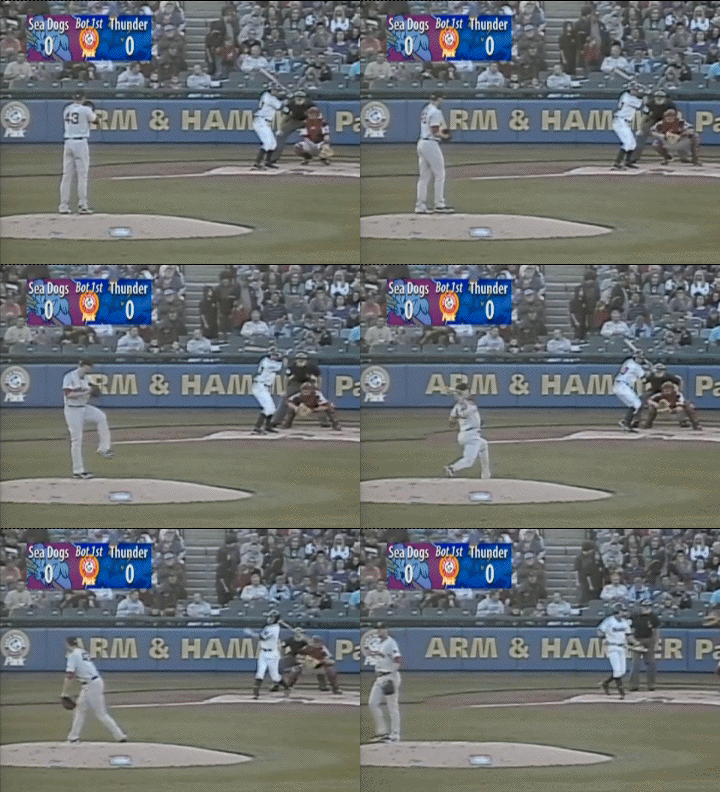
Anthony_ranaudo_curveball_4_27_13_medium (GIF from SBNation)

Anthony Ranaudo: The 6’7 225 right-hander from LSU was the 39th overall pick for the Sox in 2010. After posting a 2.95 ERA, 3.51 FIP, 24.0 K%, and 9.7 BB% in 109.2 AA innings, he earned a promotion to AAA.  I caught Ranaudo’s first AAA start, and he went 6 shutout innings with 5 strikeouts and no walks, throwing 85 pitches, 56 for strikes. His fastball was in the 89-92 range, and gets up to 94. It had good sink and a downward plane and produced lots of ground balls. He features a curveball at 75-79 with good downward break as this grainy GIF shows. His changeup could develop into above-average pitch, but is currently an inconsistent offering. Ranaudo’s stock has risen significantly after a lackluster 2012 in AA where he walked 27 hitters in 37.2 innings before having his season shut down due to injuries. If his shoulder and elbow hold up, Ranaudo could be a solid #3 starter at the next level.
 (Image from mlblogs.com)

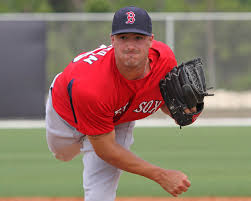
Brandon Workman: The tall right-hander was optioned to Pawtucket following the acquisition of Jake Peavy. In 4 appearances at the big-league level (3 starts) and 20.1 innings, Workman posted a 3.54 ERA with a 2.75 FIP and 3.11 xFIP, accumulating 0.7 fWAR. Additionally, Workman had stellar strikeout and walk rates at 26.8% and 4.9%, respectively. His repertoire consists of a fastball which has averaged 91.8 mph, and a cutter, curveball, and changeup, which have improved to become average to above-average pitches. Workman has had consistent success throughout the minors, with a 23.4 K%, 6.9 BB% and 3.33 FIP. Moreover, he has been durable, throwing nearly 400 professional innings over 2+ seasons. While Workman will be pitching out of the bullpen in Pawtucket with the possibility of returning to the majors in that role down the stretch, long term he projects as a quality back-end innings eater. At his worst he is probably a lower-leverage bullpen arm.

 (Image from randombaseballstuff)

Bryce Brentz: A power-hitting outfield prospect for the Sox, Brentz is likely to miss the remainder of the season following right-knee surgery to repair a torn meniscus suffered on a slide into second base July 5th. Brentz also missed spring training in 2013 after accidentally shooting himself in the leg. Prior to the knee injury Brentz had a slash line of .272/.321/.487 with a .359 wOBA and 120 wRC+. Brentz’s biggest weakness is recognizing breaking balls, and he has posted 2013 strikeout and walk rates of 23.5% and 5.9%, respectively. His impressive minor-league stats are fueled in part by a career .332 BABIP, which is likely to fall to the .260 range at the major-league level. Brentz is not a great runner, and the knee surgery will likely affect his slightly below-average range. A former two-way player, Brentz does feature a very strong arm which resulted in 10 outfield assists in 87 games in 2012. Brentz is unlikely to post high walk rates, so future big league success will depend heavily on tapping into his impressive raw power while keeping his strikeout rate from ballooning above the 20-25% range.

Stats provided by Baseball-Reference, FanGraphs, and baseballheatmaps.com. Thanks to Marc Hulet’s prospect rankings for additional insights.


Why the Blue Jays should have dealt Casey Janssen

The Blue Jays were in a tough spot this trade deadline. They came into the season with huge expectations and as you may know they have failed to live up to those lofty expectations. They should have been sellers in my opinion this deadline; instead they decided to hold, which is understandable as most of the core is at least signed though next season. Casey Janssen is considered one of those core pieces.

With that being said here are three reasons why I think that Janssen should not be a core piece and should have been dealt this past deadline.

Reason #1 Get a piece for the future.

Here’s how Janssen compares to the other “proven closer” who got traded this deadline.

Name  IP BB% K% HR/9 BABIP LOB% GB% HR/FB ERA FIP xFIP WAR RA9WAR
Casey Jannsen 34.1 6.7% 25.4% 0.26 0.225 67.6% 48.3% 3.7% 2.36 2.32 3.03 1.1 0.9
Jose Veras 44.0 8.1% 25.6% 0.82 0.234 76.7% 45.9% 9.3% 2.86 3.39 3.56 0.6 0.9


The numbers are similar but clearly Janssen has been better this season, meaning he could have brought back something better than Danry Vasquez who the Astros got for Veras. That type of prospect could have helped the Blue Jays’ depleted system recover somewhat from all the off-season trades.

Reason #2 Blue Jays have a replacement closer in the wings.

If Janssen had been dealt the Blue Jays could have handed the closer’s job to all-star Steve Delabar. Delabar has all the traits you look for in a closer: he throws hard, averaging a touch over 94mph this season. He gets strikeouts, 13.59 K/9 and 34.7% K rate. He is also getting good results sporting a pitching triple slash line (ERA/FIP/xFIP) of 2.90/2.44/3.11.  He also doesn’t have a platoon issue, allowing a .297 wOBA against righties and a .304 wOBA against lefties. I don’t see how the Blue Jays management could have a problem giving Delabar a shot at the closer’s job if they had dealt Janssen.

Reason #3 Janssen is declining

This is the big reason why the Blue Jays should have dealt Casey Janssen. His skills are declining and selling him now would have been the perfect time before he potentially implodes next season. Here’s why I see Janssen declining and not being the same next season. He will turn 32 this September so he is on the wrong side of the pitcher aging curve. He is at that age where across the board numbers usually begin to decline, and we are already starting to see that this season.  Let’s start with velocity; he is down almost 2MPH this season from 91.7mph the last 2 seasons to 90.0mph this season. We know velocity is highly correlated with strikeouts so it’s not surprising to see a significant drop in both his K/9 and K%. His K/9 is down from 9.47 last season to 8.91 this season and his K% has dropped from 27.7% to 25.4%. His swinging strike rate has never been great but it peaked last season at 9.5% which was just barely above the league average. It has dropped back to 2010-2011 levels at 8.2% and is now below average. His O-Swing rate is down, which leads me to believe his stuff isn’t fooling batters as it had in the past, and it supports why his walk rate has shot up from 1.55 BB/9 last season to 2.36 this season.

We can clearly see his skills are declining, but despite all that Janssen has managed to post the best FIP and xFIP of his career. I see this as being significantly influenced by luck. He is posting the lowest BABIP of his career at .225 vs. a career .290; his HR/9 and HR/FB% are also at career lows sitting at 0.26 and 3.7% respectively. Pitching in Toronto you have to figure there is no way he keeps suppressing home runs at his current rate.

To sum this up, we have a closer who has declined across the board, who will be 32 next month, and who is getting results by suppressing home runs in a hitter-friendly park. Yet he was kept around despite the possibility of being able to get a decent prospect and having a potential closer replacement waiting. But hey who knows what will happen in a year from now, maybe Janssen will keep it up for one more season and make me look like an idiot, but I wouldn’t bet on it.


What Kind of A-Rod Will We See?

News Today

     The Yankees welcomed Third Baseman Alex Rodriguez in Chicago today to make his season debut tonight against the White Sox.  A-Rod is expected to be in the lineup, returning to his original position for the club.  The other major event on Monday is Commissioner Bud Selig announcing the suspensions of 12 players for 50 games, and Rodriguez’s 211 game suspension, which takes effect  on Thursday, August 8th.  This has been appealed by A-Rod already as reported by the MLB Twitter account.   A-Rod will be on the active roster through the appeal process, and  should be able to play a few weeks before his status is ultimately decided on, so what can we expect to see from him on the field?

Click for a Full-size Image

Looking at his Performance

     Rodriguez played in 15 minor league rehab games to ease his return to the big leagues from off-season hip surgery. In those games, he hit .214 with a double, and 3 HR, while driving in 10 runs.  In this extremely small sample size of varying levels, it’s difficult to make any reasonable assessment.  However, we can look at a few peripheral statistics to try and gauge they type of A-Rod we’re going to see.  In his 51 minor league plate appearances, A-Rod struck out 13 times and walked 6.  This leads to a 25.5% K-Rate and an 11.8% BB-Rate.  The small sample size accounts for a large amount of error, but these numbers don’t appear to be too drastically apart from his usual self.  A-Rod’s career K-Rate is 18.2%, and it is 19% over the last five seasons.  As he’s aged, Rodriguez’s strikeout numbers have marginally increased, and seems to be following that trend.  He walked 10.9% of the time over his career, and 11.3% over the last five seasons.  A-Rod has become a more disciplined hitter with time, as pitchers have also been more cautious and pitch around him at the plate.

     Due to A-Rod’s K% and BB% in the minors seeming to be fairly stable compared to his past performance, I believe that we’ll see A-Rod maintain his current career trajectory.  His durability is not what it has been in the past, but he should return to the player he would’ve been in 2013, injury or not.  I don’t see a sudden huge drop-off, or surprising upturn in performance happening.

Career Trajectory

3
Click for a Full-size Image

     The following three plots show A-Rod’s Career trajectory in OPS (On-Base Percentage Plus Slugging Percentage), wOBA (Weighted On-Base Percentage),wRC+ (Weighted Runs Created, adjusted to the league where 100 is average), and WAR/162 (Wins Above Replacement prorated for 162 Games).  In all of the categories, higher numbers indicate a better performance.  I used 4th power exponential trend lines to approximate in all of these cases except for WAR, where I used a 6th power polynomial to account for the increased variance.

Click for a Full-size Image

     The reason for choosing a 4th degree polynomial is that I believe it truly reflects the path of A-Rod’s career.  He burst on to the scene during his first full year in 1996 with the Mariners, as he was named an All-Star, won the Silver Slugger Award, and finished 2nd in MVP voting.  His line that year was .358 / .414 / .631 and an OPS of 1.045.  Rodriguez experienced a “Sophomore Slump” if you can call it that where he hit a measly .300 / .350 / .496 and an OPS of .846, garnering his second All-Star Game appearance.  it would take A-Rod two more years to return to his 1996 performance, causing this first curve.  This curve started slowly climbing upward in 2001, his first year with the Rangers where Rodriguez admitted steroid use due to the pressure he felt to perform.  He reached his peak in 2007, an MVP season where he hit .314 /.422 /.645 with an OPS of 1.067 and 54 Home Runs, the most of his career.

Click for a Full-size Image

     This is where his current downward trend begins, as A-Rod began creeping into his mid-late 30s which bring us to where we are today.  I’ve indicated A-Rod’s drop-off since 2007 by the vertical black lines.  Notably, A-Rod’s agent Scott Boras announced during the Game 4 of the 2007 World Series, as the Red Sox were about to clinch a championship, that Rodriguez would be opting out of his contract.  The Yankees initially didn’t want to negotiate with A-Rod, but later signed him to a new deal, worth $275MM over 10 years.  Seeing A-Rod’s current decline, this was not a good move for the Yankees.  However, this was perfect for A-Rod, as he secured the deal coming off of an MVP caliber season when his value was the highest.  It’s just Boras working his magic again.

     Alex Rodriguez is on a downward decline, but as stated earlier, we should see a version of A-Rod resembling what he would be if he never missed time for injury.  This is a much needed boost for the Yankees, as their 3B for the year have accumulated a -0.9 WAR, which is 26th in the league.  With A-
Rod, who I projected to have a 2.1 WAR, the Yankees greatly improve at his position.  Assuming A-Rod plays 15 games before we know the results of his appeal, he’ll accumulate a 0.19 WAR, while the Yankees other 3B options would produce a -.08 WAR based on their performance this season.  This is a 0.27 WAR swing for the Yankees.  If you prorate this over a 162 game season, this would be a 2.92 WAR improvement which is on the Solid Starter/Good Player borderline.  For however long the Yankees have Alex Rodriguez in the lineup, he will be a huge improvement in their lineup.  It’s just a question of how well A-Rod can focus on playing during one of the most controversial and stressful times in his long career.


The Curious Case of Cody Dent

From my personal blog: msilbbaseball.wordpress.com

Path to the Draft

     What’s the usual story with first-year draftees?  They put up stellar numbers in college and/or high school, but can’t replicate those numbers after they’re drafted due to better competition in the minors.  A college All-American who hit .400 can struggle to stay above .200 as they adjust to minor-league ball.  It’s nothing to worry about, just the way things go.  So what would you expect to see from a college senior infielder, converted outfielder, converted back to infielder who hit .176 in 330 career at-bats, who didn’t hit a home run until the end of his last season, and who only had six extra-base hits in his entire college career?  I’d have my doubts that this player would even record one minor-league hit.  However, I present to you Cody Dent, the man who’s mirroring the trend.

Speaking of home runs, his father did this.

     Cody played for four years at the University of Florida, and reached the College World Series three times.  Throughout his career, he was a light-hitting utility infielder who saw a majority of his time as a defensive replacement.  During his senior year, Dent started 48 games for the Gators, but his struggles at the plate still remained.  Cody hit .233 his freshman year, then .207, .134, and .169 in each subsequent season.  But, he’s 6th on UF’s all-time sacrifice bunt leaderboard with 26 in his college career.  So, that’s something; It seems like he’d make a good-hitting pitcher.

Cody Dent Bunting for the University of Florida

     Dent’s bright spot was the 2011 NCAA Tournament, where he played in and started 11 games, and hit .273 with a double, triple, and 4 RBIs as the Gators made it the championship series in Omaha.  He was named to the All-Tournament team.  Following his senior season, the previously undrafted Dent was selected by the Washington Nationals in the 22nd round of the 2013 First-Year Player Draft, likely/hopefully for his defense.

Faux-Struggles?

     As a student a the University of Florida, I attended a large amount of baseball games, and I always rooted for Cody to do well.  He never showed negative body language, and went about his business professionally.  Also, he was the king of the “at ’em ball”.  I can’t count how many times he’s hit a rope right at an outfielder.  I always imagined what kind of horrible BABIP Dent would have, so I calculated it.  During his senior season, Cody Dent had a .193 BABIP.  With an average BABIP ranging from about .290 – .310, this created a huge dent in his average (pun intended).  Some players have established BABIPs in a different range (ex. Miguel Cabrera and Ichiro Suzuki around .345), however .193 can not be the true average for an SEC starter with MLB bloodlines.  By personally watching Dent play, I can also attest that he’s better than the numbers show.  I consider BABIP to be a measure of luck, and use it to determine whether a player is playing at their true ability.  A BABIP far under the average means that a player is under performing, and a BABIP far above the average means that a player is over performing.  To re-iterate, Dent’s senior BABIP was .193.  This, coupled with only an 11.7% Strikeout Percentage (K%) creates a sense of hope that Cody could grow into a serviceable/not as dreadful bat.

Dent’s Adjusted AVG

Professional Performance

     So what does he do during his first 27 games in Short-Season A ball?  Hit .278/ .365 /.300 with a .326 wOBA and a 108 wRC+.  With 100 being the standard average for wRC+, this means that Cody Dent is an above-average producer in Short-Season A ball.  ABOVE AVERAGE!!!  Considering the offensive woes he went through as a Gator, this is absolutely huge.  Maintaining his improved offense will be a challenge for Cody, as he’s in danger of regressing.  Dent’s minor-league BABIP is .387, way above average, and astronomically above his college numbers.  Is this a sign of the real Cody Dent?  Is he having a lucky month?  Or has Cody Dent gone through enough punishment and suffering from the baseball gods that they’re rewarding him for his perseverance?  It’s time to sit back and watch The Curious Case of Cody Dent.

Like Father, Like Son

     Also, now he’s breaking up perfect games. This came against the Lowell Spinners, the Boston Red Sox’s New York-Penn League team.  The pure perfection of this can’t be explained. Cody “Bleeping” Dent!