Archive for Player Analysis

Putting Manny Machado’s 2013 in Context

Even as a fan of a different AL East team, seeing Manny Machado go down with a knee injury this Monday saddened me. Fortunately, reports indicate the injury is not as serious as originally feared, and Machado could return for spring training. Machado is part of a class of young stars that have simultaneously taken baseball by storm and wrecked the grading curve for everyone to come after them. People are already giving up on Jurickson Profar because he isn’t a star at an age when most players are in Low-A ball. Bryce Harper ranks in the top 20 in the MLB in wRC+ at the age of 20, and hardly anybody notices.  Anyways, I digress. So where does Machado’s age-20 season rank?

Machado compiled 6.2 WAR in 2013, good for 10th in the MLB. In the last 55 years, only Alex Rodriguez in 1996 and Mike Trout in 2012 have posted a higher WAR in their age-20 season. Of course, there were some better seasons before then, but Machado probably wouldn’t have been allowed to play in those days.

Unlike Rodriguez and Trout, Machado’s offensive numbers, while impressive for a 20 year-old are league average overall. A-rod had a 159 wRC+ in ’96, and Trout had a 166 wRC+ last year. Machado managed a 101 wRC+, providing most of his value with the glove. UZR credited him with 31 runs saved, best in the majors. After a very hot start that was fueled by an inflated BABIP, Machado slowed down.

Month wRC+ BABIP
Mar/Apr 122 0.355
May 156 0.387
June 107 0.372
July 42 0.210
Aug 122 0.340
Sept/Oct 39 0.227
1st Half 119 0.361
2nd Half 73 0.260

So what can Orioles fans expect from Machado going forward?

Machado is an aggressive contact hitter. His walk rate of 4.1% is one of the lowest in the MLB, and his strikeout rate of 15.9% is well below the MLB average. While Machado will never be Joey Votto, the walk rate will improve as he matures. His minor league walk rate was above 10%. Additionally, Machado should hit for more power. I could just say that he hit 51 doubles and those will turn into home runs. But, that would be lazy, and doubles don’t always turn into home runs as a player develops. Sometimes they turn into singles. Just ask Nick Markakis.

However, there are other reasons to believe Machado will hit for power. First of all, he has excellent bat speed, and there’s no lack of raw power. Some of the home runs he has hit are very impressive. Of the 14, ESPN Home Run Tracker classifies 10 of them as either No Doubters or Plenty.  The average speed off the bat was just a shade behind Robinson Cano. Furthermore, despite playing in one of the best home run ballparks in the league, and having an average fly ball distance on par with Nick Swisher, Machado’s HR/FB ratio of 7.9% is in the bottom third of the MLB. Bet on this ratio improving. While he does have a very high rate of infield flies (9th in MLB), he should be able to bring that down with improved discipline.

Hopefully for Orioles fans and baseball fans, Machado will have a complete recovery from his knee injury. It might be hard to live up to expectations after producing a 6.2 WAR season at age 20, but with improved offense Machado could be up to the task. Expect the plate discipline and power to improve, as the defense inevitably regresses from a season that stretched the upper bounds of UZR. It’s a very small group he’s in, but star players at age 20 tend to be stars at 25.


A Pure Measure of Fielding Ability: Predictive Ultimate Zone Rating

image from thefarmclub.net

Throughout the pre-sabermetric revolution days of baseball, the statistics that determine fielding ability (namely errors and fielding percentage) had generated much criticism of fielding stats and undeserving gold glove award winners (Derek Jeter et al), and had kept fielding ability a mystery. However, this mystery in part led to the sabermetric revolution in baseball statistics. In the current day and age, with improved measures of performance available publicly, measuring fielding ability is somewhat less of an enigma, but still far from perfect.

One of the most often used fielding metrics in this day and age is UZR or Ultimate Zone Rating (click the link for an excellent FanGraphs explanation). Instead of counting perceived plays and errors, UZR records every batted ball hit to each of the numerous zones on the baseball field at each trajectory and the runs lost/saved as the fielder gets to the ball or falls short. This is found by matching the average result of the play with the Run Expectancy Matrix. Therefore, UZR provides a very accurate measure of how valuable that fielder was in terms of runs saved/lost over the course of the season.

However, there are major problems with UZR. Sample size issues cause large fluctuations from month to month and even year to year. Moreover, it does not provide a stable basis of fielding ability. Even when all players’ impacts are averaged to a constant, UZR/150, averaged to runs saved/lost per 150 defensive games, the metric is very volatile.

The reasons behind this might actually be easier to identify and correct than you might think. Let’s face it: not all fielders get the same amount of balls hit to them in the same place at the same trajectory within the same number of outs or innings. Infielders with a good knuckleballer on the mound and a slap hitter at the plate are going to get more grounders to each zone than infielders whose teams have fly ball pitchers on the mound and face lots of power hitters at the plate.

However, while the actual amounts may fluctuate from pitcher to pitcher and hitter to hitter, many fielders get a decent sample size of each batted ball to each zone over the course of multiple seasons. Even with a staff of fly ball pitchers, infielders will still handle their fair share of ground balls to each zone over the course of a season. So if there was a way to average all the pitchers and hitters together and measure the value and frequency of making a play in each zone based on the entire AL, NL, or MLB* average batted ball chart, then we could create a similar metric that would be more predictive, rather than purely descriptive.

*The purpose of separating the leagues is the discrepancy of hitting ability with the DH in the AL and the increased frequency of bunts (from pitchers) in the NL.

If we take the average percentage of batted balls to each zone with each trajectory for the AL, NL, or MLB and multiply that by the average runs saved/lost for plays made or missed in that zone, we can find a universal batted ball sample from which to apply the fielders’ impact. While this would not be directly proportional to the runs saved/lost for the fielder during that season for that pitching staff and the batters faced, it would be a metric independent of the impact that the pitcher and hitter has on the fielders. It would measure pure fielding ability over multiple seasons in the form of runs saved, but unbiased by the specific ratio of batted balls per zone and trajectory hit to the fielder over the seasons.

Predictive UZR will have sample size issues but when taken over multiple seasons, a starting fielder should get his fair share of batted balls hit to each zone with each trajectory. The percentages for his success rates at each zone and trajectory can then be applied not to the actual ratio of batted balls per zone hit his way (from his team’s pitching staff and hitters faced) but rather the average ratio of batted balls per zone hit in the entire AL, NL, or MLB.

Both UZR and Predictive UZR are very valuable for different things. UZR is a good reflection of the fielder’s direct impact on defense for the season. However, this might not accurately reflect the fielder’s true talent level because of the assortment of batted balls hit his way. Predictive UZR, while not a concrete reflection of the past runs saved, is a more pure measure of fielding ability. It can provide a number that, when compared to UZR, tells which fielder got lucky and which fielder did not, based on his pitching staff and the hitters faced. Another interesting twist the concept of Predictive UZR brings is that it can be based on the average batted ball chart of teams, divisions, and differing pitching staffs in addition to the AL, NL, or MLB. So a fielder’s projected direct impact, or UZR, can be transferred more easily as he moves from team to team, forming the basis of more accurate fielding projections.

Predictive UZR is not by any means a substitute to UZR, but rather complements it and works with it in intriguing ways. It is a concept worth looking into that has the potential to leave fans, media and front office personnel better informed about the game of baseball.

Nik Oza
Georgetown Class of 2016
Follow GSABR on twitter: @GtownSports


Robinson Cano and the Value of Turning Two

Note: I have no idea if I’m the first to do this, but quite frankly I don’t care.

It’s no secret that Yankees second baseman Robinson Cano is an all-around excellent player, as he’s on his way to his fourth consecutive 5-win season. It’s also no secret that he’ll be a free agent after this season, and will certainly receive a contract in the nonuple figures. As the Angels have shown these past two offseasons, when you spend that much money on one player, you’d better be sure he’ll be worth it; the Yankees already have experience with terrible contracts (contracts they’re still due to pay for), so they’ll have very little room for error. Thus, executives of any and every team that might be interested in Cano will be doing their research, scouring the earth for any warning signs of a possible decline.

But back to Cano’s performance at the moment. While Cano is a superb player overall, much of his value comes from his bat; over this current 4-year 5-WAR streak, he’s been the seventh-best offensive player in the majors. The (relative) caveat in his game, therefore, is his defense: over that same span, he’s just 76th in fielding in the majors. Defensive statistics are subject to year-to-year fluctuations, and the fluctuations of Cano’s defense have been well documented. However, there’s a specific aspect of his defense that I’d like to focus on for the time being.

As you probably should know, UZR–the main defensive statistic at FanGraphs–is composed of four parts: RngR, which measures how many runs a player saves or costs his team with his range; ErrR, which measures how many runs a player saves or costs his team by committing or not committing errors;  ARM, which measures how many runs a player saves or costs his team with his arm in the outfield; and DPR, which measures how many runs a player saves or costs his team by turning or not turning double plays. This last segment is the one that is so interesting, at least to me, because it’s the one that Cano is the worst in the league at.

No, really. Among 79 qualified infielders¹, Cano’s DPR of -3.6 is the worst, and the next worse player (Neil Walker) is a full 1.2 runs away, at -2.4 DPR².

Now, the real question becomes: what (if anything) does this mean? Obviously, when you’re preparing to give someone a contract that could exceed the GDP of whatever the fuck this country is, you’d prefer if he wasn’t the absolute worst in the majors at something, even a seemingly trivial thing like turning double plays. Still, though, it’s worth asking: what, exactly, is the significance of this?

There are a few different ways of looking at this; for the purpose of this post, I divided my analysis into 5 main categories:

1. Is this a fluke?

As I mentioned before, year-to-year defensive statistics can be quite fickle, so it’s best to gain some historical perspective when evaluating a player’s defense³. So, does Robinson Cano have a history of being a bad double play turner?

Well, on the one hand: In 2011, he was 6th out of 73 qualified infielders in DPR; in 2010, he was 13th out of 81; and in 2007, he was 2nd out of 89. These numbers would suggest that his horrific 2013 has been a fluke, except…

Last year, he was 61st out of 76; in 2009, he was 77th out of 81; in 2008, he was 67th out of 78; in 2006, he was 62nd out of 89; and in 2005, he was 75th out of 77.

Add it all up, and since he entered the league in 2005, Cano is 83rd out of 95 qualified infielders in DPR. However, it should be noted that before this year (i.e. from 2005 to 2012), Cano was 55th, a much more respectable figure, if not a particularly great one.

So, overall, it’s fairly safe to conclude that Cano has something of a poor history of turning double plays. What next?

2. Does a poor DPR correlate to poor defense in other areas?

To answer this question, I’ll bring up a few graphs. These’ll show us how well DPR this year has correlated to RngR…
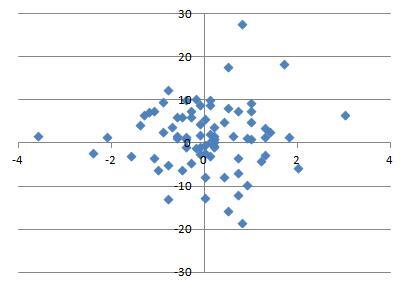
DPR-RngR

…ErrR…

DPR-ErrR

…UZR…

DPR-UZR

…and finally, whatever that Def stat is.
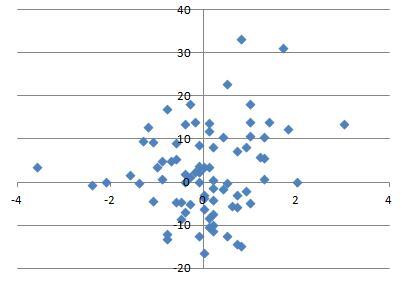
DPR-Def

In case you were wondering, the R-squared values for these graphs were .000669, .004252, .028772, and .032933, respectively.

So there’s clearly no correlation between DPR and any other defensive statistic, which brings up the original question: What’s the point of all of this? Well…

3. Just how bad is a -3.6 DPR?

Quite bad, it turns out. In the illustrious 12-year history of the stat, the only worse seasons were Jas0n Bartlett in 2009 (-4.2)⁴, Yunel Escobar in 2008 (-3.7), and Omar Vizquel in 2005 (-4.0).

Again, this takes me back to my original point: when a player’s going to be paid a yearly salary that will exceed the total gross for this shitty movie, you generally don’t want him mentioned among the worst players in history (albeit a very short history).

Still, though, these three were/are good defensive–and all-around–players for the majority of their careers. So what’s to worry about?

4. How have players with similarly poor DPRs done in their seasons?

For this one, I’ll expand the criteria to all seasons with -3 DPR or worse; other than Cano this year, there are 11 such seasons:

Player Year DPR
Neil Walker 2011 -3.2
Jason Bartlett 2010 -3.1
Yuniesky Betancourt 2010 -3.5
Jason Bartlett 2009 -4.2
Placido Polanco 2008 -3.1
Yunel Escobar 2008 -3.7
Brian Roberts 2007 -3.2
Luis Castillo 2006 -3.0
Omar Vizquel 2005 -4.0
Jimmy Rollins 2002 -3.1
Jose Vidro 2002 -3.5

Of these 11 seasons, the average WAR was 2.8, less than half of Cano’s WAR this year. The highest WAR was Bartlett’s 5.3 in 2009⁵, but overall the results were much lower.

So it would appear that Cano’s done something relatively new this season–play at a very high level while having a substandard DPR–but this still doesn’t answer the main question. I’ll answer that next, and the results are intriguing:

5. How have other players with DPRs this bad done for the rest of their careers?

Let’s continue to look at these 11 seasons. How were these players before and after their -3 DPR season?

Player WAR-Pre WAR-Post Off-Pre Off-Post Def-Pre Def-Post
Neil Walker 1.5 2.7 7.4 6.7 -6.8 -0.1
Jason Bartlett 3.5 0.8 4.4 -16.7 10.5 5.4
Yuniesky Betancourt 0.4 -1.4 -15 -23.8 -1.4 -7.7
Jason Bartlett 4.1 1 6.2 -11 14.1 0.9
Placido Polanco 3.3 2.2 1.8 -10.3 11.3 11.9
Yunel Escobar 3.6 3.1 10.2 -0.5 6.4 10.9
Brian Roberts 3.1 2.4 5.4 3.9 5.5 0.1
Luis Castillo 2.5 1.7 1 -0.8 4.6 -1.8
Omar Vizquel 2.4 1 -8.8 -24.5 12.8 14.6
Jimmy Rollins 1.4 3.4 -5.3 4.5 0.1 10.2
Jose Vidro 2.3 1.2 10.3 1.2 -5.2 -9.8
Average 2.6 1.7 1.6 -6.5 4.7 3.2

(All values are per 600 PAs. Year of DPR is included in Pre.)

They all saw a noticeable drop off in their WAR; the only ones whose WAR increased were Rollins and Walker, and they had their bad seasons when they were young. Given that Cano will turn 31 in October, it’s safe to say this will not happen to him. Since Cano is getting older, a decrease in WAR to some degree should be expected, especially considering the volatility of his position; this has been covered before, though.

What I found interesting, though, was that the players’ defense (as measured by that fancy new Def stat) didn’t really drop off much after the bad DPR year, but their offense seemingly fell off a cliff. This goes against the theory of player aging curves (that offense can get better as players get older, but defense tends to just decline overall).

Obviously, this is a very small sample size, and to extrapolate anything meaningful from it would be foolish. Also, it’s pretty unlikely that the decline was caused by one bad year turning double plays.

This post as a whole was probably rather cockamamie⁶, but then again, everything I post here tends to be. I just hope I was able to raise some interesting questions about how much turning two matters to a player’s overall worth. Perhaps, years from now, when the Yankees are paying Cano $30 million a year to hit .250 with poor defense, and the Orioles have won the division year in and year out, I’ll be able to look back with pride at my prescience.

Or maybe, the Yankees will just win more World Series with or without Cano, while the Orioles dwell in mediocrity every year.

A man can dream, though….

——————————————————————————————————————

¹For some reason which escapes me, there isn’t an option to sort the leaderboards by solely infielders, even though there’s an outfielder option.

²Hopefully, you would’ve figured that out on your own, but I put it in there just to be safe. Also: All stats are as of Saturday, September 21st, 2013.

³Otherwise, you’ll end up with pieces-of-shit “analysis” like this.

⁴Bartlett also had a DPR of -3.8 in 2006, but he didn’t qualify that season.

⁵That was his ridiculous fluke season–you know, the one that Joe Maddon just gets out of every scrub the Rays find on the street.

⁶You have no idea how long I’ve waited to use that word.


On Slow Fastballs

While thinking about Jeff’s post on the fastballs of over 100 miles per hour, I thought it might be informative to look at the pitchers who have pitched their fastballs the slowest this year.  No, it’s not as flashy as those who live at the top of what’s humanly possible, but it makes for an interesting contrast.  What’s more, you’ll often hear broadcasters say something along the lines of “you don’t need to throw 100 if you can locate your fastball.”  Is that true for pitchers who aren’t anywhere near 100?

There have been 683 fastballs this season (as of September 13th) that registered below 80 MPH according to pitch f/x (grouping together fastballs, 4-seamers, 2-seamers, and cut fastballs).  Two men alone account for 526 of them, with a third adding another 80.  Any guesses on who they are? (Hint: Jamie Moyer is retired.)

Read the rest of this entry »


Starters Destined for the Bullpen

Relievers tend to be failed starters. Most front offices have come to realize that a closer or a late-inning arm is not worth a big multi-year deal or a first-round draft pick. Instead, general managers are building quality bullpens out of failed pitching prospects, former starters, and journeymen relievers. Find a hard thrower who hasn’t managed to develop a full repertoire and stick him in the bullpen where he can air it out for one inning and get by throwing only one or two pitches. Or get a starter with wild platoon splits and convert him into a specialist who gets same-handed hitters out. Look at the Royals or the Rangers bullpens, the league leaders in relief WAR. Other than a post-Tommy John surgery Joe Nathan, you won’t find a big name there, or a big salary (Nathan’s 2/14 is the most expensive).

By initially using Z-Contact%, and then looking at factors such as pitch mix, walk rates, and fastball velocity, I identified six pitchers who I think are likely to end up in the bullpen. Three of the pitchers have trouble missing bats, despite being hard throwers, and a trip to the bullpen might allow them to pick up some extra velocity while focusing on a more limited repertoire. The other three have swing and miss stuff, but factors such as a lack of control or durability, or difficulty in developing secondary pitches have limited their effectiveness as starters.

Has a Fastball But Not Much Else

Joe Kelly has appeared in 57 games for the Cardinals since 2012, 28 of them being starts. Despite averaging over 94 mph on his fastball, Kelly has been more of a groundball pitcher. As a starter in 2013, he has posted strikeout and walk rates of 13.5% and 9.8% respectively.While Kelly’s changeup is solid, his curveball and slider are likely not good enough to keep him in the starting rotation. Despite Kelly’s smaller frame, he has managed to avoid the longball. Unless the 25 year-old masters a third pitch, the bullpen is a good spot for him.

Tyler Chatwood has started 17 games for the Rockies this season, and thanks to very high groundball rates has done well, even with poor strikeout and walk rates. As the righthander is only 23, I may be jumping the gun on calling him a relief pitcher, but his declining velocity and reliance on the fastball signal reliever to me, not to mention his undersized frame. While he has improved on his career strikeout and walk rates of 13.4% and 10.3%, his rates this year are still below average. Chatwood’s changeup is below average, and he needs to develop a reliable pitch to get lefthanded hitters out. Moving to the bullpen may preserve his velocity and allow him to focus on his slider.

Henderson Alvarez has started all 54 games he has appeared in since 2011. After returning from a long DL stint, Alvarez has shown some improvement from his 2012 season when he posted strikeout and walk rates of 9.8% and 6.7%, respectively. However, the righthander had had difficulties with lefthanded hitters, as his wOBA splits of .374/.248 show. Much of this is due to his struggles with his changeup. Alvarez has gained confidence in his slider, and it has been effective against righties. The 23 year-old will get a chance to stick in the Marlins rotation, but his smaller frame, limited pitch mix and injury history will likely relegate him to the bullpen.

Misses Bats…And the Strike Zone

Alexi Ogando has bounced around between the bullpen and the starting rotation. He started in 2011, relieved in 2012, and is starting in 2013. However, he has had durability issues. His second-half numbers in 2011 dropped off significantly with increasing innings, and he has taken two trips to the DL in 2013. Furthermore, his fastball velocity is down from 95.1 in 2011 and 97.0 in 2012 to 93.1 in 2013. This has caused his swinging strike rate to plummet from 13.2 to 7.9.  His walk rate is also up significantly. Ogando was strong as a starter in 2011, and he still shows swing and miss stuff, but a return to to the relief role he held in 2012 would do him well, particularly if Joe Nathan departs as a free agent.

Nathan Eovaldi is a 23 year-old flamethrowing righthander. However, the young hurler has not yet developed a reliable secondary pitch. Accordingly, his strikeout rate is well below the league average. Also, while his control has been better this year, he still walks hitters at an above-average rate. Though his fastball can get whiffs as shown by his above-average swinging strike rate, his lack of secondary pitches has given him difficulty in finishing off hitters. He had some success with his slider in 2012, but has struggled to command it consistently in 2013. If Eovaldi can stay healthy and learn a secondary pitch, he will remain a starter. More likely, he will slot into a high-leverage bullpen role where he can focus on airing out his already potent fastball.

Tim Lincecum won back-to-back CY Young awards in 2008 and 2009. The last couple years have not been as kind to Lincecum. His fastball velocity has dropped by 2 mph, and his walk rate has gone up. Furthermore, his HR/FB ratio has shot up to the 13-15% range, well up from his career rate of 9%. Lincecum still has swing and miss stuff, as his swinging strike rate has not dropped off from his career rate. Lincecum was utilized as a multi-inning reliever in the 2012 World Series, and dominated in that role. While Lincecum proved a lot of skeptics wrong by remaining healthy in a starter role, transitioning to the bullpen can maximize his effectiveness. However, depending on how much money he signs for this offseason, his new team may have an incentive to try and keep him in the rotation.

While a good starting pitcher will always have more value than a good relief pitcher, moving these pitchers to the bullpen can maximize their productivity. All of them profile as at least solid relievers, and at this point in their careers, I have my doubts that any of them, with the possible exception of Lincecum, can handle the rigors of starting.


The Oakland A’s and Winning Without Good Starting Pitching

The Oakland Athletics starting pitchers have posted a 106 xFIP-, and accumulated 9.5 WAR, figures that are 23rd and 19th in the MLB, respectively. As the below table shows, pitching independent stats do not show much love for the Athletics starting pitchers, with their walk rate being the only number not around the bottom third of the league.

 Stat xFIP- K% BB% GB% WAR
 Number 106 17.8 6.7 38.8 9.5
Rank      T-23rd         21st         T-7th          30th       T-19th

However, the A’s starting pitchers fare better in terms of defense-dependent stats, and with the exception of Brett Anderson, they have managed to stay healthy.

 Stat ERA- BABIP LOB% HR/FB RA9 WAR Innings
 Number            97        0.273          73.7            9.7          12.0        862.2
Rank        T-7th            1st         T-6th            7th           8th            5th

Finally, to give you an idea of how pedestrian their staff has been (at least in terms of sabermetric numbers, more on that later), I prepared a table of the A’s starting pitchers this year.

Pitcher Innings xFIP- K% BB% BABIP LOB% HR/FB WAR Fbv
Bartolo Colon 164.1 104 13.0 3.8 0.297 77.8 5.8 3.0 89.7
Jarrod Parker 176.1 110 16.8 7.9 0.256 75.4 9.0 1.7 91.7
Dan Straily 134.1 110 19.4 8.5 0.271 71.2 9.2 1.4 90.4
Tommy Milone 143.0 109 17.7 6.1 0.283 71.7 11.1 1.0 87.1
A.J. Griffin 182.0 107 19.8 6.6 0.250 77.2 12.3 1.2 88.9
Sonny Gray 39.0 73 24.4 6.4 0.264 67.2 6.7 1.1 92.9
Brett Anderson 23.2 91 21.3 11.7 0.366 55.6 17.6 0.1 91.2

The Coliseum is the 8th-most difficult park in terms of hitting home runs, and the A’s fly ball rate of 42.0% leads the MLB (no other team gets a higher percentage of fly balls than groundballs). Gray has been excellent in the six starts he has made, with a 53.7 GB%. Other than Anderson and Gray, no A’s starting pitcher has a GB% above 42.3%. Put a team full of fly ball pitchers in a big ballpark with a good outfield defense, and you have a recipe for overachieving peripherals. This helps explain how the A’s starting pitchers have managed to put together a 3.79 ERA despite a 4.25 xFIP, easily the biggest positive gap of any team.

Except for newcomer Gray (18th overall in 2011), the A’s have not used high draft picks to get these pitchers. In fact, since 2003, the A’s have only selected four pitchers out of their nineteen first round picks. Colon was an inexpensive free-agent signing. Parker and Anderson were acquired in trades with the Diamondbacks where the A’s gave up Haren and Trevor Cahill after getting some solid years out of those arms. Milone, a former 10th-round pick, was acquired as part of the Gio Gonzalez trade. Straily was a 24th-round pick in 2009. Griffin was a 13th-round pick in 2010. If you click on the links, (or just keep reading) you will find out that one other player from those two rounds has reached the majors. (Keith Butler, who managed a 5.44 xFIP in 20 innings with the Cardinals this year). Most players drafted in those rounds are no longer playing affiliated baseball, not starting games for a playoff-bound team.

As the A’s starting pitchers are currently 23rd in the MLB in xFIP- and CoolStandings puts their playoff odds at 98 percent, I thought it would be interesting to see how many teams had made the playoffs with their starting pitchers possessing a cumulative xFIP- of 106 or worse. As xFIP- only goes back to 2002, the search was restricted to the 2002-2013 era.

The 2011 Diamondbacks finished 94-68, winning the NL West.  Diamondbacks starting pitchers posted a 107 xFIP, good for 25th in MLB. Thanks to some innings eaters, they tallied 12.0 WAR, 15th in the MLB. Like the A’s, the Diamondbacks had a staff of fly ball pitchers, as they posted the lowest groundball percentage in the league. Despite playing at cozy Chase Field, their HR/FB ratio was only 9.8%, due in part to their rotation getting the fourth-highest infield-fly rate. They also had the third-lowest walk rate in the MLB. Featuring an outfield of Chris Young, Gerardo Parra, and Justin Upton, the Diamondbacks led the MLB in UZR. The rotation featured excellent seasons from Ian Kennedy and Daniel Hudson, with a side of Josh Collmenter. Nobody else reached +1 WAR. The Diamondbacks beat their Pythagorean record by +6 wins. Their 28-16 record in 1-run games was the best in the MLB.

Okay, so only one team has made the playoffs with an xFIP- of 106 or worse, and the 2011 Diamondbacks were knocked out in five games by the Brewers. So, to see if I could include some more teams, I expanded the search to include teams whose starting pitchers finished 23rd or worse in xFIP-.

The 2006 Mets won the NL East, going 97-65. Their starting rotation  featured a 104 xFIP-, which was 24th in the MLB. Like the A’s and Diamondbacks, this was a staff of flyball pitchers, which finished 28th in groundball percentage. Outfielders Carlos Beltran and Endy Chavez ran down many of those flyballs. Unlike the A’s and Diamondbacks, the 2006 Mets were heavy on strikeouts and walks. The staff finished 8th in strikeouts and 7th in walks. Overall, the starting rotation was 26th in WAR, with a 40-year-old Tom Glavine leading the team at +2.5, followed by 34 year-old Pedro Martinez and 36 year-old Orlando Hernandez at +2.0 and +1.7, respectively. Headed by Billy Wagner and Aaron Heilman, the Mets bullpen finished 2nd in WAR and xFIP, and 4th in innings. Mets hitters also finished 7th in wRC+. Furthermore, the Mets beat their Pythagorean record by +9 wins, going an MLB-best 31-16 in 1-run games.

The 2006 Oakland A’s won the AL west at 93-69 with a starting rotation that had a 104 xFIP, 23rd in the MLB. That staff featured strong years from Barry Zito and Dan Haren, who helped the A’s rotation throw the 4th most innings in the MLB, which allowed them to accumulate a more respectable 11.9 WAR, 17th in the MLB. Unlike this year’s version of the A’s, the 2006 staff was middle of the pack in groundball percentage. The bullpen featured contributions from a bevy of relievers, finishing 5th in relief WAR, despite throwing the 7th fewest innings. The hitters were patient but generally lacked power, as they finished 2nd in walk rate and 25th in ISO. An old Frank Thomas and a young Nick Swisher combined to hit over 40 percent of the team’s home runs. The fielding was solid but far from spectacular. Like the Diamondbacks and Mets, they beat their Pythagorean record by a substantial margin.  Their 32-22 record in 1-run games helped them finish with +8 wins.

And that’s it. No other team has made the playoffs since 2002 after having their starting pitchers finish 23rd or lower in xFIP-. To tally it up, that’s one team that has made the playoffs with a starting rotation that posted an xFIP- of 106 or worse, and only two more that made the playoffs while finishing 23rd or worse in xFIP-, one of those being the A’s. The A’s success this year isn’t quite unprecedented, but it’s close. Unlike the other teams mentioned, the A’s have played to their Pythagorean record. Rather than emphasizing velocity (A’s starters are 28th in fastball velocity) Billy Beane has sought out young strike throwers who can stay healthy (and Colon, an old strike thrower). By putting them in a big ballpark with good outfielders, the A’s have managed to make below-average starting pitchers look solid. Billy Beane and the A’s are finding a way to beat sabermetric pitching stats such as xFIP and FIP.  By drafting pitchers later and making the most out of less than electric arms they have managed to insure themselves against the risks associated with young pitchers.


John Axford: the Cardinals’ newest reclamation project

On Friday the Cardinals acquired Brewers reliever John Axford for a player to be named later. While dominant in 2010 and 2011, Axford’s lackluster performance since 2012 has many Cardinals fans uninspired by the move. In fact, most of the media attention has centered around his public farewell to Milwaukee fans.

Bernie Miklasz of the St. Louis Post-Dispatch offered his own analysis of the deal, calling it a “smart gamble” for the Cardinals. In addition to acknowledging Axford’s well documented HR/FB% struggles, Miklasz highlighted that the former closer has been particularly challenged by an ineffective fastball and poor performance in high-leverage situations.

PITCHf/x data on Axford’s fastball:

Year

Pitches

LD%

OPS

wOBA

2011

838

18.0%

.670

.300

2012

1018

24.1%

.844

.360

2013

636

31.9%

.835

.367

Axford’s performance in high-leverage situations:

Year

IP

LD%

OPS

wOBA

2011

30.1

7.2%

.427

.202

2012

26.2

28.1%

.772

.336

2013

11.1

28.6%

1.094

.450

FanGraphs readers will know that Cardinals GM John Mozeliak and his organization’s pitching staff have developed a reputation in recent years for quietly acquiring mediocre pitchers and helping them reach previously unimagined levels of success on the mound. To the extent that Mozeliak and company have similar designs for Axford, one must ask how they plan to help him reclaim his once dominant form.

The Cardinals may suggest any number of tweaks to Axford’s approach, but smart money has them coaching him to focus on throwing more first-pitch strikes. Jeff Sullivan recently reminded us of the importance of pitching ahead, and its import is surely not lost on manager Mike Matheny and pitching coach Derek Lilliquist. Since 2012, Redbird pitchers rank tops in the majors in terms of throwing first-pitch strikes.

Team

IP

F-Strike%

Reds

2682.1

62.4%

Cardinals

2670

62.4%

Yankees

2649.2

62.4%

Phillies

2663.1

62.3%

Braves

2659

62.2%

Diamondbacks

2674.1

61.8%

Rays

2657.2

60.7%

Tigers

2661

60.7%

Rangers

2656.1

60.7%

Pirates

2665

60.6%

In the same piece, Sullivan also noted that since arriving in St. Louis in July 2012, Edward Mujica has established himself as the league leader in first-pitch strikes, increasing that figure from a pedestrian 60.9% in 2011 to an elite 75.6% in 2013. Doing so has no doubt played a large part in his improved performance in high-leverage innings.

Mujica in 2011 with the Marlins:

Split

IP

OPS

wOBA

Low Leverage

31.1

0.556

0.242

Medium Leverage

29.2

0.656

0.284

High Leverage

15.0

0.781

0.325

Mujica in 2013 with the Cardinals:

Split

IP

OPS

wOBA

Low Leverage

20.2

0.561

0.244

Medium Leverage

16.2

0.518

0.222

High Leverage

20.0

0.529

0.234

While Mujica’s 2011 performance in high-leverage situations was not nearly as poor as Axford’s has been in 2012 and 2013, there exists a similar opportunity for improvement.

Specifically, Axford is getting absolutely crushed when behind in the count this season.

Axford’s 2013 pitching splits:

Split

IP

OPS

wOBA

Through 3 – 0

1.2

0.855

0.440

Through 3 – 1

3.1

1.383

0.555

Through 3 – 2

8

0.948

0.409

Through 2 – 0

8

0.981

0.412

Through 1 – 0

24.1

0.960

0.410

As they did when acquiring Mujica last year, look for the Cardinals to initially deploy Axford into low-leverage situations in which he can regain his confidence and focus on getting ahead in the count. If successful, one would expect the club to move Axford into higher-leverage situations, particularly if Mujica or Trevor Rosenthal wears down or runs into trouble down the stretch.


Concerning Jim Johnson and Groundball Relievers in General

Despite leading the AL in saves,  Orioles closer Jim Johnson is having a rough year compared to 2012 when he posted a 2.51 ERA and saved 51 games in 54 opportunities. Early in 2013, an enthusiastic Orioles sportswriter named Johnson the best closer in baseball, a statement that doesn’t look quite so good a few months later. As a closer who relies on the groundball, Johnson is something of an odd bird (pun intended). In 2012 his 15.2 K% ranked 130th out of 136 qualified relievers and his Zone-Contact% was 2nd highest. This year his 18.0 K% ranks 111th out of 140 qualified relievers and his Zone-Contact% is 9th highest. While Johnson has struck out a few more hitters, he has also walked slightly more, from 5.6% to 7.1%, and his groundball rate is down. Overall, his fielding-independent numbers are basically the same as last year. Various explanations have been offered for Johnson’s lack of success in 2013 compared to 2012. Bill Castro, the Orioles interim pitching coach (check out his 1979 season) attributes Johnson’s struggles to overthrowing, and a failure to locate down in the zone which has resulted in less early contact outs. I prepared the following chart to check up on these explanations.

Bottom Third% MiddleThird% UpperThird% 2-Seam velo Z-Contact% GB%
2012 14.0 14.5 8.3 94.2 92.9 62.3
2013 14.5 14.4 7.7 93.7 90.6 56.2
    Career 14.7 14.6 8.3 94.2 90.2 57.5

So Johnson is throwing slightly more pitches in the lower third of the zone, and actually getting more swings and misses on pitches in the zone. The overthrowing statement seems faulty, as Johnson’s velocity on his sinker is actually down. A look at the Pitch f/x data shows that his sinker has flattened out slightly from last year, though the difference is slight overall. The following chart shows what kind of contact batters are making off Johnson compared to last year.

BABIP HR/FB HR% HR Per Contact
2012 0.251 6.8 1.1 1.4
2013 0.323 12.5 2.1 2.9
          Career 0.286 8.0 1.5 2.0

And to go in even more detail the following two charts show BABIP by zone and then the slugging by zone for Johnson.

BABIP
Lower Third Middle Third Upper Third
2012 0.289 0.296 0.259
2013 0.292 0.486 0.423
               Career 0.286 0.298 0.343
SLG
Lower Third Middle Third Upper Third
2012 0.294 0.283 0.516
2013 0.321 0.561 0.515
               Career 0.331 0.382 0.503

So balls put in play against Johnson have been falling for hits more frequently this year and those hits have been more damaging in each third of the strike zone. In particular, the pitches Johnson has thrown over the middle have been getting hammered. Last year, the results on those pitches were quite tame. Granted, this is a pretty small sample size of balls in play, and nowhere near the point where BABIP is expected to stabilize, but it goes to show that Johnson has not fared nearly as well when hitters are making contact in 2013. But, this is not an uncommon issue for high-contact, groundball pitchers. David Robertson can suffer through a .335 BABIP in 2012 and still post a 2.67 ERA on the strength of a 32.7 K%. Pitchers like Johnson who cannot strike out hitters regularly are subject to variance on batted balls. Take a look at most groundball, contact-type pitchers, and you’ll find years where BABIP and ERA go through the roof. With the 60-70 inning seasons relievers work, the results can get skewed very badly. To get a sense for where Johnson stands relative to other groundball relievers, I did an analysis of all qualified relievers since 2002 and separated the 30 highest and 30 lowest groundball rates (Johnson was 24th).

GB% K% BB% BABIP LOB% Fbv Fb% HR% HR Per Contact WAR/60 IP SD/MD
League 44.1 19.5 9.5 0.292 73.3 91.5 62.8 2.4 3.5 0.3 1.7
GB-Heavy 60.5 16.9 9.1 0.294 73.0 90.3 72.7 1.7 2.3 0.4 1.7
GB-Light 31.2 24.4 8.7 0.264 77.0 91.2 64.7 3.0 4.6 0.6 2.3

So not a whole lot of good things to say about the groundball heavy group. Jonny Venters was the only member of the group with a strikeout rate above 20%. They limit home runs pretty well, which is to be expected with so few fly balls. However, many of those groundballs are going for hits, while fly balls that aren’t leaving the yard are twice as likely to be outs.  That 30 point difference in BABIP is pretty huge, and that’s over a sample of more than 20,000 balls in play for each group. Overall, the decrease in home runs isn’t worth the extra hits and walks. With guys like Kenley Jansen and Rafael Soriano, it’s not surprising that the fly ball group features a much better ratio of shutdowns to meltdowns. For the most part, the groundball group is filled with situational guys that have bounced around with sporadic success. While relievers of all types tend to be unreliable, groundball and contact types are subject to the additional randomness of batted ball variance.

Seasons with inflated BABIP and ERA should be an expected consequence for a contact pitcher like Johnson. Of course, it would have been very difficult for the Orioles to demote Johnson to a lower-leverage bullpen role after the success he had in 2012. However, all signs indicate that Johnson is an average bullpen arm whose performance last season far outweighed his ability. He is better suited for the role he played in 2010 as a mid-leverage arm who was not limited to one inning. The Orioles should look for a strikeout arm for high-leverage situations. While Buck Showalter has consistently defended Johnson, not too many managers will bring back a closer after a season leading the league in blown saves.


Paul Goldschmidt and his Five Tools

Typically when people think of five-tool players they think of guys like Mike Trout, Andrew McCutchen or Carlos Gonzalez. Basically up-the-middle players who do everything well. Paul Goldschmidt however is not an up-the-middle player but I believe he does have the five tools.

For those who don’t know the five tools are what scouts use (among other things) to evaluate a player. The five tools are hitting for power, hitting for average or contact ability, defense, arm and finally speed.

When looking at Goldschmidt the one tool that stands out is his power. He put up at least a .600 slugging percentage (SLG) and at least a .290 isolated power (ISO) and 2 seasons of 30 home runs in his 3 minor league seasons. His power has showed in the majors as well. In 2012 his first full season in the majors he hit 20 home runs, had a .490 SLG and a .204 ISO. This season his power has taken another step forward. He currently has 31 home runs, .548 SLG and a .251 ISO, all of which currently lead National League first basemen. I specify National League here because that Chris Davis guy has been pretty darn good this season.

Goldschmidt’s hit tool is solid but not close to as good as his power tool. With that being said Goldschmidt is still coming into his own in terms of contact rate. His contact rate has improved each season he has been in the big leagues as per pitch f/x, it rose from 70.7% in 2011, to 77.1 in 2012 and to 78.7% this season. With that contact rate increasing his strikeout rate, as to be expected, has decreased at roughly the same rate. His strikeout percentage has dropped from 29.9% in 2011, to 22.1% in 2012 and to 20.6% this season. Batting average is never the best way to evaluate a player but it does judge a players’ hit tool. His BA has risen from .250 in 2011 to.286 in 2012 to .298 this season. His BABIP is high this season at .333 but it is actually down from last season’s .340.  He had very high BABIPs in the minors and from his batted-ball profile looks like he may be a guy who consistently posts BAPIPs above .300.

His defense is again a work in progress. Defensive numbers take about three seasons to become relevant and we don’t quite have that yet but we do have 2695.2 innings for Goldschmidt at 1B. In those innings he has shown to be an above average defender. This season Goldschmidt has an ultimate zone rating of 4.9 which is fifth among qualified first-basemen. Over the last three seasons Goldy’s UZR is 2.9 which among first basemen with a minimum of 2500 innings ranks 7th out of 13. Essentially an average defender. DRS however tells a different story, this season anyway. Per DRS Goldy has been among the best fielding first basemen. He has saved 11 runs, which is tied for the lead with Adrian Gonzalez and Anthony Rizzo.

A first baseman’s arm is very difficult to judge as it is hardly ever needed. To my knowledge  there are not yet stats that judge a player’s arm. So the only way to evaluate a player’s arm is by scouting the player. I did a quick Google search trying to find a scouting report on Goldschmidt’s arm and I found nothing. Thankfully FanGraphs has a feature where fans can submit their reports on players. Of course this isn’t the most accurate analysis, but it will do. The fans gave Goldschmidt a 48 (0-100 scale) in arm strength in 2011 and a 44 arm strength in 2012. His accuracy was given a 53 and 41 in 2011 and 2012 respectively. We can conclude from this that Goldschmidt has about an average arm.

Finally the last tool to look at is arguably Goldy’s second-best tool, his speed.  Goldy stole 18 bases last season which was tops among qualified first basemen. This season he has 13 which again is tops among qualified first basemen. There is more to speed than just pure stolen bases, the ability to go first to third or score from second on a single.  There is a stat that measures this, called base-running runs above average (BsR). It takes all base-running into account including steals and caught stealing. Goldschmidt has again been elite in this category. This season he has been worth 1.2 runs above average which is 4th among first basemen. Last season he was worth 3.2 runs above average which was tops in the National League and second to only Eric Hosmer.

To conclude, perhaps Goldschmidt is not the five-tool player I had anticipated. He does however have 2 very elite tools in his power and speed. He has 2 average tools in his contact rate and defense. His arm is average to below average but for a first basemen that’s not too important. He isn’t quite a five-tool first baseman but 4 average to elite tools with only 1 below average tool make him about as close to a complete-package first baseman as you’re going to find in the game today.


Pitcher STUFF Ratings or, It’s Too Bad Rich Harden Couldn’t Stay Healthy

Of course, the concept of “stuff” is very subjective, and my formula is not so much of an attempt to quantify a subjective concept as it is an attempt to measure how well pitchers do things we associate with great stuff. Because I used Pitch f/x data exclusively, the ratings were limited to pitchers from 2007 to the present.

My formula is ((4*O-Zone Swing% *O-Zone Whiff%)+(3*Whiff%)+(5*Zone-Whiff%)+(2*IFFB%)*(FBv/100)*(4))

I will probably tinker with the formula, and will welcome any suggestions with regards to improving it. I have only applied it to starting pitchers. Of course it can be applied to relievers, but their scores run much higher unless some kind of a “relief penalty” is applied. The STUFF ratings for all starting pitches who threw at least 160 innings since 2007 run between 3.4 and 9.7. The following list presents the top 15 career STUFF pitchers since 2007.

1. Rich Harden 9.7. If you’re having trouble remembering just how filthy Harden could be, visit his player page. Harden got swings and misses like no other starter. In 2008 he had an unearthly 48 ERA- and 68 xFIP- despite the fact that injuries had already started to take their toll on his fastball velocity, as it dropped to 91.7, compared to 94.1 the year before. In 141 innings in 2009, he got whiffs on 22.6% of swings on pitches in the zone. Max Scherzer, the 2013 leader in that category, gets whiffs in the zone at an 18.4% clip. When Aroldis Chapman averaged 100 mph on his fastball in 2010, he sat at 21.9%. Unfortunately, a litany of injuries would decimate Harden’s career, and he was recently released by the Twins, an organization known for their disdain for swing and miss stuff.

2. Matt Harvey 9.4. The young right-hander with the dynamic fastball places near the top in all five of the STUFF factors, with only Scherzer, Harden, and Escobar topping his 17.6 Zone-Whiff%. Besides the fastball, Harvey also features a slider, curveball, and changeup. Harvey’s plethora of filthy offerings produces whiffs on over a quarter of his pitches overall. Furthermore, Harvey is one of the rare pitchers who has actually experienced an increase in fastball velocity since his debut season.

3. Yu Darvish 9.2. Darvish uses his assortment of pitches to produce whiffs on over half of swings at pitches he throws outside of the zone, easily the best in the sample. Combine that with a whiff rate of 15.9%  for swings on pitches in the zone and you get an overall whiff rate of 28.6%, also the best in the sample. Pitch f/x credits Darvish with six different pitches, four of which he throws at least 12 percent of the time. Though Darvish averages 92.9 mph on his fastball, he has thrown his slider nearly as often as his four-seamer and two-seamer combined. The unconventional approach has produced five games of 14+ strikeouts in 2013.

4. Kelvim Escobar 8.9. Escobar only had one year of data, but what a year it was. At the age of 31, Escobar’s fastball velocity surged to 94.1, higher than any of the pre-pitch f/x years, and he utilized an excellent changeup to get whiffs on over a third of swings at pitches he threw outside of the zone and a quarter of swings overall. However, in spring training of 2008, Escobar was diagnosed with a shoulder injury that required surgery and except for a 5 inning stint in 2009, he never returned to the majors.

5. Michael Pineda 8.7. Like Escobar, Pineda only has one year of data in the sample due to shoulder surgery. Elite fastball velocity combined with a slider that helped generate swings on a third of the pitches he throws out of the zone and contact on less than sixty percent of those swings earns him this ranking. The big righty also used his height to get one of the highest infield fly rates in the sample. Pineda was placed on the DL shortly after an August 2 rehab start resulted in stiffness in his shoulder, and it appears unlikely that the righthander will pitch again in 2013.

6. Matt Moore 8.6.While Moore’s fastball velocity has dipped steadily since he came into the league in 2011, its overall average is still 93.6. Moore’s ranking is based heavily on his 2012 STUFF rating of 9.3, his 2013 rating has fallen to 7.4. Moore has battled elbow soreness this year, and hopefully this will not be a long-term issue and he can return to the form that generated a dominant 19.0 Zone-Whiff% in 2012.

7. Francisco Liriano 8.6. Liriano’s slider has long been one of the best pitches in the game, and only Darvish can top his whiff rate on pitches outside the zone. Since joining the Pirates, Liriano has been using the slider even more, throwing it on 37.1% of his pitches. Liriano is also throwing his changeup more than he ever has before. While his 13.1 Zone-Whiff% in 2013 is one of the lowest numbers of his career, the offspeed pitches have resulted in a 36.1% chase rate, the highest of his career. It’s anyone’s guess as to how long Liriano’s oft-troubled elbow holds up, but Pirates fans should enjoy the ride while it does.

8. Cole Hamels 8.5. A master of deception, Hamels’ changeup has helped him produce a career whiff-rate of 24.5%. Among pitchers on this list, Hamels 90.9 mph fastball is faster than only fellow changeup artist Johan Santana. However, the 8-9 mph difference between his fastball and changeup produces a 33.8 chase rate, the 5th highest in the sample, and his 37.0 rate in 2013 leads the majors. Hamels has also been very durable, among the top 15 STUFF pitchers, only Justin Verlander has thrown more innings.

9. Stephen Strasburg 8.5. While Strasburg’s fastball velocity has fallen from its pre-Tommy John high of 97.6, his 95.9 average is still tops Felipe Paulino, the next closest in the sample by 0.7 mph. While we will probably not see the pure electricity of the pre-injury Strasburg which produced a 9.5 STUFF rating in 2010, Strasburg still gets whiffs on over 15% of swings on pitches in the zone and 25% overall. If the Nationals’ controversial innings-management plan pays dividends and the 25 year-old can stay healthy, he should be getting whiffs for years to come.

10. Max Scherzer 8.3.  It seems fitting that a noted sabermetrician would obtain a high ranking on a list based on Pitch f/x and batted-ball data. To the misfortune of AL hitters, Scherzer has vastly improved his secondary pitches while maintaining his fastball velocity. Before his trade to the Tigers, Scherzer threw his fastball over two-thirds of the time. With the Tigers, Scherzer’s fastball usage has decreased each year, and his use of secondary pitches, particularly his changeup, has increased. Not surprisingly, this has resulted in higher chase and whiff rates, and his Zone-Whiff%  of 19.9 since 2012 leads the majors.

11. Clayton Kershaw 8.1. Kershaw burst onto the scene in 2008 as a 20 year-old rookie with a 94 mph fastball and 73 mph 12-6 curveball. Since then he has added a slider to make life even more miserable for hitters. Kershaw ranks near the top in all five of the STUFF factors. Kershaw appears to be the odd bird that can use his pitch arsenal as much to suppress BABIP as to generate swings and misses, and this factor probably keeps him from being ranked even higher.

12. Tim Lincecum 8.0. You would be hard-pressed to find a smaller starting pitcher than Lincecum. While that height limits his ability to get infield flies, the dynamic changeup more than compensates for his lack of size. Of the top 15 pitchers, only Darvish and Liriano have higher whiff rates on swings at pitches out of the zone. Lincecum’s fastball velocity has steadily dropped from its high of 94.0 in 2008 to 90.2 in 2013. Since 2011, Lincecum has been throwing a slider more often, and while he has been prone to the longball, he still gets whiffs on a quarter of swings. While Lincecum is no longer the pitcher that won CY Young awards in 2008 and 2009, he is a very intriguing free agent, and at the least, it seems that he could be a dominant reliever.

13. Chris Sale 8.0. The lanky, or perhaps paper-thin lefthander has made a successful transition from the bullpen to the rotation. After experiencing a predictable velocity drop from the move, Sale has actually regained some of that velocity this year, as his fastball has jumped from 91.3 to 92.4. Since moving to the rotation, Sale has added a changeup to go along with his excellent slider. Sale’s herky-jerky sidearm delivery and late movement have helped him generate a 32% chase rate, 5th best among pitchers on this list. While concern’s about Sale’s elbow and durability are certain to persist, Sale is on pace for over 200 innings this year after throwing 192 last year.

14. Johan Santana 7.9. Shoulder troubles robbed Santana of some of his fastball velocity, and his average of 90.3 is the slowest among pitchers in the top 15. However, his changeup was devastating. In its heyday in 2007, Santana had a Zone-Whiff rate of 23.2%. While some of Santana’s best years were in the pre-Pitch f/x era, the Mets still got highlights such as a 36.0 chase rate in 2009, and the no-hitter in 2012. Santana’s changeup also had the effect of suppressing BABIP,  as noted by a .276 career mark. Of the top 15, only youngsters Harvey and Moore can top Santana’s 12.9 IFFB%.

15. Justin Verlander 7.9. It took Verlander a couple of years to fine-tune the curveball, but when he did, he started churning out elite swing-and-miss rates. Since 2012, Verlander has been utilizing the changeup more than the curveball, and it too has produced excellent whiff rates. The secondary offerings go along with an average fastball velocity of 94.8 that only the less battle-tested Stephen Strasburg, Matt Harvey, and Felipe Paulino can top. Since 2007, Verlander has thrown over a 100 more innings than Cole Hamels, the next closest person on this list.

Clearly, the list favors younger, less tested pitchers. But I don’t think there’s anything wrong with that. As pitchers age, their velocity declines, and while Felix Hernandez is a better pitcher throwing 92 then when he was a young flamethrower, he probably doesn’t create the same kind of excitement in fans or fear in hitters when he averaged 96 with his fastball.

I also made a list of the worst 15 starting pitchers by STUFF since 2007. I didn’t think it would be worth anyone’s while to go through the list, but suffice it to say that the worst three were Steve Trachsel, Sidney Ponson, and Livan Hernandez. Yeah, I’d say that sounds about right. Aaron Cook of the 1.9 K/9 in 2012 also made the list. The following table is a comparison of the best and worst 15 starting pitchers since 2007 by STUFF rating.

  BABIP        LOB% xFIP- ERA-
Best 15 0.284 75 85 82
Worst 15 0.304 74 107 112

So the best STUFF pitchers seem to have an ability to limit hits on balls in play and overachieve their peripheral stats, while the worst STUFF pitchers allow hits at slightly above the league average and underachieve their peripherals. Some of this is due to infield flies, which was a factor in the STUFF formula. The best 15 had an IFFB% of 11.0, while the worst 15 had an IFFB% of 7.4. But there are other factors involved. Tim Lincecum has a 7.4 IFFB% and a .296 BABIP while Nick Blackburn has a 8.6 IFFB% and a .309 BABIP while the BABIP of their respective teams since 2007 is .297 and .300. Both of these pitchers are well past the stabilization point for BABIP. So it seems that pitchers with dominant STUFF have some control over hits on balls in play outside of IFFB. Of course I cherrypicked an example, and I’m sure there are counterexamples, but the general idea seems good. Great STUFF can have an effect beyond generating swings and misses.