Archive for Player Analysis

SkaP: A New Metric to Measure Hitting Prowess

Before I explain to you what this new metric – SkaP – does, I am first going to warn you that I can’t provide you with a formula or individual statistics for it.  It’s a theory right now, and something for which I need access to data I don’t have in order to find a formula.

This statistic was inspired in part by Colin Dew-Becker’s article the other day here on FanGraphs Community Research.  In his article, he argued that the the way a hit or out is made matters – not just the result of the hit or out.  A single to the outfield, for example, is more likely to send a runner from first to third or from second to home than an infield single.  Likewise, a flyout is more likely to advance runners than a strikeout is.

This statistic was also inspired in part by UZR.  UZR attempts to quantify runs saved defensively by a player partially by measuring if they make a play that the average fielder would not.  In the FanGraphs UZR Primer, Mitchel Lichtman explains that

“With offensive linear weights, if a batted ball is a hit or an out, the credit that the batter receives is not dependent on where or how hard the ball was hit, or any other parameters.”

This means that a line drive into the gap in right-center that is a sure double but is caught by Andrelton Simmons ranging all the way from shortstop (OK, maybe that was an exaggeration) will only count for an out, even though in almost any other situation it would be a double.  The nature of linear-weight based hitting statistics (and most other hitting statistics as well) is that they are defense-dependent.  Hitters have been shown to have much more control over their batted balls than pitchers do, which is why so far only pitchers have commonly used defense-independent statistics, but it would probably be useful for hitting too, no?

Now, if we want a defense-independent and linear weights-based hitting statistic, it would not be possible to formulate something similar to the hitting equivalent of the current model  of tERA (or tRA) because that generalizes all batted balls into categories such as grounders, line drives, or fly balls, because hitters can control where and how hard and at what angle their batted balls are hit at least to some extent.  Instead, what I would use is something more similar to a hitting equivalent of this version of tERA I found on a baseball blog.  What that article proposes is something much more detailed than what we have now (by the way, tERA has been supplanted by SIERA, but is still an interesting theory).  Their idea is that instead of finding expected run and out values for grounders, line drives, and fly balls, find the expected run value for a ball, to use their words, “with x velocity and y trajectory [that] lands at location z.”  This is similar to UZR in that exact (or as close to exact as possible) batted-ball data is processed and the expected run/out values are calculated.

So now for the statistic:  SkaP, or Skill at (the) Plate, is a number that uses all that batted-ball data to find the expected run and out values of each at-bat.  It would weight the following things:  home runs (although maybe a regressed version could use lgHR/FB%*FB instead), walks, strikeouts, HBP, and each ball put in play by the player.  This makes it so that it is not defense-dependent, and so that Andrelton Simmons catching that sure double does not penalize the hitter.  I haven’t calculated this statistic, though, so I don’t know if this would be best as a rate, counting, or plus-minus statistic (maybe all three?).

There’s one catch to this, however:  Skill at the Plate is really only a measure of skill at the plate.  It doesn’t account for some batters’ ability to stretch hits or beat out infield singles.  Billy Hamilton is going to be more likely to reach on an infield single than Prince Fielder.  However, this stat would treat them both the same, and not reward Hamilton’s speed for allowing him to reach base on what might have most likely been an out.  It would be very hard to separate defense independence and batter-speed independence for hitting statistics, though, and I’m not sure it’s possible to do without an extreme amount of effort.  Maybe a crude solution would be to quantify a player’s speed using Spd, UBR or BsR and add it somehow to this statistic.

I can’t calculate this myself, as I don’t have access to Baseball Info Solutions’s (or some other database that tracks batted balls) data.  FanGraphs does, however, and I would love to see this looked into further.


The Dodgers and Jacoby Ellsbury

Before we start, I want to get a few things clear:

-Yes, I know the whole “Jacoby Ellsbury to the Dodgers” thing was probably a product of Scott Boras and the media.

-Yes, I know Matt Kemp should be ready by the start of 2014 to play center field.

-Yes, I know the Dodgers already have four outfielders, three of which have massive contracts, and three of which are injury prone.

-Yes, I know Ellsbury is injury prone. This example is operating in a vacuum.

-No, I don’t think the Dodgers will end up signing Ellsbury. There are just too many things that need to happen in order for the signing to make sense. And even then, depending on contracts, the signing STILL might not make sense due to Ellsbury’s injury history, along with how much money the Dodgers would have to eat on the contracts of their traded outfielders, and how badly that money would hamstring them for the future.

Okay. Now that we’ve gotten that cleared up, let’s begin.

The Los Angeles Dodgers, when healthy, have one of the best offensive outfields in the league. But, despite having a couple gold glove winners out there, they lack something when it comes to the fielding department, specifically in center field.

In 2013, the Dodgers trotted out five different players for a combined total of 1450.1 innings in center field, with Andre Ethier (645.1) and Kemp (576.1) getting the lion’s share of playing time. Now, Kemp hasn’t looked awful in center field (besides running into walls, which we’ll cover in a second), but UZR has less-than-friendly reviews on him. With Ethier, he looked somewhat usable while healthy in center, but just looked bad in the NLCS while trying to play with one good ankle. For the record, UZR gives Ethier a -1.8 for his efforts this season. The other three that played center for the Dodgers this season were Skip Schumaker (167 IP, -1.3 UZR), Yasiel Puig (55.1 IP), and Nick “Chili” Buss (6.1 IP). Schumaker shouldn’t be a starter, Puig’s natural position is right field, and I’m not even going to talk about Buss being in there as a viable option.

So, that brings us to comparing UZR for Kemp and Ellsbury.

Year Kemp (IP, UZR) Ellsbury (IP, UZR)
2009 1355.1, 3.2 1302.2, -9.7
2010 1346, -25.8 104.2, 1.3
2011 1380, -4.8 1358.1, 16.0
2012 911, -9.0 611.1, 3.0
2013 576.1, -16.2 1188.1, 10.0

If we take the three seasons with the greatest sample size, Ellsbury is clearly the optimal choice in the field. Granted, he doesn’t have the arm strength that Kemp has, but UZR factors that into its ratings as well. The signing of Ellsbury to play center field would likely move Kemp to left, and would make Ethier and Carl Crawford expendable. Moving Kemp to left field also saves him from the rigors of center field that have plagued him over the past couple years.

Offensively, the acquisition would be relative. Yes, Ethier would probably hit more home runs, but Ellsbury would offset that with stolen bases. In 2013, Ethier posted a wRC+ of 120 without being able to hit lefties at all (wRC+ of 73 vs LHP) and Ellsbury wasn’t far behind with a 113 RC+ and troubles against lefties of his own (w RC+ of 78 vs LHP). Ellsbury represents more of an upgrade in speed over both Crawford and Ethier, and would give the offense a new dynamic to go with Puig atop the order in front of Hanley Ramirez, Adrian Gonzalez, Kemp, and newly-signed Alexander Guerrero.

Given what a healthy Kemp has meant to this team in the past (which was just as recently as April, 2012), he is arguably the most important piece in their lineup. If moving him out of center field and into left field can save him from some of the numerous hamstring and shoulder injuries that he has experienced, it would be a huge win for the Dodgers to finally acquire a proper center fielder without giving up any value on offense.


Seeing the Complete Picture: Building New Statistics to Find Value in the Details

Attempting to accurately estimate the number of runs produced by players is one of the most important tasks in sabermetrics. While there is value in knowing that a player averages four hits every ten at-bats, that value comes from knowing that more hits tend to lead to more runs. On-base percentage became popularized through Moneyball in the early 2000s because the Oakland Athletics, among other teams, realized that getting more runners on base would lead to more opportunities to score runs.

Knowing a player’s batting average or on-base percentage can be informative, but that information does nothing to quantify how the player contributed to a team’s ability to score runs. The classic method for determining how many runs a player contributes to his team is to look at his RBI and runs scored totals. However, both of those statistics are extremely dependent on timely hitting and the quality of the rest of the team. A player will not score many runs nor have many RBI opportunities if the rest of the players on his team, particularly the players around him in the lineup, are not productive.

One of the more popular sabermetric methods to estimate a player’s run production is to find the average number of runs that certain offensive events are worth across all situations and then apply those weights to a player’s stat line. In this way, it doesn’t matter if a player comes to the plate with the bases loaded every time or the bases empty every time, just that he produced the specific type of event.

Here is a chart that shows the average number of runs that scored in an inning following each combination of base and out states in 2013^^.

Base State

0 OUT

1 OUT

2 OUT

0**

0.47

0.24

0.09

1

0.82

0.50

0.21

2

1.09

0.62

0.30

3

1.30

0.92

0.34

1-2

1.39

0.84

0.41

1-3

1.80

1.11

0.46

2-3

2.00

1.39

0.56

1-2-3

2.21

1.57

0.71

We can see in the chart that in 2013, with no men on base and zero outs, teams scored an average of 0.47 runs through the end of the inning.  If a batter came to the plate in that situation and hit a single, the new base/out state is a man on first with zero outs, a state in which teams scored an average of 0.82 runs through the end of the inning. If the batter had instead caused an out, the new base/out state would have become bases empty with one out, a state in which teams only averaged 0.24 runs through the remainder of the inning. Consequently, we can say that a single in that situation was worth 0.58 runs in relation to the value of an out in the same situation. If we repeat this process for every single hit in 2013, and apply the averages from the chart to each single depending on when they occur, we find that an average single in 2013 was worth approximately 0.70 runs in relation to the average value of an out.

This is known as the linear weights method for calculating the context-neutral value of certain events. Check this article from the FanGraphs Library, and the links within, for more information on linear weights estimation methods.

There have been a variety of statistics created to estimate a player’s performance in a context-neutral environment using the linear weights method over the last few decades. Recently, one of the more popular linear weight run estimators, particularly here at FanGraphs, has been weighted On-Base Average (wOBA) introduced in The Book: Playing the Percentages in Baseball. wOBA is arguably the best, publically-available run estimator, but I think it has potential for improvement by incorporating more specific and different kinds of events into its estimate.

wOBA is traditionally built with seven statistics: singles, doubles, triples, home runs, reaches on error, unintentional walks, and hit by pitches. While some versions may exclude reaches on error and others may include components like stolen bases and caught stealing, I will focus exclusively on the version presented in The Book that uses those seven statistics. By limiting the focus to just those seven components, wOBA can be calculated perfectly in every season since at least 1974 (as far back as most play-by-play data goes), and can be calculated reasonably well for the entire history of the game.

While it can be informative to see what Babe Ruth’s wOBA was in 1927, when analyzing players in recent history, particularly those currently playing, accuracy in the estimation should be the most important consideration. Narrowing the focus to just seven statistics, some broadly defined, will limit how accurately we can estimate the number of runs a player produced in a context-neutral environment. The statistics I refer to as “broadly defined” are singles and doubles. I say that because it is a relatively easy task to convince even a casual baseball fan that not all singles are created equally.

If we compare singles hit to the infield with singles hit to the outfield, we’ll notice that outfield singles will cause runners on base to move further ahead on the basepaths on average than infield singles. For example, in 2013, with a man on first, only 3.2% of infield singles ended with men on first and third base compared to 29.9% of outfield singles. If outfield singles create more “1-3” base states than infield singles, and we know from the chart above that “1-3” base states have a higher run expectancy than “1-2” base states in the same out state, then we know that outfield singles are producing more runs on average than infield singles. If outfield and infield single are producing different amounts of runs on average, then we should differentiate between the two events.

Beyond just breaking down hits by fielding location, we can refine hit types even further. If we differentiate singles and doubles by direction (left, center, right) and by batted ball type (bunt, groundball, line drive, fly ball, pop up) we can more accurately reflect the value of each of those offensive events. While the difference in value between a groundball single to right field compared to a line drive single to center field is minimal, about 0.04 runs, those minimal differences add up over a season or career of plate appearances. Reach on error events should also be broken down like singles and doubles, as balls hit to the third baseman that cause errors are going to have a different effect on the base state than balls hit to the right fielder that cause errors.

The two other ways that wOBA accounts for run production by a batter are through unintentional walks and hit by pitches, notably excluding intentional walks. If a statistic is attempting to estimate the number of runs produced by a player at the plate, I believe the value created by unskilled events should also be counted. While it takes no skill to stand next to home plate and watch four balls go three feet wide of the strike zone, the batter is still given first base and affects his team’s run expectancy for the remainder of the inning. Distinguishing between runs produced from skilled and unskilled events is something that should be considered when forecasting future performance as unskilled events may be harder to repeat. However, when analyzing past performance, all run production should be accounted for, no matter the skill level it required to produce those runs.

There is an argument that the value from an intentional walk should just be assigned to the batting team as a whole, as the batter himself is doing nothing to cause the event to occur; that is, the batter is not swinging the bat, getting hit be a pitch, or astutely taking balls that could potentially be strikes. However, as the players on the field are the only ones who directly affect run production — it isn’t an abstract “ghost runner” on first base after an intentional walk, it’s the batter — the value from the change in run expectancy must be awarded to players on the field. While it can be difficult to determine how to award that value for the pitching team with multiple fielders involved in every event (pitcher and catcher most notably and the rest of the fielders for balls put into play), the only player on the batting team who can receive credit for the event is the batter.

If we accept that the intentional walk requires no skill from the batter, but agree that he should still receive credit for the event, then we can extend that logic to all unskilled events in which the batter could be involved. Along with intentional walks, that would include “reaching on catcher’s interference” and “striking out but reaching on an error, passed ball, or wild pitch.” In those cases, it is the catcher rather than the pitcher causing the batter to reach base but it doesn’t matter to the batting team. If the team’s run expectancy changed due to the batter reaching base, it makes no difference if it was the pitcher, catcher, or any other fielder causing the event to occur.

When building wOBA, the value of the weight for each component is calculated with respect to the value of an average out, like in the example above. Using the average value of all outs is very similar to using the broad definition of “single,” as discussed earlier. Very often we hear about productive outs, and yet we rarely see statistics quantify the value of different types of outs in a context-neutral manner. If a batter were to exclusively make all of his outs as groundballs to the right side of the infield, he would hurt his team less than if he were to make all of his outs as groundballs to the center of the infield. Groundouts to the right side of the infield allow runners on second and third base to advance more easily than groundouts to the center of the infield. Additionally, groundouts to the center of the infield have more potential to turn into double plays than groundouts to the right side of the infield. As above, the differences in value are minimal — around 0.04 runs in this case — but they add up over a large enough sample.

To deal with the difference in the value of outs, all specific types of outs should also be included in any run estimation, weighted in relation to the average value of an out. For instance, in 2013 the average value of all outs in relation to the average value of a plate appearance was -0.258 runs while the average value of a fly out to center field in relation to the average value of a plate appearance was -0.230 runs. Consequently, we can say that a fly out to center field is worth +0.028 runs in relation to the average value of an out. We can do the same for groundouts to the left side of the infield (-0.015) or lineouts to center field (+0.021), as well as every other type of out broken down by direction, batted ball type, and fielding location. Interestingly, and perhaps not surprisingly, all fly outs and lineouts to the outfield are less damaging than an average out while all types of outs in the infield are more damaging than an average out, except for groundouts to the right side of the infield and sacrifice bunts.

Taking the weights for each of these 104 components, applying them to the equivalent statistics for a league average hitter, and dividing by plate appearances, generates values that tend to fall between .280 and .300 based on the scoring environment, somewhat similar to the batting average for a league average player. In 2013, a league average player would have a score of .256 from this statistic compared to a batting average of .253. To make the statistic easily relatable in the baseball universe, I’ve chosen to scale the values in each season to batting average. The end result is a statistic called Offensive Value Added rate (OVAr) which has an average value equal to that of the batting average of a league average player in each season. So, if a .400 batting average is an historic threshold for batters, the same threshold can be applied to OVAr. Since 1993, as far back as this statistic can be calculated with current data, Barry Bonds is the only qualified player to post an OVAr above .400 in a single season, and he did it in four straight seasons (2001-2004).

Where OVAr mirrors the construction of the rate statistic wOBA, another statistic, Offensive Value Added (OVA), mirrors the construction of the counting statistic weighted Runs Above Average (wRAA). Here is the equation for OVA followed by the equation for wRAA.

OVA = ((OVAr – league OVAr) / OVAr Scale) x PA

wRAA = ((wOBA – league wOBA) / wOBA Scale) x PA

OVA values tend to be very similar to their wRAA counterparts, though they can potentially vary by over 10 runs at the extremes. In 2013, David Ortiz produced 48.1 runs above average according to OVA and “just” 40.3 runs above average according to wRAA, a 19.4% increase from his wRAA value. Of Ortiz’s extra 7.8 runs estimated by OVA, 4.3 of those runs came from the inclusion of intentional walks, and 2.5 of those runs came from Ortiz’s ability to produce slightly less damaging outs through his tendency to pull the ball to the right side of the field.

You won’t find many box scores or player pages that list direction, batted ball type, or whether the ball was fielded in the infield or outfield, but the data is publicly available for all seasons since 1993. While wOBA gives non-programmers the ability to calculate an advanced run estimator relatively easily, if we have data that makes the estimation more precise, then programmers should take advantage. Due to the relative difficulty in calculating these values, I’m providing links to spreadsheets with yearly OVAr and OVA values for hitters, Opponent OVAr and OVA values for pitchers, splits for hitters and pitchers based on handedness of the opposing player, and team OVA and OVAr values for offense and defense, with similar splits. Additionally, I’ve included wRAA values for comparison. Those values may not exactly match those you would find on FanGraphs due to rounding differences at various steps in the process, but they should give a general feel for the difference between OVA and wRAA.

I’ve obviously omitted the meat of the programming work, as I felt it was too technical to include every detail in an article like this. For more information on run estimators built with linear weights methodology I’d highly recommend reading The Book, The Hidden Game of Baseball by John Thorn and Pete Palmer, or any of a variety of articles by Colin Wyers over at Baseball Prospectus, like this one. I used ten years of play-by-play data to get a substantive sample++ of when each type of event happened on average, and I used a single season of data to create the run environments. Otherwise, the general construction of OVAr mirrors the work done by Tom Tango, Mitchel Lichtman, and Andrew Dolphin in The Book.

The next step for this statistic is to make it league and park neutral (nOVAr and nOVA). I chose to omit this step for the initial construction of these statistics as it was also omitted in the initial construction of wOBA and wRAA. Also, the current methods to determine park factors used by FanGraphs and ESPN, among other sites, are somewhat flawed and not something I want to implement. Until that next step, enjoy a pair of new statistics.

OVAr and OVA, Ordered Batters

OVAr and OVA, Alphabetical Batters

OVAr and OVA, Ordered Batter Splits

OVAr and OVA, Alphabetical Batter Splits

OVAr, Ordered Qualified Batters

OVAr, Ordered Qualified Batter Splits

Opponent OVAr and OVA, Ordered Pitchers

Opponent OVAr and OVA, Alphabetical Pitchers

Opponent OVAr and OVA, Ordered Pitcher Splits

Opponent OVAr and OVA, Alphabetical Pitcher Splits

Opponent OVAr, Ordered Qualified Pitchers

Opponent OVAr, Ordered Qualified Pitcher Splits

OVAr and OVA, Teams

OVAr and OVA, Team Splits

OVAr and OVA, Ordered Weights

OVAr and OVA, Alphabetical Weights


^^ These averages exclude all events in home halves of the 9th inning or later to avoid biases created by walk-off hits and the inability of the home team to score an unlimited number of runs in 9th inning or later like they can in any other inning.

** A number in the Base State column represents a runner on that base, with 0 representing bases empty.

++ I have one note on sample size that I didn’t think fit anywhere comfortably in the main body of the article. The biggest issue with a statistic built with very specific events is that some of those events are extremely rare. For instance, groundouts to the outfield have happened just 111 times since 1993, compared to groundouts to the infield that have happened 891,175 times since 1993. Consequently, the average value of outfield groundouts, split up direction, can vary substantially from year to year as different events are added or taken away from the sample. I choose to use a ten-year sample to attempt to limit those effects as much as possible but they still will be evident upon close examination. With that sample size, in 2013 a groundout to left field was worth -0.447 runs in relation to the average value of an out. In 2006 the same event was worth -0.089 runs, while in 2000 it was worth +0.154 runs.

As long as the statistic is built in a logically consistent manner, I don’t mind that low frequency events like outfield groundouts and infield doubles vary somewhat from year to year in estimated value, as the cumulative effect will be quite minimal. That being said, as I am trying to estimate the value of events as accurately as possible, the variation in value is a bit off-putting. It may be that a sample of 20 or more years would be necessary for those rare events, with a smaller sample size for the more common events. That adjustment will be considered for the nOVAr and nOVA implementations, but for OVAr and OVA I wanted the construction to be completely consistent.


2013 Gold Glove Awards Strictly by the Numbers

Every year, at the conclusion of the Major League Baseball season, the MLB hands out awards to many of the games premier players. Every year, these awards are panned by critics and fans alike, usually wondering why their favorite players weren’t chosen.

Perhaps the most condemned award, especially by those of us who are more analytically inclined, is the Gold Glove Award.

After years of Derek Jeter winning Gold Gloves at shortstop, with some Rafael Palmeiros and Michael Youngs peppered in, the Gold Glove Awards pretty much became a joke among the MLB community.

The MLB seemed to catch on to that fact this season and implemented a “sabermetric component” in an attempt to help revitalize the legitimacy of the award.

This year’s Gold Glove finalists were recently announced and, to me, there appears to be progress being made. The inclusion of someone like Juan Uribe shows that the MLB is paying attention to the numbers, as Uribe is not someone who would typically pass the “eye test” that people have long based their defensive judgments on, but in reality was a pretty great defender and has been for the entirety of his 13-year career, especially at third base where he played 900 innings for the Dodgers this season.

However, this is not to say there weren’t still some odd picks in the list of finalists. The managers vote still constitutes a large portion of the selection process and these managers are still using the same “eye test” method, probably mixed in with some offensive contribution, that has controlled the fate of the award since its inception

To me, the eye test is a total cop-out, as no fan, let alone manager, can possibly watch every fielding attempt by every fielder throughout the course of a season through completely unbiased lenses as the advanced defensive metrics do. I will admit that the defensive metrics we currently have are far from perfect. But they at least account for every play on the same fair and unbiased scale for each player.

With that being said, here are what the finalists and winners of the Gold Glove Awards at each position might look like if voting were based strictly off advanced defensive metrics, free of human bias. So as not to overly complicate things, I used four defensive metrics to evaluate players. First, UZR and DRS made up the majority of the basis for my selections as they are the two most accepted and accurate defensive metrics. Though a little outdated, I still like to use RZR as sort of a tiebreaker for when UZR and DRS are too close to call. Then, just because, I included fielding percentage too. Though errors aren’t a good way to measure a defender’s ability or value, it’s safe to say that if a guy never makes an error of the course of a season he was probably pretty good, and if he made a ton of errors he probably struggled.

For catchers, the FanGraphs defense stat was used as a substitute for UZR, and rSB and RPP were used as substitutes for RZR and FP%. Pitchers aren’t included in the study.

Behold:

American League
Catcher – Salvador Perez

Player Inn Def DRS rSB RPP
Salvador Perez 1115.1 16.1 11 4 2.6
Yan Gomes 710.0 11.9 11 7 -1.2
Matt Wieters 1201.0 15.4 -13 2 3.1

The MLB included Perez and Wieters, but also had a weird pick in Joe Mauer. Mauer won the Gold Glove at catcher from 2008-2010, despite never being great behind the dish. These likely came as a result of his offensive achievements. Perez gets the nod here for being the best all-around catcher. Wieters, despite being hated by DRS this year for some reason, was still the league’s best pitch-blocker and has a sound reputation for being a good defensive catcher and pitch-framer. Yan Gomes was the snub at his position, having the most valuable arm behind the plate in the American League.

First base – Mike Napoli

Player Inn UZR DRS RZR FP%
Mike Napoli 1097.1 9.7 10 .876 .994
James Loney 1277.2 6.1 4 .796 .995
Mark Trumbo 1030.2 8.5 2 .780 .992

This was the weirdest one, on both ends of the spectrum. First, the MLB included Chris Davis – who is average at best in the field – and Eric Hosmer, who one might think would be good based on his athleticism but is actually quite terrible. Then, Mike Napoli came out on top on in the numbers. Napoli, a 31-year old lifetime catcher, played his first full season at first base this year. He also was diagnosed with a degenerative hip condition at the beginning of the year that voided his original contract with the Red Sox, and in reality he would have DH’d for almost any team in the AL that didn’t have David Ortiz. He basically had no reason to be good in the field. Yet, no matter what metrics you look at, Mike Napoli was the best defensive first basemen in the American League, and it really wasn’t close.

Second base – Dustin Pedroia

Player Inn UZR DRS RZR FP%
Dustin Pedroia 1398.0 10.9 15 .823 .993
Ben Zobrist 1017.1 10.0 7 .803 .993
Ian Kinsler 1095.1 -1.0 11 .836 .978

Pedroia – who already has two Gold Gloves under his belt – and Zobrist were head and shoulders above the rest of American League second basemen this year. Robinson Cano had a great year defensively in 2012 and rightfully won the Gold Glove. This season, it seems he was included by the MLB more for his reputation and offense, as he didn’t grade out much better than average by any defensive metric. Kinsler wasn’t loved by UZR, but he still had the second best DRS and RZR of any qualified second basemen, which is why he edged out Brian Dozier and Cano for my third finalist.

Third base – Manny Machado

Player Inn UZR DRS RZR FP%
Manny Machado 1390.0 31.2 35 .818 .973
Evan Longoria 1289.0 14.6 12 .742 .972
Josh Donaldson 1373.0 9.9 11 .738 .961

This one was easy. It’s no secret that Manny Machado is incredible defensively, as his conversion from already Gold Glove-caliber shortstop to third base went even better than expected. Longoria and Donaldson were second and third, respectively, in each of the remaining categories, making them easy choices. Notably absent is Adrian Beltre, who has been an elite defensive third basemen his whole career and has won four of the last six Gold Gloves. However, at 34 years old, his age may be starting to wear on him as he posted his first negative defensive season since 2007.

Shortstop – Alcides Escobar

Player Inn UZR DRS RZR FP%
Alcides Escobar 1388.1 10.9 4 .790 .979
Yunel Escobar 1320.0 10.7 4 .782 .989
Pedro Florimon 1099.2 4.3 12 .838 .973

After the AL third base being the easiest choice, the AL shortstops were the hardest. The two Escobars had almost identical stats, and Yunel has been a better defender over his career, but Alcides had a miniscule edge in UZR and RZR. Florimon was also a sneaky choice to rival the two Escobars, as he led all qualified shortstops in both DRS and RZR. J.J. Hardy was a fine choice by the MLB, as he has been one of the premier defenders at shortstop for nearly a decade, but the defensive talent pool at shortstop is deep, as always, and Hardy just missed the cut this year.

Left field – Alex Gordon

Player Inn UZR DRS RZR FP%
Alex Gordon 1364.1 8.6 16 .918 .997
David Murphy 980.1 10.8 8 .859 .990
Andy Dirks 868.2 9.4 6 .938 .991

Gordon has won the American League left field Gold Glove the last two seasons, and will likely win his third consecutive this season. He had the best ARM rating of any qualified outfielder in the American League with above-average range to go with it. The MLB’s selection of Andy Dirks was panned by some analysts, but I find it to be justified as he had the highest RZR of any left fielder with 500+ innings and was second in UZR.

Center field – Lorenzo Cain

Player Inn UZR DRS RZR FP%
Lorenzo Cain 761.1 12.8 17 .949 .996
Jacoby Ellsbury 1188.1 10.0 13 .923 .992
Colby Rasmus 1002.2 11.2 11 .958 .987

Noticing a trend? This is now the third Kansas City Royal deserving of a Gold Glove and we still have one position to go. A hugely important, mostly unnoticed reason for the Royals success this year was that they were baseball’s best defensive team and it wasn’t even close. Their 79.9 team UZR dwarfed the second-place Diamondbacks (51.1) and third-place Orioles (39.9). Cain was one of the main contributors, playing elite defense at arguably the sport’s most difficult position. Ellsbury and Rasmus had great years as well – and were on the field more – but Cain was the best during his time in center, earning him the nod.

Right field – Shane Victorino

Player Inn UZR DRS RZR FP%
Shane Victorino 913.1 25.0 24 .941 .989
Josh Reddick 966.1 16.4 13 .955 .981
David Lough 577.2 10.8 10 .943 .992

This offseason, the Red Sox took part in a current trend in the MLB by throwing away the idea of “corner outfielders” and simply trying to put the best possible athletes – usually natural center fielders – in the three outfield spots. Just a few examples being the Indians with Drew Stubbs (and Michael Brantley to an extent), the Pirates are with Starling Marte and now the Red Sox by signing Victorino to play right field. As you can see, it paid off, as Victorino had easily the best defensive season of any American League outfielder. Also, notice who snuck in at the third spot? David Lough, who racked up a full win’s worth of defensive value in just 577 innings for the, you guessed it, Kansas City Royals.

National League
Catcher – Russell Martin

Player Inn Def DRS rSB RPP
Russell Martin 1051.1 22.5 16 9 4.5
Yadier Molina 1115.1 17.5 12 2 5.9
Welington Castillo 956.0 15.3 19 4 3.1

I know, blasphemy, right? Yadier Molina has won five consecutive Gold Gloves and will probably make it six this year. He is incredible and one of the greatest defensive catchers of all-time. However, Russell Martin is pretty incredible himself and goes greatly unappreciated for his abilities behind the plate. He has a great catcher arm, in fact the most valuable in the MLB this season, and was the third-best pitch blocker in the MLB. While trying to concoct a way to cheat and give this award to Molina, I considered talking about pitch framing, the impact it has on a pitching staff and how that goes undetected in catcher’s defensive stats while Molina might be the best at it. But then I remembered that Martin is a pretty great pitch-framer, too which contributed a great deal to the success of Pirates pitching this year. Molina is a great catcher, but Martin was better this year and it would be pretty cool if he is rewarded for it.

First base – Anthony Rizzo

Player Inn UZR DRS RZR FP%
Anthony Rizzo 1415.0 8.3 16 .871 .997
Adrian Gonzalez 1291.0 5.7 11 .846 .992
Paul Goldschmidt 1446.0 5.4 13 .817 .997

This was only one of two positions with the same three finalists as the three finalists chosen by the MLB. Good job MLB! Yonder Alonso and Brandon Belt are both pretty good with the glove for first basemen, but these three were clearly the best. Something tells me Gonzalez and his three Gold Gloves will end up winning another based on his reputation, but Rizzo was better across the board. Paul Goldschmidt also has a pretty nice showing, proving that he can do just about everything well and is already one of the league’s best players.

Second base – Darwin Barney

Player Inn UZR DRS RZR FP%
Darwin Barney 1237.1 12.5 11 .810 .993
Mark Ellis 950.0 5.4 12 .839 .989
DJ LeMahieu 750.0 6.4 10 .821 .993

You can probably figure that Darwin Barney is a pretty great defender because otherwise why would he play every day for a Major League team. Part of that is probably because it’s the Cubs, but it’s mostly because Darwin Barney is a defensive wizard. You could probably say the same thing about DJ LeMahieu, too, though it doesn’t fully explain why Walt Weiss insisted on batting him second. There’s really not much else I can think to write about this one, besides maybe that the Cubs are kind of like the National League Royals in that we’ve had three positions and already three Cubs, except different in that it didn’t help lead them to any kind of success.

Third base – Juan Uribe

Player Inn UZR DRS RZR FP%
Juan Uribe 900.1 24.0 15 .830 .983
Nolan Arenado 1110.0 20.7 30 .799 .973
Luis Valbuena 760.2 8.3 6 .755 .967

As I mentioned in the intro to this piece, Juan Uribe even being selected as a Gold Glove finalist shows a step in the right direction for the MLB and an even bigger one if he ends up winning it. By looking at him, you might not assess him as an elite defender on account of his, let’s say “shapely,” frame. However, he had a remarkable year at third base for the Dodgers, adding somewhere in the vicinity of two wins with his defense alone. This should not shock anyone, as he has a career UZR/150 of 19.7 at third base in a sample size of nearly 3,000 innings. In addition, he held his own at shortstop for nine years, logging close to 8,000 innings of above-average defense. Not to be lost in all of this is that Nolan Arendo appears to be exceptional at third base too, with a ridiculous 30 DRS in his rookie season that rivals Manny Machado. Also, hey, look. Another Cub!

Shortstop – Andrelton Simmons

Player Inn UZR DRS RZR FP%
Andrelton Simmons 1352.1 24.6 41 .876 .981
Clint Barmes 804.1 8.9 12 .843 .968
Pete Kozma 1051.0 6.7 8 .838 .984

It has been written on this site many times how ridiculous Andrelton Simmons is. He just had maybe the best defensive season ever. Basically, right now, he is to defense what Miguel Cabrera is to offense. He is going to win his first Gold Glove this year, which is a thing that, barring injury, will happen for many, many years to come. He has the potential to build a Hall of Fame career pretty much entirely with his glove, in the vein of guys like Ozzie Smith or Omar Vizquel. The Atlanta Braves are very lucky to have him, and you should watch him play shortstop with any chance you get. /gush

Left field – Starling Marte

Player Inn UZR DRS RZR FP%
Starling Marte 1038.1 10.2 20 .941 .968
Carl Crawford 835.2 8.6 1 .946 .977
Carlos Gonzalez 857.0 7.1 10 .893 .984

As I wrote earlier, by playing Starling Marte in left field the Pirates are also taking part in the current trend of disregarding the preconceived notion of corner outfielders and just putting center fielders in the corners. Having two centerfielders in your outfield is very valuable defensively, and Marte is also an above-average hitter, making his role on the Pirates team a very valuable one. The MLB picked Eric Young Jr. over Carl Crawford, which isn’t a terrible selection as Young had the second highest RZR of any left fielder with 400+ innings and also edged Crawford out in DRS, 2-1. However, those two slight edges over Crawford didn’t make up for Crawford’s 8.6 – 3.9 edge in UZR.

Center field – Carlos Gomez

Player Inn UZR DRS RZR FP%
Carlos Gomez 1242.0 24.4 38 .942 .988
Juan Lagares 819.2 21.5 26 .900 .982
A.J. Pollock 915.2 17.4 15 .920 .992

In addition to Carlos Gomez’s breakout year with the bat, he had an insane year with the glove in center field – one of the main reasons why, along with being one of the game’s elite baserunners, I picked him as my National League runner-up MVP on my Internet Baseball Awards ballot over on Baseball Propsectus. But I’d also really like to talk about that second name there. Some of you may have read Juan Lagares’ name and said, “Who?” My answer to “Who?” would be: “One of my favorite players in baseball after reading Jeff Sullivan’s piece on Lagares and his arm.” Uncovered in that piece, besides who is Juan Lagares, is that Lagares’ arm in center field this season was arguably the most effective arm since we began accumulating advanced fielding data in 2002. Dude has a great arm, but is even better at positioning and taking optimal routes to outfield ground balls by using his experience as an infielder. Lagares shows pretty great range in center, too, and the way he adds value with his arm makes him one of my biggest snubs in the MLB’s selections.

Right field – Gerardo Parra

Player Inn UZR DRS RZR FP%
Gerardo Parra 1042.1 26.6 36 .947 .989
Jay Bruce 1438.2 10.2 18 .968 .991
Jason Heyward 697.2 11.6 15 .947 1.000

Here’s the other position with the same three finalists as the three chosen by the MLB. Good job again MLB! Jason Heyward might have come out on top if he played a full season, but since he didn’t the award is probably Gerardo Parra’s to win. Parra has always been a phenomenal outfielder, but also has always been a part-time player due to his nasty platoon splits at the plate. This year, injuries forced him into the lineup on a nearly everyday basis and he was rewarded with recognition for his abilities in the field.


xHitting: Going beyond xBABIP (part I)

For a few years, it’s struck me as unusual that pitching and hitting metrics are asymmetric.  If the metrics we use to evaluate one group (FIP or wRC+) are so good, why don’t we use them for the other?

One issue is that we’re not used to evaluating pitchers on an OPS-type basis, and similarly we’re not used to evaluating hitters on an ERA basis.  Fine.  But there’s a bigger issue: Why do pitching metrics put so much more emphasis on the removal of luck?

While most sabermetricians are aware of BABIP, and recognize the pervasive impacts it can have on a batting line, attempts to (precisely) adjust hitter stats for BABIP are surprisingly uncommon.  While there do exist a few xBABIP calculators, these haven’t yet caught on en masse like FIP.  And xBABIP doesn’t appear on player pages in either FanGraphs or Baseball Prospectus.

xBABIP itself isn’t even the end goal.  What you probably really want is xAVG/xOBP/xSLG, etc.  Obtaining these is a bit cumbersome when you need to do the conversions yourself.

Moreover, it strikes me that xBABIP cannot be converted to xSLG without some ad hoc assumptions.  Let’s say you conclude a player would have gained or lost 4 hits under neutral BABIP luck.  What type of hits are those?  All singles?  2 singles and 2 doubles?  1 single, 2 doubles, 1 triple?  The exact composition of hits gained/lost affects SLG.  Or maybe you assume ISO is unaffected by BABIP, but this too is ad hoc.

At least to me, whenever a hitter performs better/worse than expected, we really care to know two things:

  1. Is it driven by BABIP?
  2. If so, what is the luck-neutral level of performance?

As I’ve attempted to illustrate, answering #2 is not so easy under existing methods.  (Nor do people always even attempt to answer it, really.)  Even answering #1 correctly takes a little bit of effort.  (“True talent” BABIP changes with hitting style, so it isn’t always enough just to compare current vs. career BABIP.  And then there are players with insufficient track record for career BABIP to be taken at face value.)

Compare this to pitchers.  When a pitcher posts a surprisingly good/bad ERA, we readily consult FIP/xFIP/SIERA.  Specific values, readily provided on the site.  So why not for hitters?

Here I attempt to help fill this gap.  The approach is to map a hitter’s peripheral performance to an entire distribution of hit outcomes.  These “expected” values of singles, doubles, triples, home runs, and outs, can then be used to computed “expected” versions of AVG, OBP, SLG, OPS, wOBA, etc.

Recovering xAVG and xOBP isn’t that different from current xBABIP-based approaches.  The main extension is that, unlike xBABIP, this provides an empirical basis to recover xSLG, and also xWOBA.

Steps:

  1. Calculate players’ rates of singles, doubles, triples, home runs, and outs among balls in play.  (Unlike some other BABIP settings, I count home runs as “balls in play” to estimate an expected number.)
  2. Regress each rate separately on a common set of peripherals.  You’ll now have predicted rates of each for each player.   (Keeping the explanatory variables common throughout ensures the rates sum to 100%.)
  3. Multiply by the number of balls in play (again counting home runs) to get expected counts of singles, doubles, triples, home runs, and outs.
  4. Use these to compute expected versions of your preferred statistics.

What explanatory peripherals are appropriate?  Initially I’ve used:

  • Line drive rate, ground ball rate, flyball rate, popup rate
  • Speed score
  • Flyball distance (from BaseballHeatMaps.com), to approximate power
  • Speed * ground ball rate
  • Flyball distance * flyball rate

These explanatory variables differ somewhat from those in the xBABIP formula linked earlier.  The main distinctions are adding flyball distance (think Miguel Cabrera vs. Ben Revere) and using Speed score instead of IFH%.  (IFH% already embeds whether the ball went for a hit.  Certainly in-sample this will improve model fit, but it might not be good for out-of-sample use.)

Regression results:

Spd FB Dist/1000 FB Dist missing (Spd*GB%)/1000 (FB Dist*FB%)/10000 LD% GB% FB% IFFB%/100 Pitcher dummy Constant
Singles rate -0.0177 0.0608 0.0111 0.4882 0.0090 -0.0019 -0.0063 -0.0066 -0.0417 -0.6833 0.7296
Doubles rate 0.0076 0.6044 0.1457 -0.1059 -0.0152 -0.0058 -0.0066 -0.0061 -0.0070 -0.6700 0.5235
Triples rate 0.0040 0.0193 0.0057 -0.0279 -0.0019 -0.0077 -0.0077 -0.0077 -0.0010 -0.7695 0.7634
HR rate 0.0018 0.9392 0.2764 -0.0295 0.0283 0.0081 0.0080 0.0085 -0.0127 0.8020 -1.0790
Outs rate 0.0043 -1.6238 -0.4389 -0.3249 -0.0202 0.0073 0.0125 0.0118 0.0624 1.3205 0.0625

Technical notes:

  • These are rates among balls in play (including home runs)
  • Each observation is a player-year (e.g. 2012 Mike Trout)
  • I’ve used 2010-2012 data for these regressions
  • Currently I’ve only grabbed flyball distance for players on the leaderboard at BaseballHeatMaps.  This is usually about 300 players per year, or most of the “everyday regulars.”  (Fear not, Ben Revere/Juan Pierre/etc. are included.)  The remaining cases get an indicator for ‘FB Dist missing.’
  • LD%, GB%, FB%, and IFFB% are coded so that 50% = 50, not 0.50.
  • Pitcher proxy = 1 if LD% + GB% + FB% = 0.  Initially I haven’t thrown out cases of pitcher hitting, nor other instances of limited PA.
  • Notice the interaction terms.  The full impact of GB% depends both on GB% and Speed; the full impact of FB% depends on both FB% and FB distance; etc.  So don’t just look at Speed, GB%, FB%, or FB Distance in isolation.
  • Don’t worry that the coefficients on pitcher proxy “look” a bit funny for HR rate and Outs rate.  (Remember that these cases also have LD%=0, GB%=0, and FB%=0.)  In total the average predicted HR rate for pitchers is 0.01% and their predicted outs rate is 94%.
  • Strictly speaking, these are backwards-looking estimators (as are FIP and its variants), but they might well prove useful in forecasting.

I next calculate xAVG, xOBP, xSLG, xOPS, and xWOBA.  For now, I’ve simply taken BB and K rates as given.  (xBABIP-based approaches seem to do the same, often.)

Early results are promising, as “expected” versions of AVG, OBP, SLG, OPS, and wOBA all outperform their unadjusted versions in predicting next-year performance.  (At least for the years currently covered.)

Which players deviated most from their xWOBA?  Here are the leaders/laggards for 2012, along with their 2013 performance:

Leaders Laggards
Name 2012 wOBA 2012 xWOBA Difference 2013 wOBA Name 2012 wOBA 2012 xWOBA Difference 2013 wOBA
Brandon Moss 0.402 0.311 0.091 0.369 Josh Harrison 0.274 0.355 -0.081 0.307
Giancarlo Stanton 0.405 0.332 0.073 0.368 Ryan Raburn 0.216 0.290 -0.074 0.389
Will Middlebrooks 0.357 0.285 0.072 0.300 Nick Hundley 0.205 0.265 -0.060 0.295
Chris Carter 0.369 0.298 0.071 0.337 Jason Bay 0.240 0.299 -0.059 0.306
John Mayberry 0.303 0.238 0.065 0.298 Eric Hosmer 0.291 0.349 -0.058 0.350
Torii Hunter 0.356 0.293 0.063 0.346 Gerardo Parra 0.317 0.369 -0.052 0.326
Jamey Carroll 0.299 0.244 0.055 0.237 Daniel Descalso 0.278 0.328 -0.050 0.284
Cody Ross 0.345 0.291 0.054 0.326 Jason Kipnis 0.315 0.365 -0.050 0.357
Melky Cabrera 0.387 0.333 0.054 0.303 Rod Barajas 0.272 0.322 -0.050
Kendrys Morales 0.339 0.286 0.053 0.342 Cameron Maybin 0.290 0.339 -0.049 0.209

Is performance perfect?  Obviously not.  The model does quite well for some, medium-well for others, and not-so-well for some.  Obviously this is not the end-all solution for xHitting.

Some future work that I have in mind:

  • A still more complete set of hitting peripherals.  I’m thinking of park factors, batted ball direction, and possibly others.
  • Testing partial-season performance
  • Comparing results against projection systems like ZiPS and Steamer

Otherwise, my main hope from this piece is to stimulate greater discussion of evaluating hitters on a luck-neutral basis.  Simply identifying certain players’ stats as being driven by BABIP is not enough; we really should give precise estimates of the underlying level of performance based on peripherals.  We do this for pitchers, after all, with good success.

Above I’ve contributed my two cents for a concrete method to do this.  A major extension to xBABIP-based approaches is that this offers an empirical basis to recover xSLG and xWOBA.  While the model is far from perfect, even in its current form it generates “expected” versions of AVG, OBP, SLG, OPS, and wOBA that outperform their unadjusted versions in predicting subsequent-year performance.  (Not just for leaders/laggards.)

Comments and suggestions are obviously welcome!


Adam Wainwright’s Fastball

Adam Wainwright has a great curveball. It’s probably the best curveball in baseball. Look at the curveball leaderboard, and you’ll find that he’s on top by a wide margin. Of course, if you’ve seen Wainwright, even in GIF form, you don’t need those numbers to tell you that. You know it’s a nasty pitch.

But, the curveball has always been a great pitch for Wainwright. While Wainwright has posted a career-best 2.55 FIP and 2.80 xFIP in 2013, his curveball has a slightly lower swinging strike rate than it did in 2012. Also, the curve hasn’t produced as many groundballs. Wainwright was solid, but not spectacular in 2013.

So, how has Wainwright been so much more successful in 2013 than in 2012?

Perhaps the biggest factor is that Wainwright has utilized his four-seam fastball much more frequently in 2013, throwing it on over 20 percent of his pitches. Before 2012, Wainwright didn’t feature a four-seam fastball. Even in 2012, he threw the pitch very sparingly.

The four-seamer has been a very effective pitch for Wainwright in 2013. He’s throwing the pitch for a strike 71% of the time, a higher rate than the two-seamer or sinker, whose usage has been curtailed. This helped Wainwright get ahead, and according to StatCorner he threw more pitches ahead in the count than ever before. As a consequence, Wainwright had a career-best 3.7% walk rate in 2013. Entering 2013, his walk rate sat at 6.7%.

Furthermore, the four-seamer produced swings and misses. The pitch had a 7.6% whiff rate. The sinker’s best rate was 4.2%. By run value, Wainwright’s four-seamer was the 8th best in baseball in 2013. I know, pitches exist in the context of repertoires, but consider that Wainwright’s two-seamer had a run value on par with the two-seamer of Jeremy Bonderman. That should tell you that it wasn’t his most effective pitch.

Even with the increased usage of the four-seam fastball, Wainwright has not sacrificed his groundball rate. At 49.1%, it is nearly equal to his career rate of 49.4%.

He’s throwing the pitch harder than ever. Maybe it took Wainwright more than a year to fully recover from the Tommy John injury he suffered before the 2011 season. When he threw the four-seamer in 2012, it averaged less than 90 miles per hour.

During the playoffs, the four-seamer has averaged nearly 94 miles per hour. Maybe the guns are juiced up, or maybe adrenaline is kicking in, but the pitch is up almost two miles from the regular season. Whatever the case, Wainwright is relying on his four-seamer even more during the playoffs. He’s thrown 23 innings, and surrendered only four runs, with 20 strikeouts and just a lone walk.

At age 32, and after throwing more than 240 innings during the regular season, Wainwright is looking stronger than ever. The addition of his four-seam fastball is proof that you can teach an old dog new tricks. Kudos to Cardinals pitching coach Derek Lilliquist and Wainwright for making the adjustment.


The Best Case for Bryce

Happy 21st birthday, Bryce Harper!

In two seasons to date, Harper has posted a 128 wRC+ while hitting .272/.353/.481 in 1094 plate appearances.

Steamer projections have Harper projected to hit .266/.347/.464 as a 21-year old, which would make for a 125 wRC+. But if Harper posts a lower batting average, OBP, and slugging than he did in either of his first two years, I imagine that would be a major disappointment, not just for fans of the Washington Nationals, but for fans of the sport of baseball. And also, perhaps mostly, for the player himself. (But at least the projections have him down for a career-high 23 home runs.)

Changing gears for a moment, how about that Mike Trout. You may have heard, but some people thought he was the American League’s most valuable player after he hit .326/.399/.564 in 639 plate appearances in 2012. Then he somehow got even better as a hitter in 2013, posting a .323/.432/.557 line in 716 PA.

But when Trout was 19, he hit .220/.281/.390 in a 40-game, 135-PA cameo in 2011. Harper would crush that line as a 19-year old rookie in 2012. Then, of course, Trout’s age-20 season set an impossible standard that Harper had about a 3.4×10^9 percent chance of surpassing, if we’re being optimistic.

Because of the one-year age difference, had Trout just ended up reasonably good rather than ridiculously great, he might have served as a decent guide for how Harper could develop. Sort of a one-year advance copy. But Trout’s 2013 season confirmed that he is ridiculously great, so that idea is out the window for now.

What about other players who got their starts as teenagers? According to the Baseball-Reference.com similarity scores, Harper through his age 20 season has posted numbers most similar to Tony Conigliaro (956), Ken Griffey (954) and Mickey Mantle (954). All three of these players debuted in their age 19 seasons.

Mantle was already a great hitter when he was 20, posting a .311/.394/.530 line in 626 PA (158 wRC+), but the other two players set more worldly, but still great-for-20, lines: Griffey a .300/.366/.481 (666 PA, 132 wRC+) and Conigliaro a .269/.338/.512 (586 PA, 131 wRC+).

Harper’s wRC+ in 2013 was 137, slightly better than either Griffey or Conigliaro, but he only put in 497 plate appearances. Still, the three players had awfully similar age-20 seasons.

When he turned 21, Conigliaro’s effectiveness decreased to a 123 wRC+ and .265/.330/.487, before a recovery when he turned 22 (144 wRC+, .287/.341/.519, 389 PA) prior to the disaster that occurred on August 18, 1967, when he was hit in the face by a pitch.

Griffey’s improvement was steadier, as he posted a .327/.399/.527 line when he was 21 and a .308/.361/.535 one at 22 years old, with wRC+ marks of 148 and 145, before experiencing his first two 160 wRC+ seasons the next two years.

One more player I want to talk about in this context is Giancarlo Stanton. He fiddled around in A+ and AA when he was 19, because the universe doesn’t just up and grant every great talent the ability to hit Major League pitching as a teenager. Stanton instead debuted in his age 20 season and hit .259/.326/.507 (118 wRC+ in 396 PA) before hitting 34 home runs in his age 21 season with a 141 wRC+ and a .262/.356/.537 line in 601 PA.

So where the heck are we now? I just shared a lot of names and players and numbers and slashes, but none belong to Bryce Harper. He’ll have a heck of a lot more to do with his development than Mickey Mantle’s ghost.

I think the record shows, however, that players who hit well when they are 19 and 20 generally don’t stagnate at 21. The projected line from the beginning of this post still seems low.

To conclude, here is a possible range of outcomes for Bryce Harper in 2014:

Worst-case: His health remains an issue. His stats end up about as projected…or worse.

Mid-case #1: He actually gets healthy but still faces a Conigliaro-like decline between his age 20 and age 21 seasons. (Although, Conigliaro’s decline still left him hitting at a darned good level.)

The Steamer projection is somewhere between this and the prior case.

Mid-case #2: Ken Griffey. Don’t let the version of Ken Griffey from his mid-20s in the mid-90s, the version who hit 56 home runs in consecutive seasons, interfere with the classification of this as a “mid-case.” A 10-20 point jump in Harper’s wRC+, as Griffey experienced when he turned 21, would be a welcome development and continue Harper on his perennial all-star path.

Best-case: Mike Trout. I might have skipped a couple mid-cases, but let’s get back to Trout. It’s going to always get back to Trout, I think, for years when we have conversations like this. But if Trout could struggle when he was 19–unlike Harper, Mantle, Conigliaro, Griffey (sorry Stanton)–and then explode when he turned 20, why can’t the other once-in-a-generation talent of this generation experience a similar jump? (Please allow me a “why can’t” when talking about best-case scenarios.) It wouldn’t be a change from bad to great, but good to unfathomable, and it would come a year later, but maybe instead of having Griffey’s age-20 season and Griffey’s age-21 season, Harper can skip right to Trout or Mantle’s age-21 season.

The “Griffey-Griffey” path is still a more realistic hope for those looking for Harper to exceed the computed expectations set by Steamer. I don’t think a 150 wRC+ is out of reach, but even a 140 or 145 wRC+ or so would be a nice continuation for Harper’s career.


Pitching Sinks

Pitch sequencing is a complicated topic of study. Given the previous pitch(es) to a batter, the next pitch may depend on factors such as the game-based information (e.g., count, number of outs, runners on base); the previous pitch(es), including their location, type, and batter’s response to them; and the scouting report against the batter as well as the repertoire of the pitcher. In order to approach pitch sequencing from an analytical prospective, we need to first simplify the problem. This may involve making several assumptions or just choosing a single dimension of the problem to work from. We will do the latter and focus only on the location of pitches at the front of the strike zone. Since we are interested in pitch sequencing, we will consider at-bats where at least two pitches were thrown to a given batter. The idea is to use this information to generate a simple model to indicate, given the previous pitch, where the next pitch might be located.

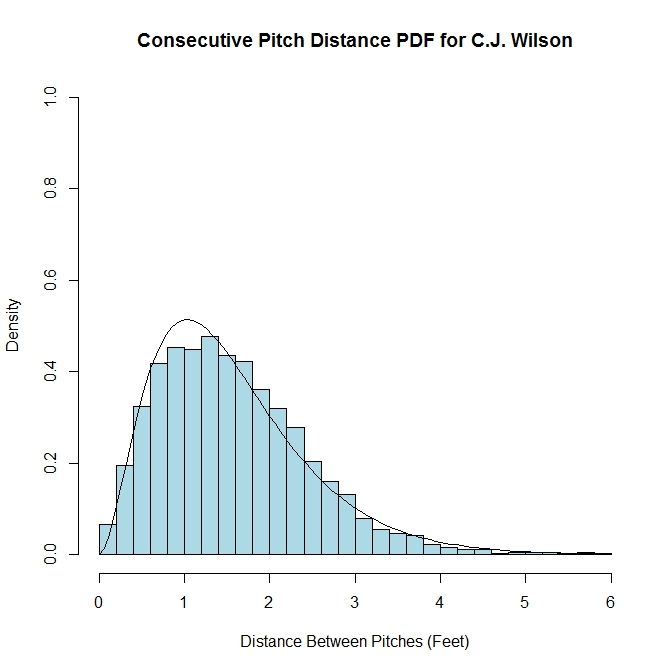
We can start with examining the distance between pitches, regardless of the location of the initial pitch. If this data, for a given pitcher, is plotted in a histogram, the spread of the data appears similar to a gamma distribution. Such a distribution can be characterized many ways, but for our purposes, we will use the version which utilizes parameters k and theta, where k is the shape parameter and theta is the scale parameter. With a collection of distances between pitches in hand, we can fit the data to a gamma distribution and estimate the values of k and theta. As an example, we have the histogram of C.J. Wilson’s distances between pitches within an at-bat from 2012 overlaid with the gamma distribution where the values of k and theta are chosen via maximum likelihood estimation.

Author’s note: I started working on this quite a few weeks ago and so, at the time, the last complete set of data available was 2012. So rather than redo all of the calculations and adjust the text, I decided to keep it as-is since the specific data set is not of great importance in explaining the method. I will include the 2013 data in certain areas, denoted by italics.
Wilson Gamma photo WilsonGamma.jpeg

While this works for the data set as a whole, this distribution will not be too useful for estimating the location of a subsequent pitch, given an initial pitch. One might expect that for pitches in the middle of the strike zone, the distribution would be different than for pitches outside the strike zone. To take this into account, we can move from a one-dimensional model to a two-dimensional one. Also, instead of using pitch distance, we are going to use average pitch location, since this will include directional information as well. To start, we will divide the area at the front of the strike zone into a grid of three-inch by three-inch squares. We choose this discretization because the diameter of a baseball is approximately three inches and therefore seems to be a reasonable reference length. The domain we consider will be from the ground (zero feet) to six feet high, and three feet to the left and right of the center of home plate (from the catcher’s perspective).

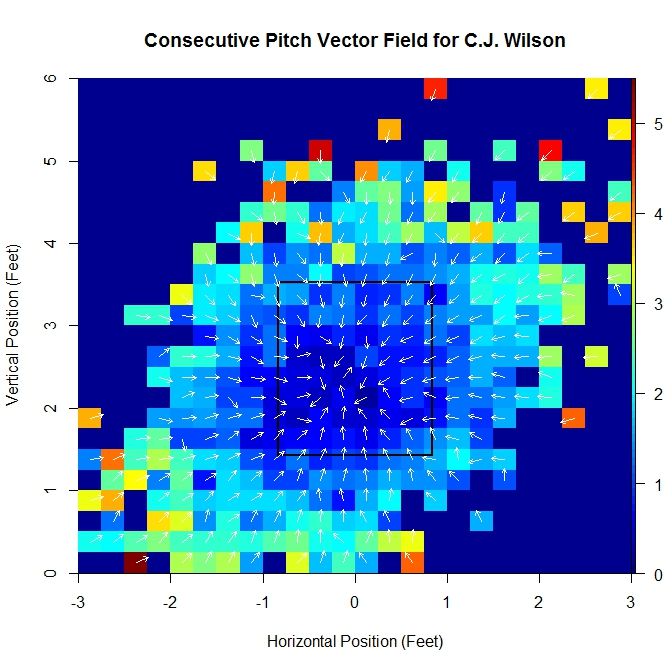
We will refer to pairs of sequential pitches as the “first pitch” and the “second pitch”. The first pitch is one which has a pitch following it in a single at-bat. This serves as a reference point for the subsequent pitch, labeled as the “second pitch”. Adopting this terminology, we find all first pitches and assign them to the three-inch by three-inch square which they fall in on the grid. Then for each square, we take its first pitches and find the vector between them and their associated second pitches (each vector points from the first pitch to the second pitch). We then average the components of the vectors in each square to provide a general idea of where the next pitch in headed for the first pitches in that square.

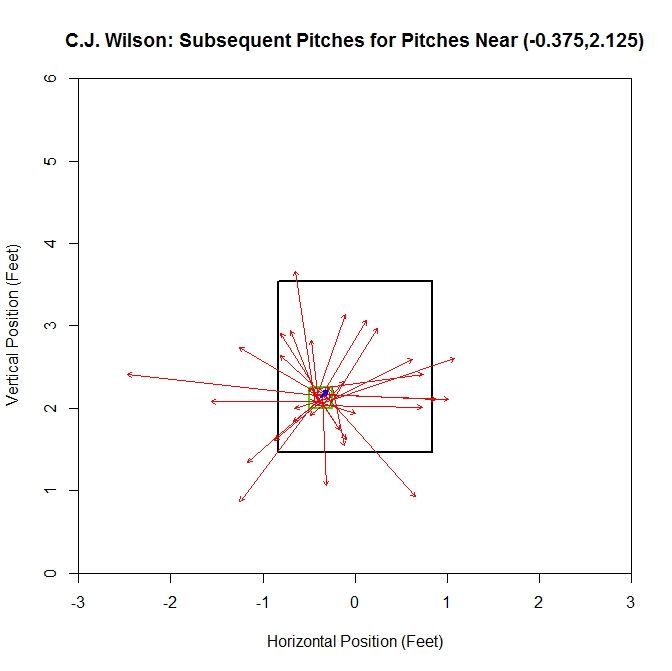
In areas where the magnitude of the average vector is small, the location of the next pitch can be called isotropic, meaning there is no preferred direction. This is because average vectors of small magnitude are likely going to be the result of the cancellation of vectors of similar magnitude in all directions (from the histogram, the average distance between pitches was approximately 1.5 feet with most lying between 0.5 and 2.5 feet apart). One can create contrived examples where, say, all pitches are oriented either left or right and so there would be two preferred directions rather than isotropy, but these cases are unlikely to show up at locations with a reasonable amount of data, such as in the strike zone. In areas where the average vector has a large magnitude, the location of the next pitch can be called anisotropic, indicating there is some preferred direction(s). Here, the large magnitude of the average vector is due to the lack of cancellation in some direction. For illustrative purposes, we can look at one example of an isotropic location and one of an anisotropic location. First, for the isotropic case:
Wilson Isotropic photo WilsonIsotropic.jpeg

In this plot, the green outline indicates the square containing the first pitches and the red arrows are the vectors between the first and second pitches. The blue arrow in the center of the green square is the average vector. For the grid square centered at (-0.375,2.125), we have a fairly balanced, in terms of direction and distance, distribution of pitches. Therefore the average vector is small in magnitude. In other cases, we will have the pitches more heavily distributed in one direction, leading to an anisotropic location:
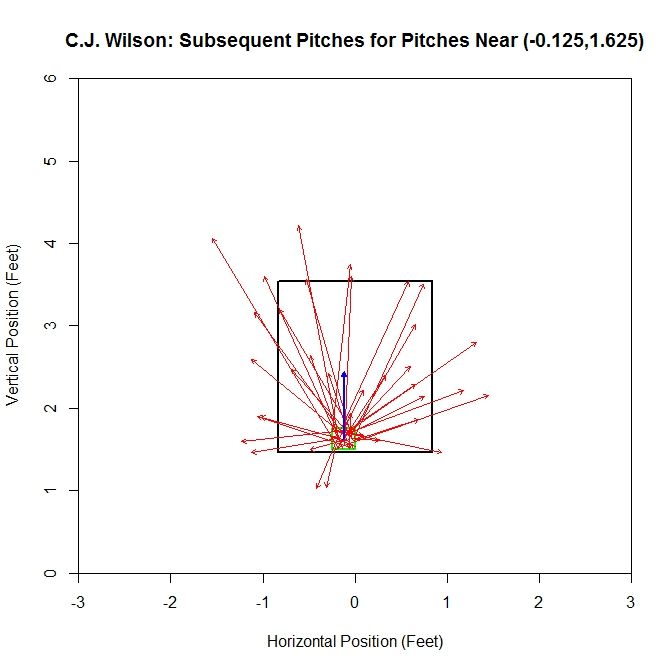
 photo WilsonNematic.jpeg

As opposed to the previous case, there is a distinct pattern of pitches up from the position (-0.125,1.625), which is shown by the average vector having a substantially larger magnitude. This is due to most of the vectors having a large positive vertical component. Running over the entire grid where at least one pitch had a pitch following it, we can generate a series of these average vectors, which make up a vector field. In order to make the vector field plot more legible, we remove the component of magnitude from the vector, normalizing them all to a standard length, and instead assign the length of the vector to a heat map which covers each grid square.
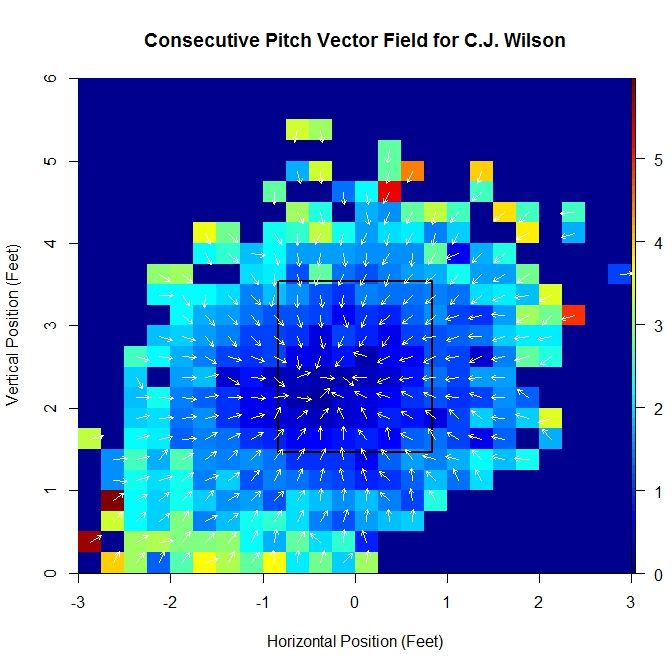
 photo WilsonCPVectorField.jpeg

For the 2013 data set:

Wilson Vector Field 2013 photo WilsonVectorField2013.jpeg

By computing these vectors over the domain, we are able to produce a vector field, albeit incomplete. Computing this vector field based on empirical data also lends itself to outliers influencing the average vectors as well as problems with small sample size. We can attempt to handle these issues and gain further insight by finding a continuous vector field to approximate it. To do this, we will begin with a function of two variables, to which we can apply the gradient operator to produce a gradient field. We can zoom in near the strike zone to get a better idea of what the data looks like in this area:
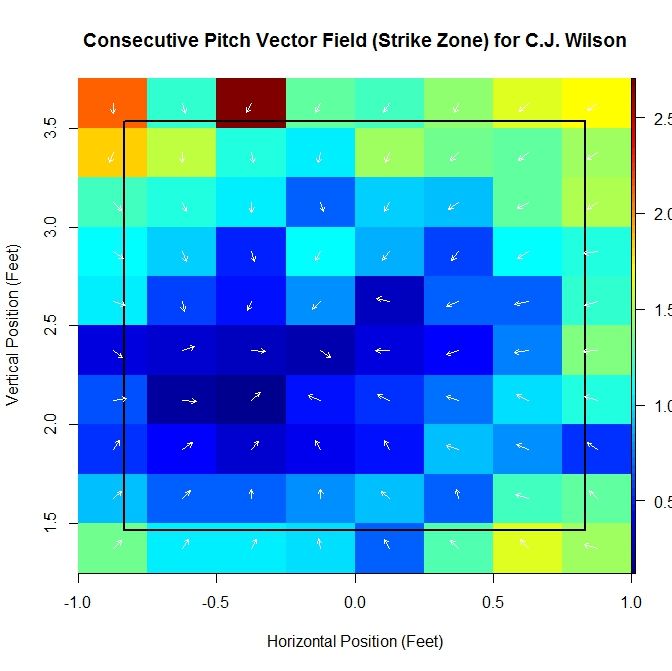
 photo WilsonSZVector.jpeg

Note that as we move inward, toward the middle of the strike zone, the magnitude of the average vector shrinks. In addition, the direction of all vectors seems to be toward a central point in the strike zone. Based on these observations, we choose a function of the form

P(x,z) = (1/2)c_x(x – x_0)^2 + (1/2)c_z(z – z_0)^2.

The x-variable is the horizontal location, in feet, and z the vertical location. This choice of function has the property that there is a critical point for P and when the gradient field is calculated, all vectors will radially point toward or away from this critical point. The constants in the equation of this paraboloid are (x_0,z_0), the critical point (in our case, it will be a maximum), and (c_x,c_z) are, for our purposes, scaling constants (this will be clear once we take the gradient). The gradient of function P is

grad(P) = [c_x(x – x_0), c_z(z – z_0)].

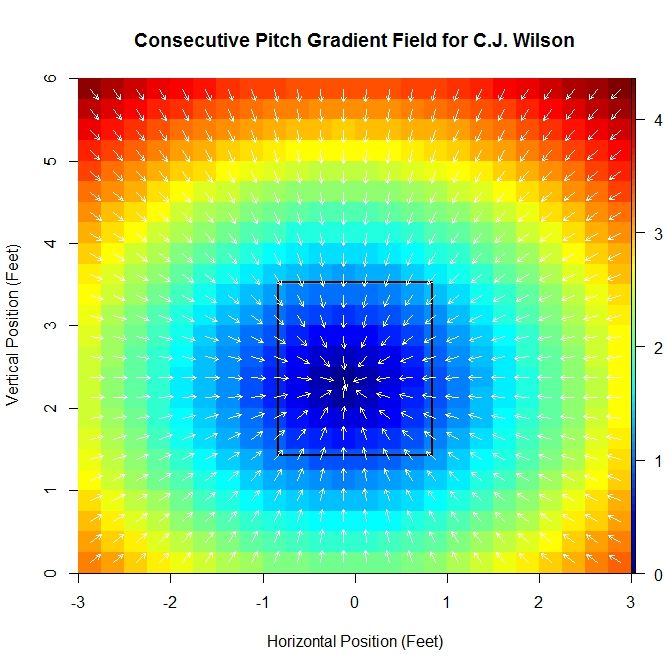
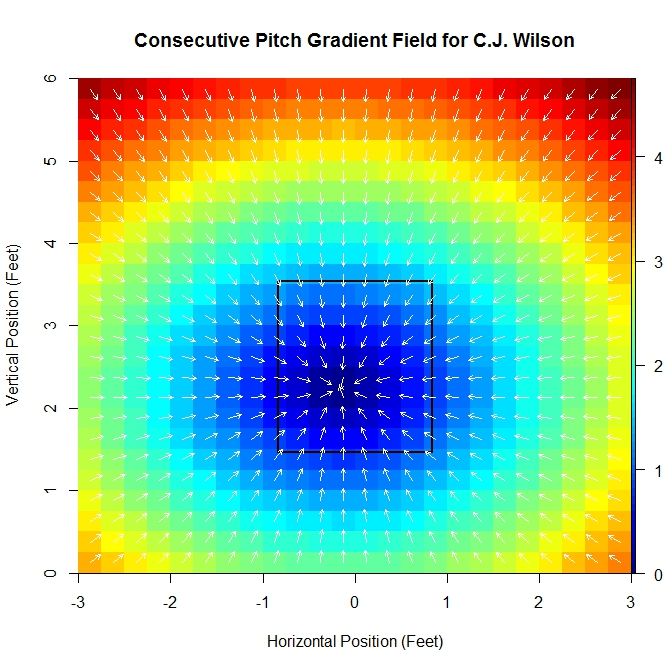
Then c_x and c_z are constants that scale the distances from the x- and z-locations to the critical point to determine the vector associated with point (x,z). Note that grad(P)(x_0,z_0) = [0,0]. In fact, we will give this point a special name for future reference: the pitching sink. For vector fields, a non-mathematical description of a sink is a point where, locally, all vectors point toward (if one imagines these vectors to be velocities, then the sink would be the point where everything would flow into, hence the name). This point is, presumably, the location where we have the least information about the direction of the next pitch, since there is no preferred direction. Again using Wilson’s data as an example:
Wilson Gradient Field photo WilsonCPGradient.jpeg

For the 2013 data set:

Wilson Grad Field 2013 photo WilsonGradField2013.jpeg

The gradient field is fit to the average vectors using linear least squares minimization for the x- and z-components. This produces estimates for c_x, c_z, x_0, and z_0. For the original vector field, if we are interested in the location where the average vector is smallest in magnitude (or the location where there is the least bias in terms of direction of the next pitch), we are limited by the fact that we are using a discretized domain and therefore can only have a minimum location at a small, finite number of points.

One advantage to this method is that it produces a minimum that comes from a continuous domain and so we will be able to get unique minimums for different pitchers. Another piece of information that can be gleaned from this approximation is the constants, c_x and c_z. If c_x is large in magnitude, there may be a large east-west dynamic to the pitcher’s subsequent pitch locations. For example, if a first pitch is in the left half of the strike zone, the next pitch may have a proclivity to be in the right half and vice versa. A similar statement can be made about c_z and north-south dynamics. Alternatively, if c_x is small in magnitude, then less information is available about the direction the next pitch will be headed. For Wilson, the constants obtained from the best fit approximation are a pitching sink of (-0.163,2.243) and scaling constants (-0.925,-1.055).

For C.J. Wilson’s 2013 season, we have the sink at (-0.109,2.307) and scaling constants (-0.902,-0.961), so the values are relatively close between these two seasons.

We can now obtain this set of parameters for a large collection of pitchers. For each pitcher, we can find the vector field based on the data and then find the associated gradient field approximation. We can then extract the scaling constants and the pitching sink. We can run this on the most recent complete season (2012, at the start of this research) for the 200 pitchers who threw the most pitches that year and look at the distribution of these parameters.
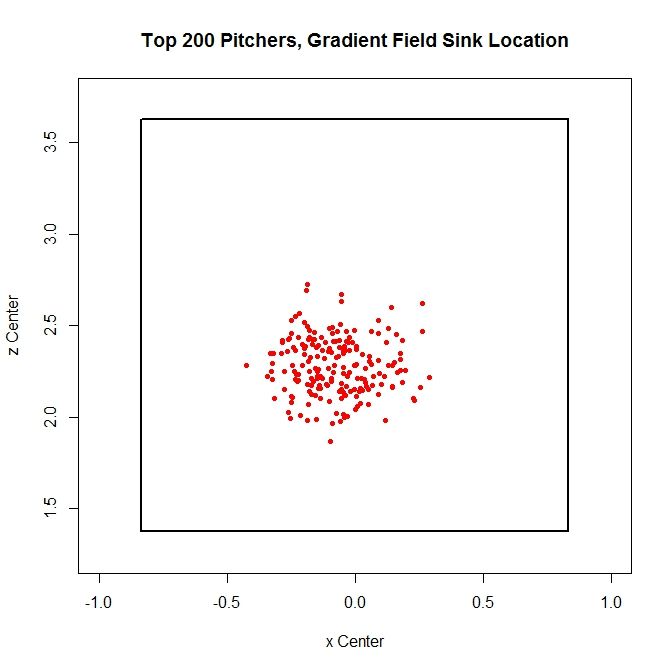
 photo TwoKSinks.jpeg

The sinks cluster in a region roughly between 1.75 and 2.75 feet vertically and -0.5 and 0.5 feet horizontally. This seems reasonable, since we would not expect this location to be near the edge or outside of the strike zone. Similarly, we can plot the scaling constants:
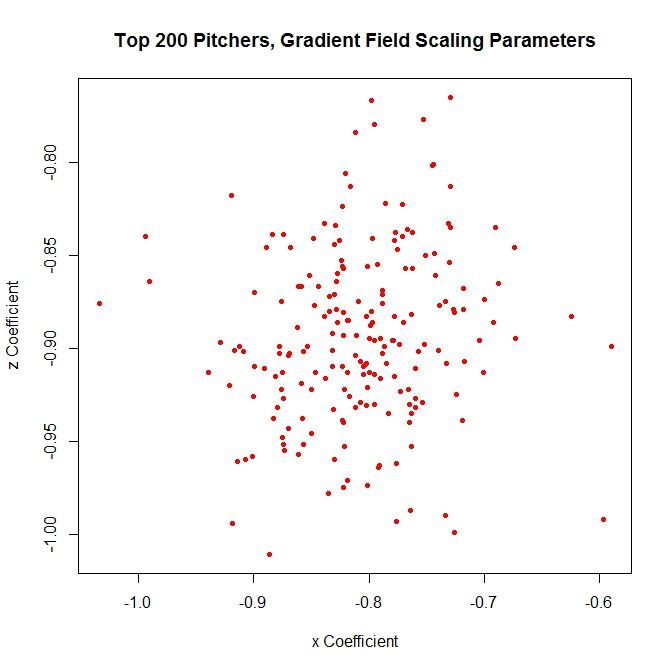
 photo TwoKScales.jpeg

The scaling constants are distributed around a region of -1 to -0.8 vertically and -0.7 and -0.9 horizontally.

One problem that arises from this method is that since we are averaging the data, we are simplifying the analysis at the cost of losing information about the distribution of second pitches. Therefore, we can take a different approach to try to preserve that information. To do so, at a grid location, we can calculate several average vectors in different directions, instead of one, which will keep more of the original information from the data. This can be accomplished by dividing the area around a given square radially into eight slices and calculating the average in each octant.

However, since each nonempty square may contain anywhere from one to upwards of thirty plus pitches, using octants spreads the data too thin. To better populate the octants, we can find pitchers with similar data and add that to the sample. To do this, we will go back to the aforementioned average vectors and use them as a means of comparison. At a given square, with a pitcher in mind whose data we wish to add to, we can compute the average vector for a large collection of other pitchers, compare average vectors, and add the data from those pitchers whose vector is most similar to the pitcher of reference. In order to do this, we first need a metric. Luckily, we can borrow and adapt one available for comparing vector fields:

M(u,v) = w exp(-| ||u||-||v|| |) + (1-w) exp(-(1 – <u,v>/||u|| ||v||))

Here, u and v are vectors, and w is a weight for setting the importance of matching the vector magnitudes (left) and the vector directions (right). For the calculations to follow, we take w = 0.5. The term multiplied to w on the left is an exponential function where the argument is the negative of the absolute value of the difference in the vector magnitudes. Note that when ||u|| = ||v||, the term on the left reduces to w. As the magnitudes diverge, the term tends toward zero. The term multiplied to (1-w) is an exponential function with argument negative quantity 1 minus the dot product between u and v, divided by their magnitudes. When u and v have the same direction, <u,v>/||u|| ||v|| = 1, and the exponent as a whole is zero. When u and v are anti-parallel, <u,v>/||u|| ||v|| = -1 and the exponent is -2 so the term on (1-w) is exp(-2) which is approximately 0.135, which is close to zero. So when u = v, M(u,v) = 1 and when u and v are dissimilar in magnitude and/or direction, M(u,v) is closer to zero.

We now have a means of comparing the data from different pitchers to better populate our sample. To demonstrate this, we will again use C.J. Wilson’s data. First, we will run this method at a point near his sink: (-0.125,2.125). Since we will have up to eight vectors, we can fit an interpolating polynomial in between their heads to get an idea of what is happening for the full 360 degrees around the square. The choice of interpolating polynomial in this case will be a cubic spline function. This will give a smooth curve through the data without large oscillations. Working with only Wilson’s data, which is made up of 30 pitches, this looks like:
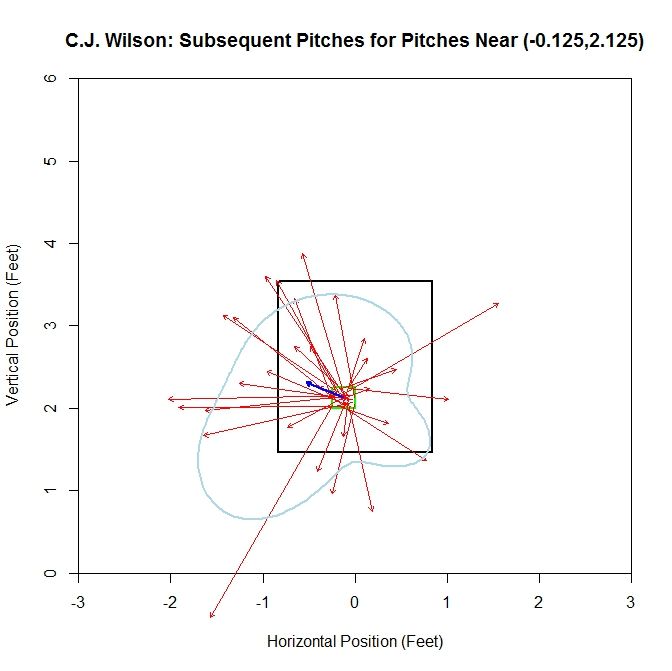
 photo WilsonVector.jpeg

The vectors are spread out in terms of direction, but one vector which extends outside the lower-left quadrant of the plot leads to the cubic spline (light blue curve) bulging to the lower left of the strike zone. Otherwise, the cubic spline has some ebb and flow, but is of similar average distance all around.
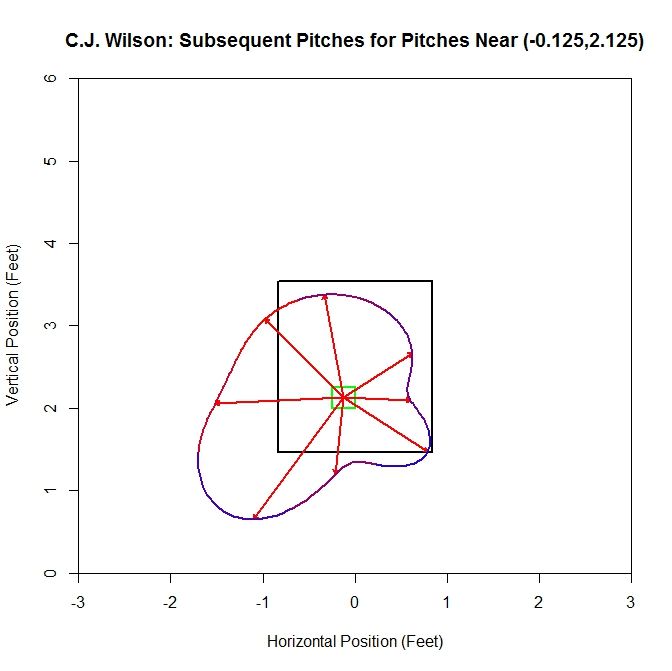
 photo WilsonOctant.jpeg

When we remove the vectors and replace them with the average vector of each octant (red vectors), we have a better idea of where the next pitch might be headed. We also color-code the spline to keep the data about the frequency of the pitches in each octant. Red indicates areas where the most pitches were subsequently thrown and blue the least. We see that the vectors are longer to the left and, based on the heat map on the spline, more frequent. However, a few short or long vectors in areas that are otherwise data-deficient will greatly impact the results. Therefore, we will add to our sample by finding pitchers with similar data in the square. We will compute the value of M between Wilson at that square and the top 200 pitchers in terms of most pitches thrown for the same season.

For Wilson, the top five comparable pitchers in the square (-0.125,2.125), with the value of M in parentheses, are Liam Hendriks (0.995), Chris Young (0.986), A.J. Griffin (0.947), Kyle Kendrick (0.943), and Jonathan Sanchez (0.923). Recall that this considers both average vector length and direction. Adding this data to the sample increases its size to 94 pitches.
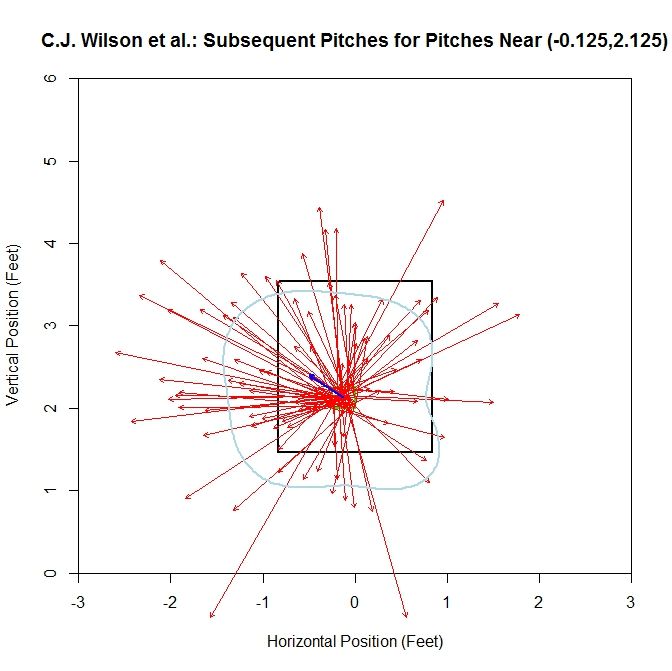
 photo WilsonetalVector.jpeg

For this plot, the average vector (the blue vector in the center of the cell) is similar to that of Wilson’s solo data. However, since the number of pitches has essentially tripled, the plot has become hard to read. To get a better idea of what is going on, we can switch to the average vector per octant plot:
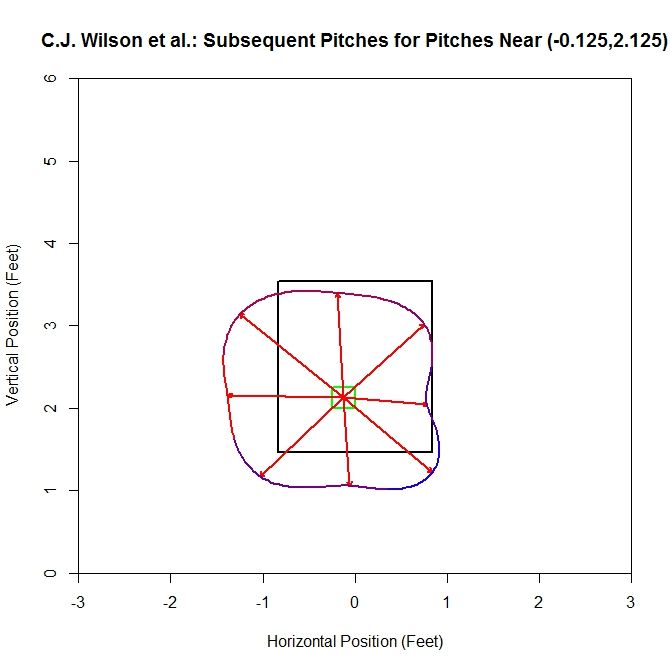
 photo WilsonetalOctant.jpeg

Examining this plot, most of the average vectors are in the range of 1-1.5 feet. The shape of the interpolation is square-like and seems to align near the edge of the strike zone, extending outside the zone, down and to the left.

We can also run this at points nearer to the edge of the strike zone. On the left side of the strike zone, we can work off of the square centered at (-0.875,2.375) (note that we drop the plots of the original data in lieu of the plots for the octants).
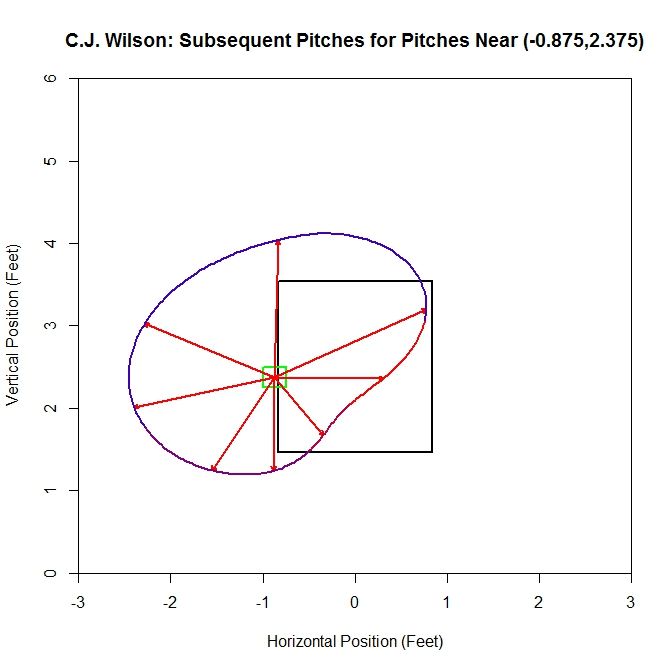
 photo WilsonLeftSideOriginal.jpeg

For the original sample, the dominant direction (where most of the vectors are pointed, indicated by the red part of the spline) is to the right, with an average distance of one to two feet in all directions. Now we will add in data based on the average vectors, increasing our sample from 15 to 97 pitches.
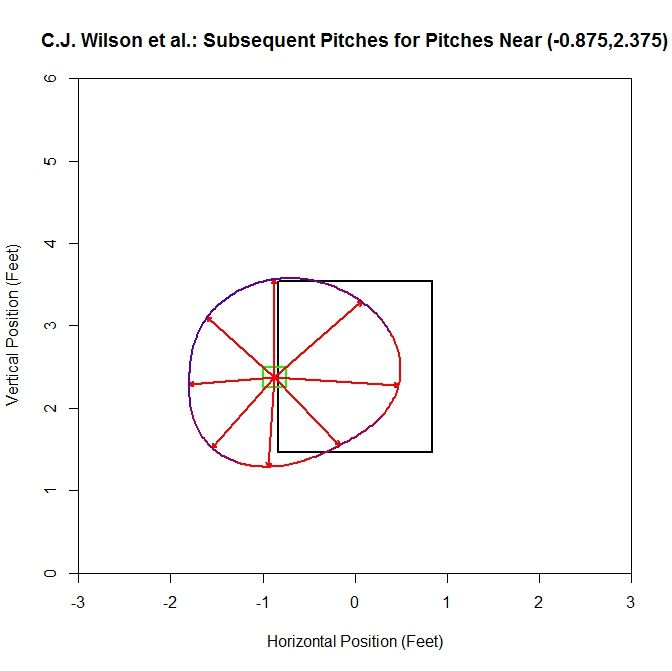
 photo WilsonLeftSide.jpeg

For the larger sample, the spline, which is almost circular, has average vectors approximately 1 to 1.5 feet in length. The preferred directions are to the right (into the strike zone) and downward (below the left edge of the strike zone). Also note that comparing the two plots, the vectors in the areas where there are the most pitches in the original sample (between three and six o’clock) have average vectors that retain a similar length and direction.
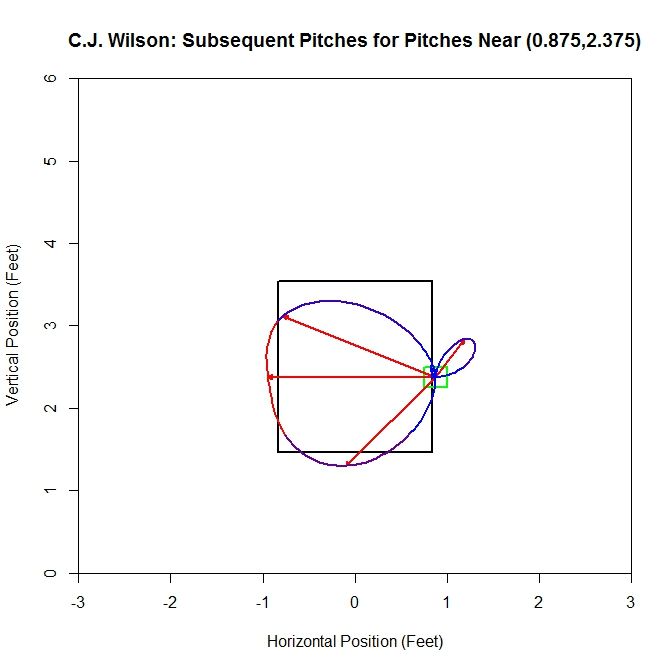
 photo WilsonRightSideOriginal.jpeg

Switching sides of the strike zone, we can examine the data related the square centered at (0.875,2.375). For the original sample, the dominant direction is to the left with little to no data oriented to the right. Since there are octants that contain no data, we get a pinched area of the cubic spline. This is due to the choice of how to handle the empty octants. We choose to set the average distance to zero and the direction to the mean direction of the octant. This choice leads to pinching of the curve or cusps in these areas. Another choice would be to remove this octant from the sample and do the interpolation with the remaining nonempty octants.
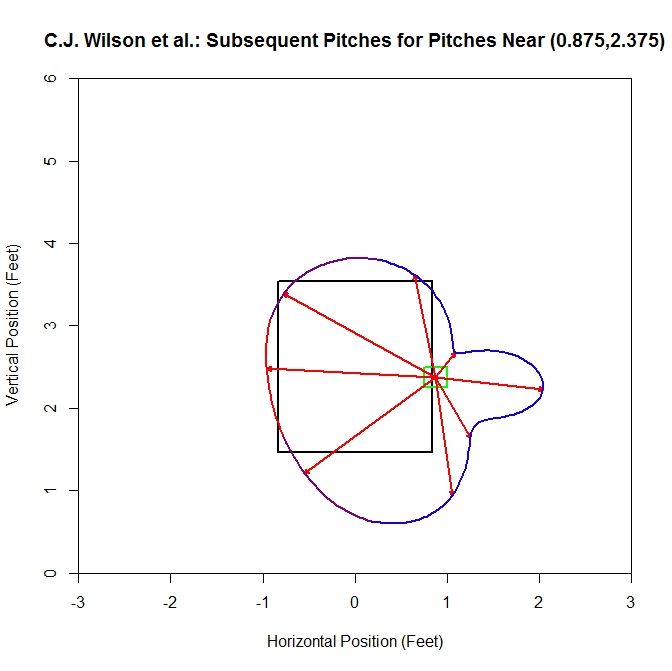
 photo WilsonRightSide.jpeg

Adding data to this sample increases it from 9 pitches to 67, and the average vector and spline jut out on the right side due to a handful of pitches oriented further in this direction (this is evident from the blue color of the spline). In the areas where most of the subsequent pitches are located, the spline sits near the left edge of the strike zone. Again, the average vectors in the red area of the spline maintain a similar length and direction.
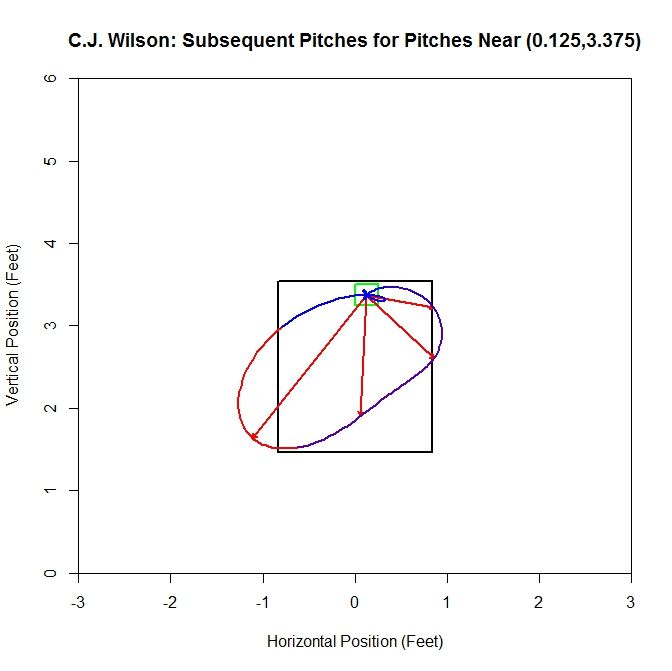
 photo WilsonTopSideOriginal.jpeg

Moving to the top of the strike zone, we choose the square centered at (0.125,3.375). The original plot for a square along the top contains 11 pitches and no second pitches are oriented upward. There are only have four non-zero vectors for the spline and the dominant direction is down and to the left.
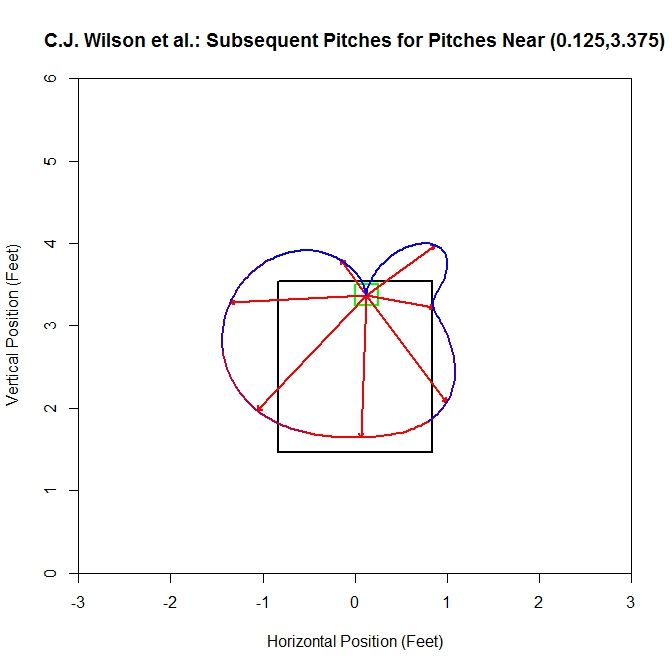
 photo WilsonTopSide.jpeg

In this square, the sample changes from 11 to 72 pitches by adding similar data. Note the cusp that occurs at the top since we are missing an average vector there. Unsurprisingly, at the top of the strike zone, the preferred direction for the subsequent pitch is downward, and as we rotate away from this direction, the number of pitches in each octant drops.
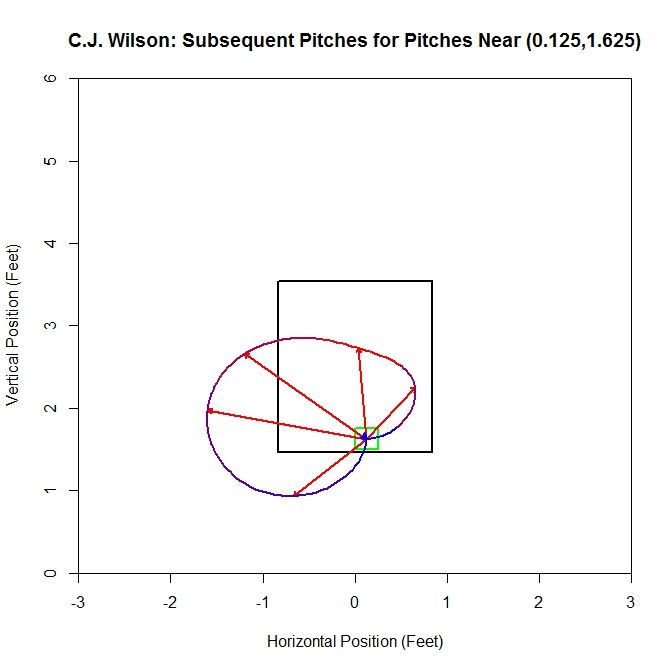
 photo WilsonBottomSideOriginal.jpeg

Finally, along the bottom of the strike zone, we choose (0.125,1.625). Starting with 27 pitches produces five average vectors, with the dominant direction being up and to the left.
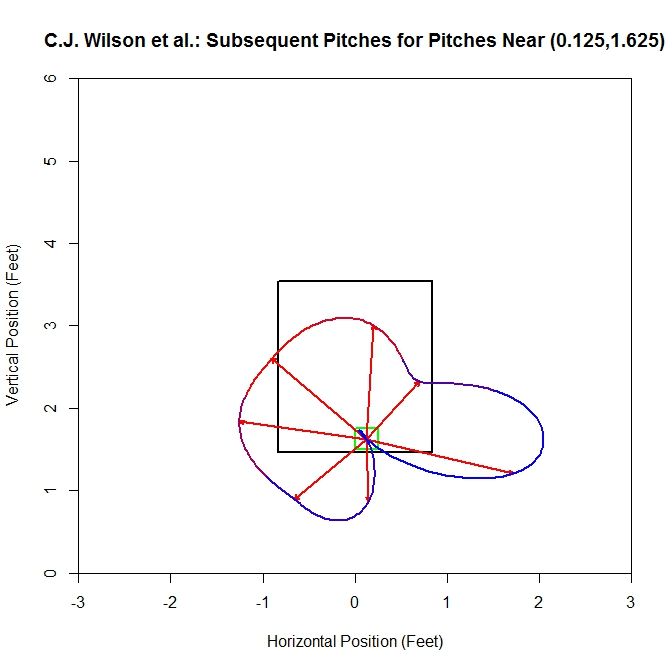
 photo WilsonBottomSide.jpeg

With the additional data from other pitchers, the number of pitches moves up to 87. The direction with the most subsequent pitches is up and to the left. In areas where we have the most data in the original sample (the red spline areas), the average vectors and splines are most alike.

There are several obvious drawbacks to this method. For the model fitting, we have some points in the strike zone with 30+ pitches and as we move away from the strike zone, we have less and less data for computing the averages. However, as we move away, the general behavior becomes more predictable: the next pitch will likely be closer to the strike zone. So the small sample should have less of a negative effect for points far away. This is also a potential problem since we use these, in some cases, small samples to calculate the average vector in each square, which is used as a reference point for adding data to the sample. It may be better to use the vector from the gradient field for comparison since it relies on all of the available data to compute the average vector (provided the gradient field approach is a decent model).

Another problem is that in computing the average vector, we are not taking into account the distribution of the vectors. The same average vector can be formed from many different combination of vectors. However, based on the limited data presented above, adding to the sample, using M and the average vectors, does not seem to have a large effect on octants where there is the most data in the original sample. These regions, even with more data, tend to retain their shape. These are also the areas that are going to contribute most to the average vector that is used for comparison, so this seems like a reasonable result.

A smaller problem that shows up near the edge of the zone is that we still occasionally, even after adding more data, get directions with only one or two pieces of data and this causes some of the aberrant behavior seen in some of the plots, characterized by bulges in blue areas of the spline. One solution to this would be to only compute the average vector in that octant if there were more than some fixed number of pitches in that direction. Otherwise, we could set the average vector to zero and the direction to the mean direction in that octant.

Obviously, an analysis of one pitcher over a small collection of squares in the grid does not a theory make. It is possible to examine more pitchers, but because the analysis must be done visually, it will be slow and imprecise. Based on these limited results, there may be potential if the process can be condensed. The pitching sink approach gives an idea of where the next pitch may be headed. As we move toward the sink, we have less information on where the next pitch is headed since near this point, the directions will be somewhat evenly distributed. As we move toward the edge of the strike zone, we get a clearer picture of where the next pitch is headed if only for the reason that it seems unlikely that the next pitch will be even further away.

While this model seems reasonable in this case, there may be cases where a more general model is needed to fit with the behavior of the data. To recover more accurate information on the location of the next pitch, we can switch to the octant method. Since some areas with this method will have very small samples, we can pad out the data via comparison of the average vectors. This seems to do well at filling out the depleted octants and retains many of the features of the average vectors in the most populated octants of the original samples. At this point, both these models exist as novelties, but hopefully with a little more work and analysis, they can be improved and simplified.


Bronson Arroyo and His Future

The loss to the Pirates, the recent removal of Dusty Baker, and the upcoming free agency of Shin-Soo Choo has overshadowed Bronson Arroyo and his status with the Reds. It seems that if there is one player who never receives enough attention, it is him. But while the baseball world may not seem to realize that he is a free agent, there is no doubt that Walt Jocketty and his staff are very much aware of the 36 year-old starter’s expired contract.

Bronson Arroyo, with the exception of 2011, has been not only one of the Reds best starters, but one of the most consistent pitchers in baseball. He has not been a Cy Young candidate and he is not the ace of the Reds by any means. But the one thing that cannot be denied is his innings pitched per year. Since joining the Reds, he has thrown over 1600 innings and has averaged about 211.1 innings pitched per year. They have started to dip recently but throwing 202 innings each year of the past two seasons shows that despite the age, he still has his durability. He has managed to avoid the DL in his career which is something to be marveled at. Every year that he has pitched with the Reds, he has started at least 32 games and averaged 6-7 innings per start. This kind of reliability is something to be desired out of a starter in this day and age where there is at least one Tommy John surgery or one pitcher who is on a strict innings limit.

One of the things that allow Arroyo to be so durable is the fact that he does not waste his time out of the zone with his pitches. His goal is to go right at the hitters. This season, he was fifth in the majors in walks per nine with 1.51. During his tenure with the Reds (2006-2013), he has averaged 2.31 BB/9 which is good for 14th among pitchers who have thrown at least 1000 IP during that time frame. He seems to be trying to improve those numbers as his BB/9 has been 1.54 over the past two seasons. He indicates that he refuses to beat himself by giving up the free pass (which can help him out seeing as how does not strike out a lot of batters and he does tend to give up home runs).

Bronson Arroyo has made himself a very good pitcher due to great durability and his ability to change speeds when he pitches. Last season his fastball averaged 87 mph and his curveball averaged about 70 mph. The change of speeds helps him to keep most batters off balance because they have no idea what kind of speed is going to be released from his arm or what kind of arm slot the baseball is going to be thrown at. While watching a Reds game, one of the guests in the booth said that he would rather face a pitcher like Aroldis Chapman because he knows what speed and arm slot to expect most of the time. Chapman will throw his fastball about 85.4% of the time and his off-speed pitch (slider) about 14.6% of the time. Once the batter stands in the batter’s box, he can expect to see that heater for the majority of the time. Bronson Arroyo throws his fastball (or sinker) last season for 44.1% of the time. That is 55.9% of the time that he throws one of his 3 other off speed pitches that ranges anywhere from 70 mph to 77.6 mph.

Despite the fact that Arroyo is such a good pitcher, it is unlikely that he will return to the Reds. The Reds, I’m sure, would like nothing more than to have Bronson Arroyo return to their team. The problem is that the Reds are going to have a full rotation and none of the other pitchers are going to the bullpen any time soon. Tony Cingrani has emerged as a phenomenal young left-handed starter that has earned a starting spot. Homer Bailey and Mat Latos have proven to be durable aces that on their best day can match up with anyone and shut down the best of offenses even in Great American Ballpark. Mike Leake probably would have been sent to the bullpen to make room for Arroyo but because of the great bounce-back season that he had, he has re-solidified his spot in the rotation as well. Cueto could be an option to be sent to the bullpen because of his long list of injuries but it is true that when healthy, he is one of the best pitchers in the game. The Reds also have several very talented pitching prospects in the minors in Robert Stephenson, Daniel Corcino, and Nicholas Travieso who are just waiting for an excuse to be called up to the majors. And because of Arroyo’s proven track record it is almost a solid guarantee that he will not be sent to the bullpen.

If you take away anything from these past few paragraphs, it should be that Arroyo is a solid and dependable starter. Maybe on certain teams (I’m looking at you, Houston) he could be an ace but on most teams he will be a solid mid-bottom of the rotation starter for any team. His tendency to give up home runs could be cured in a more pitcher-friendly ballpark but it is unlikely that the problem will go away all together. He is a good pitcher who might get his 3 years, and 30+ million dollars somewhere but he will not find it in Cincinnati. Cincinnati is a mid-market team who is going to have to worry about signing up Homer Bailey, Mat Latos, and Tony Cingrani in the future and they have already spent a lot of money to keep Jay Bruce and Joey Votto locked up for the long haul. Their depth in pitchers allows them to look elsewhere for places on where to spend all of the money that they would have to spend in order to resign Arroyo. Perhaps they could use it to get La Russa out of retirement . . .


wRC for Pitchers and Koji Uehara’s Dominance

wRC is a very useful statistic.  On the team level, it can be used to predict runs scored fairly accurately (r^2 of over .9).  It can also be used to measure how much a specific player has contributed to his team’s offensive production by measuring how many runs he has provided on offense.  But it is rarely used for pitchers.

Pitching statistics are not so much based on linear weights and wOBA as they are on defense-independent stats.  I think defense-independent stats are fine things to look at when evaluating players, and they can provide lots of information about how a pitcher really performed.  But while pitcher WAR is based off of FIP (at least on FanGraphs), RA9-WAR is also sometimes looked at.  Now, if the whole point of using linear weights for batters is to eliminate context and the production of teammates, then why not do the same for pitchers?  True, pitchers, especially starters, usually get themselves into bad situations, unlike hitters, who can’t control how many outs there are or who’s on base when they come up.  But oftentimes pitchers aren’t better in certain situations, as evidence by the inconsistency of stats such as LOB%.  So why not eliminate context from pitcher evaluations and look at how many runs they should have given up based on the hits, walks, and hit batters they allowed?

To do this, I needed to go over to Baseball-Reference, as FanGraphs doesn’t have easy-to-manipulate wOBA figures for pitchers.  Baseball-Reference doesn’t have any sort of wOBA stats, but what they do have is the raw numbers needed to calculate wOBA.  So I put them into Excel, and, with 50 IP as my minimum threshold, I calculated the wOBA allowed – and then converted that into wRC – for the 330 pitchers this year with at least 50 innings.

Next, I calculated wRC/9 the same way you would calculate ERA (or RA/9).  This would scale it very closely to ERA and RA/9, and give us a good sense for what each number actually means.  (The average wRC/9 with the pitchers I used was 3.95; the average RA/9 for the pitchers I used was 3.96).  What I found was that the extremes on both sides were way more extreme (you’ll see what I mean soon), but overall it correlated to RA/9 fairly closely (the r^2 was .803).

Now, for the actual numbers:

wRC/9 IP
Koji Uehara 0.08 74.1
Tanner Roark 1.04 53.2
Joe Nathan 1.08 64.2
Greg Holland 1.17 67
Alex Torres* 1.24 58
Craig Kimbrel 1.41 67
Luis Avilan* 1.42 65
Neal Cotts* 1.43 57
Mark Melancon 1.52 71
Kenley Jansen 1.55 76.2
Clayton Kershaw* 1.59 236
Paco Rodriguez* 1.60 54.1
Luke Hochevar 1.65 70.1
Matt Harvey 1.69 178.1
Tyler Clippard 1.69 71
Jose Fernandez 1.80 172.2
Tony Watson* 1.89 71.2
J.P. Howell* 1.94 62
Bobby Parnell 2.00 50
Clay Buchholz 2.04 108.1
Glen Perkins* 2.09 62.2
Justin Wilson* 2.13 73.2
David Carpenter 2.13 65.2
Casey Janssen 2.15 52.2
Sean Doolittle* 2.16 69
Brandon Kintzler 2.17 77
Aroldis Chapman* 2.24 63.2
Luke Gregerson 2.29 66.1
Steve Cishek 2.30 69.2
Joaquin Benoit 2.31 67
Max Scherzer 2.32 214.1
Madison Bumgarner* 2.35 201.1
Sonny Gray 2.39 64
David Robertson 2.42 66.1
Jean Machi 2.44 53
Dane De La Rosa 2.46 72.1
Tyler Thornburg 2.56 66.2
Drew Smyly* 2.58 76
Jason Grilli 2.59 50
Stephen Strasburg 2.60 183
Danny Farquhar 2.64 55.2
Michael Wacha 2.66 64.2
Joel Peralta 2.67 71.1
Brett Cecil* 2.68 60.2
Brad Ziegler 2.69 73
Johnny Cueto 2.69 60.2
Tommy Hunter 2.69 86.1
Addison Reed 2.69 71.1
Bryan Shaw 2.72 75
Casey Fien 2.73 62
Mariano Rivera 2.77 64
Sergio Romo 2.81 60.1
Hisashi Iwakuma 2.81 219.2
Jose Veras 2.81 62.2
Cliff Lee* 2.81 222.2
Darren O’Day 2.82 62
Tanner Scheppers 2.85 76.2
Trevor Rosenthal 2.87 75.1
Yu Darvish 2.87 209.2
Adam Wainwright 2.88 241.2
Anibal Sanchez 2.88 182
Mike Dunn* 2.89 67.2
Jeanmar Gomez 2.90 80.2
Brian Matusz* 2.94 51
Charlie Furbush* 2.96 65
J.J. Hoover 2.97 66
Francisco Liriano* 2.98 161
Grant Balfour 2.99 62.2
Alfredo Simon 2.99 87.2
Jonathan Papelbon 3.04 61.2
Jesse Chavez 3.04 57.1
Tyson Ross 3.07 125
Gerrit Cole 3.07 117.1
A.J. Ramos 3.07 80
Craig Breslow* 3.07 59.2
Tom Wilhelmsen 3.07 59
Andrew Cashner 3.08 175
Chris Sale* 3.10 214.1
Felix Hernandez 3.10 204.1
Vin Mazzaro 3.10 73.2
Zack Greinke 3.11 177.2
Jim Henderson 3.12 60
Matt Albers 3.13 63
Sam LeCure 3.14 61
Anthony Swarzak 3.16 96
Jerry Blevins* 3.16 60
Henderson Alvarez 3.16 102.2
LaTroy Hawkins 3.17 70.2
Tony Cingrani* 3.17 104.2
Mike Minor* 3.18 204.2
Jordan Zimmermann 3.18 213.1
Tim Stauffer 3.21 69.2
Travis Wood* 3.21 200
Edward Mujica 3.21 64.2
Alex Cobb 3.22 143.1
Rex Brothers* 3.23 67.1
Justin Masterson 3.24 193
David Price* 3.24 186.2
Santiago Casilla 3.26 50
Ryan Cook 3.26 67.1
Brett Oberholtzer* 3.26 71.2
Bartolo Colon 3.27 190.1
A.J. Burnett 3.29 191
Danny Salazar 3.30 52
Josh Collmenter 3.31 92
Nate Jones 3.31 78
Chad Gaudin 3.33 97
Jamey Wright 3.33 70
Joe Smith 3.33 63
Homer Bailey 3.33 209
Marco Estrada 3.35 128
Hyun-jin Ryu* 3.36 192
Anthony Varvaro 3.36 73.1
Chad Qualls 3.38 62
Tim Hudson 3.38 131.1
Jarred Cosart 3.41 60
Scott Rice* 3.41 51
Chris Archer 3.42 128.2
Jake McGee* 3.43 62.2
Ervin Santana 3.48 211
Will Harris 3.48 52.2
Aaron Loup* 3.48 69.1
Yoervis Medina 3.50 68
Fernando Rodney 3.51 66.2
Huston Street 3.51 56.2
Burke Badenhop 3.51 62.1
Patrick Corbin* 3.53 208.1
Mat Latos 3.53 210.2
Ryan Webb 3.54 80.1
Jered Weaver 3.54 154.1
Rafael Soriano 3.56 66.2
Bruce Chen* 3.56 121
Scott Feldman 3.57 181.2
Shelby Miller 3.57 173.1
Alex Wood* 3.58 77.2
Matt Cain 3.59 184.1
Gio Gonzalez* 3.60 195.2
Craig Stammen 3.61 81.2
Hiroki Kuroda 3.62 201.1
Matt Moore* 3.62 150.1
Ryan Pressly 3.64 76.2
Dan Straily 3.64 152.1
A.J. Griffin 3.68 200
James Shields 3.68 228.2
Adam Ottavino 3.68 78.1
Pedro Strop 3.68 57.1
Cody Allen 3.68 70.1
Alexi Ogando 3.72 104.1
Jhoulys Chacin 3.73 197.1
Kyle Lohse 3.74 198.2
Jake Peavy 3.74 144.2
Cole Hamels* 3.76 220
Nathan Eovaldi 3.76 106.1
Carlos Torres 3.76 86.1
Andrew Albers* 3.78 60
Ricky Nolasco 3.80 199.1
Robbie Erlin* 3.80 54.2
Ross Ohlendorf 3.82 60.1
Dale Thayer 3.82 65
Jarrod Parker 3.85 197
Jose Quintana* 3.86 200
John Lackey 3.86 189.1
Julio Teheran 3.87 185.2
Cesar Ramos* 3.88 67.1
Ernesto Frieri 3.88 68.2
Steve Delabar 3.91 58.2
Ivan Nova 3.91 139.1
Matt Belisle 3.91 73
Ubaldo Jimenez 3.92 182.2
Kris Medlen 3.93 197
Wandy Rodriguez* 3.94 62.2
Kelvin Herrera 3.95 58.1
Justin Verlander 3.97 218.1
Garrett Richards 3.97 145
Charlie Morton 3.97 116
Matt Lindstrom 3.97 60.2
Tom Gorzelanny* 3.97 85.1
Jared Burton 3.97 66
Jeff Locke* 3.99 166.1
C.J. Wilson* 4.00 212.1
Tim Collins* 4.00 53.1
Seth Maness 4.00 62
Matt Garza 4.03 155.1
David Hernandez 4.03 62.1
Lance Lynn 4.04 201.2
Rick Porcello 4.04 177
Miguel Gonzalez 4.04 171.1
Carlos Villanueva 4.04 128.2
Derek Holland* 4.04 213
Robbie Ross* 4.05 62.1
Jim Johnson 4.05 70.1
Kevin Gregg 4.06 62
J.C. Gutierrez 4.08 55.1
Bryan Morris 4.09 65
Mike Leake 4.09 192.1
Joe Kelly 4.11 124
Zack Wheeler 4.11 100
Jon Lester* 4.12 213.1
Taylor Jordan 4.13 51.2
Bronson Arroyo 4.14 202
Tim Lincecum 4.15 197.2
Eric Stults* 4.17 203.2
Chris Tillman 4.18 206.1
Doug Fister 4.19 208.2
Junichi Tazawa 4.20 68.1
Corey Kluber 4.22 147.1
Logan Ondrusek 4.23 55
Jaime Garcia* 4.25 55.1
Tyler Lyons* 4.25 53
Jorge De La Rosa* 4.27 167.2
Yovani Gallardo 4.28 180.2
Wade Miley* 4.29 202.2
R.A. Dickey 4.30 224.2
James Russell* 4.30 52.2
Tyler Chatwood 4.32 111.1
Sam Deduno 4.33 108
Andy Pettitte* 4.35 185.1
Michael Kohn 4.37 53
Josh Outman* 4.38 54
Dillon Gee 4.38 199
Martin Perez* 4.39 124.1
Jake Arrieta 4.39 75.1
Shawn Kelley 4.39 53.1
Drew Storen 4.41 61.2
Preston Claiborne 4.42 50.1
Tommy Milone* 4.45 156.1
Wily Peralta 4.46 183.1
Scott Kazmir* 4.46 158
Felix Doubront* 4.54 162.1
Jeff Samardzija 4.55 213.2
Shaun Marcum 4.56 78.1
Dan Haren 4.58 169.2
Alfredo Figaro 4.58 74
Troy Patton* 4.60 56
Hector Rondon 4.62 54.2
Oliver Perez* 4.62 53
Trevor Cahill 4.63 146.2
Wei-Yin Chen* 4.63 137
Todd Redmond 4.64 77
Zach McAllister 4.64 134.1
Jonathon Niese* 4.65 143
Tom Koehler 4.65 143
Ronald Belisario 4.66 68
Jeremy Hefner 4.66 130.2
Jacob Turner 4.68 118
Kyle Kendrick 4.68 182
Chris Rusin* 4.70 66.1
Brandon McCarthy 4.70 135
Freddy Garcia 4.70 80.1
Randall Delgado 4.70 116.1
Wilton Lopez 4.72 75.1
Mark Buehrle* 4.73 203.2
T.J. McFarland* 4.74 74.2
J.A. Happ* 4.79 92.2
Jason Vargas* 4.80 150
David Phelps 4.81 86.2
Brian Duensing* 4.82 61
Hector Santiago* 4.84 149
CC Sabathia* 4.85 211
Nick Tepesch 4.88 93
Jeremy Hellickson 4.89 174
Wesley Wright* 4.93 53.2
Chris Capuano* 4.95 105.2
Donovan Hand 4.97 68.1
Jerome Williams 4.99 169.1
Adam Warren 5.01 77
Paul Maholm* 5.04 153
Jeremy Guthrie 5.08 211.2
Jonathan Pettibone 5.08 100.1
John Danks* 5.09 138.1
George Kontos 5.10 55.1
Edwin Jackson 5.10 175.1
Ian Kennedy 5.14 181.1
Brad Peacock 5.15 83.1
Bud Norris 5.16 176.2
Erik Bedard* 5.17 151
Travis Blackley* 5.18 50.1
Ryan Dempster 5.19 171.1
Kevin Correia 5.19 185.1
Erasmo Ramirez 5.20 72.1
Roberto Hernandez 5.20 151
Kevin Slowey 5.20 92
Aaron Harang 5.24 143.1
Jason Marquis 5.25 117.2
Jake Westbrook 5.27 116.2
Juan Nicasio 5.29 157.2
Heath Bell 5.35 65.2
Josh Roenicke 5.35 62
Esmil Rogers 5.38 137.2
John Axford 5.42 65
Mike Pelfrey 5.43 152.2
John Lannan* 5.45 74.1
Andre Rienzo 5.46 56
Ross Detwiler* 5.54 71.1
Jason Hammel 5.55 139.1
Stephen Fife 5.63 58.1
Edinson Volquez 5.65 170.1
Dallas Keuchel* 5.68 153.2
Jordan Lyles 5.70 141.2
Phil Hughes 5.71 145.2
Tommy Hanson 5.74 73
Luis Mendoza 5.79 94
Jeremy Bonderman 5.82 55
Brandon League 5.82 54.1
Roy Halladay 5.85 62
Chris Perez 5.94 54
Scott Diamond* 6.01 131
Ryan Vogelsong 6.04 103.2
Wade Davis 6.05 135.1
Justin Grimm 6.10 98
Paul Clemens 6.14 73.1
Lucas Harrell 6.23 153.2
Jeff Francis* 6.39 70.1
Brandon Morrow 6.39 54.1
Joe Saunders* 6.39 183
Jon Garland 6.40 68
Josh Johnson 6.45 81.1
Mike Gonzalez* 6.50 50
Wade LeBlanc* 6.54 55
Brandon Maurer 6.58 90
Barry Zito* 6.63 133.1
Carter Capps 6.64 59
Dylan Axelrod 6.82 128.1
Kyle Gibson 6.92 51
Joe Blanton 7.00 132.2
Clayton Richard* 7.14 52.2
Alex Sanabia 7.29 55.1
Tyler Cloyd 7.40 60.1
Philip Humber 7.62 54.2
Pedro Hernandez* 7.68 56.2
Average 3.95 110.2

The first thing that jumps out right away is that Koji Uehara had a wRC/9 of 0.08.  In other words, if that was his ERA, he would give up one earned run in about 12 complete game starts if he were a starter, which is ridiculous.  The second thing that jumps out is that most of the top performers are relievers – in fact, 12 out of the top 13 had fewer than 80 innings, with the only exception being Clayton Kershaw.  Also, the worst pitchers by wRC/9 had a wRC/9 much higher than their ERA or RA/9.  Pedro Hernandez, for example, had a wRC/9 of 7.68, and there were 6 pitchers over 7.00.  Kershaw actually has a wRC/9 that is lower than his insane RA/9, so maybe he’s even better than his fielding-dependent stats give him credit for.

But wait!  There’s more!  The reason we have xFIP is because HR/FB rates are very unstable.  So let’s incorporate that into our wRC/9 formula and see what happens (we’ll call this one xwRC/9):

xwRC/9 IP
Koji Uehara 0.06 74.1
Paco Rodriguez* 1.13 54.1
Luke Hochevar 1.25 70.1
Tyler Clippard 1.25 71
Craig Kimbrel 1.51 67
Kenley Jansen 1.63 76.2
Aroldis Chapman* 1.68 63.2
Greg Holland 1.69 67
Casey Fien 1.88 62
Joe Nathan 2.06 64.2
Tanner Roark 2.06 53.2
Neal Cotts* 2.12 57
Clayton Kershaw* 2.13 236
Max Scherzer 2.17 214.1
Huston Street 2.18 56.2
Jose Fernandez 2.23 172.2
Alex Torres* 2.26 58
Yu Darvish 2.28 209.2
Glen Perkins* 2.29 62.2
Matt Harvey 2.32 178.1
Tony Watson* 2.35 71.2
Stephen Strasburg 2.35 183
Mark Melancon 2.36 71
Johnny Cueto 2.38 60.2
David Carpenter 2.39 65.2
Luis Avilan* 2.41 65
Justin Wilson* 2.48 73.2
Tommy Hunter 2.49 86.1
Joaquin Benoit 2.50 67
J.P. Howell* 2.51 62
David Robertson 2.52 66.1
Madison Bumgarner* 2.54 201.1
Hisashi Iwakuma 2.56 219.2
Tony Cingrani* 2.57 104.2
Jason Grilli 2.66 50
Darren O’Day 2.67 62
Jose Veras 2.68 62.2
Marco Estrada 2.70 128
Casey Janssen 2.71 52.2
Travis Wood* 2.76 200
Sonny Gray 2.80 64
Grant Balfour 2.81 62.2
Clay Buchholz 2.81 108.1
Danny Salazar 2.81 52
Cliff Lee* 2.81 222.2
Steve Cishek 2.83 69.2
Sean Doolittle* 2.83 69
Jim Henderson 2.83 60
Carlos Torres 2.84 86.1
Edward Mujica 2.85 64.2
Kelvin Herrera 2.86 58.1
Brett Cecil* 2.87 60.2
Jake McGee* 2.89 62.2
Mariano Rivera 2.89 64
Joel Peralta 2.89 71.1
Ernesto Frieri 2.93 68.2
Michael Wacha 2.95 64.2
Anibal Sanchez 2.95 182
Luke Gregerson 2.98 66.1
Brandon Kintzler 2.99 77
Tim Stauffer 2.99 69.2
Tanner Scheppers 2.99 76.2
Brad Ziegler 2.99 73
Alex Cobb 3.05 143.1
Dane De La Rosa 3.05 72.1
Addison Reed 3.06 71.1
Travis Blackley* 3.08 50.1
Jerry Blevins* 3.09 60
Bobby Parnell 3.09 50
Freddy Garcia 3.11 80.1
Jeanmar Gomez 3.13 80.2
Ervin Santana 3.17 211
Jean Machi 3.19 53
Trevor Rosenthal 3.20 75.1
J.J. Hoover 3.20 66
Chris Archer 3.20 128.2
Sergio Romo 3.20 60.1
Alfredo Figaro 3.21 74
Drew Smyly* 3.22 76
Alfredo Simon 3.23 87.2
Jonathan Papelbon 3.24 61.2
Charlie Furbush* 3.24 65
Mike Dunn* 3.26 67.2
Wandy Rodriguez* 3.26 62.2
Tyson Ross 3.27 125
Justin Masterson 3.27 193
Felix Hernandez 3.29 204.1
Mike Minor* 3.32 204.2
Rex Brothers* 3.33 67.1
Homer Bailey 3.33 209
Adam Wainwright 3.34 241.2
David Hernandez 3.34 62.1
Bryan Shaw 3.34 75
John Lackey 3.35 189.1
Danny Farquhar 3.36 55.2
Randall Delgado 3.37 116.1
Chris Sale* 3.37 214.1
LaTroy Hawkins 3.38 70.2
Chad Qualls 3.40 62
Jordan Zimmermann 3.41 213.1
Matt Cain 3.43 184.1
A.J. Griffin 3.45 200
Zack Greinke 3.45 177.2
Joe Smith 3.45 63
Burke Badenhop 3.46 62.1
Chris Tillman 3.47 206.1
Andrew Cashner 3.47 175
David Price* 3.49 186.2
Scott Feldman 3.49 181.2
Miguel Gonzalez 3.49 171.1
Francisco Liriano* 3.50 161
Nate Jones 3.51 78
Shelby Miller 3.51 173.1
Bronson Arroyo 3.52 202
Jake Peavy 3.52 144.2
Ross Ohlendorf 3.53 60.1
Tim Hudson 3.53 131.1
Logan Ondrusek 3.54 55
Yoervis Medina 3.54 68
Kyle Lohse 3.55 198.2
Tom Gorzelanny* 3.56 85.1
R.A. Dickey 3.58 224.2
Dale Thayer 3.59 65
Sam LeCure 3.60 61
Josh Collmenter 3.60 92
Aaron Loup* 3.61 69.1
Jesse Chavez 3.62 57.1
Hyun-jin Ryu* 3.62 192
A.J. Burnett 3.62 191
Brian Matusz* 3.62 51
Gerrit Cole 3.63 117.1
Bryan Morris 3.64 65
Pedro Strop 3.66 57.1
Patrick Corbin* 3.71 208.1
Hiroki Kuroda 3.72 201.1
Matt Moore* 3.74 150.1
Brett Oberholtzer* 3.75 71.2
Dan Straily 3.75 152.1
Julio Teheran 3.76 185.2
Alexi Ogando 3.76 104.1
Anthony Swarzak 3.76 96
Shawn Kelley 3.77 53.1
Jered Weaver 3.79 154.1
Ryan Webb 3.81 80.1
Jaime Garcia* 3.82 55.1
Gio Gonzalez* 3.82 195.2
Matt Albers 3.83 63
Kris Medlen 3.84 197
Matt Garza 3.86 155.1
Jamey Wright 3.86 70
Craig Breslow* 3.88 59.2
Cody Allen 3.88 70.1
Preston Claiborne 3.89 50.1
Cole Hamels* 3.91 220
Rafael Soriano 3.91 66.2
A.J. Ramos 3.92 80
Bruce Chen* 3.93 121
Santiago Casilla 3.93 50
Todd Redmond 3.94 77
Rick Porcello 3.94 177
Bartolo Colon 3.95 190.1
Dan Haren 3.99 169.2
John Danks* 3.99 138.1
Craig Stammen 4.00 81.2
Tyler Thornburg 4.00 66.2
Fernando Rodney 4.00 66.2
Chad Gaudin 4.01 97
Will Harris 4.01 52.2
Tommy Milone* 4.01 156.1
James Russell* 4.01 52.2
Jarred Cosart 4.02 60
Robbie Erlin* 4.02 54.2
Troy Patton* 4.03 56
Scott Rice* 4.03 51
James Shields 4.03 228.2
Mike Leake 4.05 192.1
Jared Burton 4.05 66
Ubaldo Jimenez 4.05 182.2
Seth Maness 4.05 62
Jeremy Hefner 4.06 130.2
Vin Mazzaro 4.06 73.2
Tim Lincecum 4.07 197.2
Mat Latos 4.08 210.2
Junichi Tazawa 4.10 68.1
Eric Stults* 4.10 203.2
Garrett Richards 4.12 145
Adam Ottavino 4.12 78.1
Zack Wheeler 4.13 100
Andrew Albers* 4.15 60
Carlos Villanueva 4.16 128.2
Andre Rienzo 4.16 56
Jeff Samardzija 4.18 213.2
Jake Arrieta 4.20 75.1
Tom Wilhelmsen 4.21 59
Jim Johnson 4.21 70.1
Brad Peacock 4.22 83.1
Corey Kluber 4.22 147.1
Heath Bell 4.22 65.2
Wade Miley* 4.25 202.2
Michael Kohn 4.25 53
Martin Perez* 4.26 124.1
Ricky Nolasco 4.26 199.1
Matt Belisle 4.27 73
Charlie Morton 4.27 116
Jon Lester* 4.27 213.1
Scott Kazmir* 4.27 158
Roberto Hernandez 4.28 151
Jarrod Parker 4.28 197
Justin Verlander 4.29 218.1
Derek Holland* 4.31 213
Henderson Alvarez 4.31 102.2
Ryan Cook 4.32 67.1
Cesar Ramos* 4.33 67.1
Ivan Nova 4.33 139.1
Jeff Locke* 4.34 166.1
Andy Pettitte* 4.35 185.1
Ryan Pressly 4.36 76.2
Yovani Gallardo 4.36 180.2
Donovan Hand 4.36 68.1
Dillon Gee 4.38 199
Drew Storen 4.39 61.2
Alex Wood* 4.39 77.2
Tyler Lyons* 4.40 53
Nathan Eovaldi 4.41 106.1
Kevin Gregg 4.42 62
Wesley Wright* 4.43 53.2
Jose Quintana* 4.43 200
Anthony Varvaro 4.44 73.1
Steve Delabar 4.44 58.2
Jason Marquis 4.46 117.2
Oliver Perez* 4.48 53
Wily Peralta 4.48 183.1
Joe Kelly 4.49 124
Lance Lynn 4.49 201.2
J.C. Gutierrez 4.53 55.1
Roy Halladay 4.54 62
Jhoulys Chacin 4.54 197.1
C.J. Wilson* 4.55 212.1
Chris Rusin* 4.56 66.1
Erasmo Ramirez 4.56 72.1
Doug Fister 4.58 208.2
Aaron Harang 4.59 143.1
Hector Rondon 4.60 54.2
CC Sabathia* 4.60 211
T.J. McFarland* 4.62 74.2
Jeremy Hellickson 4.62 174
Sam Deduno 4.64 108
Nick Tepesch 4.64 93
Ian Kennedy 4.65 181.1
Wei-Yin Chen* 4.68 137
Robbie Ross* 4.68 62.1
Chris Perez 4.69 54
Jerome Williams 4.69 169.1
Trevor Cahill 4.70 146.2
Adam Warren 4.71 77
Hector Santiago* 4.75 149
Taylor Jordan 4.77 51.2
Ryan Dempster 4.79 171.1
Esmil Rogers 4.80 137.2
John Axford 4.80 65
Tim Collins* 4.81 53.1
Jeremy Guthrie 4.81 211.2
Tom Koehler 4.83 143
Matt Lindstrom 4.84 60.2
Felix Doubront* 4.86 162.1
Jorge De La Rosa* 4.89 167.2
Jason Vargas* 4.89 150
Paul Clemens 4.95 73.1
J.A. Happ* 4.95 92.2
Erik Bedard* 4.96 151
Paul Maholm* 4.97 153
Josh Outman* 4.99 54
Jacob Turner 5.00 118
Tyler Chatwood 5.00 111.1
Shaun Marcum 5.00 78.1
George Kontos 5.03 55.1
Jason Hammel 5.04 139.1
Brandon McCarthy 5.06 135
Zach McAllister 5.06 134.1
Brandon Morrow 5.13 54.1
Jonathon Niese* 5.17 143
Brandon League 5.17 54.1
David Phelps 5.18 86.2
Chris Capuano* 5.18 105.2
Clayton Richard* 5.21 52.2
Carter Capps 5.21 59
Ronald Belisario 5.26 68
Wilton Lopez 5.27 75.1
Dallas Keuchel* 5.28 153.2
Jonathan Pettibone 5.28 100.1
Juan Nicasio 5.34 157.2
Stephen Fife 5.34 58.1
Edwin Jackson 5.36 175.1
Mike Gonzalez* 5.39 50
Kevin Slowey 5.40 92
Josh Johnson 5.42 81.1
Phil Hughes 5.42 145.2
Mark Buehrle* 5.45 203.2
Bud Norris 5.46 176.2
Brian Duensing* 5.51 61
Josh Roenicke 5.52 62
Jeff Francis* 5.62 70.1
Scott Diamond* 5.64 131
Jordan Lyles 5.65 141.2
Justin Grimm 5.66 98
Tommy Hanson 5.67 73
Kevin Correia 5.67 185.1
Edinson Volquez 5.69 170.1
Lucas Harrell 5.72 153.2
Joe Blanton 5.73 132.2
Brandon Maurer 5.80 90
John Lannan* 5.85 74.1
Ryan Vogelsong 5.85 103.2
Jeremy Bonderman 5.87 55
Luis Mendoza 5.88 94
Kyle Kendrick 5.90 182
Jake Westbrook 5.93 116.2
Mike Pelfrey 5.95 152.2
Dylan Axelrod 6.11 128.1
Jon Garland 6.21 68
Wade Davis 6.22 135.1
Ross Detwiler* 6.24 71.1
Joe Saunders* 6.29 183
Alex Sanabia 6.62 55.1
Barry Zito* 6.63 133.1
Wade LeBlanc* 6.65 55
Kyle Gibson 6.70 51
Philip Humber 7.19 54.2
Pedro Hernandez* 7.32 56.2
Tyler Cloyd 7.73 60.1
Average 3.99 110.2

Not a huge difference, although we do see Uehara’s number go down, which is incredible, and Tanner Roark’s – the second-best pitcher by wRC/9 – nearly double.  Also, Tyler Cloyd becomes much worse, and is now the worst pitcher by almost half a run per nine innings.  Kershaw’s wRC/9 goes up by a considerable amount, so much so that his xwRC/9 is now higher than his RA/9.  All in all, however, xwRC/9 actually has a smaller correlation with RA/9 (an r^2 of .638) than wRC/9 does, so it isn’t as useful. 

Now, logically, the people who outperformed their wRC/9 the most would have high strand (LOB) rates, and vice-versa.  So let’s look at the ten players who both outperformed and underperformed their wRC/9 the most.  The ones who underperformed:

IP LOB% RA/9 wRC/9 RA/9 – wRC/9
Danny Farquhar 55.2 58.50% 4.69 2.64 2.05
Charlie Furbush 65 64.40% 4.57 2.96 1.61
Casey Fien 62 69.40% 4.06 2.73 1.33
Andrew Albers 60 60.40% 5.10 3.78 1.32
Nate Jones 78 62.90% 4.62 3.31 1.31
Joel Peralta 71.1 70.20% 3.91 2.67 1.24
Addison Reed 71.1 68.90% 3.91 2.69 1.22
Tom Wilhelmsen 59 69.90% 4.27 3.07 1.20
Jesse Chavez 57.1 66.90% 4.24 3.04 1.19
Koji Uehara 74.1 91.70% 1.21 0.08 1.13

We can see that everyone here – except for Koji Uehara, who had the fourth-highest LOB% out of all pitchers with 50 innings – is below the league average of 73.5%.  Only Uehara and Joel Peralta are above 70%.  Clearly, a low LOB% makes you allow many more runs than you should.  But what about Koji Uehara?  How did he allow all those runs (10, yeah, not a lot, but his wRC/9 was way lower than his RA/9) without allowing many baserunners to score and not allowing many damaging hits?  If you know, let me know in the comments, because I have no idea.

Now for the people who outperformed their wRC/9:

Rex Brothers 67.1 88.80% 2.14 3.23 -1.09
Donovan Hand 68.1 81.90% 3.82 4.97 -1.15
Stephen Fife 58.1 78.40% 4.47 5.63 -1.16
Jarred Cosart 60 85.90% 2.25 3.41 -1.16
Heath Bell 65.2 82.70% 4.11 5.35 -1.23
Chris Perez 54 82.30% 4.50 5.94 -1.44
Mike Gonzalez 50 80.30% 5.04 6.50 -1.46
Seth Maness 62 84.50% 2.47 4.00 -1.53
Adam Warren 77 84.70% 3.39 5.01 -1.62
Alex Sanabia 55.1 77.40% 5.37 7.29 -1.93

Just what you would expect:  high LOB%’s from all of them (each is above the league average).  Stephen Fife and Alex Sanabia are the only ones below 80%.

So what does this tell us?  I think it’s a better way to evaluate pitchers than runs or earned runs allowed since it eliminates context:  a pitcher who lets up a home run, then a single, then three outs is not necessarily better than one who lets up a single, home run, then three outs, but the statistics will tell you he is.  It might not be as good as an evaluator as FIP, xFIP, or SIERA, but for a fielding-dependent statistic, it might be as good as you can find.

Note:  I don’t know why the pitchers with asterisks next to there name have them; I copied and pasted the stats from Baseball-Reference and didn’t bother going through and removing the asterisks.