Archive for Player Analysis

Will-power?

Will Middlebrooks is a popular pick for a breakout player (at least according to the local Boston media).  Now breakouts aren’t really something you can predict, but I will not go into that whole can of worms.  On the surface Will Middlebrooks seems like an obvious choice, a young player with power, coming off a down year with no serious injury history.  The hopes for a Middlebrooks breakout upon closer inspection seem to be driven by hope and optimism rather than actual facts.

Middlebrooks’s glaring flaw last season was his sub .300 OBP (.271), which was driven in large part by his low walk rate (5.3%) and high strikeout rate (26.2%).  Believing that Middlebrooks can improve those numbers is central to any hope that he will have a breakout season.  Alex Speier  showed that it’s not unprecedented for young power hitters with sub .300 OBPs to see a large improvement in the OBP area, but it’s also not guaranteed.  Of the players Speier looked at only 18% saw their OBP increase by 30 points or more (which is what it would take to get Will over .300), so why does the Boston media believe that Middlebrooks will experience this rare transformation?

The main driving narrative behind this optimism is that Middlebrooks was over aggressive and had terrible plate discipline last year, and this allowed pitchers to dominate him. But now that he has worked on his approach at the plate during spring training everything will come together.

This “Willpower” narrative goes all the way to the top

Red Sox manager John Farrell told reporters “I think last year we saw some at-bats where maybe he was pressing a little bit, maybe trying to make up for some previous at-bats where it would cause him to be a little overaggressive or expand the strike zone, That willingness to swing, pitchers didn’t have to challenge him all that much” when explaining Middlebrooks past struggles.  We are led to believe that this former Achilles heel is no more after his successful spring training, as Middlebrooks told reporters “The one thing that sticks out to me is I’ve swung at one pitch outside of the zone this spring.”

Will Middlebrooks had a great spring training ( .353/.389/.667) but spring training stats are useless for predicting regular season success.  And, as it turns out, are far from the only problems with this “Willpower” narrative.  The idea that Will Middlebrooks was overly aggressive and had bad plate discipline is something that can be checked very easily by looking at Middlebrooks’s plate discipline stats vs the league average for last season.

Did Middlebrooks have poor plate discipline last season?

2013

pitches/PA Swing% 1stP Swing Contact O-Swing% Z-Swing% Z-Contact Zone% Swstr%
Will

4.11

46.6%

26.2%

75%

30.8%

64.5%

81.4%

47%

11.5%

Lg ave

3.86

46.4%

25.3%

79.5%

30.9%

65.8%

87.2%

44.5%

9.2%

Will Middlebrooks plate discipline compared to the average major leaguer.

Checking the number reveals the surprising fact that Will Middlebrooks’s plate discipline was not terrible but surprisingly average.  He appeared to be a little bit aggressive, swinging a bit more at the first pitch but those 0.9 percentage points translated three more plate appearances with Will swinging at the first pitch hardly enough to ruin his triple slash line.  The next surprising thing that the numbers reveal is that pitchers were actually throwing Middlebrooks more strikes than the average hitter (and more compared to what he saw the previous season), so while pitcher might not have had to challenge him, they didn’t shy away from throwing him pitches in the zone.  Middlebrooks actually saw a lot more pitches in the strike zone than other power hitters.  For players with at least a 0.190 ISO and at least 350 PA only Jayson Werth saw more pitches in the strike zone .  These facts throw the whole premise of this “Willpower” out the window.

How does the image of Will Middlebrooks the aggressive hacker persist when it’s clearly untrue?

Well whenever you see such a low walk rate coupled with such a high strike out rate the easy first assumption is that the player swings at everything, this is a fare guess if didn’t have better data, but we do.  But what about some on who watched every single Middlebrooks plate appearance such as his manager, how could they have such a distorted view.  Well everything is relative, relative to an average major-leaguer Middlebrooks’s plate discipline and his approach were average but compared to other players on the Red Sox Middlebrooks was aggressive and undisciplined.  The Red Sox as a team swung at the first pitch less often than any other team in the majors.  So when not watching Middlebrooks, John Farrell was watching some of the most patient and disciplined hitters in baseball so this is an understandable bias.

The highly improbable feat of chasing only one pitch out of the strike zone over 26 plate appearances.

Now let’s look at Will’s assertion that he only chased one pitch out of the strike zone over his first 26 plate appearances (that’s the number he had prior to his quote).  This would be incredible and might even be meaningful if it were true.  We don’t have spring training plate discipline numbers so we will do a Gedankenexperiment (what Einstein called thought experiments because he was German) and assume the Will saw 100 pitches over those 26 plate appearances (lower than his career average rate and a bit below league average) and half of those were out of the strike zone (also generous considering that usually more than half of pitches are out of the strike zone and in spring pitcher are rusty and of a lower talent pool) this would give Will Middlebrooks a 2% chase rate ( chances are it would have to be lower than that for him to only chase one pitch over 26 plate appearances but we are giving him the benefit of the doubt).  This would be really impressive for a guy who normally chased around 30% of pitches (it would actually be impressive for anyone), and it’s a number that no one has ever sustained for a full season.

How rare is 2% chase rate over that short a time frame?  It’s so rare that no one even came close to it last year.  The closest was Shane Robinson, when last year in the month of June he had 27 plate appearances and only swung at 7.7% of pitches outside the strike zone, that was the lowest chase rate any player had during any month last season (assuming they had at least 20 plate appearances).

Given our prior knowledge about Will Middlebrooks and major-league hitters in general I will go out on a limb and say that I believe Middlebrooks swung at more than one pitch out of the zone.  I bet Middlebrooks believes he only swung at one pitch out of the zone, and this more than anything might point to a flawed understanding of the strike zone.  So while any player can improve by improving their plate discipline (case in point that Joey Votto can still benefit from it) its not a cure-all for baseball problems, and Will Middlebrooks’s problems extend beyond his plate discipline.

If plate discipline wasn’t the reason Middlebrooks was terrible last year then what was the problem?

Part of Middlebrooks’s problem was his abysmal .263 BABIP, this will likely be closer to league average in 2014 and is probably one of the best reasons to believe that Middlebrooks will be better than he was last year.  Unfortunately it sounds much better to say you are working on your plate discipline in spring training than to say you are hope your BABIP will regress towards the mean.  But BABIP is only part of the picture it doesn’t explain his 5.3% walk rate and 26.2% strikeout rate (the low BABIP and therefore production might have led pitcher to throw Will more strikes thus diminishing his walk rate, but this would only be a small effect).

Middlebrooks’s real problem seems to be with making contact, especially when it comes to pitches in the strike zone. He was 212th out of the 237 players with at least 350 PA last year in terms of zone contact (that means 89% of players are better than him), making contact only 81.4% of the time when he swung at a pitch in the strike zone.  This low zone contact rate is probably a large part of the reason pitchers felt comfortable throwing him so many pitches in the zone.  This issue was further compounded by the fact that when Will did make contact the ball went foul slightly more than half of the time (50.4% compared to the league average of 48.1%).  This leads to his high strike out rate.

Look at it this way:

a)      when Middlebrooks swung his chance of making contact with the ball was below average, and

b)      when he did make contact the chance of that ball going in fair territory was below average, and

c)       if that ball was put in play the chance of it being a hit was well below average.

These issues meant pitchers could throw Will lots of strikes, and if a player with average discipline sees fewer balls than average then they are going to walk less than average.

Will Middlebrooks will most likely be better than he was last season (more of a bounce-back than a breakout), and he might even have a breakout season but it will take more than improved plate discipline for that to happen.


All stats are from FanGraphs (used the regular plate discipline stats not the pitch f/x ones) with the exceptions of pitches per PA, 1st pitch swing%, and foul ball stats which are all from baseball-reference.com

Also the quotes are from the Alex Speier article, although I believe they were given to the media in general.
Is Matt Holliday’s Run of Consistency Over?

Ever since Matt Holliday came into the league in 2004, he has been a model of consistency. His WAR increased after each of his first two seasons before peaking at 7.2 WAR in his fourth MLB season. Since reaching 7.2 WAR, Holliday has yet to fall below 4.5 WAR. While Holliday has yet to experience any significant declines in production, he has seen a few areas of his game begin to decline, especially in his power production. For a 34-year-old player, this is not incredibly surprising, but as a power hitter, it is a little concerning. With Holliday heading into his age-34 season, it is important to question whether he is still the model of consistency that he has been since reaching the MLB. For the 2014 campaign, the ZiPS Projection System sees Holliday declining a career high 1.4 wins all the way down to 3.1 WAR. This is still a very respectable total, but it is a quick drop for such a steady performer and could indicate further drops in production.

As I mentioned above, Holliday’s power production has been on a steady decline. His SLG% has declined for 3 straight seasons and settled in at .490 in 2013, which is his lowest SLG% since his rookie campaign in 2004. Holliday’s Isolated Power has dipped each of the past two seasons and even reached a career low of .190 in 2013. Both these numbers are very impressive, especially since they are at or near his career lows; however, they still represent an alarming trend with his power production. As would be expected with a lower SLG% and ISO, Holliday’s HR/FB% has declined for two straight seasons falling to 15%. While Holliday has never been considered a plus fielder, his UZR/150 has declined each of the last 3 seasons all the way down to -7.0. With all these statistics declining, Holliday’s WAR has dropped each of the past three seasons.

While Holliday has seen some dip in his power production, many other areas of his game have improved or stayed relatively constant. Also, despite his SLG and ISO declining, Holliday has still topped 20 homers in each of the past 8 seasons. He has also had a very healthy BB% since 2008, as it has remained above 10% each season and reached 11.5% in 2013, just under his career high of 11.9%. Even more impressive than his steady walk rate is that he lowered his K% to 14.3% in 2013, which was just above his career best K% of 13.8%. Altogether, Holliday was able to set a career best BB/K ratio of .80 in 2013.

In recent years Holliday has maintained both a high Batting Average and a high On-Base Percentage. Holliday has remained such a strong contributor at the plate, despite his worsening power, in large part because his OBP has remained extremely high. OBP is something that usually ages very well, which is encouraging for Holliday because so much of his offensive value hinges on his ability to reach base. In each of the last 7 seasons, Holliday’s wRC+ has been over 140 and was even 148 in 2013. For reference, 100 wRC+ is considered average, so 140 is excellent. There is no doubt that Holliday has remained an outstanding hitter over the past few years, but the real question is whether he will see a significant drop in production as he enters his age-34 season.

While his overall production has remained impressive, it is important to look at his contact rates and balls in play data in order to determine if this production is likely to continue. Throughout his career, Holliday has had an incredibly high Batting Average on Balls In Play (BABIP), with his career BABIP at .343. However, his BABIP dropped to a career low of .322 in 2013. Despite his BABIP falling from the previous season, he was still able to increase his batting average, which suggests he can continue to hit for a strong average even if his BABIP falls a little more. While his SLG and BABIP were down last year, Holliday actually increased his LD% above his career average, but also saw his Infield Flyball% (IFFB%) spike to 13.6%. Another encouraging sign with his LD% increasing was the fact that he also increased his Contact% to 81%, which marked a career high. His high contact rate no doubt helped him cut his K%, which will be important moving forward.

As Holliday continues to age into his mid-30’s, it will be interesting if he can remain the model of consistency that he has been for his entire career. It is clear that Holliday cannot sustain his current level of success for the remainder of his career, but little evidence suggests that 2014 will be the first year he experiences a significant drop in production. His lessening power is not a major concern to his overall game as long as he is able to maintain his high OBP skills and low K%. Turning back to the ZiPS projection of a 3.1 WAR, I do not see Holliday’s production taking that big of a hit, as their projection also calls for a .029 drop in OBP, which seems unlikely given his consistency in being able to get on base and the fact that OBP tends to age well. I expect Holliday to continue his slow decline, but I still see him posting a WAR above 4.0 and an OBP north of .375, especially if he can maintain a BB% in the double digits.


Fantasy Comparables: Ceilings, Floors, and Most Likely Situations

I’m entering my fourth season of fantasy baseball this year and in my quest for my first championship I stepped up my preseason work to include making my own projections for players and creating my own dollar value system for my league’s custom scoring (6×6, standard with OPS and K/9 added). When making projections for players this year, I looked at their last three seasons in the Majors and used their Steamer and ZiPS projections to make sure I was in the same universe or had solid reasons for my different projection. I made projections for about 300 hitters and 200 pitchers, which I feel are grounded in reality and will give me an edge in my fantasy endeavors this year.

However, while I’m pleased with my projections and it’s definitely better than when I first started playing and just knew Yankees and other AL East players, my projections are still very limiting. One of the main problems is that I’m producing a single stat line for each player. It’s based on what they’ve done previously, how they’re trending, and how I and other systems think they’re mostly likely to produce in 2014, but it’s still just a single projection. More advanced projection systems, like PECOTA, compare a given player to thousands of other Major Leaguers to find comparable careers and produce various projections and each projections probability of occurring.

Projection systems like this recognize the inherent uncertainty of projecting future baseball performance and instead of giving one stat line, give us a range of outcomes with their likelihood and produce more accurate results. Now, I am just dipping my toe in the water of finding comparable players and making projections based on that but I wanted to see how this type of system would change my valuation two outfielders who will turn 27 this season, Justin Upton and Jay Bruce. Bruce will turn 27 in April and Upton turns 27 in August. They’ve both been big fantasy contributors in the past, Bruce is more consistent in his production while Upton has been streakier, with hot and cool months and peaks and valleys of home run and stolen base totals. I’ve put my projections for them below with a dollar value based on a 12 team league with 22 roster spots and a 70-30 hitters-pitchers split.

Player

AB

BB

Hits

2B

3B

Runs

HR

RBI

SB

AVG

OBP

SLG

OPS

Dollar Value

Jay Bruce

590

62

154

38

1

88

33

100

7

.261

.331

.497

.828

$29.39

Justin Upton

550

68

150

28

2

95

25

78

13

.273

.353

.467

.820

$26.96

I’m projecting them to produce similar value, but Bruce definitely has an edge. To find comparable players to Bruce and Upton, I looked at all MLB season from 1961 through 2013 (61 being an arbitrary start date based on how much data my laptop could sort through and organize with John Henrying it’s CPU). I narrowed down to players with similar home run and stolen base totals in their age 23 to 26 seasons, along with average, OPS, strikeout and walk percentages, and playing time in an attempt to find a list of similar hitters.

For Jay Bruce I found 19 comps and I found 26 for Upton, there’s a link to the google doc with the full list below which I recommend checking out, it’s not included here so I can save some space. Now that I have the comparable players, I want to see how the performed in their age 27 season to give me a range of outcomes for both Bruce and Upton. I’ve included some bullet points here, again with the full spreadsheet linked at the end.

Mean and Median Value of Comparable Players’ Age 27 Season

  • The average dollar value of Upton comparables was $27.17 and the median value was $31.49.
  • The average of Bruce comparables was $21.39 and the median value was $19.51.

Best Case Scenario

  • The best case scenario for Upton would be to follow Bobby Bonds’ age 27 season, where he put together his power and speed (39 HRs and 43 SBs) and bumped his average up to .283 from .260 in the previous year. I don’t think the HR total is out of the question, definitely hard and more than I’m predicting, and I think the average is within reach, but Bonds was regularly stealing 40 bases a year at this point which Upton is clearly not.
  • The best case scenario for Bruce would be to follow Dale Murphy’s age 27 season. Murphy hit .302 that year, with 36 HRs, scoring 130 times and driving in 121 RBIs. While a .300 average may seem unfathomable for Bruce, Murphy hit .281 the year before and .247 the year before that. What makes this situation most unlikely, is that Murphy had a little more speed than Bruce (most seasons stealing bases totaling in the high single digits or low double digits) but he swiped 30 when he was 27, probably out of Bruce’s reach.

More Realistic Good Scenarios

  • While I don’t expect Upton to reach Bobby Bonds level, it’s not hard to imagine him producing a line similar to Reggie Jackson’s 1973 when Jackson was 27. From 1970 to 1972, Jackson’s home run highs and lows by season were 23 to 32, his stolen bases ranged from 26 to 9, and his average fluctuated from .237 to .277.  There’s the volatile situation that we’ve grown accustomed to seeing from Upton. In 1973, Jackson put it together and hit 32 dingers, stole 22 bags, and hit .290.  Upton has already produced remarkably similar lines (2011 – 31HR/21SB/.289 avg) and could put it together for 2014.
  • Jay Bruce isn’t going to steal 30 bases but he easily follow the 27 year old season of a former Cincinnati Red, Adam Dunn. Dunn was reliably hitting 40 home runs a year at this point (seriously, four straight season with exactly 40) and while Bruce has yet to reach the 40 mark, it’s not outside the realm of possibilities. The big difference with Dunn’s age 27 season from his other years is that he got his average up to .260 (bookended with .230 seasons), stole 9 bases, and had over 100 runs and RBIs. With Bruce entering his power prime, I think 40 homers is definitely possible, if still unlikely, and hitting .260 is definitely in his wheel house.

Outside of Injury, Worst Case Scenario

  • For Upton, if he stays healthy the worst case scenario is following former Phillies 2B, Juan Samuel. Samuel had between .264 and .272 the four previous season, with home run totals as high as 28 but reliably in the high teens, and had stolen at least 30 bases each year. At age 27 though, his average fell to .240, he only hit 12 home runs (and never exceeded 13 again), and while he could rely on his speed and stole 30 bases he failed to produce 70 runs or RBIs. Not the most likely situation for Upton, but I could envision it with less stolen bases.
  • For Bruce, the floor doesn’t get that low. If he reaches 500 Abs the worst comparable is Torii Hunter’s age 27 season where he only hit .250 and stole 6 bags, but still hit 26 homers and drove in 100 RBIs. Given Bruce’s consistency and the consistency of his comparables, I’d expect a high floor.

The Merciful Conclusion

 I know this took up a lot of room and we’re all happy this is almost over, but what does this mean. First, this is pretty rudimentary with no set formula for finding comparable players, I did my best but they’re definitely not one to one matches and should be taken with a grain of salt. However, I think this helps articulate a fundamental difference between Jay Bruce and Justin Upton. Bruce is a high floor, more limited ceiling guy and I’ve got more confidence that his 2014 will fall close to my projections. I know I’m buying about a .260 average, with a couple of stolen bases, mid 30s home runs with a little wiggle room, in a good lineup.

Justin Upton is a lotto ticket guy. I’m sticking with my projection for his season which falls between the extremes, but if he repeats his 2011 or puts together his tools that he has demonstrated at different points of his career, he could finish right behind Mike Trout among fantasy outfielders. At the same time, I could see him producing a line like his big brother BJ did last year, okay maybe not that bad, but definitely not worth his draft price. Who you take depends on what path you want to believe and who you already have on your team, but I think laying out these options and using player comparables definitely adds to fantasy projections and will be a staple I’ll use next year.


As promised, here’s the link to the full list of comparable players used for this article: https://docs.google.com/spreadsheet/ccc?key=0AmP-CH5MqzENdFZSZ0xhQVZiYWxNSVQxYzBsOFh3YkE#gid=0


The Royals: The AL’s Weirdest Hitters

The MLB season is quickly approaching, and I am running out of ways to entertain myself until real baseball starts again.  One way that I attempted to do so today was to prepare a guide about strengths and weaknesses of offenses by team.  I just worked with the AL because I didn’t feel like adjusting the data for DH and non-DH teams to be in the same pool.  Using FanGraphs’ infallible Depth Charts feature, I gathered every American League team’s projected totals for AVG, OBP, SLG, and FLD, in order to see some basic tendencies for each team coming into the 2014 season.  I plugged some numbers into 4 variables which I thought would give a better-than-nothing estimate of how a team’s offensive roster was set up. Here are the stats I used to define each attribute:

Contact: AVG

Discipline: OBP – AVG

Power: SLG – AVG

Fielding: FLD

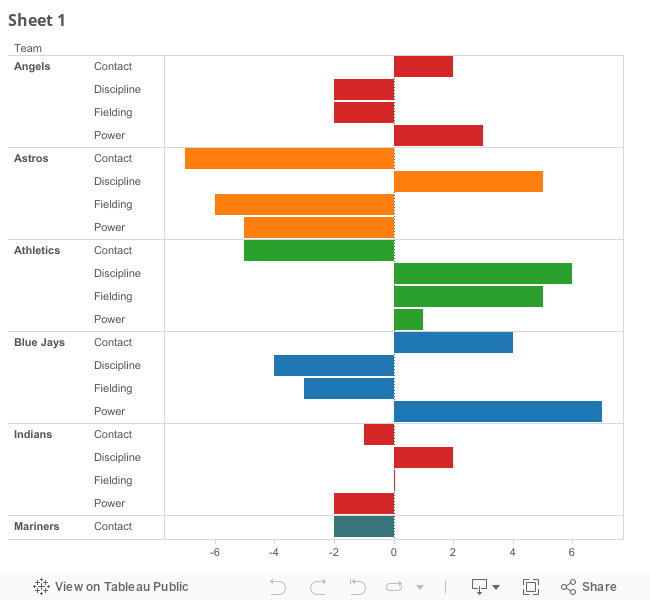
These variables are about as perfect as they are creative (which is to say, not very).  However, this was intended to be a fairly simple exercise.  For each variable, I ranked all the teams and assigned a value between -7 and 7.  The best team in the AL received a 7, second best a 6, and so on.  A score of 0 is average and -7 is the worst.  Here are the results:

Dashboard 1

As an inexperienced embedding artist, I feel obligated to include this link, which should work if the above chart is not working in this window.

Immediately, one thing popped out at me. The Royals are 1st in Contact. They also are 1st in Fielding. This is good, since they project to be dead last in Discipline and Power. These facts going together really is odd. For the most part, teams fit into more general molds. The White Sox and Twins are below average in everything. The Yankees, Red Sox, and Rangers, are below average at nothing. The Rays and A’s are, to no one’s surprise, copying each other with good Discipline and Defense.

In fact, outside of the Royals, there isn’t another team who is 1st or 15th in any 2 categories, and Kansas City did it in all 4. To figure out how they got here, let’s look at some of the ways they stick out from the rest of the league.

In 2013, the American League had a 19.8% strikeout rate. Of all the Royals’ projected starters in 2014, Lorenzo Cain had the highest 2013 K% at 20.4%. Alex Gordon sat at 20.1%, and you won’t find anyone else above 16.1%. Not satisfied with an overall team strikeout rate about 3 points lower than the league average in 2013, the Royals went out and acquired Omar Infante and Nori Aoki this offseason, whose respective rates of 9.1% and 5.9% ranked 8th and 1st among all hitters with 400+ PA last year. It’s obvious why the Royals batting average is supposed to be 8 points higher than the 3rd best in the league. They put the ball in play.

Unfortunately for them, putting it in play is about as much as they can do. They’re the least likely team in the AL to be clogging up bases with walks, and they’re the least capable team to drive in runs with power.

In 2013, the American League had an average Isolated Power of .149. Alex Gordon led the Royals with his .156 mark. And that was it for the above average power hitters. Even Designated Hitter Billy Butler couldn’t muster up anything better than a .124. The team’s ISO was .119, which won’t be affected dramatically by the arrival of Aoki and Infante, whose ISO’s averaged out to .108, but who replace weak-hitting positions for the Royals.

Oh, and for discipline: they don’t walk. They don’t like it. GM Dayton Moore got in trouble for saying something dumb about it, and the data suggest Manager Ned Yost may not have been aware they existed when he played. To the Royals’ credit, they did acquire Aoki, whose 8.2% rate last year was ever so slightly higher than the AL average of 8.1%. Omar Infante’s rate was just above 4, though, and their 6.9% team rate probably won’t be much better this year.

Lastly, fielding. Kansas City could flat out field, winning 3 Gold Gloves, and saving a mind-blowing 80 runs according to UZR. That number, more than double (!!!) anyone else in the AL in 2013, was the 2nd highest UZR ever in the AL, trailing only the 2009 Mariners. Those 80 runs are almost sure to decrease in 2014, but there’s little reason to argue that any other team in the AL will be expected to save more runs with the glove this year.

Overall, the Royals offense could be nuts in 2014. They won’t strike out, and will put the ball in play. There won’t be many other ways they get on, and they won’t be hitting the ball out of the park much. If last year is any indication, they should save some runs for their pitchers when they’re out in the field. No matter how they turn out this year, there’s one thing to remember. If you’re watching a team effort from Kansas City, there’s a decent chance that no one in the rest of the league is doing it better. There’s also just as good a possibility that everyone is.


What’s the Value of a Home Run These Days?

Let’s face it, people love the home run. It’s why players like Mark Reynolds can find jobs. These days, we aren’t surprised when we see a couple of home runs in one game. It wasn’t always like this, however. Home runs used to be a rarity among baseball events. In the early 20th century, it wasn’t uncommon for a player to lead his league in baseball by hitting 10-15 home runs. This brings me to the question: how has the home run actually changed? Not in terms of its frequency, but in terms of its value. More specifically, its value in runs. To approach a solution to this question without arduously parsing through hundreds of event files, we must find a way to mathematically frame the game of baseball in a way that encourages simplicity but doesn’t lose the most familiar parts of the game.

Markov Chains

The first batter of the game steps to the plate and sees no runners on base with none out. He pops up. The second batter steps to the plate and sees the immediate result of the last at bat: an out. The second batter walks. The third batter then sees the immediate result of the second batter’s at bat: a runner on first base. The stream of batters stepping to the plate and being placed into a state resulting from the previous batter’s at bat exemplifies the nature of a Markov Chain. When a batter steps into the batter’s box, his current state (whether it be an out situation, a base situation, or a base-out situation) is only dependent on the previous batter’s state. This is known as the Markov Property. Using this structure, we can simulate any baseball game we’d like. However, to keep our calculations simple, we should introduce some new rules.

The Rules of the Game

  1. A batter can only attain a BB, HBP, 1B, 2B, 3B, or HR.
  2. Outs only occur via a batter getting himself out.
  3. Anything other than the events from 1) is assumed to be an out.
  4. When a batter gets a hit, the runners on base advance by as many bases attained by the batter (e.g. a double with a runner on second will score the runner on second).

These are the rules of the game. There are no stolen bases, no scoring from second on a single, and no double plays. We have stripped the game down to only its essentials, while implementing certain changes for our own convenience. For our purposes, we don’t care about Mike Trout’s 33 stolen bases, only the fact that he mainly attains his bases through the events we allow.

The Out Chain

We assume that the probability of a batter getting a single at any point during a season is the number of singles he gets for the season divided by his plate appearances. We do this for the probabilities of all our desired events. By doing this, we can construct a simple Markov Chain where players step to the plate and find themselves batting with 0, 1, or 2 outs. We find that this chain is irreducible, meaning that each state (0, 1, or 2 outs) eventually leads to every other state. This, and the fact that we are dealing with a finite number of states, leads us to the existence of a probability distribution on our state space of outs. It so happens to be that when a batter starts his at bat, he does so with an equal probability of seeing 0, 1, or 2 outs, i.e. the probabilities of a batter seeing 0, 1, or 2 outs when he comes to the plate are all 1/3. The knowledge that outs are uniformly distributed over our game allows us to construct probabilities for a more complicated chain that should shed light on our original question.

The Base Chain

We now place our focus on the stream of batters who see a certain base situation when they step to the plate. The transitions of base situations are dependent on the out situation, as can be seen when a batter bats hits with 1 out versus 2 outs. Batting with 1 out, if the player makes another out, then the base situation stays the same for the subsequent batter. If he does this with 2 outs, however, then the inning is over and the base situation reverts to the state where no one is on base in the next inning. Fortunately, we know that the probability of a batter seeing any number of outs when he steps to the plate is 1/3. In a similar manner to the Out Chain, we find that every state in the Base Chain leads to every other state. The “runners on the corners” state eventually leads to the “bases loaded” state, which eventually leads to the “bases empty” state, and so on. Since there are finitely many base situations, we are led to a stationary probability distribution on the state space of base situations. That is to say, there is a probability associated with a runner stepping to the plate and seeing the bases empty, and another for seeing a runner on first, etc.

Results

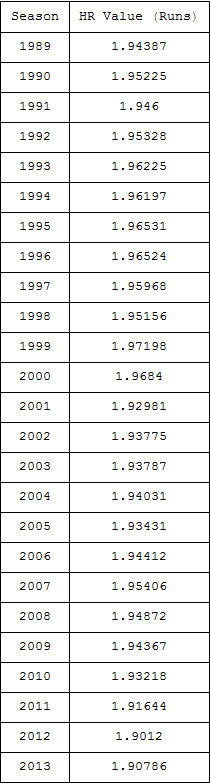
Using this method, a player in our universe who stepped to the plate in 2013 saw the bases empty with an approximate probability of .467. That same batter saw the bases full with a probability of .103 and one runner on first with probability .210. If a team managed to load the bases, they’d find that they generally had to wait about 10 more plate appearances before they next loaded the bases. If they put runners on the corners, they generally had to wait 42 more plate appearances before they did so again. All of this leads us to some of our final conclusions. In the context of our rules, the expected number of runners on base in 2013 was .908, meaning that the expected value of a home run was 1.908 runs. This method generates home run values that are always between 1.8 and 2.2 runs. The following is a table of all of the expected home run values this method generates from the seasons of the last 25 years:

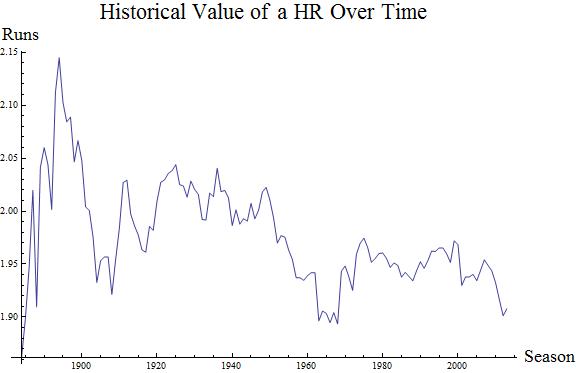
In the last 25 years, we predict that a home run had the greatest value in 1999, at 1.972 runs. This is a reflection of the heavily offensive environment of the season, when big bats such as Sammy Sosa, Mark McGwire, and Barry Bonds were getting on base at staggering rates. The following is a graph of all of the home run values the system predicts from 1884 through 2013:

We see that this system predicts home runs to have been of more value from around 1889 to 1902, when the home run hovers at around 2.00-2.15 runs. While most players of this generation weren’t hitting home runs, they were certainly getting on base often. In 1894, 38 players had on base percentages greater than or equal to .400, compared to 7 players in 2013. When on base percentages are higher, more people are on base, and this increases the expected value of the home run. Under our restrictions, however, the home run hasn’t been worth 2.00 runs since 1950 and these days it fluctuates between 1.90 and 1.93 runs. While these estimates are all under the umbrella of rules and assumptions, this framework allows us to more easily generalize the game of baseball while preserving its most important aspects. It’s this framework that gives us the power of estimating that, while Chris Davis‘ 53 home runs were probably worth 101 runs in 2013, they may have been worth 114 in 1894.


Talkin’ About Playoffs

While watching the playoffs last October, I realized that I had never seen rookies play such a prominent role in the postseason before.  Pitchers like Michael Wacha, Gerrit Cole, Hyun-Jin Ryu, and Sonny Gray propelled their teams into contention during the regular season, and took the hill in multiple elimination games.  The inimitable Yasiel Puig had a similar impact on the Dodgers’ fortunes in 2013.

This observation led me to investigate rookie performance during the 2013 regular season.  Were rookies contributing to the success of their teams more so than in the past?  Were rookie pitchers outperforming rookie hitters?  How about rookies on playoff teams versus non-playoff teams?

Using WAR data from Baseball Reference (sorry, guys) I measured rookies’ contribution to overall team success in 2000-2013, defined as rookie WAR divided by their team’s WAR.  A few definitions before jumping in to the findings:

  • Rookies are players who have accumulated less than 130 AB (or 50 IP) and less than 45 days on an active roster prior to their rookie season
  • For consistency across time, teams that won the second wild-card slot in 2012 and 2013 are not considered playoff teams (u mad, Reds and Indians fans?)
  • Rookie pitcher WAR = amount of WAR created by a team’s rookie pitchers
  • Rookie pitcher share of WAR = % of a team’s WAR created by rookie pitchers
  • Rookie batter WAR = amount of WAR created by a team’s rookie batters
  • Rookie batter share of WAR = % of a team’s WAR created by rookie batters
  • Rookie total WAR = Rookie batter WAR + Rookie pitcher WAR
  • Rookie share of total WAR = Rookie pitcher share of WAR + Rookie batter share of WAR

In chart 1, rookie share of total WAR for the average team in 2013 (11.3%) is above the long-run average of 8%, and was only exceeded in 2006 (12.7%).  But there was no discernible difference in rookie share of total WAR between the average playoff team (10.9%) and non-playoff team (11.4%) last season.  So far, it would appear as though I need to adjust my TV.

The data becomes more interesting when the average team’s rookie share of total WAR is decomposed into pitcher and batters’ contributions (chart 2).  There is a rapid rise in rookie pitcher share of WAR between 2010 and 2013, peaking last season at 6.7% of the average team’s WAR.  This increase was so strong, it more than made up for a decrease in rookie batter share of WAR during the same timeframe, from 6.5% in 2010 to 4.6% last season.

These trends become starker when the analysis is limited to playoff teams (chart 3).  On the average playoff team in 2013, rookies provided 10.9% of WAR, a step down from the high reached in 2012.  But there is still a huge rise in rookie pitcher share of WAR between 2010 and 2013, to 8.7% last season, and a concurrent decrease in rookie batter share of WAR, to 2.2%.  In other words, 80% of the average 2013 playoff team’s rookie total WAR was generated by pitchers.  If not for a certain Cuban-American hero with a penchant for bat-flipping, that share would have been even higher.

But some evidence, as well as anecdotal observation, suggests that pitchers in general have become more dominant over the past few seasons.  Is this trend, observed so far among rookies, true of all pitchers?  Over the past fourteen seasons, the average team has generated between 36-44% of WAR from pitchers (chart 4).  This share has been consistent over time, and has edged up only slightly during the past few seasons.  This suggests that rookie pitchers, especially those on playoff teams, really did excel in 2013.

Now, let’s look at just how good the rookie pitchers on playoff teams were last season (chart 5).  Together, the 54 rookie pitchers on 2013 playoff teams generated 29.6 WAR, which is slightly higher than last year’s total (29.1 WAR) and much higher than the long-run average (16.0 WAR).  What’s even more impressive is that last season, 57% of all 30 teams’ rookie pitcher WAR was generated by the rookie pitchers on playoff teams, a higher share than in any other season since 2000.  Cumulatively, 54 rookie pitchers on 8 teams outperformed 151 rookies on 22 teams.  Not bad.

But wait…there’s more.  By focusing on the best rookies on playoff teams (arbitrarily defined here as those who generated 1+ WAR), we see that there were 20 such players last season (chart 6).  Of that number, 16 were pitchers, like Shelby Miller, Hyun-Jin Ryu, and Julio Teheran.  Five of those pitchers were on the Cardinals (Miller, Siegrist, Wacha, Rosenthal, and Maness.)  The concentration of top rookie pitchers on playoff teams last year is the highest in at least fourteen seasons.

My initial observation, “Wow, there are lots of rookie pitchers killing it in the 2013 playoffs!” looks to be borne out in the data.  This raises two other interesting questions:

1.  For any of last year’s playoff teams, did rookie pitchers provide enough value to get their team into the playoffs?

2.  Is the rookie pitcher observation a one-time anomaly, or indicative of a larger trend?

The first question is relatively easy to answer.  We can compare each playoff team’s rookie pitcher WAR (essentially, how many more games the team won because of rookie pitchers) to the number of additional games each playoff team could have lost and still made the playoffs without tying a second-place team (let’s call this the buffer). 

For four out of eight playoff teams (again, I exclude the second wild-cards), rookie pitcher WAR is higher than the buffer (chart 7).  But since Detroit and Tampa made the playoffs by one game, and since Pittsburgh’s rookie pitcher WAR is less than one game higher than the buffer, it’s hard to argue that rookie pitchers definitively moved the needle for them. Andy Dirks or Yunel Escobar could have just as easily gotten their teams over the hump, since they also created more than 1 WAR.

The Cardinals are the one team whose rookie pitchers probably got them into the playoffs.  They got 9.7 extra wins from their rookie pitchers (almost 23% of the entire team’s WAR), and made the playoffs by 6 games.

The second question is harder to answer, since the 2014 season hasn’t started yet.  There’s no clear reason why rookie pitchers on playoff teams would suddenly start playing extremely well, especially since it doesn’t look like they’re causing their teams to make the playoffs.  The likeliest explanation is that the top teams in the league happened to have outstanding rookie pitchers last year.  Sometimes, “stuff” happens.

But if you want to prove me wrong, and show that last year’s playoff teams have developed great farm systems capable of producing more top rookie pitchers, pay close attention to what Jameson Taillon (Pirates), Carlos Martinez (Cardinals), Jake Odorizzi (Rays), and Allen Webster (Red Sox) bring to the table in 2014.  All four pitchers are on Baseball America’s list of top 100 prospects, are on last year’s playoff teams, and are projected to crack the majors this season.  If they get off to a hot start, and if they help their teams return to the playoffs, I might have to revisit my conclusion next winter.


Examining the Prince’s Reign in Texas: Prince Fielder and the 2014 Rangers

One of the offseason’s most talked-about moves was the trade that sent Prince Fielder to the Texas Rangers in exchange for Ian Kinsler and gobs of cash. While universally (and rightfully so) viewed as primarily a salary dump for GM Dave Dombrowski and the Tigers camp, the Rangers have gained a strong bat to place in the middle of their batting order alongside Adrian Beltre and Alex Rios.

Yet unlike the much-theorized David Price trade, the Fielder deal was not a pure salary dump. Fielder stumbled mightily in his production in 2013. In 2012, he posted a robust .313/.412/.528 traditional slash line, with an impressive .940 OPS and 153 wRC+. According to Baseball-Reference’s oWAR calculations, 2012 was Fielder’s third-most valuable year at the plate with a 5.4 mark. All of this stands in stark contrast to Fielder’s 2013.

Last year Fielder posted a much more pedestrian .279/.362/.457, .819 OPS, 125 wRC+ and 2.9 oWAR. While of course those are still above-average numbers, when attached to the name Prince Fielder and his ubercontract, Dave Dombrowski clearly had reason for concern. However, off-the-field issues are widely believed to have contributed to the dip in Fielder’s production, and natural regression may have also contributed to the fall from Fielder’s career-high traditional slash line. Fielder also enjoyed a career-high .321 BABIP in 2012, with his 2013 mark of .307 more in line with his normal marks.

So, the question presents itself; what exactly does Texas GM Jon Daniels have on his hands in the 2014 model year Fielder? There are a number of factors contributing to this answer. Firstly, while the batters ahead of him do not contribute to his slash line, they certainly do help counting stats such as RBIs. While RBIs are naturally an utterly useless stat when evaluating individual performance, men getting on base allow a hitter to create runs, and as runs are ultimately what win games, putting men on ahead of big bats such as Fielder is part of what goes into good team creation. Therefore, I will examine the clip at which we can expect there to be runners on base when Fielder bats for Texas as opposed to his stint in Detroit.

Secondly, I will also examine the impact Arlington itself will have on Fielder’s bat. Arlington has traditionally been a much more hitter-friendly location than Detroit. But how much exactly will Texas raise Fielder’s numbers?

The top of the 2013 Tigers lineup consisted of Austin Jackson, Torii Hunter, Miguel Cabrera in front of Fielder. Those first three hitters posted OBP’s of .337, .334, and .442, respectively. That averages out to a .371 mark, albeit an imperfect one due to Cabrera’s significantly higher individual mark (also, Cabrera hit a lot of home runs last year, and while that counts towards his OBP, that means the bases were empty when Fielder came to bat). We’ll refer to this average of the top of the order as tOBP, or “Top OBP” for the rest of the article for the sake of saving space.

The top of the 2014 Rangers lineup will be made up of Shin-Soo Choo, and either Elvis Andrus or Jurickson Profar before Fielder, who will bat third. There are a number of different projection systems we can use to forecast the upcoming season, for this article we’ll be using Steamer. Choo is given a .391 OBP, Andrus a .340, and Profar a .321. With Andrus in the lineup the projected tOBP is .365, with Profar it’s .356. So despite throwing his wallet at Choo and his obscene .423 2013 OBP, Jon Daniels in fact is giving Fielder less to work with in front of him.

Or is he? Part of the smaller (projected) tOBP in Texas is that Fielder simply won’t have the best hitter in the game hitting in front of him anymore. Also, one has to expect Fielder to be better at the plate this year. Steamer awards Fielder a substantial .290/.390/.516 line with a 142 wRC+ and 3.4 WAR, a major uptick over last year’s production. If we factor him into the projected Texas tOBP, with Andrus it’s a .374, and with Profar it’s .367. That’s something you like to see if you’re Adrian Beltre, who lead the league in hits last year and launched 30 homers.

And speaking of homers, Fielder’s move to Arlington will help him in that department. The newly named Globe Life Park ranked seventh last year in home runs with a total of 107 being hit there. Comerica Park, where the Tigers play, ranked fourteenth with 99. This helps Steamer award Fielder 29 home runs, up from 25 last year.

However, can we possibly expect Fielder to exceed these projections? As mentioned earlier, Fielder’s down year was contributed to by a number of off-the-field issues according to Hunter. A change of scenery will definitely do Fielder well, and he also seems to have lost some weight if the pictures and video coming out of Spring Training are to be believed. For that reason I’m willing to bump up Fielder’s numbers by a few slots, and I expect him to be even better than what Steamer predicts. Because baseball is a fickle mistress I could easily be wrong, but call it a gut feeling. All in all, Jon Daniels may have caught lightning in a bottle here with his rather expensive gamble, and if Texas manages to overcome their pitching woes they should be a very dangerous team with Fielder anchoring their lineup.


Pitcher WAR and the Concept of Value

Whenever one makes any conclusion based off of anything, a bunch of underlying assumptions get shepherded in to the high-level conclusion that they output. Now that’s a didactic opening sentence, but it has a point–because statistics are full of underlying assumptions. Statistics are also, perhaps not coincidentally, full of high-level conclusions. These conclusions can be pretty wrong, though. By about five-hundred runs each and every season, in this case.

Relative player value is likely the most important area of sports analysis, but it’s not always easy. For example, it’s pretty easy to get a decent idea of value in baseball while it’s pretty hard to do the same for football. No one really knows the value of a pro-bowl linebacker compared to a pro-bowl left guard, for one. People have rough ideas, but these ideas are based more on tradition and ego than advanced analysis. Which is why football is still kind of in the dark ages, and baseball isn’t. But just because baseball is out of the dark ages, it doesn’t mean that it’s figured out. It doesn’t even mean that it’s even close to figured out.

Because this question right here still exists: What’s the value of a starting pitcher compared to a relief pitcher? At first glance this a question we have a pretty good grasp on. We have WAR, which isn’t perfect, yeah, but a lot of the imperfections get filtered out when talking about a position as whole. You can just compare your average WAR for starters with your average WAR for relievers and get a decent answer. If you want to compare the top guys then just take the top quartile and compare them, etc. Except, well, no, because underlying assumptions are nasty.

FanGraphs uses FIP-WAR as its primary value measure for pitchers, and it’s based on the basic theory that pitchers only really control walks, strikeouts, and home runs–and that everything else is largely randomness and isn’t easily measurable skill. RA9 WAR isn’t a good measure of individual player skill because a lot of it depends upon factors like defense and the randomness of where the ball ends up, etc. This is correct, of course. But when comparing the relative value of entire positions against each other, RA9 WAR is the way to go. Because when you add up all the players on all of the teams and average them, factors like defense and batted balls get averaged together too. We get inherently perfect league average defense and luck, and so RA9 WAR loses its bias. It becomes (almost) as exact as possible.

Is this really a big deal, though? If all of the confounding factors of RA9 WAR get factored together, wouldn’t the confounding factors of FIP-WAR get factored together too? What’s so bad about using FIP-WAR to judge value? Well there’s this: From 1995 onward, starting pitchers have never outperformed their peripherals. Relievers? They’ve outperformed each and every time. And it’s not like the opposite happened in 1994–I just had to pick some date to start my analysis. Here’s a table of FIP-WAR compared to RA9-WAR compared to starters for the last 18 years, followed by the same table for relievers.

Starter RA9-WAR/FIP-WAR Comparisons

Year RA9 WAR FIP WAR Difference
1995 277.7 305.0 -27.3
1996 323.2 337.1 -13.9
1997 302.5 336.6 -34.1
1998 326.8 357.8 -31.0
1999 328.7 359.7 -31.0
2000 323.0 348.6 -25.6
2001 324.9 353.9 -29.0
2002 331.4 348.6 -17.2
2003 315.0 346.7 -31.7
2004 311.9 343.0 -31.1
2005 314.8 333.0 -18.2
2006 317.0 345.7 -28.7
2007 343.3 361.6 -18.3
2008 325.7 351.9 -26.2
2009 325.1 351.8 -26.7
2010 317.8 353.6 -35.8
2011 337.3 355.6 -18.3
2012 311.1 337.6 -26.5
2013 304.0 332.4 -28.4

Reliever RA9-WAR/FIP-WAR Comparisons

Year RA9 WAR FIP WAR Difference
1995 78.4 50.3 28.1
1996 73.9 61.8 12.1
1997 98.0 65.4 32.6
1998 101.6 70.4 31.2
1999 99.8 68.9 30.9
2000 106.9 80.2 26.7
2001 103.3 77.6 25.7
2002 91.1 76.6 14.5
2003 112.5 83.4 29.1
2004 117.7 85.1 32.6
2005 115.7 96.7 19.0
2006 112.7 84.0 28.7
2007 86.8 68.2 18.6
2008 104.1 79.7 24.4
2009 103.7 77.7 26.0
2010 109.0 74.9 34.1
2011 91.0 73.6 17.4
2012 116.3 91.3 25.0
2013 126.6 98.5 28.1

Ok, so that’s a lot of numbers. The basis, though, is that FIP thinks that starters are better than they actually are, while it thinks relievers are the converse. And this is true year after year, by margins that rise well above negligible. Starters allow roughly 250 more runs than they should according to FIP every season, while relievers allow about 250 less than they should by FIP’s methodologies–in much fewer innings. In more reduced terms this means that starters are over-valued by about 10% as whole, while relievers are consistently under-valued by about 25% according to FIP-WAR. Now, this isn’t a completely new idea. We’ve known that relievers tend to outperform peripherals for a while, but the truth is this: relievers really outperform peripherals, pretty much all the time always.

Relievers almost get to play a different game than starters. They don’t have to face lineups twice, they don’t have to throw their third or fourth-best pitches, they don’t have to conserve any energy, etc. There’s probably a lot more reasons that relievers are better than starters, too, and these reasons can’t be thrown out as randomness, because they pretty much always happen. Not necessarily on an individual-by-individual basis, but when trying to find the relative value between positions, the advantages of being a reliever are too big to be ignored.

How much better are relievers than starters at getting “lucky”? Well, a few stats that have been widely considered luck stats (especially for pitchers) for a while are BABIP and LOB. FIP assumes that starters and relievers are on even ground, as far as these two numbers are concerned. But are they? Here’s a few tables for comparison, using the same range of years as before.

BABIP Comparisons

Year Starter BABIP Reliever BABIP Difference
1995 0.293 0.290 0.003
1996 0.294 0.299 -0.005
1997 0.298 0.293 0.005
1998 0.298 0.292 0.006
1999 0.297 0.288 0.009
2000 0.289 0.284 0.005
2001 0.290 0.286 0.004
2002 0.295 0.293 0.002
2003 0.294 0.285 0.009
2004 0.298 0.292 0.005
2005 0.300 0.292 0.009
2006 0.293 0.289 0.003
2007 0.291 0.288 0.003
2008 0.297 0.290 0.007
2009 0.296 0.288 0.008
2010 0.292 0.283 0.008
2011 0.292 0.290 0.002
2012 0.294 0.288 0.006
2013 0.293 0.287 0.006

LOB Comparisons

Year Starter LOB% Reliever LOB% Difference
1995 69.9% 73.4% -3.5%
1996 70.9% 73.2% -2.4%
1997 69.5% 72.7% -3.2%
1998 69.9% 73.1% -3.2%
1999 70.6% 73.2% -2.7%
2000 71.4% 74.3% -2.8%
2001 70.9% 74.0% -3.1%
2002 70.2% 72.3% -2.0%
2003 70.7% 73.8% -3.1%
2004 70.4% 74.0% -3.6%
2005 70.6% 72.9% -2.3%
2006 70.9% 74.2% -3.3%
2007 71.5% 74.0% -2.4%
2008 71.3% 73.9% -2.6%
2009 71.7% 74.3% -2.6%
2010 72.0% 75.3% -3.3%
2011 72.0% 74.6% -2.6%
2012 73.1% 76.2% -3.1%
2013 71.9% 75.5% -3.6%

With the exception of BABIP in ’96, relievers always had better luck than starters. Batters simply don’t get on base as often–upon contacting the ball fairly between two white lines–when they’re facing guys that didn’t throw out the first pitch of the game. And when batters do get on, they don’t get home as often. Relievers mean bad news, if good news means scoring more runs.

Which is why we have to be careful when we issue exemptions to the assumptions of our favorite tools. There are a lot of solid methodologies that go into the formulation of FIP, but FIP is handicapped by the forced assumption that everyone is the same at the things that they supposedly can’t control. Value is the big idea–the biggest idea, probably–and it’s entirely influenced by how one chooses to look at something. In this case it’s pitching, and what it means to be a guy that only pitches roughly one inning at a time. Or perhaps it’s about this: What it means to be a guy who looks at a guy that pitches roughly one inning at a time, and then decides the worth of the guy who pitches said innings, assuming that one wishes to win baseball games.

The A’s and Rays just spent a bunch of money on relievers, after all. And we’re pretty sure they’re not dumb, probably.


Brian McCann’s Move to the AL East

This article was inspired by the phenomenal work on 2013 shift data at THT by Jeff Zimmerman:
http://www.hardballtimes.com/expanded-2013-infield-shift-data/

Brian McCann’s 5 year 85MM signing by the Yankees has been noted as a pretty good deal as far as Free Agent contracts go. I do not necessarily disagree since he brings leadership and not wholly quantifiable defensive contributions as a marquee catcher. He posted an ISO above the .200 mark in 2013 for the first time since 2009 and reached 20HR for the 7th time in 8 seasons despite only playing in 102 games due to injury. His generally above average OBP rebounded from a career low .300 in 2012 to .336. His heinous .234 babip from 2012 regressed upward somewhat back to .261. While there are many outward signs that his 2013 bounce back re-established him as a premier offensive contributor (122 wRC+) there are some other numbers that give me pause about his future in New York.

I found Jeff Zimmerman’s 2013 infield shift data article fascinating in so many different ways but one of the major takeaways that I got from it was the disparity of shifting frequency across MLB divisions. Granted, a division with more extreme ground ball pulling shift candidates may lead to more shifts. However, the league leading Orioles had 470 shifts implemented on ball in play events compared to just 473 shifts in the ENTIRE NL EAST in 2013 (108 of those 473 NL East shifts were implemented by the Braves). Overall there were 1800 ball in play shift events in the AL East in 2013 compared to 473 shifts in the NL East. 11 of the top 15 shifting teams in 2013 MLB were AL clubs. (AL East teams are #’s 1,2,6,8,16 overall in # of 2013 shifts)

This is where Mr. McCann and his offensive future comes in: Brian McCann hit into 123 shifts out of 402 PA (30% of PA) in 2013. He hit .179 on balls in play against the shift and .299 when the shift was not on. For comparison David Ortiz hit into 338 shifts in 2013 in 600 PA (56% of PA). Obviously there are smaller than ideal samples in this data and we all know babip fluctuates wildly. That being said the shift deflated McCann’s babip to some degree unquestionably last season and probably has been doing so for a while (I’d love to see this data for 2012, 2011 etc. broken out by batter).

If generally shift-conservative NL East teams were exploiting this aspect of McCann’s game then you can bet he’ll see even more shifts in the shift-happy AL East and across the AL in general. McCann’s GB/FB distribution has stayed slanted toward FB throughout his career around a 0.88 ratio. He has seen his babip decline like most MLB veterans do post-peak. There’s a good chance that his babip will continue to decline and perhaps quite precipitously upon his move to the AL East.

I’ll end this article with an intentionally scary and possibly not totally fair comparison since it’s a strictly left handed hitter compared to a switch hitter: McCann’s career line is .277/.350/.473 with a .289 babip and 0.88 GB/FB ratio. Mark Teixeira’s Left Handed Hitting career line is .267/.359/.518 with a .277 babip and 0.87 GB/FB ratio. If McCann’s batting average/babip were to decline at a similarly faster than normal rate like Teixeira’s I’d blame those shifty AL rivals. The short porch in New York may create some extra HRs but the AL East defensive environment could take those gains away and then some on balls in play.

It will be interesting to compare the 2014 shift data to the 2013 season and see which teams decided to implement the shift more and less frequently. The caveat must also be mentioned that not all shifts are created equal and some teams were much more effective at converting shift balls in play into outs than others. Does that have to do with superior personnel/positioning?

Thanks again to Jeff Zimmerman for the inspired shift research that made this piece possible.


Jedd Gyorko: The Second Baseman With Power

When Robinson Cano signed his 10-year, $240 million deal with the Seattle Mariners, it validated two things: (1) that the going rate for players who can consistently put up +5 WAR is at least $200 million, and (2) a second baseman who can hit like a first baseman is extremely valuable. There aren’t a lot of second baseman in the league who have the 30-homer, .500+ slugging percentage, and .316+ ISO, seasons that Cano does.

Second baseman aren’t considered to be players who have an excess of power. You can make an argument for guys like Ian Kinsler and Dan Uggla. However, neither is the player he used to be. Uggla is a shell of his former self, who can run into a dinger every now and then, but he’s not going to return to the power threat that he once was. While Kinsler has shown some above-average power for a second baseman, most of that power can be attributed to the friendly confines of  The Ballpark in Arlington. Kinsler’s power has also been waning over the past three years, as both his home run totals and slugging percentage have been in decline.

Kinsler’s Power Stats

2011: HR 32, SLG .477,  ISO .223

2012: HR 19, SLG .423, ISO .166

2013: HR 13, SLG .413,  ISO .136

Kinsler is obviously declining as a power threat, and the change from The Ballpark at Arlington to Comerica Park will probably not be kind to him, either. However, just because Kinsler is not hitting for above-average power doesn’t mean that he’s not a valuable second baseman. Kinsler can still hit for some power, and his glove is decent enough to make him one of the better second basemen in the game.

Uggla’s value is derived from his ability to draw walks and hit home runs. He has always had  trouble making contact, which in return drove down his OBP, making power the main reason he was good.

Uggla’s Power Stats

2011: HR 36, SLG .453, ISO .220

2012: HR 19, SLG .384, ISO .164

2013: HR 22, SLG .362, ISO .183

Like Kinsler, Uggla’s power has declined. However, this is to be expected given that he is 34 years old. What is more concerning is Uggla’s decline in slugging percentage, as he has had sub .400 slugging percentages for the past two years.  In both his 2012 and 2013 season, Uggla’s value derived solely from dingers. Uggla has  become a one-dimensional player when it comes to his bat.

Despite that two of the most powerful second basemen in baseball are declining in power, there remains hope in the form of the San Diego Padres’ new, young second baseman Jedd Gyorko.

Gyorko has the potential power of a first baseman. Last year, he hit 23 home runs, had a slugging percentage of .444, and ISO of .200. Considering that he was playing in Petco Park, which decreases homers by 13% for right-handers, his 2013 campaign was very impressive.

ZiPS and Steamer project Gyorko to hit between 20-25 homers next year, and to be somewhere between a +2.5 – 3.5 WAR player. Even if Gyorko’s 2014 campaign mirrors conservative projections, he is still going to be a top-10 second baseman.

Gyorko does comes with flaws. There are definitely some holes in his swing, which make him prone to strikeouts. He also is not going to have a high OBP. Gyorko is going to be a powerful bat with a decent glove, which recalls Uggla. Uggla has certainly had his struggles, and it’s not looking like he will turn things around. However, previously he was similar to what Gyorko appears to be: decent glove, above-average power.

Many of those who follow baseball — front offices, fans, certain baseball writers — seem to have profiles for positions. First basemen, third basemen and corner outfielders are thought of as powerful. Shortstops, center fielders  and second basemen are thought of as  having quick hands and being speedy. However, a player like Gyorko is valuable because he sets himself apart from the typical second baseman profile. Instead of being speedy and hitting for a high average, he’s powerful. Second basemen that hit like first baseman are rare, and that’s why Gyorko is a special player.