Archive for Trade

The Mets Should Trade Noah Syndergaard

Thor’s lat tear was the team’s biggest disappointment in 2017, a season that’s been chock-full of frustration and futility.

It was more demoralizing than the poor winning percentage. More displeasing than a certain player’s disappearance. And even more disheartening than the injuries en masse.

The fall of the Mets’ burgeoning ace is so distressing because it raised alarms about the future of their starting rotation. It’s now uncertain whether Noah Syndergaard, the pitcher once dubbed the second coming of Nolan Ryan, can play a significant role – let alone become the successor to Tom Seaver and Dwight Gooden.

How should the Mets deal with this situation? Though unpopular, there’s only one pragmatic solution: hope for a full recovery, let him recoup value, and trade him before future injuries occur.

Wait – trade him? Wouldn’t it make more sense if they gave such a tremendous talent the opportunity to fix his problems before they press panic button?

Sadly, it’s not quite that simple.

Syndergaard’s issues are so deeply rooted that he’s probably going to get hurt again.

And again.

And again.

Two core components of his skill set are the likely culprits of these injuries, and both are difficult to cure – at least without harming his effectiveness.

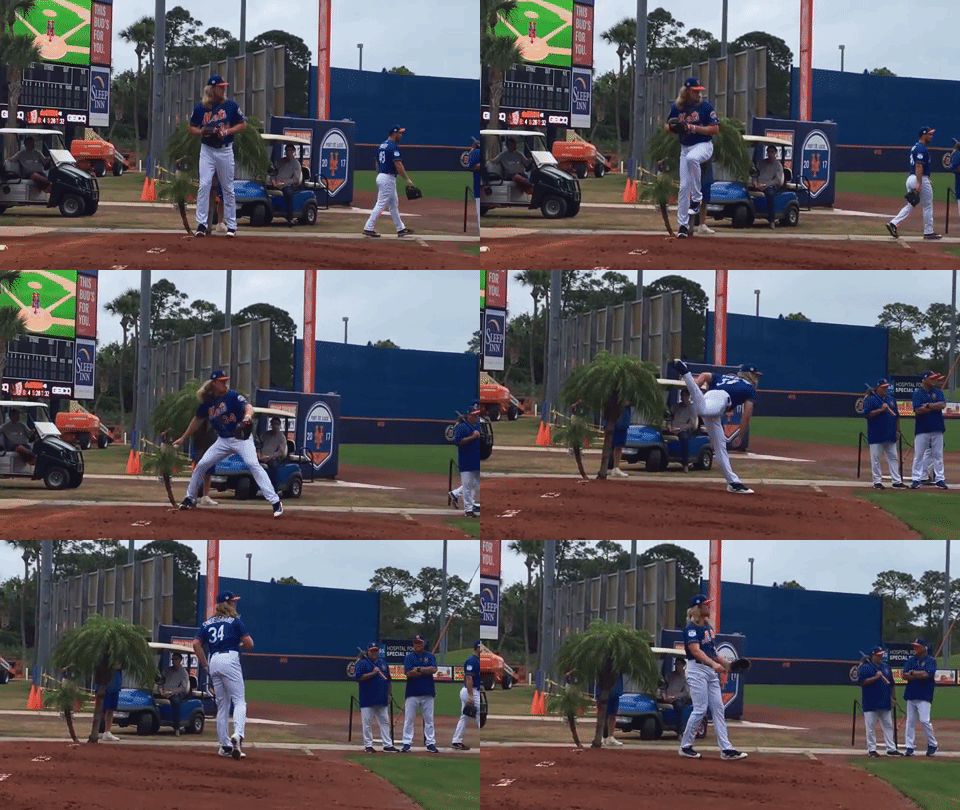
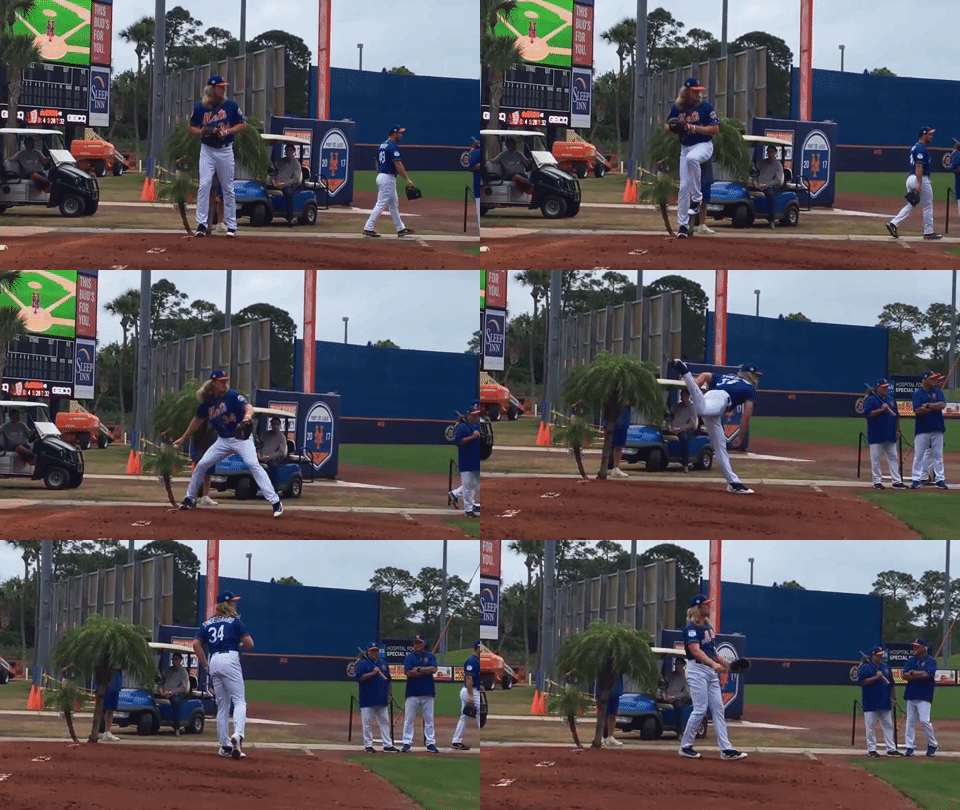
The first is Thor’s throwing motion. In the GIF below, you can see how he relies heavily on his golden arm when delivering a pitch:

At first glance, these mechanics appear quick, straightforward, and minimalistic. But also arm-dependent. If you look more closely, you won’t spot a single movement that attempts to alleviate the immense stress placed on his right wing. Not one.

You don’t see Syndergaard use a high leg kick or take a long stride. Nor do you notice him place substantial weight on his right leg when pushing off the rubber. You can’t observe him rotate his hips fully. And you won’t find too much torque in his upper body.

In short, he utilizes none of the mechanics that generate substantial velocity from his legs, hips, and core. Instead, you witness Thor gain most of his power from a sudden, violent contortion of his back and a quick snap of his almighty arm.

Needless to say, this delivery taxes his right wing…exorbitantly. On every single pitch.

But that’s not all. You also glimpse a slight timing problem that’s already become a ticking time bomb:

Syndergaard’s throwing arm is practically parallel to the ground when he plants his left foot. Then – before raising it to the cocked position – he rotates his hips and accelerates all components of his upper body, actions that place additional stress on his elbow and shoulder.

Mechanics of this sort, both arm-dependent and off-time, significantly increase his chances of getting hurt in the future…and that his afflictions will be far more severe than a torn lat.

The second cause of Thor’s injuries tilts those odds even further. That’s his max-effort pitching style. He looks to dominate batters with a repertoire of five overpowering pitches and, as you can see, holds nothing back:

Noah Syndergaard Average Velocity (MPH), 2015-2017
Pitch Type 2015 2016 2017 Avg MLB Avg
Four-Seam FB 97.72 98.64 98.70 98.23 93.17
Sinker 97.69 98.52 97.99 98.11 91.67
Slider 87.86 91.42 92.27 91.27 84.77
Changeup 88.83 90.31 90.06 89.61 84.13
Curveball 81.21 82.95 84.25 81.91 78.14
OVERALL 92.63 94.83 93.93 93.85 88.52
SOURCE: Baseball Savant/Statcast/PITCHf/x

Both fastballs routinely register around 98 MPH, and his slider and changeup hover about or above 90 MPH. Each one is at least 5 MPH faster than league average and is among the hardest thrown by any starting pitcher. Even his curveball, the “slowest” of the group, is well above the 78.14 MPH mean.

But something sinister lurks beneath these awe-inspiring averages. And that’s the not-so-subtle implication that Thor competes on stuff alone.

There’s neither an inkling that he paces himself nor an indication that he uses complex pitching strategies – at least not to any meaningful degree. Au contraire. From the looks of it, he throws as hard as physically possible all game long. Nothing more, nothing less.

Such an explosive approach requires Thor to exert himself fully on every single pitch he throws. This places additional strain on his elbow and shoulder, accelerates the damage inflicted by his delivery, and dramatically increases his chances of developing major arm problems.

Making matters worse, the two reasons for his injury are incredibly difficult to fix without breaking something else, namely his dominating performance.

Which is exactly why the Mets should move their star pitcher.

Noah Syndergaard is still a blue-chip asset with great trade value. You’d be hard-pressed to find another starter whose repertoire resembles that of an elite closer…let alone one who just turned 25 and won’t be a free agent until 2022.

That combination of unique ability, extraordinary upside, and relatively low financial risk makes him an attractive target despite his injury and its causes. As such, the team would probably acquire several top prospects in return for their ace.

If he’s able to put together a healthy season (or half-season), they should shop him around and pull the trigger on the best deal they find. Otherwise, it’s likely that a catastrophic arm injury will compromise his value; they’d never be able to swap him for anything meaningful again.

Should that day of reckoning arrive, the Mets will be forced to admit that they have another Matt Harvey on their hands: a supremely talented, though fundamentally flawed pitcher whom they should have traded before it was too late.


Cole Hamels’ No-Hitter and Pitcher Game Scores in the Game Before Being Traded

With the trade deadline approaching (ed. note: so long!), we have players donning their current affiliation’s uniforms for a final game.  Aside from a few tears shed by baseball’s infantile devotees (ages 3 and up), these will be business-like transactions; it’s the buying and selling of goods.

For this article, we’ll be looking at pitcher performances in their final game before being traded.   The last game a pitcher pitches for a team is a relatively inconsequential event.  What I mean is that teams searching for that piece to propel their momentum in the efforts of a playoff push know what Cole Hamels is worth.  His value did not take a significant ding after two abysmal starts when he totaled 6.1 IP, 20 H, 14 ER, and 5 K (July 10th and 19th), and neither did it skyrocket after his performance on Saturday.  You know what happened, but let me recap: In his last outing for the Philadelphia Phillies, Hamels threw a no-hitter against the Cubs – the very team who he could have ended up with.  That’s probably already a better idea for an article – pitchers that were traded to the team they just faced – but I’ve started the research for the article I’m currently writing, an article that, much like my night, is, for lack of a better word, aimless.  My one year old son is asleep, my wife went to a birthday dinner, I’m in my underwear watching X-Men 2: X-Men United (for the umpteenth time), drinking Diet Hansen’s Tangerine Lime, and thinking about Hamels’ almost 100-point game score in what was his last game as a Phillie.

For the purpose of this article, but mainly to eventually get some sleep tonight, we’re going to limit the research to this current decade (2010 being the starting point), and for pitchers that went to teams that made the playoffs only.  Cole Hamels’ no-hitter scored a 98 on Bill James’ game score calculation, with the only two blemishes keeping it from being a nice even 100, being the two walks he issued over the 9 IP.  There have been two pitchers traded already, Scott Kazmir and Johnny Cueto, and they each posted game scores north of 70 (73 and 78 respectively).  The starting pitcher talent level that could swap hands this year is pretty special.  It’s hard to remember the last time there was a talent pool this deep or when there were this many teams in viable contention to make playoff pushes, so it’s no surprise that we’ve seen a couple of really, really well-pitched games.  But in terms of single-game performances, how good is a game score of even Kazmir’s 73 in the final game before a player gets swapped?  You’d have to go back to 2010 to find a game score as high as 70, which was what Cliff Lee scored for the Mariners after dominating the Tigers over 8 IP.  (Zack Greinke had a 72 before he was traded to the Angels in 2012, but they didn’t make the playoffs.)

Below you’ll find a table with players that were traded close to the deadline to teams that made the playoffs from 2010 – 2014.  Next to their name you’ll find the game score of their last game pitched with the team that traded them (organized by game score) compared to the average game scores they posted with the team that traded them and the team they were traded to.  It’s highly likely that, with so much going on tonight – X-Men just ended – I missed one or two or three starting pitchers.  ((Also spoiler alert (Not about X-Men which I’ve seen close to 100 times now): There are no correlations between that one game score and their value for the rest of the season because a pitcher is the pitcher they’ve been for the body of their work)).

(Game Score Equation courtesy of Bill James: 50 + (outs recorded) + (2*IP after 4th inning) + (1*K) – (2*H) – (4*ER) – (2*Unearned Runs) – (1*BB) = Game Score)

**GmScA = Game Score Average

Player Date/Opp Game Score GmScA Before Trade GmScA After Trade
Cliff Lee 07-04-10/DET 70 65.1 56.3
Ricky Nolasco 07-03-13/ATL 64 53.1 53.4
Paul Maholm 07-29-12/STL 63 52.6 55.1
Jason Hammel 07-04-14/WSH 59 59.6 49.9
Anibal Sanchez 07-22-12/PIT 59 53.5 51.7
Jon Lester 07-25-14/TBR 58 60.3 61.7
Jake Peavy 07-25-13/DET 57 53.8 54.0
Ryan Dempster 07-25-12/PIT 56 60.9 48.3
Doug Fister 07-26-11/NYY 56 55.3 64.0
Edwin Jackson 07-24-11/CLE 54 51.2 50.1
David Price 07-30-14/MIL 53 61.5 58.2
John Lackey 07-26-14/TBR 51 54.5 49.3
Jake Peavy 07-22-14/TOR 41 49.1 59.8
Jeff Samardzija 06-28-14/WSH 37 57.2 60.6
Roy Oswalt 07-24-10/CIN 27 57.6 66.3
Justin Masterson 07-07-14/NYY 22 45.5 40.2
Edinson Volquez 08-23-13/CHC 18 43.4 51.8
Joe Saunders 08-20-12/MIA 3 49.4 50.7
Average 47.2 54.6 54.5

I know that 18 games is a small sample size, but 47.2 is a pretty sizable drop from averages of 54.6 and 54.5.  Perhaps it’s the uncertainty that these players are facing with the looming trade deadline that causes a dip in performance, or perhaps this is a silly, SILLY thing to look into and it means absolutely nothing!!!

But back to this year’s impressive pool of starting pitchers that were rumored to be available.  Let’s say all the top pitchers that are thought to be moving have thrown their last game for their respective teams.  Here’s a look at a table just like the one above but for the pitchers thought to be moving this year.  (This is assuming the caveats that all the players have pitched their final game for their respective teams and that they will all be traded to or have been traded to teams that will make the playoffs).

Player (Traded to) Date/Opp Game Score GmScA before trade
Cole Hamels (Rangers) 07-25/CHC 98 55.3
Johnny Cueto (Royals) 07-25/COL 78 62.1
Mike Leake 07-28/STL 76 55.0
Scott Kazmir (Astros) 07-18/MIN 73 60.3
Jeff Samardzija 07-28/CWS 54 54.3
David Price 07-28/TBR 40 60.3
Mat Latos (Dodgers) 07-26/SDP 49 51.3
Average 66.9 56.9

That’s a lot of 70s.  There are also three pitchers in this group with average game scores of over 60, which is one more than the number of pitchers that went to playoff bound teams from 2010 – 2014.  After all this, I wish there was a way to make this post more interesting, or show some correlation between any of these numbers, but there’s simply not!  It was a thought and I ran with it.  One game does not make a player, but I think in some TINY way, it is another example of what we know to be true:  there is some serious talent that’s about to switch hands – get excited.


Who’s Wilin to Give Rosario a Chance?

So the seemingly inevitable came to fruition last week when the Colorado Rockies sent Wilin Rosario down to Triple-A Albuquerque after just 14 at-bats with the Rockies this year. According to the man himself, it was to allow another bullpen arm to join the big-league club. Fair enough you might say, the team’s immediate needs are a priority (try telling Kris Bryant that) and the Rockies needed another pitcher in the pen.

Just a couple of years ago, Rosario posted a .270 batting average, tallying 28 home runs and an .843 OPS in 426 plate appearances in the most demanding of positions as a 23-year-old rookie.

What did he do for an encore? Well in 2013 Rosario managed a .292 batting average but launched only 21 home runs and his OPS dropped to a paltry .801 in 466 plate appearances. I jest. Still very productive for a young catcher, even if he gets the assistance of Coors field 50% of the time.

So how did it reach the point where this seemingly top prospect is now battling for a spot in the Majors aged 26?

Well, it begins with Rosario’s skills behind the plate. As a 23 year old, the Rockies knew Rosario had the bat to play but needed to improve defensively to become an everyday catcher in the Majors. Bumps and hiccups are to be expected and in 2012 he had 13 errors and 21 passed balls in 105 games.

This improved in 2013, when Rosario committed nine errors and cut passed balls to nine in 106 games.

But then in 2014, things began to fall apart again and in just 96 games, he had 12 passed balls and seven errors. Granted, a strained left wrist troubled him much of the season, and landed him on the disabled list. In May, a nasty bout with type-B influenza cost him 12 games and 11 pounds. All this culminated in a drop in production at the plate. The batting average dropped to .267, homers fell to 13 and his OPS to .739 whilst appearing at the plate 410 times.

On paper, the batting stats don’t look too bad for a catcher suffering illnesses and injuries. After two good years, one disappointing one couldn’t undo all the potential shown in the previous two seasons, surely?

Looking a little deeper then, there’s the issues Rosario has had with facing righties during his career. Below is a breakdown of his 2012, ’13 and ’14 seasons, showing his splits against RHP and LHP.

2012

Split PA H 2B 3B HR BB SO BA OBP SLG OPS
vs RHP 308 68 15 0 14 19 78 .239 .286 .440 .726
vs LHP 118 39 4 0 14 6 21 .348 .381 .759 1.140

2013

Split PA H 2B 3B HR BB SO BA OBP SLG OPS
vs RHP 328 89 14 1 14 8 85 .279 .299 .461 .760
vs LHP 138 42 8 0 7 7 24 .323 .355 .546 .901

2014

Split PA H 2B 3B HR BB SO BA OBP SLG OPS
vs RHP 303 70 16 0 5 18 56 .249 .290 .359 .650
vs LHP 107 32 9 0 8 5 14 .317 .346 .644 .989

Rosario is considered someone who cannot hit righties effectively and one highly-regarded publication even had written this about him heading into 2015. “If every opposing pitcher was a lefty, he’d win an MVP. Any hope for solving RHPs? “. Not exactly a ringing endorsement. But again, his stats against righties aren’t terrible for a young catcher in the National League, certainly serviceable.

However, you now have enough question marks to take stock at what you have; someone who had a bad year, who struggles against right handed pitching and is not performing defensively. So the Rockies had a solution, move him over to first base. His WAR had dropped from starter level in 2012 and 2013 (both years he sported a 2.1 WAR) to replacement level in 2014 (-0.1 WAR). So it seemed like a good idea. Rosario is yet to hit his peak, his bat has more than enough upside for long-term production and without the pressures of needing to improve at the immensely challenging catcher position anymore, things can only trend up.

But then a spanner is thrown into the works in the form of Justin Morneau and his $12.5 million two-year contract which runs through the 2015 season (with a mutual option for 2016). So the simplest short-term solution is to keep Rosario in Triple-A for the season, work out his issues against righties, develop his skills at first and decline the option on Morneau’s contract for 2016, freeing up monies to be used elsewhere. Rosario is arbitration-eligible the next two years and cannot become an unrestricted free agent until 2018 but a long stint in the minors could add an extra year of team control.

So let’s play a bit of devil’s advocate for a moment. If the Rockies extend Morneau through 2016, if the Rockies don’t see Rosario as an everyday first baseman going forward, if they think they can use Rosario to get better elsewhere it begs the question: Who could be Wilin to give Rosario a chance?

As things stand, the Rockies have a winning record and it’s still too early to say if they’ll be contending this year or whether they’ll try to rebuild a little. So let’s look at three possible trades the Rockies could target at the end of this season if they feel the need to move on from Rosario.

Boston Red Sox

Mike Napoli’s contract ends this year and the Red Sox won’t be renewing it. He’s having a bad year and injuries have caught up with him. Rosario on the other hand could be the perfect fit what with the Green Monster and its hitter friendly confines. So the Red Sox could do with getting Rosario. But who could they trade? The Rockies need pitching above all else (which hasn’t bothered the front office too much in the past) but the Red Sox don’t really have any pitching options to trade. If anything, they need the help too.

So let’s look at the outfield. The Red Sox will enter 2016 with Mookie Betts, Rusney Castillo, Jackie Bradley Jr, Daniel Nava and Allen Craig as outfield options, whilst the Rockies will have Corey Dickerson, Carlos Gonzalez and Charlie Blackmon (based on existing contracts and no renewals/trades). So there’s one name which may intrigue. Brock Holt.

Brock Holt is a bit of a utility guy the Red Sox are trying to find at-bats for so one could perceive a trade for an everyday first baseman as ideal. The Rockies don’t have the depth of the Red Sox so they can find ways to give Holt more regular playing time and keep an effective batting lineup.

The likelihood of this trade happening is slim, but it’s intriguing nonetheless.

Philadelphia Phillies

It’s no secret the Phillies are reluctantly rebuilding after prolonged efforts to bury their head in the sand. They still field a lineup containing Ryan Howard and Carlos Ruiz despite father time having caught up with them both (not forgetting Chase Utley).

Ryan Howard continues to be the Phillies everyday first baseman and while he’s still signed through 2016, sooner or later, they need to bite the bullet and accept whatever they can get for him. Carlos Ruiz is also signed through 2016 so maybe if at least one can be moved on, Rosario could fill in for twelve months, covering either spot with a view of an everyday first base role from 2016. He’s young enough to form a part of the rebuild and is a clear upside on both Ruiz and Howard’s bat so this makes sense.

Cole Hamels is the big star the Rockies would love, but the Phillies are looking for a big prospect haul so unless some form of Dickerson, Arenado and top prospects were sent the other way, this just isn’t happening. They don’t have any other starter who could conceivably be considered by the Rockies either. Their main pitching prospects of Aaron Nola, Yoel Mecias, Zach Eflin, Jesse Biddle and Ben Lively are all probably out of play if they get serious about rebuilding so maybe a lower level guy like Nefi Ogando is possible. But this would be a big risk for the Rockies, trading for a mid-tier (at best) pitching prospect.

So maybe some bullpen help to go with it? Ken Giles is the closer in waiting for the Phillies once Papelbon leaves behind the fans who adore him so. But he’s struggle early in 2015 but again, the likelihood of the Phillies losing a potential closer for the next few years to bring in Rosario is unlikely so at best a package of two or three decent arms could be conceived by both parties.

Although it’d be difficult to see a trade here, I think a big enough scratch beneath the service could see something done to benefit the long term goals of each side. Stranger things have happened so only time would tell if the Rockies and Phillies could get something done.

Seattle Mariners

Finally we reach the most intriguing possible destination. The Seattle Mariners have invested big to get to the World Series in recent years. Big name free agent acquisitions of Robinson Cano and Nelson Cruz on the last two off-seasons has added to their chances whilst tying up King Felix long term has given them the ace they need. They’ve constructed a good rotation and a solid batting lineup with one notable exception; first base.

Logan Morrison has been the Mariners starting first baseman so far in 2015, after they waived Justin Smoak last October. First base has become a position synonymous with power hitters in recent times, with offense on the decline throughout baseball it’s a focal position for contending teams batting lineups. I’m not disparaging Logan Morrison, I don’t know the guy and he’s a far better baseball player than I’ll ever be, but he’s not a starting first baseman for a Major League contending team. Last year was the first time since 2010 he posted a positive WAR. Even in 2011 when he hit 23 homers, his WAR was -0.6. 2011 also marked the last time he played at least 100 games in a Major League season.

So there’s clearly a need to upgrade here. Is Wilin Rosario a clear upgrade? Well he is enough of one to matter, especially considering Morrison bats leftie. Morrison actually has a better career batting average against lefties (.260 compared to .243 against righties) but that’s as far as it goes for hitting lefties. Just a glance at his over stats will show this. As a sample, he hits a homerun every 28.65 at-bats against righties and one every 42.36 at-bats against lefties. Below is Morrison’s career splits.

Split PA AB H 2B 3B HR BB SO BA OBP SLG OPS
vs RHP 1393 1232 299 67 15 43 148 219 .243 .326 .426 .752
vs LHP 522 466 121 26 1 11 44 113 .260 .333 .391 .724

The Mariners also have the advantage of the DH. They can easily keep Morrison, form some kind of platoon between Rosario and Morrison whilst still giving Rosario at bats against righties with either of them DHing. Rosario would be a cheaper option at first than most alternatives so improving their lineup without breaking the bank is a good thing right? Things are starting to make sense all of a sudden.

But what could the Mariners give up in order to acquire Rosario. Although Rosario would make sense, they certainly aren’t going to overpay for him. This is where things could get interesting…….

Rockies still haven’t pinned everything on Tulowitzki. If they ever trade him away, it’ll be in the next year so heading into 2016, the Rockies may need a shortstop. I present to you, Mr. Bradley Miller. Before you start up, I’m in no way suggesting Miller is a direct replacement for Tulowitzki!

The Mariners looked like giving Chris Taylor the starting shortstop gig in 2015, until a broken wrist curtailed that idea, giving Brad Miller another chance to shine. He’s been pretty good so far this year, but Chris Taylor is back and Miller certainly hasn’t shown the promise the Mariners hoped he would. If Taylor can hit well in Triple-A (he’s already hitting .328 with 2 homers, 5 steals and an .894 OPS) he’ll be with the big league club sooner rather than later. It’d be a downgrade at shortstop for the Rockies I grant you, but would free up a lot of cap space to go out and get something resembling a decent rotation.

But even if the Rockies do keep hold of Tulowitzki (and why wouldn’t you?), we come back to their need for pitching. The Mariners aren’t exactly steeped with pitching but certainly have enough to trade a piece away. They’d be unlikely to want to lose one of their more established “prospects” in order to get Rosario (Taijuan Walker, Roenis Elias, and James Paxton).

But there’s also Danny Hultzen, who has started the year well in Triple-A after rotator cuff surgery (currently sporting a 2.05 ERA through 30+ innings). Tyler Olsen is currently in the Mariner bullpen but was considered a 4th/5th starter during his minor league career and Ryan Yarbrough is continuing to impress in low A ball and at age 23, could easily be in the Majors within a couple of years. So the Mariners have enough depth to make a trade without harming their rotation. Whether or not they value any of these guys on a par with Rosario however is a different matter.

Looking at the three possible destinations, the Mariners appear to be the best chance of getting something done, but I’d be more inclined to suggest Wilin Rosario starts 2016 as the Rockies first baseman. And who’s to say he won’t finish 2015 in the role. Just as it wouldn’t surprise me in the least if he gets traded tomorrow, but that’s baseball. Nothing is ever set in stone and should the Rockies look to move on, there are certainly enough options out there to get something done.

Be a GM: Miami Marlins – Part 3 – Trade Deadline

From my personal blog msilbbaseball.wordpress.com

—–

The Miami Marlins are always in the news at the Trade Deadline, and the story is no different in 2013.

Bullpen

Steve Cishek Fist Pump

     The Marlins possess sought after relievers Steve Cishek, Mike Dunn, Ryan Webb, and Chad Qualls.  Cishek, Dunn, and Webb still have multiple years under team control, while Qualls’ is signed on a one-year deal.  Of the four, I would be most inclined to keep Cishek, who is currently closing games for the Marlins, and doing so extremely well.  Qualls is the most likely to be dealt, as the Marlins don’t want to part with valuable bullpen arms who could contribute to next year’s team.  Also, they don’t want to leave the young starting rotation with an inexperienced bullpen to back them up for the remainder of this season.  Qualls would be a rental reliever for any team, as a 34 year-old journeyman doesn’t scream “Long-term plans”.  Nevertheless, Qualls has caught fire in 2013, putting up the best season of his career.  Through 42 IP in 42 Appearances, Qualls has put up a 2.57 ERA, 1.024 WHIP with a 7.29 K/9 and a 1.93 BB/9 leading to a 3.44 FIP.

UPDATE (9:57 PM) – Chad Qualls fell while celebrating a strikeout tonight.  Stay hot kid.

Zack Cox at Arkansas

     The Marlins dealt relief to a contender at last year’s deadline as well, sending Edward Mujica to the Cardinals for 3B prospect Zack Cox.  Mujica had a 4.38 ERA at the time he was sent to St. Louis, so Qualls’ numbers are significantly superior.  However, Mujica was just 28 at the time, and still had a year of Arbitration remaining, which increased his value.  All things considered, Qualls should be able to produce the same return as Mujica did, possibly more.  What Mujica brought in was fairly significant.  Zack Cox was the Cardinals #4 prospect heading into 2012 by Baseball America.  He was drafted in the first round out of the University of Arkansas  in hopes that he would develop into a premier hitter.  He showed that ability during his first full minor league season in 2011, but fell off dramatically in 2012, hitting .254/ .294/ .421 in the hitter-friendly Pacific Coast League.  Cardinals management decided it was time to move on from Cox, and shipped him to the Marlins, who sent him back down to AA.  Cox has been solid in AA this season, hitting .292/ .393 / .391.  his power numbers decreased, but he’s hitting more consistently as the Marlins are allowing him to take a slow track through the system.  He has the Marlins’ future 3B job in his sights, but will be competing in the system with recent 1st round pick, Colin Moran out of UNC.

     In my opinion, the Marlins sold Mujica enormously high  The Cardinals’ frustration with Cox allowed him to be moved at a fairly cheap price, and it’s difficult to say that this trade is comparable to what the Marlins can get for Qualls.  Nevertheless, this shows that the Marlins can target mid-level prospects (or seemingly declining former top level prospects) in exchange for Qualls.

Decision: Avoid trading Qualls for the sake of trading him.  Aggressively shop him around, but if the return isn’t right (comparable to Mujica’s return), try to negotiate a 2014 contract in the off-season.  Cishek, Dunn, and Webb are main contributors to the Marlins bullpen, and with the team appearing to be a contender in 2014, I would want to keep that consistency.

OF Justin Ruggiano

Veteran Position Players

     The Marlins could potentially move Placido Polanco, Juan Pierre, Greg Dobbs, and Justin Ruggiano.  Polanco and Pierre are signed to one-year deals, and will be Free Agents after the season.  Dobbs is in the last year of a two-year contract.  All four are most likely fits on the bench for a contender, and none of them would be able to bring in a significant return.  Ruggiano had a breakout year in 2012, his first full season, hitting .313/ .374/ .535 in 91 games.  However, he’s slumped this year, removed from his everyday role, floating around a .200 batting average.  He holds the most value, as he still has another season before he’s arbitration eligible, and teams may hope that he returns to his 2012 form.  However, his remaining pre-Arb year is valuable to the Marlins as well, who didn’t want to move him a few weeks ago.  The Marlins called up their top two outfield prospects last week, which makes Ruggiano slightly more available.

Decision: Without much to gain in return, I’d hold on to the veterans, and try to retain Polanco, Pierre, and Dobbs for another year to serve as valuable bench players for the 2014 season.

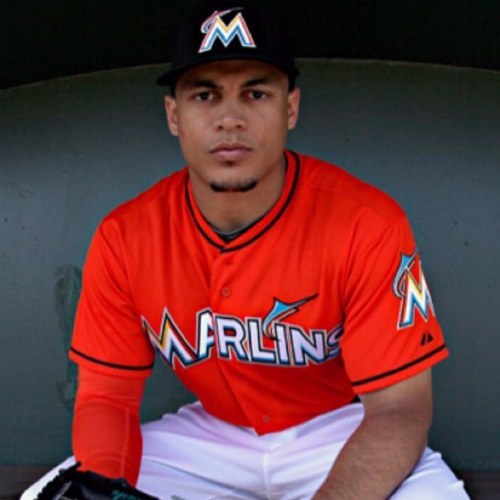
Giancarlo Stanton

     The feature of this article, and many national news stories is Right Fielder Giancarlo Stanton.  I’ve admittedly flip-flopped back and forth about what the Marlins should do with the face of the franchise.  He’s 23 years old, and will be arbitration-eligible for the first time after this season, which will increase his salary by a couple million dollars.  He led the league in slugging in 2012, and had already amassed over 100 career Home Runs.  He is a budding superstar, and teams are willing to pay a very high price for him.

Keep Him

Giancarlo Stanton

     The Marlins are historically known to being a penny-pinching team, but are in a position to spend big money, which they have available to give to Stanton.  If the Marlins stick with Stanton, I see them avoiding arbitration this year with a one year deal in the neighborhood of $7-8MM.  I then project him to earn $10-12MM after 2014, and $13-15MM after 2015.  To avoid paying Stanton $13-15MM for 2016, and then have a future long-term deal based on that salary structure, I would begin working on a back-loaded multi-year deal immediately after the season.  My first offer of a  proposed contract would follow a similar structure to my predicted arbitration salary hike, but then level off around $17-18MM for 2016 and beyond.  Miguel Cabrera, former Marlins emerging offensive superstar, signed a long-term deal with the Tigers in 2008, which levels off at about $20MM per year.  In my opinion, Stanton has shown the potential to deserve a similar contract, but there is no way that I would begin the negotiations at Miguel Cabrera’s deal.

Trade Him

Dontrelle’s Delivery

     Stanton’s value is as high as it’s ever been.  As mentioned before, he’s an emerging superstar who is just reaching arbitration for the first time.  Comparing him again to Cabrera, the Marlins traded him after the 2007 season to the Detroit Tigers along with pitcher Dontrelle Willis for the Tigers #1, 2, 6, 8 rated prospects according to Baseball America, along with other mid-low level players.  The Marlins would be able to reel in at least three of a team’s top ten prospects, ideally two of the top five.  In my opinion they should throw in one of the relievers teams have been calling for (preferably Qualls) to bump up the level of the prospects they would receive.

     The most important thing to consider in this situation, is that the Marlins already have multiple potential replacements for Stanton.  According to Baseball America, three of the Marlins’ top five prospects are outfielders, all of whom have been in the majors this season (Christian Yelich #2, Jake Marisnick #4, Marcell Ozuna #5).  Beyond those three, they also feature Jesus Solorzano, Austin Dean, Brent Keys, and Isaac Galloway in a rich system of minor-league outfielders.  Stanton is simply not at a premium position of need for the Marlins, which in my opinion makes him expendable.  Also, the millions of dollars that would be used to lock up Stanton could be better used to lock up the Marlins phenomenal young pitching staff.

Don’t Trade Him

     The rebutting argument against trading Stanton is how unpredictable trading for prospects can be.  Once again, the Marlins traded Miguel Cabrera and Dontrelle Willis to the Tigers for four of their top ten prospects, including #1 and #2.  A total of zero of them are still with the Marlins, and Cameron Maybin (#1) and Andrew Miller (#2) never lived up to their potential.  All those two names do is make Marlins fans cringe.  Bad trades happen, Major Leaguers are known commodities, while prospects are prospects, something that might be good in the future.  The unpredictability and risk of trading Giancarlo is something that cannot be over-analyzed.

Decision: Make Stanton Available, and listen to offers, but don’t undersell him

Yelich at the 2013 Futures Game

     If a team wants to give you their entire future, then by all means go for the trade.  But if I’m Michael Hill, and I’m not receiving everything that I want from a team, then there’s no deal.  If I’m trading Giancarlo Stanton to your team, I want to be able to go through your organization, and hand-pick the players I want like I’m at a buffet.  If any compromise has to be made, then it’s no deal.  Stanton won’t break the bank in the off-season, and it’s worth keeping him around to see if the Marlins can be truly competitive in 2014, which I believe is very possible, barring unforeseen injuries.

Needs

Jose Fernandez

     The most difficult part about making trades for prospect is to decide where you need help.  The Marlins are set in the outfield, no question about that.  3B seems locked down with Cox and Moran, and I’m a big fan of future Gold Glove winner Adeiny Hechavarria at SS.  Derek Dietrich hasn’t been amazing at 2B, though I really like Ed Lucas.  If only he wasn’t 31.  Donovan Solano could still be a fit, but this is a position that could use improvement.  At 1B, there isn’t much behind Logan Morrison, who is finally fully healthy.  Rob Brantly has been a disappointment behind the plate after impressing at the end of 2012 after he came over from the Tigers for Omar Infante and Anibal Sanchez.  Brantly is still just 24, but is hitting .232/ .283/ .294 while splitting time with Jeff Mathis.  Former first round pick Kyle Skipworth hasn’t been able to hit at any level, and relying on J.T. Realmuto to be the future isn’t a safe bet.  The Marlins pitching is phenomenal, led by Jose Fernandez, and followed by Nate Eovaldi, Jacob Turner and Henderson Alvarez.  The Marlins also have Andrew Heaney and Justin Nicolino in the minors among others with a young pitching staff whose future is just as bright, if not brighter than the Marlins’ outfield crop.

Trade Possibilities

Chad Qualls

2B Kolten Wong

     If we assume that Chad Qualls can bring in a similar return to Edward Mujica, then we’re talking a downward-trending lower high-level prospect (if such a thing exists) or a mid-level prospect.  I love what the marlins did in the Mujica trade, by taking a risk on a possible high-level guy, who is having a bad season.  If the Marlins deal with the Cardinals again, Kolten Wong’s name has been thrown around, as he’s blocked at the Major League level by Matt Carpenter.  However, the Marlins aren’t likely to be able to put together the package for him without having to part with an integral piece.  His name has been linked to a potential Alexei Ramirez trade, who holds more value than Qualls.  The Marlins would have to throw in another reliever or two (Dunn, Cishek, or Webb), or maybe even Derek Dietrich who replace Wong’s spot in the Cardinals system, obviously to a lesser extent.  As an outsider, it’s unclear what the asking price is for Wong, but maybe the Cardinals could sell low again.  Wong is more highly regarded than Cox was at this time last year, but then again Qualls has been better than Mujica was, and the Marlins have arms to give.

Giancarlo Stanton

SS/IF Xander Bogaerts

     I’m trying very hard not to be one of those internet users who has no sense of trade balance, but it would take a completely unreasonable package for me to trade Stanton right now.  The Red Sox reportedly are willing to give up everything to get Giancarlo.  Any deal with them would need to include Xander Bogaerts, and Henry Owens, plus much more.  Bogaerts plays the same position as Hechavarria, but could move over to 2B to create a stellar middle infield that already has me excited.  Bogaerts, the Red Sox #1 prospect by BA, is a 20 year old from Aruba, who has absolutely torn it up in the minors.  Owens, their #5 prospect, recently turned 21, and has pitched very well at High-A Salem.  The Red Sox also have C Blake Swihart at #6 who is showing an upward batting trend.  Their #2 prospect, former South Carolina Gamecock standout, Jackie Bradley Jr. has already spent time in the majors, but being an Outfielder isn’t necessarily attractive to the Marlins. Again, I’d just pick out the Red Sox star prospects, and if I can’t have everyone I want, then sorry Beantown, Giancarlo will still be a Marlin.

     The Pirates and Rangers have also expressed interest in Stanton.  For me, the Pirates would have to part with Gerrit Cole and Jameson Taillon at least.  It would create a very crowded pitching rotation for the Marlins, but is that ever a bad thing?  Unfortunately for the Pirates, many of their top prospects are Outfielders which doesn’t help.  The Rangers have Jurickson Profar, who has been playing 2B.  However, they just traded for Matt Garza which took a hit out of their system, and don’t have many other guys close enough to being Major league ready for me to feel comfortable about.

If Stanton does get traded, I’m thinking that it’s going to be the Red Sox.