Archive for tigers

MLB Dream Team: Active Players Bound for the Hall of Fame, Part I

Sports always allow us to ask, what if? What if a baseball lineup — complete with all nine positions and a designated hitter — was composed of all-time greats in their best seasons.

I have composed a lineup filled with the very best active players who I think will make the Hall of Fame.

These players will not be judged on their performance this year; they will be chosen based on how well they performed during their primes.

I have designated a player’s “prime” as the best seven years of their career — not necessarily consecutive — and these selections are based on the player’s likelihood to make the Hall of Fame. Some members of the team will be inducted on the first ballot, and some will take years to make it to the Hall, but ultimately I think that every player on this list has a great shot at being immortalized in Cooperstown.

This article is part one of a two-part set in which I show my Dream Team. Part two will be released tomorrow.

Metrics Explained

Wins Above Replacement, or WAR, is the most commonly used advanced metric in baseball. It is a measure of how many wins a team gained by playing a specific player instead of a replacement player, who would have a WAR of 0. If a player records 2 WAR in a season, he is considered starting material, 4 or 5 WAR is acknowledged to be All-Star value, and 8 WAR is MVP-level production.

The Jaffe WAR score system, or JAWS, is simply the average of a player’s seven-year peak WAR and career WAR. For example, if a player had 100 career WAR and 50 seven-year peak WAR, his JAWS would be 75. This metric gives us perspective on how likely it is for a player to make the Hall of Fame compared to those who played their position.

Fielding Percentage is a measure off how often a player commits an error. For example, a fielding percentage of 97% means the player committed an error on 3% of the plays he made.

Note: This list favors older players because:

  • They have more career WAR
  • They have more years from which to choose their seven-year peak WAR
  • They are closer to entering the Hall of Fame than younger players.

Batting leadoff and playing right field…

Ichiro Suzuki

59.4 career WAR / 43.6 7yr-peak WAR / 51.5 JAWS

Average HOF RF:

73.2 career WAR / 43.0 7yr-peak WAR / 58.1 JAWS

17th in JAWS out of 24 Hall of Fame Right Fielders

Accolades: MVP (2001), Rookie of the Year (2001), 10x All-Star, 10x Gold glove, 3x Silver Slugger

Ichiro was one of the easiest selections for this Hall of Fame Dream Team. He was a trendsetter — the first Asian position player to debut in the Major Leagues.

In his rookie season, Ichiro set the baseball world ablaze, winning MVP and Rookie of the Year, and leading the league in hits, stolen bases, and batting average.

Ichiro was a revelation in the big leagues, and his game was predicated on speed not power, completely opposite to the direction baseball was trending. According to FanGraphs, Ichiro occupies the first seven spots on the list of highest single-season infield hit totals.

Ichiro was the hit king. He holds the records for most hits in a season (262) and most consecutive 200-hit seasons (10). He also tied the record for most 200-hit seasons (10), and led the league in hits seven times.

Recently, Ichiro reached the 3,000 hit plateau, and if you count his hits from his time in Japan, he broke Pete Rose’s record for most hits across all of baseball’s professional leagues.

In his prime, Ichiro was one of the best players in the world. Only Albert Pujols and Alex Rodriguez accumulated more WAR than Ichiro from 2001 to 2010. On top of being one of the greatest to ever play in the outfield, Ichiro was a cultural icon, and many of the recent advances that Asian players have made are attributable to him.

Batting second and playing left field…

Mike Trout

52.0 career WAR / 52.0 7yr-peak WAR / 52.0 JAWS

Average HOF CF (out of 19):

71.2 career WAR / 44.6 7yr-peak WAR / 57.9 JAWS

14th out of 19 Hall of Fame Center Fielders

Accolades: 2x MVP (2014, 2016), Rookie of the Year (2012), 6x All-Star, 5x Silver Slugger

Trout usually plays center field, but I had to move him over to left in order to accommodate him in the lineup.

Mike Trout is hands-down the best player in baseball right now, and is surely destined for Cooperstown.

Trout has only played five full seasons, but his numbers stack up well next to other center fielders who are enshrined in the Hall. And at just 25 years old, Trout is only entering his prime, meaning that his best years are ahead of him.

Now that’s a stunning thought.

Trout also has the sixth-best seven-year peak WAR out of the 24 center fielders in Cooperstown, in only five seasons!

Here I am talking about how Trout is a generational talent, and I haven’t even mentioned the countless honors that he has collected. Trout has made the All-Star team (for which he has won MVP twice), taken home a Silver Slugger, and been either MVP winner (twice) or runner-up (three times) in every season of his career.

That level of dominance is mind-boggling and completely unprecedented.

Batting third as the designated hitter…

Miguel Cabrera

70.0 career WAR / 44.6 7yr-peak WAR / 57.3 JAWS

Average HOF 1B:

66.4 career WAR / 42.7 7yr-peak WAR / 54.6 JAWS

10th in JAWS out of 20 Hall of Fame First Basemen

Accolades: Triple Crown (2013), 2x MVP (2012, 2013), 11x All-Star, 7x Silver Slugger, World Series Champion (2003)

Miguel Cabrera, still one of the best players in baseball, is a generational talent and already a surefire Hall of Famer. The Venezuelan has been tearing up the big leagues ever since debuting in 2003, and has brought a cheerful smile and a love of the game to wherever he plays.

In the beginning of his career, Cabrera was a young star on the Florida Marlins, one of the youngest teams in baseball. He experienced success early on when the Marlins won the World Series in his rookie year. Then, after a blockbuster trade to the Detroit Tigers in 2007, he continued to amaze in the American League.

From 2011 to 2015, Cabrera was the most feared hitter in all of baseball. During that time, he won four batting titles, took home two MVPs, and racked up five All-Star selections. In 2013, Cabrera captured the Triple Crown (leading the league in batting average, home runs, and RBIs), a feat that had not been accomplished since 1967.

Cabrera already has 2,598 hits and 458 home runs as of July 22nd, so he has a good chance to join Hank Aaron, Willie Mays, and Alex Rodriguez as the fourth member of the 3,000 hit and 600 home run club. Cabrera’s near-incomparable match of hitting for both power and average have vaulted him into the conversation as one of the best hitters of all time.

Batting cleanup and playing first base…

Albert Pujols

100.1 career WAR / 61.6 7yr-peak WAR / 80.8 JAWS

Average HOF 1B:

66.4 career WAR / 42.7 7yr-peak WAR / 54.6 JAWS

2nd in JAWS out of 20 Hall of Fame First Basemen

Accolades: 3x MVP (2005, 2008, 2009), Rookie of the Year (2001), 10x All-Star, 2x Gold Glove, 6x Silver Slugger,  World Series Champion (2006, 2011)

The easiest choice on the roster, Albert Pujols should make the Hall of Fame on the first ballot. Much like Pujols’ overflowing trophy cabinet, I don’t have room enough to praise Pujols, truly one of the greatest players ever.

Pujols has faded since he signed with the Angels on a 10-year, $240-million contract in 2012, but don’t let his struggles of late affect your judgement on his case for the Hall of Fame. He trails only Lou Gehrig in career WAR among first basemen, and is one of only 21 position players to record 100 career WAR.

Pujols’ nickname “The Machine” was an apt description of his time as a Cardinal. His 162-game average stats for his 11 years in St. Louis were: .328/.420/.617 with 127 RBIs, 123 runs, and 43 home runs. Pujols finished in the top 10 of the MVP voting all 11 years, ending up in the top five in ten seasons, and winning the award three times. But Pujols isn’t just a slugging first basemen, he is a very capable defender and has won two Gold Gloves.

Pujols became the ninth member of the 600 home run club earlier this year, and next year he should join the 3,000 hit club (as of July 22nd he has 2,908 hits). Pujols leaves a legacy as one of the best ever, and he deserves to be enshrined in Cooperstown.

Batting fifth and manning the hot corner…

Adrian Beltre

91.5 career WAR / 49.7 7yr-peak WAR / 70.6 JAWS

Average HOF 3B:

67.5 career WAR / 42.8 7yr-peak WAR / 55.2 JAWS

5th in JAWS out of 13 Hall of Fame Third Basemen

Accolades: 4x All-Star, 5x Gold Glove, 4x Silver Slugger

Adrian Beltre, still chugging along at the ripe age of 38, has graced baseball with his presence for 20 seasons. From hitting home runs off one knee, to his aversion of people touching his head, Beltre is one of the true characters of the game.

Beltre is third all-time in WAR among third basemen, trailing only Mike Schmidt and Eddie Mathews. He also figures to be the next member of the 3,000 hit club, needing only 15 more hits as of July 22nd. And if he decides to come back and play next year, he has a great chance of overtaking Brooks Robinson for most games played at third base.

Those are just some of the records that Beltre is approaching, and he does not seem to be slowing down.

There is just no debate on Beltre’s Hall of Fame candidacy. Among all third basemen, he ranks in the top five in games played, hits, doubles, home runs, RBIs, and WAR.

Beltre’s legacy will be as one of the best defensive third basemen of all time, and he trails only Brooks Robinson in Defensive WAR among players who have manned the hot corner. His highlight reel of diving stabs, barehanded picks, and throws from all the way across the diamond make him one of the best ever to play third base.

Special thanks to baseball-reference.com for all of these helpful stats. I could not have written this article without them.

Thanks for reading Part I. Part II will be released at a later date and it will include spots 6-9 in the batting order as well as the starting pitcher.

To be continued…


Prospect Watch: 5 Future All-Stars No One Is Talking About

I chose to stick with hitters in this article, because pitching prospects are extremely difficult to predict, and I think the pitchers who do get the hype are typically deserving. However, I do see a trend of some unnoticed hitting prospects turning out great careers in the majors. Let’s get right to it.

1. Travis Demeritte – 2B – ATL

In 2016, Demeritte went from the Rangers’ to the Braves’ system and spent the entire year in high-A ball, where he dominated at the plate. A 2B with power like Cano, good speed and the ability to get on base is such a rarity.

In my opinion, Demeritte has the highest chance of being a perennial All-Star out of these five prospects. The middle infield in Atlanta has an extremely bright future. I’m predicting that Demeritte will make his splash in 2018, and make his first ASG appearance by 2020 (age 25). Let’s look at his numbers from a season ago:


Name Age G AB PA H 2B 3B HR BB SO SB CS BB% K% OPS ISO wOBA wRC+
Travis Demeritte 21 145 547 635 145 33 13 32 78 200 20 4 12.3% 31.5% 0.905 0.283 0.393 139


Let’s compare these to the four All-Star 2B in 2016 and Brian Dozier.

Name G AB PA H 2B 3B HR BB SO SB CS BB% K% OPS ISO wOBA wRC+
Jose Altuve 161 640 717 216 42 5 24 60 70 30 10 8.4% 9.8% 0.928 0.194 0.391 150
Robinson Cano 161 655 715 195 33 2 39 47 100 0 1 6.6% 14.0% 0.882 0.235 0.37 138
Brian Dozier 155 615 691 165 35 5 42 61 138 18 2 8.8% 20.0% 0.886 0.278 0.37 132
Dustin Pedroia 154 633 698 201 36 1 15 61 73 7 4 8.7% 10.5% 0.825 0.131 0.358 120
Ian Kinsler 153 618 679 178 29 4 28 45 115 14 6 6.6% 16.9% 0.831 0.196 0.356 123


Some things to keep in mind as we compare these players: Demeritte was playing in A+ ball, but he did play an average of 12 less games than these major-leaguers. As you can see, it’s basically a two-man race (other than Dozier’s 42 HRs) between Altuve and Demeritte here. While we cannot expect these A+ ball numbers to translate directly against ML pitching, Demeritte definitely deserves more attention in top-prospect lists. While he’s not quite as speedy as Altuve, he has more power, and he walks at a far higher rate. The one glaring weakness is the K numbers for Demeritte. However, some of the top players in the league K at very high rates. As long as the OPS stays high, it doesn’t really matter how a guy makes outs anymore.

I should note that 2016 was a breakout year for Demeritte; in years past he didn’t quite live up to his potential, and also served an 80-game PED suspension. These could be the main reasons why he hasn’t garnered much attention yet. He still has to prove himself to most. However, I’m sold. I’d pencil him in for the majority of the 2020s’ ASGs right now.


2. Ramon Laureano – OF – HOU

Laureano has all the tools: he can play any OF spot well, he has speed and pop, and he gets on base. Houston’s farm has taken a bit of a hit due to some trades in the last two years, but that’s because they knew they had guys like Laureano who don’t have super high trade value, but have a chance to be great ML players like the guys they traded. Let’s look at Laureano’s 2016 numbers.

Name Age G AB PA H 2B 3B HR BB SO SB CS BB% K% OPS ISO wOBA wRC+
Ramon Laureano 21 128 461 555 146 32 9 15 73 128 48 15 13.2% 23.1% 0.943 0.206 0.418 159


The numbers speak for themselves. This is the making of a star; where is the hype? I know it’s not a huge sample size, and we don’t have much to go off from the previous year either, but in A+ and AA last year he put up those phenomenal numbers you see above.

If those aren’t All-Star numbers, then I don’t know what are. Laureano’s ability to play all three OF spots will keep him in the lineup everyday and help his chances of making it to the ASG. When he does get the call-up, if his numbers stay relatively close to this, there’s no way he doesn’t make three to four All-Star Games. As of now, he’s more of a speed threat, but as he develops, the speed/power combo will even out and he will be an Andrew McCutchen-type player. Keep tabs on this guy.


3. Christin Stewart – OF – DET

While researching Stewart, I couldn’t find an article more recent than September of 2015. There’s no one talking about him…why? As we know, Detroit is aging and looking to deal top players. So, I’m assuming we will be seeing a lot of opportunities for young guys to step up and prove themselves. Detroit’s system isn’t super deep, but that could change anytime if they do decide to move some key pieces. Regardless, I see Stewart as the prospect to watch moving forward; he has the tools to be an All-Star. Let’s check out his numbers from 2016.

Name Age G AB PA H 2B 3B HR BB SO SB CS BB% K% OPS ISO wOBA wRC+
Christin Stewart 22 147 514 622 132 29 2 31 93 154 4 2 15.0% 24.8% 0.883 0.245 0.407 156


The power is impressive, and by this chart he looks even a bit better than the two previous guys I mentioned. However, with the K numbers pretty high up there, and not a whole lot of speed, Stewart is a player that could fall into slumps. Often times, adjusting to the majors can be challenging, and some top prospects never quite figure it out. While Stewart’s MiLB numbers are pretty insane, his slump potential makes him a pretty risky pick here. However, I do believe that if he does indeed figure it out, he will make it to a few ASG and serve as an everyday player in this league for a decade. HRs and BBs get it done. Keep an eye on Stewart.


4. Jason Martin – OF – HOU

Another Houston OF prospect…another future All-Star? I think so. The future is certainly bright over at Minute Maid Park: Altuve is a cornerstone, Correa is a centerpiece, Springer is a baller, and they have prospects for days. If they can just figure out how to pitch, they could be a WS contender for the next eight years.

Why Martin, though? Let’s check out his 2016 numbers from high-A ball.

Name Age G AB PA H 2B 3B HR BB SO SB CS BB% K% OPS ISO wOBA wRC+
Jason Martin 20 121 431 502 114 25 7 23 63 112 22 12 12.5% 22.3% 0.874 0.251 0.382 131


Impressive, to say the least. At just 20 years old, he pumped out 23 homers in 121 games. He walks every eight at-bats, and he also grabbed 22 bags on the season. The ability to walk and run (lol) will typically keep guys out of major slumps. While Martin is not a highly-touted prospect at this point, I think he will be a household name by 2022. I expect him to get the call-up in 2019 and play a significant role during a pennant race that year. In 2020, he will burst onto the scene and prove his worth to this franchise.

With Houston’s current build, this might be a guy we see dealt if they are trying to add talent at the deadline this year. That doesn’t change my prediction, however. I see Martin suiting up for the ASG a few times throughout his career. Stay posted.


5. Tom Murphy – C – COL

You can’t keep putting Yadier Molina in there every year. And with Buster Posey most likely making that change to 1B full-time within three years, Jonathan Lucroy getting dealt to the AL, Kyle Schwarber playing OF, etc, pathways for guys like Tommy Murphy open up. Making the All-Star Game as a C is not saying as much as other positions, in my opinion. A decent hot streak in the first half will inflate your hitting numbers. For example, Derek Norris in 2014. It may seem like he was the best catcher in the league at the halfway point, but, as usual, it evened out by season’s end.

With that being said, Murphy has proven he has pop, and playing in Colorado is a huge advantage for him. While I don’t think he will be a Hall-of-Fame catcher, I do think he’s flying under the radar right now and will probably open some eyes in 2017. I’d say he makes two appearances in the ASG before 2022. However, once he gets up near 30 and he’s no longer playing in Colorado, I think he will have trouble keeping a job.

I have him on the list, first of all, because he meets the criteria, and also because I think people should pay attention to him, and lastly because he’s ML-ready, unlike the rest of these guys. Trevor Story didn’t have a whole lot of hype; most people didn’t expect him to make the team out of spring, but with the Jose Reyes situation, the kid got a shot and as we all know, he ran with it. I’m not saying Murphy will make a cannonball-esque splash like Story, but I think he will turn some heads and maybe even get some ASG votes this year. Anything can happen, especially in Colorado. Keep tabs on him.

Honorable Mentions

Dylan Cozens – OF – PHI

There’s not a lot of buzz surrounding Cozens, which is surprising to me, because usually when we see 40 HR in 134 games, we really perk up. In his age-22 season, he played all 134 games at the AA level for the Phillies affiliate, Reading Fightin’ Phils, a place where most Phillies prospects prosper. The reason why Cozens doesn’t quite make the cut here is because of the words, “future All-Star.” He is one of those lefties that mash in the right ballpark and against RHP, but usually career platoon hitters, even if they are highly effective, don’t make the ASG.

Rhys Hoskins – 1B – PHI

Hoskins is another AA player in the Phillies system. He probably has a little bit more of a well-rounded hitting ability than does Cozens, but he’s a 1B, and that’s an overloaded position. You have to be incredible to crack that ASG squad, and I just don’t think Hoskins will ever be quite at that level. I do believe he will pan out to be an everyday guy for a good amount of time in this league. He has really good power and he gets on base, two things that will keep you in the lineup more often than not.

Bobby Bradley – 1B – CLE

Bradley is another guy I would keep an eye on; I’m just not sold on him yet. He has a a lot of raw power, but a really high K rate in the low levels of the minors. Also, he’s a 1B, so once again, really hard to make the ASG at that position.


The Evan Gattis Triples Game

There are 13 qualified hitters in baseball with at least six triples.  12 of the 13 players have at least five SB and the average among those 12 players is 18 steals.  Among the league leading ranks in triples stands one man who defies the common narrative that triples hitters are speedy.  He’s known as ‘El Oso Blanco’, which translates to “The White Bear” for non Spanish-speaking readers, and listed at a whopping 6’4”, 260 lbs, it’s easy to see why they call him that.  His story is one of modern day folklore, and it’s fitting that his wandering days eventually would lead him to an Astros squad that have taken the American League West by surprise.  Evan Gattis, has as many stolen bases as he has batting gloves, or as many as he appears to have, which is zero, because if you’ve witnessed him hit at all, one of the first things you notice about him is that he does not wear batting gloves.  Yet there his name is, one triple ahead of the likes of Adam Eaton and David Peralta; Evan Gattis, with nine triples, the man in sole position of second place for the most triples in major league baseball.

Consider this: he had 1 triple in his first 783 PA (or even 1 in his first 928, if we want to include all of his career PA up to May 28th, 2015 – the date of his first triple this year), and that one triple was hit into Triples Alley at AT&T Park in San Francisco on May 13th, 2014 (No, this was not a Friday the 13th).  Triples Alley is aptly named for the high volume of balls that are hit there that result in triples (relatively speaking).  So that was Gattis’ one and only, and yet he’s hit 9 in his following 446 plate appearances (or even scarier, 9 in 301 PA).  Before delving too much into this, I thought, “Conditions for an Evan Gattis triple would have to be perfect.  I bet at least 6 of these triples are due to Tal’s Hill“, which is the 90 foot wide, 30 degree incline, that extends the area of balls in play about 34 feet beyond where the fence would normally end at Minute Maid Park.  It is a whopping 436 feet to the wall at the top of Tall’s Hill.  However, a quick peek at Gattis’ home/away splits would reveal that he has just 5 triples at home and 4 on the road.

Well then he must have hit his triples in “triple-friendly” parks; below is a table showing where he has hit his 9 triples this year:

STADIUM 3B FACTOR
AT & T Park 1.211
Minute Maid Park (5) 1.549
Kauffman Stadium 1.240
Comerica Park (2) 1.465

Okay, that was predictable and makes a lot of sense to me.  Now here is a spray chart that shows his hit types (if you don’t read keys, the red dots are the triples):

chart (3)

*There is a sneaky red dot signifying a triple hiding behind a home run dot in left center just to the right of the most far left red dot*

Looking at the plotting of the red dots and considering what stadiums he hit his triples at is where I got the idea for this article – and I will now switch to writing in present tense to portray the feeling of spontaneity I felt when I first started this writing. Considering the factors, I get the feeling that I can guess which stadium each of his triples have been hit at – an exhibition of frivolity to be sure, but this is just the kind of thing that we’re looking for while we’re at work, trying to look busy, isn’t it?  If you wanna play, keep reading and guess along.  I am going to take a liberty and use the pronoun “we” instead of “I” so this feels more like a group effort.  And I also have a disclaimer: If you continue reading, you are assuming the risk that this could be a jarringly disjointed, moderately sarcastic, and gif cluttered article – it is.

The Evan Gattis Triples Game

Let’s consider my first hypothesis – that Tal’s Hill is responsible for a majority of these triples.  Looking at the red dots it looks like 3 of them may have very well landed there.  In order to kind of stick with my original idea, we’ll take the five most centrally located red dots and say that those are the triples he hit at home.

chart home

For reference into this reasoning, here’s the stadium layout of Minute Maid Park (all ballpark layouts are courtesy of Clem’s Baseball).  Note the massive depth of center field.

MinuteMaidPark

Using FanGraphs’ Game Logs I’ll pinpoint the dates of his 5 home triples and then plug those dates into Gattis’ spray chart over at BrooksBaseball.

1st Triple at home; 3rd Triple of Season: 06/28 vs NYY

triple1

That ball is not hit to Tal’s Hill, but it is one of his 5 most centrally hit triples of 2015, so that’s 1/1 if you’re scoring at home.

Now here’s the GIF – and here’s where I have to pause and give credit to another article.  When I started to write this post I hadn’t planned on including so much media, but as the post evolved it really did call for GIFs of these triples.  When I searched ‘Evan Gattis triples’ on google, the first link that popped up is this SB Nation post by Murphy Powell, and it’s the source for 6 of the 8 GIFs here and is, by all accounts, VERY similar and a much better article than mine, so check it out.  Any other GIFs were created using Baseball Savant media and makeagif.com.

gattis_3.0

“ARGH!”  That’s the sound of Michael Pineda groaning as he grimaces and falls on to bended-knee while telepathically willing the ball to stay in the park, which it does, barely.  Pineda is groaning because that was not a quality slider.  This information could probably be an entirely new post altogether, but I did warn you about this post being disjointed, so let’s to a quick detour.

This triple took place at the end of June – a table tracking velo and movement of Michael Pineda’s sliders shows that Pineda was throwing sliders of a lesser quality during this period.

Date(s) Velo x-movement v-movement BAA
Pitch to Gattis (06/28) 87.9 2.15 1.25 1.000 (obviously)
April 2015 84.08 4.54 -0.30 .208
May 2015 85.76 4.00 -0.41 .191
June 2015 87.12 2.47 0.02 .250
July 2015 87.10 1.34 0.46 .231

Whether it has been a conscious decision to throw his slider harder or it is a product of his ailing elbow, the results have not been so good.

Anyways, at this point, three triples into the season – and 3 in his last 36 games – Gattis’ reputation as a triples machine is really starting to build momentum (I warned you about the sarcasm, too) and as soon as the ball bounces away from Brett Gardner and is left to be retrieved by a scurrying Garrett Jones, Gattis is off to the races.

2nd Triple at home; 4th Triple of the season: 06/30 vs KCR

triple2

Bingo! This is a Tal’s Hill special and would be a home run at 29 other ball parks.

gattis_4.0

Lorenzo Cain, who has to at least be in the conversation for the smoothest looking active baseball player, is rendered looking like a reckless drunkard, smashing head-first into the wall and then toppling over on to his side after heaving the ball in towards a cut-off man from his knee.  Nonetheless, Gattis has his 4th triple of the year and we are 2 for 2.

3rd Triple at Home; 5th Triple of the season: 07/17 vs TEX

triple3

That one is not quite as impressive as the last one in terms of distance, but he laid into this one pretty good, too.

gattis_real_5.0

This hit scoots up on to Tal’s Hill after it nicks off Leonys Martin’s glove and then bounces off the wall – are you already missing the antics that Tal’s Hill won’t be causing in 2016?  The main thing here is that we are now 3 for 3 in this game.  I knew this would be easy.

4th Triple at Home; 7th Triple of the year: 07-28 vs LAA

triple4

So we’re wrong on this one and that brings our tally to 3 for 4 – and I’ll take most of the responsibility for the ones we get wrong – my bad.  “My bad” suffices when a player makes an errant pass out of bounds in a professional basketball game, so it should be enough here, too.

gattis_5.0 (1)

This one hit just under the yellow line against the Papa John’s sign, and it had to careen off the wall in such a way that it caused the ball to bounce into another empty center field where Shane Victorino finally picks it up and hurls it in just in time for Gattis to pull in to third base with a stand up triple.

5th Triple at Home; 7th Triple of the year: 08-14 vs DET

plot_hc_spray

This is technically another one of the 5 most centrally located triples so we are 4 out of 5.

Gattis Triple 5 Gif


The ball comes off the bat hard enough (99.3 mph) and then takes a generously frictional hop and loses speed as it trickles up against the wall in the deepest part of right center field at Minute Maid.  I don’t care if even the great Roberto Clemente was in right field, that is a long relay throw and there is plenty of time for Evan Gattis to lock down his 9th triple of the season.  Gattis is immediately pulled from the game as he is probably completely out of juice at this point in the season, but fans rejoice over his exploits and even Evan Gattis can’t believe his recent output of triples:

7fx3An


So we are hitting .800 after the home stand, but now let’s take on the triples hit away from home.  Here are the triples that we have left to identify:

chart (3)

The media, for whatever reason, has started to get smaller, so I will point out the locations of the triples: there is one to deep, left center; one to deep center, one to right-center, and one down the right field line.

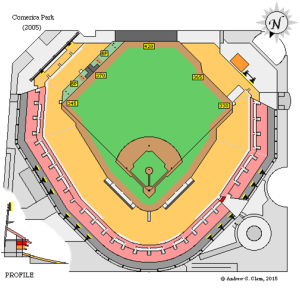
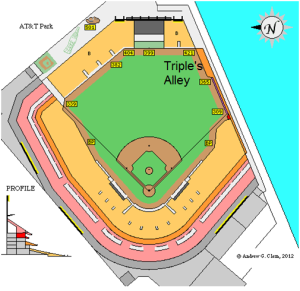
For reference, here are the stadium layouts for Comerica (where he’s hit 2 triples), AT&T Park, and Kauffman Stadium.

Comerica

ballpark

AT&T

triple7

Kauffman Stadium: has the largest outfield in major league baseball as measured by total square feet.

KauffmanStadium

Let’s start with the one triple hit to deep center that did not take place at Minute Maid and say that one took place at Comerica Park, since, like Minute Maid, Comerica has a cavernous center field.

1st Triple of the Year: 05/21 vs DET @ Comerica

triple6

Huzzah! That was kind of obvious and maybe shouldn’t have elicited a Tobias Funke jubilation, but the fact that we’re five for six does.

gattis_half_1.0

Let’s jump ahead to what should be considered the other obvious pick, his triple hit at AT&T park.  There’s a triple that was hit to right center and we’ll say this triple it was a throwback piece; inspired by his first triple in the bigs, in that it was hit to Triples Alley.

8th Triple of the Year: 08/11 vs SFG @ AT&T Park

triple8

This one is wrong and that stings because I felt like this one would’ve been obvious.

qzp-eX

I’m not sure how much of the ball Gregor Blanco gets when he leaps – he may have ultimately sandwiched the ball between his back and the wall – but it looks like he prevented an Evan Gattis HR; but still can’t prevent yet another Evan Gattis Triple.  We’re 5 out of 7.

So of the two triples left, there is one that goes to deep right-center, and one that scurries down a right-field line.  The ballparks left are Kauffman and Comerica.

We’ll play the odds and guess that the one down the right-field line is hit at Kauffman Stadium because it would make sense for the one to right-center to have ended up in that little enclave at Comerica.

6th Triple of the Season: 07/26 vs KCR @ Kauffman Stadium

Oddly enough there is no data for this on Brooks Baseball and there is also no GIF for this triple; Who’s padding the stats?? At least that builds some suspense…

2nd Triple of the Season: 05/24 vs DET @ Comerica

triple9

Wrong – which also makes us wrong on the triple hit at Kauffman so we miss the final 2 – “my bad”.

gattis_2.0

It looks like Rajai Davis was positioned towards the gap and therefore had to hunt this ball down while El Oso Blanco set the base paths aflame.

So our (my) final score is 5/9, which is good but not great considering my 100% accuracy prediction.  While I’m completely aware of the vast, expansive magnitude of my ignorance, I really did believe I could pick out where each of these 9 triples happened…it’s probably this same hubris that causes me to lose $3 daily over at Draft Kings.

Trying to elicit some meaning out of this article would be contrived, so I’ll just say (tongue-in-cheek-ly), Gattis is likely to experience some regression to the mean (whatever that mean is in regards to triples).  I can’t imagine a reality where Evan Gattis highlights aren’t home runs and continue to be centered around him tearing around the basepaths – his massive, rippling thighs simultaneously inspiring awe, terror, and a few chuckles among his teammates – but what do I know?  The last time I tried to predict something about Evan Gattis, I was only 55.6% right.