Sizing Up the “Most X of the Decade” Races; Plus Bonus Trout Stuff
Admittedly, this is a bit of a stupid topic. These distinctions are often thrown around with an air of importance that is far from earned. Nobody ever mentions that Hank Aaron had the most RBIs in the 1960s. You don’t need to talk about arbitrary endpoints with the Hammer. Mentioning that a player holds one of these “records” is a bit like saying a guy you are trying to set a friend up with has a great personality. It’s likely that this is covering up for something else like a hat covers a balding head.
(*before you head to the comments to blast me, yes, RBI is an incredibly useless statistic)
But they are fun! Hank Aaron did lead in RBI in the 1960s, but he finished second to Harmon Killebrew in home runs. Growing up into a baseball fan in the 1990s, one of the bigger surprises in this genre of record was the hit leader of that decade: Mark Grace. I’d imagine every Cub fan knows this. In addition, anyone who knows a chatty Cubs fan probably knows this, too. Looking at the most recent decade, there are a few surprises: Miguel Tejada had the most games played and at-bats. Andy Pettitte edged out Randy Johnson for most wins. Johnson, along with Alex Rodriguez, dominated most of the categories.
Moving to the point of this article, here is a quick rundown of compelling and not so compelling races to have the most X of this decade, with two seasons remaining:
WAR
You, the Fangraphs reader that goes into the depths of the Community Research section, probably know who leads this category, despite spending 2010 in A ball. But it is a bit closer than you might have thought. While Trout could conceivably win the position player award while sitting out the next two seasons (Joey Votto is the only player that might topple him in this scenario, and he is 9.1 WAR behind), this is the one major statistical category in which position players and pitchers compete with each other.
If I just jogged your memory of that, you probably know the name that is coming: Clayton Kershaw. Trout leads with 54.4 WAR. Kershaw has 52.1 WAR on the pitching side, but has also accrued 1.8 WAR as a batter. That should count. So Kershaw, at 53.9 WAR, is directly on Trout’s heals. Trout is still the heavy favorite, but Kershaw has a puncher’s chance, especially if another injury befalls Trout.
Totally made up odds: Trout, 98%; Kershaw, 2%
Hits
Jose Altuve has put up four straight 200-hit seasons, but he is 251 off the pace and in 15th place. No, this title will most likely go Robinson Cano. Cano leads with 1501, and the only players within sniffing distance are similarly on the downside of their primes. Miguel Cabrera is second at 1416, and then there is a slew of players, including Fangraphs favorite Nick Markakis, in the low to mid 1300s.
Cano should clear 150 hits the next two seasons, and if he does, he will not be passed. Cabrera, as bad as he looked at times last season, would be the likely beneficiary of some unforeseen collapse by Cano. Elvis Andrus is the end of that slew of players behind Cabrera. He has 1329 hits, but recorded 191 last season and is significantly younger than everyone in front of him. I’m going to give him sleeper status for this title.
Totally made up odds: Cano, 93%; Cabrera, 5%; Andrus, 2%
Home Runs
Currently, this is an incredibly close race, with four players within five homers of each other at the top of the list. Jose Bautista is first with 272. Edwin Encarnacion and Nelson Cruz are second and third, and then you get to Giancarlo Stanton in fourth place with 267. Other than Miguel Cabrera and the remnants of Albert Pujols, no one else is close. Stanton has to be the favorite, here, but his status is extremely tenuous. First, let’s just get Buatista out of the way. He’s unemployed and several steps below the other players even if he does try to gut out two more seasons.
Without a doubt, it would be shocking if a healthy Stanton didn’t win this. But a healthy Stanton would be at least a little bit of a shock. The once-oft-injured Cruz and Encarnacion are 37 and 35, respectively, but are still mashing and project for mid-to-high 30-something homers apiece. Cruz has played four straight full seasons and E5 has three straight under his prodigious belt. Stanton is projected by Steamer for a literally—but not really literally—bananas number of 53 home runs. The Fans of Fangraphs are more modest, pegging him with only 48. But Stanton is injury prone. You all know that. There is no argument that he is not. So this is a fairly open race.
Totally made up odds: Stanton, 55%; Encarnacion, 25%; Cruz, 20%
RBI
Again, I do know this is a stupid statistic. But artificial endpoints of decades are pretty stupid, too, so this is fitting. This is Miguel Cabrera’s title to lose, and as long as he plays, he should easily win. And guys making the cash Cabrera is due for the next thousand years generally get every opportunity to play. Sitting behind Cabrera’s 860 RBI are Albert Pujols at 806 and Robinson Cano at 789. The aforementioned Edwin Encarnacion and Nelson Cruz round out the top five with 763 and 756 respectively.
If Cabrera falters, this looks like it would be a wide-open race. Pujols achieved the remarkable 100+ RBI season while losing 2.0 WAR last year. He likely will do much worse, but as long as he is playing, he will continue to accrue a decent number of RBI. E5’s Indians outscored the M’s by 68 runs last year and seem to be a better offensive team, but Cano does have a 26 RBI lead. Honestly, this looks like a virtual toss-up if Cabrera doesn’t win, but the idea of Edwin Encarnacion or Nelson Cruz leading the decade in home runs and RBI is rather delicious.
Totally made up odds: Cabrera, 80%; Cano, 7%; Encarnacion, 6%; Cruz, 4%; Pujols, 3%
Stolen Bases
Be honest, which would you rather be known for: a surprise answer to the question “who stole the most bases in the second decade of the new millennium?” or hitting an epic World Series Game Seven home run… for the losing team. Rajai Davis might say porque no los dos? Davis has the most stolen bases this decade with 301. However, he is actually a longshot to keep this title. Davis just signed a minor league deal with the Indians that includes a non-roster invitation to spring training. He will likely struggle to ever get regular playing time again. He’s 37 years old.
This will likely come down to a race between the two guys behind him. Dee Gordon has 278 stolen bases, had 60 last year, and only turns 30 in April. He has a 35 stolen base lead on 3rd place, which would seem more insurmountable if that person was not arguably a full tick or two faster. Billy Hamilton has 243 stolen bases since coming into the league in 2013, and has been remarkably consistent, stealing one more base each year than the year before. The fans think he’ll do that again this year, hitting 60 stolen bases. Hamilton is over two years younger than Gordon, and might be faster, but the 35 stolen base edge Gordon enjoys makes him the clear favorite.
Totally made up odds: Gordon, 66%; Hamilton 33%; Davis, 1%
Wins
This is likely a two-person race between Max Scherzer and Clayton Kershaw who have 132 and 131 wins respectively. Justin Verlander and Zack Greinke sit enough off the pace at 123 and 122 to make a comeback very improbable absent an injury, but close enough to make a comeback very possible if both players in front of them miss significant time.
Moving to who I give the edge to: there just isn’t a lot separating these two. Scherzer is older, but Kershaw has had a bit more in the way of nagging injuries lately. If it truly were a push going forward, I could just go with Scherzer since he is one ahead at the moment. But I’m going to give Kershaw the ever-so-slight edge because the Dodgers are almost assuredly going to be one of the best teams in baseball the next two years while the Nationals might only have that status for the next season. Verlander gets the nod as more likely spoiler for a similar reason: the Astros are ballers.
Totally made up odds: Kershaw, 45%; Scherzer 43%; Verlander, 7%; Greinke, 5%
Saves
Craig Kimbrel should put this away by midseason. At 291, he ranks 61 ahead of Kenley Jansen and Fernando Rodney, who are tied for second with 230. Aroldis Chapman sits in 5th with 204. Kimbrel’s consistency and consistently light usage should ensure that he continues to rack up saves the next two seasons. Even a repeat of his comparatively modest 66 saves over the last two seasons would give him a realistic lock on this honor.
If Kimbrel does fall apart, the 30-year-old Jansen would be the likely beneficiary, as he has a much stronger hold on his 9th inning role than the 40-year-old Rodney. While Kimbrel might have this decade locked down, he will likely fall short in his quest to surpass Rivera’s total from the last decade. Rivera saved 397 games that decade. It should be noted, however, that Kimbrel barely pitched in the majors in 2010 and recorded only one save. On the other hand, he’s already blown one more save than Mariano did all of last decade.
Totally made up odds: Kimbrel, 97%; Jansen, 2%; Rodney, 1%
Strikeouts
Stop me if you’ve heard this before, but this is a two-man battle between Max Sherzer and Clayton Kershaw. Only this time, there is a much clearer favorite. Scherzer leads Kershaw 1909 to 1835. He essentially built that entire lead last season when he recorded 66 more strikeouts than the limited Kershaw. But Kershaw’s innings shortfall was not the only thing at play here. Scherzer struck out 1.63 more batters per nine innings. For the decade, Scherzer has a 74 strikeout lead in only 14 1/3 more innings. The only realistic path for Kershaw to overtake Scherzer is injury. Of course, with pitchers, injury is always a legitimate and significant risk.
Behind Scherzer and Kershaw is Justin Verlander with 1670. No one past Verlander has any legitimate shot barring a mass retirement of the some of the game’s best starting pitchers. At the end of the day, this is really a question about health. But for Kershaw to overtake Scherzer, he’d not only need Scherzer to get hurt, but he’d have to stay healthy himself.
Totally made up odds: Scherzer, 79%; Kershaw, 19%; Verlander 2%
Runs
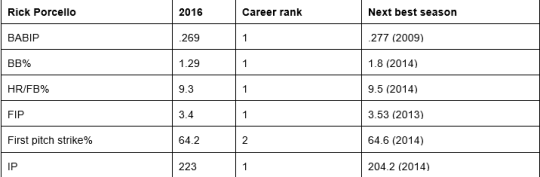
This has been a very positive article, but let’s get a bit negative for a second. Which pitcher will give up the most runs in this decade? A big factor in this, of course, is that giving up a lot of runs is bad, and playing bad usually leads to not playing. You have to be good enough to get the ball on a regular basis, but bad enough to rack up the runs allowed. Our frontrunners are honestly not terrible pitchers. Rick Porcello leads the way with 789 runs allowed. James Shields is just behind with 778 runs allowed. Porcello is 29, started a playoff game last year, and is owed a lot of money through the end of the decade. He also won the Cy Young Award in 2016 while accruing 5.1 WAR on the mound. He should have opportunities to add to this total. Porcello underperforms his peripherals, but only by a little. He is basically good enough to never get moved out of the rotation, and durable enough to throw over 1500 innings this decade, but has a suddenly-not-great-for-the-era ERA of 4.29 over the last eight seasons.
James Shields is slated to maybe start opening day 2018. Unlike Porcello, Shields has been dreadful the past two seasons. Yeah, the White Sox starting pitching this year might be awful. Shields is owed a lot of money in 2018, but 2019 is an option that will only be picked up if Shields has a dramatic turnaround. Thus, there is a bit of a catch-22 here. If Shields plays well enough to keep getting the ball regularly into 2019, it seems unlikely that he’ll chase down Porcello. Of course, this could also come down to injury. If either player gets hurt, the other will very likely take this notorious (dis)honor.
Ubaldo Jimenez sits in 3rd with 734 runs allowed. He will thankfully have a hard time adding to that total. If Porcello and Shields find themselves with quick hooks and no jobs, there are a few possible dark horses, including Ervin Santana and Jon Lester, who at the very least should get two full seasons of starts barring injury. For this one, I’m just going to put the field as a third choice rather than trying to single out who might suck, but play.
Totally made up odds: Porcello, 60%; Shields, 30%; Field, 10%
Other Interesting Battles
(My favorites in italics)
Games: Robinson Cano, 1264; Alcides Escobar, 1250 (that would be something)
Runs: Ian Kinsler, 785; Miguel Cabrera, 741; Andrew McCutchen, 740; Robinson Cano, 738
Strikeouts: Chris Davis, 1266; Mark Reynolds, 1250; Justin Upton, 1249
HBP: Shin-Soo Choo, 98; Anthony Rizzo, 98; Chase Utley, 92
Games: Tyler Clippard, 576; Luke Gregerson, 551
Innings Pitched: Justin Verlander, 1705; Max Sherzer, 1670.2; Clayton Kershaw, 1656.1
HBP: Charlie Morton, 82; Justin Masterson, 77 (23 in AAA in 2017)
Balks: Clayton Kershaw, 17; Franklin Morales, 15; Johnny Cueto, 13
Bonus Trout Stuff
You will notice that, apart from WAR, Mike Trout was not mentioned at all in this article. Of course, Trout played zero MLB games in 2010 and only 40 in 2011. But he is also an all-around performer. He doesn’t even show up in the top 10 for most counting categories. So for the lazy, here is where Trout ranks in the decade (if among top 30, must be qualified for rate stats):
Triples: T-8th (40)
Home Runs: T-16th (201)
Runs: 8th (692)
RBI: 30th (569)
Walks: 7th (571)
Intentional Walks: T-14th (61)
HBP: T-27th (55)
Sac Flies: T-16th (40)
Stolen Bases: 17th (165)
Batting Average: 6th (.306)
OBP: 2nd (.410) (not close to first, Joey Votto, .438)
Slugging%: 1st (.566) (biggest threat is probably Giancarlo Stanton, at .554)
Trout is about to play his age 26 and 27 seasons to round out the decade. He’ll be an “old 27” with his August birthday. We don’t know how he’ll age. But it is possible that he plays his whole career, a career of an inner-inner-circle Hall of Famer, and never leads a decade in any traditional counting stat. This on top of his frustratingly low MVP totals. If nothing else does, perhaps that should tell you how stupid this whole exercise is, and how stupid rigid benchmarks for greatness are in general. If Trout were born three years earlier, he could have dominated the counting stat leaderboards of this decade. If he played for a better team, he could have 2-3 more MVP awards.
So what does it all mean? Probably not much. If Albert Pujols squeaks out the most BRI of the decade, will that make it less of a disappointment? Does Nelson Cruz having the most home runs over an arbitrary 10-year period mean that he’ll one day be enshrined in Cooperstown? Well, no. However, I hope you had fun. I know that I did.