Archive for Colorado Rockies

Jon Gray Has a Pitch Strategy Problem

On the eve of July, the month of definitive do or die competition, the Colorado Rockies optioned their opening day starter, Jon Gray, to Triple A Baseball, putting a temporary halt to a season which should have been superlative. Gray was positioned to be the Rockies Ace pitcher, the de facto strike out machine. He did so, posting an MLB fifth best 11.64 K/9 with a WAR of 2.5, breaking most of his projections.

Yet, Gray’s demise and optioning is a reminder that a pitcher’s job, in the end, is to play the averages and get out of situational disaster to end innings with the formidable zero still on the board. Gray was pitiful at cleaning up the base path with a 63.1 percent left-on-base percentage. His 5.77 ERA was slowly flowing up since the beginning of the season. His MLB best 14.33 K/9 for June was met with only 27 innings of pitching, 62.2 percent left-on-base, and an ERA of six. Troubled outings and difficulty finishing starts were trending, not the outlier.

There is an odd note, however, on Gray’s optioning to Triple A. German Marquez, who finished eight innings of one-run pitching in a 3-1 win over the Los Angeles Dodgers last night, has even more developmental problems. Marquez had an even more troublesome June analytically, with an equal 62.2 percent left-on-base, an era of 6.75, a FIP of 5.26, and nine home runs allowed. Hypothetically, there are two reasons the Rockies have decided to option their ‘best’ pitcher instead of the more developmental Marquez. First, the Rockies may be admitting they are going to be sellers at the deadline, and this is the beginning to positioning certain pitchers for sale. However, this would be a very un-Rockies tact to take for a team who has been stubbornly boisterous about ‘competing’. Second, Gray may be more fixable than Marquez, with a quick stint in AAA allowing him to resolve fundamental mechanics away from the stench of scrutiny. (This hypothetical is what the remnant of the article will focus on). Or, it may be a mix of both hypotheticals, with time telling which carries more weight in organizational decisions.

Optioning Gray becomes a matter of establishing finishing touches, helping him to make his strikeouts effective. In a matter of plate discipline, batters are attacking zone pitches 5.8 percent more than last season, back to a career average of 65.8 percent. Yet, he is throwing less to the zone (43.8 percent) while batters are making drastically less contact (80 percent in 2017, 70.2 percent in 2018). All those numbers lead up to a compelling 13.2 swinging-strike percentage and the conclusion Gray ought to be even better than last season when he finished with a 3.67 ERA and a 3.18 FIP.

The pitch arsenal has seen some slight edits, with a cut to fastballs and a rise in slider percentage of five both ways. Velocity has remained mechanically the same, thus, batters should not be exploiting his pitches at this rate. The problem, however, becomes that batters are exploiting this edit by forcing perceptual chaos on Gray, in which he doubles down on throwing distinct pitches with little movement variation.

Gray’s slider placement, on a meta level, has not changed, nor has the contact basis. However, what has dramatically shifted between 2017 and 2018 is how batters are making contact. In 2017, there were three zones which batters had near .100 averages against Gray; in 2018, that rating has gone up to seven, with an egregious .250 to double down on the pain. Strategically, Gray attacks the shadow of the zone with his slider when ahead and moves up to inside the zone when behind. It is not so much a matter of controlling placement but controlling the count and situation.

A false sense of security in the slider has created situational derisiveness on Gray’s fastball. Gray has developed a distinction with his slider as his ‘shadow’ pitch (3.3 PITCHf/x movement rating, down from 5.4) while his fastball is his ‘heart’ pitch (8.7 PITCHf/x movement, down from 11.3). Thus, when in trouble, Gray’s intents become clear, and his fastballs have been straying more inside. The brevity in fastball movement has lead to batters grouping his fastball and hitting at a .172 average from the middle to right, lower portion of the zone.

In short, Gray’s problems result not from mechanical duplicity, but from strategic duplicity – a loss of confidence. Since Gray’s goal is to hit strikeouts, when bases are empty, he has a 13.84 K/9 rating; when runners are on, his K/9 falls to 8.61 while BB/9 raise to 4.19. With runners in scoring position, his FIP takes a jump to 4.94.

Situationally, the flop begins when situational leverage ebbs from low to medium with 96.6 and 61.8 percent left-on-base, respectively. Unfortunately for Gray, his troubles begin regardless of time through the order. He has allowed 21,19, and 21 runs through the first, second, and third time through the order, respectively. The underlying tact of how batters destroy Gray can be seen in slugging at a .390, .485, and .527 percentage through the order.

What can Gray fix in Triple A baseball? In two words, strategical variety. Despite being able to land more strikeouts, Gray has become less effective by staying stuck in a rut, unable (or unwilling) to hide his slider and fastball with movement. Situational aptitude and learning how to pattern his pitches will be essential to turning Gray into an effective strikeout machine.


Jonathan Lucroy, the Rockie, Is Baseball’s Best Contact Hitter

It’s no secret that Jonathan Lucroy is having a subpar season.

The two-time NL All Star was projected to be a top-three catcher in 2017.  Before the start of the season, Steamer pegged his value at 3.6 wins above replacement, while ZiPS had him at 3.2.  His .242/.297/.338 line and 66 wRC+ in 306 plate appearances as a member of the Texas Rangers produced 0.2 WAR.  No one really expected that.

Lucroy was eventually traded to the Colorado Rockies.  The Rockies, who had the worst catching tandem in baseball, instantly viewed Lucroy as an upgrade, while many other playoff-bound teams would have viewed him as a liability.  With the hitter-friendly environment of Coors Field and poor pitching staffs among the San Francisco Giants and San Diego Padres, the team figured that Lucroy would return to his All-Star form once again.  Although he has not returned to being the power threat that he once was, he has changed his game ever so slightly, such that he might have become the game’s best-hitting catcher.

His basic stat line is not reflective of his plate discipline as a member of the Rockies.  His slash line has gone back up to near his career average (.279/.384/.377), but what is most impressive about him is his actual hitting ability.  Always a good contact hitter, he has changed his game to be more selective, get more contact, and put the ball in play.  His 92 percent contact percentage ranks first in baseball since the trade, and his 88 percent contact percentage of pitches outside the strike zone also ranks first.  The result: a high walk rate (12.3 percent) and fewer swinging strikeouts (6.3 percent of plate appearances resulting in a strikeout).  All of this while swinging at fewer pitches outside the strike zone (18.6 percent) and fewer swings in general (38 percent).  You may be asking “Why isn’t he leading the league in hitting with numbers like that?”  Well, the answer is rather simple.

While he is making more contact than anyone in baseball, most of the balls in play are hit to the defense.  This season, he is hitting more ground balls than ever before.  As a Rockie, 50 percent of the balls he has hit in play have been ground balls, well above his career average of 42.8 percent.  As a result, he has hit fewer fly balls (28.7 percent) which has led to fewer home runs (3.2 percent HR/FB).  This explains his lack of power this year.

He has hit the ball in the wrong place more this season than any other.  For his career, Lucroy has had a tendency to drive the ball up the middle — that has not changed much this season — but this season he has hit the ball softer than in any previous season.  His average exit velocity (85.0 miles per hour) is more in line with middle infielders and outfielders than catchers.  In fact, he has the fourth-slowest average exit velocity among all qualified catchers.  His average exit velocity last season was 87.6 miles per hour, and it was 88.6 in 2015.  Without the wheels of a speedy outfielder or infielder capable of beating out a ground ball (or at the very least forcing the defense to rush the throw), a ground ball for Lucroy is as good as an out.  Just as the saying “baseball is a game of inches,” it’s a game of miles per hour, too.

Fewer ground balls are going through the holes in the infield, and fewer ground balls are becoming hits.  His batting average of balls in play as a Rockie is similar to his career average (.308 as a Rockie and .306 for his career), but his RBBIP — percentage of balls in play that go for a hit or an error — is .318.  While it is above league average, it is well below his RBBIP numbers of both his All Star seasons and 2012, when he hit .320.  Has Lucroy been entirely unlucky with his balls in play?  No; pitchers have pitched to him largely down and away, which has resulted in a horrible contact percentage on those pitches, and he has also regressed slightly in every season since 2015.  But if Lucroy can keep his contact percentage up, hit fewer ground balls, and stay selective at the plate, then he could be one of the best-hitting catchers in the game again.


Kyle Freeland: The New Rockies Prototype

The Colorado Rockies have been one of the biggest surprises this season with a 58-45 record, after going 75-87 last season. Currently, FanGraphs gives them a 64.8 % chance of making the playoffs as a wild-card team. Despite an offense that ranks 29th with a wRC+ of 83, their defense and baserunning have been strong suits, with the eighth-ranked defense and fifth-ranked baserunning. Their pitching staff has been around the middle of the pack (24th in ERA, 19th in FIP, 17th in xFIP) but this is a huge feat while pitching half of their games at the hitter’s heaven of Coors Field. This year, success has come in the form of a young starting rotation that ranks fourth in ground-ball percentage (48.6) and 11th in HR/9 (1.27) among all starting rotations. That’s right, while playing half of their games at Coors Field, the starting rotation has given up fewer HR/9 than 19 teams. Much of the credit for this success goes to rookie left-hander and ground-ball machine Kyle Freeland.

Taken eighth overall in the 2014 draft out of the University of Evansville, Freeland spent two and a half seasons in the minors that included him missing time in 2015 with a shoulder injury, before being called up to start the 2017 season in the Rockies’ rotation. To date, Freeland has thrown 116.1 innings with a 3.64 ERA and a 4.71 FIP while having the third-highest ground-ball rate (57.0 %) among qualified pitchers, to produce 1.4 WAR. What immediately sticks out about Freeland is the huge difference between his ERA and FIP. While FIP is typically higher than ERA for ground-ball pitchers, Freeland is still an extreme case, with his -1.07 ERA – FIP. Like most ground-ball pitchers, he doesn’t get many strikeouts or swings and misses; his 14.4 K% is the third-lowest among the 71 qualified starters, and his swinging-strike rate of 6.9 % is the lowest among qualified starters. However, unlike most ground-ball pitchers, Freeland walks a ton of guys; his 8.8 BB% is 15th-highest among qualified starters. And even more unlikely, while pitching at Coors, he’s allowed the 17th-fewest HR/9 (1.01) to go with a .281 BABIP.

Now it’s time to take a look at the stuff behind those results. Freeland features primarily a three-pitch mix of a four-seam fastball, sinker, and cutter, while also possessing a slider and changeup. His four-seam and sinker are his two best pitches (and only two pitches he has with a positive pitch value according to FanGraphs). As a left-handed pitcher, Freeland has above-average velocity on his fastball, averaging 92.8 MPH with his four-seam and 92.0 MPH with his sinker. Both of these pitches have above average arm-side run and sink, with his four-seam averaging 5.75 inches of horizontal movement with 6.34 inches of vertical movement (it really means that this pitch, on average, drops 6.34 inches less than a pitch thrown at the same velocity with no spin) and his sinker averaging 7.92 inches of horizontal movement and 3.51 inches of vertical movement (the lower the number, the more sink a pitch has).

His fastball and sinker both have above-average sink, but his sinker actually has less horizontal movement than an average sinker and is more of a two-seam/sinker hybrid (Statcast categorizes it as a two-seam while the folks over at Brooks Baseball classify it as a sinker). Yet both of these pitches generate a ton of ground balls and combined are used 65.8 % of the time by Freeland, which is the third-highest FB% among qualified starters. On the other hand, Freeland throws his cutter 20.5 % of the time at an average of 86.9 MPH with -0.46 inches of horizontal movement, to go with 3.18 inches of vertical movement. Due to this vertical movement, Statcast (differing from Brooks Baseball once again) classifies the cutter as a slider despite its low horizontal movement. Freeland’s cutter is truly a cutter/slider hybrid as it has a lot of tilt (like a slider) but doesn’t have much horizontal movement (like a cutter).

The way he uses this arsenal varies greatly when facing left-handed hitters and right-handed hitters. Against righties, Freeland throws his sinker 37.1 % of the time, his four-seam 30.7 % of the time, and his cutter 17.1 % of the time. The idea here is to mix in the sinker thrown down and away with a four-seam thrown in, and a cutter thrown either down and in or over the outer edge of the plate as a backdoor pitch. Against lefties, Freeland throws his four-seam 44.4 % of the time, his sinker 14.0 % of the time, and his cutter 33.0% of the time. Just like against righties, Freeland throws these pitches in the same areas of the zone, throwing his four-seam to his glove side, sinker to his arm side, and cutter to both sides. However, all that changes is how much he uses each pitch. Against both righties and lefties, Freeland pounds the lower outer half, but isn’t afraid to come back inside, usually up and in. This mix is tough for hitters on either side of the plate as these three different pitches all come from the same arm slot and start off heading in the same direction, but break off in different directions, allowing Freeland to miss the middle of bats and generate ground balls. This arsenal has also allowed Freeland to be almost equally effective against righties and lefties. Although it is a small sample, he has faced 102 lefties that have produced a slash of .271/.317/.409, good for a .310 wOBA, and 398 righties that have produced a slash of .253/.345/.398, good for a .324 wOBA.

Only 24, Freeland remains in the early stages of his career, and a sample of only 116.1 innings is nothing. Although he has gotten soft contact at a 25.0% rate, which is the best in the league, we can probably still expect some regression on balls in play. However, since Freeland is a pitcher that relies on the ground ball, his ERA will most likely not regress all the way up to his FIP, especially with strong infield defense behind him. The biggest issue for him to fix in order to sustain his success will be his walk rate. With his high fastball usage, Freeland has no excuse to continue to walk guys, and increased control should come as he ages. Most importantly, the Rockies will be leaning on him as they make a push for their first postseason appearance since 2009. Best-case scenario, Freeland becomes a fixture in the Rockies rotation as their new prototype for success at Coors Field, and leads them into the postseason for the first time since Ubaldo Jimenez was their ace. Worst-case scenario, Freeland experiences extreme regression as his high walk rate and lack of strikeouts come back to haunt him. Based on his stuff and pedigree, Freeland appears to have what it takes to stay in the rotation down the road, but if not, there will always be a role for him in the bullpen, where he can go and throw 75 % fastballs (or more) while generating a ton of ground balls (a la Scott Alexander). Either way, he looks like he can have big-league success while pitching in the big league’s toughest ballpark.


The NL West: Time Zones, Ballparks, and Social Investing

I think the National League West is the most idiosyncratic division in baseball. Note that I avoided a more disparaging term, like odd or weird. That’s not what I’m trying to convey. It’s not wrong; it’s just…off. Not bad–it’s home to 60% of the last five World Champions, right?–but different. Let me count the ways. (I get three.)

Time zones

EAST COAST BIAS ALERT!

It is difficult for people in the Eastern time zone to keep track of the NL West. Granted, that’s not the division’s fault. But 47% of the US population lives in the Eastern time zone. Add the Central, and you’re up to about 80%. That means that NL West weeknight games generally begin around the time we start getting ready for bed, and their weekend afternoon games begin around the time we’re starting to get dinner ready. The Dodgers, Giants, and Padres come by it naturally–they’re in the Pacific time zone. The Diamondbacks and Rockies are in the Mountain zone, but Arizona is a conscientious objector to daylight savings time, presumably to avoid prolonging days when you can burn your feet by walking barefoot outdoors. So effectively, four teams are three hours behind the east coast and the other team, the Rockies, is two hours behind.

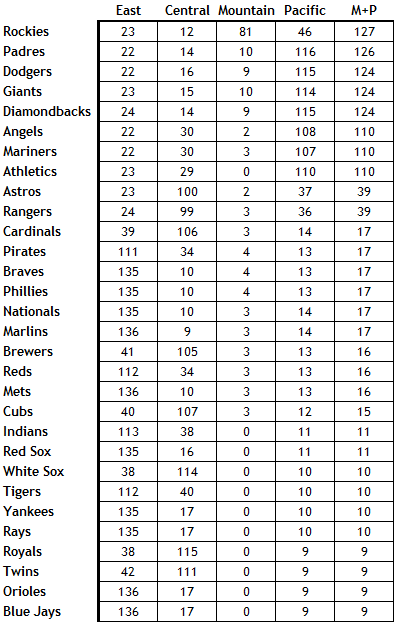
Here’s a list of the number of games, by team, in 2015 that will be played in each time zone, ranked by the number of games in the Mountain and Pacific zones, counting Arizona among the latter:

Again, I’m fully on board with the idea that this is a feature, not a bug. But it’s a feature that means that a majority, or at least a solid plurality, of the country won’t know, for the most part, what’s going on in with the National League West teams until they get up in the morning.

Ballparks

OK, everybody knows that the ball flies in Coors Field, transforming Jose Altuve to Hack Wilson. (Check it out–they’re both 5’6″.) And the vast outfield at Petco Park turns hits into outs, which is why you can pencil in James Shields to lead the majors in ERA this year. But the other ballparks are extreme as well: Chase Field is a hitter’s park; Dodger Stadium and AT&T Park are pitchers’ havens. The Bill James Handbook lists three-year park factors for a variety of outcomes. I calculated the standard deviations for several of these measures (all scaled with 100 equal to league average) for the ballparks in each division. The larger the standard deviation, the more the ballparks in the division play as extreme, in one direction or the other. The NL West’s standard deviations are uniformly among the largest. Here’s the list, with NL West in bold:

  • Batting average: NL West 10.1, AL West 7.2, AL Central 6.5, AL East 5.8, NL East 5.2, NL Central 1.6
  • Runs: NL West 26.5, NL Central 7.9, NL East 6.9, AL East 4.0, AL Central 2.8, AL West 2.7
  • Doubles: AL East 20.3, NL West 11.3, NL East 6.2, NL Central 5.9, AL Central 5.1, AL West 2.9
  • Triples: NL West 50.6, AL Central 49.5, NL East 33.6, AL West 28.3, AL East 27.8, NL Central 11.1
  • Home runs: NL Central 30.2, NL West 23.9, NL East 20.0, AL East 18.7, AL Central 11.3, AL West 11.2
  • Home runs – LHB: NL Central 31.6, AL East 27.4, NL West 25.6, NL East 21.7, AL West 14.7, AL Central 11.7
  • Home runs – RHB: NL Central 32.1, NL West 24.0, NL East 20.0, AL East 14.4, AL Central 13.6, AL West 10.2
  • Errors: AL East 17.7, NL West 12.2, NL Central 11.6, NL East 11.5, AL West 11.2, AL Central 8.2
  • Foul outs: AL West 36.2, AL East 18.3, NL West 16.0, NL Central 15.2, AL Central 13.8, NL East 6.2

No division in baseball features the extremes of the National League West. They ballparks are five fine places to watch a game, but their layouts and geography do make the division idiosyncratic.

Social Investing

You may be familiar with the concept of social investing. The idea is that when investing in stocks, one should choose companies that meet certain social criteria. Social investing is generally associated with left-of-center causes, but that’s not really accurate. There are liberal social investing funds that avoid firearms, tobacco, and fossil fuel producers and favor companies that offer workers various benefits. But there are also conservative social investing funds that don’t invest in companies involved in alcohol, gambling, pornography, and abortifacients. This isn’t a fringe investing theme: By one estimate, social investing in the US totaled $6.57 trillion at the beginning of 2014, a sum even larger than the payrolls of the Dodgers and Yankees combined.

Here’s the thing about social investing: You’re giving up returns in order to put your money where your conscience is. That’s OK, of course. The entire investing process, if you think about it, is sort of fraught. You’re taking your money and essentially betting on the future performance of a company about which you know very little. Trust me, I spent a career as a financial analyst: I don’t care how many meals you eat at Chipotle, or how many people you know at the Apple Genius Bar, you can’t possibly know as much about the company as a fund analyst who’s on a first-name basis with the CEO. So there’s no sense in making it even harder on yourself by, say, investing in the company guilty of gross negligence and willful misconduct in a major oil spill, if that’d bother you.

Note that I said that with social investing, you’re giving up returns. Some social investing proponents would disagree with me. They claim that by following certain principles that will eventually sway public opinion or markets or regulations, they’re investing in companies that’ll perform better in the long run. That’s a nice thought, but social investing has been around for decades, and we haven’t yet hit that elusive long run. The Domini 400 Index, which was started in 1990, is the oldest social investing index. It started well in the 1990s, but has lagged market averages in the 21st century. Now called the MSCI KLD 400 Social Index, it’s been beaten by the broad market in 10 of the past 14 years. It’s underperfomed over the past year, the past three years, the past five years, and the past ten years, as well as year-to-date in 2015. The differences aren’t huge, but they’re consistent. Maybe for-profit medicine in an aberration, but acting on that meant that you missed the performance of biotechnology stocks last year, when they were up 47.6% compared to an 11.4% increase for the S&P 500. Maybe we need to move toward a carbon-free future, but stocks of energy companies have outperformed the broad market by over 100 percentage points since January 2000. I think that most social investing investors are on board with this tradeoff, but some of the industry proponents have drunk the Kool-Aid of beating the market. That’s just not going to happen consistently. In fact, a fund dedicated to tobacco, alcohol, gambling, and defense (aka “The Four B’s:” butts, booze, bets, and bombs) has outperformed the market as a whole over the past ten years.

OK, fine, but what does this have to do with the National League West? Well, two of its members have, in recent years, made a point of pursuing a certain type of player, just as social investing focuses on a certain type of company. The Diamondbacks, under general manager Kevin Towers and manager Kirk Gibson, became a punchline for grit and dirty uniforms and headhunting. (Not that it always worked all that well.) The Rockies, somewhat less noisily, have pursued players embodying specific values. Co-owner Charlie Monfort (a man not without issues) stated back in 2006,  “I don’t want to offend anyone, but I think character-wise we’re stronger than anyone in baseball. Christians, and what they’ve endured, are some of the strongest people in baseball.” Co-owner Dick Monfort described the team’s “culture of value.” This vision was implemented by co-GMs (hey, Colorado starts with co, right?) Dan O’Dowd and Bill Geivett. (OK, O’Dowd was officially GM and Geivett assistant GM, but the two were effectively co-GMs, with Geivett primarily responsible for the major league team and O’Dowd the farm system).

Now, there’s nothing wrong with players who are also commendable people. You could do a lot worse than start a team with Clayton Kershaw and Andrew McCutchen, to name two admirable stars. Barry Larkin was a character guy. So was Ernie Banks. Brooks Robinson. Walter Johnson. Lou Gehrig. All good guys.

But holding yourself to the standards set by the Diamondbacks and Rockies also means you’re necessarily excluding players who are, well, maybe more characters than character guys.  Miguel Cabrera has proven himself to be a tremendous talent and a somewhat flawed person. Jonathan Papelbon has a 2.67 ERA and the most saves in baseball over the past six years, but he’s done some things that are inadvisable. Carlos Gomez, a fine player, second in the NL in WAR to McCutchen over the past two years, has his detractors. Some of the players whom you’d probably rather not have your daughter date include Babe Ruth, Ty Cobb, Rogers Hornsby, Barry Bonds, and many of the players and coaches of the Bronx Zoo Yankees.

I want to make a distinction here between what the Diamondbacks and Rockies did and the various “ways” that teams have–the Orioles Way, the Cardinals Way, etc. There’s plenty of merit in developing a culture starting in the low minors that imbues the entire organization. That’s not what Arizona and Colorado did. They specified qualities for major leaguers, and, in the case of the Diamondbacks at least, got rid of players who didn’t meet them. I don’t know what’s wrong with Justin Upton, but for some reason, Towers didn’t like something about him, trading him away. The Braves make a big deal about character, but of course they traded for Upton, so the Diamondbacks went way beyond anything the Braves embrace.

In effect, what the Diamondbacks and Rockies have done is like social investing. They’ve viewed guys who don’t have dirty uniforms or aren’t good Christians or something the same way some investors view ExxonMobil or Anheuser-Busch InBev. Again, that’s their prerogative, but it loses sight of the goal. Investors want to maximize their returns, but as I said, most social investors realize that by focusing on only certain types of stocks, they’ll have slightly inferior performance. They’ll give up some performance in order to hew to their precepts. Baseball teams want to maximize wins, and there really isn’t any qualifier related to precepts you can append to that.

The Rockies and Diamondbacks were living under the belief that by focusing on only certain types of players, they could have superior performance. It’s like the people who think they can beat the market averages through social investing. It hasn’t happened yet. And, of course, the Diamondbacks and Rockies were terrible last year, with the worst and second-worst records in baseball. Just as social investing doesn’t maximize profits, the baseball version of social investing didn’t maximize wins in Phoenix or Denver.

I’ve used the past tense throughout this discussion. Towers, Gibson, O’Dowd, and Geivett are gone, replaced by GM Dave Stewart and manager Chip Hale in Arizona and GM Jeff Bridich in Colorado. (The Monforts remain.) Last year, the Diamondbacks created the office of Chief Baseball Officer, naming Tony LaRussa, a Hall of Fame manager who’s been less than perfect as a person and in the types of players he tolerates. These moves don’t change that these are both bad teams. But by pursuing a well-diversified portfolio of players going forward, rather than a pretty severe social investing approach, both clubs, presumably, can move toward generating market returns. Their fans, after all, never signed on to an approach that willingly sacrifices wins for the sake of management’s conscience.


Does Troy Tulowitzki Suffer Without Carlos Gonzalez?

Does Troy Tulowitzki suffer without Carlos Gonzalez in the lineup?

Several weeks ago, in the same way my last article on rookie first and second half splits was inspired, my attention was alerted when a podcast personality contrived that Troy Tulowitzki, before his most recent bout with the injury bug, had performed poorly because Carlos Gonzalez had been out of the lineup.

The pundit grabbed the lowest handing fruit he could find in an effort to create a narrative, and a dogmatic one at that, as to why the Colorado Rockies slugger had not lived up to his pre All-Star break numbers.

******* *******’s (I’d prefer the article to be more about the subject of Tulowitzki and Gonzalez than the podcast member) argument was that without Carlos Gonzalez in the lineup, pitchers could approach Tulowitzki without fear, give him less strikes, and that is why his hitting has declined.

While this pundit surmised that Troy Tulowitzki’s performance declines when Carlos Gonzalez is out of the lineup, the numbers tell a much different story.

While we will look at the more direct numbers in a moment, the idea that Tulowitzki plays worse without Gonzalez is essentially the idea of lineup protection at a micro level. There have been countless instances that have debunked the idea of lineup protection, and, to my knowledge, none that have proved its existence.

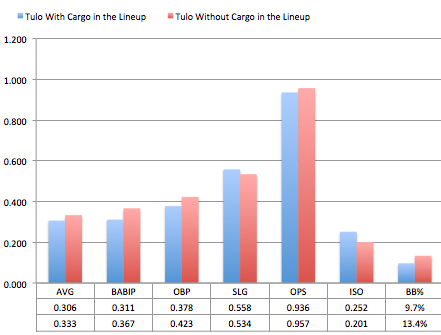
Screen Shot 2014-08-10 at 6.02.45 PM

The research looked at all games from 2010—Carlos Gonzalez’ first complete season—to today.

The results paint a much lighter picture than the Guernica that ******* ******* painted.

In games where Tulo has played without Cargo, he has had a higher AVG, OBP, OPS, and BB%. One might think that Tulowitzki would continue his normal performance without Carlos Gonzalez in the lineup, but, as this information suggests, it is hard to imagine that Tulo plays better because Carlos Gonzalez is not in the lineup, which leads me to believe what one would normally think about out of the ordinary performances in a small amount of at bats.

The utility of these results should be used for descriptive, and not predictive, purposes. Troy Tulowitzki has only had 479 plate appearances without Carlos Gonzalez, and that is far from a large enough sample size to be deemed reliable.

But because of the recent remarks made by Tulowitzki, it seems like it will be more likely than not that sooner rather than later we will see a large enough of a sample size of Tulo in another uniform to see if this trend continues.

While Tulo has played worse and is hurt as of late, we might expect that it is because he was unlikely to live up to the performance he had in the first half, and not because of Cargo’s presence or lack thereof in the lineup. Over the course of the first half of the season, Tulowitzki’s posted the 15th best OPS in a half of a season since 2010.

Tulo’s latest play suggests a regression to the mean, and while we are powerless to know exactly why regression happens, some pundits proclaim to know the reason (i.e. Tulo plays worse without Carlos Gonzalez), when really their specious statement is noise with a coat of eloquent words painted upon it.

When the next “expert” tells you that Tulo has preformed poorly, because “ he wants out of Colorado” or  “he wants to be traded”, you’ll know to be more skeptical and not passively agree.

If he gets healthy at some point this season, we should expect Tulowitzki to perform close to his projections in all areas for the rest of the year, and it will be with or without Carlos Gonzalez, not because of him.


Jason Hammel and the Oddity of ERA

ERA can be a weird thing at times. I love it, but it doesn’t always reveal the full story. Jason Hammel is the perfect subject. After six years in the Rays minor league system, and three bad stints with the Rays Major League club, he found himself looking up at a logjam of starting pitchers in Tampa Bay. The Rays traded him to the Rockies after the 2008 season in exchange for Aneury Rodriguez.

With the trade to Colorado, Hammel was given a great opportunity to start in the Majors for a full season. Since his arrival in Colorado two seasons ago, Hammel has been nothing but consistent. Take a look at his stats:

Read the rest of this entry »


Ubaldo Jimenez – An Outlier Impostor?

If you had told this Colorado Rockies fan ten years ago that our team would have a pitcher who could possibly start the All-Star Game and then possibly win a Cy Young, then this fan would either say you were crazy from lack of oxygen or that the Rockies had moved to another city.  I don’t pretend that our team is the center of the baseball world; rather I know the Colorado Rockies are stuck in no man’s land.  We are neither East Coast nor West Coast.  Our team is rarely seen and our players simply don’t get the respect they deserve due to the Nintendo Ball that was played here in the 90s.  Why do I bother with such an introduction?

Well I think this explains the case of Ubaldo Jimenez.  On April 17, Jimenez became the first player in franchise history to throw a no-hitter.   Jimenez’s story was a feel good moment for the Colorado Rockies.  Jimenez is a nice kid, with a fast ball like no other, pitching for a team where pitchers go to die.  The media gave him his due and moved on to Braden’s perfect game.  But this was only the beginning and Jimenez has since then rattled off ten more wins.  At 13-1, he has done something only two other pitchers can claim to have done in MLB history.

Sometimes though I don’t think unknown early season player performances fit well with the baseball media establishment.  This was supposed to be the year Roy Halladay was going to sweep into the NL and blow batter’s away.  So then what tends to happen to these player performances?  Articles start to sprout up trying to tear down what they have done up to this point.  These articles claim that Jimenez is simply lucky, that it is all a smokescreen, and that eventually the stats will catch up and he will be revealed as an imposter.  That is the funny thing about stats, when the outlier shows up, the men behind the numbers rationalize away the beauty of baseball, and either discount the player or the situation.  The all telling models have become so complex that these outliers just shouldn’t exist.

It should be noted that this article is in no way a complaint about the new generation of stats.  I love them.  I love that the history of baseball is the statistical record.  What I don’t like is when stats are used to manipulate the reader into dismissing great performances.  What Jimenez has done to start 2010 has been simply amazing.  For comparison’s stake let’s look at how Jimenez’s stack up compared to 1968 Gibson’s season and 1986 Clemens’ season.

IP H H / 9 R BB SO K / BB HR BF AB 2B 3B GDP BABIP
2010 Jimenez 101 65 5.8 13 36 88 2.4 3 385 344 18 2 14 0.245
1968 Gibson 124 77 5.6 23 28 92 3.3 5 473 434 9 0 7 0.213
1986 Clemens 115 75 5.9 30 29 114 3.9 11 450 420 15 0 3 0.217

Jimenez stats are pretty comparable to some great pitching performances.  In addition to above, batters are hitting 0.189 against Jimenez (Gibson at 0.177 and Clemens at 0.175).  Of the 385 batters Jimenez has faced only 56 have gotten to a full count.  He has faced 75 batters with runners in scoring position and they are batting 0.147.

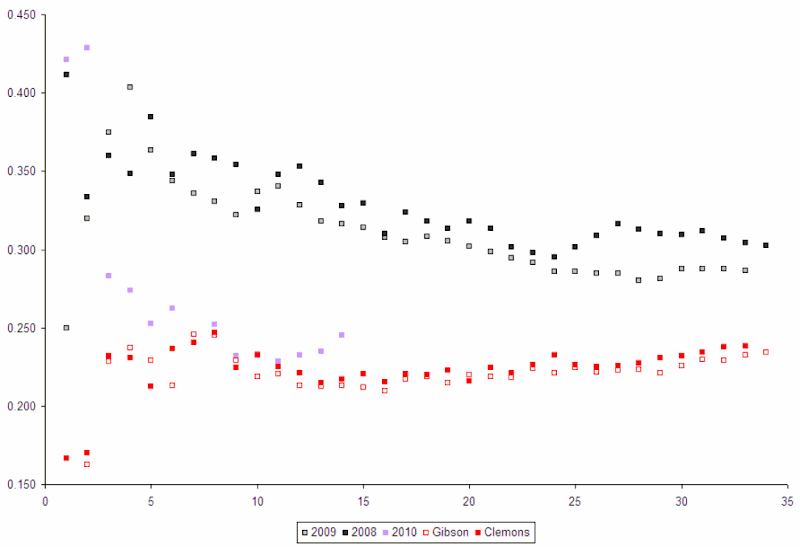
The telling stat for the home team is that he has won 13 of the 36 Rockies victories and ten of wins have come after Rockies losses.  Regardless of any stat a pitcher’s job is to put his team in the position to win.  How the pitcher gets there is some crafty pitching, some luck, and timely hitting by your side.  Baseball is a long season and time will tell whether these numbers will hold up.  I think Jimenez will probably hit a rough patch in July and August.  The team behind him is in disarray.  Scoring runs has been the Rockies Achilles heel not to mention an on and off again bullpen.  His innings pitched has raised a few eyebrows for a player with less than 100 major league starts (compared to Gibson’s 300 starts in 1968 but only 50 starts for Clemens in 1986).  And finally tracking the running average through his 14 starts of batting average on balls in play (BABIP) suggest that, through ten games Jimenez was walking with Gods, he has since then started to regress to his mean.

BABIP

Heralding a particular player at this point in the season as the greatest is a bit premature.  Although as a Rockies fan I am rooting for the franchise’s first 20-game winner!  Additionally if at this point in the season I needed one win, then Jimenez would be on the rubber.  His season so far stacks up pretty well with two of greats – Gibson and Clemens.