Archive for Cleveland Indians

Greg Allen: More Than Meets the Eye

Spring training is here, the trade rumors have quieted a bit, and it seems as if Cleveland’s 40-man roster will be comprised of players already in Goodyear, Arizona.

Many fans have voiced their displeasure with the Indians’ lack of willingness to spend money on upgrades. The front office believes that with the way the division is set up, and with the current mix of young players and recent acquisitions, the Indians are in a position to continue winning into September and beyond, depending on if and when some of the young players breakout. President of Baseball Operations Chris Antonetti also suggested that they would be willing to make midseason adjustments depending on roster needs and the market at that time.

Nevertheless, that has not sat well with the Indians fan base. It is easy to be upset when the free agent market has been as glacially slow as it has been. Let’s not forget though, prior to the team’s World Series run in 2016, the Indians opened the season with Marlon Byrd, Rajai Davis, and Collin Cowgill starting in the outfield. It is a long season and one that is full of surprises.

One of the young Indians outfielders who may be poised for a breakout season is Greg Allen. Allen was a sixth-round pick in the 2014 draft from San Diego State University. Although his 2018 slash line of .257/.310/.343 may not raise too many eyebrows, there is much more than meets the eye.

Allen played in 91 games for the Tribe last year as well as 47 for the Triple-A Columbus Clippers. He had a difficult transition to the majors partly due to the fact that from the end of spring training, he was optioned and recalled five times.

That type of uncertainty would be difficult for any player to have in the back of their head, let alone a rookie trying to find a spot on a playoff contender. Last season, Allen was twice called up for as few as two games until being optioned back to Columbus. Read the rest of this entry »


The Reds May Have Andrew Miller 2.0

Andrew Miller has an undeniably nasty slider. As a Red Sox fan, I remember it far too well from the 2016 postseason. Big Papi’s farewell tour didn’t seem all that fair when you consider the way the Red Sox ran into the buzz-saw that was Miller and the Cleveland Indians. Sure, I’m grateful for Miller helping the 2013 version of the Red Sox win a third world title since 2004, but come on Andrew, you had to ruin Papi’s goodbye?

With Miller’s recent signing with the St. Louis Cardinals, I found myself exploring his FanGraphs page. I stumbled upon this article, Andrew Miller on the Evolution of his Slider, and I instantly began to wonder if pitchers had similar experiences developing their sliders in the 2018 season. The first step in this analysis was to evaluate the evolution of Miller’s slider.

What jumps off the page is the change in velocity. Miller saw a 4.6 mph increase in his slider from 2011 to 2012, then another 3 mph added from 2012 to 2013. This in large part had to do with Miller moving from a starting role to a relief role during his time with the Red Sox. Given that information, however, an increase in velocity that drastic not only shows a pitcher’s willingness to adapt, but also a pitcher’s ability to adapt. By observing Miller’s slider splits, we see that ability to adapt almost immediately.

Read the rest of this entry »


Cleveland Is Incredibly Bad Under Pressure

I will lead this off by saying that I am both a fan of the Cleveland Indians and frustrated by the 2017 season. I generally try to write about things I have less of a stake in, but a weird stat caught my eye, and it merits discussion, bias be damned.

On the year, Cleveland has performed in a manner that has not reached their lofty expectations. They stand at 48-45, just a half game ahead of the inversely surprising Twins. You could point to a lot of reasons why this is true. Corey Kluber, excellent while on the field, has spent time on the DL. Young Francisco Lindor has caught the weak fly-out bug. After a slow start, Edwin Encarnacion has continued to put up his worst year since his breakout. Of the field, Jason Kipnis is still the same man, but you would not be able to tell by watching him play baseball this year. And I could continue with the players who have not quite met their external expectations that were placed upon them when the season started. Still, the Indians have the seventh-best run differential in baseball, and an even better BaseRuns differential, so the underlying stats still look good. How is this team only three games above .500?

Well, the Indians have a combined wRC+ of 102, a respectable total that is good for tenth in the MLB if you factor out pitchers. For a team expected to be above-average offensively coming into this season, that’s somewhere between disappointing and reasonable. It’s not as if they’re 25th in baseball, and randomness happens, so tenth is pretty good. In low-leverage situations, they are even better, putting up a Fonz-esque (cool) 111 wRC+. In medium leverage, they’ve been almost as good. In high-leverage situations, the Indians have a *twenty-eight* wRC+. For clarity’s sake, I’m going to call this HLwRC+.

If you read this website, I don’t need to explain how horrific that is, but I will anyway because it’s fun. In high-leverage situations, the Indians have basically batted like Kyle Freeland, a man who, before this year, likely had not held a baseball bat since high school. And it’s not particularly fluky either. FanGraphs’ batted-ball data shows that Cleveland has the lowest Hard% in these situations, and the fifth-highest Soft%. They’re definitely not an ideal gas, because they have not gotten hotter under pressure.

I really cannot overstate how ridiculously bad this is! Coming into the season, the lowest single-season HLwRC+  since 2002 was 50, by the 2003 Tigers. That team had zero(!) players worth 2+ wins, and had a 80 wRC+ in all situations. The lowest HLwRC+ by a team with a winning record was the 2006 Detroit Tigers, at 60. So much to say about this: that team won 95 games and went to the World Series! They must have been winning every game by scores like 10-3. Also, impressive turnaround by the Tigers. Their most valuable players were Carlos Guillen and Jeremy Bonderman. Wow.

This is a team-wide problem. Jose Ramirez, who’s quickly becoming one of those “so underrated, they’re properly rated” kind of players, has a wRC+ of 150, but an HLwRC+ of 34. Yan Gomes has some funny numbers: wRC+, 81, not great. HLwRC+: -81. In fact, only one member of the team with over 150 PA this year has a higher HLwRC+ than wRC+, and that is Roberto Perez, whose latter number is 37. Of course, all of these are small sample sizes.

At their current pace, Cleveland is on track to have about 218 more high-leverage at-bats. If from here on, their HLwRC+ equals 102, their current wRC+, they would still finish the season with an HLwRC+ of 60! Obviously, they’re still in first place, and have set themselves up to make the postseason for a second year in a row. But they’ve done so while being the anti-Freddie Mercury.


Prospect Watch: 5 Future All-Stars No One Is Talking About

I chose to stick with hitters in this article, because pitching prospects are extremely difficult to predict, and I think the pitchers who do get the hype are typically deserving. However, I do see a trend of some unnoticed hitting prospects turning out great careers in the majors. Let’s get right to it.

1. Travis Demeritte – 2B – ATL

In 2016, Demeritte went from the Rangers’ to the Braves’ system and spent the entire year in high-A ball, where he dominated at the plate. A 2B with power like Cano, good speed and the ability to get on base is such a rarity.

In my opinion, Demeritte has the highest chance of being a perennial All-Star out of these five prospects. The middle infield in Atlanta has an extremely bright future. I’m predicting that Demeritte will make his splash in 2018, and make his first ASG appearance by 2020 (age 25). Let’s look at his numbers from a season ago:


Name Age G AB PA H 2B 3B HR BB SO SB CS BB% K% OPS ISO wOBA wRC+
Travis Demeritte 21 145 547 635 145 33 13 32 78 200 20 4 12.3% 31.5% 0.905 0.283 0.393 139


Let’s compare these to the four All-Star 2B in 2016 and Brian Dozier.

Name G AB PA H 2B 3B HR BB SO SB CS BB% K% OPS ISO wOBA wRC+
Jose Altuve 161 640 717 216 42 5 24 60 70 30 10 8.4% 9.8% 0.928 0.194 0.391 150
Robinson Cano 161 655 715 195 33 2 39 47 100 0 1 6.6% 14.0% 0.882 0.235 0.37 138
Brian Dozier 155 615 691 165 35 5 42 61 138 18 2 8.8% 20.0% 0.886 0.278 0.37 132
Dustin Pedroia 154 633 698 201 36 1 15 61 73 7 4 8.7% 10.5% 0.825 0.131 0.358 120
Ian Kinsler 153 618 679 178 29 4 28 45 115 14 6 6.6% 16.9% 0.831 0.196 0.356 123


Some things to keep in mind as we compare these players: Demeritte was playing in A+ ball, but he did play an average of 12 less games than these major-leaguers. As you can see, it’s basically a two-man race (other than Dozier’s 42 HRs) between Altuve and Demeritte here. While we cannot expect these A+ ball numbers to translate directly against ML pitching, Demeritte definitely deserves more attention in top-prospect lists. While he’s not quite as speedy as Altuve, he has more power, and he walks at a far higher rate. The one glaring weakness is the K numbers for Demeritte. However, some of the top players in the league K at very high rates. As long as the OPS stays high, it doesn’t really matter how a guy makes outs anymore.

I should note that 2016 was a breakout year for Demeritte; in years past he didn’t quite live up to his potential, and also served an 80-game PED suspension. These could be the main reasons why he hasn’t garnered much attention yet. He still has to prove himself to most. However, I’m sold. I’d pencil him in for the majority of the 2020s’ ASGs right now.


2. Ramon Laureano – OF – HOU

Laureano has all the tools: he can play any OF spot well, he has speed and pop, and he gets on base. Houston’s farm has taken a bit of a hit due to some trades in the last two years, but that’s because they knew they had guys like Laureano who don’t have super high trade value, but have a chance to be great ML players like the guys they traded. Let’s look at Laureano’s 2016 numbers.

Name Age G AB PA H 2B 3B HR BB SO SB CS BB% K% OPS ISO wOBA wRC+
Ramon Laureano 21 128 461 555 146 32 9 15 73 128 48 15 13.2% 23.1% 0.943 0.206 0.418 159


The numbers speak for themselves. This is the making of a star; where is the hype? I know it’s not a huge sample size, and we don’t have much to go off from the previous year either, but in A+ and AA last year he put up those phenomenal numbers you see above.

If those aren’t All-Star numbers, then I don’t know what are. Laureano’s ability to play all three OF spots will keep him in the lineup everyday and help his chances of making it to the ASG. When he does get the call-up, if his numbers stay relatively close to this, there’s no way he doesn’t make three to four All-Star Games. As of now, he’s more of a speed threat, but as he develops, the speed/power combo will even out and he will be an Andrew McCutchen-type player. Keep tabs on this guy.


3. Christin Stewart – OF – DET

While researching Stewart, I couldn’t find an article more recent than September of 2015. There’s no one talking about him…why? As we know, Detroit is aging and looking to deal top players. So, I’m assuming we will be seeing a lot of opportunities for young guys to step up and prove themselves. Detroit’s system isn’t super deep, but that could change anytime if they do decide to move some key pieces. Regardless, I see Stewart as the prospect to watch moving forward; he has the tools to be an All-Star. Let’s check out his numbers from 2016.

Name Age G AB PA H 2B 3B HR BB SO SB CS BB% K% OPS ISO wOBA wRC+
Christin Stewart 22 147 514 622 132 29 2 31 93 154 4 2 15.0% 24.8% 0.883 0.245 0.407 156


The power is impressive, and by this chart he looks even a bit better than the two previous guys I mentioned. However, with the K numbers pretty high up there, and not a whole lot of speed, Stewart is a player that could fall into slumps. Often times, adjusting to the majors can be challenging, and some top prospects never quite figure it out. While Stewart’s MiLB numbers are pretty insane, his slump potential makes him a pretty risky pick here. However, I do believe that if he does indeed figure it out, he will make it to a few ASG and serve as an everyday player in this league for a decade. HRs and BBs get it done. Keep an eye on Stewart.


4. Jason Martin – OF – HOU

Another Houston OF prospect…another future All-Star? I think so. The future is certainly bright over at Minute Maid Park: Altuve is a cornerstone, Correa is a centerpiece, Springer is a baller, and they have prospects for days. If they can just figure out how to pitch, they could be a WS contender for the next eight years.

Why Martin, though? Let’s check out his 2016 numbers from high-A ball.

Name Age G AB PA H 2B 3B HR BB SO SB CS BB% K% OPS ISO wOBA wRC+
Jason Martin 20 121 431 502 114 25 7 23 63 112 22 12 12.5% 22.3% 0.874 0.251 0.382 131


Impressive, to say the least. At just 20 years old, he pumped out 23 homers in 121 games. He walks every eight at-bats, and he also grabbed 22 bags on the season. The ability to walk and run (lol) will typically keep guys out of major slumps. While Martin is not a highly-touted prospect at this point, I think he will be a household name by 2022. I expect him to get the call-up in 2019 and play a significant role during a pennant race that year. In 2020, he will burst onto the scene and prove his worth to this franchise.

With Houston’s current build, this might be a guy we see dealt if they are trying to add talent at the deadline this year. That doesn’t change my prediction, however. I see Martin suiting up for the ASG a few times throughout his career. Stay posted.


5. Tom Murphy – C – COL

You can’t keep putting Yadier Molina in there every year. And with Buster Posey most likely making that change to 1B full-time within three years, Jonathan Lucroy getting dealt to the AL, Kyle Schwarber playing OF, etc, pathways for guys like Tommy Murphy open up. Making the All-Star Game as a C is not saying as much as other positions, in my opinion. A decent hot streak in the first half will inflate your hitting numbers. For example, Derek Norris in 2014. It may seem like he was the best catcher in the league at the halfway point, but, as usual, it evened out by season’s end.

With that being said, Murphy has proven he has pop, and playing in Colorado is a huge advantage for him. While I don’t think he will be a Hall-of-Fame catcher, I do think he’s flying under the radar right now and will probably open some eyes in 2017. I’d say he makes two appearances in the ASG before 2022. However, once he gets up near 30 and he’s no longer playing in Colorado, I think he will have trouble keeping a job.

I have him on the list, first of all, because he meets the criteria, and also because I think people should pay attention to him, and lastly because he’s ML-ready, unlike the rest of these guys. Trevor Story didn’t have a whole lot of hype; most people didn’t expect him to make the team out of spring, but with the Jose Reyes situation, the kid got a shot and as we all know, he ran with it. I’m not saying Murphy will make a cannonball-esque splash like Story, but I think he will turn some heads and maybe even get some ASG votes this year. Anything can happen, especially in Colorado. Keep tabs on him.

Honorable Mentions

Dylan Cozens – OF – PHI

There’s not a lot of buzz surrounding Cozens, which is surprising to me, because usually when we see 40 HR in 134 games, we really perk up. In his age-22 season, he played all 134 games at the AA level for the Phillies affiliate, Reading Fightin’ Phils, a place where most Phillies prospects prosper. The reason why Cozens doesn’t quite make the cut here is because of the words, “future All-Star.” He is one of those lefties that mash in the right ballpark and against RHP, but usually career platoon hitters, even if they are highly effective, don’t make the ASG.

Rhys Hoskins – 1B – PHI

Hoskins is another AA player in the Phillies system. He probably has a little bit more of a well-rounded hitting ability than does Cozens, but he’s a 1B, and that’s an overloaded position. You have to be incredible to crack that ASG squad, and I just don’t think Hoskins will ever be quite at that level. I do believe he will pan out to be an everyday guy for a good amount of time in this league. He has really good power and he gets on base, two things that will keep you in the lineup more often than not.

Bobby Bradley – 1B – CLE

Bradley is another guy I would keep an eye on; I’m just not sold on him yet. He has a a lot of raw power, but a really high K rate in the low levels of the minors. Also, he’s a 1B, so once again, really hard to make the ASG at that position.


Edwin’s New Home

Edwin Encarnacion’s eight-year stint with the Jays is over, as he has decided to move his talents to Cleveland. This leaves a gaping hole in the Jays lineup. During his six and a half seasons in Toronto, he accumulated 239 homers and 679 RBI while hitting for an average of .268. He reinvented his career when he made the switch to first base five seasons ago, as he began to play with more confidence. He has had a higher fielding average than the rest of the league at his position since he started playing 1B in 2011 — however, his defense is nothing to write home about.

Edwin will likely be replaced with Justin Smoak and Kendrys Morales. Smoak was able to swat 14 homers with 34 RBI in just 299 at-bats, and with more plate appearances, he will be capable of cutting into the missing 42 homers and 127 RBI Edwin produced last season. Furthermore, Morales hit 30 homers with 93 RBI, which are closer to Edwin’s numbers, and with the move to a more hitter-friendly field, Morales may actually be able to replicate similar numbers. It is also important to note that right-handed hitters fare better at Rogers Centre, and Morales seems to hit the ball better from the left side, as his wRC+ is 115 hitting from the left and 109 from the right. As far as WAR goes, however, Edwin’s total through 11 seasons is 27.6, while Kendrys only has 8.4 in 10 years, and Smoak has a WAR of  0.2 through six years. In this sense, Edwin has left his old home with a gaping hole.

The Tribe, however, will be happy landing this heavy-hitting righty. Mike Napoli is yet to sign this offseason, so at this point Edwin will likely share time between first base and DH with Carlos Santana. The Indians ranked 10th in the AL with 185 homers last season, thus, Edwin’s bat will help with the lack of power in their lineup. Moreover, Encarnacion’s 3.9 WAR will make him the third-most valuable hitter (tied with Jose Ramirez) in the lineup.

A three-year contract locks Edwin in Cleveland until age 36, but the 33-year-old has shown no signs of slowing down, as his WAR has hovered around 4 since turning 29. His cumulative WAR was only 7.4 in his first six seasons, compared to a WAR of 20.2 in his past five. The three-year contract still seems most favorable to Cleveland, as, if he sees a drop in numbers next season, he will have a year to recover, and if he is unable to they can drop him in 2020. For Edwin, if the Tribe is not able to replicate the success they had last season, he is stuck watching his prime go down the drain. However, with the addition of Andrew Miller, and the experience the pitching rotation gained from their run in the postseason this past October, there is no reason the Indians should not produce the same success.

So, Edwin’s new home may be a breath of fresh air for the slugger, as his power will not be outshone by a lineup of heavy hitters. And he is still with a team that gets on base a lot, and a pitching staff that has the capability of being one of the best in the majors. Additionally, playing half of his games at Progressive Field will not hurt, as he should be able to hit a few moonshots over the shallow eight-foot wall in right field.

At any rate, Edwin’s acquisition has pushed the Indians into being arguably the projected best team for the 2017 season, and it should be a cake walk to finish first in the AL Central, especially compared to the AL East Edwin is used to. He might have found a home more suitable than the one across the border.


The Cleveland Indians as a Fringe Playoff Contender

It’s been a disappointing year thus far for the Cleveland Indians. They are currently 42-46 heading into the All-Star Game, and are in 4th place in the competitive American League Central division. They are underperforming their BaseRuns projection by 4 wins, meaning the computers view this team as much more of a playoff threat than they actually have been thus far. Although they have the third-highest remaining projected winning percentage in the AL at .532, their rough first half has them only finishing with about 81 wins. As wide open as the wild card race is, a .500 finish would clearly not be enough. What has happened to everyone’s preseason sleeper team? Besides Sports Illustrated jinxing them of course.

Well as expected, they have had stellar starting pitching from the likes of Corey Kluber, Carlos Carrasco, Trevor Bauer, and Danny Salazar, and even have gotten good outings recently from under the radar prospect Cody Anderson. Everyone knew they had a bad defense, but many thought that the Indians’ offense could support the great starting pitching enough to propel them into the postseason. Thus far, however, that has not been the case. They are at league average or below in almost all offensive categories. They are not a power hitting team by any means, and have the 10th lowest FB% in the MLB, which makes sense seeing as to hit for power you need to get the ball in the air. However, they still run the 7th lowest BABIP in baseball, which insinuates that they have a lot of hitters who tend to roll over a lot. Lo and behold, they are 3rd in Pull %, and have a lefty heavy—heavy being an understatement—lineup.

Essentially, the Indians have amassed a lineup with a bunch of pull-happy hitters who don’t hit for much power, which doesn’t work in a league that nowadays uses the shift religiously. I think all Cleveland fans know where I’m going with this, because the phrase has been overused by Tribe fans for almost a decade now. Yes, Cleveland is lacking an impact right-handed bat. Brewer’s prized prospect Matt LaPorta was supposed to be that guy when the Indians traded C.C. Sabathia for him and others—including player to be named later Michael Brantley. However, his MLB career was as successful as Kim Kardashian’s first marriage. Ironically or not, Milwaukee has another player that I believe can push the Tribe over the hump; his name is Carlos Gomez.

The 29 year old native of the Dominican Republic, known for his fiery personality, has been extremely productive for the Brew Crew since 2011, racking up 18.4 WAR in that 4 year span. With Milwaukee sitting at the halfway point with the second worst record in all of baseball, they will most definitely be sellers at the trade deadline. I recently tweeted FanGraphs’ Jeff Sullivan asking him if Gomez would be dealt, to which he responded, “Gomez is probably moving. Lucroy not.” That doesn’t mean it is set in stone, but that shows that there is a decent chance he gets traded. Let’s just assume for arguments sake that the Indians and Brewers have mutual interest in being trade partners. Why should the Indians’ make the move?

One plus is that Gomez wouldn’t be a rental. He is under contract through 2016, and is only set to make 9 million dollars next year. If you consider 1 WAR to be worth roughly 7 million dollars, Gomez’s average of 6.6 WAR per year the last two seasons would be a huge bargain for the Tribe. With the contracts of David Murphy and Ryan Raburn likely to be coming off the books next year, an extra 9 million dollars on the payroll will be inconsequential for the notoriously conservative Dolan family. Gomez also would provide a major upgrade from primary Tribe center fielder, Michael Bourn. I have included a chart that compares their averages from the last two seasons. Why two seasons? Because that’s when Bourn signed with Cleveland, where he has not been the same player he once was.

Name Avg. WAR Avg. wRC Avg. RISP Avg. DEF Avg. ISO Avg. SLG Total PA
Bourn 1.3 53 0.298 -3.3 0.101 0.360 1,062
Gomez 6.6 93 0.298 17.2 0.208 0.492 1,234


It is easy to see who has been the more valuable player. The reason I included ISO and SLG was to demonstrate Gomez’s excellent power, not necessarily to compare it to Bourn’s (because that is not the type of hitter he is). Gomez would provide a major upgrade defensively – where the Indians struggle – and at the plate, where he is a key catalyst in manufacturing runs. Gomez has created almost 40 more runs per season than Bourn the last two years. If you take into account how every 10 runs scored or given up equates to a win or a loss, those extra 40 runs would essentially add on about 4 more wins to the Indians win total (assuming those averages hold up throughout the 2015 season). So that would take the roughly 81 win Indians and make them an 85 win team; better yes, but still not a playoff contender.

Although Bourn and Gomez have been equally as good with RISP, this season has been a different story; Bourn is hitting .216 in 68 PA and Gomez is hitting .381 in 65 PA with RISP. The Indians have the 7th worst average with RISP this season at .230, with the MLB average being .255. For a team that struggles to score runs, this would be a huge difference. Slotting Gomez in the lineup everyday behind a guy like Michael Brantley would also take a ton of pressure off of him to carry the team day in and day out.

So what does this all mean? Could Carlos Gomez really propel the Tribe into October baseball this season? Probably not. Here are their season splits against teams above and below .500.

               Wins Losses Winning Percentage
Teams ≥ .500 24 32 0.429
Teams < .500 18 14 0.563


They struggle against good teams, and beat bad ones. That is not the mark of a playoff team. In the last 74 games of the season, the average winning percentage for teams they play is .515. While I fully believe the team could make a strong second half push – I actually believe they will make the playoffs – it is not likely. Still, a trade for Carlos Gomez would not only aid them in the second half of this season, but for next season as well. Clevelanders are sick of hearing “we’re building for the future.” The Indians have an extremely strong core, one that is young and locked into team-friendly contracts. It is time to win now, because they would hate to look back years from now like a reminiscent ex-lover and say, “That was the team that got away.”


A Different Way to Look at Strikeout Ability

Mike Podhorzer has looked into the relationship of a batters’ average fly ball distance as it relates to their HR/FB ratio, and has found results that will allow others to more accurately project a hitter’s home run totals from year to year.

This got me thinking. Which can be a good or bad, but in this case, the authors’ labor produced a fruitful return. While a hitters’ HR/FB ratio can fluctuate indiscriminately from year to year, Podhorzer has proven a batters’ average fly ball distance is a better indication of a player’s true talent power production. In the same light, my study looks at how a player’s swinging strike rate (SwStr%) is a better indication of a pitcher’s strikeout potential than K/9.

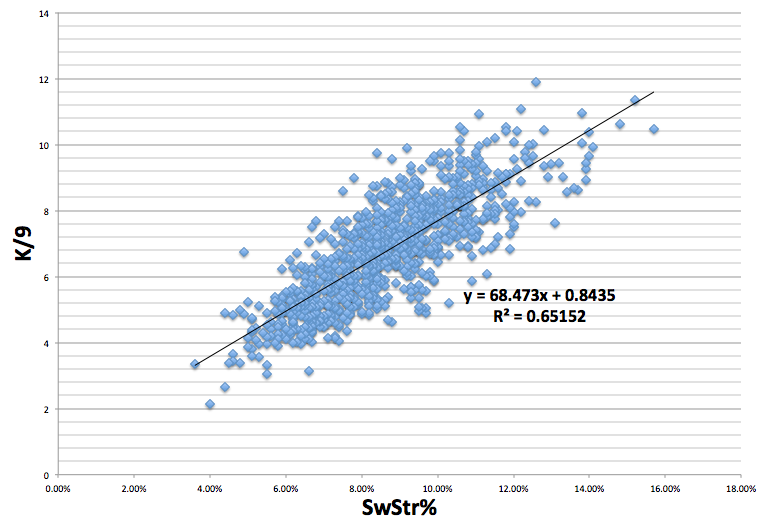
My assumption was that K/9 and SwStr% have a strong relationship. But, how strong of a relationship is it? To find this out, I took all qualified starter seasons from 2003 to 2013, which gave me a sample size of 933 pitchers, and ran a correlation between their SwSTR% and their K/9. The results showed that there is an exceedingly positive correlation between SwSTR% and K/9, to the tune of a .807 correlation coefficient and a .65 R2.

Screen shot 2013-10-03 at 1.06.11 PM

What is important to note is that there are very few pitchers present in the sample with a SwStr% above 13%, which may be symptomatic of something larger. Getting batters to swing and miss is difficult. The more often you can get a batter to swing and miss, the more valuable you are as a pitcher. As a result, the higher the SwStr%, the smaller the sample size becomes. For example, Johan Santana (2004) and Kerry Wood (2003) are the two lone dots to the farthest right on the graph with SwStr% of over 15: wow.

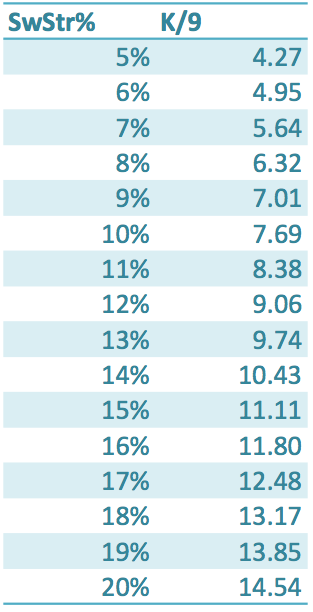
After the relationship between SwStr% and K/9 ratio became unmistakable, I calculated what a particular SwSTR%s translates into, as far as K/9, with the formula Y=68.473*x+0.8435, and got this chart:

Screen shot 2013-10-03 at 1.55.30 PM

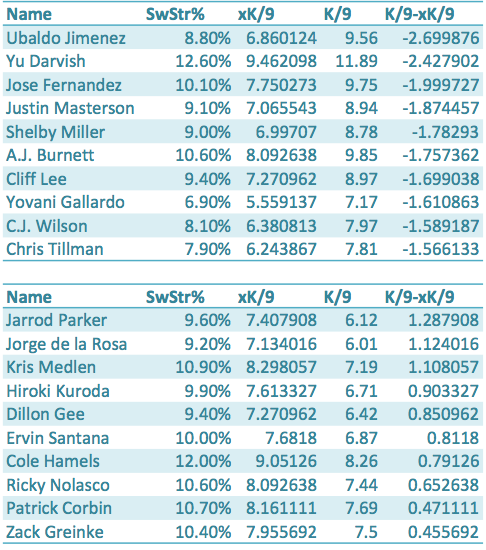
The next step is to take what we have discovered and apply it to a sample. The chart below shows each qualified pitcher for 2013, their SwStr%, xK/9, K/9, and K/9-xK/9.  xK/9 is what we would expect a pitcher’s K/9 to be based off of their SwStr%, and K/9-xK/9 shows us how much a pitcher over-performed or under-performed their SwStr% and xK/9.The first set of ten names are the pitchers who outperformed their xK/9 the most, and the second list of ten names are the players who underperformed their xK/9 the most.

Screen shot 2013-10-03 at 2.44.59 PM

The results show that Ubaldo Jimenez, Yu Darvish, and Jose Fernandez are the pitchers who have outperformed their xK/9 the most in 2013. These three pitchers also have great a great amount of deception and/or command (deception in Jimenez’s case: because, no one has ever called Ubaldo a control artist). And, while they may have outperformed their true talent in 2013 to an extent—they all had remarkable years—maybe that deception and control, which SwStr% does not take into account, leads to less swings by batters and more pitches taken for strikes, as opposed to swung at for strikes.

Perhaps xK/9 is more helpful when we look at pitchers who underperformed their SwStr%, like Jarrod Parker and Kris Medlen. Both of these pitchers had down years compared to what their projections suggested, but their xK/9s seem to be optimistic about their futures. Parker showed a .18 improvement in his K/9 from the first half to the second half of the season, while Medlen showed almost a full point improvement going from a 6.81 K/9 in the first half to a 7.67 K/9 in the second half.

While xK/9 may miss something—deception and command—when it comes to pitchers that outperform their SwStr%, xK/9 seems to find a reason to be optimistic when it comes to pitchers like Kris Medlen and Jarrod Parker who have underperformed their SwStr% and strikeout potential.

Devon Jordan is obsessed with statistical analysis, non-fiction literature, and electronic music. If you enjoyed reading him, follow him on Twitter @devonjjordan.


Tribe’s Ongoing Draft Difficulties

Successful small-market teams contend by acquiring above-average talent on two levels: (a) development, either through international free agency or the amateur draft, and (b) trades. 

Success in one area, and not the other, can create a small window of opportunity to win, but for a team to compete for multiple seasons it is important to find talent on both avenues.  

Many fans remember John Hart as the architect of those great Cleveland teams in the late 90’s, but few realize how fortunate he was to step into that situation. Much of the groundwork for the Indians renaissance can be traced back to former General Manager Hank Peters.

During his four-year tenure as GM, Peters drafted Manny Ramirez, Charles Nagy, Jim Thome, Brian Giles, David Bell, Chad Ogea, and Paul Byrd.  He also did well when he acquired Sandy Alomar Jr. and Carlos Baerga in a trade with San Diego for Joe Carter. 

The foundation was set for Hart to succeed.

Hart, as he should, receives a lot of the credit for those teams.  He was one of the first general managers to sign young players, not quite at their peak, to long term contracts. He acquired a borderline future Hall of Famer in Kenny Lofton for Willie Blair and Eddie Taubensee – both would become more journeyman than established player.

John Hart did a lot of things right but what he could not do was mimic Peters’ draft success. 

Hart’s tenure as General Manager lasted ten years, 1992 – 2001, and in that time he managed to draft and sign only three impact players – CC Sabathia, Sean Casey, and Richie Sexson. Both Casey and Sexson were eventually traded for spare parts.

Using WAR (Wins Above Replacement player) as a statistical guideline the top ten players drafted by Hart are:

Name Year Drafted Round Career WAR
C.C. Sabathia 1998 1 38
Sean Casey 1995 2 15.8
Richie Sexson 1993 24 14.4
Russell Branyan 1994 7 8.5
Steve Kline 1993 8 7.9
Luke Scott 2001 9 7.3
David Riske 1996 56 6.9
Ryan Church 2000 14 6.9
Paul Shuey 1992 1 6.8
Jon Nunnally 1992 3 5.3

While all those players carved out careers of varying success, only Sabathia ranks in the top 1000 players in career WAR.  Hart’s predecessor and current GM, Mark Shapiro, was not as lucky and stepped into a situation much more difficult.

 Hart’s final two drafts epitomized the team’s long standing draft failures and would eventually signal the beginning of Cleveland’s first rebuilding process in nearly a decade. 

In 2000 and 2001, the Indians owned 3 of the top 55 picks and 4 of the top 43 picks, respectively.  The only player chosen to mount any type of tangible career was Toronto long reliever/spot starter Brian Tallet.

As with Hart, the foundation for Shapiro was set – but this one signaled the beginning of a rebuilding period and the end of era. 

In November of 2001, Shapiro was promoted to General Manager of a team with high-priced, aging veterans and a farm system wrought with failure.  Shapiro sought to rebuild the organization from the ground up – in four seasons – the Hank Peters way.

He went about stocking the farm system by trading Bartolo Colon for Cliff Lee, Brandon Phillips, and Grady Sizemore.  Shapiro then drafted college phenom Jeremy Guthrie and signed him to a club record $3 million bonus.  He followed up the 2002 draft by selecting Michael Aubrey, a polished college hitter, in the first round the next season.   Shapiro set about reestablishing Cleveland baseball.

On paper, his way parallels that of Peters.  One problem: while he has had success in trading for prospects – Shin-Soo Choo, Asdrubal Cabrera, and Carlos Santana among others – his draft picks have not panned out.  Guthrie bounced between Buffalo and Cleveland, the bullpen and the rotation.  Aubrey spent more time in the chiropractor’s office then on the field and the rest of prospects failed to make a longstanding impact.

A small-market team has to have the ability to replace players as they enter arbitration years or they will never be able to consistently compete – which would explain the two winning seasons the Indians have had since 2002. 

Shapiro and assistant GM Chris Antonetti have changed draft philosophies in recent years and have begun taking players no longer consider “safe” choices, now focusing on “toolsy” players.  In the last three years the team has added much more promising prospects like Alex White, Lonnie Chisenhall, and 2010 second rounder LeVar Washington. 

Much like in 1992 and again in 2002, the front office and the team have both entered into another period of transition.  Chris Antonetti will spearhead another rebuilding effort in hopes of creating something fans have not experienced in so many years – a consistently competitive team.  It, of course, would be easier if he steps in a position much like Hank Peters created and not what John Hart left. 

Hank Peters’ time highlighted how building a successful franchise is built on strong talent development and smart trades.  His time in Cleveland is a perfect example on intermixing strong draft results and dealing higher priced veteran players for prospects.  In four years he was able to set the foundation, along with Hart’s subsequent tweaking, for the Tribe’s revival.