An Opening Day Overreaction: Jose Ramirez the MVP Candidate

Jose Ramirez broke out for the Indians last season. Long seen as just a placeholder for Francisco Lindor, Jose hit well enough all year to keep getting starts in a utility role, and eventually moving up to become the full-time third baseman for Cleveland. Ramirez derived the majority of his value from an elite contact rate, and excellent base-running, swiping 22 bags and hitting for an average well over .300. All in all, Jose was worth nearly five wins above replacement. There has been a lot of speculation as to whether he can repeat his huge breakout last year, if we may have already seen his peak, or maybe, he’s just getting started and there are even greater things to come.

Looking at Jose’s numbers from last season, I can see three areas for improvement. First off is defense. According to defensive runs above average, Jose was only worth 0.5 throughout the 2016 season. Jose is a shortstop by training; however, he spent most of the first half of the season bouncing around positions in a utility role, before landing at third base full-time. Considering this and the fact that he has rated out as a plus defender in past seasons, I think it is safe to project an improvement here with a more consistent role.

Second is his walk rate. Jose walked in 7.1% of his plate appearances in 2016. To compare, in 2015, as well as in his Triple-A career, his walk rate hung right around 9%, so there is possibly some room for improvement there as well.

The final area for improvement is Jose’s home-run hitting. Despite recording 60 XBHs last year, Jose only left the yard 11 times. It is very difficult to put up an MVP-quality season with lower-end HR numbers. Since 2011, there have been 29 positional-player seasons worth 7+ WAR, and every single one of them included over 20 HRs.

So what will Jose look like in 2017? It’s hard to tell, unless of course you decide to overreact to this week’s opening game, in which case…

WELCOME TO THE MVP RACE JOSE RAMIREZ

Jose batted four times in the opener, and he had one walk and one HR. THE TWO THINGS HE NEEDED TO GET BETTER AT!!! Now obviously this article is a bit tongue-in-cheek, and a sample size of one game means VERY little. The walk especially tells us just about nothing. You give me 4 PA in a major-league game and I might even luck into a walk. However, there is reason to take note of the home run.

Prior to 2017, Jose Ramirez had hit 19 home runs in the majors. His previous best exit velocity was 107.8 MPH on a HR. The longest HR of his career had traveled 437 feet. Jose’s HR in game number one left his bat at 109.3 MPH and traveled 447 feet.

So MAYBE this is a hint that Jose has added some power since last season. That would be a reason to get excited. If you take Jose’s 2016 numbers, then bump him to a 9% walk rate, 22 HRs, and plus defensive value, and even account for a few points of BABIP regression, he’s a 7-8 WAR player, and looks real similar on paper to Mookie Betts.

So, if we overact to opening day, this would make Jose a legitimate star and MVP candidate. His season will be extremely exciting to follow, although in the end probably overshadowed by Madison Bumgarner’s race to 60 dingers.


Berrios and Beer

Beerrios! That’s a way better title, but we’ll stick with the original. So I’m spending my Saturday brewing a batch of beer and dealing with some pitchFx data. If everything goes well, you’re going to get some baseball info and some brewing highlights. But also Happy Opening Week! It’s the greatest time of the year.

All right, let’s deal with some baseball first. Jose Berrios had a pretty brutal 2016 with the big club — all in all, he started 14 games and rattled off a 3-7 record with an 8.02 ERA, an ugly 1.87 WHIP, and a not-top-of-the-rotation strikeout rate of 7.6 K/9. His FIP and xFIP were better but still not great at 6.20 & 5.64. His BABIP certainly didn’t help his numbers, sitting at 0.344, but that alone can’t explain how truly atrocious his numbers looked in his first taste of the big leagues. I’m going to use the pitchRx package to look at pitching data from 2016 and see if we can figure out what went wrong and how we can fix it.

All right, now on to the beer portion. Today I’m making my Deep Lake Dark Lager. Behind every great beer there is a great story. This story begins when I worked out at a remote research camp and fridge space was not reserved for amateur beer-making. A key process in lagering a beer is fermenting the beer at low temperatures, which is why I mentioned the fridge space. We got around lagering our beer in the fridge by putting the fermenting beer into a keg and dropping the keg into a lake to about 15 meters deep (~49 feet). At this depth the temperature was steady at about 5°C (41°F). A little tip for any newcomers to the brewing community: Your beer needs to maintain command, something Berrios couldn’t do. Zing!

If anyone wants to take a quick look at some gifs of Berrios’ sick curveball (and other pitches), check them out here: http://www.pitcherlist.com/Jose-Berrios/

I tried to find a comp for Berrios related to pitch velocity, and if we ignore his slider, Jacob deGrom comes out looking like a pretty good match. Here are how their pitch velocities line up using 2016 pitchFx data. I know it’s not a good idea to exclude one of deGrom’s best pitches, but I’m more interested in consistency between starts.

Velocity Comparison – Berrios vs DeGrom
Name Four-Seam Two-Seam Curveball Change-up
Jacob DeGrom 93.4 93.3 80.4 85.5
Jose Berrios 93.4 93.2 81 84.7

Just eye-balling, they look pretty good. Let’s take a look at pitch velocity by start.

Just looking by eye, it’s hard to tell if you could consider one guy more consistent than the other. But obviously we might be able to give deGrom the benefit of the doubt here, since he was pitching with scar tissue or bone spurs in his elbow. Either way, he was pitching in discomfort. There is one thing that catches my attention, though — it’s those last 11 starts by Berrios, and you can see his change-up velocities start to sneak up from ~83.5 to 86 MPH. The unfortunate thing is that there is no concurrent increase in four-seam (FF) or two-seam (FT) velocity. Near the end of the season Berrios was trying to complement his fastballs with a change-up that had a really poor velocity difference. Let’s check that out in a bit more detail.

Okay, you give that plot a bit more thought. My timer just went off and I’ve got to go sparge the grains. I converted a five-gallon water cooler into a mash tun for steeping my brews, which works awesome, because it’s insulated so it holds the heat really well. The aspect I really love about this beer is that is has a really light lager taste, but it has a nice dark colour, which makes it a great spring beer. And to get this effect in your beer is really simple. For the 45 minutes where you are steeping your grains, only add the light grains, then just before you sparge, throw on your dark grains (in my case carafa III). That way, as you sparge you get the colour from the dark grains and none of the taste. Yaaaay beer. Everything is all sparged and now I’ve got to bring the wort to a nice rolling boil.

All righty, let’s discuss that velocity difference. I’d say there is a similar trend from his early-season call-up and his late-season starts as well. He starts out with a pretty decent velocity difference, but with each start that difference gets smaller and smaller. Especially in the second half of the season — he started out with a fantastic velocity difference. That combination should have led to some really effective pitches, but as we move into September and October those pitches are starting to look more and more similar and their effectiveness all but disappears.

Back to brewing — boiling achieved! I’ve got to let the liquid boil down for a couple hours, so through the magic of the internet, let’s fast-foward to the next step. And what a fantastic surprise, the battery in my scale is dead and of course it’s some weird specialized kind that I don’t have on hand. Well luckily I wrote the weight on the bags when I packed the hops last fall so I’m going to eyeball it and hop(e) for the best. At least now I can honestly say I can never reproduce this batch, but that’s part of the fun. So I figure I added about an ounce of hops; we’ll really never know. I’ve got to let that boil for another 40 minutes then add the flavour hops and some irish moss.

I think we can agree that this was not a season marked by consistency for Jose Berrios. But I was curious as to how his release point affected the velocity of each pitch. For all of the data presented here, I used the pitchRx package to download and store the 2016 pitchFx data. In the pitchFx data, you can pull out the release point for each pitch recorded throughout the season. Using this data, I created a general additive model using the bam() function for the R peeps out there, and within the bam function I modeled pitch velocity and pitch break separately using a Gamma link. I like to use the Gamma link because, in a not very sciencey description, it’s very flexible and fits a wide range on models. So first, a couple of notes; 1) There are two plots coming up; the first predicts pitch velocity and the second predicts pitch break length (movement). 2) Pay attention to the prediction window, the coloured box, for each pitch. And 3) These models were only run on Berrios.

And pitch break (break_length):

You can tell that velocity and break length change with different release points. I mean, there is a pretty complicated relationship with how his release point affected both the pitch break and the velocity, and I’m not really sure what the sweet spot actually is. His change-up velocity plot has a really nice faded red area sort of right in the middle of the prediction grid. This area represents roughly an 84.5 MPH change-up which would complement his 93 MPH fastball quite nicely, but unfortunately his arm slot seems to be drifting along an axis which we will get to in a second. Did you happen to notice how the coloured boxes moved slightly among pitches?

So remember how Berrios was apparently tipping his pitches this past year? Well, if not, check this out. So the way he was delivering the ball basically gave the batters a full view of what was coming. I mean, I know I don’t possess the ability to spot small things in deliveries and assess pitches. I watched gifs of Berrios throwing all of his pitches over and over many times and I can’t pick anything up. But I am sure that there are players out there who can pick up those minor details. So I’m thinking there may be more to this than just how he started his wind-up, and where he was releasing the ball was also giving batters a clue as to what was coming. Check out this plot showing how Berrios and deGrom released their pitches.

So you’re probably wondering what’s going on there. Each ellipsoid represents a different pitch, curveballs in blue, 2-seamers in orange or orange-red etc. Each ellipsoid contains 95% of the pitches thrown for each pitch type. Generally deGrom releases the ball about a foot over in comparison to Berrios, but that’s not what it important. What’s important is how each pitcher’s change-up overlaps with their respective fastballs. deGrom has remarkable consistency to throw both types of fastballs and his change-up, and the ellipsoids are basically completely overlapping. Right away we can see that something is going on with how Berrios is releasing his change-up. It only overlaps with about half of his fastball release points, but his arm angle also seems to be drifting, and you can see the ellipsoid is stretched one direction. So I’m guessing he’s not only tipping his pitches in his wind-up, but there is also some release-point trouble happening here that no doubt some hitters are able to pick up on.

Final update on the beer: I added in the flavour hops and irish with about five minutes left and took everything off the heat. Luckily, it’s still a bit cold here so I left the beer outside to cool for a couple hours to get it down to room temperature so I could pitch the yeast. And fast-forward a couple of days…I let the yeast start the fermentation process at room temperature for a couple of days, then moved it into a fridge. I’ll leave it there for about three weeks, transfer the beer to a keg, and then it’s basically ready to drink!

Thanks for sticking it out to the end; I hope you enjoyed “Beerrios.” This ended up having a lot more deGrom in it than initially planned, but I think it was a good comparison to include. I think we were able to successfully identify a couple serious flaws from Jose Berrios’ debut season, and hopefully he’ll be able to shake that off, work on fixing his mechanics, and take another shot at the majors in 2017. I have a feeling we are going to see him mid-April or early May, and I really hope we get to see what he can do over an entire season. If he can transfer just a fraction of his minor-league success to the majors, we will get to see a pretty dynamic young pitcher, and the Twins have been waiting a long time to get a pitcher of this caliber back into their rotation.


Shut the (Heck) Up About Sample Size

The analytics revolution in sports has led to profound changes in the way in which sports organizations think about their teams, players play the game, and fans consume the on-field product. Perhaps the best-known heuristic in sports analytics is sample size — the number of observations necessary to make a reliable conclusion about some phenomenon. Everyone has a buddy who loves to make sweeping generalizations about stud prospects, always hedging his bets when the debate heats up: “Well, we don’t have enough sample size, so we just don’t know yet.”

Unfortunately for your buddy, sample size doesn’t tell the whole story. A large sample is a nice thing to have when we’re conducting research in a sterile lab, but in real-life settings like sports teams, willing research participants certainly aren’t always in abundant supply. Regardless of the number of available data points, teams need to make decisions. Shrugging about a prospect’s performance, or a newly cobbled together pitching staff, is certainly not going to help the bottom line, either in terms of wins or dollar signs.

So the question becomes: How do organizations answer pressing questions when they either a) don’t have an adequate sample size, or b) haven’t collected any data? Fortunately, we can use research methods from social science to get a pretty damn good idea about something — even in the absence of the all-powerful sample size.

Qualitative Data
Let’s say you’re a baseball scout for the Yankees watching a young college prospect from the stands. You take copious notes about the player’s poise, physical stature, his hitting, fielding ability, and running abilities, as well as his throwing arm power. For instance, you might write things like, “good approach to hitting” and “lacks pure run/throw tool.”

All of these rich descriptions of this player are qualitative data. This observational data from one game of this college player is a sample size of 1, but you’ve got a helluva lot of data. You could look for themes that consistently emerge in your notes, creating an in-depth profile of the prospect; you could even standardize your observations on a scale from 20-80. Your notes help build a full story about the player’s profile, and the Yanks like the level of depth you bring to scouting.

Mixed-Methodology
You’ve worked as a scout for a few years, and the Yankees decide to bring you into their analytics department. It’s the end of the 2011 season, and one of your top prospects, Jesus Montero, just raked (.328/.406/.590, in 69 PAs) in the final month of the season. The GM of the Yankees, Brian Cashman, knocks on your door and says that they’re considering trading him. What do you say?

You compile all of Montero’s quantitative stats from the last month of the season and the minors, as well as any qualitative scouting reports on him. Good job. You’ve mixed quantitative and qualitative data to provide a richer story given a small sample of only 69 PAs. You’ve also reached the holy grail of social science research, triangulation, by which you examined the phenomenon from a different angle and, bingo, arrived at the same conclusion that your preliminary performance metrics gave you. Montero is a bum. Trade him, Brian.

Resampling Techniques
It’s four years later and Cashman knocks on your door again (he’s polite, so he waits for you to say, “come in”). It’s early October and you’ve just lost to the Houston Astros in a one-game playoff. Cashman asks you about one of the September call-ups, Rob Refsnyder, who Cashman thinks is “pretty impressive.” You combine Refsnyder’s September stats (.302/.348/.512, in 46 PAs), minor league stats, and scouting reports, but the data don’t point to a consistent conclusion. You’re not satisfied.

A fancy statistical method that might help in this instance is called bootstrapping; it works by resampling Refsnyder’s small 46 PA sample size over and over again, replacing the numbers back into the pool every time you draw another sample. The technique allows you to artificially inflate your sample size with the numbers that you already have. You can redo his sample of 46 PAs 1,000, 10,000, even 100,000 times, seeing each time how he would perform. Based on your bootstrapped estimates, you feel like Refsnyder’s numbers from last year are a bit inflated, but that he’d fit nicely as a future utility guy.

Non-Parametrics
Cashman, who’s still in your office, now wants to know about two pitching prospects who were also called up in the 2015 class: James Pazos (5 IP, 0 ER, 3 H, 3BB, 5.4 K/9, 1.20 WHIP) and Caleb Cotham (9.2 IP, 7 ER, 14 H, 1BB, 10.2 K/9, 1.56 WHIP). If the team can only keep on of these pitchers, who should we keep? Who is better?

Normally you’d use a t-test to make comparisons between the two pitchers, but with such a small sample of innings for each guy, the conclusions wouldn’t be reliable. Instead, you decide to use a Mann-Whitney U test, which is basically the same thing as a t-test, adjusted for small samples. In fact, there’s a whole litany of statistical tests that are adept at handling small sample sizes: Wilcox’s t, Fisher’s exact, Chi-square, Kendal’s tau, and McNemar. You conclude that Pazos is slightly better, and that Cotham might be better suited for the bullpen. Cashman holds on to Pazos and deals Cotham to the Reds in the trade that brings over Aroldis Chapman to the Yankees. You pat yourself on the back.

Questions Need Answering
Having an adequate sample size brings confidence to many statistical conclusions, but it is certainly not a binary prerequisite for analyses. It’s easy for your buddy to watch his hindsight bias autocorrect for his previous wait-and-see approach, but organizations need to answer questions accurately. As amateur analysts and spectators, let’s change the lexicon by changing our methods.


Fungraphs: Baseball’s Weird, Wonderful Superstitions

Why are we so weird?

We don’t have 13th floors in hotels, walk under ladders, or pick up coins facing tails-up because all of these things are bad luck. People knock on wood when they talk about the future. They say “God bless you” if you sneeze, for fear of your soul escaping.

And as if those habits weren’t odd enough, ballplayers and baseball go and take superstition to a whole new level of silly and agitating.

The worst is the concept of the jinx during a no-hitter. Under what circumstances does uttering some passing phrase about a pitcher’s no-hitter suddenly doom it? Even if it’s deliberate, how does that change a guy’s ability to paint the black or shoot a blooper? Maybe it’s some cosmic understanding that goes over the head of simpler folks. But baseball is a game that is constantly relying more and more heavily on numbers, odds, and percentages. A no-hitter is one thing we can accurately acknowledge in the moment and without in-depth analysis. Doing so is no foible.

A pitcher’s team not talking to him during a no-hitter is just fine, though. It makes out a single game as something special, and how often do we get to do that during the regular season? That pitcher is on a mission that has been accomplished only 252 times since 1901. Currently, there are nearly 2,500 games in a single season. If a guy’s doing something that’s only been done a fraction of a single percentage in all the games in modern history, there’s no reason to goof with him like it’s just another day at the park. To that point, it hasn’t been.

Other superstitions are ones that have become prominent because of the volume at which they occur. Guys skip over the chalk at the start and finish of every inning on the way out of and to the dugout. It’s okay to think, “But what would happen if they did hit the line just once? No one is going to get hurt. It isn’t going to break a teammate’s mother’s back like stepping on a crack.” Let’s remember, though: the inning is over. Commercials are about to start. That silly moment is an easy one to tune out, so we’d be best off doing just that when we find ourselves fixated on it.

But when the game is back, and a player’s getting ready to pitch or step into the box, we’re paying attention. And we notice those ridiculous, idiosyncratic tics that turn into superstition which so many guys maintain. They work them into their mechanics and if they don’t perform them they’re thrown off. I’m looking at you, Matt Garza. Your little glove twitch has been the visual equivalent to a throw-up burp. It’s unpleasant and people might take a drink of the nearest beverage just to forget it.

Though he’s retired, Nomar Garciaparra remains the king of batting-glove love. Each time he stepped to the plate he might as well have played pat-a-cake with himself. It’s nothing compared to Moises Alou, though, who refused to wear batting gloves and would pee on his hands to toughen them up. Gross.

In all this strangeness, through all this exercised peculiarity, there might be some logic, even though the very definition of superstition tells us there isn’t.

In an episode of Fresh Air titled “Habits: How They Form And How To Break Them,” we learn about something called the habit loop from Charles Duhigg, author of The Power of Habit: Why We Do What We Do in Life and Business. There are three steps to it: a cue, a routine, and a reward. The cue enables the brain to let a behavior happen, while the routine is the actual action, and the reward is the brain enjoying it all and making it easier to remember.

That process becomes automated rather quickly. Scientists attribute it to the basal ganglia, which “plays a key role in the development of emotions, memories and pattern recognition.” You might realize how none of this speaks to the actual decision of players to do quirky things like skip over foul lines or fiddle with their equipment a certain way. That’s because the part of our brain that makes decisions — the prefrontal cortex — checks out once a behavior becomes automatic. It appears that once someone starts a habit, in many cases they’re not actually choosing to continue it.

Habits do provide comfort, though. And habits held in the belief of good fortune are why we get silly baseball superstitions that we can laugh at or hate. Whether they’re rare or regular occurrences, they’re one more way the game gives back to us.


The Dodgers May Have Found the Next Justin Turner

Over the past few seasons, there seems to have been an uptick in power breakouts for hitters. J.D. Martinez, Jose Altuve, and Daniel Murphy are examples of guys who dramatically increased their power output seemingly out of nowhere. One of the most notable cases is Justin Turner, who transformed himself from a mediocre utility player with the Mets into an elite third baseman with the Dodgers. The Dodgers were rewarded for identifying a player with untapped potential and extracting that potential. Today I’m here to tell you that they’ve done it again, with Rob Segedin.

All right, a little background first. Rob Segedin was drafted in the third round by the Yankees back in 2010, and was traded to the Dodgers last year for pitching prospect Tyler Olson and KATOH star Ronald Torreyes. Despite having a pretty decent track record in the minors, he debuted in the majors just this past season and has never received much fanfare, even from the statistical community (the last article he was mention in on FanGraphs.com was a prospect report written back in 2012). Part of this is probably due to the fact that he’s usually been old for his level and never really hit for much power. The slew of injuries didn’t help, either.

Last year, however, all that changed. Well, the power and the health changed; he was still relatively old. Over 424 plate appearances in Triple-A last year, Segedin slashed .319/.392/.598 with 21 homers and a .279 ISO. That’s really good! The year before, his ISO was .136. Now, Segedin did move from Scranton to the PCL, which is significantly more hitter-friendly. But still, it’s hard not to be impressed with those numbers. And looking at his spray charts, the difference is stark (via MLB Farm).

Basically every home run Segedin hit in 2015 was pulled far left. In 2016 there’s a lot more action to center-left, and even some to the opposite field. And while, having looked over some footage, there doesn’t appear to be any obvious change to his swing, there’s another possible explanation for the sudden improvement. Segedin largely credits it to more consistent playing time after moving to the Dodgers organization – “It was a little frustrating for me last year to not be an everyday player and not get those everyday at-bats,” Segedin said. “I think playing for another organization was better for my career.” (Idec, Keith. “Baseball: Old Tappan’s Rob Segedin at Home in Dodger’s Organization.”NorthJersey.com. The Record, 14 July 2016. Web. 27 Mar. 2017.)

As mentioned earlier, Segedin had his big-league debut last year, so we have some MLB data to work with. And I’m gonna be honest. It doesn’t look great. Not on the surface, at least. In 83 PA, he slashed .233/.301/.370, good for an 83 wRC+. The great power numbers he had in Triple-A didn’t seem to translate, as he posted a mediocre .137 ISO. So yeah, that’s not very encouraging.

But there’s reason for optimism! For one, despite the low ISO, his exit velocity was pretty good. Rob Segedin’s average EV last year was 91.6 MPH, which is the same as Carlos Santana and Evan Longoria, and puts him higher on the list than Edwin Encarnacion. Segedin’s problem was less about hitting the ball hard, and more about putting the ball in the air: his average launch angle was 8.6 and his ground-ball rate was 52.8%. Which is a major problem (it’s hard to hit for power when you hit everything on the ground), but it may not be as bad as it seems. For one, it was only 83 plate appearances, and though GB% stabilizes pretty quickly, there’s still a good bit of noise in that sample. Also, remember what Segedin said about inconsistent playing time hurting his performance? Well in 18 of his 83 plate appearances, he came to the plate as a pinch-hitter. In those 18 PA he hit a whopping 24 wRC+ , as opposed to a 99 wRC+ when playing as a regular. I mean, I know that’s a ridiculously small sample, but it fits the narrative, so here we are. For what it’s worth, he’s batting .444/.500/.944 with 2 home runs in 20 PA this spring.

It’s kinda hard for me to look at Segedin’s current situation and not be reminded of Justin Turner. That said, he’s probably gonna strike out a bit more than Turner did. And he might struggle to find playing time in a crowded Dodgers infield. So there probably isn’t quite as much upside. But all the signs of a Rob Segedin breakout are there. All he needs is the opportunity.


When Do Pitchers Try Harder?

Pitch counts have become an integral part of the game of baseball, so much so that it’s impossible to find a TV telecast that doesn’t display the pitch count side-by-side with the score and the inning. Yet pitch counts continue to be maybe the most annoyingly simple and arbitrary metric used to craft crucial in-game strategy. 99 mph fastball down the middle: +1 pitch. 76 mph curveball in the dirt: +1 pitch. Intentional ball: +1 pitch. Dirty ball tossed to the umpire: +0 pitches. Pitchout +1 pitch. Warmup pitches: +0 pitches. My goal here is not to fix this problem — just explore some interesting data that I believe should eventually be used to bring pitch count into the modern era.

Right now, I’m just going to look at 4-seam fastballs and how hard they’re thrown. All data comes from the 2016 regular season. Thank you Baseball Savant. The question I set out to answer is simple: When a pitcher needs to make a pitch, does he try harder? Common sense says yes, of course this is what happens. Relievers throw harder than starters in general because they don’t have to worry about throwing more quality pitches in later innings. But the data shows that pitchers change their effort levels within innings as well, especially when they have two strikes and/or runners in scoring position. Eventually, we should be able to use this knowledge to craft a better pitch count that takes this extra effort into account. Read the rest of this entry »


Mark Trumbo and Fitting a Square Peg in a Round Hole

A long, slow dance in free agency for Mark Trumbo culminated with a three-year pact worth $37.5M to return to his 2016 team, the Baltimore Orioles. Trumbo, a classic slugger, reportedly hoped for an extra year and a total value of $75-80M on the heels of a season in which he led Major League Baseball with 47 home runs. Those who favor traditional statistics would point to Trumbo’s home-run totals and argue that he is one of the premier sluggers in the game, but in a baseball landscape run by the sabermetric crowd, Trumbo is seen as a one-dimensional player. In this chart, we will look at statistics that paint the picture that Trumbo is a one-dimensional player.

Mark Trumbo and His Contemporaries (2016)

Player 1st Half BA 2nd Half BA UZR/150 Baserunning Runs fWAR
Mark Trumbo .288 .214 -9.9 -2.0 2.2
Mark Reynolds .283 0.1
Chris Carter .213 0.9
Jose Bautista -9.3 1.4
Joe Mauer -2.2 1

It is argued that Trumbo’s year was inflated by an unsustainable .288 batting average in the first half, comparing him to Mark Reynolds, a cautionary tale of a player who peaked with a rather one-dimensional 44-homer season of his own. This is only accentuated by the fact that Trumbo’s batting average collapsed to .214 in the second half; this is nearly identical to fellow 40-homer masher, Chris Carter, who was non-tendered for being one-dimensional himself. Incidentally, Carter has been mentioned as a cheaper and nearly as valuable alternative for teams unwilling to make the splurge this offseason on Trumbo. On the field, Trumbo has been worth just about -10 runs per 150 games, which is more negative value than Jose Bautista, who was ravaged by injuries this season. On the bases, he provided enough negative value to compare to Joe Mauer, a former catcher.

There are several issues with this argument, though. The first is that Trumbo’s 2.2 fWAR is significantly higher than the one-dimensional sluggers (and others) he is being labeled alongside. Another is that he was stuck in the outfield by Baltimore in 2016 despite having no business being there. In fact, in his career, Trumbo grades out as an above-average first baseman. On the basepaths, Trumbo’s value is 105/146 of all qualified players, which isn’t as much of a tanker as one would think. As for his fluctuating halves, there is a tale behind that, too.

Mark Trumbo, Above Average First Baseman

Player BABIP wRC+ UZR/150
Mark Trumbo (1st Half) .327 143
Mark Trumbo (2nd Half) .216 98
Mark Trumbo (Career) .288 111 6.3 (1B)
2016 1B AVG .307 120 .3


Batting Average on Balls in Play (BABIP)
assesses whether a player is going through a lucky (or unlucky) streak based on deviation from their normalized rate. The average BABIP is .290, and Trumbo is no different, checking in at .288 for his career. His first half was above the average rate, while his second half was at an extreme (and unsustainable) low. As you can see in the chart, his wRC+ is in line with the offensive-minded first basemen of the league, and there is room for some uptick. His defense at first base, even if 6.3 is too optimistic, can make him a $75M man. A lot of Trumbo’s depressed value comes from spending too much time in right field; this chart will break down the calculation behind Trumbo’s 2016 fWAR and estimate what he can provide if played at his true position (and some time at DH).

Mark Trumbo as Full Time 1B (2016, 2017 Projection)

Player Mark Trumbo
Batting Runs 18.7
Baserunning Runs -2
Fielding Runs* 5.7
Positional Adjustment* -12
League Adjustment 2.6
Replacement Runs 20.1
fWAR* 3.4

fWAR calculation: (BR+BsR+FR+Positional Adjustment+League Adjustment+Replacement Runs)/(R/W)

*Assumes a 6.3 UZR/150, 135 games played as 1B, 15 games played as DH

This is an aggressive projection, but Trumbo proves that he is not a one-dimensional player. A 3.4-win player is extremely valuable, and if he produces to that level over the next three years, he will provide a significant amount of surplus value.

Mark Trumbo Projected Surplus Value, 2017-2019

Year fWAR $/WAR Value Produced Salary Surplus/Deficit
2017 3.4 8M 27.2M 11M +16.2M
2018 2.9 8.4M 24.4M 11M +13.4M
2019 2.4 8.8M 21.1M 11M +10.1M
Totals 8.7 72.7M 37.5M* +35.2M*

*Assumed aging curve via FanGraphs: +0.25 WAR/yr (18-27), 0 WAR/yr (28-30),-0.5 WAR/yr (31-37),-0.75 WAR/yr (> 37, assumes a 5% inflation/year in $/WAR

*$4.5M of Mark Trumbo’s contract is deferred and to be paid in $1.5M increments from 2020-2022; that amount was subtracted from the overall surplus.

This chart shows the full potential of Mark Trumbo, quality first baseman. As calculated in the “Value Produced” column, he is rather close to the $75M man he marketed himself as. Because of the stigma surrounding his 2016 season, his market did not develop, and clearly overcorrected. Contending teams with needs at first base went elsewhere – the Red Sox signed Mitch Moreland, the Indians signed Edwin Encarnacion, and the Blue Jays signed Kendrys Morales. Even the Colorado Rockies signed SS/CF Ian Desmond for $70M (plus the 11th overall pick in the draft) to learn yet another new position. Unfortunately for Mark Trumbo, the team he signed with, the Baltimore Orioles, already employs a first baseman in Chris Davis. This redundancy will force Trumbo to again be a square peg in a round hole; part-time DH, part-time right fielder. This has been an unfortunate circumstance for him throughout his career, playing for teams that already had Albert Pujols and Paul Goldschmidt. What might have been to see Trumbo realize his full value, on a contract he deserves, and hitting moonshots out of Coors Field or Fenway Park.


Zack Greinke and the Future of Pitching Contracts

Spending money is an interesting avenue to build a pitching staff. Many of the deals are conventional; a superstar pitcher around 30 years old gets a contract in the neighborhood of at least 7/$175M. But something unconventional is the nature of the contract that Zack Greinke signed with Arizona; 6/$206M. We have seen pitching contracts at or exceeding $175M several times in recent years; they have all been at least seven years in length. Never before has a contract in Major League Baseball history paid so much money in so little time. In fact, Greinke’s $34.5M take-home in 2016 was the highest single-season pay in Major League Baseball history. Now, with stricter luxury taxes in place, the higher average annual value (AAV) is certainly a unique burden on Arizona, but what about the burden of the seventh, eighth, or even ninth year of a deal for every other team? Arizona’s braintrust decided that, rather than having Greinke hamstring their payroll for seven or eight years, he will only do so for six, albeit at a slightly higher rate. I think they are onto something.

Here’s a look at every major pitching contract signed from the 2000-2011 seasons worth at least five years. Compare the values produced in the first four years of those deals to the value of the whole contract, and look at the following years as well.

Pitching Contracts and Subsequent Performance in $, 2000-2011 Seasons

Player Contract Value in Yrs 1-4 Value in Yr 5 Value in Yr 6 Value in Yr 7 Value in Yr 8 Value in Yr 9
Mike Hampton 8/121M 28M 4.6M 2.3M 5.3M .7M
Mike Mussina 6/87M 84M 12.2M 24.9M
Roy Oswalt 5/73M 99.5M 20.5M
Daisuke Matsuzaka 6/52M 46.2M .6M -2.2M
Chris Carpenter 5/63.5M 58M 36.5M
Barry Zito 7/126M 41.1M -4.1M 5.8M -3.4M
Carlos Zambrano 5/91.5M 57.6M 3.1M
Johan Santana 6/137.5M 74.4M 10.7M INJ
A.J. Burnett 5/82.5M 54.4M 31M
C.C. Sabathia 9/211M 147.4M 18.9M .9M 9.5M 21.2M N/A**
John Lackey 5/82.5M 44.7M 17.9M
Cliff Lee 5/120M 138.8M INJ
Jered Weaver 5/85M 53.1M -1.2M
C.J. Wilson 5/77.5M 54.4M INJ
John Danks 5/65M 20M -.8M
Gio Gonzalez 5/42M 109.8M 22.9M
Yu Darvish 6/60M 91.1M 21.6M N/A**

*all contract data via Baseball Reference, all valuations via FanGraphs by conversion of (fWar)($/fWAR)

** these seasons will be played out in 2017

Of course, there are some contracts in here that went south from the start. Mike Hampton, Barry Zito, and John Danks are the culprits here. You probably notice that in most cases, years one through four go completely according to plan! Some of the exceptions are due to injury, and those are Johan Santana and John Lackey. But even other injury victims, such as Yu Darvish and Chris Carpenter, were so valuable in two or three years that they held up their end of the bargain.

However, the second thing you’ll notice is how quickly values go down on this list after year four. Of the 17 samples we have here, there are only seven success stories in year five (Oswalt, Carpenter, Burnett, Sabathia, Lackey, Gonzalez, and Darvish). Two of those cases are unique, as A.J. Burnett experienced a career revitalization in Pittsburgh under Ray Searage, and Darvish was a young international free agent. Overall, the success rate isn’t encouraging. The real black marks are the years following that. We have 11 samples on hand, and aside from modest renaissances from Mike Mussina and C.C. Sabathia, you get some really ugly numbers.

With this chart now in context, it brings us to wonder why any pitcher is even offered a deal in excess of four years. It is just not worth having so much dead payroll for one to five years. In fact, looking at how successful the first four years are, the values already come pretty close to the original contract anyways. Did the Phillies or Cliff Lee ever consider a four-year contract in that same $120M range? Probably not, but Lee would have taken it, and the Phillies would have been better off. I’m sure C.C. Sabathia never received a 4/$120M offer from the Yankees, but it would have let him hit the market again to potentially cash in one more time, and New York would have still recouped 75% of the value they ultimately got from him in nine years.

Thinking in present times, here’s a chart in a similar vein, but examining pitching contracts in the length of at least more than four years signed from just the 2012 season alone. Remember, these players have pitched the first four years of these contracts…

Pitching Contracts and Subsequent Performance in $, 2012-Present Seasons

Player Contract Value in Yrs 1-4 Value in Yr 5 Value in Yr 6 Value in Yr 7 Value in Yr 8
Matt Cain 5/112.5M 7M N/A N/A
Cole Hamels 6/144M 122.7M N/A
Hyun-Jin Ryu 6/36M 55.5M N/A N/A
Anibal Sanchez 5/80M 82.7M N/A
Matt Harrison 5/55M -1.1M INJ
Felix Hernandez 7/175M 120M N/A N/A N/A
Adam Wainwright 5/97.5M 116.7M N/A
Justin Verlander 5/140M 122.5M N/A N/A N/A N/A

*all contract data via Baseball Reference, all valuations via FanGraphs by conversion of (fWar)($/fWAR)

…and we see more of the same. Year five for these eight pitchers is 2017, and how many are a good bet to produce? Verlander, Hamels, most likely Hernandez, and…possibly Wainwright? Matt Harrison’s career is already over due to injury. Lengthy DL stints have ruined Ryu and Cain. Wainwright and Hernandez have also dealt with injury woes. Anibal Sanchez hasn’t been an effective pitcher since 2014. And yet, years one through four look beautiful for everybody but our two outliers.  

The same unorthodox contracts could apply to these guys. Anibal Sanchez is on the 2017 payroll for $16.8M, but what if Detroit had signed him for 4/$80M? Equal value would have been produced, and he wouldn’t be an albatross in 2017. 4/$100M for Adam Wainwright? That is similar to our previous Cliff Lee scenario. If Seattle had offered King Felix 4/$120M, he would have taken it in the hopes of cashing in one more time, and the Mariners would have received good value, similar to the Yankees and Sabathia.

Let’s condense all of the data from both charts and see what averages we get.

Sample Size Average Length Average Value Average Value (Yrs 1-4) Average Annual Value (AAV) Average Annual Value (AAV) – 4/73.14M
25 5.68 Yrs 96.68M 73.14M 17.02M 18.29M


Examining the averages, what if the average pitching contract shifted from nearly 6/$96.68M to 4/$73.14? The players would lose $23.54M on average over the length of the contract, but gain close to two free-agency years. Presumably, two free-agent years would be worth more than that, making for a worthy trade-off. As for the teams, they would pay $1.27M more per year in AAV, but eliminate two years of dead payroll (for those of you calculating that at home, that’s [17.02×1.68] – [1.27×4] for an average gain of $23.51M). That is a worthy trade-off for them as well. In other words, teams save millions, and players make more millions.

These condensed contracts have virtually no true precedent, but the 6/$206M deal that Greinke signed is closer to them than the current industry standard. Of course, pitching deals signed around the same time as Greinke are completely in tradition with this century (Max Scherzer, Jordan Zimmermann, David Price, Jeff Samardzija, Johnny Cueto, Mike Leake, Wei-Yin Chen, Ian Kennedy, and Stephen Strasburg), but that makes this one contract so potentially revolutionary among its contemporaries.

If you are thinking of the player and team who may follow these footsteps, I would imagine the perfect test case to be Matt Harvey. The Mets pitcher proved that he is an All-Star-level hurler in his comeback 2015 season from Tommy John surgery, but was hampered again in 2016 and diagnosed with thoracic outlet syndrome. All of this speculation is for naught if Harvey’s career is going to fizzle out or if he will need to be relegated to the bullpen, but let’s say the next two years are a comeback for him in the mold of 2015. After 2018, he would hit free agency going into his age-29 season. He would theoretically be in line for a five- to seven-year deal, but I don’t think someone with “Tommy John surgery” and “thoracic outlet syndrome” on his resume is a wise investment for that long. What if instead of something in the 6/$150M range, it’s a deal for 3/$100M? 4/$130M? If his production is equal to that type of contract, he would still hit free agency at age 33 or 34 and be in demand; it’s quid pro quo.             

Only time will tell if front offices of the future will adopt this strategy, and the harsher luxury-tax penalties surely dampen the idea. However, a team with cash to spend is always a team in need of pitching; perhaps we will see their contracts truly begin to condense.


Sigh of Relief Aside, Expect a Big Year From David Price

No matter what team you root for, we are all baseball fans, and as baseball fans, the game is better when David Price comes out of a visit with Dr. James Andrews in one piece. Red Sox fans held their collective breath after the (since-updated) report was released that Price was being sent to Dr. Andrews following a troubling MRI scan. Even Boston’s brass was expecting to lose Price for the year to Tommy John surgery. Of course, it is not known exactly what Price was diagnosed with, and being shut down for seven to ten days is still troubling, but while the spirits are up, let’s consider something else: David Price will be back in serious Cy Young contention this season.

To be clear, David Price was an excellent pitcher in 2016. Any team would sign up for a 4.5 fWAR pitcher, and that production alone is All-Star worthy. However, in the context of David Price’s career, 2016 qualified as an “off year.” His previous two seasons saw him post totals of 6 fWAR and 6.4 fWAR, respectively. Looking at traditional stats, his 3.99 ERA was his highest since his 128-inning rookie season. So while Price was worth every penny in 2016, it wasn’t the rosiest year of his career.

If we want to find out what was different for David Price in 2016, we won’t have to look very far.

What Went Wrong For David Price in 2016

Year HR/9 FB% HR/FB% Pull% Hard Hit%
2010 0.65 39.6% 6.5% 30.1% 25.5%
2011 0.88 36.9% 9.7% 34.4% 24.7%
2012 0.68 27.0% 10.5% 35.3% 25.6%
2013 0.77 33.4% 8.6% 34.7% 28.6%
2014 0.91 38.1% 9.7% 36.4% 28.3%
2015 0.69 36.4% 7.8% 33.3% 28.2%
2016 1.17 33.9% 13.5% 44.1% 34.8%

*all stats via FanGraphs

Starting in column two, we can see a clear-cut spike in the number of home runs he allowed. Your first thought may be that this can be explained by his having to pitch in the notoriously hitter-friendly Fenway Park, but Price has pitched nearly his entire career in the confines of the American League East and hasn’t had a homer problem until this point. So we move to column two, with the hopes that an increased fly-ball percentage would be the answer to our question. However, his fly-ball percentage was actually his third-lowest recorded since 2010, which makes his spiked home-run-per-fly-ball percentage in column four even more puzzling. With the mystery unsolved, we move to the next column, which measures the percentage of balls in play that were pulled by opposing batters. This rate increased dramatically in 2016, and it coincides with the escalated hard-hit rate in column six.

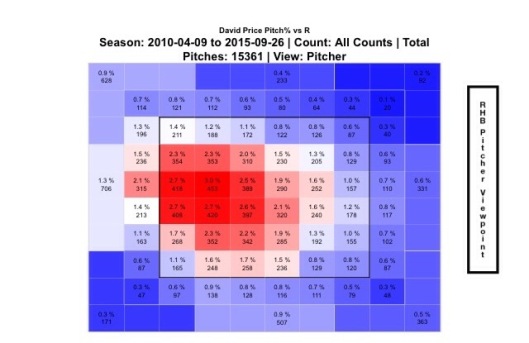
If opposing batters (generally righties) are squaring up on the ball and pulling it more than ever (generally to the Green Monster) on Price, it stands to reason that he is giving them pitches to pull hard. Let’s first examine a heatmap from Price’s pitch locations to right-handed batters over the same six-year sample size we have been using.

fullsizerender-7

*via FanGraphs

This looks pretty good! It’s no wonder why Price has been so adept at avoiding the longball; he really pounds the outside corner on those right-handed batters. So let’s look at 2016 and see if anything has changed.

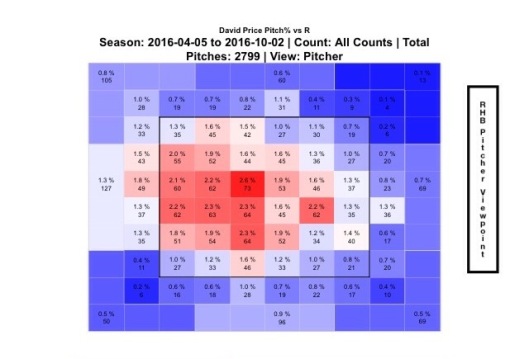
fullsizerender-9

*via FanGraphs

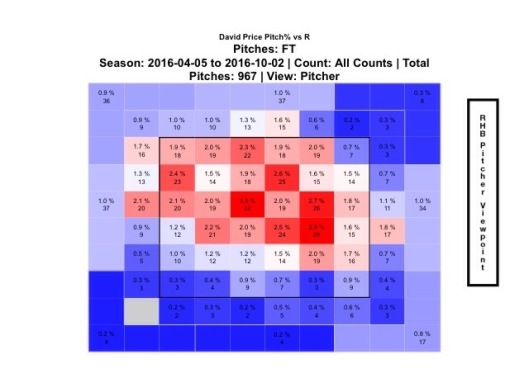
Yeah, that will change your fortunes. Much less of that outside corner action, much more of that “meatball right down the middle” action. I decided to dig a little deeper and look at which of his four pitches (fastball, cutter, changeup, and curve) was most responsible, or if multiple pitches were culprits. I’ll save you the trouble and get to the one culprit.

fullsizerender-8

*via FanGraphs

We’ve got a match, and you probably guessed it – it’s the fastball. I can’t explain to you why Price was missing his spots, but you and I know that this is a game of inches, and his fastball was responsible for 16 of the 30 homers he gave up. While this is purely speculation, it’s possible that Price was getting acclimated to his new environment and $217M contract. Whatever the case may be, this is the only adjustment that he really has to make in 2017 to return to his previous levels of Cy Young stardom.

Pitching is an unforgiving occupation, and pitchers often spend years refining their craft, but I am willing to go out on a limb and bet that someone of David Price’s caliber can make this one readjustment. He is no longer the new big-ticket addition in Boston (that would be Chris Sale), nor is he the defending Cy Young (that would be another teammate, Rick Porcello), which should lessen the pressure somewhat. With the hopes that Price is in good health, you can expect a huge bounce-back year from him in 2017.


The 2017 Red Sox Season Ends and Starts With Bogaerts

The Red Sox are currently tabbed as the favourites in the American League by most experts and odds-makers, but there was a lot of roster turnover from last season so it is difficult to really project their level of success for the coming year. Their positive 2017 outlook is despite losing the face of their franchise and best power hitter, David Ortiz, to retirement. He has been one of the most consistent clean-up hitters in the past decade and so offensively he leaves big shoes to fill (pun intended). The Red Sox offense in 2017 led the majors in most offensive categories like AVG, OBP, SLG, Off WAR component, swStr%, contact% and had the best OPS since the 2009 Yankees. Instead of signing or trading for a big slugger in the offseason to fill this void, Red Sox management looked elsewhere by acquiring one of the majors’ best starting pitchers in Chris Sale. The 2017 Red Sox are now led by a young nucleus of hitters who are projected to carry an offence that is likely going to be one of the best, and the Red Sox are banking on the continuing development of their young offensive talent to help them go far in the postseason.

One player who is expected to make major offensive contributions this season is Xander Bogaerts — a hitter who has shown the ability to hit for an elite batting average (.320 BA in 2015) and display some power (21 HR in 2016). He plays for one of the league’s most scrutinized teams and at one of the most important positions, creating an environment that demands excellence and puts a high level of pressure on a young player. Bogaerts has posted back-to-back seasons with a WAR over 4 and a wOBA over .338 but he achieved these feats in contrasting ways. In 2015, it was driven by an elite batting average, while in 2016 he made some changes to his swing and approach at the plate and was able to hit for a high average (.294) while increasing his home-run total from 7 to 21.

But when we delve into the numbers of his 2016 season, we learn that it was a tale of two halves. His noticeable two-halved season is similar to the 2016 seasons of Matt Carpenter and Kevin Pillar, players who I have written about recently, but these tales were directly related to injuries they sustained. For Bogaerts, however, his change was not due to an injury but from a change in his approach at the plate. This change had a negative effect on most of his offensive statistics and perhaps is a cause for concern for the coming season.

In the first half of the season versus the second half of the season, his batting average fell from .329 to .253, his BB/K fell from 0.59 to 0.37, his OPS dropped by 134 points, and his wOBA dropped by 57 points. The only improvements he displayed was improving his HR/FB ratio from 10.6% to 12.1% and increasing his ISO slightly by 13 points (.146 vs. .159).  So what changed, you ask? Well, you can probably tell from interpreting the aforementioned changes in his statistics; he sold out for power. He made a significant change to his ground-ball to fly-ball ratio, as it decreased from 1.62 to 0.98. Below we can see the change in his AVG/P from the first half to the second half of the 2016 season:


He stopped hitting balls to the opposite field, decreasing his Oppo% by 6.3% and increased his Pull% and Cent% by 2.8% and 3.5%, respectively. See below for a summary:

He also increased his average launch angle from 6.3 degrees in 2015 and 6.9 degrees in the first half of 2016 to almost double those marks in the second half of 2016 — 13.1 degrees. Despite increasing his launch angle in the second half, he made no major changes to his exit velocity (89.8 MPH vs. 90.2 MPH) or to his swing speed (61.3 MPH vs. 61.7 MPH).

In the table below, we see how Bogaerts ranked at his position in wRC+ and wOBA based on batted-ball type in the first half of the season and the second half:

Further, it is interesting to investigate his home and road splits in the second half as he hit .325 at home vs. .207 on the road. His second half away FB% was 39.9% and pull% was 42% while at home it was 38.3% and 52.1%. He increased his away FB% by 9.4% and increased his home FB% by 5.9% and his pull% by 7.7%. This change obviously helped him when playing at Fenway Park as his ISO increased from .172 to .205 while maintaining an identical batting average. However, while playing on the road, this new approach to hit fly balls and to pull the ball over an imaginary Green Monster led to major struggles at the plate.

I wanted to see if there was hope for Bogaerts with his new fly-ball-driven plate approach, so I wanted to look at hitters who made similar changes year-over-year and how they fared. I used data from the past four seasons and looked at qualified hitters who had at least a 0.40 decrease in their GB/FB from one year to the next. Analyzing the data, I found that Xander Bogaerts’ second half was eerily identical to Salvador Perez’s 2014 season. Perez made similar changes in his fly-ball approach from his 2013 to 2014 season and below are the results:


Apart from their HR/FB ratios, their batted-ball and hitting-profile metrics are identical. Bogaerts decided to pull and hit fly balls in the second half and if he was able to sustain this batted-ball profile over the course of a full season, versus if he kept his batted-ball profile the same as he had in the first half of the season, he would have hit six more home runs. Hitting over .310 with 18 HRs is much preferable to hitting sub .260 with 24 HRs. Of course, this extrapolation has its flaws, but whenever your hitting is compared to a catcher’s, it is a bit of a sign of concern.

It is not all doom and gloom for Bogaerts, as he is only 24 years old and has a lot of time to build into his frame and develop a power stroke. Looking at the same set of data, Bogaerts’ 2016 full-season data (a mixture of high-average approach vs. HR-hitting approach) looked similar to Robinson Cano’s 2016 season, apart from his ability to tap into his power. Cano and Bogaerts decreased their GB/FB rates by 0.72 and 0.75 respectively from 2015 to 2016, as shown below:


If Bogaerts can learn to hit the ball harder more consistently and perhaps focus less on pulling the ball, and revert back to his 2014 Oppo% of 32%, he could turn into both an elite power and contact hitter. An ideal future player comparison for Bogaerts would be somewhere in between Derek Jeter and Robinson Cano. Being able to utilize the whole field, hitting for a high batting average, stealing some bases, scoring lots of runs atop a killer lineup, and hitting for a lot of extra-base hits are all within the realm of possibilities for this young shortstop.

An important aspect to consider for the upcoming season is, where should Bogaerts hit in the batting order? According to Ian Browne of MLB.com, John Farrell is tinkering with the idea of hitting Bogaerts sixth in the Red Sox lineup, and this was the case for his first spring-training game since returning from the WBC on Thursday. And perhaps he has done so for good reason. In 2016, Bogaerts had most of his success hitting third in the lineup, but was moved to the two-hole on August 10th and stayed there for the vast majority of games there on out, and he began to struggle at the plate. It is a bit of a chicken-and-the-egg dilemma but something that probably prompted the move was his inability to hit with runners in scoring position. His batting average fell from .351 to .136, due mostly to his increased FB% — a trend that he has showed throughout his short major-league career, as shown by the table below:


His struggles with runners in scoring position are something that I am sure Farrell is well-aware of, and therefore his move down in the batting order makes a lot of sense, especially if he continues struggling with his new approach at the plate. It should not only helps his team be more efficient at run production, but it should also help Bogaerts’ chances of stealing more bases this season — something he has talked about doing more of if given the opportunity. He stole 11 bases in the first half of the season but only stole two in the second half, something that he attributed to having fewer green lights from his coaching staff when on the base paths, as they didn’t want to take the bat out of Big Papi’s hands. Of course, that is no longer an issue, and if he does in fact hit in sixth slot, he should have more opportunities to run than if he hit fourth – a position in the order that he was originally projected to hit from.


Fantasy Perspective: The move down in the order will definitely hurt his counting stats in runs and RBI, but the optimist in me believes that he will revert back a little to his 2015 self and hit fewer fly balls than he did in the second half of 2016. This should hopefully help him hit for a high batting average, considering he was able to sustain a BABIP in the .370 range over the course of over 1000 PAs from the beginning of the 2015 season to the halfway point of the 2016 season. His batting average over that period was .323, which which was tied for second with Jose Altuve, and only trailed Dee Gordon at .324. A more balanced approach should hopefully result in productive power numbers from Bogaerts, posting an elite number of doubles and HRs in the mid- to high teens. He has talked about trying to steal at least 20 bases this season and the likelihood of doing so is highly dependent on where he hits in the order. So if he stays in the six-hole for the majority of the season or moves up to the two-hole at some point – I believe that 20-25 steals is achievable.