The Power of Expectations

“Oft expectation fails, and most oft where most it promises; and oft it hits where hope is coldest; and despair most sits” – William Shakespeare

If you’ve ever read the magnificent Joe Posnanski (and if you haven’t, what are you waiting for?), you’re probably familiar with his patented movie rating scale. The first time I read about it, I was blown away – the concept is so simple and elegant, yet it captures the intricacies of expectations and how they influence our final opinions of movies, books, beers, musics, video games, first dates, and yes, baseball players. Let’s take the M. Night Shyamalan film “Lady in the Water” for example. If you rented the movie after watching “The Sixth Sense”, you’d obviously have high expectations for the film – maybe a 3 1/2 to 4 star rating. And well, it turns out the movie was nothing like what you were expecting; it wasn’t a thriller or suspense story, but more something like a fairy tale for kids. To you, the movie was a flop – a one star movie in the end. Four stars minus one star gives you a negative overall movie experience.

But suppose you entered watching that same movie with different expectations. I’d watched little Shyamalan before watching “Lady in the Water”, and I’d heard from others that the movie was a disappointment. I was expecting something like a 1/2 star performance, but hey, the girlfriend wanted to watch it so we did. I wasn’t expecting a thriller or suspense movie, so the movie struck me as actually quite fun. I’d rank it a two-ish star movie in the end, giving me a positive movie experience. My expectations were lower than the quality I received, so it made the movie fun to watch.

It’s an odd coincidence that when I first read about Joe Poz’s movie system, I was studying abroad in Denmark. The Danes are masters of low expectations; their entire culture is built around “Jantelov“, the idea that nobody is better than anyone else. If you succeed and admit it, you’re ridiculed and held in contempt. And if you talk to a Dane, they’ll constantly remind you of the fact that their nation is no great shakes.* If you take a look at their nation’s history, you can understand why. They’ve lost every war they’ve been involved in since Viking times, their nation has shrunk continuously for the past 200 years, and their land is cold, dark, and uninspiring for 11 1/2 out of 12 months every year. Heck, the most cocky thing you can find in the entire nation is Carlsberg’s (their beer’s) slogan: “Probably the best beer in the world.” And even then… “probably”? What advertising agency over here would ever approve of such ambiguity? Danes are the kings of schadenfreude.

*My host family commented at one point that the war in Iraq probably wasn’t going to end well since the Danes were allied with the US. “We’ve lost every war we’ve been involved in – sorry, but it doesn’t look good for you.”

And yet, in multiple studies over different time spans, the Danes have been ranked the happiest nation in the world. Not who you would have expected, huh? In classic form, the Danes don’t have a great answer as to why – they just shrug their shoulders and say that they’re really not that happy. The weather stinks, their taxes are too high – jantelov all over again. The best answer I’ve ever heard came from one of my professors there; she claimed that if you were never expecting anything good to happen to you, you’d always end up pleasantly surprised.

What does any of this have to do with baseball? As fans, everything.

Read the rest of this entry »


Flooring the WBC: How the World Baseball Classic Negatively Affects the Health and Performance of Pitchers

The World Baseball Classic is certainly a noble idea. I mean, what’s not to like about it on paper? You take the best players from each baseball-playing nation and have them battle it out to see which country reigns over the rest of the globe. Can anyone trot out a more thunderous lineup than the USA? Who has the more dynamic pitchers: the Dominican Republic or Venezuela? Does Japan really produce the most fundamentally sound players? Fans all over the world have shown their support for this, as have many players.

All of this would be fine if baseball were like basketball, hockey or soccer; sports where you could wake up, trip over your dog, tumble down the stairs into a pair of cleats, skates or sneakers and play. Those sports employ bio-mechanics the body was designed to handle like running, jumping, kicking and swinging. Baseball, specifically pitching, is not like that. The human arm was not designed to handle the stress and torque put on it by pitching. If you don’t believe me, then I have a few thousand shoulder and elbow scars to show you, including my own.

The lucky few who are able to withstand such actions and be successful are kept on a yearly routine: start throwing in mid-February, build strength and stamina through March before turning up the intensity at the beginning of April. But just like it isn’t wise to turn the ignition on a new Mustang and instantly floor it, it doesn’t seem right to take a pitcher conditioned to ease into a season during Spring Training and tell him to pitch with October-like intensity in March. Unfortunately, this is the case with the WBC.

After looking through the statistics of those who appeared in both WBC tournaments, it is my belief that pitchers who participate in the WBC, especially starters, are far more likely to see a regression in their performance, get hurt or both than pitchers who do not play in the WBC. I reason that the most likely cause is the tournament’s timing disrupts the normal routine of pitchers and their arms are not yet ready to handle the stress and intensity then. With data collected from various sources, I will demonstrate the stark differences between WBC pitchers and their counterparts who did not participate in the tournament, using spreadsheet data and graphs included in this analysis.

***

The pitchers who were included in this study had to satisfy a few conditions. First, pitchers in the WBC group had to have pitched primarily in Major League Baseball in 2005, 2006, 2008 and 2009[1]. Players who played in one year but not another (spent one year in the minors or injured; or retired after a WBC) were not included. For the baseline of starters and relievers, a pitcher who made 10 or more starts for the year was counted as a starter while a pitcher who made 25 or more appearances with nine or fewer starts was counted as a reliever. The “all pitchers” category includes every pitcher who made an appearance during the 2005, 2006, 2008 and/or 2009 seasons.

***

At the heart of it, the key to successful pitching is how good you are in preventing runs from scoring, with ERA and component ERA (ERC)[2] being the primary statistics used to measure this aspect. The MLB’s ERA usually falls between 4.25 and 4.45 in most years, with only small differences from season to season. The last four groups saw small-to-moderate increases in their ERA between 2005 and 2006, but WBC starting pitchers saw a dramatic jump, from 3.75 to 4.48 while the ERC inflated from 4.09 to 4.79. WBC relievers also saw a significant jump in their collective ERAs (3.15 to 3.51), but not only is that only roughly half of what starters experienced, WBC relievers saw their ERC drop from 3.86 to 3.41. Compared against the league-wide ERA/ERC jumps of 0.24 (4.29 to 4.53) and 0.25 (4.18 to 4.43), respectively, the WBC starters’ jumps look even more like one of Superman’s single bounds. A major factor for this spike may be the above-average rise in HR/9 ratios. The average MLB starter showed no increase in his HR/9 rates and all other groups had increases of 0.1, but the HR/9 rates of WBC starters rose by 0.2 (0.9 – 1.1).

Home runs aren’t so bad, just as long as there isn’t anyone on base, but WBC starters were putting more and more runners on in 2006. Starting pitchers saw the highest rise in WHIP out of the five groups. The major league-average increase in WHIP between 2005 and 2006 was 0.04 (1.37 to 1.41), but the average WBC-participating starter saw his WHIP rise double that amount (0.08) from 1.29 to 1.37. Part of that increase was fueled by an up-tick in their BB/9 rates, which climbed from 2.9 to 3.1 (0.2). The most startling changes, though, were with the starters’ rising H/9 rates and falling K/9 rates . While all other groups saw a 0.2 increase in their H/9 ratios, WBC-participating starters’ ratios shot up by 0.5, going from 8.7 in 2005 to 9.2 in 2006. This may be attributed to a pitcher’s prematurely tired arm or improper mechanics from being rushed along during what normally is Spring Training. Either way, the pitches became more hittable, which also showed a decrease in these pitchers’ ability to strike batters out.

Every group I collected data on showed an improvement in their K/9 ratios by 0.2…except for WBC-participating starters. Their K/9 ratios actually fell, going from 7.0 in 2005 to 6.7 in 2006—a drop of 0.3 whiffs per nine innings. A good K/9 ratio shows both how good a pitcher is at retiring a batter without the help of his fielders and how dominant his repertoire is. The higher, the better. When I see that one group’s ratio is regressing while all others are improving, that would make me a little curious as to what may be causing such a downturn, especially with a group as valuable as starting pitchers. If I were in a team’s front office, it would make me wonder if this little event that is supposedly good for baseball is actually harming my pitcher and my team’s playoff chances.

***

Now, this wouldn’t so much of a concern if the pitchers who saw this decline in performance were just hurlers on the wrong side of 30 and/or at the tail-end of their contract, but that’s not a case. Pitchers like Jake Peavy and Dontrelle Willis saw their performances take a dive after participating in the 2006 WBC, while promising up-and-comers like Francisco Liriano and Gustavo Chacin suffered major injuries that year. Two of the more alarming examples are Peavy and Willis, two National League hurlers from pitcher-friendly ballparks who use complicated or violent deliveries.

Peavy seemed out of sorts during the first half of the 2006 season, posting ERAs of 5.17 or worse in three of the first four months. It was during this time that Peavy was also prone to the long ball, serving up 14 of his 23 home runs in April, May and June. The “gopher-itis” lessened once July hit, but then Peavy had a little more trouble finding the strike zone. After issuing no more than eight free passes in each of the first three months, Peavy walked 12 or more batters in every month during latter half of the season. Peavy eventually straightened himself out in 2007, but the same cannot be said for Willis. After nearly winning the Cy Young in 2005, Willis never could establish any consistency in 2006. His WHIP climbed an astonishing 0.29 points from 1.13 (sixth in the NL) to 1.42 (outside the top 30). At the same time, his HR/9 rate doubled from 0.4 to 0.8 while his opponents’ OPS climbed from .644 to .745. Since then, Willis’ regression went from bad to worse and is now viewed as little more than a reclamation project for the Arizona Diamondbacks.

***

Whereas 2006 saw a decline in WBC pitchers’ performance, the 2009 tournament participants saw an even more disturbing trend: a steep drop in their time on the mound. There were only negligible decreases in innings pitched following the 2006 WBC—10.1 percent for starters, 2.6 percent for relievers—but those figures worsened dramatically following this past tournament. WBC starters pitched, on average, 21.1 percent fewer innings in 2009 than they did in 2008 while relievers saw their innings totals drop by 27.2 percent. Houston ace Roy Oswalt saw his streak of five consecutive 200-inning seasons come to an end due to chronic back problems. Cincinnati’s Edinson Volquez appeared in one WBC game, then made only nine starts during the regular season before undergoing “Tommy John” surgery[3].

A second trend I noticed involved those pitchers who were in the playoffs the previous season. Out of the 11 pitchers who appeared in both the ’08 playoffs and the ’09 WBC, eight of them missed time due to injury (or, in the case of Javier Lopez, demotion) or saw an overall regression in their performance. The pitchers from this group who spent time on the disabled list pitched anywhere from 13.5 percent to 80.3 percent fewer innings than they had in ’08. Some of the more notable examples include Red Sox right-hander Daisuke Matsuzaka, whose 59.1 innings in ’09 were the fewest he’s pitched in either Japan or America, and Angels set-up man Scot Shields, who had never been on the disabled list for his entire nine-year big league career.

***

There are more examples of pitchers seeing their fortunes change for the worse after either of the two WBCs, like Bartolo Colon’s shoulder falling apart after rushing through rehab and Esteban Loaiza’s collapse in Oakland in 2006 or how Volquez’s elbow went kaput in the middle of 2009. I won’t list every pitcher who suffered, but my point is clear: the WBC increases the chances for pitchers to suffer injuries, see an across-the-board decline in performance or both. As I stated earlier, I feel the biggest reason for these unfortunate trends is the timing of the tournament. Holding this tournament in the early spring can only damage the health and careers of the players who wish to represent their countries and, in turn, hurt the player’s team both on the field and their long-term organizational plan. I feel the best possible resolution would be to hold the tournament at two different times: have the preliminary rounds during the week of the All-Star Game—while giving MLB, the Japanese leagues and all other leagues a mid-season break—and the final two rounds shortly after the World Series. This way, not only would the careers and health of the pitchers be better preserved, but it would also be highly beneficial to MLB as a whole.

Under the current scheduling, the WBC and MLB has to battle against the NCAA men’s basketball championship tournament for ratings and coverage. Since all other major professional and collegiate leagues are inactive in July, it would allow MLB a better opportunity to drum up interest in the tournament and give less well-known baseball-playing nations a bigger platform to perform. The week off would also benefit the players who are not in the WBC, as they would have had time to recover from injuries and spend invaluable time with family and friends. Lastly, the buzz over a recently completed World Series could carry over to the final stages of the WBC, with story lines from the first phase being built up prior to the resumption of the tournament. Playoff-participating players could have the option of continuing in the tournament or allow other players, who spent most of October resting and re-energizing, to go in their places. Those fresh bodies would also improve the quality of play seen by the fans.

The bottom line is this: the World Baseball Classic is an excellent idea, but is poorly executed in its current form, with pitchers suffering the most damage. Pitchers are the most valuable and volatile commodity in baseball and MLB should do its very best in order to protect that commodity. Even though there have been only two tournaments to study, the numbers are very clear and the logical decision to change should be made.

Michael Echan is a freelance sports writer from New Jersey. Please contact him if you would like to see the compiled spreadsheet data and graphs. He may be reached at mcechan@hotmail.com


[1] Francisco Liriano spent most of 2005 in the minors, but was included because he spent most of 2006 with Minnesota before a season-ending elbow injury in August. Luis Ayala was on Washington’s roster in 2006, but injured his elbow during the WBC.

[2] ERC is a statistic created by Bill James. It takes the number of hits, walks, home runs, hit batters and total batters faced by a pitcher to give an “alternate” ERA that better reflects his performance.

[3] Volquez did pitch a career-high 196 innings in 2008, his first full season in the big leagues, but has had his workload gradually increased during his career. His combined innings progression: 140 in ’05, 154 in ’06, 178.2 in ’07, 196 in ’08.


Fun With ERA Estimators

There are a number of ERA estimators out there and just as many opinions on which one is the best.  Among the more well-known estimators are FIP (Fielding Independent Pitching, developed by Tom TAngo), xFIP (FIP, with a normalized HR-rate), SIERA (created by Matt Swartz and Eric Seidman at Baseball Prospectus), tRA (created by Graham MacAree), QERA (created by Nate Silver), Component ERA (created by Bill James), and DIPS, which was developed by Voros McCracken and was the first ERA estimator to attempt to use the three true outcomes (strikeouts, walks, home runs allowed) to separate the things pitchers have control over from other factors, such as defense, sequencing of hitting events, and luck.  Ultimately, that’s what an ERA estimator attempts to do:  they allow us to evaluate pitching performance based on the things pitchers actually control.

For this article, the three estimators that will be used are FIP, xFIP, and SIERA.  A quick refresher on the three:

FIP—“Fielding Independent Pitching, a measure of all those things for which a pitcher is specifically responsible. The formula is (HR*13+(BB+HBP-IBB)*3-K*2)/IP, plus a league-specific factor (usually around 3.2) to round out the number to an equivalent ERA number. FIP helps you understand how well a pitcher pitched, regardless of how well his fielders fielded. FIP was invented by Tangotiger.” (from The Hardball Times glossary).

xFIP—“Expected Fielding Independent Pitching. This is an experimental stat that adjusts FIP and “normalizes” the home run component. Research has shown that home runs allowed are pretty much a function of flyballs allowed and home park, so xFIP is based on the average number of home runs allowed per outfield fly. Theoretically, this should be a better predicter of a pitcher’s future ERA.” (from The Hardball Times glossary).

SIERA—Skill Interactive Earned Run Average.  This is the most recent entry into the field and is more complex as it incorporates a number of adjustments to the basic three true outcomes formula.  From the introductory essay at BP, there are things that SIERA takes into account that other ERA estimators do not:  it allows for the fact that a high ground ball rate is more useful to pitchers who walk more batters, a low fly ball rate is less useful to high strikeout pitchers, adding more strikeouts is more useful to low strikeout pitchers, and adding ground balls is more useful for high ground ball pitchers.  SIERA also uses ground balls per plate appearance rather than ground balls per balls in play.

For background information on FIP, xFIP, and SIERA, please see the following web pages:

http://www.hardballtimes.com/main/statpages/glossary/

http://www.baseballprospectus.com/article.php?articleid=10027

Ultimately, we want an ERA estimator that will tell us how well the pitcher is pitching after you take away the defense and luck elements.  Also, we want our ERA estimator to be able to most accurately predict future performance.   If you have Dan Haren and his 4.56 ERA on your fantasy team, you want to know if he’s going to improve or if you should part ways with your expected Ace, so you look at an ERA estimator as a clue to his expected future performance.  Which ERA estimator you choose can give you very different expectations.

Here at Fangraphs, I’ve noticed a recent backlash against xFIP from commenters on articles that use the metric in their analysis.   These commenters feel that pitchers do have control over their HR-rate, whereas xFIP normalizes all pitchers to a league average rate.  Often, they will point out that a pitcher’s home ballpark could be a factor in a pitcher’s high home run rate and that it isn’t likely to come down as long as the pitcher continues to play for that team.  For them, FIP is the metric to use.  This can obviously make a big difference in predicting future performance.  I’m not going to weigh in on that particular debate, but I did want to highlight some pitchers and their respective ERA, FIP, xFIP, and SIERA numbers to illustrate the different expectations based on which ERA estimator you choose to use.

All pitcher data is as of June 30 and only pitchers with 75 or more innings were included.  This produced a sample of 115 pitchers.

ERA Leaders

Rank Pitcher ERA FIP xFIP SIERA
1 Josh Johnson 1.83 2.47 3.16 2.99
2 Ubaldo Jimenez 1.83 3.07 3.68 3.49
3 Jaime Garcia 2.27 3.47 3.84 3.77
4 Roy Halladay 2.29 2.78 3.06 3.05
5 Adam Wainwright 2.34 3.11 3.27 3.12
6 Tim Hudson 2.37 4.37 4.29 3.94
7 David Price 2.44 3.73 4.07 3.97
8 Cliff Lee 2.45 2.34 3.30 3.09
9 Clay Buchholz 2.45 3.47 4.28 4.37
10 Yovani Gallardo 2.56 2.97 3.46 3.32

Generally, the league’s top 10 ERA leaders have had some good fortune to go along with their good pitching.  In the case of these pitchers, the first place to look is their BABIP.  In 2010, MLB hitters have a .299 BABIP.  Eight of the ten pitchers in the list above have BABIPs lower than .299 and the other two pitchers are at .304 and .305.  The lowest is Tim Hudson’s .234.  Left On Base Percentage (LOB%) is another key area.  Eight of the ten pitchers have a LOB% of 79% or higher, with the other two at 71.6% and 76.2%.  Ubaldo Jimenez leads the league with a LOB% of 86.2%.  Finally, HR-rate (HR/FB) is a key factor for a pitcher keeping his ERA low.  Nine of the ten pitchers have a HR/FB rate at 9% or lower, with Clay Buchholz leading the pack at 3.6%.

FIP Leaders

Rank Pitcher FIP ERA
1 Francisco Liriano 2.19 3.47
2 Cliff Lee 2.34 2.45
3 Josh Johnson 2.47 1.83
4 Roy Halladay 2.78 2.29
5 Tim Lincecum 2.88 3.13
6 Jered Weaver 2.93 3.01
7 Yovani Gallardo 2.97 2.56
8 Jon Lester 3.01 2.86
9 Ubaldo Jimenez 3.07 1.83
10 Adam Wainwright 3.11 2.34

When we shift over to look at FIP leaders, we have four pitchers who fall out of the top 10 based on ERA:  Jaime Garcia, Tim Hudson, David Price, and Clay Buchholz.  Joining the remaining six in this list of FIP leaders are Francisco Liriano, who surges to the top, along with Tim Lincecum, Jered Weaver, and Jon Lester.  Francisco Liriano has a solid 3.47 ERA, but his FIP shows he could be much better going forward.  The main culprit is a .355 BABIP, which should come down.  All ten of these pitches have great HR/FB rates.  Adam Wainwright has the highest rate, at 9.0%.  The other nine pitchers are at 8.7% or lower, with six pitchers sporting a rate below 7.0%.

xFIP Leaders

Rank Pitcher xFIP ERA
1 Francisco Liriano 3.01 3.47
2 Roy Halladay 3.06 2.29
3 Josh Johnson 3.16 1.83
4 Jered Weaver 3.21 3.01
5 Tim Lincecum 3.22 3.13
6 Adam Wainwright 3.27 2.34
7 Cliff Lee 3.30 2.45
8 Ricky Romero 3.43 2.83
9 Dan Haren 3.43 4.56
10 Jon Lester 3.44 2.86

The usual suspects remain on the list, with two additions in Ricky Romero and Dan Haren, while Yovani Gallardo barely drops out of the top 10, falling to 11 here, and Ubaldo Jimenez drops to 16.   Romero had placed out of the top 10 in ERA (17th) and FIP (11th), so he receives just a slight bump up based on xFIP, where he places 8th.  Dan Haren is the high-riser, though, as he’s allowed a HR/FB rate of 13.5%.  Haren is 78th based on ERA and 47th based o FIP, but moves up to 9th based on xFIP.  If you believe that HR-rates normalize over time, then Haren is a pitcher to target.  If, however, you think Haren will continue to be plagued by the long ball, whether that’s due to his home park or his actual skill, then you might want to steer clear of him (his career rate is 11.0%, by the way).

SIERA Leaders

Rank Pitcher SIERA ERA
1 Jered Weaver 2.55 3.01
2 Francisco Liriano 2.91 3.47
3 Josh Johnson 2.99 1.83
4 Roy Halladay 3.05 2.29
5 Cliff Lee 3.09 2.45
6 Adam Wainwright 3.12 2.34
7 Dan Haren 3.14 4.56
8 Tim Lincecum 3.17 3.13
9 Jon Lester 3.28 2.86
10 Yovani Gallardo 3.32 2.56

The SIERA leader list and xFIP leader list have nine common names.  The difference is Yovani Gallardo at #10 according to SIERA and #11 according to xFIP, and Ricky Romero (#11 based on SIERA, #9 based on xFIP).  Looking at the entire list shows that xFIP and SIERA produce similar ERA estimates.  I ran a correlation for all 116 pitchers between their xFIP and their SIERA and it produced a 0.96 correlation.  I then took the absolute difference between each metric for each pitcher and found that, on average, the difference was 0.17.  Seventy-seven of the 116 pitchers (66%) had xFIPs and SIERAs within 0.20 of each other and four pitchers had identical xFIPs and SIERAs.

Pitchers the ERA Estimators Agree On

Some pitchers have FIPs, xFIPs, and SIERAs that are near matches for their actual ERA.  It might be said that these pitchers are the easiest to predict going forward, simply because all three ERA estimators agree that their current ERA is likely to be a legitimate estimate of their ability.  Below is a top 10 list of pitchers who’s ERA estimators agree most closely with their actual ERA.  The final column, “AVG”, shows the average of the three ERA estimators.  To create the top 10 list, I found the absolute difference between each estimator and actual ERA, then divided by three to get an average absolute difference for each pitcher.

Rank Pitcher ERA FIP xFIP SIERA AVG
1 Freddy Garcia 4.66 4.69 4.60 4.66 4.65
2 Kyle Kendrick 4.88 4.89 4.90 4.98 4.92
3 Roy Oswalt 3.55 3.51 3.55 3.39 3.48
4 Zack Greinke 3.72 3.74 3.76 3.52 3.67
5 Kenshin Kawakami 4.48 4.23 4.52 4.52 4.42
6 Chris Volstad 4.40 4.21 4.47 4.47 4.38
7 Felix Hernandez 3.28 3.38 3.49 3.33 3.40
8 Tim Lincecum 3.13 2.88 3.22 3.17 3.09
9 Scott Kazmir 5.42 5.27 5.46 5.15 5.29
10 Jeremy Bonderman 4.36 4.02 4.42 4.23 4.22

Now, some of these pitchers are better than others.  In Joe Morgan terms, these are the most “consistent” pitchers when looking at how they fare according to advanced metrics but consistent doesn’t mean good (something Joe never seems to mention).  You can be consistent like Scott Kazmir and be of no use to anyone.  Or you can be consistent like Felix Hernandez or Tim Lincecum and be a top starting pitcher.  These pitchers generally have BABIPs within 10 points of the league average and HR/FB rates close to league average.

Most Volatile Pitchers

The following list shows the pitchers who’s ERA estimators disagree with their actual ERA by the largest amount.  These are the pitchers who advanced metrics suggest will either greatly improve or who are headed for heaping dose of reality in the future.

Rank Pitcher ERA FIP xFIP SIERA AVG
1 Tim Hudson 2.37 4.37 4.29 3.94 4.20
2 Livan Hernandez 3.10 4.40 4.91 5.18 4.83
3 Clay Buchholz 2.45 3.47 4.28 4.37 4.04
4 Ubaldo Jimenez 1.83 3.07 3.68 3.49 3.41
5 Jeff Niemann 2.72 4.39 4.29 4.16 4.28
6 Jason Vargas 2.80 3.71 4.81 4.45 4.32
7 David Price 2.44 3.73 4.07 3.97 3.92
8 Jaime Garcia 2.27 3.47 3.84 3.77 3.69
9 Justin Masterson 5.21 4.04 3.94 3.55 3.84
10 Matt Cain 2.93 3.60 4.70 4.49 4.26

Of note here is that nine of these ten pitchers are expected to perform much worse going forward, with only sabermetric favorite Justin Masterson expected to improve.  Some of these names are sure to cause controversy.  Matt Cain, for example, consistently out-performs his FIP and xFIP.  He has a lifetime ERA of 3.44, with a lifetime FIP of 3.66 and xFIP of 3.97.  Every year, his HR/FB rate is below the league average (7.7% for his career), and in five of his six years in the league his BABIP has been below league average (.285 for his career).  At some point, we must conclude that Matt Cain is better than the ERA estimators think he is.  Another pitcher on this list, Tim Hudson, has a career ERA of 3.43, with a FIP of 3.82.  He’s done it with a better-than-expected career BABIP (.287).  This year, that BABIP is .234, so he should regress, but he has a history of bettering his FIP, so he has a good chance of not regressing as much as the ERA estimators believe he will.

The ERA Estimator “Get Them If You Can” Official List

For this list, I limited the pitchers to those for whom the average of the three ERA estimators suggest a 3.80 ERA or below.  I don’t think it’s particularly helpful to know that the ERA estimators suggest Kyle Davies should have an ERA around 5.04 rather than the 6.06 he currently sports.  The “AVG” column is the average of the ERA estimators. The “DIFF” column is the difference between that average and the pitcher’s actual ERA.

Rank Pitcher ERA FIP xFIP SIERA AVG DIFF
1 Randy Wells 4.96 3.47 3.77 3.94 3.73 -1.23
2 Dan Haren 4.56 3.90 3.43 3.14 3.49 -1.07
3 James Shields 4.76 4.13 3.55 3.41 3.70 -1.06
4 Gavin Floyd 4.66 3.41 3.81 3.73 3.65 -1.01
5 Brandon Morrow 4.50 3.45 3.90 3.55 3.63 -0.87
6 Tommy Hanson 4.50 3.45 4.10 3.54 3.70 -0.80
7 Francisco Liriano 3.47 2.19 3.01 2.91 2.70 -0.77
8 Jason Hammel 4.32 3.69 3.81 3.85 3.78 -0.54
9 Justin Verlander 4.02 3.38 4.10 3.74 3.74 -0.28

The top eight pitchers on this list have BABIPs at .328 or higher.  The top six have LOB% below 70%.  Dan Haren and James Shields sport HR/FB rates of 13.5% and 14.4%.  Obviously, some of these pitchers are better than others and you can see for yourself the disagreement between the ERA estimators.  Haren and Shields, with their high HR/FB rates, have much higher FIPs than the others.   If you believe he can remain healthy, I’d say the #1 target would be Francisco Liriano, as his ERA is 40th among starting pitchers, while he’s ranked #1, #1, and #2 according to the ERA estimators.

The ERA Estimator “Sell!  Sell!  Sell!” Official List

For this list, I limited the pitchers to those who currently have ERAs below 3.50 and a K/9 great than 6.0.  Tim Hudson and Livan Hernandez, with K-rates around 4.0, are not likely to be easy to unload, despite their shiny ERAs.  The pitchers below have good ERAs and solid strikeout rates, but the ERA estimators suggest they are not as good as their performance so far.

Rank Pitcher ERA FIP xFIP SIERA AVG DIFF
1 Clay  Buchholz 2.45 3.47 4.28 4.37 4.04 1.59
2 Ubaldo Jimenez 1.83 3.07 3.68 3.49 3.41 1.58
3 Jeff Niemann 2.72 4.39 4.29 4.16 4.28 1.56
4 David Price 2.44 3.73 4.07 3.97 3.92 1.48
5 Jaime Garcia 2.27 3.47 3.84 3.77 3.69 1.42
6 Matt Cain 2.93 3.60 4.70 4.49 4.26 1.33
7 Ted Lilly 3.12 4.21 4.61 4.27 4.36 1.24
8 Andy Pettitte 2.72 3.76 4.04 4.05 3.95 1.23
9 Wade LeBlanc 3.25 4.19 4.60 4.57 4.45 1.20
10 Trevor Cahill 2.88 4.18 4.03 4.02 4.08 1.20

These pictures have a mixture of low BABIPs, high LOB%, and low HR/FB, which makes them candidates to perform worse from here on out.  Of course, Matt Cain, as mentioned before, always seems to defy expectations of ERA estimators.  Also, Ubaldo Jimenez, currently #2 in ERA, is #9 in FIP, and #16 in xFIP and SIERA, so he’s still a top pitcher, just not as good as he’s shown so far.  Depending on your confidence in these advanced metrics, there are moves to make as the baseball season reaches its halfway point.


Pitching Stats and the Quality of Batters Faced

Pat Andriola’s recent post about a pitcher’s opposition prompted me to present something I’ve been playing with for a few months. Several months ago, around the time of the Cy Young Awards, I saw a debate on another website focusing on the question of who the best pitcher in baseball was. The debate primarily centered on Roy Halladay and Tim Lincecum. One thing that was continually brought up in defense of Halladay was that he’d faced much stiffer competition than Lincecum, and that needed to be taken into account. Baseball Prospectus posts OPS of batters faced on their stat pages, but I thought that there had to be something that was better, something that was more quantifiable. This analysis, originally posted at Lookout Landing,  is the result of that thought.

Special Thanks

I’d like to thank both Graham MacAree and Matthew Carruth up front. Graham allowed me to bounce the idea off of him and helped me start the list of caveats. He also put me in touch with Matthew, who was gracious enough to send me the data behind all pitcher/batter matchups in 2009. I’d also like to thank them publicly for StatCorner, as I used their tRA data as the basis for the pitching numbers and their wOBA data as the basis for the hitters. You guys rock.

The Steps

The solution to me seems to be wOBA of batters faced. It’s easily understood (well, if you’re a stats nerd anyway) and incredibly easy to use in analysis. If you can get the data, it’s not that hard to weight hitters’ wOBA figures together to get an aggregate. I started by hand-pulling data from baseball-reference, but that was incredibly time-consuming. I got in touch with Matthew and he graciously provided the batter/pitcher data that allowed me to run this for the pitcher universe in a much easier fashion.

Once you get the wOBA figures for the average hitter that faces a given pitcher, you need the average league wOBA to convert that to a runs figure. I compiled the StatCorner data by league and got averages of .341 in the AL and .330 in the NL. For this analysis, I included pitchers’ hitting stats (from what I understand, they’re typically excluded from the averages that drive batting runs above average) since that’s a major component of the difference between leagues. Additionally, I created a major league average wOBA.

I then calculated the bRAA of the hitters facing a given pitcher just like you would to create a hitter’s batting contribution ( [wOBA – league average wOBA] / 1.15 * Plate Appearances (or in this case, Total Batters Faced)]. So if in 2009 Zack Greinke faced an average hitter with a .340 wOBA and the AL average is .341, that cumulative hitter over the number of ABs against Greinke was 1.23 runs below average. Similarly, I made the calculation substituting major league average wOBA (.335 from StatCorner) for the league-specific figure and calculated the average hitter faced by each pitcher under that scenario (the comparable Greinke figure was a +3.42 run hitter). For the record, there is roughly a 10 run spread between the pitchers who face the “worst” and “best” average hitters in each league, and roughly 20 runs from worst and best average hitters across all major league pitchers.

I then took those bRAA figures and used them to adjust tRA, which is easily done by multiplying the bRAA figure by 27, dividing by xOuts, and subtracting the results (so a pitcher that faces a below average hitter would see an upward adjustment to his tRA). Intuitively it makes sense to me that if Halladay is a +44 pitcher and the hitters he faced were +5, then he should get credit for actually being something close to +49. I do this both within leagues and across leagues, and the differences between the adjusted and unadjusted leaderboards are shown below. I limited it to pitchers with 300 of more expected outs (so approximately 100 innings pitched). Clearly there’s a bit of reshuffling and the largest change is the AL/NL reshuffling on the combined leaderboard (note that you may have to open the leaderboards for full effect).


Results and Application

In general, the changes were what I expected. AL pitchers face better hitters than their NL counterparts (which makes total sense given the DH rule). Within the leagues, the pitchers in each East division faced the toughest hitters. But somewhat surprisingly, there were some relatively meaningful differences even among starters on a given team (for instance, Adam Wainwright faced a +1.2 bRAA NL hitter, while Chris Carpenter and Joel Pineiro both faced hitters around -2.5 bRAA; granted, it’s not huge, but it’s still almost half a win).

As far as how it gets applied, I’m still not totally sure about applying it directly to tRA (or FIP). I think the adjustment works to an extent, but there’s probably some noise in there or a perhaps a good reason why we shouldn’t just add pRAA to bRAA against, especially when trying to look at AL vs. NL pitchers. I also believe there’s likely to be some very good information contained in rolling this up by team or even division, which could aid in projecting “next year” for a player that changes teams/divisions/leagues from one year to the next (certainly multiple years would be needed).

Caveats

I have several caveats about this analysis. For one, it is heavily driven by the wOBA of hitters faced. It is possible that if, say, the AL is similarly better than the NL at both hitting and pitching that differences across leagues may not be picked up correctly (i.e., a .335 wOBA in the NL is potentially not the same as a .335 wOBA in the AL). Similar to that is the idea that there could be a disconnect within leagues as well due to the variation in the quality of pitchers that individual hitters face, which help drive each individual’s wOBA (of course now we’re back to a very cyclical chicken vs. egg argument). Second, I’m using but one year of data, so I’d need to run this several more times to see if 2009 is a representative year. As described above, I’m not sure if it works as an actual adjustment or if it should just be informational. I’ve also made no effort yet to figure out next steps as far as how this may be regressed. Additionally, I considered attempting to use left/right split wOBA data in the analysis but decided against it. That is one more potential refinement. Lastly, I’m not sure how this interacts with stats like tRA* or xFIP, as the adjustment of certain underlying batted ball figures would undoubtedly take care of some aspects of “facing better hitters” or whatever you want to call it.

Conclusion

These are but some of my thoughts on adjusting pitching stats for the quality of batters faced. I’m very interested in what the larger group thinks about the merit of such an adjustment, especially given some new information on how big some of the tRA adjustments are. What else should be considered? Are there other reasons that you have why it may or may not work? How do we consider the chicken and egg nature of adjusting both hitters and pitchers for the quality of the opponent? I’d love to hear any comments any of you have, either positive or negative. Thanks for taking the time to read this!


How Much Have Young Pitchers Contributed to the “Year of the Pitcher”?

There has been plenty of talk this year comparing 2010 to 1968, also known as the Year of the Pitcher.  While I believe the comparison is a bit farfetched, there is an aspect of this discussion that does grab my attention.  This renaissance is being led by a young group of pitchers such as Ubaldo Jimenez, Josh Johnson and Stephen Strasburg, and is a group that many are considering to be one of the best of all time.  After seemingly going through somewhat of a dry spell during the early 2000’s, it appears that the latest troupe of pitchers has arrived en masse.  Many people are comparing this group to the vaunted group of pitchers that debuted in the late 1960’s, including Hall of Famers Tom Seaver, Steve Carlton, Fergie Jenkins, Jim Palmer and Don Sutton.  

I am a big subscriber to the theory that people think whatever is happening in the present is the greatest event of all time, so I decided to compare just how good the young pitchers of this generation were compared to their counterparts from years past.  I took a snapshot of Major League Baseball right now in 2010, as well as the end of the 1970 season and the 1990 season.  1990 was chosen because it was halfway between the two year’s in question, and would give an indication of whether or not the late 1960’s and today’s era were special or just the norm when it comes to young pitchers.  Using the Baseball Reference Play Index, I identified the pitcher’s age 27 and under who I thought had accomplished the most prior to the given years.  In my analysis, nothing that happened after the cut-off years is taken into consideration; I just want to know how good these pitchers were at the given dates.  Also, please keep in mind the era’s, as the ERA numbers from the 1970 group are not as impressive as you may think.  It was just not worth it to calculate the ERA+ of each player to illustrate my point, especially thanks to the presence of WAR, and I think most of the people reading this are smart enough to realize that a 3.50 ERA in 1970 is not the same as in 2010.  All WAR data prior to 2010 is from Rally’s WAR database, and 2010 information is from FanGraphs.

1970
1970

Reading through the names on this list is pretty impressive.  However, when you look at the numbers they lose some of their lustre.  For example, at the end of the 1970 season, Don Sutton was 25 years old, owned a career record of 66-73, and had only posted two seasons with an above average ERA, the best being a 110 ERA+ in 1966.  Hardly Hall of Fame material.  Many of these players went on to have very successful careers, but the fact of the matter is it is highly unlikely that people in 1970 were talking about a golden age of young pitchers.  Relative to the rest of the league, there was not much special about these guys outside of a select few, which can be seen by the average WAR/200 IP of 2.93.  The majority of them had their best seasons after 1970, as evidenced by the presence of only two Cy Young Award winners. 

1990
1990

As you can see, this list is much shorter, and there certainly was not as much young pitching depth as twenty years prior.  However, the quality is far superior, as the ERA’s are very impressive when compared to league average, and the average WAR is higher than 1970 by .72.  This group includes four Cy Young Award winners, and Roger Clemens was just entering his peak.  Time has not remembered this group as kindly as there is only one slam-dunk Hall of Famer (Maddux), a solid HOF candidate (Smoltz) and a tarnished legend (Clemens).  However, when taking a snapshot at the end of the 1990 season, I believe this group is stronger than the top candidates from 1970.

2010
2010

Now let’s take a look at today’s players.  Obviously the win totals are suppressed as players spend more time in the minors and make fewer and shorter starts.  However, outside of Nolasco and Santana, the ERA numbers are very impressive, and the average WAR is slightly higher than the 1990 group.  They are a little short on accolades, but I would not begrudge you if you argued that the 2010 season is not finished, and following this season we can probably put CYA-’10 next to Jimenez or Johnson, and maybe ROY-’10 next to Strasburg.  This group is fairly equal to the 1990 group and I believe we have several exciting years of baseball ahead of us thanks to these guys.

Conclusion

This is certainly a very subjective topic as it is very difficult to discuss players from the past without letting their future accomplishments cloud your judgement.  I have done my best to isolate this flaw by only considering data from before a certain date when each of these players was still considered young.  If I had to rank these groups given the statistics shown above, it would go 2010, 1990, 1970.  However, we also must remember that the pitchers from the 1960’s carried a much heavier workload.  On average, they had thrown 1,075 innings while the most recent group averages only 619 innings pitched.  Rating WAR on a scale of 200 IP might not also be the best measure, as these pitchers often threw more than 250 innings per season.  If we change our baseline to 250 IP the average WAR jumps to 3.67, which is more in line with the other two samples.

Another thing to consider is that human nature does not allow us to remember and process partial careers, and as such, most people consider the pitchers who debuted in the 1960’s as far superior to those in the 1980’s.  Considering the careers that Carlton, Seaver and the rest of that group went on to have, I can understand why.  If you only take away one thing from reading this article I hope it is an understanding that nobody will be able to remember exactly how we felt halfway through the 2010 season about our young pitchers.  Time will make the memories murky, and ultimately, this group will be measured based on the overall success of their careers, not just what they accomplished prior to 2010.  If Tim Lincecum continues to lose velocity and is done by age 30 and Stephen Strasburg blows out his arm in 2013, future generations will not be talking about all of the great young pitchers we were fortunate enough to see in 2010.  Enjoy them while you can.

This article was originally published at MLB Insights. Thank you to everyone at FanGraphs, Baseball Reference, Baseball Projection and Bloomberg Sports for providing the information required for this research.


Bunt it Like Barton

Daric Barton, first baseman for the Oakland Athletics, is currently tied for the Major League lead in sacrifice bunts. And a lot of people really do not like that.

Over at Athletics Nation, an A’s fan site, statistics-savvy contributors have been calling for manager Bob Geren’s head for months. Joe Posnanski agrees. He wrote a column the other day suggesting that, among other things, “[s]omebody tell that man to stop doing that immediately.” Matt Klassen at FanGraphs also agrees, arguing that every single one of Barton’s bunts has been a bad idea. How could the team that led baseball’s statistical revolution in the late-1990s and early-2000s be so stupid? How can Billy Beane sit back and let his manager throw away out after out by allowing Barton, a good on-base hitter, to sacrifice his plate appearances?

As Tom Tango explains, it is not so simple. Tango makes two points: 1) Barton may have a chance to reach base when he bunts; and 2) all the bunting may force infielders to play in, giving him more hitting room and making him more successful when he does choose to swing.

The latter point is difficult to measure, but Tango has provided help with the former. His run expectancy calculator is a wonderful tool that allows some analysis of Barton’s bunts. It is based on the idea that every combination of baserunners and outs has a certain average “run expectancy.” There can be zero, one, or two outs in the inning, and there are eight possible configurations of baserunners (empty, first, second, third, first and second, first and third, second and third, loaded). Multiply the three out states by eight baserunner states, and there are 24 different situations that can come up in an inning. For each of these states, a team can expect to score, on average, a certain number of runs to the end of the inning — the run expectancy. Input a batting line into the calculator, and you get a table that shows the run expectancy for all 24 states.

One more consideration before we plug in some numbers: the current A’s team is not good at hitting. Since they score fewer runs per game than most teams (in other words, fewer runs per 27 outs), each out is worth a little less than it would be for an average team. Their lack of offensive punch also magnifies the value of a runner moving 90 feet closer to home.

I plugged the A’s season batting line through Monday into the calculator, and all run expectancy numbers come from the resulting tables. Let’s first look at the numbers when Barton bunts with a runner on first and no outs. On average, the A’s should expect to score 0.873 runs between this situation and the end of the inning. If Barton successfully bunts the runner to second, the state changes to a runner on second and one out — a situation which yields an expectation of 0.648 runs. So by successfully bunting in this situation, it would appear that Barton has cost his team, on average, about a quarter of a run. However, a successful sacrifice bunt is not the only possibility. Barton could reach base, resulting in runners on first and second with no outs (run expectancy: 1.493). The bunt attempt could also fail, resulting in a runner on first and one out (run expectancy: 0.499). Barton is a good bunter and always bunts with the speedy leadoff batter on first, so his chance of failure is probably very low. For the sake of argument, let’s say he can expect to pop his bunt up or fail in some other way only about two percent of the time. What about reaching base? Using all of these numbers, a little algebra can tell us how much of a chance Barton needs to have to make this a good play.

P(Bunt Fails) * .499 + P(Bunt Succeeds) * .648 + P(Barton Reaches) * 1.493 = .873

I suggested that P(Bunt Fails) is perhaps .02, so we can set P(Barton Reaches) = X and P(Bunt Succeeds) = .98 – X to make the probabilities add up to one. Solving for X gives about .27, or 27 percent. This means that if Barton has a greater than 27 percent chance of reaching base when he bunts with a runner on first with no outs, then he is actually increasing the number of runs his team should expect to score. If he has a less than 27 percent chance of reaching base, he costs his team runs and would be better off simply swinging away.

Reaching base could include a bunt hit or a fielder error, but a 27 percent chance still seems like a stretch. How about when there is a runner on second and no outs, the situation in which Barton has most often been successful? Posnanski specifically blasted the decision to bunt in that situation, but the numbers are actually a bit better. Here is the equation:

P(Bunt Fails) * .648 + P(Bunt Succeeds) * .895 + P(Barton Reaches) * 1.715 = 1.044

With a runner on second and no outs, again assuming a two percent chance of total failure, the threshold is 19 percent — if Barton has better than a 19 percent chance of reaching, he is helping his team score more runs. The number still seems high, but, contradicting Posnanski, it appears that bunting in this situation is a better play than when there is a runner on first.

Barton has appeared to be bunting for a hit on many of his sacrifices, and though he has not succeeded, he must believe there is some chance he will get on base. And there are two other factors at work. First, the fielders must play further in if he is likely to bunt, making his non-bunt appearances in these situations far more valuable. Second, Tango’s tool also gives the chance of scoring at least one run for each state, and this value stays constant at about 41 percent when Barton successfully bunts a runner to second, and actually rises from 58 percent to 65 percent when he bunts a runner from second to third.

Indeed, Barton’s bunts are far more complicated than some commentators have made them out to be. As Mitchel Lichtman explained during the playoffs last year, when a few Yankees sacrifices left viewers baffled, we cannot simply analyze the before and after state of a “successful” sacrifice bunt. The range of possible outcomes includes the bunter reaching safely; the effect on the fielders should the batter choose to swing is also a factor. The A’s may actually know what they are doing here.

This post originally ran at Ball Your Base.


Sabathia’s Strong June

CC is having his best month so far this year. In June he has a 2.48 ERA, 3.13 FIP, and a 3.46 xFIP, all excellent numbers. His improved numbers have come mainly by way of improved strikeout numbers. His K/9 this month is 8.69, over 1.4 more strikeouts per nine than any other month, a huge jump. He is punching out more batters this month because of nastier secondary pitches:

March-May (SL = slider, CH = changeup, CU = curveball):

Type Count Selection Strike Swing Whiff Foul In Play
FF 504 48.6% 63.3% 38.1% 4.6% 16.7% 16.9%
CH 188 18.1% 64.9% 54.8% 16.0% 18.1% 20.7%
SI 175 16.9% 69.7% 54.3% 8.0% 13.1% 33.1%
SL 141 13.6% 56.7% 41.1% 15.6% 12.8% 12.8%
CU 27 2.6% 66.7% 33.3% 7.4% 14.8% 11.1%
FA 3 0.3% 33.3% 0.0% 0.0% 0.0% 0.0%

June:

Type Count Selection Strike Swing Whiff Foul In Play
FF 252 60.1% 63.1% 40.9% 4.4% 16.7% 19.8%
CH 54 12.9% 68.5% 57.4% 25.9% 13.0% 18.5%
SI 46 11.0% 52.2% 47.8% 8.7% 17.4% 21.7%
SL 34 8.1% 73.5% 50.0% 32.4% 5.9% 11.8%
CU 33 7.9% 63.6% 51.5% 24.2% 15.2% 12.1%

As you can see, his secondary pitches are being swung through quite often now. What’s also really important here is that in June, he has thrown his slider for a strike way more often than earlier in the year, suggesting improved command. When looking at the movement of his pitches, one can see that his breaking ball(s?) especially have sharpened up:

March-May

Type Count Selection Velocity (mph) Vertical (in) Horizontal (in)
SL 141 13.6% 80.4 -0.63 -5.75
CU 27 2.6% 78.5 -3.85 -2.03

June

Type Count Selection Velocity (mph) Vertical (in) Horizontal (in)
SL 34 8.1% 80.8 -1.27 -2.96
CU 33 7.9% 80.9 -3.10 -0.88

In June he has lost a considerable amount of horizontal movement, but gained vertical movement (assuming that his curveball and slider are basically the same pitch). This indicates that his slider/curve was a little flat earlier in the year, and he has since added more tilt to the pitch.

His release points also look a little tighter:

March-May                                                                                               June

sabathia_release_points_march-maysabathia_release_points_june

*obviously the march-may chart is going to be more crowded (than the June chart) because of more pitches thrown during that time-period. Additionally, the horizontal changes in release point  may have more to do with changes in where Sabathia stands on the rubber than actual release point differences. I also apologize for the changing color of the pitches from chart to chart.

It certainly looks like Sabathia has found his secondary pitches, particularly his slider/curve. He’s throwing his slider/curve with better tilt and much better command. This improvement can also be seen by looking at linear weight values, found on Fangraphs:

wSL/C
March/April 2.71
May 1.17
June 3.46

As a result of his improved secondary pitches, batters are chasing balls and swinging through Sabathia’s pitches more often:

0-swing SwStr%
March/April 29% 10.5%
May 29.7% 6.8%
June 34.2% 11.2%

It is quite clear that his secondary pitches are better this month than previously in the year (march-april), yet for some reason Sabathia is actually throwing fastballs more often.

fastball + sinker %
March-May 65.8%
June 71.1%

*this article originally appeared on www.pendingpinstripes.net/


Ubaldo Jimenez – An Outlier Impostor?

If you had told this Colorado Rockies fan ten years ago that our team would have a pitcher who could possibly start the All-Star Game and then possibly win a Cy Young, then this fan would either say you were crazy from lack of oxygen or that the Rockies had moved to another city.  I don’t pretend that our team is the center of the baseball world; rather I know the Colorado Rockies are stuck in no man’s land.  We are neither East Coast nor West Coast.  Our team is rarely seen and our players simply don’t get the respect they deserve due to the Nintendo Ball that was played here in the 90s.  Why do I bother with such an introduction?

Well I think this explains the case of Ubaldo Jimenez.  On April 17, Jimenez became the first player in franchise history to throw a no-hitter.   Jimenez’s story was a feel good moment for the Colorado Rockies.  Jimenez is a nice kid, with a fast ball like no other, pitching for a team where pitchers go to die.  The media gave him his due and moved on to Braden’s perfect game.  But this was only the beginning and Jimenez has since then rattled off ten more wins.  At 13-1, he has done something only two other pitchers can claim to have done in MLB history.

Sometimes though I don’t think unknown early season player performances fit well with the baseball media establishment.  This was supposed to be the year Roy Halladay was going to sweep into the NL and blow batter’s away.  So then what tends to happen to these player performances?  Articles start to sprout up trying to tear down what they have done up to this point.  These articles claim that Jimenez is simply lucky, that it is all a smokescreen, and that eventually the stats will catch up and he will be revealed as an imposter.  That is the funny thing about stats, when the outlier shows up, the men behind the numbers rationalize away the beauty of baseball, and either discount the player or the situation.  The all telling models have become so complex that these outliers just shouldn’t exist.

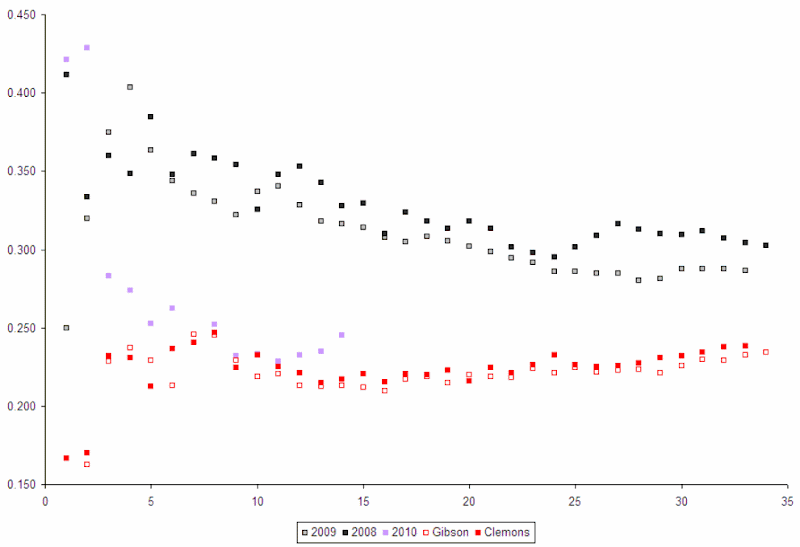
It should be noted that this article is in no way a complaint about the new generation of stats.  I love them.  I love that the history of baseball is the statistical record.  What I don’t like is when stats are used to manipulate the reader into dismissing great performances.  What Jimenez has done to start 2010 has been simply amazing.  For comparison’s stake let’s look at how Jimenez’s stack up compared to 1968 Gibson’s season and 1986 Clemens’ season.

IP H H / 9 R BB SO K / BB HR BF AB 2B 3B GDP BABIP
2010 Jimenez 101 65 5.8 13 36 88 2.4 3 385 344 18 2 14 0.245
1968 Gibson 124 77 5.6 23 28 92 3.3 5 473 434 9 0 7 0.213
1986 Clemens 115 75 5.9 30 29 114 3.9 11 450 420 15 0 3 0.217

Jimenez stats are pretty comparable to some great pitching performances.  In addition to above, batters are hitting 0.189 against Jimenez (Gibson at 0.177 and Clemens at 0.175).  Of the 385 batters Jimenez has faced only 56 have gotten to a full count.  He has faced 75 batters with runners in scoring position and they are batting 0.147.

The telling stat for the home team is that he has won 13 of the 36 Rockies victories and ten of wins have come after Rockies losses.  Regardless of any stat a pitcher’s job is to put his team in the position to win.  How the pitcher gets there is some crafty pitching, some luck, and timely hitting by your side.  Baseball is a long season and time will tell whether these numbers will hold up.  I think Jimenez will probably hit a rough patch in July and August.  The team behind him is in disarray.  Scoring runs has been the Rockies Achilles heel not to mention an on and off again bullpen.  His innings pitched has raised a few eyebrows for a player with less than 100 major league starts (compared to Gibson’s 300 starts in 1968 but only 50 starts for Clemens in 1986).  And finally tracking the running average through his 14 starts of batting average on balls in play (BABIP) suggest that, through ten games Jimenez was walking with Gods, he has since then started to regress to his mean.

BABIP

Heralding a particular player at this point in the season as the greatest is a bit premature.  Although as a Rockies fan I am rooting for the franchise’s first 20-game winner!  Additionally if at this point in the season I needed one win, then Jimenez would be on the rubber.  His season so far stacks up pretty well with two of greats – Gibson and Clemens.


No Soup For Ubaldo

There probably isn’t a single baseball fan in the country who hasn’t heard Ubaldo Jimenez been called “lucky.”

For several weeks now, analysts have devoted countless hours and vast amounts of energy to debunking the theory that Jimenez is—as his 13-1 record and 1.15 ERA suggest—one of the best pitchers in the history of the game. And with good reason.

There’s no question Jimenez is a talented pitcher entering the prime of what will certainly be an impressive career. But he’s not an all-time great, and he’s certainly not the greatest of all time.

Jimenez’ 7.8 K/9 rate is impressive (though not legendary—he’s looking up at not only Tim Lincecum and Josh Johnson, but guys like Javier Vazquez and Felipe Paulino), but it’s not enough for us to turn a blind eye to his wildness (3.2 BB/9). A 2.44 K/BB ratio is nothing to sneeze at, but it’s nothing compared to Dan Haren (5.05), Roy Halladay (5.63), or the superhuman Cliff Lee (16.75).

As a result, Ubaldo’s FIP is a more mortal-looking 2.93. That’s nothing to sneeze at, and it’s the seventh-best mark in the game. But it’s more than two-and-a-half times his ridiculous 1.15 ERA.

And that’s before you consider Jimenez’ ludicrously low 3.8% HR/FB rate. That’s why his 3.61 xFIP is significantly higher even than his FIP—and that’s normalized for a pitcher in a neutral park, not one who plays half his games at the launching pad that is Coors Field. Substitute his xFIP for his ERA and ignore the wins (naturally, he wouldn’t have as many if he gave up more runs) and you’ve got a questionable All-Star, not a unanimous Cy Young.

So where is all this luck coming from?

The fishiest thing about Jimenez’s season so far is his 91.2% LOB rate. In other words, fewer than one out every 11 baserunners he’s allowed have ended up crossing the plate. The discrepancy between his strand rate and the norm (72 percent) is greater than the overall range of qualified pitchers’ LOB rates in 2008.

It makes sense that a better pitcher would strand more runners; the better the pitcher, the better the chance of making an out, so there is less opportunity for the other team to score. But Jimenez’ 91.2% figure places his performance well outside the reach of logic and fully inside the realm of luck.

Consider the case of John Candelaria, whose 88.8% strand rate in 1977 stands as the closest anyone has come to pulling a Ubaldo over a full season since at least 1974. The year before that, his strand rate was 72.5%; the year after, it fell to 76.8%. Simply put, you can’t sustain a number like that unless you’re playing Xbox.

Then, of course, there is the issue of Jimenez’. BABIP. I’m a firm believer that pitchers have some degree of control over where and how hard the ball is hit. I wouldn’t think it noteworthy if Ubaldo’s hit rate had merely slipped to .290, or .280, maybe even .270. But if you think the ability to induce weak contact is the reason his hit rate stands at an historically low .239 mark, I’m going to have to stop you right there.

It takes a lot more than talent for a pitcher to sustain a hit rate that low for more than a few weeks. Since 1989, only one pitcher has posted a hit rate at or below Jimenez’ current .239 mark over a full season without it ballooning 50 points or more the following year.

Now, some say that Jimenez’ hit rate is explained by the kind of contact he’s induced—his 13.8% line-drive rate is the third-lowest in the league, and his 54.9% groundball rate ranks fifth. But there’s no refuge in that argument, either.

Looking at tRA, which (unlike FIP) takes his batted-ball profile into account, Jimenez is expected to give up 3.09 runs per nine innings. That’s not a bad number by any stretch, but it’s not good enough to put Ubaldo in the history books. So even if you assume that his low line drive and HR/FB rates are the product of sustainable skill and not felicitous chance, Jimenez could be expected to give up nearly three times as many runs if he had neutral luck.

There’s no question Ubaldo Jimenez is a good pitcher, or that his is an arm to watch for years to come. But once the winds of fortune stop blowing in from the Coors bleachers, no one will mistake him for the best pitcher in the game.

Lewie Pollis lives outside of Cleveland, Ohio, and will be starting at Brown University in Fall 2010. Like at least half the people who will read this article, his dream is to be GM of a baseball team. For more of Lewie’s writing, click here.


Burnett’s New Strategy a Cause for Concern?

Note: I originally posted this on my blog before his most recent start, but I was hoping I could perhaps get some feedback.

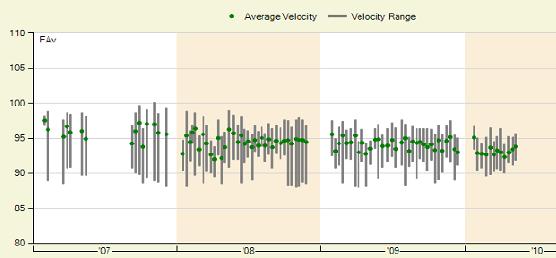
Lost amid much of the early-season trials and tribulations of this year’s Yankees squad has been the performance of the Yanks’ lead pie-thrower, A.J. Burnett. While Burnett can boast of an improvement in his walk rate (3.11 BB/9 in 2010; 4.22 in 2009; 3.75 career), his strike-out rate has seen a steeper drop (2010 K/9: 6.43; 2009: 8.48; 8.27 career). David Golebiewski of FanGraphs recently wrote an article in which he pointed out that hitters are making much more contact this year than in past years off of Burnett. Golebiewski posited that this was due to the ineffectiveness of Burnett’s knuckle-curve, but I believe that Burnett’s diminished fastball velocity and overall approach to pitching has also played a role in making him more hittable. Here are Burnett’s velocity charts:

In 2007, the first year in which velocity data was available from Pitch F/x, Burnett was averaging 95.9 MPH (the gap you see in the velocity chart can be explained by a two month-long stay on the disabled list for a shoulder strain). In 2008, Burnett’s velocity saw a rather large drop to 94.4. The velocity held steady in ’09, when he averaged 94.2 on the fastball. This year, however, Burnett’s velocity has dropped down to 93.2.

There are two possible explanations for Burnett’s decrease in velocity. It is very possible that Burnett is toning down his velocity in order to have better command, and the decreased walk rate appears to indicate that. The decrease in overall fastball velocity could also do with the fact that Burnett has added a two-seam fastball to his repertoire, throwing it 25.1% of the time, in comparison to his four-seamer, which he throws 46.8% of the time. As a side note, the four-seamer and the two-seamer have similar velocities (4-seam: 93.3; 2-seam: 93.1).

Apparently, Burnett has adjusted his pitching philosophy. He has spoken of his wishes to “become more of a pitcher” (Mark Feinsand) and to “pitch to contact” (Chad Jennings). Developing the sinker seems to go along with that thought process. Catcher Chad Moeller, as quoted in the Jennings piece, indicated that the two-seamer away to left-handed hitters was intended to induce more groundballs. Indeed, it has. In 2010, Burnett has posted his highest ground-ball rate against lefties (51.1%) since 2007, when it eclipsed 53%. Overall, Burnett is inducing ground balls at a rate of 48.4%, which is good, but not great.

Usually, it’s good to have a third pitch, especially if you are a starting pitcher. I laud the fact that Burnett has started using a two-seam fastball and is trying to be smarter about pitching, but the overall approach that he has adopted this year has robbed him of his gargantuan K rate. The meager improvements in walk rate and ground-ball rate are not enough to justify losing nearly 2 K/9 innings. Keeping balls on the ground is great and all, but the strength of Burnett’s game has always been inducing swings and misses. Getting away from his bread and butter does not appear to be working.