A Better Understanding of Pitch Overlays

I make pitching gifs on a regular basis. In fact, there are dozens of other accounts on Twitter that do it as well. We participate in trying to help other fans understand what happens during plate appearances that go beyond what meets the eye. They can be great for seeing pitch shapes and how they contrast each other, but it’s important to know that there are some factors that can make them a bit deceptive (I myself have been guilty of making more out of an overlay that there actually is).

Overlays can be good for viewing how pitches move in relation to each other or noticing how different spin and axis affect the shape of a pitch. The Athletic’s Joe Schwarz is great at writing about and breaking that stuff down with the help of another gif-creating giant, ‘cardinalsgifs‘.

These two use gifs to demonstrate how a pitcher has made adjustments, for better or worse, and compare how it impacted the shape of their respective pitch. Having a good camera angle for that practice matters as we are less concerned about how the hitter sees the pitch and more about how certain tweaks can alter its personality.

Most MLB cameras do not lend themselves to a good visual representation of an event. You’re not getting the actual pitch shape nor are you getting the real trajectories from the hitter’s perspective. Even direct-level views (via the Braves, Marlins, or Orioles, to name a few) aren’t always beneficial, especially if you’re trying to make a point of how “filthy” or “nasty” pitches are to hitters. Read the rest of this entry »


playerElo: Factoring Strength of Schedule into Player Analysis

*Note: All numbers updated to August 12th, 2019*

Introduction

Consider the following comparison between Freddie Freeman (29) and Carlos Santana (33). Both players were starters for the 2019 All-Star teams of their respective leagues, and both are enjoying breakout seasons beyond their usual high production level, with nearly identical statistics across the board.

  PA wOBA xwOBA wRC+
Freeman, 1B 533 0.400 0.398 146
Santana, 1B 503 0.390 0.366 142

However, I argue that there is an underlying statistic that makes Santana’s success less impressive and Freeman’s worth MVP consideration. Recall the quality of competition of pitchers faced. The Atlanta Braves’ division, the NL East, contains the respectable pitching competition of the Mets (13th in league-wide in ERA), Nationals (15th), Marlins (16th), and Phillies (19th). Contrast this with the competition of the Cleveland Indians in the AL Central: The Twins (ninth), White Sox (22nd), Royals (24th), and Tigers (28th). Over 503 plate appearances, Santana has faced a top-15 pitcher (ranked by FIP) just 15 times, compared to 46 times by Freeman over 533 plate appearances. wRC+ controls for park effects and the current run environment, while xwOBA takes into account quality of contact, but all modern sabermetrics fail to address the problem of Freeman and Santana’s near-equal statistics despite widely different qualities of competition. Thus, I present the modeling system of playerElo. Read the rest of this entry »


Edwin Diaz’s Running Fastball

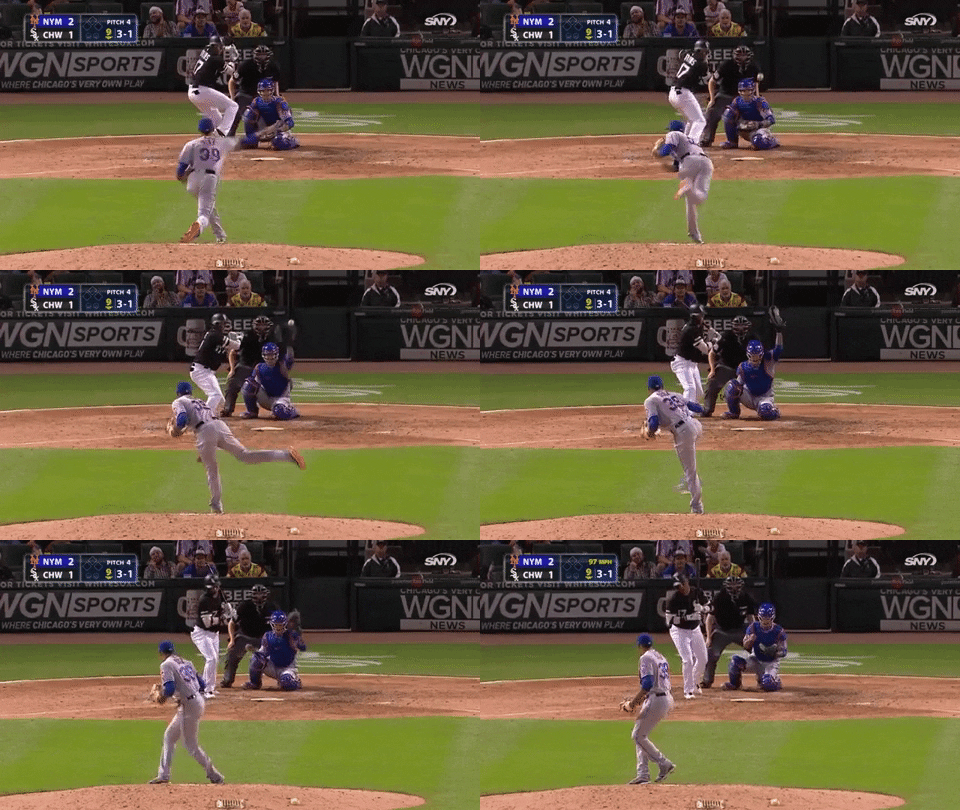
Edwin Diaz is having an absolutely miserable season. A year after posting a 1.96 ERA (208 ERA+), he currently holds an ERA of 5.32 (78 ERA+). He has already given up 10 homers in 44.0 innings, whereas last year he gave up just 5 in 73.1 frames. Some of his stats, such as his strikeout rate of 14.5% and walk rate of 3.3%, while less impressive than last year, are sitting at about his career averages. Mets mananger Mickey Callaway has often cited his mechanics as the main problem, and that when he throws more “sidearm,” it is a recipe for disaster. To get a visual of this difference, notice the release point on the following two pitches:


Notice how Diaz’s arm is much flatter in the first picture. The release point is a bit farther from his body and significantly lower. Pitches released in that way have too often resulted in a running fastball:


From this angle, however, it is difficult to see the exact difference in release point because one may be farther forward than the other. Consider the following table that tells a more detailed story: Read the rest of this entry »


What’s Next for Chris Archer?

The trade and struggles of Chris Archer have been well-documented by the baseball community. As many patrons of this very website know, Archer was sent from the Rays to the Pirates at the 2018 trade deadline for Austin Meadows, Tyler Glasnow, and a player to be named later, who was revealed as Shane Baz. Both Meadows and Glasnow have been very productive at the major league level for the Rays, while Baz is FanGraph’s 63rd-rated prospect on THE BOARD, carrying a future value of 50.

Archer, on the other hand, has been an unmitigated disaster. The once-tantalizing strikeout artist has delivered a 5.01 ERA paired with a 5.05 FIP. He has still struck out batters at a 26.0% rate, but his walk rate with the Bucs has surged to 10.1%. The main culprit for Archer’s spell of bad performance has been home runs; Archer has always tended to give up more fly balls than the average hurler, but since his move to Pittsburgh, 19.6% of his fly balls have gone over the fence, about 6% more than league average over that time span. Naturally, this leaves all of us baseball fans wondering, what happened to the pitcher who just four years ago was deemed by Dave Cameron as one of the 10 most valuable assets in MLB?

The Pirates were once thought of as one of the savviest organizations in baseball, a team that could spin washed-up pitchers into innings-eating workhorses. Detailed in Travis Sawchik’s book Big Data Baseball, the Pirates were one of the first teams to weaponize the infield shift. Pirates pitchers under the tutelage of pitching coach Ray Searage have been taught to rely on sinkers and two-seamers and to induce ground balls that can be gobbled up by the shift. As hitters have adjusted to the shift and focused on putting balls in the air, the Pirates’ approach of tailing fastballs low in the strike zone has become outdated. What was once the fountain of youth for veteran pitchers has become the focus of ridicule from the more analytically inclined. Read the rest of this entry »


Inside Aaron Bummer’s Transformation, or How to Make a Lights-Out Reliever From Scratch

A look at the relief pitcher ERA leaderboard yields names many baseball fans are now familiar with. Felipe Vazquez, Adam Ottavino, and Ken Giles have been in the spotlight before. The breakout seasons for All-Star trio Kirby Yates, Shane Greene, and Liam Hendriks have been well documented. Will Harris has been quietly dominant for multiple years. Even Scott Oberg had 200 innings of respectable relief pitching under his belt entering this year.

And then there is Aaron Bummer. Like most of his teammates on the White Sox who don’t routinely flip their bats into near-earth orbit, Bummer is fairly anonymous to the baseball world at large. Yet he has been without question the best arm in a surprisingly respectable White Sox bullpen, notching 49 innings across 41 appearances in 2019, posting a 1.65 ERA that is good for third amongst qualified relief pitchers.

Bummer is an outlier on this leaderboard in more than name recognition. The names ahead of him are racking up the strikeouts, with Yates posting a 14.58 K/9 to go with his 1.08 ERA while Hendriks holds 12.42 and 1.30 marks, respectively. Bummer averages a measly 7.88 K/9 by comparison. Few other relievers with such stellar ERAs have struck out batters at the low rate that Bummer has.

Bummer has largely accomplished this through an astronomical 68% ground-ball rate, surpassed by only worm-burner sensei Zack Britton. So how did this 19th-round relief-only prospect who topped out at 23rd on any White Sox prospect list turn into a ground-ball machine with one of baseball’s most effective fastballs? Let’s take a look. Read the rest of this entry »


Baseball Has a Glaring Flaw in Its Rules

I have found a gaping hole in the rules and laws of baseball. When you know the flaw, you won’t be able to ignore it, and you will wonder why teams haven’t tried to exploit this, just once. It all has to do with equipment regulations, or more specifically, baserunning equipment regulations. It’s brilliant (if I say so myself) and something I had to keep a secret, otherwise there would be madness on the basepaths.

In boxing, the competitors wear shorts with rather large waistbands. This is because any shot below the waistline is classified as “below the belt” and therefore an illegal hit. I don’t pretend to know boxing or the rules (I despise fighting sports), but this is one I’m pretty sure about. It probably leads to points deductions or a fine or a yellow card or a sinbin (imagine a two-minute penalty box in boxing, with one opponent dancing around the ring on his own… anyway…). Essentially, hitting below the belt is bad, so boxers try and maximize the size of their waistband and try to pull their shorts as high as possible.

In baseball, there are regulations on the size of a bat, the size of a glove, the way players and coaches dress themselves, their conduct during play, and the distance between the pitchers mound and home plate (thankfully the field dimensions are a recommendation and not specified like NFL/NBA etc, which allows for great and different ballparks to be made), and they are all laid out for everyone to see.

There is a piece of equipment that doesn’t have a set of dimensions or regulations. This small and insignificant bit of swag is the baserunning mitt, the single oven glove, the nubbin, the sock puppet, whatever you call it. It’s the thing you see those folks who like their fingers not to be treated to a studding from the baseman’s cleats wear while running the bases. It fits over one of their hands, and they use that hand to lead when sliding head-first into the bases.

While watching a game in the postseason, I noticed a hitter reach first base and be handed one of these mitts by one of the equipment guys. As he placed the device onto his hand, I couldn’t help but notice the size of it. It looked considerably bigger than the others I had laid eyes on previously. It then made me wonder, what length of mitt could you get away with before umpires start noticing? Clearly the ideal solution would be to have a 90-foot mitt on the end of your hand and simply tap the next base while being stood at your current location. Clearly this would attract a lot of attention, as the equipment guy comes out of the dugout, holding it horizontally over his two arms, bumping into umpires and players on the way out to second base. Read the rest of this entry »


Attacking the First-Pitch Strike

I have a few bugbears when I watch a baseball game. I feel most of these are derived from the fact that I have never been taught how to play the game or faced something being thrown at me faster than 50 mph. A lot of these are behavioral or unwritten rules, but some leak into how the game is played.

The thing that I don’t understand the most is the first pitch called strike. Below are videos of Nolan ArenadoMike Trout, and George Springer all taking first pitch called strikes. Read the rest of this entry »


Juiced Ball Economics

Look, another article about the juiced ball! I know, I know. At this point, the narrative of the juiced ball has been written from many angles. (For anyone reading this who is somehow not familiar with that narrative, Jay Jaffe’s piece from June is replete with graphs, tables, and external links.)

As fans, this narrative is interesting, as it contextualizes the product we see on the field. It feels like there are more home runs — hey, there are more home runs! It’s human nature to wonder why. Baseball writers have tough jobs, and they need something to write about. Many baseball writers have tried to tackle the “why” to satisfy both reader curiosity and their editor’s article quota.

While this narrative is interesting for fans, for teams, it’s of massive importance financially. Teams have payroll budgets, and presumably, some of those teams will have room in those budgets for free agents this offseason. Teams also have players under contract who are eligible for arbitration, on whom the team must place valuations in advance of submitting a figure to arbitrators or deciding to non-tender the player. In short, teams have financial decisions to make, and they rely on all the information at their disposal to make them. Wasted dollars represent opportunity cost more than anything, in a league where advantages are razor thin and random variance plays such a key role in success or failure from year to year. Read the rest of this entry »


Dissecting Jack Flaherty’s Approach Against Lefties

In 2018, Jack Flaherty took significant strides towards looking like a potential front-of-the-rotation starter for the St. Louis Cardinals. He posted a 3.34 ERA across 151 innings, striking out nearly 30% of the batters he faced, while holding a 3.58 xFIP. Additionally, he maintained strong numbers against both righties and lefties. As a result, expectations for Flaherty in 2019 were high. Projection systems called for an ERA between 3.30 and 3.60, which placed Flaherty among the top 15-20 pitchers in baseball, depending on the algorithm. However, through 97 innings in 2019, Flaherty has fallen short of those marks. Going into the All-Star break, the young righty held a 4.64 ERA with a 4.07 xFIP. Peripherally, his strikeout rate (K%) is down 3%, his ground-ball rate (GB%) is down 5%, and his hard-hit% is up as well. Investigating further, one of the biggest differences between Flaherty’s 2018 and 2019 seasons is his performance against left-handed hitters.

Flaherty2018Splits

While worse than his performance against righties, in Flaherty’s .275 wOBA against left-handed hitters in 2018 ranked eighth out of all right-handed pitchers with more than 300 total lefties faced, and his 26.8% strikeout rate against them ranked twelfth. Those numbers place him around pitchers like Aaron Nola, Jose Berrios, and the 2018 version of Mike Foltynewicz. Those are good pitchers! However, Flaherty’s performance against lefties in 2019 has not held up — take a look at the numbers.

FlahertyLHHSplits18-19.png

It’s easy to see, but through the first half of the 2019 season, Flaherty has been drastically less productive. His surrounding numbers paint the whole picture: the average exit velocity from lefties has risen from 81.9 mph to 84.4 mph, with their GB% dropping from 42.5% to 35.8%. Lefties have been replacing those ground balls with batted balls in the air, as his FB% went from 34.4% to 41.8%. It doesn’t help either that his HR/FB rate has nearly doubled across the two seasons. The bottom line is that lefties are hitting him harder, and when they do so, their results are better. Read the rest of this entry »


Gerrit Cole’s Strikeout Rates Continue to Reach New Heights

There is arguably not another starting pitcher in the majors better at striking out opposing hitters right now than Gerrit Cole. Not only does he lead all starters in total strikeouts (216) and strikeout rate (36.4%), the Astros’ right-hander is also second in strikeout-per-nine innings (12.90 K/9). Only Chris Sale (13.09 K/9) has a higher strikeout-per-nine rate. Cole’s progression as a strikeout artist is noteworthy when compared to his last season in Pittsburgh.

Cole’s strikeout surge has been driven, partially at least, by an increased reliance on his four-seam fastball in recent seasons, which, by average spin rate, is one of the more interesting pitches in baseball. In fact, the 28-year-old also leads all starters in strikeouts generated by four-seam fastballs with 119. The resurgent Lance Lynn is second in this measure with 91 strikeouts while notable hurlers Sale and Max Scherzer are third and fifth with 87 and 81 results, respectively. Again, Cole’s progression in this area with his four-seam fastball since departing from Pittsburgh continues to impress. Read the rest of this entry »