Has the Modern Bullpen Destroyed Late-Inning Comebacks?

During the World Series, I submitted an article showing that the team leading Los Angeles Dodger games after six innings wound up winning the game 94% of the time, the highest proportion in baseball. I suggested that maybe that’s why Dodger fans leave home games early; it’s a rational decision based on the unlikelihood of a late-inning rally. (Note: I was kidding. Back off.)

But between the lack of comebacks for the Dodgers and the postseason legend of Kansas City’s HDH bullpen, I wondered: Are we seeing fewer comebacks in the late innings now? The last time the Royals made the postseason, in 1985, the average American League starter lasted 6.17 innings, completing 15.9% of starts. The average American League game had 1.65 relievers pitching an average of an inning and two thirds each. This year, American League starters averaged 5.93 innings, completing just 2.5% of starts. The average game had just under three relievers throwing an average of 1.02 innings each. The reason that starters don’t go as long isn’t my point here, and has been discussed endlessly in any case. But looking at the late innings, today’s batters are less likely to be facing a starter frequently (52% of AL starters faced the opposing lineup a fourth time in 1985, compared to 28% in 2014), reducing the offensive boost from the times-through-the-order penalty. Instead, modern batters face a succession of relievers, who often have a platoon advantage, often throwing absolute gas. The Royals, as I noted, won 94% of the games that they led going into the seventh inning (65-4), and that wasn’t even the best record in baseball, as the Padres were an absurd 60-1. Are those results typical? Has the modern bullpen quashed the late-innings rally?

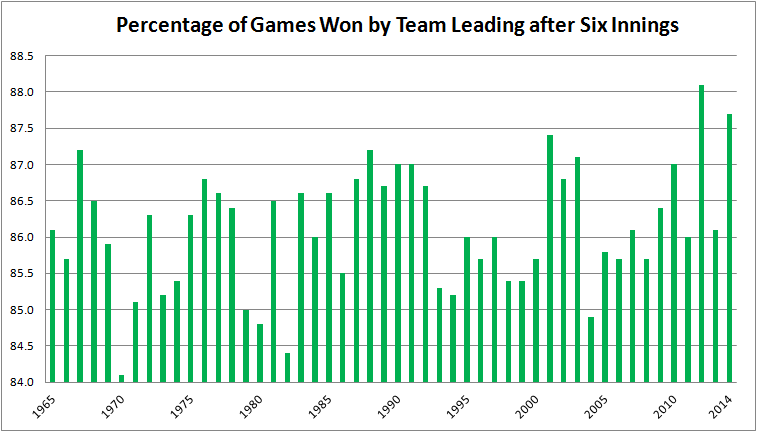
To test this, I checked the percentage of games in each year in which the team leading after six innings was the final victor. (These data are available at Baseball-Reference.com, using the Scoring and Leads Summary.) I went back 50 years, recording the data for every season from 1965 to 2014. In doing so, I got the 1968 Year of the Pitcher; the 1973 implementation of the DH; the expansions of 1969, 1977, 1993, and 1998; the Steroid Era; and the recent scoring lull. This chart summarizes the results:

The most important caveat here is this: In Darrell Huff’s 1954 classic, How to Lie with Statistics, he devotes a chapter to “The Gee-Whiz Graph,” in which he explains how an argument can be made or refuted visually by playing with the y-axis of a graph. This is a bit of a gee-whiz graph, in that the range of values, from 84.1% of leads maintained in 1970 to 88.1% in 2012, is only 4%. That’s not a lot. My choice of a y-axis varying from 84.0 to 88.5 magnifies some pretty small differences. Still, the average team was ahead or behind after six innings 140 times last season, so the peak-to-trough variance is five to six games per year (140 x 4% = 5.6). That’s five or six games in which a late-inning lead doesn’t get reversed, five or six games in which there isn’t a comeback, per team per season.

The least-squares regression line for this relationship is Percentage of Games Won by Team Leading After Six Innings = 85.756% + .015%X, where X = 1 for 1965, 2 for 1966, etc. The R-squared is 0.06. In other words, there isn’t a relationship to speak of. There is barely an upward trend, and the fit to the data is poor. And that makes sense from looking at the graph. The team leading after six innings won 86.5% of games in the Year of the Pitcher, 86.6% when the Royals were last in the Series, 85.7% in the peak scoring year of 2000, and 86.1% in 2013. That’s not a lot of variance. You might think that coming back from behind is a function of the run environment–it’s harder to do when runs are scarce–but the correlation between runs per game and and holding a lead after six innings, while negative (i.e., the more runs being scored, the harder it is to hold the lead), is weak (-0.22 correlation coefficient).

So what this graph appears to be saying, with one major reservation I’ll discuss later, is that the emergence of the modern bullpen hasn’t affected the ability of teams to come back after the sixth inning. Why is that? Isn’t the purpose of the modern bullpen to lock down the last three innings of a game? Why hasn’t that happened? Here are some possible explanations.

  • Wrong personnel. Maybe the relievers aren’t all that good. That seems easy to dismiss. In 2014, starters allowed a 3.82 ERA, 3.81 FIP, 102 FIP-. Relievers allowed a 3.58 ERA, 3.60 FIP, 96 FIP-. Relievers compiled better aggregate statistics. A pitcher whose job is to throw 15 pitches will have more success, on average, than one whose job is to throw 100.
  • Wrong deployment. Analysts often complain that the best reliever–usually (but not always) the closer–is used in one situation only, to start the ninth inning in a save situation. The best reliever, the argument goes, should be used in the highest leverage situation, regardless of when it occurs. For example, when facing the Angels, you’d rather have your best reliever facing Calhoun, Trout, and Pujols in the seventh instead of Boesch, Freese, and Iannetta in the ninth. Managers may have the right pieces to win the game, but they don’t play them properly.
  • Keeping up with the hitters. Maybe the reason teams over the past 50 years have been able to continue to come back in, on average, just under 14% of games they trail after six innings is that hitters have improved at the same time pitchers have. Batters are more selective, go deeper into counts, benefit from more extensive scouting and analysis of opposing pitchers, and get better coaching. So just as they face more and better pitchers every year, so do the pitchers face better and better-prepared hitters.

My purpose here isn’t to figure out why teams in 2013 came back after trailing after six innings just as frequently as they did in 1965, just to present that they did, despite advances in bullpen design and deployment.

Now, for that one reservation: The two years in which teams leading going into the seventh inning held their lead the most frequently were 2012 and 2014. Two points along a 50-point time series do not make a trend, so I’m not saying it’s recently become harder to come back late in a game. After all, the percentage of teams holding a lead were below the long-term average in 2011 and 2013. But I think this bears watching. Pace of game, fewer balls in play, ever-increasing strikeouts: all of these are complaints about the modern game. None of them, it seems to me, would strike at the core of what makes baseball exciting and in important ways different from other sports the way that fewer late-inning comebacks would.


A Surplus of Middle Infielders for the Rangers…Again!

2014 looked to be a positive year for the Rangers. However, injuries took their toll on the Rangers and though they could keep up for a few months, they were too much to handle. Jurickson Profar was out for the whole season due to injury, this led for an opportunity for young prospects Rougned Odor and Luis Sardinas. Odor eventually outplayed Sardinas and won the starting job, as Sardinas was sent back to the minor leagues. As 2015 approaches the Rangers now have four middle infielders who could potentially play shortstop and second base.

Elvis Andrus has been the shortstop for the Rangers since 2009, and signed a huge eight-year contract in 2013 and seems to be the guy for shortstop in 2015, however since batting.286 in 2012 has failed to hit over .275 in the past two seasons, and hit just .263 in 2014. His OBP was just .314 in 2014 and OPS was only .647.

Jurickson Profar remains a big question mark. Labeled the number-one prospect in all of baseball before the 2013 season, he played in 85 games and hit just .234 for the Rangers. Named the everyday second baseman in spring training before hurting his shoulder, the Rangers were expecting big things from Profar.

Rougned Odor was called up from Double-A in May of 2014 and exceeded all expectations the Rangers had for him. He hit .259 with 9 home runs, and was the youngest player in the major leagues at 20 years old. His defense improved as the year progressed and was certainly a nice surprise in a season of dismay.

Luis Sardinas played in just 43 games for the Rangers, but sure did showcase a strong set of skills. Hitting .261 with six extra-base hits and 8 R.B.I. Sardinas played well in the role the Rangers gave him, and he will be competing for a spot in 2015.

As Elvis has played below expectations for the past two seasons, I do not see the Rangers trading him away. The only way the Rangers could get rid of him is to trade him, and with his big contract, if a team is willing to take it on the return for him will not be worth it. Though he had an incredibly poor year last year Andrus offers a veteran presence, and consistency defensively. With Andrus, the Rangers know they’ll get above-average defense, a bunch of stolen bases, and a decent batting average, with little power. Because of this he will be the shortstop for the Rangers in 2015.

Jurickson Profar puts the Rangers in an odd spot. Essentially he has missed a year and half of development with his injuries, and there is no telling what he will be in 2015, or if he will even be healthy. In 2013 the Rangers moved him all over the field and that played a part as to why he did not perform to his potential. He could not get comfortable in a position, and it hindered him. In 2015 if healthy, he should break spring as the second baseman, and play well at second base offensively and defensively.

Rougned Odor performed incredibly well for the Rangers in 2014. He improved defensively at second base and after a tough month of August where he hit just .221 turned it around in September hitting .296, and he had a much improved OBP at .345. Odor was the youngest player in the MLB last season, and should start 2015 in Triple-A where he can work on pitch selection, working the count, and improving at second base defensively.

Luis Sardinas has the slimmest of chances to win a job on the Major League club out of spring training. His best chance is as a utility man, however the Rangers would rather have him in the minor leagues getting to play everyday. Sardinas performed well in his time with the Rangers, but as he was the 3rd youngest player in the MLB will likely find himself as the everyday Triple-A shortstop for the Round Rock Express.

To sum it up, The Rangers middle infield is going to be Andrus at short and Profar at second, with Odor and Sardinas starting the season in Triple-A. With the youth of Profar, Odor, and Sardinas they can be traded, and used for a package deal potentially for a starting pitcher pitcher like Andrew Cashner or Ian Kennedy of the Padres. It will be an interesting off-season for the Rangers, as they try to put 2014 behind them.


Bears in Love: Should the Cubs Pursue Panda?

Large black and white bear with light-tower power seeks LTR in middle of playoff-contending lineup. In addition to high AAV contract, needs steady supply of bamboo shoots.

Pablo Sandoval enters the off-season as one of the biggest (in every sense of the word) free-agents in the current class. As a star-quality player at a position largely bereft of talent, Sandoval should and will command a top-dollar contract. The Cubs, with money to spend, playoff ambitions (whether premature or otherwise), and a hole at the hot corner, are a logical fit. Kris Bryant has yet to solidify his defense at the position, and there is no one else in the Cubs’ organization ready to seize the position. Yes, they have Luis Valbuena, but, come on, he’s Luis Valbuena for God’s sake. And Panda is a team marketing department’s wet dream; if giant Panda heads have taken over San Francisco, imagine how many could be sold in the Chicago-Joliet-Naperville metropolitan statistical area. Sandoval is just what the Cubs need to turn playoff dreams into reality in 2015.

Or so Sandoval’s agent would have you believe. That is pretty much the case for the Cubs signing Sandoval, but does it hold up under scrutiny? Let’s take the arguments on at a time.

Is Sandoval a star player at a weak position?

“But where are the third basemen of yesteryear?” Francois Villon might well have asked had he been (a) alive today; (b) able to speak English; and (c) modestly knowledgeable about baseball. Consider this: in 1973 three future Hall-of Fame third basement were active (Brooks Robinson, Mike Schmidt, and George Brett), though Brett was just getting his first cup of coffee. Several others (Ron Santo, Graig Nettles, Buddy Bell, Sal Bando, and Darrell Evans) who at least arguably belong in the Hall also played that year. According to Baseball Reference, third base was the most valuable non-pitching position in the majors in 1973, as measured by Wins Above Average.

In 2014, third base tumbled all the way to … second most valuable non-pitching position, albeit well off the front-runner (center field). The talent at the top may be thinner – only Adrian Beltre appears to be assured of a place in Cooperstown – but there are several intriguing younger players coming into their own at the position, including Josh Donaldson, Anthony Rendon, Kyle Seager, and (for now, at least) Manny Machado. This may not be the Golden Age of Third Basemen, but it isn’t exactly the Stone Age either.

Regardless of what one thinks of the current class of third basemen, Sandoval is not at its head. He was 11th on the WAR list for third basemen last season, just .3 ahead of, yes, Luis Valbuena. True, this year was a bit of a down year for the Panda, but on the WAR list for third basemen over the last three years he actually fares worse, falling to 17th. His offense has declined every year since 2011, and while he has been a slightly above average defender, his overall career numbers conceal wild year-to-year swings.

Is Kris Bryant a bad defender?

Let’s get retrostatistical!

Player              Career Fielding Pct at 3B          Career Range at 3B

Mr. X                                  .942                                           2.73

Mr. Y                                  .936                                           2.62

One guy is a minor league hot cornerist known for his glove. The other is Kris Bryant.  Yeah, the traditional fielding stats may not tell us much, but they’re what we have in the minors, and this comparison at least suggests Bryant hasn’t been hideously overmatched at the position. He’s Mr. X, by the way, and his numbers at AAA last year (.966/2.73) actually showed slight improvement over his career marks. (The other guy is Christian Villanueva, by reputation, at least, the best Cubs’ third base glove in the minors.) If the Cubs are seriously thinking of moving Bryant off third, nothing in his playing time shows that. Bryant has played 160 of his 167 career games at third; in the other seven he DH’d.

Is Panda better then Valbuena?

Yes.

Player           Career wRC+         Career vs. R            Career vs. L

Panda                 122                           134                              95

LuValb                88                             89                              88

That said, in 2014 both players had severe platoon splits; they were both good against righties and atrocious against lefties. Against righties Sandoval had a slightly higher OBP, while Valbuena had a higher ISO. The advantage goes to Panda, 136 to 124 in wRC+, But Panda was actually worse against lefties than Valbuena (59 to 75 wRC+). Panda’s collapse against lefties was a BABIP illusion; there is reason to think he will return to his typical middling effectiveness against them next year. A more interesting question is whether Valbuena can maintain his newly found status as a useful platoon player. Scott Strandberg seemed to think so in June, and Valbuena backed that analysis up, finishing the season with just one bad month.

Should signing Panda be a Cubs’ priority?

The Cubs major league payroll is svelte right now, only Houston and Miami pay their major leaguers less. That will change, in part because Wrigley’s rebuild-in-place will provide additional revenue streams, and in part because the Cubs farm system won’t be able to plug all of the numerous holes in the 25-man roster. The Cubs have four ways to spend their increased payroll:

  1. To extend the contracts of the young players whose performance warrants it
  2. To pay free agent starting pitchers
  3. To pay free agent relievers
  4. To pay free agent hitters

However one orders these priorities, free agent hitters should probably come last. Hitting is the strength of the Cubs’ system, and while not all their young studs will mature into actual baseball players, many will, and it’s too soon to bring in expensive free agents who would not only eat up payroll space, but also block some of this nutritious farm produce from reaching the store shelves. The Cubs really don’t have this problem on the pitching side, especially with respect to starters – if they’re going to drop big bags of free agent coin, that would seem to be the best place to do it.

Sandoval’s not a bad player, but he’s probably going to get paid like the superstar he’s not. He’d be an upgrade over Valbuena, the current incumbent, but at a hefty price increase, and just when it looks like Valbuena might be getting useful. He’s probably not better than Kris Bryant, unless Bryant has serious defensive woes not visible in his admittedly unenlightening minor league defensive stats.

So Theo probably shouldn’t answer the ad – better to stay home and watch Netflix.  Maybe he can scratch that Giants itch with a little Orange is the New Black.


Josh Donaldson: Changes in Approach and Mechanics

A short note: For those inclined only to GIFery, you can skip to the bottom.

The 2014 Oakland Athletics got taken out in the soul-crushing Russian roulette that was the Wild Card play-in game. The Billy Beane gambles didn’t pay off. On top of that, even though it rained on their parade, the San Francisco Giants won the World Series.

All is not lost for the A’s, however.

There are other great articles that go over the outlook for next year’s Athletics team in terms of payroll and contracts. Today, we’re going to squarely focus on the on-field performance of only one of those pieces – someone who has evolved into one of the best overall position players in the game.

Let’s dive into Josh Donaldson’s trends in the offensive arena, and attempt to find meaning in those trends for his performance in 2015 and beyond.

Josh Donaldson figured it out in the summer of 2012: after struggling through most of the early part of that year, he was sent down to AAA in mid-June, getting the call back up to the majors on August 14th. He batted .290/.356/.489 the rest of the way with 19 extra base hits, led the A’s to an unlikely division championship, and gave us a snapshot of the player we now expect him to be.

At his best, Donaldson is a middle of the order power bat that can hit to all fields and draws walks at an above average clip. Whether coincidentally or not, his overall plate approach fits that of the A’s organization: work into deep counts, get a good pitch to drive, and swing hard. He’s shown some subtle differences in rate statistics during the two highly successful years since his breakout, and that’s what we’re mainly going to look at before moving on to a discussion about his specific hitting mechanics.

One of the main differences between Donaldson’s 2013 and 2014 was his batted ball profile in regard to line drives and fly balls. At surface level, the continued evolution of Donaldson’s batted ball profile since his breakout in August of 2012 mirrors the Athletics’ high OBP/home run tendencies. As we’ll see later on with the mechanics portion of the article, there’s more here than meets the eye. However, to begin with, let’s look at his line drive and flyball tendencies.

Here we have Line Drives per Ball In Play for Donaldson in 2013 and 2014:

LDs_per_BIP

And here we have a breakdown of his Fly Balls per Ball In Play:

Flyballs_per_BIP

It’s not too difficult to tell what’s happened during the majority of Donaldson’s effectiveness at the major league level: he’s hit more fly balls and less line drives against fastballs over time. The obvious answer to why this has happened is that Donaldson could simply have changed his approach to try to elevate hard pitches for homeruns in 2014. His overall line drive rate fell along with his batting average and Batting Average on Balls In Play in 2014 as well, as fly balls don’t always (or even usually) go for homeruns, and also result in outs more often than line drives. Donaldson’s groundball rate stayed almost exactly the same between the two years.

His counting stats reflect this change in batted ball profile, as he shifted a few 2013 doubles to home runs in 2014. Let’s compare his stats from the past two years. Donaldson played in the same number of games in each of the past two years, with a few more plate appearances in 2014:

2013_2014_Compare

There isn’t a major difference in his strikeout and walk rates – strikeout rates are up for almost everyone, so proclaiming Donaldson’s slight increase a true trend has its problems. As we’ve seen, the strikezone expanded this year by a large degree, something that wasn’t lost on the All Star third baseman.

Another element in this comparison that we should keep in mind is the damage on his statistics wrought by his slump of over a month in June of 2014. It was one of the worst months of Donaldson’s career, as he hit .181 with a 4.5% walk rate, 6.0% line drive rate, and hit grounders 65.1% of the time (as a reminder, league average is around 44%). He would overcompensate his swing in July, causing a 52% flyball rate (league avg. = 36%), but his walks and power production came back to almost normal levels. As it is, we’re left to wonder what his 2014 could have looked like if not for the extended slump.

Given the changes in batted ball profile and rate statistics between 2013 and 2014, we need to go deeper into causation. Did Donaldson simply change his approach to hit more fly balls? Was this an unintended result of a change in his mechanics?

Let’s find out.

To help me with the technical specifics of Donaldson’s swing, I’ve brought in Jerry Brewer, a great hitting instructor and general swing mechanics wizard from the Bay Area. He runs East Bay Hitting Instruction, and posts great in-depth breakdowns of swing mechanics over at Athletics Nation. We talked about a few different topics on Donaldson’s swing over the past week.

Owen Watson: Hey Jerry! Thanks for lending your expertise to this – I’m a relative newcomer to the world of swing mechanics and it’s always great to talk to someone who really knows the subject. Can you briefly explain the basic mechanics of hitting, so we can get a baseline understanding of the subject?

Jerry Brewer: The goal of the swing is to put the bat behind the ball with speed on the bat. Pretty simple. Elements of a “good” swing include proper body position, movement sequencing, timing, consistency, and execution. These are the main things I look for when grading someone’s swing:

1) Swing time: how long it takes a player to start their swing to contact with the ball.

2) Swing path: the path the bat travels to meet the ball.

3) Finally, I look for body position as the hitter is completing the stride, which is where you can get a sense of whether the player can make adjustments to pitch location and speed. Donaldson is fantastic here.

OW: Great, so what are the main characteristics of Donaldson’s swing – how is he different from other hitters, and what does he do well/not so well?

JB: Donaldson’s swing in a word: athletic. The baseball swing is just a sequence of movements, and he moves his body optimally. What he does well: his front side mechanics. His rear mechanics are really good too, but his front side is incredible. In my opinion, it is what allows him to be such an all-fields hitter. The one knock could be his path to the ball is an inch or two long. But, to quote myself, “that’s like pointing out a scratched license plate on a Ferrari.”

OW: Donaldson is in many ways a classic poster boy for the A’s patience/power combo. Is his power increase from 2013 to 2014 a result of the coaching of the A’s offensive approach under (former) hitting coach Chili Davis?

JB: It’s hard to say how much influence Davis had on Donaldson’s approach. My guess is very little. Donaldson was a high walk/high power guy in the minors and it just took some time to gel in the show. I am of the mindset that a person’s approach is pretty ingrained and hard to coach. As for the power, Donaldson came into spring training in 2014 with a pretty pronounced bat tip (how far forward the bat head is brought during swing loading) toward the opposing dugout. Think of it like a bigger backswing. That told me right then that he was going for more power.

OW: How do we explain the increase in flyball rate, then? When I look at the jump in his flyball tendency in 2014 as opposed to 2013, one explanation is that it was an intentional attempt to try to elevate the ball for more power.

JB: The flyball tendency is a little difficult to explain on swing mechanics alone. For example, he got the bat tip completely out of control in June and still hit only 30% flyballs. My best guess is that the excessive bat tip caused him to be just a hair late on fastballs, sending more balls in the air. We saw this in his opposite field hitting: in 2013 his flyball rate to the opposite field was 52%, but in 2014 it went up to 62%.

I didn’t see a change in loft in his swing in 2014, it’s just a little more difficult to put the bat on the ball consistently with the aggressive bat tip. When he did hit the ball well, it travelled, as his HR/FB was way higher in the first half when he was tipping, but he had more mishits than in 2013.

Basically, Donaldson went Javier Baez for awhile.

OW: When I watch him, he seems like he has an entrenched timing mechanism with the leg kick. How does that function in his mechanics? I’ve always wondered whether it could be a cause for slumps if it gets mistimed.

JB: The leg kick is really secondary. The more important thing is Donaldson now has a lot more of a slower, longer movement with the bat before launching the swing. Most guys who do this (Ortiz, Bautista, Hanley Ramirez) go to a leg kick so the lower body is doing something while the upper body is doing something. I call this matching. On the other end of the spectrum are guys who don’t do much with the bat pre-launch, so their lower bodies are more quiet (Tulo, Utley, Brandon Moss). The positives of the bigger movements are that it can allow the player to get to the position they need. Stride type is really personal based on approach, habits, and anatomy.

Looking at Donaldson’s pre-leg lift swings, the high leg kick gives him time to open his front leg more, which is something he talked to me about. The negatives of the leg kick are that it simply may not be the right fit for a player based on the above factors. It takes some serious athleticism to be consistent with a swing like that.

OW: Let’s talk about that consistency. I’ve been wondering about the big slump he had in June when he hit .181 with just four extra base hits over the entire month, carrying the slump well into July. What happened to cause that?

JB: Mechanics wise, I think the excessive bat tip caught up with him, either from the grind of the season or taking a couple pitches off the hands/forearms in June and July. In late July he quieted down the bat tip and started rolling. If he goes back to the excessive bat tip, then yeah, he could fall into a slump. I think and hope that he’s got that figured out.

OW: What do you see as his ceiling, then? If he figures out the bat tipping and can cut down on extended slumps, where will that put him?

JB: It’s very high. The batting average is the big question. We were a little spoiled in 2013 when he hit .301. That was propped up by a ridiculous .448 average on balls hit the other way…

OW: Right, and a Batting Average on Balls In Play of .333.

JB: That is and was completely unsustainable. But I think he fits in somewhere between .300 and last year’s .255 in regard to the average. Last year he kind of got robbed on some hard hit balls, when he hit 131 of them and his average on those balls in play was 54 points under the league norm. Some of that is the Coliseum being a pitcher’s park, obviously. Also, he got rung up 10 more times on looking strike threes in 2014 than in 2013, so that could be an area of improvement. I would probably say his ceiling is around .277 with 27 HRs.

OW: Not bad for a third baseman with that kind of defensive prowess, too. Thanks a lot for your time, Jerry! This has been really informative. Here’s to spring training…

————————————————

After the discussion with Jerry, it became apparent that Donaldson’s change in mechanics toward a more aggressive bat tip could be a big reason behind the differences in batted ball profile between 2013 and 2014. I decided to look at some instances of tape over the past two years to see when he was going with a more controlled approach as opposed to a more aggressive one. While 2013 showed a very consistent approach throughout the entire year, 2014 didn’t have as much of a set pattern as I once thought. Let’s investigate.

Here we have Donaldson’s mechanics during almost all of 2013 – at the point of swing loading (just before the stride starts toward the pitcher when the balance of weight is on the back foot), Donaldson’s bat is almost perpendicular to the ground, and his stride forward is consistent and low. Here he is hitting an inside-out double to right center in mid-September of 2013:

091313_Controlled

Bat tipping is minimal here, allowing Donaldson to stay short enough from swing loading to contact to hit a 94 MPH fastball on the inside part of the plate into the right centerfield gap. Now let’s look at a swing from almost exactly a year later, in mid-August of 2014:

081214_Aggressive

Watching it a few times, it’s clear this is a highly aggressive swing. The leg kick is slightly higher than it was in 2013, and the bat movement is noticeably different. Instead of being almost perpendicular to the ground, the bat points strongly toward the opposing dugout at swing loading, whipping around to generate as much power as possible. One reason this swing could be so aggressive is that Bruce Chen was on the mound, and Donaldson could gear up on a slow fastball in a 1-0 count. Instead, he got an 83 MPH slider that didn’t slide, and stayed back on it enough to hit it 425 feet over the centerfield fence.

Looking at tape of early July 2014 following the terrible slump, it’s apparent that Donaldson all but ditched the aggressive bat tip, probably in order to make more consistent contact. Yet, with the example above during August, it was back in a major way.

This begs the question: is the aggressive bat tipping something that Donaldson turns on situationally, such as a 3-1 count? Or is this just noise, and part of the tweaking and maturation process that a relatively new major leaguer goes through?

The answer to that question may be for another time, but a cursory examination may support the situational hypothesis. Looking back through a few examples, the bat tip does change from situation to situation in a short span of time. Just three days before the hyper-aggressive swing against Bruce Chen, Donaldson showed almost no bat tipping on an RBI single with two out and the bases loaded versus the Twins. In mid-July, three weeks earlier than that, he showed very aggressive tipping on a three run walkoff home run against the Orioles. This could certainly be random, or noise, or something he doesn’t know he’s doing.

Or maybe, as Jerry says, Donaldson just wants to go a little Javier Baez sometimes.

————————————————

Special thanks to Jerry Brewer, who can be found at East Bay Hitting Instruction and on Twitter @JerryBrewerEBHI. All graphs are Brooks Baseball.


Job Posting: IT/Network Support Specialist

IT/Network Support Specialist

TrackMan Baseball is looking for a resourceful, innovative, self-starter to take ownership of IT and Technical support for our network of stadium and remote data collection systems.

About TrackMan

TrackMan develops, manufactures and sells 3D ball flight measurement equipment used in a variety of sports. Today, TrackMan is the world leader in golf ball flight and club data measurements and the company is considered to have set the industry standards for accuracy in golf and baseball.

TrackMan Baseball measures stuff – the location, trajectory and spin rate of pitched and batted balls – and provides real-time feedback for coaching and a new set of statistics for analyzing player performance. TrackMan Baseball is used by the majority of Major League baseball teams and premier NCAA, international and amateur baseball programs. Additionally, TrackMan is used for R&D, marketing, and media purposes by equipment manufacturers to develop more effective products and broadcasters to enhance content and analytical capabilities.

Position Description / Responsibilities

Candidate will be responsible for overseeing and maintaining internal IT, Cloud services and supporting a network of distributed system located in Major League, Minor League and NCAA baseball stadiums, and amateur baseball tournaments. Responsible for effective installation/configuration, operation, and maintenance of systems hardware and software, proactive monitoring of critical and network systems and troubleshooting. Candidate will support the company in the overall design and implementation of IT systems.

Responsibilities include, but are not limited to the following:

  • Optimize, develop and implement monitoring efforts and system building.
  • Design, develop and document solutions for troubleshooting
  • Interact with internal and external IT and non-IT personnel when setting systems and diagnosing problems.
  • Manage a team, set schedules and develop escalation policies for a network operations center

Required skills:

  • Comfortable working on Windows & UNIX operation systems
  • Proficient with backup and disaster recovery plans
  • Experience system building and automation
  • Strong organizational, analytical and problem solving skills
  • Strong ability to multi-task /change focus quickly, ability to deal with unexpected events
  • Strong technical documentation skills

Desired Skills:

  • Experience in programming both scripted and compiled languages.
  • Proficient with Microsoft SQL Server, working knowledge of relational database.
  • Knowledge of No-SQL databases
  • Experience with Cloud Services like Azure and Amazon

Education and Work Experience

  • Degree in Computer Science or related field experience.
  • 2+ years of experience managing IT

Location, Compensation & Application

  • Application: Send resume and cover letter to: np@trackman.dk
  • Location: This position is full time and based in Stamford, CT. Salary
  • Compensation: Commensurate with experience.

About TrackMan Inc.

TrackMan Inc. is a US based subsidiary of TrackMan A/S.

TrackMan A/S has developed a range of products for the golf market and is considered the gold standard in measurement of ball flight and swing path. TrackMan’s golf products are used by top touring professionals, teaching pros, broadcasters and governing bodies.

TrackMan Inc. is based in Stamford, CT, about 30 miles north of New York City.  TrackMan, Inc. introduced 3D Doppler radar technology to the baseball industry and the technology is now used by more than half of Major League Baseball teams.  TrackMan, Inc. is revolutionizing baseball data by measuring the full trajectory of both the pitch and hit and has been featured in publications such as the New York TimesSports Illustrated and ESPN.


Were the Royals the Best Team In the AL?

There has been a lot said recently about the playoff system in Major League Baseball, and how the two teams in the World Series are not really the best teams in baseball. Some fans enjoy the high stakes playoff games where the entire season is on the line. Other fans prefer “fairer” scenarios where each team needs to play 1,000 regular season games to get the best representation of who has the best team.

A much stranger scenario is outlined in The Science of the Playoffs by Sky Andrecheck. Complicated scenarios are created to match a team’s playoff odds with how that team performed in the regular season to create a more just playoff system. For instance, if a team has a regular season record that indicates it has a 60% chance of being better than the team they are matched up against, they should be awarded a playoff scenario where they have a 60% chance of advancing. Although the sample sizes are small and do not give an ultimate answer to which team is better, this approach offers a “fairer” post-season solution based on a team’s regular season record. I decided to take this idea and run with it by figuring out if the Kansas City Royals’ postseason run exceeded the initial probability that their regular season record demonstrated of being the best team in the AL.

To determine the probability that one team is better than the one they are facing in the playoffs, I compared each team’s win total using a binomial distribution with unknown true win pcts (p in Binomial Distribution), but known win totals (k in Binomial Distribution). If a team is the better team, then their win pct would be better than the team they are up against. The probability that Kansas City is better than another team can be found by summing all possible probabilities where Kansas City has a particular win pct and the team they are facing has a lower win pct. The math behind this method is shown below comparing Kansas City to the Oakland Athletics. The same formula was also used to determine the probability that the Royals were better than the Angels and Orioles.
KC OAK med
Additionally, I use the impact of home-field advantage in postseason calculations as giving the home team a 51% chance of winning an evenly matched series taken from here.

Going into the wild card playoff game, the Royals had only one more regular season win than the A’s. The regular season predicted that the Royals were the better team with a probability of 51.5%, slightly better than even money. Since the Royals were given home field advantage, they were awarded a probability of advancing close to what their regular season record demonstrated. The Royals won the game, fairly confirming that they should move on to the American League Division Series.

Next up for the Royals were the Los Angeles Angels. The Angels had a regular season record of 98 wins, much better than the Royals’ 89 win total. With this disparity in win totals, the Royals only had about a 14% chance of being the better team based on both teams’ regular season records. However, taking three out of three games from the Angels, two in Los Angeles and one in Kansas City, has about a 12% chance of happening if both teams are evenly matched. So, if the Angels were better, the probability of the Royals winning all three games would be even lower. The sweep exceeded the Royals’ initial probability of being better than the Angels, once again fairly pushing the Royals forward into the ALCS.

In the American League Championship Series, the Royals played the Orioles. The Orioles won 96 games, giving the Royals only about a 20% chance of actually being the better team. The probability of sweeping the Orioles in the ALCS if both teams were evenly matched was about 6%. Here, the Royals far exceeded their regular season odds of being considered the better team.

The odds of the Royal sweeping the entire American League in the playoffs exceeded the probability that the Royals were the best team. In other words, it was totally fair that the Royals won the AL pennant.


A Proposal for Regression Analysis of a Four-Seam Fastball

Hello, I am new to this, and this is my first post. I think I should introduce myself first. My name is Daniel Fendlason, and I am a first year graduate student at Tulane University, New Orleans, Louisiana, and I  am studying Economics, which is very fun stuff. I did my undergraduate studies at Northeastern University, Boston, Massachusetts, which is where I majored in Finance and minored in Economics.

Ok, now on to the point for doing this in the first place. I am taking Econometrics this semester, and it requires a research paper researching something that we find interesting. Since I am interested in baseball I decided to do my research paper on baseball. A proposal is due in a few days, and below is that proposal. Please read and tell me what you think. I will follow up and submit the full paper when it is due, which is in December. So, without further digressions, enjoy.

Proposed Title: “The effectiveness of the speed and movement of a four-seam fastball”

In my investigation, I would like to better understand the sport of baseball by answering the following questions: is it more difficult to hit a faster moving four-seam fastball than one that is slower moving? Also, is it more difficult to hit a four-seam fastball if it is moving in a more horizontal manner or a more vertical manner? My hypothesis is twofold: if a pitch is faster, it will be more difficult to hit, and if a pitch moves more, it will be more difficult to hit. If my hypothesis is true, then more speed and more movement will make a ball more difficult to hit. The ball from a specific pitch is difficult to hit if a skilled batter swings his bat and does not make contact with the ball, or the contact that is made is poor and results in the batter making a strike, if he swings and misses, or an out, if he puts the ball in play.

Independent Variables

A pitcher can throw many types of pitches. The pitcher can try to deceive the batter by throwing a pitch that has a lot of movement, like a curveball or slider, or a pitch that is slower than it looks when the ball leaves the pitcher’s hand, like a change-up. But the four-seam fastball is the only pitch the pitcher is not trying to intentionally deceive the hitter with movement or deception-of-speed. When a pitcher throws a four-seam fastball he is simply trying to throw it as hard, and as accurate, as he can.

Even though a pitcher is not trying to induce movement when he throws a four-seam fastball, the ball still moves—in fact, the ball can move horizontally, vertically, or both horizontally and vertically. This unintended movement has an effect on the batter to make contact, which means that there will be three independent variables: speed, vertical movement plus horizontal movement, and total movement plus speed. Since there are three independent variables, to analyze this situation three models will need to be created. This should not be difficult, as all that has to change is the variable on the left side of the equation; the dependent variables will remain the same for each model. 

Dependent Variables

The dependent variables will be all of the possible per-pitch outcomes that involve the batter attempting to hit the pitch by swinging his bat; this excludes pitches that an umpire calls a strike or a ball. These two outcomes are excluded, because the batter did not swing his bat, which means that the speed or movement of the pitch having any effect on avoiding contact, or inducing poor contact, cannot be discerned.

In addition, because the outcomes are per-pitch, the walks and strikeouts are excluded, because those outcomes are already accounted for. More specifically, if the batter walks, then he did not swing at the pitch and is therefore excluded. If the batter strikes out, then he swung and missed, which is accounted for with the swinging-strike outcome, or the umpire calls him out which is excluded, because the batter did not swing his bat.

The included outcomes are: swinging strike, foul ball, ground-out, infield fly-out, outfield fly-out, line-out, single, double, triple, and home run. I’ve included many types of outs, because each type of out can tell us what type of contact was made. For example, if the contact was poor, then the result will either be a ground-out or an infield fly-out. If the contact was solid, but the batter still made an out, then the result will be a line-out, or an outfield fly-out. If the contact did not result in an out, then it will be assumed that the contact was solid.

Error Term

The error term will include the sequencing of the previous pitches, the count, the base-out state, the location of the pitch, and the quality of the defense.

Each pitch will be context neutral; the pitches that preceded it will not be accounted for. This can affect the outcome of the pitch, because the absolute speed of the pitch may not matter as much if the previous pitches that a batter has seen in an at bat have been much slower than that of the four-seam fastball.

The count of the at bat can affect the outcome of the pitch, because batters know that, in some counts, pitchers are more likely to throw a four-seam fastball. In this case, the batter may be anticipating the four-seam fastball, which will give the batter an advantage. The base-out state can affect the outcome of the pitch, because it can dictate what pitch a pitcher is more likely to throw. The location can affect the outcome of the pitch, because some locations are more difficult for a batter to reach with his bat when he swings. The quality of the defense can affect the outcome of the pitch as well, because it can turn hits into outs, if the defense is good, or it can turn outs into hits, if the defense is poor.

Data

The data will be collected from www.baseballsavant.com. This website contains data on every pitch thrown from the seasons of 2008 to 2014. The website allows the user to apply filters, which means that the data can be filtered by pitch type, and pitch outcome.

The data will include every four-seam fastball that was thrown in seasons 2008 to 2014. Statistics for the fastballs will include speed, horizontal movement, vertical movement, and all outcomes except walks, strikeouts, called strikes, and balls. Since the outcomes are not numerical values, a numerical code will need to be assigned to each outcome. Table 1 illustrates the numerical code that will be used in this study.

Each year’s worth of data contains approximately 50,000 lines of data. Hence, the initial assumption is that the data is normally distributed and linear. Since there are seven years of data, each model can be run seven different times. This will render a much more unbiased coefficient for each dependent variable.


Peak Age Range for the Shortstop Position

Before we begin, we need to understand a few things.  First of all, in just the past ten years there have been more than 400 shortstops that have enjoyed the opportunity to play at the MLB level.  We will not be analyzing every single shortstop that has played the game over the past 100+ years.  This leads us to our next point, we will use a sampling of SS to reach our conclusions.  Some of those SS are, or will be, Hall of Famers, others were grinders.  We will take the sum of those samplings to reach our our conclusion.  Finally, we will base our findings on the following formula:

WAR per year rating above or below career WAR average.  Only years with a WAR above their career average are considered “peak years”.

By basing our findings on WAR we take into account the league average of any one given year.  Plus, we are able to negate the differential between offensive and defensive production.  Although that does raise a proposition for statistical analysis identifying peak offensive and defensive years…but I digress.  Let’s dive into our beloved SS peak-year analysis.

Derek Jeter (NYY)- Career Avg WAR:  3.9

Peak Age Years:  22 – 31

Caveat-  Jeter had one year (age 25 season) during his prime years where he performed below his career average WAR (3.7).  Also, Jeter had one year (age 34 season) during his sub-prime years in which he performed above his career average WAR (6.8).

Ozzie Smith (STL)- Career Avg WAR:  3.6

Peak Age Years:  25 – 34

Caveat-  The Wizard had two seasons (age 26 and 28 seasons) during his prime years where he underperformed his career average WAR (0.7 and 3.4 respectively).  He also outperformed his career average WAR twice (age 36 and 37 seasons) during his sub-prime years (both with a 5.1 WAR).

Alex Gonzalez (TOR)- Career Avg WAR:  0.7

Peak Age Years:  22 – 29

Caveat-  Alex Gonzalez had three seasons during his prime years (24, 26, 28 age seasons) that he underperformed his career average WAR (0.3, -0.3, 0.6).  During his subprime years he outperformed his career average (age 31 season) WAR once (1.5).

Edgar Renteria (STL)-  Career Avg WAR:  2.2

Peak Age Years:  25 – 30

Caveat- Renteria underperformed his career average WAR twice (1.7 and 1.7) during his peak years (age 27 and 28 seasons).  During his subprime years he outperformed his career average only once during his rookie year with a 3.5 WAR.

Rafael Furcal (ATL & LAD)- Career Avg WAR:  2.5

Peak Age Years:  24-31

Caveat-  Furcal underperformed his career average WAR twice (1.4, 2.1) during his peak years (age 28 and 29 seasons).  Furcal only outperformed his career average WAR once during his rookie year.

These are just a few examples of the types of shortstops we dissected through our research.  We used a combined 100 shortstops to find our conclusions.  What we found is a pronounced trend.  For shortstops who were able to play until at least their age 36 seasons, the more than 80% of those shortstops endured at minimum a slight drop in their WAR during their age 32 seasons and falling below their career-average WAR by their age 33 seasons.  For shortstops who played until they were at least 32 but not past 35, over 75% of them suffered a steep decline below their career-average WAR by age 30.

For such a demanding position which requires speed, athleticism, quick hands, quick feet, a good glove and at least a serviceable bat it was impressive to find that out of the 100 shortstops we evaluated, 9% were able to play until at least their age-40 seasons.  In order to compare the most like positions, our next analysis will evaluate second basemen.


Who Should Be the Cardinals’ 2015 Center Fielder?

With the Cardinals season recently finished, and the end of season press conferences over, one thing was made clear for the 2015 season in St. Louis: center field was Jon Jay’s to lose. I have a few problems with this. First of all, I hate guaranteed starting jobs. I’m not saying it will happen, but it is very easy for players to fall into more of a relaxed state when they know they don’t have to fight for their playing time. As we saw in 2013, when Jay had no competition for the job, he’s not immune to becoming too relaxed in his play. Second, I still am not convinced that Jon Jay is the best center fielder on our team.

Let me make one thing clear: this is not an anti-Jay piece. I really enjoy having Jay on the team, and I think he’s a very solid piece to the team. I would love for the Cardinals to retain Jay, I’m just not sure I want him to be our starting center fielder.

Jay has generally been pretty consistent in his play throughout his career. He has 5 seasons with over 300 plate appearances since 2010, and he wRC+ over that span have all been between 115 and 116 with the exception of 2013 – a season which seems to be pretty unlucky as his BABIP dropped 30 points despite his batted ball profile remaining mostly the same. At this point in his career, it seems like we know (mostly) what type of player Jay is – an above-average hitter, with limited power, and basically average skills everywhere else.

While there is value in being average to above average everywhere, the Cardinals have another center fielder that seems to be mostly average at the plate, but has elite skills when it comes to base-running and fielding. Peter Bourjos, for his career, has posted a wRC+ of 94 – just six percent shy of being a league average hitter. While you could argue that it’s mostly driven from 2011, you could also argue that was also the only season in which he’s received consistent playing time for a full season. On top of that, Bourjos was a league-average hitter or better at every stop in the minors on his way to the big leagues – so it’s not impossible to say that he could be a league-average hitter in the majors. Add into that Bourjos’s great speed (he’s been roughly five runs above average on a 600 PA rate throughout his career) and his elite defense, and Bourjos starts to look like a great candidate.

This year, Jay got nearly twice as many plate appearances as Bourjos, and produced roughly twice as many wins as Bourjos – which makes sense. When grading them on equal scales (WAR/600), the two center fielders produced identical 3.2 win values – which brings me to the next point for starting Bourjos.

The Cardinals have long been looking to improve their offense on their bench. For years the Cardinals have had one of the weaker benches of postseason contenders, and every year they look to improve upon that. With Jay providing a clearly better bat (his career wRC+ is nearly 20 percent better than Bourjos), it seems like a good (cheap) way to improve the bench without hurting the starters. Bourjos provides similar (if not better) value to the everyday line-up, while Jay gives the Cardinals a solid bat to come off the bench.

While it’s unlikely we see this happen, barring Jay returning to his 2013 play, it seems like a reasonable route to efficiently take care of a problem so that the front office and focus on other areas of concern (the bullpen, other bench bats, back-up catcher). Mozeliak has an opportunity to make a quick, relatively cheap fix to an area of concern for his team – I just hope he and Matheny will let that happen.


The Unassailable Wisdom of Los Angeles Dodger Fans

Another exit from the postseason deprived the nation of tales of Dodger fandom and their proclivities–Dodger Dogs, Vin Scully, and, of course, leaving the game early. Why they leave early, beats me. Maybe they have premieres to attend. Maybe they’re going to foam parties. Maybe they’re trying to beat the traffic. Me, I don’t know. Like most FanGraphs readers, I’d guess, I have never been invited to a premiere. Or, for that matter, a foam party. (And I’m still not entirely clear as to what one is.) As for beating the traffic, yeah, I get it, average attendance at Dodger Stadium was 46,696 this year, highest in the majors, so I imagine that’s a lot of cars. But Dodger games took an average of 3:14 last year, which means that night games ended well after 10 PM, so one would assume that traffic on the 5 and the 10 and the 101 and the 110 would have eased by then, though I don’t live in a part of the country in which highways are referred to with articles, so what do I know.

Aesthetically, of course, the argument against leaving a game early is that you might miss something exciting–an amazing defensive play, a dramatic rally, last call for beer. That would seem to trump the concerns of early departers.

Especially a rally. A late-innings comeback is one of the most thrilling pleasures of baseball. But that made me wonder: Are they becoming less common? If so, wouldn’t that be an excuse, if not a reason, for leaving early?

During the postseason, you may have heard that the Royals have a pretty good bullpen. (It’s come up a couple times on the broadcasts.*) With Kelvin Herrera often pitching the seventh, Wade Davis the eighth, and Greg Holland the ninth, the Royals were 65-4 in games they led after six innings. Of course, a raw number like that requires context, so here is a list of won-lost percentage by teams leading after six innings:

Team W L  Pct.
Padres 60 1 98.4%
Royals 65 4 94.2%
Nationals 72 6 92.3%
Dodgers 81 7 92.0%
Twins 52 5 91.2%
Giants 62 6 91.2%
Orioles 72 7 91.1%
Indians 67 7 90.5%
Braves 62 7 89.9%
Tigers 70 8 89.7%
Rays 61 7 89.7%
Mariners 68 8 89.5%
Angels 76 10 88.4%
Marlins 51 7 87.9%
Cardinals 69 10 87.3%
Reds 61 9 87.1%
Yankees 67 10 87.0%
Cubs 59 9 86.8%
Brewers 63 10 86.3%
Athletics 65 11 85.5%
Phillies 53 9 85.5%
Mets 64 11 85.3%
Red Sox 52 9 85.2%
Pirates 61 11 84.7%
Blue Jays 61 11 84.7%
Reds 51 10 83.6%
Rangers 45 9 83.3%
Rockies 49 11 81.7%
Diamondbacks 49 12 80.3%
Astros 54 16 77.1%

Sure enough, the Royals did very well. The major league average was 87.7%. Kansas City, at 94.2%, easily eclipsed it. But, as you can see, so did the Dodgers. We certainly didn’t hear about their lockdown bullpen in their divisional series loss to the Cardinals. Presumably, the Dodger bullpen’s 6.48 ERA and 1.68 WHIP over the four games of the series had something to do with that. But during the regular season, the Dodgers held their leads.

How about the other way–what teams were the best at comebacks? Shame on Dodger fans if they were leaving the parking lot just as the home team was launching a rally, turning a deficit into victory. Here’s the won-lost record of teams that were trailing after six innings:

Team W L  Pct.
Nationals 14 54 20.6%
Athletics 12 52 18.8%
Angels 11 48 18.6%
Pirates 11 50 18.0%
Giants 13 60 17.8%
Marlins 14 66 17.5%
Royals 11 58 15.9%
Cardinals 8 47 14.5%
Indians 10 59 14.5%
Tigers 9 54 14.3%
Orioles 8 50 13.8%
Reds 10 64 13.5%
Astros 9 64 12.3%
Mariners 8 57 12.3%
Brewers 8 59 11.9%
Blue Jays 8 60 11.8%
Yankees 7 53 11.7%
Padres 9 71 11.3%
Mets 7 59 10.6%
Twins 9 77 10.5%
Phillies 8 71 10.1%
Red Sox 8 72 10.0%
Diamondbacks 8 73 9.9%
Rays 7 66 9.6%
Cubs 7 71 9.0%
Rockies 7 72 8.9%
Rangers 7 74 8.6%
Reds 5 67 6.9%
Braves 3 60 4.8%
Dodgers 2 54 3.6%

Whoa. Ignoring for now the late-inning heroics of the Nationals, who were able to come from behind to win over one of every five games that they trailed after six innings, look who’s at the bottom of the list! The Dodgers trailed 56 games going into the seventh inning this year, and won only two.

So maybe the Dodger fans who left games early are on to something. I devised a Forgone Conclusion Index (FCI) by combining the two tables above. It is simply the percentage of games in which a team leading after six innings comes back to win the game. For example, the Royals led after six innings 69 times and, by coincidence, trailed after six innings an equal number of times. Their Forgone Conclusion Index is 65 Royals wins when leading after six plus 58 opponents’ wins when the Royals trailed after six, divided by 138 (69 plus 69) games in which a team led after six innings. The Royals’ FCI is thus (65 + 58) / 138 = 89.1%. The team leading Royals games going into the seventh inning wound up winning just over 89% of the time. A Royals fan wishing to leave a game after six innings did so with 89% certainty that the team in the lead would go on to win. (Yes, I know, I should do a home/road breakdown, but this is a silly statistic anyway.)

Here’s the Foregone Conclusion Index for each team last year.

Team FCI   Team FCI   Team FCI
Dodgers 93.8% Rangers 88.1% Giants 86.5%
Padres 92.9% Indians 88.1% Blue Jays 86.4%
Braves 92.4% Tigers 87.9% Nationals 86.3%
Twins 90.2% Phillies 87.9% Diamondbacks 85.9%
Reds 90.1% Red Sox 87.9% Angels 85.5%
Rays 90.1% Yankees 87.6% Reds 85.2%
Royals 89.1% Mets 87.2% Marlins 84.8%
Orioles 89.1% Brewers 87.1% Athletics 83.6%
Cubs 89.0% Rockies 87.1% Pirates 83.5%
Mariners 88.7% Cardinals 86.6% Astros 82.5%

And there you have it. The Dodger patrons leaving the game early weren’t being fair-weather or easily-distracted fans. Rather, they were simply exhibiting rational behavior. They follow the team for which the team leading after six innings was the most likely in the majors to hold on to win. They were the least likely fans to deprive themselves of the excitement of a late-inning comeback by leaving early.

I know what you’re thinking: Single-season fluke. There have to have been more comebacks in Dodger games in recent years, right? As it turns out, yes, but not a lot. The Dodgers were eighth in the majors in Foregone Conclusion Index in 2013 (87.8%) and seventh in 2012 (90.4%). Maybe 2014 is an outlier in which there were an extremely small number of comebacks in their games, but over the 2012-2014 timeframe, only the Braves (91.8% FCI) and Padres (90.9%) have played a higher proportion of games in which the team leading entering the seventh inning has gone on to win than the Dodgers (90.8%).

So keep it up, Dodger fans. Get into your cars during the seventh inning, turn on Charlie Steiner and Rick Monday on the radio, and drive on your incrementally less crowded highways on the way to your premieres and foam parties. You probably won’t be missing a comeback, and by leaving early, you’re expressing your deep understanding of probabilities.


*TBS managed to botch a fun fact about Kansas City’s bullpen. At one point, they posted a graphic stating that the Royals are the first team to have three pitchers–the aforementioned Herrera, Davis, and Holland–to compile ERAs below 1.50 in 60 or more innings pitched. They forgot the key qualifier: Since Oklahoma became a stateThe 1907 Chicago Cubs featured three starters with ERAs below 1.50: Three-Finger Brown (1.39), Carl Lundgren (1.17), and Jack Pfiester (1.15). The Cubs’ team ERA was 1.73.