Will Neftali Feliz Be Back to Form in 2015?

On August 3, 2009, Neftali Feliz made his major league debut against the Athletics, pitching two perfect innings with four punchouts. In those innings, he mowed down hitters with 23 fastballs that averaged 99.45 mph, 4 changeups that averaged 91.13 mph, and 3 sliders that averaged 82.43 mph. He would end his rookie season with a 1.74 ERA (2.48 FP), a 33.3 K%, and a 6.8 BB%. As a 21 year-old, he already looked like a bonafide bullpen ace for the Rangers.

Fast forward to the end of spring training in 2014. Feliz is 25 years old and in the prime ages of his baseball career. And he’s starting in AAA. With a fastball that is 91-93 mph. Rangers’ General Manager Jon Daniels said of him, “He’s healthy and his work ethic has been solid, but he needs some work and the best place to get him that is in Round Rock right now. I expect he’ll be back as soon as he’s ready to help us.” A team whose bullpen for opening day included Seth Rosin thought that Feliz wasn’t ready to contribute for them out of the gate. Clearly something was off.

On August 1, 2012, Neftali Feliz underwent Tommy John surgery. Tommy John surgery generally requires at least 12 months for recovery, and he was back in the majors by September 2013. He averaged 94.19 mph with his fastball during his 6 games in September 2013. While his velocity was a step down from his 97+ mph heat in 2009-2011, pitchers often have to slowly build their arm strength up again to pre-surgery levels and there was no reason to believe he wasn’t on track to doing so. When his velocity failed to reach that level through most of his 2014 campaign, though, it became unclear if he would ever regain his pre-surgery stuff.

By some measures, his time in AAA was a success. He struck out 9.73 batters and walked only 2.51 per 9 innings. He produced a 3.14 ERA compared to the Pacific Coast League’s league-wide 4.64 ERA. His biggest problem was home runs—he gave up 6 in only 28.2 innings. When was he called back up to the major league squad on July 4, there were reasons to be cautiously optimistic that he could find some success again as a reliever. The Rangers noted that he was throwing in the mid 90’s some games while in others he would sit in the low 90’s.

Feliz didn’t exactly dominate during his early outings. Through July 23, he had pitched 10.1 innings with only 4 strikeouts, 3 walks, and 2 home runs given up. Yet, out of the playoff race, Texas dealt their closer Joakim Soria to the Tigers and anointed Feliz their new closer. While it’s possible that the team merely liked his shiny ERA at the time over his FIP (2.61 to 5.75), perhaps they started to see some signs of life in him. Regardless, his 1.69 ERA and 13 saves out of 14 save opportunities the rest of the way probably made them feel validated in their decision. With his end of the season performance, it appears likely that he will be the Rangers’ opening day closer.

Projecting into 2015, Feliz’s 4.90 FIP and -.1 WAR from 2014 provide red flags. His home run rate also look to be an issue. His extreme flyball tendencies (51.1 FB% versus 27.3 GB%) resulted in 1.42 HR per 9 innings despite a fairly ordinary 11.1 HR/FB% rate. His 17.2 K% and 9 BB% doesn’t exactly inspire confidence, either. Steamer isn’t a fan and projects him for .1 WAR in 65 innings.

But there are reasons for optimism, too. He kept up his low BABIP streak at .176 (.215 career) thanks to his impressive 20 IFFB% (17.8 career). Among relievers with 200 innings since his debut, he has the lowest BABIP, the 6th lowest LD%, and the highest IFFB%. Steamer projects him for a .284 BABIP next year, but I’m willing to bet his will be much lower than that figure and will continue to let him beat his FIP by around a full run.

Next, we’ll look at his home run rate. His 2014 figure was the highest of his career, caused primarily by his 11.1 HR/FB% (6.9 career). What may have caused that? Well, it may have been caused at least in part by his changeup. A changeup is a pitch designed to fool hitters who are looking for a fastball: it is supposed to be thrown with identical arm speed as the fastball to make it harder to pick up, and then its velocity and/or movement difference makes it effective. For a pitcher throwing in the upper 90’s with hitters already struggling to catch up to their fastball, a changeup may be less effective because the velocity reduction may sometimes help the hitter instead of hurting him (of course, there are exceptions). When Feliz was throwing in the upper 90’s in 2009-2011, he threw his changeup just 4.4 percent of the time. When Feliz was throwing in the low to mid 90’s in 2014, he threw his changeup 12.4 percent of the time. For his career, opponents have a .212 ISO against his changeup compared to a .119 ISO against his fastball.  In 2014, hitters had a .429 ISO against the pitch, including 3 of his 5 home runs given up on the year.

His velocity provided another reason for optimism as well. While his early- to mid-season velocity wasn’t great, he improved as time went on: in July he averaged 92.88 mph; in August he averaged 93.7; and in September he averaged 95.81. The ISO against his fastball decreased each month as well (from .107 to .107 to .053), even as he increased his usage of his fastball (from 64.7% to 77.36 to 77.78).  His velocity increase had an added bonus as well: it allowed him to use his changeup less (from 14.72% to 11.32 to 3.17). The biggest question is whether he can maintain his September velocity, or even improve upon it.

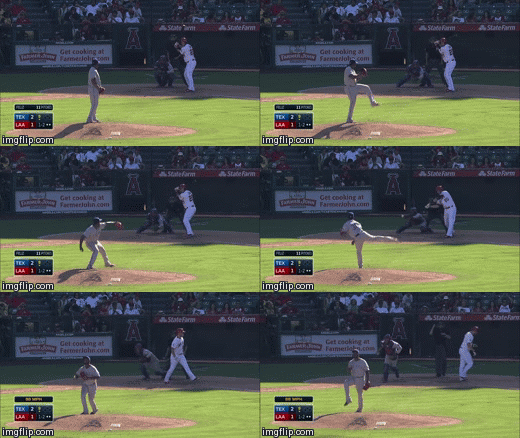
Overall, I don’t think Neftali Feliz is a safe bet to be great in 2015. But I do think that he has a real chance to be much better than the projections project him to be. To end this post, I’ll post a few gifs of Feliz at his best in 2014:
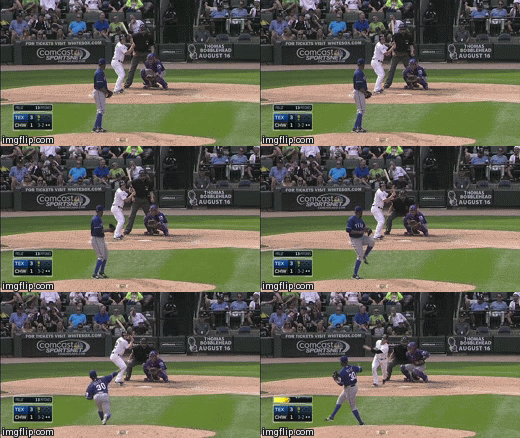
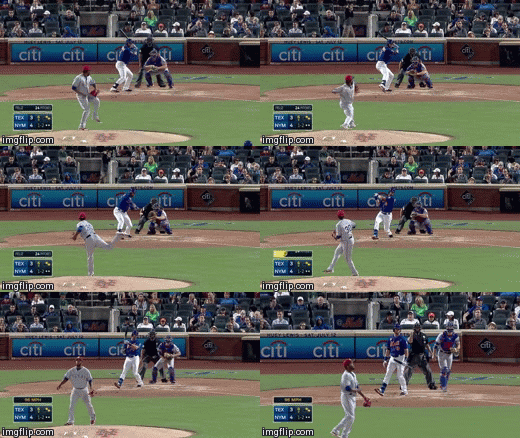
* All pitch usage, velocity, and movement numbers are obtained from Brooks Baseball. All pitch results numbers are obtained from Baseball Savant.

The Resurgence of Jon Lester: How a Small Mechanical Change Brought Back a Pitch that Earned Millions

Jon Lester just got paid. Early Wednesday morning, it was announced that Jon Lester accepted a 6-year $155M contract with a vesting option for a 7th year to become a member of the Chicago Cubs. This is over $20M more than the FanGraphs readers predicted in the offseason free agent crowdsourcing. This is the same pitcher that the Red Sox offered a 4-year $70M extension to prior to the season and proceed to nearly double their offer to $135M in the off-season. Before 2014, it was reasonable to think Jon Lester might be looking at a deal similar to the 5 years $90-95M that has been predicted for James Shields. What did Lester do to convince teams he is closer to a $200M pitcher than a $100M pitcher? He looked like the elite Lester we saw in 2009-2010, and not the merely very good pitcher he was in the past few years. How did he improve in his contract year? Let’s take a look.

Jon Lester fWAR/Season fWAR rank FIP FIP rank K% K% rank Contact % Contact% Rank
2009-2010 5.8 9th 3.14 10th 26.4% 2nd 76.1% 7th
2011-2013 3.6 16th 3.84 60th 20.4% 48th 80.9% 68th
2014 6.1 6th 2.80 9th 24.9% 12th 78.6% 29th


Lester was one of the top pitchers in the game during the 2009 and 2010 seasons, and even placed 4th in AL Cy Young voting in 2010. His peers were Felix Hernandez and Adam Wainwright, along with Lincecum and Sabathia (before they became husks of their former selves on the mound). While WAR still treated Lester well in 2011-2013, partially due to the sheer number of IP and park and league statistical adjustments, his FIP placed him in the leagues of Kyle Lohse, Homer Bailey, Yovani Gallardo and Ian Kennedy. During that period, Lester’s opponent contact rate and swinging-strike rate were the same as those of Clay Buchholz. So comparing a theoretical Lester deal to the Bailey extension, which was looked at as an overpay by some, didn’t seem unfair. From 2011-2013, Lester trailed Shields by over 2 WAR, so a similar contract didn’t seem unfair prior to 2014.

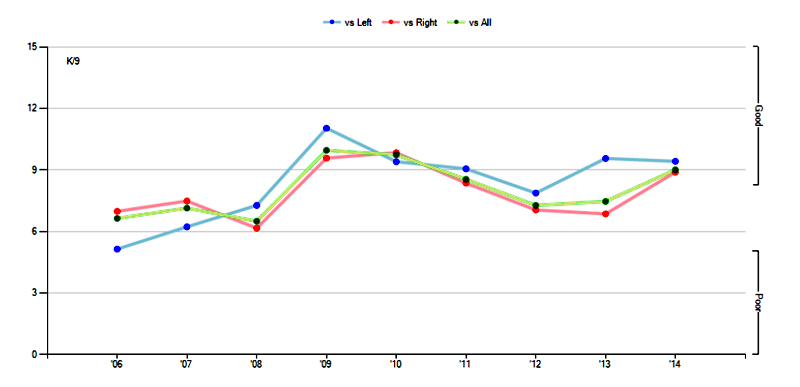
What caused Lester to fall from the ranks of the elite and become more of a number-two starter? The strikeouts disappeared.

800x387xlester-l-r.png.pagespeed.ic.p9Ej

800x394xlester-k9.png.pagespeed.ic.-Zrox
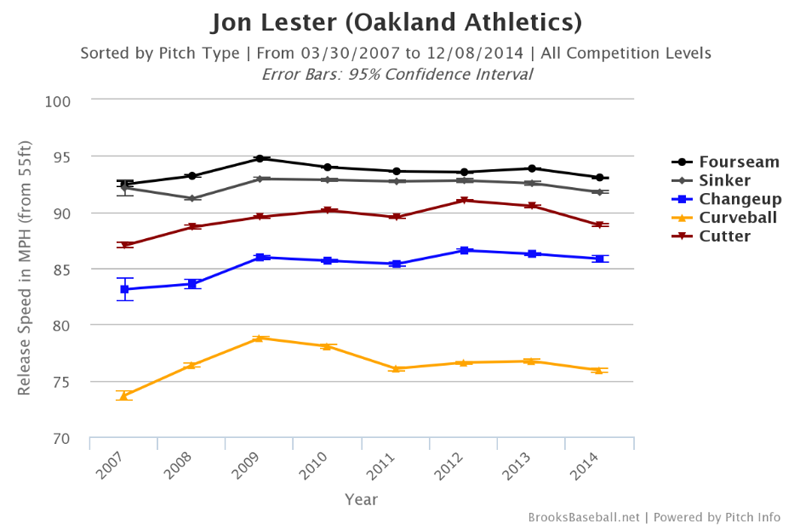
The problem was especially apparent against righties, whom he struck out at only a 17.9% clip in 2013 (compared to 26.3% in 2010). What caused this decline? Let’s take a quick look at the Pitch F/X data. A lot of people are under impression that the decline was due to velocity loss that occurs with aging. This isn’t really the case for Lester. Lester’s fastball velocity has declined by less than one mile per hour, from 94 MPH in 2010 to 93.2 MPH in 2014. While the cutter and curveball have lost velocity, they aren’t as dependent on velocity as the fastball:

800x529xlester-pitch-type.png.pagespeed.
If we take a look at his pitch usage, we notice two things: He has for the most part ditched the sinker and changeup in favor of the fastball, cutter, curveball combination that our Matt Trueblood detailed in his recent piece.

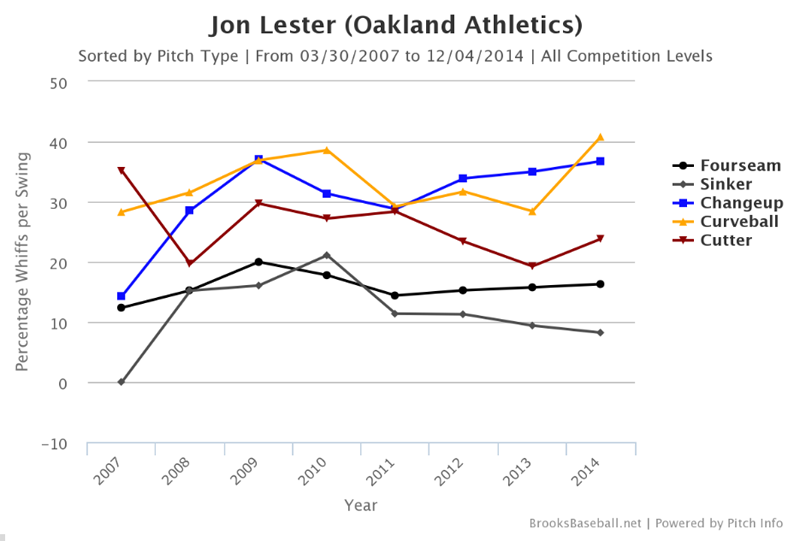
Let’s take a look for the most telling data for any pitcher: the ability to get hitters to swing and miss.

800x541xlester-whiff.png.pagespeed.ic.Br

Lester’s fastball generated whiffs on 16.3 percent of all swings in 2014, his best mark since 17.8 percent in 2010. That is around the league average of 16.4 percent, according to Eno Sarris’s benchmarks. The cutter, which he is throwing at a career-high frequency of 31.0% of all his pitches, is generating a whiff-per-swing rate of 23.8 percent (5th in MLB, minimum 500 pitches thrown), above the league average of 21.4%. The pitch isn’t as good as it used to be, when it generated whiffs on over 28 percent of swings, for reasons Sarris detailed last year. However, it’s still a very good pitch that was even better in 2014 due to improvements in the horizontal movement.

The curveball, though, is what’s special. In 2014, Lester’s curveball generated whiffs-per-swing on 40.8 percent of opponents’ swings, the highest mark of his career—and 12 percentage points more than in 2013, when his curveball was league-average in that regard. In 2014, It was the best curveball in the league in terms of whiffs per swing, with pitchers like A.J. Burnett, Adam Wainwright and Sonny Gray behind him.

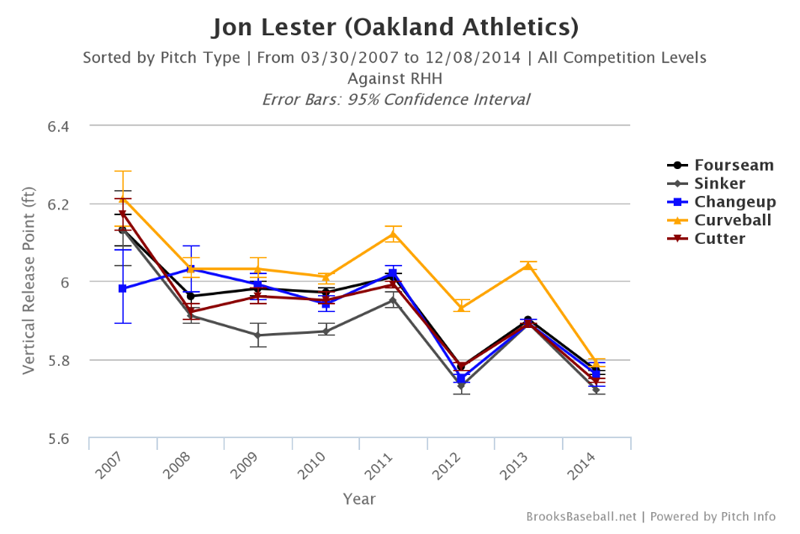
Now what happened to the curveball? It didn’t gain velocity. It didn’t gain movement. It gained a more consistent vertical release point. Look at 2014. Lester changed his release point on all pitches, but as you can see, the release points of the fastball, cutter, and curveball are tightly grouped together. Now look at 2009 and 2010, and compare it to 2011-2013. It appears that in his “peak years,” Lester maintained a better-disguised release point on the curve than he did in 2011-2013.

If the curveball was being tipped or was less deceptive, righties would have the best look at it.  Let’s check that out:

800x534xlester-release.png.pagespeed.ic.

nAa3HGr.png


NqtDfGc.png

There is something incredibly satisfying in finding the results we might expect. The curveball generated 41.4% Whiffs/Swing vs. righties compared to the 25.8% in 2013. Lester’s Curveball caused 25 Ks against righties, 6th in baseball compared to 2014 when it only caused 6. This is exceptional because he only generated 55 whiffs on the CB vs. RHH. When righties do make contact, they aren’t hitting it hard, only slugging .151 against the hook last year, compared to .338 in 2013. Righties aren’t picking up the curveball like they were before, and in 2014, that solved the platoon issues he had against them in previous years. Trueblood said, “Lester might have tapped into something that will allow him to dominate right-handed batters in the future.” That something is the curveball. It allowed him to ditch his changeup with little consequence.

The gist is that 2014 Jon Lester was more like 2009-2010 Jon Lester than 2011-2013 Jon Lester. A mechanical adjustment allowed the curveball to reemerge as an elite weapon in Lester’s arsenal, complementing a very good cutter and an above average fastball. It also allowed him to enjoy success versus righties again. The question is: How sustainable is this change? If Lester can lose his mechanics for years, is there serious risk of him losing them again? Can he continue to improve? If he can bring the curveball back to its former glory, can he regain a bit more movement on the cutter again? Can he bring back an effective sinker, giving him a deeper arsenal? These are the questions on which the Cubs will be betting $155 million on. If these changes can be sustained, it wouldn’t be surprising if Lester is worth the contract barring injury. Just one 5 WAR season can be worth $40M on this market. Lester made a slight change to his mechanics and it just might have earned him tens of millions of dollars.


Giants Shouldn’t Overspend on Headley

When the Red Sox locked up Pablo Sandoval a few weeks ago, Giants fans immediately began to wonder who San Francisco would turn to at third base. After all, Sandoval had just wrapped up his seventh season with the Giants, and the Panda had become a fan favorite for his postseason success. With a free agent market saturated with several bench pieces and only one legitimate option in Chase Headley, the Giants began to focus on Headley as a potential replacement. With Headley seeking a four-year deal, worth close to $50 million, the Giants have to ask themselves, is this the best option?

No.

While Sandoval will always be a beloved figure in the Bay Area, let’s not overestimate his value with the club. From 2009-2011, the Panda was worth 12 wins. His WAR over the next three years? 7.9.

Sandoval from 2009-2011:

.857 OPS, .198 ISO, 129 wRC+

Sandoval from 2012-2014:

.759 OPS, .144 ISO, 115 wRC+

Whether or not the Red Sox overpaid on Sandoval is a discussion for another day, so let’s focus on the Giants’ potential options here. If Opening Day was tomorrow, Bruce Bochy would have to decide between Marco Scutaro and Joaquin Arias as his starter at third base. Scutaro, entering his age 39 season, is coming off a major back injury that limited him to just 5 games in 2014. On top of that, Scutaro has made just 15 starts at third base since 2008, and all 15 of those came in 2012. Arias adds some intriguing value in more of a platoon role, but we’ll get to that later. Now let’s take a look at the Giants’ top option on the free agent market, Chase Headley.

Defensively, Headley is widely regarded as one of the top performers in all of baseball. For his career, Headley boasts a 10.8 UZR/150, along with a 2014 season that included 13 DRS, second only to Josh Donaldson’s 20 DRS among AL third basemen. Everyone knows of Headley’s breakout season in 2012: .874 OPS, 31 HR, 145 wRC+, 7.2 (!!!) WAR, and everyone is just as quick to point out the downfall in the next two seasons. But Headley hasn’t been that bad.

Headley in 2013 and 2014:

.725 OPS, 26 HR, 109 wRC+, 8.0 WAR

As we have always known with Headley, his defense increases his value. In 2012, it was merely an afterthought to a career season at the plate. Headley would add solid production the Giants’ lineup, but could they get similar production at a cheaper cost? One step towards that would involve a trade with a team that will break in a top prospect at third base at some point in 2015. Enter the Chicago Cubs and Luis Valbuena.

Valbuena, who will soon be replaced by top prospect Kris Bryant, is projected to make somewhere in the neighborhood of $3 million in 2015. He would make an excellent platoon partner with Arias, for a total of $5 million, or half the price of Chase Headley. But why go with these platoon players when you can add a proven everyday guy in Headley? Because the Giants could use the money to help pay for improvements elsewhere, such as left field, or the starting rotation. They could even save the Headley money for the 2016 season, when the Giants lose over $40 million in annual salaries to the likes of Tim Lincecum, Tim Hudson, Jeremy Affeldt and Scutaro. But a platoon of Valbuena and Arias is not just half the price, it’s equal the production. Let’s take a look:

vs RHP in 2014:

Headley .690 OPS, 99 wRC+

Valbuena .811 OPS, 124 wRC+

vs LHP in 2014:

Headley .721 OPS, 110 wRC+

Arias .720 OPS, 107 wRC+

Now it is worth noting that Headley’s ISO was very consistent from both sides, posting a .130 vs RHP and a .132 vs LHP. Valbuena posted a .208 ISO vs RHP, while Arias was just .076 vs LHP. If the Giants did choose this platoon, the power would be limited from Arias. But what about the defense from each player?

Career UZR/150

Headley 10.8 (6,366.2 innings)

Valbuena 10.2 (2438.2 innings)

Arias 15.6 (800.1 innings)

Even when you combine Valbuena and Arias, the total time at third base is roughly half the time Headley has seen at the MLB level. With that being said, both are very good defenders at third base.

Would a platoon of Valbuena and Arias produce better results than Chase Headley in 2015? Maybe, maybe not. But it is very possible that the Giants get equal the production, at half the price, and spend some of that extra money elsewhere. Maybe the extra $5-6 million lands them a pitcher they couldn’t quite afford if they had Headley under contract? Maybe it helps them make space for a Justin Upton in left field in 2015? Either way, the Giants would be wise to find a cheaper option at third base.


The Mariners’ Deficiency

This trade, at least in its basic terms, has been well covered. I personally don’t believe that one of these players is really any better than the other, not in any significant sense. The Mariners gave away a roughly league-average player and received a roughly league-average player in return, but as a result paid a penalty in salary and in team control — for essentially no reason. Jeff has gone over all of that on two different websites. It’s a nice deal for the Jays. It’s less than that for Seattle.

Where it gets ugly is at the far periphery, the tertiary implications of this deal that, on its face, really indict a disparity between the Mariners’ front office and the rest of baseball.

The Mariners now need a right fielder, having just traded theirs. A right fielder is an everyday player theoretically assigned for about 1500 defensive innings and 700 plate appearances; and therefore someone who will be competing, on average, against a very high threshold of performance. From 2012-2014, the average full-time right fielder produced 2.6 WAR/600 per FanGraphs. The market price for 2.6 WAR, at the established pre-season price of $7M/win, is approximately $18M. This is about in line with what’s been observed to date. The 2015 cost of these players on the open market:

Player Projected WAR 2015 Salary (M) $/Win Additional Costs
Hanley Ramirez 3.6 $22.00 $6.11 2nd Rd. Pick, length
Victor Martinez 2.7 $17.00 $6.30 1st Rd. pick, length
Nelson Cruz 1.5 $14.50 $9.67 1st Rd. Pick, length
Nick Markakis 1.5 $11.00 $7.33 length
Torii Hunter 1.7 $10.50 $6.18 None
Jason Heyward 5.0 $7.80 $1.56 Shelby Miller, tm. control
Justin Upton 3.0 $14.50 $4.83 ???

In order to obtain someone to meet this threshold, you have to pay. You have to pay a lot. Nick Markakis just signed for 4 years and $44M. Nelson Cruz signed for $57M to knock out just one half of the workload, also costing a draft selection. Victor Martinez signed for $68M to knock out just one half of the workload. He didn’t cost the Tigers a draft selection, but that’s unique to the Tigers. For someone who can do it all, you’re looking at Hanley Ramirez, and then you’re looking at nine figures. The $/win for the four free agents above is $7.12M. Their average salary for 2015 is $15.0M for 2.2 WAR. Four of the five signed for 4 years or more, the exception being Torii Hunter, who is likely to retire.

The Blue Jays now need a #5 starter, having just traded theirs. A #5 starter starts more-or-less every 5 days. About once every 4 or 5 weeks, his start might be skipped thanks to an off day. An average #5 starter makes roughly 30 starts for roughly 180 innings per year. On average, this type of pitcher meets a very low threshold of performance. From 2012-2014, there have been 257 qualifying seasons for starting pitchers. The average performance of this group is 2.7 WAR/200 IP. Population sections of 20% amount to 51 or 52 individuals per section, the lowest ranked section theoretically accounting for the #5 slot. The average performance of this section is 0.9 WAR/200 IP. At the established pre-season price of $7M/win, the market price for 0.9 WAR is approximately $6.5M. The cost of these players on the open market:

Player Projected WAR 2015 Salary (M) $/Win Additional Costs
Colby Lewis 0.6 $4.00 $6.67 None
JA Happ** 1.2 $6.70 $5.58 Michael Saunders, tm. cont
AJ Burnett 1.7 $10.00 $5.88 None
Jerome Williams 0.4 $2.50 $6.25 None
Brad Mills None Minor League NA None
Jeff Francis None Minor League NA None

**Option picked up

To obtain players who can meet this threshold, you can generally pay fringe talents for 1-year deals or look to candidates from minor-league affiliates for league-minimum salaries. This position is not often filled by a singular person, as teams rarely have that many reliable starters on a roster due either to scarcity or to budgetary constraints. The Mariners themselves filled their 5-slot in 2014 with a combination of Erasmo Ramirez, Blake Beavan and Brandon Maurer, winning 87 games. This is not uncommon. The Orioles, Angels and Athletics all employed variations of this theme.

The average $/win for the above free agents given guarantees is $6.3M. The average guaranteed salary for 2015 is $5.8M. None of these players is signed beyond 2015.

The Blue Jays took their high-cost need and exchanged it for a low-cost need, transferring the balance onto the Mariners.

This is not to say that the Blue Jays have to sign a #5 starter. If someone better presents themselves at a price they can incur, they absolutely have that option. But if they decide to follow the standard rotation model, that’s okay too, because most of baseball either does or has to. The penalty for playing down to the average #5 starter is relatively small.

The Mariners no longer have this luxury. There’s no such thing as a #5 right-fielder. If you were to place the terms of this concept on the right-field position, you’d have a replacement player, the penalty for which is a couple wins. The Mariners, at least in their position, can’t afford that.

This isn’t about obtaining talent for talent, salary for salary, years for years. This is about understanding your market, about being able to let your environment work for you. We don’t have to sugar-coat this. There are people who get it and people who don’t. Jack Zduriencik, for whatever reason, just doesn’t get it.

But the Mariners aren’t constrained to budget limitations in the way the A’s and Rays are. They don’t struggle in the draft the way the Yanks, Astros and White Sox do. The Mariners, for all of their issues, have a winning team with a young core to credit them, and Zduriencik has quite the hand in that. That his knack for strategy might be among the lower tier of his peers is a singular constraint among many working parts, and the hope is that the rest of the machine can overcome the deficiency — the same way a lot of teams do.

But I won’t blame you for cringing at what might be next. Their propensity for this kind of deal is matched only by their propensity to compound one mistake with another. And given their shiny new need, they may not have much of choice.


Could Pro Sports Lead Us to Wellness?

Comment From Bill
St. Louis is being hindered in the stretch drive by some kind of GI bug passing through (so to speak) the team. Reports have as many as 15 guys down with it at once. That seems a lot, but given the way a baseball clubhouse works, my question is why don’t we see more of that? Answering that baseball players are fanatically interested in sanitation and hygiene ain’t gonna cut it, I don’t think…

12:10
Dave Cameron: They have access to a lot of drugs.

–comment from a chat at FanGraphs, September 24, 2014

So this comment caught my eye. Ever since I began following sites like BaseballProspectus.com and FanGraphs.com, and reading things like Moneyball, I’ve found myself thinking about efficiency and unappreciated or unexplored resources in different situations.

I realize this was a throwaway line in a baseball chat. But it piqued my interest because it seems to point out something that’s maybe underappreciated and understudied about how sports teams go about their business–specifically, the kinds of things they do to keep their athletes healthy.

My question is, does this represent a potential source of “Found Research” data that could help the rest of us reach wellness? more


The Real Reason for Mark Teixeira’s Decline

When the Yankees signed Mark Teixeira to an 8-year, $180 million contract in the 2008-2009 offseason, they knew fully well that they were getting a hitter who liked to pull the ball. Like Jason Giambi, his predecessor at first base, it was believed that his superb power would make up for a batting average that was likely to decline throughout the deal, especially with the short porch in right field at Yankee Stadium. However, Teixeira’s 2014 line of .215/.305/.413 against righties was probably not what they had in mind for their switch-hitting first baseman.

Naturally, many have jumped to blame Teixeira’s woes on the drastic defensive shift that is employed when he hits left-handed. But the shift was there in 2009, when Teixeira finished 2nd in the AL MVP voting with a .292/.383/.565 line and 39 home runs. The fact is Mark Teixeira, spray chart included, was once good enough of a hitter to earn a $180 million contract. Defenses could basically know where he was going to hit the ball and still shook in their boots when he came up to bat.

However, one factor has not remained constant: Teixeira’s production against fastballs. In his prime, Teixeira wasn’t just good against heaters: from 2003-2012, his wFB/C of 1.70 ranks 16th among qualified hitters. But his numbers against fastballs has consistently diminished during his Yankee years. Brooks Baseball gives some additional information (note: wFB/C is from FanGraphs and is not against RHP only):

Mark Teixeira vs. RHP
Year Whiff/Swing GB/BIP% wFB/C
2009 9.74% 30.56% 2.22
2010 11.55% 25.00% 1.29
2011 11.64% 25.23% 1.43
2012 11.80% 29.41% 1.47
2014 14.52% 34.58% -0.14

2014 saw Teixeira whiffing on more fastballs then ever before and hitting more grounders when he did make contact. Even more alarming is the fact that his wFB/C is negative, suggesting that he was a liability against what was once his favorite pitch. Baseball Savant shows a similar downward trend against righties throwing four seam fastballs, two seam fastballs, cutters, or sinkers:

Mark Teixeira v. RHP
Year BA SLG
2009 0.314 0.661
2010 0.291 0.526
2011 0.258 0.512
2012 0.271 0.476
2014 0.195 0.381

Teixeira’s decreasing offensive value makes sense when one considers the fact that what was once his greatest strength as a hitter is now a weakness. And considering the fact that FanGraphs has had pitchers throwing 57.8% fastballs to Teixeira throughout his career, it is definitely not a problem that can be avoided by trying to do damage against other pitches. However, this trend also suggests that Teixeira, who put up wRC+’s of 142, 128, 124, and 116 in the first 4 years of his deal, can become a force on offense again if he can start hitting heaters like he used to.

Unfortunately, I have very little no expertise that can assuredly help Teixeira regain his prowess against fastballs. The only “shot in the dark” idea I have for Teixeira is for him to level out his notorious uppercut swing. The fact that Teixiera is whiffing on more fastballs and hitting more groundballs suggests that his ability to make solid contact has diminished with age and injury. Straightening the path of his swing would give him more of a margin for error.

He could maintain his power by guessing on more pitches, which is what I believe fellow Yankee Brett Gardner did in 2014, when he hit 17 of his 40 career home runs. According to Baseball Savant, 15 of his 17 home runs came from four seam fastballs, two seam fastballs, sinkers or cutters. The fact that all of them were pulled to right field, despite greater velocity, leads me to believe that Gardner was sitting on them more often than not.

Alternatively Teixeira’s lingering wrist injury (which is why I left his 15-game 2013 season off the tables above) might be making it harder for him to turn on pitches with high velocity. Conversely, Teixeira could be correct in suggesting that a full offseason workout program could allow him to return to form. In any case, Teixeira needs to regain his ability to destroy fastballs if he has any hope of being a force on offense again.


High-End Free Agents: Do They Exist?

A common refrain during this point in baseball’s calendar is that the free agent market isn’t what it used to be. The underlying premise is that more and more teams place more and more focus on locking up their young, talented players to long-term contract extensions.  In turn, fewer and fewer young and talented players are reaching free agency. With the free agent market drying up, teams must pay a significant premium for the few players that do reach free agency that are both relatively young and relatively talented. Ken Rosenthal highlighted this line of thinking in an article last year:

One of the game’s rising young stars recently told me he was concerned about the flurry of contract extensions in baseball. The player didn’t want to be identified, but his thoughts intrigued me, in no small part because he is a candidate for an extension himself. The player’s point was this: Free agency helped make the players union into a powerhouse. But now, with fewer top players reaching free agency, who is going to drive the top of the market? Shouldn’t players feel a sense of responsibility to those who came before them and those who will follow? Fair questions, particularly if you look at the next two free-agent classes, which are almost devoid of stars. But when I expressed the player’s concerns to the head of the union, Michael Weiner, and a prominent agent, Scott Boras, I didn’t get the answers I expected. Neither views the trend as necessarily a problem.

But is this really a trend at all? Let’s look at that question more closely. Let’s begin by looking at the 2014-2015 crop of free agents.  Baseball Reference has a list that is published here. As of this writing, that list contains 306 players. These 306 players have an average age of 31.6 and a median age of 31.0. The average WAR is at 5.54, which reflects outliers at the high end (like Ichiro and Jason Giambi); the median WAR for these 306 players is only 1.90. Of these 306, there are only six players that both (a) are 30 years old or younger (using Baseball Reference’s midpoint method to calculate ages, this is the age the player will be on July 1 of the next season), and (b) have achieved 12 wins above replacement in their career. These six players, in order of descending career WAR, are (i) Pablo Sandoval, (ii) Billy Butler, (iii) Asdrubal Cabrera, (iv) Melky Cabrera, (v) Colby Rasmus, and (vi) Max Scherzer.

If you are general manager looking to fill multiple holes in your roster, this is not the most inspiring group, especially when considering the cost of doing so. This group does reflect the current narrative — there does appear to be a dearth of high-end talent available on the free agent market. But how does this group compare to prior free agent cohorts? Has the free agent market really dried up, or has it always been dry?

Again, Baseball Reference is helpful. On its site, it lists the free agent signings for each year. For example, its list of 2013-2014 free agents is published here. Using the same criteria as before (30 or younger, and 12 career WAR or better), the 2013-2014 free agent crop had seven relatively young and relatively talented players: (i) Josh Johnson, (ii) Brian McCann, (iii) Jacoby Ellsbury, (iv) Ubaldo Jimenez, (v) Scott Kazmir, (vi) Chris Young (the hitter), and (vii) Matt Garza. Perhaps a bit better than 2014-2015, in general, but not markedly different. Looking back further, in summary fashion, here is a look at the free agent market during the ten seasons leading up to this one:

Total Number of Signings/Free Agents* Average Age Median Age Average WAR Median WAR Relatively Young and Relatively Talented (30 and younger; 12 bWAR or better)
2004 493 31.5 31 5.27 0.3 12
2005 420 31.5 31 5.03 0.5 6
2006 411 31.4 31 6.06 0.4 10
2007 391 31.3 31 5.41 0.4 1
2008 433 31.1 30 5.44 0.4 6
2009 443 31.2 31 5.14 0.6 6
2010 445 31.2 31 5.76 0.6 4
2011 417 31.3 31 5.46 0.6 7
2012 426 31.3 30 4.74 0.7 8
2013 413 31.1 31 4.96 0.9 7
2014 306 31.6 31 5.54 1.9 6

As for a list of the remaining names of the relatively young and relatively talented players appearing in the table above, they are:

2012-13:  Zack Greinke, Russell Martin, Michael Bourn, B.J. Upton, Melky Cabrera, Anibal Sanchez, Edwin Jackson, Stephen Drew

2011-12:  Jose Reyes, Grady Seizemore, Dontrelle Willis, Francisco Rodriguez, Aaron Hill, Prince Fielder, Kelly Johnson

2010-11:  Carl Crawford, Dontrelle Willis, Mark Prior, Jhonny Peralta

2009-10:Matt Holliday, Jon Garland, Rich Harden, Coco Crisp, Hank Blalock, Austin Kearns

2008-09:  CC Sabathia, Mark Teixeira, Jon Garland, Mark Prior, Francisco Rodriguez, Adam Dunn

2007-08:  Aaron Rowand

2006-07:  Barry Zito, Kerry Wood, Mark Mulder, Marcus Giles, Jeff Weaver, Wade Miller, Randy Wolf, Juan Pierre, Aramis Ramirez, Aubrey Huff

2005-06:  Rafael Furcal, Jeff Weaver, Wade Miller, Ramon Hernandez, Paul Konerko, A.J. Burnett

2004-05:  Carlos Beltran, J.D. Drew, Adrian Beltre, Troy Glaus, Edgar Renteria, Matt Morris, Richard Hidalgo, Eric Milton, Kevin Milwood, Placido Polanco, Wade Miller, Richie Sexson

What can we learn from looking at information from the ten free agent classes before this year’s free agent class?

  1. The free agent classes have looked very similar, on average, for the past ten years.
  2. Over the past ten years, free agency has not yielded the bumper crop of talent that has been suggested.  The locking up of young talent prior to free agency does not appear to be a recent trend.
  3. The appearance of high-end talent, particularly high-end talent in the fat part of an aging curve, is at best sporadic (occasionally yielding a young high-end bat, such as Carlos Beltran, Adrian Beltre, Matt Holliday, or Prince Fielder, but almost never a pitcher with his best years ahead).

Based on this look, it has always been difficult to find players in their prime on the free-agent market. They exist, but they are rare. This does not appear to be a new trend.* The number of free agents in 2014 does not include the players that have not been tendered a contract for arbitration. Once this group of non-tendered players become free agents this winter, it will both inflate the number of available free agents and depress the average and median WAR figures shown in the table.


A Gif-tastic Review of Arizona Fall League Pitching Prospects

Rogers Hornsby was once quoted as saying, “People ask me what I do in winter when there’s no baseball. I’ll tell you what I do. I stare out the window and wait for spring.”  While staring out of a window for several months may be a worthwhile way to spend our limited time on Earth, I wish to propose a marginally more enjoyable choice: watching gifs of top pitching prospects.

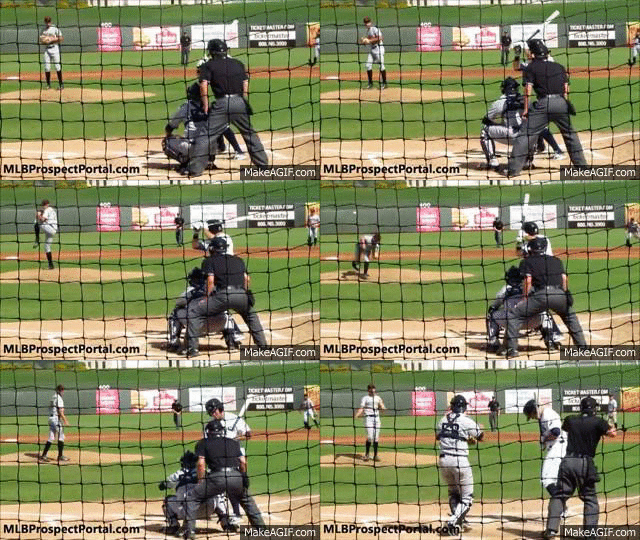
With the 2014 Arizona Fall League featuring several top pitching prospects, and with the plentiful high-quality videos posted on Youtube by our good friends at MLBProspectPortal.com, I was able to create a collection of gifs that showcase these pitchers’ talents.

Kyle Zimmer

Zimmer finished the AFL with an incredible 41.7 K%.  Unfortunately, due to injuries, he only made three starts.  When he has been healthy, though, he has been known to throw mid 90’s fastballs and biting curveballs.  Below is a gif of his curveball thrown to Pirates’ outfield prospect, Josh Bell.  It should be noted both that Bell missed this curveball by a lot, and that he rarely swings and misses versus left-handed pitchers (9.9 K% against them).

Kyle Zimmer 2014 AFL

In the pitch following the curveball, Zimmer threw a high fastball that Bell couldn’t catch up to:

http://cdn.makeagif.com/media/11-26-2014/M0iguz.gif

In the pitch following the curveball/fastball combination, Zimmer threw either a changeup or two-seam fastball that had Bell out in front:

http://cdn.makeagif.com/media/11-26-2014/DmBK3j.gif

Tyrell Jenkins

A former 1st round supplemental draft pick by the Cardinals in 2010, Tyrell’s statistics have been erratic in the minors, including his 13.3 K%/7.4 BB%/4.31 FIP in High A in 2014.  His athletic frame and power stuff are still coveted, though, and the Braves acquired him in the recent Jason Heyward trade.  Below is a curveball from Jenkins to Addison Russell, who happens to be one of the top prospects in all of baseball:

http://cdn.makeagif.com/media/11-26-2014/CFVYNx.gif

Below is a high fastball to Dalton Pompey that resulted in a strikeout.

http://cdn.makeagif.com/media/11-26-2014/mPI9aR.gif

Archie Bradley

Archie Bradley is likely the most well-known name on this list, and some sources had him as the #1 pitching prospect entering this season. FanGraphs’ own Kiley McDaniel gave him a future 70 grade on his fastball, along with a future grade of 65 on his curveball.  Below is one such curveball thrown to Addison Russell:

http://cdn.makeagif.com/media/11-26-2014/g_VnqS.gif

Not content to merely acquire a strikeout against Russell, Bradley went with his fastball with good arm-side run to create a double play-inducing weak grounder:

http://cdn.makeagif.com/media/11-26-2014/r52BEN.gif

Tyler Glasnow

Tyler Glasnow posted a league-leading 31.9 K% and .171 opposing batting average  in 2014 in High A.  The third highest K% in the FSL was 23%, and the second lowest opposing batting average was .216.  These numbers may seem incredible to you, but they’re actually a step down from his 2013 season in Low A where he posted a 36.3 K% and a .141 opposing batting average.  You may have guessed that Glasnow has good stuff.  You’d be right.

Below, the batter sticks his bat out for a bunt and then spins back as if the pitch were going to hit him.  It was called a strike.

http://cdn.makeagif.com/media/11-26-2014/p2TYOo.gif

Finally, we have a called strike three on a curveball.  Notice the defeatism in the batter.; he has been bested by the pitcher but is glad that he has been allowed to keep his life.

http://cdn.makeagif.com/media/11-26-2014/FkmhjH.gif

*Credit for all of the videos goes to MLBProspectPortal.com.


Mike Trout, Out of Context

Recently, Mike Trout was officially named the Most Valuable Player in the American League. To celebrate, let’s take Trout out of context and put him in a new one.

Part of the reason many fans believed Trout was more valuable than Miguel Cabrera in 2012 and 2013 was his home park. Angel Stadium is a pitcher’s park, whereas Comerica Park in Detroit is pretty average for hitters. In 2012, when Trout won AL Rookie of the Year but finished behind Cabrera for AL MVP, park effects played a huge, obvious role in the voting results. If you take out the home field and just look at road games, Trout’s batting average, on-base percentage, and slugging percentage were all better than Cabrera’s:

Cabrera:         .327 / .384 / .529
Trout:             .332 / .407 / .544

Furthermore, this is a tough time to objectively evaluate hitters. Offensive production isn’t nearly at the level it was five or ten years ago, so stats that would’ve looked pedestrian in 2004 now lead the league. It’s tough to appreciate the greatness of a young player like Trout in a depressed offensive environment. So let’s take Mike Trout out of that environment and put him in a better one: Coors Field. From 1998-2001.

Using the Neutralized Batting tool at Baseball-Reference, I moved Mike Trout’s career back in time by 13 seasons and put him on the Colorado Rockies. Here are the horrifying numbers this produced:

Year Age G PA AB R H 2B 3B HR RBI
1998/2001 19 40 145 130 29 34 7 0 6 23
1999/2012 20 139 728 623 207 246 36 11 40 133
2000/2013 21 157 834 661 179 262 54 13 38 159
2001/2014 22 157 782 652 172 223 51 12 46 166
TOTAL   493 2489 2066 587 765 148 36 130 481

You’ll notice that in Trout’s rookie season (1999/2012), he broke Billy Hamilton‘s century-old single-season record for runs scored. The following year, he made 834 plate appearances and tied Ichiro Suzuki’s single-season hits record, while pounding out 105 extra-base hits. This past season was his third straight with 220 hits, and he drove in 166 runs. He has a combined 338-340 runs + RBI in each full season. More stats:

Year Age G PA SB BB TB BA OBP SLG OPS
1998/2011 19 40 145 5 12 59 .262 .331 .454 .785
1999/2012 20 139 728 67 90 424 .395 .473 .681 1.154
2000/2013 21 157 834 45 152 456 .396 .512 .690 1.202
2001/2014 22 157 782 20 107 436 .342 .439 .669 1.108
TOTAL   493 2489 137 361 1375 .370 .467 .666 1.132

Let’s get right to the point here: Coors Field Mike Trout has a slugging percentage of .666, because this version of the man is obviously the devil (or possibly Ty Cobb). His career slash line is .370/.467/.666, for an OPS of 1.132. He stole 67 bases as a rookie, batting .395. For an encore the next season, he walked 152 times and still gained 456 total bases. This was possible because he hit .396/.512/.690. This most recent season (the MVP year) was comparably pedestrian, but it was his third straight season with over 420 total bases.

The 2000/2013 season is particularly nuts. Trout made 834 PA, so that’s obviously part of it, but he had 262 hits and 152 walks (plus 13 HBP). That’s 427 times on base. No, seriously.

And this is just batting. Other than the stolen bases, we haven’t said anything about his (excellent) baserunning, or his defense, which was sensational in 2012. Trout is a great player in any context, but in pre-humidor Coors Field, he is a terrifying offensive force. Congratulations, Mr. Trout.


R.A. Dickey: A Brief Tale of Consistency

Being a Toronto native, I had a fair share of complaints last season. Seeing hefty division leads evaporate with the blink of an eye stinks, as does Brett Lawrie’s 3rd failed attempt at a breakout. I could complain about a lack of financial commitments from management (on the field) and about the overall middle of the pack finish.

When Alex Anthopoulous acquired R.A. Dickey before the 2013 season, expectations were high. When initially reviewing his first season in Toronto, a Cy Young winner who puts up a 4+ ERA the following season is disheartening. Yet in March 2013, were you really expecting a fly ball pitcher in the Rogers homerdome of the AL to perform on par with what he did in the NL while throwing to the pitcher every other inning? The last two seasons have had disappointments, but R.A. Dickey has been consistent in a reliable and also amusing way.

Dickey ended 2013 with a 14-13 record, and coincidentally, this past season’s win-loss record was an identical 14-13. I am in no way soliciting win-loss records, and this is saying nothing about how he threw the ball. The identical records merely add to the interesting couple seasons the now 40-year-old knuckleballer has had with the Jays.

To achieve the identical 14-13 records, each of the last two years Dickey made 34 starts. While it may not sound impressive, only nine other pitchers made as many starts in 2014, and only “Big Game” James Shields has made the cumulative 68 starts since 2013 that Dickey has. Since 2013, he ranks 4th in innings pitched, trailing only Felix Hernandez, Adam Wainwright and Shields himself. While many Jays fans would infer that doom looms when Dickey jogs on for his 6th and 7th inning of a start, the overall results were at the very least, respectable.

Although eating innings is certainly an important quality, nobody is congratulating Edwin Jackson every five days. Our best overall performance indicator is probably WAR, and wouldn’t you know it, Dickey’s fWAR was 2.1 in 2013 and 2.1 in 2014. 2 Wins Above Replacement matches up with expectations for your average starting pitcher, so it is no surprise that Dickey’s number is in line. On a runs allowed basis, his bWAR is 2.0 and 2.5 in 2013 and 2014, respectively. To fuel the similarity fire, his strikeout percentage in 2013 was 18.8%. As you guessed, his 2014 figure is one Josh Thole framing blunder away, at 18.9%. And, without shock, the strikeout to walk rate budged a mere .15 percentage points from year to year. As you can see, if one tempers their Cy Young expectations, Dickey has been plenty useful and stable for the Blue Jays. If you buy that case, then the remaining wonder is whether he has value relative to the investment.

When last year ended, Dickey took home $5 million in salary, not including signing bonuses offsetting Canada-US tax discrepancies. With the price of a WAR being roughly $7 million annually nowadays, Dickey was a bargain at $5 million in 2013. His extension had him making $12 million this past season, so if we are auditing to the penny, he was slightly below market rate.

With regards to the initial trade, the package for Dickey included Travis d’Arnaud, the big Noah Syndergaard, a low end outfield prospect and John Buck, who was set to earn $6 million in 2013. Of course, the Jays also received two catchers in Mike Nickeas and Josh Thole (there were a lot of catchers in this trade). Although d’Arnaud was a major piece at the time, it is worth noting that come next season, he will be a 26 year old catcher with a grand total of 533 plate appearances at the MLB level. On the other hand, Syndergaard is still only 22, and has very good stuff. However, given the increase in the frequency of pitcher arm injuries nowadays, he remains miles away from being a middle of the rotation starter.

Blue Jays fans have seen Bautista and Encarnacion as the significant bright spots for the team over the last two years. With both of them only under contract for a couple more seasons, in addition to them having likely put their best years behind them, Dickey has certainly given the team a better chance to win – at the appropriate time. This was Anthopoulous’ thinking when he made the acquisition, and although the overall results have not been perfect, it was a reasonable gamble. Not to mention the positive return on investment the team yielded from Dickey himself.

The overstated reality is that R.A. Dickey has been a good pitcher. The guy had a better ERA- than Hisashi Iwakuma last season. He had a better ERA- than Francisco Liriano too, and the latter is likely to get nearly $40 million in free agency despite having not started 30 games since 2010. Dickey has given the Jays a good chance to win in a tough environment. Sure, nobody is happy to have Thole in the lineup once a month, let alone once every five days. But hey, at least we are fortunate enough to not have had Jose Molina and his 23 wRC+ (not a misprint) frequent the lineup card.