Archive for Uncategorized

Breaking Down the Swing: Best Hitters of 2012

Often players will be credited for being very efficient with their swings, or evaluators and coaches will praise a hitter for having tremendous bat speed.  Those who work with hitters and study the art of hitting on a regular basis know that it takes a lot more than being a good athlete or having fast hands to be a successful hitter.  I myself work with many amateur hitters at Carmen Fusco’s Pro Baseball & Softball Academy in New Cumberland, PA.  We use video analysis as an integral part of the learning process, and I spend many hours outside of work devoted to breaking down MLB, MiLB, and draft-eligible players’ swings and pitching deliveries.  In this study I have conducted, I wanted to collect data regarding the best Major League hitters’ swings to discern what actually matters and is worth commenting on from a mechanical perspective of a hitter.

Going into this project, I wanted it to be primarily a data-driven approach to what players do in the batter’s box.  This is a study of hitters’ mechanics at the Major League level, hopefully useful in producing predictive or at least somewhat comparative parameters to be applied to unproven professional or amateur players.  Many criticisms and compliments get heaped on hitters for how their swings work and the correlation to big league success.  However, I have not seen many of these thoughts backed up with hard evidence as proof or even fact-based suggestions that they are truly instrumental to a player’s results on the field.  I will mix in many of my own thoughts here and there as well, but this is meant to be used as an objective analysis of hitters’ mechanical processes.

Read the rest of this entry »


Rebuilding on a Crash Diet: The Brewers and a Calamitous May

To describe May, 2013 as an awful month for the Milwaukee Brewers would not do it justice.

In fact, the Brewers were downright putrid, winning only six games the entire month.  Their record in May was so bad (6-22) that it tied the worst month in franchise history: the August turned out by the 1969 Seattle Pilots, who ended the following season in bankruptcy, followed by a permanent road trip to become the Milwaukee Brewers.

The Brewers ended the month of April only a half game out of first place.  The Brewers ended the month of May 15 games behind the St. Louis Cardinals, managing the impressive feat of losing 14.5 games in the standings in one month.  Now that is a tailspin.

CoolStandings.Com currently gives the Brewers a 1 in 250 chance of making even the wild-card play-in game.  GM Doug Melvin admitted there is no chance the Brewers will be buyers this year at the trade deadline.  Rather, they will either be in a sell mode, seeking high-ceiling prospects a few years away, or keeping the assets they have, presumably only if they cannot get anything in return.  In short, the Brewers are suddenly rebuilding, and are focusing on  stocking up their farm system and developing controllable rotation talent.

But, rebuilding is a complicated topic in small markets like Milwaukee.  As Wendy Thurm has noted, the Brewers, with their limited geographic reach, have one of the smallest television contracts in the league.  Thus, the Brewers rely upon strong attendance to deliver profits for Mark Attanasio and his ownership group.  In recent years, the Brewers’ attendance fortunately has been some of the most impressive in baseball, particularly in comparison to the size of the Milwaukee metropolitan area.  Over the last five years, the Brewers have consistently approached or exceeded three million fans, despite challenging economic times.  So, one thing the Brewers cannot afford is a collapse akin to the mere 1.7 million fans they drew in 2003 during a terrible season — not if they want to make the investments in future talent required to make the franchise a perennial contender.

So, the Brewers face an obvious challenge: the team needs to lose enough games to obtain a prime draft position, and thereby maximize its chances to draft a top-ceiling player with minimum bust potential.  At the same time, the Brewers need to avoid losing in any drawn-out fashion, because a corresponding and sustained decline in attendance could hemorrhage desperately-needed cash from their balance sheet.  As Ryan Topp and others have argued, this need to maintain attendance in the short term seems to be one reason why the Brewers have systematically traded away what previously was an excellent farm system, with the apparent goal of maintaining the aura of a competitive team.

How does one navigate this problem?  Well, the best solution could be to experience a May like the Brewers just suffered.  Doing so addresses two problems: (1) it abruptly puts the team on course to get a top 5 draft pick, and (2) it achieves this result so abruptly, and in this case so early in the season, that the fan base can still — at least in theory —enjoy much-improved baseball for the remainder of the season without jeopardizing that draft slot.  In short, when you can take your medicine over the course of one month, instead of over an entire season, you really ought to do it.

As to the draft:

Thanks to May, the Brewers currently have the fifth-worst record in baseball at 23–37.  As of the morning of June 8, 2013, FanGraphs predicted that the Brewers will end the season tied for baseball’s fourth-worst record with the New York Mets at 73–89.  Provided that 2013’s top five draft picks all reach agreement with their teams, the Brewers are on pace for a top-5 draft slot in 2014.

The Brewers have not had a top-5 pick in the Rule 4 draft since 2005, when they picked some guy named Ryan Braun.  Before 2013, the top five slots in the draft provided, among others, Buster Posey (#5, 2008), Stephen Strasburg (#1, 2009), Manny Machado (#3, 2010), Dylan Bundy (#4, 2011), and Byron Buxton (#2, 2012) — the types of superstar prospects the Brewers have been denied for years, and which they need to anchor their next generation of players.  At the end of April, and before May occurred, the Brewers were on track for yet another mid-round pick slot.

As to the rest of the season:

It is unlikely that the Brewers will continue to suffer the combination of injuries and dreadful rotation pitching that helped ruin their May.  FanGraphs seems to agree, predicting that the current Brewers roster (or something like it) will essentially play .500 baseball for the rest of the season, even while maintaining one of the five worst records in the game.

Average baseball is not contending baseball, but average baseball at least would offer Brewers fans — already pleased with Miller Park’s immunity from rain delays — a reasonable likelihood of seeing a win on any given day.  In 2009, the Brewers were able to bring in over three million fans, despite finishing under .500 overall.  In 2010, the Brewers ended up eight games under .500, but still brought in 2.7 million fans.  It remains to be seen whether playing .500 baseball for the rest of the 2013 season would be sufficient to keep fans coming through the Miller Park turnstiles, but if so, the increasing remoteness of May could be a significant factor, particularly if the team can convince fans that “one bad month” does not represent the current Miller Park experience or true caliber of the team.

Of course, it is also possible that the Brewers will be able to trade significant assets at the deadline in exchange for the prospects Doug Melvin wants.  If so, their projected record could, and probably would decline.  (This is necessarily not a bad thing, given that 68.5 wins is the average cut-off to secure a top 5 draft spot from 2003 through 2012).  If that happens, the Brewers will have a further challenge on their hands in trying to provide even average baseball for their fans, and maintain the attendance they need.

That said, the Brewers’ remarkable close to 2012 — an incredible .610 winning percentage from August through October — was accomplished after trading away Zack Greinke and calling up minor league talent to plug gaps in the rotation left by Greinke’s trade and Shaun Marcum’s injuries.  If the Brewers are once again able to make advantageous trades at the deadline, and also able to play even .500 ball for the rest of the year, they are still in a position to do so without hurting their chances to get the impact player they need in the 2014 Rule 4 draft.

If they can pull both of these things off, much of the thanks should be given to the horrible month of May.


Measuring a pitcher’s ability, performance, and contribution

I’d like to share some of my thoughts and research on how we evaluate Major League Baseball pitchers. I think for the most part when we use statistics to discuss a pitcher, we are really looking at the pitcher from one or more of the following three perspectives: 1) ability, 2) performance, and 3) contribution. Before I get into my research, I will take a moment to describe what I mean by each of the three terms.

ABILITY

When I use the word ‘ability’, I am describing the physical and mental skills the pitcher has at his disposal. Some examples of ability are: how hard he can throw, what kind of movement he has on his pitches, how well he can locate, how well he mixes his pitches, etc. With the introduction of PitchFX, we are now capable of measuring ability better than ever before. With that being said, it is still difficult to accurately and meaningfully quantify many aspects of ability. Since a pitcher’s performance is based at least in part upon his ability, performance statistics can sometimes be used as a substitute for direct ability measures.

PERFORMANCE

Performance literally describes how well a pitcher performed. In other words, it refers to the outcome or outcomes resulting from that pitcher throwing pitches. Nearly all baseball statistics describe performance. Some statistics measure a pitcher’s individual performance fairly well, whereas others combine the pitchers performance with the performance of his team and other factors. For example, ERA is generally not considered a great measure of a pitcher’s individual performance; however, FIP is considered a better measure of individual performance.

CONTRIBUTION

I have not found much reference to the word ‘contribution’ in the baseball literature, but I do think it is an important concept to consider. Contribution is a word I use to describe a pitcher’s contribution in helping his team win baseball games. By this general definition, I suppose ERA (and other performance measures) could also be considered a contribution measure in some respects, since wins are related to runs allowed. Therefore, I also propose that the relationship between ability, performance, and contribution is not divided by solid lines but is instead a spectrum where each statistic can be considered somewhat a part of each category. However, in an attempt to clear up this somewhat murky discussion, I will offer stats such as W-L, WAR and WPA as the most obvious contribution stats*.

*Note: Contribution stats can be measured directly (ie. W-L) or derived from performance stats (ie. fangraphs WAR is derived from FIP).

RESEARCH

Now on to my research… The hypothesis that drove this work was: pitcher ability measures are more consistent between seasons than performance or contribution. This hypothesis is based on my belief that unlike performance and contribution, which are affected by countless outside factors, a pitcher’s ability is within himself and therefore less likely to dramatically change between seasons.

To test this, I took each pitcher that pitched a minimum of 120 innings in each season from 2008-2011. This gave me a pool of 63 pitchers.

For my ability measure, I took the statistic whiff/swing. I like this measure of ability because to me it is the simplest measure of an isolated part of a pitcher’s ability. Since the batter has already decided he will swing, we are only looking at the pitcher’s ability to throw a ball that will evade a hitter’s bat. I know ability to hit the ball is also heavily dependent on the hitter’s ability, but I think that using pitchers that pitched 120 innings in each season will let me take the individual batter out of the equation and use this as a measure of pitcher ability.

For my performance measures I used ERA and FIP from FanGraphs. I agree ERA is not the best performance measure, and may be considered more of a contribution; however, I have included it nonetheless. Finally, for my contribution measure I decided to use FanGraphs WAR.

I calculated the average whiff/swing, ERA, FIP, and WAR for each pitcher of the four-year period. I also calculated the standard deviation within each pitcher for each stat and the within pitcher coefficient of variation (stdev/avg). Coefficient of variation is the best way to report the variability of each statistic over the four seasons because it effectively normalizes each stat by the units they are reported in.

Globally, over the four-season period the 63 pitchers in my group had an average:
whiff/swing = 0.205
ERA = 4.03
FIP = 3.97
WAR = 3.08.

The average within pitcher coefficient of variation was:
9.6% for whiff/swing
18.5% for ERA
12.0% for FIP
and 47.7% for WAR.

TAKE HOME

So what does this mean? Well, I know this is just a start, but based on this I believe my hypothesis was correct. A pitcher’s ability is much more consistent between seasons than their performance and/or contribution. Furthermore, performance is more consistent than contribution. It appears as though the further you get from pure ability measures the more difficult it will be to accurately/reliably predict a pitcher’s future performance and contribution. I’d like to do some further research on performance prediction to confirm this but, my guess is that trying to predict future WAR from past WAR will be extremely difficult. Perhaps predicting future WAR from past ability measures may prove to be more effective.


Can the WBC be fixed?

While this year’s iteration of the World Baseball Classic has certainly experienced success, it does not have the juggernaut status that the Football World Cup or the Olympics currently hold. While the Classic will probably never approach the success these two international tournaments have, it does have the potential to spread baseball interest and expand the game around the world, particularly in places like Europe or China. In order for baseball to grow, it has to reach new fan bases outside of the United States, which appears to be at the max of its potential. The WBC is a nice touch to baseball’s international growth, but it needs a few modifications to truly reach its potential.

The problem with the current round-robin format is the attendance figures and interest level with the games involving two lesser-known countries. In pool A, three out of the six games drew less than 5,000 fans, while the other three had more than 10,000 fans each, and two drew more than 25,000. The attendance figures in pool B were even more extreme. three of the games drew less than 2,000 fans, while the other three drew more than 20,000 each. To combat this problem, there have been numerous suggestions about modifying the tournament to turn it into a single elimination format, as Dave Cameron suggested in his post “Fixing the WBC”. This format is definitely the best option for the tournament, as it would increase the interest and attendance in each game given the win or go home nature atmosphere. Hopefully, since all the games would pit a high-seeded team against a low-seeded team, the low-interest games of less than 5,000 fans would be eliminated.

The other advantage to the single-elimination tournament is the elimination of the silly WBC rules and tiebreaking procedures. Run differential would no longer be the difference between advancing out of a pool and going home. The pointless games to determine seeding at the end of the second round would also be eliminated. Perhaps the pitch limits would go away as well because teams would play fewer games. The tournament would no doubt gain some relevancy if the silly rules and restrictions were eliminated.

Most of the potential changes to the WBC involve shortening it to a week or so. While most would agree that the current format is too long, MLB might not bite on a change that shortens the tournament to a mere week. The solution: why not expand the number of teams to 32? The current 16 teams would stay, and all the teams that participated in the qualifier would be added as well. That adds up to 28 teams. I wasn’t really sure what the four other teams could be, so I came up with Pakistan, Russia, Belgium, and Austria. I’m sure there might be better teams out there, but let’s proceed with these four teams to make it easy. To determine the format, I divided the tournament into four conferences: Northwest, Euro, East, and South:

East:                                                    South

  1. Japan                                    1. Venezuela
  2. South Korea                        2. Australia
  3. Taiwan                                 3. Brazil
  4. China                                    4. Colombia
  5. Israel                                     5. South Africa
  6. Czech Republic                   6. New Zealand
  7. Pakistan                               7. Philippines
  8. Russia                                   8. Thailand

Euro:                             Northwest:

1. Netherlands                     1. Dominican Republic
2. Italy                                    2. United States
3. Spain                                  3. Puerto Rico
4. Germany                            4. Cuba
5. United Kingdom              5. Canada
6. France                                6. Mexico
7. Belgium                              7. Panama
8. Austria                               8. Nicaragua

The current March timing for the WBC works OK, but it’s not perfect. The All-Star break doesn’t work either because MLB would never agree to nix the “beloved” event. That leaves the winter. I’m not sure the middle of the winter makes sense because the offseason is in full swing and free agents wouldn’t want to do it in fear of getting injured. That leaves November and February. Both of these times make sense to me, but I think the players would be less than thrilled to participate right after the postseason. That leaves February. The absence of football is a plus, and players wouldn’t have the excuse of spring training to avoid participation. Assuming that Spring Training starts March 1, here are some potential dates:

February 14: 4 East First Round Games

February 15: 4 South First Round Games

February 16: 4 Euro First Round Games

February 17: 4 Northwest First Round Games

February 19: 2 East Semifinal Games

2 South Semifinal Games

February 20: 2 Euro Semifinal Games

2 Northwest Semifinal Games

February 22: East Final Game

South Final Game

February 23: Euro Final Game

Northwest Final Game

February 25: East Winner vs. South Winner

February 26: Euro Winner vs Northwest Winner

February 28: Final Game

The close proximity of these games might require them to be played in a single country as opposed to the international format used now. I’m not really sure how many countries could host the two-week tournament besides Japan and the United States. Perhaps Japan and the US could alternate until other countries become viable alternative solutions. Or the regional tournament games could be held in that specific region and the winners could meet up for the semis somewhere else, like the current format. It would be great if European countries or other big countries like India could host the WBC, but currently it doesn’t seem likely.

Overall, this format offers some significant advantages to the current one. This version of the classic would have 31 games, only eight less than the current format, which would appeal to MLB because the new version could generate a comparable amount of revenue. However, individual teams would play fewer games, potentially attracting the big stars currently holding out. Already, we have seen players like Chase Headley, Jurickson Profar, Gio Gonzalez, and Kenley Jansen join the Classic in the later rounds when there are fewer games to play. Additionally, players competing for a job in spring training would be more enticed to join the classic because it provides another opportunity to showcase their talent to teams. The injury risk would be less because 1. there are fewer games to play and 2. players would have a longer period of time to recover from injury. Yes, baseball would start earlier, but hopefully this format would attract players the same way the World Cup does for soccer. With increased player participation, more exciting games, more teams involved, and a time frame that doesn’t compete with baseball’s own spring training, these changes make sense for MLB, the players, and most importantly, the fans.


The True Dickey Effect

Most people that try to analyze this Dickey effect tend to group all the pitchers that follow in to one grouping with one ERA and compare to the total ERA of the bullpen or rotation. This is a simplistic and non-descriptive way of analyzing the effect and does not look at the how often the pitchers are pitching not after Dickey.

I decided to determine if there truly is an effect on pitchers’ statistics (ERA, WHIP, K%, BB%) who follow Dickey in relief and the starters of the next game against the same team. I went through every game that Dickey has pitched and recorded the stats (IP, TBF, H, ER, BB, K) of each reliever individually and the stats of the next starting pitcher if the next game was against the same team. I did this for each season. I then took the pitchers’ stats for the whole year and subtracted their stats from their following Dickey stats to have their stats when they did not follow Dickey. I summed the stats for following Dickey and weighted each pitcher based on the batters he faced over the total batters faced after Dickey. I then calculated the rate stats from the total. This weight was then applied to the not after Dickey stats. So for example if Francisco faced 19.11% of batters after Dickey, it was adjusted so that he also faced 19.11% of the batters not after Dickey. This gives an effective way of comparing the statistics and an accurate relationship can be determined. The not after Dickey stats were then summed and the rate stats were calculated as well. The two rate stats after Dickey and not after Dickey were compared using this formula (afterDickeySTAT-notafterDickeySTAT)/notafterDickeySTAT. This tells me how much better or worse relievers or starters did when following Dickey in the form of a percentage.

I then added the stats after Dickey for starters and relievers from all three years and the stats not after Dickey and I applied the same technique of weighting the sample so that if Niese’12 faced 10.9% of all starter batters faced following a Dickey start against the same team, it was adjusted so that he faced 10.9% of the batters faced by starters not after Dickey (only the starters that pitched after Dickey that season). The same technique was used from the year to year technique and a total % for each stat was calculated.

Here is the weighted year by year breakdown of the starters’ statistics following Dickey and a total (- indicates a decrease which is desired for all stats except K%):

2012:
ERA: -46.94%  with 5/5 starters seeing a decrease
WHIP: -16.16% with 4/5 seeing a decrease
K%: 47.04% with 4/5 seeing an increase
BB%: 6.50% with 3/5 seeing a decrease
HR%: -50.53% with 5/5 seeing a decrease
BABIP: -14.08% with 4/5 seeing a decrease
FIP: -25.17% with 5/5 seeing a decrease

2011:
ERA: 17.92%  with 0/3 seeing a decrease
WHIP: -9.63% with 2/3 seeing a decrease
K%: -2.64% with 2/3 seeing an increase
BB%: -15.94% with 2/3 seeing a decrease
HR%: -9.21% with 2/3 seeing a decrease
BABIP: -15.14% with 2/3 seeing a decrease
FIP: -5.58% with 2/3 seeing a decrease

2010:
ERA: -23.82%  with 5/7 seeing a decrease
WHIP: 1.68% with 5/7 seeing a decrease
K%: -22.91% with 1/7 seeing an increase
BB%: -2.34% with 5/7 seeing a decrease
HR%: -43.61% with 5/7 seeing a decrease
BABIP: -3.61% with 4/7 seeing a decrease
FIP: -10.61% with 5/7 seeing a decrease

Total:
ERA: -17.21%  with 10/15 seeing a decrease
WHIP: -8.10% with 11/15 seeing a decrease
K%: -3.38% with 7/15 seeing an increase
BB%: -5.17% with 10/15 seeing a decrease
HR%: -32.96% with 12/15 seeing a decrease
BABIP: -11.04% with 10/15 seeing a decrease
FIP: -13.34% with 12/15 seeing a decrease

So for starters that pitch in games following Dickey against the same team, it can be concluded that there is an effect on ERA, WHIP, BABIP, and FIP and a slight effect on BB% and on K%. There is also a large effect on HR rates which we can attribute the ERA effect to. This also tells us that batters are making worse contact the day after Dickey.

So a starter (like Morrow) who follows Dickey against the same team can expect to see around a 17.2% reduction in his ERA that game compared to if he was not following Dickey against the same opponent. For example if Morrow had a 3.00 ERA in games not after Dickey he can expect a 2.48 ERA in games after Dickey.

So if in a full season where Morrow follows Dickey against the same team 66% of the time (games 2 and 3 of a series) in which he normally would have a 3.00 ERA without Dickey ahead of him, he could expect a 2.66 ERA for the season. This seams to be a significant improvement and would equate to a 7.6 run difference (or 0.8 WAR) over 200 innings.

Here is a year by year breakdown of relievers after Dickey (these are smaller sample sizes so I will not include how many relievers saw an increase or decrease):

2012:
ERA: -25.51%
WHIP: -1.57%
K%: 27.04%
BB%: -49.25%
HR%: -34.66%
BABIP: 30.23%
FIP: -38.34%

2011:
ERA: -17.43%
WHIP: 8.45%
K%: 6.74%
BB%: -5.14%
HR%: 7.34%
BABIP: 9.75%
FIP: -2.05%

2010:
ERA: -2.55%
WHIP: 7.69%
K%: -9.28%
BB%: 10.84%
HR%: 2.11%
BABIP: 4.23%
FIP: 9.43%

Total:
ERA: -16.61%
WHIP: 5.38%
K%: 7.50%
BB%: -12.65%
HR%: -8.53%
BABIP: 13.38%
FIP: -10.40%

As expected there was a good effect on the relievers’ ERA, FIP, K%, and BB%, but the WHIP and BABIP were affected negatively. This tells me that the batters were more free swinging after just seeing Dickey (more hits, less walks, more strikeouts).

So in a season where there are 55 IP after Dickey in games (like in 2012) there would be a 16.6% reduction in runs given up in those 55 innings. If the bullpen’s ERA is 4.20 without Dickey it can be expected to be 3.50 after Dickey. Over 55 IP this difference would save 4.3 runs (or 0.4 WAR).

Combine this with the saved starter runs and you get 11.9 runs saved or (1.2 WAR). This is Dickey’s underlying value with the team that he creates by baffling hitters. This 1.2 WAR is if Morrow has a 3.00 ERA normally and the bullpen has a 4.00 ERA. If Morrow normally had a 4.00 ERA than his ERA would reduce to 3.54 over the season with 10.2 runs saved for 200 innings (1.0 WAR) and if the bullpen has a 4.00 ERA normally as well, 4.1 runs would be saved there, equating to 14.3 runs saved or a 1.4 WAR over a season.


Part I: Curveball Velocity, Location, or Movement: What is more important?

The curveball is often used as an ‘out’ pitch. This implies either it is difficult to hit or is often taken for a called strike. I was interested in exploring both of those possibilities, and as such, I have decided to present research addressing both. Part I, presented below, addresses the questions of how difficult the curveball is to hit and what makes it difficult to hit.

Earlier this week, I shared some research about the relative importance of velocity, location, and movement with respects to major league fastballs. The approaches I used to answer the curveball problem were very similar to the approaches I described previously. Again, I used the 2011 MLB season as my dataset, and included only pitches to right handed batters. Since curveballs are thrown far less frequently than fastballs, this time I included both right and left handed pitchers to increase my sample size. Another reason I wanted to include lefties is I wanted to know if the direction of the horizontal break mattered.

Is a curveball more difficult to hit than a fastball?

Read the rest of this entry »


When Do the Standings Matter?

This post originally appeared here

Vin Scully likes to repeat a quote from a well-known former Major League manager, “Give me 50 games and I’ll know what kind of team I have.” I don’t remember who said it, or what the exact quote is, but that’s the gist of it. Just for reference, 50 games into the MLB season usually lands around the end of May. I wanted to test this out and see how quickly we know how good a team actually is, so I did what any regular baseball fan would do: I went to coolstandings.com and grabbed the record at the end of each month for every team since 1998 (expansion). Then, I looked at the end of month winning percentage and compared it to the end of season win total, using a linear regression. I also split each month up into bins of team winning percentage. Each bin contains about 65 teams.

Read the rest of this entry »


Full On Double Wildcard: What Does This Mean?

This post originally appeared here.

According to Major League Baseball commissioner Bud Selig, another wild card spot in each league will be added to MLB’s playoff system. However, Michael Weiner – head of the Player’s Association – says talks are still in negotiation, though he doesn’t seem opposed to the idea. I’m sure there is a lot of politicking taking place, something I don’t much care for. So instead, I ask the question: what is the difference in adding a second playoff team? I decided to take a look at each season since the wildcard was introduced in 1995 and find out for myself. I took the record for each playoff team since 1996 and this is what I found:

Read the rest of this entry »


Brett Gardner, Good Eye or Non-Swinger?

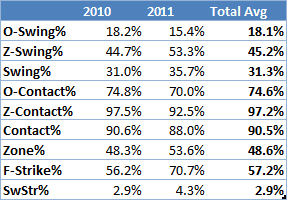
On the surface, Brett Gardner looks like a Bobby Abreu protege (without any power). Since 2010, Brett has shown off his great eye for pitches, posting the 2nd lowest chase rate in baseball at 18.1%.

His ability to make contact with pitches is also astonishing, as he makes contact with 97.2% with pitches in the strike zone, behind only Juan Pierre and Marco Scutaro. Of the 2789 pitches Brett has seen since the start of 2010, he has only swung and missed at 265 pitches.

Where Brett Gardner lacks is in his ability to swing at pitches in the strike zone. Over the last two seasons, Brett has swung at a major league low 45.2% of pitches in the strike zone. He owns this record almost 6% (next lowest is Elvis Andrus at 50.9%) and is almost 20% below the league average. Combined with his low chase rates, its only natural also that Brett has the lowest swing rate in MLB at 31.3%, compared to the league average of 45.6%.

Read the rest of this entry »


Comparing 2010 Hitter Forecasts Part 1: Which System is the Best?

There are a number of published baseball player forecasts that are freely available and online.  As Dave Allen notes in his article on Fangraphs Fan Projections, and what I find as well, is that some projections are definitely better than others.  Part 1 of this article examines the overall fit of each of six different player forecasts: Zips, CHONE, Marcel, CBS Sportsline, ESPN, and Fangraphs Fans.  What I find is that the Marcel projections are the best based on average error, followed by the Zips and CHONE projections.  However, if we control for the over-optimism of each of these projection systems, each of the forecasts are virtually indistinguishable.

This second result is important in that it requires us to dig a little deeper to see how much each of these forecasts is actually helping to predict player performance.  This is addressed in Part 2 of this article.

The tool that is generally used to compare the average fit of a set of forecasts is Root Mean Squared Forecasting Error (RMSFE).  This measure is imperfect in that it doesn’t consider the relative value of an over-projection versus and under-projection; for example, in earlier rounds of a fantasy draft we may be drafting to limit risk while in later rounds we may be seeking risk.  That being said, RMSE is pretty easy to understand and is thus the standard for comparing average fit of a projection.

Table 1 shows the RMSFE of each of the projection systems in each of the main five fantasy categories for hitters.  Here, we see that each of the “mechanical” projection systems (Marcel, Zips, and CHONE) are the best compared to the three “human” projections.  The value is the standard deviation of the error of a particular forecast.  In other words, 2/3rds of the time, a player projected by Marcel to score 100 runs will score between 75 and 125 runs.

Table 1. Root Mean Squared Forecasting Error

Runs HRs RBIs SBs AVG
Marcel 24.43 7.14 23.54 7.37 0.0381
Zips 25.59 7.47 26.23 7.63 0.0368
CHONE 25.35 7.35 24.12 7.26 0.0369
Fangraphs Fans 29.24 7.98 32.91 7.61 0.0396
ESPN 26.58 8.20 26.32 7.28 0.0397
CBS 27.43 8.36 27.79 7.55 0.0388

Another measure that is important is bias.  Bias occurs when a projection consistently over or under predicts.  Bias inflates the MSFE, so a simple bias correction may improve a forecast’s fit substantially.  In Table 2, we see that the human projection systems exhibit substantially more bias than the mechanical ones.

Table 2. Average Bias

Runs HRs RBIs SBs AVG
Marcel 7.12 2.09 5.82 1.16 0.0155
Zips 11.24 2.55 11.62 0.73 0.0138
CHONE 10.75 2.67 9.14 0.61 0.0140
Fangraphs Fans 17.75 4.03 23.01 2.80 0.0203
ESPN 13.26 3.78 11.59 1.42 0.0173
CBS 15.09 4.08 14.17 2.05 0.0173

We can get a better picture about which forecasting system is best by correcting for bias in the individual forecasts. Table 3 presents the results of bias corrected RMSFEs. What we see here is a tightening in the results of the forecasts across each of the forecasting systems.  Here, we see that each forecasting system is about the same.

Table 3. Bias-corrected Root Mean Squared Forecasting Error

Runs HRs RBIs SBs AVG
Marcel 23.36 6.83 22.81 7.28 0.0348
Zips 22.98 7.02 23.52 7.59 0.0341
CHONE 22.96 6.85 22.33 7.24 0.0341
Fangraphs Fans 23.24 6.88 23.53 7.08 0.0340
ESPN 23.03 7.27 23.62 7.14 0.0357
CBS 22.91 7.29 23.90 7.27 0.0347

So where does this leave us if each of these six forecasts are basically indistinguishable?  As it turns out, evaluating the performance of individual forecasts doesn’t tell the whole story.  It may be true that there is useful information in each of the different forecasting systems, so that an average or a weighted average of forecasts may prove to be a better predictor than any individual forecast. Part 2 of this article examines this in some detail. Stay tuned!