Archive for Player Analysis

The Real Reason for Mark Teixeira’s Decline

When the Yankees signed Mark Teixeira to an 8-year, $180 million contract in the 2008-2009 offseason, they knew fully well that they were getting a hitter who liked to pull the ball. Like Jason Giambi, his predecessor at first base, it was believed that his superb power would make up for a batting average that was likely to decline throughout the deal, especially with the short porch in right field at Yankee Stadium. However, Teixeira’s 2014 line of .215/.305/.413 against righties was probably not what they had in mind for their switch-hitting first baseman.

Naturally, many have jumped to blame Teixeira’s woes on the drastic defensive shift that is employed when he hits left-handed. But the shift was there in 2009, when Teixeira finished 2nd in the AL MVP voting with a .292/.383/.565 line and 39 home runs. The fact is Mark Teixeira, spray chart included, was once good enough of a hitter to earn a $180 million contract. Defenses could basically know where he was going to hit the ball and still shook in their boots when he came up to bat.

However, one factor has not remained constant: Teixeira’s production against fastballs. In his prime, Teixeira wasn’t just good against heaters: from 2003-2012, his wFB/C of 1.70 ranks 16th among qualified hitters. But his numbers against fastballs has consistently diminished during his Yankee years. Brooks Baseball gives some additional information (note: wFB/C is from FanGraphs and is not against RHP only):

Mark Teixeira vs. RHP
Year Whiff/Swing GB/BIP% wFB/C
2009 9.74% 30.56% 2.22
2010 11.55% 25.00% 1.29
2011 11.64% 25.23% 1.43
2012 11.80% 29.41% 1.47
2014 14.52% 34.58% -0.14

2014 saw Teixeira whiffing on more fastballs then ever before and hitting more grounders when he did make contact. Even more alarming is the fact that his wFB/C is negative, suggesting that he was a liability against what was once his favorite pitch. Baseball Savant shows a similar downward trend against righties throwing four seam fastballs, two seam fastballs, cutters, or sinkers:

Mark Teixeira v. RHP
Year BA SLG
2009 0.314 0.661
2010 0.291 0.526
2011 0.258 0.512
2012 0.271 0.476
2014 0.195 0.381

Teixeira’s decreasing offensive value makes sense when one considers the fact that what was once his greatest strength as a hitter is now a weakness. And considering the fact that FanGraphs has had pitchers throwing 57.8% fastballs to Teixeira throughout his career, it is definitely not a problem that can be avoided by trying to do damage against other pitches. However, this trend also suggests that Teixeira, who put up wRC+’s of 142, 128, 124, and 116 in the first 4 years of his deal, can become a force on offense again if he can start hitting heaters like he used to.

Unfortunately, I have very little no expertise that can assuredly help Teixeira regain his prowess against fastballs. The only “shot in the dark” idea I have for Teixeira is for him to level out his notorious uppercut swing. The fact that Teixiera is whiffing on more fastballs and hitting more groundballs suggests that his ability to make solid contact has diminished with age and injury. Straightening the path of his swing would give him more of a margin for error.

He could maintain his power by guessing on more pitches, which is what I believe fellow Yankee Brett Gardner did in 2014, when he hit 17 of his 40 career home runs. According to Baseball Savant, 15 of his 17 home runs came from four seam fastballs, two seam fastballs, sinkers or cutters. The fact that all of them were pulled to right field, despite greater velocity, leads me to believe that Gardner was sitting on them more often than not.

Alternatively Teixeira’s lingering wrist injury (which is why I left his 15-game 2013 season off the tables above) might be making it harder for him to turn on pitches with high velocity. Conversely, Teixeira could be correct in suggesting that a full offseason workout program could allow him to return to form. In any case, Teixeira needs to regain his ability to destroy fastballs if he has any hope of being a force on offense again.


R.A. Dickey: A Brief Tale of Consistency

Being a Toronto native, I had a fair share of complaints last season. Seeing hefty division leads evaporate with the blink of an eye stinks, as does Brett Lawrie’s 3rd failed attempt at a breakout. I could complain about a lack of financial commitments from management (on the field) and about the overall middle of the pack finish.

When Alex Anthopoulous acquired R.A. Dickey before the 2013 season, expectations were high. When initially reviewing his first season in Toronto, a Cy Young winner who puts up a 4+ ERA the following season is disheartening. Yet in March 2013, were you really expecting a fly ball pitcher in the Rogers homerdome of the AL to perform on par with what he did in the NL while throwing to the pitcher every other inning? The last two seasons have had disappointments, but R.A. Dickey has been consistent in a reliable and also amusing way.

Dickey ended 2013 with a 14-13 record, and coincidentally, this past season’s win-loss record was an identical 14-13. I am in no way soliciting win-loss records, and this is saying nothing about how he threw the ball. The identical records merely add to the interesting couple seasons the now 40-year-old knuckleballer has had with the Jays.

To achieve the identical 14-13 records, each of the last two years Dickey made 34 starts. While it may not sound impressive, only nine other pitchers made as many starts in 2014, and only “Big Game” James Shields has made the cumulative 68 starts since 2013 that Dickey has. Since 2013, he ranks 4th in innings pitched, trailing only Felix Hernandez, Adam Wainwright and Shields himself. While many Jays fans would infer that doom looms when Dickey jogs on for his 6th and 7th inning of a start, the overall results were at the very least, respectable.

Although eating innings is certainly an important quality, nobody is congratulating Edwin Jackson every five days. Our best overall performance indicator is probably WAR, and wouldn’t you know it, Dickey’s fWAR was 2.1 in 2013 and 2.1 in 2014. 2 Wins Above Replacement matches up with expectations for your average starting pitcher, so it is no surprise that Dickey’s number is in line. On a runs allowed basis, his bWAR is 2.0 and 2.5 in 2013 and 2014, respectively. To fuel the similarity fire, his strikeout percentage in 2013 was 18.8%. As you guessed, his 2014 figure is one Josh Thole framing blunder away, at 18.9%. And, without shock, the strikeout to walk rate budged a mere .15 percentage points from year to year. As you can see, if one tempers their Cy Young expectations, Dickey has been plenty useful and stable for the Blue Jays. If you buy that case, then the remaining wonder is whether he has value relative to the investment.

When last year ended, Dickey took home $5 million in salary, not including signing bonuses offsetting Canada-US tax discrepancies. With the price of a WAR being roughly $7 million annually nowadays, Dickey was a bargain at $5 million in 2013. His extension had him making $12 million this past season, so if we are auditing to the penny, he was slightly below market rate.

With regards to the initial trade, the package for Dickey included Travis d’Arnaud, the big Noah Syndergaard, a low end outfield prospect and John Buck, who was set to earn $6 million in 2013. Of course, the Jays also received two catchers in Mike Nickeas and Josh Thole (there were a lot of catchers in this trade). Although d’Arnaud was a major piece at the time, it is worth noting that come next season, he will be a 26 year old catcher with a grand total of 533 plate appearances at the MLB level. On the other hand, Syndergaard is still only 22, and has very good stuff. However, given the increase in the frequency of pitcher arm injuries nowadays, he remains miles away from being a middle of the rotation starter.

Blue Jays fans have seen Bautista and Encarnacion as the significant bright spots for the team over the last two years. With both of them only under contract for a couple more seasons, in addition to them having likely put their best years behind them, Dickey has certainly given the team a better chance to win – at the appropriate time. This was Anthopoulous’ thinking when he made the acquisition, and although the overall results have not been perfect, it was a reasonable gamble. Not to mention the positive return on investment the team yielded from Dickey himself.

The overstated reality is that R.A. Dickey has been a good pitcher. The guy had a better ERA- than Hisashi Iwakuma last season. He had a better ERA- than Francisco Liriano too, and the latter is likely to get nearly $40 million in free agency despite having not started 30 games since 2010. Dickey has given the Jays a good chance to win in a tough environment. Sure, nobody is happy to have Thole in the lineup once a month, let alone once every five days. But hey, at least we are fortunate enough to not have had Jose Molina and his 23 wRC+ (not a misprint) frequent the lineup card.


Mike Trout’s Traditional MVP Award

If you read or surf through once in a while, you will surely venture across baseball job openings. It is enlightening to see an increasing amount of analytics positions looking to be filled, especially with major league teams. Advanced stats and sabermetrics have emerged in the last decade. This is clear. What is not clear yet is if the once niche perspective is fully sunk into mainstream baseball culture. Certainly, this wasn’t true a couple years ago, or Mike Trout’s MVP award would not be his only one.

It would be a lie to say that advanced statistics have been beyond the peripherals in major award voting in recent years. I am fairly certain that a league leading ERA and WHIP were not enough to win an AL Cy Young award this past season (poor Felix). Not to mention that the same Mariner took home the glory with a murky 13-12 record a few years ago. On the Gold Glove circuit, I can make the open claim that defensive metric leaders and Gold Glove victors lined up much more this year than they have in the past. Even Adam Jones’ defensive season was arguably deserving of a gold glove (not his 4th though…).

Let us focus on baseball’s best player (I can say that now, right?). Mike Trout has been juiced out of at least one MVP, and maybe two depending on what side of the fence you sit. From the table below you can see his “traditional” stats in both those years.

Year HR R RBI AVG fWAR
2012 30 129 83 .326 10.1
2013 27 109 97 .323 10.5

From analyzing the first table, he still had fantastic years. And as we know, he scored back-to-back 10 fWAR seasons. On the other hand, here is what Miguel Cabrera’s corresponding numbers look like:

Year HR R RBI AVG fWAR
2012 44 103 137 .348 7.6
2013 25 101 109 .313 5.4

Based on the tables, the main drivers year over year seem to be home runs and RBI. From 1993 to 2007, every single AL MVP had 30 homers and 100 RBI – aside from leadoff hitting Ichiro in 2001. In the NL, the song remains the same with only Barry Larkin failing to reach the 30 homer mark and two others merely totalling 90+ RBI. While this was a steroid heavy era, there is not enough reason to discredit the data, as with an even larger sample of MVPs, the same trends can be drawn. In 2012, Miguel’s “box” looks significantly better – 137 to 83 RBI is quite a large gap. To avoid sounding like a broken record, I will not mention the poor defense and baserunning that the Tigers corner infielder accounted for. That is why Trout’s standalone fWAR numbers are second to none. In 2013, it was more of the same from Trout. The 10 fWAR season was almost double Cabrera’s, but a 179 OPS+ (park- and league-adjusted) put him behind Cabrera’s 190 OPS+. With the defense and baserunning, it was still likely another Trout miss by the voters.

Arriving back to present time with Trout holding his trophy, it is worth understanding what he did differently. In short, he started being more aggressive and his whiff rate (number of swings and misses per pitch) rose. I would also speculate that with Statcast data, we would see ball speed off his bat is faster this year. As for his results, there is no surprise his strikeout rate jumped, nor is there for the home run total. As they positively correlate, the RBI came up too, leaving his “traditional” numbers looking like this. His fWAR total is also alongside.

Year HR R RBI AVG fWAR
2014 36 115 111 .287 7.8

While it is common on a typical defense and baserunning aging curve, the former and the latter did, in fact, take dives as well this year. Trout’s willingness to run decreased by more than 50% (18 total stolen base attempts) and he actually graded out as a relatively bad center fielder.

My claim here is simple. Mike Trout, whether acting purposeful or not, did what the classic MVP voting criteria wanted him to do – hit homers and drive in runs. This past season, Trout was significantly less valuable than he was in his previous two years, but according to the traditional measures, he was fabulous in the now hitting-depressed baseball. In September of 2012, Trout was quoted saying “I was trying to do too much, trying to hit home runs when I shouldn’t be.” Clearly, he has discarded this mentality, and because of it, he unanimously captured the MVP – the first American Leaguer to do so since Ken Griffey Jr. in 1997.

Can you see the irony here? Mike Trout manages two consecutive 10 fWAR seasons, a feat only done by Barry Bonds, Willie Mays and Mickey Mantle. He doesn’t win the MVP in either one. The next year he cuts his fWAR by almost 3 wins but adds 28 RBI and half a dozen homers to his totals. All of the foregoing occurs, in the era in which sabermetrics are undoubtedly now integrated into modern baseball. (Fortunately for him, he didn’t need 10 WAR to be seen as baseball’s best player). The fact is that Mike Trout just won the MVP – the traditional way.


Extreme Makeover: B.J. Upton Edition

Back in 2007, B.J. Upton was thought to be a future megastar, a young tools-filled player, whose future seemed to almost certainly include MVP consideration and numerous other awards. As a 24-year-old he put up back-to-back 4+ WAR seasons. For the past two years however, he has posted a total -0.2 WAR. What has happened to B.J. Upton? He is only 30 years old, which for an athlete of his caliber, is still potentially only the tail end of his prime.

Defensively speaking, he has had ups and downs, but the swings in performance were never too drastic, posting a -7 DRS and -1.9 UZR/150 in 2014 compared to -3 and 8.4 back in 2008. His Defense rating has dropped from 9.8 to 0.1 from 2008 to 2014. Again, obviously not good, but not enough to account for such a big drop in WAR. So his troubles must mostly be tied to his offensive production.

I first tried to identify the problem with his hitting by dividing our options into two groups. The biomechanics processing results versus possible telling statistics on his approach. Let us look at the latter to start. A couple things I want to focus on would be his O-Swing% and how he performs in hitter-friendly counts. From 2008 to 2014, his O-Swing% has jumped up 11% from 16.8% to 27.8%, which is not a great indication that he has a plan when stepping into the box. Hitter’s counts are all about the approach, not only working yourself into this count, but being ready for your pitch because you can be selective at the plate.

Avg. / wRC+ Through 2-0 Through 3-1 Through 3-0
2008 .265 / 176 .262 / 212 .353 / 280
2014 .091 / 134 .097 / 150 .100 / 204

Now obviously the wRC+ numbers will be inflated due to the higher walk rates when in a hitter’s count, so I am focusing more on average. To help put this into perspective, in 2014, through 0-2 counts, Upton hit .085. That is scarily similar to his performance in hitter’s counts. Clearly something is off. When in a hitter’s count, the batter typically sits on a fastball, so naturally my next focus was to look at his wFB. His wFB in 2008 was 1.1 and in 2014 was -11.1. So while he used to be above average, he has now become much worse at handling fastballs, which would correlate to his lack of success hitting in hitter’s counts. In order to survive in this league as a hitter, you must be successful hitting against the fastball. His pitches seen rate has remained relatively consistent except for a slight increase in sliders seen. His lack of production in these areas really makes me question whether he is ready to hit when stepping into the box.

If you have ever seen a B.J. Upton swing you know there are a lot of moving parts. This in and of itself is part of the problem. Double loads, bat wraps, too much rotational and not enough linear movement, dipping, and changing eye levels are all apparent. But first let’s start with the numbers. A couple of things jump out when looking at the numbers. To begin with, his GB/FB rate in 2008 was 1.65 in comparison to a rate of 1.11 in 2014 while his 2014 HR/FB rate is lower than his career rate, it is higher than his 2008 All Star rate at 9% compared to 7.4%. His line drive rate is consistent throughout.

However Upton’s BABIP tells you most of the story. Upon entering the league full time in 2007, B.J.’s BABIP was .393 then .344 in 2007-08 compared to .286 in 2014. This is ridiculous and impossible to sustain! The question is, does this then make his two best years a fluke? Back in 2010 and 2011 he had near-league average BABIP years and posted close to a 4 WAR in both. So as ridiculous as those 2007-08 numbers were, I can’t blame his entire decline on not being as lucky.

Another one of the most worrisome numbers is to see his Z-Contact% drop 10%, almost as much as his overall Contact% which dropped 12%. This to me screams mechanics. So let’s take a look (and I apologize in advance for the youtube link, but it serves our purposes decently enough — I still haven’t figured out the .Gifs). Ironically enough, he hits a home run in this video. It just goes to show all the holes in his best of swings.

The first thing you see is at the peak of his negative move his hips slant upwards (2 second mark). The reason this happens, is because his leg kick doesn’t gain any ground. It immediately makes him more likely to have a bit more uppercut in his swing and it also changes his eye level due to the flexion in his knees changing while the distance between his feet do not change. Both factors make it more difficult to produce solid contact. Once at toe-touch, he then loads again and inverts his front leg, making it a double load (5-6 second mark). This leads to the potential to over-rotate (think Newton’s 3rd law — for every action there is an equal and opposite reaction). By inverting and coiling his body, he will uncoil, or over-rotate off the pitch, causing his shoulders and hips to pull off the pitch and not stay square.

Once he finishes inverting his front side he commits to swinging. His hands/upper half look okay up to this point (7 second mark), and they’re very active. However his upper half and lower half are completely out of sync. Once he initiates his swing, his bat immediately wraps because he still hasn’t come set with his barrel, the bat has been moving the entire time. At this point there is nothing going forward at all, no backside drive. It is all rotational, making it harder to stay on the ball if his timing isn’t near perfect. In other words, due to having a more rotational swing versus a linear swing, his margin of error with timing is much narrower.

Once at the contact position (11 second mark) he looks okay. He hits the ball off his front foot, his elbows are at slightly obtuse angles, and his front side is stiff. During his bat path his hands dip a bit, giving him a high finish, most likely due to the pitch being low.

B.J. Upton’s biggest problems in his swing come before his contact position. This is a very good explanation for why he struggles against fastballs and in hitter’s counts. Simply put, he isn’t ready to hit. He has way too much going on, the main problems being his double load and lack of linear movement. In an age of power bullpens and power fastballs it is no wonder that he is struggling as badly as he is. B.J. Upton needs to simplify and settle everything down in the box. His swing is fixable, but these issues need to be addressed and changes have to be made if he is ever to be successful again.


We Might’ve Met NYY’s Next Great Reliever

2014 wasn’t a good year to be a starting pitcher on the New York Yankees. With injuries to CC Sabathia, Masahiro Tanaka, Michael Pineda, Ivan Nova and David Phelps, jokes about Andy Pettitte coming back from retirement again started to find “but really though” tacked on at the end. Out of the rotation vacuum emerged Shane Greene, an unlikely success story from Daytona Beach Community College. If the Yankees manage to put together a healthy starting rotation for opening day, Greene will likely be shifted to the bullpen, where I believe he will flourish.

In 78.1 IP as a starter, he posted a 3.79 ERA, a 3.64 FIP, a WHIP of 1.37, and K/9 and BB/9 rates of 9.19 and 2.99 respectively. His WHIP would lead many to think he overachieved, but aside from that and his walk rate, he was an above average pitcher.

What stands out specifically about Greene is his 2-seam fastball. To make a long story short, Pitch f/x would suggest that it is very hard to hit:

Pitcher vSI vFT h-movSI v-movSI h-movFT v-movFT
League Average 90.7 91.5 -4.6 4.9 -1.9 6.4
Shane Greene 93.9 92.7 -7.7 5 -8.5 6.3

Note that while his scouting report does not specifically mention him as throwing a sinker, Pitch f/x occasionally registered his 2-seamer as one. While this is pretty common (Kelvin Herrera’s 90 mph changeup routinely registers as a 4-seamer), I believe that it is a telling sign when it comes to the life on Greene’s fastball.

Unsurprisingly, his fastball is harder to hit with increasing velocity. Hitters put up a mere .136 BA and SLG% in an admittedly small sample size against Greene’s 2-seamers above 94 mph. Those slower than 94 mph were hit to the tune of a .340 BA and a .447 SLG%. It is well known that pitchers experience an increase in velocity after a starting rotation to bullpen transition. Greene’s 2-seam fastball, which averaged at 92.8 mph, could easily creep up to the mid 90’s if he were put in the bullpen.

Of course, one reason why he might not ever succeed out of the bullpen is because he could remain a starter. He showed flashes of dominance in 2014, the most noteworthy being his shutout of the potent Tigers lineup. But even if the Yankees do pencil Greene into the 5th spot of their rotation, something will have to give when Ivan Nova comes back from Tommy John surgery.

Like Joba Chamberlain when he became a starter in 2009, those few extra miles per hour on his fastball could make a huge impact on Greene’s numbers. As a fan, I appreciate David Robertson both as an excellent pitcher and a superb role model. But if the Yankees do not want to pay him the closer money he will deservedly get on the free agent market, Greene might be a cost-effective late-inning option.

Note: Stats not taken from FanGraphs are from baseballsavant.com


A Surplus of Middle Infielders for the Rangers…Again!

2014 looked to be a positive year for the Rangers. However, injuries took their toll on the Rangers and though they could keep up for a few months, they were too much to handle. Jurickson Profar was out for the whole season due to injury, this led for an opportunity for young prospects Rougned Odor and Luis Sardinas. Odor eventually outplayed Sardinas and won the starting job, as Sardinas was sent back to the minor leagues. As 2015 approaches the Rangers now have four middle infielders who could potentially play shortstop and second base.

Elvis Andrus has been the shortstop for the Rangers since 2009, and signed a huge eight-year contract in 2013 and seems to be the guy for shortstop in 2015, however since batting.286 in 2012 has failed to hit over .275 in the past two seasons, and hit just .263 in 2014. His OBP was just .314 in 2014 and OPS was only .647.

Jurickson Profar remains a big question mark. Labeled the number-one prospect in all of baseball before the 2013 season, he played in 85 games and hit just .234 for the Rangers. Named the everyday second baseman in spring training before hurting his shoulder, the Rangers were expecting big things from Profar.

Rougned Odor was called up from Double-A in May of 2014 and exceeded all expectations the Rangers had for him. He hit .259 with 9 home runs, and was the youngest player in the major leagues at 20 years old. His defense improved as the year progressed and was certainly a nice surprise in a season of dismay.

Luis Sardinas played in just 43 games for the Rangers, but sure did showcase a strong set of skills. Hitting .261 with six extra-base hits and 8 R.B.I. Sardinas played well in the role the Rangers gave him, and he will be competing for a spot in 2015.

As Elvis has played below expectations for the past two seasons, I do not see the Rangers trading him away. The only way the Rangers could get rid of him is to trade him, and with his big contract, if a team is willing to take it on the return for him will not be worth it. Though he had an incredibly poor year last year Andrus offers a veteran presence, and consistency defensively. With Andrus, the Rangers know they’ll get above-average defense, a bunch of stolen bases, and a decent batting average, with little power. Because of this he will be the shortstop for the Rangers in 2015.

Jurickson Profar puts the Rangers in an odd spot. Essentially he has missed a year and half of development with his injuries, and there is no telling what he will be in 2015, or if he will even be healthy. In 2013 the Rangers moved him all over the field and that played a part as to why he did not perform to his potential. He could not get comfortable in a position, and it hindered him. In 2015 if healthy, he should break spring as the second baseman, and play well at second base offensively and defensively.

Rougned Odor performed incredibly well for the Rangers in 2014. He improved defensively at second base and after a tough month of August where he hit just .221 turned it around in September hitting .296, and he had a much improved OBP at .345. Odor was the youngest player in the MLB last season, and should start 2015 in Triple-A where he can work on pitch selection, working the count, and improving at second base defensively.

Luis Sardinas has the slimmest of chances to win a job on the Major League club out of spring training. His best chance is as a utility man, however the Rangers would rather have him in the minor leagues getting to play everyday. Sardinas performed well in his time with the Rangers, but as he was the 3rd youngest player in the MLB will likely find himself as the everyday Triple-A shortstop for the Round Rock Express.

To sum it up, The Rangers middle infield is going to be Andrus at short and Profar at second, with Odor and Sardinas starting the season in Triple-A. With the youth of Profar, Odor, and Sardinas they can be traded, and used for a package deal potentially for a starting pitcher pitcher like Andrew Cashner or Ian Kennedy of the Padres. It will be an interesting off-season for the Rangers, as they try to put 2014 behind them.


Josh Donaldson: Changes in Approach and Mechanics

A short note: For those inclined only to GIFery, you can skip to the bottom.

The 2014 Oakland Athletics got taken out in the soul-crushing Russian roulette that was the Wild Card play-in game. The Billy Beane gambles didn’t pay off. On top of that, even though it rained on their parade, the San Francisco Giants won the World Series.

All is not lost for the A’s, however.

There are other great articles that go over the outlook for next year’s Athletics team in terms of payroll and contracts. Today, we’re going to squarely focus on the on-field performance of only one of those pieces – someone who has evolved into one of the best overall position players in the game.

Let’s dive into Josh Donaldson’s trends in the offensive arena, and attempt to find meaning in those trends for his performance in 2015 and beyond.

Josh Donaldson figured it out in the summer of 2012: after struggling through most of the early part of that year, he was sent down to AAA in mid-June, getting the call back up to the majors on August 14th. He batted .290/.356/.489 the rest of the way with 19 extra base hits, led the A’s to an unlikely division championship, and gave us a snapshot of the player we now expect him to be.

At his best, Donaldson is a middle of the order power bat that can hit to all fields and draws walks at an above average clip. Whether coincidentally or not, his overall plate approach fits that of the A’s organization: work into deep counts, get a good pitch to drive, and swing hard. He’s shown some subtle differences in rate statistics during the two highly successful years since his breakout, and that’s what we’re mainly going to look at before moving on to a discussion about his specific hitting mechanics.

One of the main differences between Donaldson’s 2013 and 2014 was his batted ball profile in regard to line drives and fly balls. At surface level, the continued evolution of Donaldson’s batted ball profile since his breakout in August of 2012 mirrors the Athletics’ high OBP/home run tendencies. As we’ll see later on with the mechanics portion of the article, there’s more here than meets the eye. However, to begin with, let’s look at his line drive and flyball tendencies.

Here we have Line Drives per Ball In Play for Donaldson in 2013 and 2014:

LDs_per_BIP

And here we have a breakdown of his Fly Balls per Ball In Play:

Flyballs_per_BIP

It’s not too difficult to tell what’s happened during the majority of Donaldson’s effectiveness at the major league level: he’s hit more fly balls and less line drives against fastballs over time. The obvious answer to why this has happened is that Donaldson could simply have changed his approach to try to elevate hard pitches for homeruns in 2014. His overall line drive rate fell along with his batting average and Batting Average on Balls In Play in 2014 as well, as fly balls don’t always (or even usually) go for homeruns, and also result in outs more often than line drives. Donaldson’s groundball rate stayed almost exactly the same between the two years.

His counting stats reflect this change in batted ball profile, as he shifted a few 2013 doubles to home runs in 2014. Let’s compare his stats from the past two years. Donaldson played in the same number of games in each of the past two years, with a few more plate appearances in 2014:

2013_2014_Compare

There isn’t a major difference in his strikeout and walk rates – strikeout rates are up for almost everyone, so proclaiming Donaldson’s slight increase a true trend has its problems. As we’ve seen, the strikezone expanded this year by a large degree, something that wasn’t lost on the All Star third baseman.

Another element in this comparison that we should keep in mind is the damage on his statistics wrought by his slump of over a month in June of 2014. It was one of the worst months of Donaldson’s career, as he hit .181 with a 4.5% walk rate, 6.0% line drive rate, and hit grounders 65.1% of the time (as a reminder, league average is around 44%). He would overcompensate his swing in July, causing a 52% flyball rate (league avg. = 36%), but his walks and power production came back to almost normal levels. As it is, we’re left to wonder what his 2014 could have looked like if not for the extended slump.

Given the changes in batted ball profile and rate statistics between 2013 and 2014, we need to go deeper into causation. Did Donaldson simply change his approach to hit more fly balls? Was this an unintended result of a change in his mechanics?

Let’s find out.

To help me with the technical specifics of Donaldson’s swing, I’ve brought in Jerry Brewer, a great hitting instructor and general swing mechanics wizard from the Bay Area. He runs East Bay Hitting Instruction, and posts great in-depth breakdowns of swing mechanics over at Athletics Nation. We talked about a few different topics on Donaldson’s swing over the past week.

Owen Watson: Hey Jerry! Thanks for lending your expertise to this – I’m a relative newcomer to the world of swing mechanics and it’s always great to talk to someone who really knows the subject. Can you briefly explain the basic mechanics of hitting, so we can get a baseline understanding of the subject?

Jerry Brewer: The goal of the swing is to put the bat behind the ball with speed on the bat. Pretty simple. Elements of a “good” swing include proper body position, movement sequencing, timing, consistency, and execution. These are the main things I look for when grading someone’s swing:

1) Swing time: how long it takes a player to start their swing to contact with the ball.

2) Swing path: the path the bat travels to meet the ball.

3) Finally, I look for body position as the hitter is completing the stride, which is where you can get a sense of whether the player can make adjustments to pitch location and speed. Donaldson is fantastic here.

OW: Great, so what are the main characteristics of Donaldson’s swing – how is he different from other hitters, and what does he do well/not so well?

JB: Donaldson’s swing in a word: athletic. The baseball swing is just a sequence of movements, and he moves his body optimally. What he does well: his front side mechanics. His rear mechanics are really good too, but his front side is incredible. In my opinion, it is what allows him to be such an all-fields hitter. The one knock could be his path to the ball is an inch or two long. But, to quote myself, “that’s like pointing out a scratched license plate on a Ferrari.”

OW: Donaldson is in many ways a classic poster boy for the A’s patience/power combo. Is his power increase from 2013 to 2014 a result of the coaching of the A’s offensive approach under (former) hitting coach Chili Davis?

JB: It’s hard to say how much influence Davis had on Donaldson’s approach. My guess is very little. Donaldson was a high walk/high power guy in the minors and it just took some time to gel in the show. I am of the mindset that a person’s approach is pretty ingrained and hard to coach. As for the power, Donaldson came into spring training in 2014 with a pretty pronounced bat tip (how far forward the bat head is brought during swing loading) toward the opposing dugout. Think of it like a bigger backswing. That told me right then that he was going for more power.

OW: How do we explain the increase in flyball rate, then? When I look at the jump in his flyball tendency in 2014 as opposed to 2013, one explanation is that it was an intentional attempt to try to elevate the ball for more power.

JB: The flyball tendency is a little difficult to explain on swing mechanics alone. For example, he got the bat tip completely out of control in June and still hit only 30% flyballs. My best guess is that the excessive bat tip caused him to be just a hair late on fastballs, sending more balls in the air. We saw this in his opposite field hitting: in 2013 his flyball rate to the opposite field was 52%, but in 2014 it went up to 62%.

I didn’t see a change in loft in his swing in 2014, it’s just a little more difficult to put the bat on the ball consistently with the aggressive bat tip. When he did hit the ball well, it travelled, as his HR/FB was way higher in the first half when he was tipping, but he had more mishits than in 2013.

Basically, Donaldson went Javier Baez for awhile.

OW: When I watch him, he seems like he has an entrenched timing mechanism with the leg kick. How does that function in his mechanics? I’ve always wondered whether it could be a cause for slumps if it gets mistimed.

JB: The leg kick is really secondary. The more important thing is Donaldson now has a lot more of a slower, longer movement with the bat before launching the swing. Most guys who do this (Ortiz, Bautista, Hanley Ramirez) go to a leg kick so the lower body is doing something while the upper body is doing something. I call this matching. On the other end of the spectrum are guys who don’t do much with the bat pre-launch, so their lower bodies are more quiet (Tulo, Utley, Brandon Moss). The positives of the bigger movements are that it can allow the player to get to the position they need. Stride type is really personal based on approach, habits, and anatomy.

Looking at Donaldson’s pre-leg lift swings, the high leg kick gives him time to open his front leg more, which is something he talked to me about. The negatives of the leg kick are that it simply may not be the right fit for a player based on the above factors. It takes some serious athleticism to be consistent with a swing like that.

OW: Let’s talk about that consistency. I’ve been wondering about the big slump he had in June when he hit .181 with just four extra base hits over the entire month, carrying the slump well into July. What happened to cause that?

JB: Mechanics wise, I think the excessive bat tip caught up with him, either from the grind of the season or taking a couple pitches off the hands/forearms in June and July. In late July he quieted down the bat tip and started rolling. If he goes back to the excessive bat tip, then yeah, he could fall into a slump. I think and hope that he’s got that figured out.

OW: What do you see as his ceiling, then? If he figures out the bat tipping and can cut down on extended slumps, where will that put him?

JB: It’s very high. The batting average is the big question. We were a little spoiled in 2013 when he hit .301. That was propped up by a ridiculous .448 average on balls hit the other way…

OW: Right, and a Batting Average on Balls In Play of .333.

JB: That is and was completely unsustainable. But I think he fits in somewhere between .300 and last year’s .255 in regard to the average. Last year he kind of got robbed on some hard hit balls, when he hit 131 of them and his average on those balls in play was 54 points under the league norm. Some of that is the Coliseum being a pitcher’s park, obviously. Also, he got rung up 10 more times on looking strike threes in 2014 than in 2013, so that could be an area of improvement. I would probably say his ceiling is around .277 with 27 HRs.

OW: Not bad for a third baseman with that kind of defensive prowess, too. Thanks a lot for your time, Jerry! This has been really informative. Here’s to spring training…

————————————————

After the discussion with Jerry, it became apparent that Donaldson’s change in mechanics toward a more aggressive bat tip could be a big reason behind the differences in batted ball profile between 2013 and 2014. I decided to look at some instances of tape over the past two years to see when he was going with a more controlled approach as opposed to a more aggressive one. While 2013 showed a very consistent approach throughout the entire year, 2014 didn’t have as much of a set pattern as I once thought. Let’s investigate.

Here we have Donaldson’s mechanics during almost all of 2013 – at the point of swing loading (just before the stride starts toward the pitcher when the balance of weight is on the back foot), Donaldson’s bat is almost perpendicular to the ground, and his stride forward is consistent and low. Here he is hitting an inside-out double to right center in mid-September of 2013:

091313_Controlled

Bat tipping is minimal here, allowing Donaldson to stay short enough from swing loading to contact to hit a 94 MPH fastball on the inside part of the plate into the right centerfield gap. Now let’s look at a swing from almost exactly a year later, in mid-August of 2014:

081214_Aggressive

Watching it a few times, it’s clear this is a highly aggressive swing. The leg kick is slightly higher than it was in 2013, and the bat movement is noticeably different. Instead of being almost perpendicular to the ground, the bat points strongly toward the opposing dugout at swing loading, whipping around to generate as much power as possible. One reason this swing could be so aggressive is that Bruce Chen was on the mound, and Donaldson could gear up on a slow fastball in a 1-0 count. Instead, he got an 83 MPH slider that didn’t slide, and stayed back on it enough to hit it 425 feet over the centerfield fence.

Looking at tape of early July 2014 following the terrible slump, it’s apparent that Donaldson all but ditched the aggressive bat tip, probably in order to make more consistent contact. Yet, with the example above during August, it was back in a major way.

This begs the question: is the aggressive bat tipping something that Donaldson turns on situationally, such as a 3-1 count? Or is this just noise, and part of the tweaking and maturation process that a relatively new major leaguer goes through?

The answer to that question may be for another time, but a cursory examination may support the situational hypothesis. Looking back through a few examples, the bat tip does change from situation to situation in a short span of time. Just three days before the hyper-aggressive swing against Bruce Chen, Donaldson showed almost no bat tipping on an RBI single with two out and the bases loaded versus the Twins. In mid-July, three weeks earlier than that, he showed very aggressive tipping on a three run walkoff home run against the Orioles. This could certainly be random, or noise, or something he doesn’t know he’s doing.

Or maybe, as Jerry says, Donaldson just wants to go a little Javier Baez sometimes.

————————————————

Special thanks to Jerry Brewer, who can be found at East Bay Hitting Instruction and on Twitter @JerryBrewerEBHI. All graphs are Brooks Baseball.


Hitting Wins Championships(?)

Over the past week or so, there have been baseball playoffs. And, like you, I have heard so many different opinions about what it takes to win a World Series Championship. Usually you hear “pitching wins championships”. This year, it’s “destiny”, “shut down bullpens”, and being a member of the San Francisco Giants. But what about hitting? Why is everyone so down on hitting? Isn’t it weird that the part of baseball people marvel at is brushed aside when trying to explain success in the postseason? Why have we never heard this?

Since I mostly despise the people that exclaim “THEY JUST KNOW HOW TO PLAY IN THE POSTSEASON” without any regard to statistics, I went back and looked at the World Series winners since 2002. I only went to 2002 because some data isn’t available on FanGraphs for the stats that I wanted to use.

The stats I used for this article

Starting Pitching and Relief Pitching

I used Wins, Saves, and Beard Length GB%, K%-BB%, and WAR because these are generally the three most looked at stats in terms of success for starting pitchers. I also felt it would give me a broader picture of the staff instead of just looking at WAR and being done with it.

Hitting

I used Runs, RBI, Bunts wRC+ instead of WAR because I wanted to isolate what the player did at the plate. We’ll look at defense and base running later. I also used K%, BB%, BB/K, ISO, and O-Contact%. I used the percentage and ratio stats to see if good discipline or free swinging mattered most. ISO is a better indicator of power than SLG and home runs. Using O-Contact%, however was a niche of mine that I threw in because I’ve always been scared of guys that have a bigger strike zone than others. It was also inspired by this Ken Arneson series of tweets. In theory, guys with higher O-Contact% rates are also harder to strike out, are more prone to BABIP luck, and also “put more pressure on the defense.”

Baserunning

I used BsR to measure both the weight in stolen bases and base running performance.

Defense

Even though it is far from perfect, I used UZR to quantify defense. Inspired by the Kansas City Royals, I also included outfielder UZR for this exercise.

Methodology

I picked out every WS winner since 2002 and wrote down the number of each stat mentioned above, and the league rank that went along with it. Here is my Excel spreadsheet, if you’re interested. I picked out the importance of each statistic based on top-5 and top-10 rank, and, to mirror the successes, bottom-10 and bottom-5 rank.

Results

If you looked at the spreadsheet that I linked to, you’ll notice that the statistic with the most top-5 rankings, the fewest bottom-10 rankings, AND the highest average ranking is wRC+. In fact, four of the top five stats with the highest average rank were hitting statistics. The top-5 with average rank: wRC+ 7.58, BB/K 9.17, SP WAR 10.17, ISO 10.25, O-Contact% 10.42. I’m not trying to say nothing else matters, but the data seems to suggest that teams need a better offense more than they do starting pitching, if only slightly so.

On the flip side of things, the statistic with the most bottom-10 ranks, and lowest overall ranking (K% would be lowest, but remember, lower is better with K%) is GB% for starting pitchers. Only the ’04 and ’11 Cardinals had a top-5 GB% while also getting league average (Rank > or = to 15) WAR from their starting pitchers. Six out of the 12 teams listed here posted bottom-10 ranks in GB%, which is incredibly interesting, given the theories behind ground ball pitchers that are so commonly found on the web nowadays. Does this mean ground balls are not important? Well, no. But it does mean that they may not be as important as they once were thought to be.

Base running didn’t end up being as big of a factor as I thought it would be, the Cardinals apparently care not for good defense, but look at O-Contact%! It was the fifth most important stat by average rank, and finished with only one team (’04 Red Sox) in the bottom ten, as opposed to six top ten placements. Furthermore, the rate at which teams struck out mattered more than how often they walked, but BB/K is the peripheral that seems to be the most telling.

We’ll probably never hear about how an offense won a team a World Series. In fact, we’ll probably instead hear it spun as a pitcher blowing the game. But at least now we have statistical evidence (even if it is only the past 12 years) that offense IS a major player in deciding who wins the World Series. We also have evidence to suggest that maybe hitters who expand the strike zone to their advantage are more valuable than has been discussed recently. Admittedly, this would take another article to deduce. Any takers?


Albert Almora’s Inability to Walk

In 2012, the Chicago Cubs used the 6th overall draft pick to select Albert Almora, a high school outfielder from Miami. Almora was considered one of the top prospects in Chicago’s system and all of baseball entering 2014, ranking 36th on Baseball America’s Top 100, 28th on Keith Law’s Top 100, and 25th on Baseball Prospectus’s Top 101.

Almora struggled at the plate for a couple months in High-A this season before finally showing some brief improvement. This led to a promotion after just 89 games despite an OPS of .712. He performed even worse in Double-A, posting an OPS of .605 in the 36 games he played at the level. One of Almora’s most glaring flaws is his low walk rate—in 530 combined PA between the two levels at which he played this year, Almora walked just 14 times, a miniscule 2.6% of his plate appearances.

One explanation for Almora’s low walk rate is that his innate ability to make solid contact on most pitches prevents him from getting deep into counts and working walks. As Keith Law noted last offseason, “[Almora] has great hand-eye coordination that allows him to square up a lot of pitches, but has to learn to rein himself in and wait for a pitch he can drive to make full use of his hit and power tools — and if that means taking a few more walks, well, both he and the Cubs could use that right about now.”

We know that drawing walks is a good offensive skill to possess, but how problematic is it to be unable to do so? I wanted to better understand if it is possible for Almora to still have a successful major league career even if he is never able to overcome his inability to see ball four, and if so, how he might accomplish that.

I was a little surprised to find that out of all qualified major league hitters this year, the five lowest walk rates all belong to players who provided at least 2 WAR to their team, meaning they were at least average players. I examined how each player was able to do so despite posting a walk rate of 3.7% or lower.

Ben Revere owned the lowest walk rate in the MLB this year, coming in at 2.1%. Despite this, he was able to put up a respectable wRC+ of 92. Most of Revere’s offensive value comes from his ability to make contact (7.8% strikeout rate) and a high BABIP aided by his tremendous speed. He also provides a lot of value on the bases, where he is once again helped by his speed. While UZR hasn’t loved him in center field this year, he does play a premium position, and he has had better defensive numbers in the past. Revere mostly posted walk rates around 7-8% coming up through the minors, but his complete lack of power means that MLB pitchers are able to challenge him with strikes without having to worry about giving up extra-base hits. Revere has relied upon his speed to find success in the majors.

Adam Jones is the most successful of this bunch, posting a 5.4 WAR even with a walk rate of just 2.8%. Jones rates well in UZR this year and has won three Gold Gloves, but generally defensive metrics have not loved his defense, rating him below average in 2009-2013. Solid baserunning has helped Jones provide value to the Orioles, but his production mainly comes from his power, as he has a career ISO of .181. He has hit at least 25 home runs in each of the past four seasons, topping 30 twice. Jones’s power is his biggest asset and has allowed him to succeed, even with low walk rates and OBPs.

Salvador Perez posted a WAR of 3.3 in 2014, ranking him sixth among all catchers. Perez derives most of his value from two areas: his power and his plus defense at the most difficult position on the defensive spectrum. While the problems with measuring catcher defense have been well-noted, both stats and humans seem to agree that Perez is really good at it. On offense, his .148 career ISO has helped warrant a spot in the lineup, even while posting an OBP under .290 this year.

Next on the list is Alexei Ramirez. Ramirez’s greatest contributions come from playing an above average shortstop and running the bases well. He has put up solid, if unspectacular, offensive numbers thanks to good contact rates and decent power. Ramirez has been an average or above average player for five straight seasons even while walking only 4.4% of the time during that span.

The final player in this group is another Royal—Alcides Escobar, a shortstop known for his plus defense. His walk rates in the big leagues have mostly been around 3-4%, and his offensive production has fluctuated with his BABIP, as he relies on his average to carry his OBP. His strong defense at a premium defensive position and solid baserunning have provided enough value to keep him in the big leagues when his BABIP is low and to make him an average or above average player when it is high. 2014 was Escobar’s best season in the majors, but even when his offensive production is down, his defense and baserunning are able to make up for it enough to warrant a spot on a major league team.

Succeeding in the major leagues with a low walk rate is certainly possible, and these five players show there are multiple ways to do it. I think there are a few major takeaways from this exercise.

1) Players who rarely walk must get most of their value from defense and baserunning. All of these five players play a premium defensive position, allowing them to provide a lot of value on defense while requiring less of them at the plate. Most of them are also above average on the basepaths.

2) Players who rarely walk don’t necessarily have to be even an average offensive player, but they can’t be helpless either. They need to derive some sort of offensive value, whether it’s from hitting for power or making lots of contact and having a high BABIP to boost their OBP to a respectable level.

So where does this leave Almora? He checks off the first point, as most people seem to agree he is a plus defensive centerfielder, and although he’s not described as a burner on the basepaths, his instincts will likely allow him to be at least an average baserunner. At the plate, though, Almora still has a ways to go. While he doesn’t necessarily need to get his walk rate up a ton to be successful, he will have to find a way to provide more value than he has shown he can do this year.

It seems most likely that if Almora is to be a successful major leaguer, he will wind up in the Escobar/Ramirez mold—a player who makes plenty of contact and hits for a high average to support his OBP enough to keep him in a major league lineup while his defense accounts for most of his value. He still has a ways to go to reach even this level of competency at the plate, but he showed an ability to do it in the Midwest League in 2013, and he is still just 20 years old. 2014 was a step backward for Almora, and he’ll have to prove that he can provide some sort of offensive value if he wants to patrol centerfield on the north side, but he is not a lost cause and has the necessary skill set to succeed in the majors even with the impatience he has shown at the dish in his minor league career.


A Discrete Pitchers Study – Predicting Hits in Complete Games

(This is Part 2 of a four-part series answering common questions regarding starting pitchers by use of discrete probability models.  In Part 1, we dealt with the probability of a perfect game or a no-hitter. Here we deal with the other hit probabilities in a complete game.)

III. Yes! Yes! Yes, Hitters!

Rare game achievements, like a no-hitter, will get a starting pitcher into the record books, but the respect and lucrative contracts are only awarded to starting pitchers who can pitch successfully and consistently. Matt Cain and Madison Bumgarner have had this consistent success and both received contracts that carry the weight of how we expect each pitcher to be hit. Yet, some pitchers are hit more often than others and some are hit harder. Jonathan Sanchez had shown moments of brilliance but pitch control and success were not sustainable for him. Tim Lincecum had proven himself an elite pitcher early in his career, with two Cy Young awards, but he never cashed in on a long term contract before his stuff started to tail off. Yet, regardless of success or failure, we can confidently assume that any pitcher in this rotation or any other will allow a hit when he takes the mound. Hence, we should construct our expectations for a starting pitcher based on how we expect each to get hit.

An inning is a good point to begin dissecting our expectations for each starting pitcher because the game is partitioned by innings and each inning resets. During these independent innings a pitcher’s job is generally to keep the runners off the base paths. We consider him successful if he can consistently produces 1-2-3 innings and we should be concerned if he alternately produces innings with an inordinate number of base runners; whether or not the base runners score is a different issue.

Let BR be the base runners we expect in an inning and let OBP be the on-base percentage for a specific starting pitcher, then we can construct the following negative binomial distribution to determine the probabilities of various inning scenarios:

Formula 3.1

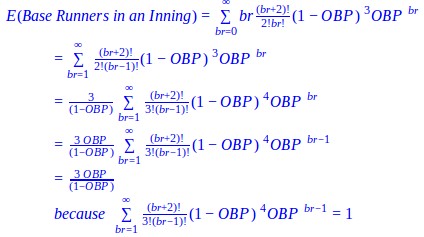
If we let br be a random variable for base runners in an inning, we can apply the formula above to deduce how many base runners per inning we should expect from our starting pitcher:

Formula 3.2

The resulting expectation creates a baseline for our pitcher’s performance by inning and allows us to determine if our starting pitcher generally meets or fails our expectations as the game progresses.

Table 3.1: Inning Base Runner Probabilities by Pitcher

Tim Lincecum

Matt Cain

Jonathan Sanchez

Madison Bumgarner

P(O Base Runners)

0.333

0.352

0.280

0.356

P(1 Base Runner)

0.307

0.310

0.290

0.311

P(≥2 Base Runner)

0.360

0.338

0.430

0.333

E(Base Runners)

1.326

1.250

1.586

1.233

Based upon career OBPs through the 2013 season, Bumgarner would have the greatest chance (0.356) of retiring the side in order and he would be expected to allow the fewest base runners, 1.233, in an inning; Cain should also have comparable results. The implications are that Bumgarner and Cain represent a top tier of starting pitchers who are more likely to allow 0 base runners than either 1 base runner or +2 base runners in an inning. A pitcher like Lincecum, expected to allow 1.326 base runners in an inning, represents another tier who would be expected to pitch in the windup (for an entire inning) in approximately ⅓ of innings and pitch from the stretch in ⅔ of innings. Sanchez, on the other hand, represents a respectively lower tier of starting pitchers who are more likely to allow 1 or +2 base runners than 0 base runners in an inning. He has the least chance (0.280) of having a 1-2-3 inning and would be expected to allow more base runners, 1.586, in an inning.

As important as base runners are for turning into runs, the hits and walks that make up the majority of base runners are two disparate skills.  Hits generally result from pitches in the strike zone and demonstrate an ability to locate pitches, contrarily, walks result from pitches outside the strike zone and show a lack of command.  Hence, we’ll create an expectation for hits and another for walks for our starting pitchers to determine if they are generally good at preventing hits and walks or prone to allowing them in an inning.

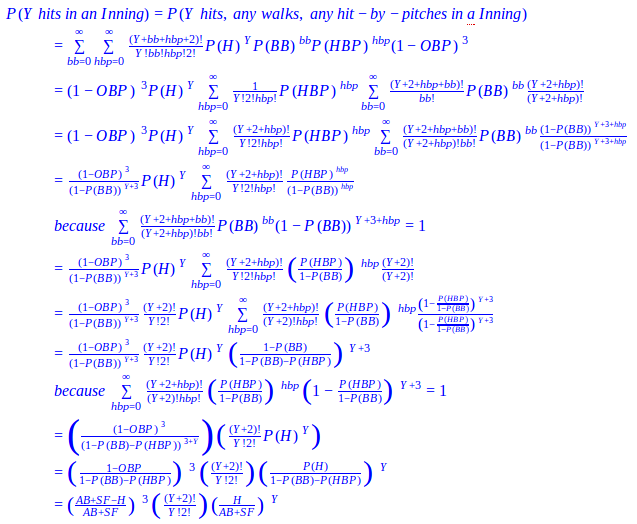
Let h, bb, and hbp be random variables for hits, walks, and hit-by-pitches and let P(H), P(BB), P(HBP) be their respective probabilities for a specific starting pitcher, such that OBP = P(H) + P(BB) + P(HBP). The probability of Y hits occurring in an inning for a specific pitcher can be constructed from the following negative multinomial distribution:

Formula 3.3

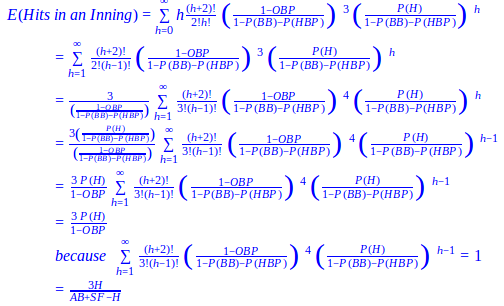
We can further apply the probability distribution above to create an expectation of hits per inning for our starting pitcher:

Formula 3.4

For walks, we do not have to repeat these machinations.  If we simply substitute hits for walks, the probability of Z walks occurring in an inning and the expectation for walks per inning for a specific pitcher become similar to the ones we deduced earlier for hits:

Formula 3.5

We could repeat the same substitution for hit-by-pitches, but the corresponding probability distribution and expectation are not significant.

Table 3.2: Inning Hit Probabilities by Pitcher

Tim Lincecum

Matt Cain

Jonathan Sanchez

Madison Bumgarner

P(O Hits in 1 Inning)

0.457

0.466

0.439

0.443

P(1 Hits in 1 Inning)

0.315

0.314

0.316

0.316

P(2 Hits in 1 Inning)

0.145

0.141

0.152

0.150

P(3 Hits in 1 Inning)

0.056

0.053

0.061

0.060

E(Hits in 1 Inning)

0.896

0.870

0.947

0.936

The results of Table 3.2 and Table 3.3 are generated through our formulas using career player statistics through 2013. Cain has the highest probability (0.466) of not allowing a hit in an inning while Sanchez has the lowest probability (0.439) among our starters. However, the actual variation between our pitchers is fairly minimal for each of these hit probabilities. This lack of variation is further reaffirmed by the comparable expectations of hits per inning; each pitcher would be expected to allow approximately 0.9 hits per inning. Yet, we shouldn’t expect the overall population of MLB pitchers to allow hits this consistently; our the results only indicate that this particular Giants rotation had a similar consistency in preventing the ball from being hit squarely.

Table 3.3: Inning Walk Probabilities by Pitcher

Tim Lincecum

Matt Cain

Jonathan Sanchez

Madison Bumgarner

P(O Walks in 1 Inning)

0.685

0.718

0.589

0.776

P(1 Walk in 1 Inning)

0.244

0.225

0.286

0.189

P(2 Walks in 1 Inning)

0.058

0.047

0.093

0.031

P(3 Walks in 1 Inning)

0.011

0.008

0.025

0.004

E(Walks in 1 Inning)

0.404

0.351

0.580

0.264

The disparity between our starting pitchers becomes noticeable when we look at the variation among their walk probabilities. Bumgarner has the highest probability (0.776) of getting through an inning without walking a batter and he has the lowest expected walks (0.264) in an inning. Sanchez contrarily has the lowest probability (0.589) of having a 0 walk inning and has more than double the walk expectation (0.580) of Bumgarner. Hence, this Giants rotation had differing abilities targeting balls outside the strike zone or getting hitters to swing at balls outside the strike zone.

Now that we understand how a pitcher’s performance can vary from inning to inning, we can piece these innings together to form a 9 inning complete game. The 9 innings provides complete depiction of our starting pitcher’s performance because they afford him an inning or two to underperform and the batters he faces each inning vary as he goes through the lineup. At the end of a game our eyes still to gravitate to the hits in the box score when evaluating a starting pitcher’s performance.

Let D, E, and F be the respective hits, walks, and hit-by-pitches we expect to occur in a game, then the following negative multinomial distribution represents the probability of this specific 9 inning game occurring:

Formula 3.6

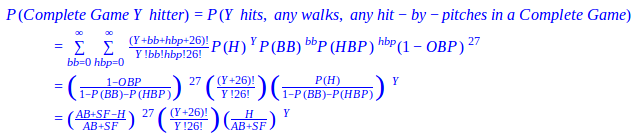
Utilizing the formula above we previously answered, “What is the probability of a no-hitter?”, but we can also use it to answer a more generalized question, “What is the probability of a complete game Y hitter?”, where Y is a random variable for hits. This new formula will not only tell us the probability of a no-hitter (inclusive of a perfect game), but it will also reveal the probability of a one-hitter, three-hitter, etc. Furthermore, we can calculate the probability of allowing Y hits or less or determine the expected hits in a complete game.

Let h, bb, hbp again be random variables for hits, walks, and hit-by-pitches.

Formula 3.7

Formula 3.8

Formula 3.9

The derivations of the complete game formulas above are very similar to their inning counterparts we deduced earlier. We only changed the number of outs from 3 (an inning) to 27 (a complete game), so we did not need to reiterate the entire proofs from earlier; these formulas could also be constructed for an 8 inning (24 outs), a 10 2/3 inning (32 outs), or any other performance with the same logic.

Table 3.4: Complete Game Hit Probabilities by Pitcher using BA

Tim Lincecum

Matt Cain

Jonathan Sanchez

Madison Bumgarner

P(O Hits in 9 Innings)

0.001

0.001

0.001

0.001

P(1 Hit in 9 Innings)

0.006

0.007

0.004

0.005

P(2 Hits in 9 Innings)

0.023

0.026

0.017

0.018

P(≤3 Hits in 9 Innings)

0.060

0.067

0.046

0.049

P(≤4 Hits in 9 Innings)

0.124

0.137

0.099

0.105

E(Hits in 9 Innings)

8.062

7.833

8.526

8.420

The results of Table 3.4 were generated from the complete game approximation probabilities that use batting average (against) as an input. Any of the four pitchers from the Giants rotation would be expected to allow 8 or 9 hits in a complete game (or potentially 40 total batters such that 40 = 27 outs + 9 hits + 4 walks), but in reality, if any of them are going to be given a chance to throw a complete game they’ll need to pitch better than that and average less than 3 pitches per batter for their manager to consider the possibility. If we instead establish a limit of 3 hits or less to be eligible for a complete game, regardless of pitch total, walks, or game situation (not realistic), we could witness a complete game in at most 1 or 2 starts per season for a healthy and consistent starting pitcher (approximately 30 starts with a 5% probability). Of course, we would leave open the possibility for our starting pitcher to exceed our expectations by throwing a two-hitter, one-hitter, or even a no-hitter despite the likelihood. There is still a chance! Managers definitely need to know what to expect from their pitchers and should keep these expectations grounded, but it is not impossible for a rare optimal outcome to come within reach.