Archive for Xander Bogaerts

Rafael Devers: Boston’s Rising Star

The Red Sox’s third-base problem was not solved by a veteran rental. No, it was solved by a sweet-hitting 20-year-old Dominican named Rafael Devers.

But before I explain Devers’ spectacular rise, I must set the stage for his entrance.

~~July 24th~~

It’s July 24th and the Red Sox have ground to a halt. Baseball’s non-waiver trade deadline is just eight days away and nearly the entire baseball community expects the Sox to trade for Todd Frazier.

Frazier, the third baseman for the White Sox, is in the midst of the worst season of his career. He’s hitting just .210 and his contract expires at the end of the year.

The Red Sox haven’t been able to gain traction since the All-Star break, going just 5-6. The Yankees, their ever-present rivals, are creeping up on them in the standings and have swooped in on a trade for Todd Frazier, even though many executives and analysts were sure the slugger would join the Red Sox.

Third base has been a huge issue for Boston, who has used eight (!) different players there. Collectively, Red Sox third basemen are slashing .227/.280/.320, marks that rank 27th, 29th, and 30th in the league, respectively. They have not only been terrible hitters, but they also lead the league in errors.

Dave Dombrowski decides to rectify the Red Sox’ third base issue by promoting top prospect Rafael Devers to the big leagues.

~~A Rafael Devers Profile~~

Rafael Devers was born on October 24th, 1996 in Sanchez, an aging port city in the Dominican Republic. He first started playing baseball at the age of five, inspired by his father, who played amateur ball. Devers grew up with baseball all around him and quickly showed immense talent.

In 2013, Devers signed with the Red Sox at just 17 years old. He was ranked as the number three international prospect in his class, and he signed with the Red Sox, his childhood favorite team, for $1.5 million. Devers entered the Red Sox organization as their 20th ranked prospect in a deep farm system.

Upon joining the Red Sox, Devers was placed in the Dominican Summer League (DSL), a place where new international signings go to work on their skills. Devers took the DSL by storm, batting .337/.445/.538 with three home runs in 28 games. He impressed everyone, by his ability to hit for both average and power, and also by his great batting eye — Devers walked more times than he struck out.

After tearing up the Dominican League, Devers was sent to the States, where he played in the Gulf Coast League. The Gulf Coast League, or GCL, is where first-year minor-league players are sent after being drafted or signed by their teams. Most of the players in the GCL have been drafted out of college or have just finished high school, meaning that at age 17, Devers was one of the youngest players in the league. Devers carved up the GCL, batting .312 with 11 doubles and four homers in 42 games.

After Devers’ wildly successful first year, he was rated as the Red Sox’ sixth-best prospect, and baseball’s 99th-best, all at just 18 years old. This was an incredible accomplishment, as Devers was the youngest player on Baseball America’s top-100 list that year.

In 2015, Devers was promoted to the Red Sox’ Low-A affiliate, the Greenville Drive, where he experienced full-season ball for the first time. There, he was matched up against much older opponents, being one of just seven position players under the age of 19 in the South Atlantic League. Devers played well in Greenville too, batting .288 with 38 doubles and 11 home runs in 115 games. During the 2015 season, Devers was selected to the Futures Game, an event during All-Star weekend that showcases baseball’s best young talent. After a season in Low-A, Devers was ranked as Boston’s second-best prospect, and baseball’s 18th-best. Devers jumped 81 spots on Baseball America’s top-100 in just one year, a remarkable achievement.

In 2016, Devers was promoted to the Red Sox’ High-A affiliate, the Salem Red Sox, at the age of 19. However, Devers hit a bump in the road in Salem. Among players much older than him, it appeared that Devers had finally met his match. In the first half of the season, he scuffled to a .233/.300/.305 line with just four home runs in 63 games.

However, Devers bounced back brilliantly after the All-Star break. He slashed an incredible .326/.367/.539, with seven home runs and 11 steals in 64 games. After this second-half breakout, Devers has not looked back in his meteoric rise to the majors.

In 2016, Devers’ defense finally started to catch up with his offense. Early on in his career, scouts considered moving him to first base, because of his heavy build. But Devers has worked hard on his defense, and has stayed at the hot corner. In High-A, Devers led all Carolina league third basemen in fielding percentage (.960), putouts (104), and assists (258).

After his outstanding second half in High-A, Devers earned a non-roster invitation to 2017 spring training with the Red Sox. This was a big step up for the 20-year-old Devers, but he wasn’t ready for it, batting 3 for 22 against big-league competition. Nevertheless, he earned a promotion to Double-A Portland, where he played for most of this year.

Devers was the Portland Red Sox’ standout player this year, socking 18 homers in addition to achieving an excellent .296/.366/.571 slash line. In 77 games, Devers jumped to number six in Baseball America’s most recent prospect rankings. He was also selected to participate in the MLB Futures Game for the second time.

Devers was promoted to Triple-A on July 14th, and continued to hit for both average and power while in Pawtucket. Devers became the third-youngest player ever to be promoted by the Red Sox to Triple-A, yet another reminder that he was playing extremely well for his age. The Dominican lefty hit an astounding .400 for the Pawtucket Red Sox, and he earned a promotion to the big leagues after just nine games in Triple-A.

When Devers debuted on July 25th, he was the youngest player in the major leagues, but you’d never know it. His first major-league hit was a home run (!), and during his 16 career major-league games, Devers has surprised everyone.

Scouting report

Devers has a very promising future, thanks to his ability to hit for both average and power. He has incredible raw power, and can spray the ball to all fields. His opposite-field power is unsurpassed among players his age. For example, when Devers hit two homers against the Indians on August 14th; one was a laser into the Green Monster seats in left field, and the other was a high drive into the Red Sox bullpen in right field.

Devers also has great bat speed, and he is able to hit pitches very far, and to any part of the field. On August 13th, Devers hit a 102.8 mph pitch into the Yankees bullpen, the fastest pitch ever hit for a home run in the pitch-tracking era.

Devers is not as polished as other recent Red Sox prospects like Andrew Benintendi, but he has a higher ceiling. I project that in his prime years he will hit around .285 with 30 home runs, 40 doubles, and five to ten stolen bases.

He has improved his defensive skills, but don’t expect him to be a Gold Glove-winning third baseman. I believe he will stay at the hot corner, as he is becoming more reliable and is improving his range. Overall, Devers projects to be an All-Star with a dependable glove and a reliable, middle-of-the-order bat.

Conclusion

As of August 15th, Devers is hitting .339 with six home runs, incredible statistics that show his ability is way beyond his years. I don’t mean to read too closely into Devers’ 62 career at-bats, but he has a very promising future.

Pairing Devers with other young Red Sox stars like Mookie Betts, Jackie Bradley jr. and Xander Bogaerts should help Boston stay at the top of the AL East for years. Devers gives Boston an entirely homegrown lineup, the dream of every major-league team.


Special thanks to Baseball Reference, Baseball America, and milb.com for the statistics I used in this post.

I would also like to thank NESN.com, the New Haven Register, and SB Nation’s Minor League Ball blog.

Prospect rankings are from Baseball America

Fenway Park Photo Credit: User: (WT-shared) Jtesla16 at wts wikivoyage [CC BY-SA 1.0 (http://creativecommons.org/licenses/by-sa/1.0)], via Wikimedia Commons


The 2017 Red Sox Season Ends and Starts With Bogaerts

The Red Sox are currently tabbed as the favourites in the American League by most experts and odds-makers, but there was a lot of roster turnover from last season so it is difficult to really project their level of success for the coming year. Their positive 2017 outlook is despite losing the face of their franchise and best power hitter, David Ortiz, to retirement. He has been one of the most consistent clean-up hitters in the past decade and so offensively he leaves big shoes to fill (pun intended). The Red Sox offense in 2017 led the majors in most offensive categories like AVG, OBP, SLG, Off WAR component, swStr%, contact% and had the best OPS since the 2009 Yankees. Instead of signing or trading for a big slugger in the offseason to fill this void, Red Sox management looked elsewhere by acquiring one of the majors’ best starting pitchers in Chris Sale. The 2017 Red Sox are now led by a young nucleus of hitters who are projected to carry an offence that is likely going to be one of the best, and the Red Sox are banking on the continuing development of their young offensive talent to help them go far in the postseason.

One player who is expected to make major offensive contributions this season is Xander Bogaerts — a hitter who has shown the ability to hit for an elite batting average (.320 BA in 2015) and display some power (21 HR in 2016). He plays for one of the league’s most scrutinized teams and at one of the most important positions, creating an environment that demands excellence and puts a high level of pressure on a young player. Bogaerts has posted back-to-back seasons with a WAR over 4 and a wOBA over .338 but he achieved these feats in contrasting ways. In 2015, it was driven by an elite batting average, while in 2016 he made some changes to his swing and approach at the plate and was able to hit for a high average (.294) while increasing his home-run total from 7 to 21.

But when we delve into the numbers of his 2016 season, we learn that it was a tale of two halves. His noticeable two-halved season is similar to the 2016 seasons of Matt Carpenter and Kevin Pillar, players who I have written about recently, but these tales were directly related to injuries they sustained. For Bogaerts, however, his change was not due to an injury but from a change in his approach at the plate. This change had a negative effect on most of his offensive statistics and perhaps is a cause for concern for the coming season.

In the first half of the season versus the second half of the season, his batting average fell from .329 to .253, his BB/K fell from 0.59 to 0.37, his OPS dropped by 134 points, and his wOBA dropped by 57 points. The only improvements he displayed was improving his HR/FB ratio from 10.6% to 12.1% and increasing his ISO slightly by 13 points (.146 vs. .159).  So what changed, you ask? Well, you can probably tell from interpreting the aforementioned changes in his statistics; he sold out for power. He made a significant change to his ground-ball to fly-ball ratio, as it decreased from 1.62 to 0.98. Below we can see the change in his AVG/P from the first half to the second half of the 2016 season:

​​

He stopped hitting balls to the opposite field, decreasing his Oppo% by 6.3% and increased his Pull% and Cent% by 2.8% and 3.5%, respectively. See below for a summary:

​​

He also increased his average launch angle from 6.3 degrees in 2015 and 6.9 degrees in the first half of 2016 to almost double those marks in the second half of 2016 — 13.1 degrees. Despite increasing his launch angle in the second half, he made no major changes to his exit velocity (89.8 MPH vs. 90.2 MPH) or to his swing speed (61.3 MPH vs. 61.7 MPH).

In the table below, we see how Bogaerts ranked at his position in wRC+ and wOBA based on batted-ball type in the first half of the season and the second half:

Further, it is interesting to investigate his home and road splits in the second half as he hit .325 at home vs. .207 on the road. His second half away FB% was 39.9% and pull% was 42% while at home it was 38.3% and 52.1%. He increased his away FB% by 9.4% and increased his home FB% by 5.9% and his pull% by 7.7%. This change obviously helped him when playing at Fenway Park as his ISO increased from .172 to .205 while maintaining an identical batting average. However, while playing on the road, this new approach to hit fly balls and to pull the ball over an imaginary Green Monster led to major struggles at the plate.

I wanted to see if there was hope for Bogaerts with his new fly-ball-driven plate approach, so I wanted to look at hitters who made similar changes year-over-year and how they fared. I used data from the past four seasons and looked at qualified hitters who had at least a 0.40 decrease in their GB/FB from one year to the next. Analyzing the data, I found that Xander Bogaerts’ second half was eerily identical to Salvador Perez’s 2014 season. Perez made similar changes in his fly-ball approach from his 2013 to 2014 season and below are the results:


Apart from their HR/FB ratios, their batted-ball and hitting-profile metrics are identical. Bogaerts decided to pull and hit fly balls in the second half and if he was able to sustain this batted-ball profile over the course of a full season, versus if he kept his batted-ball profile the same as he had in the first half of the season, he would have hit six more home runs. Hitting over .310 with 18 HRs is much preferable to hitting sub .260 with 24 HRs. Of course, this extrapolation has its flaws, but whenever your hitting is compared to a catcher’s, it is a bit of a sign of concern.

It is not all doom and gloom for Bogaerts, as he is only 24 years old and has a lot of time to build into his frame and develop a power stroke. Looking at the same set of data, Bogaerts’ 2016 full-season data (a mixture of high-average approach vs. HR-hitting approach) looked similar to Robinson Cano’s 2016 season, apart from his ability to tap into his power. Cano and Bogaerts decreased their GB/FB rates by 0.72 and 0.75 respectively from 2015 to 2016, as shown below:


If Bogaerts can learn to hit the ball harder more consistently and perhaps focus less on pulling the ball, and revert back to his 2014 Oppo% of 32%, he could turn into both an elite power and contact hitter. An ideal future player comparison for Bogaerts would be somewhere in between Derek Jeter and Robinson Cano. Being able to utilize the whole field, hitting for a high batting average, stealing some bases, scoring lots of runs atop a killer lineup, and hitting for a lot of extra-base hits are all within the realm of possibilities for this young shortstop.

An important aspect to consider for the upcoming season is, where should Bogaerts hit in the batting order? According to Ian Browne of MLB.com, John Farrell is tinkering with the idea of hitting Bogaerts sixth in the Red Sox lineup, and this was the case for his first spring-training game since returning from the WBC on Thursday. And perhaps he has done so for good reason. In 2016, Bogaerts had most of his success hitting third in the lineup, but was moved to the two-hole on August 10th and stayed there for the vast majority of games there on out, and he began to struggle at the plate. It is a bit of a chicken-and-the-egg dilemma but something that probably prompted the move was his inability to hit with runners in scoring position. His batting average fell from .351 to .136, due mostly to his increased FB% — a trend that he has showed throughout his short major-league career, as shown by the table below:


His struggles with runners in scoring position are something that I am sure Farrell is well-aware of, and therefore his move down in the batting order makes a lot of sense, especially if he continues struggling with his new approach at the plate. It should not only helps his team be more efficient at run production, but it should also help Bogaerts’ chances of stealing more bases this season — something he has talked about doing more of if given the opportunity. He stole 11 bases in the first half of the season but only stole two in the second half, something that he attributed to having fewer green lights from his coaching staff when on the base paths, as they didn’t want to take the bat out of Big Papi’s hands. Of course, that is no longer an issue, and if he does in fact hit in sixth slot, he should have more opportunities to run than if he hit fourth – a position in the order that he was originally projected to hit from.


Fantasy Perspective: The move down in the order will definitely hurt his counting stats in runs and RBI, but the optimist in me believes that he will revert back a little to his 2015 self and hit fewer fly balls than he did in the second half of 2016. This should hopefully help him hit for a high batting average, considering he was able to sustain a BABIP in the .370 range over the course of over 1000 PAs from the beginning of the 2015 season to the halfway point of the 2016 season. His batting average over that period was .323, which which was tied for second with Jose Altuve, and only trailed Dee Gordon at .324. A more balanced approach should hopefully result in productive power numbers from Bogaerts, posting an elite number of doubles and HRs in the mid- to high teens. He has talked about trying to steal at least 20 bases this season and the likelihood of doing so is highly dependent on where he hits in the order. So if he stays in the six-hole for the majority of the season or moves up to the two-hole at some point – I believe that 20-25 steals is achievable.


The Evolution of Xander Bogaerts

Since dominating the Dominican Summer League as a 17-year-old shortstop, Xander Bogaerts has been considered one of the elite young talents in the game, heralded for his on-base ability, and specifically his power.  After being promoted to start the 2011 season in Greenville, the Aruban native continued to rake, proving his skills at every rung of the organizational ladder.  At each full-season minor league level, Bogaerts never ran a wOBA below .366, and his lowest ISO was a very respectable .169.  It seemed as if he were destined to inherit the throne left vacant in Boston since Nomar Garciaparra departed in 2004; fans drooled over his future as the Red Sox’s franchise cornerstone, anchoring the heart of the Boston lineup while playing a premium defensive position.

On August 19, 2013, with Stephen Drew mired in a slump and the Sox struggling, Bogaerts was promoted from Pawtucket and joined the team in San Francisco, thus beginning his tenure in Boston.  Bogaerts appeared in 18 games down the stretch, hitting only 1 home run and watching his K% balloon to 26%.  However, his struggles were mostly ignored as the team wrapped up the division, and all concerns were quieted by the maturity he demonstrated after being inserted into the Sox’ starting lineup on baseball’s biggest stage, as evidenced by his .386 wOBA during the postseason run culminating with a title.  At the tender age of 20, Xander Bogaerts was a World Series champion, appearing poised for a Rookie of the Year campaign in 2014.

Unfortunately, Bogaerts failed to meet expectations in 2014, posting his worst season as a professional by far.  After a hot start, he collapsed in the second half.  He continued to strike out in nearly 25% of his plate appearances, his 6.6 BB% was a career worst at the time, and he finished with a disappointing 82 wRC+.  Bogaerts’s struggles were driven by his inability to hit right-handed pitching, as he posted a measly .105 ISO against righties coupled with a 71 wRC+.  The following image should help to explain the decline:

After getting ahead in the count, righties attacked Bogaerts down and away, leading him to chase breaking balls and expand the strike zone.  In fact, on a per-pitch basis, the rookie shortstop was the fifth-worst hitter in baseball against the slider.  With his confidence shattered after a poor performance at the plate along with Boston’s decision to sign Stephen Drew midseason, outsiders questioned whether Bogaerts could recover from his prolonged slump, while some predicted that he would be the next big prospect to bust.

After admitting that 2014 was probably the “toughest season [he] ever had,” Bogaerts entered 2015 once again as Boston’s starting shortstop, hoping to recapture the stroke that propelled him to the big leagues so rapidly.  Although he collected a Silver Slugger and seemingly accomplished his goal, Bogaerts exhibited a vastly different approach, one in stark contrast with his minor-league track record.  While he retained his high on-base ability, rather than selectively punishing mistakes, Bogaerts became a more restless slap hitter, sacrificing power in exchange for contact.  He boosted his Swing% by almost four points, offering at nearly half of the pitches he seen, but his ISO fell to a career worst .101.  This change can be attributed to his increased willingness to use the entire field; Bogaerts boosted his Oppo% by 13 points but showed nearly no power when going to right field as evidenced by a Hard% of only 14.5.  He also become an above average hitter on a per-pitch basis when challenged with sliders, improving upon perhaps what was his biggest weakness.

This more aggressive approach resulted in a significant drop in Bogaerts’s K%, coupled with a smaller decline in his BB%.  He finished the year with a much-improved 109 wRC+, certainly playable when coupled with league-average defense at shortstop, yet he left much to be desired in the minds of talent evaluators around baseball.  Rather than demonstrating the power he had exhibited throughout his minor-league career, Bogaerts instead resembled a weak middle infielder.  Once destined for stardom, Bogaerts had been relegated to an average shortstop, definitely a valuable piece on a contending team, but not the player many had projected him to be.

Now over 40 games into the regular season, despite capturing success in 2015, rather than settling, it appears that Bogaerts has once again evolved.  A quick glance at his numbers may suggest his improved offensive performance can be chalked up to luck, as evidenced by his high BABIP, but a deeper look at his underlying peripherals indicates that Bogaerts may have once again altered his approach at the plate.  First, he is proving that the decrease in K% is legitimate; Bogaerts is once again running a strikeout rate below 16%, nearly five points better than league average.  This year, it also appears that he has developed better command of the strike zone, as the has cut down his swing rate while boosting his BB%, both to nearly league-average levels.  More important than these, however, may be the reemergence of Bogaerts’s power.  Through 40 games, Bogaerts is running an ISO of .157, a level that he never once reached during his miserable 2015 season.

Unlike other unsustainable power surges, it seems as if Bogaerts’s may be viable.  His HR/FB has risen by nearly six percentage points, yet it still falls below the league average.  Statcast also seems to confirm our findings, as Bogaerts’s average exit velocity has risen by three miles per hour since the end of last season, although this data is still relatively new and cannot be considered a perfectly reliable indicator of future performance.  The majority of Bogaerts’s damage this season has come to the pull side, as his wRC+ has jumped by almost 100 points, and it seems as if he is making a concentrated effort to elevate more of the balls that he hits to left, as his FB% to the pull side has increased by nearly four points.  His bloated wRC+ will almost certainly fall, as a 44.4% HR/FB ratio to left field is absolutely ridiculous, but Bogaerts’s new offensive approach suits him well.

As seen in the table, Bogaerts is also demonstrating more power going the other way, and although his solid contact has still not resulted in any home runs to right field, the singles of 2015 have transformed into doubles this season.  Although he still sees the same number of percentage of pitches in the strike zone, it seems as if pitchers are approaching Bogaerts with more trepidation because of his newfound power, as he is seeing fewer fastballs this season than at any point during his major-league career.

The projections are a bit skeptical, as they forecast a fall in both BABIP and ISO, but if Bogaerts is able to maintain his current level of production, or really anything near it, 2016 will be his most successful season in the major leagues, by far.  He has undergone a major transformation at the plate, yet he has essentially reverted to the hitter he was as a prospect shooting through the minor leagues.  The strikeout-prone 2014 Xander Bogaerts gave way to the slap-hitter 2015 version, which then evolved into the more selective and powerful current manifestation of the young shortstop.  Perhaps most intimidating, however, is the fact that Bogaerts remains only 23 years old, and his evolution may not be complete.  Overshadowed prior to this season by the likes of Carlos Correa, Francisco Lindor, and Addison Russell, Xander Bogaerts appears set on mashing his way back into the conversation as the best young shortstop in baseball.


Xander Bogaerts’ Rookie Struggles

Coming into the year, the Boston Red Sox were riding high after the 2013 title in which they’d gone from worst to first. Just about everyone with a worthwhile opinion thought that’d they at least be in contention for the playoffs again this year, and it wasn’t uncommon to see people picking them to repeat in 2014.

One of the few questions people did have about the team was how would they integrate their two young players, Jackie Bradley, Jr. and Xander Bogaerts, in their first full seasons as starters. Of these two players, Bradley was the one that people seemed most concerned about. This made sense, since he was less regarded as a prospect than Bogaerts (number 2 overall on most prospect top 100 lists). But while Bradley has been a complete zero with the stick (57 wRC+), his defense has carried him to 1.5 fWAR so far this season. Bogaerts, on the other hand, has a wRC+ of 82, which combined with mediocre defense has left him hovering around replacement level.

Now, there’s no doubt that people are disappointed by Bogaerts’ season, and they have every right to be. Bogaerts was hyped as the rare prospect with superior skills and a significant amount of polish, and he showed why when he played like a veteran down the stretch in last year’s playoffs. Nobody was expecting him to be replicate Mike Trout’s rookie season, but a league average regular was probably a reasonable expectation. Obviously Bogaerts has underperformed relative to that standard.

Guys like Trout, Yasiel Puig and Manny Machado have essentially ruined the kind of expectations we now put on guys going through their first full seasons. Do you know how many batting-title-qualified rookies have had an OPS lower than Bogaerts’ current .650? 311! And of that 311, 283 of them were older than Bogaerts’ current 21 years of age. Bogaerts is struggling, but that’s what rookies do. There’s no greater jump in professional baseball than the one to the majors.

Bogaerts is actually hitting pretty well against fastballs and changeups. The crux of his issues this year have been against breaking balls. And there’s really no way to sugarcoat it. He’s been terrible against any and all spin, hitting just .143 and slugging .167. Unfortunately, opposing pitchers have noticed, and Bogaerts has only seen more breaking balls as the season has progressed.

plot_hco_bytime (1)

As the rate of breaking balls has gone up against Bogaerts, his numbers have gone down. The Red Sox shortstop was actually a well above average hitter heading into June (119 wRC+ in March/April, 149 wRC+ in May), but then everything fell apart. Bogaerts posted an almost unthinkable .426 OPS in June, a number less than half (.897) of what he posted the month before. He followed that up with a much improved, but still terrible July (.595 OPS) and continued to struggle in August.

Bogaerts’ struggles with breaking balls coincide with the part of his game that has perhaps regressed the most as his season has progressed: his plate discipline. After working 25 walks through the end of May, Bogaerts has been told to take his base just seven times since. A large part of that has been the decline of his ability to discriminate between a breaking ball thrown for a strike, and one thrown for a ball.

plot_hco_bytime

As you can see in the graph above, Bogaerts has stayed fairly steady against fastballs and changeups, but his ability to recognize breaking balls has completely melted away. As for why this has happened, that’s difficult to say. Maybe Bogaerts has always struggled against breaking pitches. But the most likely answer is that he’s a rookie struggling to adjust against pitchers capable of taking advantage of his weaknesses. Nevertheless, it’s at least been a prolonged slump, and one that Red Sox fans have to hope isn’t a glimpse into continual struggles for their youngest player.

Then, putting aside things that we can actually measure, there’s the possibility that Bogaerts is simply in his own head right now. As a ballplayer, he’d probably tell you he’s trying to do too much. There’s certainly something to that side of the argument. It can’t be easy to fail so spectacularly after being hyped as the next face of one of the most prestigious franchises in the game.

There’s also an argument to be made that some responsibility for Bogaerts’ struggles can be set at the feet of his manager, John Ferrell. There have been rumors that Ferrell was the person in the organization pushing the hardest for the Red Sox to resign Drew, which they ultimately did in late May. Drew, who had never played any position but shortstop in his big league career at that time, would be forcing Bogaerts over to third base, the position he played down the stretch of the 2013 title run. Bogaerts expressed some disappointment at time as a result, and an argument can be made that the team’s decision to resign Drew shook his confidence. Before Drew joined the lineup on June 2nd, Bogaerts was batting .296/.389/.427. Since then he’s hit .169/.201/.279. You might say that those dates are arbitrary and coincidental, and you can make of them as you wish. I will say that confidence is a huge part of succeeding in this game, and it should not be overlooked.

Overall, Bogaerts probably won’t look like he belongs back in AA forever, though we may have to wait until 2015 to see the player we were all hoping for. We got that player in the first couple months of this season, but pitchers’ adjustments, along with Bogaerts lack of adjustment to those adjustments, have torpedoed what was initially a very promising rookie year. That said, young players with Bogaerts pedigree and polish often turn into solid players at the very least, and I’m still as excited as ever about his career going forward. He’ll figure it out.


Be a GM: Miami Marlins – Part 3 – Trade Deadline

From my personal blog msilbbaseball.wordpress.com

—–

The Miami Marlins are always in the news at the Trade Deadline, and the story is no different in 2013.

Bullpen

Steve Cishek Fist Pump

     The Marlins possess sought after relievers Steve Cishek, Mike Dunn, Ryan Webb, and Chad Qualls.  Cishek, Dunn, and Webb still have multiple years under team control, while Qualls’ is signed on a one-year deal.  Of the four, I would be most inclined to keep Cishek, who is currently closing games for the Marlins, and doing so extremely well.  Qualls is the most likely to be dealt, as the Marlins don’t want to part with valuable bullpen arms who could contribute to next year’s team.  Also, they don’t want to leave the young starting rotation with an inexperienced bullpen to back them up for the remainder of this season.  Qualls would be a rental reliever for any team, as a 34 year-old journeyman doesn’t scream “Long-term plans”.  Nevertheless, Qualls has caught fire in 2013, putting up the best season of his career.  Through 42 IP in 42 Appearances, Qualls has put up a 2.57 ERA, 1.024 WHIP with a 7.29 K/9 and a 1.93 BB/9 leading to a 3.44 FIP.

UPDATE (9:57 PM) – Chad Qualls fell while celebrating a strikeout tonight.  Stay hot kid.

Zack Cox at Arkansas

     The Marlins dealt relief to a contender at last year’s deadline as well, sending Edward Mujica to the Cardinals for 3B prospect Zack Cox.  Mujica had a 4.38 ERA at the time he was sent to St. Louis, so Qualls’ numbers are significantly superior.  However, Mujica was just 28 at the time, and still had a year of Arbitration remaining, which increased his value.  All things considered, Qualls should be able to produce the same return as Mujica did, possibly more.  What Mujica brought in was fairly significant.  Zack Cox was the Cardinals #4 prospect heading into 2012 by Baseball America.  He was drafted in the first round out of the University of Arkansas  in hopes that he would develop into a premier hitter.  He showed that ability during his first full minor league season in 2011, but fell off dramatically in 2012, hitting .254/ .294/ .421 in the hitter-friendly Pacific Coast League.  Cardinals management decided it was time to move on from Cox, and shipped him to the Marlins, who sent him back down to AA.  Cox has been solid in AA this season, hitting .292/ .393 / .391.  his power numbers decreased, but he’s hitting more consistently as the Marlins are allowing him to take a slow track through the system.  He has the Marlins’ future 3B job in his sights, but will be competing in the system with recent 1st round pick, Colin Moran out of UNC.

     In my opinion, the Marlins sold Mujica enormously high  The Cardinals’ frustration with Cox allowed him to be moved at a fairly cheap price, and it’s difficult to say that this trade is comparable to what the Marlins can get for Qualls.  Nevertheless, this shows that the Marlins can target mid-level prospects (or seemingly declining former top level prospects) in exchange for Qualls.

Decision: Avoid trading Qualls for the sake of trading him.  Aggressively shop him around, but if the return isn’t right (comparable to Mujica’s return), try to negotiate a 2014 contract in the off-season.  Cishek, Dunn, and Webb are main contributors to the Marlins bullpen, and with the team appearing to be a contender in 2014, I would want to keep that consistency.

OF Justin Ruggiano

Veteran Position Players

     The Marlins could potentially move Placido Polanco, Juan Pierre, Greg Dobbs, and Justin Ruggiano.  Polanco and Pierre are signed to one-year deals, and will be Free Agents after the season.  Dobbs is in the last year of a two-year contract.  All four are most likely fits on the bench for a contender, and none of them would be able to bring in a significant return.  Ruggiano had a breakout year in 2012, his first full season, hitting .313/ .374/ .535 in 91 games.  However, he’s slumped this year, removed from his everyday role, floating around a .200 batting average.  He holds the most value, as he still has another season before he’s arbitration eligible, and teams may hope that he returns to his 2012 form.  However, his remaining pre-Arb year is valuable to the Marlins as well, who didn’t want to move him a few weeks ago.  The Marlins called up their top two outfield prospects last week, which makes Ruggiano slightly more available.

Decision: Without much to gain in return, I’d hold on to the veterans, and try to retain Polanco, Pierre, and Dobbs for another year to serve as valuable bench players for the 2014 season.

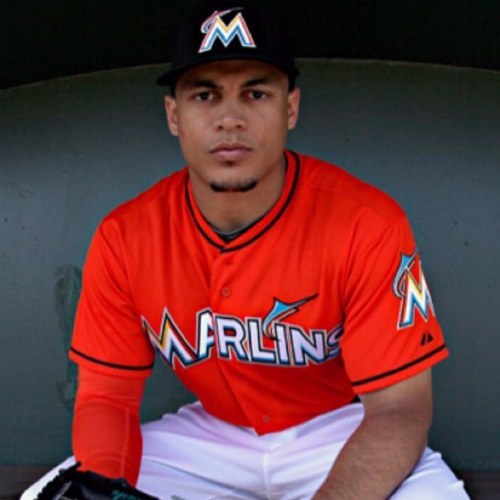
Giancarlo Stanton

     The feature of this article, and many national news stories is Right Fielder Giancarlo Stanton.  I’ve admittedly flip-flopped back and forth about what the Marlins should do with the face of the franchise.  He’s 23 years old, and will be arbitration-eligible for the first time after this season, which will increase his salary by a couple million dollars.  He led the league in slugging in 2012, and had already amassed over 100 career Home Runs.  He is a budding superstar, and teams are willing to pay a very high price for him.

Keep Him

Giancarlo Stanton

     The Marlins are historically known to being a penny-pinching team, but are in a position to spend big money, which they have available to give to Stanton.  If the Marlins stick with Stanton, I see them avoiding arbitration this year with a one year deal in the neighborhood of $7-8MM.  I then project him to earn $10-12MM after 2014, and $13-15MM after 2015.  To avoid paying Stanton $13-15MM for 2016, and then have a future long-term deal based on that salary structure, I would begin working on a back-loaded multi-year deal immediately after the season.  My first offer of a  proposed contract would follow a similar structure to my predicted arbitration salary hike, but then level off around $17-18MM for 2016 and beyond.  Miguel Cabrera, former Marlins emerging offensive superstar, signed a long-term deal with the Tigers in 2008, which levels off at about $20MM per year.  In my opinion, Stanton has shown the potential to deserve a similar contract, but there is no way that I would begin the negotiations at Miguel Cabrera’s deal.

Trade Him

Dontrelle’s Delivery

     Stanton’s value is as high as it’s ever been.  As mentioned before, he’s an emerging superstar who is just reaching arbitration for the first time.  Comparing him again to Cabrera, the Marlins traded him after the 2007 season to the Detroit Tigers along with pitcher Dontrelle Willis for the Tigers #1, 2, 6, 8 rated prospects according to Baseball America, along with other mid-low level players.  The Marlins would be able to reel in at least three of a team’s top ten prospects, ideally two of the top five.  In my opinion they should throw in one of the relievers teams have been calling for (preferably Qualls) to bump up the level of the prospects they would receive.

     The most important thing to consider in this situation, is that the Marlins already have multiple potential replacements for Stanton.  According to Baseball America, three of the Marlins’ top five prospects are outfielders, all of whom have been in the majors this season (Christian Yelich #2, Jake Marisnick #4, Marcell Ozuna #5).  Beyond those three, they also feature Jesus Solorzano, Austin Dean, Brent Keys, and Isaac Galloway in a rich system of minor-league outfielders.  Stanton is simply not at a premium position of need for the Marlins, which in my opinion makes him expendable.  Also, the millions of dollars that would be used to lock up Stanton could be better used to lock up the Marlins phenomenal young pitching staff.

Don’t Trade Him

     The rebutting argument against trading Stanton is how unpredictable trading for prospects can be.  Once again, the Marlins traded Miguel Cabrera and Dontrelle Willis to the Tigers for four of their top ten prospects, including #1 and #2.  A total of zero of them are still with the Marlins, and Cameron Maybin (#1) and Andrew Miller (#2) never lived up to their potential.  All those two names do is make Marlins fans cringe.  Bad trades happen, Major Leaguers are known commodities, while prospects are prospects, something that might be good in the future.  The unpredictability and risk of trading Giancarlo is something that cannot be over-analyzed.

Decision: Make Stanton Available, and listen to offers, but don’t undersell him

Yelich at the 2013 Futures Game

     If a team wants to give you their entire future, then by all means go for the trade.  But if I’m Michael Hill, and I’m not receiving everything that I want from a team, then there’s no deal.  If I’m trading Giancarlo Stanton to your team, I want to be able to go through your organization, and hand-pick the players I want like I’m at a buffet.  If any compromise has to be made, then it’s no deal.  Stanton won’t break the bank in the off-season, and it’s worth keeping him around to see if the Marlins can be truly competitive in 2014, which I believe is very possible, barring unforeseen injuries.

Needs

Jose Fernandez

     The most difficult part about making trades for prospect is to decide where you need help.  The Marlins are set in the outfield, no question about that.  3B seems locked down with Cox and Moran, and I’m a big fan of future Gold Glove winner Adeiny Hechavarria at SS.  Derek Dietrich hasn’t been amazing at 2B, though I really like Ed Lucas.  If only he wasn’t 31.  Donovan Solano could still be a fit, but this is a position that could use improvement.  At 1B, there isn’t much behind Logan Morrison, who is finally fully healthy.  Rob Brantly has been a disappointment behind the plate after impressing at the end of 2012 after he came over from the Tigers for Omar Infante and Anibal Sanchez.  Brantly is still just 24, but is hitting .232/ .283/ .294 while splitting time with Jeff Mathis.  Former first round pick Kyle Skipworth hasn’t been able to hit at any level, and relying on J.T. Realmuto to be the future isn’t a safe bet.  The Marlins pitching is phenomenal, led by Jose Fernandez, and followed by Nate Eovaldi, Jacob Turner and Henderson Alvarez.  The Marlins also have Andrew Heaney and Justin Nicolino in the minors among others with a young pitching staff whose future is just as bright, if not brighter than the Marlins’ outfield crop.

Trade Possibilities

Chad Qualls

2B Kolten Wong

     If we assume that Chad Qualls can bring in a similar return to Edward Mujica, then we’re talking a downward-trending lower high-level prospect (if such a thing exists) or a mid-level prospect.  I love what the marlins did in the Mujica trade, by taking a risk on a possible high-level guy, who is having a bad season.  If the Marlins deal with the Cardinals again, Kolten Wong’s name has been thrown around, as he’s blocked at the Major League level by Matt Carpenter.  However, the Marlins aren’t likely to be able to put together the package for him without having to part with an integral piece.  His name has been linked to a potential Alexei Ramirez trade, who holds more value than Qualls.  The Marlins would have to throw in another reliever or two (Dunn, Cishek, or Webb), or maybe even Derek Dietrich who replace Wong’s spot in the Cardinals system, obviously to a lesser extent.  As an outsider, it’s unclear what the asking price is for Wong, but maybe the Cardinals could sell low again.  Wong is more highly regarded than Cox was at this time last year, but then again Qualls has been better than Mujica was, and the Marlins have arms to give.

Giancarlo Stanton

SS/IF Xander Bogaerts

     I’m trying very hard not to be one of those internet users who has no sense of trade balance, but it would take a completely unreasonable package for me to trade Stanton right now.  The Red Sox reportedly are willing to give up everything to get Giancarlo.  Any deal with them would need to include Xander Bogaerts, and Henry Owens, plus much more.  Bogaerts plays the same position as Hechavarria, but could move over to 2B to create a stellar middle infield that already has me excited.  Bogaerts, the Red Sox #1 prospect by BA, is a 20 year old from Aruba, who has absolutely torn it up in the minors.  Owens, their #5 prospect, recently turned 21, and has pitched very well at High-A Salem.  The Red Sox also have C Blake Swihart at #6 who is showing an upward batting trend.  Their #2 prospect, former South Carolina Gamecock standout, Jackie Bradley Jr. has already spent time in the majors, but being an Outfielder isn’t necessarily attractive to the Marlins. Again, I’d just pick out the Red Sox star prospects, and if I can’t have everyone I want, then sorry Beantown, Giancarlo will still be a Marlin.

     The Pirates and Rangers have also expressed interest in Stanton.  For me, the Pirates would have to part with Gerrit Cole and Jameson Taillon at least.  It would create a very crowded pitching rotation for the Marlins, but is that ever a bad thing?  Unfortunately for the Pirates, many of their top prospects are Outfielders which doesn’t help.  The Rangers have Jurickson Profar, who has been playing 2B.  However, they just traded for Matt Garza which took a hit out of their system, and don’t have many other guys close enough to being Major league ready for me to feel comfortable about.

If Stanton does get traded, I’m thinking that it’s going to be the Red Sox.