Archive for Ubaldo Jimenez

A Different Way to Look at Strikeout Ability

Mike Podhorzer has looked into the relationship of a batters’ average fly ball distance as it relates to their HR/FB ratio, and has found results that will allow others to more accurately project a hitter’s home run totals from year to year.

This got me thinking. Which can be a good or bad, but in this case, the authors’ labor produced a fruitful return. While a hitters’ HR/FB ratio can fluctuate indiscriminately from year to year, Podhorzer has proven a batters’ average fly ball distance is a better indication of a player’s true talent power production. In the same light, my study looks at how a player’s swinging strike rate (SwStr%) is a better indication of a pitcher’s strikeout potential than K/9.

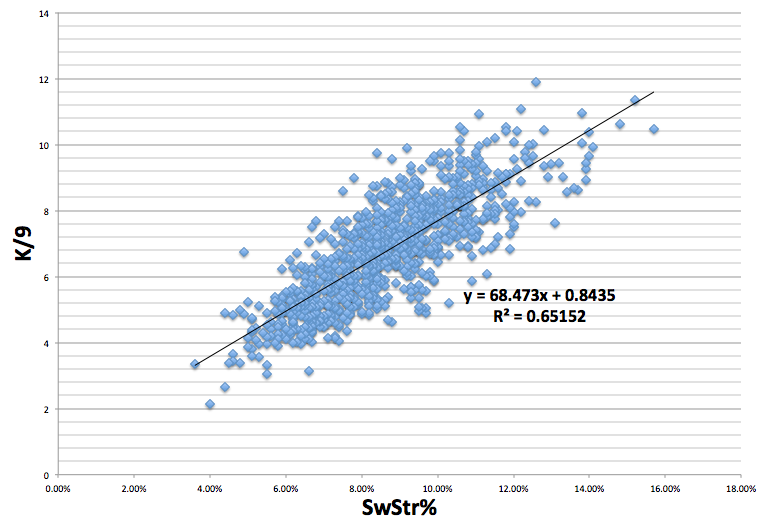
My assumption was that K/9 and SwStr% have a strong relationship. But, how strong of a relationship is it? To find this out, I took all qualified starter seasons from 2003 to 2013, which gave me a sample size of 933 pitchers, and ran a correlation between their SwSTR% and their K/9. The results showed that there is an exceedingly positive correlation between SwSTR% and K/9, to the tune of a .807 correlation coefficient and a .65 R2.
Screen shot 2013-10-03 at 1.06.11 PM

What is important to note is that there are very few pitchers present in the sample with a SwStr% above 13%, which may be symptomatic of something larger. Getting batters to swing and miss is difficult. The more often you can get a batter to swing and miss, the more valuable you are as a pitcher. As a result, the higher the SwStr%, the smaller the sample size becomes. For example, Johan Santana (2004) and Kerry Wood (2003) are the two lone dots to the farthest right on the graph with SwStr% of over 15: wow.

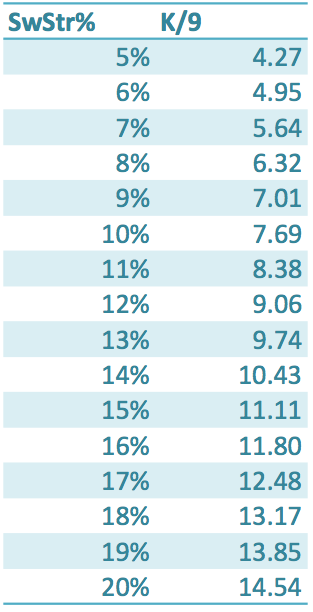
After the relationship between SwStr% and K/9 ratio became unmistakable, I calculated what a particular SwSTR%s translates into, as far as K/9, with the formula Y=68.473*x+0.8435, and got this chart:
Screen shot 2013-10-03 at 1.55.30 PM

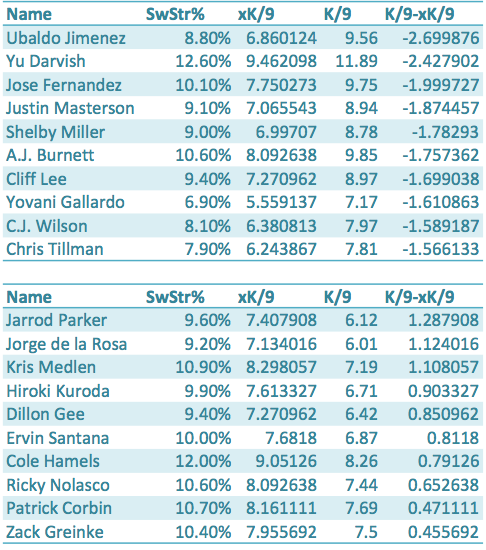
The next step is to take what we have discovered and apply it to a sample. The chart below shows each qualified pitcher for 2013, their SwStr%, xK/9, K/9, and K/9-xK/9.  xK/9 is what we would expect a pitcher’s K/9 to be based off of their SwStr%, and K/9-xK/9 shows us how much a pitcher over-performed or under-performed their SwStr% and xK/9.The first set of ten names are the pitchers who outperformed their xK/9 the most, and the second list of ten names are the players who underperformed their xK/9 the most.
Screen shot 2013-10-03 at 2.44.59 PM

The results show that Ubaldo Jimenez, Yu Darvish, and Jose Fernandez are the pitchers who have outperformed their xK/9 the most in 2013. These three pitchers also have great a great amount of deception and/or command (deception in Jimenez’s case: because, no one has ever called Ubaldo a control artist). And, while they may have outperformed their true talent in 2013 to an extent—they all had remarkable years—maybe that deception and control, which SwStr% does not take into account, leads to less swings by batters and more pitches taken for strikes, as opposed to swung at for strikes.

Perhaps xK/9 is more helpful when we look at pitchers who underperformed their SwStr%, like Jarrod Parker and Kris Medlen. Both of these pitchers had down years compared to what their projections suggested, but their xK/9s seem to be optimistic about their futures. Parker showed a .18 improvement in his K/9 from the first half to the second half of the season, while Medlen showed almost a full point improvement going from a 6.81 K/9 in the first half to a 7.67 K/9 in the second half.

While xK/9 may miss something—deception and command—when it comes to pitchers that outperform their SwStr%, xK/9 seems to find a reason to be optimistic when it comes to pitchers like Kris Medlen and Jarrod Parker who have underperformed their SwStr% and strikeout potential.

Devon Jordan is obsessed with statistical analysis, non-fiction literature, and electronic music. If you enjoyed reading him, follow him on Twitter @devonjjordan.

Ubaldo Jimenez – An Outlier Impostor?

If you had told this Colorado Rockies fan ten years ago that our team would have a pitcher who could possibly start the All-Star Game and then possibly win a Cy Young, then this fan would either say you were crazy from lack of oxygen or that the Rockies had moved to another city.  I don’t pretend that our team is the center of the baseball world; rather I know the Colorado Rockies are stuck in no man’s land.  We are neither East Coast nor West Coast.  Our team is rarely seen and our players simply don’t get the respect they deserve due to the Nintendo Ball that was played here in the 90s.  Why do I bother with such an introduction?

Well I think this explains the case of Ubaldo Jimenez.  On April 17, Jimenez became the first player in franchise history to throw a no-hitter.   Jimenez’s story was a feel good moment for the Colorado Rockies.  Jimenez is a nice kid, with a fast ball like no other, pitching for a team where pitchers go to die.  The media gave him his due and moved on to Braden’s perfect game.  But this was only the beginning and Jimenez has since then rattled off ten more wins.  At 13-1, he has done something only two other pitchers can claim to have done in MLB history.

Sometimes though I don’t think unknown early season player performances fit well with the baseball media establishment.  This was supposed to be the year Roy Halladay was going to sweep into the NL and blow batter’s away.  So then what tends to happen to these player performances?  Articles start to sprout up trying to tear down what they have done up to this point.  These articles claim that Jimenez is simply lucky, that it is all a smokescreen, and that eventually the stats will catch up and he will be revealed as an imposter.  That is the funny thing about stats, when the outlier shows up, the men behind the numbers rationalize away the beauty of baseball, and either discount the player or the situation.  The all telling models have become so complex that these outliers just shouldn’t exist.

It should be noted that this article is in no way a complaint about the new generation of stats.  I love them.  I love that the history of baseball is the statistical record.  What I don’t like is when stats are used to manipulate the reader into dismissing great performances.  What Jimenez has done to start 2010 has been simply amazing.  For comparison’s stake let’s look at how Jimenez’s stack up compared to 1968 Gibson’s season and 1986 Clemens’ season.

IP H H / 9 R BB SO K / BB HR BF AB 2B 3B GDP BABIP
2010 Jimenez 101 65 5.8 13 36 88 2.4 3 385 344 18 2 14 0.245
1968 Gibson 124 77 5.6 23 28 92 3.3 5 473 434 9 0 7 0.213
1986 Clemens 115 75 5.9 30 29 114 3.9 11 450 420 15 0 3 0.217

Jimenez stats are pretty comparable to some great pitching performances.  In addition to above, batters are hitting 0.189 against Jimenez (Gibson at 0.177 and Clemens at 0.175).  Of the 385 batters Jimenez has faced only 56 have gotten to a full count.  He has faced 75 batters with runners in scoring position and they are batting 0.147.

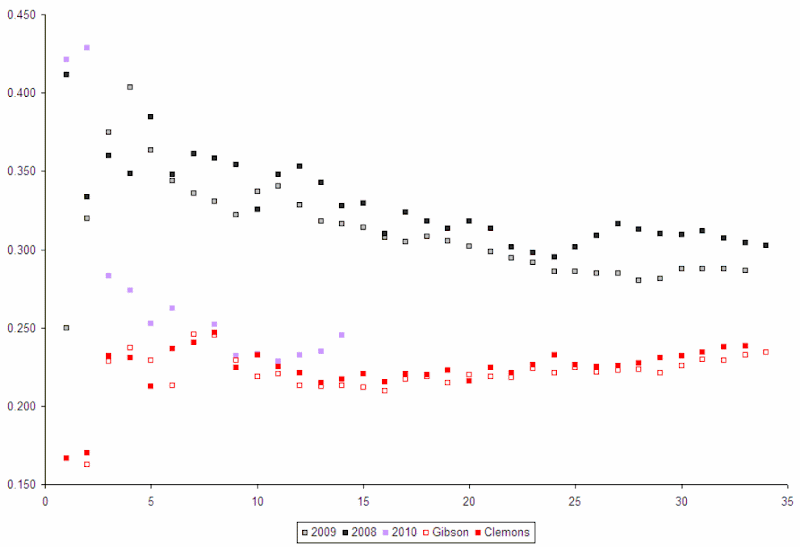
The telling stat for the home team is that he has won 13 of the 36 Rockies victories and ten of wins have come after Rockies losses.  Regardless of any stat a pitcher’s job is to put his team in the position to win.  How the pitcher gets there is some crafty pitching, some luck, and timely hitting by your side.  Baseball is a long season and time will tell whether these numbers will hold up.  I think Jimenez will probably hit a rough patch in July and August.  The team behind him is in disarray.  Scoring runs has been the Rockies Achilles heel not to mention an on and off again bullpen.  His innings pitched has raised a few eyebrows for a player with less than 100 major league starts (compared to Gibson’s 300 starts in 1968 but only 50 starts for Clemens in 1986).  And finally tracking the running average through his 14 starts of batting average on balls in play (BABIP) suggest that, through ten games Jimenez was walking with Gods, he has since then started to regress to his mean.

BABIP

Heralding a particular player at this point in the season as the greatest is a bit premature.  Although as a Rockies fan I am rooting for the franchise’s first 20-game winner!  Additionally if at this point in the season I needed one win, then Jimenez would be on the rubber.  His season so far stacks up pretty well with two of greats – Gibson and Clemens.


No Soup For Ubaldo

There probably isn’t a single baseball fan in the country who hasn’t heard Ubaldo Jimenez been called “lucky.”

For several weeks now, analysts have devoted countless hours and vast amounts of energy to debunking the theory that Jimenez is—as his 13-1 record and 1.15 ERA suggest—one of the best pitchers in the history of the game. And with good reason.

There’s no question Jimenez is a talented pitcher entering the prime of what will certainly be an impressive career. But he’s not an all-time great, and he’s certainly not the greatest of all time.

Jimenez’ 7.8 K/9 rate is impressive (though not legendary—he’s looking up at not only Tim Lincecum and Josh Johnson, but guys like Javier Vazquez and Felipe Paulino), but it’s not enough for us to turn a blind eye to his wildness (3.2 BB/9). A 2.44 K/BB ratio is nothing to sneeze at, but it’s nothing compared to Dan Haren (5.05), Roy Halladay (5.63), or the superhuman Cliff Lee (16.75).

As a result, Ubaldo’s FIP is a more mortal-looking 2.93. That’s nothing to sneeze at, and it’s the seventh-best mark in the game. But it’s more than two-and-a-half times his ridiculous 1.15 ERA.

And that’s before you consider Jimenez’ ludicrously low 3.8% HR/FB rate. That’s why his 3.61 xFIP is significantly higher even than his FIP—and that’s normalized for a pitcher in a neutral park, not one who plays half his games at the launching pad that is Coors Field. Substitute his xFIP for his ERA and ignore the wins (naturally, he wouldn’t have as many if he gave up more runs) and you’ve got a questionable All-Star, not a unanimous Cy Young.

So where is all this luck coming from?

The fishiest thing about Jimenez’s season so far is his 91.2% LOB rate. In other words, fewer than one out every 11 baserunners he’s allowed have ended up crossing the plate. The discrepancy between his strand rate and the norm (72 percent) is greater than the overall range of qualified pitchers’ LOB rates in 2008.

It makes sense that a better pitcher would strand more runners; the better the pitcher, the better the chance of making an out, so there is less opportunity for the other team to score. But Jimenez’ 91.2% figure places his performance well outside the reach of logic and fully inside the realm of luck.

Consider the case of John Candelaria, whose 88.8% strand rate in 1977 stands as the closest anyone has come to pulling a Ubaldo over a full season since at least 1974. The year before that, his strand rate was 72.5%; the year after, it fell to 76.8%. Simply put, you can’t sustain a number like that unless you’re playing Xbox.

Then, of course, there is the issue of Jimenez’. BABIP. I’m a firm believer that pitchers have some degree of control over where and how hard the ball is hit. I wouldn’t think it noteworthy if Ubaldo’s hit rate had merely slipped to .290, or .280, maybe even .270. But if you think the ability to induce weak contact is the reason his hit rate stands at an historically low .239 mark, I’m going to have to stop you right there.

It takes a lot more than talent for a pitcher to sustain a hit rate that low for more than a few weeks. Since 1989, only one pitcher has posted a hit rate at or below Jimenez’ current .239 mark over a full season without it ballooning 50 points or more the following year.

Now, some say that Jimenez’ hit rate is explained by the kind of contact he’s induced—his 13.8% line-drive rate is the third-lowest in the league, and his 54.9% groundball rate ranks fifth. But there’s no refuge in that argument, either.

Looking at tRA, which (unlike FIP) takes his batted-ball profile into account, Jimenez is expected to give up 3.09 runs per nine innings. That’s not a bad number by any stretch, but it’s not good enough to put Ubaldo in the history books. So even if you assume that his low line drive and HR/FB rates are the product of sustainable skill and not felicitous chance, Jimenez could be expected to give up nearly three times as many runs if he had neutral luck.

There’s no question Ubaldo Jimenez is a good pitcher, or that his is an arm to watch for years to come. But once the winds of fortune stop blowing in from the Coors bleachers, no one will mistake him for the best pitcher in the game.

Lewie Pollis lives outside of Cleveland, Ohio, and will be starting at Brown University in Fall 2010. Like at least half the people who will read this article, his dream is to be GM of a baseball team. For more of Lewie’s writing, click here.