Archive for Injuries

How Long Before Things Go Bad?

Spring is a time for optimism, in baseball and in life. Teams are starting to think about their opening day starters and more broadly, their starting rotations. Some rotations look “set” while some have a “battle for the 5th spot”. Some are toying with the idea of a 6-man rotation.

But here’s the thing: we know that (almost) every team will end up using a 6-man rotation, whether they like it or not. Eventually, your favorite team will need to call in reinforcements. This can happen because of poor performance or injury. But hey, we’ll cross that bridge when we come to it, right?

… when do you think we might come to it?

We know, as do those in charge that teams use something like 11 starters per year (in 2017: 11.3). In a six-month season, how long does it take before the first reinforcements arrive?

Cumulative Starters Used, 2017

In a few words, not very long. Some pitchers have injuries, some get moved to the bullpen, some sent to the minors. Either way, at least one of them will be gone pretty soon, so don’t name the puppy.

Of course, fate comes at different paces. In 2017, the Cardinals didn’t use a sixth starter until June 13th. And even then, Marco Gonzales only pitched because they had a double-header. In contrast, Junior Guerra, the Brewers’ opening day starter, was injured that same opening day. He wouldn’t pitch in the majors for another seven weeks (and it turns out, not very well either).

Half of teams used a sixth starter before April 25th. 90% of teams used a sixth starter before their 50th game.

Some of those sixth starters, along with their full-season WAR: Alex Wood (3.4), Mat Latos (-0.3), Mike Clevinger (2.2), Mike Pelfrey (-1.0).

We know that teams need depth. Not only that, but life comes at you fast.

Data: Baseball Savant


The Mets Should Trade Noah Syndergaard

Thor’s lat tear was the team’s biggest disappointment in 2017, a season that’s been chock-full of frustration and futility.

It was more demoralizing than the poor winning percentage. More displeasing than a certain player’s disappearance. And even more disheartening than the injuries en masse.

The fall of the Mets’ burgeoning ace is so distressing because it raised alarms about the future of their starting rotation. It’s now uncertain whether Noah Syndergaard, the pitcher once dubbed the second coming of Nolan Ryan, can play a significant role – let alone become the successor to Tom Seaver and Dwight Gooden.

How should the Mets deal with this situation? Though unpopular, there’s only one pragmatic solution: hope for a full recovery, let him recoup value, and trade him before future injuries occur.

Wait – trade him? Wouldn’t it make more sense if they gave such a tremendous talent the opportunity to fix his problems before they press panic button?

Sadly, it’s not quite that simple.

Syndergaard’s issues are so deeply rooted that he’s probably going to get hurt again.

And again.

And again.

Two core components of his skill set are the likely culprits of these injuries, and both are difficult to cure – at least without harming his effectiveness.

The first is Thor’s throwing motion. In the GIF below, you can see how he relies heavily on his golden arm when delivering a pitch:
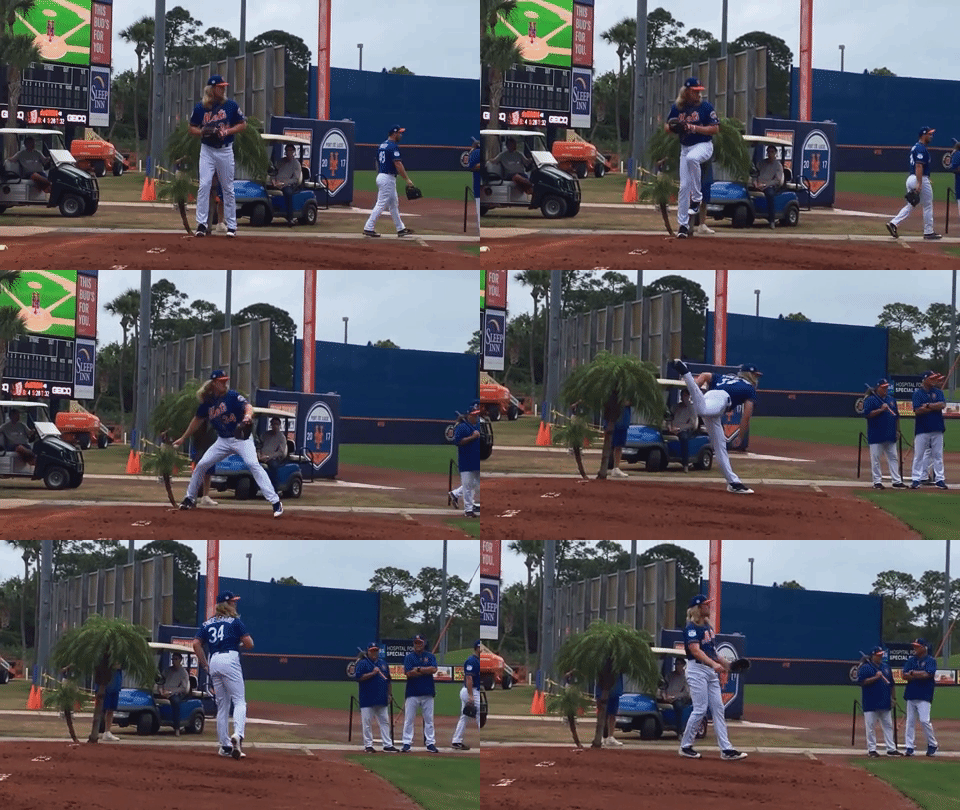
At first glance, these mechanics appear quick, straightforward, and minimalistic. But also arm-dependent. If you look more closely, you won’t spot a single movement that attempts to alleviate the immense stress placed on his right wing. Not one.
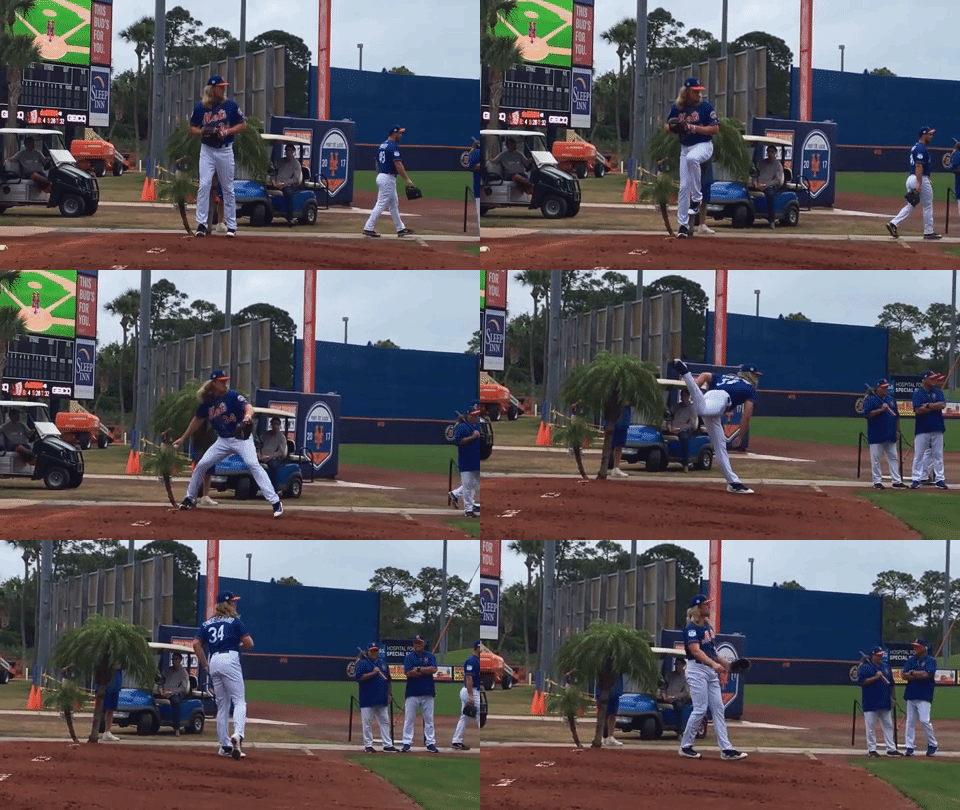
You don’t see Syndergaard use a high leg kick or take a long stride. Nor do you notice him place substantial weight on his right leg when pushing off the rubber. You can’t observe him rotate his hips fully. And you won’t find too much torque in his upper body.

In short, he utilizes none of the mechanics that generate substantial velocity from his legs, hips, and core. Instead, you witness Thor gain most of his power from a sudden, violent contortion of his back and a quick snap of his almighty arm.

Needless to say, this delivery taxes his right wing…exorbitantly. On every single pitch.

But that’s not all. You also glimpse a slight timing problem that’s already become a ticking time bomb:

Syndergaard’s throwing arm is practically parallel to the ground when he plants his left foot. Then – before raising it to the cocked position – he rotates his hips and accelerates all components of his upper body, actions that place additional stress on his elbow and shoulder.

Mechanics of this sort, both arm-dependent and off-time, significantly increase his chances of getting hurt in the future…and that his afflictions will be far more severe than a torn lat.

The second cause of Thor’s injuries tilts those odds even further. That’s his max-effort pitching style. He looks to dominate batters with a repertoire of five overpowering pitches and, as you can see, holds nothing back:

Noah Syndergaard Average Velocity (MPH), 2015-2017
Pitch Type 2015 2016 2017 Avg MLB Avg
Four-Seam FB 97.72 98.64 98.70 98.23 93.17
Sinker 97.69 98.52 97.99 98.11 91.67
Slider 87.86 91.42 92.27 91.27 84.77
Changeup 88.83 90.31 90.06 89.61 84.13
Curveball 81.21 82.95 84.25 81.91 78.14
OVERALL 92.63 94.83 93.93 93.85 88.52
SOURCE: Baseball Savant/Statcast/PITCHf/x

Both fastballs routinely register around 98 MPH, and his slider and changeup hover about or above 90 MPH. Each one is at least 5 MPH faster than league average and is among the hardest thrown by any starting pitcher. Even his curveball, the “slowest” of the group, is well above the 78.14 MPH mean.

But something sinister lurks beneath these awe-inspiring averages. And that’s the not-so-subtle implication that Thor competes on stuff alone.

There’s neither an inkling that he paces himself nor an indication that he uses complex pitching strategies – at least not to any meaningful degree. Au contraire. From the looks of it, he throws as hard as physically possible all game long. Nothing more, nothing less.

Such an explosive approach requires Thor to exert himself fully on every single pitch he throws. This places additional strain on his elbow and shoulder, accelerates the damage inflicted by his delivery, and dramatically increases his chances of developing major arm problems.

Making matters worse, the two reasons for his injury are incredibly difficult to fix without breaking something else, namely his dominating performance.

Which is exactly why the Mets should move their star pitcher.

Noah Syndergaard is still a blue-chip asset with great trade value. You’d be hard-pressed to find another starter whose repertoire resembles that of an elite closer…let alone one who just turned 25 and won’t be a free agent until 2022.

That combination of unique ability, extraordinary upside, and relatively low financial risk makes him an attractive target despite his injury and its causes. As such, the team would probably acquire several top prospects in return for their ace.

If he’s able to put together a healthy season (or half-season), they should shop him around and pull the trigger on the best deal they find. Otherwise, it’s likely that a catastrophic arm injury will compromise his value; they’d never be able to swap him for anything meaningful again.

Should that day of reckoning arrive, the Mets will be forced to admit that they have another Matt Harvey on their hands: a supremely talented, though fundamentally flawed pitcher whom they should have traded before it was too late.


Insurance in Baseball is Like a Black Hole

How much gravity does insurance have in Major League Baseball front office decisions?

Puns aside, let me tell you the funny thing about a black hole. You see astronomers cannot really see one, instead they are detected through their effects on the universe around them. Although less extreme, insurance is similar in this regard on its impact on baseball teams. Most teams insure some of their larger contracts in case their players cannot play due to an exterior factor such as injury. Perhaps the impacts of this major facet of the game does not cross our mind often because it is not eminently visible. However, make no mistake that insurance is a major factor when teams make major decisions regarding the DL, contract extensions, playing time and so on.

First, consider the history of baseball insurance to better understand why it impacts baseball. It can be said that by the late 1990s it had become common place for teams to insure their larger contracts. The first time baseball and insurance first truly started getting media attention was with Albert Belle in 2001 due to confusion over his insurance contract. Albert Belle had suffered a career-ending hip injury with the Orioles. Fans grew excited however despite the disheartening news when in 2002 the all-star slugger was added back onto the Orioles’ 40 man roster. Disappointed Orioles fans can tell you that Belle never played another MLB game however. Instead, he was added back onto the 40-man roster so the Orioles could collect insurance on his contract (some MLB insurance contracts do not cover a player unless they remain on the 40-man roster). At the time the MLB insurance contract covered the remainder of the salary owed on Belle’s contract. According to writer Michael Branda, the Orioles recovered an astounding 27.3 million out of a 39-million-dollar loss represented by Belle’s injury. Since the huge losses on Belle’s contract in the early 2000s, insurers in baseball have become much more stringent with their underwriting in baseball contracts.

Belle was not the only reason for teams being more stringent with their underwriting. The associated risks with insuring a MLB player have increased. One reason is PEDs. The MLB really did not enforce its ban on PEDs up until the late 2000s, but now being caught using PEDs can result in a significant loss in playing time. According to MLB Trade Rumors a syndicate of the MLB, Ervin Santana a first-time offender was suspended for 80 games on April 3rd of 2015. Santana was expected to make 13.5 million dollars this season. Despite being suspended, the Minnesota Twins are expected to still have to pay half of Santana’s salary (only players caught for the second time or more for steroids lose most of their salary).

To account for this insurers enforce a 60 to 90 day deductible policy in order to shield themselves from these sort of losses as well as claims made for short-term injuries. In addition to the 90 day deductible insurance policies are typically term policies of about three years with an option for renewal after the conclusion of the contract. As a result, if a contract proves to incur severe losses the liabilities will be only in the short term. Obviously to further protect themselves insurers only cover players with no preexisting injuries and all players must be inspected by the insurer. Furthermore, with wide variability and unpredictability in player health an insurer can in a way readjust its rate every three years to better reflect the player’s risk of not playing.

These more stringent underwriting practices have influenced the game, oftentimes when deciding when to take a pitcher off of the DL. Adam Kilgore of the Washington Post explained it best when he talked about how in 2012 Stephen Strasburg was “shut down” during a playoff push for the Nationals due to potential health concerns. In this decision there appeared to be a delicate balance between contention and the considerations of the insurance company that would not have covered Strasburg if he had been injured due to these health concerns. It is not crazy to think that finances come into play when making a decision on baseball players. Jeff Moorad, a decision maker for the Padres explained that in 2010 Chris Young was eligible to come off the DL. The Padres ultimately chose to put Young back on the field but Moorad added, “the accounting department much preferred that he [had stayed] on the disabled list.”

Baseball insurance has grown steadily more expensive. Although it is difficult to ascertain how much a team actually spends on insurance it is clear that it can be a burden for smaller teams. For instance, the Arizona Diamondbacks’ rotation once featured the dominant starting pitcher Brandon Webb. Between 2006 and 2008 Brandon Webb made three all-star games and finished first, second and second respectively in Cy Young voting. In this span Webb also led the league in innings pitched once. In essence Webb was due for a large payday once his contract expired. However contract negotiations between Webb and the Diamondbacks hit a snag in June of 2008. Despite a track record as a durable starter, no insurance company was willing to write a policy for injury risk to the Diamondbacks hurler. The reason is because insurance companies refused to accept the risk of Webb injuring his arm or if they were willing to, they were going to charge exorbitant rates.

As a result, the Diamondbacks could not get an insurance contract that did not have an exclusion on arm, shoulder or elbow injuries, all vital and injury-prone body parts for pitchers. According to AZCentral, a news outlet that covers the Arizona Diamondbacks, due to Webb not being insurable the Diamondbacks broke off all contract negotiations. In the long run, this proved to be a smart move since ten months later after contract talks ceased Brandon Webb never pitched in the majors again due to injuries. The point of this is that not only is baseball insurance so expensive it can prove to be impractical, it shows that most insurers are unwilling to insure some pitchers. Walt Jocketty, the former general manager for the middle-market St. Louis Cardinals explained that insurance has “become so expensive that it’s a cost item we really have to look at when you put your payroll together.”

In addition to insurance contracts altering how teams manage their rosters they influence how teams treat their players. In essence there is a human side to these contracts. Consider Josh Hamilton who is in the middle of a massive five-year, 125-million-dollar contract with the Angels and who has been playing quite ineffectively relative to his salary. Josh Hamilton who recently suffered a relapse on his drug addiction before the 2015 season is a prime example of insurance influencing teams to treat their players in a way they hopefully normally would not. Despite being a repeat offender, an arbitrator chose not to suspend Hamilton for any period of time. What makes this story scandalous is the Angels’ seemingly acerbic response to this news. It appears that the Angels almost wanted Hamilton to be suspended to spare them the expense of his failed contract. Clearly the Angels have little incentive to help Hamilton recover from his addiction. Instead, it is in their interest to see that Hamilton never plays another game of baseball again because if he does not play for an extended period of time the Angels can potentially collect insurance and definitely reduce their payroll.

Insurance influences baseball more than many people may realize. When it comes to playing time, DL decisions and contract negotiations, insurance seems to be an integral piece in the decision-making process. For me though, part of what makes baseball great is the inherent competition of players, often with disregard to their own body (*cough* Adam Eaton *cough*). There is little harm of teams protecting themselves from the inherent risks of baseball players becoming injured. The risk is that insurance becomes an incentive for teams to make decisions that may be bad for the game, such as not playing players for financial gain. Let’s hope that ultimately, teams do not get engulfed into this black hole.


Giancarlo Stanton: Please Stay Healthy

Giancarlo Stanton. What a trip this guy is. One second he is hitting home runs and the next he is running to first and coming up lame with a pulled hamstring, or a knee injury, or even an eye injury. He is an enigma that we seemingly know little about. He is hard to project into the future because of the injuries, but the one concrete thing we know about him is that he possesses monstrous power.

Recently I have come to see Stanton as similar to Ken Griffey Jr., in that he hammers the ball and could put up single season home run figures similar to Griffey’s, who hit 56 home runs in consecutive seasons. In addition, Griffey averaged 32 doubles per season, while Stanton averages 36, Griffey had a career OPS of .907, while Stanton’s is .892, and they are only .001 point apart in slugging percentage. I could go on with more statistics, but you get the point, these guys are like statistical clones. Stanton does not have the benefit of playing in the Kingdome like Griffey did, so we should even take into account the fact that Stanton currently plays half of his games in the Petco Park of the East.

Unfortunately, they are also similar in the injury department. I’m not saying Stanton will miss as many games as Griffey, but Stanton has missed 95 games due to injury since the beginning of 2012. What is even more worrisome is that he is hurting in many different regions of the body. I alluded to the numerous injuries in the opening; he has missed time for arthroscopic knee surgery, shoulder issues, and hamstring issues. The ability of each of these separate injuries to flare up again is something that should concern all fans of Stanton, as well as fantasy owners. In fact, I owned Stanton last year in my own fantasy league and we had a running joke going that we couldn’t call him “Giancarlo” (we referred to him as “Mike”) until he hit five home runs. I thought this was a very trivial joke at first, but the other owners had the last laugh because Stanton did not reach five homers until June 15th, mainly due to injuries.

If Stanton can stay healthy, he may be this generation’s Griffey. He does not have the flair, mechanically perfect swing, or happy-go-lucky attitude that Griffey seemed to carry on and off the field, but Stanton is similar to him where it matters most — in the statistics category. As an avid baseball fan I would certainly not be opposed to watching Stanton bash 600, or even 700 homers over the next 15 years and I know every Marlins fan would thoroughly enjoy that kind of production, assuming he stays in Miami. He may not have quite the average that Griffey achieved (Stanton career: .267, Griffey career: .284) but he can certainly smash the ball at a consistent clip.

Strange as it is, I want Stanton to be like Jeremy Renner in Hurt Locker. I want him to step up to the plate and discern what puzzle the pitcher (or the insurgent) is putting in front of him and then solve the riddle and hit the ball 450 feet, like when Renner disarms a circle of six IEDs. Then, I want him to keep the bomb suit on and run around the bases so he doesn’t injure himself. In fact, he should keep the mask on so he doesn’t get an eye injury again.

I am basically asking for Stanton to break numerous batting records all while playing at half speed (or maybe in a bomb suit) so that he will stay healthy. I know that is unfeasible, but we basically have a prior tale of what will happen if he keeps getting injured. We can always just take a look back at Griffey’s career and see what Stanton’s production will be if he keeps landing on the disabled list at his current pace. But the interesting and exciting thing is that if we want to know what could’ve been if Griffey’s career hadn’t been riddled with injuries, we might get a realistic clue if Stanton can get healthy and remain that way for the years to come. Hopefully we will be able to sit back and enjoy the moments of Stanton’s career where he “disarms” pitchers and launches moon shots off the Marlins’ scoreboard.