The Improvement of the Indians Starting Rotation
Remember at the end of last season and before this season when we all foresaw an Indians rotation that could possibly feature somewhere between 2 and 5 really good, and possibly great, starting pitchers? Don’t get bogged down on the slight exaggeration of that 1st sentence – To recap what we were looking at coming into this season for the Indians’ rotation: Corey Kluber won the 2014 AL Cy-Young; Carlos Carrasco had a string of starts to end 2014 in which he seemingly (finally) figured out how to harness all of his powers in a bid to ascend his name to an echelon where only Clayton Kershaw’s name resides; Danny Salazar has always had elite swing and miss stuff and was also excellent in the second half of 2014; Trevor Bauer and his Costco-sized arsenal of pitches have made some of us incredulously, if not warily optimistic since he was taken 3rd overall in 2011; and even T.J. House made us pause and take notice with his strong second half of 2014.
Then, like hype men with a special blend of Cleveland Kool-Aid being intravenously administered, Eno Sarris and Daniel Schwartz posted one of my favorite FanGraphs articles ever, Pitch Arsenal Score Part Deux, and the anticipation over the Indians’ rotation pulsated like a vein in the neck of John Rambo in the midst of fleeing from man-hunters.
The supporting cast, the lineup, looked poised to support the staff with plenty of runs. Returning would be: break out star Michael Brantley; bounce-back candidate Jason Kipnis; now-full-time-first-basemen, Carlos Santana; a supposedly healthy Michael Bourn; an offense-first but totally-respectable-defensively, Yan Gomes; and an actually-not-that-horrible-in-2014, Lonnie Chisenhall. Slugger Brandon Moss, and contact-happy-supposedly-glove-first Jose Ramirez had secured full-time spots as well in RF and SS respectively. So even though it wasn’t without flaws, it seemed like they would allow the pitchers to rack up plenty of fantasy-relevant wins.
Note: This post isn’t about the disappointment of the Indians, though they have been disappointing; it’s more about what factors beyond luck have contributed to the numbers of the Indians’ starting rotation at various points throughout the year, and the disparity (big or small) between the pitchers’ rates and predictors at those points.
The Indians’ starting pitchers, or at least the top 4 (Kluber, Carrasco, Salazar, and Bauer) have, for the most part, been putting up good, albeit, inconsistent numbers all year despite posting some elite peripheral rates and ERA indicators. A number of reasons have caused these numbers to grow apart (bad), come together, and then grow apart again (good). Luck can work like a bit of a pendulum, swinging from one extreme, through the middle, and to the other extreme before evening out and that is at the core of what the Indians’ starting pitchers have experienced this year — although they have yet to experience the final stabilization phase.
We will examine plenty of numbers (Beginning of season to August 18th) based on this time frame: (Spoiler alert – this article is long and dense, and this timeline serves as a sort of cliff notes as to how the staff’s numbers have improved throughout the year – so if you’re the type of person who feels like looking at a bunch of data is superfluous when the bullet points are in front of your eyes, just read the timeline and be done with it.)

April 6th – May 23rd/May 24th – June 15th
One week into the season, before it was evident that the team’s defense was very sub-par, Yan Gomes hurt his knee and hit the disabled list for over a month. Roberto Perez filled in quite nicely, and looking at just a couple numbers, could be considered the more valuable catcher (1.4 WAR compared to 0.5 WAR for Gomes). Brett Hayes (0.0 WAR) was called up and was the secondary catcher during this period. Behold, a table from StatCorner:

Perez has had the least amount of pitches in the zone called balls and the most amounts of pitches out of the zone called strikes. Overall, despite receiving fewer pitches than Gomes, he has saved more runs (4 DRS to Gomes’ 1) and their caught stealing rates are basically identical with a slight edge going to Perez – 38% to Gomes’ 35%. Gomes was much better in terms of framing in 2014, and it’s possible the knee injury has limited his skills all around this season. Anyways, from April 6th – May 23rd, the combined stats of Kluber, Salazar, Carrasco, and Bauer look like this:
| ERA | FIP | xFIP | SIERA | K-BB% | GB% | |
| Kluber | 3.49 | 2.16 | 2.46 | 2.51 | 25.3 | 48.6 |
| Salazar | 3.50 | 3.27 | 2.46 | 2.30 | 28.7 | 43.8 |
| Carrasco | 4.74 | 2.60 | 2.67 | 2.82 | 22.3 | 48.9 |
| Bauer | 3.13 | 3.23 | 4.09 | 3.94 | 14.2 | 35.7 |
| 3.75 | 22.7 | 44.7 |
Gomes returned as the primary catcher on 05/24, and from that point through June 15th, the cumulative numbers aren’t too different, although there is a dip in both K-BB% and GB% that we’ll have to look into.
| ERA | FIP | xFIP | SIERA | K-BB% | GB% | |
| Kluber | 3.67 | 3.26 | 3.20 | 3.19 | 19.8 | 43.8 |
| Salazar | 3.60 | 3.72 | 3.36 | 3.43 | 17.3 | 47.7 |
| Carrasco | 3.65 | 2.83 | 3.29 | 3.17 | 20.2 | 44.1 |
| Bauer | 3.96 | 4.72 | 4.47 | 4.30 | 11.5 | 36.8 |
| 3.74 | 17.2 | 43.1 |
So despite lower K-BB and ground ball percentages (leading to higher ERA predictors), the group’s ERA in the segment of the season when Gomes was reinstated is essentially exactly the same as from the first block of time with Perez. Now, I am not a big believer in CERA because there is a high level of variation and too many unknown variables pertaining to how much of the responsibility/credit goes to the catcher, the coaching staff, or the pitcher; but I do think that it’s possible Gomes’ extra service time has enabled him to be more in tune with his staff as well as understand hitter tendencies better than Perez and Hayes. I realize we’re getting into a gray area of intangibles, so I’ll reel it in with some results based on pitch usage%.
% Difference in Pitch Usage with Yan Gomes compared to Roberto Perez
| Pitcher | FB% | CT% | SL% | CB% | CH% | SF% |
| Corey Kluber | -9.0 | 8.8 | -17.3 | 5.0 | ||
| Danny Salazar | 9.8 | -12.6 | -4.4 | 17.1 | ||
| Carlos Carrasco | -6.5 | 9.4 | 49.2 | 13.3 | ||
| Trevor Bauer | -2.9 | -15.0 | -8.9 | 78.5 | 25.8 |
Using BrooksBaseball Pitch f/x data, let’s painstakingly find out how different each pitcher’s pitch usage was in regards to different counts, or better known as Pitch Sequencing. We’ll look at first pitches, batter ahead counts, even counts, pitcher ahead counts, and 2 strike count situations. As good as pitch f/x is, the data still isn’t perfect. There may be discrepancies if you look at usage at Brooks compared to the usage at FanGraphs, so for each pitcher we’ll split the pitches up into three categories: Fastballs (four-seam, sinkers, cutters), Breaking Balls (sliders, curve balls), and Change Ups (straight change/split finger) – I’m aware that splitters are “split fingered fastballs”, but I liken them to change ups more because of the decreased spin rate and generally lower velocity.
*Having a table for each pitcher in regards to pitch sequencing made this article quite messy, so I’ve included a downloadable Excel file, and briefly touched on each pitcher below.
Pitch Sequencing Excel Doc.
Corey Kluber
Looking at the data, Gomes stays hard with Kluber more than Perez until they get ahead in the count. Perez swaps some early count fastballs for curve balls, but they both see his curve ball as a put-away pitch. Gomes tends to trust Kluber’s change-up more than Perez later in counts and Perez likes it more earlier in counts.
Danny Salazar
Much like with KIuber, when Gomes catches Salazar, they have a tendency to stay hard early. Gomes pulls out Salazar’s wipe out change up after they’re ahead whereas Perez will utilize it in hitter’s counts as well.
Carlos Carrasco
Carrasco has 5 good pitches and he’s pretty adept at throwing them for strikes in various counts which is why there is some pretty even usage across the board, at least in comparison to Kluber and Salazar. There is quite a bit more usage of Carrasco’s secondary pitches in all counts and there are pretty similar patterns when Gomes and Perez are behind the plate. With Hayes, it doesn’t look like there is much that changes in sequencing until there are two strikes on a hitter.
Trevor Bauer
Bauer is probably a difficult pitcher to catch because of the number of pitches he has and the constant tinkering in his game. Side note: Gomes is the only catcher to have caught a game in which Bauer threw cutters, and in their last game together, Bauer threw absolutely no change-ups or splits. Bauer’s highest level of success has come with Hayes behind the plate and perhaps that’s from their willingness to expand his repertoire in more counts than Gomes and Perez do, but there is no way I can be certain of that.
Pitch sequencing can effect the perceived quality of each pitch and therefore, can produce more favorable counts as well as induce higher O-Swing and SwStrk percentages (or less favorable and lower). So despite the framing metrics favoring Perez, the group throws more strikes with Gomes and also induces more swings at pitches outside the zone – although, as previously noted, there is some regression with Gomes behind the dish in terms of SwStrk% and K-BB%.
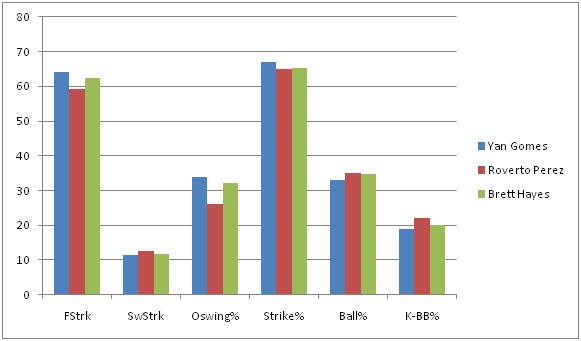

**These graphs represent numbers through the entire season to garner a bigger sample size.
With lower line drive rates and more medium + soft contact, and (in the case of the Indian’s defense), more fly balls, a conclusion could be jumped to that the staff’s BABIP has trended downward since Gomes regained his role. A look at BABIP throughout the course of the season:

Woah! It was well above league average in April and then plateaued at just above league average through mid June, but has been plummeting ever since. Obviously a catcher is not responsible for this dramatic of a swing in BABIP, so the Indians’ defense must have improved.
June 16th – August 18th
The rotations’ traditional stats look even better if you use June 16th as the starting point:
| Pitcher | IP | H | K | BB | W | ERA | WHIP |
| Corey Kluber | 84 | 61 | 82 | 16 | 5 | 3.11 | 0.92 |
| Danny Salazar | 71 | 46 | 69 | 23 | 5 | 2.79 | 0.97 |
| Carlos Carrasco | 77.1 | 56 | 77 | 13 | 3 | 2.91 | 0.89 |
| Trevor Bauer | 68.1 | 69 | 63 | 24 | 4 | 5.80 | 1.37 |
| 300.2 | 232 | 291 | 76 | 17 | 3.59 | 1.03 |
So let’s take a look at the Indians’ defensive alignment by month (Player listed is the player who received the most innings played at the position).
| POS | April | May | June 1 – 8 | June 9 – 15 | June 16 – 30 | July | August |
| C | Perez | Perez | Gomes | Gomes | Gomes | Gomes | Gomes |
| 1B | Santana | Santana | Santana | Santana | Santana | Santana | Santana |
| 2B | Kipnis | Kipnis | Kipnis | Kipnis | Kipnis | Kipnis | Ramirez |
| 3B | Chisenhall | Chisenhall | Chisenhall | Urshela | Urshela | Urshela | Urshela |
| SS | Ramirez | Ramirez | Aviles | Aviles | Lindor | Lindor | Lindor |
| LF | Brantley | Brantley | Brantley | Brantley | Brantley | Brantley | Brantley |
| CF | Bourn | Bourn | Bourn | Bourn | Bourn | Bourn | Almonte |
| RF | Moss | Moss | Moss | Moss | Moss | Moss | Chisenhall |
If you’ve paid attention to the Indians at all, you know they’ve made some trades and called up a couple prospects. But just how different is the new defense? Well, we only have a small sample with the current configuration, but it appears to be A LOT better. If BABIP wasn’t enough of an indicator, and it’s not, because there has to be some regression to the mean – it can’t stay that low – here are some numbers from the players who were playing the most in May compared to the players who are playing the most in August (again, numbers represent full-season stats):
| MAY | PLAYER | FLD% | rSB | CS% | DRS | RngR | Arm | UZR | UZR/150 |
| C | Perez | .994 | 2.0 | 38.5 | 4 | ||||
| 1B | Santana | .997 | -6 | 0.0 | 0.7 | 1.2 | |||
| 2B | Kipnis | .988 | 4 | 4.5 | 3.6 | 7.0 | |||
| 3B | Chisenhall | .963 | 7 | 3.1 | 3.3 | 10.5 | |||
| SS | Ramirez | .948 | -2 | -2.4 | -5.2 | -21.9 | |||
| LF | Brantley | .992 | 1 | 0.3 | -2.1 | -1.4 | -3.3 | ||
| CF | Bourn | 1.000 | 4 | -7.2 | 1.1 | -5.8 | -11.4 | ||
| RF | Moss | .975 | -4 | 1.7 | -2.5 | -1.1 | -1.8 | ||
| AUG | PLAYER | FLD% | rSB | CS% | DRS | RngR | Arm | UZR | UZR/150 |
| C | Gomes | .996 | 0.0 | 35.0 | 1 | ||||
| 1B | Santana | .997 | -6 | 0.0 | 0.7 | 1.2 | |||
| 2B | Ramirez | 1.000 | 1 | 1.1 | 2.8 | 23.2 | |||
| 3B | Ursehla | .973 | 2 | 4.5 | 6.0 | 15.7 | |||
| SS | Lindor | .967 | 6 | 6.0 | 4.9 | 14.9 | |||
| LF | Brantley | .992 | 1 | 0.3 | -2.1 | -1.4 | -3.3 | ||
| CF | Almonte | 1.000 | 2 | 0.4 | -0.2 | 0.9 | 10.0 | ||
| RF | Chisenhall | 1.000 | 4 | 1.6 | 0.5 | 2.3 | 27.3 |
What’s interesting is that the biggest difference in the infield is Francisco Lindor (Giovanny Urshela has been very solid, but Chisenhall was pretty similar this season at 3B). I’m sure someone at FanGraphs could churn out a really cool article (if someone hasn’t already) that shows us a quantifiable difference an above average to well above average shortstop makes for a team even if you just keep the rest of the infield the same, as the control. The 2015 Tigers come to mind – a healthy Jose Iglesias has made a difference for a team that still features Nick Castellanos at 3B and Miguel Cabrera at 1B. Teams are willing to sacrifice offensive contributions if a SS has elite defensive skills (Pete Kozma, Andrelton Simmons, Zack Cozart to name a couple off the top of my head). Lindor, to this point, has been an above average offensive player, too, so this could be special.
At this point the Indians are in last place and are out of contention. Abraham Almonte is their starting center fielder and with Kipnis back from the DL, Jose Ramirez is not playing 2B, but is instead getting reps in left field while Michael Brantley DHs due to his ailing shoulder. Perhaps all this means is that they don’t have better replacements; OR PERHAPS they’re planning to establish a more defense-oriented squad next year…
Now there’s no doubt that this research has led to some frustrating conclusions. With Gomes behind the plate, the K rate and GB rate of the staff has trended in the wrong direction in regards to ERA indicators; so is the difference in the batted ball profile plus an improved defense enough to make up for these facts? This small sample size thinks so, but it could 100% just be noise. However, there are clubs that are succeeding by using similar tactics right now:
| Team | ERA | FIP | ERA-FIP | GB% (rank) | SOFT% (rank) | OSWING% | K-BB% (rank) |
| Royals | 3.57 | 3.93 | -0.36 | 42.1 (29th) | 18.1 (16th) | 30.9 (19th) | 10.5 (26th) |
| Rays | 3.63 | 3.79 | -0.16 | 42.4 (28th) | 18.7 (13th) | 31.2 (17th) | 14.8 (7th) |
| Indians (as a reference) | 3.85 | 3.65 | 0.20 | 44.7 (17th) | 18.2 (15th) | 33.3 (2nd) | 16.9 (1st) |
Granted, the Royals and Rays have the 1st and 2nd best defenses in baseball, and their home parks play differently than the Indians, but they also don’t boast the arms the Indians do.
The Indians have their noses deep in advanced metrics and having rid themselves of Swisher, Bourn, and Moss during 2015’s trading period has allowed them to deploy a better defensive unit which has amplified their biggest strength – their starting pitching. Furthermore, their unwillingness to move any of their top 4 starting pitchers also leads me to believe they see next year as a time for them to compete. I’m not going to speculate what moves the Indians will make in the offseason, but I hope they stick with this defense-oriented situation they have gone with recently because it’s been working (and because I own a lot of shares of Kluber, Carrasco, and Salazar in fantasy).