Can Pat White Play Baseball?

The Kansas City Royals last week flashed back to the past by signing NFL quarterback Pat White in a move that conjures up memories of the old Kansas City Royals Baseball Academy which I wrote about here in June.

Judging by the internet commentary on this move, it is being seen as comical or a case of pure desperation by either White or the Royals and is being dismissed entirely by baseball and football fans alike.

For those unfamiliar with White, he was a star college quarterback for West Virginia for several years and noted for his unique combination of running and passing ability. White is rather short for an NFL quarterback and lacked the great arm strength desired by NFL scouts. Many thought he would be best suited as a wide receiver and might be converted by a team like fellow college quarterbacks Antwaan Randle-El  or Patrick Crayton and many others have done successfully.

The Miami Dolphins thought differently and drafted him in the second round with plans to use him in their much-hyped “Wildcat” formation which was wildly successful in its first year of operation.

A year later, the Dolphins infatuation with White has apparently waned and he was released as an NFL camp casuality in his second year. This posed a problem for White because a team that might want him as a WR cannot place him on their practice squad because he has too much NFL service time and no teams are interested in making him a backup quarterback right at the beginning of the season.

White has long been pursued by major league baseball teams, being drafted by the California Angels in the fourth round out of high school in 2004. He was subsequently drafted again by the Angels,  Reds and Yankees in the last part of the draft.

As a high schooler, White projected as a Carl Crawford-type outfielder with the speed to play center field. He hit .487 his senior year of high school and might have been taken in the second round if not for his quarterbacking abilities.

Now, the question is can Pat White play baseball at age 24? Most seem to think not. It’s a question of Nature or Nurture. And most seem to come down on the Nurture side of things.

Are baseball players born or developed? Has Pat White’s window of opportunity closed because he hasn’t swung the bat for so long or is his brain arranged in such a way that he was born to hit a baseball?

There is reason to think it is possible that White could be playing in the major leagues in a few years. Consider the case of Ron LeFlore.

LeFlore did not grow up playing baseball or any sport for that matter. He was incarcerated at age 19 and began playing sports because he noticed that the prison athletes received extra free time from the guards to play their sports. He began by playing basketball and then was invited to play softball, ultimately graduating to the prison baseball team where he began playing at age 23.

In a community service visit to the prison, Tigers manager Billy Martin was cornered by the inmates who urged him to give LeFlore a tryout. Martin promised he would. Upon his release from prison, LeFlore unexpectedly took Martin up on that promise. Martin didn’t really remember LeFlore but made good on his pledge and ultimately signed him to a contract over the objections of Tigers ownership after a prodigious batting practice display. It was real-life shock and awe.

And how much did LeFlore’s late start set him back? He was signed at age 25 and hit .273 in a 73 at-bat stint in Class A. The next year, he hit .339 in 423 at-bats in Class A and was promoted to AAA and the Tigers shortly afterward. Just one year after signing and three years after beginning playing the sport, LeFlore hit .260 in the major leagues and eventually became a .300 hitter and stole as many as 97 bases in a season.

Or consider Rick Ankiel who went back to hitting at age 25 when he could no longer throw a strike and eventually hit 25 home runs for the St. Louis Cardinals at age 28.

Or consider the way Deion Sanders and Bo Jackson tore through the minor leagues despite never really being all that serous about baseball.

There is also Josh Hamilton. You know him, right?

As talented as White may be, my guess is that he does not have the baseball talents of a Ron LeFlore. I suspect that White is not committed enough to baseball and will bolt for his first chance in the NFL or professional football. I will not be at all surprised if White manages to hit Class A pitching rather well, though.

I’ll put White’s odds at being a major league baseball player at 1 in 15. However, if White was truly destined to be a All-Star major-league baseball player and was another Carl Crawford, he’ll be playing center field for the Royals in three years. No joke.

It’s been done before — more than once.


2010 Pitchf/x Summit Recap

A few weeks ago, Sportvision hosted the 3rd Annual Pitchf/x Summit.  Sportvision is the company behind the Pitchf/x system and has initiated Fieldf/x, which I’ll get into in a minute.  The goal of the summit was to share some of the research being done in baseball analysis, while also serving to explain the possibilities that exist with the new system.  Without further ado, here were the presentations:

Using Velocity Components to Evaluate Pitch Effectiveness (Matt Lentzner/Mike Fast): The purpose of this study was to change the reference point by which Pitchf/x data are measured.  Often, fastballs show more movement than breaking balls, but without the proper frame of reference, it means nothing.  Mike and Matt were able to demonstrate how to determine the horizontal and vertical velocities with respect to the batter’s eye and make the Pitchf/x data more meaningful.

Pitchf/x Application in Player Development and Evaluation (Dr. Glenn “Butch” Schoenhals): Dr. Schoenhals has a Pitchf/x system set up at his instructional school, which allows pupils (including some major leaguers) to see the their pitches broken down immediately and make adjustments.  In conjunction with three cameras set up around the pitcher, the Pitchf/x data provide benefit to both pitchers and instructors in learning/teaching how to pitch.

Okajima’s Mystery Pitch (Matt Lentzner): Hideki Okajima throws a pitch roughly 20% of the time that had previously been classified as a curveball, more specifically a “rainbow curveball.”  Actually, it didn’t really fit any of the known pitch types.  Using his research on pitch types and arm slots (“The Pitching Peanut”), we see that this pitch has almost no break, is faster than a curveball but slower than a slider, and falls at the exact center of the peanut.  His explanation: Okajima is the Boston pitcher who is actually throwing the gyroball, not his more famous teammate Daisuke Matsuzaka.

Leaving the No-Spin Zone (Alan Nathan): Dr. Nathan showed his experiments that relate the spin of the baseball just before and just after it is hit. The result? The two are almost totally independent of each other! I couldn’t believe that, but Dr. Nathan made a lot of sense.  This was a high-grade physics lesson, crashed into about 20 minutes.  He explained why balls tend to curve toward the foul lines; he showed that the bat actually “grips” the ball for a few nanoseconds or so before the ball explodes off the bat, which contrasts the earlier model of the ball “rolling” off the bat.  Really, really cool.

Fieldf/x System Overview (Vidya Elangovan): And the main event began.  Fieldf/x is a new tracking system that utilizes cameras attached to the light standards in baseball stadiums (for now, just AT&T Park) to track the movement of every person on the field 15 TIMES A SECOND.  As soon as I heard that, my mind started going crazy and I don’t think I paid attention for about 5 minutes.  The only issue at the time is that the system does not include the ball (but it will).  All ball events currently have to be added by someone watching the video.  The following presentations showed some of the things you can actually do with the data, and it’s fairly obvious that these data, particularly when connected to batted ball data through the Hitf/x database, are about to revolutionize how baseball players are evaluated.

Infield Defense with Fieldf/x (John Walsh): Actually the first presentation, thanks to being in Italy, (tough life), but it really would have been more helpful after the overview.  Either way, a lot of cool stuff.  First thing he said was that in tracking the different players, he noticed that an average centerfielder runs 8 miles per game, which stunned me and kept my attention.  Thanks to these new data, we can also see the effects of shifts and also what players away from the ball are doing while teammates are attempting to make plays.  Other questions John poses: can we see infielders cheating in a certain direction as the pitchers throws the ball? Do infielders lean in a certain direction before the pitch? Based on his initial investigations, he saw that third basemen step toward the line as the pitch is delivered and shortstops step directly at home plate.  Weird, but potentially important, and just a peak into what can be obtained.

From Raw Data to Analytical Database (Peter Jensen): As a baseball nerd and a programming dork, this was really cool.  Peter Jensen took the 400,000 lines of code that results from each game and wrote a macro to display what actually happened in the game in an Excel worksheet.  The simulation relates the position of each player as well as an approximation of where the ball is throughout the play.  His solution with regards to the reorganization of the data was very impressive for a first run, and it is absolutely vital to make the data useful for analysis.

Using Fieldf/x to Assess Fielders’ Routes to Fly Balls (Dave Allen): These next three were absolutely incredible to me (and I’m sure the last three would have joined them had I had the time to stay).  By using the data to reconstruct fielders’ routes to the ball, Allen surmises that the Fieldf/x data can be used to determine the speed of an outfielder as they pursue a ball, the starting points of each fielder at the time of the pitch (and hit), and how efficient each player is in getting to the ball (measuring the distance traveled against the shortest distance to the ball).  To me, this is something that teams can use to help players they already have by addressing alignment issues or noticing what is happening during the different points of pursuit.  Are outfielders getting good reads/jumps on the ball?  Are they running in straight lines or weaving?  Simply put, the data can confirm for us (and also measure exactly and more efficiently) what our eyes (and scouts’ eyes) have seen.

Measuring Base Running with Fieldf/x (Mike Fast): Mike’s presentation examined the different portions of base running and what the data can be used for.  Mike was able to track each base runner’s path around the bases, even what they were doing on pitches that weren’t hit (during which we would typically say “nothing happened”).  Obviously, with all of these data, there’s a lot happening.  Also, by knowing the position of the player at each moment in time, we can track both his speed and acceleration as rounds the bases; very valuable information for measuring “baseball speed.”

Fieldf/x of Probabilities: Converting Time and Distance into Outs (Jeremy Greenhouse): The coolest of the presentations.  As soon as he said the words “probability model,” I was sold.  Jeremy first examined stolen base attempts (in the thirteen games of data released, he only found four) and tried to determine the different component times of the stolen base attempt.  Some things he brought up that were interesting: “Pop” times, or the time it takes a catcher to catch the ball and get it to second base, was between 2.0 and 2.2 seconds for all attempts, which suggests that a lot of stolen bases are taken off pitchers, not catchers.  The ability to get a good lead is now measurable, as well as the jump a runner gets on the pitcher.

Jeremy also developed a model to determine the probability that a player makes a play on a ball hit near him.  The model was based on where the player is, where the ball would come down, and how long it would take the ball to get there.  From there, the player’s probability can change based on his jump, route, speed, and what I called “catching ability,” or the ability to actually make a play on the ball when in the vicinity.  It was shocking to see some of the plays made where players started out with low (less than 10 percent) chances of catching the ball, but by getting a good jump and running (quickly) in a straight line toward the ball, their probability would increase each 1/15 of a second.  He then showed the video of these plays and we were able to see the spectacular catches made by really good outfielders.  This also applies to outfielders who start with a low probability to make the catch, but increase it as they, for example, chase a ball into the gap, close quickly on it, but don’t catch it.  The ability to increase the probability of a catch is very valuable and that knowledge would be immensely valuable to teams.  Lastly, he also showed how bad outfielders can turn outs into hits by reading the ball poorly, getting bad jumps, and being indecisive.  Super cool, and as soon as the presentations are made available online (which hopefully will be soon), I will link to some of them, but especially some of these graphs.

Unfortunately, I missed the following presentations, so I will just show the abstracts presented in the program.

Where Fielders Field: Spatial and Time Considerations (Matt Thomas): Continued application of close-range photogrammetry through high-resolution digital photography to baseball is revealing hitherto unseen patterns of fielding in the game. Matt examines these patterns and where data permit, factors time into this examination. After reviewing general trends he notes specific achievements and then speculates on whether any of this freshly quantified insight tells us what makes for good (and not so good) fielding.

Scoutf/x (Max Marchi): This presentation evaluates players’ tools with Pitchf/x, Hitf/x, and Fieldf/x.

True Defensive Range (TDR): Getting out of the Zone (Greg Rybarczyk): Greg intends to display detailed tracking of the 25 batted balls in the released data that were hit in the air to the outfield. Presented data will include the relative positions of the outfielders and the ball from the time the ball leaves the bat until the time it is retrieved by the fielder. Using the essential elements of this data (fielder starting position, ball hang time and landing point), he outlines the fundamentals of a new outfield defensive metric, called ‘True Defensive Range’ or TDR, which should provide more accurate player defensive ratings with a smaller required sample size than current metrics. Full realization of this metric will require establishment of baseline values using the full data set. TDR for infielders will employ a similar method, but it will not be covered during this presentation.

The Future of Sportvision’s Data Collection (Greg Moore): Greg will talk about several bits of baseball data that Sportvision might collect in the future, and he will discuss how the data can be used in conjunction with Pitchf/x, Hitf/x, and Fieldf/x. Greg will also conclude the 2010 Pitchf/x Summit with closing remarks.

Obviously, there was a lot of cool stuff presented.  As mentioned, only 13 games worth of data were released to the analysts and most of the presentations were about determining what could be done with the data.  But with enough work and research, it will not only change the way teams and analysts evaluate players, but also will give teams another tool with which to teach their players and improve the guys they already have on the roster.  We’ll also know exactly what skills are important in each aspect of the game (base running, fielding, etc.), and as we learn these things we’ll discover other things we want to know.  I’d love to know what you guys think of all this and I’ll try to answer any questions you have about what can and can’t be measured and how we’ll use it in the future.

UPDATE: After I wrote this mess, I discovered this, much cleaner, detailed, mess, written by Baseball Prospectus writer Ben Lindbergh.  I’ll link to it down here because I want you to read what I wrote instead of Ben’s running diary.  Sorry, Ben.

This article was originally published at Knuckleballs, written by Dan Hennessey.


Matt Kemp’s Struggles: Fastballs

Matt Kemp has been struggling this season, and even if you account for the low BABIP (.303) compared to his xBABIP (.335), he is still striking out at a higher rate this season (28.1%) compared to last (22.9%). What has also confounded me is thatm even though he has a higher strikeout rate, he is also setting a career high in walk rate as well (8.1%). Usually, drawing walks and getting struck out are thought of as tradeoffs, opposite ends of the “patience scale.” Last season, Kemp hit .362/.429/.616 against LHP and .278/.329/.453 against RHP, but this season, he is down to .303/.341/.443 against LHP and .240/.306/.445 against RHP. What happened?

There are two questions I’d like to investigate: 1) Is Kemp swinging at more strikes in 2010 compared to 2009 and how? and 2) Is Kemp making less contact in 2010 compared to 2009 and how?

To answer these two questions, I’d like to look at Kemp’s swinging strike percentages (swinging strikes per pitch) and contact percentages (contact made per pitch) against all fastballs (four-seamers, two-seamers, cutters, and splitters). Checking to see any differences between 2009 and 2010 should lend some insight into Kemp’s offensive struggles this season.

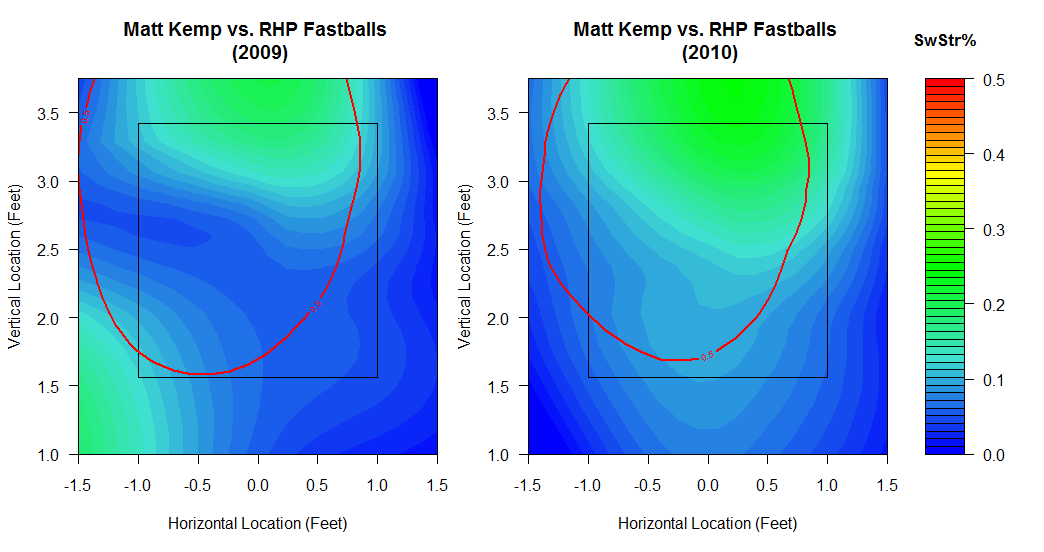
I ran several regressions to model surfaces of Kemp’s swinging strike percentages and contact percentages as well as his swing zones. First up, let’s take a look at Matt Kemp’s SwStr% against RHP fastballs:

The red contour lines tell us that Kemp chooses to swing 50% of the time when a ball is thrown within the contour line. This is what I call Kemp’s swing zone, so the red circles refer to this. Further examples and explanations of these swing zones can be seen here. What the swing zones tell us here is that Kemp is swinging less at RHP fastballs in 2010, but is whiffing at a much higher rate as well. He is also missing more RHP fastballs down the middle as compared to before.

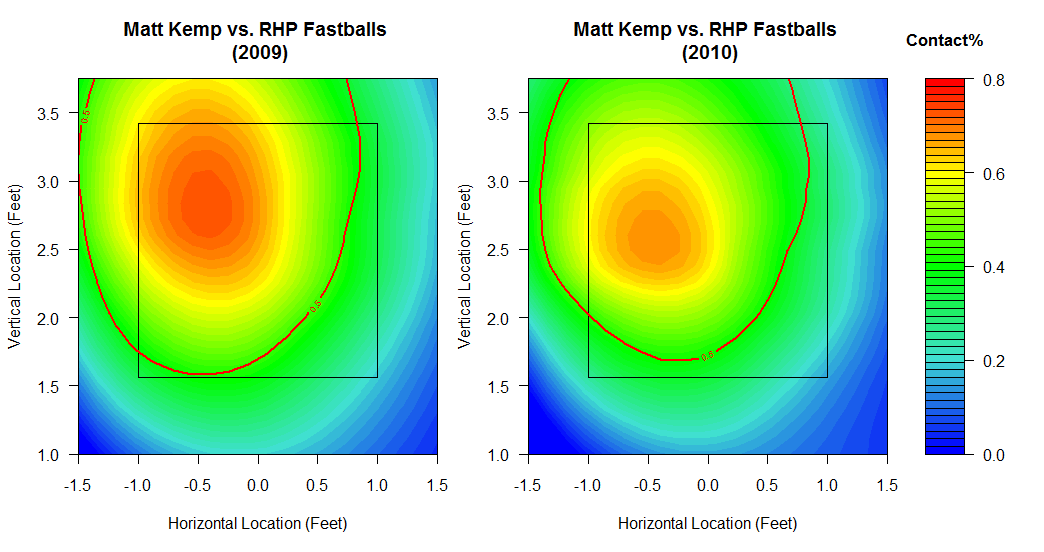
Let’s check Kemp’s Contact% against RHP fastballs to see if his swinging strikes are affecting his ability to make contact:

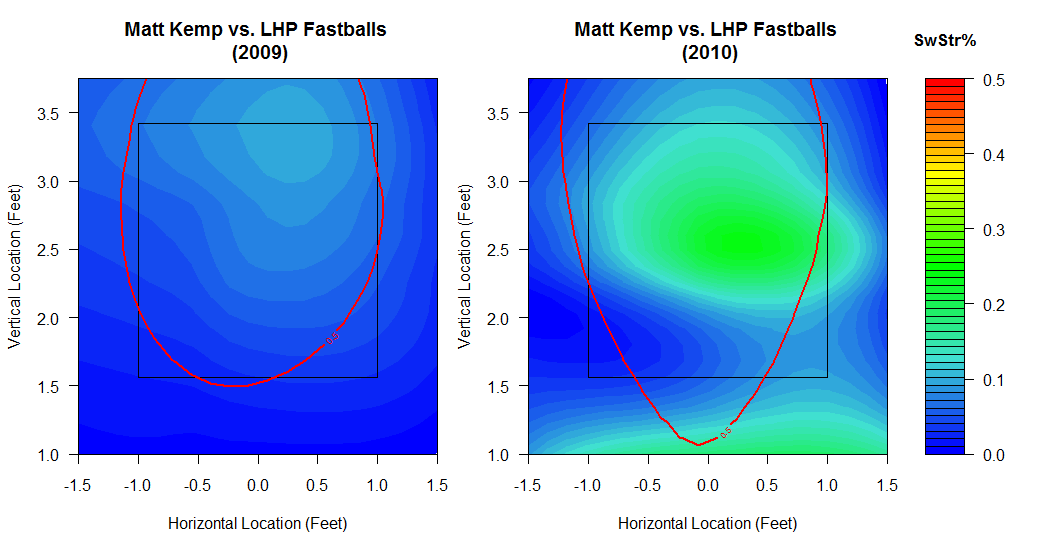
The red contour lines are the same as in the previous two graphs. Clearly, Kemp is making a lot less contact off RHP fastballs, and this tells me that he is putting the ball into play less. The previous two show Kemp swinging and missing more, while these two show Kemp making less contact, particularly on high inside fastballs. Let’s take a look at how Kemp has been doing against LHP fastballs, first at his SwStr%:

Here are his swinging strike plots, Kemp has actually started to swing more on LHP fastballs down and out of the zone (the red contour lines dip in 2010), so his swinging strike rate there is up. But he is also missing a lot more LHP fastballs this year that come down the middle over the plate, ideal pitches for the right-hander to hit out of the park. This is particularly concerning when you consider that Kemp’s wFB/C (runs above average per 100 fastballs) was at 1.64 last season, while that number is down to 0.38 this season. A major part of that drop must have to do with Kemp whiffing on fastballs down the middle that he used to hit.

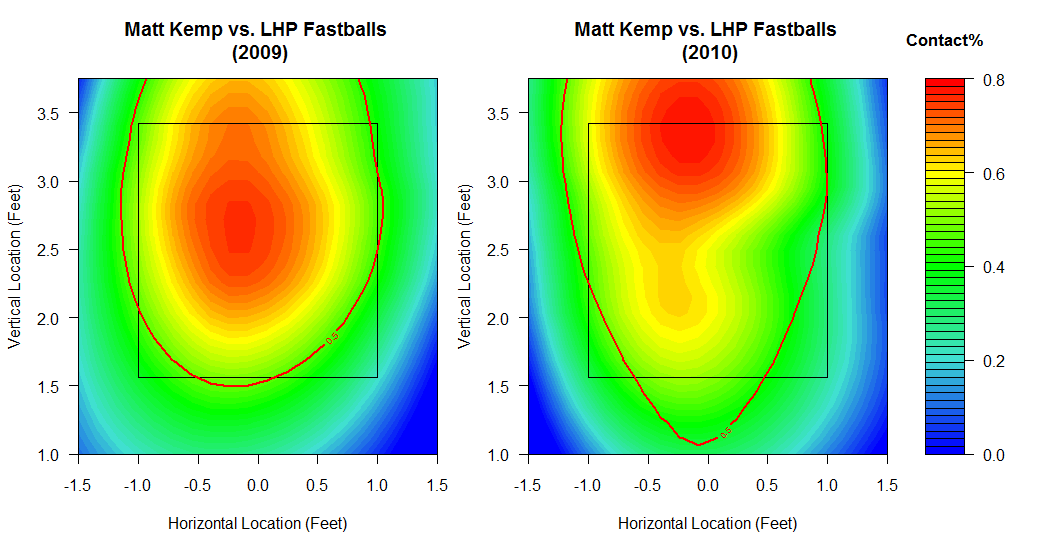
Finally, let’s look at Kemp’s Contact% against LHP fastballs:

Looking at his contact plots, we see similar colors in where he makes the most contact (making contact 80% of pitches in those areas). But we notice a huge shift in where the epicenter of that hotspot is. Last year, Kemp made contact off a lot of LHP fastballs down the middle of the plate, but this year, the epicenter of that contact hotspot has shifted a full foot up from the direct middle of the zone to the top of the zone. We can infer that Kemp is making less contact off the sweet spot of his bat, and making more high fastball contact that usually result in pop outs. This is problematic and adds further evidence that Kemp is simply missing fastballs down the middle as well as chasing high fastballs.

In general, what I present here is what Dodgers’ fans already know: Kemp is swinging and missing a lot. But I hope that I was able to demonstrate clearly how Kemp has been struggling against fastballs, showing where he is whiffing on them and where he is making less contact.

An article over at Memories Of Kevin Malone convinced me that perhaps Kemp’s whiffing behavior this season (along with swinging less and drawing more walks) could have been caused by Kemp’s change in swinging mechanics. Finally, if you visit my blog at Think Blue Crew, you can read a longer post about Kemp’s offensive struggles against breaking balls as well.

A variation of this article was originally posted at Think Blue Crew, a blog dedicated to data visualization of baseball, basketball, and football statistics. Check it out for more f/x visualizations like this.


Tribe’s Ongoing Draft Difficulties

Successful small-market teams contend by acquiring above-average talent on two levels: (a) development, either through international free agency or the amateur draft, and (b) trades. 

Success in one area, and not the other, can create a small window of opportunity to win, but for a team to compete for multiple seasons it is important to find talent on both avenues.  

Many fans remember John Hart as the architect of those great Cleveland teams in the late 90’s, but few realize how fortunate he was to step into that situation. Much of the groundwork for the Indians renaissance can be traced back to former General Manager Hank Peters.

During his four-year tenure as GM, Peters drafted Manny Ramirez, Charles Nagy, Jim Thome, Brian Giles, David Bell, Chad Ogea, and Paul Byrd.  He also did well when he acquired Sandy Alomar Jr. and Carlos Baerga in a trade with San Diego for Joe Carter

The foundation was set for Hart to succeed.

Hart, as he should, receives a lot of the credit for those teams.  He was one of the first general managers to sign young players, not quite at their peak, to long term contracts. He acquired a borderline future Hall of Famer in Kenny Lofton for Willie Blair and Eddie Taubensee – both would become more journeyman than established player.

John Hart did a lot of things right but what he could not do was mimic Peters’ draft success. 

Hart’s tenure as General Manager lasted ten years, 1992 – 2001, and in that time he managed to draft and sign only three impact players – CC Sabathia, Sean Casey, and Richie Sexson. Both Casey and Sexson were eventually traded for spare parts.

Using WAR (Wins Above Replacement player) as a statistical guideline the top ten players drafted by Hart are:

Name Year Drafted Round Career WAR
C.C. Sabathia 1998 1 38
Sean Casey 1995 2 15.8
Richie Sexson 1993 24 14.4
Russell Branyan 1994 7 8.5
Steve Kline 1993 8 7.9
Luke Scott 2001 9 7.3
David Riske 1996 56 6.9
Ryan Church 2000 14 6.9
Paul Shuey 1992 1 6.8
Jon Nunnally 1992 3 5.3

While all those players carved out careers of varying success, only Sabathia ranks in the top 1000 players in career WAR.  Hart’s predecessor and current GM, Mark Shapiro, was not as lucky and stepped into a situation much more difficult.

 Hart’s final two drafts epitomized the team’s long standing draft failures and would eventually signal the beginning of Cleveland’s first rebuilding process in nearly a decade. 

In 2000 and 2001, the Indians owned 3 of the top 55 picks and 4 of the top 43 picks, respectively.  The only player chosen to mount any type of tangible career was Toronto long reliever/spot starter Brian Tallet.

As with Hart, the foundation for Shapiro was set – but this one signaled the beginning of a rebuilding period and the end of era. 

In November of 2001, Shapiro was promoted to General Manager of a team with high-priced, aging veterans and a farm system wrought with failure.  Shapiro sought to rebuild the organization from the ground up – in four seasons – the Hank Peters way.

He went about stocking the farm system by trading Bartolo Colon for Cliff Lee, Brandon Phillips, and Grady Sizemore.  Shapiro then drafted college phenom Jeremy Guthrie and signed him to a club record $3 million bonus.  He followed up the 2002 draft by selecting Michael Aubrey, a polished college hitter, in the first round the next season.   Shapiro set about reestablishing Cleveland baseball.

On paper, his way parallels that of Peters.  One problem: while he has had success in trading for prospects – Shin-Soo Choo, Asdrubal Cabrera, and Carlos Santana among others – his draft picks have not panned out.  Guthrie bounced between Buffalo and Cleveland, the bullpen and the rotation.  Aubrey spent more time in the chiropractor’s office then on the field and the rest of prospects failed to make a longstanding impact.

A small-market team has to have the ability to replace players as they enter arbitration years or they will never be able to consistently compete – which would explain the two winning seasons the Indians have had since 2002. 

Shapiro and assistant GM Chris Antonetti have changed draft philosophies in recent years and have begun taking players no longer consider “safe” choices, now focusing on “toolsy” players.  In the last three years the team has added much more promising prospects like Alex White, Lonnie Chisenhall, and 2010 second rounder LeVar Washington. 

Much like in 1992 and again in 2002, the front office and the team have both entered into another period of transition.  Chris Antonetti will spearhead another rebuilding effort in hopes of creating something fans have not experienced in so many years – a consistently competitive team.  It, of course, would be easier if he steps in a position much like Hank Peters created and not what John Hart left. 

Hank Peters’ time highlighted how building a successful franchise is built on strong talent development and smart trades.  His time in Cleveland is a perfect example on intermixing strong draft results and dealing higher priced veteran players for prospects.  In four years he was able to set the foundation, along with Hart’s subsequent tweaking, for the Tribe’s revival.


Mark Reynolds’ Whiffs by Pitch Type

Mark Reynolds is perhaps one of the more interesting power hitters heading into his prime this season. He has led the entire league in strikeouts since 2008, holding the all-time record for most strikeouts in a season with 223 K’s last season.

This year, he leads the league once again in strikeouts, as well as perennial leader in swinging strike percentage. He has whiffed on 17.3% of all pitches this season, second place being Ryan Howard at 14.4%. Interestingly, Reynolds does not actually swing at everything a la Jeff Francoeur (60.7% swing percentage) and is barely in the top 50 in percentage of pitches he swings at with 46.8%. This makes it even more amazing that Reynolds leads the league in strikeouts and swinging strike percentage regularly without even taking that many swings. That’s a lot of whiffing going on, and I do suppose that the rare times he does connect the bat to the ball, he hits it hard.

I wanted to know more about Mark Reynolds’ swinging strike percentages to see how he fares against certain pitch types by handedness. Of the five main pitch types, fastballs, sliders, cutters, curveballs, and changeups, Mark Reynolds has seen cutters less than 200 times since his debut, 139 cutters from right-handed pitchers and 41 cutters from left-handed pitchers. He has seen at least 200 pitches for the other pitch types for right-handed pitchers or left-handed pitchers. Ignoring cutters due to small sample size, I will take a look at Reynolds’ swinging strike percentages against four-seam fastballs, sliders, curveballs, and changeups.

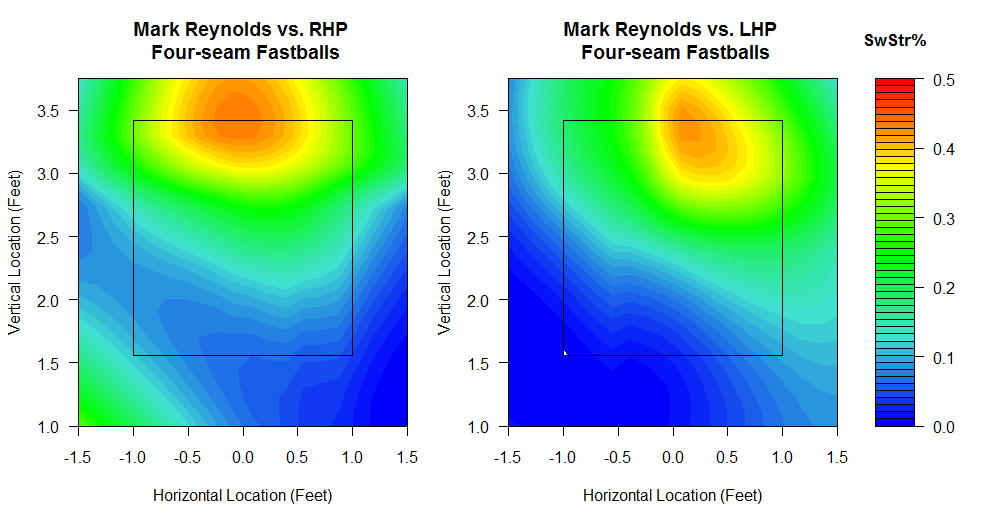
Let’s take a look at Mark Reynolds’ swinging strike percentages against four-seam fastballs split by RHP and LHP (1435 pitches from RHP, 468 pitches from LHP):

Four-seam fastballs

Here, it looks like Reynolds falls victim to high fastballs from both right-handers and left-handers. For Reynolds, he whiffs on the outside fastball from LHP stick out as well as the low and inside fastball from RHP.

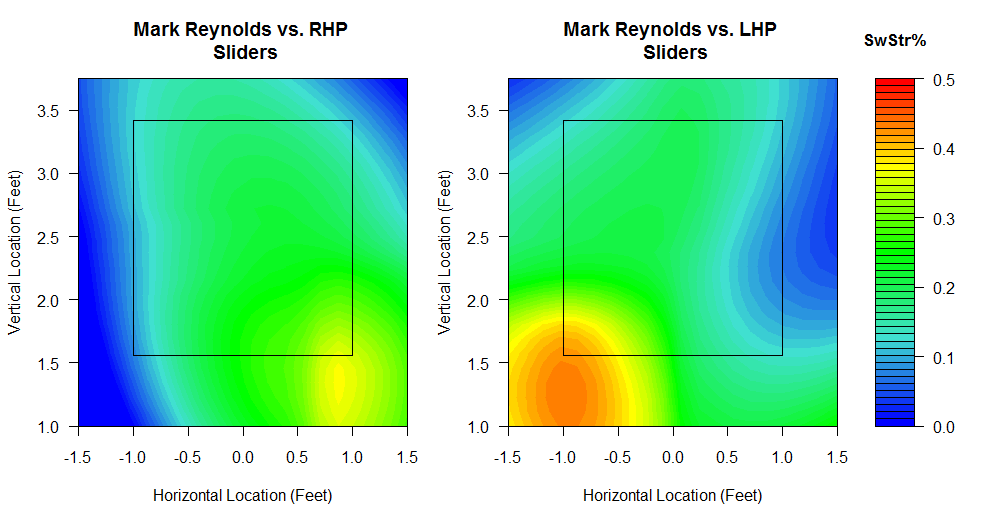
Here’s a look at Reynolds against sliders (1542 from RHP, 224 from LHP):

Sliders

This is interesting. Reynolds strikes out far more against right-handed pitchers than against left-handed pitchers, but he tends to swing at (and miss) sliders coming from LHP more than he does from RHP. LHP sliders come low and inside while RHP sliders go low and outside, but even LHP sliders coming in from low and outside are swung at and missed by Reynolds.

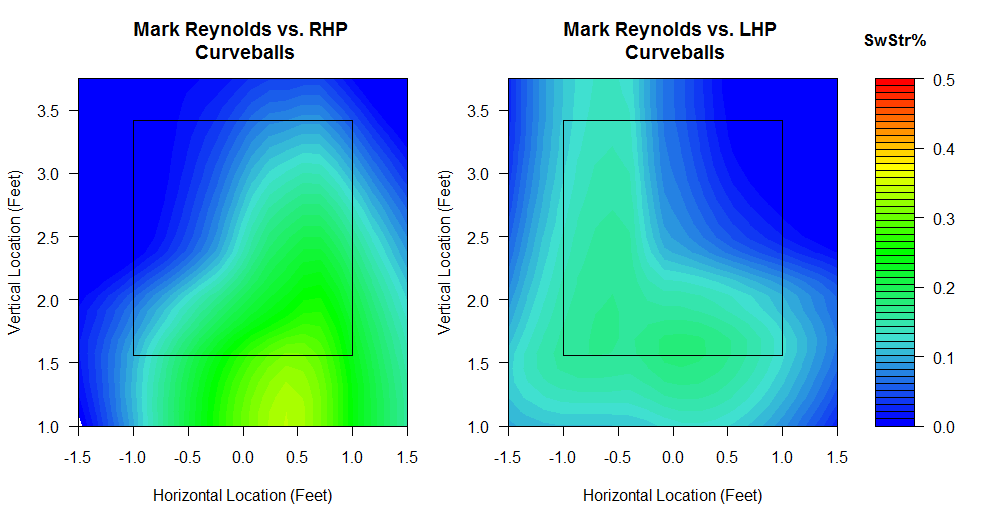
Curveballs against Reynolds are a whole different story (567 from RHP, 228 from LHP):

Curveballs

Here, Reynolds clearly struggles at connecting on curveballs from right-handed pitchers, some in the strikezone and most low and outside the strikezone. Curveballs from LHP also get Reynolds to whiff sometimes on the inside part of the plate as well as the lower part.

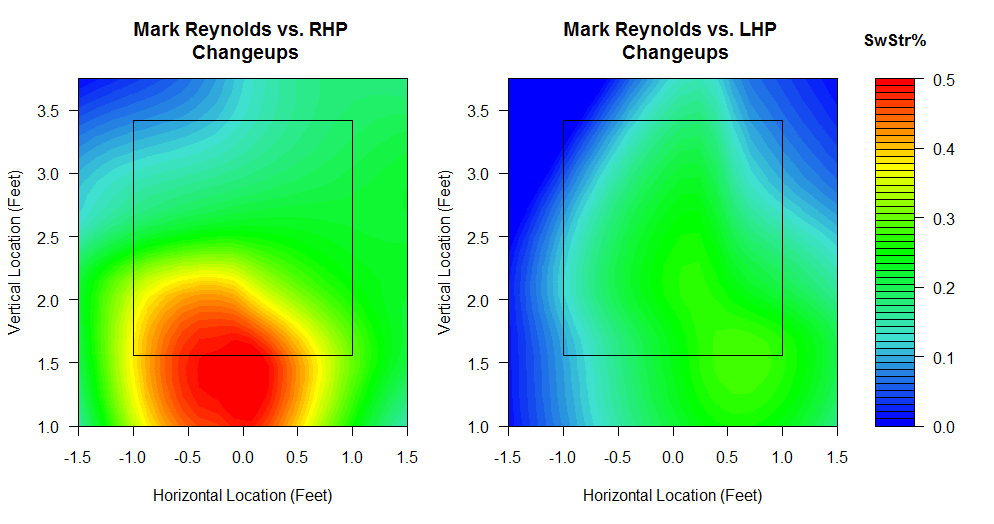
Finally, here’s a look at Reynolds against changeups, which look like his greatest weakness when it comes to missing pitches (430 from RHP, 338 from LHP):

Changeups

This is very telling. The splits against changeups are very different, as Reynolds whiffs on over 50% of changeups from right-handers that are located on the edge of the strikezone at the bottom. This is much different from LHP changeups, where any spot doesn’t look to cross over 30% whiff rate, except the lower righthand corner of the zone. What’s also crazy about this is that when you look at Reynolds against changeups in general, he misses at around 20% of nearly all changeups low outside and nearly all areas within the strikezone as well.

From these plots, there are characteristics of Reynolds’ swinging strikes that are similar to conventional thought and common knowledge, such as chasing high fastballs or low breaking balls. But the key to exploiting Reynolds’ weakness at missing the ball when swinging is definitely throwing timely changeups, especially from right-handed pitchers, while it seems that Reynolds is less prone to whiff against LHP curveballs the most.

This article was originally posted at Think Blue Crew, a blog dedicated to data visualization of baseball, basketball, and football statistics. Check it out for more f/x visualizations like this.


Cesar Izturis’ Inexplicable Continued Employment

As far as value goes, being a +5.8 WAR player is generally considered quite an accomplishment. After all, only three players have accrued that much value this season (Josh Hamilton, Cliff Lee, and Roy Halladay) and the list of those who topped the mark last year is a roll call of stars.

Why, then, is it with a contemptuous sneer that I note that Cesar Izturis is a +5.8 WAR player? Because that’s his career mark. As shocking (or not, if you happen to be an Orioles fan) as this may be, four months of 2010 Josh Hamilton has been more valuable than an entire decade of Cesar Izturis.

And because direct numerical comparisons are always an exhilarating exercise, why don’t we look at the career WAR marks of some other shortstops? Luminaries who have surpassed the “Izturis Line” include Bobby Crosby (in 1,342 fewer plate appearances), Alexei Ramirez (in a whopping 2,637 fewer PA), the significantly-less-than-immortal Damian Jackson (in 1,676 fewer PA), and Pokey Reese (in 1,047 fewer PA). These are but a few members of the list of unspectacular shortstops who were more valuable in fewer plate appearances than Cesar.

In light of this staggering performance, I think the two main points to investigate are why he has been so awful (given his rep as a serviceable option) and what has compelled MLB teams to run him out there on a daily basis since just after George W. Bush took office the first time.

Considering that during every one of my visits to Camden Yards this year I’ve played a mental game of “Is Cesar’s ISO above or below 0.040?” (it currently sits at a tied-for-MLB-worst 0.038), it seems like his prodigious lack of power is a good place to start. Despite posting a very reasonable strikeout rate (9.7%), an OK walk rate (4.9%), and a mediocre but not crippling BABIP (.281) in his career, Izturis boasts a meager .276 lifetime wOBA, a direct result of an equally abysmal .068 career ISO. Never in a full season has he produced an ISO above .100, although he did give the Blue Jays a (comparatively) robust .119 ISO in 46 games in his rookie year in 2001. All of this ineptitude translates to an insane -169.9 batting runs over 4,185 PA spanning the past decade.

But, you argue, he’s not known for his bat. It isn’t fair, hypothetical you argues, to judge him without looking at the superior defense he provides. This segues nicely into my second question, which is why MLB teams continue to pay him to play every day.

As nearly as I can tell, Izturis’ rep among baseball media and traditional fans is that he’s a superb fielder and a decent overall player. After all, you can certainly do worse than a Gold Glove winner at short, right? Unfortunately for anyone who espouses this belief (I’m looking at you, Gary Thorne and Jim Palmer), it just isn’t true.

No matter how much you want to complain about UZR or DRS as defensive metrics, I’m willing to believe that over the course of 8,300+ career innings they paint a fairly accurate picture of Izturis’ true talent level defensively. UZR has him at +6.7 per 150 games at SS (+45.6 runs total among all positions) while DRS has him at 48 career runs saved, so the metrics agree. At that +6-8 runs per season level, Cesar has been above-average but certainly not elite with the glove.

Is this a case of MLB teams overvaluing defensive contributions at the expense of offense? After all, even the two-year, $5 million deal the Orioles gave him prior to the ’09 season has been more than the Venezuelan has been worth (+0.8 WAR during his time with the O’s). Perhaps teams let their scouting departments and Izturis’ hardware (’04 Gold Glove winner) cloud their judgment, or perhaps there just aren’t any other near-replacement-level shortstops out there. Although I’m skeptical about that last possibility.

And yet, for a guy who has hit 15 career home runs (or as many as Jose Bautista has hit since Independence Day), topped the +0.2 WAR mark just thrice in his career, and averaged a paltry +0.4 WAR since 2004, Izturis is certainly doing pretty well for himself. After all, he gets to start every day for a major league team.

Nathan Biemiller is a junior at Franklin and Marshall College who writes regularly for nothing but his college newspaper. If you would like to offer him a place to write consistently (gratis!) or if you just have questions or comments, you can e-mail him at nbiemill@fandm.edu.


xBABIP Experiment: Mark Kotsay

I am tired of Mark Kotsay. I am tired of his automatic 4-3 ground outs. I am tired of his lazy fly balls to left center. I am tired of his .190 batting average with runners in scoring position. I am tired of his .688 OPS. But most of all, I am tired of people in the White Sox organization defending Mark Kotsay. From Ozzie Guillen to Hawk Harrelson and Chris Rongey, the excuses are coming from every corner of the organization. And as an objective White Sox fan, the constant excuses are getting tiring. Luck or no luck, Mark Kotsay is a bad baseball player, that much is for certain.

Kotsay does nothing well and he contributes nothing on the field to this White Sox team, as shown by Mark Kotsay’s -0.6 WAR, good for the fourth worst in all of Major League Baseball amongst players who have at least 280 plate appearances. This shouldn’t come as a surprise, as of this moment, Mark Kotsay is hitting .228. Yet you have Ozzie Guillen saying things like, “Personally, the numbers out there for Kotsay [are not what] he deserves.” Followed by…“You can ask his teammates, you can ask [hitting coach] Greg Walker. He should have better numbers than what he has.”

You can ask any average White Sox fan or anybody in the White Sox organization and they will say that Kotsay has been unlucky or he “deserves” better. However, just how much better? Fortunately for us, the great people in the sabermetric community have come up with something that tries to battle this thing called luck. I think everybody knows of BABIP by now, but there is something better, something more contextual: xBABIP (Expected Batting Average on Balls In Play) . The concept is simple, take the mean batting average of line drives, ground balls, and fly balls that are not home runs, then create a BABIP based on those averages.

So what if Kotsay wasn’t lucky or unlucky? What if this was a perfect world where the average always happens? For the record, Mark Kotsay is a good player for this little experiment since his career offensive numbers are about as average as you can get. Currently, Mark Kotsay’s xBABIP is .269. This is more or less based on his line drive rate of 15.9%. His actual BABIP is .239. So as you see, he has been pretty unfortunate as that’s a 30 point disparity. Now let’s take this a step further, let’s say that .269 xBABIP is his actual BABIP. Mark Kotsay has hit 222 balls into the field of play (this does not include home runs), if he gets hits 26.9% of the time on those 222 balls, he would have 60 hits. Add his 7 home runs to those 60 hits and you have 67 hits in 258 at bats, which comes out to a .259 Batting Average. What about his On Base Percentage? Taking those 67 hits while adding his 30 walks divided by his 286 plate appearances, we would get an OBP of .336. So far so good right? Looks like Mark Kotsay would be a decent ballplayer if it wasn’t for those “hang wiffums” right?

Hold on just a second here, we can also apply this to his Slugging Percentage. We can play the rate game, which is a dangerous game to play, but we’ll do it anyways. Of the 53  hits Mark Kotsay has put in play, 38 have been singles, 13 have been doubles, and 2 have been triples. So from this, we can see that 71% of Kotsay’s non-home run hits have been singles, 25% have been doubles, and 4% have been triples. As I said before, this is a dangerous game to play, almost a fallacy, but since Kotsay does have an appropriate sample size here, it might be safer than usual. So taking these new numbers to his 60 expected hits, his new hit figures are 43 singles, 14 doubles, and 2 triples. This would result in a Slugging Percentage of .414. By adding Kotsay’s expected OBP and SLG together we come up with a .750 Expected On Base Plus Slugging or OPS, which is just about average.

Alright, so how do these new expected rates affect Mark Kotsay’s value? If we calculated an expected wOBA from these newly calculated values, Mark Kotsay would have a .329 Expected wOBA,  just about average. We can then calculate this into a run value to produce a new expected WAR. In this case, Kotsay would have produced -0.99 batting runs (without ballpark adjustment) in comparison to the average replacement player, much better than his previous rate of -6.2. So in this case, Kotsay’s WAR goes from -0.6 to -.08. A half win difference can go a long way at times.

So what does this tell us? Well first off, it says that Kotsay is a very average hitter in a luck-isolated world and average hitters should not be DHing 1/3 of the games for a team that already has issues scoring runs.  It also tells us is that Mark Kotsay has no place on this current White Sox team. He is a replacement level player who is only capable of DHing and playing 1B and that’s even if he hit like the “deserved” to hit. With Mark Teahen coming back and Brent Lillibridge already on the team, this team could be incredibly versatile. Isn’t that what Ozzie Guillen wanted? Isn’t that why Ozzie said no to Jim Thome, who is clubbing the ball for the rival Twins and is also a great clubhouse guy? This love affair with Mark Kotsay has gone too far. He is in fact costing this team on the offensive side of the ball. I would have no problem if Kotsay stays on this team as a pinch hitter and starts maybe once a week; he’s apparently a good guy in the clubhouse (as is his wife, I imagine). But the fact that this replacement level player has played 3/4 of this team’s games is disturbing. With the way that this situation has been tended to, you’d think the White Sox’ new slogan would be something along the lines of “White Sox Baseball: Here to Make Friends, Not to Win”.


Cleaning Up Kenny Williams’ Mess

In spite of a questionable off-season approach to their designated hitter situation and a deadline deal that didn’t fill that vortex of suck, the Chicago White Sox are in first place on the backs of Alex Rios, Alexei Ramirez, Paul Konerko, and most of the pitching staff. After facing Baltimore for one more tonight, they will be going into a critical 3 game series against division rival Minnesota. It doesn’t get us anywhere to look at the past, so the question is what can the White Sox do to maximize the value of the players they have going forward?

The most glaring weakness is still the DH spot. Mark Kotsay has received the majority of the playing time here, and he has also been the team’s least valuable hitter. Kotsay has posted a slash line of .228/.305/.378, with a wOBA of .299. Kotsay’s –0.7 WAR is not only the worst on the team, but tied for fourth worst in the MLB among players with 280 or more PAs. It’s clear that Kotsay isn’t getting the job done, but who is the most viable choice to replace him?

Young Cuban slugger Dayan Viciedo is an interesting option. He’s posting a .361 wOBA (.310/.310/.521) in his first 71 PAs. On the surface, that looks great, but his .333 BABIP is unsustainable for someone as… um… husky as Viciedo. Also, his walk rate of 0% is going to be exploited soon enough (Viciedo’s already swinging at 39.8% of balls outside of the strike zone). It’s clear that even with his incredible power, he’s just not ready for the Majors, and would likely be eaten alive in the playoffs.

Mark Teahen is nearing the completion of his rehab stint in Charlotte, and could be back with the club in the next week. The .255/.340/.387 (.317 wOBA) line he put up while starting at third base isn’t the most stunning, but against RHP he’s hitting .287/.376/.444 (.363 wOBA).

Andruw Jones has played in the DH role some, while also serving as the fourth outfielder. Andruw’s .204/.312/.444 line gives him a .336 wOBA, placing him in the neighborhood of being a league average hitter. Jones benefits from facing lefties, against whom he posts a line of .235/.350/.515 (.376 wOBA).

So based on those numbers, the answer to the DH scenario appears to be a Teahen/Jones platoon, right?

Wrong.

Well, half right. The White Sox currently have a right fielder who, while being a good hitter, is just terrible defensively. I’m of course referring to Jermaine Dye Carlos Quentin. Quentin’s line of .232/.328/.488 (.352 wOBA) is solid in it’s own right, but Quentin’s a great candidate to improve that line, thanks to the impending regression of his .213 BABIP. Quentin’s defense in the past two seasons has been quantifiably terrible. Back to back UZR/150s of –25.2 and –34.2 (the former in LF) have shown that Quentin can’t get the job done, and that he’s a DH (or maybe a first baseman, but that’s a discussion for 2011).

Teahen, meanwhile, has a UZR/150 of just –2.0 in 261 games in right. Jones, in 42 games this year, has a UZR/150 of 8.6. A platoon of these two players also would help the oft-injured Quentin stay healthy, keeping his dangerous bat in the lineup.

The White Sox are in a position that most didn’t think they could be in after the first two months of the season. The team has had some breaks, but if they’re going to compete with a very good Twins team, they have to utilize their players effectively. Getting Quentin out of the outfield and Mark Kotsay out of the lineup? Well, that’s just smart baseball.


Keeping Up With the Musials

It’s safe to say that Andruw Jones has been one of the most disappointing baseball players in recent memory. Just five years ago, Jones was in the middle of a fantastic season wherein he hit 51 homers with a .922 OPS (despite a .240 BABIP) and was worth 8.3 WAR. As recently as 2007, he slammed 26 long balls while driving in 94 and accumulating 3.8 WAR.

Then disaster struck. In 2008, after signing a two-year, $36 million with the Dodgers, Jones absolutely tanked, hitting just .158 with three homers and a .505 OPS; he struck out in more than a third of his at-bats and his once prodigious power disappeared, as evidenced by his Michael Bourn-esque .091 ISO.

In the 160 games Jones has played with the Rangers and White Sox in 2009-10, he’s regained some of his lost power, bashing 32 homers with a .244 ISO in just under 600 plate appearances. However, those numbers don’t seem particularly special for a guy who’s spent the majority of his time at first base and DH, especially when combined with a putrid .209 batting average. No one’s mistaking him for an All-Star.

And yet, there is no doubt that Andruw Jones belongs in the National Baseball Hall of Fame.

Wait, what?

For starters, let’s not be too hasty and dismiss his earlier offensive accomplishments. In 12 years with the Braves, he averaged 33 homers and 98 RBI per 162 games with an .824 OPS. He hit the 20/20 club three times, including his 31/27 season in 1998.

His 403 career homers put him 46th all-time — ahead of current Cooperstown residents Al Kaline (399), Jim Rice (382), Ralph Kiner (369), and Albert Pujols (okay, so he’s not in the Hall of Fame yet, but I’m sure they’re already planning out his plaque). And while 31 was a tad on the young side for a complete collapse, don’t forget that he had established himself as a key part of the Braves’ outfield before he was old enough to drink. But all of that is just icing on the cake.

Forget everything he did at the plate, on the basepaths, or in the dugout; if for no other reason, Andruw Jones deserves to be enshrined because of what he did in center field. Jones isn’t just one of the best defensive outfielders of his generation — he’s arguably the best-fielding outfielder of all time, and surely ranks among the top glovesmen in baseball history at any position.

Jones won 10 consecutive Gold Gloves from 1998-2007. Even opening it up to players who were honored in multiple, nonconsecutive years, that beats Ichiro (nine), Torii Hunter (nine), Andre Dawson (eight), Jim Edmonds (eight), Larry Walker (seven), and Kenny Lofton (four). The only outfielders who have ever done better are Willie Mays and Roberto Clemente (12 apiece), but I’m sure you’ll join me in condoning Jones for not quite living up to their lofty standard.

Of course, you could argue that Gold Gloves are a popularity contest, and aren’t necessarily the best way to determine the game’s best defenders (see “Kemp, Matt” and “Jeter, Derek” last year). It’s true, they don’t accurately describe Jones’ accomplishments — they don’t do them justice.

According to TotalZone (used for seasons from 1954-2001) and Ultimate Zone Rating (2002-now), Jones has saved 274.3 runs in his career with his glove. Two-hundred seventy-four point-three runs. That’s about 28-wins worth of value for his career without taking into account anything he’s done with his bat.

If that number isn’t terribly impressive to you, perhaps you should consider the context: it’s the best score of any outfielder in baseball history, and a look at the Top 10 shows that it’s not particularly close:

1. Andruw Jones 274.3
2. Roberto Clemente 204.0
3. Barry Bonds 187.7
4. Willie Mays 185.0
5. Carl Yastrzemski 185.0
6. Paul Blair 174.0
7. Jesse Barfield 162.0
8. Al Kaline 156.0
9. Jim Piersall 156.0
10. Brian Jordan 148.0

These statistics are far from perfect, and there’s definitely an argument to be made that the older numbers are particularly flawed. But even if we can’t use it to compare players of different eras (could the margin of error really be more than 70 runs?), we can see just how amazing Jones has been by comparing him to his contemporaries. If you noticed that the only other names of those 10 who played at the same time as Jones were Bonds (whose days as a serviceable fielder were numbered by the time Jones made his debut) and the woefully unappreciated Jordan, you can probably see where this is going.

Darin Erstad (146.6)? Ichiro (120.2)? Carl Crawford (119.8)? Lofton (114.5)? Mike Cameron (110.7)? Walker (86.0)? Edmonds (57.5)? None of them even come close. In fact, Jones’ score is better than any two of those names’ combined.

It’s not just outfielders, either. Jones’ TZR/UZR is the second best of all-time, behind only Brooks Robinson. Compare his 274.3 runs saved with Cal Ripken Jr.’s 181.0, Ivan Rodriguez’ 156.0, Luis Aparicio’s 149.0, and Omar Vizquel’s 136.4. He even beats true defensive legends like Joe Tinker (180.0), Honus Wagner (85.0), and the amazing Ozzie Smith (239.0). If you can go toe-to-toe with the “Wizard of Oz” in the field, you barely need a pulse offensively to deserve a place in Cooperstown.

Jones hasn’t had time to slowly build up his score by being a consistently solid fielder; instead, he grabbed the bull by the horns and has enjoyed some of the best individual defensive seasons in baseball history.

In 1998 — at age 21 — he was worth 35 runs in the field, which at the time was tied for the second-best defensive performance since tracking began in 1950. In 1999, he promptly went out and beat that, earning 36 TZR. All told, he appears on the Top 80 list for single-season Total Zone Rating five times. And that’s not including UZR, which has been kinder to him than TZR since 2003.

Will the BBWAA vote him in when his time comes? Probably not. Even assuming the voters have learned how to use the newfangled defensive metrics by then (far from a sure thing, given that a majority of NL Cy Young voters implicitly declared wins to be the most important pitching statistic last year), there are too many reasons for them to doubt his candidacy.

While TZR and UZR make sense and are great tools for getting a general idea of a player’s defensive prowess, they’re too inconsistent for fans to take as the word of God (though, in my opinion, a 70-run lead is more than enough to cancel out the margin of error). Aside from that, you’ve just got a free-swinging, power-hitting outfielder (a dime a dozen over the last 20 years) who fell off a cliff right before his 32nd birthday. He’d have to return to his younger form and maintain it for at least a few more years in order to have a realistic shot at Cooperstown.

But, as the Beatles once sang, “all you need is glove” (unless I heard that wrong), and that’s what Ozzie Smith proved when he got more than 90 percent of the vote for the Hall of Fame in 2002. Combine phenomenal defense with a solid bat (remember those 403 homers?) and there’s no question Andruw Jones deserves a spot in Cooperstown.

Lewie Pollis is a freshman at Brown University studying political science. He also contributes to BleacherReport.com, ManCaveSports.org, and Green Pages, the quarterly publication of the U.S. Green Party.


Year of the Pitcher?…Think Again

WASHINGTON D.C., August 10th – Five no-hitters.  Two of them perfect games.  A third perfecto lost.  And then there was Brandon Morrow, losing his no-hitter with two outs in the ninth.  The 2010 season has been branded as the Year of the Pitcher.  But statistical evidence points in a different direction.

RS RS/G Z-score Change Change% ABS %
2000 24971 10.28 3.34 N/A N/A N/A
2001 23199 9.55 0.72 -0.73 -7.10 7.10
2002 22408 9.22 0.46 -0.33 -3.46 3.46
2003 22978 9.46 0.40 0.24 2.60 2.60
2004 23375 9.62 0.97 0.16 1.69 1.69
2005 22326 9.19 0.57 -0.43 -4.47 4.47
2006 23599 9.71 1.30 0.52 5.66 5.66
2007 23322 9.60 0.90 -0.11 -1.13 1.13
2008 21939 9.03 1.14 -0.57 -5.94 5.94
2009 22419 9.23 0.43 0.20 2.21 2.21
2010 14813 8.88 1.69 -0.35 -3.79 3.79
STDEV 0.28 -0.14 -1.37 3.81
AVERAGE 9.35

This chart summarizes the runs-scored data for the 2000-2010 seasons.  While the runs scored per game figure for this season is clearly the lowest in the set, there are multiple available factors that determine that it’s a normal fluctuation.

The first is the basic standard deviation.  The average of the set is approximately 9.35 RS/G, and the standard deviation is approximately 0.28 RS/G.  The z-score column indicates a particular point’s distance from the mean in terms of the standard deviation.  Ninety-five percent of the time, a point is expected to be within two standard deviations from the mean, or have a z-score between 0 and 2.  As we can see from the chart, the 2010 season fits neatly into that range, with a z-score of approximately 1.7.

The second is the percentile change between each season’s RS/G figure.  If we take the absolute value of each percentile change, we find that each year, the runs-scored total differs from the previous year’s total by about 3.81% in one direction or the other.  This season hits that mark almost exactly, featuring a 3.79% drop from the previous year.

And there isn’t a definitive trend, either.  Of the ten points in the data sent for changes, six were drops from the previous year, and four were increases, leading to the basic average of -1.37%, which equals about -0.14 RS/G over the course of a season.

In conclusion, statistical factors point in the direction of this season being a normal fluctuation in terms of runs scored.  We’ve certainly seen dominance from the mound, and this could turn out as being the most pitching-heavy season in recent memory, but it’s well within normal, and could easily go right back the other way at the drop of a hat.