Determining the Market Value for Greinke, Price and Cueto

With the World Series over and all the free agents declared it’s now time for my second-favorite part of the MLB season: the offseason. The 2015 free-agent class is pretty deep and includes some elite players. In this article I wanted to figure out a way to determine monetary value for the top three starting pitchers available this year: Zack Greinke, David Price and Johnny Cueto. All of them are aces and certainly heading for a big pay day but I wanted to develop a way of using the recent big contracts pitchers have signed and the production of great players in the past to determine what kind of pay day these guys are heading for.

Since 2009 there have been nine pitchers to sign a major deal: Clayton Kershaw, Max Scherzer, Justin Verlander, Felix Hernandez, C.C. Sabathia, Jon Lester, Zack Greinke, Cole Hamels and Matt Cain. (I didn’t include Masahiro Tanaka because he didn’t face big-league hitting until he signed his contract.) The average salary amount for these contracts was $168 million and had an average year length of about 5-6 years. When we’re looking at contracts there are many things to consider but two of the biggest factors has to be dollar and year amount. For all three of these pitchers, this may be their last big contract, so maximizing potential is crucial. Every team would love to add a pitcher of their caliber but not every team is in a position to pay for them. That’s part of the reason I wanted to figure out a way to see what dollar amount these pitchers’ production has warranted so far, in comparison to the big contracts signed since ’09 and speculate what can be expected of them for the length of the contract.

To figure out the dollar amount I looked at the nine players’ contracts and figured out the average yearly salary for each individual. I then took that number and divided it by their career WAR, essentially figuring how much it cost the team for the player’s WAR production. Here are the results I got (in millions).

Clayton Kershaw – $5.2m
Justin Verlander – $7m
Felix Hernandez – $6.5m
Jon Lester – $8.9m
C.C. Sabathia – $6.7m
Cole Hamels – $7m
Matt Cain – $9.4m
Zack Greinke – $7.7m
Max Scherzer – $7.5m

I averaged out the numbers, rounded off and got $7.3 million per WAR created. I then took that 7.3 number and multiplied it by Greinke’s career WAR to get, 27.7. So theoretically a year of Zack Greinke pitching is roughly $27.7 million. For David Price it’s $29.2 million and for Johnny Cueto it’s $21.1 million. It’s hard to predict where the market will go once teams start the bidding war, and I’m sure some team is willing to pay above the WAR value to ensure they get their man but for now I’m going to use these numbers to speculate year amount and production.

To determine the amount of years each player could receive, I decided to compare their career production with that of a similar type of pitcher. Let’s start with Zack Greinke. For Greinke I went with Greg Maddux as a comparison; obviously Greinke throws harder but I felt their command of the strike zone and pitches put Maddux and Greinke in the same boat. Below I’ve compared Greinke’s first 12 years in the big leagues to Maddux’s and I certainly think they’re close.

Zack Greinke      Greg Maddux

ERA = 3.49          ERA = 3.06
IP = 2,092.1         IP = 2,596.7
BABIP = .299       BABIP = .283
WAR = 3.8           WAR = 5.5
K/9 = 7.97            K/9 = 6.27
BB/9 = 2.37          BB/9 = 2.23
FIP = 3.52            FIP = 3.06
HR/9 = .92           HR/9 = .49

At age 32 Maddux had a better WAR than Greinke and threw about 500 more innings, but the latter may work in Greinke’s favor. The next part will help determine how many years a team can reasonably expect Greinke to pitch at an elite level. I looked at Maddux’s career numbers from age 32-38 and these were the results.

Greg Maddux (Age 32-38)

ERA = 3.21
IP = 1,581.6
BABIP = .285
WAR = 5.3
K/9 = 6.18
BB/9 = 1.50
FIP = 3.46
HR/9 = .81

As you can see from the results, Maddux was still pitching at an elite level from ages 32-38. From the ages of 39-41 however, you have a different story.

Greg Maddux (Age 39-41)

ERA = 4.20
IP = 827
BABIP = .291
WAR = 3.5
K/9 = 4.93
BB/9 = 1.39
FIP = 3.88
HR/9 = .91

Still good enough to be a major-league pitcher but a far cry from his prime. For Greinke’s situation I think you can expect a similar outcome, so a contract of 6 years at $166 million would be incredibly reasonable for a team. But this is America and money talks; whichever team is willing to pay the elite price tag for more then six years, I think, will be the winner of his services. A seven-year contract between $27-$29 million would be palatable and completely plausible but I think you start to handcuff yourself as a team going for eight years at that rate. Greinke had a dominant 2015 and if there ever was a time for him to test the open market, it’s now. We’ll see what teams are willing to shell out for him but for now let’s move on to David Price.

Unlike Greinke, David Price has never had a chance to test the open market and after another stellar season in the big leagues, Price is gearing up for a big pay day. As I mentioned before Price has a WAR value of about $29.2 million per season and at the age of 30 could see a lengthier contract then Greinke. To figure out future production I could only go with another tall, hard-throwing left-hander by the name of Randy Johnson. Price has eight years under his belt and his comparison to Randy Johnson looks something like this.

David Price          Randy Johnson

ERA = 3.02          ERA = 3.44
IP = 1,439.8         IP = 1,457.8
BABIP = .275       BABIP = .279
WAR = 4              WAR = 4
K/9 = 8.34            K/9 = 9.78
BB/9 = 2.43          BB/9 = 4.46
FIP = 3.30            FIP = 3.43
HR/9 = .80           HR/9 = .76

Price and Johnson compare very well, with Johnson having the advantage in K/9 but Price’s BB/9 is significantly better. Both have a WAR of 4 and nearly identical IP, BABIP, FIP and HR/9. Over the next eight years Johnson went on to be one of the most dominating pitchers in the game and during that stretch had some of the greatest seasons we’ve seen from a pitcher, period. Here are his numbers from 1996-2003.

Randy Johnson (’96-’03)

ERA = 2.93
IP = 1,660.8
BABIP = .308

WAR = 7
K/9 = 12.04
BB/9 = 2.79
FIP = 2.85
HR/9 = .94

This was by far the prime of Johnson’s career and although Price may not put up those types of numbers, he has a good shot of coming close. An 8-year deal for $233 million would be a steal if Price could come close to Johnson’s numbers. Price’s situation is similar to Greinke’s whereas whichever team is willing to pay elite prices for the most years will probably win out. Like Maddux, if you look at the back end of Johnson’s career, you’ll see the decline in results. Still effective for a major-league pitcher but not worth the elite money they once were.

Randy Johnson (’04-’09)

ERA = 4.00
IP = 1,011.6
BABIP = .290

WAR = 3.8
K/9 = 9.09
BB/9 = 2.21
FIP = 3.70
HR/9 = 1.21

Again, whichever team is willing to pay the elite price tag for these years of Price’s career will probably be the winner. It’s a gamble for sure to exceed eight years but eight elite seasons of David Price might be worth a year or two of mediocre Price. This brings us to our last top-tier starting pitcher and the one who perhaps stands to gain the most by being in the same class as Greinke and Price: Johnny Cueto.

First off, I want to say that I think Cueto is a great pitcher and one who deserves the “ace” title, and I know he’s spent most of his career in a hitter-friendly ballpark, but I don’t think his numbers warrant the price tag that Greinke and Price may receive. That being said, pitching is crucial for success in the big leagues and there are only a few top-tier pitchers available via free agency. A team that loses out on Greinke and Price could very well overpay for Cueto’s services to ensure they get one of the best available. For comparison I decided to use Jake Peavy; although Peavy is still playing I think his time as the ace for San Diego and his funky delivery pair nicely with Cueto. Here are the comparisons for the two pitchers through the first eight seasons of their careers.

Johnny Cueto          Jake Peavy

ERA = 3.31            ERA = 3.34
IP = 1,418.7           IP = 1,360.1
BABIP = .272         BABIP = .286
WAR = 2.9             WAR = 3.7
K/9 = 7.35              K/9 = 9.00
BB/9 = 2.65            BB/9 = 2.94
FIP = 3.87              FIP = 3.46
HR/9 = .94             HR/9 = .90

Through similar innings pitched Cueto and Peavy have comparable ERA, BABIP, WAR, BB/9, FIP and HR/9. The WAR value that I came up with for Cueto was $21.1 million per season, a number I think he can certainly get for a number of years. He’s only 29 and unlike Greinke and Price, may be able to sign two major contracts in his career if he can maintain elite status throughout the first one he is about to sign. If he were to sign a four- or five-year deal (4 years/$84 million or 5 years/$105), it’s not crazy to think that a team will pay the elite price tag for another three or four years of a quality Johnny Cueto.

The red flag I see with Cueto is the amount of innings he’s thrown; at 29 he’s only 21.1 innings away from David Price’s total of 1,439.8. As is the case with Jake Peavy, injuries completely derailed effectiveness and Peavy quickly went from “ace” to a 3rd or 4th starter. I’m not saying Cueto is destined to get hurt — his chances are the same as anyone, but paying the high price required to get him makes the possible injury sting even more. Here are the numbers Jake Peavy has put up over the past 6 seasons.

Jake Peavy (’10-’15)

ERA = 4.06
IP = 893.8
BABIP = .281
WAR = 2.3
K/9 = 7.39
BB/9 = 2.31
FIP = 3.82
HR/9 = 1.04

As I mentioned above, injuries greatly affected Peavy’s last six seasons and that’s not the best situation to compare future production from Cueto but it could be a caution to whichever team signs him as to the other end of the spectrum. We all hope for the best but you have to plan for the worst and shelling out $21m+ per season for those types of numbers doesn’t necessarily make sense.

Again I think Cueto is in a great position here, he’s young enough to sign a big deal and still have the potential to land another one down the road. It just depends on effectiveness and health; if both of those stay on his side, he should have no problem getting another big contract around 34 or 35.

After it’s all said and done, we’ll truly know the answer and that’s part of the fun. Speculating how much, how long and where players will end up helps get through the grueling winter months and I, for one, love it. Let me know what you think below and as always, thanks for reading.


Hardball Retrospective – The “Original” 1907 Philadelphia Phillies

In “Hardball Retrospective: Evaluating Scouting and Development Outcomes for the Modern-Era Franchises”, I placed every ballplayer in the modern era (from 1901-present) on their original team. Therefore, Rusty Staub is listed on the Astros roster for the duration of his career while the Athletics declare “Shoeless” Joe Jackson and the Blue Jays claim Tony Fernandez. I calculated revised standings for every season based entirely on the performance of each team’s “original” players. I discuss every team’s “original” players and seasons at length along with organizational performance with respect to the Amateur Draft (or First-Year Player Draft), amateur free agent signings and other methods of player acquisition.  Season standings, WAR and Win Shares totals for the “original” teams are compared against the “actual” team results to assess each franchise’s scouting, development and general management skills.

Expanding on my research for the book, the following series of articles will reveal the finest single-season rosters for every Major League organization based on overall rankings in OWAR and OWS along with the general managers and scouting directors that constructed the teams. “Hardball Retrospective” is available in digital format on Amazon, Barnes and Noble, GooglePlay, iTunes and KoboBooks. The paperback edition is available on Amazon, Barnes and Noble and CreateSpace. Supplemental Statistics, Charts and Graphs along with a discussion forum are offered at TuataraSoftware.com.

Don Daglow (Intellivision World Series Major League Baseball, Earl Weaver Baseball, Tony LaRussa Baseball) contributed the foreword for Hardball Retrospective. The foreword and preview of my book are accessible here.

Terminology

OWAR – Wins Above Replacement for players on “original” teams

OWS – Win Shares for players on “original” teams

OPW% – Pythagorean Won-Loss record for the “original” teams

Assessment

The 1907 Philadelphia Phillies    OWAR: 56.2     OWS: 349     OPW%: .527

Based on the revised standings the “Original” 1907 Phillies finished in a tie for fourth place, only six games behind the front-running Cubbies. Philadelphia paced the National League in OWS and OWAR.

Sherry Magee batted .328 with a League-best 85 RBI and a team-leading 37 Win Shares. Elmer Flick supplied a .302 BA and legged out 18 three-base hits. Nap Lajoie rapped 30 doubles and pilfered 24 bases. The keystone combo of Ed Abbaticchio and Kid Elberfeld swiped 57 bags. Roy A. Thomas posted a .374 OBP and led the League in walks for the seventh time in eight seasons. “Silent” John Titus provided a solid option as a fourth outfielder, belting 23 doubles and 12 triples while hitting at a .275 clip.

Nap Lajoie places sixth among second basemen according to Bill James in “The New Bill James Historical Baseball Abstract.” Teammates listed in the “NBJHBA” top 100 rankings include Magee (21st-LF), Flick (23rd-RF), Thomas (29th-CF), Kid Gleason (72nd-2B), Elberfeld (75th-SS) and John Titus (76th-RF).

LINEUP POS WAR WS
Roy Thomas CF 2.55 20.78
Nap Lajoie 1B/2B 7.5 30.2
Sherry Magee LF 7.13 37.68
Elmer Flick RF 4.95 34.39
Kid Elberfeld SS 2.9 21.36
Fred Jacklitsch C 0.84 8.17
Ed Abbaticchio 2B 2.27 20.54
3B
BENCH POS WAR WS
John Titus RF 2.16 23
Doc Marshall C 0.44 2.67
George Browne RF 0.39 12.1
Mickey Doolin SS 0.06 12.08
Paul Sentell SS -0.06 0.02
Red Dooin C -0.21 7.72
Del Howard LF -1.08 7.34
Kid Gleason 2B -1.44 1.12

Doc White fashioned a 2.26 ERA and a 1.058 WHIP while topping the leader boards with a 27-13 record. Tully Sparks delivered a 22-8 mark with a 2.00 ERA and 1.026 WHIP as he completed 24 of 31 starts. Johnny Lush (10-15, 2.68) and “Smiling” Al Orth (14-21, 2.61) rounded out the Phillies’ rotation. George McQuillan (4-0, 0.66) yielded only three earned runs in 41 innings pitched during his inaugural campaign.

ROTATION POS WAR WS
Doc White SP 4.37 23.84
Tully Sparks SP 3.63 23.54
Johnny Lush SP 0.53 12.13
Al Orth SP -0.06 15.29
BULLPEN POS WAR WS
Harry Coveleski RP 0.7 2.75
King Brady RP -0.02 0.13
George McQuillan SP 2.32 7.19
Fred Burchell SP -0.09 0.27
Jesse Whiting RP -0.28 0
John McCloskey RP -0.58 0
Bill Duggleby SP -1.42 1.9
Bill Bernhard SP -1.54 0

The “Original” 1907 Philadelphia Phillies roster

NAME POS WAR WS General Manager Scouting Director
Nap Lajoie 2B 7.5 30.2
Sherry Magee LF 7.13 37.68
Elmer Flick RF 4.95 34.39
Doc White SP 4.37 23.84
Tully Sparks SP 3.63 23.54
Kid Elberfeld SS 2.9 21.36
Roy Thomas CF 2.55 20.78
George McQuillan SP 2.32 7.19
Ed Abbaticchio 2B 2.27 20.54
John Titus RF 2.16 23
Fred Jacklitsch C 0.84 8.17
Harry Coveleski RP 0.7 2.75
Johnny Lush SP 0.53 12.13
Doc Marshall C 0.44 2.67
George Browne RF 0.39 12.1
Mickey Doolin SS 0.06 12.08
King Brady RP -0.02 0.13
Paul Sentell SS -0.06 0.02
Al Orth SP -0.06 15.29
Fred Burchell SP -0.09 0.27
Red Dooin C -0.21 7.72
Jesse Whiting RP -0.28 0
John McCloskey RP -0.58 0
Del Howard LF -1.08 7.34
Bill Duggleby SP -1.42 1.9
Kid Gleason 2B -1.44 1.12
Bill Bernhard SP -1.54 0

Honorable Mention

The “Original” 1978 Phillies   OWAR: 57.7     OWS: 320     OPW%: .547

Clashing with the Expos and the Bucs into the final week of the ’78 season, Philadelphia emerged in third place, only two games behind Pittsburgh. The Fightin’ Phillies led the circuit in OWAR and placed runner-up to the Pirates in OWS. Greg “The Bull” Luzinski launched 35 moon-shots and knocked in 101 baserunners. First-sacker Andre Thornton blasted 33 long balls, tallied 105 RBI and scored a personal-best 97 runs. Larry Hisle delivered a .290 BA with career-bests in home runs (34) and RBI (115). Mike Schmidt struggled through a sub-par season at the dish but played stellar defensive at the hot corner, winning his third of nine consecutive Gold Glove Awards. Shortstop Larry Bowa contributed 27 steals and a .294 BA while backstop John “Bad Dude” Stearns pilfered 25 bases. Fergie “Fly” Jenkins furnished a record of 18-8 with a 3.04 ERA and 1.080 WHIP. Dick Ruthven provided 15 wins with a 3.38 ERA. Mike G. Marshall anchored the relief corps with 10 victories and 21 saves.

On Deck

The “Original” 2001 Mariners

References and Resources

Baseball America – Executive Database

Baseball-Reference

James, Bill. The New Bill James Historical Baseball Abstract. New York, NY.: The Free Press, 2001. Print.

James, Bill, with Jim Henzler. Win Shares. Morton Grove, Ill.: STATS, 2002. Print.

Retrosheet – Transactions Database

Seamheads – Baseball Gauge

Sean Lahman Baseball Archive


Mostly Useless Information About the World Series In the Wild Card Era

We could easily call my decision to publish an article with playoff predictions using a brand-new theory about previous success predicting future success ballsy (or stupid). To summarize, research by Rosenqvist and Skans (2015) [1] showed that golfers who barely qualified for a golf tournament would go on to have more success in future tournaments than golfers who barely missed the cut in the same tournament. Seemingly accidental success created confidence, which led to more success in the future. So, using this logic, I wanted to see if this same phenomenon occurred at the team, rather than the individual level. The attempt was to predict all divisional victors from this year’s 2015 MLB playoffs using previous playoff experience and success as the predictor. As it turns out, the teams with more experience/success were only 1 for 4 in the first round of the playoffs.

This time, instead of making predictions, I did the smart thing and looked at previous trends. Instead of using the first round of the playoffs (which arguably is more erratic given that it’s only a five-game series), I focused solely on the World Series. I totaled all the previous playoff experience, age, and WAR for every player on each 25-man World Series team roster in the Wild Card Era (1995 – 2015, n = 42 teams).

WAR doesn’t predict the winner of the World Series

Is this old news? I don’t know. Tallying up a team’s WAR correlates with the actual number of wins that team will have by the end of the regular season (somewhere around r = .82 last time I checked), but it doesn’t correlate with the victor of the World Series. In fact, 13 out of the last 21 (62%) World Series victors had average WARs lower than their opponent’s.

Differences in experience at the team level relate to the duration of the World Series

The difference in previous playoff experience between the two World Series teams is a good predictor of the number of World Series games that will be played in a series. Specifically, at the team level, the greater the difference in the average previous playoff series won (r = -.45, p < .05, n =21), the average number of World Series appearances (r= -.45, p < .05, n =21), and the average number of World Series titles (r = -.46, p < .05, n =21) between the two teams, the less World Series games played that year. You’re saying, “yeah but what about the 2014 World Series that went 7 games when the seasoned Giants played the inexperienced Royals?” It’s just a trend, not a guarantee.

Other tidbits

  • The higher the average of previous World Series appearances across both World Series teams, the higher number of television viewers (r = .45, p < .05).
  • The World Series victor with the highest average WAR per player was the 1998 Yankees (m = 2.57); the lowest WAR was the 2006 Cardinals (m = 1.26).
  • Oldest World Series victors were the 2000 Yankees (m = 30.7); youngest were the 2002 Angels (m = 27.4).
  • Most experienced victor was also the 2000 Yankees (96% of the team had previous playoff experience), and least experienced were the 2002 Angels (0%).

More needs to be understood about this theory

There was however, no relationship between previous playoff experience and that year’s World Series outcome. In terms of playoff experience, the results from Rosenqvist and Skans could not be replicated in this setting. Baseball isn’t golf, and baseball isn’t an individual sport, it’s a team sport. Perhaps the average and/or aggregate levels of experience within a team might manifest differently than for an individual. So, too, are there other ways to operationalize this hypothesis of previous experience/success, so I wouldn’t write this off as a done deal. We’re still a long ways away from determining how and if this theory occurs within the context of baseball – more research into the theoretical underpinnings is always the answer.

Back to the drawing board.

[1] Rosenqvist, O. & Skans O.N. (2015). Confidence enhanced performance? – The causal effects of success on future performance in professional golf tournaments. Journal of Economic Behavior & Organization, 117, 281-295.


Pace Yourself: The Relationship Between Pace and xFIP

This increasing time of games has been cited by Major League Baseball to be a deterrent to fans, jeopardizing ticket sales. Total game time has increased between 2.85 hours in 2004, rising to 3.13 hours in 2014. In 2015, MLB implemented rules to help speed up game time. These rules included forcing batters to stay in the batter’s box during at-bats, and decreasing the time between innings to 2 minutes and 30 seconds. Back in April, after the first few weeks of the season had passed, MLB reported success on their initiatives, stating that if current paces were maintained, average game time would drop below the 2.92-hour mark for the first time since 2011.

A more dramatic possible change was to implement a pitch clock, forcing pitchers to throw their next pitch within 20 seconds of receiving the ball back from the catcher. Currently, the rulebook states (Rule 8.04) that pitchers should throw their next pitch within 12 seconds of receiving the ball from the catcher. However, this rule is not enforced. FanGraphs presents data on the time between pitches, called Pace, which is calculated by taking the total time in an at-bat, and dividing it by the number of total pitches. Between 2010 and 2014 (for pitchers who threw at least 50 MLB innings), the slowest pitchers were Jose Valverde in 2012 (32.4 seconds), Joel Peralta in 2012 (32.3 seconds), and Joel Peralta in 2014 (32.1 seconds). The fastest pitchers were Mark Buehrle in 2010 (16.4 seconds), Mark Buehrle in 2011 (15.9 seconds), and (drum roll please… ) Mark Buehrle in 2015 (15.9 seconds). However, what goes into a pitcher’s selected pace? Focus on execution of their pitch? Embracing the glow of the national spotlight? There hasn’t been much (if anything) to describe the relationship between a pitcher’s self-selected pace and pitching performance.

I looked at the average pace for all pitchers who threw a minimum of 50 innings in years 2010 through 2015. The time between pitches increased steadily between 2010 and 2014, rising from 21.9 seconds in 2010, to 23.5 seconds in 2014. In 2015, the influence of the new pace-of-play initiatives could be seen, with pace decreasing to an average of 22.2 seconds between pitch. Definitely a step in the right direction from MLB’s perspective, but how did this impact pitching performance?

Focusing on xFIP for all pitchers from the same cohort (a minimum of 50 IP), a trend existed for xFIP to decrease between years 2010 and 2014 – an inverse relationship compared to pitching pace. In 2010, the average xFIP was 3.98, compared to 3.60 in 2014. In 2015, xFIP increased to 3.84.

View post on imgur.com

Is this truly a reflection of pitchers requiring an extra second or two to steady themselves and prepare to throw their best possible pitch in a given situation – or are other factors in play? From a physiological perspective, reducing the time between physical efforts can result in an increased accumulation of muscle fatigue. A recent paper published in the journal of Sports Sciences by Wang and colleagues (2015) found pitchers in a fatigued state were less able to throw strikes. A possible explanation of this relationship is found between increased pitching pace and decreased xFIP.

Major League Baseball will surely press forward with what is best for the game, and the business of baseball. It would be worthwhile for coaches, pitchers, and player’s union representatives to further investigate how pitchers self-select their pace between pitches. Further work is required to establish if there are any negative health consequences associated with decreasing the time between pitches. This should be completely ruled out before any further initiatives are taken by the MLB to speed up the game of baseball.


References

Lin-Hwa Wang, Kuo-Cheng Lo, I-Ming Jou, Li-Chieh Kuo, Ta-Wei Tai & Fong- Chin Su (2015): The effects of forearm fatigue on baseball fastball pitching, with implications about elbow injury, Journal of Sports Sciences, DOI: 10.1080/02640414.2015.1101481


Seven Days In the Desert: My Favorite Prospects From the AFL

Seven days, nine games. Eight guys who stood out to me.

These aren’t necessarily the best players I saw in the Arizona Fall League (AFL), just the eight guys who I’m particularly bullish on. Alex Reyes has a lights-out fastball/curveball combo, and some of the best mound presence I’ve ever seen from a 20-year old, but he’s been written about by many others…so I decided to write about these eight.

1. Lewis Brinson, R/R OF (TEX)
6’3”+, long, athletic outfielder with a frame that has plenty of room to fill out. Above-average speed and athleticism, enough to probably steal 20-25 bases at the big-league level today. Good approach at the plate, takes his hacks, and doesn’t waste any at-bats. Despite a fairly wiry body, Brinson still has impressive in-game power (400+ ft. HR to center)…once his frame fills out, this kid very well could be an All-Star. He strikes me as being a surefire MLB contributor, and he has the upside of a Starling Marte or Jason Heyward. Brinson won’t turn 22 until next May, and he’s already had a very impressive campaign at AA, plus 37 PA at Triple-A in which he mashed to a .433/.541/.567 line. I didn’t really know much about him prior to the AFL, but I was impressed from his first plate appearance. My personal favorite player at the AFL this year.

2. Dominic Smith, L/L 1B (NYM)
He’s a professional hitter. His approach is very refined, his swing is incredibly simple. Very impressive hitter given he only turned 20 this past June. He’s a big boy though, with a body similar to Michael Conforto or even a slightly lighter Kyle Schwarber. Given he’s pretty bulky and left-handed, his defensive flexibility is limited to first base. I don’t believe he’s had any time in the outfield, but I suppose he’s athletic enough to play a reasonably below-average LF. With that said, his bat will play for any of the 30 teams. He’s a very balanced hitter and has a stroke with almost no extraneous motion. Short and compact swing, and he really uses his thick lower half to drive the ball. The second night I was out there, I saw him hit a ball about 420-430 feet with that same easy stroke — the ball just sounds pretty coming off his bat. Others have raved about his ability, and it’s pretty easy to tell there’s some serious talent there just by looking at his fall-league numbers, but he has the mechanics to support it. However, I did see him struggle a bit against lefties, including a downright ugly check-swing strikeout on a sidearm slider about six inches outside. The lower-end of the spectrum for Smith might be a James Loney-type platoon first baseman; best-case scenario is a pure .300 hitter who develops some legit 30+ HR power during the prime of his career (maybe a lefty-only Victor Martinez).

3. Clint Frazier, R/R OF (CLE)
He’s not quite 6-foot, but Frazier looked like one of the strongest guys in the AFL. Seriously, his forearms are huge. Above-average tools pretty much across the board, Frazier is a natural athlete. He doesn’t quite have the range to stick in center, but he’s been playing there for the Scottsdale Scorpions. Considering he just turned 21 two months ago, Frazier is a very impressive player. I wouldn’t be surprised at all to see him crush the ball in Double-A next year, and work his way into at least a cup of coffee in Cleveland. He still swings and misses a bit too much, particularly on breaking stuff down, but he consistently drives the ball, and has the type of speed to turn some doubles into triples. There’s no doubt he’ll be a major leaguer, but if he continues to whiff too much, he’s probably more of a Travis Buck-type 4th outfielder. I liked what I saw though, so I’m pretty bullish; I see him being something like a right-handed Kole Calhoun with a bit more stolen-base ability.

4. Ian Clarkin, LHP (NYY)
Besides Alex Reyes, Clarkin might’ve the most intriguing pitcher I saw in the AFL. With that said, my immediate thoughts were Clarkin’s  a 3-starter with #2 upside. Very clean, very smooth, fundamental delivery…similar in robotic-nature to Cliff Lee. Very nice life on his fastball, and while I didn’t have a gun, I’d guess Clarkin was sitting 91-92, and touching 94 when he needed to. From a 20-year old lefty, that’s pretty fantastic.

Drafted 33rd overall in 2013, Clarkin sat out the entire 2015 season with elbow inflammation. Clearly, the Yankees should be concerned his UCL might be a ticking time bomb, but they should be very pleased to have this lefty in their system. His secondary stuff was good enough, mixing in an above-average curveball with an average change and cutter. While he doesn’t have the lights-out type of stuff some other guys have, Clarkin brought a very mature approach to the mound. As long as he stays healthy, look for him to develop into a dependable lefty starter with some standout seasons (a la Gio Gonzalez with a little more command). At worst, he’s a solid lefty bullpen arm, but I think injuries would be the only thing standing in the way of him being a starter.

5 & 6. Jack Reinheimer, R/R SS (ARI) and Tyler Smith, R/R 2B/SS (SEA)
These two guys are ballplayers, flat out. In my head, I lumped them together before discovering they were both drafted by the Mariners in 2013 (5th and 8th rounds, respectively). They started the 2015 season as the middle-infield combo at Double-A Jackson. Reinheimer’s the more natural defender, with a legit chance to stick at short, whereas Smith is primarily more of a second baseman going forward. Luckily for Smith, they were separated in June when Reinheimer was acquired by Arizona in the deal that brought Mark Trumbo to Seattle.

Of the two, I prefer Reinheimer overall, but Smith flashed a bit more power, pulling a ball about 380 feet for a low-flying home run that left the park in a hurry. They both have athletic bodies (6’1/186 and 6’0/190) and an instinctive feel for the game, but Reinheimer is a full year younger. He also has a slightly better hit tool — enough that I could see him hitting .280 during his prime. He’s not a franchise shortstop you build around, but he’s a very nice piece for the Diamondbacks to have. He has a solid approach at the plate, an athletic stance, and the swing plane to spray line drives around the field. He reminds me of a better version of Cliff Pennington (a 3.5 win player with Oakland in 2010), whereas Smith is more of a Cliff Pennington version of Cliff Pennington. Both should contribute at the MLB level in the near future.

7. Ramon Torres, switch-hitting 2B/SS (KC)
The first game I went to was a Thursday afternoon matchup between Surprise and Scottsdale at the Giants’ Spring Training complex. I got there early enough to catch the second half of Surprise’s infield/outfield, and there was really only one player who stood out to me. The only natural defender I saw was Ramos Torres. He was playing second base, and he made all the plays easy; ranging to his left or right, it didn’t seem to slow down the 5’9/155 Royal. His middle-infield counterparts (including Yadiel Rivera and Aledmys Diaz) left a lot to be desired, but Torres looked very fluid. The multi-million dollar question becomes: can he hit? I hadn’t ever heard of this guy, so I was able to scout him without presumption. What I saw that day was not very impressive. A seemingly weak, left-handed contact swing that didn’t instill much confidence. Granted, the kid’s only listed at 5’9/155, but it hardly looked like the type of swing that could keep you above the Mendoza line in the big leagues. 0-4 with 2 K’s; I left the park saying, “If only he could hit.”

Good thing I got to see him play multiple games. Two days later he crushed a home run, right-handed, probably close to 385 feet. It was his only hit of the day (1-5 with a BB), but the power he generated was enough to make me stand up out of my seat. The next time he played, three days later, I was also in attendance. Batting second in the best lineup in the AFL, Torres displayed some serious pop from the left-side. This time, pulling a ball for a stand-up triple off the right field fence at spacious Salt River Field. This ball might’ve gone even further, given the power alleys are 390 feet away. Impressive in-game pop from both sides of the plate for a natural up-the-middle defender? Yes, please. I’m having a hard time putting an exact comp on Torres, but I could see him having the upside of a switch-hitting Elvis Andrus, with a good chance of at least being a respectable utility infielder like Adam Rosales.

8 (Bonus). Nathan Orf, R/R INF (MIL)
25 year old utility-type infielder and AFL “taxi squad” member (essentially, roster filler only active on Wednesday and Saturday games to give the ‘real’ prospects some extra rest). Nate Orf is a ballplayer through and through. Despite only reaching AA this year at the not-so-tender age of 25, Nate Orf was one of the most impressive players out in Arizona. Only 5’9”, Orf is about as easy to overlook as Dominic Smith is to notice. Orf seemed to get a hit every time he was up, spraying the ball all over the field and showing an advanced eye at the plate. Granted, Orf was facing pitchers some 3-to-5 years younger than him, but he seemed to hit line drives to the opposite field at will. He also made some nice defensive plays at third, and while he’ll never have the power to be much of an everyday corner infielder, Orf has the type of approach to the game that will make him an excellent bench player in the Major Leagues someday soon. Easily one of the most fun guys to watch while I was out there.

I saw JP Crawford and AJ Reed, and neither did anything to ‘wow’ me — though, Crawford’s multiple errors came pretty close. The only thing that surprised me was how big Crawford is. He’s every bit the 6’2/180 he’s listed at, and has the frame that makes me think he could be a 20+ HR threat at some point in his career. I’ll be putting together a Part II because there are a few other guys I’d like to cover, both negative and positive, including Austin Meadows, Brett Phillips, Yoan Lopez, Chance Sisco, and many others. Thanks for reading.


KC’s Secret Sauce: Age-Defying Player Development

The 2006 Kansas City Royals went 62-100, tallying the team’s fourth 100-loss record in five years. In June of this particular season, owner David Glass hired a new general manager, Dayton Moore. ESPN’s first reaction was that Moore could have waited for the GM job with the Braves, who unlike the Royals were an “admired organization.” Jason Whitlock, who was in the midst of a 16-year stint as a writer for the Kansas City Star, declared that Moore was owner David Glass’ new scapegoat, and would soon be undermined by Glass’ “cheapness and incompetence.”

It took Dayton Moore a while to gain respect in Kansas City. In January of 2014, the last off-season that Moore’s Royals would endure without a World Series appearance, Royals Review mocked Moore’s tenure in Kansas City, which still only had one winning season.

Dayton Moore’s professional history before moving to Kansas City seemed to be the opposite of what a modern general manager was supposed to be. While the league’s front offices frantically shifted towards advanced statistics, Moore’s background was in scouting and player development. He established an excellent analytics office in the Royals’ organization, but his expertise and focus were drafting and signing promising young athletes and patiently developing the right type of team.

It worked, slowly. In 2009, they won 65 games. Then they won more in 2010 — and again in 2011, 2012, 2013, 2014, and 2015.

For six straight seasons, the Royals won more games than in the year before. They are the only team since World War II to do that. And they did it by being better than the rest of the league at exactly what Moore was supposed to do: develop talent.

In 2013, Jeff Zimmerman found that aging curves in baseball were changing. The fascinating and significant article showed that, in general, hitters no longer improved throughout their 20’s.

Dayton Moore’s Royals did not get the memo, and this may be what sets them apart from the rest of the league more than anything else. Sure, their bullpen is historically dominant. Yes, their solid and spectacular defense is remarkable. Their contact ability is extreme.

But all of these factors ignore something else that the Royals do historically well. Their hitters keep getting better, at points in their career when they are not supposed to.

From the ages of 23 to 26, Alex Gordon had a wRC+ of 93. That is not supposed to get better. From the age of 27 to 31, his wRC+ has been 123.

From the ages of 25 to 27, Lorenzo Cain had a wRC+ of 86. That is not supposed to get better. In his age 28 and 29 season, his wRC+ has been 121.

From the ages of 22 to 25, Mike Moustakas had a wRC+ of 82. This year, at age 26, it was 124.

This year, career 104 wRC+ hitter Eric Hosmer hit 125 at the age of 25.

Possibly most importantly for the 2015 team, Kendrys Morales followed up a 71 wRC+ season at the age of 31 with a 131 mark this year.

These players are not extremely old. None of them are at a point in their careers where they should be falling off a cliff, but recent history suggests that they should be stagnating, at best. But that’s not what the Royals have done.

Since Dayton Moore’s first full season in 2007, there have been plenty of mid-career surprises.

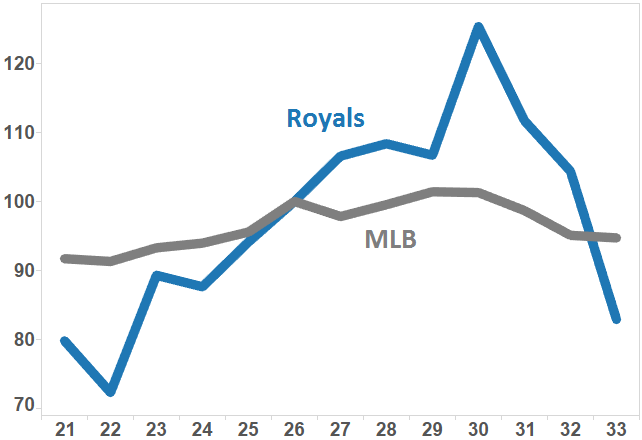
To create an aging curve, I measured the difference in wRC+ between consecutive seasons in which players had at least 300 PA. Then, I made every season relative to the performance at age 26, because that appears to be the first year of plateauing for the whole MLB. (Note: The results are not identical to Zimmerman’s).

From 2007-2015, with Age 26 being normalized to 100, here is what we get:

Aging Curve

Royals players dramatically improve from their early 20’s all the way until they turn 30. While the sample size is not huge, the consist improvement is remarkable. Kansas City’s players show greater improvement than MLB average at age 25, 26, 27, 28, and 30. This feat is doubly difficult when you consider that a lucky season at age 27 should naturally show a decline at age 28.

Dayton Moore and the Royals organization are rightly being showered with praise after their second consecutive World Series appearance and their seemingly invincible run through the 2015 playoffs. But their formula of success is not a frozen-in-time snapshot of the 2015 team. Player production in one year does not define the strengths of the Royals organization. Rather, the possibility that it could be even better next year does.


Help With the Physics Behind PITCHf/x

I’ve been digging into the PITCHf/x data over the past few weeks and stumbled across something I can’t quite figure out. When I first started using the data, I didn’t realize that px and pz were where PITCHf/x is mapping the final location of the ball; undeterred I set out to Google to jog my memory on the basics physics formulae that can map time using initial velocity, final velocity, distance and constant acceleration.

Step 1 was to calculate final velocity for every pitch from -50 feet to 0 feet. This was a simple formula that is SQRT(vy0^2-2*50*ay). Initial velocity squared less acceleration * yo2 * distance. Based on y0 being 50 feet from home plate.

Step 2 was to calculate time based on initial velocity and final velocity. I cross-checked my numbers to using the Start_Speed and End_Speed (which don’t match up to to vy0 for some reason) and got basically the same number.

Step 3 was to calculate xFinal based on Time, ax and x0 (ditto for zFinal). Strangely, my zFinal was a little lower (about .17 feet) than the PITCHf/x pz value and .015 more to the right than the px value. That might mean that they are measuring z and x 50 feet from release point, rather than at home plate.

I need to know if (a) my math is wrong (b) pz and px are wrong (c) ax and az are wrong.

Any help would be appreciated!


Meant to Be? The Rockies and the 3-3-3 Rotation

Since the Rockies have started playing baseball in Colorado, they’ve continually run into the same problem: pitching. We’re all familiar with the situation — the altitude and thin air create a hitter’s haven and a nightmare for pitchers, particularly starting pitchers. The Rockies have tried to remedy the situation in the past by bringing in top-tier starting pitchers, only to have them struggle. In 2012 and ’13 they tried a four-man rotation with a 75-pitch limit which led to a 64-98 record and a 5.22 team ERA. 2013 was a bit more successful, as they finished with a 74-88 record and a 4.44 team ERA. Still it wasn’t good enough to contend for a playoff spot and definitely not good enough to compete for a World Series title. In fact, in 2007 when the Rockies had their only World Series appearance, they carried a team ERA of 4.32. Only four teams since 2007, including the Rockies, have had a team ERA of over 4.00 and made it to the Fall Classic. The others were the 2009 New York Yankees and Philadelphia Phillies and the 2010 Texas Rangers. As the Mets and Royals have shown us this year, quality starting and relief pitching can take you pretty far in this game. My question is, with all the different strategies the Rockies have tried, what can they do differently to compete?

My suggestion is a slight tweak on an idea that Dave Fleming wrote about in 2009 called the 3-3-3 Rotation. In his article he describes the 3-3-3 Rotation as three pitchers, pitching three innings, every third day with a pitch limit of 40-60 pitches. By having a pitcher essentially go through the order one time, it allows them to give it all they have for a short time instead of conserving their energy for the later innings. In theory, this makes sense. Look at the Royals the past few years; they’ve turned a number of former starting pitchers into relievers and most, if not all have found success in their new roles. In his first year as a starter in 2008, Luke Hochevar had an opponents batting average of .243/.289/.319 the 1st, 2nd and 3rd time through the order. His last year as a starter in 2012 was a little bit better with a .288/.263/.294 BAA but his best season in the majors came as a reliever in 2013 when he held opponents to a .169 BAA.

This may hit a little too close to home for Rockies fans but last year Franklin Morales as a starter for Colorado had a split of .300/.337/.220; in his first year with the Royals out of the pen he held opponents to a .246 BAA. Staying with the Kansas City bullpen, we can look at Wade Davis, who actually had declining BAA numbers in his last year as a starter — .280/.251/.236 — but still posted a solid .151 BAA in his first season in relief. Andrew Miller had a split of .336/.261/.300 in his last year as a starter in 2011; his first year as a reliever in 2012 was significantly better with a .194 BAA. Zach Britton is a similar case with a .272/.266/.293 BAA split in his last year as a starter in 2011 and a .180 BAA in 2012 as a bullpen piece. The point is, generally speaking, when a major-league hitter has a chance to see a pitcher three times in one game, the advantage shifts to the hitter, and if a pitcher with quality stuff can face the order once, the advantage goes to the pitcher. This point is even more important for the Rockies who can’t afford to give their opponents any more advantages when playing in Colorado.

The Rockies have always struggled to attract top-tier starting pitching, since no one really wants to inflate their numbers by pitching half of their games at Coors Field. Colorado has tried to draft and develop power arms who rely on strikeouts and ground balls more so than fly-ball pitchers but still the results are the same ;; a sub-.500 team with an ERA over 5.00, which is not a recipe for success. The average major-league team has five starting pitchers and carries seven relievers in their bullpen. My tweak on Dave Fleming’s 3-3-3 rotation would be to split the 12 pitchers into four groups of three, all with a pitch count of 40-60 depending on effectiveness. In a perfect world every pitcher would go through the order once, throwing anywhere from 30-60 pitches and then turning the ball over to the next guy up who would hopefully do the same thing.

But we don’t live in a perfect world so by having four groups of three, each pitcher could be shifted around depending on the amount of pitches thrown in a week, meaning an effective pitcher could pitch as much as three to four times a week. The average starting pitcher in the majors pitches once maybe twice a week, each time throwing anywhere between 70-120+ pitches depending on the outing; by splitting up that workload they could see action three to four times a week. The average reliever definitely pitches less innings, around 70-80, and in turn throws less pitches but many major-league relievers spent time in the minors as starters, throwing 100+ innings a season. The workload is definitely something to monitor but in 2015 the Rockies used 29 different pitchers. The average amount of innings that a team played was 1,447, and the Rockies staff as a whole pitched 1,426.1 innings. So between the 29 different pitchers, you could keep arms fresh and put pitchers in a position to succeed.

Which brings me to my next point — putting pitchers in a position to succeed. When an offense has a strong 3 and 4 hitter, a manager may put a young player in the 2nd spot instead of lower in the order to ensure that the young player will see strikes. A pitcher never wants to walk someone in front of a player who can crush it out of the park. This leads to more balls seen in the strike zone, hopefully leading towards a positive result, Josh Donaldson is a great example of that this year. Joe Maddon has also implemented a strategy to set young Addison Russell up for success by having him bat 9th after the pitcher instead of 8th before the pitcher. The logic is the same — Russell will see more strikes because opposing pitchers don’t want to walk him and turn the lineup over to their heavy hitters.

I believe the 3-3-3 rotation does this for pitchers, especially pitchers in Colorado. The Rockies had a collective split of .298/.339/.351 the 1st, 2nd and 3rd time through the order in 2015. By having their pitchers face the opposing lineup once, it allows them to display all of the pitches right away. Instead of establishing your A and B pitches the first time through the order and showing your C and possibly D pitches through the second and third time, a pitcher can show all of them through the first three innings. This creates confusion for the hitters and also forces them to be more aggressive at the plate early, something that can be taken advantage of if properly executed. It’s also worth mentioning that some of the best offenses in the game do a tremendous job of communicating with their teammates about the pitcher and the pitches they’re seeing. Remember, the more familiar the pitcher is to the batter, the more advantage the batter has. If you can remove that advantage from the opposing offense, it further sets your pitching staff up for success. Opposing teams would have to have different game plans for each pitcher they see, and those quick adjustments aren’t the easiest to make throughout a 162-game season.

All in all it’s an experiment and besides Tony LaRussa trying something similar for a week in 1993, there hasn’t been another team to try this method. For many teams, the classic five-man rotation works and who am I to say they’re wrong but the Rockies have never really been able to figure it out and if any team is in a position to give it a shot, I believe it’s them.


An Ode to The Dude

Lucas Duda.  The Dude.  The Big Lebowski.  If there is one player on the Mets who would be most deserving of the title of “Most Underrated” it would be Lucas Duda.  I arrived at this conclusion based on my own subjective, and fallible, perception of the casual baseball fan’s perception about Lucas Duda; which I would assume would be somewhere in the vicinity of none.  Some of his relative underratedness may stem from the fact that he was relatively “streaky” during the course of this regular season, which is an inherent trait of a player who produces a large amount of his value by way of the home run.  Also, after Duda had eight straight hits go for home runs during the course of a seven-game stretch in late July, Yoenis Cespedes caught the eyes of the national media from basically the moment he was traded to New York.  That being said, I think Mr. Duda deserves a little recognition for his solid year, especially since he looms as an important figure in the active World Series.

On the surface Duda has almost exactly replicated his breakout 2014 in 2015.  For reference, this table of arbitrary statistics:

Statistic 2014 2015
WAR 3.2 3.1
wRC+ 136 133
BABIP 0.283 0.285
ISO 0.228 0.242

His overall value has remained almost exactly the same over the past two years as he has churned out two straight 3-win seasons.  His walk rate and strikeout percentage have been fairly stable as well, as has his various swing rates.  In this regard Lucas has been remarkably consistent.

However, there is one portion of Duda’s underlying statistics that differed significantly from this year to the rest of his career.  Duda pulled the ball less, and went to opposite field more.  Here is another table to illustrate this fact:

Year Pull% Cent% Oppo%
2012 44.0% 34.2% 21.8%
2013 45.9% 31.7% 22.5%
2014 44.1% 34.7% 21.1%
2015 39.0% 33.9% 27.1%
Career 43.2% 33.8% 23.1%

* The table starts in 2012 simply because the prior years don’t really provide any additional insight


And here are the batted-ball maps for 2o14 and 2015 to further illustrate Duda’s change in approach:

duda2014

duda2015

It looks as though Duda has tried to make himself a more balanced hitter, and decrease the amount of shifts he faces, as he has made an obvious attempt to go the other way more often this year.  This didn’t result in any additional offensive value this year – as we saw in the first table his overall value stayed steady – as we didn’t even see an increase in BABIP.  Regardless, this seems to be a trend worth keeping an eye on, and worth remembering during the World Series.

In specific regard to the World Series, Duda has a relatively significant platoon split; Career 91 wRC+ vs LHP, 136 wRC+ vs RHP.  With the Kansas City Royals featuring right-handers Yordano Ventura, Edinson Volquez, Johnny Cueto, Chris Young, Wade Davis, Ryan Madson, and Kelvin Herrera, among others, Duda looks to occupy an important role during the series.  With all of Kansas City’s probable starters being right-handed Duda should start every game, and it doesn’t seem like he will be pinch-hit for too often with Kansas City’s three best relievers being right-handed as well.

Lucas Duda; chronically underrated, and under-spoken, might just be the Mets’ most pivotal player during this World Series.  Or not.  Probably not, there are a lot of players on a baseball team, but he will assuredly be a pivotal player.  The Dude Abides.


Jacob’s Ladder: Arrieta’s Atypical Ascent

Let’s look at two pitchers:

________           ERA       ERA+      FIP     K/9     BB/9     HR/9

Jake Arrieta      1.77         222         2.35     9.3       1.9         0.4

Pitcher X               5.23          80         4.75     6.9       4.0         1.2

Pitcher X is not Jake’s long lost brother, but is in fact Jake Arrieta – those are his cumulative stats from 2010-2013, his first four years in the majors. And that’s not a small sample size; Arrieta accumulated 409 innings in his first four years. The top line is from 2015, a season which has put Arrieta within shouting distance of a Cy Young award.

No other pitcher has had a surge like this after floundering so badly for his first four years, but even before 2015, Arrieta was traveling through a baseball landscape witnessed by very few humans. Just 26 pitchers in major-league history have amassed over 400 innings in their first four years and “achieved” an ERA+ of 80 or worse. The list is here. It’s most notable for its lack of notability — an array of names of you haven’t heard of, interspersed with a few modern guys who, for the most part, failed to make an impact.

The other notable thing about the list is how short it is; most teams will have given up on a pitcher this consistently bad long before he’s eaten 400 innings of paychecks. Beside Arrieta, just two of the 26 had successful major-league careers as starters: Bullet Joe Bush and Camilo Pascual. None of them ever came close to Arrieta’s 222 ERA + in 2015; in this respect, Arrieta walks (or rather suppresses walks) alone.

Arrieta came up in 2010 to participate in two 90-loss Orioles seasons, but the Birds were taking flight, and in 2012 they would win 93, before slipping to 85 wins in 2013. These were good teams, patched together with Dan Duquette’s yard-sale bargains and Buck Showalter’s newly humanized intensity.

Arrieta had a quiet breakthrough in 2012, his third year with the Orioles, when his K/9 spiked at 8.7, while his BB/9 plunged from over 4 down to 2.7. These front-line starter numbers were buried by his 6.20 ERA, which in turn stemmed in part from a high homer rate (1.3/9). The Orioles understood that beneath the ERA there was progress, and did not trade him.

In 2013, Arrieta gave most of his gains back. The strikeouts remained, but he began walking the house. Even FIP began to have doubts, and on June 17 they shipped him to the Cubs (along with Pedro Strop, now a competent set-up man) in exchange for backup catcher Steve Clevenger and 90 mediocre innings from Scott Feldman. It looks like a disastrous trade now, but at the time it seemed suicidal for a contender to hand Arrieta the ball every fifth day.

Perhaps the Orioles’ inflexible approach to pitching mechanics impeded Arrieta’s development. Perhaps he developed a new pitch, or refined an old one. Maybe he needed a change of scenery. Whatever the case, Arrieta didn’t become Jake Arrieta with the Cubs right away. He brought the walks and homers with him in his carry-on luggage when he touched down in Chicago in late June. His strikeout rate actually dropped. But perhaps most importantly, his WHIP plunged, from over 1.7 with the Orioles in 2013 to just over 1.1 with the Cubs. Both rates were BABIP driven: in Baltimore, .343, in Chicago, an equally unsustainable .190. But Arrieta took advantage of his luck, using the emotional breathing space the sudden drop in traffic provided to focus on developing his devastating sinkerslidercutterwhatever. In this case the change of scenery provided an immediate and positive, if accidental, dividend. Arrieta’s BABIP has since returned to a normal neighborhood: .274 in 2014 and .246 in 2015. (His success this year was only partially BABIP-fueled, a fact that should the scare the pine tar off the bats of NL Central hitters.)

Although no one on the List of 26 is really a comp for Arrieta, Pascual probably comes closest, thanks to his dominating stuff. Featuring a knee-buckling curve, Pascual achieved strikeout rates that wouldn’t look at all out of place in today’s game. From 1958-1964, Pascual K/9 never fell below 7; this in an era when league strikeout rates were typically in the 5s. Wildness and gopheritis plagued Pascual in his early years, but he became a rotation mainstay for the Senators in ’58, and stuck with the franchise until 1966, a year after the now-Twins went to the Series.

Pascual had a quiet breakthrough in 1956, his third year with the Senators. His strikeout rate spiked at 7.7/9, while the walk rate dropped to a (still high) 4.2. Victimized by a ghastly 33 homers, his ERA was awful, but there were signs of promise. In 1957 it all went backwards. His ERA peaked at an eye-watering 6.11 on May 4, and after ebbing somewhat, reached another appalling summit at 5.49 on June 22, about the same time in the season that Arrieta’s career ended in Baltimore.

But the Senators did not blink. It was around this time, in the sweltering 1957 summer, that Camilo Pascual became Camilo Pascual. The strikeouts came back, the homers did not. He finished with a respectable 4.10 ERA, a figure he would easily beat for the next 8 years.

Pascual was only 23 during his Crossroads Year; Arrieta was 27, a much easier age for a team to give up on a player. Arrieta has Scott Boras as his agent; Pascual had the reserve clause as his ankle bracelet. Perhaps most importantly, the 1957 Senators were simply abominable. They would lose 99 games (out of 154!) in 1957, and indeed would exceed 90 losses during every season from 1955-1959.

In 2013, the Orioles couldn’t risk nine more Jake Arrieta starts if they hoped to contend; In 1957, the Senators wouldn’t contend until 1962, by which time they had moved to a different time zone. The 2013 Orioles’ team success produced a roster assembly failure, while the 1957 Senators’ team failure produced a roster assembly success.

Pascual was very good for several years. Arrieta has been outstanding for two. His FIP has been very consistent in his two full years with the Cubs: 2.26 in 2014, and actually slightly higher (2.35) in 2015.  Arrieta’s remarkable climb has reached the top rung; it remains to be seen how long he can stay there.