Archive for Player Analysis

Adam Jones’ Regression At The Plate

I don’t think it’d be a stretch to say that Adam Jones has been a big disappointment at the plate so far in 2010. He came into Saturday’s game batting just .254/.283/.384, and instead of taking a step forward from his .277/.335/.457 line in 2009 he’s taken a step (or two) back. What might be going on?

It’s not exactly news to say that Adam’s not the most disciplined hitter, but that’s actually gotten worse this year:

Year Swing % O-Swing % Z-Swing % In Zone Swing %
2008 53.5% 36.2% 69.1% 68.0%
2009 53.7% 35.3% 73.2% 66.0%
2010 52.5% 40.1% 65.2% 61.3%

Jones is swinging about as often he has in recent years, though that’s still a much higher mark than your average batter. He is chasing pitches out of the strike-zone more than he used to, and even the mid 30s rates were high. He started out last season getting that rate down a little, but his slump coincided in part with starting to chase balls close to that 40% rate he’s continued into this season. Adam’s swing at strikes less though, which means the percent of pitches that he swings at that are better to hit – in the zone (the last column) – has gone down. For the average batter, somewhere around 70% of the pitches they swing at are in the strike-zone. For Jones this year, that’s down to just 61%. So even if he’s going to be making contact – which he isn’t exactly great at anyway – it’s not going to be on as good of a pitch to hit.

Now, one might think that Jones is chasing more balls because pitches are throwing him a bunch of sliders and curveballs out of the zone. I think we all have that mental image of Adam waving at a slider down and away. That’s not exactly the case though:

Year Fastball% Change-up% Slider% Curveball%
2008 58.5% 7.6% 18.8% 12.7%
2009 62.3% 9.9% 17.6% 10.1%
2010 63.1% 10.1% 13.5% 8.0%

In his first full season pitchers tried to get him to chase, but now they seem to be challenging him more. I don’t think that’s a good sign. How often does he swing at each pitch?

Year Fastball S% Change-up S% Slider S% Curveball S%
2008 51.0% 62.0% 57.9% 48.5%
2009 52.0% 57.4% 59.9% 50.5%
2010 51.5% 52.2% 60.7% 45.6%

Very consistent on the heaters each season. He’s taking more change-ups and – in 2010 at least – curveballs as well. That slider continues to be his nemesis, as even though he’s seeing fewer of them he is swinging more often at the ones he does see. The percent of total pitches that Adam has thrown to him that fall into the “swinging at a slider” group has fallen though, from over 10% in ‘08 and ‘09 to about 7.4% in ‘10. Even when you add in the fact that his contact rate against the pitch has gotten worse, the percent of all pitches that end up as sliders that have been swung on and missed has gone down.

Breaking out the pitch types by in the zone versus out of the zone was inexact, but it looks like a much higher percentage of the fastballs thrown to Jones are in the strike-zone while a much lower percent of sliders and (especially) change-ups.

So summarizing the best I can by pitch type:

Fastball: Seeing more of them, principally in the strike-zone; swinging at them as much as he used to, and also making contact more often when he swings.

Change-up: Seeing more of them, and more of them out of the zone; swinging at them less, but making less contact when he does swing.

Slider: Seeing a lot less of them, but more frequently out of the zone; still chasing a lot, with slightly higher whiff rate.

Curveball: Seeing less of them, with about the same frequency in the zone; chasing it less, and still whiffing a whole lot on it.

It looks to me like Adam is taking pitches early in the count a little more often – getting fastballs in the zone to fall behind (he went to an 0-1 count over 55% of the time, and was getting a first-pitch fastball much more often – almost 70% of the time – which explains more than the entire increase in fastball usage overall) – and then chasing pitches out of the zone later in the count. He’s maybe trying to work the count, but doesn’t have the pitch recognition or the ability to tell a ball from a strike that’s needed to carry through on it.

Jones is striking out more and walking much less this year, and given his swing rates, those marks (~3% and ~21% respectively) aren’t out of line. If that doesn’t change – especially the first number – then it’s going to be very hard for him to be even an average hitter. ZiPS still thinks it’ll get better though, projecting a line from here to the rest of the season of .273/.327/.461. I don’t want to overreact to 40 games, but it certainly is concerning (and swing rates are the first things to stabilize). Also – it should be noted – it wouldn’t matter so much if Jones was playing plus defense in center.

Article originally posted at Camden Crazies.

Is Delmon Young About to Break Out?

Delmon Young, a former #1 pick in the ’03 draft, is viewed as failed prospect, but might he be ready to live up to some of that hype that once surrounded him? Perhaps.

His walk rate was 5.6% in ’08 and 2.9% in ’09. This season it has jumped up to 8%. Just in terms of raw numbers, Young has 10 walks this season in 112 at-bats. He had 12 in 395 at-bats all of last season. With the walks have come a decrease in strikeouts. Young posted an 18.3% strikeout rate in ’08 and a 23.3% in ’09. This season, however, he has cut that ’09 strikeout rate in half almost, with a 12.5% strikeout rate.

In terms of power, Young is also starting to find his stride. His isolated power is .188, a career high, this season. That places him in front of Carlos Pena and Kendry Morales and just behind Austin Kearns and Carl Crawford in the category. If you’re just looking at home runs, he’s hit 4 this season. That’s not too amazing, but the most he’s ever hit in one season is 13, so he could be in for a career year. His .438 slugging percentage is also a career high. His previous high was .425 in ’09.

What’s hurting Young right now is a .247 BABIP, which is helping drive his .250 batting average. In ’07, ’08, and ’09 he posted a .338 BABIP and his career BABIP, over almost 2,000 at-bats, is .334, so we have a decent idea of what his BABIP could rebound to. Once Young, a career .288 hitter, sees his BABIP rebound, he could see his some of his progress start to pay off.

We also have to keep in mind that Young was drafted straight out of high school. He’s 24 years old now; if he had gone to college for three years and then gone to the minors, we might just now be seeing his first year at the major league level, not his fourth. Either way, Young may be primed for a breakout season.


Have the Tigers Ruined Rick Porcello?

Coming out of Seton Hall Prep in 2007, Rick Porcello was an ace in the making.  When scouts combined his age, velocity, and dominance (103Ks in 63 IP as a Senior); they saw a front-of-the-line major league starter. After being draft 27th overall, Detroit wasted no time showcasing their young ace. In order to ensure Porcello developed his other pitches, the Tigers insisted that Porcello stop relying on his curve. With his new approach, Porcello only managed 5.18 K/9 in his brief stint in the minor leagues.  Two seasons later, the strikeouts and the curveball have almost disappeared completely. While it’s still extremely early in his career, is it possible that the Tigers may have ruined Rick Porcello?

Here’s what Keith Law wrote about Porcello in 2009:

He doesn’t miss a lot of bats with the new approach, but generating ground balls keeps the pitch count down, and pitchers who throw strikes and don’t give up home runs can be very successful. But bear in mind that Porcello has the raw stuff to be more of a strikeout pitcher, and when he reaches the majors, he could blend the two approaches and be one of the top pitchers in the game.

That last sentence sums up the main cause for concern with Porcello. While scouts believe Porcello has the ability to dominate, his K/9 rate in the majors is a dismal 4.70. Even more disturbing is Porcello’s disappearing curveball. After throwing his curve 8.1% of the time in 2009, Porcello is only throwing his curveball .2% of the time in 2010.  Unless Detroit is still enforcing the “no-curve rules,” it might be time to start worrying whether his approach has been permanently impacted. It is interesting that the curve was Porcello’s worst pitch in 2009 according to the pitch type values. His reluctance to throw it in 2010, could mean that he has lost confidence in the pitch. The big question is, whether Porcello can be an ace without his curve?

Then again, Porcello is still only 21 years old and has already experienced success in the majors. It’s certainly possible that a) the Tigers are still enforcing the “no-curve rules,” or b) Porcello continues to develop into an ace while in the majors. Porcello did not spend a lot of time in the minors, and he is exceptionally young for his level. Typically, only the most promising players reach the majors at Porcello’s age. However, it is disturbing that his current approach has not produced “ace” results. Just for reference, Mark Buehrle has a higher career K/9 rate than Porcello’s current K/9. As Keith Law stated in his 2009 top prospect list, pitchers that get ground balls and prevent home runs have a lot of value, but Porcello was drafted as an ace and not an innings-eater. Yes, it’s still incredibly early in his career, but there is already some evidence to suggest Detroit may have mishandled their prized pitcher.

*This article was originally written on Foulpole2Foulpole.com


David Wright Is Not Getting Much Help From Jobu

We are a quarter of the way through the 2010 season and David Wright has appeared to put the ghosts of 2009 behind him.  After hitting only 10 HR all of last year, he has already hit 8 this year, helping him to post a wOBA just over .390 through the early part of the season. None of this is really surprising (his career wOBA sits at .392) and it appears to be business as usual for the talented third basemen.  The catch is that he has been able to post these numbers while striking out an alarming rate. 

As of this post, he was the unfortunate owner of a 38% strikeout rate, 2nd overall to Kyle Blanks and 6.7% higher than the next closest hitter with a wOBA over .390.  So what is causing this jump in strikeouts?  His strikeout rates spiked last year as well, but they are starting to spiral out of control this year.  A quick look at his numbers offers two possible solutions. First, though his Zone Swing/Contact rates appear normal, his O-Swing% has jumped up 4.5% while his O-Contact% has fallen 9.5%.  Swinging at more pitches outside the zone and making less contact is a quick and easy recipe for disaster. The second cause for concern can be seen in his pitch type linear weights.  He is mashing fastballs at a career high rate (wFB/C of 3.19), but this comes at the cost of looking downright foolish against the curveball (wCB/C of -2.01) and sliders (wSL/C of -2.58).  Apparently, opposing pitchers have noticed this weakness in David’s approach and have reacted accordingly, offering him 4.4% more sliders/curveballs and 8.4% less fastballs than last year.

Another (albeit small) contributing factor might be related to his platoon splits. David sports a career L/R split of .439/.370 for wOBA and 14.4%/22.9% K-rate. The wOBA has been even more extreme this year (.608/.339 andthe strikeouts have jumped to 19.2%/42.3%. This is even more troubling as Wright has so far faced even more RHP than usual. This year he has faced RHP 80% of the time, up 78% in 2009 and 74% in 2004-2008.  His platoon splits are well known, and he is presumably facing more RHP later in games. This decision was easier for opposing coaches last year, as he no longer had the left handed power of Delgado (or any power, really) batting behind him.  With the only lefties in the lineup being the unproven Chris Carter and Ike Davis, David will contine to face a lot of right-handed relievers.

The extra appearances against RHP does not explain why his strikeout rate against them has doubled though. It is early in the season, so it could just be bad luck on his part, and his strikeouts should regress towards his career line of 20.8%, or at least his line of 26.2% last year. Even if they don’t, he will remain a premier 3B if he can maintain his power, walk rates, and high BABIP.  Still, if David wants to approach his MVP caliber numbers of 2007, he should take strides to lay off pitches outside the zone and adjust better to the breaking balls.


Is Something Wrong With Ryan Rowland-Smith?

Entering the 2010 season, the Mariners starting pitching was a question mark. After Cliff Lee was sidelined early in Spring Training with an abdominal strain, the bottom half of the rotation came under further scrutiny. As the Mariners evaluated questionable candidates for the bottom half of the rotation, fans and the front office could at least rest easy thatFelix Hernandez and Ryan Rowland-Smith were healthy and prepared to start. 

What a difference forty days can make. Doug Fister and Jason Vargas have been among the few pleasant surprises in Seattle this season, while RRS has seemingly lost the confidence of the coaching staff. Last night, RRS gave up two more long balls and he was removed in the bottom of the third inning. It was his second start in a row he did not record an out in the third inning. 

It isn’t difficult to see that Rowland-Smith has been struggling. He hasn’t pitched into the seventh inning since April 17th, and hasn’t made it to the sixth in three starts. He’s allowed ten home runs in thirty-nine innings while walking more men than he’s struck out (17-16.) All of this leads to a gruesome 7.15 FIP and a troublesome 5.91 xFIP. Furthermore, 25% of balls put in play against Rowland-Smith have been line drives, leading to a9.10 tRA

He’s also having a problem generating swinging strikes. It isn’t that he is having control issues; he’s throwing strikes at virtually the same percentage this year as he was last season. His problem is generating swinging strikes, particularly on pitches out of the strike zone. Last year, hitters made contact on 69.3% of pitches they swung at outside of the strike zone. This year, that number has climbed all the way to 78%. This would explain his inability to strike people out, as he can’t lure batters to swing at good pitches out of the zone. 

Considering the high xFIP, tRA, and contact rate on balls outside of the strike zone, one has to wonder if there is some hidden problem in his game. My best guess would be that something is wrong with his fastball. Last year his heater was 4.4 runs above average. This season, his fastball has been worth -6.6 runs below an average offering. Let’s look a little deeper.

In 2009, Rowland-Smith worked almost exclusively with a four seam fastball (when throwing fastballs of course.) This year, all of his fastballs have been two-seamers. Perhaps the adjustment from four-seamers to two-seamers has been part of the problem. Though his fastball velocity down only a tick, hitters are really teeing off against it. 

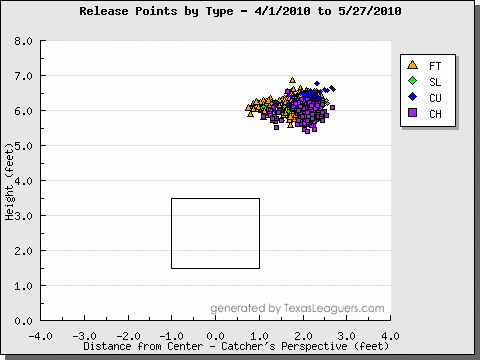
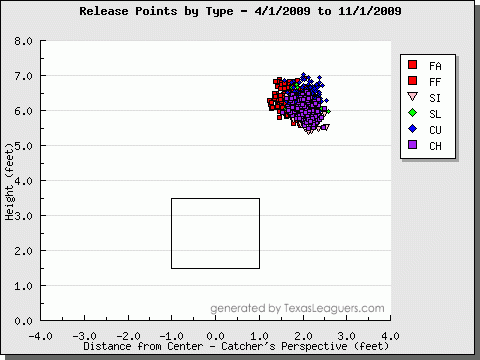
I’ve pored through his pitch F/x data, looking for some differences between his pitches this year and last year. The most striking difference between the two years I can find is his struggle to find a consistent release point this year. Take a look at the difference between 2010 and last season. (Pitch f/x data is courtesy of Texas Leaguers.)

RRS has particularly had trouble with consistently releasing his two seam fastball. I’m not sure if an inconsistent release point is responsible for his struggles this year, but this is something to monitor over his next couple of outings. He’s releasing his two-seamer closer to the strike zone than the other two pitches, which could explain why hitters, and lefties in particular, are seeing the ball better than they did last year. His two-seamer doesn’t have much movement, and perhaps the lack of movement, slightly reduced velocity, and limited horizontal movement have turned his heater into a poor pitch. 

I can’t be sure that RRS’s release point issues are the cause of his poor performance to date in 2010. At the same time, I would like to see him become more consistent with his release point. If he corrects that flaw and is still struggling, we can re-examine his case. Until then, I’m assuming that he’s releasing his fast-ball on a more over the top plane than his other pitches, and that is either causing it to break less or is tipping off hitters.


Nick Markakis’ Lack Of Power

Nick Markakis has just two home runs thus far this season, and is on pace to hit just 9 on the year. I think it’s relatively clear now that Nick isn’t really a power hitter – he’ll get his share of homers but is more of a doubles hitter who is content taking outside pitches to left-field. “His share” though, has been quite low in 2010. I’m not saying I’m worried yet – the season is long and the ZiPS updated projections still has him finishing with 17 homers (only one less than last year) – but it is a bit curious.

One of the more obvious aspects of home run hitting is that it’s much easier when you pull the ball. Here’s a nice graph from an article by Mike Fast at The Hardball Times:

So where is Nick hitting the ball? Here’s all balls in play by year and field:

LF CF RF
2006 31.4% 34.0% 34.7%
2007 33.6% 38.0% 28.4%
2008 29.4% 36.4% 34.2%
2009 32.3% 32.1% 35.6%
2010 31.6% 46.2% 22.2%

He’s always been a guy who uses the whole field, but so far this year he’s not turning on as many pitches. And just the flyballs:

LF CF RF
2006 46.0% 34.7% 19.4%
2007 46.7% 35.7% 17.6%
2008 47.2% 37.7% 15.1%
2009 41.8% 33.3% 24.9%
2010 37.5% 50.0% 12.5%

Last year Nick hit a much higher proportion of flyballs to right-field, which helps explain why almost all of his home runs (14 of 18) were to right. This year, not only is Markakis not pulling flyballs but he’s also not hitting as many to the opposite field. Center-field is the deepest part of any park, and a full half of Nick’s flyballs are going out there. No wonder they’re not finding seats.

I’m not really sure why that’s happening – likely mostly normal variation – but Nick is getting a lot more fastballs and he’s done a pretty terrible job of getting around on that the pitch so far.

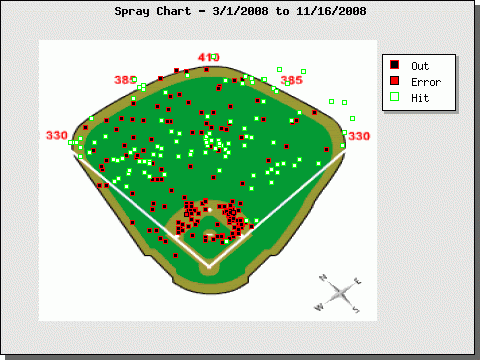
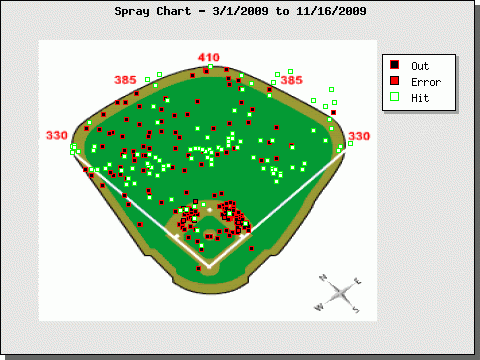
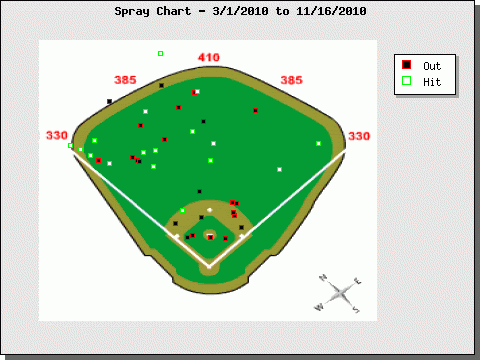
Compare these three spray charts on fastballs going back the last three years (courtesy of Texas Leaguers):

2008:

2009:

2010:

Right-field on that last one is pretty barren. I thought that maybe Nick hasn’t been able to catch up to a good fastball, but his contact rate against heaters at 94 mph or above has actually gone up the last three years; from 71% to 85% to 93%. Perhaps he’s more content to just make contact than to try to drive the ball. The spray charts for all pitches tell a similar tail; not all that many balls being driven to the “warning track”, or to right-field.

Nick’s 5% HR/FB rate is well below his career mark of 10.6%, as well as last year’s career low of 8.6%. I’m not might sure exactly how much we can expect that rate to go up this season, but I do think it’s clear that if Markakis doesn’t start pulling the ball in the air at least a little more often his power numbers won’t be particularly impressive at the end of the year.